Rochester Institute of Technology
RIT Scholar Works
Theses Thesis/Dissertation Collections
12-1-2012
Breaking free
Fatemah AlazmiFollow this and additional works at:http://scholarworks.rit.edu/theses
This Thesis is brought to you for free and open access by the Thesis/Dissertation Collections at RIT Scholar Works. It has been accepted for inclusion in Theses by an authorized administrator of RIT Scholar Works. For more information, please [email protected].
Recommended Citation
I
ROCHESTER INSTITUTE OF TECHNOLOGY
A Thesis Submitted to the Faculty of
The College of Imaging Arts and Sciences
School of Art
In the Candidacy for the Degree of
MASTER OF FINE ARTS
BREAKING FREE
by
Fatemah Alazmi
II Thesis Approval
Thesis Title: Breaking Free__________________________
Thesis Author: Fatemah Alazmi__________________________
Chief Advisor Thomas Lightfoot___________________________________ (Please type)
___ Thomas Lightfoot ______________________________________ (Signature)
Date:______________________________________________________________________
Associate Advisor Elizabeth Kronfield__________________________________________ (Please type)
_______Elizabeth Kronfield ___________________________________ (Signature)
Date:______________________________________________________________________
Associate Advisor Luvon Sheppard_____________________________________ (Please type)
__Luvon Sheppard ________________________________________ (Signature)
Date:_____________________________________________________________________
Department Chairperson Carole Woodlock_______________________________________ (Please type)
Carole Woodlock _______________________________________ (Signature)
III ABSTRACT
Written here is an account of my journey exploring and investigating a new artistic path.
I showcase the ways in which my visual production is unique both within the field of art but also
and more importantly is an imprint of my authorship and personality.
As an abstract expressionist painter interested in formalism, my artwork suggests a
universal language of color and form. Colors and distinctive shapes come to form a great energy
and dynamism. Through the effect of the process, whereby all these elements are combined, I
have attempted to transcend the norms of formalism and express the very nature of freedom
through the work of art. I also speak about the many motivations for my personal and artistic
transformation, looking at the ways in which my background and personality affect my overall
work. I chronicle some key changes in my stylistic transformation - one that is always of
progress and process. In effect, this research incorporates the challenges and determinant factors
IV
Table of Contents
Abstract...III
List of Illustrations...V
Life in Kuwait...1
My Background in Art...2
Traveling to the United States...2
Exploring New Ideas...3
Revolution
In My Explorations...4
Expand
Allure
Endeavor
Explosion
Breaking Free
Challenges and Lessons...8
A View of My Work...9
What is Freedom?
Bibliography…...11
Works Cited
Works Referenced
V
List of Illustrations
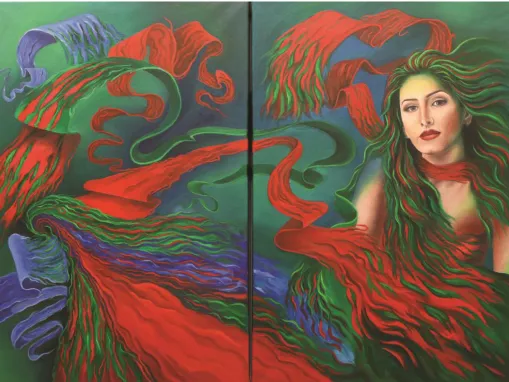
Fig. 1. Fatimah Alazmi, Revolution, 2011-2012. Canvas, 48 x 36. RIT Studio.
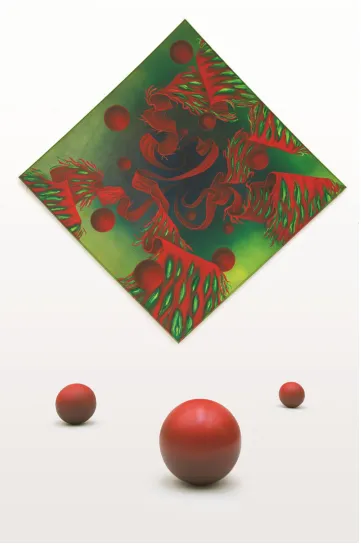
2. ---. Expand, 2012. Canvas, 100 x 100. RIT Studio.
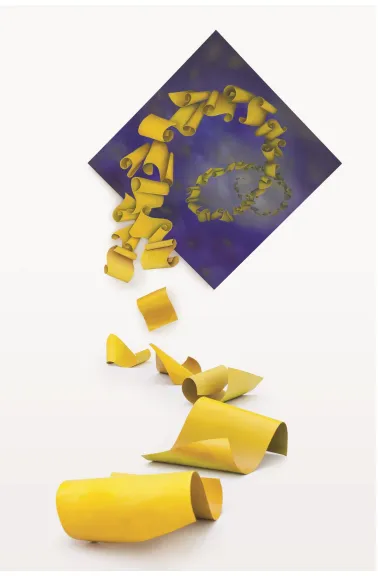
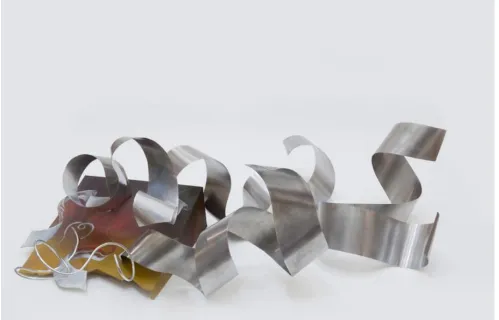
3. ---. Allure, 2012. Wood, 68 x 68. RIT Studio.
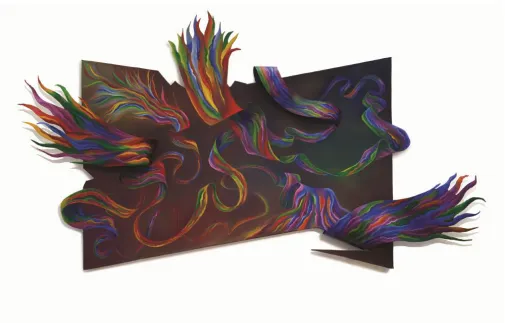
4. ---. Endeavor, 2012. Canvas, 105 x 60. RIT Studio.
5. ---. Explosion, 2012. Canvas, 83 x 70. RIT Studio.
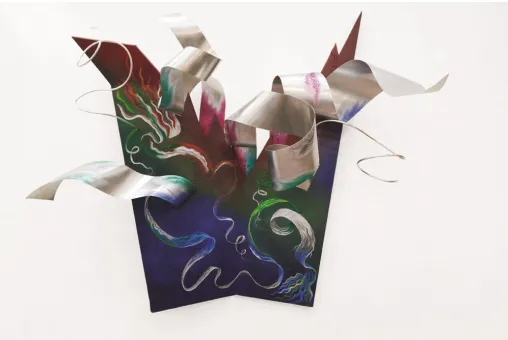
6. ---. Breaking Free, 2012. Canvas, 45 x 70 x 70. RIT Studio.
1
Breaking Free
By
Fatima Alazmi
Life in Kuwait
I was born in Kuwait, a majority Muslim country located in the Arabian Gulf. I am
proud that Kuwait is largely seen as the most Democratic of Gulf countries. Women in Kuwait
are treated as equal to men, distinguishing our cultural progressiveness from those around us.
Personally, I consider the women of Kuwait to be among the most emancipated in all Gulf
nations; achieving positions of power and influence. Despite this, Kuwaiti society is, by and
large, socially conservative primarily due to the strong religious base.
I was born in a family who followed more “classical” Arabian traditions. My normal
stance is one staunchly opposed to this perspective, an opinion that has obviously been
problematic my entire life. As a teenager, I could not understand some religious orders. To make
things worse, some strict Arabian traditions contradicted the leniency of Islamic Laws. I first
had objections to this paradox at a very young age. During this time, it was not easy to reject
these traditions. People around me started to see me as a rebel. That did not stop me from
believing in myself.
Art became my diary; a record of my thoughts and beliefs. Through this action I became
recognized as an active artist. In my work I used a narrative component and symbols to comment
about my life, freedom, and my objections to restrictions. I made sundry work in different media;
drawing, oil painting and sculpture. I participated in several local juried exhibitions and I won
prizes. Unfortunately my art was not welcome in my family or in the environment surrounding
me since it went against Islamic rule to draw living things such as (people or animals). I decided
to do what I believed in and I disregarded others’ objections.
Thus the title of this paper, “Breaking Free,” is the most appropriate phrase to use since it
extends itself thematically throughout the length of this paper. As I turn to largely discussing
2
realized artistic transformation. It is a breaking free from convention, artistic rights and
transformative art, politics, popular opinion and injustice.
My Background in Art
I have been interested in art since childhood. For me, art is a language. It translates
thoughts, words, and the immaterial as well – into drawing. I first pursued art as a hobby, but
quickly turned it into a profession. As a result of this journey, I have acquired many skills.
When I first began to work in art, it consisted mostly of “narrative” work that focused on my
personal life and feelings. I use symbolism in my art in order to attract people and reveal the
personal content.
In Kuwait, I was trained as a classical artist. Throughout my undergraduate studies at
Kuwait’s College of Art Education I studied many classical genres: painting, drawing, metal
work, ceramic and sculpture. I showed strong interest in painting and sculpture. Aside from
studio art, I also studied Art History, Art Critique, and Modern Art. In Kuwait, I found myself
interested in surrealism and romantic art. These schools allowed and encouraged me to create
my own style. My paintings are full of mystery and shocking visuals. My foremost desire as an
artist is to spread wonder and curiosity upon the viewer. As a result, my hope is that the
audience will engage with the painting on a deeper level. After graduating school in Kuwait, I
taught painting and drawing for five years in a high school. After this experience, I applied and
was accepted to attend Kuwait’s Art and Design Department at Kuwait University. I worked as
a Teaching Assistant (TA) and assisted in ‘survey’ courses and ‘studio’ courses. I worked
side-by-side with Kuwait and American Professors for the full Teaching Assistantship. This position
gave me a wealth of experience and encouraged me to continue my graduate work in the USA;
where I awaited learning about less traditional forms of art.
Traveling to the USA
During my first year as a graduate student, I experimented with many processes to find a
new style. Doing this increased my understanding of contemporary art. During my period as a
student in Art Since 1950, I witnessed and felt two distinct things come together: an increase in
my understanding of contemporary art, and the meaning behind the freedom of expressing
3
the work of Jackson Pollack. I copied and investigated one of Pollock’s central pieces. I approached my investigation with my body and its sensations. Pollock mentioned once “What was to go on the canvas was not a picture but an event … what matters always is the revelation contained in act”1
. Pollock taught me to be spontaneous and recognize what it truly means to
journey toward comprehending the work of art and that this just as important as the artwork
itself. This inspiration naturally changed my view of art and set about redefining my definition of
art and the artist.
Exploring New Ideas
Revolution
My determination to understand how art was changing for me during this process made
me no less susceptible to natural human fears; the fear of trying something new, the fear of using
new colors and forms, and of leaving behind my comfort zone of painting just narrative and
figurative art. In spite of these fears, I threw all caution to the wind and asked myself: how will
things begin and how will they end?
My first experimentation with abstract art was on stretched canvas and is titled
Revolution2. First, I painted the background with an atmospheric gradation of light to dark in
shades of greens and blues, giving the illusion of infinite space. I had applied this background
previously on surrealist paintings using atmospheric gradations in landscapes and seascapes. The
sky is important for me. It is a spiritual source as well implying infinity and mystery. I retained
this feature of spiritual space and mystery in my new work. After finishing the background, I began to express my feelings directly on the canvas. In the beginning, I used contrasting intense
colors because I wanted to show strong emotion and energy, so I chose light cadmium red with
greens and blues. I blended colors to look abstract on one side and to gradually look
representative of shapes on the other side. I created a shape that represents a ribbon moving in
dynamic directions in endless space. This ribbon was not meant to be symbolic; merely a line of
movement and energy.
1
Fineberg, Jonathan. 2011. Art Since 1940: Strategies of Being. Illinois: University of Illinois Press. (Fineberg 2011, 97)
2
4
I enjoyed the expression and movement of the first canvas, but required more room both
physically and aesthetically. Space became a major concern. On a similar sized canvas, I set up
a diptych that added considerably to my art by blending abstract expressionism with a
self-portrait. Revolution was a personal revolution. It is my figure, my story, and a beginning in a
new direction. The painting is also about my struggle to break old habits, get over myself and
move forward. Emotionally, this piece was liberating. I created my own unique shapes and had
the ability to choose alternative colors (mainly with figures). Inspired by Pollack’s spontaneous
movements (splashes and drips), distinct shapes and lines of ribbon were incorporated into my
painting to achieve a similar affect. My work incorporates a sense of movement, demonstrating
an object’s response to a given force.
In My Explorations
Expand
For this new project, I incorporated some of my prior techniques and forms but also
sought to explore new avenues. I took apart the diptych of my former piece, to construe scale. I
wanted to build a big canvas, engulfing the viewer in my emotions. Second, I eliminated the
“figure” as the subject. My goal was to create a direct connection between painting and viewer.3
I used the shapes of ribbons and spheres. The ribbons dynamically move from the very deep dark
center of the painting, expanding until they reach the edges. They appear to be coming toward
the viewer. Similarly, the spheres swim away from the center of the painting. The focus of this
painting was more centric. My artistic intention was for the painting to give off an illusion of
depth and infinite space. I wanted the objects to come from a mysterious place of endless space
and expand toward the viewer. I also wanted the painting to take the viewer inside this deep
space, to allow him or her to momentarily live through experience. Expand gives the viewer a
sense of expansion. When I finished the painting, I turned the canvas forty-five degrees, making
it diamond-like. I believe this was a success due to the inclusion of the diagonally shaped
twisted ribbons that emphasized movement and made the painting appear much larger. The
viewer’s perception of this relationship is one where the artwork surrounds them, and thus
fulfilling a goal of mine to create something more realistic that would come toward the viewers.
3
5
With that in mind, I expanded the artwork by placing real spheres on the ground in front
of the painting. The spheres were made of hollow steel, and varied in sizes. I painted them using
the same colors as in the painting. I emphasized the shades and light on the steel spheres. After I
finished, I arranged them in front the painting, laying them out from the smallest to the largest.
This arrangement automatically created a space around the viewer.
I found a common concept between my work and Frank Stella’s relief paintings with the difference in application. “Stella gave the image a sense of being real, by breaking through the
pictorial boundaries to coexist in our everyday space. He painted the metal reliefs to fuse the
piece with life in a physical pictorial presence”4. Stella’s expansiveness is still on the wall but in
my work I expanded the objects and liberated them as separate units on the floor. My concept
was to merge the space between them and the illusionistic space of the painting into one unit.
Allure
For Allure5, my third piece, I decided to change the lines of energy (represented by
ribbons) and replace them with a paper trail. Using yellow and purple, contrasting colors, I
added to my concept of energy. I created a trail of paper as a spiral design. From a deep infinite
space, the energy comes from the center of the painting, perhaps, as if wind blew the forms
towards the viewer. This trail of paper also continued to cross the boundary of the painting.
I made a small model of this piece using cardboard and water colors. The model was
helpful in giving me insight on how to approach it on a larger scale. I chose to paint on wood in
order to shape one of the boundary’s sides. This shape served as a continuation for the paper
trail. I chose one-inch thick wood because I wanted to screw metal representations of paper onto
it. For the three-dimensional objects I chose aluminum sheets of 0.8 thick; a light metal that is
easy to shape. I used a plasma cutter to cut the aluminum sheets. I shaped them using a metal
rolling machine. Some of this “metal” paper was to be attached onto the wood painting while
4
Rubin, William and Frank Stella. 2002. Frank Stella: 1970-1987. New York: MOMA Press.
(Rubin and Stella 2002, 73)
5
6
remaining partially flat. I also intended for the paper trail to increase in size as it continued from
the painting. I painted the aluminum surface similar to the two-dimensional objects to emphasize
and control the light on the real object, as well as assuring the same colors and brush strokes for
both.
I then screwed two aluminum papers onto the painting. I rotated the painting into a
diagonal position, like the previous painting. The twisted paper line then faced downwards. I
installed one of the aluminum papers on the wall, close to but not touching the painting. Then I
continued the trail onto the ground, one after the other, increasing in size going toward the
viewer. Similar to the previous painting, I created an inviting space for the audience to walk
around and through the artwork.
Allure was my first experiment in shaping my canvas. This work gave me a clear vision
for the direction I wanted to pursue. I was very excited to do more experiments in combining
painting with sculpture. This time, I wanted to shape my painting even more and break the
traditional rule of rectangular paintings.
Endeavor
Jackson Pollack inspired me to break free from traditional artistic styles; however, there
is also a great amount of similarity between my work and that of Frank Stella, specifically
artistic “dimensionality” and perceived space. Stella notes:
…with its inherent three-dimensional illusionism in constant tension
with its two-dimensional surfaces…Pictorial space is one in which
you have two-dimensional forms tricked out to give the appearance
of three-dimensional ones, so that the space you actually perceive
comes down somewhere in-between, and somewhere in-between
isn’t a bad analogy of my work6.
My ultimate intention was to blend sculpture and painting together. I wanted to extend
the two-dimensional illusionary elements by making them pop-out from the painting and
6
7
transforming them into three-dimensional objects. I tried to challenge the viewers’ perception in
order to explore the fine line between illusion and reality. To create this piece, I used plywood. It
is easy to shape and can support the weight of the objects added onto the surface.
For my new piece titled Endeavor7, I created flamboyant ribbons breaking free from the background. Some of the ribbons continued outside the boundary of the same flat surface as the
two-dimensional illusion. And for other ribbons, I made a slot through some areas of the canvas
weaving them through, creating a three-dimensional object.
These aluminum ribbons follow the same ribbon lines in the two-dimensional painting. I
painted the aluminum in the same vibrant colors in order to blend the sculpture with the painting.
I continued to use the aluminum sheets because of their flexible quality; to shape, cut, bend and
manipulate them. Also, I intended to deny the material itself. It was more important for me to
show the sculpture as a form rather than a material; therefore, I covered it with paint, not
allowing the aluminum to have a voice.
The results of this piece differed from previous works. My palette was busy with various
bold colors, and the shape of the canvas was much more interesting. The irregular contour
emphasized movement.
Endeavor is similar to the external contour and the motions of objects in Elizabeth
Murray’s paintings. “In Murray’s work everything is in flux; we are pulled in by the sense of
objects and space on the move, of color and painted and literal shapes subject to various internal
and external pressures”8
. I learned from Murray that the external contour is no less important to
emphasize movement. “In her work the physical facts of building a stretcher and making a
painting play an active role in the final image, both extending and checking its highly illusive
space and highly allusive narrative”9
.
Similar to Frank Stella, Murray’s paintings challenged the fine line between the illusion
and the real object. Her canvases jut-out from the wall in a pictorial illusionism within a
three-dimensional structure.
7
See “List of Illustrations,” Figure 4, “Endeavor”
8
Smith, Robert. “Motion Pictures,” Graze, Sue and Kathy, Halbreich. Elizabeth Murray: Paintings and Drawings. New York: Harry N. Abrams, Inc.(Smith 1987, 8)
9
8
Explosion
After completing Endeavor, I started to think of ideas for the fifth project. For this work,
I wanted to build a three-dimensional canvas rather than a flat one. I designed it to explode from
the middle, and gave it sharp edges. The ribbons in this project are taller and twisted into
different curves. I screwed them behind the painting so that they appear to be emerging from the
split in the center. The ribbons are large enough to extend into the viewers’ space. I called this
painting Explosion10. Here I decided against painting on any type of aluminum. Instead, the open metal gave a sense of power, strength and unquestionable beauty. I simplified the painting
this time around and used a methodology reminiscent to that of building a sculpture. This
sparked inspiration for my final project. I decided to assemble my final work as a piece which
stands on the ground, like a sculpture, each feature having been called forth in equal measure,
each an equal component of interest.
Breaking Free
My final piece is titled Breaking Free11and for good cause. The most attractive feature of this work might very well be in its construction. “Breaking Free”is made up of a
three-dimensional wooden canvas, not unlike a pedestal however with irregular contours. The most
prominent element of this project is its ribbon component. Four large ribbons were fabricated
out of aluminum sheets. This project and its elements move beyond two-dimensional transitional
space from the canvas and into the environment of the viewer.
Challenges and Lessons
The very concepts of my work create certain challenges. It follows then that the work
itself would be challenging as well. First, I had to build my canvas. I cut the wood for this
canvas myself, a process that took longer than anticipated. I also painted directly on wood for
the first time and realized that no matter the number of coats of paint applied, the color remained
transparent. Gluing canvas on the plywood and painting after I installed the primary objects
made painting easier and gave me a better idea of how the project would progress. Solving these
10
See “List of Illustrations,” Figure 5, “Explosion”
11
9
two challenges were essential to my artistic vision. A third challenge has been the application of
a third dimension by blending sculpture and painting together and exploring the fine line
between illusion and reality. This concept is one I intend to analyze beyond this thesis in a new
project.
In Explosion, it was more difficult to partially paint some areas while leaving other metal
parts exposed. Visually, the paints on some parts of the metal became layered. I tried to avoid
this by making the paint resemble metal. I gradually mixed the color to match the metal by
blending silver along the color’s edges. In addition, I placed a silver layer on top of this
painting. This reduced the intensity of the colors and gave it a silver shine, similar to the metal.
A View of My Work
What is Freedom?
When I decided to travel to the USA for my degree, I had no idea what I was in store for.
While studying at the Rochester Institute of Technology I was shaken by a dramatic political
event in Syria. Both the Syrian Civil War and, wider, the Arab Spring, have inspired a greater
sense of truth in my work as I observe the worldwide political response to these events. The war
has claimed fifty-thousand civilian lives, while all global news sources tell us the West will not
intervene. This lack of support and intervention has (prompted a level of compassion, truth and
freedom in my work, and has also changed my artistic and moral compasses). My stance on
“freedom” and what it means to be free has been altered and, therefore, so has my art. A
‘liberation' from ‘restriction’ and elements of restriction in my work have come to be the central
thrust upon which my examination of freedom takes place. I question that if inaction is the
answer to such destruction and oppression, how free can I really be? I am left feeling that all my
freedoms: social, political, and cultural; are all ostensibly preordained. I use art to investigate
this paradox and my project as a thematic border by which I secure full dedication to these
important issues
Assessing my freedom with respect to the events in Syria has shown me that I must
always question conventions and maintain both an artistic and personal integrity. As David Icke
10
they think they are.”12
My ‘rebellious’ artistic shifts are wholly reminiscent of this assessment.
One essential question remains: what type of artwork can exist in such a climate?
My theses originated from the idea of liberating artistic elements from existing as
simply mere illusion and bring them to life as real objects. My goals centered on breaking
boundaries [of the canvas as well] and attempting to paint “beyond”. I wished to create my own
imprint, an indication of my personality. Artists who inspire me on this path include Frank Stella
and Elizabeth Murray. Especially in regard to Frank Stella, these are painters who have broken
“traditional” artistic limitations by – along with many other uses - applying distinctively shaped
canvases. These painters also use bold colors and inventive shapes which suggest their role in
developing new forms of expressionism such as neo-expressionism. Similarly, I use painting and
sculpture to achieve a blend of illusion and reality, which most accurately expresses my concept
of breaking free.
My work is distinct and different than traditional abstract expressionism. The work
emphasizes strong, intense contrasting colors with rough lines and shapes. I believe that
non-representational painting expresses emotional truths in the most direct ways. I wanted to expose
myself to human experience through individual exploration and my task of “breaking free” was
to not only pinpoint this exchange, but offer solutions as well.
Currently I am interested in sculptural painting and working with three-dimensional
concepts to investigate the fine line between illusion and reality. Recently I produced a
three-dimensional canvas that initially exposes itself to its viewer through a space in the wall. I am
researching art that challenges the role of ‘wall paintings’ and relationships between various
three-dimensional elements overlapping one another. Though my final work became a sculpture,
many questions have been asked whether this was where I would continue my investigation. My
goals were never to transform from paintings to sculpture. In my previous work as an artist, in
Kuwait, I experimented with sculpture and different materials. Now I am more interested in
investigating the fine line between illusion and the real object.
12
11
Bibliography
Works Cited
Fineberg, Jonathan. 2011. Art Since 1940: Strategies of Being. Illinois: University of Illinois
Press.
(Fineberg 2011, 97)
Graze, Sue and Kathy, Halbreich. 1987. Elizabeth Murray: Paintings and Drawings. New York:
Harry N. Abrams, Inc.
(Graze, and Kathy 1987, 9&8)
Radical Truth: Knowledge & Revolution. DVD. Directed by Jay Weidner. 2011; Burbank, CA:
Sacred Mysteries Video, 2011.
Rubin, William and Frank Stella. 2002. Frank Stella: 1970-1987. New York: MOMA Press.
(Rubin and Stella 2002, 77&73)
Works Referenced
Graze, Sue and Kathy, Halbreich. Elizabeth Murray: Paintings and Drawings. New York: Harry
N. Abrams, Inc., 1987.
Ochel, Evita. Film Review: David Icke’s Radical Truth: Knowledge and Revolution. June 2011,
http://evolvingbeings.com/posts/2224/movie-review-david-icke-radical-truth-knowledge-and-revolution/,
(January 25, 2013).
Rubin, William and Frank Stella. Frank Stella: 1970 – 1987. New York: MOMA Press, 2002.
Storr, Robert. Elizabeth Murray. New York: Moma press, 2005.
12 Illustrations
Figure 1, Revolution. Canvas, 48 x 36. April 2011.
13
[image:19.612.73.434.92.638.2]
14 Figure 3, Allure. Wood, 68 x 68. 2012.
17
[image:23.612.71.570.99.419.2]