Abstract: Good tea manufacturing process actually starts with proper plucking of shoot, handling of leaf, Withering, Fermenting and Blending. Withering of tea leaves is the first and foremost step in the process of tea manufacturing after plucking the leaves. After plucking it is necessary to separate the shoots and hence the leaves in the trough needs to be broken up to separate every shoot from each other as this is must for even withers. The tea leaves are dried to arrest enzymic reaction as well as oxidation and also to remove moisture from the leaf and to produce a stable product with good keeping quality. Application of hot air during withering reduces the moisture content in the leaf. This process of drying tea leaves to reduce moisture content is done by blowing hot air of temperature 60 oC to 80 oC for 6 hours to 10 hours and the moisture content is reduced to 65% initially. Then further processing like fermentation and drying of leaves to ultimate 3% moisture level is done in successive stages to obtain the end product. Maintaining the temperature of the air blown in the troughs is critical and monitoring the temperature continuously is challenging. Hence this paper proposes a remote monitoring and control system for air temperature via Ethernet.
Key Words: Tea leaf withering, MRAC, Modified MRAC, Ethernet
I. INTRODUCTION
In the process of tea manufacturing withering of leaves at a critical temperature is the most essential part. While withering, if the leaves are overheated tea leaves are discolored and leaves a bitter taste and poor withering results in metallic taste in the tea. The area of concern in drying or withering is to maintain the temperature for 6hrs to 10 hrs and cut down the moisture to 65%. The uniform circulation of air makes the quality of the product good [1]. The moisture is checked every now and then, manually by taking samples from different areas of the trough and placing it in moisture meters. The process of withering directly influences the quality and quantity of the product. The relation between moisture content and time is shown in Figure 1.
Revised Manuscript Received March 08, 2019.
Pamela D, Department of Instrumentation Engineering, Karunya
Institute of Technology And Sciences, Coimbatore, Tamil Nadu
Gerard Joe Nigel, Department of Instrumentation Engineering, Karunya
Institute of Technology And Sciences, Coimbatore, Tamil Nadu
Sanjeevi Gandhi A, Karpagam College of Engineering, Coimbatore,
[image:1.595.309.545.190.366.2]Tamilnadu
Fig. 1 Moisture vs Time relation for a drying temperature of 60oC
II. CONVENTIONAL DRYERS
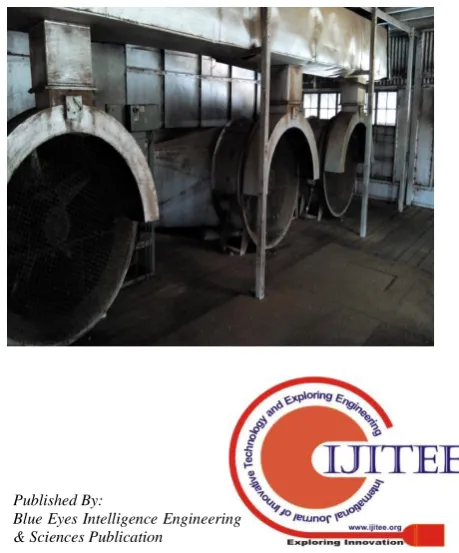
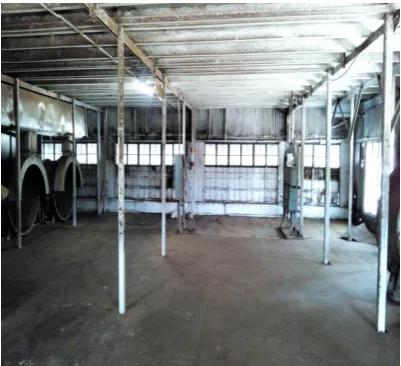
In the conventional dryer, the plucked plant shoots fall over a chain of moving perforated trays where the hot incoming air-dries the leaves. The hot air is generated by heating the air by burning coal and this hot air is blown inside blowers. The temperature control of hot air in troughs is done manually by regulating the ambient air flow by opening and closing the windows. This continuous monitoring and regulation of air flow is supervised by the officers whose office is almost 100meters away from the plant. The most primitive and traditional methods used in Tea Estates is shown in Figure 2.
Design of Model Based Controller for Air
Temperature Control in Tea Leaf Withering
Process
[image:1.595.316.546.558.835.2]Fig. 2 Traditional Method of air temperature Regulation
Hence the need for automation in tea factories is inevitable and the experimental analysis done in networked temperature process has been proved vital in remote control and automation of hot air temperature control in tea factories. The further analysis in this thesis focuses on monitoring and controlling the temperature of the air flow from the control room which is almost 100meters away from the plant. The need for automation and reducing the network delay by focusing on the control algorithms was the key motivation for this research.
Screening through various literatures, the use of industrial protocols for networking seems to be complicated and hence communication between sensor, controller and process was established via Ethernet cable. Owing to its high bandwidth, data rate and ease of installation industrial networks are replaced with Ethernet cables. The use of such network reduces man power to a great extend with very less investment. The transmission of sensor output to the controller and the controller output to the process located at a remote place should be fast and reliable. Hence different control algorithms were applied to analyze the speed of communication and reliability of the data transfer. The performance of the controllers were decided based on the performance indices like dead time, settling time, rise time, peak overshoot and integral square error[2-5]. The essence of modernizing industrial and commercial systems requires blending of computing and control of process into various stages of machine operations and data process to reduce cost.
III. LITERATURE REVIEW
K.Asan Mohideen, et al. (2012) presented a novel idea about the modelling and controlling of level process which is one of the most prominent challenges in the process industry. Model Reference Adaptive Controller (MRAC) has been implemented for the non-linear level process station. The main objective of this paper is to design a Model Reference Adaptive Controller MRAC with good steady-state and transient performance, which is the most challenging area of a nonlinear system.
Yupeng Yuan et al. (2015) proposed the design of Temperature Control using Hybrid Control with MRAC. The relevance of a hybrid controller which is a combination
Model Reference Adaptive Control (MRAC) and Expert Control System (ECS) to a MIMO microwave heating process is dealt in this paper. Microwave power and ambient temperature are the two input variables, considered to be regulated and controlled to track the desired temperature profiles.
Muhammad Nasiruddin et al. (2008) presented in their paper the performance evaluation on the application of Direct Model Reference Adaptive Control (DMRAC) with different types of command inputs. A second order reference model scheme is proposed for the system. Simulation is carried out using Matlab Simulink to control the modeled coupled tank under various experimental conditions. Different forms of inputs like square wave, sinusoidal and triangle (ramp) input signal are fed to the system. The controller produces the appropriate control to regulate the liquid level signals in response to the desired transient performance defined by reference model.
D. Rathikarani and D. Sivakumar (2009), proposed the design of adaptive PI controller based on MIT algorithm and identification of the nonlinear Air Flow Control System using the data acquired in real time. The controller is designed in MATLAB simulation platform and by conducting experiments on the laboratory the results have been validated. The overall system performance when employing Adaptive PI is observed to be better than that of the system with Adaptive MIT controller. The Performance Criteria based on Time Integral like, Integral Square Error (ISE), Integral Absolute Error (IAE) and Integral Time Absolute Error (ITAE) are tabulated. The ISE, IAE and ITAE values are small when adaptive PI controller is placed in the control loop.
Pankaj Swarnkar et al. (2010), suggested the positive effect of Adaptation Gain on system Performance for Model Reference Adaptive Control Scheme using MIT Rule. It shows the effect of adaptation gain on the system performance. Simulation is done in MATLAB and results are discussed. The adaptive Controller maintains constant dynamic performance in the presence of unpredictable and immeasurable variations. It has been seen that response is very slow with the smaller value of adaptation gain but there are no oscillations in the response. With the increment in α, the maximum overshoot is increased but at the same time speed becomes faster (the settling time is reduced).
IV. EXPERIMENTAL SETUP
Fig. 3 Block Diagram of Temperature Process station.
V. MODEL REFERENCE ADAPTIVE
CONTROLLER (MRAC)
Model Reference Adaptive Control (MRAC), an efficient adaptive control strategy with some adjustable controller parameters to be adjusted to obtain the desired response, KB.J.Parvat (2002) and Jiannan Li (2008). The principle of MRAC design is based on adjusting the control parameters
of the adaptive controller for the variations in plant dynamics[5,8,9]. The idea behind the design is that the process should track the reference model output.
Reference Model: An ideal response to the reference input of the adaptive control system is given by the reference model.
Controller: Controller design is based on the variations of few parameters where θ is used to describe the control law. The importance of θ is dependent on adaptation gain.
Adaptive Mechanism: Algorithms like MIT rule, Theory of augmented error and the Lyapunov theory and can be used to develop the adjusting mechanism. This mechanism drafted by, T.K.Radhakrishnan (2009) is used to alter the parameters of the controller as a result the actual plant could trail the reference model.
Fig. 4 Block Diagram of Model Reference Adaptive Controller
The basic block diagram of MRAC system is shown in the above figure. In Figure 4, K.Asan Mohaiden (2010) proposed that y(t) is the actual plant output, ym(t) is the
output of the reference model and difference between both is the error, denoted as e(t).
e(t) = y(t) - ym(t) (1)
MIT Rule : MIT rule was first developed by the researchers of Massachusetts Institute of Technology (MIT) and it was initially designed for autopilot system. In MRAC scheme MIT rule can be used to design a controller with for any system. In this rule, a cost function is defined as,
J(θ) =1/2 𝑒2(θ) (2)
e, is the error, and θ is the variable to be adjusted, θ, is modified such that the cost function can be reduced to zero. For this reason, the variation in the parameter θ is maintained in the negative gradient of J, that is
𝑑θ /𝑑𝑡 = -γ 𝛿𝐽 / 𝛿θ (3)
𝑑θ /𝑑𝑡= - γ 𝛿𝑒/𝛿θ (4)
Where, 𝛿𝑒/𝛿θ term which is the partial derivative of error is called as the sensitivity derivative of the system[10,11]. Equation (4), describes the rate of change in the parameter θ so that the cost function J(θ) can be reduced to zero. Here γ denotes the adaptation gain of the controller, which is always a positive quantity.
For the first order process the adaptation rules are formulated based on the MIT rule as follows:
For process
𝑑𝑦/𝑑𝑡 = -ay+bu (5)
For the model
𝑑𝑦𝑚/𝑑𝑡 = -𝑎𝑚𝑦𝑚+𝑏𝑚u (6)
For controller
u= 𝜃1𝑢𝑐−𝜃2𝑦 (7)
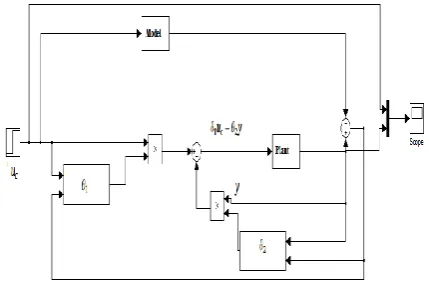
[image:3.595.331.546.495.636.2]The MRAC controller response for the temperature process is simulated using Matlab and Lab VIEW environment as shown in Figure 5 and Figure 6 respectively and its response for a given set point is shown in Figure7
[image:3.595.60.271.496.680.2]Fig. 6 Lab VIEW Block Diagram of MRAC for the Temperature Process.
Fig. 7 Response of MRAC
The following parameters were inferred from the results of the response of MRAC controller. The Dead Time was measured as 25sec, Settling Time 398sec, Rise Time 47sec, Peak overshoot 0% and the Integral Square Error was observed as 2245.
VI. MODEL REFERENCE ADAPTIVE CONTROLLER (MRAC)
To improve the transient performance a modification to the MRAC scheme was proposed by K.B.J.Parvat (2002). In
the proposed controller, the parameter u is modified which is the controller output as given by Equation (8).
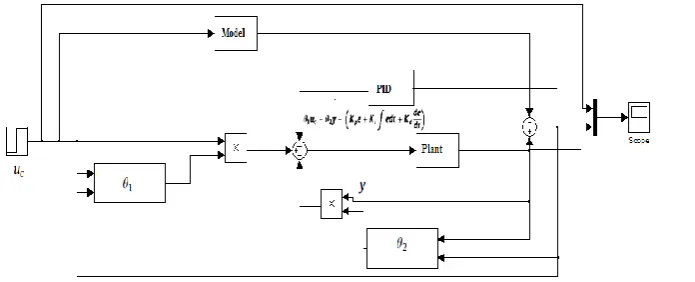
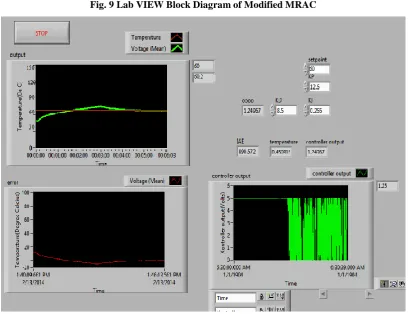
A Proportional Integral Derivative (PID) controller is also deployed along with the MRAC controller and the ensuing controller is called Modified MRAC. Parallel form of PID controller is used here. Figure 8 represents the block diagram of Modified MRAC, Figure 9 represents the Lab VIEW block diagram of Modified MRAC and Figure 10 is the response of the process to Modified MRAC.
𝑢=𝜃1𝑢𝑐−𝜃2𝑦 − (𝑘𝑝𝑒(t) + 𝑘𝐼∫𝑒(t)𝑑𝑡 + 𝑘𝑑𝑑𝑒/𝑑𝑡) (8)
[image:4.595.135.483.589.730.2]Fig. 9 Lab VIEW Block Diagram of Modified MRAC
Fig. 10 Response of Modified MRAC
The following parameters were inferred from the results of the response of Modified MRAC controller. The Dead Time was measured as 21sec, Settling Time 216sec, Rise Time 31sec, Peak overshoot 0% and the Integral Square Error was observed as 980.
VII. CONCLUSION
The designs of Conventional, Model Based controllers have been discussed in this paper. The conventional controller design has three tuning parameters called the Proportional gain, Integral gain and Derivative gain. The tuning of these parameters are done manually using Zeigler-Nichols method and thus the design is complex, also the designed controllers results in poor performance. Then, the
[image:5.595.94.503.278.592.2]REFERENCES
1. Chien-Liang Lai and Pau-Lo Hsu (FEBRUARY 2010) “Design the remote control system with the Time-Delay estimator and the Adaptive Smith Predictor” IEEE Transaction on Industrial Informatics, vol.6,No.1.
2. Juliano S. A. Carneiro and Luca Ferrarini,( NOVEMBER 2010) “Preventing thermal overloads in Transmission Circuits via Model Predictive Control” IEEE Transactions On Control Systems Technology, Vol. 18, No. 6.
3. V.Balaji, Dr. L.Rajaji,( November 2013) “Comparative Study of PID and MPC Controller Using Lab View” International Journal of Advanced Research in Electrical, Electronics and Instrumentation Engineering Vol. 2, Issue 11.
4. Arvapalli Rajesh, Y.V., Pavan Kumar, Sadhu Yugandhar and Viswaraju Srikanth (2012), “Cascaded PID Controller Design for Heating Furnace Temperature Control”, IOSR Journal of Electronics and Communication Engineering (IOSR-JECE), Vol.2, No.2, pp.217-229.
5. Asan Mohideen K (2014). “Differential Evolution Algorithm for System Identification and Tuning of Fuzzy Modified Model Reference Adaptive Controller for a Coupled Tank Level Process”. IJET, vol.6, No.3, pp. 1530-1547.
6. M. A. Zermani, Elyes Feki, Abdelkader Mami,( OCTOBER 2014) “Temperature Acquisition and Control System based on the Arduino” International Journal of Emerging Science and Engineering (IJESE) ISSN: 2319–6378, Volume-2 Issue-12.
7. Pamela D. and Jebarajan T. ( December 2012), “Design of Intelligent Controller for Temperature Process FGCN/DCA 2012, CCIS 350”, Springer-Verlag Berlin Heidelberg, 16th to 19th December 2012, 278-284, ISSN 1865-0929, ISBN 978-3-642-35593
8. Donald R. Coughanowr and Steven E. LeBlanc, “Process Systems Analysis And Control,” Third Edition, Published by McGraw-Hil. Version 2 EE IIT, Kharagpur, Process Control.
9. Aytekinbagis (2007), “Determination of the PID controller parameters by modified genetic algorithm for improved performance”, Journal of Information Science and Engineering.
10. Balaji V. and Rajaji L. (2013), “Comparative Study of PID and MPC Controller Using LabView”, International Journal of Advanced Research in Electrical, Electronics and Instrumentation Engineering Vol. 2, No.11, pp. 97-108.