Analysis of the Involvement and Impressions of the Local
Community on the Tourism Development of Ilocos Norte
Cherie B. Orpia1 1
Mariano Marcos State University, Batac City, Ilocos Norte, Philippines
Abstract. Tourism development is not possible without the involvement of the local community in various development stage and tourism activities. They can be involved right from planning, construction, operation, and promotion activities. It generates investment, foreign exchange and employment to the locals. This study sought how the local community is involved and what are their impressions in Ilocos Norte’s Tourism developments. It also sought to determine the demographic qualities differentiates against tourism development involvement and their impressions. The study used non-probability convenience sampling in various towns in Ilocos Norte. Questionnaire type of survey and unstructured interviews were employed to the locals and to the local government units. Local residents perceive the tourism activities to provide employment opportunities, income, foreign exchange, and promote cultural heritage. Very few perceive to be a contributor to pollution and depletion of natural resources.. Most people have an impression that it has improved their way of life thru more access to their town, business opportunities, and more infrastructure. However, most of them has an impression that cleanliness and safety has gotten worse. Most people like to participate in tourism activities thru investment, employment and planning.
Introduction
The state recognizes the tourism industry as an indispensable element of the national economy and an industry of national interest and importance. It is an engine of socio-economic growth and cultural affirmation to generate investment, foreign exchange and employment, and an engine to mold and enhance our national pride for all Filipinos. Furthermore, it is dedicated in to developing environmentally sound and community participatory tourism programs and development, enlisting the participations of the local communities.
The province of Ilocos Norte for the past half decade, has been very aggressive in promoting and packaging Ilocos Norte as a major tourist destination. Huge budget allocations has been made do develop tourist sites and infrastructures within the vicinity. To the locals this would mean changes in how the live within their communities. Positive or negative, it would mean more cash inflows to the locality, more jobs, but it would also mean the negative aspects of having a lot of people in the community and this would mean possible problems on peace and order garbage disposal, destruction of environment among others.
This study therefore seeks how the local community is involved and what are their impressions in Ilocos Norte’s Tourism developments. It also seeks to determine the demographic qualities differentiates against tourism development involvement and their impressions.
2 Related Studies
According to Muganda [1] there are various ways through which communities can be involved in the tourism industry so as to attract their support and participation which in turn enhance the development of the industry. He focused on the two factors namely, the involvement in the tourism decision-making process and the employment opportunities.
Tosun, [2] suggested that community participation via decision making is crucial determinant to ensure that the benefits local communities get from tourism are guaranteed, and their lifestyle and values are respected. While, employment opportunities is another way to involve and attract community participation and ultimately support in tourism development. Tosun [3] then stressed that the community participation through working in the tourism industry has been recognized to help local communities not only to support development of the industry but also to receive more than economic benefits.
It is quite given than it is inevitable that the community is involved in planning and development due to the nature of tourism – which is pervasive, that uses the community as a resource, sells as a product and in the process, affects the life of everyone [4].
The current situation in Ilocos Norte is that individual town has its own strategy, cub cultures and interests. The tourism program now of the province seems to encompass all of these to form a provincial tourism program that would be an assortment of activities and interests. Murphy and Murphy [5] might refer to this as the community approach to tourism development as it integrates interest of all stakeholders, residents included.
This program would apparently address the issue of benefits and costs for individuals and community. It may be ordinary for them to see local sights, food interests but then tourism and outsiders might get interested as these are unusual to them, therefore the local would start to appreciate these local aspects of their community and therefore would realize the revenues [6].
3 Data and Methodology
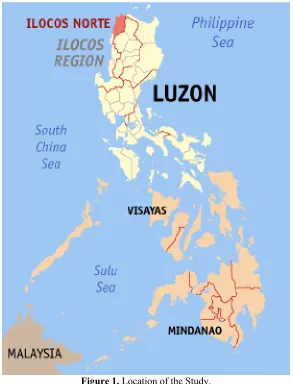
Data are gathered came from the selected municipalities and cities of Ilocos Norte that possess many tourism related developments, namely, Paoay, Laoag, Bangui, Currimao, Burgos and Pagudpud. Questionnaires were floated from the month of August to September, 2013.
Figure 1. Location of the Study.
The study used non-probability convenience sampling of 100 residents per municipality because of ease of implementation. Questionnaire type of survey and unstructured interviews were employed to the locals and to the local government units. Date are analyzed according to basic statistical descriptives and statistical analysis of the data using Mann-Whitney U and Kruskal-Wallis test to see if the various tourism impacts are the same on various socio-economic factors.
4 Results and Discussion
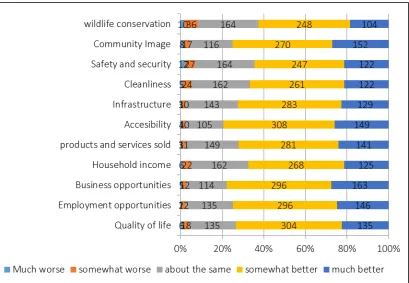
Figure 3 shows varied tourism impacts for the past five years based on the perception of locals whether it has gotten better or worse or nothing changed. For the socio-cultural and economic impacts, the locals see it as it has gotten better. For the environmental impacts, most locals sees that it gotten better although there is a good percentage that see that pollution has not changed or it has gotten even worse. Several local also make mention of the cleanliness has gotten worse
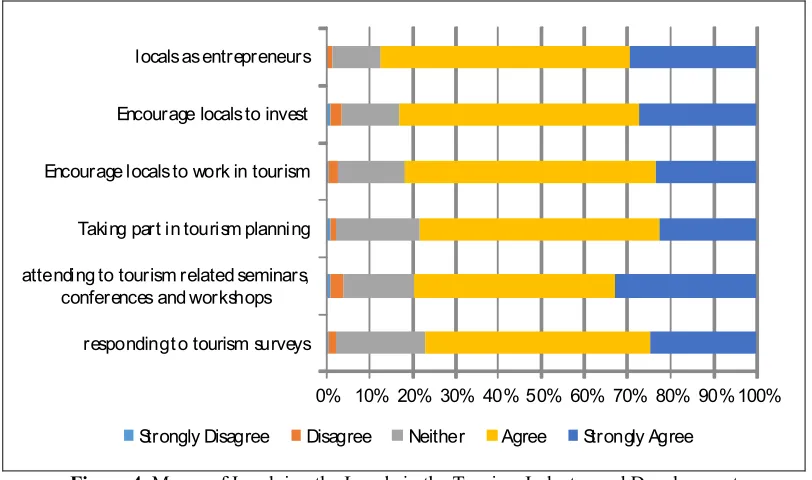
[image:4.482.34.453.226.557.2]The locals are involved in several ways on tourism industry and development of their locality. Plenty of them agrees and strongly agrees that the locals are participating in seminars, responding to surveys, planning, as an employee, and as an investor.
Table 1. Sociodemographic Profile of Respondents
Socio Demographic Profile Count Percentage
Gender Male 277 46
Female 323 54
Age 18-30 271 45
31-55 273 46
56-80 51 9
Undefined 5 1
Marital Status Single 277 45.2
Married 278 45.5
Widowed 29 5
Undefined 16 3
Educational Attainment Elementary Undergrad 12 2
Elementary Graduate 39 7
High School Undergrad 49 8
High School Graduate 127 21
Tertiary Undergraduate 166 28
Tertiary Graduate 178 30
Undefined 29 5
Type of Employer Self 181 30
Government 63 11
Private 61 10
Retired 25 4
Unemployed 237 40
Undefined 33 6
Years of Residency <10 years 49 8
>10 years 137 23
Since birth 389 65
Undefined 25 4
0% 10% 20% 30% 40% 50% 60% 70% 80% 90% 100% responding t o tourism surveys
attending to tourism related seminars, conferences and workshops
Taking part in tourism planning Encourage locals to work in tourism Encourage locals to invest
locals as entrepreneurs
[image:6.482.39.445.77.317.2]Strongly Disagree Disagree Neither Agree Strongly Agree
Figure 4. Means of Involving the Locals in the Tourism Industry and Development
4.1 Mann-Whitney and Kruskal Wallis Test
To be able to determine whether there is an equal/unequal distribution of locals perception on various categories of socio demographic aspect, Mann-Whitney analysis and Kruskal Wallis test were performed. Table 2 would show that all items listed down except two, has the same distribution among both genders. These two that identifies itself has varied perception across genders are the environmental conservation and being involved in tourism planning
Majority of the statements on perceptions, impacts, means of involving of the locals, the locals’ role and agencies who should be involved in tourism planning and development are significantly related on the locals perceived involvement on tourism development.
While, the perception of locals based on how long they stayed in the community was also evaluated whether there is a difference. Test was made using Kruskal-Wallis. It shows that various perceptions are not significantly related to their years of residence except for foreign exchange, resource depletion, and accessibility of the place, pollution, natural resources, encouraging locals to invest and involvement of the LGU.
Table 2. Analysis on the perception of locals on tourism by gender, involvement of the locals and years of residence
Perception on Tourism Gender
Mann-Whitney Test
p-value
Involvement of the Locals
Mann-Whitney Test
p-value
Years of Residence
Kruskal-Wallis
Test
p-value
Tourism provides employment opportunities
0.514 0.000* 0.595
Tourism generates income 0.853 0.000* 0.062
[image:6.482.30.454.544.662.2]Tourism promotes cross-cultural exchange 0.429 0.000* 0.451
Tourism generates foreign exchange. 0.135 0.000* 0.039*
Tourism encourages cultural activities to the locals.
0.376 0.000* 0.213
Tourism encourages conservation of archeological and historical sites.
0.005* 0.005* 0.132
Tourism encourages environmental awareness.
0.141 0.003* 0.150
Tourism results in resource depletion. 0.433 0.074 0.028*
Tourism contributes to pollution. 0.865 0.969 0.065
Tourism improves the accessibility of the place.
0.098 0.199 0.011*
Tourism improves the infrastructure of the place.
0.161 0.051 0.336
Impact of Tourism Development to the Locals
Gender
Mann-Whitney Test
p-value
Involvement of the Locals
Mann-Whitney Test
p-value
Years of Residence
Kruskal-Wallis
Test
p-value
Quality of life of the locals 0.619 0.000* 0.140
Employment 0.484 0.000* 0.142
Business Opportunities for the locals 0.706 0.000* 0.673
Household income of the locals 0.818 0.000* 0.150
Products and services sold and offered by the business establishment in the
community
0.146 0.000* 0.287
Accessibility (transportation and communication)
0.874 0.000* 0.618
Infrastructures 0.463 0.070 0.209
Cleanliness of the community 0.758 0.027* 0.525
Foreign Exchange 0.136 .0000* 0.004
Perception on the Means of Involving Local People in Tourism Development
Gender Mann-Whitney Test p-value Involvement of the Locals Mann-Whitney Test p-value Years of Residence Kruskal-Wallis Test p-value
Encouraging locals to invest in tourism industry
0.522 0.000* 0.025*
Encouraging locals to work for the tourism industry
0.290 0.000* 0.356
Taking part in tourism planning for developments
0.014 0.000* 0.240
Responding to tourism surveys 0.188 0.003* 0.986
Attending to tourism related seminars, conferences, workshops.
0.137 0.000* 0.132
Perception on the Appropriate Role of the Local People in Tourism
Development Gender Mann-Whitney Test p-value Involvement of the Locals Mann-Whitney Test p-value Years of Residence Kruskal-Wallis Test p-value
Locals as entrepreneurs 0.507 0.013* 0.265
Locals as workers in tourism industry 0.150 0.000* 0.436
Local as part of the tourism planning 0.825 0.007* 0.245
Perception of the Locals on Who Should Make the Plan for the Tourism
Development Gender Mann-Whitney Test p-value Involvement of the Locals Mann-Whitney Test p-value Years of Residence Kruskal-Wallis Test p-value
Department of Tourism 0.541 0.000* 0.918
Provincial Government of Ilocos Norte 0.177 0.001* 0.372
Local Government Unit (LGU) 0.082 0.000* 0.005*
Private Sector 0.213 0.009* 0.075
*Significant at 0.05
5 Summary and Conclusion
The study clearly shows that most locals has a positive impression on tourism development on all aspects of socio-cultural, economic, environmental impacts. It there show that the locals want to participate the development of the community not only because of group interest but as individuals as well. Most would want to uplift their lives as they could see the tourism development as an inflow of revenue to the locality and they want to be involved either as a worker or an investor. There is however, as small portion of the community that must not be ignored which says that pollution and cleanliness in an increasing concern on tourism development. This should be addressed alongside economic development to be able to have a sustainable livelihood.
With regards to gender perception on the issues, both genders have similar impressions except on aspects of tourism planning and environmental conservation. The variation on the perception of involved locals on various is very varied. However, residents have varying perceptions on various issues depending on years of stay. Most of them have the same perception except foreign exchange, natural resources, and locals to invest.
References
1 M. Muganda, Community involvement and participation in tourism Development in Tanzania. Barbarani Village: unpublished (2009)
2 Tosun, Towards a typology of Community Participation in the Tourism Development Process. Tipology of community participation, vol. 10, 2, 113 (1991)
3 Tosun Limits to community participation in the tourism development process in developing countries. Bilkert, Ankara, Turkey. Elsevier Science Ltd (2000)
4 P. E. Murphy, Tourism management in host communities. The Canadian Geographer, Vol. 24 (10), pp. 1 (1980)
5 P. Murphy & A.E. Murphy, Strategic management for tourism communities. Clevedon: Channel View Publications (2004)