International Journal of Innovative Technology and Exploring Engineering (IJITEE) ISSN: 2278-3075, Volume-9 Issue-1, November 2019
Hand Gesture Recognition using Convexity Defect
Caroline El Fiorenza, Sandeep Kumar Barik, Ankit Prajapati, Sagar Mahesh
Abstract: Gestures are the simplest way of conveying a message, rather simpler than verbal means. It is the most primitive way of conversation. Gestures can also be the easiest and intuitive way of communicating with a computer, they can be used to communicate or convey information to computers, robots, smart appliances and many other pieces of machinery. It can eliminate the use of mouse and keyboard to some extent. The gestures cited are basically the variable positions as well as orientations of the hand. They can be detected by a simple webcam attached to the computer. The image is first changed into its corresponding RGB values and then to HSV values for better handling and feature recognition. The hand is segregated from the background using feature extraction. Then the values are matched in proximity of the coded values. Then the region of interest is calculated using the concept of convexity and background subtraction. The convex defect helps to define the contour efficiently. This method is invariant for different positions or direction of the gesture. It is able to detect the number of fingers individually and efficiently.
Keywords: RGB, HSV, hand gesture, background subtraction, detection, feature extraction, convexity defect.
I. INTRODUCTION
Gestures have been used since primitive times to convey messages in the simplest of fashions. Simple messages, if not sophisticated were communicated by the variable positions and orientations of the hand and other parts of the body. They can be originated from any bodily movement. The use of gestures as a form of communicating with the digital media such as the PC and other smart devices drives as the motivating force to analyse and record the movements. The system needs to be visually intelligent to capture and understand the movement. This includes multi-disciplinary studies [1]. The gesture recognition system is rapidly developing and is the stepping stone for the advancement in smart appliances as well as IOT enabled devices. The Human Computer Interaction (HCI) [1], is simple and more intuitive as compared to the conventional keyboard and mouse-based input. Gestures are easy to form and remember and easier to produce.
This system finds application in simple PCs, smart appliances, PDAs, medical equipment, public accessibilities, offices with digital media, entertainment purposes etc. The proposed system can be dissociated into the following modules; sample image capturing, image pre-processing, feature analysis, parameters extraction, classification and recognition [3].
Revised Manuscript Received on November 06, 2019.
* Correspondence Author
Ms. Caroline El Fiorenza, Assistant Professor (O.G.), Department of Computer Science and Engineering, SRM Institute of Science and Technology, Chennai
Mr. Ankit Prajapati, Department of Computer Science and Engineering, SRM Institute of Science and Technology, Chennai
Mr. Sandeep Kumar Barik, Department of Computer Science and Engineering, SRM Institute of Science and Technology, Chennai
Mr. Sagar Mahesh, Department of Computer Science and Engineering, SRM Institute of Science and Technology, Chennai
The paper is organised as follows, Literature survey, materials and methods, features extraction, results and discussion and at last the conclusion.
II. LITERATURE SURVEY
In one of the papers [1] the main contribution is to introduce a forward movement finding strategy that performs the separation and detection of hand signals all the time. A stochastic approach is suggested to design a non-motion process using CRFs model without data planning. This system could efficiently identify signals and non-motion models in tandem with forward spotting program. Often, consider the time delay problems between the detection and identification undertakings. The biggest advantage of this method is that it improves efficiency and also allows us to deal on complex issues that are abstracted from the consumer and operate in the background, rendering it more efficient and easier as well.
In another paper [2] the target of this paper is to plan a hand motion acknowledgment framework that works continuously and perceived manipulative hand signals. The motions that are utilized in this acknowledgment framework have particular significance. Every single one of these signals speaks to a specific activity. This paper worries to plan a component extraction technique that is invariant overturn, scaling, interpretation, and direction-dependent on minute element extraction strategy with the goal that the framework can perceive hand motions caught in various point or direction or size. A major demerit would be that the proposed method is susceptible to errors, especially in shapes like square and circular.
Human hand following [3], it requires predefining a gathering of signal accumulation, from which getting the main motion descriptor. In view of the mapping from picture highlight space to signal space, we can evaluate legitimately motion. By and large, such picture highlights incorporate dab, line, corner or surface zone and so forth. The use of this strategy needs setting up the mapping connection between picture qualities and human hand act. Nonetheless, close by moving procedure, hand's expressive sharp changes make the mapping unquestionably profoundly non-direct. This technique doesn't necessities ascertaining 3D motions, rather, it requires learning and preparing in ample datasets which portray any conceivable signal. Advantage of this would be objects dominating the image will be represented as orientation histograms.
signal zone dependent on morphological activity and a single availability strategy. Truth be told, part B furthermore, part C is intended to expel obstruction from complex foundations for hand signal acknowledgment. Advantage of this method is that system would be able to successfully recognize the dynamic and static hand gestures. Jump Motion controller [5] for hand motion acknowledgment for static indications of Indian Sign Language (ISL) is utilized. The framework is tried with independent and twofold given motions of ISL. The device Leap Motion is a compact USB tool that combines two monochromatic IR cameras and three infrared LEDs. The scope of this gadget is a rough hemispheric area, around 1 meter away. Jump Motion sensor is a little size sensor which is anything but difficult to utilize and of minimal effort. Disadvantage would be that it uses pre-set data-sets so the amount of hand gestures are limited to the available data-set.
Fig. 1. Architecture diagram
III. MATERIALS AND METHODS
A. Camera
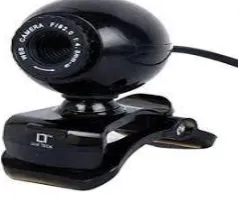
A simple camera or rather web camera attached to the system is need to capture the video feed of the gestures. The camera will change the visual data into digital data.
[image:2.595.51.297.249.433.2]A good camera along with good lighting is a must for better results.
Fig. 2. Web- camera
B. Background subtraction
Separating the moving object from the still image utilizing basic and static cameras is an algorithm-based approach. This approach's sole purpose is to identify the moving object from the stationary context, in our case its side. This is achieved by comparing the current image with the frame of reference. The "background image" or "shadow model" is the reference point. Subtraction of the backdrop usually takes place if the object is part of a video feed. Subtraction of the image is under the computer vision umbrella. The shifting entity is eliminated through the tracking of the backdrop.
[image:2.595.309.543.490.644.2]The area of the image containing the hand will be the region of interest. Subsequent steps of image pre-processing include eradicating the noise, adjusting the colour tones (if necessary) and post-processing. As in the case of facial scans, the face is the region of interest and is segregated from the background using background subtraction and foreground detection, similarly the hand gestures are analogous to the cited case of facial scans. Due to various factors which include uneven skin tone, reflections, erratic lighting and other moving objects the background subtraction is a difficult task. To overcome this Stauffer and Grimsson [1,3] proposed the Mixture of Gaussians (MOG) model.
Fig. 3. Background learning
C. MOG model
It's a Gaussian-based refinement algorithm. The most distinctive trait of the given algorithm is that it assigns each pixel the right Gaussian distribution number. It provides better adaptability due to changes to scenery of different scenes. Figure shows the results after using the subtraction method for the MOG2 context.
Fig. 4. Background subtraction
D. Convexity approach
[image:2.595.125.245.518.622.2]International Journal of Innovative Technology and Exploring Engineering (IJITEE) ISSN: 2278-3075, Volume-9 Issue-1, November 2019
polygon, and categorizing them into concave / convex points. The main focus is on the convex points which correspond to the fingers in the hand. The convexity approach determines the convex points of one image at a time. The convex points are minimised as much as possible for efficient and reliable results.
E. Contour
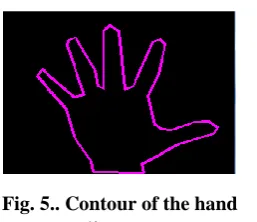
The contour of the hand in the region of interest is the set of points which correspond to the extremities of the human hand, which in turn define the hand’s boundaries. The contour is then analysed for the gesture and also approximated into a polygon. Canny edge detection method is opted to calculate the contour.
F. Convex hull
To calculate the convex hull of the given contour, the palm is considered with the fingers as the convexity defects. The complex structure can be simplified by this technique. The convex hull will be the convex polygon which is surrounded by the vertices corresponding to the tip of the fingers. In gesture contour by all the convex vertices. The convex hull of the contour of the hand gesture is the convex polygon surrounded in gesture contour by all the convex vertices, as shown in the figure.
[image:3.595.321.531.49.210.2]
Fig. 6. Convex hull
G. Convex defect
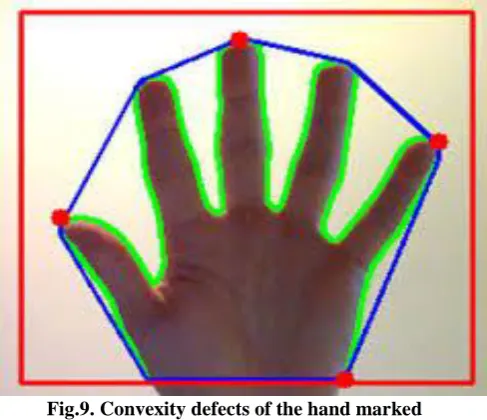
[image:3.595.107.236.144.255.2]It can be depicted as the calculated difference between the convex hull and the contour. The convexity defect is defined as the points farthest from the convex points. So, if the finger tips are considered as the convex points, the trough between the fingers can also be considered as convexity defects.
Fig. 7. Convexity defects of the hand 1) Eliminate distortion from the produced frame.
The uniform convex defect length cannot be either of the two extremes. Too short or too high, Figure shows a finer depth than other convex defects with convex finger defects, and therefore, convex defect depth may be used to decide whether or not convex finger defects are convex.
The minimum and maximum depth limits of 1/5 and 1⁄2 the contour of the hand gesture height, and the contour of the manual motion height should be described as the contours of the quadrilateral contour consisting of the minimum x-coordinates, the total x-coordinates of the hand based on the anatomical structure of the human hand and a great number of studies.
Fig.8. Coordinates of the ROI
2) Check convex defects in the direction of the clock take as first and last fingertips the initial point of the first convex defect and the final points of the last convex defect.
[image:3.595.324.540.371.547.2]3) Use the present convex defect's mean end point location and the starting point of the next convex defect as the real fingertip.
Fig. 5.. Contour of the hand
[image:3.595.100.242.472.545.2]Fig.9. Convexity defects of the hand marked
IV. FEATURE EXTRACTION
For the extraction of required features from the binary image, the convexity of the gesture can be associated to the variable position of the fingers with respect to the palm. Through rigorous analysis it is found that the tightness of the convex hull also changes with various gestures. The tightness of the convex hull can be depicted using the symbol δ, whose value is given by the ratio of the area of the contour to that of the hull.
δ = 𝑐𝑜𝑛𝑡𝑜𝑢𝑟𝐴𝑟𝑒𝑎 ℎ𝑢𝑙𝑙𝐴𝑟𝑒𝑎
Where, hull Area is the area of the hull and contour Area is the area of the contour. We can get the value of δ and determine the gesture.
Therefore, movements can be distinguished by the varied finger location. Two parameters are described, respectively α and β, where α is the summation of angles with the middle as the base, lines from the centre to the first fingertip and the other fingertips as the borders, and in this equation β is the angle with the center as the axis, lines from the center to the initial and end fingertips as the sides, i.e. α = θ1 + θ2 + θ3 + …..θN-1, β = θN-1, Where the symbol, N is the number of fingers, and where N is the distance from the initial fingertip to the centroid movement of the other fingertip. The centroid of the hand is defined by the Moments function, where M is the moment. Picture moment will provide an average pixel brightness. The moment is given by the continuous function f (x, y).
V. RESULTS AND DISCUSSIONS
[image:4.595.329.536.169.301.2]In this article it was limited to the extraction of convex error based features for identification of hand gestures. The features indicated the pressure of the movement contour, convexity and relative position of the hands,into its convex foundation. The Euclidean distance metric was adopted for the similarity estimation and was used for the five moves used to test the application of these characteristics that depend on convex defects.
Table 1. Features proposed
Table 1 depicts the features adapted from some common gestures consisting of different numbers of fingers, these features are found to have the capability to discern the number of gesture templates.
VI. CONCLUSION
The recommended methodology is sufficient to classify the photographs of the phenomenon of hand gestures seen. We have the binary images, then the threshold and subtraction of the comparison. This paper takes hand-photos of one-by-one movement and they measure the angle of summation with centre. They use algorithms for the analysis of objects to obtain manual contour, convex shaft and convexity defects. Attributes are known as contour structures, hull surfaces and recovery angles. In order to explain the hand gesture more clearly, we will need the assistance of further implementations in our future work.
REFERENCES
1. Mahmoud Elmezain, Ayoub Al-Hamadi, Bernd Michaelis, A Robust Method for Hand Gesture Segmentation and Recognition Using Forward Spotting Scheme in Conditional Random Fields, 2010 International Conference on Pattern Recognition.
2. Tasnuva Ahmed, A Neural Network based Real Time Hand Gesture Recognition System, International Journal of Computer Applications (0975 – 8887) Volume 59– No.4, December 2012
3. Lihua Tian, Liguo Han and Xiujuan Guo, Dynamic Gesture Recognition based on Image Sequence, International Journal of u- and e- Service, Science and Technology Vol.8, No. 12 (2015), pp.171-182.
4. Qinghe Zheng, Xinyu Tian, Shilei Liu, Mingqiang Yang, Hongjun Wang and Jiajie Yang, Static Hand Gesture Recognition Based on Gaussian Mixture Model and Partial Differential Equation, IAENG International Journal of Computer Science, 45:4, IJCS_45_4_09 (Advance online publication: 7 November 2018).
International Journal of Innovative Technology and Exploring Engineering (IJITEE) ISSN: 2278-3075, Volume-9 Issue-1, November 2019
AUTHOR’S PROFILE
Ms. Caroline El Fiorenza,
Assistant Professor, Dept of CSE, SRM Institute of Science and Technology, Chennai, India Holds a post-graduation degree M. Tech (CSE) from
SRM University,
Kattankulathur. Having more than six years of teaching experience as an assistant professor. Also, underwent 4 weeks vocational training on “Free and open source software”. She can be reached
at Email:
Sandeep Kumar Barik, UG Scholar, B Tech, Department of Computer Science and Engineering, SRM Institute of Science and Technology, Chennai, India. He is currently working on his projects in Artificial Intelligence and Computer Vision. This is his first paper on machine learning and its algorithms. He can be reached at Email:
Ankit Prajapati, UG Scholar, B Tech, Department of Computer Science and Engineering, SRM Institute of Science and Technology, Chennai, India. He is currently working on his projects in Artificial Intelligence and Computer Vision. This is his first paper on machine learning and its algorithms. He can be reached at Email:
Sagar Mahesh, UG Scholar, B Tech, Department of Computer Science and Engineering, SRM Institute of Science and Technology, Chennai, India. He is currently working on his projects in Artificial Intelligence and Computer Vision. This is his first paper on machine learning and its algorithms. He can be reached at Email: