Real-Time Performance Analysis for Publish/Subscribe
Systems
Sangyoon Oh1, Jai-Hoon Kim2, Geoffrey Fox3
1 School of Information and Computer Engineering,
2 Graduate School of Information and Communications,
Ajou University, Suwon, S. Korea {syoh, jaikim}@ajou.ac.kr
3 Pervasive Computing Labs., Indiana University, Bloomington, IN. U.S.A.
Abstract. The publish/subscribe communication system have been popular communication model in many area. Especially, it is well suited for distributed real-time system in many ways. However, the research of cost model and anal-ysis for publish/subscribe system in distributed real-time system has not been announced yet. In this paper, we present our cost model for publish/subscribe system in real-time domain, analyze its performance, and compare to other communication models such as request/reply and polling models. Our empirical result on mobile embedded device shows accordance with cost analysis, which verifies correctness and usefulness of our cost model.
1 Introduction
Using publish/subscribe communication system [1] have been popular in many dis-tributed application domains. Unlike traditional point-to-point model such as client-server, publish/subscribe model decouples publisher and subscriber in time, space, and synchronization. Producer (i.e. event source) declares the topics on which they intend to publish event (data) and subscriber (i.e. event displayer) register to the top-ics of interest. When the producer publishes events on a topic, server (i.e. event bro-kering system) disseminates events to the subscriber. Subscriber can access published data asynchronously anytime and anywhere at its own convenience. Because of its location transparency and flexibility to dynamically add and remove participants, it is appropriate communication system for large scale loosely coupled distributed systems. Examples of such systems include collaboration systems which require an asynchron-ous multicast messaging system and military system requiring distributed real-time system support.
other benefit of having publish/subscribe system for distributed real-time system is its multicast-like model. Publisher sends only one event to the event broker and the event is delivered to many subscribers [4]. Thus, an increasing number of distributed real-time systems adopts publish-subscribe system for data transfer among massive number of distributed entities.
There has been a lots of research proposals and implementations of pub-lish/subscribe communication model [5-9] to improve performance of the system including Siena [10], Gryphon [11], JEDI [12], Rebeca [13], Scribe [14] and Elvin [19]. However, to the best of our knowledge, research of performance modeling for distributed real-time system using a publish/subscribe system has not been announced yet. We propose cost model for general publish/subscribe systems and pub-lish/subscribe system in distributed real-time systems, analyze their performance, and compare them to other interaction-based models such as client-server model and polling models. We can estimate performance of publish/subscribe system in distri-buted real-time system. We can also effectively adopt publish/subscribe systems by using our proposed cost model and analysis of publish/subscribe systems.
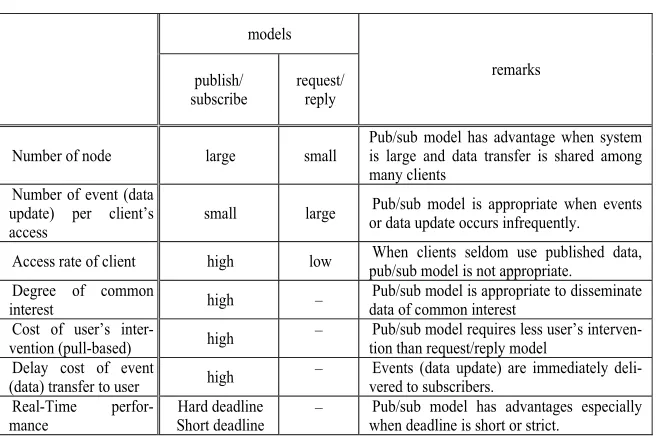
[image:2.612.144.473.401.619.2]Networking middleware that implements a real-time publish/subscribe model such as Data Distribution Service (DDS) [16] is being used for many application domains. It targets high performance (e.g. low latency, high throughput) applications, such as multimedia or military systems. Thus, it is getting important to analyze performance and effectiveness of publish/subscribe communication system, especially in condition in which time is a key parameters such as in real-time condition.
Table 1. Model selection
models
remarks publish/
subscribe request/ reply
Number of node large small Pub/sub model has advantage when system is large and data transfer is shared among many clients
Number of event (data update) per client’s
access small large
Pub/sub model is appropriate when events or data update occurs infrequently.
Access rate of client high low pub/sub model is not appropriate. When clients seldom use published data, Degree of common
interest high – data of common interestPub/sub model is appropriate to disseminate
Cost of user’s
inter-vention (pull-based) high – tion than request/reply modelPub/sub model requires less user’s interven-Delay cost of event
(data) transfer to user high – vered to subscribers.Events (data update) are immediately deli-Real-Time
perfor-mance Short deadlineHard deadline – when deadline is short or strict.Pub/sub model has advantages especially
many cases. For the analysis, we define pull based publish/subscribe system model as the case when user has intention to retrieve data (or message) from the broker.
We also experimentally measured and compared performance of pub-lish/subscriber model to client/server model on our test bed with NaradaBroker [17] which is a publish/subscribe based message brokering system to verify correctness of our performance model on the real systems. Our cost analysis model is simple but accordant with experimental results.
2 Cost Model
2.1 System Models
In this subsection, we propose cost analysis model for publish/subscribe systems. We assume following basic system parameters to analyze cost.
z α (publish rate): We assume that publisher’s event generation is governed by Poisson process with average inter arrival time of 1/α.
z β (request rate or process (reference access) rate): We use this parameter for two meanings: (1) subscriber’s access rate of published events, and (2) request rate of client in the client/server models. We assume that these rates are also go-verned by Poisson process
z cps (α) (publish/subscribe cost per event): cost required for an event publish. cps is divided into two parts: (1) cpub: ES(Even Source) publish events to EBS(Event Brokering System), and (2) csub: EBS(Event Brokering System) relays the events to ED(Event Displayer) which registered for the events.
z crr: (β) (cost per request and reply): cost for sending request and receiving re-sponse in client-server model.
z cpoll(α,T) (cost of periodic publish or polling): We assume function of α and T (ex. cpαT , cpoll), where T is length of period. (We can also think it as cost of pe-riodic polling in client/server model.)
z cd(α,T) (cost of delaying publish): It is cost (or penalty) by delaying data transfer. We assume function of α and T (ex. α T). We need to assign some function for each application.
z s(n) (effect of sharing among n subscribers): For example, server can deliver events with low cost when it broadcasts event to many subscribers. It will be be-tween 1/n and 1.
z tps (time delay for publish/subscribe): time delay for publishing an event. tps is divided into two parts: (1) tpub: time delay for publish, ES(Even Source) publish events to EBS(Event Brokering System), and (2) tsub: time delay for subscribe, ED(Event Displayer) subscribes events from EBS(Event Brokering System).
z trr (time delay for request and reply): time delay required for sending request message and receiving response message in request-reply (client-server) model.
z D: relative deadline from user’s access intension or event occurrence.
2.2 Cost Analysis
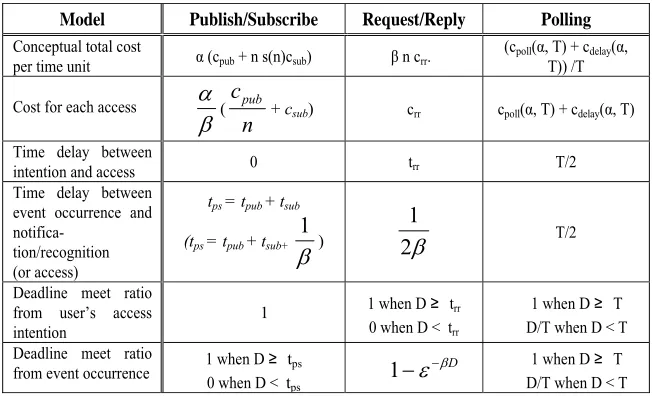
[image:4.612.142.468.305.503.2]In this analysis, we analyze cost of three different models, publish/subscribe, re-quest/reply, and periodic polling models without any failure of communication link or node. We consider (1) conceptual total cost (e.g., the number of message, amount of message, or time delay) per unit time for each model, (2) cost for each access by client (or subscriber), (3) time delay for access after subscriber’s (or client’s) inten-tion, and (4) time delay between event occurrence and notification to subscriber (or recognition by client). Cost can be the number of message, amount of message, or time delay.
Table 2. Cost Analysis for different models
Model Publish/Subscribe Request/Reply Polling
Conceptual total cost
per time unit α (cpub + n s(n)csub) β n crr. (cpoll(α, T) + cT)) /T delay(α,
Cost for each access
β
α
(
n
c
pub+ csub) crr cpoll(α, T) + cdelay(α, T)
Time delay between
intention and access 0 trr T/2
Time delay between event occurrence and
notifica-tion/recognition (or access)
tps =tpub +tsub
(tps =tpub +tsub+
β
1
)
2
β
1
T/2
Deadline meet ratio from user’s access intention
1 1 when D ≥ trr
0 when D < trr
1 when D ≥ T D/T when D < T Deadline meet ratio
from event occurrence 1 when D ≥0 when D < t tps ps
D β
ε
−−
1
D/T when D < T 1 when D ≥ TCost of publish/subscribe model
Since we assume that cpub is cost for that ES(Even Source) publish events to EBS(Event Brokering System), and csub is cost for that ED(Event Displayer) sub-scribes events from EBS(Event Brokering System), cost of publish/subscribe model for each event publish and subscribe is cpub + n s(n)csub . Please remember that n is the average number of subscriber and s(n) is sharing effect among n nodes. When publish rate is α, cost per time unit is:
Now, we consider cost in the view point of subscriber (per each event access of subscriber). We analyze three performance metrics, (1) conceptual cost for each access, (2) time delay for subscriber to access event after its intention, (3) and time delay until notification to subscriber after event occurring. The average number of event occurred before each access is cost for each access:
β
α
β
α
α
β
α
β
=
⎟⎟
⎠
⎞
⎜⎜
⎝
⎛
+
+
∑
∞=0
i
i ,
where cpub is shared among n subscriber and csub is required for each subscriber. Thus, average cost for each access is:
β
α
(
n
c
pub + csub)There is no time delay for access after subscriber’s intention since event has al-ready been received. Time delay between event occurrence and notification to sub-scriber is:
tps =tpub +tsub
We analyze real-time performance (deadline meet ratio) for two aspects: one rela-tive deadline (D) is set from the subscriber’s intention to access data and the other deadline is set from the occurrence of event. Deadline meet ratio from the subscrib-er’s intention is always 100% since data was published to the subscriber before sub-scriber intends to access. However, Deadline meet ratio from the occurrence of event is different. When D ≥ tps, subscriber can access data (event) within the deadline. However, when D< tps, subscriber cannot access data (event) within the deadline.
Deadline meet ratio from the subscriber’s intention is: 1
Deadline meet ratio from the occurrence of event is:
1 when D ≥ tps 0 when D < tps
Cost of request/reply model
Cost for each request and reply is assumed to crr. Thus total cost is n crr, where n is the number of client. When request rate is β, cost per time unit is:
Time delay for access after client’s intention is trr as we assume. Time delay be-tween event occurrence and recognition of client is depends on request rate (similar to polling rate):
β
2
1
Deadline meet ratio from client’s intention is as follows: when D ≥ trr, client can access data within the deadline; however, when D < trr, client cannot access data within the deadline.
Now, deadline meet ratio from the occurrence of event is analyzed. Client can access data within deadline when the client requests data within D after the occur-rence of event. As client’s request rate is β , deadline meet ratio is:
D D
t
dt
ββ
ε
βε
−=
−
−∫
1
0
.
Periodic (polling) model
Periodic model is appropriate for applications in which delayed message is accept-able. Cost of periodic model (periodic publish or polling) per period is cpoll(α, T) + cdelay(α, T). Thus, cost per time unit is:
(cpoll(α, T) + cdelay(α, T)) /T ,
where cpoll(α, T) can be between crr and αTcrr. If we assume periodic publish, cost per time unit is:
(cpub (α, T) + n s(n) csub(α, T) + cdelay(α, T))/T,
where cpub(α,T) is between cpub and αTcpub, cpub(α,T) and csub(α,T) is be between csub and αTcsub,, and cdelay(α,T) is proportional to between cdelay and αTcdelay. Average time delay for access after client’s intention is T/2. Time delay between event occurrence and recognition of subscriber is T/2.
Client can always access data within the deadline when D ≥ T. When D < T, how-ever, client can access data within the deadline of probability D/T. (Client can access data within the deadline when it requests data after which the first following polling occurs within D during the polling period T. We assume that data access is evenly distributed during polling period T.
3. Performance Comparisons
We have conducted performance comparisons on simulated condition and verify the parameter values by empirical experiments. They are explained in the following subsections respectively.
3.1 Parametric Analysis
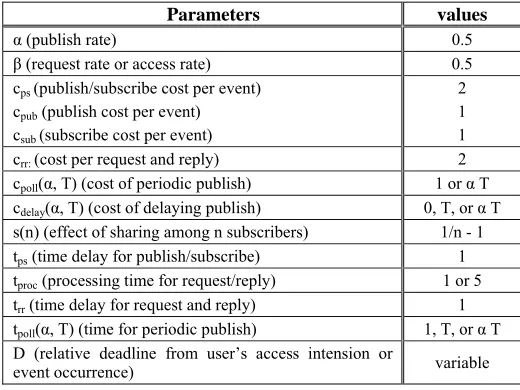
[image:7.612.162.422.288.483.2]In this section, we describe performance comparisons by parametric analysis. We set system parameters as follows:
Table 3. System parameters for analysis
Parameters values
α (publish rate) 0.5
β (request rate or access rate) 0.5
cps (publish/subscribe cost per event) cpub (publish cost per event) csub (subscribe cost per event)
2 1 1
crr: (cost per request and reply) 2
cpoll(α, T) (cost of periodic publish) 1 or α T
cdelay(α, T) (cost of delaying publish) 0, T, or α T
s(n) (effect of sharing among n subscribers) 1/n - 1
tps (time delay for publish/subscribe) 1
tproc (processing time for request/reply) 1 or 5
trr (time delay for request and reply) 1
tpoll(α, T) (time for periodic publish) 1, T, or α T
D (relative deadline from user’s access intension or
event occurrence) variable
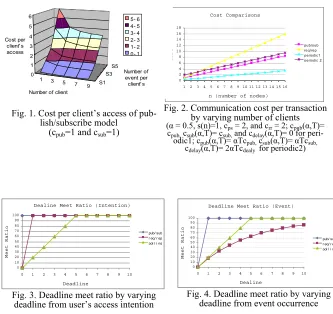
Fig.2 shows performance comparisons between publish/subscribe, request/reply, and polling systems. In this experiment, cost is communication cost for each transac-tion. Since publish/subscriber system disseminates data via server instead of indivi-dually for each client, it requires less cost than request/reply system. As the number of client node increases, the cost gap between two systems increases. Periodic polling system saves cost by transferring data once per period when delay cost is negligible. However, cost increases as delay cost increase. Polling system is viable approach for applications where data delay is allowed and delay cost is negligible.
Fig. 1. Cost per client’s access of pub-lish/subscribe model
(cpub=1 and csub=1)
Cost Comparisons 0 2 4 6 8 10 12 14 16 18
1 2 3 4 5 67 8 9 10 11 12 13 14 15 16 n (number of nodes)
Co
st
[image:8.612.143.476.133.447.2]pub/s ub req/rep periodic 1 periodic 2
Fig. 2. Communication cost per transaction by varying number of clients
(α = 0.5, s(n)=1, cps = 2, and crr = 2; cpub(α,T)= cpub, csub(α,T)= csub, and cdelay(α,T)= 0 for
peri-odic1; cpub(α,T)= αTcpub, csub(α,T)= αTcsub, cdelay(α,T)= 2αTcdealy for periodic2)
Dealine Meet Ratio (Intention)
0 10 20 30 40 50 60 70 80 90 100
0 1 2 3 4 5 6 7 8 9 10 Deadline
Meet
Ra
tio pub/ sub
r eq/ r ep pol l i ng
Fig. 3. Deadline meet ratio by varying deadline from user’s access intention
Deadline Meet Ratio (Event)
0 10 20 30 40 50 60 70 80 90 100
0 1 2 3 4 5 6 7 8 9 10 Dealine
Meet Ratio
pub/ sub r eq/ r ep pol l i ng
Fig. 4. Deadline meet ratio by varying deadline from event occurrence
3.2 Experimental Results
To verify the simulated result, we conducted empirical experiment using embedded system clients and a message brokering system. The purpose of our experiment was to get actual cps (tps) and crr (trr) which are publish/subscribe cost (i.e. time delay) per event and request and reply cost (i.e. time delay), respectively, for both different message sizes and numbers of clients in a practical environment. The experiment environment consists of NaradaBrokering system which is message brokering system with HHMS (Held Message Service) [18] Proxy plug-in for mobile and embedded client. NaradaBrokering is developed at the Community Grids Laboratory at Indiana University. It is a content distribution infrastructure which supports asynchronous publish/subscribe communication model and originally designed for a uniform soft-ware multicast to support a real-time collaboration. We choose to use HHMS for the experiments because mobile or embedded devices are popular choice of client in distributed real-time system.
1 3 5 7 9 S1 S3 S5 0 1 2 3 4 5 6 Cost per client' s access
Number of client
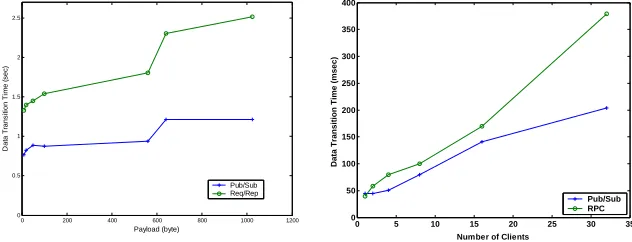
We performed two types of experiments. First is the experiment to measure the da-ta transition time between an event source (publisher) and an event displayer (sub-scriber) by varying the size of message (i.e. size of payload). We performed on the wireless environment which is common network environment for distributed real-time system such as military system on the field. Since correct measurement of data transition time on the embedded device is not easy task to achieve, we measured a round trip time (RTT) on the event source and get cps = RTT where cps = cpub + csub. A client application (i.e. subscriber) on Treo 600 mobile phone device [19] which is connected to Internet through 2nd generation CDMA service just echoes back message from the event source (i.e. publisher) which runs on Linux machine. We did the same to get crr, ‘Cost of request/reply event.’
The experiment result of the data transition time of publish/subscribe message (tps) and the data transition time of request/reply message (trr) is shown in Fig.5. From the graph, we can get the relationship between tps and trr.
trr = tps + k, (1) where k is constant. The k is relatively small to tps and trr if we increase the size of message (i.e. payload). Thus, our system parameter setting in section 3.2, cps = crr and tps = tr are valid
The second experiment is to measure the communication cost per transaction for varying number of clients. Conducting an experiment with large number of client is not acceptable in many cases and we were in the same situation where we have li-mited number of mobile embedded devices. Thus, we performed the experiments using J2ME simulators. It is not a quite similar experimental environment compare to “simulation result” in section 3.1. The simulator in this experiment is a software plat-form where the actual application runs on, thus it is more like to make an application run on a virtual device. The experimental result is shown in Fig. 6. From the result, we can see that the curves on both Fig. 2 and Fig. 6 are much resembled. Using these verified parameters, we perform simulations for comparing real-time performance (deadline meet ratio) Thus, we verify our simulation result.
0 200 400 600 800 1000 1200 0
0.5 1 1.5 2 2.5
Payload (byte)
D
a
ta
T
rans
it
ion T
im
e
(
s
ec
)
[image:9.612.155.471.491.612.2]Pub/Sub Req/Rep
Fig. 5. Delay time by Payload
0 5 10 15 20 25 30 35
0 50 100 150 200 250 300 350 400
Number of Clients
D
a
ta Transition Time (msec)
Pub/Sub RPC
The experiment is performed on a Linux machine equipped with Pentium III 1GHz CPU and 512MB memory and a mobile embedded device, Treo 600 equipped with 33MHz Motorola Dragonball processor and 8MB of memory. Time is measured with the Linux native timer by JNI. The subscriber application on mobile embedded device is written in Java Micro Edition for embedded and mobile device with MIDP 2.0.
4. Conclusion
Although publish/subscribe system has been popular in distributed real-time sys-tem recently, cost analysis model is not been suggested and verified yet. In this paper, we present our cost analysis model for publish/subscribe systems especially in distri-buted real-time system domain. The empirical result from our test bed verifies our cost model. By providing the simulation result and the empirical result which is based on our cost analysis model, we give theoretical proof to the known claim, the pub-lish/subscribe system is well suited for distributed real-time system.
5. References
[1] P. Eugster, P. Felber, R. Guerraoui, and A. Kermarrec, “The Many Faces of Publish/Subscribe,” ACM Computing Survey, vol. 35, pp. 114-131, June 2003. [2] R. Rajkumar, M. Gagliardi, and L. Sha, “The Real-time Publisher/subscriber
inter-process communication model for distributed real-time systems: design and implementation,” In Proceedings of the 1st IEEE Real-time Technology and Ap-plication Symposium, pp. 66-76, May 1995.
[3] J. Kaiser and M. Mock, “Implementing the Real-Time Publish/Subscriber Model on the Controller Area Network (CAN),” In Proceedings of the 2nd IEEE Inter-national Symposium on Object-Oriented Real-Time Distributed Computing, pp 172-182, May 1999.
[4] Y. Huang and H. Garcia-Molina, “Publish/Subscribe in a Mobile Environment,” Wireless Networks, vol.10, pp 643-562, 2004.
[5] G. Deng, M. Xiong, A. Gokhale, and G. Edwards, “Evaluating Real-time Pub-lish/Subscribe Service Integration Approaches in QoS-enabled Component Mid-dleware,” In Proceedings of the 10th IEEE International Symposium on Object-oriented Real-time Distributed Computing (ISORC), May 2007.
[6] P. Costa, M. Migliavacca, G. Picco, and G. Cugola, “Epidemic Algorithms for Reliable Content-Based Publish-Subscribe: An Evaluation,” In Proceedings of the 24th International Conference on Distributed Computing Systems (ICDCS04), 2004
[7] J. Pereira, F. Fabret, F. Llirbat, and D. Shasha, “Efficient Matching for Web-Based Publish/Subscribe Systems,” In Proceedings of the 7th International Con-ference on Cooperative Information Systems, pp. 162 - 173, 2000.
Networked System Design and Implementation (NSDI), San Jose, California, May 2006.
[9] M. Caporuscio, A. Carzaniga, and A. Wolf, “Design and Evaluation of a Support Service for Mobile, Wireless Publish/Subscribe Applications,” IEEE Transac-tions on Software Engineering, vol. 29, no. 12, pp. 1059 – 1071, Dec. 2003. [10]Carzaniga, D. Rosenblum, and A. Wolf, “Design and evaluation of a wide-area
event notification service,” ACM Transactions on Computer Systems, vol. 19, pp. 332-382, August 2001.
[11]M. Aguilera, R. Strom, D. Sturman, M. Astley, and T. Chandra, “Matching events in a content-based subscription system,” In Proceedings of the 18th an-nual ACM symposium on Principles of distributed computing pp. 53 – 61, May 1999.
[12]G. Cugola, E. Di Nitto, A. Fuggetta, “The JEDI Event-based infrastructure and its Application to the Development of the OPSS WFMS,” IEEE Transactions of Software Engineering, vol. 27, issue 9, pp. 827-850, September 2001.
[13]L. Fiege, G. Muhl, and F. Gartner, “A Modular Approach to Building Event-Based Systems,” In Proceedings of the 2002 ACM Symposium on Applied Computing, pp. 385-392, 2002
[14]Antony I. T. Rowstron, Anne-Marie Kermarrec, Miguel Castro, and Peter Drus-chel, "SCRIBE: The design of a large-scale event notification infrastructure," in Networked Group Communication, 2001, pp. 30--43
[15]B. Segall, D. Arnold, J. Boot, M. Henderson and T. Phelps, “Content Based Routing with Elvin4,” In Proceedings of AUUG2K, Canberra, Australia, June 2000.
[16]G. Pardo-Castellote, “OMG Data-Distribution Service: Architectural Overview,” In Proceedings of the 23rd International Conference on Distributed Computing Systems, pp. 200-206, May 2003
[17]S. Pallickara and G. C. Fox, “ NaradaBrokering: A Middleware Framework and Architecture for Enabling Durable Peer-to-Peer Grids,” In Proceedings of ACM/IFIP/USENIX International Middleware Conference Middleware2003, Rio de Janeiro, Brazil, June 2003.
[18]S. Oh, G. C. Fox, and S. Ko, “GMSME: An Architecture for Heterogeneous Collaboration with mobile Devices,” In Proceedings of The Fifth IEEE/IFIP Conference on Mobile and Wireless Communications Networks, Singapore, Oc-tober 2003.