UNIVERSITI TEKNIKAL MALAYSIA MELAKA
FIVE AXIS TOOL PATH PROGRAMMING UTILIZING CATIA
V5 FOR SINGLE BLADE
This report submitted in accordance with requirement of the Universiti Teknikal Malaysia Melaka (UTeM) for the Bachelor Degree of Manufacturing Engineering
Technology (Process and Technology) (Hons.)
BY
CHENG WEI CHIAT
B071310393
911019-01-5091
I
DECLARATION
I hereby, declared this report entitled “FIVE AXIS TOOL PATH PROGRAMMING UTILIZING CATIA V5 FOR SINGLE BLADE” is the results of my own research
except as cited in references.
Signature : ………
Name : CHENG WEI CHIAT
Date : ………
II
APPROVAL
This report is submitted to the Faculty of Engineering Technology of UTeM as a partial fulfilment of the requirements for the degree of Bachelor of Manufacturing Engineering Technology (Process and Technology) with Honours. The member of the supervisory is as follow:
……….
(Project Supervisor)
III
ABSTRAK
IV
ABSTRACT
V
DEDICATIONS
VI
ACKNOWLEDGMENTS
First and foremost, I would like to thanks to my beloved university, Universiti Teknikal Malaysia Melaka (UTeM) giving me this opportunity to explore myself in new thing. I would like to thanks God for blessing, I have successfully complete my Final Year Project. High appreciate to my supervisor, En. Syahrul Azwan Bin Sundi @ Suandi and co-supervisor En. Muhammad Syafik Bin Jumali for the motivation and guidance during doing the research.
Special thanks to everyone who help me to accomplish the research. I would like to take this opportunity to express my gratitude to all technicians and assistance engineers in UTeM which given fully assistance to me for this research study.
VII TABLE OF CONTENT
DECLARATION ... I
APPROVAL ... II
ABSTRAK ... III
ABSTRACT ... IV
DEDICATIONS ... V
ACKNOWLEDGMENTS ... VI
TABLE OF CONTENT ... VII
LIST OF FIGURE ... X
LIST OF TABLE ... XIII
LIST OF ABBREVIATIONS, SYMBOLS AND NOMENCLATURE ... XIV
... 1
1.0 Introduction ... 1
1.1 Background ... 1
1.2 Problem Statement ... 2
1.3 Objectives ... 3
1.4 Scope ... 3
... 5
2.0 Introduction ... 5
2.1 Five axis Machining ... 5
2.1.1 Five axis CNC Milling Machine Configurations ... 6
2.1.2 Advantages of Five axis Milling Machining Center ... 9
2.2 Machining Strategies ... 9
2.2.1 Flank Milling ... 11
VIII
2.2.3 Inclined Tool ... 12
2.3 Aluminum Alloy ... 13
2.4 Dimensional Accuracy ... 14
... 16
3.0 Introduction ... 16
3.1 Project Planning ... 17
3.1.1 Phase 1 ... 18
3.1.2 Phase 2 ... 19
3.2 Computer Aided Design (CAD) ... 21
3.2.1 CAD Model Modification ... 21
3.2.2 Stock ... 21
3.2.3 Plane system ... 22
3.2.4 CAD Model and Plane System Assembly ... 23
3.3 Preparation ... 23
3.3.1 Cutting Tools ... 23
3.3.2 Jig and Fixture ... 25
3.4 Computer Aided Manufacturing (CAM) ... 25
3.4.1 Part Operations ... 25
3.4.1.1 Define the Machine ... 26
3.4.1.2 Define Reference Machining Axis System ... 27
3.4.2 Manufacturing Program ... 29
3.5 Post Processor ... 37
3.6 Physical machining ... 40
3.7 Three axis CAM and Physical Machining ... 44
3.8 Measurement ... 47
... 49
IX
4.1 Result and Discussion ... 49
4.1.1 Comparison CAD model and CAM result ... 49
4.1.2 Dimensional Accuracy Analysis ... 52
... 57
5.0 Introduction ... 57
5.1 Conclusion ... 57
5.2 Future work ... 58
APPENDICES ... 59
X
LIST OF FIGURE
Figure 1.1: Assembled blade ... 1
Figure 1.2: Blisk Blade ... 2
Figure 2.1: Table-Table BC type ... 7
Figure 2.2: Table-Tool BC type ... 7
Figure 2.3: Table-Tool BC type (turn-mill) ... 7
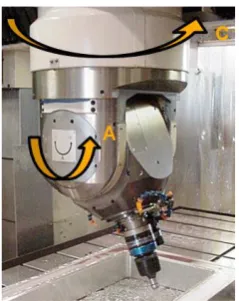
Figure 2.4: Tool-Tool AC type ... 8
Figure 2.5: Machining strategies ... 10
Figure 2.6: Flank Milling ... 11
Figure 2.7: Overcut and undercut... 11
Figure 2.8: Point milling ... 12
Figure 2.9: Cutting Force against Tool Axis Inclination Angle... 13
Figure 3.1: Flow Chart ... 17
Figure 3.2: Original CAD Model ... 18
Figure 3.3: Machining strategies of CATIA V5 ... 20
Figure 3.4: CAD Model modification ... 21
Figure 3.5: Stock dimension ... 22
Figure 3.6: Plane System ... 22
Figure 3.7: Assembled CAD model with plane system ... 23
Figure 3.8: End mill terminology ... 24
Figure 3.9: Jig and Fixture ... 25
Figure 3.10: Part operations ... 26
Figure 3.11: Selected machine and post processor ... 26
Figure 3.12: Selected reference axis ... 27
Figure 3.13: Selected product ... 27
Figure 3.14: Selected Part ... 28
Figure 3.15: Selected Stock... 28
Figure 3.16: Selected tool ... 29
Figure 3.17: Five axis manufacturing program sequence ... 30
Figure 3.18: Flow chart of machining process perform ... 31
Figure 3.19: CAM setting of Point to Point operation 1 ... 32
XI
Figure 3.21: CAM setting of Point to Point operation 3 ... 32
Figure 3.22: CAM setting of Point to Point operation 4 ... 33
Figure 3.23: CAM setting of roughing operation 1 (Geometry Page) ... 34
Figure 3.24: CAM setting of roughing operation 2 machining (Strategy Page) ... 34
Figure 3.25: CAM setting of roughing operation 3, radial (Geometry Page) ... 34
Figure 3.26: CAM setting of roughing operation 4, axial (Geometry Page) ... 35
Figure 3.27: Geometry setting of CAM setting of multi axis helix machining operation ... 36
Figure 3.28: Radial on strategy page of CAM setting of multi axis helix machining operation ... 36
Figure 3.29: Tool axis on strategy page of CAM setting of multi axis helix machining operation ... 37
Figure 3.30: Tool path of multi-axis helix machining ... 37
Figure 3.31: Flow chart of post processor ... 38
Figure 3.32: APT. source format converted to .H file ... 38
Figure 3.33: In/out page of Post process ... 39
Figure 3.34: Tool Motions of Post process ... 39
Figure 3.35: Formatting of Post Process ... 39
Figure 3.36: Deckel Maho DMU 60 monoBLOCK... 40
Figure 3.37: Specification of Deckel Maho DMU 60 MonoBLOCK ... 40
Figure 3.38: Simulation ... 41
Figure 3.39: Error in Program ... 41
Figure 3.40: Troubleshoot formatting ... 42
Figure 3.41: Troubleshoot edit program ... 42
Figure 3.42: Roughing process with five axis machine ... 42
Figure 3.43: Error in Tool change ... 43
Figure 3.44: Error in Exchange buffer battery ... 43
Figure 3.45: WPC set up in three axis machining ... 44
Figure 3.46: Three axis manufacturing program sequence ... 44
Figure 3.47: Tool path of three axis machining first WPC ... 45
Figure 3.48: CAM result of three axis machining first WPC ... 45
Figure 3.49: Tool path of three axis machining second WPC ... 46
XII
Figure 3.51: Physical machining in three axis machining ... 47
Figure 3.52: Process Analysis by CMM (Coordinate Measure Machine) ... 48
Figure 3.53: Measurement of Single Blade... 48
Figure 4.1: Comparison convex side CAM and CAD model done by five axis machining ... 50
Figure 4.2: Comparison convex side of CAM and CAD model done by three axis machining ... 50
Figure 4.3: Comparison concave side five axis machining CAM and CAD model .. 51
Figure 4.4: Comparison concave side three axis machining CAM and CAD model 51 Figure 4.5: Start and End Point of concave side physical and direct probing curves 52 Figure 4.6: Start and End of Point of convex side physical and direct probing curves ... 52
Figure 4.7: Best fits Accuracy of Concave and Convex ... 54
Figure 4.8: Concave curve 1 result from CMM ... 56
XIII
LIST OF TABLE
Table 2.1: Types of five axis machines 6
Table 2.2: Aluminum Alloy Designation System 14
Table 3.1: Selected Cutting Tools 24
XIV
LIST OF ABBREVIATIONS, SYMBOLS AND
NOMENCLATURE
CNC - Computer Numerical Control
CAD - Computer Aided Design
CAM - Computer Aided Manufacturing
CATIA - Computer Aided Three-Dimensional Interactive Application CMM - Coordinate Measuring Machine
CMCs - Composite Matrix Composites
NASA - National Aeronautics and Space Administration ALCOA - Aluminium Company of America
NC - Numerical Control
1
INTRODUCTION
1.0 Introduction
This chapter presents about project background of the proposed research. It also discusses problem statements, objectives, scope and organization.
1.1 Background
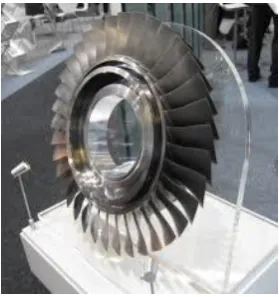
[image:16.595.256.396.588.737.2]Aeronautic is a business in still developing sector and no doubt aircraft is an expensive process. The difficulty of manufacturing complex geometry aircraft parts especially engine part makes most of the components costly. Worldwide air traffic level prediction foresees a quick continuous development, expecting the number of planes to increase at a normal of more than three percent by 2030. The expanding of the aeronautics business represents a challenge in aero engine manufacturing because of demanding productivity and quality of manufacturing increase. (Kappmeyer et al., 2012) Blisk (Figure 1.1) is a turbo machine component that combine of both rotor disk and blades. There is also a design where disk and blades are fabricated in a single piece.
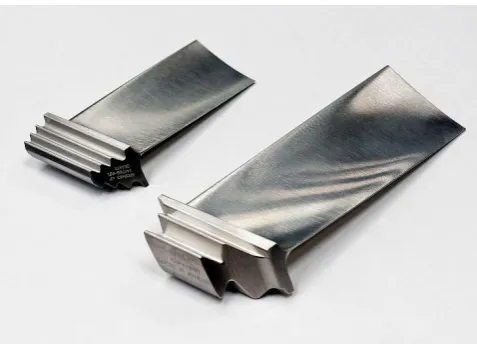
2 These sharp edge (Figure 1.2) are required to be replace in case there are any damage to the blades beyond minor dents. Blisk can be fabricated by machining from a forged part, cast part or by welding blades to a disk. However, these techniques are usually not suggested in critical application by concern fatigue (Broomfield, 1986). The right way to manufacture components for the aerospace industry is critical, CNC machining allowing for the manufacture of perfect parts within special designed aerospace machining center. Aircraft engines are high technology product, the manufacture of which involves creative techniques. Aero-engines face up to the need of continuous improving of its technical capabilities in terms of achieving higher efficiencies with regard to lower fuel consumption, enhanced reliability and safety.
Figure 1.2: Blisk Blade
1.2 Problem Statement
3 combination of machine and control is operating very precisely, there would be contour deviations on the surface if no further measures were taken. Quality control is required to ensure blisk reliable performance. It is a big challenge to obtain high accuracy single propeller blade. Since propeller blades are machined first on one side and then on the other side, it is necessary to flip the propeller. Flipping propeller model on the machining fixture is not accurate enough. Small errors in position and orientation can result in very large errors at the tip and poor alignment between blade face and back surface. Therefore, initial set-up and alignment of rotary table is great importance for five axis machining.
To obtain high accuracy machined part and the way of programmer tailor CAM programming for machined part is a challenge for CAM users. The choice of five axis machining strategy depend on the material, machine, available tools, and holders. Additionally, the limited of the different rotation axes of milling machine should be considered when creating five axis tool path. However, five axis tool path may not run optimal on any machine by default setting.
1.3 Objectives
The objectives of this research are as follows:
a) To create and validate the five axis machining tool paths utilizing CATIA V5 for a single blade.
b) To investigate the effect dimensional accuracy on machined part to be compared to the CAD model.
1.4 Scope
5
LITERATURE REVIEW
2.0 Introduction
Literature review discuss about the relevant information and survey the literature in relevant area of study. At early stage of the studies, gather the reference books, research journals, online article, and magazine as the main sources of thesis guides. Followed by critically analyses the information to ensure that are relevance of this research by showing limitations of theories and points of view. This section included the principle of five axis machining, machining strategies, multi axis helix, multi axis flank machining, dimensional accuracy, and aluminum.
2.1 Five axis Machining
6 It is a challenging task for machining mechanical parts such as turbine blades, impeller and compressor blade with high dimensional accuracy and high geometrical complexity. In order to obtain ideal dimensional accuracy, the incline angle must be keep within the limits. Three-axis CNC are always falls out of the limits, therefore it is much harder to achieve required accuracy. Five axis CNC machining center can be easily corrected the tool position which need extra maintenance and cost. The extra cost can be cover by the benefits of lower tool wear, shorter planning and the quality of work is improved. In addition, five axis machining able to maintain constant cutting forces along the tool path by setting the feed rate which able to reduce machining time significantly. (Layegh et al., 2012).
2.1.1 Five axis CNC Milling Machine Configurations
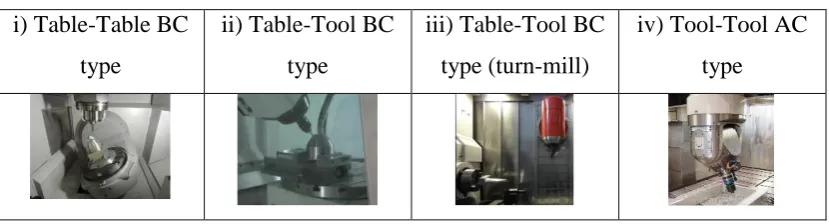
[image:21.595.120.535.505.617.2]Basically, machine tool has six degrees of freedom and can by moving tool at any position, while milling machine structure has five degrees of freedom. There are some common machine configuration for five axis that are available in current market. The most common types of five axis machining center are table-table, table-tool, table-tool (turn-mill), and tool-tool.
Table 2.1: Types of five axis machines i) Table-Table BC
type
ii) Table-Tool BC type
iii) Table-Tool BC type (turn-mill)
iv) Tool-Tool AC type
7 Figure 2.1: Table-Table BC type
[image:22.595.295.410.286.417.2]The table still rotate in C axis but the head of machine can be tilt.
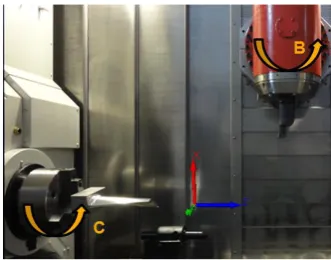
Figure 2.2: Table-Tool BC type
Turn-mill is the combination of milling machining center and turning machining. The turning spindle become the C-axis to rotate the part and the tilting of the tool is driven by the B-axis. The linear axis are located on lathe, with the Z- positioned horizontally along the spindle axis instead of vertically along the tool axis.
[image:22.595.269.435.586.716.2]8 Both rotary axes are located on the milling head to rotate and tilt the tool into desired position, while the table is stationary for AC type five axis milling machine center. This design allow to machine heavier parts compared to table-table type of machine. Because the table-table does not tilt, and is suitable-table for a very rigid setup for larger parts. Furthermore, the rotating head allows to use the shorter length tooling because the tool can enter or rotate around the part. With this, can greatly reduce the vibration of tool and increase the accuracy of parts.
Figure 2.4: Tool-Tool AC type
9 2.1.2 Advantages of Five axis Milling Machining Center
With expanding the demand for the performance design, mechanical element having complex shape and accuracy are needed to be manufactured in tight tolerances. In manufacturing high end designs, the complex part has to be created by maintaining the dimensional accuracy with minimum number of setups which required tool positioning and contouring capability. Five axis milling has been widely used in automotive, aerospace and die-mold industries. These shapes are known as free form surfaces, which cannot expressed analytically with ease. Precision casting, forming, forging, injection, blowing, pressing and other are the production technologies that can effectively fabricated free form surfaces parts. Today, these complex shapes are possible to produce a complete part with five axis milling centres aided of CADCAM system by only one clamping (Pokorný et al, 2012).
2.2 Machining Strategies
There are several of tool path strategies selection in CAM systems and each of them are appropriate place in five axis. For a particular application, the suitable tool path strategies can be vary. It is depend on programmer experience, lesson learned from the past project and the actual machine configuration will playing the big role in selection. Therefore, different programmers to program a same part, the outcome will be likely to totally different machining strategies. Available tooling and specified material could play a critical role in selection of tool path strategies process.