..
w
w
***
* *
*
** **
*
*
*****
*
*
*
*
***
*
***
*
***
* *
* *
***
* *
* *
L'Observatoire europeen
du textile et de l'habillement
FIGURES
AND FACTS
IN THE WORLD
FIGURES AND FACTS IN THE WORLD OF TEXTILES
BASIC STRUCTURAL DATA ON THE EC
TEXTILE AND CLOTHING INDUSTRY
1988-1992
Part One
CONTENTS
INTRODUCTION
I. FACTUAl ANAlYSIS
II.
Ill.
IV.
1.
2.
The importance of the textile and clothing industry in the European Community in 1992
Evolution between 1988 and 1992
TABlES
1992
1988 - 1992
METHODOlOGY USED
1.
2.
Objectives and methodology of the Working Group on Structural Data
Background to the basic structural data
USERS' NOTES
PAGE:
1
2
3
12
29
30
31
LIST OF GRAPHS :
1. EMPLOYMENT 1992
2. PRODUCTION 1992
3. TURNOVER 1992
4. VALUE ADDED PER EMPLOYEE 1992
5. EMPLOYMENT 1988-1992
LIST OF TABLES :
1. THE STRUCTURE OF THE EC TEXTILE AND CLOTHING
INDUSTRY - 1992
2. THE STRUCTURE OF THE EC TEXTILE INDUSTRY
(NACE 43
+
455) - 19923. THE STRUCTURE OF THE EC CLOTHING INDUSTRY
(NACE 453
+
454) - 19924. THE STRUCTURE OF THE TEXTILE AND CLOTHING
INDUSTRY 1988-1992, EC
5. THE STRUCTURE OF THE TEXTILE AND CLOTHING
INDUSTRY 1988-1992, BELGIUM
6. THE STRUCTURE OF THE TEXTILE AND CLOTHING
INDUSTRY 1988-1992, LUXEMBOURG
7. THE STRUCTURE OF THE TEXTILE AND CLOTHING
INDUSTRY 1988-1992, DENMARK
8. THE STRUCTURE OF THE TEXTILE AND CLOTHING
INDUSTRY 1988-1992, GERMANY
9. THE STRUCTURE OF THE TEXTILE AND CLOTHING
INDUSTRY 1988-1992, GREECE
10. THE STRUCTURE OF THE TEXTILE AND CLOTHING
INDUSTRY 1988-1992, SPAIN
11. THE STRUCTURE OF THE TEXTILE AND CLOTHING
INDUSTRY 1988-1992, FRANCE
12. THE STRUCTURE OF THE TEXTILE AND CLOTHING
INDUSTRY 1988-1992, IRELAND
13. THE STRUCTURE OF THE TEXTILE AND CLOTHING
INDUSTRY 1988-1992, ITALY
14. THE STRUCTURE OF THE TEXTILE AND CLOTHING
INDUSTRY 1988-1992, THE NETHERLANDS
15. THE STRUCTURE OF THE TEXTILE AND CLOTHING
INDUSTRY 1988-1992, PORTUGAL
16. THE STRUCTURE OF THE TEXTILE AND CLOTHING
INTRODUCTION
The aim of this document is to give a concise presentation of structural data on the textile and clothing industry in the European Community.
Emphasis is placed on the importance and structure of this industry in 1992, as well as on its evolution since 1988.
This first part identifies the different sectors within the clothing and textile industries, either separately or as a whole. The second part, which will be published in the autumn, will cover each sector in more detail (e.g. wool, cotton, knitwear, ... ).
I. FACTUAL ANALYSIS
1. The importance of the textile and clothing industry in the European
Community in 1992
The textile and clothing industry remains very important within the Community. In comparison with manufacturing industry, this sector represents some 8. 7% of total employment, 4.8o/o of the value of
production and 5.1% of value added.1
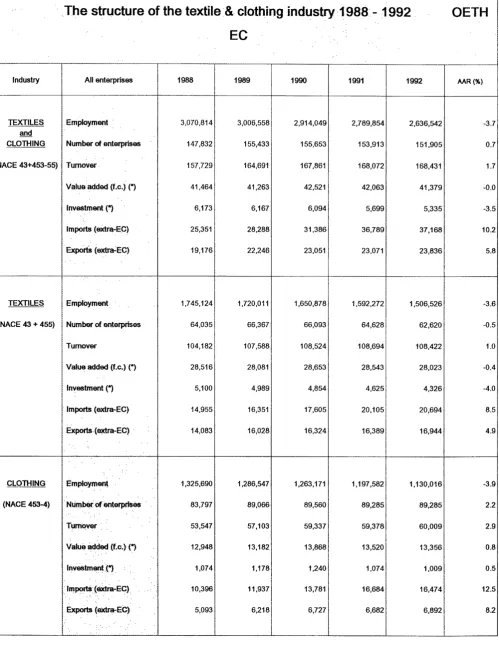
Employing 2,636 million people, with a turnover of more than 168 billion ECU (1985 prices) and investment of nearly 5.4 billion ECU, this remains without doubt a major industrial sector.
The relative importance of the industry differs considerably depending upon both the sectors within it and the various Member States, as was illustrated in detail by the OETH's recent factual report entitled "The EC Textile and Clothing Industry 1991 /1992".
Employment
More than 90% of employment within ~he textile and clothing industry is
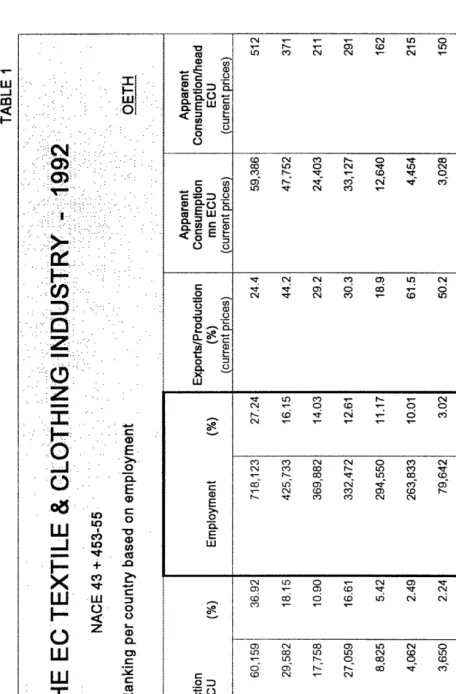
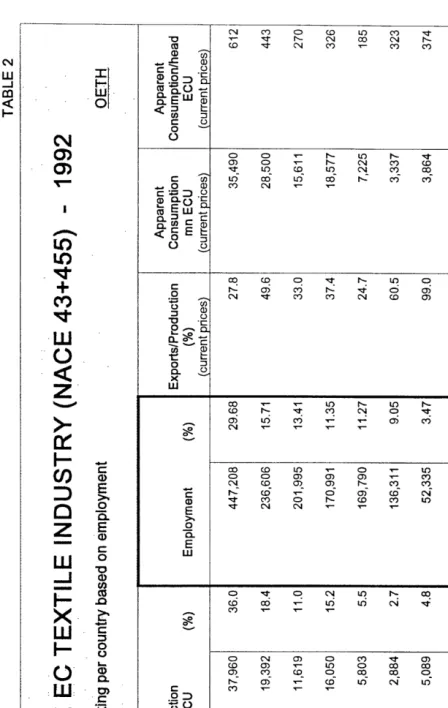
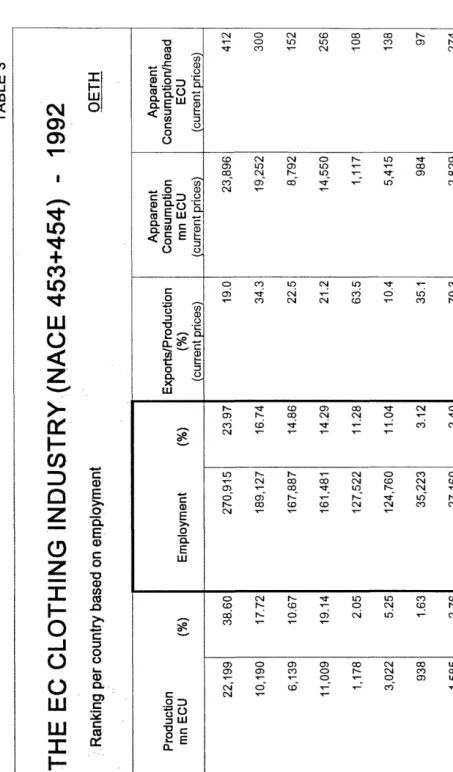
found in six Member States, namely (in decreasing order of importance) Italy (with more than a quarter of the EC's total employment in this industry), Germany, United Kingdom, France, Spain and Portugal. The importance of these Member States is relatively similar in both textiles and clothing, although, in absolute terms, the majority of employment in the industry is in the textile sector, which represents 57% of the entire industry. This total volume of employment emanates from 151 ,905 enterprises, of which more than 100,000 consist of less than 20 employees (graph 1 and tables 1, 2 and 3).
Production and turnover
The cumulative turnover of Italy, France and Germany makes up 71.8o/o of the total turnover of the textile/clothing industry in the Community (70o/o in textiles, 75.2% in clothing). Furthermore, these countries, along with Belgium, have the highest rates of apparent consumption per inhabitant in the Community (graphs 2 and 3, tables 1,2 and 3).
As to the three Member States who have joined the Community most recently (Spain, Portugal and Greece), their share of the total EC turnover in the industry is 9. 7%, while the corresponding figure for employment is 24.3°/o.
Two-thirds of the turnover of the textile/clothing industry of the Community is generated by the textile industry.
These characteristics are equally valid as concerns production (graph 2) even though the relation between this variable and turnover can vary widely from one Member State to another.
Value added
The value added in enterprises with more than 20 employees in the textile/clothing industry represents 35% of production. With an average level of 23,289 ECU per employee, the textile industry considerably surpasses the clothing industry (nearly 18,000 ECU per employee). This difference would be even greater if the knitting industry were not included within the textile industry (tables 1,2 and 3}.
It is in Belgium that value added per employee in the textile /clothing industry, which is a reliable indicator of productivity, is the highest, followed closely by Italy, the Netherlands, France and Germany. Conversely, Portugal and Greece show the lowest levels of value added per employee, at 15% and 43% of the Community average respectively (graph 4 and tables).
2. Evolution between 1988 and 1992
Employment and number of enterprises
During this period, the industry lost 434,000 jobs in the Community as a whole, of which 153,000 were in 1992 alone (graph 5 and table 1).
In the textile sector the fall in employment at the Community level was 13.6%. Comparing the employment levels in 1992 and 1988, the countries which were the most affected were Greece and the United Kingdom with a 22.5°/o drop, followed by Portugal and Denmark (21.5%), France (19°/o) and Spain (14°/o).
In the clothing industry, again the United Kingdom suffered the worst fall in
employment (28.1 o/o) followed by Italy and Spain (17.5°/o and 16.3°/o
respectively).
The number of enterprises seems on the contrary to have increased by 2. 7% overall in the Community (in the textile/clothing industry). However, it is important to take account of the fact that a revision in the statistical coverage of clothing enterprises in Italy in 1989 makes any comparison with the previous year difficult.
Looking at the 1989-92 period, there was a fall in the number of enterprises in the Community by 3, 500 because of numerous closures in the last two years. This phenomenon differs according to the sectors and the countries under consideration. The clothing industry has recorded better results (the most recently available data being for 1991 ), with the number of enterprises staying constant as opposed to a 5.6% fall in textiles (table 4).
Turnover
The turnover of the EC (at constant prices} and more specifically of the textile/clothing industry is increasing steadily, and has risen 6.8% since 1988. Since 1990, however, the rate of increase has stabilized somewhat with significant variations between the different Member States (graph 6 and tables}.
The largest increases were found in the main producing countries, namely Italy ( 11. 7%), Germany (8°/o), France(15.6°/o) and Belgium ( 17.1 o/o). On the other hand, Portugal's turnover decreased by 15 o/o, as did those of the United Kingdom (1 0.6°/o) and Denmark.
Italy alone generated 35 o/o of the Community's turnover in 1992, while the share of the overall turnover generated by the three countries with the largest turnovers in the Community (Italy, Germany and France) went up from 68. 7o/o to 71.8% between 1988 and 1992.
Value added
The value added of the textile/clothing industry stayed relatively stable, even though a slight fall took place in the last two years in both the textile industry (1.8%) and the clothing industry (1.6%).
Investment
After a steady rise since the beginning of the 80's, investment (at current price levels) in the textile/clothing industry has decreased considerably.
The volume of investment in textiles was, in 1992, at its lowest level since the beginning of the 80's. The amount of investment in the clothing industry is at a significantly lower level than that in the textile industry, but is greater
than it was in the 80's even though there has been a decrease in
investment in this sector of 10.2% between 1990 and 1992.
In 1992, as compared with 1988, the most significant decreases in investment in the industry were in Belgium (19.2%), Italy (17.9%) and Spain (14°/o), while when the same comparison is made for 1991 (the most recently available figures) the most significant decreases in the level of investment were in the United Kingdom (42.1 %) and in Denmark (28°/o).
External trade
During the 1988-1992 period, for the whole textile/clothing industry, Community imports increased (in value) by 46.6o/o and (extra-Community) exports increased by 24.3o/o. The result has been a large increase in the trade deficit in textiles, including knitwear, from 872 million ECU to 3,750 ECU. The trade deficit in woven clothing went from 5,303 million ECU to 9,582 million ECU. In 1992 the deficit stabilized, although this development was due more to a stabilization of imports of textile/clothing products ( 1 o/o increase) rather than to a large increase in exports (only 3.3%).
The largest increases of imports of textiles/clothing, comparing 1992 with 1988, were in Spain (219°/o}, Portugal (90.8°/o), Greece (85 °/o) and Germany (46°/o). As concerns exports, Portugal had the largest rise (44.8 %), followed by Greece (41.5°/o), Germany and the Netherlands (30.3°/o), France (28°/o), Italy and Belgium (24°/o).
Looking now at the export/production ratio in the textile/clothing industry, it must be noted that the highest levels are not found in those Member States who have the most significant levels of production, but (in decreasing order of importance) in the Netherlands, Belgium, Ireland, Denmark and Portugal (table 1).
Employment
1992
Graph
1
F
12.8%
F
F
11.6%
D
D
14.3%
D
24.0%
Other
Other 7.8%
Other
9.8%
8.9%
UK
p
13.7%
E
14.9%
E
11.3%
9.3%
11.0%
UK
p
11.5%
14.2%
10.1%
E
11.3%
Textiles
Clothing
T.
&C.
constant
prices
1985 F
8-L
15.2%
36.0%
Production
1992
D
Graph
2
er
5.8%
E
5.3%
UK
10.7%
B-L
UK
5.5%
36.9%
11.0%
Textiles
Clothing
OETH
F
16.6%
UK
10.9%
T.
&
c.
D Other 7.8%
E
Turnover
1992
constant prices
1985
F
B-L
16.4%
34.6%
D Other 8.6%
E
UK
5.4%
11.1%
Textiles
OETH
Graph
3
F
19.6%
B-L
3.1%~~~
r
5.8%
E
5.0%
UK
10.8%
Clothing
B-L
35.7%
F
17.5%
UK
11.0%
T.
&C.
D
18.6%
Other 7.6%
E
Value
added
per
employee
1992
OETH
35
30
25
20
15
10
000
ECU)
5
0
--- ~
Graph
4
--EC
B
DK
D
GR
E
F
IRL
35
(000 ECU) --I
~Textiles
-
-
---1-~
•
---1-~
~
~
-
----...
'::":'1 :!!-".1
Employment
1988-1992
Graph
5
(unit:
1
,000)
1000~---~DCiothing
800
...
~Textiles
600
:· : : : :· : :.
: :·.
;:;:;:: ... ~~':'""'""':'~:-::·::·::
:·::·,..
..
:· ~~~;mu
!1
I!
!li!
II::
l·f!II!Ii
Iii:
200~~~~~
I··0
OETH
88
D
92
88
F
...
:.
..
:. :;.
... ... ... .. ...::::::::::
~
::::~
:::::::
. : ... : . () () :·., ... r:;.:;.::· ::;;.:;;;:: :: :··:;::;:;;~
:::::~\.
:::;;.;-::"1
.
:.
..
:. : ..
:·::
·: : ·: :·::
·::
. . . . . . ..
.
.
..
I • e e e • ... ..
.
.
..
. ..
.
. . . . . . . ... • : • : • : • : • : •• f--· ·. ·. ·. ·. ·. ·.92
.·
...·.
88
~~--.
:
.-:-.
>:):::>:
~~nun:
·>
:··.
:··.
·:.:·
::::::::::::::::::::~~:
·.·.·.·.·.·.
('
,._
:-·.
!!"
----
···-···---···::~:)/Y.:·-WUHi:::
t
i::·
.
.
.
.
..
~
iii?/?
:·:::
::::::::::::::::::::::::.
~~ ·. ·. ·. •.·
..
·•---·::::::::::::::::::::::::·,...
~~~
: :::::::::: :. . :. : ....
.
·:.
:.
~ ~~::::::::::::::::::::::::.
:: ·: :: ·::::::
·: :: ·:·:.
.'·.'·."·.'·."·.'·. ·•
Turnover
1988-1992
70
60
50
40
30
20
10
0
DCiothing
~Textiles
... I
t I I I I I I I I • I I ...
,..._.,...,..._,...,.., ... I
I I I I I I . .
.
. . . ....
... . . . . . . ..
.
.
..
.
.
I I t I I I I I I I I I I I I I I t I I I t I I I I I I I I I I I I I I I I I I . . . . . ..
I I I I I I I.
.
.
.
.
.
I I I I I I I I I I I I I I I I I I I I I I I I I I I I I I I I I I ..
.
..
.
.
88
..
.
..
.
.
..
.
. ..
. . .. . . . . I I I t t I I I I • t I I I... I
I I I I I I t I I I t t . . . .
.
. . I I t t I I I I I I I I I I I I I I I I t I I I I I I I I I I I I I...
II I I I I I . . . . . . . I I I I I I I I I I I I I ... I I I I I I I
92
I I I I I I I I I I I I I I I I I I I I...
...
... II I I I I I I I I I I I I I I I I I I I I I I I I I
88
...
.
... . ....
.
....
.
....
...
.
• t t t I • t.
...
.
.
.
'..
.
... ... ... ...
....
...
.
.
... . .....
.
. ... ....
0I t • t • 0 •• t • I t ... ·---· ... .
.
.
.
.
.
.
.
... .
...
.
t • I I • • •.
.
92
OETH
D
F
Graph
6
... " ... ••• t •• ..
.
..
.
. ... . ..
. . . . I I I I I I 0 I I I I I I I I I I I I I I I I I I I I I I I I I I I... I
I I I I I I
...
II I I I I I
... I
I I I I I I ...
.
.
..
.
.
. I I I I I I I...
ITABLE 2 " '' ' . ... . . '' "' ''' " "
. ··:::THf:·'ST:R.UCTURE
OF
THE
l=C
TEXTILE
INDUSTRY
(NACE
43+455)
-1992
Constant prices (1985=100) Production per Value added per Country employee employee (*"') ECU ECU Italy 84,882 Germany· 81,959 ·. ·.·.'.· .':' United Kingdom. 57,521 France 93,865 " Spain· 34,178 Port4g~l · .. 21,158 . '. ~eJgiurn· <~>.. :
= · · 97,239 Greece 61,055 . " " '" " : Netherlands : 92,958 Denm:a,rk· 83,983 Ireland 56,272 ... Luxembo4rg. 255,894 EC 69,982 (*): Foreign trade data includes Luxembourg (**): Based on enterprises with 20 employees or more EC foreign trade data only relates to Extra-EC trade.28,552 29,950 22,452 30,336 14,882 4,239 31,293 10,137 30,538 25,658 20,408
000 23,289 · Ranking per country based on employment
Production mn
[image:19.840.36.484.31.739.2]TABLE 3 ..
THE
STRUCTl)RE
OF
THE
EC
CLOTHING
INDUSTRY.(NACE
453+454)
-1992
.. Ranking per country based on emplqyment OETH .. Constant prices (1985~100) ·Country Italy Germany
..
United
Kin~dom ..
France· Portligc:il Spain Greece··
.. . s.elg.iurn ·(*) . · •. . . · .·
Ireland Denmark. .
. . . . Luxembourg ... · · EC Production per employee ECU
81,941 53,879 36,566 68,175 9,238 24,223 26,630 58,358 26,477 63,374 63,151 13,975 50,897
Value added per employee (**•) ECU
26,540 21,210 16,263 22,222 1,819 20,778 7,831 21,598 12,029 17,447 22,802 17,962
(*): Foreign trade data includes Luxembourg
Production mnECU
22,199 10,190 6,139 11,009 1
'178
3,022 938 1,585 264 494 491
6 57,514 (**): Production and Employment data are for enterprises with 20 employees or more (***}: Based on enterprises with 20 employees or more EC foreign trade data only relates to Extra-EC trade. (%) Employment (%) 38.60 270,915 23.97 17.72 189,127 16.74 10.67 167,887 14.86 19.14 161,481 14.29 2.05 127,522 11.28 5.25 124,760 11.04 1.63 35,223 3.12 2.76 27,160 2.40 0.46 9,971 0.88 0.86 7,795 0.69 0.85 7,775 0.69 0.01 400 0.04 100 1 '130,016 100 Exports/Production (%) (current prices)
19.0 34.3 22.5 21.2 63.5 10.4 35.1 70.3 58.7 203.1 65.8 9.8
Apparent Consumption mn ECU (current prices)
23,896 19,252 8,792 14,550 1
'117
5,415 984 2,829 560 2,076 828
80,298 Apparent Consumption/head ECU (current prices)
[image:20.841.36.490.29.801.2]· The structure of the textile:&- clothing industry .1988-.- 1992 _
EC
Industry All enterprises 1988 1989
TEXTILES _ Employment : 3,070,814 3,006,558
and
CLOTHING Number of enterprises 147,832 155,433
(NACE 43+453-55) Turnover- 157,729 164,691
Valua added (f.c.) (*) 41,464 41,263
lnvastmant ('") 6,173 6,167
Imports (eXtra-EC) 25,351 28,288
Exports (extrS.:EC) 19,176 22,246
TEXTILES Employment • - 1,745,124 1,720,011
(NACE 43 + 455) Number of enterprisas 64,035 66,367
Turnover 104,182 107,588
Vai(Je added (f.c.) (*) 28,516 28,081
Investment (*) 5,100 4,989
· Imports (extra-EC) 14,955 16,351
Exports.(extra-EC) - 14,083 16,028
CLOTHING Employmen~ 1,325,690 1,286,547
(NACE 453-4) Numb~ of enterprtses 83,797 89,066
Tum~ver: 53,547 57,103
--Value added (f. c.) (*) 12,948 13,182
_ lnv&stm90t (*) . 1,074 1,178
: lmJ>f?rtS: (extra-EC) = - 10,396 11,937
Exports (extra-EC) 5,093 6,218
Notes:
Values: Mn ECU; Turnover & Value Added are in constant prices (1985=100)
(*):Data for enterprises with more than 20 employees only.
f.c. =at factor cost
NACE 43 Includes the knitting industry
1990 1991 1992
2,914,049 2,789,854 2,636,542
155,653 153,913 151,905
167,861 168,072 168,431
42,521 42,063 41,379
6,094 5,699 5,335
31,386 36,789 37,168
23,051 23,071 23,836
1,650,878 1,592,272 1,506,526
66,093 64,628 62,620
108,524 108,694 108,422
28,653 28,543 28,023
4,854 4,625 4,326
17,605 20,105 20,694
16,324 16,389 16,944
1,263,171 1,197,582 1,130,016
89,560 89,285 89,285
59,337 59,378 60,009
13,868 13,520 13,356
1,240 1,074 1,009
13,781 16,684 16.474
6,727 6,682 6,892
TABLE 4
OETH
AAR(%)
-3.7 0.7 1.7 -0.0 -3.5 10.2 5.8
-3.6 -0.5 1.0 -0.4 -4.0 8.5 4.9
[image:21.573.38.538.59.705.2]The structure of the textile.& clothing industry 1988 - 1992
Belgium
Industry All enterprises 1988 1989 1990
TEXTILES Employment. 86,878 87,541 87,132
and
CLOTHING Number of enterprises 2,930 2,915 2,904
(NACE 43+453-55) Turnover 6,118 6,531 6,995
Value added (f.c.) (*) 1,701 1,833 1,984
Investment(*) 400 367 362
Imports (**) ·. · 4,545 4,908 5,494
Exports (**) 5,329 6,040 6,479
TEXTILES Employment 56,546 56,901 55,505
(NACE 43 + 455) Number of enterprises 1,458 1,472 1,461
Turnover 4,881 5,076 5,348
Value added (f.c.) (*) 1,378 1,445 1,558
Investment (*) 366 331 326
Imports(**) 3,147 3,339 3,610
Exports ('"*) ' ' 4,490 5,057 5,268
CLOTHING · Employment:· 30,332 30,640 31,627
(NACE 453-4) ·Number ot eriterp~es 1,472 1,443 1,443
. '
Turnover .·. 1,237 1,455 1,647
. Value ~dad (f.c.) (, 323 388 426
· Investment·(*) · . • . · · 34 36 36
ImpOrts (**}: • · · 1,398 1,569 1,884
Exports
(*1:.: '
839 983 1,211Notes:
Values: Mn ECU; Turnover & Value Added are in constant prices (1985=100)
(*):Data for enterprises with more than 20 employees only; (**):Foreign trade data Includes Luxembourg.
f.c. = at factor cost
NACE 43 Includes the knitting industry
1991 1992
82,649 79,495
2,857 2,857
6,666 7,168
1,908 1,954
326 323
5,826 6,044
6,625 6,658
53,174 52,335
1,414 1,414
4,940 5,312
1,455 1,485
290 287
3,792 3,814
5,310 5,244
29,475 27,160
1,443 1,443
1,726 1,856
453 469
36 36
2,034 2,230
1,315 1,414
TABLE 5
OETH
MR(%)
-2.2 -0.8 4.2 3.6 -5.1 7.4 5.8
-1.9 -1.0 2.3 2.0 -5.8 5.0 4.1
The structure: of the textile &.cl()thing
industry
1988·
-1992
·luxembourg
Industry All enterprises 1988 1989
TEXTILES Emptoyment · 942
and
CLOTHING Number of enterprises 67
(NACE 43+453-55) Turnover 86
Value added. (f.c~) (*) ...
Investment (j 47
Imports ...
Exports ...
TEXTILES . Employment 523
(NACE 43 + 455) Number of enterprises 21
Turnover 81
Value added (f.c.) (*) · ...
Investment (*) · 47
Imports ...
Exports. ...
CLOTHING Employment 419
(NACE 453-4) Number of en~erprtses 46
Turnover··· 5.1
Value added (f. c.) f") ...
· Investment (,: .. 0.2
ImportS ...
Exports·.=: ...
Notes:
Values: Mn ECU; Turnover & Value Added are in constant prices (1985=100)
(*):Data for enterprises with more than 20 employees only.
f.c. = at factor cost
NACE 43 includes the knitting industry
1990 1991 1992
920 926 926
65 72 72
148 161 161
... ... . ..
5 13 13
... . .. . ..
... ... ...
512 526 526
21 21 21
143 156 156
... . .. ...
5 13 13
... ... ...
. .. ... ...
408 400 400
44 51 51
4.8 4.7 4.7
... ... . ..
0.3 0.2 0.2
... ... ...
... ... ...
TABLE 6
OETH
MR(%)
926 -0.8
72 3.9
161 40.1
. ..
13 30.1
. ..
. ..
526 0.3
21
156 42.7
. .. ...
13 35.3
. .. . ..
. .. . ..
400 -2.3
51 5.8
4.7 -4.0
. ..
0.2 8.3
. ..
The structure of the textile & clothing industry 1988 - 1992
Denmark-·-Industry All enterprises 1988 1989
TEXTILES Employment _ 24,821 23,617
and
CLOTHING Number of_ enterprises 1,224 1,139
(NACE 43+453-55) Turnover 1,756 1,681
Value added (f.c.) (*) 464 389
-Investment- -• 103 114
Imports- _ : - 1,436 1,504
Exports- 990 1,043
TEXTILES Employm~: 15,958 15,136
(NACE 43 + 455) Number of enterprises-- 698 670
Turnover 1,246 1,200
Value added (f.c.) (*) - 358 286
Investment 84 92
Imports - 1,025 1,056
-Exports:: 773 797
-·
-:
CLOTHING · Employment • -· · - 8,863 8,481
(NACE 453-4) _Number of. em~~-: .. 526 469
· TtirlJover<. 510 481
- ..
Val~e ad~f;)(j (f.c,>:{*) _ .- 106 103
. .
·- inve5tm&nt -·: -- 19 22
.
_ hnj,orts· · 411 448
EXpertS- 217 246
.
- -.- . -. . . .
Notes:
Values: Mn ECU; Turnover & Value Added are in constant prices (1985=100)
(*):Data for enterprises with more than 20 employees only.
f.c. = at factor cost
NACE 43 includes the knitting industry
1990 1991 1992
22,319 21,194 20,337
1,022 948 948
1,577 1,567 1,585
431 434 401
91 74 74
1,625 1,952 1,950
1,179 1,326 1,433
13,836 12,976 12,562
607 545 545
1,085 1,079 1,085
292 292 269
67 62 62
1,101 1,283 1,329
876 940 1,035
8,483 8,218 7,775
415 403 403
492 488 500
139 142 132
24 12 12
524 669 621
303 386 398
TABLE 7
OETH
AAR(%)
-4.9 -6.1 -2.5 -3.1 -9.4 8.2 9.7
-5.8 -5.9 -3.3 -6.5 -8.4 6.9 7.6
• The structure•of the:textire
&
clothing industry 1988·--1992
Germany
Industry All enterprises 1988 1989 1990 1991 1992
TEXTILES Employrrient 479,881 478,553
and
CLOTHING Number of enterpnses- - 33,649 33,714
(NACE 43+453-55) Turnover- 29,026 30,748
Value added-(f;c.) (*) -- 8,602 8,790
Investment (•) 1,112 1,187
. Imports 18,898 20,733
Exports 12,176 13,721
TEXTILES Employment 260,794 260,310
(NACE 43 + 455) Number of enterprises 8,801 8,931
Turnover 18,721 19,807
Value added (f.c.) (•) _ - 5,902 5,991
Investment
r>
947 988Imports 11,563 12,436
Exports 9,191 10,236
CLOTHING Employment- . ·- 219,087 218,243
(NACE 453-4) . Nmnoor ot enterprises:• - 24,848 24,783
Turnover 10,305 10,941
-vatueadded (f.c~) (1 · 2,700 2,799
· fnvestrnent
r> • -
165 199· lr(tports 7,335 8,297
~xpoitS 2,985 3,485
Notes:
Values: Mn ECU; Turnover & Value Added are in constant prices (1985=100)
(1: Data for enterprises with more than 20 employees only.
f.c.
=
at factor costNACE 43 includes the knitting industry
468,188 33,090 32,037 8,995 1,302 23,906 14,608
254,540 8,880 20,570 6,144 1,104 13,995 10,731
213,648 24,210 11,467 2,851 198 9,911 3,877
The data for Germany covers former West Germany only, except for import & export data from 1991.
459,787 425,733
32,720 32,351
33,410 31,371
9,513 8,943
1,224 1,104
28,360 27,710
15,296 15,866
251,233 236,606
8,510 8,141
21,559 20,554
6,496 6,178
1,026 906
16,521 16,841
11,165 11,481
208,554 189,127
24,210 24,210
11,851 10,817
3,017 2,765
198 198
11,839 10,869
4,131 4,385
TABLE 8
OETH•
AAR(%)
-2.9 -1.0 2.1 1.1 0.2 10.3 6.9
-2.4 -1.9 2.4 1.2 -0.7 10.0 5.8
The structure of the ·textile & clothing industry: :1988·
~-1992
Greece·
Industry All enterprises 1988 1989
TEXTILES . Employment 96,378 95,076
and
CLOTHING Number of enterprises · 2,010 1,992
(NACE 43+453-55) Turnover 3,403 3,468
Value added·(f.c~) (*) · 762 709
. Investment (j- : 191 176
Imports· 740 1 '111
Exports 1,180 1,494
TEXTILES Employment 57,402 55,699
(NACE 43 + 455) Number of enterprises. 871 862
Turnover 2,672 2,700
Value added (f.c.) (*) 554 497
Investment (*) 164 151
Imports 654 950
EXportS: 905 1,151
CLOTHING Employment:. 38,976 39,377
"
(NACE 453-4) . Number or enterprises • 1,139 1,130
TurnOver 731 768
. VajJ,je added {tc;):
t->
= 208 212Investment ('ry · 27 25
..
hnp<)rts:. 86 161
Experts 275 343
Notes:
Values: Mn ECU; Turnover & Value Added are in constant prices (1985=100)
(j: Data for enterprises with more than 20 employees only.
f.c.
=
at factor costNACE 43 Includes the knitting industry
1990 1991 1992
88,038 82,397 79,642
1,989 1,905 1,905
3,441 3,491 3,483
707 669 621
148 148 148
1,274 1,320 1,369
1,559 1,634 1,670
49,323 46,095 44,419
804 720 720
2,626 2,604 2,528
486 443 403
116 116 116
1,076 1,093 1,109
1,181 1,232 1,278
38,715 36,302 35,223
1,185 1,185 1,185
815 887 955
221 226 218
32 32 32
198 227 260
378 402 392
TABLE 9
OETH
AAR (%)
-4.6
-1.8
0.6
-4.9
-11.9
18.0
9.5
-6.1
-6.1
-1.4
-7.6
-15.6
15.4
9.5
-2.5
2.0
6.9
1.2
10.3
34.8
·The structure of the textile
&
clothing industry 1988 - 1992
Spain·
Industry All enterprises 1988 1989
TEXTILES Employment 346,617 334,330
and
CLOTHING Number of enterprises 16,419 18,298
(NACE 43+453-55) Turnover(•; 8,948 9,269
Value a~ded (tc.) (•) · 3,344 3,636
InveStment · 313 325
Imports 1,197 1,817
Exports 1,654 1,762
TEXTILES Employr,n:ent. 197,617 192,330
(NACE 43 + 455) Number of enterprises 7,661 8,402
Turnover<--> 6,074 6,369
Value added (f.c.) (•). 2,153 2,436
Investment 272 252
Imports 906 1,342
:EXports: . 1,313 1,378
CLOTHING : Empfoym~~ . 149,000 142,000
(NACE 453-4) Number
or
entetprtses. 8,758 9,896Tllffiove~ (") · 2,874 2,900
.. . .
. . .
ValUe added (f. c.)('') 1,191 1,200
h1ve5tment ·. 41 73
lrriports ·: :: : 291 475
. .
. . . . . .
£XPorts: .··
341 384Notes:
Values: Mn ECU; Turnover & Value Added are in constant prices (1985=1 00)
(i: Data for enterprises with more than 20 employees only.
(-;:Turnover Is based on data for production
f.c.
=
at factor costNACE 43 Includes the knitting industry
1990 1991 1992
325,873 313,150 294,550
17,958 17,868 17,599
9,305 8,789 8,825
3,697 3,405 3,380
286 276 263
2,390 3,243 3,826
1,891 1,967 2,054
187,873 180,062 169,790
8,062 7,972 7,703
6,085 5,792 5,803
2,370 2,194 2,210
216 206 193
1,644 2,116 2,344
1,484 1,548 1,599
138,000 133,088 124,760
9,896 9,896 9,896
3,220 2,997 3,022
1,327 1,211 1,170
70 70 70
746 1,127 1,482
407 419 455
TABLE 10
OETH.
AAR(%)
-4.0 1.9 -0.3 0.4 -4.1 34.2 5.6
-3.7 0.3 -1.1 0.9 -8.1 27.5 5.1
The structure of. the textile
&
clothing industry 1988- 1992
France
Industry All enterprises 1988 1989
TEXTILES Employment. 393,370 379,117
and
CLOTHING Number of enterprises 15,293 14,979
(NACE 43+453-55) Turnover 25,555 26,149
Value added (tc~) (*) . · 7,044 6,488
lnv~trnent 898 941
Imports. 9,364 10,643
Exports 6,948 8,033
TEXTILES Employment 211,083 204,402
(NACE 43 + 455) Number of enterprises 5,077 5,080
Turnover 16,012 16,513
Value added (f.c.) (*) 4,729 4,327
Investment 677 689
Imports 6,638 7,393
Exports 5,129 5,780
..
CLOTHING Emr>foyment. : . · · 182,287 174,715
(NACE 453-4) Number ot enterprf$e8 10,216 9,899
·Turriover 9,543 9,636
Value acJd&d {t~c.) · (*) 2,315 2,161
Investment .. 221 252
lmP<>rts
2,726 3,250Expcirts· 1,819 2,253
Notes:
Values: Mn ECU; Turnover & Value Added are In constant prices (1985=100)
(*): Data for enterprises with more than 20 employees only.
f.c. = at factor cost
NACE 43 includes the knitting industry
1990 1991 1992
363,676 351,233 332,472
16,620 16,943 16,871
28,799 29,106 29,545
7,313 7,184 7,090
1,035 953 950
11,716 12,151 12,571
8,501 8,577 8,916
188,926 181,498 170,991
5,048 5,102 5,030
17,344 17,544 17,790
4,612 4,591 4,572
749 681 678
7,925 8,058 8,228
5,935 5,987 6,177
174,750 169,735 161,481
11,572 11,841 11,841
11,455 11,562 11,755
2,701 2,593 2,518
286 272 272
3,791 4,093 4,343
2,566 2,590 2,739
TABLE 11
.·OETH
AAR(%)
-4.1
2.6
3.8
0.4
1.6
7.7
6.6
-5.1
-0.2
2.7
-0.7
0.2
5.6
4.9
-3.0
5.4
5.6
2.9
7.5
12.5
The structure of the_ textile
&
clothing industry 1988 :1992
-
Ireland-Industry All enterprises 1988 1989
TEXTILES Employment 22,521 22,177
and
CLOTHING Number ot enterprises 480 481
(NACE 43+453-55) Turnover 901 938
Value added (f.c.) (j 296 308
Investment _ 49 50
fmp6rts 1,008 1,086
EXports 659 698
TEXTILES Employment - 11,598 11,662
(NACE 43 + 455) Number of enterprises 232 233
Turnover 598 651
Value added (f.c.) (•) 182 201
Investment 40 39
Imports 696 739
-Exports 491 535
CLOTHING EmPJoytnent- : 10,923 10,515
(NACE 453-4) Number ot ent~rprbes 248 248
Turnover · 303 287
.
-Value added (f.c.) {j 114 107
lnve8tinent :· · · - 9 11
trfiP<>rtS :: . : 312 347
Experts-
168 163Notes:
Values: Mn ECU; Turnover & Value Added are in constant prices (1985=100)
(j: Data for enterprises with more than 20 employees only.
f.c. =at factor cost
NACE 43 Includes the knitting industry
1990 1991 1992
22,445 21,672 21,131
488 495 495
920 902 913
310 305 313
50 50 50
1,160 1,211 1,232
736 791 803
11,706 11,375 11,160
240 247 247
627 633 646
200 202 207
39 39 39
783 798 799
563 619 623
10,739 10,297 9,971
248 248 248
293 269 267
110 103 106
11 11 11
377 413 433
173 172 180
TABLE 12
-OETH
MR(%)
-1.6 1.0 0.4 1.4 1.2 5.2 5.1
-0.9 2.1 2.0 3.4 -2.5 3.5 6.2
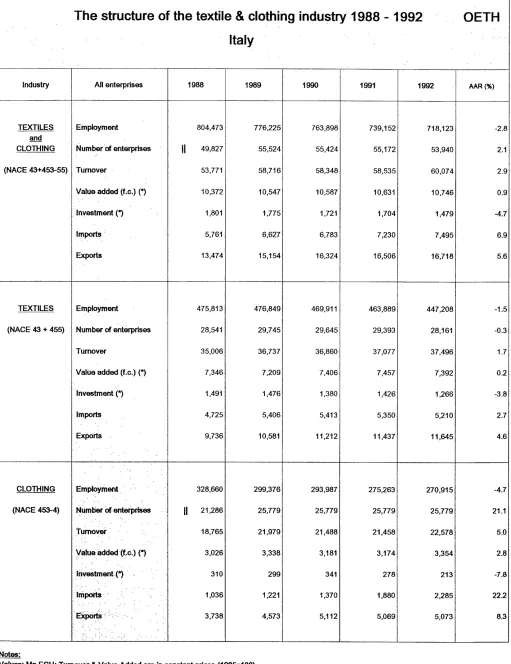
The structure of the textile & clothing industry 1988 - 1992 Italy
Industry All enterprises 1988 1989
TEXTILES . Employment 804,473 776,225
and
CLOTHING Number·of enterprises
II
49,827 55,524(NACE 43+453-55) Turnover · 53,771 58,716
Value added (f.c.) (*) 10,372 10,547
Investment (j 1,801 1,775
Imports: 5,761 6,627
Exports 13,474 15,154
TEXTILES Employment 475,813 476,849
(NACE 43 + 455) Number of enterprises 28,541 29,745
Turnover 35,006 36,737
Value added (f.c.) (*) 7,346 7,209
·Investment ("') 1,491 1,476
Imports 4,725 5,406
Exports 9,736 10,581
CLOTHING Emptoyment . · 328,660 299,376
(NACE 453-4) Nlimber
or
enterprises II 21,286 25,779turnover 18,765 21,979
yalue added (f:c.) {j 3,026 3,338
h1ve5tment .("'} · 310 299
..
· rnipoits · . · 1,036 1,221
EXportS·: 3,738 4,573
Notes:
Values: Mn ECU; Turnover & Value Added are in constant prices (1985=100)
(j: Data for enterprises with more than 20 employees only.
f.c. = at factor cost
NACE 43 includes the knitting industry
II : Break In the data
1990 1991 1992
763,898 739,152 718,123
55,424 55,172 53,940
58,348 58,535 60,074
10,587 10,631 10,746
1,721 1,704 1,479
6,783 7,230 7,495
16,324 16,506 16,718
469,911 463,889 447,208
29,645 29,393 28,161
36,860 37,077 37,496
7,406 7,457 7,392
1,380 1,426 1,266
5,413 5,350 5,210
11,212 11,437 11,645
293,987 275,263 270,915
25,779 25,779 25,779
21,488 21,458 22,578
3,181 3,174 3,354
341 278 213
1,370 1,880 2,285
5,112 5,069 5,073
TABLE 13
OETH
MR(%)
-2.8 2.1 2.9 0.9 -4.7 6.9 5.6
-1.5 -0.3 1.7 0.2 -3.8 2.7 4.6
The
structure of
the
textile
&
clothing= industry
1988 - 1992
The Netherlands.
Industry All enterprises 1988 1989 1990 1991 1992
TEXTILES Employment 31,755
and
CLOTHING Number of enterprises 569
(NACE 43+453-55) Turnover 2,641
Value added (f.c~) (*) 785
lnvestinent
<i
115Imports 5,476
EXports 3,253
TEXTILES Employment ·. 23,005
(NACE 43 + 455) Number of enterprises 432
Turnover 2,098
Value added (f.c.) (*) 631
Investment (*} 107
Imports 3,436
Exports. 2,437
CLOTHING Employment (-} : 8,750
(NACE 453-4) · Num~r of enterprises t"} · 137
Turnover('").· 543
Value·added (f.c.) (*) 154
. . . ..
Investment (*} · 8
Imports 2,040
.. . . :
..
ExJioits. =·: · 816
Notes:
Values: Mn ECU; Turnover & Value Added are in constant prices (1985=100)
(*):Data for enterprises with more than 20 employees only.
f.c.
=
at factor costNACE 43 includes the knitting industry
31,626 30,685 31,121 30,418
593 577 581 581
2,716 2,739 2,829 2,743
819 848 832 773
139 138 134 134
5,845 6,504 7,076 7,127
3,616 3,940 4,180 4,239
23,323 22,504 23,082 22,623
450 442 446 446
2,178 2,185 2,256 2,172
670 693 685 637
119 119 115 115
3,618 3,985 4,325 4,409
2,659 2,828 2,950 2,973
8,303 8,181 8,039 7,795
143 135 135 135
538 554 573 571
149 155 147 136
20 19 19 19
2,227 2,519 2,751 2,718
957 1,112 1,230 1,266
TABLE 14
OETH
AAR(%)
-1.1
0.7
1.0
-0.3
5.8
6.9
6.9
-0.4
1.1
0.9
0.4
2.6
6.5
5.1
-2.8
-0.6
1.3
-3.0
72.5
7.6
The structure ofthe.textile
&
clothing industry 1988- 1992
Portugal
Industry All enterprises 1988 1989
TEXTILES Employment· 289,179 307,202
and
CLOTHING Number of enterprises 9,724 10,084
(NACE 43+453-55) Turnover (*j 4,813 4,006
Value add9d (m.p.) (*) 777 729
Investment · 267 290
Imports 995 1,189
Exports 2,819 3,329
TEXTILES Employment 174,415 171,629
(NACE 43 + 455) Number of enterprises 3,701 3,779
Turnover (-) 3,133 2,869
Value added (m.p.) (*) 596 547
Investment 236 255
Imports 912 1,075
Exports 1,887 2,189
CLOTHING Employment 114,764 135,573
(NACE 453-4) Number ot enterprises . · 6,023 6,305
Turnover.(**}· 1,680 1,137
Value added (m.p.) (*). ·. 181 182
lnvestinao~ · · 31 35
.lmpc:)rb.' 83 114
.. :
~pOrts : .·.· 932 1,140
Notes:
Values: Mn ECU; Turnover & Value Added are in constant prices (1985=100)
(*): Data for enterprises with more than 20 employees only.
(**):Turnover is based on data for production
m.p.
=
at market price; Value added data for textiles is based on NACE 431990 1991 1992
306,151 290,671 263,833
10,881 10,574 10,508
4,242 4,182 4,062
768 767 723
290 290 290
1,500 1,735 1,899
3,775 3,954 4,082
166,215 155,040 136,311
4,576 4,269 4,203
3,071 3,005 2,884
587 582 534
255 255 255
1,333 1,493 1,590
2,434 2,548 2,677
139,936 135,631 127,522
6,305 6,305 6,305
1,171 1,177 1,178
181 185 189
35 35 35
167 242 309
1,341 1,406 1,405
TABLE 15
OETH·
AAR(%)
-2.1 2.0 -3.8 -1.7 8.6 17.7 9.9
-5.9 3.7 -0.9 -0.4 8.1 15.1 9.2
The
structure
of
the textile
& clothing
industry
1988 -- 1992
United Kingdom
Industry All enterprises 1988 1989 1990 1991 1992
TEXTILES Employment _ 493,999 470,174
and
CLOTHING Nurriber Of enterprises 15,640 15,649
(NACE 43+453-55) Turnover 20,711 20,321
Value added (f.c.) (*) 7,317 7,015
Investment ('") 877 798
Imports 9,730 10,334
Expom 4,794 5,044
TEXTILES Employment 260,370 251,258
(NACE 43 + 455) Number of enterprises 6,542 6,722
Turnover 13,660 13,345
Value added (f;c.) (") 4,687 4,472
Investment (*) _ 669 592
Imports 6,914 7,151
Exports. 3,648 3,883
CLOTHING Employment· .. 233,629 218,916
(NACE 453-4) Number of enter_Prtses . 9,098 8,927
-·
Tum0vet· -- 7,051 6,976
.. .. ...
Vah.Je added ([c.) <i . 2,630 2,543
.. ..
lnvestm9rat"f1· 208 206
...
: rrriJX;rts_ = 2,816 3,183
Exports::._ 1,146 1,161
Notes:
Values: Mn ECU; Turnover & Value Added are in constant prices (1985=100)
("): Data for enterprises with more than 20 employees only.
f.c.
=
at factor costNACE 43 includes the knitting Industry
434,718 395,902 369,882
14,628 13,778 13,778
19,297 18,434 18,501
6,881 6,415 6,435
658 507 507
10,402 10,568 10,723
5,314 5,507 5,637
230,013 213,322 201,995
6,307 5,989 5,989
12,567 12,049 11,996
4,305 4,146 4,136
470 396 396
7,136 7,181 7,347
3,968 3,968 4,066
204,705 182,580 167,887
8,321 7,789 7,789
6,730 6,385 6,505
2,576 2,269 2,299
188 111 111
3,266 3,387 3,376
1,346 1,539 1,571
TABLE 16
OETH
AAR(%)
-7.0 -4.1 -2.8 -3.1 -16.5 2.5 4.1
-6.1 -2.8 -3.2 -3.1 -16.0 1.5 2.8
Ill. METHODOLOGY USED
The OETH' s role is the collection and analysis of statistical information relating to the sector of textiles and clothing. It has assembled information on aspects of the industry such as the recent fluctuations within the sector, its structure and its social and technological aspects.
Within this framework, the need for more reliable structural data proved to be urgent. The OETH thus decided to devote a major part of its programme of activities to this matter and, on 19 December 1991, it set up a working group
consisting of experts from Eurostat1, DEBA2, DG 1113, Comitextil4, ECLA5 and
CIRFS6
•
2
3
4
6
6
Eurostat: Statistical Office of the European Community
DEBA: Data for European Business Analysis
DG Ill: Directorate General Industrial Affairs of the Commission of the European Community
COMITEXTIL: Coordination Committee for the Textile Industries in the European Economic Community
ECLA: European Clothing Association
CIRFS: International Rayon and Synthetic Fibres Committee
1. Objectives and methodology of the Working Group on Structural data
The general approach of the OETH is to create a statistical information base in the first instance. Following that, more specific studies will be undertaken.
As far as the collection and improvement of data is concerned, this programme has the following general outline:
making an inventory of sources and of existing statistics, filling the gaps;
comparing professional with official statistics, and analysing the differences;
launching of surveys to correct observed data;
deciding on methods of estimating missing data in order to obtain complete data;
generating new information on specific topics;
creating an appropriate data bank with easy access.
Publications will be prepared on a regular basis, giving both basic information and information on specific topics. This will be done in close collaboration with Eurostat, DEBA and professional associations.
The OETH' s working programme on structural data covers five areas of work:
basic structural data;
regional analysis;
cost structure;
social statistics;
strategic information.
2. Background to the basic structural data
2.1 The Working Group adopted a method of working based on a framework
(priorities, options), the compilation of an inventory of available sources, and on data comparison.
Initially, the exercise was carried out on data for 1988 (sources: annual and
five-yearly surveys (Eurostat), SOCI1, and professional associations' reports
for NACE 43
+
455 and 453+
454, in accordance with the CommunityNomenclature adopted in 1970).
Secondly, an estimation for 1989 and 1990 was carried out in order to
enable the OETH to prepare an interim report sent out in October 1992 to
professional associations, National Statistical Offices and Ministries of Industry.
After contributions and criticisms relating to this report had been analysed,
a historical series was generated, starting in 1988, including a number of
sub-sectors ( NACE 3-digit).
2.2 The following steps were taken by the Working Group:
a) Establishment of a framework.
The definitions of each variable and the correspondence between
NACE 70 and NACE Rev. 1 were provided by Eurostat (Annexes 2
and 3).
For this purpose the Working Group decided to apply the coverage adopted in NACE Rev. 1 for textiles, by combining the existing NACE 43 and 455.
In addition, COMITEXTIL prepared a methodological document concerning the data sent to them by their members.
b) Inventory of available data
The Working Group made an inventory of structural data. This, together with the EC surveys of company structure and activity, and the data from professional associations, PANORAMA and the DEBA data bank (based on the annual survey), constitutes the essential statistical information base.
SOCI: data bank on social statistics, DG V
c) Comparison of sources
Eurostat has made recommendations derived from the results of a comparison of sources. Using these recommendations, and comments made on the interim report, the OETH decided on the data which seemed to it to be the most reliable in terms of cover, definition and estimating method.
2.3 Procedure adopted
In the course of this work it clearly emerged that there could not be a single source which could supply the desired data for all of the sectors of activity, countries and variables.
The question was to decide what to draw from the various sources. In order to do this, the Working Group first of all determined the criteria to be met in choosing between sources. On the basis of these criteria, the data were selected.
a) Desired criteria for data-selection
Three criteria were chosen, namely:
intrinsic quality
*
*
correspondence between what the data measures and what the user requires;
precision (do the data measure what they are intended
to measure ?);
consistency with other series
*
can the data be compared with those for othercountries, industries and variables ?
the most recent data available.
b) The concept of the organization of data by the OETH was based on
c) An examination of the main sources of data reveals the following strengths and weaknesses:
Eurostat data
Eurostat has two sources of structural data.
The principal source of data is the annual and five-yearly industrial surveys.
Their strengths reside in the comparability and relatively complementary nature of the data. During the last two decades a major achievement has been the harmonisation of data between Member States.
Their weaknesses are due to a generally insufficient coverage (enterprises with less than 20 employees are not regularly covered), and to gaps which sometimes arise from the need for confidentiality. Moreover, recent data are often not available. This is why estimates are regularly made in the DEBA data bank.
The second source of data relates to small and medium-sized enterprises. These surveys provide information on the distribution of activity by size of company. The data are available at a two-digit NACE level (sometimes also at a three-digit NACE level) for recent years, but for a limited number of variables.
Their main usefulness, together with the data from the five-yearly survey, is to provide scope for estimating the number of companies, employment and turnover for enterprises employing less than 20 people.
Information from professional associations
Comitextil has submitted a detailed note on the data and sources available within the textile trade, together with an analysis of the methodology adopted (see Annex 4).
The strength of these data lies in their detailed coverage (information at NACE three-digit or four-digit level), but gaps remain for certain Member States and for certain variables.
In most cases the accuracy of the data seems satisfactory. However they do not always correspond to the definitions of the variables adopted.
The data provided by ECLA relate to the main variables but at a more aggregated level than those in the upstream sectors.
The accuracy of the data seems generally satisfactory where enterprises employ more than 20 persons, but this is not the case for smaller firms.
d) Strategy Adopted
The 1988 data (the year of the last available five-yearly survey) were
analysed first in order to decide on the sources to be used.
It was agreed that the data from the annual Eurostat survey should be retained automatically where the differences between these data and those from the professional associations were not greater than
5o/o at the national level.
In the other instances, the trade data were compared with new estimates made by DEBA and essentially based on the SMEs (small and medium-sized enterprises) and five-yearly surveys (this applied especially to the clothing sector), data from the professional associations and the national ministries as well.
An estimation exercise was made in a similar manner for 1988 to
IV. USERS' NOTES
1 . . . . data not available
blank data not available for the given year
2. All references to NACE refer to NACE 1970.
3. BRANCH DEFINITIONS
NACE 43 NACE 431 NACE 432 NACE 433 NACE 434 NACE 435 NACE 436 NACE 437 NACE 438 NACE 439 NACE 453 NACE 454 NACE 455 NACE 456
Textile industry = NACE 431, 432, 433, 434, 435, 436, 437, 438, 439
Wool industry Cotton industry Silk industry
Flax, hemp and ramie Jute industry
Knitting industry Textile finishing
Carpets, linoleum and floor coverings Miscellaneous textile industries Ready-made clothing
Bespoke tailoring Household textiles Furs and fur goods
4. METHODOLOGICAL NOTES
NACE 43 (Textile industry) includes the knitting industry (NACE 436).
Values are in constant prices ( 1985 = 1 00). Import and export data are in current prices.
Values of exports and imports for EC-total are for extra-EC trade only. For member states extra- and intra-EC trade are included.
Foreign trade data, by NACE, include imports and exports of raw materials.
Where figures for individual countries are not available, the EC totals have been adjusted so as to be consistent from year to year.
5. SOURCES
Public sources
1. EUROSTAT
2. Relevant Ministries in member states
3. National Statistical Offices
Private sources
1 . National Associations
2. Comitextil
3. DEBA (Data for European Business Analysis)
4. ECLA
5.0ETH
The OETH (L'Observatoire European du Textile et de I'Habillement) was founded in 1991. It is an independent non-profit making organisation, incorporated under Belgian law (ASBL). The OETH's aim is to increase objective knowledge of the economic conditions of the textile and clothing sectors, especially of EC countries. It conducts research by its own staff and in collaboration with DG Ill of the European Commission, Eurostat and its Working Groups.
The OETH is entirely financed by the European Commission.
Members of the Council of Administration :
President Vice- President Treasurer Secretary Commissioner
Mr Jean-Louis Juvet Mr Hans Erik Diekmann Mr Camille Blum
Mr Jean-Franc;ois Limantour Professor Leo Sleuwaegen
The European Commission has the status of privileged observer at the Council, and is represented by DG Ill and Eurostat.
Director General
OETH PUBLICATIONS
OETH QUARTERLY BULLETIN
N ° 0, Volume I N° 1, Volume I N° 2, Volume I N° 1, Volume II N ° 2, Volume II
OETH MONTHLY REPORT
September October November December
OETH STUDIES
1992 1992 1992 1992
Ms Michele Ledic
March July October January June
1992 1992 1992 1993 1993
January February March April/May
1993 1993 1993 1993
The EC Textile and Clothing Industry 1990/1991 A Factual Report
-(English, French, German) - June 1992
The EC Textile and Clothing Industry 1991/1992 A Factual Report
-(English, French, German, Italian) - April 1993
Figures and Facts in the World of Textiles
Basic Structural Data on the EC Textile and Clothing Industry, 1988 1992 -Part One