SEC <89) 1665 final Brussels, 22 November 1989
INTEGRATED MEDITERRANEAN PROGRAMMES
1988 PROGRESS REPORT
Rapport d'actlvlte PIM
1. Page 7, point 6, 3eme phrase:
Lire: "En fait, les dlfflculth d'utlllsatlon des prets qui avalent
deJA - ete slgnalees tors du premier rapport Ctallle
modeste de Ia plupart des lnvestlssements, taux eleve des
subventions, conditions et modal ltes des prets, situations
speclflques dans chacun des trots pays etc.), ont ete conflrmees et I 1 sera souhaltable de prendre tes lnl~latlves aptes A favorlser une mel IIeure utilisation des prets."
2. Le tableau page 22 est remplace par le tableau cl-apres:
{t.IECUS)
Prats Subventions Rapport aux Mecus Ccnmunautal res pr3h/subvent i on"s
"
PIM fran~als {1) 180 360,6 50
:
·-PIM grecs 655 1828,5 36 ..
PIM I to liens 707 1009,6 70
TOTAL -1542 3198,7 48
3. Le tableau de Ia page 28 est remplace ·comme suit:
Prill (t.leeua) Prill (Mecua)
"
de86/88 Prfvlalon 86/88 r.fallaatlon
PIM F"ran~ala
- Aqultalne
-
30 0- t.fldi-Pyrfnfea 15.6 40 39
- Languedoe-Rousalllon
-
30 0- PACA 42.9 55 78
- Corse
-
10 0-.oreme
-
7.5 0- Ard6che
-
7.5 0- Total 58,5 180 32.5
Plt.l greea
- Att I que 0.6 30 2
- Greee Centrale et Orientale 2.7 30 9
- In format ique o. 1 5 2
- Grece du Nord 6.4 55 11.6
- Grece de I'Oueat -Pfloponese 5.5 so 11
- Crete 13 60 21.7
- lies toler Egfe 6.8 24 28.3
- Total 35.1 254 13.8
Total gfnfrol (France, Grece) 93.6 434 21.6
S'aglssant des PIM ttatlens, QUI sont entres en vtgueur au cours de l'annee 1988, I 1 est observe Que les affectations sur prets globaux se sont eleves jUSQU'au 31 decembre 1988 A 40,34 t.CECUS alors QUe les previsions s'elevalent, pour Ia meme annee, A 90 t.CECUS solt un taux d'utl I lsatlon de 45 %.
4. Page 29, 2eme paragraphe:
Lire: "En fait, les dlfflcultes d'utlllsatlon des prets QUI avalent
deja ete slgnalees tors du premier rapport (tattle
partlculterement modeste de Ia plupart des lnvestlssements, taux
eleve des subventions, conditions et moda.lltes des prets,
5. Page 23, 3eme paragraphe:
Lire: "En Grece, outre le flnancement des lnvestlssements productlfs, les prets communautalres sont destln6s prlnclpalement ~ Ia.
r6allsatlon d'lnfrastructures (notamment routes, travaux
portualres et a6roportualres, ouvrages d'adductlon d'eau et d'assalnlssement volrle rurale), ~ Ia production, au transport et
~ Ia distribution d'61ectrlclt6, y comprls 1'61ectrlflcatlon
r_~E.l.§~.U. " On constat e tou fe f o is un
qui concerne les paiements du
certain retard en ce FEOGA-Orientation,
particuli~rernent en France."
2.§..t .. " 011 constste
l'execution physique
f o·r est i ere s
page 52 - point 5.3
toutefcis un certain retard dans
de certaines rnesures
. en France."
9. premier alinea : inc.hang~
deuxitme alinea : supprime
10. remplacer le text~ par le texte suivant :
"Le tableau. qui cornmunautaires. formulees :
suit
LE:S
fait etat de l'intervention des fonds observations suivantes ~euvent ~tre
- les engagements du FEDER ont ~ti effectues avec un certain
retard par rapport aux previsions, quoique les paiements y
affdrents aient atteints u~ excellent niveeu en fin d'enn~e.
- les paiements du FEOGA sont gen~ralement effectuis par
tranches en fon~tion de la r'alisation des tpavaux, qui, de
par leu~ nature, s'~tendent sur plusieurs ann~es
(infrastructures _ rurales. investiesements dans
l'agroalirnentairel. -·De ce fait, un decalage parfois
important dans le temps entre engagement et paiernents
correspondents est normal.· Pour la plus grande partie des
mesures finenc~es par le FEOGA les engagements n'ont d~bute
qu'apr~s la signature - fin 1987, et surtout en 1988; les
paiements correspondents n'interviendront dans leur majorit~
qu'en 1989 et dans certains cas les enn~es suivantes. Ceci
explique les diff~rentes importantes que l'on constate, fin
1988 PROGRESS REPORT DRAFT
Summary and conclusions
Chapter 1. lmplementat ton of the programmes.: General aspects
1.1 Activities In 1988
1.1.1 Italy
1.1.2 France and Greece
1.1.3 Preparation of the second phase
1.1.4 Preparatory activities
1.1.5 Other activities relating to Information and communication
1.1.6 Activity of the IMPs Advisory Committee
1.2 Appl lcatlon of the principal administrative and Institutional
Innovations deriving from the IMPs
1.2.1 Partnership
1.2.2 Monitoring Committees
1.2.3 Monitoring
1.2.4 Assessment
1.2.5 Technical assistance
1.2.6 Financial channels
Chapter 2. Allocation and utilization of resources
2.1 Financial estimates
2.1.1 Estimates of expenditure and financing by·the Community budget
2.1.2 The estimated utlllzatl6n of ~esources of the IMP budget heading
2.1.3 Estimated uti 1 lzaton of EIB.Ioans
2.2 Uti I lzatlon of Community budget appropriations 2.2.1 Take-up rates
2.2.2 Implementation of 1988 budget
2.3 Community appropriations not allocated during ·the first phase
2.4 Uti I lzatlon of EIB loans Chapter 3. The I tal lan IMPs
3.1 Organizational aspects
3.1 .1 Administrative organization and the apportionment of
responslbll ltles 3.1.2 Monitoring Committees 3.1.3 Financial mechanisms 3.2 Implementation
3.3 AI location and uti I lzatlon of resources 3.3.1 Financial estimates
Chapter 4. The Greek IMPs
4.1 Organizational aspects
4.1. 1 Administrative organization and the apportionment of
responsibilities
4.1.2 Monitoring Committees
4.1.3 Financial mechanisms
4.2 Implementation of measures
4.3 Take-up rates
4.4 The second phase
4.4.1 The Crete IMP 4.4.2 The other IMPs
Chapter 5. The French IMPs
5.1 Organizational aspects
5.1.1 Administrative organization and apportionment of responslbl I ltles
5.1.2 Monitoring Committees
5.1.3 Financial mechanisms
5.2 Implementation
5.3 Take-up rates
Table 1
Table 2
Table 3
Table 4
Table 5
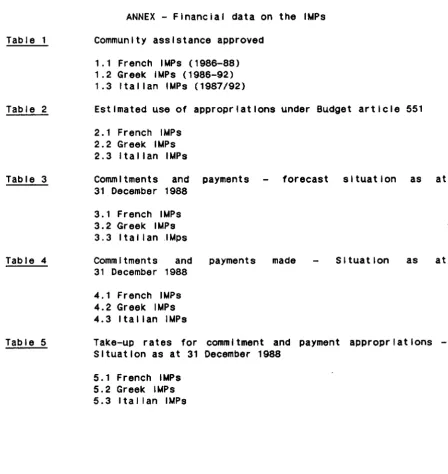
ANNEX- Financial data on the IMPs Community assistance approved
1.1 French IMPs (1986-88) 1.2 Greek IMPs (1986-92) 1.3 ltal Jan IMPs (1987/92)
Estimated use of appropriations under Budget article 551
2.1 French IMPs 2.2 Greek IMPs 2.3 Italian IMPs
Commitments and payments
31 December 1988
forecast situation as at
3.1 French IMPs 3.2 Greek IMPs 3.3 Italian IMps
Commitments and payments made
31 December 1988
4.1 French IMPs 4.2 Greek IMPs 4.3 Italian IMPs
Situation as at
Takeup rates for commitment and payment appropriations -Situation as at 31 December 1988
[image:9.590.63.512.60.534.2]Table 6
Table 7
Table 8
Table 9
Budget articles concerning the IMPs - Situation as at
31 December 1988
Budget article 551 -appropriations used In 1988
7.1 French IUPs 7.2 Greek IUPs 7.3 Italian IUPs Budget article 551
8.A Appropriations used In 1986 8.8 Appropriations used In 1987
Implementation of expenditure forecasts for 31 December 1988
Summary and conclusions
1. This second report concerns the activities carried out In 1988 In connect ion wIth the ImplementatIon of the Integrated MedIterranean programmes resulting from the appl lcatlon of Regulation (EEC) No 2088/85. The aim Is to Inform the Council, the European Par llament and the other bodies concerned of the activities carried out during this period.
2. The year in question marks the end of the first phase (1986-1988) of the French and Greek IMPs and the launch of the Italian IMP. Whereas the previous report was devoted primarily to an analysis of the methodology and procedures, this one gives overwhelming priority to what has actually been carried out In France and Greece. It also gives a description of the Italian IMPs adopted by the Commission In 1988. In providing a great deal of factual Information, particularly of a financial nature, this report takes account of the observations made by the European Pari lament and the IMPs Advisory Committee on previous reports.
3. The total expenditure Involved In the 29 IMPs approved by the Commission up to 31.12.1988 Is ECU 7 bl I 1 lon, of which the Community contribution Is 3.2 bl I I ion. In relation to the Community budget appropriation provided for In Article 10 of Regulation CEEC) No 2088/85, which amounts to ECU 4.1 bl I 1 lon (ECU 2.5 bl I lion from the Funds and 1.6 bl I lion In the form
of an additional budgetary contribution), the present appropriation represents 78% of the Community budget resources made aval table for the IMPs. The balance of ECU 0.9 billion Is made up of ECU 171 million to be used In Greece during this second phase (1989/1992) and ECU 730 ml I I ion to be used to fInance t ~e second phase of the French IMPs and provIde an additional contribution towards certain measures Included In or to be added to the I tal lan IMPs.
4. In addition to Community subsidies, the Regulation governing the IMPs also provides for the possibility of loans from the own resources of the EIB and NCI funds estimated at ECU 2.5 billion. The Indicative forecasts for the ut II I zat I on of loans entered In the IMPs was ECU 1.5 million on 31.12.1988, I .e.60% of the estimated volume when the Regulation was adopted.
Over the entire period 1986-1988, ECU 1.09 bl I I lon were actually commlt~ed
and ECU 595 million settled. In relation to the total of 4.1 billion provided for In Regulation (EEC) No 208/85, the take-up of appropriations Is therefore around 27% for commitments and 15% for payments. If the full amount provided for In the Regulation Is to be used, the regional and national authorities concerned wl I I have to speed up their projects markedly over the period 1990-1993.
6. Compared with the forecasts, the actual take-up of Community loans over the period 86/88 Is overall very low. The take-up rate compared with forecasts contained In the programmes Is around 32% for France and 9% In Greece (In the case of 9 of the 14 programmes, the rate was zero or practically zero). The difficulties Involved In using loans already pointed out In the first report <modest scale of Individual Investments, high rate of subsidies, attractiveness of EIB loans compared with those from other sources) were confirmed and It will be necessary to take measures to encourage better use of loans.
Moreover, Information Is not being exchanged properly between the financial Institutions which have the task of administering the global loans and the authorities responsible for carrying out the programmes.
7. The IMPs constitute the first large-scale attempt at a partnership
between regional, national and Community authorities. During the
Implementation of the programmes, this partnership Is seen In, among other things, the operation of the monitoring committees. Although a distinction has to be made between the different Institutional set up In France (decentral lzatlon) and Greece (~entral lzatlon and to a certain extent devolution) the Monitoring Committees, which Include' the various bodies providing the funds and the senior figures responsible for Implementation
have, In most cases, proved to be dynamIc bodIes whIch encourage
consu I tat I on and transparency and· ensure that the programmes are Implemented more effectively. In Italy the Institutional set up where the regional authorities have wide ranging powers makes the proper functioning
of the Monitoring Committees a vital condition for the effective
Implementation of the programmes.
8. In accordance with the programme contracts, a monitoring system has been set up for each French and Greek region. This system allows a systematic follow-up of the way operations are carried out. Although these systems are not yet computerized In alI cases, financial monitoring Is In place and has provIded I nformat Jon whIch wIll serve', among other thIngs, as a bas Is for
negotiations on the second phase. The preparation of the physical
Indicators for the monitoring process has however suffered a certain delay which should nevertheless be made up, at least partly, In 1989.
9. The Independent assessment body whose appointment Is provided for In the programme contracts Is now accepted by at I the partners Involved. As their selection has however been delayed In most cases, It Is expected that- all the assessment bodies will be appointed In the course of 1989; the Initial assessment reports on French and Greek IMPs are therefore expected In 1989. 10. Special efforts have also been made to establish financial channels whIch w I I I guarantee transparency of f 1 nanc I ng. However • achIevements In
this field vary from one State to another.
For example. the broad lnst I tunona I autonomy enjoyed by Ita II an reg Ions enables them In principle to go furthest In this direction. A legislative and financial framework has been adopted which enables the contributions from each party providing funds to be Identified and payment processes speeded up. Implementation of the new arrangements Is however experiencing difficulties connected with the Introduction of a national revolving fund.
In Greece, decisions author I zing commitments and payments concerning the IMPs are taken In the main by the central authorities. The Innovation Introduced from 1988 consisted of the Itemization In the public expenditure budget of commitment proposals concerning each measure of each IMP. This
mechanism ensures that the national share Is covered and permits
transparent administration and an assessment of the additional contribution by the Community. From 1988, also, each prefecture has been granted an overall budget, a clearly Identified part of which concerns the IMP budget that It has been allocated. As regards publ lc bodies, transparency Is also guaranteed through a budget breakdown which enables IMP financing to be
Identified.
In France, financial cover for the IMPs Is guaranteed under the
state/region plan contracts and annual altocat Ions are entered In the regional sectoral budgets. These nevertheless contain a breakdown according to whether the funds originate from national or Community sources. The French budget system does not a I low for the lntroduct ton of more dIrect
financial channels, but transparency Is guaranteed by the existing
mechanisms.
In spite of the measures taken In this area In 1988, several .IUPs which are encountering real difficulties In Implementing programmes have not yet made use of this possibility.
12. Overall. It may be concluded that planning at operational l~vel and the
main Innovations resulting from the Implementation of the IUPs
(partnership. follow-up and monitoring, assessment, financial channels) have by and large been assimilated In the French regions and In Greece where the IMPs represent the first major exercise Involving programmes. In Italy It will be necessary to awalt the actual Implementation of the IMPs to be able to make an assessment. In any event the. experience gained In
these regions will doubtless be Immensely valuable when operational
Chapter 1 - Implementation of the programmes: General aspects 1.1 Activities In 1988
1.1.1 Italy
1. The main activity In 1988 was the conclusion of examination of the 14 IMPs not yet approved (the 15th IMP concerning the Mol lse region had been approved at the end of 1987). The opinions of the Advisory Committee were del lvered at the end of July and the last programme contracts were signed In November, thus bringing to a definitive close the Initial examination phase for at I the IMPs.
2. At the same time as the signing of the programme contracts, the Monitoring Committees provided for In Article 9 of Regulation No 2088/85 were set up at the end of the year; each Committee has met at least once In a II the reg Ions of the Centre-North {L lgur I a, Em II I a Romagna, Toscana, Aquaculture IMP) and In Abruzzo and Mollse.
1.1.2 France and Greece
3. Whereas 1987 may be considered as the year when Implementation of measures concerning the French and Greek IMPs actually commenced, 1988 was a fully operational period In terms of Implementation of the measures and fo I low-up.
4. AI I the Monitoring Commlttees1 began work during the first five months of 1988. Given the Individual characteristics of the Information technology
IMP, In this case, more frequent meetings were, however, required.
PreparatIons for the second phase of the Crete IMP a I so necessItated a larger number of meetings of the Monitoring Committee for this programme.
5. The Monitoring Committees which, It wll I be recalled, are the forum In which are brought together the competent authorities and In particular the providers of funds, and which have responsibility for ensuring that each programme Is Implemented on a consistent and monitored basis, have studied the progress of the measures (comparison of cost estimates against actual expenditure) as wei I as the budgetary forecasts prepared by the authorities responsible for the sub-programmes.
A study Is also commencing Into the progress of the measures In physical
terms based on specific Indicators defined for each measure.
As regards the majority of the Greek lt.tPs, Information concerning their Implementation up to the first half of 1988 was made aval lable In October 1988. At the same juncture, lnformat lon on the lmplementat lon of
the French programmes up to August was also notified.
6. In the course of their work, the Monitoring Committees received a number of requests for changes. In the case of small changes (differences In expenditure of around 10%), the flexlbl I lty accorded to the national authorities has already enabled changes to be made In respect of the measures concerned. Other changes requiring the Commission's approval wl I I be discussed In connection with the examination of the second phase.
1.1.3 Preparation of the second phase
7. The first phase of the Greek and Fre~ch IMPs took place over the period 1986 to 1988. During 1988, a number of discussions prior to the definition and preparation In two phases took place. The second phase had, however, different Implications for Greece and France. In the case of Greece, programming covered the entire period (1986-92); It would be a question therefore of making adjustments and additions to the IMPs. In the case of France, since financing was, at the request of the French authorities, approved for the first three years only, a new section will have to be added to the programmes.
8. The Crete IMP which, It will be recalled, was the first programme approved by the Commission, was also the programme In respect of which preparation and adoption of the second phase were accomplished earliest. The Commission decision was taken In December 1988.
9. With regard to the other Greek IMPs Involving a high rate of
Implementation, (Northern Greece, Central and Eastern Greece, Western
Greece, the Peloponnese and Aegean Islands), the discussions begun In 1988 enabled a working method to be determined for costing operations awaiting Implementation at the end of the first phase, examining measures subject to a potential cost amendment and studying other measures which could, If appropriate, be Included.
10. WIth regard to the French IMPs, preparatory exchanges technical meetings which subsequently took place at the Initiative resulted In the official submission, at the end of French proposals concerning the second phase.
1.1.4 Preparatory activities
11. At the end of 1983 the Commission launched, In a number of areas of the Member States concerned, act I v 1 t 1 es preparatory to estab I I shment of the IMPs. These activities were designed to serve as pilot schemes for the Implementation of an Integrated development strategy and, In particular, with a view to the formulation and Implementation of new methods and procedures prior to their possible Introduction Into the IMPs.
The last operations under the heading of preparatory activities were
concluded at the end of 1987.
In 1988, activity In this sphere amounted to examining the final reports transmitted by the national and regional authorities, closing the accounts, and various on-the-spot monitoring missions.
1.1.5 Other activities relating to Information and communication
12. Several activities relating to Information and the exchange of
experience took place In 1988 at the Initiative of the national
authorities, the regions, or In the context of the Inter-regional
operation In support of tralnlng.and development In the French regions to which the IMPs apply.
These meetings, which were essentially Inter-regional In character or
Involved the three Member States concerned with the IMPs (with, In certain cases, the participation of Portuguese and Spanish national and regional programming bodies) allowed the participants to exchange experience and gain a fuller understanding of certain particularly Innovative aspects of the IMPs as, for example, the definition and establishment of Indicators to evaluate the results of the programmes (AJacclo seminar, June 1988)1
1.1.6 Activity of the IMPs Advisory Committee
13. In 1988 the IMPs Advisory Committee met seven times. The Committee was
primarily concerned with the anaylsis and formulation of opinions
concerning the Italian ,IMPs (with the exception of the Mollse IMP which had been adopted In 1987), the second phase of the Crete IMP and the 1986-87
annua I report.
1.2 Application of the principal administrative and Institutional
Innovations deriving from the IMPs.
1.2.1 Partnership
14. The principle of partnership, which was appl led during the IMPs
examination phase was seen to play an Increasing role during the
The partnership presents, however, a different significance In each of the phases concerned. During Implementation, responsibility for undertaking the measures In Question lies with the national or regional authorities and cannot be shared with the Commission.
Partnership In this situation Implies active presence and exchange, the role of the Community authorities often being catalytic as a provider of
Impetus.
The presence of Commission officials has, In fact, helped on more than one occasion to clarify the obJectives of the measures, speed up the process of Commission decision-making and define more precisely the content of the Communtty•s contribution.
The contribution of the regional authorities In the specific context of each Member State has Increased substantially during Implementation .. As a result, the commitment of the parties Involved In the programme has been clearly strengthened.
15. The decentralized administration of the programmes and the work of the Monitoring Committees should also facilitate the mobilization of local
economic forces. This, however, remains variable from one region to
another. The number of Initiatives by beneficiaries that It has been possible to encourage for the second phase has not been satisfactory; hence, the essential role which publicity and economic promotion measures must fulfl I In future.
1.2.2 Monitoring Committees
16. The principle of partnership became a real lty with the establ lshment of the Monitoring Committees, which have functioned on a regular basis In Greece and France.
The role and operating procedures of the Monitoring Committees (Influence on decision-making, In particular) have been defined and clarified during the year In Question. The results are determined by the Quality of work and Initiative capacity of the Committee, the chairman playing a decisive role.
In general, the Quality of the work performed by the Monitoring Committees depends on a clear division of responsibility between the partners and on
the commitment of the authorities responsible for Implementing the
17. Experience shows at all events that where the Monitoring Committees
function positively, they Increase the commitment of the regional
authorities and centralized services, which results particularly In more precise monitoring of the measures, rapid Identification of blockages and
Improved flexlbll tty In programming management. 1.2.3 Monitoring
18. As was mentioned In the previous report,1 each programme contract provides for the setting-up of a monitoring system to give an obJective and rapid Insight Into the progress of the operations. These systems are starting to become operational and It seems that they wl I I have a decisive
Influence on the Quality of Implementation support measures. Their
effectiveness depends, however, to a large extent on an opening-up of the Information channels of the administrative system concerned and on the degree of transparency of the legislative and budgetary frameworks set up. 19. In 1987 the Commission developed an Initial computerized prototype monitoring system which was presented to and discussed with the parties concerned. This prototype became a basis for subseQuent work carried out,
In accordance with the respective spheres of competence, either
Independently or, where reQuested, In col laboratlon with the Commission.
Hence, In Greece, the analysts carried out In connection with the
setting-up of the monitoring system received Community financing for technical assistance. The authorities In charge of the Implementation of each IMP became responsible subseQuently for adapting the system to their specific reQuirements.
In France, action In this sphere has been taken on the basts of Initiatives by the regions. Currently, the Information reQuired to ensure transparency and the monitoring of operations Is available on a manual basis. Work on
computerization ts however, sufficiently advanced to enable the
Introduction of computerized systems to be foreseen as from the beginning of 1989.
In Italy, work In this sphere has been conducted by a group of regions In
association with the Department responsible for the Coordination of
Community Policies and with the collaboration of the Commission which has a I so prov 1 ded techn I ca I ass I stance through the fInancIng of consu I tancy services. As a result of the work completed, a computerized monitoring system has already been set up In several regions (Umbria, Mollse) and It
Is predicted that all the systems should be operational In 1989.
20. Jo be comprehensive, these systems also require the establ lshment and uti I lzatlon of physical Implementation Indicators. The development of this Important part of monitoring has, however, suffered a certain delay, due mainly to the Innovatory nature of this approach. There had already been discussion of the principal methodological problems at the Montpel I ler and AJacclo seminars and further discussions wl I I take place In 1989.
1.2.4 Assessment
21. Each programme contract also provides for the appointment, on a proposal by the chairman of the Monitoring Committee and In agreement with the Commission, of an Independent assessment authority responsible for examining the qual lty of Implementation of the programme In the course of Its Implementation, for analysing Its economic Impact and Informing the Monitoring Committee which, In full cognizance, will then be able to propose solutions for Improving Implementation.
In order to obtain the services of high-grade bodies or experts, the Invitation-to-tender procedure was adopted for selecting assessors.
Hence, In Greece, the central authorities organized at national level an Invitation to tender which led to the drawing-up of a I 1st which, following certain amendments, was approved by the Commission. The choice of assessor for each IMP wl 1 I be made at the beginning of 1989.
In France, each region concerned conducted Its own Invitation to tender. With the agreement of the national authorities, the choice was subsequently notified to the Commission which has subsequently given Its approval In the case of the IMPs for Corsica, AQultalne, PACA and Midi-Pyrenees. A simi Jar procedure will be used for appointing assessors for the other French IMPs during the first quarter of 1989.
In Italy, the procedure chosen by common accord by the regions, the Government and the Commission, was to organize an Invitation to tender In the national press with a view to drawing up a list of persons and bodies from which the regions could make their choice. The Commission conducted this operation on a technical assistance basis.
1.2.5 Technical assistance
22. The previous report1 defined the approached adopted by the Commission with regard to technical assistance. Whereas In the past this form of activity consisted primarily of the granting of financing for studies, often of a general nature, In connection with the preparation of all or part of a programme, as Implementation has progressed and particularly In 1988 technical assistance has tended to be more targeted.
Hence, special attention has been given to analyses of the content of and
mechanisms necessary for the Implementation of certain particularly
Innovative measures as wei I as administrative organizational support measures, notably the Introduction of the monitoring systems.
At the present stage of the programmes, technical assistance Is mobil lzed In the following three ways:
(I) use of funds earmarked for certain particular measures (feaslbl I lty study pr I or to the Imp I emen tat I on of measures such ·as advanced services In respect of SUEs, for example);
(II) use of the measures designed for this purpose In the context of each IUP, the "Implementation" sub-programme providing for funds
for reQuirements In terms of analyses/studies, training and
Information;
( I I I ) use of Community budget heading 552 concerning technical
assistance.
23.From a brief assessment of all technical assistance In connection with the IUPs, the following conclusions can be made:
(a) Specific studies focusing on precise reQuirements and based on
clearly defined terms of reference are very useful; this type of operation should be developed;
(b) a general brief given to a consultant not Involved In the
admlnlstrat·lon Is warranted only where the administration has proved deficient, If the situation Is one In which the results are assimilated by alI sections of the administration concerned and In so far as the consultant's work Is governed by policy objectives defined by the authorities;
(c) particular Importance Is attached to administrative organizational support, for example In terms of technical aspects relating to computerization and notably follow-up operations, to the management
and preparation of executive projects, to training and the
provision of Information for administrative staff, etc.; In all cases, the objective Is the ~ffectlve transfer to national staff of factual knowledge and procedural know-how plus the opportunity to exchange experience;
(d) the presence of Commission officials on
In terms of the motivation, advice
provide; this presence should be
consideration needs to be given to utility.
the spot plays a vital role and Information they can
strengthened, but extra
the Questions of cost and
24. The Importance must be stressed of a permanent process of motivation, Information and experience exchange, a process In which the Commission has engaged through the financing of measures In support of training and development In the IMP regions. These measures, conducted on a partnership basis by the regional and national authorities responsible for the IMPs, with the Commission In joint participation, have Involved the organization of a series of activities (seminars, working parties, visits/exchanges,
publlc~tlon of brochures), and the briefing/training of the regional publ lc off 1 c 1 a 1 s and soc 1 a 1 and econom 1 c a gene I es I nvo I ved In the IMPs. ThIs approach, which has operated well In France (resulting In the training of more than 3 000 persons s I nee the end of 1985), has not yet been put Into effect In Greece and Italy.
At the end of 1988, the Commission also decided to set up, for
Implementation of the IMPs, an Intermediate support structure to· be given responsibility, on the basis of the Integrated approach and principles underlying the partnership, for organizing seminars and working parties on a range of relevant Issues/themes aimed at encouraging the Implementation of the programmes.
It should be noted that, broadly speaking, technical assistance In the majority of cases has been provided following a Commission proposal and that since many regions experiencing problems In Implementation have so
far had no recourse to technical assistance, Information on the
opportunities available under Regulation No 2088/85 would prove useful.
1.2.6 Financial channels
27. Implementation of the Integrated approach has resulted In the
Introduction of new legal frameworks and new administrative procedures. The new frameworks have already, at all events In Greece and Italy, produced greater transparency In activities concerning the IMPs and should ensure Increased security In terms of financial coverage of the measures In question.
28. Hence, In Italy, the regions have.had drawn up a regional law covering acceptance of the IMP and an amendment of the structure of their regional budgets. The amended regional budget Is broken down so as to show clearly, for each measure, the origin and allocation of the regional, national and
Community contributions. An experimental procedure has also been
successfully conducted Involving direct payment of fund.s from heading 551
29. In accordance with the programme contracts, the Italian regions have
also created a cash fund In order to pay advances to the final
beneficiaries and thus speed up the Implementation. The operation of this instrument should be evaluated once the ltal lan IMPs are functioning smoothly.
30. In Greece, the regional budgets do not yet exist; the principal Innovation with regard to financial channels concerns the national budget and the public bodies' budget within which a number of Innovations were Introduced from 1988. These amount basically to the separate Identification of commitment proposals concerning each measure for each IMP and the granting of an overall IMP appropriation In favour of the prefectures. 31. In France, although budgetary transparency has currently been achieved, the rlgldlty.of the budget system has not allowed any Innovation In this sphere. Financial coverage Is achieved at present In the contracts under the plan and annual allocations are entered In the regionalized sectoral
budgets which Include a breakdown according to origin national or
CommunIty.
It should be noted, however, that In Languedoc-Roussl I ion and Department of Drome, experiments are currently In hand employing funds to provide advance payments to final beneficiaries.
1.3.1 Impact of the programmes
In the liquid
It Is too soon yet to make an exhaustIve assessment of the Impact of the programmes, especially since the physical Indicators are not yet aval lable. Some comments can, however, be made.
The essentially rural nature of the regions concerned has resulted In the
agricultural sub-programmes receiving a relatively· large share of
attention. By comparison with the Initial appl lcatlons by the
Member States, the emphasis on agriculture, although considerable, has been remodelled and to some extent redirected towards var leta I and product conversion and structural support measures. At the same time, special attention has been given to diversification Into activities other than agriculture (notably farm tourism) through support for SMEs and business services. Special attention has accordingly been given to training under the IMPs.
The maJority of the IMP Importance. In each IMP, Identified and described.
regions contain areas habitats of special
of great Importance
Any Intervention In such habitats requires an Impact study to be carried out In accordance with Councl I Directive 85/337/EEC concerning any adverse
effects on the environment and In particular on major conservation
potential In areas of particular value from this point of view. The results of such Impact studies have to be sent to the Commission before work may commence.
Chapter 2. AI location and uti llzatlon of resources 2.1 Financial estimates
2.1.1 Estimates of expenditure and financing by the Community budget
1. Taken together the 29 IMPs approved by the Commission represent a total expendIture of about ECU 7 b I II Jon to whIch the CommunIty budget contributes 3.2 bl I I Jon, 52% In the first phase1. Compared with the budget allocation provided for under Regulation No 2088/85 of ECU 4.1 bl I I ton (2.5 billion from the Funds and 1.6 billion from the supplementary budget) the current allocation represents 78% of Community resources made available
to the IMPs.
2. The distribution of appl tcatlons by Member State and corresponding expenditure In respect of approved IMPs was as follows:
(m II II on ecu)
National appllcatlons(2) !Amounts approved I
"
I lI
Total
I
CarmunityI
TotalI
Carmuni ty 1{3)/(1)expend I t u re budget expenditure budget 1{4)/(2)
•
I
I(1) (2)
I
(3)I
(4) I (5)I
(6)French It,Fs 4785 (3) 1402 {3) 1232.7 (4) 360.8 (4) (4) (4)
Greek It.Ps 3670 2297 3213.6 1828.5 88 80
Ita II an lt,Fs 5791 2413 2568.0 1009.6 44 42
TOTAL 14246 6112
I
7014.3I
3198.7I .
49I
52• Amounts proposed In the discussion approving the It,F.
(1) For details of the French, Greek: and Italian IMPs, see tables In Annex 1.
(2) Calculated using the conversion rates of March 1987: ECU FF 6.87112/DR 151.413/LIT 1468.79.
(3) For the total period.
3. The breakdown of Community assistance by financing source Is as follows: (million ecu)
Total Article 551 EAGGF ERDF ESF Flaherlea 1
French It.Fa 360.6 133.2 67.9 101.2 54.7 3.6
Greek It.Fa 1828.5 763.3 280.6 691.4 90.4 2.6
Italian lt.Fa 1009.6 353.9 253.9 291.8 92.6 17.4
TOTAL 3198.7 . 1250.4 602.4 1084.4 237.7 23.6
2.1.2 The estimated uti I lzatlon of resource~ of the IMP budget heading. 4. The budget heading established by Art lcle 11 of the IMP Regulat lon2 was allocated ECU 1.6 bl I I lon. of which 1.25 bl I lion (78%) was allocated as
follows: (million ecu)
Total Sole aid Aid supplementing Fund aid
million million ecu
"
million ecu"
ecu
French lt.Fa 133.2 126.3 95 6.9 5
Greek lt.Fa 763.3 404.0 53 359.3 47
Ita II an It.Fa 353.9 335.1 95 18.8 6.8
TOTAL 1250.4 865.4 69 385 30.8
1 Regulation (EEC) No 4028/86.
Detal Is for the IMPs are given In Table 2 of Annex 1.
For all the IMPs budget Article 551 was used to finance the Implementation sub-programmes. This part represents on average 3.7% of the total (1.2% In France, 2.6% In Greece and 6.8% In Italy).
Following the examination phase of the Italian IMPs which are analysed In detail In Chapter 3 {para. 3.4.1), In France and Italy, the lt.AP heading resources were mainly used to finance measures that are not el lglble for the structural Funds, or to Intervene In regions or areas excluded from the ERDF and EAGGF GuIdance aId. In Greece about ha If the lt.AP fIgure was used to reinforce Community a.sslstance provided under the ~und.
The principal measures to be financed solely by Article 551 are:
rural redevelopment operations such as farm tourism, recreation, forestry, the environment, etc.;
research, agricultural experimentation and advisory services, especially for the development of new products or varieties;
agricultural conversion, Including Irrigation, support measures and animal husbandry;
research, techn I ca I ass I stance and promotIon for sma I I busInesses and the crafts, especially support for Innovation;
development of business services, especially financial services In the Centre-North of Italy, and services not eligible for ERDF aid
(factoring).
2.1.3 Estimated uti I lzatlon of EIB loans.
5. Indicative estimates of the utilization of EIB loans are given below: (million ecu)
Loans million eeu Community subsidies Ratio of loans:
subsidies
"
French lt.Ps1 180 360.6 50
Greek lt.Ps 655 1828.5 36
I tal ian It.Ps 677 1009.6 67
TOTAL 1512 3198.7 47
Under Article 10(2) of Regulation No 2088/85, the loan facl I I ties that could be aval lable to the IMPs amounted to ECU 2.5 bill Jon. This estimate places the utilization of EIB loans at 60% excluding a possible growth In the second phase of the French IMP.
In the Ita I I an IMPs, loan fInancIng maIn I y concerns sma II manufacturIng enterprises and the hotel trade. They are managed through the technique of global loans. Some aid for Infrastructure projects Is also envisaged In southern Italy.
In Greece, apart from financing smal 1 business Investments, Community loans are Intended for Irrigation and Infrastructure, mainly rural.
In France, the expected assistance covers a fairly varied range of measures
In the agriculture, fisheries, Industry/crafts and tourism sectors,
Including for example water control measures (Including Irrigation), rural
Infrastructure, processing agricultural produce, road, port, airport,
Industrial and tourist Infrastructure, and loans In support of the
development of accommodation capacity.
2.2 Uti I lzatlon of Community budget appropriations
2.2.1 Take-up rates
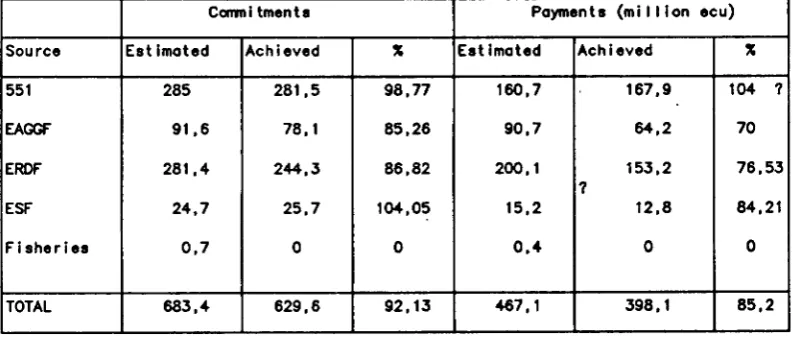
6. On 31 December 1988, the accumulated mobJI·Jzatlon of Community budgetary assistance provided for under the programme contract was as follows:
Ccmnitments (million ecu) Payments (million ecu) X
Planned effected Planned aett led 2/1 4/2 4/3
(1) (2) (3) (4) (5) (6) (7)
french l~s 360.8 328.6 228.9 169.4 91 52 74
Greek l~s 683.4 629.6 467.1 398.1 92 63 85
Italian l~s 148.4 130.7 65.1 39.6 88 30 61
TOTAL 1192.6 1088.9 761.1 607.1 91 56 80
Detal led Information by IMP Is given In Tables 3, 4 and 5 of Annex 1 and Is analysed In Chapters 3 to 5 of this report. It should, however. be noted that In the case of the Italian IMPs an analysis of the take-up rates Is not relevant at present, given that 1988 was mainly devoted to completing the examination and concluding programme contracts.
The take-up rates of CommunIty approprIatIons depends on the progress of work In the field and actual expenditure. The take-up rates of Community appropriations In the table below. although presenting a good rate of Implementation, do not always correspond exactly to the state of progress of measures. on account <?f the various Community commitment and payment
techniques. When the regulations permlt,the operations can receive
advances, the balance to be paid on completion of the work. The exchange rates used for the analysis of the progress of work necessarl ly differ from
the rates used for final payment (rate of the month In which the
Member State presents the final payment claim).
7. An analysis by source of Community financing produces the following results:
Article 551 EAGGF ERDf ESf Fl aheries 1 Total
Ccmn i tmen ta - X of implementation of est !mates Ccmnitment
.
French J~s 100 78 84 101 57 91
Greek J~s 99 85 87 104 0 92
1 tall an J~s 100 66 84 151 89 TOTAL
Payments - X of ccmn I tmen ta settled Payments
French J~a 56 11 67 58 5 52
Greek J~a 60 82 63 50 0 63
Italian ~~- 33 36 8 50 30
TOTAL 55 50 61 55 5 56
The difference observed between the take-up rates are due In part to the differences In commitment and payment procedures. The ERDF and Article 551
are managed globally by annual Instalments In respect of which advance payments are made. By contrast, financing from the Social Fund and under Regulat lon (EEC) No 4028/86 Is on the basis of projects. In the case of EAGGF, both systems exist - certain operations under the Mediterranean package (afforestatIon, I rr I gat I on, rura I Infrastructures and zootechnIcs) are managed as programmes (Indirect operations) and sometimes as projects (dIrect ope rat Ions) afforestatIon, rura 1 Infrastructures, projects under Regulation (EEC) No 355/85.
These differences In financing arrangements resulting from Article 12 of Regulation (EEC) No 2088/85 make the financial management of programmes a complex matter. This Is particularly the case where, on justified economic grounds, the special IUP heading comes Into play to supplement assistance from a Fund.
2.2.2 Implementation of 1988 budget
8. The global use In 1988 of specific IMP articles was as follows, the datal Is being provided In Table 6 of Annex 1
Article 551 (Article 11 of Regulation (EEC) No 2088/85)
Budget Articles
5 5 1
Commitment appropriations Availability Implementation
m ecu X
270,8 (2) 98,2
• Transfer from Articles 550 and 552.
2 Including ECU 140.8 million carried forward from
1987.-Payment appropriations availabi llty
m ecu
Initial final
137.7 148.7•
Implementation
"
Article 550 (preparatory actions and studies) and Article 552 (technical assistance
Budget Commitment appropriations Payment appropriations
Articles oval lobi I I ty imp I ementat I on avo I I ab I I i t y Implementation m ecu
"
m ecu"
I nit Ia I final
5 5 0 14,8 6,8 33,8
5 5 2 6,0 15,7 4,0 1,0 23,9
The take-up rates In relation to budget estimates are very satisfactory In the case of Article 551 for which ECU 11 ml I I lon In appropriations had to be paid from Articles 550 and 552.
9. The appropriations available In 1988 were allocated as follows as regards Article 551 of the Community budget.
Commitments (m ecu) Payment (m ecu)
instal- 86 instal- 87 Instal- 88 Total instal- 86 instal- 87 instal- 88 Total
ment ment ment ment ment ment
French l~s 60.4 60.4 3.6 2.0 28.8 34.4
Greek l~s 151.7 151.7 7.6 12.7 75.5 95.8
Ito I ion I~s 2.3 51.5 53.8 1.4 16.7 18.1
10. The appropriations and their ut lllzat Jon, as referred to above, developed as follows:
Ava_i lablll ty (m ecu) Implementation Implementation Carryover (m ecu}
"
(m ecu} (m ecu) CQIIII'II tment approprlat Ions1985 120 120.0
1986 330 15.5 5 104.5 210.0
1987 350.8 187.5 54 22.5 140.8
1988 270.8 (1} 265.9 98 4.9
Payment appropriatIon a 1985
1986 118.0 7.6 6 110.4
1987 178.1 103.9 58.3 6.5 67.7
1988 148.7 (2) 148.6 99.9 0.1
The take-up rates for 1986 estimates are of little significance. The IMP proposa Is were presented durIng that year and on I y one IMP was approved (Crete). Consequently, In 1986 only commitments and the payment of the 50% advance on the first annual Instalment of this IMP were made.
In 1987, the commitments for the 1986 and 1987 Instalments were made for the other Greek IMPs, for the French IMPs and for the I tal ian IMP In the Mol lse region. The payments correspond to advances on these commitments and to the balances of the 86 Instalments for the Crete IMP and the French IMPs with the exception of those In the Mldi-Pyr~n~es and PACA regions.
The still relatively low rates for 1987 are due to longer than expected delays In processing ltal lan IMPs and certain difficulties In launching the French and Greek programmes.
In 1988, however, the take-up rates show the French and Greek IMPs In ful I operation. From a budget point of view, the delay In launching a number of Italian IMPs has even been offset by Greek and French achievements. In 1988, all commitment appropriations were used. The payments made In 1988 corresponded to advances on the Instalments for the year, payments of 1986 balances still due and the balance of 1987 Instalments for the Drome, Northern Greece and Eastern Central Greece IMPs.
1 Including ECU 130 ml I I ion for 1988.
However, In relation to the total budget allocation of 1.6 billion the commitments amounting to ECU 468.9 ml I I ion represent current implementation of around 29%. This situation Implies a greater effort in the Implementation of the programme to achieve full utilization of the appropriations by 1993.
2.3 Community appropriations notal located during the first phase
11. At the end of the first phase of processing, 78% of the amounts provided for In Regulation CEEC) No 2088/85 have been allocated. The remaining 22% or ECU 901 ml I I ion Is made up of a reserve of ECU 171 ml I I ion to be used in Greece durIng the second phase and ECU 730 m i I I ion to be at located during the second phase of the French IMPs and for the financing of additional measures under ltal lan IMPs.
As regards the allocation of the Greek reserve, it is planned to give priority to the financing of productive activities.
12. By virtue of the priorities adopted for each programme, It should be noted that the IMPs system wl 1 I allow certain appropriations to be transferred from measures In respect of which the rate of uti I izat ion is inadequate compared wIth the forecasts to measures the Imp i ementat I on of which Is satisfactory or to finance new measures.
2.4 The uti I lzatlon of EIB loans
The following table sets out the amounts Involved In EfB operations during 1988 for each IMP:
French Il.f>s - Aquitaine - Midi-Pyr6n6es - Languedoc-Roussil ion - PACA
- Corsica - Or6me - Ardeche
Loans (m ecu) 86/99
16.6 42.9
- Total 58.5
Greek ll.f>s
- Attica 0.6
- Central and Eastern Greece 0.9
- Information technology 1.6
- Northern Greece 1.9
- Western Greece Peloponnese 5.1
- Crete - 12.5
- Aegean Islands
- Total 22.6
Overall total (France/Greece) 81.1
Loans (m ecu) Percentage estimates 86/88 imp I ementat ion
30 0
40 39
30 0
55 78
10 0
7.5 0
7.5 0
180 32.5
30 2
30 3
5 32
55 3
50 10
60 21
24 0
254 8.9
From this It Is clear that overal I the rate of uti I lzatlon of EIB loans Is very low. Regulation (EEC) No 2088/85 on the IMPs gives an estimate of EIB loans over seven years of ECU 2.5 bl I I lon and the estimated take-up currently entered In the IMPs Is ECU 1.5 bllllon1 or 60%. In terms of Implementation (1986-1988) the loans actually granted In France and Greece amount to ECU 81.1 million of an estimate of ECU 434 ml II lon, I.e. 18.7% of the estimates over that period.
Certain difficulties In using EIB loans which had been pointed out In the
first report were confirmed (modest scale of approved Investments,
Importance of systems of subsidies In the least prosperous regions, unattractiveness of EIB 'loans and situations specific to each of the three Member States concerned)2.
Moreover, the preference for global loans also gives rise to certain problems In Identifying projects to be Included In the IMPs and those forming part of the normal activities of the EIB. Global loans are managed by regional and national financial Institutions which operate essentially on a project by project basis and are not necessarl ly aware of the
Inclusion of a specific project In an IMP or another programme.
In this connection, one possible solution will be to establish mutual Information channels between the financial Institutions, programme managers and Monitoring Committees. At the same time, It Is necessary to examine to
what extent management by the financial Institutions acting as
Intermediaries could be organized on a programme by programme basis.
1 It should be noted however that the French estimate relates only to the first phase.
Chapter 3: The I tal Jan IMPs
Organizational aspects
3.1.1 Administrative organization and the apportionment of responslbll ltles
1. In Italy, as a result of decentralization and the responsibilities
Incumbent on the regions, the latter have naturally played a vital role In the examination of the IMPs and will continue to play this -role during
Implementation.
The regional authorities are responsible for the Implementation of the IMP measures, the. execution being entrusted to various kinds of subregional local authority or specialized public or private organizations as the case may be.
2. At central level, the department for the coordlnat Jon of Community policies (coming under the Prime Minister's Office) Is responsible for the coordination of examination and Implementation and represents the central authorities on the Monitoring Committee.
3. Within each regional authority, an 'Assessorato' (assessment department) Is responsible for coordination of the whole programme. Normally this department Is responsible for planning and I lalson with the European Community. In some cases, however, assessment departments with sectoral responslbl I ltles are responsible for coordination. For example, this Is the case for the Eml I la-Romagna IMP where this responslbl I lty devolves on the assessment department responsible for agriculture.
The mobl I lzatlon of departments with sectoral responslbl I ltles varies from one region to another during the examination phase. For Implementation, however, the general rule Is that each sectoral department Is responsible for measures within his field of competence and Is responsible for his own subprogrammes on the Monitoring Committee.
3.1.2 Monitoring Committees
4. The programme contract provides that the Chairman of the Monitoring Committee should be the President of the Giunta Reglonale or his delegate. As a rule the secretariat of the Committee Is provided by
official from the department responsible for coordination. are usually the responsibility of senior officials In department concerned.
5. Since the meet lngs which took place only held to launch the work, It Is too of the Monitoring Committees. Equally, effectiveness of the participation of the to cooperate In the programme contracts.
3.1.3 Financial mechanisms
In 1988, apart from Mo II se, were early to assess the effectiveness It Is too early to assess the local and social forces expected
6. Under the I tal ian budgetary system, programmes and Investment projects in regions are decided by the responsible authorities within the I lmlts of the resources allocated to them, by subsector, from the State budget. The
Mezzoglorno regions which benefited from special Intervention under
Law 64/85 are required to prepare regional development plans to serve as a basis for the allocation of additional resources provided under this law.
Since the usual resources were allocated to programmes underway, the IMPs cal led for additional national resources to be made available.
The delay In the allocation of additional resources to regions In the Centre-North gave rise to problems In Implementing the measures.ln the first year some regions resorted to bank loans. In the case of regions In
the south an additional appropriation of LIT 1 200 billion (about
ECU 800 mi I I ion) under Article 13 of Law 64/851 was granted In November 1988. Thus, there are no major problems In funding IMP measures In these regions.
7. The programme contracts and ltal ian legislation (see Law 183 of
16 Apr I I 1987) provide for the establishment of a national revolving fund. National resour·ces for this fund will be supplied by the central and Community authorities and will facilitate the organization of financial
flows to meet regional Implementation needs. Each contract programme
provides for the creation In each region of a fund In the form of a special cash account, which Is based on Community and national advance payments and wll I be able to make advances to the final beneficiaries of the measures ..
Untl I the national revolving fund becomes operational,, the first Community advances, In agreement with the national authorities, wll I be paid directly
Into the regions' accounts.
This covers the national part of publ lc financing for projects receiving CommunIty ass I stance·/
8. The regions have altered their budgetary laws In order to:
provide for a breakdown of receipts obtained under the IMP (national and Community) and planned expenditure under the same heading (breakdown by measure and source of financing- regional, natlonal;or Community);
set up a fund to pay advances to beneficiaries.
This method wl I I Increase the transparency of budgets, ensure financing and provide more flexlbl I lty for management thus facl I ltatlng the completion of
Individual measures.
These mechanisms have been In operation In some regions In the Centre-North and In Mollse and Abruzzo In 1988. They were developed with a view to becoming operational early In 1989 In the other regions of Italy.
3.2 Implementation
9. Implementation of the measures In the ltal lan IMPs had to be delayed on account of the late signature of the programme contract. The situation of the IMPs In the Centre-North differs from the situation of the Mezzoglorno
IMPs.
10. In the Centre-North, despite difficulties associated with financing problems, programmes have been effectively launched, especially concerning agriculture and certain key measures In subprogrammes supporting small businesses. In particular,· studies on financial or other services to businesses are beginning to clarify the content of the respective measures.
In the Mezzoglorno, only the IMPs for which the programme contracts were concluded before the summer (Mollse, Abruzzo, Baslllcata) were actually
launched.
In short, the following brief comments can be made about each IMP:
(a) Eml I la-Romagna. Implementation of the Eml I la-Romagna IMP can be regarded as exemplary In the ltal lan context. The situation as regards the accounts In 1988 Is as follows: almost 72% of the appropriations granted for 1988 have been committed and a sum corresponding to 20% of the committed appropriations has been disbursed.
With respect to physical Implementation, 21 out of a total of 31 measures
were launched In 1988. Implementation of vocational training,
reafforestatlon and genetic Improvement measures Is the most satisfactory. Measures concerning the tourism subprogramme have reached cruising speed as has Investment support. Steps taken with respect to the other measures seem to ensure that nearly all the measures Included In the programme wl II be
(b) UmbrIa. On the whole, lmplementat lon of the programme Is sat lsfactory despite the difficulty of obtaining the financing for which the central authority Is responsible; this necessitated recourse to a loan.
The measures extending previous activities have absorbed the funds as planned.
New measures have been I aunched or have reached the stage of advanced planning. In particular, with regard to job creation measures, an Initial selection of entrepreneurs has been made: new entitles have been set up to manage services centres, research on special materl.als and services for tourism.
(c) Liguria. In 1988, two measures relating to the guarantee fund and venture capital company were launched. For the rest of the programme, the region has prepared for the approval of 31 projects representing about 40% of the planned Investment for 1988-90. Some 48% of these operations concern
the agriculture sector, 27% tourism and 25% support for smal I businesses.
(d) Toscana. The difficulties In launching this IMP, particularly the agriculture subprogramme were caused by the lack of financial cover for the part to be paid by the central authority. The region had recourse to a loan or a transfer of funds from budget Items Initially unrelated to the IMPs:
thus, with the exception of agriculture, out of a budget of ECU 36 ml I I lon, 34 ml I I lon were committed up to the end of 1988. In the case of non-agricultural sectors, some measures were launched In 1988, for example services to smal I businesses, particularly technological Innovation and the crafts areas.
In the forestry subprogramme, reafforestat I on and support for processIng are underway.
(e) Marche. On 31 December, payments In favour of the final beneficiaries amounted to no more than 5.25% of planned expenditure. Commitments made by the region In respect of final beneficiaries accounted for about 30% of the
1988 budget. The operations, however, concern only the first two
An analysis by subprogramme shows that the only measures to be Initiated concern vocational training and technological Innovation (100% commitment) of the Industry subprogramme and measures concerning reafforestatlon, Infrastructure and tourist Itineraries (100% commitment) and to vocational training (35% commitment) of the agriculture subprogramme. In some cases
-In particular the setting up of new venture capital companies and
completion of a prel lmlnary feaslbl llty study on the Implementation of the measure concerning advanced services - the measures have been launched but the prel lmlnary phases have not given rise to payments.
(f) Northern Adriatic lagoons. It should be noted that of the three regional subprogrammes, only the subprogramme for Frlul 1-Venezla Glul Ia was launched In 1988 with a rate of expenditure close to 85% of the cost of the
subprogramme. _ Work affecting the other two regions (Veneto and
Eml I la-Romagna) wl II not start untl I 1989 due to a delay In Identifying the source of the national share of financing.
(g) Basil lcata. Despite the delay due to late conclusion of the programme contract, some measures were launched In 1988. They concerned the snow route, the promotion of tourism and the crafts.
With respect to the latter subprogramme, a preliminary feasibility study carried out before setting up an Information technology network between the training centres had been completed. For the other measures, there Is a formal undertaking on the part of the region with respect to the final beneficiaries. With respect to traditional measures (farm tourism, the hotel trade and In part the guarantee fund for craftsmen) which are part of
the regional aid scheme, regional comml·tments to date exceed the
programming.