COMMISSION OF THE EUROPEAN COMMUNITIES
Proposal for a COUNCIL DIRECTIVE
COM(94) 36 final Brussels, 16.02.1994 94/0006(SYN)
· concerning the quality of bathing water
EXPLANATORY MEMORANDUM
1. JUSTIFICATION OF THE PROPOSAJs
1.1 General considerations
(1)
1. In the context of the debate on subsidiarity, the conclusions of the Edinburgh European Council'included a list of Directives which should be reviewed. This view was reiterated at the end of the last Council in Brussels.
In thi·s context, the Commission has committed itself to revising the Community legislation with regard to simplifying it, consolidating it and bringing it up to date.
Directive 76/160/EEC<1> concerning the quality of bathing water has very often
been at the heart of the debate on subsidiarity and the Commission has undertaken to revise the legislation by simplifying it. However, it was also necessary, after more the eighteen years, to adapt the Directive to scientific and technical progress.
That is not to say, however, that simplification will mean the weakening of the Directive in terms of protection of the health of bathers or of the environment. This might seem contradictory since one of the principal changes relates to the Annex to Directive 76/160/EEC in which the list of the parameters to be measured has been reduced. However, the emphasis of the revised text has been placed on those pollution indicators which guarantee the safety of bathers. 2. Scientific and technical progress since the adoption of the Directive in 1975
have, in effect, allowed the precise identification of reliable pollution indicators. These indicators, if their limit values are exceeded, predict the presence of pathogens. Thoses same pollution indicators were adopted recently by ISO (International Standards Organization). It is important to appreciate that regular monitoring of these indicators will guarantee to maintain a high level of protection of the environment and of human health. However, the cost to Member States of monitoring will be reduced due to the reduction in the number · of parameters to be measured and the use of parameters which do not require sophisticated measuring techniques.
3. Adopted by the Council in December 1975, Directive 76/160/EEC concerning the quality of bathing water is based upon precise parameters and limit values. In setting these values, the Directive has not only established a framework for the evalutation of bathing water quality but has also provided a way to decide whether poor quality water requires remedial action.
OJ No L 31, 5.2.1976, p. 1..
Efforts made by Member States to implement water treatment programmes have led to a substantial improvement in the quality of identifi~d bathing waters in the Community, while at the same time contributing to a general improvement in the quality of surface waters.
It should be noted that the Directive has given rise to a considerable increase in identified bathing waters and consequently in the nionitoring of these waters. At present, more than 16 000 bathing zones are covered by the legislation.
The twin objectives of protecting the environment and public health remain of fundamental importance, although, they can nqt, of course, be considered independently.
The Directive has been in force for some fifteen y~ars and it is now appropriate
I
to review the effectiveness of it so as to take advan~ge of the experience gained, to incorporate the results of scientific and technical progress and to concentrate on those requirements which are essential for the protection of public health and the environment.
Nevertheless, the Commission's initial approach which was to set precise parameters and limit values remains valid to this :day; the protection of human health having to be guaranteed within the Community to the same level of confidence.
4. The quality of bathing water is an important asset,for tourism, as is noted in the 5th Environmental Action Programme "Towards Sustainability"<2) (Section 5.4). It is therefore appropriate to guarantee safe, :good quality bathing water throughout the Community. It should be possible to compare bathing water
I
quality throughout the Community on a basis wlll:ch is as objective as possible. 5. It is therefore appropriate to invite the Council to ~dopt a Directive to revise the
existing one. The aims of the proposed Directive are to: .
maintain the protection of the environment ;and public health provided by Council Directive 76/160/EEC, to take advantage of technical progress and to focus on the most significant parameters;
simplify the operation of the Directive by deleting redundant parameters and making certain definitions more explidit, thus reducing the financial burden on Member States without reducipg the level of protection of public health and the environment; and '
ensure that Member States take action in ,cases of deteriorating water quality and make further provisions for
the
identification of new bathingI
6. Directive 76/160/EEC has already been amended several times:
By the Act of Accession of Greece of 28 May 1979, Annex I, Chapter XIII.l.a<3>;
by the Act of Accession of Spain and Portugal of 12 June 1985, Annex I, Chapter X.l.b and Annex XXXVI, Chapter 111.3<4>; by Council Directive 90/656/EEC of 4 December 1990 on the transitional measures applicable in Germany in regard to certain Community provisions relating to the protecting of the environment<S>; and by the Council Directive 91/692/EEC of 23 December 1991 standardizing and rationalizing reports on the implementation· of certain Directives relating to the environment<6>.
This means that the current rules must be sought partly in the original Directive and partly in later pieces of Community legislation. In order to enhance the accessability and transparency of Community legislation, the Commission has decided to present this propo~ to amend the existing Directive as a consolidated proposal, including the current provisions of Directive 76/160/EEC as previously amended.
Therefore, a substantial part of the proposal already exists as Community law and is included in the proposal only for the said reasons of providing a more accessible and transparent legal instrument.
7. The proposal has been consolidated and amended from the original Directive as published in the Official Journal. The text makes clear the proposed amendments, not only by means of indication in the margin ("adapted") but also by underlining each textual addition or rewording.
1.2. Reference to the 5th Environmental Action Programme
(3) (4) (S) (6)
(7)
The 5th Environmental Action Programme<7> emphasizes that, for the purposes of
improving the quality of life and as a condition for achieving sustainable development, it is essential to secure sufficient water of adequate quality for all purposes throughout the Community. Against this background it is stated that Community policies must-inter alia - aim at the prevention of pollution of fresh and marine surface waters. The target for the year 2 000 is to safeguard existing surface waters of high quality, and to improve the quality of other surface waters in the Community. _
The special importance for the tourism sector of good quality bathing waters is also mentioned in the Programme.
The present proposal for a revised Directive aims at contributing towards the implementation of these objectives throughout the Community.
OJ No L 291, 19.11.1979, p. 17. OJ No L 302, 15.11.1985, p. 9. OJ No L 3~.3, 17.12.1990, p. 59. OJ No L 377,31.12.1991, p. 48. OJ No C 138, 17.5.1993, p.
1.
1.3 The scientific basis
Health protection is based on the respect and the maintenance of the quality of a defined environment. This quality can be assessed by the measurement of indicators of pollution.
In relation to recreational activities, bathing in sewage~polluted waters constitutes a public health · problem worldwide. A number of di~es, mainly affecting the gastrointestinal tract, skin, eye, ear and upper respiratory tract, have been associated with bathing in such waters. To minimize such risk~, standards based mainly on microbiological criteria have been set up. ·
I
Directive 76/160/EEC contains provisions based on tnicrobiological and
physico-chemical indicators. '
However, since the adoption of Directive 76/160/EE(:: in 1976, there has been a considerable growth in scientific knowledge on microbiqlogy and also an improvement in analytical techniques.
In particular, recent scientific findings in microbiological research enable the operation of Directive 76/160/EEC to be simplified by deleting redundant parameters and making certain definitions and obligations more explic~t.
. '
Epidemiological studies carried out in several countrie:s since 1976 have provided a great deal of information in relation to the use of pollutipn indicators relating to health protection.
1.4 Environmental objectives to be achieved
Article l30r of the Treaty establishing the European Community sets out a framework for the Community's environmental policy. Paragraph
!I
requires that environmental policy shall, inter alia. contribute towards preserving, .protecting and improving the quality of the environment as well as protecting human health.As regards the objective of contributing to the protection of human health, the basic microbiological requirements cannot differ from Member State to Member State, as they are based on scientific evidence. As regards the .other parameters, they reflect minimum conditions for a satisfactory water quality. '
These two objectives overlap, and measures to be taken!to comply with one will assist in complying with the other.
2.. SUBSIDIARITY AND COSTS
2.1 What are the objectives of the proposed action compared with the obligations of the Community?
The present proposal has been elaborated. to meet the requirements of Article 130r of . the Treaty in order to preserve, protect and improve the quality of bathing waters and
to contribute to the protection of health of the bathers. · Community action is needed in order to:
ensure basic satisfactory common standards with the same level of health protection for bathers all over the Community;
protect and improve the quality of the environment and make sure that. action is taken in cases of deteriorating water quality;
contribute to the solution of transboundary problems of water pollution; ensure that there is no distortion of competition in the tourism industry;
ensure that European citizens have access to comparable information about the quality of bathing waters giving them a real choice with respect to recreatiomil activities which can have health implications.
2.2 · Is the proposed action based on an exclusive competence of the Community or
a competence shared with the Member States? ·
The main objectives of this proposal are to preserve and improve the quality of bathing waters and to protect human health in accordance with the objectives mentioned in Article 130r of the EC Treatjr.
Therefore, the legal basis for the proposal is Article 130s(l) of the EC Treaty and the competence is shared between Member States and tJ:e Community.
,.·
2.3 What is the Community dimension of the problem?
All Member States are concerned by this action.
At present Council Directive 76/160/EEC applies to more than 16 000 identified bathing areas. The modified text will leave the scope of application unchanged.
2.4 Which solution is most efficient comparing the means of the Community and the Member States?
Two fundamental aspects covered by the Directive concerning the bathing water quality can only be addressed efficiently at a Community level:.
the setting-up of common standards for protecting health of bathers all over the Community, and
the transboundary dimension of water pollution ..
The setting of basic standards for bathing water at Community level is necessary to ensure that bathers enjoy an adequate level of health protection based on reliable common standards throughout the EC. Such common s~dards can only be developed at Community level. As tourism is an important economic factor in all Member States and bathing water quality an important asset for many Holiday resorts, confidence in its safety and good quality has to be guaranteed.
In the context of bathing water, the basic requirements for health and environmental protection have to be legally binding, but the Member States must have the freedom to decide how best to achieve the specified aims and to set higher standards or to react to specific local or regional problems.
Finally, Community action seems particularly well ~uited for dealing with the transboundary aspects of water pollution which can not be dealt adequately by Member States working individually.
2.5 What added value will the action bring to the Commhnity and what are the costs of the action?
(8)
'
The assessment in financial terms of the improvement in the quality of the environment and public health is difficult to quantify. 'l'here is no reliable basis upon which an objective calculation to measure the valae and security of a better environment can be made.
There is little doubt, however, that Directive 76/160/EEC has made a significant contribution towards improving the quality of life for the citizens of Europe in the 17 years since its adoption. Therefore, a revised directive which includes technical amendments will continue to provide such added value.
The new technical amendments aim at updating the: scientific framework of the Directive and improving its practical implementation. The modifications proposed in this revised and consolidated text are considered to ~ave minor cost implications. Firstly, Member States have long since implemented Directive 76/160/EEC. The continuing costs of monitoring and analysis are required to ensure a basic level of health protection. Therefore, these costs should not be attributed to revised Community legislation in this field.
The costs for remedying the problems related to bad quality bathing water resulting from untreated sewage should be attributed to that source of pollution. The measures required to address these problems are contained in C~>Uncil Directive 91/271/EEc<s> of 21 May 1991 concerning Urban Waste Water Treatment.
(2)
With regard to the financial benefits of a revised Bathing Water Directive, it is important to note that good quality bathing water at established holiday resorts helps to ensure that these remain popular with tourists and are not abandoned in favour of new locations. Thus the consequentiai loss of revenue from a reduced tourist trade as well as the unnecessary consumption of unspoilt coastal resources can be minimized. As regards small and medium-sized enterprises, the proposed revision· to Directive 76/160/EEC will not significantly change the impact of the existing Directive on them. Small and medium-sized businesses benefit from investment in tourist infrastructure.
The continued application of a Directive concerning bathing water quality can make a positive contribution to this investment by ensuring that related water quality problems are avoided or, at least, properly addressed.
Finally, benefits have also to be seen in relation to health. Costs to society linked to health problems can have an impact on public funds.
2.6 Which instruments does the Community have at its disposal?
Because of the need to provide an adequate protection of public health, the limit values and the criteria for Compliance must be laid down in a legally binding instrument. It would therefore be insufficient just to adopt a recommandation. On the other hand, it would clearly be disproportionate to make use of a regulation considering the role which Member States could play in this context and the need to include the said standards in' different national legal frameworks. For these reasons, the instrument proposed is a Directive.
Besides, it should be noted that even if the Community can contribute to the funding of certain actions to control the pollution of bathing waters, the use of financial instruments alone does not suffice for reaching the objectives pursued."·
2.7 Will a Directive defining the general objectives to be achieved, leaving the implementation to the Member States, be sufficient?
The Directive aims at setting scientifically-based bathing water quality objectives for the protection of human health and the environment. The implementation measures to be taken in order to meet and maintain these quality objectives are left to the Member States.
In order to ensure that an adequate level of protection applies in all Member States, it is necessary, however, that minimum criteria and sampling frequencies are used everywhere, just as it is necessary to ensure that analyti~al methods give reliable data.
2.8 Proportionality
The revision to Directive 76/160/EEC has a double goalt leaving the ambition of the Directive unchanged and, facilitating its implementation by way of simplifying its text and by reducing the routine costs of analyses .
. ·The proposed changes concentrate on the essential requirements leaving Member States free to set higher standards and to react to specific1local and regional problems . . The number or parameters have been reduced and the criteria for compliance have
been simplified without reducing the level of protection ensured by the Directive. Concerning the remedial measures to be taken when poHution affects a bathing area, . the proposal leaves the Member States the choice and the extent of the actions to be
taken-to fulfil the obligations defined in the present proposal.
It has been made clear that bathing does not necessarily have to be prohibited in the case of non-compliance and that it is up to Member States to assess whether such a measure is necessary because the pollution represents danger to public health.
3. RESULTS OF CONSULTATIONS Wim AFFECTED PARTNERS
In preparing this proposal the Commission has taken into account advice it has received from Member States, from experts and from cOnsultants' reports.
Principal actors for the implementation of a Directiye concerning the quality of bathing waters are the public administrations at different levels. Governmental experts were consulted on 5 October 1991 about the modifications they considered necessary to Directive 76/160/EEC.
On a technical level, the Commission has been in close contact with the scientific community via the work carried out by the BCR '(Bureau Communautaire de References) concerning intercomparisons of microbiological methods for analysing seawater and also via working groups in WHO (World Health Organization) when setting up recommendations for recreational waters.'
4. DESCRIPTION OF THE LEGISLATIVE SITUATION IN MEMBER STATES
The Directive was adopted by the Council in December 1975, giving the Member States two years to bring into force the laws, regulations and administrative provisions necessary to comply with it.
5. CHOICE AND JUSTIFICATION OF THE LEGAL BASIS
The original text of Directive 76/160/EEC was based on Articles 100 and 235 of the Treaty establishing the European Economic Community.
However, since the adoption of the Directive, the Treaty has been amended and now contains a specific legal basis (Article 130s) for a Community policy in the field of the environment. Consequently, Article 130s is applicable to the principal
parts
and main content of the revised Directive. ·Article I OOa, also introduced by the Single European Act, can only be relied upon for those measures which have as an objective the establisment and function of the internal market. Although certain secondary aspects of the measures proposed relate to the functioning of the internal market, it is not proposed to have Article 1 OOa and Article 130s as joint legal basis. , Since the main objectives and contents of this proposal are covered by Article 130s alone.
Under Article 130s, only paragraph 1 can apply as the proposal sets objectives for bathing water quality. As they are not related to issues of water resources management, paragraph 2 is not· applicable and therefore has not beeri taken into consideration.
6. DETAILED EXPLANATION OF THE AMENDMENTS
Recitals
The recitals have been updated and brought into line with the provisions of the proposal.
Article 1 Articl~ 1(2)
Article I (2) of Directive 76/160/EEC has to be changed slightly to accommodate the new provisions of Article 7.
The definition of bathing waters has not been changed in the present proposal. Firstly, it gives Member States some flexibility in the identification of bathing waters by taking local conditions into account and, secondly, the European Court, in its judgement of I4 July 1993, Commission versus the United Kingdom, (Case C-56/90), has given the necessary details for the interpretation, of the Directive in case of litigation.
Article 2 .
' . .:
· Artfcle 2 in Directive 76/160/EEC is changed so as to take account the new tables and
Annexes. ·
Article 3
'
Ar,ticle
3(ll.: Artibl"e 3(1) in Directive 76/160/EEC is changed so as to reflect the changes to the Arinexes. All parameters with the exception of bacteriophages have I values, and there is no further need for the second subparagraph of Article 3(1 ). Bacteriophages are
con~idered separately below, in point (iv) of the discussion of the Annexes.
Article 3(2)
ArticlEi 3(2) of Directive 76/160/EEC has to be changed. slightly to accommodate the revisions to the Annexes.
Article 3(3) ·of Directive 76/160/EEC is no longer appropriate because, with the exception of the parameter for bacteriophages, all parameters have an I value. Article
. ·3(3)
is therefore deleted, and the obligation upon Member States to endeavour to ' observe the G values has been put into the revised Arti.de 3(2).Article 3(3)
A new Article 3(3) then places the provisions of Article .7(2) of Directive 76/160/EEC in their logical position. In addition, it is also made clear that Member States, in accordance with Article 130t of the EC Treaty, may set values for parameters not inclu4ed in Annex I. It thus confirms that Member States have powers to respond to an.r further threat to bathing water quality which might arise in particular areas.
Article .. 4
Artic~e 4(1)
Much of Article 4 in Directive 76/160/EEC has now been overtaken by events. All existing bathing waters should already be in conformity with the Directive's rules.
Th~ amended Article 4( 1) makes this obligation explicit.
Article 4(2)
'The. present Directive is not satisfactory with respect to new bathing waters. It is possible that because of a change in the degree of u~e a water will fall within the
This is not practically possible in many cases and it is proposed that
Artidb.
4(2) should be changed so as to allow two years for such newly identifie~ waters to bebroughtup to the necessary quality. · · :
Article 4(3)
' .
Article 4(3) in Directive 76/160/EEC is now redundant and is deleted. It is replaced by a new article so as to place Member States under a positive duty to inv~stigate
failures to comply with the Directive's mandatory values, and to take the neeessary action to bring about compliance as soon as possible if the water qualicy does not conform to the I values of the Directive despite the measures already taken by the
competent authorities. ' ·.
The Commission recognises that a bathing water might fail to comply. 'with the parameters of Directive 76/160/EEC even though the Member State concerned had taken what had been considered to be the appropriate measures to comply ~th
Article 4(1) of that Directive. · · · ·
Under these circumstances the priority must be to restore water quaiity·.
~~q~icldy
as possible, and this is the only remedial action that can reasonably be requi.red from the Member State concerned... . .·
This new paragraph in Article 4, together with the new Article 6( 4), should ensure that the deterioration of water quality i~. either prevented or, where this is :~<)(possible, restored as quickly as possible so as to Correspond to the I values. · · '
Article 5 't :
Article 5(1)
(i) The revised Article 5(1) simplifies the rules for assessing -compliance. 'it ·is ·proposed that a water shall be considered to conform to the Directive's requiremerttS,' provided that no more than a specified number of samples fail to meet the parametric values given in Column I of Annex I. This specified number is given in Table 2 of the
• l ' " Annex. With fewer than 20 samples, all samples are required to comply. · ··
Th~ references to 90 % ·and 80 % in the second indent of Article
s(
1)
·of Directive 76/160/EEC have been deleted. They have been the cause of confusion, and it is preferable to have a single arid unambiguous criterion for compliance. · · ., . i ..The Commission is aware of suggestions that compliance,with the Bathing Water Directive should be based upon a statistical assessment of the results for each of the mandatory parameters, measured over the course of a bathing season.
This would give equal weight to all analytical results and would give a statistically more reliable assessment of water quality. In particular, isolated, perhaps atypical, exceedences of the 'mandatory standards
iii
a water of otherwise good_ q~ality would not necessarily lead to the water being considered as not being in compliance with theDirective. · · . ·
The Commission has given careful consideration to these arguments but has concluded that the test contained in Table 2 of Annex I is preferable, for the following reasons. (a) Poor quality is not acceptable to bathers. It would not be possible to explain to
the public that water not complying at a certain moment with the parametric values of the Directive would nevertheless be considered as respecting the standards of the Directive on the basis of a statistical assessment of analyses made over the course of a bathing season.
(b) Seemingly atypical results can be of particular significance, and can indicate the presence of previously unrecognised sources of pollution.
Member States should investigate the reasons why, individual samples do not comply with the. Directive's standards, with a view to taking remedial action. (c) The Commission attaches particular importance to certainty in Directives' rules
and to transparency in their. application. The use of the rules in Annex I provides both certainty and transparency; and also ~sures comparability. (ii) Compliance is assessed for each parameter. A water is :only considered to conform
to the Directive's requirements if each parameter confomts to the relevant mandatory
value. ·
(iii) The additional requirements in the 1975 Directive concerning consecutive
non-conforming samples have been ·dropped in the interest of' simplicity. In practice these requirements were only of effect when the number of samples taken during the bathing season was much greater than the minimum specified in the Directive. (iv) For the avoidance of doubt it is stated that compliance is assessed on the basis of
results obtained over a bathing season. This merely confirms current practice.
Article 5(2)
The new Article 5(2) introduces the concept of bathing water of excellent quality. ·This is bathing water which in addition to complying with the I values also respects
the G values.
It is a standard to which Member States should aspire and, as an incentive, waters meeting this high standard will be identified in the reports· produced by the Commission in accordance with Article 11.
Compliance with this criterion is on the basis of Table 3 in Annex I. Where fewer than five samples are considered, compliance of all samples is called for. With five or more samples the compliance rate is at least 80 %.
The new classification is complementary to that introduced by the new Article 5{1). There are now two unambiguous and straight-forward specifications of bathing water quality. One relates to waters meeting the Directive's mandatory standards; the other to waters of much higher quality ..
Article 5(3)
This revises Article 5(2) of Directive 76/160/EEC so as to reflect the changes made to the Annexes.
In addition, it is made clear that only temporary deviations may be disregarded, and that the Commission must be informed of those cases in which the provisions of the new Article 5(3) have been used.
Article 5(4)
An ~dditional paragraph is added ·to Article 5 requiring Member States to publicise
information on bathing water quality and, where appropriate, the remedial measures
in progress or planned. ·
The exact form of tJ:p.s publicity must depend upon local circumstances, but the expectation is that prospective bathers will be provided with up to date information on bathing water quality.
This should be supplemented with information about water quality in the previous bathing season and, where remedial works are in progress or planned, relevant information about those works. Member States should ensure that this information is displayed prominently near the bathing water in question.
The operation of this new paragraph will be without prejudice to Directive 90/313/EEC, on the freedom of access to information on the environment<9>.
Article 6
Article 6(1)
(9)
Article 6(1) is changed so as to make it clear that the sampling operations referred to in Directive 76/160/EEC include, as appropriate, analysis, visual· and- olfactory inspection. The amount of analysis needed to identify sources of pollution and to oonfirm that remedial measures have been effective will depend.' upon local circumstances.
Monitoring is not an end in itself. Rather, it provides the information needed to: establish the actual quality of the water;
OJ No L 158, 23.6.1990, p. 56.
thus confirm that the quality is as expected or to indicate the need for further investigation and remedial action.
It also provides the basis for reports to the Commission and to the public.
However, it is necessary to specify a minimum sampling frequency in order to provide comparable assessments of water quality.
In deciding which minimum frequency to propose the Commission has endeavoured to balance the value of the results of sampling and analysis against the cost of obtaining these results.
The proposal is that the sampling and inspection frequency should be at least once a fortnight during the bathing season except for enterovituses, where the minimum frequency is monthly.
This frequency may be halved when in the two previous, bathing seasons water was of excellent quality and when no new factor likely to loW.er the quality of the water has appeared. In any event, sampling and analysis must always begin two weeks before the start of the bathing season.
Article 6(2)
Taking into account the wish of Member States, Article 6(2) also gives guidance for sampling and inspecti_on in order to ensure the comparab,ility of the data.
Article 6(3) and 6( 4)
The proposal lays stress on the need to identify sources of pollution. Conformity with Article 4(1) may require that such discharges should be reduced or eliminated. This is an essential point of the Directive.
Member States must understand the quality of bathing waters in relation to discharges, continuous or intermittent, and from diffuse sources. This knowledge should be kept up to date and, in particular, unexpected changes in bathing water quality should be investigated promptly and thoroughly.
These two provisions should ensure that preventive action is taken, while the new Article 4(3) covers a case where water quality does not conform with the requirements of the Directive, despite any action Member States might have taken.
(3)
Article 6(5)
Member States should normally use the reference methods of analysis. If they use any other method they must include this in their reports.
It is important that analysis methods provide comparable results; the Commission should be able to assess the reliability of analytical results sent to it.
Article 7
Article 7(1)
This Article provides explicitly that Member States must prohibit bathing when the quality of bathing water presents a threat to public health. A threat to public health is deemed to exist in cases of significant deviation from the imperative values set out in table I of Annex I. In evaluating the threat to public health, local conditions have to be taken into account. Such a prohibition might only be for a short time in response to an isolated pollution incident. However, where a bathing water is of poor quality because of unsatisfactory discharges the prohibition could last for months or even years until remedial work had been completed.
Article 7(2)
In a few cases a permanent ban would be the correct course, but the usual case would . be for the prohibition to last for a limited time. In such cases the Directive will
continue to apply.
Article 7(3)
Member States must inform the Commission of any permanent prohibition of bathing and of the reasons why such a bathing water cannot be brought into compliance with the Directive's standards.
Until the Commission has been advised of such prohibitions it will consider that the waters in question remain as identified bathing waters.
Article 8
This Article contains the provisions of Article 7(1) of Directive 76/160/CEE only. Article 7(2) is deleted. The power to fix more stringent values is already provided in the revised Article 3(3).
Article 8 of Directive 76/160/EEC is deleted. The provisions provided in Article 8 of Directive 76(160/EEC are no longer needed, given the revisions to the definitions of the parameters in the Annex.
However, footnote 3 of Table I in Annex 1 contains part of the provisions of Article 8 in relation to natural enrichment in phenols.
Article 9 - Article 10
Article 9 allows for the adaption of Annex I as a result. of scientific and technical progress following the procedure set out in Article 10, in accordance with Council Decision 87/373/EEC of 13 July 1987<10>.
In this respect, a Management Committee established un4er Procedure II Variant (b) ofDecision 87/373/EEC provides an efficient and effective means of dealing with any adaptation to Annex I as a result of scientific and technical progress.
Article 11
Article 13 of Directive 76/160/EEC falls within the scope·ofthe Council Dire<..1ive of . 23 December 1991 standardizing and rationalizing reports on the implementation of certain directives relating to the environment<11>, and is modified by that Directive. The
change proposed ensures that a correct transition can be made.
Article 12 . ·
In accordance with the general rules on legislative consolidation, Article 12 repeals Directive 76/160/EEC, without prejudice to the obligatiqns of the Member States to its transposition.
It is. thereby assured that Member States which. have not yet properly transposed Directive 76/160/EEC do not escape from this obligation, With a view to best ensure : .. transparency, Annex II referred to in Article 12, sets out the dates of application of
the transposition measures.
To facilitate the correlation of the new Directive with the provisions of the repealed Directive, the Article. further refers to a correlation table, set out as Annex III.
Article 13
Article 13 contains the standard provisions on the obligations of Member States to transpose a Directive and to communicate these measures taken to the Commission.
ANNEX I
The Annex of Directive 76/160/EEC has been changed in a number of important ways. The intention is to make the obligations clear and unconditional, and, at the same time, to concentrate effort on to the significant parameters. Particular attention has been paid to the advice given-by national experts.
(10) (ll)
Table 1
(i) This Annex has been simplified from that in Directive 76/160/EEC. Footnote (1) has been incorporated into Article 5(2). Footnote (2), on the opportunity of sampling, has been deleted. This has removed an area of uncertainty. All parameters are important and should be measured regularly. It is only in this way that the results for different bathing waters can be compared on a correct basis.
(ii) The coliform parameters in Directive 76/160/EEC serve only as indicators of faecal pollution and of the possible presence of pathogens.
The results have no absolute significance. However, there is considerable overlap between the present two parameters : total coliforms and faecal coliforms.
The principal difference between them is that total coliforms are enumerated after incubation at 37°C while faecal coliforms are incubated at 44°C. Therefore, in the interest of simplicity it is proposed to retain only the faecal coliform parameter. In practice this is usually the stricter of the two coliform standards.
The reference method of analysis now makes it clear that incubation is at 44°C. The opportunity has been taken to rename the parameter 'Escherischia coli'. This name is preferable because it reflects modem scientific usage and because Escherischia coli (E. coli) is the most readily and reliably measured form of coliforms. Their presence
is characteristic of faecal pollution. ·
(iii) Faecal streptococci together with E. coli are probably the most significant single indicators of faecal pollution and so of the risk to the health of bathers from the presence of pathogenic microorganisms. There is therefore now a mandatory value for this parameter. The value chosen reflects scientific evidence.
For clarity, it is stated that incubation is at 37°C, which is the usual temperature. (iv) Salmonella and enteroviruses can enter bathing waters by a number of routes, not
all of which are controllable by Member States. It has therefore been argued that the standards in the 1975 Directive are, in some cases, impossible to respect because·the parameters are ubiquitous and no action a Member State might take could guarantee compliance.
Therefore, the amended Article 6(3) contains an obligation for competent authorities to identify all discharges which might lead to salmonella reaching bathing areas, and to take appropriate action to avoid pollution from such sources.
Consequently, the parameter salmonella has been deleted from the Annex. As there must be a certain concentration of salomella present in bathing water before a danger of infection arises, the general provision of Article 7(1) on prohibition where there is a threat to public health, seems appropriate for all cases in which the presence of salmonella gives rise to problems.
With enteroviruses matters are different. The term enterovituses includes many individual kinds of virus, some of which are very infectious. There is therefore good reason to have a strict standard and the existing value is retained for the present.
. The difficulty is that the isolation and enumeration of enteroviruses is time-consuming and expensive and requires well-equipped laboratories with highly skilled personnel. It is therefore proposed to replace this parameter in due course, and as soon as , scientific evidence allows, by the parameter bacterio-phages. The new parameter has
the following advantages :
it is an indicator of faecal contamination;
it is a virus, and decays in water at about the same rate as enteroviruses and so provides an indicator of their possible presence; and
. determinations can be carried out without the need for elaborate facilities. The new parameter is an indicator of faecal contamination and so of the possible presence of pathogenic viruses, although they will only be present if they are also present in the local population.
For. the present no parametric values are proposed; the technical and scientific .. evidence needed to support a numerical proposal is not yet available. However, the · · · Council is invited to include the parameter in its present form so as to permit the
addition of numerical standards as soon as possible.
'Ho~ever, in some cases, it is possible to simplify the application of the present enterovirus parameter.
·.Where the guide value for faecal coliforms and the :mandatory value· for faecal streptococci were complied with during the two preceding bathing seasons, it is expected that the bathing water will be of good quality.: In such cases entero-viruses
n~ only be measured twice in a bathing season. The exception does not apply to
w~ters receiving discharges of chemically disinfected sewage. This is because disinfection could well reduce the bacteria counts substantially without producing a . corresponding reduction in the numbers of viruses present.
;.~ .
(v) · The pH parameter provides useful information on wat~r quality and is particularly relevant to freshwater. It is retained in the present proposal.
(vi) .. No numerical values have been set for the parameter mineral oils. This parameter is · an important indicator of quality and the correct test is visual or olfactory inspection, or both. This reflects the fact that the presence of mineral oil is objectionable on several grounds and is particularly relevant to the aesthetic value of bathing water : the exact concentration is not particularly important.
It of course remains.open to Member States to set numerical values for this parameter . where they consider it to be appropriate .
..
The minimum transparency of 1 metre has been retained but is qualified by the footnote "Where this mandatory value cannot be respected for geographical reasons it may be replaced by "No abnormal decrease".
The reference in the 1975 Directive to meteorological conditions has been deleted~ the exception is· already provided in Article 5(2) of that Directive. The exception has been carried forward to the proposed amended Directive, where it appears in Article 5(2).
(viii) The significance to health of phenolic compounds in bathing water· is related to chlorine substitute compounds (chlorophenols). All of the chlorophenols are corrosive or cause irritation to the skin, eyes, and mucuous membranes. Phenols not containing chlorine are not shown to be carcinogenic, and their acute toxicity is very low. Chlorophenols as well as phenols have an objectionable smell and taste. Simple organoleptic determination is thus suitable for ensuring health protection~·
Organoleptic determination of phenols cannot differenciate between the chlorinated compounds and the non-chlorinated ones. However, in the case of natural eiui.chment, only non-chlorinated compounds are concerned and while such situations ·are not common, provisions are included in footnote 3. ·
(ix) The parameter dissolved oxygen has been retained, and the present guide value converted to a mandatory value. Water of dissolved oxygen saturation outside the range 80-120 % cannot be considered fully satisfactory; high values· can be an indication of eutrophication while low values suggest the presence of. . organic pollution. Water quality is not sufficiently protected by having only
a
gUide' value, as is the case with the present text of Directive 76/160/EEC. ·(x) Parameters 14 to 19 inclusive in Directive 76/160/EEC have been'-deleted. No values were set for them in Directive 76/160/EEC and measurement is only a qualified obligation. In practice Member States did not use these parameters and they are not normally present in concentrations likely to affect bathing water qualitY. It is of course open to Member States, under Article 3(3) of the revised Directive, to measure any further parameter they consider necessary. · : · (xi) Apart from the minor additions noted above in paragraphs (ii) and (iii) the reference
methods of analysis are as in Directive 76/160/EEC. The Commission eonsiders ·that the correct way to make any necessary changes is by using the Committee established by Article 10 of Directive 76/160/EEC. (Article 10 of amended Direclive) ·
ANNEXD
As referred to under paragraph 12, a new annex has been added, setting out the deadlines for the application of transposition measures concerning the repealed Directive 76/160/EEC.
• ' ' ' I .i
ANNEXID
This Annex sets out a correlation table, referred under paragraph 13.
Proposal for a COUNCIL DIRECTIVE
concerning the quality of bathing water
THE COUNCIL OF THE EUROPEAN UNION,
Having regard to the Treaty establishing the European Community, and, in particular, Article 130s(l) thereof,
Having regard to the proposal from the Commission(l>, In cooperation with the European Parliament<2>,
Having regard to the opinion of the Economic and Social Committee<J>,
Whereas Council Directive 76/160/EEC of 8 December 1975 concerning the QJJality of bathing watet4
>,
as
last amended by Directive 91/692/EEC<5>, has, been amended on a numberof occasions: whereas the said Directive should. for reasons of clarity. be
recast;
Whereas, in order to protect the environment and public health, it is necessary to reduce the pollution of bathing water and to protect such water against further deterioration;
Whereas the quality of. bathing water is an important
asset
of
the tourismsector
in the Community: whereas its improvement and its surveillance are also necessazy in the framework of the establishment and fwictioning of the internal marketWhereas
Communityaction
is needed. in accordance with the. principle of subsidiarity. inorder to ensure basic health protection for bathers thr<>ughout the Community. to improve the quality of the aquatic environment by coordinating efforts made by Member States and to
guarantee a sufficient quality
of
batbing water for the Commuriity tourism industty:.Whereas all citizens of the Union have a right to health protection and to
an
unpollyted environment and whereas the assessment of the quality of bathing water should bemade
on the basis of criwria harmonized at Community level in order that the public may make infonned comparisons:(I) {2) (3) (4) (5)
Whereas the list of parameters to be measured should indicate in the most appropriate way the quality of bathing water and take account of advances in science and technology: whereas there is a need to require the verification of only thoses parameters which are indispensable for ensuring an adequate protection of human health;
Whereas Member States should remain free to set stricter values than those given in this Directive and to set values for parameters not specified in this Directive;
Whereas it should be provided that bathing water will, under certain conditions, be deemed to conform to the relevant parametric values even if a certain proportion of the· analytical results or observations recorded during a bathing season do not comply with limits specified. and whereas the rules for determining that proportion should be set out numerically; whereas there is a need to simplify the criteria for compliance laid down in Directive·76/160IEEC:
Whereas Member States should identify all sources which are likely to affect the qyality of bathing water and. in the event of non-compliance, take appro.priate remedial action:
Whereas to highlight situations where outstanding results eire achieved. it is desirable tQ introduce a
standard
of "excellent quality" for bathing water:Whereat in the
case
of bathing waters first falling within the scQpe of this Directive after 31 December 1995 as a result of an increased use by bathers. it is ap_propriate to allow a period of time for Member States tQ bring them up to the requisite qyality: ·Whereas the public should be adequately informed abQut the quality of bathing waters and abQut any remedial actiQn taken by the competent authorities:
Whereas Member States should mooitor the quality
of
bathing waters with adequate frequencyand
analyse them by comparable methods; whereas this frequency can be reduced. under certain conditions, for bathing waters which have previously proved to be of excellent Quality;Whereas
bathing should not necessarily be prohibited on the ground that water· is riQt in compliance with the limit values laid down in this Directive: whereas. howeyeL in order to protect the health of bathers. it is necessacy for Member States to prohibit bathing in any bathingarea
evezy time the pollytioo :represents a danger to public health: whereas theSaid
limit values should be taken intQ account;Whereas technical progress may necessitate rapid adaption of the technical requirements laid down in Annex t whereas, in order to facilitate the introduction of the measures required for this purpose, a procedure should be set up under which the CommissiQn can adQpt such adaptations
with
the assistanceof
a Committee comp<>sed by the re»resentatives of Member States;Whereas this Directive should not affect the obligations of the Member States concerning the deadlines for transposition into national law and for a.pplicatiQn indicated in Annex II;
HAS ADOPTED THIS DIRECTIVE:
Article 1
1. This Directive concerns the quality of bathing water, with the exception of water intended for therapeutic purposes and water used in swimming pools.
2. For the purposes of this Directive:
(a) "bathing water" means without prejudice to Article 7 all :running or still fresh waters or parts thereof and sea water, in which: - bathing is explicitly authorized by the competent authorities
of each Member State, or
- bathing is not prohibited and is tradi-tionally practisep by a large number of bathers;
(b) "bathing area" means any place where bathing water is found; (c) "bathing season" means the period during which a large number of
bathers
can be expected, in the light of local custom, and any local
rules which may exist concerning bathing and weather conditions.Article 2
The physical, chemical and microbiological parameters applicable to bathing water are indicated in Table 1 of Annex
I.
Article 3
1. Member States shall, for all bathing areas or for each individual bathing area, set the values applicable to
bathing water for the parameters given in Table 1 of Annex I.
2. The values set pursuant to paragraph 1 may not be less stringent than those given in column I of Table 1 of Annex I. In setting those values, Member States shall endeavour. subject to An:icle 8. to observe the corresponding values appearing in column
G
of Table 1 of Annex I as guidelines.3. Member States may fix more stringent values for bathing Water than those laid down in the Directive and may fix · values for parameters not included in Table 1 of Annex I.
DIRECTIVE 76/160/EEC Article 1
(adapted)
Article 2 (adapted)
Article 3(1) (adapted)
Article 3(2) and 3(3) (adapted)
Article 4
1. Member States shall take all measures necessary to ensure that the qualityof bathing water at least conforms to the values
given in column I of Table 1 of Annex I.
2. In the case of bathing areas first falling within the scope of the second indent of Article 1.
paragraph (2)(a) after 31 December 1995. Member States shall take all necessmy steps to ensure that at the start of the third bathing season following identification of a new bathing
area.
the bathing water there at least conforms to the values given in column I of Table 1 of Annex I.3. By way of derogation from paragraphs 1 and 2 above. in those cases where the measures taken have not brought about compliance with the values giyen in column I of Table 1 of Annex 1. the competent, authority must identify the cause or causes of the non-compliance. and take the necessacy action to bring about compliance as soon as possible .. The competent authority shall in addition infonn the Commission forthwith of the reasons for the failure to comply and of the necessmy action to be taken. including a timetable for completion.
4. As regards sea water in the vicinity of frontiers between Member States and water crossing frontiers which. affect the. quality of the bathing · water of another Member State, the consequences for the common · quality objectives for bathing areas so affected shall be determined in collaboration by the riparian Member States concem~d.
The Commission may participate in these deliberations.
Article 5
1. Bathing water shall be deemed to comply with the requirements of this Directive if for each
parameter for which there is a value in column I of Table 1 of Annex I the number of samples failing to comply with the relevar1t value does. not exceed the number specified in Table 2 of Annex I.
Compliance shall be assessed on the basis of the results obtained in a bathing season.
24
Article 4(1) (adapted)
Article 4(2) (adapted)
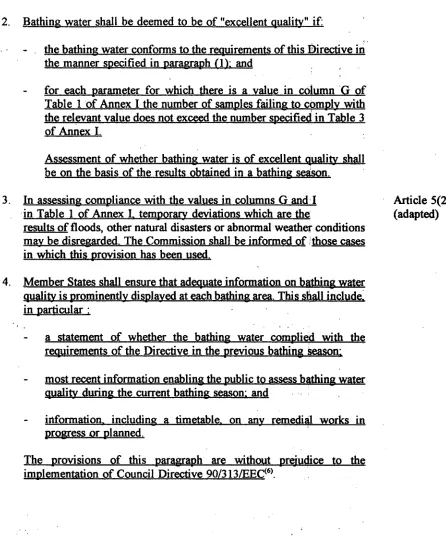
2. Bathing water shall be deemed to be of "excellent quality" if:
the bathing water conforms to the reguirements of this Il>irective in the manner specified in paragraph (1): and
for each parameter for which there is a value in column
·a
of Table 1 of Annex I the number of samples failing to comply with the relevant value does not exceed the number specified in Table 3 of Annex I.Assessment of whether bathing water is of excellent qyality shall be on the basis of the results obtained in a bathing season.
3. In assessing compliance with the values in columns G and'l ·in Table 1 of Annex I. temporary deviations which are the
results of floods, other natural disasters or abnormal weather conditions may be disregarded. The Commission shall be informed of ! those cases
in which this provision has been used.
4. Member States shall ensure that adeguate information on bathing water quality is prominently displayed at each bathing
area.
This shall includi in particular :a statement of whether the bathing water complied with the requirements of the Directive in the previous bathing
season:
most recent information enabling the public to assess bathing water Quality during the current bathing season: andinformation. including a timetable. on any remedi<jl works m progress or planned.
The provisions of this paragraph are without prejudice to the implementation of Council Directive 90/313JEEC<6>. ·
6
[image:25.576.54.500.60.604.2]Article 6 ·
1. The competent authorities. in the Member States shall sample and analyse and make visual and olfactozy inspections of bathing waters during the period specified in paragraph (2) and at least as frequently as is specified in Table 1 of Annex I.
By way of exce.ption. where ·water guality was excellent in the two
previous bathing seasons. according to the criteria set out in Article 5(2) and when no new factor likely to lower the
quality
of the water has appeared, the sampling frequency during the current bathing season may be half that specified in Table 1 of Annex I.2. The sampling. analysis a:nd visual and olfactoty inspections referred to in paragraph (1) shall begin before the start of the bathing season and continue throughout· the duration of the bathing season. The sampling and the ins.pections ~hould be carried out at places where the daily average density of bathers is highest. Wherever possible samples shall be taken 30 em below the surface of tbe water.
3. Competent authorities shall periodically identify all discharges. whether continuous or intermittent which are likely to affect the guality of bathing water, and assess their significance in relation to the obligations contained in Article 4(1) and to local geQgraphical, tidal and current flow conditions. •.. .
They shalL in particular. identify all pollution sources. whether discharges. or contributions from diffuse sources. wbich might lead to salmonella reaching bathing areas. and shall take appropriate action to
avoid pollution from such sources. .
4. Competent authorities shall investigate any unexpected sudden deterioration in the quality·
of
bathing water in order to identify the cause and must take immediate and wpropriate action to restore the quality of the water. ·5. Reference methods of analysis for the parameters concerned are set out in Table 1 of Annex I.
26
Article 6(1) (adapted)
Article 6(2) (adapted)
Article 6(3) and 6(4) (adapted)
Member States which employ other methods shall ensure that,the results obtained are equivalent or comparable to those specified i" Table 1 of Annex I. They shall inform ihe Commission of their use and provide· · evidence of their equivalence or comparability to the reference method.
The Commission shall infomi the other Member· States thereof. The Commission may assess the reliability of such other methods.
Article 7
I. Where pollution constitutes a threat to public health Member States shall prohibit bathing at individual bathing areas. Such a threat shall be deemed to ·exist in a case of significant deviation from ·the values specified in column I in· Table 1 of Annex l taking local :conditions into account.
2. Unless the prohibition is permanent the water shall still be 'considered to be bathing water for the purposes of this Directive.
3. Member States which permanently prohibit bathing at i'ndividual bathing areas shall forthwith inform the Commission thereof. indicating the reasons why the bathing water cannot be brought into conformity with this Directive's requirements.
Article 8
• c '; . . . . ' . .
Implementation of the measures taken pursuant to this
Directive may under no circumstances lead either directly or iftdirectly to deterioration of the current quality of bathing water. ·
Article 9
Such amendments as are necessary to adapt the content of Annex I to scientific and technical progress, · shall be adopted in accordance with the procedure laid down in Article 10.
Article 10
1. The Commission shall be assisted by a committee composed of the representatives of the Member States and chaired by the rq>resentative of the Commission.
Article 7(1)
Article 9 (adapted)
2. The representative of the Commission shall submit to the committee a draft of the measures to be taken. The committee shall deliver its opinion on the draft within
a
time limit which the chairman may lay down according to the urgency of the matter. The opinion shall be delivered by the majority laid doWn in Article 148 (2) of the Treaty in the case of decisions "':hic11 'the Council is required to adopt on a proposal from the Commission. The votes of the rq>resentatives of the Member States within the committee shall be weighted in the manner set out in that Article. The chairman shall not vote.3. The Commission shall adopt measures which shall apply immediately. However. if these measures· are not in accordance with the opinion of the committee. they shall be communicated by the Commission to the
Council forthwith. In that event:
the Commission may defer application of the measures which it has decided for a period of three months from the date of communication.
the Council. acting by. a qualified majority. may take a different decision within the time limit referred to in the previous paragraph.
Article 11
Every year, and for the first time by 31 December 1996, the Member States shall send to the Commission a report on the implementation of this Directive
in the current year. The report shall ~e drawn up on the basis of a questionnaire· or ·outline drafted by the Commission in accordance with the procedure laid down iri Article 6 of Directive 91/692/EEC.
The questionnaire and outline shall be sent to the Member States six months before the start of the period covered by the report. The report shall be made to the Commission before the end of the year in question.
The Commission shall publish a Community report on the implementation of the directive within four months of receiving the reports from the Member States.
Article 12
Directive 76/160/EEC is hereby repealed with effect from 31 December 1995. without prejudice to the obligation of the Member States as to deadlines for transposition into national law and for application as shown in Annex II.
Reference to the repealed Directive shall be construed as a reference to this 28
. J ' .
Directive and should be read in accordance with the correlation table set out in Annex III.
Article 13
1. Member States shall bring into force the laws, regulations and administrative provisions necessary
to comply with this Directive no later than 31 December 1995. They shall forthwith inform the Commission thereof.
When Member States adopt these provisions. these shall contain a reference to this Directive and shall be accompanied by such reference at the time of their official publication. The procedure for such reference shall be adqpted by Member States.
2. Member States shall communicate to the Commission t;Jte texts of the main provisions of national law which they adopt in the field covered
~ this Directive.
Article 14
This Directive shall enter into force on the twentieth day following that of its publication in the Official Journal of the European Communities.
Article 15
This Directive is addressed to the Member States.
Done at Brussels, For the Council
The President
\ _ _;
LN
0
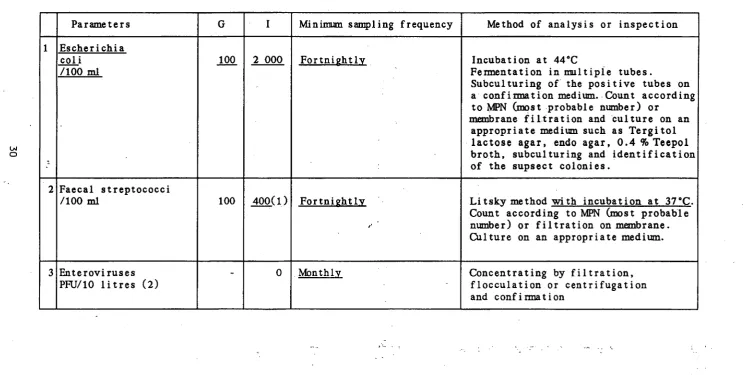
Param.e te r s 1 Escherichia
coli /100 m1
·-2 Faecal streptococci /100 m1
3 Enteroviruses PFU/10 litres (2)
TABLE 1
G I
100 2 000
100 400(1)
- 0
ANNfX I
(U.<\LI1Y RIU!IRfMENTS roR BA.1Hii'U VATER
Minimum sampling frequency ~thod of analysis or inspection
Fortnightly . Incubation at 44°C
Fennentation in multipie tubes.
Subculturing of the positive tubes on a confinnation nwdimn.-Count according to MPN Cmost probable number) or
membrane filtration and ·culture on an appropriate nwdium such as Tergitol ·lactose agar, endo agar, 0.4 fo Teepol
broth, subculturing and identification of the supsect colonies.
Fortnightly Li tsky nwthod with incubation at 37°C. Count according to MPN Cmost probable
,. number) or filtration on membrane.
CUlture on an appropriate nwdium.
Monthly Concentrating by filtration,
- flocculation or centrifugation
[image:30.832.42.786.141.516.2]4 BacterioQhages Nwnb e r I 1 00 ml
5 pH - 6 to 9 Fortnightly Electranetry vnth calibration at pH 7 and 9
6 Colour
-
No ab- Fortnightly Visual inspection or photometry vnthnonnal standards on the Pt.Co scale.
change
7 Mineral oils
-
No film Fortnightly Visual and olfactory inspection.visible on the surface and no odour Vol
--" 8 Surface active substan- No Fortnightly Visual inspection (for the I value)
ces reacting with lasting
methylene blue mg/1 foam Absorption photcmetry with methylene
< 0.3 blue (for the G value)
9 Phenols (3)
-
No Fortnightly Olfactory inspection.. specific
VI
N
10 Transparency m 2 1 (4) Fortnightly Secchi's disc.
11 Dissolved oxygen% - 80-120 Fortnightly VVtnklers' method or electranetric
saturation 02 method (oxygen meter)
12 Tarry residues and Absence Absence Fortnightly Visual inspection. floating materials such of
as wood, plastic sewage
articles, bottles, solids
containers of glass, plastic, rubber or any other substance.
~ste or splinters.
- - -
-(1) .In case of abnormal peak value, Member States can within 2 "WOrking days retest this parameter.
If following retesting a nonnal value is recorded, the peak value can be disregarded. However, the COnnrlssion shall be infonned of the number of peak values disregarded for each bathing zones.· (2) This parameter must be measur~d once in the fortnight before the start of the bathing season. ·
If during the ~preceding bathing reasons the bathing ~ter complied with the G value for Escherichia coli and the I value for faecal streptococci, on the basis of Table 3 and 2 respectively, and the bathing ~ter
I
does not receive discharges of chemically treated sewage. then the parameter needs only to be measured once more. This measurement should be made. in the middle of the bathing season.
(3) Vffien bathing ~ter undergoes natural enric~nt of this substance, in its unchlorinated form, Member States can, without prejudice to public health protection, ~ve the related provision of the Directive. In such cases,
it shall fort~th inform the Cornrrrission thereof.
TABLE2
NUMBERS OF SAMPLES
wmCH NEED NOT CQMPL Y WITH
THE
DIRECTIVE'S ST ANPARDSNumber of samples taken and analysed
up to 19 inclusive 20 to 39 inclusive 40 to 59 inclusive
Greater than 59
Maximum number which need not conform to the I value
0
1
2
TABLE3
NUMBERS OF SAMPLES
wmCH NEED NQT COMPLY WITH THE DIRECTIVE'S STANDARDS
Number of samples taken and analysed
up to 4 inclusive 5 to 9 inclusive 10 to 14 inclusive 15 to 19 inclusive 20 to 24 inclusive 25 to 29 inclusive 30 to 34 inclusive 35 to 39 inclusive 40 to 44 inclusive 45 to 49 inclusive 50 to 54 inclusive 55 to 59 inclusive
Greater than 59
Maximum number which need not conform to the G value
0 1 2 3 4 5 6 7 8 9 10
11
20% of number of samples
ANNEXTI
DEADLINES FOR TRANSPOSITION.INTO NATIONAL LAW AND/OR .APPLICATION
..
amended by Directive ..
II
Directive ..
76/160/EEC GR ESIPO 90/656/EEC 91/692/EEC
(1) (2) (3) (4)
Article I ...
Article 2 . ' ....
Article 3
. '
Article 4 '·
-Article 5
Article 6 '
'Article 7 ... ~· .
Article 8 ' -·
Article 9 .. ..
Article 10 ... : ..
Article 11 amended amended
.Article 12 ... ·amended
Article 13 - amended
Article 14
(1) EC-9: 10.12.1977 (transposition)
10.12.1985 (application of Article 4(1)) GR: 1.1. 1981 (transposition)
10.12.1985 (application of Article 4(1)) ES: 1.1.1986 (transposition and application) P: 1.1.1993 (transposition and application)
D: for the territory of the former GDR: 31.12.1993 (transposition and application) · (2) EC-10: 1.1.1981