This is a repository copy of Developing a Safety Case for Electronic Prescribing.
White Rose Research Online URL for this paper:
http://eprints.whiterose.ac.uk/150209/
Version: Published Version
Proceedings Paper:
Jia, Yan, Lawton, Tom, White, Sean Paul et al. (1 more author) (2019) Developing a Safety
Case for Electronic Prescribing. In: Studies in Health Technology and
Informatics:MEDINFO2019. , pp. 629-633.
https://doi.org/10.3233/SHTI190299
[email protected]
https://eprints.whiterose.ac.uk/
Reuse
This article is distributed under the terms of the Creative Commons Attribution-NonCommercial (CC BY-NC)
licence. This licence allows you to remix, tweak, and build upon this work non-commercially, and any new
works must also acknowledge the authors and be non-commercial. You don’t have to license any derivative
works on the same terms. More information and the full terms of the licence here:
https://creativecommons.org/licenses/
Takedown
If you consider content in White Rose Research Online to be in breach of UK law, please notify us by
Developing a Safety Case for Electronic Prescribing
Yan Jia
a, Tom Lawton
b, Sean White
c, Ibrahim Habli
aa
Department of Computer Science, University of York, York UK, b
Bradford Royal Infirmary and Bradford Institute for Health Research, Bradford UK c
NHS Digital, Leeds UK
Abstract
It is now recognised that Health IT systems can bring benefits to healthcare, but they can also introduce new causes of risks that contribute to patient harm. This paper focuses on approaches to modelling and analysing potential causes of medication errors, particularly those arising from the use of Electronic Prescribing. It sets out a systematic way of analysing hazards, their causes and consequences, drawing on the expertise of a multidisciplinary team. The analysis results are used to support the development of a safety case for a large-scale Health IT system in use in three teaching hospitals. The paper shows how elements of the safety case can be updated dynamically. We show that it is valuable to use the dynamically updated elements to inform clinicians about changes in risk, and thus prompt changes in practice to mitigate the risks.
Keywords:
Electronic Prescribing, Medication Errors, Patient Safety
Introduction
Many countries have promoted Health Information Technology (HIT) as a primary means to improve the safety and efficiency of healthcare delivery. For example, the US government and European Commission have initiated policies to promote the adoption and use of HIT [1]. In the UK, several funding programmes have been launched to drive technology use within the National Health Service (NHS) [2]. One of the main types of HIT being targeted is Electronic Prescribing Systems (EPS) that involve “the use of computing devices to enter, modify, review, and output or communicate, drug prescriptions” [3]. There are many potential benefits associated with EPS, e.g. reduction in prescription errors as a result of fewer illegible orders, easier repeat prescriptions and better ability to track prescriptions [4]. However, the introduction of EPS also introduces new causes of risks, for example alert fatigue [5]. In order to realise the benefits of EPS, thorough risk assessment must be conducted. This should enable hospitals to evaluate whether the EPS will achieve safer care by reducing current clinical risk and also controlling the new risks associated with the introduction of the new technology.
In many engineering domains the use of a Safety Case (SC) is an established practice [6]. A SC is a structured argument, supported by evidence, that a system is acceptably safe in its context of use [7]. The SC is a risk management tool, providing rationale for accepting a system into service and enabling the relevant stakeholders to make informed decisions. The SC is particularly useful when it is produced at the same time as the system is designed and deployed, as it can help to inform design decisions and potential changes to the clinical workflows [8].
Previously, we reviewed the notion ofhazard for HIT [9] and implemented a tool-supported methdology called the Safety Modelling, Assurance and Reporting Toolset (SMART) [10]. In this context, hazards are conditions or behaviour that can be observed at the level of the clinical system, and which have a clear link to patient harm, e.g. wrong medication. In this paper, we use SMART to support hazard analysis and develop a SC for an EPS deployed in three teaching hospitals. This paper focuses on three areas:
• Safety analysis: modelling causes and consequences of hazards, and hazard controls;
• Safety case: the use of the Goal Structuring Notation (GSN) [11] to present a safety argument, reflecting the hazard controls and risk acceptance;
• Through-life safety: an initial analysis of those aspects of the SC that are static, and those which can benefit from being updated dynamically.
Our approach involves proactive safety analysis, prior to deployment of EPS. In addition, we present a rationale for dynamically updating the SC, to support through-life safety. We refer to this as a Dynamic Safety Case (DSC) [12].
Methods
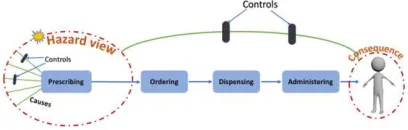
[image:2.539.288.492.518.583.2]Setting: The study was undertaken in three teaching hospitals based on a large-scale HIT system, with a focus on the prescribing process as part of medication management. Figure 1 is an abstract model of the medication management process, of which prescribing is the first step, and the scope of our study.
Figure 1 – Abstract Model of Medication Management
Data collection: a qualititve reseach method is used in this study. Data was collected from multi-disciplinary workshops (eight in total), which were organised to perform the hazard identification and risk analysis for the EPS. There were 3 clinical consultants, 2 nurses, 2 pharmacists, 2 safety engineers, 2 researchers and 2 systems engineers (representing the EPS supplier) involved in the workshops.
L. Ohno-Machado and B. Séroussi (Eds.)
© 2019 International Medical Informatics Association (IMIA) and IOS Press.
Data analysis: A combination of Software Hazard Analysis and Resolution in Design (SHARD) [13] and Systems Engineering Initiative for Patient Safety (SEIPS) [14] were used to stimulate the indentification of hazards, their causes and consequences, and the controls associated with the hazards. SHARD is suitable for identifying hazards and casuses of hazards from a software perspective, e.g. missing data, but it does not address complex interactions between software systems and humans. SEIPS provides a framework for a comprehensive consideration of work system design, which includes five elements: person, tasks, technology and tools, environment and organisation, and its impact on care processes and outcomes. This helps to address the interactions of software system and humans in a complex socio-technical context. Thus the two methods are complementary. The results of using SHARD and SEIPS are recorded using bow-tie diagrams. Finally, GSN was used to represent the safety arguments for EPS based on the results and findings from the workshops.
Results
Six main findings were identified, which are reported in this section.
The importance of a clear process model
To ensure the safe implementation of HIT systems, it is important to understand how HIT systems are used to support the clinical activities. As such, the first step was to define a clear process model to reflect the relationships between EPS, as a HIT system, and prescribing, as a clinical activity. During this task, one challenge arose, which is to what level of granularity the prescribing process should be modelled, e.g. a more detailed IT centered view, including “right click for more medication options”, or a more abstract clinical activity level, such as “choose right medication”. As a result of considering both the validitiy of the processes and the emphasis on clinical context for hazard identification, the multidisciplinary team constructed the clinical process model to describe the flow of clinical activities and decisions, linked to the specific functions in the EPS, as shown in Figure 2. This also reflects well established
health informatics approaches to evaluating HIT systems, that HIT interventions should be clinically- and problem-driven rather than technology-driven [15]. As is shown in Figure 2, the “sign” clinical activity in this model is associated with the “sign medication” function in the EPS. This model provides an understanding of the interaction between a HIT system and its clinical activities which is necessary before being able to identify hazards.
Identifying hazards in complex clincal settings
The most critical step in achieving and demonstrating the safety of HIT systems is to conduct a systematic process to identify potential hazards during the product development and then engineer them out or reduce their likelihood [16]. In order to carry out a thorough and proactive hazard identification, we first agreed on an overall hazard categorization based on the five rights in medication safety [17], producing five general categories:
1. Wrong patient selected in prescribing phase 2. Wrong medication dose prescribed 3. Wrong medication route prescribed 4. Wrong medication time prescribed 5. Wrong medication choice
Each hazard category can be refined further. We do this using the failure classes defined in SHARD, which provides a structured approach to the identification of potentially hazardous behaviour in software systems. By applying these failure classes (omission, commission, early, late and incorrect) to the hazard category 5 - wrong medication choice, defined above, we identified seven specific hazard cases, loss of prescription, unintended medication, wrong medication, late medication, early medication, duplicate medication and adverse interaction.
For brevity, the rest of the paper focuses on the wrong medication choice category, but the method described above would apply equally well to the other hazard categories.
Fgure 2- Prescribing Process in SMART
Y. Jia et al. / Developing a Safety Case for Electronic Prescribing
Modelling the causal chains (technical and non technical)
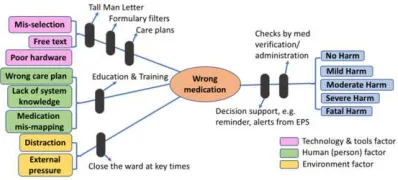
Figure 3 – Bow-Tie for Wrong Medication
In order to mitigate the hazards, it is important to identify their causes so we can identify effective controls. In a socio-technical system, it is important to recognise both technical and non -technical factors. Therefore, we used the SEIPS model to guide us to think systematically. The use of the SEIPS model both helps to identify causes of the specific hazard, and the controls. For each hazard, there are a range of controls that can counteract causes of the hazards, and others that can influence the consequence of the hazards. Figure 3 illustrates the causes and consequences and the controls related to the Wrong Medication hazard,arising out of the analysis workshops. In Figure 3, we can see that there are 8 identified causes that contribute to Wrong Medication during prescribing (the left-hand side of the bow-tie). Among them, three causes belong to the technology factor (technology and tools in SEIPS), which is related to the EPS deployed in the hospital. A well designed EPS should have the ability to mitigate the causal factors, for example by integrating Tall Man Letter to make it noticeable or striking out inapplicable options when the prescribers are selecting medications. Another three causes are categorised as human factors (person in SEIPS). These causes can be controlled by providing education and training to clinical practitioners. The last two causes are work environment factors (environment in SEIPS). They are related to the local organisation and policy. These factors should be controlled by providing guidance or procedures by the local organisation, e.g. to close the ward at key times.
The classification of causal factors is useful, as recognising that different causal factors belong to particular categories helps to
find the right control. It also helps to make the causes of hazards explicit and reveal the weak points of the system. For example, considering Wrong Medication, it seems that the organisation should also seek to reduce the pressure on clinical practitioners, e.g. by reducing the un-necessary and non-clinical related workload (environmental factor).
Difficulty of determining severity
Turning to the right-hand side of the bow-tie, we consider the consequences of the hazards. In the workshops, we found it very challenging to assess the potential harm concerning a par-ticular hazard. For example, consider the Wrong Medication hazard; the medication type, the profile of the patients, the com-plexity of the clinical conditions and the state of the clinical setting would lead to different consequences.
In addition, we found it difficult to map the consequence of medication errors to severity of harm. From our literature re-view, we discovered that it is very hard to find information to make such connections. Studies such as [18] and [19] either just give a severity classification without a detailed description of how they mapped their patient results to the severity, or they focus on error types and their causes, but do not identify the severity of the patient outcome. Further work is needed on how to categorise the severity of harm and give concrete examples how to map the consequences (patient outcomes) to different severities. In order to illustrate this, we present examples of patient harm in Table 1 using the World Health Organization (WHO) severity classification [20]. This table is intended to be illustrative but refining and expanding it, e.g. by considering different aspects of human function such as vision and respira-tion, might aid in future hazard and risk assessment.
Clear arguments, the essense of reasoning
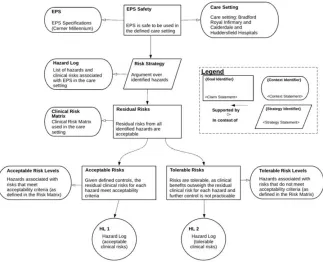
Based on insights gained in the workshops, we employed GSN to represent the safety argument for the EPS in three teaching hospitals. Figure 4 shows the top level of the safety argument and reflects the use of a Hazard Log to record information about all the hazards. A Hazard Log is a standard safety management tool for recording and tracking information about risks, used in other sectors, e.g. aerospace, but also applicable in healthcare and required by the NHS HIT standards [7; 21].
Table 1– Examples of Severity Classes
Severity None Mild Moderate Severe Fatal
Summary No symptoms (detected)
Symptoms short-term, requiring minimal in-tervention
Harm or loss of function may be long-term, requiring intervention
Life-saving inter-vention needed; long-term harm or permanent loss of function
Death caused or brought forward by the incident
Examples Paracetamol given instead of priadel (loss of therapeu-tic effect)
Use of antibiotics to treat viral in-fections (NB re-duces utility of antibiotics)
Nausea, vomiting or diarrhoea from over-dose of epirubicin
Forgetting to specify maximum daily dos-age for an “as re-quired” drug
Accidental sedation due to prescribing di-azepam not diltiazem
Digestive problems including ulcers and internal bleeding
Hypotension due to overdose of lis-inopril
Dyspepsia and ul-cers from overuse of non-steroidal anti-inflammatory drugs for arthritis
Blindness due to prescribing a diu-retic to patients with low blood pressure
Lung damage and possible sepsis giv-ing oral treatment to patient with dyspha-gia
Weekly dose of methotrexate given daily
Ten times overdose of insulin
[image:4.539.57.482.503.693.2]Figure 4 – Top level of the GSN for the EPS for the three Teaching Hospitals
It is often infeasible to eliminate risks, so the claim Residual Risks shows that the risks left after implementing the controls are acceptable and/or managed in the context of the Risk Matrix used at the hospitals; this breaks down into two sub-cases:
• Residual risks meet the acceptability criteria
• Residual risks do not meet the criteria, but can be accepted due to the clinical benefit
Evidence to support these claims can come directly from the Hazard Log.
For example, the risk of the “Wrong Medication” hazard has been reduced to an acceptable level, given the seven controls identified in Figure 3. The controls and risks are set out in the Hazard Log. Alternatively, we could have expanded the GSN argument further, replacing solution HL1 with more detailed sub-arguments for each hazard. For the “Wrong Medication” hazard, the solutions at the bottom of the argument would be evidence about the effectiveness of each of the controls. The evidence about the controls on the left of the bow-tie is generated from analysis of the error records, which are derived from chart review, automated review of electronic records, review of incident reports, review of self-reporting, patient and staff interviews, and from direct observation [22]. For example, in order to assess whether the controls – Tall Man letters and Formulary filters – are effective, we should interrogate the error rates related to mis-selection of medication and free text.
Dynamic Safety Cases
It is well established that the safety of critical services is a dynamic property [23]. In healthcare, this dynamism is often attributed to variation in the health and care services, and their underlying systems, as well as in the environments within
which they are deployed. Although variation can be seen as a negative attribute, e.g. a sign of noncompliance, increasingly more emphasis is placed on the necessity of variation to enable, and sometimes empower, people and technologies to adjust and adapt to ensure continuous safe care. The ability to adapt and adjust is a key enabler for resilience in healthcare [24]. Unlike traditional SC, which often remain static and are only updated in a reactive manner, both the justification and evidence base of the SC for a complex process such as prescribing should evolve based on real-time data that is collected, proactively, from diverse sources, particularly covering and combining clinical, organisational and technological factors.
The SC described in this paper will be extended and integrated with a new dynamic risk model and uncertainty assessment algorithms, based on Bayesian Networks, for proactively computing the confidence in, and updating the reasoning about, the safety of the medication services based on real-time data. This will be combined with a set of update rules triggering the provision of actionable suggestions to clinicians in response to changes in the services, clinical settings, the safety argument or the confidence in that argument. Thus clinicians will be able to take risk reduction action, i.e. adding new controls, based on leading indicators/precursors of problems before they develop into potential errors and patient harm.
Discussion
The paper summarises our work to date on developing a full SC for the entire HIT system in the three hospitals. Our results so far show that having a clear model of the medication process aids analysis, both in identifying hazards and their controls. In particular the clincal process models enable the workflows to be analysed at a level which is understandable by the users of the EPS, and which is also clinically meaningful.
Y. Jia et al. / Developing a Safety Case for Electronic Prescribing
The use of the bow-tie to model the causes and consequences of a hazard in the precribing process gives a direct visuliation of how a hazard is controlled, what can be the potential causes of this particular hazard, what consequences there can be for the patient through this hazard and what kind of controls we have to mitigate the hazard. This is a very useful basis for hazard and risk assessment. We see an opportunity to use this approach to improve analysis of medication safety, particularly assessment of risk, beyond just EPS, and this is an area for future research.
Further, we have shown how to use GSN to construct an explicit argument to justify the safety of EPS use in the context of the wider medication management system. The SC rests on evidence, some of which relates to the controls identified in the bow-tie diagram. SC are predictive, and the evidence is usually based on analysis prior to operation. A first step in making the SC representative of actual use of EPS would be to update the evidence to reflect the effectiveness of the controls, as they change over time. Ideally we would use this to show that the EPS plus controls is better (in terms of patient safety) than the previous manual system. However it is hard to obtain data that shows what happened before introduction of EPS, and hence to make such comparisons. In contrast, in future, it will be possible to see whether or not the controls are effective and the extent to which the risk is reducing over time, e.g. the frequency of over-riding alerts and error rates relating to mis-selection and free text are going down. Thus the SC can support management of risk through life, rather than just being a tool for deciding whether or not a system can be deployed. This is a key area of our future work, and should lead to development of DSC.
Conclusions
Management of risk associated with HIT systems is challenging as the technology is used in a complex socio-technical setting, and the staff using the systems are often under significant pressure, due to the volume of work, or the need to respond to patients’ symptoms very quickly. We have presented our approach to assessing the safety of HIT systems, based on work on EPS in three UK hospitals, which draws on accepted practices in other domains, which we believe helps address the problems of managing safety in a healthcare setting.
The work enables causes and consequences of hazards to be analysed more directly than is possible with a purely statistical approach. Further, it enables the role and effectiveness of risk controls to be assessed. The work reported here is part of an ongoing research programme that will enable dynamic control over safety risk, by updating the evidence in the SC from analysis of operational data.
Acknowledgements
This work is partly funded by Bradford Royal Infirmary.
References
[1] European Commission, eHealth Action Plan 2012–2020. Innovative healthcare for the 21st century, in, 2012. [2] Department of Heath, The NHS plan: a plan for
investment, a plan for reform, in, 2000. [3] J. Teich and J.J.W. Marchibroda, DC, Electronic
prescribing: toward maximum value and rapid adoption. eHealth Initiative, (2004).
[4] E.L. Abramson, Causes and consequences of e-prescribing errors in community pharmacies, Integrated pharmacy research & practice5 (2015), 31.
[5] T.H. Payne, EHR-related alert fatigue: minimal progress to date, but much more can be done, BMJ Quality & Safety
(2018), bmjqs-2017-007737.
[6] M.A. Sujan, I. Habli, T.P. Kelly, S. Pozzi, and C.W. Johnson, Should healthcare providers do safety cases? Lessons from a cross-industry review of safety case practices, Safety Science84 (2016), 181-189. [7] NHS Digital, DCB0160: Clinical risk management: its
Application in the Deployment and Use of health IT Systems, in, 2018.
[8] R. Bloomfield, N. Chozos, D. Embrey, J. Henderson, T. Kelly, and F. Koornneef, Using safety cases in industry and healthcare, Health Foundation, London (2012). [9] I. Habli, S. White, M. Sujan, S. Harrison, and M. Ugarte,
What is the safety case for health IT? A study of assurance practices in England, Safety Science110 (2018), 324-335. [10] I. Habli, Safety modelling, assurance and reporting
toolset (SMART) for digital health, Informatics for Health,
Manchester, UK (2017).
[11] The GSN Working Group Online, GSN Standard, in, 2018.
[12] E. Denney, G. Pai, and I. Habli, Dynamic safety cases for through-life safety assurance, in: Proceedings of the 37th International Conference on Software
Engineering-Volume 2, IEEE Press, 2015, pp. 587-590.
[13] D.J. Pumfrey, The principled design of computer system
safety analyses, University of York, 1999.
[14] P. Carayon, A.S. Hundt, B. Karsh, A.P. Gurses, C. Alvarado, M. Smith, and P.F. Brennan, Work system design for patient safety: the SEIPS model, BMJ Quality & Safety15 (2006), i50-i58.
[15] H. Fraser, E. Coiera, and D. Wong, Safety of patient-facing digital symptom checkers, The Lancet (2018). [16] E.H. Shortliffe and M.J. Sepúlveda, Clinical Decision
Support in the Era of Artificial Intelligence, JAMA (2018). [17] M. Grissinger, The five rights: a destination without a
map, Pharmacy Therapeutics35 (2010), 542.
[18] J. Kelly and D. Wright, Medicine administration errors and their severity in secondary care older persons’ ward: a multi‐centre observational study, Journal of clinical
nursing21 (2012), 1806-1815.
[19] K.L. James, D. Barlow, R. McArtney, S. Hiom, D. Roberts, and C. Whittlesea, Incidence, type and causes of dispensing errors: a review of the literature, International
journal of pharmacy practice17 (2009), 9-30.
[20] W.H. Organization, International Classification for Patient Safety Key Concepts and Preferred Terms, in, WHO Geneva, 2009.
[21] NHS Digital, DCB0129: Clinical Risk Management: its Application in the Manufacture of Health IT Systems, in, 2018.
[22] M.P. Tully and B.D. Franklin, Safety in medication use, CRC Press, 2015.
[23] C. Vincent and R. Amalberti, Safety in healthcare is a moving target, in, BMJ Publishing Group Ltd, 2015. [24] R.L. Wears, E. Hollnagel, and J. Braithwaite, Resilient
health care, volume 2: the resilience of everyday clinical work, Ashgate Publishing, Ltd., 2015.
Address for correspondence