by
John f . Tilley.
Thesis for the Degree of Master of Science
Australian National University Diffusion Research Unit
This w ork is divided into two se c tio n s. The f i r s t d e ta ils the m e a su re m e n t of in trad iffu sio n co efficien ts by conventional d ia p h ra g m -c e ll technique. Iso to p ic frictio n co efficien ts have been calcu lated fro m th e in trad iffu sio n , m utu al-d iffu sio n , and activ ity d ata fo r th e sy ste m s; Sucrost la b elled s u c r o s e -w a te r and M an n ito l-lab elled m a n n ito l-w a te r. An attem p t h as been m ade to c o rre la te fric tio n co efficien ts w ith m o le c u lar p ro p e rtie s . B ecau se of th e lim ited data av ailab le fo r s y ste m s of th e type studied good c o rre la tio n s w ere not obtained.
The second section d e s c rib e s th e developm ent of a continual m o n ito rin g technique applied to the d iap h rag m c ell. In an e ffo rt to im p ro v th e a c c u ra c y of th is technique a la rg e n u m b er of tr a c e r - io n concen tratio n m e a su re m e n ts w e re m ade on th e sy ste m S trontium c h lo rid e - w a te r. The r e s u lts obtained fro m continual m on ito rin g w e re co m p ared w ith th o se from
n
t
the conventional technique and th e c a p illa ry -c e ll technique. Good a g reem e A betw een diffusion coefficients fro m th e th r e e m ethods w as not obtained and an a n a ly sis of the e r r o r s involved in the m ethods h as been m ade to explain th e d is c re p a n c ie s .CONCLUSION
C o rre la tio n of fric tio n co efficien ts with m o le c u la r p ro p e rtie s is e m p iric a l a t p re s e n t. In fu tu re, stu d ie s should be u n dertaken on
hom ologous s e r ie s of so lu tes to enable e a s ie r c o rre la tio n than i s p o ssib le a t p r e s e n t. The w ork done on the continual m o n ito rin g technique in d ic a tes th a t th e m ethod w ill p ro v id e highly a c c u ra te diffusion co efficien ts if
Page CHAPTER 1
INTRODUCTION 1
Liquid diffusion 2
Definitions 4
Methods for measuring tracer-diffusion coefficients 5 Theory of tracer-diffusion in electrolyte solutions 11
Tracer diffusion of non-electrolytes 12
Multicomponent diffusion 14
CHAPTER 2
THE DIAPHRAGM CELL METHOD 18
Theory 19
Stirring of solutions 20
Transport mechanisms 21
Diaphragm steady state 22
Volume change on mixing 23
Cell calibration 24
Duration of experiments 32
Cell constant variation 33
CHAPTER 3
INTRADIFEUSION MEASUREMENTS IN SOME AQUEOUS NON-ELECTROLYTE
SYSTEMS. THEORY AND EXPERIMENTAL 35
Experimental flow equations 37 Relation "between intradiffusion coefficient and mutual-
diffusion coefficient 38
Theoretical flow equations 40
Listing of the auxiliary data required for the calculation
of friction coefficients 44
Treatment of the data 47
Reagents 30
Purification of radioactive compounds 52
Preparation of solutions for diffusion 53
Preparation of solutions for counting 55
Determination of radioactive tracer concentration 55
Counting technique 56
CHAPTER 4
INTRADIFFUSION MEASUREMENTS IN SOME AQUEOUS NON-ELECTROLYTE
SYSTEMS. RESULTS
AND
DISCUSSION 60Experimental intradiffusion coefficients 61
Discussion of errors 63
Special effects 64
Curve fitting the experimental data 66
Comparison of intradiffusion data with other related data 67
Eriction coefficients 73
CHAPTER 5
CONTINUAL MONITORING- METHOD OP MEASURING DIFFUSION
COEFFICIENTS. THEORY AND EXPERIMENTAL 78
Aims o f th e s e m ic o n d u c to r m o n ito r in g m ethod 79 D e te c to r c h a r a c t e r i s t i c s 80
D e te c to r n o is e 81
R e q u ire m e n ts o f a s s o c i a t e d e l e c t r o n i c eq u ip m en t 83
Use o f d e t e c t o r s 84
C om parison o f se m ic o n d u c to r d e t e c t o r s w ith o t h e r r a d i a t i o n
d e t e c t o r s 86
D esig n o f th e d i f f u s i o n c e l l 87 C hoice o f s u i t a b l e is o t o p e s 88 P u r i f i c a t i o n o f r a d i o a c t i v e s tr o n ti u m c h l o r i d e 89
E x p e rim e n ta l p r o c e d u r e 90
C a l c u l a t i o n o f d i f f u s i o n c o e f f i c i e n t 91
C o u n tin g c o r r e c t i o n s 92
CHAPTER 6
CONTINUAL MONITORING METHOD OF MEASURING DIFFUSION
COEFFICIENTS. RESULTS AND DISCUSSION 93
T r a c e r - d i f f u s i o n c o e f f i c i e n t s o f s tr o n ti u m io n i n
s tr o n tiu m c h l o r i d e s o l u t i o n s 94 C om parison w ith p r e v io u s d a t a
Limitations of the measuring system 9&
Problems in background estimation 98
Estimation of x> rediffusion time 100
Conclusion 101
1 2 3 4 5
6
78
9 10 11 Page 63 63 63 67 72 74 74 8485
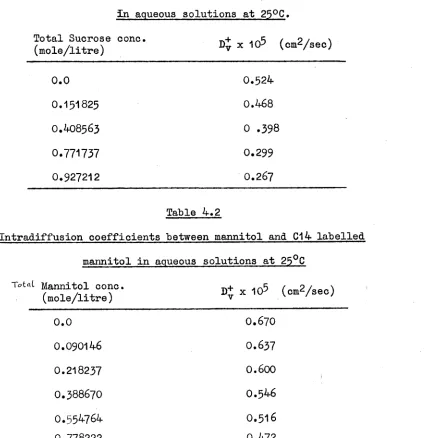
87 95 FollowsDiffusion of Sucrose in aqueous solutions
Diffusion of mannitol in aqueous solutions
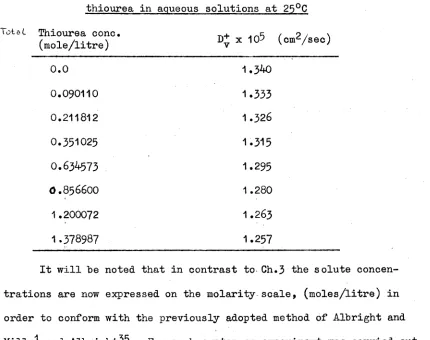
Intradiffusion coefficients of thiourea
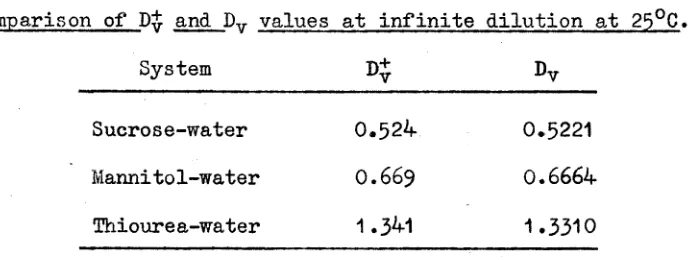
Comparison of diffusion data of sucrose
Test of equation 4.4 for thiourea
Friction coefficients of sucrose
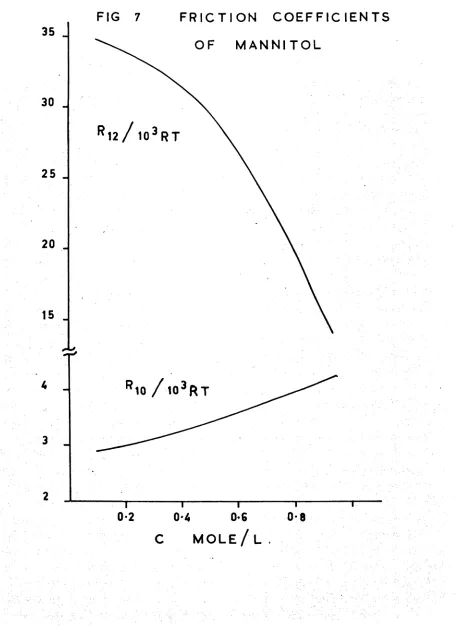
Friction coefficients of mannitol
Cross-section of a surface-barrier detector
Circuit of detector system
Diaphragm cell for continual monitoring
CHAPTER 1
Liquid diffusion
It has been customary to express molecular interactions in diffusing liquid systems in terms of the diffusion coefficients of the components. Recently, a number of workers have suggested that data from diffusion studies might be more informative if transport properties were expressed in terms of friction coefficients. The
calculation of reasonably precise isotopic friction coefficients requires highly accurate mutual-diffusion, tracer-diffusion and activity data. Over the past two decades several techniques have been introduced for the measurement of tracer-diffusion coefficients in liquids, and the most accurate of these is the diaphragm-cell method. Present practice is to calculate a diffusion coefficient from just two measurements of the tracer concentration all made at the conclusion of the experiment. In spite of this limitation, pre cision of the order of a few tenths of is possible1 * Part of the work described in this thesis is devoted to measuring tracer diffus ion coefficients by the above method and thereby to calculate frict ion coefficients. In addition;with the aim of enhancing the accuracy of the method, a project was undertaken in which a large number of tracer-concentration measurements were made during the course of an experiment.
driving force. Onsager^, when deriving equations for diffusion, used the gradient of chemical potential-* as the force. For tracer diffusion this gradient is considered to be a term derived from the entropy of mixing. An established method for measurement of tracer- diffusion coefficients is by means of radioactive isotopes. It is assumed that the diffusive behaviour of labelled and unlabelled isotopes is identical. A feature of diffusion in aqueous solution is that the diffusing entity is usually hydrated, and since diffus- ional velocities are more dependent on size than mass, the substit ution of a labelled atom in place of an unlabelled one is virtually
4
unnoticeable. Most experimenters have found that diffusion coeffic ients for the same molecule measured with different labelled isotopes are identical within the precision of measurement, except where mass differences are large.
The equations derived by Fick^ are the basis of diffusion measurement. The first law states that for an isothermal single phase system the diffusional flux (j) passing at time (t) through unit area perpendicular to the x- direction is proportional to the
concentration
(c)
gradient along the x- axis.independent of concentration in the above equations and is actually s
the case for tracer-diffusion. The second law applied to all diff
using systems and a solution of it, subject to the appropriate
boundary conditions is employed in both free-diffusion and
restricted-diffusion studies. The first law may be applied to simpler systems
where the concentration gradient is tirne-independent. This situation
is closely approximated in the diaphragm-cell method.
Definitions.
Some confusion has been evident in the past in regard to the
terminology used to describe the various types of diffusion coeffic
ients. An explanation of the various terms used in this work is given.
Tracer diffusion is a general term describing the motion subject
to a concentration gradient of a labelled component present in (very)
low concentration in an otherwise uniform medium. One aspect of
tracer diffusion is where the tracer species has a chemically ident
ical counterpart in the supporting medium. This has been termed
intradiffusion^. A special case of intradiffusion is self diffusion,
where the supporting medium contains only the chemically identical
counterpart of the tracer. In a diffusing system of two chemically
b t r\
rKr^J
different components several different mtrb^ai^hiffusion coefficients
exist, depending on the frame of reference chosen. The mutual-diffus
for the volume-fixed frame of reference. In this case the
mutual-diffusion coefficients of each component are identical. Also, if
no volume change occurs on mixing, the cell-fixed and volume-fixed
frames of reference coincide.
Methods for measuring tracer-diffusion coefficients.
Open-ended capillary method.
This method was developed for aqueous solution work by Anderson
and Saddington^ in 1949. Modifications have been carried out by Wang"'7,
Mills^, and Mills and G-odbole^. The theory of the method has been explained by these authors.
Capillaries used are approximately 2 cm in length and 0.5 mm
internal diameter and sealed at one end. The tube is filled with
tagged solution and immersed in a relatively large reservoir of in
active solution, of the same chemical composition. Diffusion is
allowed to proceed and after a measured time interval the quantity
of tagged material remaining in the capillary is measured and com
pared with the initial quantity. It is possible to diffuse tracer
solution into the capillary by filling the bath with tagged solution
and the capillary with inactive solution. Solution of kick's second
law for the given boundary conditions produces a relatively simple
equation if the experimental diffusion period is sufficiently long.
Errors in capillary method.
The capillary equation shows that the method is an absolute
one, but it suffers from some degree of uncertainty in the exactness
invariably results in a slight scooping out of tracer solution.
A drop of liquid is usually left on top of the open end to minimise
10 i i
this error. Mills and Kennedy , and Mills and Adamson'1, showed
that losses of approximately 1.5% of the capillary contents resulted
under stirred conditions, corresponding to a lengthening of the diff
usion time by 100 seconds. This is negligible when compared with
usual diffusion times of 2 x 1 (ß seconds.
Solution of F i c k ’s second law requires that the concentration
of the tracer at the open end of the capillary is zero. Consequently
some form of stirring is necessary to remove the stagnant layers of
c -ip
tracer solution. Anderson and Saddington , Burkell and Spinks ,
13
Matuura and Shimozawa and several others, neglected stirring, and
their results would tend to be lower than the true value. Wang?
attempted to remedy the defect by using a one litre reservoir and
stirring solutions with a large paddle placed below the capillary.
However because of the turbulence caused by the paddle, the diffus
ion coffecients were higher than the true value. Tagged solution
was being scooped out of the capillary by the uneven flow of reserv
oir solution over the mouth of the capillary. Quoted experimental
error of the method at this stage was ± 2/o.
Further study of the technique by Mills and K e n n e d y ^ indicated
possible additional errors due to ion adsorption of the tracer, and
pH differences between tracer and bath solution. The next advance
flow of reservoir solution was passed over the open end of capill
aries. The flow rate of reservoir solution was varied until results
from the capillary cell and diaphragm cell agreed. The accuracy
claimed was ± 1$.
The results of Mills and G-odbole^ using a continual monitoring
method indicated a precision of + 0.2$. In this method the capillary
containing tracer solution was placed inside a plastic scintillator
mounted on a photomultiplier tube, and. enabled a continuous determin
ation of the activity remaining in the capillary. By using low conc
entrations o1 solute they were able to test the Onsager^ limiting law
for ionic diffusion.
Free diffusion.
f.ang and Kennedy^ + used large tubes of 0.1cm diameter, which
were divided into three sections. The duration of the experiment
was such that the change in solute concentration at the closed end
was negligible, and a solution of F i c k ’s second law for the approp
riate boundary conditions allowed the diffusion doefficient to be
found. Claimed accuracy of this method was ± 1
$.
Porous-Frit method.
A thin porous disc (thickness 0.033 to 0.1~]b- cm, hole diameter
1p) of inert porcelain is saturated with labelled solution and then
suspended in a large bath of unlabelled material. From the rate of
decrease of activity with time the diffusion coefficient is calculated.
diffusing polymers. They suspended a porcelain disc saturated with the solution of interest from the arm of an analytical balance and determined the diffusion coefficient from the time rate of weight change. The bath liquid was stirred except when recording weights. The pore size of the frit was chosen to eliminate bulk flow and wall effects.
As with the open-ended capillary cell immersion errors are present but are insignificant for sufficiently long diffusion times. Errors are likely due to diffusion from the ends of the frit and
scooping-out of tagged solution may well occur because of the turb ulent stirring employed. In an extension of the method Marcinkowsky et al17 used the following procedure : a porcelain frit was saturated with radioactive tracer solution, and a non-labelled solution of the
same chemical concentration was pumped past the frit. The diffusion coefficient was found from a plot of counting rate against time together with frit calibration data. They calibrated the frit with the data of Mills^ for tracer diffusion of Na+ in 1M EaCl and adjusted the flow rate of the bulk solution so that their results coincided with calibration data. They found that for best results frits had to be aligned parallel to the direction of flow. Accuracy claimed was ± 5%«
Diffusion coefficients in molten salts1^ have been determined by the porous-frit weight-loss method. Results obtained have been
Diaphragm cell method.
In 19-4-7 Adamson5^ adapted the diaphragm cell for tracer diffusion measurements. Previously it had been used for mutual- diffusion studies. Diffusion is confined to the sintered glass diaphragm separating the upper and lower cell compartments. One compartment is filled with tracer solution and the other with iso- topically normal solution of the same chemical concentration. Sol utions are stirred continuously and sampled at beginning and end of experiments. Being a pseudo-steady state method a solution of Pick’s first law is used. Cells are calibrated with accurate mutual-diffus ion data (± 0.1%) obtained by optical techniques and the method gives diffusion coefficients reproducible to approximately + 0.3%« Several sources of error exist, viz. ion adsorption and stirring speeds.
Nielsen, Adamson and Cobble^0 , and Stokes^ found that measure ments below 0.05M for univalent salts were in error, due to adsorpt
ion of ions on the glass sinter. The formation of an electrical double layer contributes to total transport by surface diffusion. This then excludes the method for testing the limiting laws of elect rolyte theory.
20
field argued that solutions were stirred by density difference and while this may have applied (for mutual diffusion) to the bulk of solution, the existence of stagnant layers on the diaphragm was realised from studies of reactions at solid—liquid interfaces» Several methods of stirring were employed, but for the most part they were not satisfactory. Stokes^ indicated a successful method whereby small glass rods containing iron wire sweep the diaphragm at 50 to 80 r.p.m. One just sinks in the upper solution and one just floats in the lower solution.
Theory of tracer diffusion in electrolyte solutions.
Onsager and Fuoss2^ formulated a general equation expressing
the diffusion coefficient of an ion in terms of the solution conc
entration and mobilities of the ions present. Onsager2 extended
the theory to obtain a limiting law. This law expressed the diff
usion coefficient of an ion present in low concentration in terms of
the electrolyte concentration and conductances of the ions.
Gosting and Harned25 gave a simpler version of the law which
could be used to test experimental data. The law applies only to
very dilute solutions. The form of the limiting law is as follows:
D = D0 - K C1^2
where D is the tracer-diffusion coefficient of the ion under study.
% value of the tracer-diffusion coefficient at infinite
dilution given by Nernst equation.
K is a constant involving a number of thermodynamic properties
of the solution and
C is the concentration of the supporting electrolyte.
The limiting law has been confirmed by the measurements of
Mills and G-odbole^. A semi-empirical extension2^ of the limiting
law has enabled reasonable correlation between theoretical and
experimental data for a slightly larger concentration range (up to
0.1 M). The extension has been to include a factor including the
ion size, which is neglected in the original treatment. The estim
concentrations greater than 0.1M is empirical in the absence of any
suitable theory to account for the complex phenomena occurring at
these concentrations.
A relation between diffusional mobility and viscosity has been
obtained and is expressed in the Stokes-Einstein equation. However
the non-applicability of this equation to the aqueous tracer diffus
ion considered here is not surprising since the relation was derived
for large uncharged solutes in non-polar solvents. Because of the
highly polar nature of water and the charges on ions there is a certain
structure present and the idea of local viscosities near ions being
larger than the bulk viscosity has been discussed by Wang^7. Empir
ical extensions have been derived from Onsager's equation to take
account of viscosity and hydration and ionic charge, but have not on
the whole been successful in accurately predicting the experimental
data.
Tracer-diffusion of non-electrolytes.
Theories relating mutual and tracer-diffusion coefficients in
binary liquid mixtures are of two general types.
Adamson*^ and Hartley and Crank^9 propose that the mutual-diffusion coefficient is equal to the tracer-mutual-diffusion coefficient
multiplied by an activity correction term.
w h e r e )^cr^ i s a r e s i s t a n c e c o e f f i c i e n t a n d i s t h e m o le f r a c t i o n o f
c o m p o n e n t i , i s t h e a c t i v i t y o f c o m p o n e n t 1 a n d D-j 2 i s t h e m u tu a l'
d i f f u s i o n c o e f f i c i e n t o f c o m p o n e n t 1 i n c o m p o n e n t 2 .
C arm en a n d S t e i n o b t a i n e d
»12 = (N2D* + N ^ X ^ l n a i ) a I n N>,
b y s a y i n g t h a t N <r|>vRT
A dam son o b t a i n e d t h e s i m i l a r e x p r e s s i o n
D12 = ( + *2*1) ( )
b e i n g t h e v o lu m e f r a c t i o n o f c o m p o n e n t i , a n d D* t h e t r a c e r - d i f f u s i o n
c o e f f i c i e n t o f c o m p o n e n t i .
I r a n i a n d A d am so n -^ , B e a r m a n 3 2 , a n d Laram-^ u s e t h e c o n c e p t o f
f r i c t i o n c o e f f i c i e n t s b e tw e e n e a c h o f t h e d i f f u s i n g m o l e c u l e s t o
p r e d i c t i n t e r - r e l a t i o n s b e tw e e n m u t u a l a n d t r a c e r - d i f f u s i o n c o e f f i c i e n t s .
xx
The e q u a t i o n s o f L am nr^ c o n t a i n q u a n t i t i e s w h ic h c a n n o t b e
d e t e r m i n e d e x p e r i m e n t a l l y b u t a n a p p r o x i m a t i o n w h ic h may b e u s e d i s
D / j 2 — N - j
Dj . Dg0 D*° -
$
2T>*2 1~b I n a2
b l n C2
Irani and Adamson’s approximate relation is ä ln &2
»12 = (»2 -
I S A ) / 01 - alTcJ
where ^ is the solution viscosity,^ ^ the viscosity of pure 2.
Bearman's equation for regular solutions is
D* / D| = V2 / V1
wh ere is the partial molar volume of component 1.
Bearman32 and M i l l s ^ have considered the range of applicab ility of the preceeding equations, and stated that the equations should apply only to regular solutions. However M i l l s ^ added that study of the interactions of like molecules as a function of conc entration may lead to an extension of the statistical mechanical equations of Bearman-^ to non-regular systems.
Multicomponent diffusion.
will enable the liquid state to be better understood than is the case at present.
Isothermal diffusion in multicomponent systems may be des cribed by either of two types of formulation. The method developed by G-osting^^ based on Fick’s laws uses diffusion coefficients to relate diffusional flux and concentration gradients. For a system of n non-reacting components, the flux of component i measured with respect to a frame of reference R is given by
n ^
Cfc-(Ji)R = - E (°ik)R k=1
(i = 1,2 ... n)
D ± ± are termed main term and cross-term diffusion coeffic
ients, the ik denoting the effect on the i th ion of the flow of the k th ion.
The frame of reference^ R may refer to the volume-fixed, cell-fixed, mass-fixed or number-fixed frames of reference.
For the case of tracer diffusion the experimental data is ob tained on the cell-fixed frame of reference which coincides with the volume-fixed frame as there is negligible volume change on mixing the diffusing components.
of most of the experimenters was to confirm the Onsager Reciprocal
Relations.
ffor a large number of irreversible phenomena it has been found
that the flows are linear functions of the thermodynamic forces in
v o l v e d ^ . This may be expressed as
n
- (Ji)R
= E (Lik)R . Xk k=1(i = 1 ,2 ... n)
where the force producing diffusion Xk is assumed to be the chemical
potential gradient of the k th component. The (Lj_k )R are termed
phenomenological coefficients. Their magnitudes depend on the frame
of reference chosen.
Woolf, Miller and G o s t i n g ^ have given a rigorous derivation
of the relations between (Lik )R and (i>ik )R coefficients. They showed
that by making all forces and flows independent, the phenomenological
coefficients will obey the Onsager Reciprocal Relation expressed in
an appropriate form e.g.
(R ik)v = (^ki)v (i / k )
where v indicates the volume-fixed frame of reference.
By using a different starting point a set of transport coeffic
ients independent of the reference frame may be defined. Onsager
used the relation
X± = ^ R ik • Jk (k = 1 >2... n )
and implying
Rik
= Rki
(i / k)
The flux Jp may be expressed in terms of the velocity vp of the
i th component by
(Ji)R
= C± (v± )RLaity^5, KleranA^, B e a r m a n ^ and D u n l o p ^ have derived equations based
on the equation of Onsager. Dunlop’s equation is
n
- *i = E Rik • ck (v i “ vk) (i = 1, 2 ... n) k=1
c
Since the Rj_k relates forces and velocities they have been called
friction coefficients. They are independent of the chosen frame of
reference and have advantages over the (Lik)R coefficients for this
reason. The relations between (Dpk)R and Rj_k usedin the following
sections of this thesis have been derived by D u n l o p ^ and Albright
and Kills"* .
A l b r i g h t ^ derived two approximate equations based on different
assumptions which relate viscosity and intradiffusion coefficients in
a multicomponent system. The first equation is obtained by using the
approximation that the friction coefficients Rpk raay be related in a
certain way to the friction occurring in viscous flow. The second
Theory.
Northrop and Anson^9 introduced the porous disc method of
measuring diffusion coefficients in 1928, and since then a number
of modifications have been made to the theory and practical operation
of the device, in order to improve the accuracy and reliability of
the measurements. The aim of the method is to confine the diffusion
process to the disc itself, so as to avoid mechanical and thermal
mixing of the solutions undergoing diffusion. Diaphragms are usually
made of sintered glass, but may be of plastics or metals having suit
able porosity and chemical characteristics.
The mathematical solution of F i c k ’s second law for the boundary 50
conditions of the diaphragm cell was performed by Barnes and extend
ed by Mills, Woolf and Watts^l. The following equations proceed from
the expressions for upper and lower compartment concentrations quoted
in reference 5 1• It will be seen that the equations obtained vary
slightly with different initial conditions.
(1) A linear concentration gradient being established across the
diaphragm just prior to the commencement of diffusion
-(2) Top compartment and diaphragm filled with solvent at the
commencement of diffusion.
(3) Bottom compartment and diaphragm filled with solution at
the commencement of diffusion.
ln
CB - C
t“ 6 '
" ^ 1
; ^ VT + V
B^
1
“ 6 ^D,t*
where o q£ and CB are initial and final solute concentrations in the
lower compartment, and ocrp and Crp are initial and final solute conc
entrations in the upper compartment, expressed in moles per litre*
A and 1 are the effective cross-sectional area (cm2) and length (cm) of the diaphragm, and Vy and VB are the volumes (cm3) of upper and lower compartments respectively. \ is defined by
2Vj)
X = V
t+V
bwhere Vp is the effective volume of the diaphragm. A number of
assumptions have been made in the derivation of the above equations,
the validity of these will be examined in relation to experimental
practice.
Stirring of solutions.
Firstly, the solutions are each assumed to be homogeneous.
Unfortunately most of the results obtained prior to 1950 were in
correct, because either no stirring, or inadequate stirring was em
ployed. The existence of stagnant layers of solution on the diaph
ragm when solutions were unstirred, was demonstrated by Mouquin and
Cathcart52 w ho used both stirred and unstirred cells. Mechanical
satisfactory method was demonstrated by S t o k e s ^ , who showed that
stirrers must remain in contact with, and sweep the effective area
of the diaphragm to successfully remove stagnant solution layers.
There is a threshold stirring rate above which results are quite re
producible and it has been show n ^ that with cells of Stokes design
a speed of 5 0 to Ö0 r.p.m. is satisfactory for solutions whose viscos
ities differ only slightly from that of water. With solutions of
higher viscosity a higher stirring rate is probably necessary; however
disruption of the diaphragm steady must not be allowed.
Transport mechanisms.
To achieve valid results, the transport of material across the
diaphragm must be diffusion controlled. Experience has shown that
the most satisfactory diaphragm pore size is approximately 5-10 mic
rons, as this prevents bulk flow while allowing a reasonably short
diffusion time. Robinson and Stokes^6 have indicated that the method
produces incorrect results for electrolyte concentrations below about
0.05M. (This applies to 1:1 electrolytes and for higher valence
types the method may be in error for concentrations higher than 0.05M).
In this case the electrical double layer on the sintered disc allows
surface diffusion to a small but significant degree in the overall
transport.
T o o r ^ investigated the directions of diffusion fluxes in the
diaphragm. Because of the tortuous nature of the pores in the sinter,
of diffusion, fluxes exist along the other two mutually-perpendicular
axial directions. However Toor proved mathematically that the solut
ion of the diffusion equation without assuming unidirectional flux,
under the usual e:jq?erimental conditions, reduces to the same solut
ion when flux is assumed unidirectional. H o l m e s ^ studied convective
mass transfer in a diaphragm cell having a vertical diaphragm and
stirrers placed on the horizontal cells' walls. He found that much
higher speeds were needed to adequately stir solutions than with cells
of conventional design.
Diaphragm steady state.
At any instant during the diffusion the quantity of solute
entering the diaphragm is assumed equal to the quantity leaving. The
flux (mole. cm~2 sec”1 ), itself changes exponentially with time. For
the case of pure solvent filling one compartment and a linear conc
entration gradient existing across the diaphragm, Barnes concluded
that the assumption introduces a negligibly small error when the ratio
X is <" 0.1, and the diffusion time is sufficiently long so that a
number of time-dependent terms in the full equation may be neglected.
D u l l i e n ^ employed similar assumptions to Barnes, (except that one
initial solution be pure solvent) and integrated the diffusion equat
ion numerically for typical diffusion-cell conditions. He indicated
that even if the diffusion coefficient varied with concentration, the
use of the quasi-steady state assumption should introduce errors of
Gordon^?, quotes results obtained for mutual-diffusion measure ments on KCI-H2O and HCI-H2O solutions in cells of widely differing characteristics and concluded that under the conditions of use^diaph ragm-cell diffusion may be treated as a steady state problem. The assumption of a quasi-steady state amounts to declaring that a const ant concentration gradient exists across the diaphragm. Barnes der ived an equation expressing the solute concentration at any point in the diaphragm after the commencement of diffusion. It consists of two linear terms and a lengthy summation, which rapidly approaches zero as time proceeds. If a linear gradient is assumed at the end of an experiment which began with a solute or solvent filled diaphragm then negligible error should be introduced. Barnes noted that the same does not apply near the commencement of either of the two types of experiment mentioned.
Volume change on mixing.
Olander^Q and Robinson et al^9 investigated the effect on the diffusion coefficient, produced by volume changes on mixing upper and lower compartment solutions. Mathematical analysis showed that for most binary liquid and liquid-solute systems, volume changes are too small to appreciably alter measured diffusion velocities. In systems where there is a large heat of mixing, e.g. ethanol-water and sulphuric
used the steady state assumption; i.e. the flux ratio of solute is invariant with distance through the sinter. If volume changes occur on mixing, this statement should not strictly he true, as in a binary system the diffusion coefficient and partial molal volume of solute are concentration dependent. Here then, a concentration profile should be non linear. Probably because the rate of concentration change is quite slow the steady-state assumption may not be seriously in error. An approach which could give an accurate estimate of the volume change effect, but which may be very difficult is to solve Barnes' equations for a volume change on mixing.
The assumption by Barnes that the volumes of cell compartments are equal is usually not realised in practice. Differences may be from 1-1 Q$. By defining A as any error in D is greatly reduced
VB+VT
and is in fact allowed for in the cell constant when the cell is calibrated.
Cell calibration.
Cells of the type shown in ref. 26 were used to find intra- diffusion coefficients for the organic solute-water systems. Cell compartment volumes averaged 45-50 ml., and the porous glass diaphragms were of porosity 4 (5-1 Op). The upper teflon plug is in two sections,
rating. Diaphragm volumes were approximately 1ml. Solutions were stirred "by the rotation of hollow glass rods of 3mm. diameter inside which were small lengths of iron wire. Externally mounted bar magnets rotated around the cell. Stirring rates used were 54 and 70 r.p.m.
The capacity of the water thermostat was approximately 30 gallons. A triple-bulb mercury contact thermometer was used as the sensing element and regulation was 25
t
0.01°C over an extended period. Before commencing a set of experiments, cells were aligned so that their diaphragms were within 1° of being horizontal, by means of aspirit level and plumb line. Each cell had its individual brass holder which was fastened securely to it after measurement of cell volumes.
The accurate relocation of each cell was provided for by plugging the slotted base of the brass holding rod into a keyway in the base block and tightening the locking screw. All volumes were determined by filling the cell with water and emptying each compartment in turn. Weighing the cell empty and after each emptying, gave weights reprod ucible to + 0.02 gm. Volumes were equated to weights of water, as the density of water was assumed constant under the prevailing con ditions.
All solutions were filtered through porosity No.4 sintered glass pads to avoid pore blockage, and then degassed by connecting to a water-aspirator pump for approximately 5 minutes. The solutions were
Bottom and top compartments were rinsed twice with approximately
10ml of equilibrated pure water. (While solutions were equilibrating,
the cell was maintained at around 25°C by warming in a laboratory oven)* The cell was inverted and the bottom compartment filled with pure water. The water was gently drawn through the diaphragm by suction. Approx imately 30-40 ml was used. With the cell upright and bottom compart ment plugged temporarily, the top section was filled with pure water
and plugged. The bottom section was rinsed with KC1 solution, then
filled and stoppered with a special plug, the internal portion of which was washed with water and acetone, then dried by drawing air through
it. Small rubber tubes sealed at one end were placed over the glass
inlets and the cell was then placed in the temperature-controlled water bath.
The time allowed for prediffusion (tp) was calculated from an empirical relation of Gordon^.
^2
tp = 1.2 ( -jj- ) seconds where D is the diffusion coefficient.
(2.3)
1 is the effective length of the diaphragm. Equation 2.3 can be rearranged to give equation 2.4
0.579 x 10⁻³
Dß hrs. (2.4)
At the end of the prediffusion period, the top compartment was rinsed three times with pure degassed water which had been placed in
the final filling solution was taken as the commencement of the
diffusion period. To avoid disturbing the diaphragm solution during
filling and withdrawing solutions, special bulb pipettes with blank:
base, and small side hole were used because they pass solution horiz
ontal to the diaphragm.
At the end of an experiment, the cell was withdrawn from the
water bath, then dried around the top plug, which was opened by gently
withdrawing the insert. When the rest of the plug was removed approx
imately 30-40 ml of solution was withdrawn and transferred to weighed
flask. With the top plugged, the cell was inverted and about 5 cc.
of air was forced into the bottom section through the glass tube in
the bottom plug-' . This pushed solution through the diaphragm, effect
ively stopping diffusion. A sample of the bottom solution was then
transferred to a second weighed flask.
To find the dell constant ß, concentrations of the KC1 solutions
are required. Solutions from the cell compartments were accurately
weight diluted with pure water, to bring their specific conductances
close to 0.01 ohm“-'cm"-'. The diluted solutions were mixed thoroughly
placed in a standard type of conductivity cell, and equilibrated in a
controlled temperature oil bath for about 3 0 minutes before a resist
ance measurement was taken. The conductivity thermostat employed a
light commercial grade of oil, and had a capacity of 22 gallons.
The oil was stirred vigorously by a sturdy centrally-located,
triple-bladed stirrer. Power input to the immersion heater was approximately
triple-bulb mercury contact thermometer. Overall temperature reg ulation was ± 0.005°C, the temperature being measured by a thermom eter calibrated by N.S.L. Sydney.
Concentrations of top and bottom solutions were estimated from the measured resistances of the sampling solutions. Resistances were measured by standard A.C. bridge method. The audio oscillator, narrow band filter, amplifier, detector and meter balance indicator were combined in a single unit; Hewlett-Packard Wave Analyser Model 302A. This instrument allowed a very precise measurement of the out of bal ance voltage because of its narrow filter.! 2 H z jand sensitive meter (0-30 pV). The resistance bridge was of Jones-Dike0^ design. An accuracy of 5 parts in 100,000 was readily obtained for resistance measurement.
The use of a large graph of d (gm.mho cm“"* mole"^ ) versus
C/d (mole. Rg“^ ) constructed from the KC1 conductivity data of Stokes^, allowed a value of C/d to be found by successive approximations, from any given specific conductance. A graph of C/d versus d (gm.cm“3)
from the density data of Costing0^ then allowed a value of C (mole 1”^ ) to be calculated for any value of C/d.
Use of the steady state assumption allows an evaluation of the unknown concentrations of cell compartments at the beginning of an experiment.
°C
t'V
t+ °C
b,'V
b+ °C
d*V]) = CT.VT + CB.VB + CD.VD
where
°C
d, CB
and °^B are usually unknown. By considering the diaphragm to extend from its lower edge at x = 0 (top of lower compartment) to x = 1, (bottom of upper compartment) we may represent the concen tration at any point within the diaphragm by
Cp (x)
=
Cb+
(Ct- CB)
~
Now, the total concentration of solute in the diaphragm is given by
CD = J Jq CD (x) dx
Crp + CB
= 2
Use of this expression with the general mass balance equation allows a value of °Cß to be found for the three cases introduced previously.
(1) Linear gradient established at the commencement of experiment, °Ct = 0, °Cb is unknown.
°CB =
C
b+ C
t(
VT + I . VD
VB + i . Vd
)
(2) Lower compartment and diaphragm filled with solution, top compart ment filled with solvent at commencement of experiment
°Cß - cT VT + 7 • VD ] VB + \ • VD
VB + VD
j
+ C
b
l
VB + VDVB +
\
. V D°cB
'BV B
+ Ct
V T +
\
. VD VbFor a concentration-independent diffusion coefficient the theory
provides the following equation for an initial linear gradient.
°CB - °C
\ CB - Cy, = ( i ^ Vt + V B “ 6 ^ D , t *
For the diaphragm cell calibration experiments, the diffusion
coefficient is an averaged value over concentration and time, so that
in the above equation D should be replaced by
D (t) dt. o
where
D (t)
Ci - Cf Cf c. do
and Ci
Cf
D
initial concentration
final concentration
Differential mutual-diffusion coefficient
D the diaphragm-cell integral diffusion coefficient is
defined by
D
t D <*> dt
and ß the cell constant by
< f > <
k +
-
- e )the differential diffusion data. Stokes^0 showed that by using the following equations (which are not strictly exact) negigible error is introduced in the calculation of D.
Cr« ’ 1
- C m U
J
Cm "D. dc
and 1 D. do
then
1 - Cm" cm '
cm "
* V "
where cm ' = °CB + Cg
Cm "
° Ct + Ct
To find accurate Dq values the following procedure was employed. The KC1 differential data of a number of experimenters^1>62,63*^0 was plotted on a large graph and a smooth curve drawn through the points from 0 - 1M. The Nernst limiting value and 190 pairs of D and C values read from the curve, were fitted to an equation by a computer program on an I.B.M. 3^0/50 machine. D was expressed as a power
series in with nine coefficients, (includes ( C ^ ^ ) 0 ).
to the expression for and the computer used to print values of
Dq and C over the ranges,
0.01M to 0.1M at intervals of 2 x 10“5 M and
0.1M to 1 .OM at intervals of 2 x 10”^ M.
Duration _of_ experiments.
Gordon37 gave a rough estimate of the time required to estab lish a linear gradient across the diaphragm. A measurement of the
time required for solute to move across the sinter has been possible
in the continual monitoring experiments, and is approximately one
third to one half the prediffusion time of G-ordon. This is confirmed
by the measurements of Mills et a l ^ .
Using the statistical theory of error propagation and minimising
the fractional standard deviation AD/D in the diffusion coefficient
R o b i n s o n ^ obtained the following result for the optimum duration of
an experiment 2
topt = Ö7ß
Subject to the assumptions
-(1) Volumes of compartments are equal.
(2) Errors in ß and t are negigible.
(
3
) Errors in concentration are independent of concentration.Since these conditions are closely approached in practice,
the equation may be used without alteration.
With a knowledge of the approximate diffusion coefficient and
solutions may be achieved. The object of dilution being to bring
solutions close to the same concentration so that errors in analytical
procedures will be minimised. The dilution factor for the lower com
partment solution in an intradiffusion experiment is found from the
following relations
Vnp
°CB ^ CB + CT (if - 1)
D. ß.C ^ In
Cg +
CB - Cm
j. 1.2
^opt - D ß
Crp
^ en Cg" ” 0.54 at the end of an experiment.
Therefore dilution of the bottom solution by 1.85 will closely
equalise the concentrations. Of course dilution factors may be
com-puteu 1 or any particular time interval from the above relations.
Cell constant variation.
A minor variation of the cell constant with time is evident due to the abrasive action of the stirrers on the sinter. Cells were
calibrated approximately every 300 hours and the values plotted so
that a cell constant for each run could be estimated readily. The
reproducibility of cell constants was at least + 0.1$. Any major
change in cell constant was due to excessive wear or clogging of
diaphragm pores and may indicate the end of the useful life of a cell.
with the cells used for organic solute-water systems.
Table 2.1
Cell Hrs. of use. Calibration Constant
Or 1 44 0.14451
308 0.14450
846 0.14465
1186 0.14468
1680 0.14470
2032 0.14480
G- 2 324 0.14757
644 0.14785
685 0.14803
1125 0.14823
& 3 65 0.19646
294 0.19671
CHAPTER 3
IN T R A D IF g U S IO N MEASUREMENTS IN SOME AQUEOUS NON-ELECTROLYTE SYSTEM S.
Reasons for measuring intradiffusion coefficients.
Because of the limited results obtained from the continual
monitoring method, intradiffusion measurements were undertaken on
some non-electrolyte solutes in water. The object of this work was
to measure the intradiffusion coefficients and then calculate the
derived friction coefficients. The systems chosen were,
Sucrose --- labelled Sucrose --- water.
Mannitol -- labelled Mannitol ---- water.
Thiourea -- labelled Thiourea ---- water.
Intradiffusion coefficients for only the first system have been meas
ured previously, but the results obtained in that case appeared to be
inaccurate. A discussion of the intradiffusion results for the three
systems follows in the next chapter. The systems sucrose - labelled
sucrose - water, and mannitol - labelled mannitol - water were consid
ered suitable for allowing the calculation of friction coefficients
for the following reasons.
(1) Each was reasonably soluble in water.
(2) Radioactive (C14) compounds were readily available.
(
3
) Mutual diffusion, density and activity data of high precisionwere available.
The system thiourea - labelled thiourea - water was chosen because
at the time it was expected that mutual-diffusion coefficients were
being measured in another laboratory. A limited quantity of data
(up to 0.3M) is available but this is not sufficient to allow the
Experimental flow equations.
A
Intradiffusion1 may be regarded as a special case of diffusion in three component systems. In this case we can recognise two iso topic forms of the same solute. Isothermal unidimensional diffusion in such a system may be described by the following equations
2
(Ji)R = - E (Dij)R “ (i=1*2) (3.1)
j=1
where 1,2 refer to labelled solute and unlabelled solute respectively, and o is reserved for the solvent. R denotes the reference frame to which the diffusional velocities are referred. In the following
sections, for convenience in the interpretation of experimental results we shall consider only the volume-fixed frame of reference. The volume fixed frame of reference is defined by the relation
2 _
Z (Ji)„ • V± = 0 (3.2)
i=0
For definitions of and conversion between frames of reference see ref. 39* The units of quantities referred to in the equations above are as follows
J - diffusion flux - mole cm * sec 1.-2 -1
x - length cm.
t - time sec.
D - diffusion coefficient - cm“2 1 sec-1 C - concentration - mole litre“**.
In an intradiffusing system
E C± = i=1
Cs = constant at all times (3.3)
so that dC>| ^c2
(3 .4 )
b x bX
hence -(Ji)v = (-1 )1 1 (Di2)v - (Di-Ov)!“ 1" (3 .5 )
= ^ ’ a x (3 .6)
where D* is the intradiffusion coefficient of the i th component.
Also D* =
(^ii)v *“ (^ij)v (3.7)
(i / j, i = 1 >2, j = 1 , 2 )
Relation between intradiffusion coefficient and mutual-diffusion coefficient»
In a system consisting of two components, e.g. C2H5OH and H2O in which a concentration gradient exists, the flow of either component may be expressed in terms of a mutual-diffusion coefficient. (Volume- fixed frame of reference is understood). No difference is assumed in the diffusional behaviour of the various possible isotopic forms. For example, the C2H5OH may consist of (C12) C2H5OH and a trace of
(C14) C2H5OH, The mutual-diffusion coefficient calculated from conc entration measurements (gravimetric and radiometric) will be identical.
gradient exists between one or more isotopic forms of component,
the diffusional flows of these isotopes may be described by intra
diffusion coefficients.
For the special case of two isotopic forms of a component
being distinguishable we can treat the system, solvent-first isotopic
form-second isotopic form as a three component system.
In this case
where Dv is the mutual diffusion coefficient of the solute at the
concentration Cs .
Rearrangement of the previous equations gives
Ci/C^j = constant independent of x and t (3*8)
and
2
E (Ji)v
(
3
.
9
)
i=1
then (Ji)v
(
3.
10)c±
3cs
(
3
.
10
)
(
3
.
11
)
(i / 1» i - 1|2j j — 1>2 ) and
(Dipv "
(
3*12)(i = 1,2 j = 1,2 )
Theoretical flow equations.
According to the theory of irreversible thermodynamics diff-
usional flows my be related to forces as follows
2
(Ji)v = “ (^ik)v • (3*^3)
k=0
where the thermodynamic force causing diffusion, is understood to
be the chemical potential gradient of k. (l*ik)v are termed the
phenomenological coefficients and they describe molecular interaction.
Woolf, Miller and G o s t i n g ^ derived equations in which flows aid
forces are completely independent so that the (l‘jjc)v would necessarily
be bound by the restriction called the Onsager Reciprocal Relation viz.,
(kik)v = (^ki)v
(i/k)
(3
•'14)
For the volume-fixed frame of reference they obtain the expression 2
(Ji)v = - £ (Liklv . Yk (i=1,2) (3.15) k=1
where 2
E j=1
( « kj + CjVj, / C0V0 )
^ x
(3.16)
(i=1,2 k = 1 ,2) and |ij is the chemical potential of j.
To find (Lik)y ^-n 'terms of (Dik)v we e(iuate flows in the modified
Fick expression (3*1) with flows in the theoretical equations (3»15)»
Dunlop and Gosting^O and W o o l f , Miller and G-osting^ formed
( L1 l ) v = a 2 2 ^ 1 1 ) v “ a12(D1 2 )v / A ( 3 .1 7 a )
( L2 2) v = a 1 l ( D22)v " a2l ( D2l ) v / A ( 3 .1 7 b )
( L12)v = a 1 l ( ^ 2 l )v “ a 2 1 ^ 1 i ) v / 4 ( 3 .1 7 c )
( L2l ) v = a2 2 (D2 l ) v " a12^D22)v / A ( 3 .1 7 d )
2
where a j l = £ ^ l k * Mkj
k=1 (1 = 1 ,2 )
0 = 1 , 2 )
( 3 .1 8 )
i j = K i j + c j v i / c ov o) ( i = 1 , 2 ) ( j = 1 ,2 )
( 3 .1 9 )
<5Rk
Mfcj = S c J ( 3 .2 0 )
A = a 11 *a 22 “ a12 • a 21 ( 3 .2 1 )
Hi “ + RT In C iy i ( 3 .2 2 )
y i i s t h e molar a c t i v i t y c o e f f i c i e n t In t h i s p a r t i c u l a r system
l>
(i
.
cm
l>
ii
\>
( 3 .2 3 )
Also ä ln ai (i=1,2)
(k = 1 ,2 )
2 Ck
1 _ ^ y s g ik
ys ' acs + ck (3.25)
aj_ being the activity of component i.
By combining the previous equations we obtain
(L ik)v = (RT)-'
(i=1,2 k = 1 ,2)
C V C . C. D o 0 1 k v
1000 C2 (2>ln a s/ * C s )
(-l)i+k C.,C2D+
(3.26)
Equations for where o denotes the solvent-fixed frame of ref
erence may also be obtained from the above equations contained in
reference 1.
(L ik), (RT)-1
1000 CjCk Dv (-l)i+k C^CgD*
cov o c s O l n a s/ * C s )
(3.27)
( i = 1 ,2 k = 1 ,2)
D u n l o p ^ considered the alternative representation of Onsager. Here
the basic equation is of the form
2
- Xi = — = Z R i k .(Jk )v (i=0,1,2) (3.28) k=o
V/here the Rj_k (3 for ternary system) are termed frictional coefficients. It has been suggested that relationship between diffusion processes
and macroscopic solution properties e.g. viscosity, will be more
described by the Rj_k rather than the (Dik)p coefficients. This is
so because the frictional coefficients are independent of the frame
of reference chosen while the (Dik)p and also (Lik)R are not.
By expressing flows in terms of diffusional velocities the
following equation is obtained
2 f \
- = Z Ri k Ck ; ( V i ) v - (v k ) v \ ( i = 1 , 2 ) (3.2 9)
k=o V /
Now by relating forces in (3.29) with concentration gradients in
equation (
3
*1
) a set of expressions for R-y^- may be obtained viz.,cl ( c1p11 + c 2p12)
^ 0 C0 (C>)a>|>j + C2a>|2 ) (3 .3 0 a )
c l ( a12p11 “ a11p21)
R>l2 “ c i an + C2a12 ( 3 . 3 0 t )
c 2 ( a21P22 “ a22P2 l )
RO, ■“ M p
C1a21 + C2a22
(3 .3 0 o )
c 2( c 1p2i + c2p22 ;
R2 ° " C0 (Cia2i + C2a 2 2 l (3 .3 0 d )
where P11 = - n22/Q (3 .3 1 a )
P 1 2 = N12/Q ( 3 . 3 1 t )
Q = N±j ' = - N 12N21
‘11
H 2 ~ (D11'v ^12 “ ^D12^v ^11 / 6
(D2l)v Ij12 " (D22)v P-21 / 0
P11 P22 " P12 P-21
from which we obtain ®ik = RT
V0C0 (3 In as/dCs) 1000 D,
(3 . 3 2 )
/ e (3.33a)
/ e (3.338)
/ 0 (3.33o)
/ © (3.33d)
(3.3*0
1
D+ Co v 3
^ ik
+ - 1 (3.3 5) Ci
Kl
(i=1,2 k=1,2)
And because of the chemical identity of 1 and 2
R 1o = r2o “ R o1 = r o2 (3.36)
- - C - • R 0o (3.37)
RT V0CS O l n as/3Cs)
1000 Dv (3.38)
Listing of auxiliary data required for the calculation of friction coefficients.
that activity, density, and mutual diffusion data are required to
evaluate the R-y^ coefficients. In addition viscosity data are re
quired for some of the calculations in chapter 4. Hence the relevant data are presented below in a convenient manner showing the concent ration ranges used, the precision of the curve-fitting equations in relation to the experimental points, and the origin of the data. The symbols and units used are
c
concentration mole/1000 cm3c
concentration mole/1000 mld density gm/cm3
n, r
relative viscositym concentration mole/Kgm water
0
osmotic coefficientAll quantities were measured at 25°C. Density data.
Sucrose-water. Equation
Average deviation
Concentration range 0 <C C 0.9M
Reference number 74
Mannitol-water.
d = 0.997048 + 0.13153 C - 0.001570 C2
+ 0.0007%
Equation
Average deviation
Concentration range 0 ^4 C 0.9M
76
d = 0.007048 + 0.063110 C - 0.000754 C2
+
0.
0002%
Thiourea-water.
Equation d = 0.997048 + 0.021311 C - 0.000171 C2
Average deviation ± 0.0005%
Concentration range 0 ^ C £ 1 ,5M
Reference number Viscosity data.
74
Sucrose-water.
Equation
\ r
= 1 + 0.85055 C + 0.73573 C2 - O.O6538 c3 + 0.61484C
Average deviation
t
0.04%Concentration range 0 ^ C ^ 0 . 9 M
Reference number 74
Mannitol-water.
Equation Y[ r = 1 + 0.469 C + 0.225 C2
Average deviation t 0.06%
Concentration range O ^ C ^ 0.6m Reference number
Thiourea-water.
4 1
Equation ^ r = 1 + 0.01510 C + 0 . 0 0 7 9 9 c 2
Average deviation ± 0.02%
Concentration range 0 ^ C ^ 1 . 5 M
Osmotic coefficient data. Sucrose-water.
Equation 0 = 1 + 0.0740 m + m2(o-oioo)
Average deviation 0.04% Concentration range 0 < C 2M Reference number 77
Mannitol-water.
Equation 0 = 1 + 0.0034 m + 0.0042 m2 Average deviation i 0.05%
Concentration range 0 ^ m ^ 1 ,3m Reference number 77
Mutual diffusion data. Sucrose-water.
Equation 105 . Dv = 0.5221 - 0.26408 (C1 ) + 0.04060 (C1)2 R.M.S. deviation t 0.1%
Concentration range o ^ C ^ 1 .4M Reference numbers
Mannitol-water.
72, 73, 74
Equation 105 . Dv = 0.6664 - 0.2088 C + 0.0278 C2 Average deviation + 0.1%
Concentration range 0 £ C £ 0.9M Reference number 76
Treatment of the data.