Kalter et al. BMC Res Notes (2019) 12:164
https://doi.org/10.1186/s13104-019-4210-7
RESEARCH NOTE
Development and use of a flexible
data harmonization platform to facilitate
the harmonization of individual patient data
for meta-analyses
Joeri Kalter
1,2,3, Maike G. Sweegers
1,2,3, Irma M. Verdonck‑de Leeuw
2,3,4,5, Johannes Brug
1,6and Laurien M. Buffart
1,2,3,7*Abstract
Objective: Harmonizing individual patient data (IPD) for meta‑analysis has clinical and statistical advantages. Harmo‑ nizing IPD from multiple studies may benefit from a flexible data harmonization platform (DHP) that allows harmoni‑ zation of IPD already during data collection. This paper describes the development and use of a flexible DHP that was initially developed for the Predicting OptimaL cAncer RehabIlitation and Supportive care (POLARIS) study.
Results: The DHP that we developed (I) allows IPD harmonization with a flexible approach, (II) has the ability to store data in a centralized and secured database server with large capacity, (III) is transparent and easy in use, and (IV) has the ability to export harmonized IPD and corresponding data dictionary to a statistical program. The DHP uses Microsoft Access as front‑end application and requires a relational database management system such as Microsoft Structured Query Language (SQL) Server or MySQL as back‑end application. The DHP consists of five user friendly interfaces which support the user to import original study data, to harmonize the data with a master data dictionary, and to export the harmonized data into a statistical software program of choice for further analyses. The DHP is now also adopted in two other studies.
Keywords: Flexible data harmonization platform, Easy in use infrastructure, Centralized and secured database server
© The Author(s) 2019. This article is distributed under the terms of the Creative Commons Attribution 4.0 International License (http://creat iveco mmons .org/licen ses/by/4.0/), which permits unrestricted use, distribution, and reproduction in any medium, provided you give appropriate credit to the original author(s) and the source, provide a link to the Creative Commons license, and indicate if changes were made. The Creative Commons Public Domain Dedication waiver (http://creat iveco mmons .org/ publi cdoma in/zero/1.0/) applies to the data made available in this article, unless otherwise stated.
Introduction
Meta-analyses that synthesize results from multiple stud-ies inform health professionals about the best available care and are an essential part of evidence-based medi-cine [1, 2]. A meta-analysis on individual patient data (IPD) is regarded as the gold standard for meta-analysis [3] because it allows standardized analytical techniques across studies, the testing of interaction effects with covariates at the level of the patient, and the use of con-sistent analyses for time-to-event outcomes [4, 5].
Gathering and harmonizing IPD from individual stud-ies is dependent on response of principal investigators (PI’s) from the original study, their time to prepare their data for data sharing, or on a study’s privacy, ethical or legal issues [6]. Additionally, researchers conducting the IPD meta-analysis may face difficulties with harmonizing IPD because different studies often used different coding schemes or constructs [7].
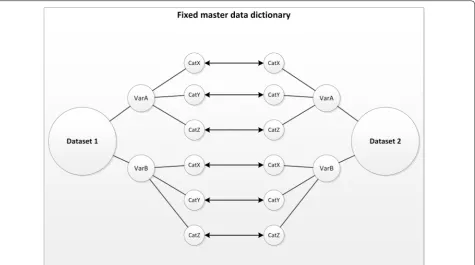
Different strategies can be used to harmonize IPD from multiple studies. Data can be transformed from the origi-nal data dictionary (i.e. a codebook with descriptions of variable names and value labels, variable type, format, and missing values) [8] to a fixed master data dictionary that defines similar and overlapping data from all studies (Fig. 1). This fixed master data dictionary can be defined prospectively (before data collection) or retrospectively
Open Access
BMC Research Notes
*Correspondence: [email protected]
1 Department of Epidemiology and Biostatistics, Amsterdam University Medical Centres, Vrije Universiteit Amsterdam, De Boelelaan 1089a, 1081 HV Amsterdam, The Netherlands
(after all data has been retrieved), each with their spe-cific challenges. A prospectively defined master data dictionary is time consuming when certain variables are defined differently across studies. For example, if age was assessed as a continuous variable in most studies (e.g. age in years), but as a categorical variable (e.g. < 50 vs. ≥ 50 years) in a newly retrieved study, all previously
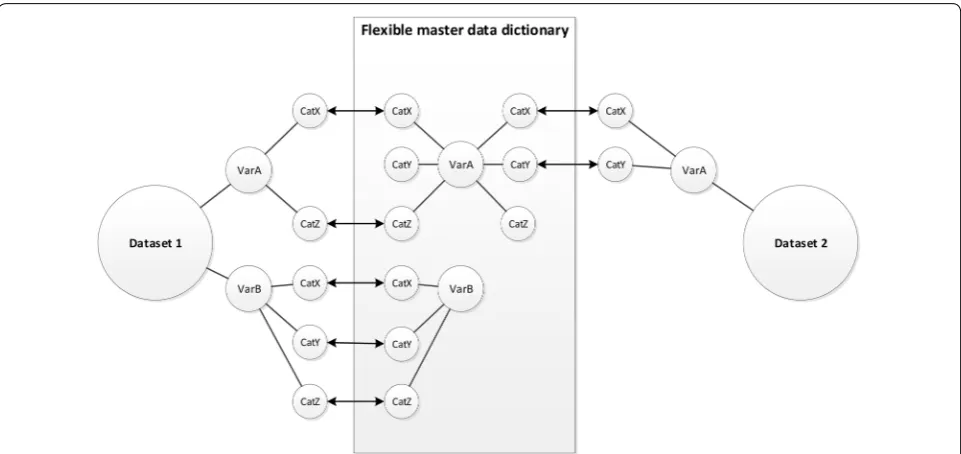
retrieved study data need to be transformed into categor-ical data in order to harmonize the datasets. On the other hand, retrospectively defining a master data dictionary can only be done after data collection of all variables of interest of identified studies has been completed. How-ever, when the number of variables and datasets is large, it is more time-efficient to start harmonizing the data as soon as IPD from the first studies have been received. This way, data analyses can start soon after data collec-tion has been completed. This requires a flexible strategy to harmonize IPD, allowing adaptations when new stud-ies and/or variables with different coding schemes are included (Fig. 2). This also allows to easily add new stud-ies at a later point in time.
We built a flexible data harmonization platform (DHP) to harmonize IPD from multiple studies. The DHP was primarily built for the Predicting OptimaL cAncer RehabIlitation and Supportive care (POLARIS) study [9–11], in which we harmonized IPD from—so
far—57 randomized controlled trials (RCTs) to conduct an IPD-meta-analysis to evaluate the effects of physi-cal activity or psychosocial interventions on health-related quality of life in patients with cancer, and to identify moderators of the intervention effects [9]. The DHP is also adopted in two other studies in which IPD were used from observational studies [12, 13]. In this paper, we describe the development and use of the flexible DHP to facilitate harmonization of IPD for meta-analyses.
Main text
We developed a DHP that had to meet the following requirements: (I) allowing IPD harmonization with a flexible approach, (II) having the ability to store data in a centralized and secured database server with large capacity, (III) being transparent and easy in use, and (IV) having the ability to export harmonized IPD and corre-sponding data dictionary to statistical programs such as SPSS [14], STATA [15], SAS [16] or RStudio [17].
For this article, we used examples from the POLARIS study as proof of concept for which the DHP was initially developed [9–11]. Currently, the database of POLARIS includes IPD from almost 10,000 patients from 57 rand-omized controlled trials [9–11].
[image:2.595.63.539.88.353.2]Page 3 of 6 Kalter et al. BMC Res Notes (2019) 12:164
Infrastructure DHP
Microsoft Access was used as front-end applica-tion. The front-end application includes interfaces that directly communicate with users, and forwards requests to a back-end server to retrieve requested data or to perform a requested service. The back-end server that can be used for this application is a relational data-base management system, such as Microsoft Struc-tured Query Language (SQL) Server or MySQL. For POLARIS, the front-end application is connected with Microsoft SQL Server 12.0. This server has been set up at the Amsterdam University Medical Center—loca-tion VUmc, Amsterdam, The Netherlands. The DHP is secured by user identifier and password, and accessible for POLARIS consortium members that are authorized by the POLARIS steering committee.
Microsoft Access was chosen for the front-end applica-tion because of its widespread availability, and its ability to link with data files of different statistical software pack-ages and to transfer both the data and the correspond-ing data dictionary into multiple tables in the relational database management system. The front-end application is linked to the tables in the relational database manage-ment system using an open database connectivity that enables communication between the front-end applica-tion and the relaapplica-tional database management system. To improve performance of the front-end application, we created pass-through queries that run statements that select, insert, update, and delete information in the rela-tional database management system.
Software requirements
To function adequately, the DHP has specific software requirements. The following software must be installed on a local computer: Microsoft Access 2010 (or newer), and a relational database management system such as Microsoft SQL Server or MySQL. Furthermore, Micro-soft Access uses multiple required references that ena-ble the DHP to communicate with statistical software programs. The Microsoft Access references required for adequate function of the DHP are: Visual Basic For Applications, Microsoft Access 14.0 object library (or newer), Microsoft Visual Basic for Applications Exten-sibility 5.3, OLE Automation, System_Windows_Forms, Microsoft ActiveX Data Objects 2.5 Library, Microsoft Scripting Runtime, mscorlib.dll, System, Microsoft Office 14.0 Access database engine Object Library (or newer), and Microsoft Windows Common Controls 6.0 (SP6). For POLARIS, the DHP has been set up to import SPSS data files, as most data files in POLARIS were provided in SPSS format. This requires SPSS to be installed on a local computer, as well as the following references in Microsoft Access: SPSS Statistics Type Library, and SPSS Statistics Legacy Type Library.
User interfaces of the data harmonization platform
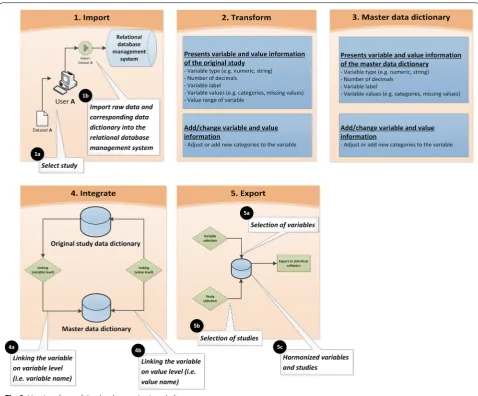
[image:3.595.58.539.87.314.2]user with importing and harmonizing the data dictionary of the original study with the master data dictionary, and exporting the raw data of all selected variables and stud-ies of interest into one harmonized dataset. The function of the five DHP user interfaces has been described in more detail in Additional file 1. A short description of the user interfaces is provided below.
Import
The import interface enables the user to select and import raw data and corresponding data dictionaries from original studies. The import of data is a fully auto-matic process in which raw data and corresponding data dictionaries are stored in predefined tables. The stored data includes study information (e.g. study name, source file pathname, import date of the study, and person responsible for the import of the study), variable infor-mation (e.g. variable name, type, labels, missing values,
and study identifier), and value information (e.g. value definitions of categories and missing values (system and user) of specified variables, and study identifier). After being imported, the data is ready for transformation.
Transform
[image:4.595.58.537.86.482.2]Page 5 of 6 Kalter et al. BMC Res Notes (2019) 12:164
data would incorrectly be imported as new numeric data into the harmonized dataset and not as missing data. This results in an incorrect outcome of the analyses, and therefore this transformation process is crucial to accu-rately harmonize the IPD into the new dataset.
Master data dictionary
The master dictionary interface shows the master data dictionary, and enables the user to add or adjust vari-ables and/or categories in the master data dictionary during the data collection of eligible studies. It further provides information about the types, labels, number of decimals, and values of the variables in the master data dictionary and enables the user to adjust this information if necessary.
Integration
The integration interface enables the user to link the vari-able from the original study with the master data diction-ary. The linking of variables occurs on the level of the variable itself (i.e. variable names) and on the value level (i.e. value definitions). When selecting the variables to be harmonized from the original study and the master data dictionary, the interface automatically shows the case missing values, and categories with the corresponding labels which can be linked. For study missing values, an algorithm has been created that adds study missing data (if needed) to the harmonized datasets when creating a harmonized dataset in the export interface. The integra-tion interface further presents which variables from the original study are linked to the master data dictionary and which are not. Finally, it has the flexibility to discon-nect linked specifications at the variable and/or value level, when a link was incorrect.
Export
The export interface enables the user to create a harmo-nized dataset from selected variables and from studies of interest in a preferred statistical software program. For POLARIS, we created harmonized datasets in SPSS. After selecting the preferred variables and studies, the user starts the fully automatic export process by pressing the ‘create file’ button in which the DHP runs an algo-rithm that creates a syntax in SPSS. Running this com-plete syntax creates a harmonized SPSS dataset including all selected variable names and studies that enables fur-ther analysis.
Discussion
To the best of our knowledge, this is the first paper that describes a DHP that allows starting data harmoniza-tion already during data collecharmoniza-tion, which is time effi-cient, especially when the number of studies is large. It
also allows adding data of new studies at a later point in time. With the increasing use of IPD meta-analysis [4], our flexible DHP helps managing the time necessary to harmonize IPD.
In contrast to previous DHPs for which all PI’s of original studies needed to transform their datasets to a defined master data dictionary before harmonization [7, 18], our DPH has the ability to store, prepare and harmonize IPD within one transparent DHP. The use of one centralized platform for data transformation, reduces the time burden for the PI of the original study. Our DHP is user-friendly, requiring minimal technical knowledge from the user. Instead of using syntaxes in statistical software [19], the harmonization process is facilitated by transparent interfaces, which are easy in use. Furthermore, our DHP enables the export of har-monized IPD and corresponding data dictionary to a statistical program of choice, creating more flexibility than offered in previous DHP where only R Software can be used [19].
To guarantee security of data, the DHP requires stor-age of the original datasets at one single secured location. To make explicit how and when the data is used, we have developed data sharing agreements for data access, use, and intellectual property arrangements for the POLARIS study [9]. Additionally, only fully anonymous datasets are shared by the PI’s of the original studies to ensure privacy of study participants [20].
Overall, the flexible DHP described in this paper facilitates harmonization of IPD already during the pro-cess of collecting data from multiple studies, allows to store, prepare, and harmonize IPD within one transpar-ent platform, is easy in use, and has the ability to export harmonized IPD and corresponding data dictionary to a statistical program for further analysis. The DHP is cur-rently being used in enriching the POLARIS study with data of new RCTs, and in two other IPD meta-analyses [12, 13].
Limitations
Additional file
Additional file 1. Detailed description of the five DHP user interfaces.
Abbreviations
DHP: data harmonization platform; IPD: individual patient data; PI: principal investigator; POLARIS: Predicting OptimaL cAncer RehabIlitation and Support‑ ive care; RCT : randomized controlled trial; SAS: statistical analysis system; SPSS: Statistical Package for the Social Sciences; SQL: Structured Query Language.
Authors’ contributions
JK and LB developed the DHP and drafted the manuscript. MS, IVdL and JB critically reviewed the paper. All authors read and approved the final manuscript.
Author details
1 Department of Epidemiology and Biostatistics, Amsterdam University Medical Centres, Vrije Universiteit Amsterdam, De Boelelaan 1089a, 1081 HV Amsterdam, The Netherlands. 2 Amsterdam Public Health Research Insti‑ tute, Amsterdam, The Netherlands. 3 Cancer Center Amsterdam, Amsterdam, The Netherlands. 4 Department of Otolaryngology‑Head and Neck Surgery, Amsterdam University Medical Centres, Vrije Universiteit Amsterdam, Amster‑ dam, The Netherlands. 5 Department of Clinical‑ Developmental‑ and Neuro Psychology, Faculty of Behavioral and Movement Sciences, Vrije Universiteit Amsterdam, Amsterdam, The Netherlands. 6 Amsterdam School of Commu‑ nication Research (ASCoR), University of Amsterdam, Amsterdam, The Neth‑ erlands. 7 Department of Medical Oncology, Amsterdam University Medical Centres, Vrije Universiteit Amsterdam, Amsterdam, The Netherlands.
Acknowledgements
We would like to thank Data Management VUmc (Amsterdam University Medical Centres, Vrije Universiteit Amsterdam, Amsterdam, The Netherlands) for their guidance on the development of the DHP.
Competing interests
The authors declare that they have no competing interests.
Availability of data and materials
As the platform may need few modifications prior to its use in other studies with other designs, it is not an open source platform. However, the DHP can be requested by contacting the corresponding author of this manuscript.
Consent for publication
Not applicable.
Ethics approval and consent to participate
Not applicable.
Funding
The POLARIS study was supported by the “Bas Mulder Award” granted to L.M. Buffart by the Alpe d’HuZes foundation, part of the Dutch Cancer Society (VU 2011‑5045). The funding body had no role in the design of the study and col‑ lection, analysis, and interpretation of data and in writing the manuscript.
Publisher’s Note
Springer Nature remains neutral with regard to jurisdictional claims in pub‑ lished maps and institutional affiliations.
Received: 25 October 2018 Accepted: 18 March 2019
References
1. Stevens KR. Systematic reviews: the heart of evidence‑based practice. AACN Clin Issues. 2001;12(4):529–38.
2. Schlosser RW. The role of systematic reviews in evidence‑based practice, research, and development. Focus. 2006;15:1–4.
3. Chalmers I. The Cochrane collaboration: preparing, maintaining, and dis‑ seminating systematic reviews of the effects of health care. Ann N Y Acad Sci. 1993;703:156–63 (discussion 163-155).
4. Riley RD, Lambert PC, Abo‑Zaid G. Meta‑analysis of individual participant data: rationale, conduct, and reporting. BMJ. 2010;340:c221.
5. Tierney JF, Vale C, Riley R, Smith CT, Stewart L, Clarke M, Rovers M. Individual participant data (IPD) meta‑analyses of randomised controlled trials: guidance on Their use. PLoS Med. 2015;12(7):e1001855.
6. Griffith LE, Shannon HS, Wells RP, Walter SD, Cole DC, Cote P, Frank J, Hogg‑Johnson S, Langlois LE. Individual participant data meta‑analysis of mechanical workplace risk factors and low back pain. Am J Public Health. 2012;102(2):309–18.
7. Carter KW, Francis RW, Carter KW, Francis RW, Bresnahan M, Gissler M, Gronborg TK, Gross R, Gunnes N, Hammond G, et al. ViPAR: a software platform for the Virtual Pooling and Analysis of Research Data. Int J Epide‑ miol. 2016;45(2):408–16.
8. Codebook/Data dictionary. http://www.emgo.nl/kc/codeb ook‑data‑dicti onary . Accessed Dec 2017
9. Buffart LM, Kalter J, Chinapaw MJ, Heymans MW, Aaronson NK, Courneya KS, Jacobsen PB, Newton RU, Verdonck‑de Leeuw IM, Brug J. Predicting OptimaL cAncer RehabIlitation and Supportive care (POLARIS): rationale and design for meta‑analyses of individual patient data of randomized controlled trials that evaluate the effect of physical activity and psychoso‑ cial interventions on health‑related quality of life in cancer survivors. Syst Rev. 2013;2(1):75.
10. Buffart LM, Kalter J, Sweegers MG, Courneya KS, Newton RU, Aaronson NK, Jacobsen PB, May AM, Galvao DA, Chinapaw MJ, et al. Effects and moderators of exercise on quality of life and physical function in patients with cancer: an individual patient data meta‑analysis of 34 RCTs. Cancer Treat Rev. 2017;52:91–104.
11. Kalter J, Verdonck‑de Leeuw IM, Sweegers MG, Aaronson NK, Jacobsen PB, Newton RU, Courneya KS, Aitken JF, Armes J, Arving C, et al. Effects and moderators of psychosocial interventions on quality of life, and emo‑ tional and social function in patients with cancer: an individual patient data meta‑analysis of 22 RCTs. Psychooncology. 2018;27(4):1150–61. 12. de Zoete A, de Boer MR, van Tulder MW, Rubinstein SM, Underwood M,
Hayden JA, Kalter J, Ostelo R. Rational and design of an individual partici‑ pant data meta‑analysis of spinal manipulative therapy for chronic low back pain—a protocol. Syst Rev. 2017;6(1):21.
13. Lakerveld J, Loyen A, Ling FCM, De Craemer M, van der Ploeg HP, O’Gorman DJ, Carlin A, Caprinica L, Kalter J, Oppert JM, et al. Identify‑ ing and sharing data for secondary data analysis of physical activity, sedentary behaviour and their determinants across the life course in Europe: general principles and an example from DEDIPAC. BMJ Open. 2017;7(10):e017489.
14. SPSS®. http://www.ibm.com/analy tics/us/en/techn ology /spss/. Accessed Dec 2017
15. STATA ®. http://www.stata .com/. Accessed Dec 2017 16. SAS®. http://www.sas.com/. Accessed Dec 2017
17. RStudio: Integrated Development Environment for R. http://www.rstud io.com/. Accessed Dec 2017
18. OBiBa: Open Source Software for BioBanks. http://www.obiba .org. Accessed Sept 2017
19. Gaye A, Marcon Y, Isaeva J, LaFlamme P, Turner A, Jones EM, Minion J, Boyd AW, Newby CJ, Nuotio ML, et al. DataSHIELD: taking the analysis to the data, not the data to the analysis. Int J Epidemiol. 2014;43(6):1929–44. 20. Tudur Smith C, Dwan K, Altman DG, Clarke M, Riley R, Williamson PR.