R E S E A R C H A R T I C L E
Open Access
Cost-effectiveness of adding novel or group
5 interventions to a background regimen
for the treatment of multidrug-resistant
tuberculosis in Germany
Daniel Wirth
1*, Ramesh Dass
2and Robert Hettle
3Abstract
Background:Treatment of multidrug-resistant tuberculosis (MDR-TB) is complex, lengthy, and involves a minimum of four drugs termed a background regimen (BR), that have not previously been prescribed or that have proven susceptible to patient sputum culture isolates. In recent years, promising new treatment options have emerged as add-on therapies to a BR. The aim of this study was to evaluate the long-term costs and effectiveness of adding the novel or group 5 interventions bedaquiline, delamanid, and linezolid to a background regimen (BR) of drugs for the treatment of adult patients with pulmonary multidrug-resistant tuberculosis (MDR-TB), within their marketing authorisations, from a German healthcare cost-effectiveness perspective.
Methods: A cohort-based Markov model was developed to simulate the incremental cost-effectiveness ratio of bedaquiline plus BR, delamanid plus BR, or linezolid plus BR versus BR alone in the treatment of MDR-TB, over a 10-year time horizon. Effectiveness of treatment was evaluated in Quality-Adjusted Years (QALYs) and Life-Years Gained (LYG), using inputs from clinical trials for bedaquiline and delamanid and from a German observational study for linezolid. Cost data were obtained from German Drug Directory costs (€/2015), published literature, and expert opinion. A 3% yearly discount rate was applied. Probabilistic and deterministic sensitivity analyses were conducted. Results:The total discounted costs per-patient were€85,575 for bedaquiline plus BR,€81,079 for delamanid plus BR, and€80,460 for linezolid plus BR, compared with a cost of€60,962 for BR alone. The total discounted QALYs per-patient were 5.95 for bedaquiline plus BR, 5.36 for delamanid plus BR, and 3.91 for linezolid plus BR, compared with 3.68 for BR alone. All interventions were therefore associated with higher QALYs and higher costs than BR alone, with incremental costs per QALY gained of€22,238 for bedaquiline,€38,703 for delamanid, and€87,484 for linezolid, versus BR alone. In a fully incremental analysis, bedaquiline plus BR was the most cost-effective treatment option at thresholds greater than €22,000 per QALY gained. In probabilistic analyses, the probability that bedaquiline plus BR was the most cost-effective treatment strategy at a willingness-to-pay threshold of€30,000 was 54.5%, compared with 22.9% for BR alone, 18.2% for delamanid plus BR, and 4.4% for linezolid.
Conclusions:In Germany, the addition of bedaquiline, delamanid, or linezolid to a BR would result in QALY gains over BR alone. Based on this analysis, bedaquiline is likely to be the most cost-effective intervention for the treatment of MDR-TB, when added to a BR regimen at thresholds greater than€22,000 per QALY.
Keywords:Cost-effectiveness, Multidrug-resistant tuberculosis, Bedaquiline, Delamanid, Linezolid, QALY, LYG, ICER
* Correspondence:[email protected]
1Health Economics & Market Access, Janssen-Cilag GmbH, Johnson & Johnson Platz 1, 41470 Neuss, Germany
Full list of author information is available at the end of the article
Background
Multidrug-resistant tuberculosis (MDR-TB) is a form of tuberculosis (TB) that is resistant to at least the two most effective first-line therapeutic drugs, isoniazid and rifampicin [1]. MDR-TB is a persistent, and in some re-gions, increasing public health concern: the incidence of MDR-TB in Europe in 2013 was 16.9% among new TB cases and 48.0% among previously treated cases [2].
In Germany, the total number of MDR-TB cases has increased year-on-year between 2010 and 2013, reaching 100 to 102 reported cases in 2013, depending on the reporting method used [2, 3]. Further, three cases of ex-tensively drug-resistant (XDR)-TB in Germany were re-ported in 2013 [3]. These statistics reflect a trend towards increasing antibiotic resistance that is mirrored throughout many regions of Europe, both in tuberculosis and in other infectious diseases [4].
Treatment of MDR-TB is complex and involves a minimum of four drugs that have not previously been prescribed or that have proven susceptible to patient iso-lates (termed a background regimen, or BR). The recom-mended total duration of treatment is 18–24 months and patient isolation is recommended until sputum cul-ture conversion is achieved [5–8].
Despite these lengthy and resource-intensive regimens, success rates are suboptimal; the European Centre for Disease Control (ECDC) estimated that just 38% of pa-tients who started MDR-TB treatment in 2011 were cured 24 months later. 235 of 1386 patients starting MDR-TB treatment died, representing a 17% mortality rate [2, 9]. For Germany, the Robert Koch Institute pub-lished very recent data with similar treatment success rates (34%) [10]. Further, many MDR-TB therapies are highly toxic and are associated with side effects includ-ing nausea, vomitinclud-ing, peripheral neuropathy, nephrotox-icity, haemotoxnephrotox-icity, and ototoxicity. These side effects contribute to an additional treatment and monitoring burden, negatively affect patient quality of life, and de-crease patient adherence, therefore affecting the prob-ability of treatment success [6]. All of these factors contribute to the high economic burden of MDR-TB; a recent study estimated that the direct costs (in 2012€) of MDR-TB treatment in Germany totalled€64,429 per pa-tient, with a further€17,722 to€44,304 in lost product-ivity costs [11].
It is therefore necessary to introduce more effective MDR-TB treatment regimens that lead to improved pa-tient outcomes and reduced disease transmission, while also demonstrating a manageable adverse event (AE) profile. Recently, three promising treatment options have emerged as add-on therapies to a BR: bedaquiline, linez-olid, and delamanid. These are novel or Group 5 inter-ventions that have been shown to improve efficacy outcomes in patients with MDR-TB over BR alone [12–14].
Bedaquiline and delamanid are novel interventions, while linezolid has been repurposed as an off-label treatment op-tion in MDR-TB.
However, new healthcare interventions must be evalu-ated in the context of fixed healthcare budgets. In order to effectively allocate limited healthcare resources, it is important to establish not only the efficacy, but also the cost-effectiveness of new interventions for MDR-TB. Bedaquiline plus BR has previously been demonstrated to be cost-effective versus BR alone in a range of low-income, middle-low-income, and high-income settings in-cluding Germany [15–17]. Delamanid has also been shown to be cost-effective versus BR in the German set-ting [18]. However, no published study to date has evalu-ated the cost-effectiveness of these three interventions within the same model structure, or evaluated the cost implications of associated AEs.
The aim of this study was to evaluate the cost-effectiveness of adding bedaquiline, delamanid, or linez-olid to a BR of drugs in the German setting, including the economic impact of AE management for each intervention.
Methods
Model overview
A cohort-based Markov state transition model was de-veloped to evaluate the long-term costs and effectiveness of adding bedaquiline, delamanid, or linezolid to a BR, compared with BR alone in the treatment of adult patients with pulmonary MDR-TB. The model was ori-ginally developed for the UK healthcare system [17], and subsequently adjusted to the perspective of the German Statutory Health Insurance system [16].
A cohort of 100 patients with MDR-TB was included in the model simulation, reflecting current epidemiological data for Germany at the time of model design [2]. Of these patients, 87.7% were assumed to be treated in the in-patient setting, over a mean duration of 89.1 days [11].
Outcomes considered in the model included direct costs, quality-adjusted life-years (QALY), life-years gained (LYG), and incremental cost-effectiveness ratio (ICER). Both costs and effectiveness were discounted in the base case at an annual rate of 3% following local guidelines [19]. A 1-month cycle length and half-cycle correction were applied to estimate costs and outcomes, with a 10 year time horizon.
Model structure
completion (assumed equivalent to MDR-TB cure) [20]. Patients failing to achieve sputum culture conversion during the first year of the simulation were considered treatment failures and transitioned to the‘active second-ary MDR-TB’ state at month 12 to begin a new treat-ment course. Patients who failed to achieve culture conversion following the new treatment course were as-sumed to occupy the ‘active secondary MDR-TB’ state until death or loss to follow-up, for the purpose of model simplification.
The probabilities of intervention, loss to follow-up, and death were based on the literature [14, 21–24]. A summary of the transition probabilities applied in the model is shown in Table 1.
Efficacy and quality of life inputs
Efficacy data for the interventions under consideration were sourced from the results of Phase 2, placebo-controlled clinical trials for bedaquiline [14] and delama-nid [12]. In both studies, the effect of treatment was evaluated in terms of the hazard ratio for time to spu-tum culture conversion (SCC), with bedaquiline and delamanid added to BR being associated with statistically significant improvements in the rate of SCC versus BR alone.
The rate of SCC in the population treated with add-on therapies was calculated by multiplying the hazard rate of culture conversion in the BR alone population by the hazard ratio of sputum culture conversion for treatment
[image:3.595.60.540.86.278.2]Fig. 1Model structure, adopted from [16, 17]. Transitions to the“Death”state are possible from every state, but not shown on the diagram for better clarity. MDR-TB: Multidrug resistant tuberculosis; TB: tuberculosis
Table 1Transition probabilities in the model
Health state Transition to Monthly probability (%) Distribution for
probabilistic analysis
Source
Active TB
(MDR-TB; secondary MDR-TB and XDR-TB)
Sputum culture converted Variable Multivariate log-normal distribution
[14]
Lost to follow-up 0.39 Beta [14]
Death MDR-TB, no cure: 2.21, MDR-TB,
cured: 0.32
XDR-TB, no cure: 2.69% XDR-TB, cured: 0.39
Beta [21,22]
Lost to follow-up Death 6.87 Beta [24]
Sputum culture converted Active secondary MDR-TB (relapse)
0.98 Beta [14]
MDR-TB or active XDR-TB (relapse) (21.4 to XDR-TB; 78.6 to MDR-TB) [14]
Treatment completion and cured Active secondary MDR-TB (reoccurrence)
0.20 Beta [21]
MDR-TB or active XDR-TB (reoccurrence)
(21.4 to XDR-TB; 78.6 to MDR-TB) [14]
[image:3.595.57.539.524.725.2]plus BR, versus BR alone. This calculation generated a treatment-related hazard rate, which was subsequently used to estimate the probability of culture conversion while receiving add-on therapies (Table 2). The bedaqui-line trial publication reported the hazard ratio for SCC versus placebo as 2.44 (95% confidence interval [CI]: 1.57–3.80) [14].
For delamanid, comparative efficacy versus placebo was derived using a Bayesian analysis. For the meta-analysis, a fixed effects model was fitted to aggregated summary data from the study by Gler and colleagues [12]. The Bayesian model consisted of a binomial likelihood function, complementary log-log link function, and vague prior distributions. The estimated hazard ratio for delama-nid versus placebo was 1.73 (95% CI: 1.153–2.627), based on a calculation of 1 divided by 0.58 (the reported hazard ratio for increased time to SCC with placebo vs. delama-nid) [12]. Data for delamanid from Gler 2012 were only available for 8 weeks but in the model, the duration of add-on therapy for delamanid was assumed to be 24 weeks. In the absence of additional data, it was conser-vatively assumed that the hazard ratio for SCC at 8 weeks was maintained for 24 weeks.
Linezolid is used in an off-label setting for MDR-TB; data from a German observational study were used to determine relative efficacy for linezolid [13] (Table 2). In this study, patients were treated according to WHO rec-ommendations, using fluoroquinolones, injectable agents and other second-line oral agents (BR), linezolid being one agent in this regimen. Patients who received linezo-lid in their BR were more likely to achieve SCC com-pared with those without linezolid (relative risk of 1.28; 95% confidence interval 0.99–1.6), although the time taken to achieve SCC was significantly longer in the linezolid group (mean time to SCC of 102.9 days for li-nezolid versus 65.4 days without lili-nezolid). The effect of linezolid was modelled using the relative risk of SCC, which was assumed to represent the effect of linezolid on time to SCC.
Treatment discontinuation with a novel or Group 5 intervention was simulated in terms of both loss to follow-up and discontinuation of the intervention due to AEs.
The treatment algorithm for patients with MDR-TB– including drug treatment, dosages, and length-of-stay in isolated care–reflected recommendations made in local clinical guidelines and expert opinion [6–8, 25]. Surgery was excluded from this analysis as a treatment interven-tion, as guidelines recommend surgery in only a small minority of MDR-TB cases [6].
The health utility weights applied in the simulation model were adapted from a previous study in a low inci-dence setting [17], as local data for Germany are not available. Patients who occupied the active MDR-TB and lost to follow-up states were assigned the utility weight for active TB, while patients who occupied the sputum converted MDR-TB states were assigned a utility weight that was dependent on the time since conver-sion (a longer duration of sustained converconver-sion was asso-ciated with an improvement in utility weight up to the utility weight for the general population [treatment com-pletion]). Accordingly, the utility weight for sputum con-verted MDR-TB was estimated by linear interpolation of the weights for active TB (lower bound) and the general population (upper bound). All health utility weight inputs are summarized in Additional file 1: Table S1.
Cost inputs
Direct medical costs were assumed to consist of drug ac-quisition costs, costs of treatment monitoring, costs of administered care (inpatient and outpatient care), costs of end of life care, and costs of managing AEs.
Unit costs for each drug in the BR, the cost of each monitoring resource, outpatient visits, and inpatient costs were sourced from publicly available tariffs and formularies in Germany [26]. Drug costs (€/2015) were based on the German Drug Directory (Lauer-Taxe On-line 2015), and calculated based on the smallest pack available for the minimum period of treatment neces-sary, assuming use of generics when available [27]. The cost of resource use and monitoring was adapted from a previous study [11].
[image:4.595.56.543.631.723.2]The cost of AEs included medication costs and moni-toring costs, and was based on expert opinion and clin-ical study data [14] [analysis with data on file] [12, 28]. AEs that were at least potentially causally related to the
Table 2Summary of relative efficacy of adding novel or group 5 interventions to a BR
Intervention Time to SCC Mean treatment effect as Relative Risk RR (SE) Discontinuation rate per month (%) Source/assumption
Bedaquiline vs. placebo
83 days vs. 125 days 2.44 (0.57) 0.87% [14]
Delamanid vs. placebo
Not reported (HR of 0.58 reported only for placebo vs. delamanid)
1.73 (0.38) 1.26% Analysis of data
reported in [12]
Linezolid vs. placebo
103 days vs. 65 days 1.28 (0.57) 3.1% [13] see main text
investigational study drug and occurring in >5% of pa-tients were included for each intervention. Inputs for the cost and duration of treatment-associated AEs are pre-sented in Additional file 2: Table S2. The cost of electro-cardiogram and liver enzyme monitoring was absorbed within overall monitoring costs. A summary of costs for the total costs of treatment, split by interventions and cost category (hospitalisations, outpatient costs, medica-tion costs etc.) is displayed in Addimedica-tional file 3: Table S3.
Sensitivity analysis
Both probabilistic and deterministic sensitivity analyses were conducted following international recommenda-tions [29]. In the deterministic simularecommenda-tions, key model parameters and assumptions were varied by ±20%, in-cluding clinical efficacy for each intervention, transition probabilities, utility weights, discount rates, the cost of AEs, and drug costs.
In probabilistic analyses, the likelihood of bedaquiline, linezolid, or delamanid plus BR being cost-effective ver-sus BR alone was explored at different willingness-to-pay thresholds.
Results
Base-case results
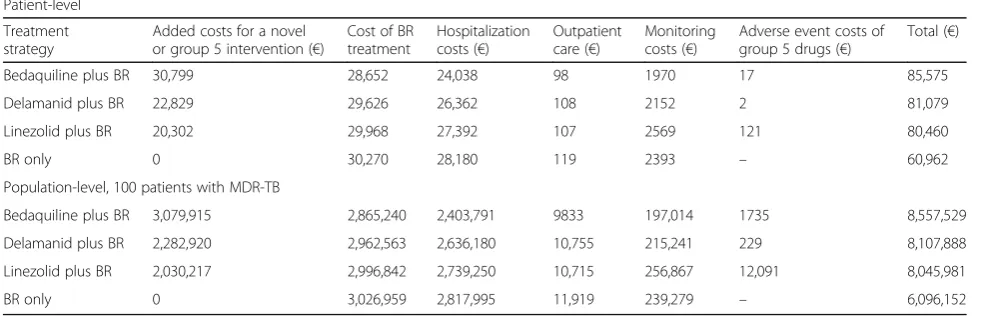
Over the 10-year time horizon, the total discounted per-patient costs associated with the interventions under evaluation were €85,575 for bedaquiline, €81,079 for delamanid, €80,460 for linezolid plus BR, and €60,962 for BR only. Total costs were largely driven by TB drug costs and hospitalisation costs; costs associated with AE management were relatively small (Table 3).
The differing cost of BR treatment across regimens displayed in Table 3 primarily reflects two model as-sumptions. Firstly, patients who fail to achieve sputum culture conversion in the first 20 months of treatment are considered treatment failures, and go on to receive
further BR treatment in the secondary MDR-TB state until cure, loss to follow-up, or death. With add-on ther-apies, more patients achieve cure, fewer patients fail treatment, and fewer patients go on to receive BR in the secondary MDR-TB state. Secondly, the model assumes a difference in the mortality rate between culture-converted and unconverted patients. The higher rate of cure with add-on therapies means that patients will on average live longer, and consequently, a higher percentage of patients will complete the full course of BR treatment.
The total discounted cost and discounted QALYs for the single cohort of 100 patients assigned to bedaquiline plus BR was €8,557,529 and 479 QALYs, respectively (Table 4). The total discounted cost and discounted QALYs for the patients assigned to delamanid plus BR was €8,107,888 and 421 QALYs, respectively, and to li-nezolid plus BR, €8,045,981 and 391 QALYs, respect-ively. In terms of life-years gained (LYG), the total discounted LYG for the patients assigned to bedaquiline plus BR was 595; delamanid plus BR, 536; to linezolid plus BR, 507; and BR alone, 482 (Table 4).
The incremental cost per QALY gained versus BR alone was €22,238 for bedaquiline, €38,703 for delama-nid, and€87,484 for linezolid (Table 4).
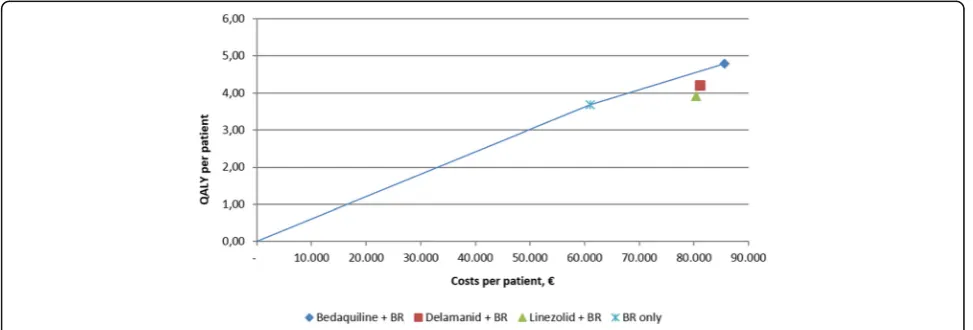
The results of the fully incremental analysis are pre-sented graphically using the cost-efficiency frontier (Fig. 2), which compares the expected costs (x-axis) and benefits (y-axis) of each intervention in the evaluation [30]. The cost-efficiency frontier is plotted by connecting those treatments that represent the most cost-efficient use of healthcare resources, relative to any other therapy or their combinations.
[image:5.595.55.548.566.724.2]In this analysis, BR alone and bedaquiline plus BR were considered the most cost-efficient interventions, with delamanid plus BR and linezolid plus BR being dominated by a combination of BR alone with or with-out bedaquiline. By excluding delamanid and linezolid
Table 3Per-patient and population level costs for the interventions included in the analysis
Patient-level
Treatment strategy
Added costs for a novel or group 5 intervention (€)
Cost of BR treatment
Hospitalization costs (€)
Outpatient care (€)
Monitoring costs (€)
Adverse event costs of group 5 drugs (€)
Total (€)
Bedaquiline plus BR 30,799 28,652 24,038 98 1970 17 85,575
Delamanid plus BR 22,829 29,626 26,362 108 2152 2 81,079
Linezolid plus BR 20,302 29,968 27,392 107 2569 121 80,460
BR only 0 30,270 28,180 119 2393 – 60,962
Population-level, 100 patients with MDR-TB
Bedaquiline plus BR 3,079,915 2,865,240 2,403,791 9833 197,014 1735 8,557,529
Delamanid plus BR 2,282,920 2,962,563 2,636,180 10,755 215,241 229 8,107,888
Linezolid plus BR 2,030,217 2,996,842 2,739,250 10,715 256,867 12,091 8,045,981
BR only 0 3,026,959 2,817,995 11,919 239,279 – 6,096,152
from further consideration in the cost-efficiency frontier, the analysis shows that treatment with BR alone is the most cost-efficient therapy at willingness to pay thresh-olds up to €22,000 per QALY gained, with bedaquiline plus BR becoming the most cost-efficient therapy at thresholds greater than €22,000 (which falls below the informal threshold of €30,000 to €50,000 per QALY commonly applied in European healthcare systems).
Sensitivity analyses
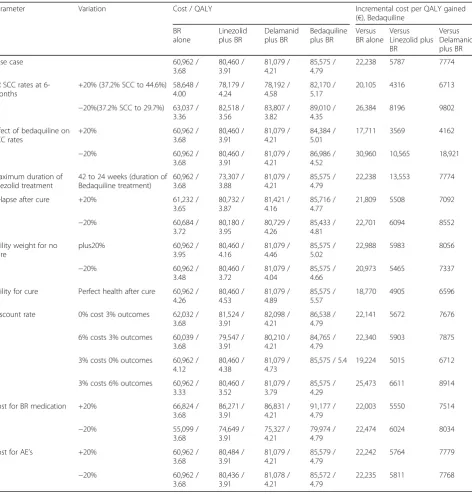
The results of the deterministic sensitivity analysis are presented in Table 5.
In the one-way sensitivity analysis, the effect of beda-quiline on SCC was the most influential parameter, with ICERs of€17,711 (plus 20% more effective) and€30,960 (20% less effective) in comparisons with BR alone. Other influential parameters included the rate of SCC for BR alone (ICERs of between €20,150 [20% higher rate of SCC] and €26,384 [20% lower rate of SCC]), and the utility assigned to cured patients (ICER of €18,770 for perfect health post-cure versus€22,238 in the base case). The model results were not sensitive to assumptions on discounting rates, the cost of BR medication, the cost of AEs, or the rate of relapse after cure.
In comparisons of bedaquiline plus BR versus linezolid plus BR, all ICERs were below€15,000 per QALY gained. In the analysis where the duration of linezolid was
reduced from 42 to 24 weeks (same duration as with bedaquiline plus BR), the ICER comparing bedaquiline plus BR versus linezolid plus BR increased from €5778 (base case) to €13,553 per QALY gained, which remains below a threshold of €30,000 per QALY, which is com-monly applied informally in European healthcare sys-tems. In comparisons of bedaquiline plus BR versus delamanid plus BR, all ICERs were below €20,000 per QALY gained.
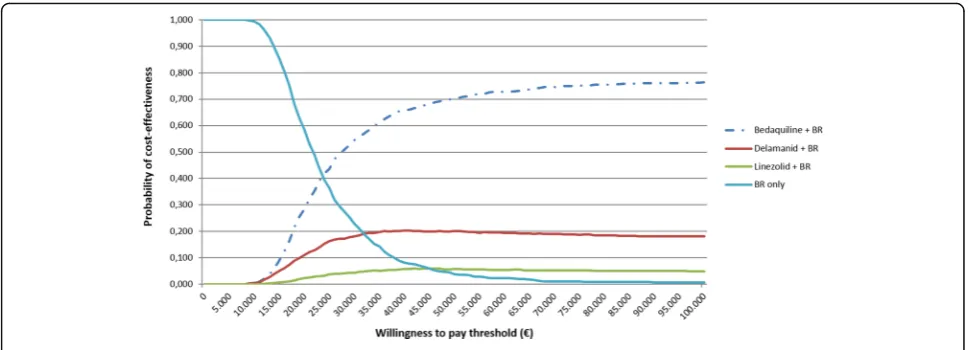
The results of the probabilistic sensitivity analysis are presented in Fig. 3. All data on probabilistic distributions, parameters and definitions used in the probabilistic sensi-tivity analysis are shown in Additional file 4: Table S4.
The probability that bedaquiline plus BR was the most cost-effective treatment strategy at a willingness to pay threshold of €30,000 was 54.5%, versus 22.9% for BR alone, 4.4% for linezolid plus BR and 18.2% for delamanid plus BR. At a higher threshold of €50,000 per QALY gained (informally, towards the upper limit of willingness-to-pay thresholds applied in European healthcare systems for orphan drugs), the probability that bedaquiline plus BR is a cost-effective alternative to existing interventions was greater than 70%.
Discussion
[image:6.595.58.536.99.191.2]The results of this study demonstrate that, in the German setting, adding bedaquiline, delamanid, or linezolid to a Table 4Incremental cost per QALY gained
Treatments ordered from least to most effective
Patient-level Population-level (100 MDR patients) Incremental cost per QALY gained (€)
Total cost,€
Total QALYs gained
Total LYG
Total cost,€
Total QALYs gained
Total LYG
Versus BR alone
Versus Linezolid plus BR
Versus delamanid plus BR
BR alone 60,962 3.68 4.82 6,096,152 368 482 – 87,484 38,703
Linezolid plus BR 80,460 3.91 5.07 8,045,981 391 507 87,484 – 2026
Delamanid plus BR 81,079 4.21 5.36 8,107,888 421 536 38,703 2026 –
Bedaquiline plus BR 85,575 4.79 5.95 8,557,529 479 595 22,238 5787 7774
BRBackground Regimen,QALYQuality-Adjusted Life Year,LYGlife-years gained
[image:6.595.56.543.551.716.2]BR would lead to QALY and LY gains under a range of scenarios. The cost per QALY versus BR alone ranged from €22,238 for bedaquiline, to €38,703 for delamanid, and€87,484 for linezolid.
QALY gains for add-on therapies to a BR were driven by improved efficacy versus BR alone. As would be ex-pected from adding interventions to a BR, higher total costs associated with add-on therapies were driven by increased drug acquisition costs, although total incremen-tal costs were partially offset by reduced hospiincremen-talisation
costs (resulting from improved sputum culture conversion compared with BR alone and therefore assuming less time spent in the inpatient setting). Monitoring costs and the costs of AE management had a relatively limited effect on the outcome, as the AEs were generally treatable with in-expensive medications.
[image:7.595.64.537.97.592.2]Where multiple treatment options are available, it is important to identify which strategies provide the most efficient use of limited health care resources. This is achieved through fully incremental analysis where the Table 5One-way sensitivity analysis (per patient level)
Parameter Variation Cost / QALY Incremental cost per QALY gained
(€), Bedaquiline
BR alone Linezolid plus BR Delamanid plus BR Bedaquiline plus BR Versus BR alone Versus Linezolid plus BR Versus Delamanid plus BR
Base case 60,962 /
3.68 80,460 / 3.91 81,079 / 4.21 85,575 / 4.79
22,238 5787 7774
BR SCC rates at 6-months
+20% (37.2% SCC to 44.6%) 58,648 / 4.00 78,179 / 4.24 78,192 / 4.58 82,170 / 5.17
20,105 4316 6713
−20%(37.2% SCC to 29.7%) 63,037 / 3.36 82,518 / 3.56 83,807 / 3.82 89,010 / 4.35
26,384 8196 9802
Effect of bedaquiline on SCC rates
+20% 60,962 /
3.68 80,460 / 3.91 81,079 / 4.21 84,384 / 5.01
17,711 3569 4162
−20% 60,962 /
3.68 80,460 / 3.91 81,079 / 4.21 86,986 / 4.52
30,960 10,565 18,921
Maximum duration of linezolid treatment
42 to 24 weeks (duration of Bedaquiline treatment) 60,962 / 3.68 73,307 / 3.88 81,079 / 4.21 85,575 / 4.79
22,238 13,553 7774
Relapse after cure +20% 61,232 /
3.65 80,732 / 3.87 81,421 / 4.16 85,716 / 4.77
21,809 5508 7092
−20% 60,684 /
3.72 80,180 / 3.95 80,729 / 4.26 85,433 / 4.81
22,701 6094 8552
Utility weight for no cure
plus20% 60,962 /
3.95 80,460 / 4.16 81,079 / 4.46 85,575 / 5.02
22,988 5983 8056
−20% 60,962 /
3.48 80,460 / 3.72 81,079 / 4.04 85,575 / 4.66
20,973 5465 7337
Utility for cure Perfect health after cure 60,962 / 4.26 80,460 / 4.53 81,079 / 4.89 85,575 / 5.57
18,770 4905 6596
Discount rate 0% cost 3% outcomes 62,032 / 3.68 81,524 / 3.91 82,098 / 4.21 86,538 / 4.79
22,141 5672 7676
6% costs 3% outcomes 60,039 / 3.68 79,547 / 3.91 80,210 / 4.21 84,765 / 4.79
22,340 5903 7875
3% costs 0% outcomes 60,962 / 4.12
80,460 / 4.38
81,079 / 4.73
85,575 / 5.4 19,224 5015 6712
3% costs 6% outcomes 60,962 / 3.33 80,460 / 3.52 81,079 / 3.79 85,575 / 4.29
25,473 6611 8914
Cost for BR medication +20% 66,824 /
3.68 86,271 / 3.91 86,831 / 4.21 91,177 / 4.79
22,003 5550 7514
−20% 55,099 /
3.68 74,649 / 3.91 75,327 / 4.21 79,974 / 4.79
22,474 6024 8034
Cost for AE’s +20% 60,962 /
3.68 80,484 / 3.91 81,079 / 4.21 85,579 / 4.79
22,242 5764 7779
−20% 60,962 /
3.68 80,436 / 3.91 81,078 / 4.21 85,572 / 4.79
22,235 5811 7768
cost-effectiveness of transitioning from one option to a more effective option is assessed. A key conclusion from this analysis was that a mix of strategies comprising BR alone and BR plus bedaquiline may yield greater QALY benefits than treatment with either linezolid or delama-nid, but at higher total costs. More formally, linezolid and delamanid were dominated by a combination of BR alone and BR plus bedaquiline, and consequently, the administration of linezolid and delamanid would be con-sidered a cost-inefficient use of available resources. Fol-lowing standard practice [31], linezolid and delamanid were excluded from further cost-effectiveness analyses. The resulting analyses suggest that BR plus bedaquiline is the most cost-efficient treatment strategy at thresholds greater than€22,000 per QALY gained.
At the same time, the exclusion of linezolid and dela-manid due to cost would not be clinically justifiable, given that dominance can only be achieved if some patients receive BR alone. Without access to novel ther-apies, some of these patients may go on to develop fur-ther drug resistance because of inadequate treatment with BR, possibly leading to active secondary MDR-TB with an excess morbidity and mortality burden. More-over, there is a recognition that combining several new mechanisms of action will likely further enhance treat-ment outcomes [32]. Thus, MDR-TB treattreat-ment strat-egies should not be excluded based on dominance, given the severe consequences of poor outcomes in this popu-lation with a BR-only based treatment.
Previous studies have focused on the comparative ef-fectiveness [33] or the cost-efef-fectiveness of novel or Group 5 interventions compared with BR alone [15–18], but this is the first study to explicitly model cost-effectiveness across novel or Group 5 interventions for the treatment of MDR-TB within a consistent model structure. The results of this analysis are consistent with previous cost-effectiveness analyses of bedaquiline for
MDR-TB [15, 17, 34], reinforcing that this intervention remains cost-effective under a range of assumptions and different country settings. The total costs for BR alone and ICER versus bedaquiline varied slightly to values re-ported in a previous cost-effectiveness analysis [34], due to a minor model variation in which treatment efficacy was linked to discontinuation over time: patients who leave the model (after failure to successfully treat active secondary MDR-TB) are assumed to derive no further benefit from treatment. Nevertheless, the conclusions are broadly consistent.
The results of the delamanid analysis presented here dif-fer from a previous analysis by Diel and colleagues [18]. In the current analysis, delamanid plus BR was associated with an ICER of €38,703 per QALY versus BR alone, whereas in the Diel et al. publication, delamanid domi-nated over BR with an ICER of€-3494 per QALY gained. This discrepancy is very likely to reflect the different per-spectives considered in these analyses: societal in the Diel analysis; payer in the current analysis, as well as the use of different data sources to inform the modelling by using patient-level data and the differing definitions of outcome parameters. To our knowledge, no economic evaluations of linezolid in MDR-TB have been published to date.
Due to the toxicity associated with MDR-TB therapies, it is important to consider the impact of AEs and their time of onset when comparing treatment options. This is the first study to comprehensively incorporate the costs of AEs associated with Group 5 interventions into a cost-effectiveness analysis of treatments for MDR-TB. It was not possible to assign utility weights to these AEs due to the lack of disease-specific data to inform utility loss associated with MDR-TB in the German setting. Al-though proxy data could–in theory–be substituted to inform utility loss, attempting to apply such data on top of a utility weight already heavily impacted by disutility due to BR side effects proved unfeasible in this analysis.
[image:8.595.56.541.87.262.2]The development of utility weights for MDR-TB spe-cific AEs would therefore be valuable to inform future cost-effectiveness analyses in MDR-TB. However, due to the comparative tolerability of the interventions con-sidered in this analysis relative to other MDR-TB drugs, the conclusions are likely to hold even if such disutility were to be explicitly modelled. Alternatively, a quality-adjusted time without symptoms or toxicity (Q-TWIST) approach [35] could be considered. Although typically applied in oncology, such an analysis would capture dis-ease- and treatment-related disutility, and would also allow the user to model the patient impact of the much-needed shortened treatment regimens that are currently in clinical trials.
Additional future modelling work may account for re-cent developments in the MDR-TB treatment landscape, looking at shorter simplified regimens or different com-binations of new and current drugs. Trials are currently underway to assess the efficacy of innovative comb-inations of Group 5 or novel interventions, such as the 6-month combination regimen of bedaquiline, linezolid, and PA-824 being evaluated in the NiX-TB-(B-L-Pa) trial (NCT02333799) [36], as well as the STREAM study. The STREAM study is a Phase 3, multicentre, inter-national randomised controlled trial aiming to assess the safety and efficacy of shorter MDR-TB regimens [37]. The second stage of the STREAM study will include two bedaquiline-containing arms [38], including an all-oral regimen. Further, the EndTB program aims to expand access to new TB drugs such as bedaquiline and delama-nid in 16 countries [39], while an NIH-sponsored safety trial is planned in South Africa.
The analysis presented here was subject to a number of assumptions, which have been described, discussed, and justified in detail previously [17]. Briefly, the use of trial data for bedaquiline and delamanid may not accur-ately reflect results found in German clinical practice. However, the results were not found to differ substan-tially when interim data from real-world evidence stud-ies from a European and African setting were applied in sensitivity analyses [40–42], and therefore, the results of this analysis can be assumed to be applicable in the real-world setting.
Secondly, the mortality imbalance observed in the bedaquiline C208 clinical trial was not captured here be-cause no causal link to study medication was found. Fur-ther, newly published results of the C209 trial [43] as well as recent published interim data from the ongoing Compassionate Use program for bedaquiline in France, South Africa, and Latvia [40–42, 44], suggest a lower mortality rate than that observed in the C208 trial, justi-fying this assumption.
The third assumption relates to patients after leaving the model. Patients who were lost to follow-up were
assumed to remain in this state until death and did not incur any costs, for the purpose of simplifying the model structure. Data are limited on the retreat-ment of such patients [45], and due consideration to treatment with third-line or even fourth-line regimens was beyond the scope of this analysis. Regardless, this assumption is unlikely to substantially impact the re-sults of the analysis, given that the rate of loss to follow-up was assumed to be consistent between treatment strategies [17].
In addition, patients who achieved sputum culture conversion did not experience any lasting disutility and were assigned the same utility as patients in the general population, which is likely to be a simplistic assumption. However, data on the utility of patients who have been cured of MDR-TB are limited and in sensitivity analyses, the impact of varying utility weights for the ‘cured’ health state had a relatively small effect on the ICER.
Finally, heterogeneity between the studies considered in this analysis introduces an element of uncertainty, and can be considered a key limitation of the model structure. Relative efficacy outputs should be interpreted within the appropriate context, especially given that the hazard ratio of SCC was the most influential parameter in one-way sensitivity analyses.
Although the best available evidence was used at the time of model development (clinical trial data for beda-quiline and delamanid; German observational data for li-nezolid due to a lack of RCTs in MDR-TB), other studies exist that could be used to model relative effi-cacy. For example, clinical trials carried out in XDR-TB populations in the Chinese and Korean settings [46–49], respectively, demonstrated higher rates of sputum cul-ture conversion for linezolid than were reported in the German study used in this analysis [13]. In addition, re-cent contributions to the literature reporting MDR-TB and TB outcomes for bedaquiline [43] and XDR-TB outcomes for delamanid [50] could also be consid-ered in future research. Alternatively, the collection and application of direct comparative clinical trial data would allow for treatment effect to be modelled more objectively.
Conclusions
Additional files
Additional file 1: Table S1.Adverse events considered in the economic model [12, 14, 28, 51, 52]. (DOCX 22 kb)
Additional file 2: Table S2.Utility data used for health states in the economic model. (DOCX 13 kb)
Additional file 3: Table S3.Total costs of treatment in the MDR-TB cohort, split by intervention & cost category. (DOCX 13 kb)
Additional file 4: Table S4.Probabilistic distributions, parameters and definitions as used in the PSA. (DOCX 14 kb)
Abbreviations
AE:Adverse event; BR: Background regimen; CI: Confidence interval; ICER: Incremental cost-effectiveness ratio; LYG: Life-year gained; MDR-TB: Multidrug-resistant tuberculosis; QALY: Quality-adjusted life-year; Q-TWIST: Quality-adjusted time without symptoms or toxicity; SCC: Sputum culture conversion; TB: Tuberculosis; XDR: Extensively drug-resistant
Acknowledgements
The authors would like to thank Elizabeth Griffiths and Jasim Uddin at PAREXEL International for their help in the preparation of this manuscript.
Funding
This study was commissioned and funded by Janssen Pharmaceutical Companies of Johnson and Johnson. D. Wirth and R. Dass were employed by Janssen-Cilag at the time of writing this manuscript. R. Hettle is employed by PAREXEL International. Janssen-Cilag provided financial support to PAREXEL International for writing and modelling contributions. The funders played a role n the study design, data collection and analysis, decision to publish, and preparation of the manuscript. Janssen-Cilag and PAREXEL International provided support in the form of salaries for the authors. The specific roles of these authors are articulated in the author contributions section.
Availability of data and materials
The datasets used to develop the model presented in the current study are available from the corresponding author on reasonable request.
Authors’contributions
DW contributed to the conception and design of this study, data acquisition for model inputs, and data analysis. RD contributed to the conception and design of this study, and data analysis. RH designed the model that this study is based on, and generated the model results.
All authors were involved in drafting the manuscript content, and all authors read and approved the final manuscript. The authors jointly made the decision to publish and agree to be accountable for all aspects of this study. They all comply with the International Committee of Medical Journal Editors guidelines for authorship.
Competing interests
This study was financially supported by Janssen-Cilag, and publication was not contingent on the approval or censorship of the manuscript by Janssen-Cilag. D. Wirth and R. Dass were employed by Janssen-Cilag at the time of writing this manuscript; R. Hettle received fees from Janssen-Cilag in relation to the development of this manuscript and the model that it is based on. There are no patents or further conflicts of interest to declare.
Consent for publication Not applicable.
Ethics approval and consent to participate Not applicable.
Author details
1Health Economics & Market Access, Janssen-Cilag GmbH, Johnson & Johnson Platz 1, 41470 Neuss, Germany.2Janssen-Cilag Ltd, High Wycombe, UK.3PAREXEL International, London, UK.
Received: 9 September 2016 Accepted: 24 February 2017
References
1. WHO. Global Tuberculosis Report, 2014. http://apps.who.int/iris/bitstream/ 10665/137094/1/9789241564809_eng.pdf?ua=1. Accessed 5 Dec 2016. 2. ECDC. Tuberculosis surveillance and monitoring in Europe, 2015. http://
ecdc.europa.eu/en/publications/Publications/tuberculosis-surveillance-monitoring-Europe-2015.pdf. Accessed 5 Dec 2016.
3. Robert Koch Institut. Bericht zur Epidemiologie der Tuberkulose in Deutschland für 2013. http://www.rki.de/DE/Content/InfAZ/T/Tuberkulose/ Download/TB2013.pdf?__blob=publicationFile. Accessed 5 Dec 2016. 4. World Health Organisation. World Health Organisation, regional office for
Europe: antimicrobial resistance. 2015. http://www.euro.who.int/en/health-topics/disease-prevention/antimicrobial-resistance/antimicrobial-resistance . Accessed 5 Dec 2016.
5. WHO. Guidelines for the programmatic management of drug-resistant tuberculosis. 2013. http://www.who.int/tb/challenges/mdr/programmatic_ guidelines_for_mdrtb/en/. Accessed 5 Dec 2016.
6. Lange C, Abubakar I, Alffenaar JW, Bothamley G, Caminero JA, Carvalho AC, et al. Management of patients with multidrug-resistant/extensively drug-resistant tuberculosis in Europe: a TBNET consensus statement. Eur Respir J. 2014;44:23–63. 7. Schaberg T, Bauer T, Castell S, Dalhoff K, Detjen A, Diel R, et al. Recommendations
for therapy, chemoprevention and chemoprophylaxis of tuberculosis in adults and children. German Central Committee against Tuberculosis (DZK), German Respiratory Society (DGP). Pneumologie. 2012;66:133–71.
8. Schaberg T, Otto-Knapp R, Bauer T. New drugs for the treatment of Multidrug-resistant Tuberculosis (MDR-TB). Pneumologie. 2015;69:282–6. 9. Karo B, Hauer B, Hollo V, van der Werf MJ, Fiebig L, Haas W. Tuberculosis
treatment outcome in the European Union and European Economic Area: an analysis of surveillance data from 2002-2011. Euro Surveill. 2015;20(49). 10. Robert Koch Institut. Bericht zur Epidemiologie der Tuberkulose in
Deutschland für 2014. 2015. http://www.rki.de/DE/Content/InfAZ/T/ Tuberkulose/Download/TB2014.pdf?__blob=publicationFile. Accessed 5 Dec 2016.
11. Diel R, Nienhaus A, Lampenius N, Rusch-Gerdes S, Richter E. Cost of multi drug resistance tuberculosis in Germany. Respir Med. 2014;108:1677–87. 12. Gler MT, Skripconoka V, Sanchez-Garavito E, Xiao H, Cabrera-Rivero JL,
Vargas-Vasquez DE, et al. Delamanid for multidrug-resistant pulmonary tuberculosis. N Engl J Med. 2012;366:2151–60.
13. Migliori GB, Eker B, Richardson MD, Sotgiu G, Zellweger JP, Skrahina A, et al. A retrospective TBNET assessment of linezolid safety, tolerability and efficacy in multidrug-resistant tuberculosis. Eur Respir J. 2009;34:387–93.
14. Diacon AH, Pym A, Grobusch MP, de los Rios JM, Gotuzzo E, Vasilyeva I, et al. Multidrug-resistant tuberculosis and culture conversion with bedaquiline. N Engl J Med. 2014;371:723–32.
15. WHO, Vassell A. Cost-effectiveness of introducing bedaquiline in MDR-TB regimens - an exploratory analysis. 2013.
16. Wolfson LJ, Gibbert J, Wirth D, Diel R. Cost-effectiveness of incorporating bedaquiline into a treatment regimen for multidrug-resistant/extensively drug-resistant tuberculosis in Germany. Eur Respir J. 2015;46(6):1826-9. 17. Wolfson LJ, Walker A, Hettle R, Lu X, Kambili C, Murungi A, et al.
Cost-effectiveness of adding bedaquiline to drug regimens for the treatment of multidrug-resistant tuberculosis in the UK. PLoS One. 2015;10:e0120763. 18. Diel R, Hittel N, Schaberg T. Cost effectiveness of treating multi-drug
resistant tuberculosis by adding Deltyba to background regimens in Germany. Respir Med. 2015;109:632–41.
19. IQWiG. Arbeitspapier Kostenbestimmung. 2009. https://www.iqwig.de/ download/Arbeitspapier_Kostenbestimmung_v_1_0.pdf . Accessed 5 Dec 2016.
20. WHO. Definitions and reporting framework for tuberculosis - 2013 revision. 2013. http://apps.who.int/iris/bitstream/10665/79199/1/9789241505345_ eng.pdf . Accessed 5 Dec 2016.
21. Lee J, Lim HJ, Cho YJ, Park YS, Lee SM, Yang SC, et al. Recurrence after successful treatment among patients with multidrug-resistant tuberculosis. Int J Tuberc Lung Dis. 2011;15:1331–3.
23. Somocurcio JG, Sotomayor A, Shin S, Portilla S, Valcarcel M, Guerra D, et al. Surgery for patients with drug-resistant tuberculosis: report of 121 cases receiving community-based treatment in Lima, Peru. Thorax. 2007;62:416–21. 24. Franke MF, Appleton SC, Bayona J, Arteaga F, Palacios E, Llaro K, et al. Risk
factors and mortality associated with default from multidrug-resistant tuberculosis treatment. Clin Infect Dis. 2008;46:1844–51.
25. WHO interim policy guidance. The use of bedaquiline in the treatment of multidrug resistant tuberculosis. 2013. http://apps.who.int/iris/bitstream/ 10665/84879/1/9789241505482_eng.pdf. Accessed 5 Dec 2016.
26. Institut für das Entgeltsystem im Krankenhaus. Definitionshandbuch G-DRG-Version 2013/2015 [Online]. http://www.g-drg.de/cms/G-DRG-System_2015/ Definitionshandbuch/Definitionshandbuch_2015. Accessed 5 Dec 2016. 27. Schwabe U, Paffrath D. Arzneiverordnungs-Report 2014: Aktuelle Daten, Kosten, Trends und Kommentare. Berlin: Springer; 2014. https://dx.doi.org/ 10.1007/978-3-662-43487-1 . Accessed 5 Dec 2016.
28. Zhang X, Falagas ME, Vardakas KZ, Wang R, Qin R, Wang J, et al. Systematic review and meta-analysis of the efficacy and safety of therapy with linezolid containing regimens in the treatment of multidrug-resistant and extensively drug-resistant tuberculosis. J Thorac Dis. 2015;7:603–15.
29. Briggs AH, Weinstein MC, Fenwick EA, Karnon J, Sculpher MJ, Paltiel AD. Model parameter estimation and uncertainty analysis: a report of the ISPOR-SMDM Modeling Good Research Practices Task Force Working Group-6. Med Decis Making. 2012;32:722–32.
30. IQWiG. General Methods 4.2, 22 Apr 2015. https://www.iqwig.de/download/ IQWiG_General_Methods_Version_%204-2.pdf . Accessed 5 Dec 2016. 31. Bala MV, Zarkin GA. Application of cost-effectiveness analysis to multiple
products: a practical guide. Am J Manag Care. 2002;8:211–8. 32. Ben Amor Y, Day MS, Schluger NW. Preventing the next generation of
extensively drug-resistant tuberculosis. Int J Tuberc Lung Dis. 2010;14:525–7. 33. Byun JH, Park JA, Kang HR, Shin JY, Lee EK. Comparison of effectiveness
between delamanid and bedaquiline among patients with multidrug-resistant tuberculosis: a Markov model simulation study. Clin Drug Investig. 2016;36(11):957-68.
34. Wolfson L, Wirth D, Gibbert J, Rutz S, Diel R. Costs and effectiveness of combination therapy with Bedaquiline and other anti-tuberculosis drugs in patients with multi- and extensively drug-resistant tuberculosis in Germany (PIN 62). 2014.
35. Goldhirsch A, Gelber RD, Simes RJ, Glasziou P, Coates AS. Costs and benefits of adjuvant therapy in breast cancer: a quality-adjusted survival analysis. J Clin Oncol. 1989;7:36–44.
36. clinicaltrials.gov. A Phase 3 Study Assessing the Safety and Efficacy of Bedaquiline Plus PA-824 Plus Linezolid in Subjects With Drug Resistant Pulmonary Tuberculosis. 2015. https://clinicaltrials.gov/ct2/show/ NCT02333799 . Accessed 5 Dec 2016.
37. Nunn AJ, Rusen ID, Van DA, Torrea G, Phillips PP, Chiang CY, et al. Evaluation of a standardized treatment regimen of anti-tuberculosis drugs for patients with multi-drug-resistant tuberculosis (STREAM): study protocol for a randomized controlled trial. Trials. 2014;15:353.
38. Janssen. Press release: Janssen Collaborates for Continued Evaluation of Multidrug-Resistant Tuberculosis Treatment Regimens with SIRTURO® (bedaquiline). 2015. https://www.jnj.com/news/all/Janssen-Collaborates-for- Continued-Evaluation-of-Multidrug-Resistant-Tuberculosis-Treatment-Regimens-with-SIRTURO-bedaquiline . Accessed 5 Dec 2016. 39. Partners in Health (PIH), Médecins Sans Frontières (MSF), Interactive
Research and Development (IRD). The endTB Project: Expanding New Drugs for TB. http://www.stoptb.org/wg/gli/assets/documents/M7/3.%20RICH_ endTB%20Project.pdf. Accessed 5 Dec 2016.
40. Guglielmetti L, Le DD, Jachym M, Henry B, Martin D, Caumes E, et al. Compassionate use of bedaquiline for the treatment of multidrug-resistant and extensively drug-resistant tuberculosis: interim analysis of a French cohort. Clin Infect Dis. 2015;60(2):188-94.
41. Ndjeka N, Conradie F, Schnippel K, Hughes J, Bantubani N, Ferreira H, et al. Treatment of drug-resistant tuberculosis with bedaquiline in a high HIV prevalence setting: an interim cohort analysis. Int J Tuberc Lung Dis. 2015; 19:979–85.
42. Kuksa L. The role of bedaquiline for pre-XDR TB and XDR-TB treatment in Latvia: DR-TB Training Network webinar. 2015. https://drtbnetwork.org/sites/
default/files/The%20role%20of%20Bedaquiline%20for%20pre-XDR%20TB%20Latvia.pdf. Accessed 5 Dec 2016.
43. Pym AS, Diacon AH, Tang SJ, Conradie F, Danilovits M, Chuchottaworn C, et al. Bedaquiline in the treatment of multidrug- and extensively drug-resistant tuberculosis. Eur Respir J. 2016;47(2):564-74.
44. Ndjeka N, Conradie F, Hughes J, Schnipel K, Cox H, Bantubani N, et al. Safe and effective bedaquiline treatment of drug-resistant tuberculosis (DR-TB) within the National Bedaquiline Clinical Access Programme in South Africa. In: The Union/CDC Late-breaker session on TB; 28 October, 2014. 2014. 45. Day M, Middlemiss A, Thorpe J, Okereke E. What really happens to
tuberculosis patients classified as lost to follow-up in West Yorkshire? Euro Surveill. 2012;17(38).
46. Tang S, Yao L, Hao X, Zhang X, Liu G, Liu X, et al. Efficacy, safety and tolerability of linezolid for the treatment of XDR-TB: a study in China. Eur Respir J. 2015;45: 161–70.
47. Lee M, Lee J, Carroll MW, Choi H, Min S, Song T, et al. Linezolid for treatment of chronic extensively drug-resistant tuberculosis. N Engl J Med. 2012;367: 1508–18.
48. Lee M, Cho SN, Barry III CE, Song T, Kim Y, Jeong I. Linezolid for XDR-TB–final study outcomes. N Engl J Med. 2015;373:290–1.
49. Jeong BH, Jeon K, Park HY, Kwon OJ, Lee KS, Kim HK, et al. Outcomes of pulmonary MDR-TB: impacts of fluoroquinolone resistance and linezolid treatment. J Antimicrob Chemother. 2015;70:3127–33.
50. Gupta R, Geiter LJ, Wells CD, Gao M, Cirule A, Xiao H. Delamanid for extensively drug-resistant tuberculosis. N Engl J Med. 2015;373:291–2. 51. Avong YK, Isaakidis P, Hinderaker SG, Van den Bergh R, Ali E, Obembe BO, et
al. Doing no harm? Adverse events in a nation-wide cohort of patients with multidrug-resistant tuberculosis in Nigeria. PLoS One. 2015;10:e0120161. 52. Lakhani N, Thompson W, Bombassaro AM. Probable linezolid-induced
pancytopenia. Can J Infect Dis Med Microbiol. 2005;16:286–8.
• We accept pre-submission inquiries
• Our selector tool helps you to find the most relevant journal
• We provide round the clock customer support
• Convenient online submission
• Thorough peer review
• Inclusion in PubMed and all major indexing services
• Maximum visibility for your research
Submit your manuscript at www.biomedcentral.com/submit
![Fig. 1 Model structure, adopted from [16, 17]. Transitions to the “Death” state are possible from every state, but not shown on the diagram for betterclarity](https://thumb-us.123doks.com/thumbv2/123dok_us/8292156.286670/3.595.57.539.524.725/model-structure-adopted-transitions-death-possible-diagram-betterclarity.webp)