R E S E A R C H A R T I C L E
Open Access
Fostering development of nursing practices
to support integrated care when
implementing integrated care pathways:
what levers to use?
Caroline Longpré
1,2*and Carl-Ardy Dubois
1Abstract
Background:Care integration has been the focus of recent health system reforms. Given their functions at all levels of the care continuum, nurses have a substantial and primordial role to play in such integration processes. The aim of this study was to identify levers and strategies that organizations can use to support the development of a nursing practice aligned with the requirements of care integration in a health and social services centre (HSSC) in Quebec.
Methods:The research design was a cross-sectional descriptive qualitative study based on a single case study with nested levels of analysis. The case was a public, multi-disciplinary HSSC in a semi-urban region of Quebec. Semi-structured interviews with 37 persons (nurses, professionals, managers, administrators) allowed for data saturation and ensured theoretical representation by covering four care pathways constituting different care integration contexts. Analysis involved four steps: preparing a predetermined list of codes based on the reference framework developed by Minkman (2011); coding transcript content; developing general and summary matrices to group observations for each care pathway; and creating a general model showing the overall results for the four pathways.
Results:The organization’s capacity for response with regard to developing an integrated system of services resulted in two types of complementary interventions. The first involved investing in key resources and renewing organizational structures; the second involved deploying a series of organizational and clinical-administrative processes. In resource terms, integration efforts resulted in setting up new strategic services, re-arranging physical infrastructures, and deploying new technological resources. Organizational and clinical-administrative processes to promote integration involved renewing governance, improving the flow of care pathways, fostering continuous quality improvement, developing new roles, promoting clinician collaboration, and strengthening care providers’capacities. However, progress in these areas was offset by persistent constraints.
Conclusions:The results highlight key levers organizations can use to foster the implementation and
institutionalization of integrative nursing practices. They show that progress in this area requires a combination of strategies using multiple complementary levers. They also suggest that such progress calls for rethinking not only the deployment of certain organizational resources and structures, but also a series of organizational and clinical processes.
Keywords:Care integration, Organizational resources, Clinical-administrative processes, Professional practice, Nursing, Change strategies
* Correspondence:[email protected];[email protected] 1Faculty of Nursing, University of Montreal, Montreal, Quebec, Canada 2Department of Nursing, University of Quebec, Outaouais, St-Jerome, Quebec, Canada
Background
Care integration has been a core priority of recent health system reforms and has often been considered as a solu-tion for reorganizing health and social services to ensure greater accessibility, to reinforce coordination, continuity, and quality, and to respond more effectively to population needs. In the province of Quebec, governments and health institutions have promoted various clinical and organizational methods, such as merging institutions, organizing activities into programs, strengthening links between primary and secondary care, developing care pathways tailored to the needs of specific patients, or-ganizing services into hierarchical structures based on principles of population-based responsibility—all strat-egies that have been associated with stronger integration of care and services [1]. A study has suggested, however, that the transformations sought from these different strat-egies, in both the professional and organizational arenas, are often slow to materialize [2].
Given their functions in care provision at all levels of the care continuum, nurses have a substantial role to play in these transformation processes [3–5]. To contrib-ute optimally to these processes, nurses’roles, knowledge, competencies, and practices need to be renewed and adapted to new clinical and management requirements [5]. However, a recent analysis revealed gaps and signifi-cant delays in implementing nursing practices that could contribute to care integration. These delays were observed in various dimensions of practice: knowledge about the roles and responsibilities of different care providers; formalized collaboration processes and agreements; com-munication mechanisms and collaboration practices; sup-port for interdisciplinary approaches; and supsup-port for team work [2].
At the organizational level, successive changes intro-duced by governments have often succeeded in transform-ing administrative structures without actually productransform-ing new forms of governance, fundamentally innovative man-agement practices, or radically different ways of organizing services [6]. Consequently, the problems that prompted these changes remain unresolved: deficiencies in acces-sibility, continuity, and complementarity of care and services; excessive use of hospital-based services; and overcrowding of emergency rooms [7].
These difficulties in achieving the transformations of professional and organizational practices that are often announced in service integration projects reflect the numerous issues and challenges associated with such changes. For nurses, these changes involve developing new functions and roles, acquiring new competencies, and collaborating more closely with other professionals, while negotiating the boundaries of their activities with these professionals. Very few studies have documented the views of nurses directly involved in these processes
and the factors that facilitate or impede the changes needed in nursing practice.
Depending on the care pathway, important variations can be observed in clinical practices, reflecting contrasting ways of implementing mechanisms for care integration [2], as well as an association between nurses’ well-being and the integration processes and their perceptions of these processes [8]. Given these observations, identifying the factors that facilitate or hinder nursing practice in an integration context seems particularly relevant.
Goals and objectives
Given nurses’ perspectives as front-line actors, the aim of this study was to identify the levers and key strategies that organizations can use, in terms of management and clinical practice, to support the development of a nursing practice that is aligned with the requirements of care inte-gration in a health and social services centre (HSSC) in Quebec. Specifically, the study had two objectives, which were to identify, in light of the main stakeholders’ experi-ences: 1) what factors support the practice of nurses in an integrated care setting; and, 2) what factors constitute barriers to nursing practice in this context.
Conceptual and theoretical bases
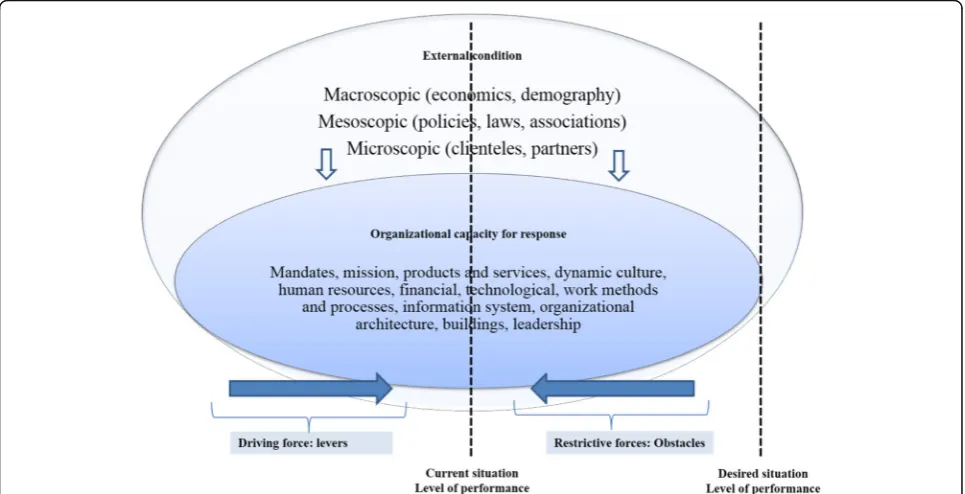
Collerette, Lauzier, and Schneider’s model of strategic organizational analysis [15] provides an integrative frame-work that synthesizes these different factors (Fig. 1). The model was developed based on a systemic perspective, ac-cording to which organizations must adapt to their envi-ronments to achieve their objectives [16]. The systemic perspective involves studying an object in all of its com-plexity. According to this perspective, an organization’s health depends largely on its ability to adapt to the charac-teristics, requirements, and challenges of its environment. It is a question of apprehending the object in its environ-ment, its functions, its mechanisms of action, its structure, and its evolution [17].
Relying on this perspective enables the framework pro-posed by Collerette & al. [15] to take into account a wide array of factors that operate at various levels, inter-act with each other, and are likely to influence nursing practice in an integration context. According to the framework, these changes in practice are influenced not only by a set of external factors (demographic and epi-demiological changes; technological developments; eco-nomic, political and social contexts, etc.), but also by a set of internal organizational conditions that represent an organization’s capacity to respond to external circumstances.
Collerette & al.’s framework [15] is further enhanced by Lewin’s (1951) ‘force-field theory’, [18] according to which a social situation (seen as dynamic) is characterized as the result of the combined effect of multiple forces in a more or less stable state of equilibrium. These can be
driving forces or levers that exert a positive influence in the direction of the desired change, or restrictive or constraining factors that oppose the change [15, 19]. Factors operating at different levels can thus generate both driving and restrictive forces, working for or against the desired change. By using Collerette & al.’s framework [15], this study hopes to open what has until now been a black box and identify, drawing on nurses’ own experiences, the organizational factors that act as levers or constraints with respect to developing their practice in a care integration context.
Methods
Design
The research design was a cross-sectional descriptive qualitative study based on a single case study with nested levels of analysis [20].
Study environment
The case studied was that of a public, multi-activity and multi-disciplinary health and social services centre (HSSC) located in a semi-urban region of Quebec, which provides services to more than 280,000 inhabitants (a population characterized by a higher percentage of aging individuals and a higher birth rate than the Quebec average). Using a program-based approach, the HSSC coordinates services provided by four local community health centres (CLSCs), four long-term care facilities (CHSLDs), an average-sized hospital, and more than 200 partners providing various services (community pharmacies, family medicine groups
[image:3.595.57.540.465.712.2][FMGs], community organizations, group homes, etc.). This HSSC was selected as the locus for the study because it faced challenges similar to those confronting the great majority of HSSCs in Quebec: administrative authority over a large territory; a population with disparate socio-economic characteristics; rapid increase in population needs for health services; human resource shortages; and budget constraints.
With the support of key participants (directors of ser-vice programs), four care pathways were selected. A care pathway aims at a multidisciplinary, optimal, and con-sensual management of patients presenting the same pathology or the same care situation. Patients follow a clinical path that provides timely access to the services they need in a coordinated manner. Shared responsibility of institutions or professionals towards a patient requires integration of care. Pathways were selected based on the following criteria: feasibility of studying the pathway; management interest and availability; inclusion of path-ways at different stages of development; and coverage of different care integration contexts. The care pathways selected were: chronic obstructive pulmonary disease (COPD), palliative oncology services (POS), autonomy support for the elderly (ASE), and mental health services (MHS). A previous study that evaluated so-called ‘ inte-grative’ practices in this organization showed that the COPD and MHS pathways were at less advanced phases of integration (Phase 1–initiative and design), while the ASE and POS pathways were at intermediate phases (Phase 2 – experimentation and execution, and Phase 3 – expansion and monitoring, respectively), and that none of the pathways had reached Phase 4 (consolida-tion and transforma(consolida-tion), the most advanced phase of the integration process [2].
Data sources
The strategy used was purposive sampling [20] from a maximal variety of sources: members of the nursing team (nursing assistant, nurse technician and clinician, nurse navigator, liaison nurse, care consultant), members of the interprofessional team (respiratory therapist, so-cial worker, occupational therapist, physical therapist), managers, and senior administrators. Nurses and other professionals were selected with the assistance of man-agers and program directors based on the following in-clusion criteria: French-speaking; holder of a practice license from a professional association; employed in one of the targeted care pathways for at least the previous six months (full- or part-time, days or nights, or on rota-tion); interested and available to participate in the study. Managers and senior administrators were selected based on the following criteria: French-speaking; employed full-time in the organization for at least the past six months; interested and available to participate in the
study. All the people approached (n= 37) agreed to par-ticipate (100%); this sample size not only allowed for data saturation, but also ensured theoretical representa-tion by covering four care pathways representing differ-ent care integration contexts, as well as the differdiffer-ent perspectives of clinicians and managers. Respondents were evenly distributed across the four pathways: ASE (n= 7), MHS (n= 10), POS (n= 9), and COPD (n= 9). They included all nursing job titles (nursing assistant, nurse technician, nurse clinician, nurse navigator, nurse practitioner, nurse advisor, nurse manager) (n= 27), other professionals (n= 4), two representatives of execu-tive management (n= 2), and four managerial or admin-istrative representatives with an overall view of the care pathways—one for each pathway (n= 4). The objective of obtaining this diversity of perspectives was to increase the validity of the study results and improve our under-standing of the phenomenon being studied [21].
The great majority of respondents were women (n= 32), had university degrees (n= 31), and worked days (n= 34). Participants were spread across different missions of the organization: hospital (n= 14), CLSCs (n= 15), CHSLDs (n= 4), and FMGs (n= 2). Sample composition was also balanced between management (n= 18) and clin-ical (n= 18) functions.
Data collection process
This project was approved by the research ethics com-mittee of the University of Montreal, the research ethics and administrative committees of the study sites, and the HSSC senior management team. An information letter was hand-delivered to the targeted participants and its contents were explained to them. All interviews were con-ducted by the lead investigator as part of a doctoral study. Interviews were booked directly with each respondent, for confidentiality purposes and to accommodate their pre-ferred time and place. Interviews lasted approximately 60 min. Participants signed a consent form authorizing both audio-recording of the interviews and written note-taking [21]. A literature review was also conducted.
Data collection instruments
employment position, training, work location and shift, se-niority). Documents recommended by key participants provided additional relevant information, including, among other things, the organizational structure of the HSSC, organizational policy statements relating to nurs-ing, and the HSSC’s management principles, strategic plans, and annual reports.
Data analysis
All audio-recordings of the interviews were fully tran-scribed. Verbatim transcription of the interviews resulted in an average of 50 pages of text per interview, for a total of around 1850 pages (37 interviews of 50 pages). The principal investigator drafted a five-page summary for each interview, which was then submitted to the corre-sponding respondent for content validation [21]. Out of the 37 respondents, 18 confirmed the contents as accur-ate, four suggested minor adjustments due to changes in their situation, and the remainder did not follow up.
To ensure the validity of the coding process, the sum-maries and coding for five interviews were subjected to intra- and inter-rater validation. The intra-rater valid-ation involved having the same researcher repeat the coding, after a one-week interval. A 90% similarity score was obtained between the two codings. The inter-rater coding process was carried out with the lead investigator, an expert in qualitative process and content. The valid-ation process continued until 80% agreement among codings was obtained. This pre-coding exercise was used to validate the process, after which all the transcripts were coded. Following transcript validation, the data were analyzed in three main steps (Fig. 2). NVivo 10 software was used to systematically organize the coded data and to develop themes and subthemes, as well as conceptual matrices.
In the first step, the coding process was based on the dimensions of Minkman’s (2011) model of integrative practice [10] and the framework of Collerette & al.’s strategic organizational analysis model [15]. The verba-tim content was coded in three steps: 1) according to the dimension of nursing practice that it represented; 2) according to the dimension of organizational capacity for response to which it corresponded; and 3) according to whether it expressed a driving force or a restrictive
force. In essence, for each dimension of practice, analyz-ing the forces and obstacles usanalyz-ing the Collerette & al.’s model helped identify recurrences and group content. For example, for content identified as part of the‘ multi-disciplinary practice’dimension (a theme) [10], elements related to human and physical resources (subthemes) [15] were identified and in turn gave rise to categories of driving forces and restrictive forces (third-level theme). Table 1 (below) provides an example illustrating the basic outline of the analysis.
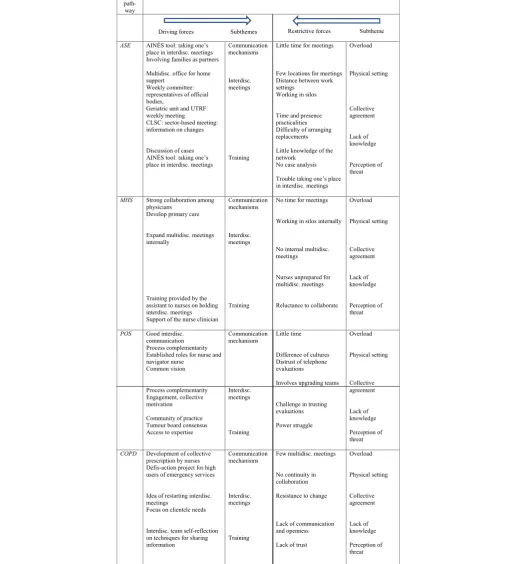
In the second step, summaries were developed to group the observations for each care pathway. Using the themes and subthemes as a starting point, analysis of the respondents’ verbatim statements regarding each care pathway helped identify the different elements that arose as driving or restrictive forces in a care pathway. Table 2 presents the driving and restrictive forces and the sub-themes corresponding to the main theme ‘Support for collaboration’for each care pathway.
In the third step, the analysis consisted in bringing to-gether the cross-cutting results obtained from observa-tion of the four pathways. For example, for the theme
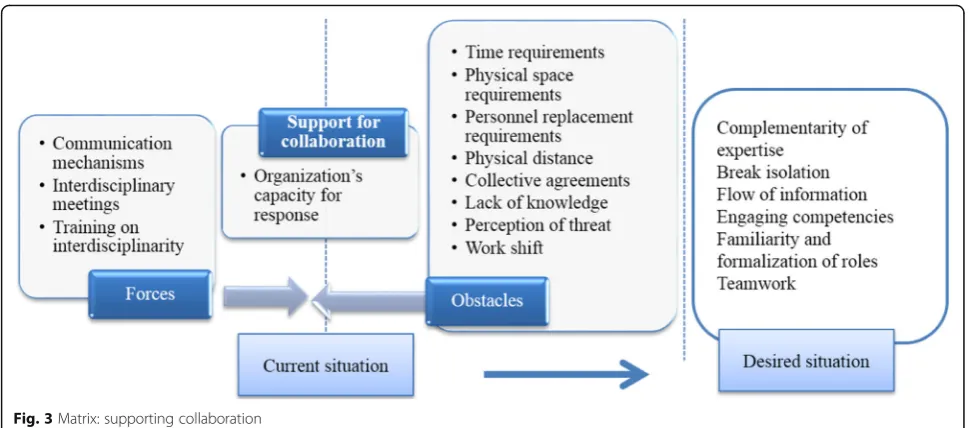
‘Support for collaboration’, the subtheme ‘training’ was identified across all four care pathways. Figure 3 pre-sents the resulting matrix, which consolidates data from the four care pathways with respect to the driving and restrictive forces for this theme.
Results
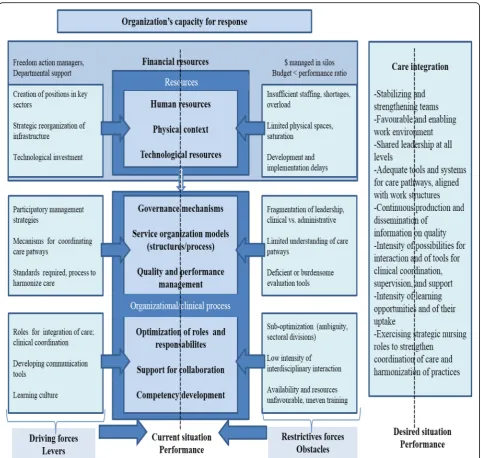
Participants referred to two categories of factors that in-fluenced the organization’s capacity to implement and sustain a nursing practice that met the requirements of integration. The first had to do with availability of organizational resources, and the second involved deploy-ment of a set of organizational and clinical-administrative processes (Fig. 4).
Organizational resources
With regard to resources, three key factors were seen as having a determining influence on nursing practices to support integrated care, either serving as catalysts or generating a variety of constraints.
Stage 1 Individual verbatim
analyses X n/care pathways
Stage 2 Verbatim summary
analyses by care pathway
X 4
Stage 3 Summary analysis of recurrences between the 4 care pathways Cross-cutting themes
[image:5.595.58.539.630.719.2]Human resources
Participants pointed out that certain investments in hu-man resources played a key role in the organization’s capacity to put in place various structures to foster inte-gration of care. Examples of new structures that required appropriate human resources staffing included the single-window access point (a single gateway for patients in the healthcare system, where they are assessed and guided according to their needs) for mental health ser-vices, the breast health clinic (POS), and the smoking cessation clinic (COPD). These new investments also re-sulted in the deployment of specific professional roles (e.g. nurse navigators in palliative care, care for the eld-erly, and oncology; mental health liaison nurse, etc.), the opening of new nurse positions in targeted areas (need for better integration of patient care), and support for new continuing education activities for personnel.
Despite these investments, participants emphasized two factors that, under current conditions, impeded a nursing practice oriented toward care integration. The first was that, in their view, there were not enough nurses to meet the demand. According to participants, having enough nurses is essential to respond effectively to patients’ complex needs and ensure the stability required for continuity of care. When personnel is insufficient, as was reported in several programs, nurses are over-extended, both in terms of quantity and complexity of care, and do not have enough time to provide the full range of services to each patient. In the medical unit, nurses reported they sometimes had to limit themselves to looking after patients’basic care needs due to lack of time, and that they would neglect relational activities, for instance, to concentrate on complex or prescribed care. Several participants noted that staff shortages also compromised access to care at various points along the care continuum.
“A workload reduction would help promote a practice of more continuous care for patients. We could be on top of everything, it would be easier”(MPOC)(free translation)
“Sometimes I’m all over the place, I have to refocus on my objectives, and my boss helps a lot with that…The staff is starting to get tired and worn out. Two years ago, 25 patients a day in chemo was a big day, now it’s around 47-48 patients…”(POS) (free translation).
In the MHS pathway, this shortage of personnel was associated with long wait lists for primary care services. Staff shortages were also associated with nurses’ lack of availability to attend intra- or interdisciplinary team meetings, continuing education activities, or discussions with colleagues—all elements that foster integrative and collaborative practice.
A second obstacle had to do with team instability, manifested most notably by frequent changes in personnel, numerous replacements, and intensive use of external labour. These instability factors were associated with nurses’ difficulties in becoming fully integrated into the team, taking part in unit activities, establishing relation-ships of trust with other members of the intra- or interpro-fessional teams, and mastering the operational aspects of care—all elements that can compromise care continuity. Replacement staff do not necessarily know the different re-sources that are available. Thus, an agency nurse might not be as quick to refer a hospitalized patient who wants to quit smoking to the smoking cessation clinic, or to call upon the palliative care nurse navigator to coordinate a pa-tient’s transfer to the palliative care centre. Replacement personnel would also have more difficulty in using the nursing treatment plan, a key tool for monitoring and co-ordinating care from one shift to another, one care location to another, or even one professional to another.
The physical setting for care provision
[image:6.595.61.530.98.145.2]The creation of local health networks specific to the Quebec context has significantly modified the spatial configuration of services, with impacts for both patients and professionals. According to nurse participants, the modernization and expansion of the hospital and reno-vations to various care settings had made it possible to create the spaces needed for various new strategic ser-vices in which nurses are fully involved and which should foster greater integration. Setting up the infra-structure needed to implement a centralized wait list, for example, helped create a single point of entry for health services for certain target patients (e.g. MHS, POS, ASE). Developing this infrastructure (offices, telephone lines, in-formation systems, documentation) placed nurses at the centre of the care integration process by giving them a set of resources with which to manage requests for services and patients’records, and to conduct assessments, set pri-orities, initiate treatments, and direct patients toward other appropriate services. The implementation of a sys-tem to manage COPD patients was another example of
Table 1Basic outline of the analysis
Verbatim Theme (Minkman) Subtheme (Collerette) Third-level: Force
“We use the AINÉS tool to help us better plan our report, and that helps us become familiar with our place in the interdisciplinary team”
Interdisciplinarity (support for collaboration)
how providing certain material conditions, such as or-ganizing physical spaces to accommodate all care team members (nurse, respirologist, respiratory therapist)
[image:7.595.39.563.111.676.2]and supplying all the necessary material and equipment, had facilitated various nursing interventions. These in-cluded systematically applying pulmonological assessment
protocols, using digital tools to monitor patients, and developing educational capsules for patients. For partic-ipants, the various arrangements involving new con-struction or renovation and investments in certain equipment (e.g. meeting rooms, computer equipment, consultation rooms, and rooms for examinations or specific interventions) were interpreted as an appropri-ate response to the different needs associappropri-ated with functioning as a network: physical spaces for meetings and conversations, communication and monitoring from a distance, and intra- and inter-establishment interactions.
Despite these investments, various factors related to the physical environment were perceived as important constraints to the integration of services provided by nurses. The limitations of physical spaces, which in many cases were considered too small and poorly adapted, made it difficult not only to accommodate pa-tients, but also to deploy personnel optimally and to gather all members of the interdisciplinary team around patients. Lack of space in the oncology centre, for ex-ample, limited the number of patients that could be seen daily, the quantity and type of services that could be provided, and even the number of nurse navigators and other professionals who could practice on the unit at the same time. Nurses had to go from one place to another in the organization to ensure continuity of care to pa-tients, or to attend team meetings or training activities. Furthermore, the merger of several organizations that were geographically dispersed inevitably resulted in physical distance between professionals in the different missions (e.g. primary care, hospital care, residential care for the elderly) who were expected to work together. Ac-cording to the participants, this geographical dispersion of facilities, with the associated dispersion of equipment,
patients, and personnel, posed a significant challenge for communication, complicated interdisciplinary activities, forced both patients and staff to navigate among the dif-ferent facilities, and ultimately made continuity of care more difficult to achieve.
“We don’t have enough space in the oncology unit, because the amount of traffic has increased significantly, the clinic is overloaded. Even if we wanted another nurse navigator, there wouldn’t be any room for her. The care is less personalized, there is more assembly-line work, and the wait times are too long (6-7 hrs for 30 min. of treatment). Luckily, there is an expansion project underway. All the services will be located together and there will be less patient movement. Which is much appreciated by the patients and professionals”(POS)(free translation).
Technological resources
[image:8.595.56.541.86.300.2]promoting best practices. A second asset mentioned was the progressive implementation of computerized medical records. Because it created conditions that facilitated data organization, access, and circulation, the computerized medical record was widely considered to be a lever for en-couraging care coordination among nurses and facilitating interactions with other members of the interdisciplinary team. For example, a designated nurse used computerized medical records to identify patients who were high users of emergency services, then made the necessary arrange-ments to coordinate and mobilize the interdisciplinary team to respond optimally to these patients’needs for care and services. A third asset consisted of computer-based
resources, such as specialized software, that provided nurses with monitoring and assessment tools to ensure better care coordination. A software program developed especially for COPD patients and used by nurses in FMGs and ambulatory care centres helped systematize patient assessment and monitoring and provided a shared tool for intervention and coordination used by nurses, respiratory therapists, and physicians.
[image:9.595.58.540.86.544.2]keep up with technological advances, and about inad-equate support for professionals who need to use these technologies (training, availability of support technicians, time required to use them, etc.).
“Computerized records have not enabled technological support for a daily watchlist available to practitioners in the network. We are dependent on maintaining the ‘pop-up’of information, there is no mechanism to alert the team when someone arrives in emergency”(MPOC) (free translation).
In all, participants strongly associated the organiza-tion’s level of investment in the three types of resources (physical, technological, and human) with the creation of conditions fostering greater integration of the care pro-vided by nurses. Such investments depended very much on the budget allocated to the organization. The MSSS or the Health and Social Services Agency (ASSS) pro-vided funding for specific projects (e.g. development and implementation of a clinical project). However, partici-pants’general perception was that the organization had very little room to manoeuver when it came to investing in resources required for the integration project. They saw this underfunding as a major cause of the various structural obstacles to integration mentioned above: physical space constraints, insufficient personnel for key care-provision functions, obsolete technologies.
Clinical-administrative processes
Six main process-related factors were seen as having a determining influence on nursing practices to support integrated care, involving both administrative (governance mechanisms, service organization, quality and perform-ance management) and clinical aspects (introduction of care integration roles, support for interdisciplinary team work, capacity strengthening).
Governance mechanisms
With respect to governance, participants first highlighted efforts made by the organization to promote a shared vi-sion of care integration and to set some broad orienta-tions. In particular, these efforts took the form of activities to involve different groups, including nurses, in develop-ing an organizational project and a strategic plan for the institution. Such activities included, for example, days of reflection, consultation meetings, training sessions, col-lective problem-analysis approaches, and problem-solving discussion groups or workshops. Another strategy seen as facilitating was the implementation of governance struc-tures to ensure collective responsibility for the integration project and allow shared leadership to be developed at all levels of the organization. This resulted in participative management approaches that included, among other
things, interdisciplinary workshops, working committees at different organizational levels involving employees from different shifts and points of service, the use of various spokespersons representing different groups in the organization, and a relative increase in clinical-ad-ministrative meetings through which the contributions of the different organizational groups could be solicited. Nurses in the different pathways were engaged to varying degrees in the process of carrying out the clinical project. The Nursing Directorate itself (which includes the Dir-ector of Nursing at the HSSC and plays a key role in all strategic decisions related to the organization and delivery of care and services) invested in promoting a cross-disciplinary view of patient care, using clinical nursing consultants. At a more operational level, nurses were dir-ectly involved in developing the care pathways. The men-tal health liaison nurse developed a process for emergency room triage assessment of patients with mental health problems that enabled them to be referred more rapidly to the appropriate service. A clinical nurse consultant with a master’s degree developed and implemented a project to evaluate high users of emergency room services, with mechanisms for interdisciplinary follow-up of these pa-tients (COPD). Participants interpreted these various ac-tivities as developing an integration-oriented culture that was based on providing more opportunities for interac-tions among the actors (health professionals and man-agers), creating a variety of spaces for collaboration and learning, and involving the actors in various collective learning processes.
Nevertheless, despite the efforts that had been made, participants noted various gaps in governance that ex-plained the delays seen in service integration. In contrast to the ideal of shared leadership originally espoused, leadership was fragmented among different departments whose interventions were not sufficiently coordinated, which impeded care continuity in the care pathways. One respondent in mental health explained, for example, that for a mental health patient with multiple pathologies, the departments of physical and mental health needed to work together, which was not always the case. Moreover, while the subcultures of certain units or institutions (e.g. CLSCs, primary care mental health services) are very much accustomed to interdisciplinary work and referral mechanisms, other settings, such as hospitals, have main-tained a culture of working in silos. Another problem mentioned by several participants was the different actors’ varying levels of involvement in the change process, de-pending on their settings. Some nurses in the COPD path-way working in the medical unit expressed frustration at feeling marginalized in these change processes.
the trouble arose from questions of values between groups. Adjustments have to be made on all sides; departments, managers, coordinators, practitioners. There are many small cultures that have to be plugged in(ASE)…Things change, there are links that form, we weren’t as closely tied to the CLSC before. In some ways, it’s also gotten more weighed down. People don’t quite know who to refer to anymore when there’s a need”(MHS)(free translation)
They reported that they had not been involved in any way in the change process, not due to lack of interest, but rather because they had not been given the oppor-tunity. Other participants noted that some professionals were reluctant to engage in the change processes for various reasons: misgivings, negative perceptions of change, lack of information. Rumours circulating to the effect that a number of nursing positions in secondary care (e.g. intermediary resources) in the MHS pathway would be cut in order to open nursing positions in pri-mary care (e.g. home care) naturally raised concerns among the nurses involved.
Service organization models
In this area, participants referred to various service reorganization processes and clinical-administrative in-struments that were associated with better patient man-agement and with the capacity to provide a better-coordinated range of services. They spoke about three types of processes. The first were processes to strengthen links between primary and secondary care teams. One ex-ample was a program of shared services between the two levels. There was a significant service to support general practitioners in the territory, wherein a contact psych-iatrist helped clarify diagnoses and made recommenda-tions regarding medical treatments. The second type involved processes and tools to facilitate patient navigation of the system and refer them to the most appropriate ser-vices. This involved developing, for example: detailed maps of MHS pathways; protocols to guide follow-ups and transfers to appropriate services; service provision guidelines for the oncology nurse navigator or for nurses managing the wait list; mechanisms to clarify the roles of professionals providing ASE services; and intervention in-struments, such as decision-support tools and interven-tion plans tailored to the patient’s condition for ASE nurses. The third type of process consisted of grouping to-gether in one location a set of complementary services provided by an interdisciplinary team to respond more ef-fectively to the needs of certain types of clienteles (e.g. in-take clinic in respirology, palliative care centre, general practitioner/psychiatrist shared services program). How-ever, certain obstacles were mentioned as factors that im-peded the above-mentioned processes.
“There again, everything goes to secondary. There’s an issue there. So, do I try to make secondary care more competent to provide services to patients with serious conditions, to make it functional and efficient? If so, that’s excellent, but what do I do with primary care that then isn’t keeping up? This takes some thought. It’s the major challenge”(MPOC)(free translation)
The obstacles included, among others: resources being concentrated in secondary care, slowing the deployment of primary care services; a lack of knowledge about the range of existing services, both among patients and among the professionals themselves; professionals’scope of practice often being defined more by their position or assignment to a given unit than by patients’needs; and a narrow conception of care pathways that only partially covers patients’ real needs. The inclusion criteria deter-mining patients’ access to certain care pathways were seen as limiting the management of a variety of situa-tions, especially for patients with multiple pathologies. For instance, professionals working in the COPD path-way could not manage on their own the substance use problems presented by some of their patients.
Quality and performance management
with a desire to assess nurses’performance, whether dir-ectly or indirdir-ectly: staff and patient surveys as part of the accreditation process; patient satisfaction questionnaires; stretcher occupancy rates in MHS; and incident/accident reports.
According to participants, however, implementation of these performance management tools masked several significant limitations. The instruments (measurement tools, information systems) used to measure the quality of nursing services were still considered inadequate. Sev-eral new roles had been introduced (e.g. palliative care nurse navigator, COPD liaison nurse) and had not yet been formally evaluated.
“Unfortunately, we know that performance associated with stretcher occupancy rates is more important than the level of performance in quality of care. A drop in performance could mean we risk losing stretcher to [physical] medicine for example. In all that, is the quality of patient care really being evaluated?”(MHS) (free translation)
The gap between needs and resources, as well as the pressure associated with certain performance require-ments (mainly in terms of service volumes), generated significant stress for the personnel. In the MHS ambula-tory clinic, a key performance indicator was the number of patient assessments performed daily. The oncology unit’s recognition as a regional cancer centre depended, among other requirements, on the number of patients managed by the nurse navigator.
Introduction of care integration roles
In this area, participants referred repeatedly to several new nursing roles that were considered integrative roles: liaison nurse, nurse navigator, nurse clinician consultant, case manager, network professional. These roles were seen as levers for improving the coordination of services for certain target patient groups, for supporting them in transitioning among different levels of care, for ensuring more rapid access to certain professional resources, and for optimizing the use of those services through more accurate referrals of patients needing them. The oncol-ogy nurse navigator contributed to care integration by orchestrating the oncology patients’medical records. At work, she was available to respond to her patients’needs, made connections between the various health profes-sionals (e.g. multidisciplinary team) involved in patients’ care, and ensured that patients were appropriately followed both outside and inside the department of on-cology, as needed. The liaison nurse in the medical unit contributed to the COPD care integration process by mobilizing necessary resources and linking with profes-sionals to ensure patients continued to be followed,
mainly after discharge or upon returning home. The ASE nurse clinician consultant looked after the quality of care provided to elderly patients by all institutions in the network. Based on her comprehensive overview, she ensured that nursing services to these patients were optimized; she did clinical coaching and developed tools, protocols, and collective prescriptions; and she trained teams in collaboration with physicians and pharmacists.
However, participants noted many obstacles to full de-ployment of these new roles. Several participants reported that a significant proportion of clinicians and managers had a poor understanding of these roles and their poten-tial, resulting in under-utilization of the persons in these roles. Another major difficulty had to do with financial constraints, which often made it difficult to ensure the sustainability of positions associated with these roles.
“I could see myself intervening more in complex care situations. I am not being used at full capacity. Since I can move between facilities, I could easily act as a bridge between situations, which is not often enough the case”(POS)(free translation).
Finally, because these roles were not very standardized in terms of how they were defined and enacted, they varied considerably depending on the specifics of differ-ent settings and professionals. The resulting ambiguity added to the complexity of collaborating with other members of the interdisciplinary team, thus impeding integration of care.
Support for collaboration
On this theme, participants referred to four types of ac-tivities they perceived as being levers for promoting col-laboration among team members and for coordinating their interventions more effectively.
holding monthly meetings and admission/discharge meet-ings in the ASE pathway; attendance at regional interdis-ciplinary round tables by nurses in the MHS pathway; and initiatives that were currently being introduced to hold more systematic interdisciplinary and team meetings in the MHS pathway. The fourth type of activity consisted in creating or strengthening roles dedicated to clinical coord-ination. Nurse clinician consultants, nurse navigators, and liaison nurses were working to support teams in adopting new practices and working tools and in coordinating their interventions more effectively. The RISPA nurse (Réseau intégré de soins pour la personne âgée—Integrated net-work of care for the elderly) was mandated to coordinate the activities of all professionals involved in providing care to elderly patients. An oncology nurse was assigned to manage all transfers to palliative care and to ensure coord-ination among the various professionals and managers in-volved in these transfers.
According to participants, the possibilities associated with these various activities were constrained by several factors: a lack of human resources; difficulties encoun-tered by the people in these positions making themselves available for team activities, such as interdisciplinary meetings; a lack of preparation for interdisciplinary work; difficulties encountered by some professionals in interact-ing or sharinteract-ing information with others; variability in the opportunities available to different professionals de-pending on their work context (e.g. fewer opportunities for interaction among persons working evening and night shifts, or working in relative isolation—such as the smoking cessation nurse—or even those in care units where the culture of holding interdisciplinary meetings was less developed).
“One mentality and philosophy that should be changed would be to remove the words‘my patient’ from our vocabulary. It’s‘our patient’or‘the patient you referred to me’…Also, to see other professionals as complementary, rather than as threatening. There are people who want to do everything with their patient, rather than using the strengths of everyone, which would enable the person to move forward…and bring other ideas and intervention possibilities to our team discussions”(MHS)(free translation).
Capacity strengthening
In this area, participants referred to the organization’s investments in two main types of activities that sup-ported nursing practices to support integrated care. First, the implementation of care pathways gave nurses access to several new learning opportunities. Interdiscip-linary meetings, involvement in the development of new tools and service models, and participation in working committees were perceived as opportunities to acquire
knowledge and develop competencies needed to imple-ment more integrated care. Along the same lines, partici-pants highlighted the support received in communities of practice and in intra- and interdisciplinary co-development groups. In POS, for example, the tumour board, made up of members of the medical, professional, and nursing team, provided regular opportunities to discuss complex cases and reach consensus on the best treatments. Second, the organization had engaged nurse clinicians, nurse con-sultants, nurse navigators, and liaison nurses in a series of activities aimed at offering formal training activities, promoting self-study activities, and providing clinical support to nurses, such as through coaching or mentor-ing. Nurses with a particular expertise were invited to present training capsules or lunch conferences on topics of interest related to best practice development.
“Certainly, having moments to think, to review your situation, and to create the opportunity to share with other practitioners, it’s amazing how enriching it is, but it’s not easy within the organization or for a nurse in the SAD [home support] who has to answer for her day’s caseload”(MHS)(free translation).
The main obstacle to implementing these activities was nurses’lack of availability, in contexts often charac-terized by inadequate staffing or excessive workloads. In addition, because of the physical distances involved, training tended to be designed for each setting rather than around care pathways, making standardization more complex.
Discussion
show that the organization’s capacity for response to the driving forces calling for more nursing practices to support integrated care is mitigated.
In terms of resources, integration efforts took the form of investments in implementing and staffing new stra-tegic services, re-organizing physical infrastructures, and deploying new technological resources. According to study participants, however, these investments had limited im-pacts in several study environments and were not sufficient to offset a persistent set of constraints related, among other things, to insufficient human resources, slow deployment of computerized medical records, lack of space to accom-modate interdisciplinary teams, and the geographic disper-sion of facilities. Moreover, the current context of the healthcare network is marked by massive budget cuts. These conclusions highlight the importance of investing in the work environment as one of the fundamental levers that must be fully activated to create a supportive context for integrative practices. Work environment refers to a set of properties having to do with the arrangement of infra-structures, the physical and spatial organization of work, the availability and organization of material and techno-logical resources, human resources staffing, and the avail-ability of a set of psychosocial resources [22, 23]. Various writings on the topic of structural empowerment discuss the impact of these structural factors on nurses’provision of services [24, 25]. These factors pertain to nurses’access to a variety of conditions and resources that support them in carrying out their tasks: information, sources of support in the organization, material resources, and possibilities for professional advancement. Two decades of research on Magnet hospitals have shown that a work environment in which there is adequate staffing and access to a variety of sources of professional support is associated with improved services to patients [26]. Other studies on high-performing systems have shown that they are characterized by access to a certain number of resources (technological, informa-tional, human) that give them the ability to innovate in their service production processes [27]. All of this conver-ging evidence shows that the lever provided by the work environment was not fully activated in the case examined in the present study, given the persistent problems.
In terms of organizational processes, the integration ef-forts made in the study case resulted in a variety of ac-tivities aimed at renewing governance, introducing participative management approaches, improving the flow of care pathways, and promoting continuous qual-ity improvement. Here again, these efforts were offset by difficulties related to fragmented leadership, poor knowledge about the care pathways on the part of both patients and care providers, and shortcomings in qual-ity monitoring.
These conclusions highlight three levers that were only partially activated in this service transformation process:
the exercise of shared leadership; the systematization and instrumentation of care pathways and their alignment with the work structure; and the production of informa-tion on quality. With regard to leadership, a study that examined, among other things, the topic of clinical gov-ernance has shown that high-performing health organiza-tions are characterized not only by a strong management team, but also by shared and collective effort, and a joint commitment by clinicians and managers at all levels to steering and implementing improvement initiatives [28]. Regarding systematization of care pathways, using such a lever gives organizations the possibility of standardizing practices, programming and structuring clinical interven-tions more effectively, and aligning them with the best evi-dence and practices to optimize patient pathways [29]. This involves being able to develop and implement standardized protocols on a large scale, to develop and implement shared intervention tools, and to adopt and institutionalize proven guidelines and practices, sup-ported by strong evidence. With regard to producing information on quality, such a lever makes it possible to generate information needed to substantiate the ana-lysis of care processes, diagnose problems early, and implement evidence-based solutions [30], thereby lay-ing the foundations for learnlay-ing systems in which clini-cians and managers have access to the information needed to assess the quality of their services and to en-sure continuous improvement [30]. This case analysis showed a definite will to activate each of these three le-vers, but with interventions that did not have the full impact needed to overcome obstacles and achieve the desired results.
In terms of clinical processes, the integration efforts led to a variety of activities aimed at developing new roles, promoting collaboration among clinicians, and strengthening the capacities of service providers. However, advances in this area were offset by delays in the deploy-ment of new roles, a continued low intensity of interdis-ciplinary interactions, and practice conditions that did not leave professionals enough time to engage in learning activities and capacity strengthening. These findings indi-cate that two levers were not used to their full potential in the case examined: reinforcement of coordination, super-vision, and clinical support mechanisms; and capacity strengthening.
navigator) [30]. Such a coordination infrastructure can serve as a platform to create more frequent opportun-ities for interaction and exchange among team members (interdisciplinary meetings, case discussions, team meet-ings), ensure the communication and transmission of clinical information, implement tools to reinforce inter-disciplinary work (e.g. interinter-disciplinary assessment forms, interdisciplinary intervention plans). This lever also refers to integrator roles that go by a variety of names (e.g. li-aison officers, case managers, patient navigators), provid-ing many opportunities to reinforce the coordination of services for target user groups, support them in their tran-sitions among different care levels, and ensure more rapid access to certain professional resources [31].
The capacity-strengthening lever refers to strategies and teaching methods that should be deployed to sup-port transformation processes. These investments in personnel, their professional development, and learning processes can help improve not only care provision and patient or client satisfaction, but also the satisfaction of professionals [32]. The amounts invested can also be recovered thanks to increased efficiencies generated by improvements in management processes and service provision.
The results of this study should be interpreted in light of two main limitations. The first is that this analysis was based on a single case study. Despite the richness of this case and the similarity between the issues seen here and those facing the great majority of HSSCSs in Que-bec, we cannot exclude the possibility that other levers might have been identified if the sample had been ex-panded to include a wider variety of institutions and settings.
The second limitation concerns the essentially percep-tual nature of the data upon which the study was based. While this made it possible to address the questions through multiple stakeholders’ viewpoints, some of the factual information provided by participants was not verified. Despite these limitations, this study shed light on the main levers that organizations can employ to en-courage the implementation and institutionalization of integrative nursing practices in their efforts to lessen the current fragmentation of services.
Conclusions
This study indicates that progress in this area will require a combination of strategies that involve mobilizing several complementary levers: a supportive work environment; shared leadership; systematization and instrumentation of care pathways, and their alignment with the work struc-ture; production of information on quality; reinforcement of coordination, supervision, and clinical support mecha-nisms; and capacity strengthening. This study highlights the fact that progress in implementing these more
integrative practices will necessarily require rethinking the deployment of certain organizational resources and structures. However, beyond structural aspects, funda-mental changes are also needed across all clinical and organizational processes.
Acknowledgements
The authors thank the Centre for Training and Expertise in Nursing Administration Research (FERASI) and the Quebec Network on Nursing Intervention Research (Réseau de recherche en interventions en sciences infirmières du Québec - RRISIQ), for its financial support, as well as everyone who participated in the interviews.
Funding
No applicable.
Availability of data and materials
The data will not be made available in order to protect the participants identity.
Authors’contributions
CL conceived the study, collected, analyzed and interpreted the data, and wrote the first draft of the paper. CAD commented on the study design and on the analysis and interpretation of the data, and edited successive drafts of the paper. Both authors read, revised, and approved this final version.
Ethics approval and consent to participate
This project was approved by the research ethics committee of the University of Montreal, the research ethics and administrative committees of the study sites, and the HSSC senior management team.
Consent for publication
Participants signed a consent form authorizing audio-recording of the interviews, written note-taking and, written manuscript.
Competing interests
The authors declare that they have no competing interests.
Publisher’s Note
Springer Nature remains neutral with regard to jurisdictional claims in published maps and institutional affiliations.
Received: 23 August 2016 Accepted: 7 November 2017
References
1. Juhel A, Anctil H. L’architecture des services de santé et des services sociaux: les programmes-services et les programmes-soutien (Publication n° 04-710-01). Ministère de la santé et des services sociaux; 2004. http:// publications.msss.gouv.qc.ca/acrobat/f/documentation/2004/04-710-01.pdf. 2. Longpre C, Dubois CA. Implementation of integrated services networks in
Quebec and nursing practice transformation: convergence or divergence? BMC Health Serv Res. 2015;15:84. doi:10.1186/s12913-015-0720-8. 3. Bernier L. Les pratiques stratégiques dans les réseaux intégrés de services
de santé. (Thèse de doctorat). Montréal: Université de Montréal; 2012. 4. Cavalière R. Optimiser la contribution des infirmières et infirmiers pour
améliorer l’accès aux soins, assurer la qualité et la sécurité des soins et contrôler les coûts. Montreal; 2014. Retrieved from https://www.oiiq.org/ sites/default/files/3417-memoire-commission-revision-programmes.pdf. 5. D’Amour D, Tremblay D, Bernier L. Les pratiques professionnelles de
réseaux: l’intégration au-delà des structures. In: Fleury M-J, Tremblay M, Nguyen H, Bordeleau L, editors. Le système sociosanitaire au Québec: gouvernance, régulation et participation. Montréal: Gaëtan Morin; 2007. p. 273–87.
7. Benigeri M. Les urgences au Québec: évolution de 2003–2004 à 2012–2013. Québec: Commissaire à la santé et au bien-être; 2014.
8. Longpre C, Dubois CA, Nguemeleu Tchouaket E. Associations between level of services integration and nurses’workplace well-being. BMC Nurs. 2014; 13(1):50. doi:10.1186/s12912-014-0050-x.
9. Wagner EH, Austin B, Davis C, Hindmarsh M, Schaefer J, Bonomi A. Improving Chronic Illness Care: Translating Evidence Into Action. Health Aff. 2001;20(6):64–78. doi:10.1377/hlthaff.20.6.64.
10. Minkman M. Developing Integrated Care: Towards a Development Model for Integrated Care. (Doctoral thesis). Rotterdam: Erasmus University; 2011. Retrieved from http://www.vilans.nl/docs/vilans/over_vilans/pdf/ Proefschrift_Mirella_Minkman_Developing_Integrated_Care.pdf. 11. Malo D, Grenier R, Gratton F. L’intégration des soins infirmiers auprès de
personnes âgées fragiles vivant à domicile. Recherches Qualitatives. 2006; 26(1):154–80.
12. Roberge D, Pineault R, Hamel M, Borgès Da Silva R, Cazale L, Levesque JF, Ouellet D. L’accessibilité et la continuité des services de santé: une étude sur la première ligne au Québec. Rapport méthodologique de l’analyse des contextes. Québec: Centre de recherche de l’Hôpital Charles LeMoyne, Agence de la santé et des services sociaux de Montréal, Institut national de santé publique du Québec; 2007. Retrieved from https://www.inspq.qc.ca/ pdf/publications/772-AccServiSanteRapMetho.pdf.
13. Champagne F, Contandriopoulos AP, Brousselle A, Hartz M, Denis JL. L’évaluation dans le domaine de la santé: concepts et méthodes. In: Brousselle A, Champagne F, Contandriopoulos AP, Hartz M, editors. L’évaluation: concepts et méthodes. Montréal: Les Presses de l’Université de Montréal; 2009. p. 35–6.
14. Scott WR, Ruel M, Mendel P, Caronna C. Institutional change and healthcare organizations: From professional dominance to managed care. Chicago: University of Chicago Press; 2000.
15. Collerette P, Lauzier M, Schneider R. Le pilotage du changement. Canada: Presses de l’Université du Québec; 2013.
16. Graetz F, Smith A. Managing organizational change. A philosophies of change approach. J Chang Manag. 2010;10(2):134–54. doi:10.1080/ 14697011003795602.
17. LeMoigne JL. In: Morin E, editor. Comprendre la complexité dans les organisations. Lille Cedex: ASPEPS édition; 1997. p. 85. 978-2-907977-40-1. 18. Lewin K. Field theory in Social Science. In: Cartwright D, editor. Selected
Theoretical Papers. New York: Harper & Row; 1951.
19. Collerette P, Delisle G, Perron R. Le changement organisationnel: Théorie et pratique. Canada: Presse de l’Université du Québec; 1997.
20. Yin RK. Case Study Research: Design and Methods. 3rd ed. Thousand Oaks: Sage Publications; 2014.
21. Miles MB, Huberman AM. Analyse des données qualitatives (M. Hlady Rispal, Trans. 2e ed.). Bruxelles: De Boeck Université; 2003.
22. Chaudhury H, Mahmood A, Valente M. The effect of environmental design on reducing nursing errors and increasing efficiency in acute care settings: a review and analysis of the literature. Environ Behav. 2009;41(6):755–86. doi: 10.1177/0013916508330392.
23. Page A, editor. Keeping patients safe: transforming the work environment of nurses. Washington, DC: National Academics Press; 2004.
24. Orgambídez-Ramos A, Borrego-Alés Y. Empowering Employees: Structural Empowerment as Antecedent of Job Satisfaction in University Settings. Psychol Thought. 2014;7(1).
25. Spence Laschinger HK, Finegan J, Shamian J, Wilk P. Impact of structural and psychological empowerment on job strain in nursing work settings: expanding Kanter’s model. J Nurs Adm. 2001;31(5):260–72.
26. Kelly LA, McHugh MD, Aiken LH. Nurse outcomes in Magnet(R) and non-magnet hospitals. J Nurs Adm. 2011;41(10):428–33. doi:10.1097/NNA. 0b013e31822eddbc.
27. Baker GR, MacIntosh-Murray A, Porcellato C, Dionne L, Stelmacovich K, Born K. Learning from high-performing systems: quality by desing High Performing Healthcare Systems: Delivering Quality by Desing. Toronto: Longwoods Publishing; 2008. p. 11–26.
28. Ham C. Improving the performance of health services: the role of clinical leadership. Lancet. 2003;361(9373):1978–80. doi:10.1016/s0140-6736(03)13593-3.
29. Plante A, Joannette S. Centre intégré de cancérologie de la Montérégie: L’intégration des infirmières pivots dans les équipes d’oncologie en Montérégie: Le processus. Partie 2. Can Oncol Nurs J/ Revue canadienne de soins infirmiers en oncologie. 2009;19(2):6.
30. Cavalière R. Mémoire. La gouvernance infirmière: Condition de succès de la transformation du réseau. Montréal: Ordre des infirmières et infirmiers du Québec; 2014.
31. Huber D. Leadership and Nursing Care Management. Missouri: Elsevier, Saunders; 2014.
32. Becker BE, Huselid MA. High performance work systems and firm performance: A synthesis of research and managerial implications. Res Pers Hum Resour Manag. 1998;16:53–101.
• We accept pre-submission inquiries
• Our selector tool helps you to find the most relevant journal • We provide round the clock customer support
• Convenient online submission • Thorough peer review
• Inclusion in PubMed and all major indexing services • Maximum visibility for your research
Submit your manuscript at www.biomedcentral.com/submit