Open Access
Research article
Diffusion of good practices of care and decline of the association
with case volume: the example of breast conserving surgery
Ugo Fedeli*
1, Natalia Alba
1, Elena Schievano
1, Cristiana Visentin
1,
Rosalba Rosato
2, Manuel Zorzi
3, Giancarlo Ruscitti
4and Paolo Spolaore
1Address: 1SER-Epidemiological Department, Veneto Region. Via Ospedale 18-31033 Castelfranco Veneto (TV), Italy, 2Unit of Cancer
Epidemiology, S. Giovanni Battista Hospital and University of Turin. Via Santena, 7 – 10126 Torino, Italy, 3Venetian Tumour Registry, Istituto
Oncologico Veneto (IOV). Via Gattamelata, 64 – 35128 Padova, Italy and 4Department of Health and Social Services, Veneto Region. S. Polo, 2513
– 30125 Venezia, Italy
Email: Ugo Fedeli* - [email protected]; Natalia Alba - [email protected];
Elena Schievano - [email protected]; Cristiana Visentin - [email protected]; Rosalba Rosato - [email protected]; Manuel Zorzi - [email protected];
Giancarlo Ruscitti - [email protected]; Paolo Spolaore - [email protected] * Corresponding author
Abstract
Background: Several previous studies conducted on cancer registry data and hospital discharge records (HDR) have found an association between hospital volume and the recourse to breast conserving surgery (BCS) for breast cancer. The aim of the current study is to depict concurrent time trends in the recourse to BCS and its association with hospital volume.
Methods: Admissions of breast cancer patients for BCS or mastectomy in the period 2000–2004 were identified from the discharge database of the Veneto Region (Italy). The role of procedural volume (low < 50, medium 50–100, high > 100 breast cancer surgeries/year), and of individual risk factors obtainable from HDR was assessed through a hierarchical log-binomial regression.
Results: Overall, the recourse to BCS was higher in medium (risk ratio = 1.12, 95% confidence interval 1.07–1.18) and high-volume (1.09, 1.03–1.14) compared to low-volume hospitals. The proportion of patients treated in low-volume hospitals dropped from 22% to 12%, with a concurrent increase in the activity of medium-volume providers. The increase over time in breast conservation (globally from 56% to 67%) was steeper in the categories of low- and medium-volume hospitals with respect to high caseload.
Conclusion: The growth in the recourse to BCS was accompanied by a decline of the association with hospital volume; larger centers probably acted as early adopters of breast conservation strategies that subsequently spread to smaller providers.
Published: 18 October 2007
BMC Health Services Research 2007, 7:167 doi:10.1186/1472-6963-7-167
Received: 16 April 2007 Accepted: 18 October 2007
This article is available from: http://www.biomedcentral.com/1472-6963/7/167
© 2007 Fedeli et al; licensee BioMed Central Ltd.
Background
Breast conserving surgery (BCS) followed by radiotherapy to the residual breast tissue has been proved as an appro-priate approach to the treatment of early-stage breast car-cinoma since the early 1980s [1]. Although a consensus on breast conservation has been reached since 1990 in the United States [2], mastectomy rates after the introduction of these recommendations have been higher than expected and unexplained by medical contraindication [3,4].
Large centers are more likely to adopt innovative thera-peutic modalities [5], and early studies from both North-ern America and Europe showed a significant association between the surgical approach to breast cancer and hospi-tal bed size or procedural volume (yearly number of breast cancer surgeries) [5-8]. More recent investigations conducted on data from cancer registries or hospital dis-charge records (HDR) continue to detect this pattern. For example, BCS was more frequently performed in high-vol-ume hospitals in Los Angeles County and New York City in the period 1990–1998 [9,10], as well as in an analysis of thirteen years (1988–2000) of the US Nationwide Inpa-tient Samples [11]. Moreover, the finding of a significant association between the recourse to BCS and hospital vol-ume has been replicated in analyses of HDR from some Italian regions [12-15].
In the Veneto Region located in northeastern Italy, breast cancer is a major public health problem, as the crude rate was 167 per 100,000 individuals in the period 1998– 2001, with an estimated 1.96% annual percent increase in incidence from 1987 to 2001 [16]. The aim of the present study is to examine HDR and assess time trends in the recourse to BCS in Veneto, as well as to investigate con-comitant changes in the role -if any- played by hospital volume.
Methods
The total population of the Veneto Region was 4,699,950 on December 31, 2004 (ISTAT-National Institute of Statis-tics). There were approximately 950,000 discharges from Veneto hospitals each year; one primary and up to 5 sec-ondary discharge diagnoses and one primary and up to 5 secondary procedures were registered in HDR.
All discharges of residents from Veneto hospitals with the International Classification of Diseases, 9th
Revision-Clin-ical Modification (ICD9-CM) code 174 (cancer of the female breast) in all diagnostic categories, were identified for the period January 1, 2000 to December 31, 2004. Among these, admissions with BCS (ICD9-CM procedure codes 85.21–85.23) and mastectomy (85.41–85.48) were selected; patients who had already previous breast surgery in 1999 were excluded. In the case of repeated admissions
for breast surgery in the years 2000–2004, only the first admission was considered. Lastly, we also included surgi-cal biopsies (ICD9-CM procedure code 85.12) as BCS when no other breast surgery was performed in the study period, assuming that the biopsy resulted in complete excision of early breast cancer. A parallel analysis was also conducted examining the less conservative surgery identi-fied in 2000–2004 among repeated admissions for breast surgery.
The variables examined were patient's age (four classes), severity of cancer defined by clinical criteria for disease staging adapted to ICD9-CM codes [17] (classified as non-localized when discharge codes 196–198 of locoregional or distant metastasis were reported), presence of comor-bidities (an adaptation of the Charlson Comorbidity Index computed on the index admission and on admis-sions in the previous year through a program from the National Cancer Institute [18]), calendar year of dis-charge, and the hospital's volume of activity (<50, 50– 100, >100 women with breast cancer surgery). The vol-ume cut-off points were chosen a priori in order to com-pare results with recent studies carried out in Northern Italy [14,19]. Since the case volume sharply fluctuated in each hospital through the study period (Figure 1), a hos-pital's activity was defined as the annual number of dis-charges with breast surgery and was allowed to vary each year.
A hierarchical log binomial regression was applied in order to assess the influence of the above variables on the recourse to BCS while taking into account clustering of patients within providers. Since BCS is a common event, odds ratios estimated through conventional logistic regression depart from risk ratios (RR) of breast conserva-tion. We therefore applied a model that directly estimates the RR [20]. The analysis was performed through the gllamm procedure of the package Stata 8 by assuming a binomial distribution and a log link function. To investi-gate time changes in the association of breast conserva-tion with hospital caseload, an addiconserva-tional analysis was conducted including, as well as age, severity and comor-bidity, a dichotomized variable for volume of activity (large versus medium and small hospitals), a linear term for the calendar year, and an interaction term between the latter two variables.
Results
first surgery. Lastly, 1,603 surgical biopsies with no other surgery recorded through the study period were added to the dataset, resulting in a total of 18,644 records (repre-senting unique patients) submitted to statistical analyses. The distribution of patients' age was unbalanced between hospitals groups: patients ≥70 years represented 40% of those treated in low-volume hospitals, while constituting only 33% and 25% in medium- and high-volume hospi-tals, respectively; only minor differences were evident for presence of comorbidities and stage of disease.
The BCS rate was 61.5% overall and markedly lower in those aged 70 or more, in patients with nonlocalized dis-ease, in the presence of one or more comorbidities, and in those treated in low-volume hospitals following regres-sion analysis; the recourse to conservative surgery sharply increased with calendar year and was above 65% at the end of the study period (Table 1).
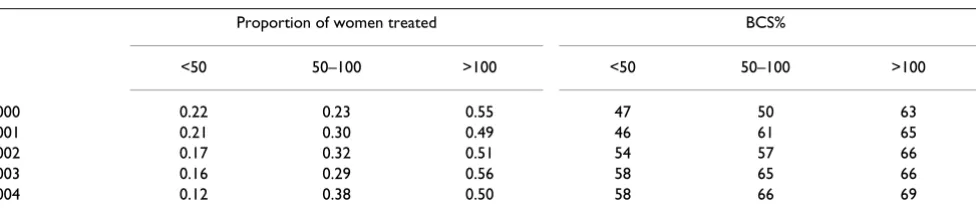
During the five years observed there was a progressive increase of patients discharged from medium-volume hospitals, whereas the proportion treated by structures with less than 50 admissions for breast surgery fell from 22% to 12% (Table 2). In the first year studied, high-vol-ume hospitals showed the highest BCS rate, although,
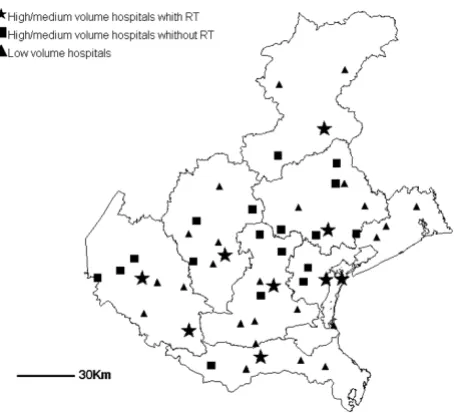
thereafter the increase over time in the proportion of breast conservation was steeper in the categories of low and medium annual caseload; in 2003–2004 the recourse to BCS was similar in medium- and high-volume struc-tures (Table 2). Similar results were obtained when the less conservative instead of the first surgery was assigned to patients with repeated admissions (data not shown). The decrease in the percentage of patients treated in low-volume hospitals is partially explained by ward closures or amalgamations (Table 3): of 41 low-volume hospitals in 2000, 8 no longer were performing breast surgeries by the end of the study period, 7 increased their activity above 50 surgeries, 26 remained under 50 surgeries (and overall reduced their caseload); an additional low-volume center was active in 2004. It is worth noting that among the nine radiation treatment facilities available in the Veneto Region, four were placed in medium-volume and five in high-volume hospitals; two of the latter were aca-demic centers. The geographical distribution of centers by case-volume and availability of adjuvant radiation ther-apy is shown in Figure 2.
The age-severity-comorbidity adjusted RR for BCS (with 95% Confidence Interval) was 1.12 (1.09–1.14) for large versus small and medium institutions, 1.06 (1.05–1.07)
Hospital caseload in 2004 compared to 2000 (seven hospitals with more than 100 surgeries were excluded in both years)
Figure 1
Hospital caseload in 2004 compared to 2000 (seven hospitals with more than 100 surgeries were excluded in both years).
0
50
100
150
Hospitals
W
om
en t
reat
ed
for the linear trend through calendar years, and 0.98 (0.97–0.99) for the interaction term. This latter result con-firms that the influence of hospital caseload diminishes over time.
Discussion
The extent to which surgical treatments are adopted by cli-nicians must be assessed on a population basis, since studies on clinical or physician-based data are often flawed by bias due to referral patterns or patient selection [21]. Cancer registries can accurately identify cancer cases providing additional information on stage and histology, although the delay in data availability and the coverage of restricted geographical area generally do not allow a timely capture of variability in patterns of care at a regional level. Because all types of breast surgery (includ-ing BCS) are performed in hospital sett(includ-ings and not in
ambulatory care in Italy, the regional discharge database, which collects data from both public and private struc-tures, ensures a complete coverage and allows proper eval-uations of time-trends. The major drawback of this database is that it contains limited data on the stage of dis-ease and comorbidity; improvement of accuracy and com-pleteness of HDR may allow a better evaluation of appropriateness of surgical treatments [22]. As a conse-quence, the increase in breast conservation may be due both to changing attitudes of patients and clinicians and to the diffusion of screening programs with an increased detection of early-stage cancers. However, this does not hamper the main finding of the present study that the decline of volume-associated differences between struc-tures parallels the growing recourse to breast conserva-tion.
A collaborative study of European tumor registries dem-onstrated that from 1990 to 1991 only 30.6% of breast cancer patients were treated conservatively in Italy, a pro-portion far lower than in Northern Europe. Out of the Ital-ian registries, the lowest percentage was reported from Southern Italy [23]. Since the early nineties, the recourse to BCS in some Italian regions was investigated by means of HDR. Overall, these studies were consistent in observ-ing a greater proportion of BCS among younger women, with lower severity of disease, and in those treated in higher-volume hospitals [12-15]; more recent studies reported higher BCS rates than earlier papers, suggesting an increase in breast conservation over time in Italy. The first investigation was performed in the Lombardia Region on 1990–1991 discharges with a rate of breast conservation equal to 43% [12]; a study on 1997 HDR in the Latio Region found 52% conservative procedures [13]; lastly, the BCS reached 67% of total breast cancer surgeries in the Piedmont Region in 2000–2002 [14].
[image:4.612.56.293.129.374.2]As well as age, stage of disease, and hospital case volume, other factors both at the patient and at the provider level have been reported to influence the choice of breast can-cer treatment including socioeconomic status [10], prox-imity of residence to radiation therapy facilities [24], detection of the malignancy through screening programs
Table 2: Annual proportion of women treated by low (<50 surgeries), medium (50–100), and high volume hospitals (>100), and corresponding percentage of breast conservation (BCS%)
Proportion of women treated BCS%
<50 50–100 >100 <50 50–100 >100
2000 0.22 0.23 0.55 47 50 63
2001 0.21 0.30 0.49 46 61 65
2002 0.17 0.32 0.51 54 57 66
2003 0.16 0.29 0.56 58 65 66
[image:4.612.65.553.623.729.2]2004 0.12 0.38 0.50 58 66 69
Table 1: Discharges with breast surgery (n), percentage of breast conserving surgery (BCS), Risk Ratios for BCS (RR) with 95% Confidence Intervals (CI) estimated by hierarchical log binomial regression.
n BCS (%) RR CI
Age (yrs)
<50 3995 68 ref
50–59 4260 70 1.04 1.02 – 1.07 60–69 4806 67 1.01 0.98 – 1.04 70+ 5583 46 0.72 0.69 – 0.75 Severity of disease
Localized 17145 63 ref
Non-localized 1499 47 0.73 0.69 – 0.77 Comorbidity index
0 17391 62 ref
1+ 1253 49 0.90 0.85 – 0.96 Hospital volume
<50 3249 52 ref
50–100 5685 60 1.12 1.07 – 1.18 >100 9710 66 1.09 1.03 – 1.14 Calendar year
2000 3541 56 ref
[25], academic affiliation and breast surgery experience of individual physicians [26].
Hospital volume is usually defined as the average number of a specific type of surgery in a given hospital over a var-iable span of years [10]. Our data show two possible intri-cacies with this approach: variation of hospital volume by calendar year, and time trends in the role played by hos-pital volume. Modern health care systems are character-ized by rapid changes in the profile of providers including structures stop, transfer or begin activity, or sharply mod-ify their activity over time (usually, but not necessarily, with an increase in volume – see Figure 1).
An investigation comparing treatment of early breast car-cinoma before and after the introduction of clinical prac-tice guidelines in Australia found an increased proportion of patients undergoing BCS; the analysis by surgeon's caseload showed an increase over time across all classes of activity level except for the least active surgeons [27].
Sur-geon's volume is not obtainable from HDR, but is only one facet of the complex association between pattern of care and hospital volume. In our database it was difficult to disentangle separate effects of case-volume, presence of radiation therapy facilities, academic affiliation. Centers with higher volumes may also have a greater capacity to disseminate information on new clinical practices and to assure better access to postoperative therapy.
Conclusion
The present study delineates an evolving scenario in the Veneto Region, with two coexisting trends: the decline in the proportion of breast cancer patients treated in low-volume hospitals, and the diffusion of breast conserving practices. Larger centers can act as early adopters of new therapeutic strategies and subsequently spread these strat-egies to other providers, a pattern consistent with the dif-fusion of innovation theory [4].
Competing interests
The author(s) declare that they have no competing inter-ests.
Authors' contributions
UF conceived the study, participated in its design, drafted the manuscript
NA planned, performed and revised the statistical analysis ES performed the statistical analysis
CV participated in the study design and collected the data MZ participated in the study design and drafted the man-uscript
RR participated in the study design and drafted the manu-script
GR helped to draft and revised the manuscript PS conceived the study and participated in its design All authors read and approved the final manuscript
Veneto Region, 2004: geographical distribution of centers performing breast cancer surgery by presence of a radiation therapy facility (RT) and case volume (low < 50, medium/high
[image:5.612.52.555.112.183.2]≥50)
Figure 2
Veneto Region, 2004: geographical distribution of centers performing breast cancer surgery by presence of a radiation therapy facility (RT) and case volume (low < 50, medium/high
[image:5.612.60.287.449.657.2]≥50).
Table 3: Number of centers performing breast cancer surgery at the beginning and the end of the study period, and presence of a radiation therapy capability according to hospital volume
Hospital volume n centers availability of radiation therapy (2004) 2000 2004
<50 41 27 0
50–100 12 19 4
Publish with BioMed Central and every scientist can read your work free of charge
"BioMed Central will be the most significant development for disseminating the results of biomedical researc h in our lifetime."
Sir Paul Nurse, Cancer Research UK
Your research papers will be:
available free of charge to the entire biomedical community
peer reviewed and published immediately upon acceptance
cited in PubMed and archived on PubMed Central
yours — you keep the copyright
Submit your manuscript here:
http://www.biomedcentral.com/info/publishing_adv.asp
BioMedcentral
Acknowledgements
The work of Ugo Fedeli was partially supported by Master of Epidemiology, University of Turin.
References
1. Veronesi U, Saccozzi R, Del Vecchio M, Banfi A, Clemente C, De Lena M, Gallus G, Greco M, Luini A, Marubini E, Muscolino G, Rilke F, Sal-vadori B, Zecchini A, Zucali R: Comparing radical mastectomy with quadrantectomy, axillary dissection, and radiotherapy in patients with small cancers of the breast. N Engl J Med 1981, 305:6-11.
2. NIH Consensus Conference: Treatment of early-stage breast cancer. JAMA 1991, 265:391-395.
3. Morrow M, Bucci C, Rademaker A: Medical contraindications are not a major factor in the underutilization of breast conserv-ing therapy. J Am Coll Surg 1998, 186:269-274.
4. Lazovich D, Solomon CC, Thomas DB, Moe RE, White E: Breast conservation therapy in the United States following the 1990 National Institutes of Health Consensus Development Con-ference on the treatment of patients with early stage inva-sive breast carcinoma. Cancer 1999, 86:628-637.
5. Hebert-Croteau N, Brisson J, Latreille J, Blanchette C, Deschenes L: Variations in the treatment of early-stage breast cancer in Quebec between 1988 and 1994. CMAJ 1999, 161:951-955. 6. Grilli R, Mainini F, Penna A, Bertolini G, Scopiglione N, Torri V,
Lib-erati A: Inappropriate Halsted mastectomy and patient vol-ume in Italian hospitals. Am J Public Health 1993, 83:1762-1764. 7. Kotwall CA, Covington DL, Rutledge R, Churchill MP, Meyer AA:
Patient, hospital and surgeon factors associated with breast conservation surgery. A statewide analysis in North Caro-lina. Ann Surg 1996, 224:419-426.
8. Nattinger AB, Gottlieb MS, Hoffman RG, Walker AP, Goodwin JS: Minimal increase in use of breast-conserving surgery from 1986 to 1990. Med Care 1996, 34:479-489.
9. Hiotis K, Ye W, Sposto R, Goldberg J, Mukhi V, Skinner K: The importance of location in determining breast conservation rates. Am J Surg 2005, 190:18-22.
10. Hiotis K, Ye W, Sposto R, Skinner KA: Predictors of breast con-servation therapy: size is not all that matters. Cancer 2005, 103:892-899.
11. Guller U, Safford S, Pietrobon R, Heberer M, Oertli D, Jain NB: High hospital volume is associated with better outcomes for breast cancer surgery: analysis of 233,247 patients. World J Surg 2005, 29:994-999.
12. Grilli R, Repetto F: Variation in use of breast-conserving sur-gery in Lombardia, Italy. Int J Technol Assess Health Care 1995, 11:733-740.
13. Schifano P, Scarinci M, Borgia P, Perucci CA: Analysis of the recourse to conservative surgery in the treatment of breast tumours. Tumori 2002, 88:131-136.
14. Rosato R, Baldi I, Bona C, Bordon R, Di Cuonzo D, Pagano E, Ponti A, Sacerdote C, Segnan N, Vineis P, Ciccone G: L'assistenza alle pazienti affette dal carcinoma della mammella in Piemonte: un sistema di indicatori per la valutazione della qualità sulla base dei dati correnti. Proceedings of the XXVIII Annual meeting of the Italian Epidemiological Association, 15–17 settembre 2004, Torino . 15. Russo A, Autelitano M, Bellini A, Ghilardi S, Giubelli C, Bovini A,
Fili-pazzi L, Cervasio E, Bisanti L: Determinanti dell'accesso alla chirurgia conservativa per carcinoma mammario. Proceedings of the XXVIII Annual meeting of the Italian Epidemiological Association, 15–17 settembre 2004, Torino .
16. Veneto Tumour Registry: I tumori nel Veneto. Trend tempo-rali. [http://www.registrotumoriveneto.it/registro/trend/ trend_f.pdf].
17. Gonnella JS, Louis DZ, Gozum ME, Eds: Clinical Criteria for Disease Staging 4th edition. Ann Arbor: The MEDSTAT Group; 1994. 18. National Cancer Institute: SEER-Medicare: Calculation of
Comorbidity Weights. [http://healthservices.cancer.gov/seer medicare/program/comorbidity.html].
19. Pagano E, Ponti A, Gelormino E, Merletti F, Mano MP: An economic evaluation of the optimal workload in treating surgical patients in a breast unit. Eur J Cancer 2003, 39:748-754. 20. Barros AJ, Hirakata VN: Alternatives for logistic regression in
cross-sectional studies: an empirical comparison of models
that directly estimate the prevalence ratio. BMC Med Res Methodol 2003, 20:21.
21. Wingo PA, Guest JL, McGinnis L, Miller DS, Rodriguez C, Cardinez CJ, Morrow B, Thun MJ: Patterns of inpatient surgeries for the top four cancers in the United States, National Hospital Dis-charge Survey, 1988–95. Cancer Causes Control 2000, 11:497-512. 22. Schifano P, Papini P, Agabiti N, Scarinci M, Borgia P, Perucci CA: Indi-cators of breast cancer severity and appropriateness of sur-gery based on hospital administrative data in the Lazio Region, Italy. BMC Public Health 2006, 6:25.
23. Sant M, Eurocare Working Group: Differences in stage and ther-apy for breast cancer across Europe. Int J Cancer 2001, 93:894-901.
24. Celaya MO, Rees JR, Gibson JJ, Riddle BL, Greenberg ER: Travel dis-tance and season of diagnosis affect treatment choices for women with early-stage breast cancer in a predominantly rural population (United States). Cancer Causes Control 2006, 17:851-856.
25. Zorzi M, Puliti D, Vettorazzi M, De Lisi V, Falcini F, Federico M, Fer-retti S, Moffa IF, Mangone L, Mano MP, Naldoni C, Ponti A, Traina A, Tumino R, Paci E, IMPACT Working Group: Mastectomy rates are decreasing in the era of service screening: a population-based study in Italy (1997–2001). Br J Cancer 2006, 95:1265-1268.
26. Chagpar AB, Studts JL, Scoggins CR, Martin RC 2nd, Carlson DJ, Lai-dley AL, El-Eid SE, McGlothin TQ, Noyes RD, McMasters KM: Fac-tors associated with surgical options for breast carcinoma.
Cancer 2006, 106:1462-1466.
27. White V, Pruden M, Giles G, Collins J, Jamrozik K, Inglis G, Boyages J, Hill D: The management of early breast carcinoma before and after the introduction of clinical practice guidelines. Can-cer 2004, 101:476-485.
Pre-publication history
The pre-publication history for this paper can be accessed here: