
KNOWLEDGE BASED LEARNING EXPERIENCE
MANAGEMENT ON THE SEMANTIC WEB
Feng(Barry) Tao+, David Millard+, Mohd T Zalfan+ , Liming Chen*, Hugh Davis+
+University of Southampton, *University of Ulster, UK{ft,dem,mtz04r,hcd}@ecs.soton.ac.uk, [email protected]
ABSTRACT
Learners engaged in informal learning tasks often find sharing their learning experience to be helpful. Informally, a learning experience describes what a learner has done, with what learning resources. We explore technological issues in a semantic web driven learning experience management architecture that supports collaborative learning, i.e., learning by reusing, sharing experience and building knowledge together within a particular domain. We demonstrate that by exploiting semantic web technology, it is possible to search and reuse the learning resources more intelligently through the use of semantically annotated learning experiences. Work has been done in line with the knowledge life cycle, from building an ontology of learning experiences, creating semantic annotations to reusing semantics to manage learning experience. Functionalities of ontology management, semantic annotation and reuse have been provided in a Service Oriented Architecture (SOA). We give a scenario in which the system can be used to assist collaborative learning in different domains through sharing learning experience and constructing knowledge together.
KEYWORDS: Learning experience, Semantic Web, Ontology, e-Learning
1. Introduction
The term "collaborative learning" originally refers to an instruction method in which students at various performance levels work together in small groups toward a common goal. The students are responsible for one another's learning as well as their own. Proponents of collaborative learning claim that the active exchange of ideas within small groups not only increases interest among the participants but also promotes critical thinking [1].
An area of research in e-learning concerns meta-data and the content packaging of the learning objects. These allow learning objects to be described and packaged in a way that enables reuse and interoperability between different learning platforms. In addition, learner profile and learning activity related information can be useful to assist personalization and collaborative learning.
The concept of the semantic web was originally proposed as an extension of the current web in which information is given well-defined meaning, better enabling computer and people to work in cooperation [5]. The advance of the Semantic Web and e-learning technologies has provided new opportunities to achieve collaborative learning in a broader scale, involving learners who are distributed in both time and location. Ontology, served as an explicit consensus of the domain conceptualization, underpins the foundation of the collaborative learning in the domain by providing the “well-defined meaning” as required in the semantic web vision.
Note that all these semantic annotations are created and contributed from different individuals and stored in well defined format to form a learning experience knowledge base on the semantic web. We address different phases of the development in line with the knowledge life cycle [2], from ontology building to learning experience management and reuse of semantics. We aim to provide a semantic layer consisting of ontology, ontology management and semantic annotation services on learning experience. This is to facilitate the learning paradigm
shift from traditional “learning by information transfer” to “learning by knowledge construction” [3]. A semantic
2. The Semantic Web Assisted Learning Experience Management (SWALEM)
Architecture
In an informal learning scenario we are more concerned with learning activities such as seminars, workshops, conferences etc., rather than lectures and assessments. We argue that those working or researching in an area learn through participating in such academic activities, exchanging ideas and establishing networks at these academic events.
Motivation - A scenario of learning experience management:
We believe that learner’s previous learning experiences form an important part of the learner’s knowledge and this knowledge can be collectively contributed from everybody and managed and reused on the semantic web to facilitate Life long learning and collaborative learning within the community. Barry, an experienced researcher in technology enhanced learning, can contribute to some learning experience of presenting a paper in a conference, based on an agreed ontology, which will make available semantic statements such as {learner_001, attend_event, conference_001}, {learner_001, author, paper_001}. Together with other contributions such as {conference_001, has_topic, “semantic web”}, {paper_001, has_keywords, “Learning Design”} and {learner_001, knows, learner_002}, etc. , it is possible to form a layer of hyper-linked semantic web that can be machine processed to automatically summarize a learner’s past learning activity/experience and related learning resources. A junior researcher Jen planning to enter the same domain/group can have a snapshot of the group’s research portfolio by requesting a summary of the group’s recent learning experience as the starting point to guide her into her further development path. A course module designer Alex can also access this data on the semantic web and provide its learners registered for “learning design” with additional points of reference to some related learning experiences– conference_001 and learner_001.
To this end, we describe in this section the SWALEM architecture, the design of ontological concepts and how it helps this type of learning through learning experience annotation
Definition: Learning experience – a semantically annotated event/activity that connects an annotated learning
resource (e.g., a learning object) in the learning environment to a particular learner (annotated role in learning). The SWALEM architecture can be viewed as using ontology support and semantic web services on top of a simplified IMS-Learning Design information model [4] to manage semantic annotation of learning experiences.
Ontology layer
Learning experience layer
Semantic annotation layer
Figure 1 the SWALEM architecture
Semantic web technologies are integrated in this SWALEM architecture to help learners build/annotate and share their learning experience and related knowledge. As illustrated in Figure 1, the SWALEM can be viewed from the following two perspectives:
Horizontal layers:
Learning experience Layer – This is the learning experience data model that sits in the middle layer in Figure 2. It is
Ontology Layer – This is the top layer where ontology resides to specify conceptualizations and restraints which
are used to describe the Learning experience Layer. Ontology layer is mainly the place for knowledge engineer to provide knowledge models in the form of ontology.
Semantic annotation layer – Bottom layer where annotated learning experiences reside. Basically, learners are
allowed to create their learning experience by instantiating the ontology on role, event/activity and environment; they can then associate these instances together for a triple, which represents a learning experience. These instances and triples are then stored in this semantic annotation layer so that they can be reused, shared and queried.
Vertical sections:
Role – This refers to the learner’s profile. “With consideration of humans at the centre, learning is clearly a social,
constructive phenomenon. It occurs as a side effect of interactions, conversations and enhanced presence... [3]” This is the underlying rational that inspires us to inherit FOAF1 for the Learner profile ontology that models the Role in the learning experience management. FOAF defines a suit of RDF vocabulary for expressing social network related metadata, such as “knows”. Inherited from the FOAF, the learner ontology also has additional learning related attributes such as “takePartIn” (links the role with Event.) and “accessibility” (learning ability related description as defined in the IMS Learner Information Package[12]) as shown in Figure 2.
Figure 2 Learner Ontology for Roles Figure 3 Event Ontology
Event (Activity) – This is the learning experience’s central point that connects learners to the learning environment
and learning objects inside. The Event ontology (Figure 3) models this social and constructive phenomenon that give human learners the opportunity to interact, converse and enhance presence. Activity defined in the IMS-Learning information model is also used to detail information at lower granularity. For example, a ‘Tutorial’ is an event which can be further detailed by a sequence of activities {“reading tutorial notes”, “watching demo”, “hand-on experiments”, “question and answers”}.
Environment – This normally refers to the learning objects, equipment, services, etc. which support the learners in
carrying out their learning related activities in the leaning event. An example would be the paper to be presented and published in an academic conference. We say that the paper is part of the learning environment, or a learning object inside.
3. The Knowledge Life Cycle
Operations in the SWALEM are also in line with the Knowledge Life Cycle [1, 17]. We regard learning experience related resources as the knowledge in this paper. The development and maintenance of ontologies that capture this rich meaning is the subject of Knowledge Engineering. In this section we present the different stages of the Knowledge Life Cycle, a step by step process which aims to model, capture and reuse knowledge.
• Knowledge Acquisition (KA): The first stage is to acquire conceptualization of the knowledge from the domain.
This can be done in a variety of ways including literary review and interviews with domain experts. In this paper, we mainly studied the IMS Learner’s information model and its application in collaborative learning and developed a set of domain vocabulary and relationships (conceptualization) that describe the learning experience related resources.
1
• Knowledge Modeling (KM): The next stage is for this conceptualization to be explicitly described as ontology.
Classes are defined based on the concepts identified in the KA stage and the possible relationships between these classes are specified as concept properties. We use Protégé [9] in this step for visually building the ontology, Protégé can also save or export the ontology in RDF/OWL so that it can be further processed at the programming level later on.
• Knowledge Population (KP): A typical example of the knowledge population is semantic annotation, which in
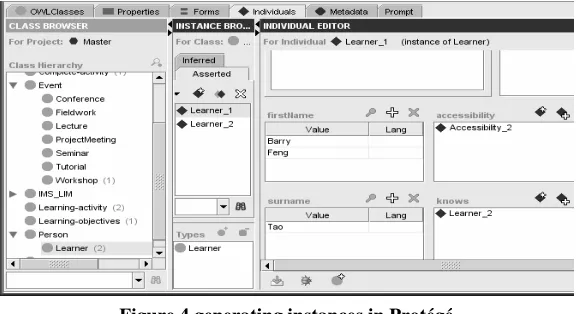
[image:4.595.162.450.240.397.2]this case refers to the process of binding ontology to learning resources. The results are instances and annotations triples in a knowledge repository to represent the learning experience. To allow quick evaluation of the ontology, we use Protégé again for simulation of learning experience instance generation and annotation.
Figure 4 generating instances in Protégé
The elements that form the learning experience annotations are learners, events and environment, which are generated as semantic instance. These elements are then associated together (by setting takePartIn property for example) as learning experience annotations, as illustrated in Figure 4. Automated annotation service and easy seamless user interface are very important so that learners can be freed as much as possible from the tedious annotation tasks.
• Knowledge Reuse (KR): When there is enough knowledge accumulated in the form of semantic instances,
knowledge reuse becomes more and more effective in reflecting and re-enhancing the learning experience. Reuse is achieved when new applications make use of the knowledge that are either explicitly indicated as factual data in the annotation repository or implicated through reasoning and inference data in the repository.
Explicit factual knowledge - in the research profile management scenario, learners can make explicate queries
that generate a list of academic event/activities that he/she has been doing over the last specified period of time.
Implicit knowledge - The semantic web also promises the reasoning and inference capacities that allow the
learner to discover and reuse knowledge that is implicit. For example, learners can ask for a social network report of other learners who are interested in a particular subject A. This can be realized by analyzing learners’ participating events or using environments that are annotated with a subject B where B is related to A in some way.
The Knowledge Life Cycle is intended to iterate over the project life time. This means that the ontologies are expected to evolve, and maintenance is necessary.
4. Services in the Services Oriented Architecture (SOA)
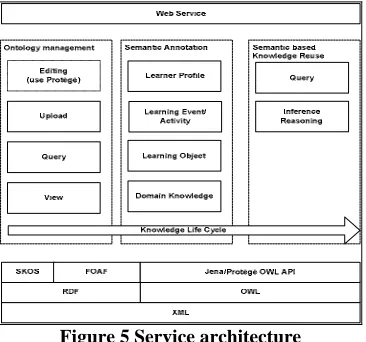
services. We list here three most important high level services (as illustrated in Figure 5) that directly interact with the learners and knowledge engineers.
Ontology management service – This allows knowledge engineers to update the underlying knowledge models,
which are represented in the form of ontology files. To simplify the system and make use of the powerful ontology editing capacity provided by Protégé, only file management services such as upload, query and simple view are provided as services. To editing and modify the ontology itself, knowledge engineers are expected to use Protégé.
Semantic annotation service – This allows the learners to generate semantic instances that represent their learning
[image:5.595.215.398.319.490.2]experience and knowledge constructed. Learners are given the opportunity in this life cycle phase to annotate their learner profile, relevant learning events (and activities) and learning resources/objects in the learning environment. They do this through semantic annotation service by instantiating ontologies, associate instances and therefore generating semantic annotation (or instances) of learning experience. Instances are also shared so that learners only need to generate those not existing yet. They contribute to the learning community their own learning experience through semantic instance generation, or knowledge construction. Domain knowledge is another potential where learner can build and share their understanding of the domain, for example, taxonomies or rules.
Figure 5 Service architecture
Knowledge reuse service –
Simple query service: This is mainly querying explicit facts from the learning experience annotations. For
example, a learner can use it to generate a report of academic events/activities/publications that he/she has been involved in over the last specified period of time.
Inference and reasoning service: This type of services uses semantic reasoning to provide inferred knowledge
that is not explicitly stated in the semantic annotation repository. This is made easier by using several semantic web languages and standards2, such as XML, RDF and their upper level application OWL, SKOS and FOAF in the annotation process.
We use FOAF as a basis for our learner profile ontology to include basic user profile and social network related metadata.
SKOS stands for Simple Knowledge Organisation System. The name SKOS was chosen to emphasise the goal of providing a simple yet powerful framework for expressing knowledge organisation systems in a machine-understandable way [6]. SKOS defines a set of generic knowledge representation elements such as skos:broader,
2
skos:narrower, skos:related. Figure 6 gives an example of subject ontology with mark-ups using skos-narrower and skos-related.
Events and environment in the learning experience can be annotated using the subject ontology. In this way, when the service receives request from learners asking for a social network report of other learners who are interested in a particular subject SemanticWeb, it can analyze the learning experiences with inference on the skos mark-up and produce roles that are also related to ontology and OWL due to their relationships declared in the skos mark-up (Figure 6).
5. The Ontology-Driven Implementation
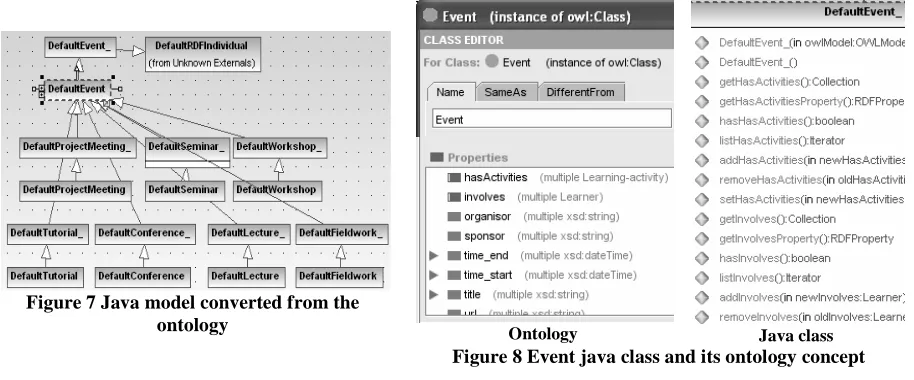
[image:6.595.182.391.152.239.2]As a semantic application, ontology is also used as the backbone to drive the data model used in the SWALEM services. As illustrated in Figure 7, ontology written in OWL is used to represent the conceptual model of the learning experience at design time. By using Protégé’s OWL API [10, 11], we convert these ontological models to java classes, representing the data models at the run time environment.
Figure 7 Java model converted from the
ontology Ontology
Java class
Figure 8 Event java class and its ontology concept
Figure 7 shows the UML diagram of the hierarchical Java model converted from the ontology by using Protégé with OWL plug-in [7]. This can be done at both GUI mode or at programming level though the Protégé API. Class names, member variables and methods in the java class correspond to the underlying ontological concepts and properties (as shown in Figure 8). In this way, manipulating events (and role, environment similarly) for learning experience annotation at the programming level can now be carried out on top of the memory based java models, therefore allowing implementation to be transparent to the underlying ontological data models developed at the deign phase.
The java data model generated also makes use of the Protégé OWL API, which is built on top of Jena OWL API for RDF/OWL manipulation yet shares more interoperability with Protégé. Figure 7 shows the DefaultEvent jave
<skos:Concept
rdf:about="#Ontology">
<skos:prefLabel>Ontology</skos:prefLabel> <skos:narrower rdf:resource =
"#SemanticWeb"/>
<skos:narrower rdf:resource = "#XML"/>
<skos:related rdf:resource = "#OWL"/>
</skos:Concept>
[image:6.595.77.534.389.579.2]interface generated from the ontology. This helps the encapsulation of the RDF/OWL operations in the java model, making it transparent to the manipulation of the defined data model.
6. Related Work and Discussion
Buddy space has been used in the ELeGI project as an Instant Messenger (IM) and group discussion tool to address collaborative learning and present enhancing in the e-learning framework. As the project is relatively large in scale (23 partners across Europe) and involves hundreds of individuals distributed both in location and their expertise, buddy-finder is used as a integrated search engine to allow learners find buddies based on a text mining algorithm called CORDER[13], which can crawl web pages and rank a list of online users based on their “scavenged profiles” on the web. As a project partner in Elegi, we believe that the SWALEM architecture we proposed in this paper can produce more accurate social network related information through learning experiences related semantic annotations. For example, learners who attend same learning events or share relevant learning objects as described in their learning experience annotations will be discovered and ranked as well.
Geodise knowledge [14, 15] aims to provide knowledge support for design engineers in using a suite of grid enabled design optimization and search tools. It supports knowledge capture and reuse in the domain of Engineering Design Search and Optimization (EDSO). Engineers in EDSO can be also regarded as learners who can annotate their resource and share them as knowledge within the community. This knowledge is further reused in an advisor and a knowledge toolbox [8] that both semantically process resource semantic annotations to aid decision making during workflow construction. This serves as a domain application of the learning experience management.
Tagging and concept map are two approaches that adopt meaning enrichment methods. Tagging has already been used in many popular Web 2.0 applications such as photo sharing Flickr.com. Comparing to the learning experience annotation, it can be regarded as a light yet open ontology missing formal restraints on concepts and their relationships thus making it difficult for other 3-party ontology-aware application to reuse. Concept mapping[18] takes a further step by providing relationship as well and many also use it to collect domain knowledge and access learning[19]. They are also both early attempts in demonstrating that it is useful and pragmatic to enrich learning related resource with extra meaning.
7. Summary and Conclusion
This paper describes our vision of semantic web technologies being used in modelling learning experiences and their management to support collaborative learning through learning experience annotation and sharing. The SWALEM architecture based on the IMS Learner Information Model is proposed to achieve this goal. We have described how ontology can be used to integrate semantic web technologies into the system and how knowledge in the form of learning experiences annotations can be managed in different phases of the knowledge life cycle to support this vision.
We have described our approach to learning experience annotation and to reuse scenarios. In general, the scenario has some generic characteristics. It is ontology-driven with respect to the underlying data and knowledge models. The learners are given the opportunity to semantically annotate their learning experience as triples of {role, event and environment}, as well as contribute to the domain knowledge as taxonomy and rules. Examples of reusing these learning experience and domain knowledge are query of experience/knowledge and semantic reasoning for learning experience related resources and social network related facts implicated in the learning community.
Semantics driven knowledge construction of learning experience helps the learning paradigm shift from traditional “learning by information transfer” to “learning by knowledge construction”. The scientific benefits of introducing the semantic layer are very obvious: it enables learners to record and share their learning experience through semantic annotations (knowledge construction) of learning experience. Knowledge accumulated in the form of these semantic annotations can then be reused through query and inference to re-enhance and reflect further learning. We believe that this integrated semantic layer will enable us the flexibility to do things within the eLearning domain that are not currently possible or effective enough.
Acknowledgements: Part of this work was funded by The European Commission under the E-Learning Grid
References
[1] Anuradha A. Gokhale, Collaborative Learning Enhances Critical Thinking, Journal of Technology Education Vol.7 No.1, Fall 1995
[2] Tao, F. B., Millard, D., Davis, H. and Woukeu, A. (2005) Managing the Semantic Aspects of Learning using the Knowledge Life Cycle. In Proceedings of The 5th IEEE International Conference on Advanced Learning Technologies (ICALT 2005), pp. 575-579, Kaohsiung, Taiwan
[3] The European Learning Grid Infrastructure (ELeGI) Project, http://www.elegi.org/
[4] IMS Learning Design Information Model, Version 1.0 Final Specification, http://www.imsglobal.org/learningdesign/ldv1p0/imsld_infov1p0.html
[5] Berners 2001, May 2001 Scientific American article "The Semantic Web" (Berners-Lee et al.) [6] W3C SKOS Core Guide, http://www.w3.org/TR/2005/WD-swbp-skos-core-guide-20051102/#secintro
[7] H Knublauch, RW Fergerson, NF Noy, MA Musen, The Protege OWL Plugin: An Open Development Environment for Semantic Web Applications, the 3rd International Semantic Web Conference (ISWC 2004), 2004 – Springer.
[8] Tao, F., Puleston, C., Goble, C., Shadbolt, N., Chen, L., Pound, G. and Cox, S. (2004) Applying the Semantic Web to Manage Knowledge on the Grid. In Proceedings of UK e-Science AHM Conference, Nottingham, UK.
[9] Protégé, Ontology Editor and Knowledge Acquisition System, http://protege.stanford.edu/
[10] H. Knublauch (2004) "Ontology Driven Software Development in the Context of the Semantic Web: An Example, Scenario with Protégé/OWL", 1st International Workshop on the Model Driven Semantic Web (MDSW2004)
[11] The Protégé Owl API, http://protege.stanford.edu/plugins/owl/api/guide.html
[12] IMS Learner Information Packaging Information Model Specification, http://www.imsproject.org/profiles/lipinfo01.html [13] Zhu, Dr. Jianhan and Eisenstadt, Prof. Marc and Gonçalves, Mr. Alexandre and Denham, Mr. Chris (2005) BuddyFinder-CORDER: Leveraging Social Networks for Matchmaking by Opportunistic Discovery. In Proceedings International Semantic Web Conference (ISWC2005) Workshop on Semantic Network Analysis, Galway, Ireland.
[14] Grid-enabled Optimisation and Design Search in Engineering (GEODISE), http://www.geodise.org
[15] Chen, L., Shadbolt, N., Goble, C., Tao, F., Cox, S., Puleston, C. and Smart, P. (2003) Towards a Knowledge-based Approach to Semantic Service Composition. In Proceedings of 2nd International Semantic Web Conference (ISWC2003) 2870, pp. 319-334, Florida, USA.
[16] Towards Knowledgeable Grid Services and Systems - OntoGrod, http://www.ontogrid.net/
[17] Millard, D., Tao, F., Doody, K., Woukeu, A. and Davis, H. (2006) The Knowledge Life Cycle for e-learning. International Journal of Continuing Engineering Education and Lifelong Learning: Special Issue on Application of Semantic Web Technologies in E-learning 16(1/2) pp. 110-121.
palladium(II)](data:image/gif;base64,R0lGODlhAQABAIAAAP///wAAACH5BAEAAAAALAAAAAABAAEAAAICRAEAOw==)