by
Kay Cuellar BA (Hons.)
School of Psychology University of Tasmania
Submitted in fulfillment of the requirements for the degree of
I certify that this thesis contains no material which has been accepted for a degree or
diploma by the university or any other institution, except by way of background
information where acknowledgement is made in the text of the thesis, and that to the best
of my knowledge and belief this thesis contains no material previously published or
written by another person except where due acknowledgement is made in the text of the
thesis.
Copyright Act, 1968.
ABSTRACT
The aim of the present study was to investigate associations between various dimensions of perfectionism and key aspects of interpersonal functioning. Participants in Study 1 were 371 adults. In studies 2 to 5 a more homogenous sub-sample of 165 adults 25 years and under was used. The measures of perfectionism were the Perfectionism Cognitions Inventory (PCI, Hewitt, Flett, Blankstein & Gray, 1998), two measures both named the Multidimensional Perfectionism Scale (MPS-F and MPS-H; Frost, Marten, Lahart & Roseblate, 1990; Hewitt & Flett, 1991b), and the Positive and Negative Perfectionism Scale (PANPS, Terry-Short, Owens, Slade & Dewey, 1995). These measures yielded 12 different scales or dimensions that were classified into two domains, negative evaluation concerns (NEC) and standards and achievement (SA) according to whether the dimension was characterised as primarily negative or more positive in nature.
using photographs of facial expressions (Study 3), vignettes describing friendly, neutral
and unfriendly interactions (Study 4), and ratings of self-reported negative interpersonal
interactions based on a diary methodology (Study 5). Study 3 failed to find any evidence
that perfectionists categorised facial expressions more negatively or made attributions of
more negative mood based on facial expression relative to non-perfectionists. In Study 4
some high NEC but not SA groups made more negative attributions about the friendly
and neutral behaviour of others and attributed more negative emotional responses to the
person who was the object of the behaviour. In Study 5 two high NEC but no SA groups
engaged in increased avoidance behaviour and some high NEC groups and one SA group
differentially showed increased interpersonal distress. Individuals high in SA dimensions
did not demonstrate more constructive approach behaviours.
ACKNOWLEDGMENTS
The completion of this thesis would not have been possible without the great patience and assistance of Dr Ted Thompson and Dr John Davidson. Dr Thompson provided invaluable assistance with his encouragement and endless reading of successive drafts. Dr John Davidson persisted beyond any reasonable expectation and was equally invaluable in his patient assistance, constructive comment and guidance in all things statistical and with helping to make this document readable.
I would also like to thank Sue Ross and Pam Thitherly for their unfailing smiles and interest in my progress as well as their help on countless occasions with many things. I am also very grateful for the assistance of all of those who participated in the investigations conducted to achieve this thesis.
I also thank my friends and peers who supported me so often and showed me that eventually my goals could be achieved. Most especially my thanks go to Georgie who was always optimistic and encouraging and who helped me believe that the light at the end of the tunnel was not a freight train.
Table of Contents
Chapter 1 The Construct of Perfectionism
Page
1.1 Brief Rationale and Aims of the Investigation 1 1.2 Unidimensional Theories of Perfectionism 5 1.3 The Development of Multidimensional Measures Of Perfectionism 6
1.4 The Perfectionism Cognitions Inventory 12
1.5 Criticisms of multidimensional measures of perfectionism 14 1.6 Positive and negative conceptualisations of perfectionism 15 1.7 Overlap between the MPS-F and MPS-H Scales 16 1.8 Positive and Negative Perfectionism Scale 20 1.9 The benefits of positive aspects of perfectionism 23
1.10 Issues of definition 25
1.11 An approach to perfectionism based on two domains 28
Chapter 2 Dimensions of Perfectionism: Associations with Anxiety and Depression
2.1 Dimensions of perfectionism and psychopathology 32 2.2 Associations between negative evaluation concerns dimensions
of perfectionism and anxiety and depression 35 2.3 Moderating and mediating variables in relation to negative
Page 2.4 Negative evaluation concerns dimensions of perfectionism
and specific stressors 41
2.5 Making mistakes in an achievement context 43 2.6 Psychological distress and the negative effects of standards and
achievement dimensions of perfectionism 45
2.7 Perfectionism, depression and interpersonal relationships 50 2.8 Depression, anxiety and interpersonal functioning 52
2.9 Concluding comments 54
Chapter 3 Review of Perfectionism and Interpersonal Correlates
3.1 Negative interpersonal interactions 56
3.2 Negative evaluation concerns dimensions of perfectionism,
interpersonal functioning and psychological distress 57 3.3 Negative evaluation concerns dimensions of perfectionism;
relationship behaviours and psychological distress 66 3.4 Standards and achievement dimensions of perfectionism;
interpersonal functioning and psychological distress 67 3.5 Standards and achievement dimensions of perfectionism;
relationship behaviours and psychological distress 73
Chapter 4 Aims of the Investigation and Issues of Analysis
4.1 Overview 78
4.2 Aims of the investigation 80
4.3 Analysis strategy 81
4.4 Presentation of results 85
Chapter 5 Study 1: Participant Characteristics, Measures of Psychological Distress and Subjective Well-being and Associations with Measures of Perfectionism
5.1 Rationale 87
5.2 Method 89
5.3 Results 98
5.4 Discussion 117
Chapter 6 Study 2: Perfectionism and The Frequency of Negative Interpersonal Interactions and Differences in Interpersonal Rejection Sensitivity
6.1 Rationale 133
6.2 Method 136
6.3 Results 138
Chapter 7 Study 3: Interpreting Social Information: Facial Expressions
Page
7.1 Rationale 153
7.2 Method 155
7.3 Results 157
7.4 Discussion 162
Chapter 8 Study 4: Interpreting Social Information: Attributions in
Regard to the Interpersonal Behaviour and Emotional Responses of Others
8.1 Rationale 166
8.2 Method 168
8.3 Results 169
8.4 Discussion 176
Chapter 9 Study 5: Self-Reported Interaction Behaviours, Perfectionistic Motivations and Interpersonal Distress in Unpleasant Interpersonal Interactions
9.1 Introduction 183
9.2 Rationale 191
9.3 Method 197
Page Chapter 10 Summary of Findings, Concluding Comments and Implications
for Future Research
10.1 Review of Results of the Investigations Conducted in this Thesis 235 10.2 Consideration of the Contributions of Dimensions of
Perfectionism to Differences in Interpersonal Functioning and
Vulnerability to Psychological Distress 249 10.3 Perfectionism Theory and Aspects of Interpersonal Functioning 261 10.4 Concluding Comments and Directions for Future Research 266 10.5 Limitations of the Studies Conducted in This Thesis 269
References 272
Appendices
Appendix A. Experimental Materials Al Participant Information Sheet, Statement of
Informed Consent and Questionnaire Instruction Sheet 291 A2 General Information Questionnaire (Study 1) 295 A3 Raters Instructions, Procedure and Results for Facial
Expression Task (Study 3) 298
A4 Participant Materials for Facial Expression Task (Study 3) 301 AS Rater Instruction Sheet, Procedure and Results for
Page A6 Participant Instructions for Vignette Task and
Experimental Materials (Study 4) 310
A7 Participant Instructions and Experimental Material
for the Interaction Diary Task (Study 5) 317
Appendix B. Tables: Means and Standard Deviations B1 Appendix B1 Tables of Means and Standard Deviations
(Study 1) 323
B2 Appendix B2 Table of Means and Standard Deviations
(Study 2) 332
B3 Appendix B3 Tables of Means and Standard Deviations
(Study 3) 334
B4 Appendix B4 Tables of Means and Standard Deviations
(Study 4) 340
B5 Appendix B5 Tables of Means and Standard Deviations
(Study 5) 349
Appendix C: Review of Key Results for Dimenisons
CHAPTER 1
The Construct of Perfectionism
1.1 Brief Rationale and Aims of the Investigation
In recent years there has been a proliferation in the development of new measures of perfectionism. These newer measures reflect changes in the conceptualisation of the construct of perfectionism from a unidimensional to a more multidimensional focus (Burns, 1980; Frost, Marten, Lahart & Rosenblate; 1990; Hamachek, 1978; Hewitt & Flett, 1991b; Hollender, 1965; Pacht, 1984, Slade & Owens, 1998; Terry-Short, Owens, Slade & Dewey, 1995). Investigations using multidimensional measures of perfectionism have identified dimensions of perfectionism that are associated with disorders such as anxiety and depression (Antony, Purdon, Huta & Swinson, 1998; Enns & Cox, 1997; Frost et al., 1990; Frost, Heimberg, Holt, Mattia & Neubauer, 1993; Flett, Hewitt, Blankstein & Grey, 1998; Flett, Hewitt, Endler & Tassone, 1994; Hewitt & Flett, 1991a,
In an attempt to explain the links between perfectionism and psychopathology, researchers have begun to investigate cognitions and behaviours relating to interpersonal functioning and perfectionism that are thought to increase or decrease vulnerability to psychological distress. It is generally accepted that negative interpersonal interactions can have a significant impact on psychological well-being and interpersonal conflicts have been identified as one of the most upsetting stressors in a daily diary self-report study (Bolger, DeLongis, Kessler & Schilling, 1989; nett, Hewitt, Garshowitz & Martin, 1997). In addition, anxiety and depression have been found to be associated with deficits in interpersonal functioning independently of perfectionism (Dow & Craighead, 1987; Gotlib & Robinson, 1982).
adaptive interpersonal behaviours and cognitions (Dunldey et al., 2000; Frost et al., 1993; Slade & Owens, 1998).
Investigations to date have relied largely on the Multidimensional Perfectionism Scale (MPS-H; Hewitt & Flett, 1991b) to measure perfectionism in relation to interpersonal functioning and distress. Thus there is little information available in regard to the ways in which dimensions of perfectionism from other perfectionism measures might be implicated in behavioural and cognitive differences in interpersonal functioning and levels of interpersonal distress that might increase or decrease vulnerability to psychopathology. In order to clarify this issue four measures of perfectionism are used to investigate aspects of interpersonal functioning with reference to the aims set out below.
The first aim of the investigation is to identify associations between dimensions of perfectionism and sample characteristics such as age, sex, the presence of medical and mental illness, work or school absenteeism related to stress and illness and a history of suicide attempts and self-mutilation. An additional aim is to identify the extent to which dimensions of perfectionism predict symptoms of anxiety and depression, and perceptions of subjective well-being. These aims are pursued in Study 1.
The third aim of this investigation is to identify whether individuals high in dimensions of perfectionism report different perceptions about the nature of social information such as facial expression or interpretations about negative or positive interpersonal behaviour of others as well as their perceptions of the emotional impact for the people who are the objects of this behaviour. This aim is achieved through Studies 3 and 4.
The fourth aim is to examine whether there are differences in interpersonal behaviour, perfectionistic motivations and levels of interpersonal distress in relation to self-reported unpleasant interpersonal interactions. This is aim is achieved through Study 5. The use of a daily diary methodology is expected to more directly capture the experience of high trait perfectionism in daily interpersonal situations. A fifth aim of this research is to examine the extent to which the results of the studies undertaken in this investigation can be explained by existing conceptualisations of perfectionism.
perfectionism and the on-going debate about the nature and measurement of perfectionism that inform the findings and conclusions drawn in the current investigations.
1.2 Unidimensional Theories of Perfectionism
Until recently perfectionism has been largely viewed as a unidimensional construct focusing on self-imposed setting of unattainable goals and heightened self-criticism for perceived failure to meet these goals (Burns, 1980; Hollender, 1965; Pacht, 1984).
Hollender (1965) proposed that perfectionism exists when the individual "characterises his mode of performing as perfectionistic...not only does the perfectionist demand a certain level of performance himself, but he cannot accept or be content with anything short of perfection" (p. 94). Hollender qualified this by suggesting that the definition referred to the manner in which the individual aspires to perform rather than the manner in which the person may think of him or her self.
successful in their perfectionism (those who are able to set high standards and strive towards them and who gain pleasure from success achieved without undue self-criticism or distress for failure), from those for whom perfectionism is a more pathological trait (Frost et al., 1993; Hamachek, 1978). In describing this proposed difference between perfectionistic individuals, Hamachek distinguished between 'normal' and 'neurotic' perfectionists.
Hamachek (1978) suggested that normal perfectionists are those who set high standards for themselves but are able to be more flexible in their perceptions of success or failure. Conversely, neurotic perfectionists set high standards for themselves but do not allow any flexibility in the latitude allowed for making mistakes or failing to reach goals. Frost et al. (1990) have since argued that the distinction between normal and neurotic perfectionists is that neurotic perfectionism involves not only the setting of high standards, but a tendency for overly critical evaluation of one's own behaviour. They further suggest that the association of perfectionism with various psychopathologies is more closely related to this tendency for critical evaluation, rather than the setting of high standards in itself.
1.3 The Development of Multidimensional Measures of Perfectionism The Multidimensional Perfectionism Scale (MPS-F ;Frost et al., 1990)
In order to enable investigation of these differing aspects or dimensions of perfectionism, Frost et al. (1990) developed a measure to reflect the theorised multidimensional nature of the construct of perfectionism, The Multidimensional Perfectionism Scale (MPS-F).
UN
IVE
RS
ITY
OF TA
The MPS-F comprises six dimensions of perfectionism. Personal standards (PS) reflects a tendency to set very high standards while placing excessive importance on these standards for self evaluation. The personal standards dimension most closely resembles previous uni-dimensional conceptualisations of perfectionism. Concern over mistakes (CM) reflects the perfectionists over-concern about making mistakes in performance situations. Frost et al. suggest that neurotic perfectionists are so over-concerned about making a mistake that even the smallest mistake is perceived as failing to meet the standards they have set. Thus this dimension measures a tendency to react negatively to mistakes and equate mistakes with personal failure and fears that one will lose the respect of others following perceived failure. Doubts about actions (DA) is suggested to reflect the perfectionist's sense of doubt about the quality of his or her actions or beliefs. It is suggested that this dimension is not about the recognition or evaluation of specific mistakes but rather the sense that a task is not completed satisfactorily.
withdrawal of approval for the perfectionist. Thus to gain love and approval the individual must perform at increasingly perfect levels.
Finally, the organisation scale (OR) is suggested to measure the tendency of perfectionists to emphasise precision, order and organisation. It is suggested that while the organisation subscale does not directly relate to the setting of standards or evaluation of performance, it may reflect the way in which perfectionistic individuals attempt to meet standards and may therefore be an important component of perfectionism. Although the MPS-F measures individual subscales, a total perfectionism score can be generated using five of the subscale scores. The organisation subscale score is omitted from the calculation of the total score because of low correlation with the other subscales (Frost et al., 1990).
The Multidimensional Perfectionism Scale (MPS-H; Hewitt & Flett, 1991b)
Almost concurrently with the development of the MPS-F, Hewitt and Flett (1991b) developed a scale of the same name although from a different conceptual standpoint. Hewitt and Flett (1990) argued that rather than focusing on perfectionism from a purely cognitive viewpoint, perfectionism should be viewed as a broad personality style that encompasses multiple aspects of functioning including affective, interpersonal, behavioural and motivational components as well as the cognitive component. Hewitt and Flett (1991b) argued that existing measures of perfectionism failed to address the interpersonal situations in which perfectionistic attitudes might be activated and were consequently too narrowly focused on perfectionism as an aspect of self-criticism. They also suggest that although previous conceptualisations of perfectionism made implied references to other dimensions of perfectionism, the focus of these conceptualisations remained almost exclusively related to self-directed cognitions.
self-oriented perfectionism (SOP) scale reflects the more traditional concept of perfectionism: the tendency to set high standards for oneself as well as to evaluate one's own behaviour stringently. High levels of self-oriented perfectionism involve maintaining unrealistic expectations of one-self when failing and a self-evaluative focus on one's own flaws. Self-oriented perfectionism is conceptualised as a dimension in which perfectionistic behaviours are derived from one self and are directed towards one self. The self-oriented perfectionist sets their own perfectionistic standards and requires only him or her self to be perfect (Hewitt & Flett, 2002).
Socially prescribed perfectionism (SPP) is suggested to reflect the perception of individuals that others have imposed high standards on them and are engaging in stringent evaluation of them, and are exerting pressure on them to be perfect. Perfectionistic expectations are perceived to be imposed by others yet are directed towards the self. In other words although perfectionistic expectations are perceived to be imposed by others the socially prescribed perfectionist is concerned with their own lack of perfection in meeting these externally imposed standards. Hewitt and Flett (2002) propose that it is the socially prescribed perfectionists high level of concern about obtaining and maintaining the approval and care of others by being perfect in the eyes of others that is more important in the generation of distress for these individuals. Socially prescribed perfectionism and other-oriented perfectionism are characterised as interpersonal aspects of perfectionism that will be involved in psychosocial problems whereas self-oriented perfectionism is characterised as a more intrapersonal dimension of perfectionism that is less related to interpersonal difficulties (Enns & Cox, 2002; Habke & Flynn, 2002).
from engaging in 'self-defeating styles of cognitive appraisal ( such as equating minor mistakes and flaws as personal failure) and engaging in maladaptive coping and problems solving styles.
Hewitt and Flett (2002) further propose that the three MPS-H perfectionism dimensions are core vulnerability factors that may be directly or indirectly involved with the onset or exacerbation of symptoms of psychopathology. This same research team has developed a further unitary measure of the frequency of perfectionism cognitions, the Perfectionism Cognitions Inventory (PCI; Flett, Hewitt, Blankstein & Gray, 1998). This measure of perfectionism has also been found to be associated with psychological distress.
1.4 The Perfectionism Cognitions Inventory
The PCI (Flett, Hewitt, Blankstein & Gray, 1998) was developed to assess the frequency with which perfectionists experience perfectionistic cognitions. The authors suggested that frequent perfectionistic cognitions are experienced by individuals who are aware of a discrepancy between their ideal standards and their actual characteristics and that personality traits involved in anxiety and depression have a cognitive component involving rumination. The activation of this personality component contributes to increased distress.
obtaining higher level goals. Flett, Hewitt, Blankstein and Gray (1998) argue that whereas the MPS instruments focus more globally on the degree of trait levels of perfectionism, the PCI provides an assessment of the frequency with which individuals make evaluative comparisons at a cognitive level between the ideal perfectionistic self and the current self or current situation.
In their investigation of the PCI, Flett, Hewitt, Blankstein and Gray (1998) found in a student population, that although automatic perfectionistic thoughts were associated with _ both anxiety and depression, this measure may have a stronger association with anxiety than with depression. Results from two of their five studies suggested that the PCI is associated with the presence of general distress but not a lack of positive affect. However, those with high PCI scores also reported their anxious and depressive thoughts created increased levels of sadness, worry and guilt and that these thoughts were perceived as highly self-relevant and difficult to remove.
further conclude that this pressure is associated with an internal dialogue involving thoughts about one's inability to attain perfection.
1.5 Criticisms of Multidimensional Measures of Perfectionism
Various criticisms have been made about the utility and/or factor structure of the MPS-F and MPS-H measures of perfectionism. Researchers have identified both three and four factor solutions for the MPS-F (Purdon, Antony & Swinson, 1999; Stober, 1998; Stumpf & Parker, 2000), and reduced item content for both the MPS-F and MPS-H (Cox, Enns, & Clara, 2002). Another research team has reported that the dimensions of socially prescribed and self-oriented perfectionism each consist of two separate facets that are
differentially associated with adaptive and maladaptive outcomes for the individual (Campbell & Di Paula, 2002). This latter finding will be discussed at greater length in Chapter 4.
Shafran and Mansell (2001) also suggested that dimensions such as socially prescribed perfectionism in fact measure beliefs about the high expectations of others in relation to
oneself, but that individuals high in this dimension of perfectioniSm may not perceive themselves as perfectionists. It is suggested that although socially prescribed beliefs of this kind may be relevant to perfectionism they are not central to it. Rheaume et al. (2000) in a related argument suggested that some subscales of existing measures of perfectionism represent developmental aspects that make interpretation of results and understanding of perfectionism difficult.
Slaney, Rice, Mobley, Trippi & Ashby (2001) have also argued that some dimensions of perfectionism of the MPS-F and MPS-H appear to be based on assumed causes, or the concomitant or resulting effects of being a perfectionist rather than being a definition of perfectionism itself. Slaney et al. contend that the MPS-H dimension of socially prescribed perfectionism appears to be a cause of perfectionism (a belief that others set high standards and therefore one needs to maintain perfection). It is similarly suggested that the MPS-F dimensions of parental expectations and parental criticism are causal rather than based on any definition of the construct.
1.6 Positive and Negative Conceptualisations of Perfectionism
Antony, 2004; Slade & Owens, 1998; Slaney & Ashby, 1996; Terry-Short et al., 1995). Despite some criticism of the factor structures or item sets for the MPS-F and MPS-H, there has been an increasing body of opinion that two over-arching dimensions of perfectionism can be identified that fall within the conceptualisation of two forms of normal/healthy or neurotic/unhealthy perfectionism proposed by Hamachek (1978; Bieling et al., 2004; Cox et al., 2002; Dunkley et al., 000; Frost et al; 1993; Slade & Owens, 1998; Terry-Short et al., 1995).
These two forms of perfectionism have been variously labeled healthy and unhealthy (Stumpf & Parker, 2000), adaptive and maladaptive (Bieling, Israeli, Smith & Antony (2003), sound and dysfunctional (Rheaume et al., 2000), active and passive (Lynde-Stevenson & Hearne, 1999), personal standards and evaluative concerns (Dunldey et al., 2000), positive achievement striving and maladaptive evaluation concerns (Frost et al., 1993) and positive and negative perfectionism (Terry-Short et al., 1995, Slade & Owens, 1998). Investigations of the MPS-F and MPS-H have found that there is considerable overlap between specific dimensions derived from each instrument.
1.7 Overlap Between the MPS-F and MPS-H Scales
substantial association between self-oriented perfectionism and concern over mistakes (r = .38). Concern over mistakes (r = .49), parental expectations (r = .49) and parental criticism (r = .49) were most closely associated with socially prescribed perfectionism. Other-oriented perfectionism showed a more mixed profile of association between positive and negative aspects of perfectionism as this dimension was associated with personal standards (r = .33) as well as concern over mistakes (r = .22) and parental
expectations (r = .19). Other studies have also found a similar pattern of associations between these dimensions of perfectionism in student (Flett, Sawatzky & Hewitt, 1995) and clinical disorder populations (Enns & Cox; 1999; Hewitt, Flett & Blankstein, 1991). Frost et al. conclude that the total perfectionism score generated by the MPS-F appears to reflect a more global measure of perfectionism that is associated with self-oriented perfectionism (r = .49) and socially prescribed perfectionism (r = .57) but less so to
other-oriented perfectionism (r = .28).
affect. As none were associated with positive affect, it was concluded that the dimensions of concern over mistakes, doubts about actions, and socially prescribed perfectionism may be more a reflection of anxiety symptoms rather than depression.
On the basis of a factor analysis of the nine perfectionism scales Frost et al. (1993) further concluded that the dimensions of perfectionism from both the MPS-F and MPS-H broadly fell into two domains of perfectionism and referred to them as maladaptive evaluation concerns and positive achievement striving. Maladaptive evaluation concerns was found to be significantly related to negative affect and symptoms of depression and was comprised of the scales of concern over mistakes, doubts about actions, parental expectations and parental criticism from the MPS-F and socially prescribed perfectionism from the MPS-H. The second factor, positive achievement striving,
showed no relationship to symptoms of depression but was significantly associated with positive affect and was comprised of the dimensions of personal standards and organisation (MPS-F) and self-oriented perfectionism and other-oriented perfectionism (MPS-H). Frost et al. speculated that individuals with high positive achievement striving scores would be those who had had success in achievement and that their personal experiences of success were the result of skills which in turn resulted in high expectations for the self.
Dunkley et al. (2000) suggest that individuals high in a cluster of perfectionism dimensions they labeled evaluative concerns (comprised of socially prescribed perfectionism, concern over mistakes and doubts about actions) may be characterised as
experiencing increased perceptions that others impose unrealistically high standards on them, and that consequently these individuals engage in overly critical evaluation of their behaviour and are unable to gain satisfaction from their performance. Furthermore, individuals high in evaluative concerns focus on the negative aspects of a situation to the extent that they may experience normal daily events as serious stressors. It is also speculated that lower levels of self-efficacy in regard to ability to cope adequately or to the satisfaction of others may result in an avoidance orientation or less active coping that may in turn increase both the frequency and duration of events perceived to be distressing. These individuals may also perceive that any mistake made may result in loss of respect or rejection from others.
1.8 Positive and Negative Perfectionism Scale (PANPS; Terry-Short et al., 1995)
Another research team has also proposed a distinction between a positive/adaptive form of perfectionism and a negative/maladaptive form of perfectionism. Working from the standpoint that previous research into perfectionism was too narrowly focused on clinical populations and that this resulted in negatively biased and pathologically oriented conceptualisations, Terry-Short et al. (1995; see also Slade & Owens, 1998) argued that it is possible to distinguish between aspects of perfectionism on the basis of the perceived consequences of perfectionism for the individual. They proposed that the distinction between positive and negative aspects of perfectionism mirrored a learning theory behavioural distinction between positive and negative reinforcement.
In short,
positive perfectionismis driven by positive reinforcement (such as recognition
and goal achievement) and a desire for success, whereas
negative perfectionismis driven
by negative reinforcement (fear of failure to meet goals) and a desire to avoid negative or
aversive consequences such as criticism or failure. Consistent with the ideas of Skinner
(1968) it was also suggested that the same behaviours may be associated with differing
emotional states dependent on whether the behaviour was a function of negative or
positive reinforcement.
Terry-Short et al. (1995) developed a new measure of perfectionism, the
Positive andNegative Perfectionism Scale
(PANPS). Questions were developed to tap the dimensions
of
self-orientedand
socially prescribed perfectionismand drew on the content of the
MPS-H. However within each category, further questions were formulated to specifically
measure
positiveand
negative perfectionism.The PANPS was administered to four participant groups (control, eating disorder,
depressed and athlete). Results showed that in reference to the control group, athletes
scored highly on
positive perfectionismbut at normal levels of
negative perfectionism,whereas depressed participants scored in the reverse and eating disorder participants
scored highly on both dimensions. Principal Components Analysis of the data yielded
three factors:
Negative Perfectionism, Positive Perfectionismand
Positive SocialTerry-Short et al. (1995) and subsequently Slade and Owens (1998) have therefore argued that individuals high in positive perfectionism will tend to pursue success, perfection and excellence, whereas individuals high in negative perfectionism will seek to avoid failure, imperfection and mediocrity. With regard to social or interpersonal functioning individuals high in positive perfectionism will seek approval from others whereas those high in negative perfectionism will be motivated by the desire to avoid the disapproval of others. It is also proposed that overt behaviours may appear identical, but that the differing underlying motivations of those high in positive and negative perfectionism result in very different emotional consequences. In this context it is
suggested that individuals high in positive perfectionism will tend to experience satisfaction and pleasure when they achieve success but will not be unduly affected by failure. Individuals high in negative perfectionism will not feel satisfaction as a result of goal achievement because failure may still be imminent (Terry-Short et al., 1995; Slade & Owens, 1998).
1.9 The Benefits of Positive Aspects of Perfectionism
Despite agreement in some quarters that forms of positive and negative perfectionism exist, there remain doubts that good evidence exists for the beneficial effects of positive aspects of perfectionism. Efforts to identify benefits or an increase in adaptive outcomes in relation to positive forms of perfectionism have been limited. Rice, Ashby and Slaney (1998) investigated the ways in which self-esteem might mediate the effects of perfectionism on depression. This investigation failed to find evidence of a relationship between positive aspects of perfectionism and self-esteem and concluded that there was not good evidence for increased beneficial outcomes.
However, in a subsequent study (Ashby & Rice, 2002) using a measure relating only to high standards (standards subscale of the Almost Perfect Scale-Revised; Slaney et al., 2001), Ashby and Rice found that standards was a positive predictor of self-esteem. Discrepancies between ideal and actual outcomes and self-criticism related to performance were found to be negative predictors of self-esteem. Ashby and Rice argued that these findings offered support for the contention that high personal standards are not in and of themselves negative traits and could in fact provide benefits for the individual.
represented evidence of a performance advantage to adaptive or positive aspects of perfectionism not previously identified.
Bieling et al. (2004) examined the proposed distinction between ma/adaptive evaluation concerns and positive achievement striving in an achievement situation and compared three models of perfectionism based on the Frost et al. (1990) and Hewitt and Flett (1991b) MPS measures. The first model separately examined the total scores derived from each of the MPS measures. The second model, a unitary model combined the total scores of both measures, while the third model examined the two factor model based on the Frost et al. (1993) distinction between maladaptive evaluation concerns and positive achievement striving. Using Confirmatory Factor Analysis (CFA) it was found that the two factor Frost et at model was a better fit to the data than the other two models. However, the data from the two factor Frost et al. model also showed that positive achievement striving retained positive associations with all psychopathology scales (Depression, Anxiety and Stress Scale 21 Item Version, DASS-21, Lovibond & Lovibond, 1995; and the Test Anxiety Scale, TAS; Sarason, 1984), although smaller than the associations found between measures of psychopathology and the maladaptive evaluation concerns scales.
positive achievement striving was not found to be a significant predictor for any analysis. Positive achievement striving was thus thought not to contribute any unique variance to the psychopathology variables that was not already explained by maladaptive evaluation concerns. Overall there appears to be only limited evidence available that indicates that there are beneficial outcomes related to dimensions of perfectionism related to high standards and achievement striving.
Bieling et al. (2004) concluded that there was evidence to support a distinction between the two types of perfectionism. However, although their study showed a positive association between maladaptive evaluation concerns and various measures of psychological distress, positive achievement striving did not show an inverse relationship to these same measures. It was also found that positive achievement striving and ma/adaptive evaluative concerns correlated positively and significantly indicating that these two forms of perfectionism are not independent of each other. It was concluded that positive achievement striving might best be characterised as a neutral form of perfectionism that does not imply either positive or negative emotional outcomes for the individual.
1.10 Issues of Definition
that existing measures of perfectionism do not adequately reflect the original construct of perfectionism and that new measures are required to address this. Shafran and Mansell argued that on the basis of their review of empirical evidence, increased personal standards were specifically elevated in individuals with eating disorders, and that beliefs around high standards for the self were associated with a wide range of psychopathology. On this basis they argued that personal standards, concern over mistakes (MPS-F), and self-oriented perfectionism (MPS-H) are the dimensions that most closely resemble the original construct and that other dimensions do not.
In response to the model of clinical perfectionism proposed by Shafran et al. (2002), research teams such as Hewitt, Flett, Besser, Sherry and McGee (2003) have offered a number of arguments to refute aspects of the clinical perfectionism model and to reiterate the empirical and theoretical bases that support multidimensional models of perfectionism. In part Hewitt, Flat, Besser et al. argued that in making their case, Shafran et al. failed to take into account existing research on the cognitive aspects of perfectionism including the role of ruminative processes and frequent automatic thoughts about attaining perfectionism. Hewitt, Flett, Besser et al. also argued that Shafran et al. failed to acknowledge aspects of early theories of perfectionism (e.g., Hamacek, 1978; Homey, 1950) that discuss the interpersonal aspects of perfectionism. The issues raised by these different research teams are complex and are not addressed in detail within this thesis. However, it should be noted that the model proposed by Shafran et al. continues to be a subject of debate among perfectionism theorists and researchers.
everything I read) or physiological constructs (e.g., I should feel perfectly well and free of anxiety) and can thus be applied to all to all aspects of life. Although Rheaume et al. agree that positive perfectionism exists, they suggest that measures of perfectionism should be focused on the exaggerated nature of perfectionism, as it is this exaggeration that is associated with different forms of psychopathology.
1.11 An Approach to Perfectionism Primarily Based on Two Domains
It is apparent from the review of the literature provided in this chapter that there remains a great deal of debate about the nature and definition of perfectionism and the way in which the construct should most properly be measured. Researchers are divided about the way in which perfectionism should be defined and whether current measures are in fact measuring perfectionism or merely a group of related constructs.
One school of thought suggests that perfectionism can be clearly conceptualised as having both maladaptive/negative and adaptive/positive aspects of perfectionism that both warrant research attention and clearer measurement. Despite the increasing theoretical focus on the potential benefits of positive aspects of perfectionism there is little research available that is able to demonstrate a clear benefit derived from having high levels of positive/adaptive perfectionism. However, it is implicit in conceptualisations put forward that these benefits should exist.
the original construct of high personal standards and stringent self-criticism. In fact some of these theorists argue that conceptualisations of perfectionism should be limited to aspects of perfectionism related to psychopathology as it is the extreme and exaggerated nature of perfectionism that results in distress and disorder. Increasing numbers of investigations are being undertaken in an attempt to clarify these issues of appropriate measurement and definition but results from these investigations have been inconsistent about the nature of associations between some specific dimensions of perfectionism and measures of psychological distress. This literature in regard to perfectionism in relation to symptoms of anxiety and depression will be reviewed in Chapter 3.
31
Table 1.
Dimensions of Perfectionism Within the Domains of Negative Evaluation Concerns and
Standards and Achievement Perfectionism
Perfectionism domain
Perfectionism measure NEC SA
PANPS negative perfectionism positive perfectionism
MPS-F concern over mistakes
doubts about actions parental criticism parental expectations
personal standards organisation
MPS-H socially prescribed self-oriented
other-oriented
PCI PCI
Note. Dimensions/Domains of Perfectionism: NEC = negative evaluation concerns; SA = standards and
achievement; PCI = Perfectionism Cognitions Inventory, Flett et al, 1998; MPS-F = Multidimensional
Perfectionism Scale, Frost et al. 1990; MPS-H = Multidimensional Perfectionism Scale, Hewitt & Flett,
CHAPTER 2
Dimensions of Perfectionism and Associations with Anxiety and Depression
2.1 Dimensions of Perfectionism and Psychopathology
In the previous chapter, literature was reviewed in regard to changes in the conceptualisation of perfectionism over the last two decades and the on-going debate that exists about the definition and appropriate measurement of the construct. As different research teams have sought to clarify the nature of perfectionism, there has been a growing body of work that identifies links between perfectionism and psychopathology. Perfectionism has been shown to be negatively associated with aspects of general functioning such as academic achievement orientation and emotional distress (Arthur & Hayward, 1997; Brown et al., 1999); levels of self-efficacy (Hart, Gilner, Handal & Gfeller, 1998), somatic health concerns (Saboonchi & Lundh, 2003), and work related stress (Flett, Hewitt & Hallett, 1995; Mitchelson & Burns, 1998).
Goggin, 1996; Hewitt, Flett & Weber, 1994; Hewitt, Newton, Flett & Callander, 1997; Hunter & O'Connor, 2003). While it is beyond the scope of this thesis to examine all of these associations in any depth, they are briefly addressed within this chapter. Anxiety and depression are identified as among the most common mental health problems experienced by adults (Beumont, Andrews, Boyce & Carr, 1997) and associations between anxiety and depression have been extensively examined within the perfectionism literature and will therefore be the focus of the review presented later in this chapter.
Early investigations using the MPS-F and MPS-H have found associations between somatic health complaints and a range of dimensions of perfectionism including concern over mistakes, doubts about actions, self-oriented and socially prescribed perfectionism (Frost et al, 1990; Hewitt & Flett, 1991b). Researchers have found associations between perfectionism and somatic complaints such as insomnia (Lundh, Broman, Hetta & Saboonchi, 1994) and tension and fatigue in women (Saboonchi & Lundh, 2003). In the latter study although socially prescribed and self-oriented perfectionism were weakly associated with tension and fatigue, only other-oriented perfectionism predicted undergoing medical treatment.
negative perfectionism to be associated with exhaustion and cynicism in working mothers (Mictchelson & Burns, 1997).
There is also evidence to suggest that the experience of perfectionism may change with age. The results of an investigation by Chang (2000) suggest that although greater levels of perfectionism were found to be associated with increased psychological distress in both younger and older adults, younger adults experienced greater levels of perfectionism and increased levels of negative affect. Chang concluded that although perfectionism is characterised as a personality trait, the expression of aspects of perfectionism may change with age.
Suicidal behaviour and increased suicidal ideation have also been associated with increased levels of perfectionism. More specifically socially prescribed perfectionism has been associated with increased suicidal ideation (Hewitt et al., 1994, 1997) contributing uniquely to variance in suicidal ideation scores (Hewitt et al., 1997; Dean et al., 1996). One study found self-oriented perfectionism to be associated with increased suicidal ideation (Hewitt et al., 1994).
associated with self-mutilating behaviour (Favaz7a & Rosenthal, 1993) there is no literature that has examined possible links between this behaviour and perfectionism.
Self-mutilation is frequently characterised as a behaviour utilised by the individual to reduce unbearable levels of tension and distress (Brain, Haines & Williams, 1998; Favazza, 1989; Favazza & Simeon, 1995). As dimensions of perfectionism such as socially prescribed perfectionism, concern over mistakes and doubts about actions are characterised as being involved in the generation of increased levels of stress and distress (Dunkley et al., 2000; Frost et al., 1990, 1993; Hewitt & Flett, 1991b, 2002) it is possible that associations may exist between self-mutilative behaviour and these and other negative evaluation concerns dimensions of perfectionism.
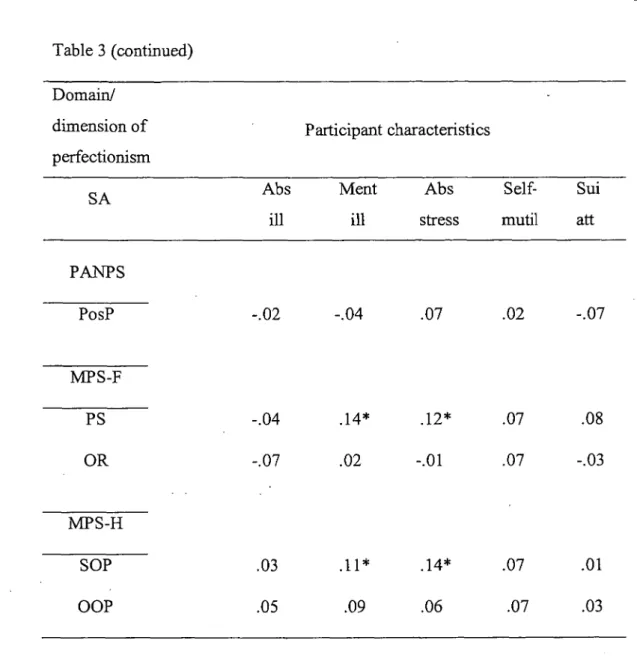
The behaviours and characteristics associated with perfectionism outlined above will be used to examine associations between perfectionism and participant characteristics within this thesis in order to isolate characteristics that may be differentially associated with specific dimensions of perfectionism. Other associations between symptoms of psychological distress such as anxiety and depression have been comprehensively investigated. These findings are discussed below.
2.2 Associations Between Negative Evaluation Concerns Dimensions of Perfectionism and Anxiety and Depression.
depression and anxiety. Enns and Cox (1999) also examined both MPS measures with a specific focus on depressive symptoms self-reported by 145 clinical patients and independent ratings by observers. Only socially prescribed perfectionism and concern over mistakes from these measures consistently showed medium to large effect sizes with self-reported depression symptoms. Other researchers reported that socially prescribed perfectionism was uniquely associated with chronic bipolar symptoms (Flett, Hewitt,
Ediger et al., 1998).
In studies from a large investigation of the brief treatment of depression a number of findings relating to perfectionism have emerged. Self-critical perfectionism (comparable to maladaptive evaluation concerns dimensions; Frost et al., 1993) has been found to impact negatively on therapeutic outcomes in the brief treatment of depression (Blatt, Zuroff, Bondi, Sanislow & Pilkonis, 1998). This negative impact was evident not only in the self-report ratings of patients but was also found in ratings by the therapists and independent clinical evaluators 18 months after cessation of treatment. Perfectionism negatively affected outcomes on measures of clinical condition and patient ratings of satisfaction with treatment.
these attitudes at comparatively high levels at termination and at follow up (see also Blatt, Quinlan, Pilkonis & Shea, 1995; Blatt, Zuroff, Quinlan & Pilkonis, 1996).
Zuroff and Blatt (2002) examined predictors of the intensity of symptoms of depression after termination of the short term treatment program. Their results suggested that patients who remained relatively high in perfectionism after termination of treatment were more vulnerable to symptoms of depression when they experienced increased levels of stress relative to less perfectionistic patients. It was found that perfectionism interacted with overall stress levels rather than fluctuations in stress. The authors suggested that one possible reason for this finding is that self-critical or perfectionistic individuals may have more negative mental representations of themselves and their interpersonal experiences and that these negative mental representations might be more accessible during times of stress. In a further examination of data, it was found that in addition to interference with treatment because of deficits in ability to build therapeutic alliance poor treatment outcomes were also a function of pre-treatment perfectionism interfering with the ability to establish and maintain satisfying social relationships outside treatment.
individuals do not attend to positive interpersonal cues (Aube & Whiffen, 1996), avoid intimacy and self-disclosure (Zuroff & Fitzpatrick, 1995) and act in a hostile manner in personal relationships (Zuroff & Duncan, 1999).
Dimensions of perfectionism have also been found to distinguish between different aspects of anxiety in examinations of the relationship between dimensions of perfectionism with state and trait measures of anxiety. Flett, Hewitt et al. (1994) found that socially prescribed perfectionism is significantly associated with both the cognitive worry and autonomic arousal components of state anxiety and with ambiguous and daily routine facets. When dimensions of perfectionism and state/trait anxiety were examined under conditions of high versus low ego-involvement it was found that socially prescribed perfectionism was associated with higher state anxiety but only in the high ego involvement condition. The authors concluded that overall socially prescribed perfectionism is the dimension most closely linked to state/trait anxiety especially under
conditions of ego threat.
2.3 Moderating and Mediating Variables in Relation to Negative Evaluation Concerns Dimensions of Perfectionism and Psychological Distress
Investigators have also found that there are a wide range of variables that appear to mediate or moderate the effects of perfectionism on psychological distress. Bieling and Alden (1997) examined levels of perfectionism in individuals with social phobia and the consequences of perfectionism for these individuals. Individuals with social phobia scored more highly on socially prescribed perfectionism and increased trait perfectionism was associated with higher social standards in those with social phobia than in a control group. The authors concluded that although social phobia and socially prescribed perfectionism were interrelated they appeared to contribute to negative self-appraisal
through different mechanisms. Individuals with social phobia who are also perfectionistic are likely to have low levels of self-efficacy and also to feel that others will have high expectations of them in social situations.
Bieling and Alden (1997) concluded that it appeared that these socially phobic individuals believed that they needed to be perfect in meeting the expectations of others but they did not require perfection from themselves. They suggested that highly perfectionistic individuals with social phobia may therefore be at dual risk as they may not only see themselves as less socially able than others but also perceive that the goals they must meet as being further beyond their reach.
maintain a flawless appearance and avoid the negative evaluation of others) may also have a role in mediating the relationship between perfectionism and psychological distress. Correlation analysis revealed that maladaptive perfectionism (comprised of the MPS-F dimensions of concern over mistakes, doubts about actions, parental expectations and parental criticism), self-concealment and psychological distress were all positively associated. Additional results suggested that the tendency to conceal negative information might be greater with family and friends. Results from multiple regression analysis also showed that maladaptive perfectionism and self-concealment both significantly predicted psychological distress. However, once self-concealment was controlled, maladaptive perfectionism was no longer significantly associated with psychological distress.
On the basis of these results Kawamura and Frost (2004) concluded that active concealment of personally distressing information appears to be a common pattern for those who engage in highly critical self-evaluation. They further concluded that perfectionists may be particularly sensitive to having those close to them become aware that they are struggling with personal issues.
adequacy of one's behaviour as well as beliefs that others are placing excessive demands contribute to experiencing social interactions as being tense. (See also Saboonchi, Lundh & Ost, 1999).
2.4 Negative Evaluation Concerns Dimensions of Perfectionism and Specific Stressors Hewitt and Flett (1993) examined whether dimensions of perfectionism interact with specific stressors to predict depression in a depressed only sample and a general psychiatric sample. Socially prescribed perfectionism among several other variables interacted with interpersonal stress in the depressed group and with achievement stress in the general psychiatric group to predict depression. The authors concluded that although socially prescribed perfectionism was correlated with depression in both samples, there was little to support the notion that socially prescribed perfectionism acted as a specific vulnerability factor in symptoms of depression.
However, self-esteem did not mediate the association between perfectionism and depression. Rather self-esteem provided a buffer to maladaptive perfectionism. It was suggested that perhaps individuals high in maladaptive perfectionism only become depressed when they also experience feelings of inadequacy and low self-worth. However, Preusser, Rice and Ashby (1994) found that self-esteem mediated an association between depression and perfectionism for both males and females but only for the dimension of socially prescribed perfectionism. Other studies have also identified that in student samples, socially prescribed perfectionism was directly associated with depression as well as indirectly via negative associations with two facets of self-esteem (Flett, Besser, Davis & Hewitt, 2003).
Yet another study (Flett, Hewitt, Blankstein & O'Brien, 1991) found socially prescribed perfectionism was the dimension most closely associated with depression symptoms.
When increased socially prescribed perfectionism interacted with lower perceptions of self-control, socially prescribed perfectionism accounted for unique variance in depression scores. Lynd-Stevenson and Hearne (1999) have found that passive perfectionism (the tendency for individuals to procrastinate because they fear making a
are involved in an active interplay in the onset of symptoms of depression. Other researchers have found that responses to perceived mistakes also increase levels of distress.
2.5 Making Mistakes in an Achievement Context
Using a diary methodology, Frost et al., (1997) investigated responses to making mistakes in an achievement context. Individuals high in concern over mistakes did not report differences in the quality and quantity of mistakes they had made relative to those low in perfectionism. Nor did independent raters judge there to be differences in the level of importance, harmfulness or wrongness of mistakes made between high and low concerns over mistakes perfectionists.
However, individuals high in concern over mistakes were more negative in their beliefs about their mistakes and in their affective responses. Not only did those high in concern over mistakes report increased levels of negative affect, they reported being more bothered by their mistakes and rated them as more serious, wrong and "morally reprehensible" than their low perfectionism counterparts.
interpersonal aspect to these fears about what others will think if a mistake is made (Frost et al., 1997). It is not clear to what extent increased concern over mistakes might increase levels of negative affect and distress in other contexts such as interpersonal interactions, as other researchers have found that negative social interactions in and of themselves add incrementally to the experience of psychological distress above that experienced as a result of stressful life events and hassles (Lakey, Tardiff & Drew, 1994).
These results are all consistent with the findings of Dunkley et al. (2000) who investigated the over-arching positive/adaptive and negative/maladaptive conceptualisations of perfectionism based on the MPS instruments. Dunkley et al investigated a form of perfectionism labeled evaluative concerns (comprised of socially prescribed perfectionism, concern over mistakes and doubts about actions). These researchers investigated the ways in which coping style, perceived social support and daily hassles may mediate the relationship between the dimensions of perfectionism and symptoms of depression and anxiety. All three variables were found to be unique mediators of a strong relationship between evaluative concerns and psychological distress.
stressful events and outcomes (Lazarus & Folkman, 1984). Dunldey et al. proposed that their results that evaluative concerns perfectionists experience more frequent daily stressors of greater duration is consistent with the idea that these perfectionists generate stress which in turn contributes to a greater experience of distress. This initial response is then compounded by the use of avoidant coping strategies that further compound the negative effects of hassles and distress. See also Hewitt and Flett (1993) and Blankstein and Dunkley (2002) for further review and discussion.
2.6 Psychological Distress and the Negative Effects of Standards and Achievement Dimensions of Perfectionism
Despite demonstrated associations between some dimensions of perfectionism and more adaptive traits such as increased self-esteem, the literature also suggests that even among dimensions of perfectionism characterised as more positive in nature there are also associations with negative cognitive and behavioural characteristics. For example, Flett et al., (2003) found negative associations between all MPS-H dimensions of perfectionism and reduced unconditional self-acceptance. Unconditional self-acceptance was itself associated with increased levels of depression.
adaptive outcome as positive outcomes will increase perceptions of self-worth. However, if the individual experiences negative life outcomes, high levels of self-oriented perfectionism are likely to take on a more maladaptive character by lowering the
individuals' sense of self-worth.
High levels of other-oriented perfectionism also showed indirect links with depression via lower unconditional self-acceptance. Flett et al., (2003) speculate that their findings could be explained by the extent to which individuals high in other-oriented perfectionism view others as a source of disappointment to them in terms of providing adequate social support and suggest that the self-esteem of individuals high in other-oriented perfectionism is not robust and may be conditional on feedback and support received from others.
Overall the results reported in the literature regarding associations between other-oriented perfectionism and measures of psychological distress have been somewhat inconsistent. Studies have either found no association between other-oriented perfectionism and depression (Chang & Sanna, 2001; Flett et al., 1997; Flett, Hewitt,
perfectionism was found to be uniquely associated with chronic unipolar depression symptoms (Flett, Hewitt, Ediger et al., 1998).
These latter results regarding self-oriented perfectionism are consistent with the findings of Hewitt & Flett (1991a) who found that depressed patients had higher levels of self-oriented perfectionism compared to anxiety or control groups. It was suggested that self-oriented perfectionism may be specific to depressed patients and did not generalise to anxiety. It was argued that high levels of self-oriented perfectionism may be specific to depressed patients because of their tendency to set unrealistic goals and that subsequent stringent self-evaluation of performance increased perceptions of the experience of failure and increased the personal impact and meaning of failure experiences. This is consistent with findings from two studies which concluded that failure in tasks of greater or lesser importance interacts with perfectionism to produce dysphoric mood (Hewitt, Mittelstaedt et al., 1990; Hewitt et al., 1989). Self-oriented perfectionism has also been associated with different forms of anxiety.
In one investigation it was found that self-oriented perfectionism (as measured by the Burns Perfectionism Scale; Burns, 1980) was related to trait anxiety and marginally to state anxiety (Flett, Hewitt & Dyck, 1989). Flett et al., (1994) found that self-oriented perfectionism was significantly associated with both the cognitive worry and autonomic
stressors to predict depression scores in a depressed only and in a general psychiatric sample (Hewitt & Flett, 1993). Hewitt and Flett concluded that the results regarding self-oriented perfectionism were consistent with the idea that the impact of a stressor is dependent on the particular meaning of the stressful event. Hewitt and Flett proposed that individuals high in self-oriented perfectionism may perceive even minor shortfalls as major failures and that achievement stressors may serve as a reminder of imperfections in the self and be interpreted as failure with implications for self-concept.
In a later investigation, Hewitt et al., (1996) found that after controlling for initial depression scores (Time 1), self-oriented perfectionism interacted with achievement stressors to predict depression scores four months later (Time 2). Hewitt et al. argued that the results support the notion that perfectionism dimensions are involved in vulnerability to depression over time, but that self-oriented perfectionism specifically may be the most important as a stress related vulnerability factor in depression (see also Hewitt et al., 1998). Yet Rice et al., (1998) found that adaptive perfectionism (characterised as individuals having high personal standards, a need for order and organisation, and an unwillingness to procrastinate) does not have a significant role in depression.
& O'Brien, 1991). The authors suggested that the latter result may have occurred because self-oriented perfectionism was not considered within the context of a failure experience. Lynd-Stevenson and Hearne (1999) found that those who tend towards increased active perfectionism (striving towards achievement) did not show higher levels of depression. Their investigations also found active perfectionism did not moderate the impact of stressful life events on symptoms of depression.
As noted previously Dunldey et al. (2000) investigated two over-arching positive/adaptive and negative/maladaptive conceptualisations of perfectionism based on the MPS instruments. In their investigations Dunkley et al. found that personal standards perfectionism (comprised of personal standards and self-oriented perfectionism) showed a positive but weaker relationship with measures of distress than
the negative form of perfectionism of evaluative concerns. Personal standards perfectionism was positively associated with both hassles and active coping, but was not related to avoidant coping and perceptions of lowered social support.
strategies (Dunldey et al., 2000). For further review and discussion see also Blankstein and Dunkley (2002).
2.7 Perfectionism, Depression and Interpersonal Relationships
Wiebe and McCabe (2002) note that interpersonal theories of depression have conceptualised the problematic interpersonal behaviours of depressed individuals as manifestations of symptoms of depression (such as anhedonia or fatigue) or as impairments in social skills (the individual will facilitate fewer positive interactions; Coyne, 1976; Lewinsohn, 1974; Segrin & Abramson, 1994). However, Wiebe and McCabe contend that it is cognitive factors separate from social rules or symptoms of depression that impact on the social difficulties experienced by depressed individuals. They argue that the idea that social behaviours related to depression are simply an• expression of depressive symptoms is inconsistent with evidence that suggests that these difficulties tend to persist even when the individual is asymptomatic or that conflictual relationships can actually precipitate the onset of depression.
perfectionism was found to relate to increased symptoms of both depression and anxiety. It was speculated that this association between increased relationship expectations for one self and anxiety was the result of fears of behaving below ones own standards. Self-directed relationship perfectionism did not mediate the relationship between increased levels of depression and increased hostility in interpersonal behaviours.
It can be seen from the review provided above that there is some conflicting information about the positive or negative nature of specific standards and achievement dimensions of perfectionism in relation to symptoms of psychological distress. It is also apparent from the review provided above that the majority of information about associations between perfectionism and measures of distress relates to the MPS-H measure of perfectionism. This does not allow consideration of the ways in which other positively characterised dimensions of perfectionism might be involved in vulnerability to, or protection against, psychological distress.
2.8 Depression, Anxiety and Interpersonal Functioning
Research unrelated to perfectionism has long found associations between symptoms of anxiety and depression and various aspects of interpersonal functioning. It has been found that depressed individuals not only tend to report inadequate social relationships, but when engaged in social interactions show a tendency towards increased expectations of poor social skills and relatively strict self-evaluation, rather than objective deficits in social behaviour (Dow & Craighead, 1987). Dow and Craighead conclude that these findings may be more specific to depression than to anxiety.
It has also been shown that depressed persons may perceive their interpersonal impact on others as being more negative (Siegal & Alloy, 1990); and that they may seek to avoid those who they believe are happy (Wenzlaff & Prohaska, 1989). Depressed individuals also tend to elicit more negative information from their interaction partner if they believe that the interaction partner is happy in mood and that they may thus be exposed to an increase of negative interpersonal experiences (Wenzlaff & Beevers, 1998). In addition it has been identified that depressed people tend to be more hostile than non-depressed people and will more frequently express greater anger and criticism towards others (Gotlib & Robinson, 1982; Kahn, Coyne & Margolin, 1985; McCabe & Gotlib, 1993).