ICMT2014, 7 -9 July 2014, Glasgow, UK
Integration of Business and Technical Aspects of Reliability
and Maintenance
Atabak Taher
1, Iraklis Lazakis
1, Osman Turan
11. Naval Architecture, Offshore & Marine Engineering, University of Strathclyde, Glasgow G1 1XQ, UK
Abstract: Maintenance is now considered to be a cost effective rather than a forced and unnecessary option for companies Therefore, more innovative maintenance techniques such as preventive and predictive methodologies are developed alongside their corrective counterparts. As a result, numerous maintenance policies using predictive and preventive tasking systems have been developed such as the Reliability Centered Maintenance (RCM), Total Productive Maintenance (TPM), Condition Based Maintenance (CBM) and Risk Based Inspection (RBI) . In this paper, full literature review has been carried out on most commonly used maintenance systems for offshore and marine industry. This paper introduces an innovative business and reliability based maintenance framework called Business Oriented Reliability Based Maintenance (BORM). Thus, this paper discusses a variety of tools and concepts developed in the industry in more detail. Additionally, it discusses the mathematics behind the Bayesian Belief Network (BBN) tool of as part of the BORM methodology and introduces a BBN case study on Subsea control system. Finally, it recommends possible future work in order to improve this framework.
Keywords: Reliability;Bayesian; Probability; Maintenance; Failure
Article ID:
1 Introduction
1Safe and efficient operation of offshore oil and gas plants are essential for the survival of the industry. This means that al offshore equipment should have more reliable and safe operation with minimum impact to the environment as any break-down could raise financial, environmental and human health issues. As a result, it is vital to have an effective maintenance strategy in place for offshore platforms.
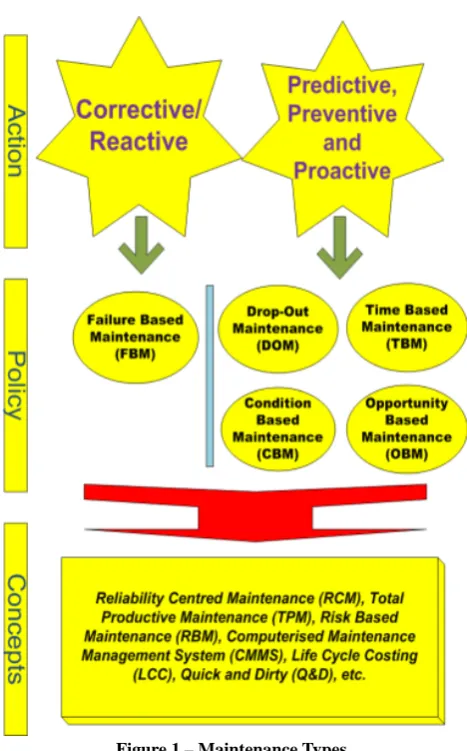
European Federation of National Maintenance Societies (EFNMS) defines the term maintenance as (Stuber & Despujols, 2002): "All actions, which have the objective of retaining or restoring an item in or to a state in which it can perform its required function. The actions include the combination of all technical and corresponding administrative, managerial, and supervision actions." Maintenance action structure itself is divided into three major categories: Corrective, Preventive and Predictive. Corrective maintenance also known as Reactive maintenance is defined as the repair in case of failure, which is the most basic type of maintenance strategy (Arunraj & Maiti, 2007). Preventive maintenance was first introduced in 1970s. It uses scheduled maintenance tasks in order to prevent failures from occurring (Hameed, et al., 2010). Since the mid-70s, due to the advancement on automations more complete and complex predictive methodologies were represented implementing condition monitoring and decision support systems (Sharma,
Received date:
Foundation item: Supported by *Corresponding author Email:
et al., 2006).
In brief, this paper is going to look into different maintenance strategies developed in the industry and then it will cover Reliability Centered Maintenance (RCM) in more detail in section. Moreover, it is going to introduce an innovative maintenance methodology called Business Oriented Reliability-Based Maintenance (BORM). Subsequently, it will represent a Bayesian tool used for the Sub Sea Control System Case study. Finally, it is going to conclude with recommendations on future work.
2 Maintenance Concepts
Figure 1 – Maintenance Types
2.1 Total Productive Maintenance (TPM)
Total productive maintenance (TPM) was first introduced in Japan in the 1970s. This technique has various benefits such as helping for a complete preventive maintenance of the system, increasing component effectiveness and employment of every one working on the plant. This method unifies the operation and maintenance tasks of the company and everyone involved. This has numerous advantages such as everyone becoming multitasked, which improves flexibility and skills of employees, operators involved on maintenance can have a feeling of pride, reduction of delays, and promotion of team working skills (Ben-Daya, 2000). TPM is one the most effective types of preventive maintenance methodologies, which helps companies to eradicate waste and interruptions, and achieve best performance from their machinery. TPM identifies six major losses on organization: Equipment failure, adjustments, minor stopping, reduced speed, process errors and rework/scrap. TPM methodology implementation highly depends on the structure and the philosophy of the organization.
Rodrgues & Hatakeyama, 2006 have suggested that TPM has eight pillars: 1) Equipment and process improvement; 2)
Autonomous maintenance (self-management and control); 3) Planned maintenance; 4) Education and training; 5) Early management of new equipment; 6) Process quality management; 7) Effective involvement of administration on TPM; and 8) Safety and environmental management.
2.2 Risk Based Inspection (RBI)
Risk Based Inspection (RBI) is an inspection optimization technique that uses risk as the basis of scheduling inspection and maintenance. RBI determines risk on high risk components by multiplying likelihood of failure to its consequences. It eliminates unnecessary inspections and its main proposes are (Patel, 2005).
RBI was first emphasized by the regulations presented by ASME and API. RBI can be implemented on three different ways: Qualitative, Semi-Quantitative and Quantitative. Depending on the accuracy and time limit requirements any of these methods can be used. RBI can be either implemented on plants with run-to-failure inspection method where it can increase the safety and reduce the unwanted shutdowns or on facilities with traditional preventive maintenance system where RBI can decrease the inspection costs (Ablitt, & Speck, 2005). RBI is the recommended method for the new generation of computer aided maintenance procedures. RBI itself is categorized into two main phases: Risk assessment and maintenance planning. The most important phase is risk assessment (Arunraj & Maiti, 2007).
2.3 Business Centered Maintenance (BCM)
Business Centered Maintenance (BCM) and Profit-Centered Maintenance (PCM) are other maintenance methods which eliminate unnecessary practices to save money and expenditure on maintenance (Pun, et al., 2002). This business and profit oriented approaches are actually originated from TPM (Hughes, 2001). (Jones, et al., 2008) has discussed an example of BCM by the application of Business Driven Reliability (BDR) using the Cost of Unreliability (CoUR) in refineries.
2.4 Condition Based Maintenance (CBM)
systems (Hameed, et al., 2010). CBM can be more expensive than most of the Preventive methodologies but becoming more effective due to improvements on detection systems (cheaper systems) (Pintelon & Herz, 2008). Condition monitoring is a type of Condition Based Maintenance (CBM) (Utne, 2010). Deterioration on machinery conditions could have external causes such as harsh operational condition, bad raw materials, inefficient maintenance and external shocks. As a result, all of above should be monitored. Product characteristics and its condition on manufacturing process should also be taken into account (Al-Najjar, 2006). There are two major types of condition monitoring techniques used for CBM in industry: Vibration monitoring and Oil analysis (Tsang, et al., 2006).
2.5 Reliability Centered Maintenance (RCM)
High number scheduled maintenance activities themselves could also create their own failures. Reliability Centered Maintenance (RCM) diminishes this possibility by optimizing the maintenance schedule. It uses known likelihood, severity and consequences of the failures to introduce the most optimum maintenance plan. Federal Aviation Association (FAA) airline industry was the first industry to introduce RCM in 1950s. They produced their own RCM methodology to replace their periodic and scheduled maintenance approach as it was resulting in unnecessary maintenance activities and generating undesirable maintenance related failures (Kennedy, 2009).
An effective RCM methodology should be able to predict failure (Predictive Maintenance) before its occurrence. This would decrease the cost. This is due to the fact that expenditure on unwanted repairs sometimes can be much higher than planned repairs and replacements (McGowin, 2006). Numerous computerized additions are developed for RCM such as innovative computerized RCM methodology with unique process design software called ASPEN Plus introduced by Fonseca & Knapp, 2000. This model has an availability structure section to obtain information from RCM module and data analysis module in order to perform dynamic maintenance scheduling, availability assessment and risk analysis.
Eisinger & Rakowsky, 2001 have stated that RCM methodology in general has four major steps of system preparation, system analysis, decision making, and maintenance planning. However, BS EN 60300-3-11:2009 has stated that Typical RCM has five major steps: 1) Initiation and Planning (Objective identification, Analysis content development, Knowledge and expertise determination, and Clarification of the operational system of items); 2) Functional Failure Analysis (Field data collection and analysis, Functional system classification, and FMEA/FMECA); 3) Task Selection (Failure consequence analysis, Policy selection, and Task interval identification);
4) Implementation (Task detail description, Task prioritization, Task interval rationalization, and Preliminary age estimation); and 5) Continuous Improvement (Maintenance Effectiveness evaluation, HSE monitoring, and age survey implementation) (British Standard Institution (BSI), 2009).
The next section of this paper will investigate different reliability and probabilistic tools typically used on RCM in more details.
2.6 Reliability, Criticality and probability analysis Tools
Failure analysis, reliability and probability tools are the major types of the tools that are required for the RCM methodology. Most commonly used RCM tools are Failure Mode, (Criticality) and Effect Analysis (FMEA/FMECA), Fault Tree Analysis (FTA), Weibull’s Distribution and Bayesian Belief Network (BBN).
2.6.1 Failure Mode, (Criticality) and Effect Analysis (FME(C)A)
Failure Mode and Effect Analysis (FMEA) is a table of all possible failure types on each component, their likelihood, effect and consequence on the overall sub system or system. FMECA adds criticality analysis into this system as it is beneficial for the managers to prioritize maintenance tasks and rank failures by determining the consequences, probabilities, and likelihood of asset failures. This method creates a Risk Priority Number (RPN) in order to obtain factors for the ranking process. RPNs could be determined by converting qualitative data into quantitative values. However, it could create some uncertainties due to variations on expert judgments (Moore & Starr, 2006).
As mentioned above, FMECA implements a criticality component on its analysis. In order to analyze the criticality factor, FMEA technique should be used first, before criticality of each component is analyzed on four different principles (Abdul-Nour, et al., 1998): 1) Effect of the machine downtime on production process (EM); 2) Utilization rate of the machine (UR); 3) Safety and environmental incidences (SEI) of machine failures; and 4) Technical complexity of the machine and requirements for external maintenance resources (MTC). Additionally, Defense Standard of 00-45 also requires that the FMECA is implemented to identify all asset failure modes (New, 2012).
2.6.2 Fault Tree Analysis (FTA)
approach. Each basic failure event in FTA has a predetermined probability value assigned by statistical data (Shalev & Tiran, 2007). There are numerous types of data inputs that can be used on FTA such as none-repairable, repairable, test intervals, frequency and on demand data (Turan, et al., 2011). FTA can have dynamic gates in order to analyze complex maintenance strategy elements (British
StandardInstitution (BSI), 2006). Moreover, Contini, 1995
has developed a hybrid fault tree analysis system that can be analyzed both top-down and bottom-up.
2.6.3 Weibull’s Distribution
Weibull’s distribution method can be used for Data collection and end-of-life Analysis on RCM (Rausand, 1998). Tsang, et al., 2006 have implemented Weibull’s distribution model as foundation for their hazard rate function. Weibull’s hazard function and time-dependent stochastic covariates have also been used by Jardine, et al., 1997 to simplify the reliability analysis of large amounts of data gathered from monitoring systems.
2.6.4 Bayesian Belief Network (BBN)
Bayesian networks not always completely imply Bayesian statistics as Conditional Probability Distribution (CPD) is often assessed using frequency calculations. Nevertheless, BBNs use Bayes’ rules for the interferences and hierarchical Bayesian models. Probability of events resulting in one child could end up having dependency even though they are marginally independent. This effect is called explaining away, which in statistics is referred to as Berkson’s paradox or selection Bias’. Bayesian networks can be viewed either from effect to cause (Bottom-up) or from cause to effect (Top-down) (Murphy, 2000). Weber, et al., 2012 illustrated an increasing trend of implementation of BNN on dependability structures and risk analysis. Qualitative part on the study by Trucco, et al., 2008 determines casual dependencies between different events and their quantitative part using the combination of FTA and BBN methodologies together. Cai, et al., 2013 have also created a methodology that converts dynamic fault tree gates into dynamic BBN automatically. Poropudas & Virtanen, 2011 have used Dynamic BBN on decision making process of their methodology.
2.7 Different Specialized Maintenance Concepts
In the past, a number of quick and easy versions of the RCM methodology called Stream-lined RCM (SRCM) have been used in the industry. For instance, Retroactive SRCM process starts with current maintenance tasks rather than first step of defining the functions of the system. This system does not focus on plant performance improvement and only considers PM tasks. Another type of SRCM
methodology is the use of generic lists of failure modes by implementing off-the-market system that is used in similar type of organization. Final method of SRCM is the critical only method where only critical components are analyzed. This method can be rather dangerous as it skips some important steps of true RCM methodology (Moubray, 2001).
Another type of maintenance concept is generated on RIMAP project that increases the performance of the methodology using Reliability Based Maintenance Inspection (RBII) (Schroder & Kauer, 2004). RBII is not just a decision-making strategy for maintenance planning but it can also be used to determine the most critical components of the system. Stand-by safety system should be inspected periodically as it is rather difficult to detect their failures (Khan, et al., 2004). The CIBOCOF (Centrum voor Industrieel Beleid Onderhouds Concept Ontwikkelings Framework, or in English, Centre for Industrial Management Maintenance Concept Development Framework) is developed for the customization of maintenance concepts by Waeyenberg & Pintelon, 2006. Value Driven Maintenance (VDM) is another type of business and reliability based methodology that uses Performance goal-setting and measurement for the plant management. Main principle of VDM methodology is called Experience Based Reliability Centered Maintenance (EBRCM). EBRCM is integration feedback data, decision logic, fault modes, effects and criticality analysis (Rosqvist, et al., 2009). Selvik & Aven, 2011 presented an updated version of risk and reliability based approach called Reliability and Risk Cantered Maintenance (RRCM), which decreases the uncertainties.
Finally, Turan, et al., 2011 have created an innovative new criticality and reliability technique called Reliability and criticality Based Maintenance (RCBM). Lazakis, 2011 has added Total Productive maintenance (TPM) managerial aspects to the previous RCBM technique.
This section in brief provided some background information on general maintenance concepts used in industry and specifically focused on the TPM, RBI, BCM, CBM and RCM methodologies and their tools and concepts. Therefore, the next section of this paper will introduce an innovative maintenance concept that enhances the performance of the ordinary reliability based maintenance methodology by addition of business aspects and criticality analysis.
3 Proposed Business Oriented
Reliability-Based Maintenance (BORM)
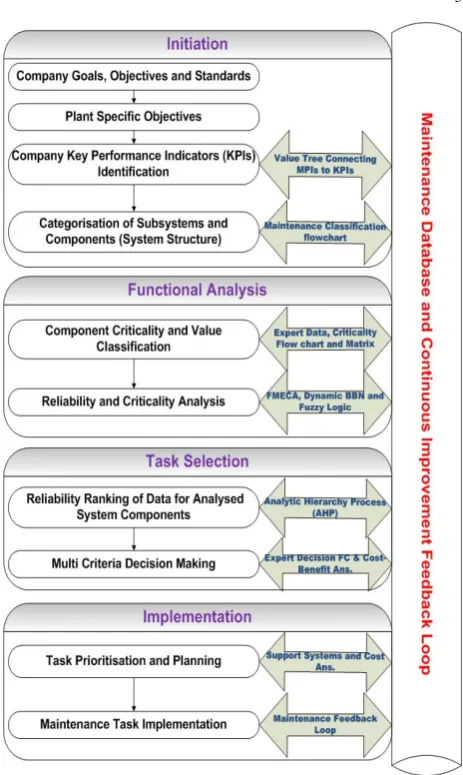
business aspects and performance indicators of a plant and its maintenance technique based on its reliability. This methodology uses business aspects of the organization with their Key Performance Indicators (KPIs) as a base for creating maintenance planning. It also consideres the risk aspect based on criticality of components and it has a continuous improvement system that uses condition monitoring data.
KPI identification is part of the initiation process for the proposed maintenance methodology, which also includes the collection and definition of company goals, objectives, industry standards, regulations, plant specific objectives, KPIs and subsystem categorization. This information are implemented inside a value tree system and connected maintenance data base and continuous improvement feedback loop. In general, all four sections of Initiation, Functional Analysis, Task selection, and Implementation are connected to data base feedback loop. This can be seen in further detail on Figure 2.
On functional analysis section of the methodology, criticality and importance of individual components to their subsystems and the overall system is defined using the results from the value tree at first. Then, it creates interconnections between different components and subsystems using Bayesian nets in order to analyze their failure rates and reliabilities. Subsequently, task selection section analyzes data received from functional analysis in order to rank and prioritize different alarms, failures and degradation of the component for maintenance and repair using Analytical Hierarchical Process (AHP). This section also uses experts’ judgment and cost-benefit analysis for its Multi Criteria Decision Making (MCDM) subsection of its task selection process.
[image:5.595.307.539.57.445.2]Finally, implementation section of this methodology uses cost analysis to prioritize maintenance actions and creates a general planning for maintenance of the plant. This section also includes maintenance data collection system that feeds data back to main maintenance data base for future improvement of the maintenance regime. For functional analysis in this methodology, Bayesian Belief Network (BBN) is the preferred methodology. This is due to the fact that it can easily consider the interconnectivity between components and show overall illustration of connections between components and subsystems. This also helps to apply sensitivity analysis in order to identify critical components.
Figure 2 - Business Oriented Reliability-Based Maintenance (BORM)
In brief, it can be perceived from this section that reliability analysis plays a major roll on both task prioritization and maintenance planning. As a result, the next section of this paper investigates reliability analysis performed on subsea control system case study using Bayesian networks.
4 Case Study: BBN Reliability/Probability
analysis of a Subsea Control System
(both hydraulic and electrical). The following part of this paper will illustrate step by step the reliability and probability analysis of the failure rates of all the components of above subunits. This will provide final reliability model for the overall subsea control system.
4.1 Data Gathering
Failure rate data for this case study was obtained from OREDA database. Failure rates of each failure type for every component where first gathered from their result tables. Then, the overall failure rate of each component was calculated as the number of failures each failure type had on that component. At the end, failure probability of every component was defined as the percentage of number of failures of each specific component compared with overall number of failures. All values were saved on text files to be read for the developed probabilistic model in JAVA.
4.2 Sub Sea Control System BBN Analysis
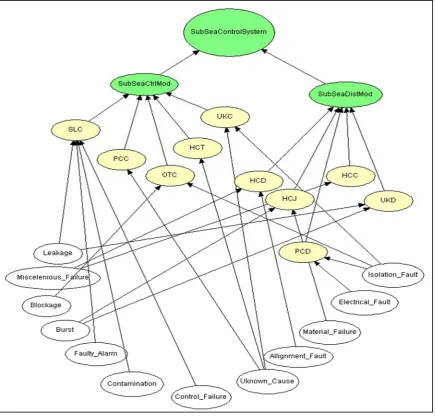
[image:6.595.81.518.285.701.2]This section is going to represent the overall probabilistic model generated in JAVA environment. This model implements Bayes’ theorem, where it uses conditional probabilities. Most probabilities in Bayes' theorem may have number of probability interpretations and interconnections. The theorem expresses how an individual probability should judiciously change to account for its evidence. The casual relationship between different probabilities can be represented by Directed Acyclic Graphs (DAGs) called Bayesian Networks, where probabilities themselves are shown by nodes and the connection between them is shown by arrows. Figure 3 demonstrate one section of the overall BBN model of this case study where the colored nodes are parent Component and subsystem nodes and uncolored ones are child failure nodes.
ICMT2014, 7 -9 July 2014, Glasgow, UK
In general, failure possibilities and scenarios of connected parent nodes can be defined using Equation 1.
. .
.
. .
. . .
. . …. .
(1)
In a simple example of BBN with “x” as failure probability of the child nodes and “C” as probability of different cases of the parent node relative to its child nodes can be illustrated mathematically as shown on equation 1. Overall failure rate of the parent node then can be evaluated using equation 2
∑ ∑ , (2)
In both equations, “n” is number child nodes and “K” is number of possible cases which follows the expression (K = 2n).:
4.3 Decision and Utility Modules
Decision node is a node that connects a decision of an action that can change the results of the model. Utility nodes are needed in order to add quantitative value on decisions to decide if the action with current probabilities is feasible or not. In general final decision of a BBN model can be represented as Expected Utility “EU”. In general, expected utility of decision node D can be calculated via equation 3:
. |
. | ⋯ . |
(3)
4.4 Results and Discussion
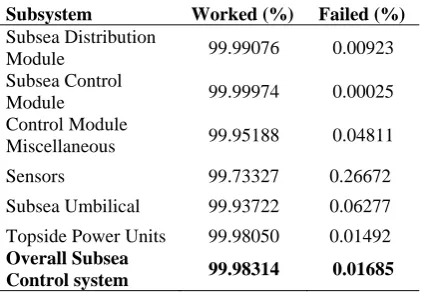
[image:7.595.310.521.90.236.2]This designed program provided results on reliability of different subsystems and the whole system on predefined failure data assuming all network connections between different failure types and components. The final result achieved can be seen on Table 1.
Table 1 – Subsea Control System Failure Results
Subsystem Worked (%) Failed (%)
Subsea Distribution
Module 99.99076 0.00923
Subsea Control
Module 99.99974 0.00025
Control Module
Miscellaneous 99.95188 0.04811
Sensors 99.73327 0.26672
Subsea Umbilical 99.93722 0.06277
Topside Power Units 99.98050 0.01492
Overall Subsea
Control system 99.98314 0.01685
Reliability values are in percentage and data shown are
recorded for 106 hours of operation time of a single subsea
control system on a platform. This also includes 16 hours daily operational investigation by experts. Using the values obtained in this it can be determined that in almost 115 years of operation, the subsea control system has failed for only about 1.8 years. This result can easily be compared with industry standards and stakeholders requirements to see if it is acceptable. Most unreliable subsystem here is sensors. Further, sensitivity analysis can be performed on the model in order to observe the alteration pattern on the reliability of different components and subsystems. This could help to define the problematic systems in case if the obtained results are not up to predefined standards and requirement. However, this does not mean this system is critical as there are other measures such as repair cost and severity of its effect to the overall system has to be taken into account. This result also does not include any interconnectivity between individual components as sometimes a failure in one component could affect the operation of another component. Finally, degradation of the components daily and for the future has to be identified using more dynamic nodes. As a result, this model is not yet totally optimized and future work recommendations on improving the results obtained from this model follow in the next section.
4 Conclusions and Recommendations
analysis. At the end, it introduces a java code developed that uses Bayes’ theorem on data gathered from a subsea control system case study to analyze its reliability. Results of the reliability analysis performed in this demonstrate the failure rates of different components on subsystems that can help to identify the most unreliable subsystem.
The methodology illustrated in this paper can be further improved by adding interconnections between components as failure in one component can influence the performance of other components. Another important topic to be considered in this model is the use of dynamic nodes where time as a variance is included into the analysis. Finally, criticality values can be assigned to each component and company values can be added to create an even more realistic and customizable probabilistic model.
References
Ablitt,, C. & Speck, J., 2005. Experiances in implementing Risk-Based Inspection. Manama, Bahrain, Middle East Nondestructive Testing Conference & Exhibition.
Abdul-Nour, G. et al., 1998. A reliability based maintenance policy - a case study. Computers & Industrial Engineering, 35(3-4), pp. 591-594.
Al-Najjar, B., 2006. Cost-effective & continuous improvement of
production process and company’s business when using total quality maintenance (TQMain). ChengDu, China, International Conference on Maintenance Engineering.
Arunraj, N. & Maiti, J., 2007. Risk-based maintenance—
Techniques and applications. Journal of Hazardous Materials,
142(3), pp. 653-661.
Ben-Daya, M., 2000. You may need RCM to enhance TPM
implementation.. Journal of Quality in Maintenance Engineering,
6(2), pp. 82-85.
Bleakie, A. & Djudjanovic, D., 2013. Feature extraction, condition monitoring, and fault modeling in semiconductor manufacturing systems. Computers in Industry, 64(3), pp. 203-213.
Bleakie, A. & Djudjanovic, D., 2013. Feature extraction, condition monitoring, and fault modeling in semiconductor manufacturing systems. Computers in Industry, 64(3), pp. 203-213.
British Standard Institution (BSI), B. S. I., 2006. Application of Markov Technique, London, UK: Patent No: BS EN 61165:2006.
British Standard Institution (BSI), 2009. Dependability
Management -, London, UK: Patent No: BS EN 60300-3-11:2009. Cai, B. et al., 2013. A dynamic Bayesian networks modeling of human factors on offshore blowouts. loss Prevention in the Process Industries, 26(4), pp. 639-649.
Contini, S., 1995. A new hybrid method for fault tree analysis.
Reliability Engineering & System Safety, 49(1), pp. 13-21. Eisinger, S. & Rakowsky, U. K., 2001. Modeling of uncertainties in reliability centered maintenance - a probabilistic approach.
Reliability Engineering & System Safety, pp. 71-79.
Eisinger, S. & Rakowsky, U. K., 2001. Modeling of uncertainties in reliability centered maintenance - a probabilistic approach.
Reliability Engineering & System safety, 71(2), pp. 159-164. Fonseca, D. J. & Knapp, G. M., 2000. An expert system for reliability centered maintenance in the chemical
industry. Expert Systems with Applications, 19(1), pp. 45-57. Hameed, Z., Ahn, S. H. & Cho, Y. M., 2010. Practical aspects of a condition monitoring system for a wind turbine with emphasis on its design, system architecture, testing and installation. Renewable Energy, 35(5), pp. 879-894.
Hughes, B., 2001. Business Centred Maintenance.. [Online]
Available at: http://www.maintenanceresources.com/referenceliberary/ezine/buss
cm.html
[Accessed 14 03 2014].
Jardine, A. K., Banjevic, D. & Makis, V., 1997. Optimal replacement policy and the structure of software for condition-based maintenance. Quality in Maintenance Engineering, 3(2), pp. 109-119.
Jensen, F. V., 2001. Statistics for Engineering and Information
Science, Bayesian Networks and Decision Graphs. 1st ed. Aalborg, Denmark: Springer.
Kennedy, R., 2009. Plant Maintenance. [Online] Available at:
http://www.plant-maintenance.com/articles/RCMvTPM.shtml [Accessed 19 04 2013].
Jones, W., Kubenka, J. & Ledet, W., 2008. Business Driven
Reliability at Mobil's Beaumont Refinery. [Online]
Available at: http://www.marshallinstitute.com/inc/eng/resources/Areas/articles/
Body/articles/tmg3.pdf [Accessed 14 03 2014].
Khan, F. I., Sadiq, R. & Haddara, M. M., 2004. Risk-Based Inspection and Maintenance (RBIM): Multi-attribute
decision-making with aggregative risk analysis. Process Safety and
Environmental Protection, 82(6), pp. 398-411.
Lazakis, I., 2011. Establishing an innovative and integrated
reliability and criticality based maintenance strategy for the maritime industry: A PhD thesis, Glasgow, UK: University of Strathclyde, Department of Naval Architecture and Marine Engineering.
McGowin, C., 2006. Condition Monitoring of Wind Turbines
OverView, Seeded-Fault Testing and Cost-Beneffit Analysis, Palo Alto, CA, USA: Electric Power Research Institute.
Moore, W. J. & Starr, A. G., n.d. An intelligent maintenance system for continuous cost-based prioritization of maintenance activities.
Computers in Industry, 57(6), pp. 595-606.
Moubray, J., 2001. Is Streamlined RCM Worth the Risk. [Online]
Available at: http://www.mt-online.com/january2001/is-streamlined-rcm-worth-the-risk
[Accessed 11 03 2013].
Murphy, K. P., 2000. MathWorks. [Online] Available at:
https://code.google.com/p/bnt/ [Accessed 10 07 2013].
New, C., 2012. Developing a Risk Based Policy for Integrating
Safety and Maintenance Management. London, UK, Royal Institute of Naval Architecture (RINA) Conference Proceedings.
Patel, R. J., 2005. Risk Based Inspection. Manama, Bahrain,
Meaddile-East Nondestructive Testing Conference & Exhibition. Pintelon, L. & Herz, A. P., 2008. Maintenance: An Evolutionary Perspective. In: K. H. Kobbacy, D. P. Murphy & H. Pham, eds.
Complex System Maintenance Handbook. London, UK: Springer, pp. 21-48.
Pintelon, L. & Herz, A. P., 2008. Maintenance: An evolutionary perspective. In: K. H. M. D. P. &. P. H. Kobbacy, ed. Complex System Maintenance Handbook. London, UK: Springer, pp. 21-48. Poropudas, J. & Virtanen, K., 2011. Simulation metamodeling with
dynamic Bayesian networks. European Journal of Operational
Research, 214(3), pp. 644-655.
Pun, K. F., Chin, K. S., Chow, M. F. & Lau, H. W., 2002. An effectiveness-centred approach to maintenance management: A case study. Journal of Quality in Maintenance Engineering, 8(4), pp. 346-368.
Rausand, M., 1998. Reliability Centered Maintenance. Reliability
Engineering & System Safety, 60(1), pp. 121-132.
Rodrgues, M. & Hatakeyama, K., 2006. Analysis of the fall of
TPM in companies. Journal of Materials Processing Technology,
179(1-3), pp. 276-279.
maintenance planning for a production plant. Reliability Engineering & System Safety, 94(1), pp. 97-110.
Schroder, H. C. & Kauer, R., 2004. Regulatory requirements
related to risk-based inspection and maintenance. International
Journal of Pressure Vessels and Pipping, 81(1), pp. 847-854. Selvik, J. T. & Aven, T., 2011. A framework for reliability and risk centered maintenance. Reliability Engineering & System Safety,
96(2), pp. 324-331.
Shalev, D. M. & Tiran, J., 2007. Condition-based fault tree analysis (CBFTA): A new method for improved fault tree analysis (FTA),
reliability and safety calculations. Reliability Engineering and
System Safety, 92(9), pp. 1231-1241.
Sharma, R. K., Kumar, D. & Kumar, P., 2006. manufacturing excellence through TPM implementation: a practical analysis.
International Management & Data Systems, 106(2), pp. 638-644. Stuber, A. & Despujols, A., 2002. European Federation of National Maintenance Societies (EFNMS). [Online] Available at: http://www.efnms.org/?1=2 [Accessed 14 2 2013].
Tian, Z., Jin, T., Wu, B. & Ding, F., 2011. Condition based maintenance optimization for wind power generation systems
under continuous monitoring. Renewable Energy, 36(5), pp.
1502-1509.
Trucco, A., Cango, E., Ruggeri, F. & Grande, O., 2008. A Bayesian Belief Network (BBN) modelling of organizational factors in risk
analysis: A case study in maritime transportation. Reliability
Engineering & System Safety, 93(1), pp. 823-834.
Tsang, A. H., Yeung, W. K., Jardine, A. K. & Leung, B. P., 2006.
Data management for CBM optimization. Quality in Maintenance
Engineering, 12(1), pp. 37-51.
Turan, O., Lazakis, I., Judah, S. & Incecik , A., 2011. Investigating the reliability and the criticality of the maintenance characteristics
of a diving support vessel. Quality and Reliability Engineering
International, 27(7), pp. 931-946.
Turan, O., Olcer, A. I. & Martin, P. L., 2011 Risk assessment of loss of life for fishing vessels in fuzzy environment. Safety and Reliability, 23(2), pp. 19-38.
Utne, I. B., 2010. METHODOLOGY AND THEORY Maintenance strategies for deep-sea offshore wind turbines. Journal of Quality in Maintenance Engineering, 16(4), pp. 367-381.
Waeyenberg, G. & Pintelon, L., 2006. CIBOCOF: A framework for industrial maintenance concept development. International Journal of Production Economy, 121(2), pp. 633-640.