City, University of London Institutional Repository
Citation
:
Roy, R. ORCID: 0000-0001-5491-7437 (2005). Virtual Cost Engineering Studio (V-CES): a framework for Cost Engineering services. Paper presented at the 2005 IEEE International Technology Management Conference (ICE), 20-22 Jun 2005, Munich, Germany.This is the accepted version of the paper.
This version of the publication may differ from the final published
version.
Permanent repository link:
http://openaccess.city.ac.uk/22206/Link to published version
:
Copyright and reuse:
City Research Online aims to make research
outputs of City, University of London available to a wider audience.
Copyright and Moral Rights remain with the author(s) and/or copyright
holders. URLs from City Research Online may be freely distributed and
linked to.
City Research Online: http://openaccess.city.ac.uk/ [email protected]
Virtual Cost Engineering Studio (V-CES): a
framework for Cost Engineering services
Rajkumar Roy, Jose Rios
Enterprise Integration, Cranfield University, MK43 0AL, UK, [email protected],
Abstract
Cost has become a business driver. V-CES is a European Project aiming to develop and deploy a set of services to the Cost Engineering Community: Training, a Cost Engineering Virtual Community, a Cost Estimating Tool, and a Cost Engineering Database. The access to such services will be done via Internet and a Web browser. This implies the possibility for the cost professionals of exercising a just-in time training, estimating and consulting related to their work. The use of these services implies interactions of the kind client-server and peer-to-peer, and their implementation demands the use of different software technologies, being the main ones: Virtual Learning Environment (VLE), database, multi-agent toolkit, and reasoning engine. This paper presents the technological definition of the framework to be used for the over all development and implementation.
Keywords
Cost Engineering, Cost Estimating, Cost Database, Virtual Training, Intelligent systems
1
Introduction
Cost is perhaps the most influential factor in the outcome of a product or service within many of today’s industries. Predicting cost of a product is a challenging task that requires a lot of experience and data [Rush and Roy, 2001]. In this sense, it has been observed that there is a limited training in cost engineering practices, and that there is a lack of availability of cost related data in many industrial sectors. V-CES is a European founded project which aims to address these issues. The consortium is made up of five partners: IZET Innovationszentrum Itzehoe, Cranfield University, Centro Ricerche FIAT, PRICE Systems, and DAS GmbH. The purpose of this paper is to present a general description of the technical aspects involved in the V-CES project. This objective demands the analysis of the different disciplines that come together in the project, mainly related to: cost engineering, e-training, databases, industrial sectors, company profiles, potential users, and network framework as a deployment context. In the following sections, each of these elements is explained.
2
Scope of Cost Engineering in V-CES
The relevance of cost and the need to predict it applying engineering principles and techniques is widely recognized by industry and academia. In essence, cost engineering is a
discipline with a wide scope of concern, from [Roy 2003]: “cost engineering is concerned
with cost estimation, cost control, business planning and management science, including problems of project management, planning, scheduling, profitability analysis of engineering
projects and processes”. In particular, V-CES focuses on ‘cost estimating’, which is the first
stage and function of cost engineering, with the objective of approximate, in an independent, objective, accurate and reliable way, the true cost of producing a product.
When considering the elaboration of a cost estimate, there are different methodologies that
each of the possible techniques can be used, depends on which stage of the product life cycle the estimate is carried out. In V-CES, three main cost estimating methodologies are
considered: bottom-up, analogy based, and parametric. Among the three methodologies, the
parametric one is based on the identification and mathematical formulation of relationships between cost and product parameters, known as cost estimating relationships. This approach demands the access to historical data and assumes that the relationship will continue in a
similar way in the future. The bottom-up methodology, also known as detailed, demands
access to detailed cost data, and the allocation of the cost elements, mainly: labour, material,
and equipment. The analogy-based or case-based requires to identify the similarities and
differences of items, identify a reusable case, and adapt it if necessary.
3
Industrial sectors and company profiles
The industrial sectors addressed in the project are: automotive, aerospace and semi-conductor equipment manufacturers. These sectors are quite distinctive, mainly because the kind of product they produce. The project for a new airplane, car, or equipment, is quite different in terms of complexity, duration, risk and cost. The particular characteristics of these products, and the profile and practices of the companies play an important role when considering the cost engineering practices used. From the experience gained in the aerospace and automotive sectors [Roy et. al. 2001], [Rush and Roy 2001], a few general conclusions can be outlined: each company has its own way of implementing cost engineering techniques and processes, cost engineering (CE) depends heavily in the availability of reliable cost data, CE as any other engineering activity demands a strong commitment of man-effort and skilled cost engineers, and more collaboration between the Original Equipment Manufacturers (OEM) and the suppliers is needed.
One profile of company to be specially addressed is the ‘Small and Medium size Enterprise
(SME)’. The fact that SMEs need more attention to improve their technological level is
widely recognized by the European Commission, which promotes specific actions for this kind of companies. When referring to e-training or e-learning, the picture is quite similar. As it is presented by [Attwell 2003], and quoting from the report:
• Many SMEs lack a basic learning culture or organised training plans and infrastructure.
• There is little support from managers for introducing e-learning, and there is no
organised and planned action to take up e-learning.
Considering these issues, it can be concluded that: there is a need to train employees in CE practices, to provide a collaborative space for CE practices both in a forum environment and in a peer-to-peer basis, and the solution has to address the specific situation in the SMEs.
4
E-training and tutoring
The reason for using the term ‘training’ in V-CES derives from the definition of the term
itself: “the process of learning the skills needed for a particular job or activity”, training in
V-CES is: “the process of gaining the knowledge and the ability needed for developing cost
estimates”. In line with the definitions provided in (http://www.jisc.ac.uk/), e-training can be
defined as: “training facilitated and supported through the use of information and
communication technology (ICT)”. A similar term is Computer-based training (CBT), which
is together with: On-the-job training (OJT), games and simulations, and lectures and discussions, one of the four basic classes of training [Blanchard & Thacker 2004].
Based on the idea of: ‘available at any time and anywhere an Internet connection exits’;
relevant part of the information learnt on a training course is forgotten by the time the trainee needs it, so the solution to this would be to take the training course as much close as possible to the time when the knowledge and skills are needed, Just-In Time.
A Virtual Learning Environment (VLE) will be used for the development and deployment of JITT in Cost Engineering. It is relevant to mention the lack of availability of on-line material in Cost Engineering. Just a very few sources have been identified: AACE International, Al Dell’Isola (www.vecourse.com), and West Virginia University.
4.1 Virtual Learning/Training Environment
Currently there are different terms being used to describe online learning systems: Virtual Learning Environment (VLE), Learning Management System (LMS), Managed Learning Environment (MLE), Learning Content Management Systems (LCMS), and Content Management System (CMS). In [Schoolnet 2003] there is a definition of all these terms, and the kind of services that they may include. For the purpose of V-CES, the selected VLE system is Moodle. However, as any VLE system with a certain level of maturity, it lacks of
any kind of ‘intelligent tutoring or mentoring’, element that is of special relevance to V-CES.
4.2 Intelligent tutoring
Intelligent tutoring demands the integration of different technologies, which usually go beyond the scope of the current VLE or CBT systems. It requires the use of Artificial Intelligence techniques, for instance: multi-agent systems and inference engines [Garro & Palopoli 2003]. The tutoring solution is also affected by the adoption of a pedagogical approach, in this respect, and according to [Mayes & de Freitas 2004] three learning perspectives can be considered: associative view, cognitive view, and situative view, with each of them emphasising different aspects of the learning process. V-CES will utilise existing research in this area to develop the training environment and the associated tutoring.
5
Cost database
There is some research identifying the level of data required for cost estimating [Roy et. al., 2003]. But in addition to it, the definition of the data itself, e.g. the definition of the logical or conceptual level through the creation of a ‘conceptual schema’ or ‘data model’, is one of the kernels of this part of the project. In particular, this part leads to the use of standards, and the definition of taxonomies, related to equipment, material and labour. The second fundamental aspect is the cost data collection to populate the database.
6
V-CES network framework and enabling technologies
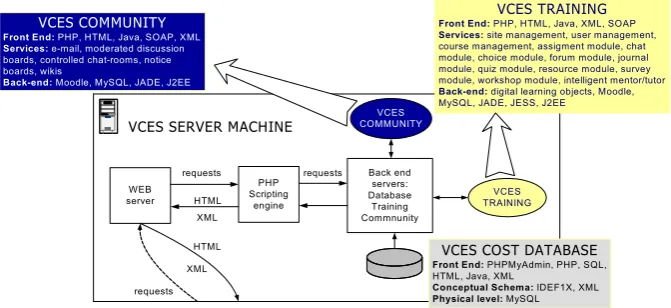
The network framework in which the outcomes will be deployed demands a hybrid client-server and peer-to-peer interactions. Because of the kind of services V-CES aims to provide, and the kind of interactions expected, there is a set of technologies that need to be considered: SOAP, XML, HTML, Web protocols, and Java development frameworks like J2EE.
Special attention has to be given to the ‘intelligent tutoring system’, and in particular to ‘multi-agent systems’ as a possible platform for its development. Distributed agent systems
demand the use of a ‘middleware toolkit’. JADE [Bellifemine et al. 2003] is the toolkit
Back end servers: Database
Training Commnunity
VCES COST DATABASE
Front End: PHPMyAdmin, PHP, SQL, HTML, Java, XML
Conceptual Schema: IDEF1X, XML
Physical level: MySQL
VCES TRAINING requests VCES COMMUNITY VCES COMMUNITY
Front End: PHP, HTML, Java, SOAP, XML
Services: e-mail, moderated discussion boards, controlled chat-rooms, notice boards, wikis
Back-end: Moodle, MySQL, JADE, J2EE
WEB server
PHP Scripting
engine
VCES SERVER MACHINE
requests HTML HTML XML XML requests VCES TRAINING
Front End: PHP, HTML, Java, XML, SOAP
Services: site management, user management, course management, assigment module, chat module, choice module, forum module, journal module, quiz module, resource module, survey module, workshop module, intelligent mentor/tutor
[image:5.595.130.466.73.227.2]Back-end: digital learning objects, Moodle, MySQL, JADE, JESS, J2EE
Figure 1: V-CES technical description
7
Concluding Remarks
The paper presents a framework to develop an on-line training, database, and cost estimating tool. It is observed that the current level of technology allows developing an interactive intelligent CE training environment. The development of a CE database is challenging and depends heavily in the definition of a standardized data model and in the availability of cost data. The service is initially developed for aerospace, automotive and semiconductor equipment manufacturing industries, but it can be relevant to other sectors using parametric,
detailed or analogy based cost estimating techniques.
Acknowledgement
This work has been funded by the European Commission through IST Project V-CES(No.: IST-2003-507041). We wish to acknowledge our gratitude to all the project partners for their contribution to the ideas presented in this paper. Finally, recognise contributions from members of the Decision Engineering Group at Cranfield.
References
Attwell, G.: The challenge of e-learning in small enterprises: issues for policy and practice in Europe, Report Cedefop Panorama Series, Luxemburg: Official Publication of the European Communities Office, 2003. Bellifemine, F., Caire, G., Poggi, A., Aimassa, G.: JADE a white paper, Exp, Vol 3, n 3, September 2003. Blanchard, P. N., and Thacker, J. W.: Effective training: Systems, strategies, and practices, Prentice Hall, 2004. European Schoolnet, VLEs for European Schools: A survey and commentary, Brussels, January 2003.
Garro, A., Palopoli, L., MASeL: a Multi-agent system for e-Learning and skill management, Exp, Vol 3, n 3, September 2003.
Lewis, J. H. and Romiszowski, A.: Networking and the Learning Organization: Networking issues and scenarios for the 21st century. Journal of Instructional Science and Technology, Vol. 1, No. 4, Nov.1996 Mayes, T., de Freitas, S.: Review of e-learning theories, frameworks and models, JISC e-Learning Models
Desk Study, 2004.
Roy, R., Mishra, K. and Souchouorkov, P.: Interface between commercial and engineering activities in cost estimating: industry practice, Proc. of the 3rd Joint Annual ISPA/SCEA Intl. Conf., USA, June 2001. Roy, R., Souchoroukov, P. and Kopponen, H.: Information requirements for cost estimating and the automotive
industry, 8th Annual ASME Design for Mnfg. Conf., Chicago, Ref.: DETC2003/DFM-48153, Sept. 2003. Roy, R.: Cost engineering: Why, what and how? Decision Engineering Report Series, Edited by R. Roy & C.
Kerr, Cranfield: Cranfield University. ISBN 1-861940-96-3, 2003.
Rush, C. and Roy, R.: Expert judgement in cost estimating: Modelling the reasoning process. Concurrent Engineering: Research and Applications (CERA) Journal, 9 (4), 2001, pp. 271-284.
V-CES Project, Deliverable 1.5 Report on functional and technological specification for V-CES, January 2005. Woolf, B. P., Beck, J., Eliot, C., Stern, M.: Growth and maturity of Intelligent Tutoring Systems: a status
report, in Forbus, Feltovich, (Editors), Smart machines in education, AAAI Press & MIT Press, 2001.