City, University of London Institutional Repository
Citation
:
Molesworth, C. (2006). Prototype effects in high functioning children with autism. (Unpublished Doctoral thesis, City University London)This is the accepted version of the paper.
This version of the publication may differ from the final published
version.
Permanent repository link: http://openaccess.city.ac.uk/8529/
Link to published version
:
Copyright and reuse:
City Research Online aims to make research
outputs of City, University of London available to a wider audience.
Copyright and Moral Rights remain with the author(s) and/or copyright
holders. URLs from City Research Online may be freely distributed and
linked to.
Prototype effects in high
functioning children with autism
Catherine Molesworth
Department of Psychology City University Northampton Square
London ECIV OHB
TABLE OF CONTENTS
List of Tables List of Figures Acknowledgements
To the University Librarian Abstract
Chapter 1 - Autism and the psychological theories of autism 1.1 What is autism?
1.2 The psychological theories of autism
Chapter 2 - Prototype effects in autism: theory and method 2.1 Theory
2.2 Methodology: Participant selection
Chapter 3 - Prototype effects in autism: Intact in recognition memory? Abstract and Introduction
Experiment 3.1 Experiment 3.2 Experiment 3.3 General Discussion
Chapter 4 - Prototype effects in autism: recognition and categorisation compared
TABLE OF CONTENTS Contd.
Chapter 5 - When prototypes are not best and category membership is restricted: Judgements made by children with autism
Abstract and Introduction Experiment 5.1
Experiment 5.2 Experiment 5.3 General Discussion
Chapter 6 - From prototype formation to perception of similarity 6.1 Summary
6.2 Conclusion
6.3 Overall conclusion References
Appendices
Appendix to Chapter 3
Appendix A: Participants' data from Experiments 3.1 - 3.3 Experiment 3.1
Appendix B: Practice memory test - study stimuli Appendix C: Practice memory test - test stimuli Appendix D: Memory test - study stimuli Appendix E: Memory test - test stimuli Experiment 3.2
Appendix F: Prototype effect test - average study stimuli
TABLE OF CONTENTS Contd.
Appendix G: Prototype effect test - average test stimuli Experiment 3.3
Appendix H: Prototype effect test - modal study stimuli Appendix I: Prototype effect test - modal test stimuli Appendix to Chapter 4
Appendix J: Participants' data from Experiment 4.1 Appendix K: Practice stimuli
Appendix L: Stimuli for instruction sheet Appendix M: Study stimuli
Appendix N: Test stimuli Appendix to Chapter 5
Appendix 0: Participants' data from Experiments 5.1 - 5.3 Experiment 5.1
Appendix P: Prototype effect test - study stimuli Appendix Q Prototype effect test - test stimuli Experiment
5.2
Appendix R: Shapes test materials Appendix S: Numbers test materials
LIST OF TABLES
Table 3.1 Participant characteristics
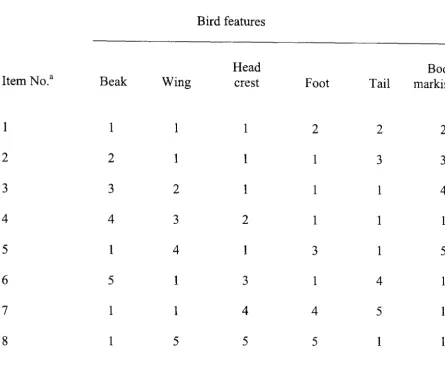
Table 3.2 Study stimuli for average prototype categories Table 3.3 Test stimuli for average prototype categories Table 3.4 Study Stimuli for modal prototype categories Table 3.5 Test stimuli for modal prototype categories Table 4.1 Participant characteristics
Table 5.1 Participant characteristics
Table 5.2 Study stimuli: Hov feature values
Table 5.3 Test stimuli: Feature values for all categories Table 5.4 Mean choice proportions (and standard deviations)
for each exemplar type and participant group
42
50
51
56 57
74
99
100
103
LIST OF FIGURES
Figure 3.1. Examples of average category test stimuli
Figure 3.2. Average category: Mean proportion of positive
48
recognition responses for each participant group and exemplar type 53
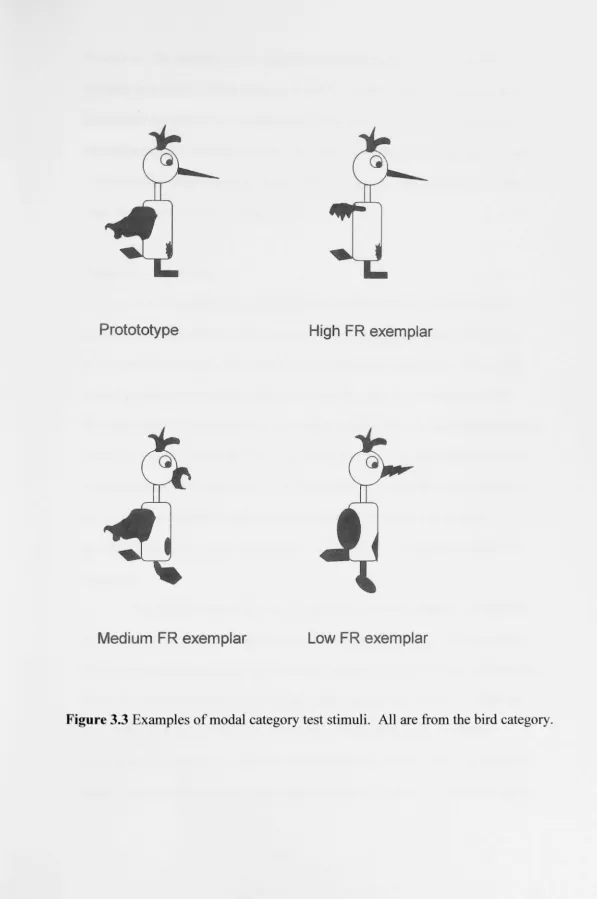
Figure 3.3. Examples of modal category test stimuli 58
Figure 3.4. Modal category: Mean proportion of positive
recognition responses for each participant group and exemplar type 60
Figure 4.1. Examples of study stimuli and test stimuli 76
Figure 4.2. Diagram of screen events during study phase 78
Figure 4.3. Diagram of screen events during the test phase 80
Figure 4.4. Study phases: Mean proportion of correct categorisation
responses for each condition
Figure 4.5. Test phases: Mean proportion of positive recognition
responses for each condition and exemplar type
Figure 4.6. Test phases: Mean proportion of correct categorisation
responses for each condition and exemplar type
Figure 5.1 Test page for the Hov category
Figure 5.2 Shapes test stimuli
Figure 5.3 Mean choice proportion for each participant group and
exemplar type
Figure 5.4 Mean proportion of membership decisions for each
participant group and array in the shapes test
81
84
86
102
107
111
ACKNOWLEDGEMENTS
I am grateful to my first supervisor, Dermot Bowler, for support throughout
completion of the thesis, for advice on experimental design with autistic populations,
and for patient reading of multiple drafts of similar material. James Hampton, my
second supervisor, also played a significant role with advice on experimental design
and detailed comments on some of the material: chiefly on statistical analyses and
some of the discussion of the concepts literature. In addition, this research would not
have been possible without the good nature and help of participants from several
mainstream schools and specialist units. Often, staff took time out from pressured
jobs to assist with various requests and stipulations.
Most of the data described in this thesis has been presented at the Memory
and Cognition Research Group within the psychology department. The questions
and comments from those present were invaluable in shaping its interpretation. I
would also like to thank Laura Klinger and Kate Plaisted for giving me copies of
unpublished manuscripts. Finally, the support and friendship of fellow PhD students
was invaluable, particularly Claire Simmons, whose comments also influenced the
TO THE LIBRARIAN
Background: This thesis represents the application of cognitive
psychology, specifically phenomena reported in the concepts and categorisation literature, to autism research. The studies reported here tested the claim that
prototype formation and therefore prototype effects are impaired in autism (Klinger & Dawson, 2001). The claim is supported by other theories: weak central coherence (Frith, 1989; Frith & Happe, 1994) and a reduced perception of similarity (Plaisted, 2001). Additionally, supporting evidence suggests that individuals with autism do not show prototype effects (Klinger & Dawson, 2001; Plaisted, O'Riordan, Aitken, & Killcross, Submitted). Method: There were three studies each with two participant
groups: high-functioning children with autism and a matched control group of typically developing children. The first study used stimulus cards to test whether prototype effects were shown in recognition memory (Experiments 3.1 - 3.3). The second used dot pattern stimuli presented on computer to compare the influences of recognition and categorisation on prototype effects (Experiment 4.1). The final study used stimulus cards to investigate the influence of ambiguity on children's
categorisation responses (Experiments 5.1 - 5.3). Results: The majority of
participants with autism demonstrated prototype effects similar to those of controls in all three studies. Other findings reported for the autism groups were reduced visual recognition memory for old, meaningless stimuli (Experiment 4.1) and reduced category membership decisions (Experiment 5.3). Conclusion: The convergence of
experimental findings showed that most children with autism do show intact
CHAPTER 1 - Autism and the psychological theories of autism: their
characteristics
1.1 What is autism?
The first descriptions of autism
By reference to early psychiatric literature, historical accounts, myths and
legends, Frith (1989) makes a cogent case that the constellation of characteristics,
now referred to as autism, has existed for centuries. However, autism and the closely
related condition, Asperger syndrome (AS) were not delineated until the early 1940s.
Working independently, Kanner (1943) and Asperger (1944, 1991) published case
studies of children, that each author viewed as constituting a new and hitherto
undefined syndrome. Both Kanner and Asperger emphasised the pervasive social
difficulties. For example, when children visited Kanner's office, they completely
ignored all other people in the room and headed straight for the toys and objects that
caught their interest. In a similar vein, Asperger commented on the tendency of
the children to act on their own impulses and interests without concern for the social
consequences. His case studies detail many examples of the ensuing conflict within
both family and school environments. Both Kanner and Asperger observed
numerous other features: Both were struck by a lack of eye contact, stereotypies
(repetitive movements) and resistance to change. There are also contrasts between
the accounts. For example, Asperger's cases possessed fluent and communicative
language, whereas Kanner's cases had little useful language. There is also some
indication that Asperger's cases were more intellectually able: He commented on
their capacity for abstract thought. Kanner, instead, emphasised the rote learning
skills of the children that he observed. Asperger also commented on the clumsiness
and fine motor co-ordination (used in handwriting). However, Kanner, whilst
observing a clumsy gait in some of his cases, specifically highlighted their manual
dexterity.
Coincidentally and perhaps misleadingly, Asperger and Kanner both
described their cases as autistic, a term coined to describe an entirely distinct
psychiatric disorder: schizophrenia (Bleuler, 1911). Bleuler used the term to convey
a sense of shutting off from the environment as well as the predominance of an inner
mental life. Kanner's use of the name autism has remained in place to refer to cases
that resemble his. In contrast, the syndrome that Asperger described later came to
bear his name.
The diagnosis of autism and AS
According to Happe and Frith (1996) autism has formed a distinct
psychiatric category since it was first included in an internationally agreed diagnostic
system: the Diagnostic and Statistical Manual of Mental Disorders, 3rd edition (DSM
III) published by the American Psychiatric Association (APA, 1980). This
innovation followed converging evidence that suggested that Kanner's observations
constituted a distinct syndrome (e.g. Rutter, 1978). An influential study carried out
by Wing and Gould (1979) provided further justification for viewing autism in this
way. These researchers studied all children, within a former London borough, who
possessed either learning difficulties, or any of the autistic features described by
Kanner, or both. Wing and Gould observed that a "triad" of impairments in
socialisation, communication, and imagination tended to co-occur in classic
"Kanner-type" cases thus reinforcing the notion of an autistic syndrome. The study
Additionally, the researchers recorded considerable heterogeneity in how
impairments were expressed. For example, children exhibited social abnormalities in different ways: some were withdrawn and aloof, others showed unusual passivity, and others were socially active but in an inappropriate manner.
The study also gave rise to the notion of an autistic continuum. Wing and Gould observed a great range in ability amongst individuals possessing the "triad of symptoms". These ranged from individuals with serious intellectual and physical disabilities to whom social impairments were an additional problem through to very able individuals with subtle social deficits. Happe and Frith (1996) point out that the concept of a triad informed the next update of the DSMIIIR (APA, 1987).
Asperger's original paper received little research interest until Wing's (1981) review and case studies. It was not until the latest version of the DSM-IV, APA, (1994) and the International Classification of Diseases (lCD-10, World Health Organisation, 1993) that AS has been included as a separate diagnostic category.
Both autism and AS are located within a wider spectrum of pervasive developmental disorders (DSM-IV, APA, 1994). These are loosely described as having severe and pervasive impairments in the development of social and
presence of stereotypies, repetitive behaviour, or restricted interests. An example of
these would be an, "apparently inflexible adherence to specific, non-functional
routines or rituals." (pp. 71&77, DSM-IV). The diagnostic systems state an
additional necessary requirement for the diagnosis of autism: a qualitative
impainnent in communicative language. This might include, "stereotyped and
repetitive use of language or idiosyncratic use of language." (p.70, DSM-IV). Also,
it is necessary for delays or abnonnalities to be present before 3 years of age in a
least one of the three following areas: social interaction, communicative language, or
symbolic play. In contrast, the criteria for AS state that there should be no (clinically
significant) abnonnalities or delays in these areas. Additionally, there is no
requirement for impainnents in communicative language.
In practice, the use of the lCD-10 and DSM-IV to differentiate between AS
and higher functioning autism (HF A) can be highly problematic. The following two
examples to illustrate this point will be taken from the DSM-IV because the
provision of extra guidelines appears to make it the stronger of the two for
differential diagnosis:
Example 1: There are cases for which the guidelines are self-contradictory.
The DSM-IV states a default rule: An AS diagnosis is not made if criteria are met for
autism. It also states that the lack of language delay associated with AS distinguishes
the disorder from autism. This means that all individuals who meet the criteria for
both disorders should receive a diagnosis of autism. However, a subset of these
individuals without language delay should simultaneously receive an additional
diagnosis of AS. Herein lies the conflict: for the diagnostic schedules do not admit
Example 2: If any candidate meets the criteria for both AS and autism and possesses any delay or abnormalities in the functions of communicative language, social interaction, or play (before age 3) the application of the above mentioned default rule will result in a diagnosis of autism. Therefore, even though the criteria for AS state delays in functioning must not reach clinical significance, in practice it is necessary to demonstrate that development in these key areas is completely typical. The difficulty lies in establishing this. Usually, parents supply relevant information on early development. Gillberg and Ehlers (1998) discuss the inherent difficulties in relying on parental report for establishing normality in language development. Parents may either not notice or remember abnormalities and delays: particularly the more subtle ones. The same points apply to the other areas of functioning.
The lack of delineation provided by the diagnostic systems reflects current controversy in the field over the differential diagnosis of AS from HF A. Some authors regard AS and HF A as separate disorders, (Klin, Volkmar, Sparrow, Cicchetti, & Rourke, 1995; Rhinehart, Bradshaw, Brereton, & Tonge, 2001;
Rhinehart, Bradshaw, Moss, Brereton, & Tonge, 2000, 2001). Others such as Wing (1998) and Miller and Ozonoff (2000) conclude that there is no evidence to justify regarding the two syndromes as separate disorders. (This is discussed further in Chapter 2.)
Aetiology and Epidemiology
1966). The wider spectrum of autistic disorder, as defined by Wing's (1988) triad, is much more prevalent. This is estimated at about 1 per 1000 (Gillberg & Coleman, 2000). The incidence of AS in school-age children appears to be somewhat higher, estimated as 3-5 per 1000 (Gillberg & Coleman, 2000). The gender ratio for both disorders is striking. More males than females are affected and population studies indicate that the boy: girl ratio for both disorders is very similar: between 3: 1 and 4: 1 (Gillberg & Coleman, 2000). Another characteristic associated with autism is the additional presence of learning disabilities (defined by an IQ below 70) in 75% of cases (Lockyer & Rutter, 1970; Wing, 1993).
1.2 The psychological theories of autism
Preface
The psychological study of autism has spanned just over six decades. This has been sufficient time for major paradigm shifts to occur in the study of the mind. These shifts in tum have been reflected in theorising about autism. Psychodynamic models were predominant in the late 40s and 50s. In Section 1.1, mention has already been made of two theoretical viewpoints influenced by these: the
psychogenic theories of autism (Bettelheim, 1967; Kanner, 1949). The domination of the psychodynamic models floundered on a lack of empirical evidence and the behaviourist models of the 1960s and 1970s superseded these. The application of these theories to autism involved the use of operant conditioning to both study and change behaviour (e.g. Ferster, 1961; Jensen & Womack, 1967; Lovaas, Schreibman, Koegel, & Rehm, 1971; McConnell, 1967). Behaviourism's neglect of the mind eventually triggered the third paradigm shift, dubbed the "cognitive revolution" (Gardner, 1985).
behavioural and mental context, and historical and cultural influences. Gardner also
cites interdisciplinary work as another feature of cognitive science. He gives the
example of linguistic processing that has drawn upon evidence from psychology,
neuroscience, and artificial intelligence.
The reader may observe from the following review that the theories vary
considerably in the extent to which they have been influenced by the cognitive
revolution. Some such as the theory of mind (TOM; Baron-Cohen, Leslie, & Frith,
1985) and executive function deficits (Russell, 1997) with their emphasis on
cognitive deficits, firm information processing viewpoint, and interdisciplinary roots
reflect a strong influence. At the other end of the spectrum, it is arguable whether
Hobson's theory (1982,1989,1993) with its emphasis on viewing cognition, affect,
and conation as a unitary whole, as well as its focus on inter-personal relatedness,
belongs within the cognitive revolution at all. None the less, Hobson's theory has
been included within this review as an influential contemporary of the other theories.
The primary purpose of this review is to introduce the theories and only brief
mention is made of empirical evidence.
Theories of autism within the cognitive revolution: A proliferation of basic level 'deficits'
The title of this section is derived from the fact that each theory outlined
here has, as a unique defining characteristic, one or more particular abnormalities of
function which are considered "basic". The word basic here is used in one of the
senses that Hobson (1993) used the word meaning a primary cause of several
secondary features of autism. The first account to be covered here is that of
1970s that indicated a deficit in autism in the cognitive skills of sequencing and
abstraction. After completing a series of experiments with a lower functioning
autism (LFA) group, (i.e. those with learning disabilities), Herme1in and O'Connor
concluded that the thought processes and memory of children with autism were less
dependant upon meaning than children without autism. They proposed that a
cognitive deficit involving abstraction or conceptual inference lay behind the
observed behavioural and social abnormalities.
Rutter (1999) pointed out that researchers at this time became aware of the
necessity of looking at possible ways in which such a cognitive deficit might lead to
abnormalities in social reciprocity and social functioning. One approach to
understanding the social difficulties was provided by Hobson (1982, 1989, 1993).
Hobson argued from clinical experience that individuals with autism were lacking a
particular biologically innate capacity: namely the ability to directly perceive,
empathise with, and respond to the observable communicative cues given out by
other people. He also argued that such inability prevents individuals with autism
forming interpersonal relations, and this lack of subjective experience then causes a
lack of understanding of the minds of other people. Hobson's account is unique with
respect to the theories discussed here because of his emphasis on considering
conation, affect, and cognition jointly when considering autism. Another unique
feature of Hobson's account is that he believed that the basic units of analysis should
include the nature of interpersonal interaction as well as the individual's thoughts,
beliefs, and feelings.
Another account of social abnormalities was provided by the TOM
hypothesis (Baron-Cohen et aI., 1985). This represented an integration of theoretical
Premack and Woodruff (1978) first introduced the phrase "theory of mind" in their
study of non-human primates. They argued that in order to predict and explain the
behaviour of others it is necessary first to be able to attribute mental states to self and
others. To have this ability is to possess a TOM. Dennett (1978) and Pylyshyn
(1978) both commented that a capacity to form second order representations (e.g. "C
believes that E believes that pIt, Dennett, 1978, p. 569) was a prerequisite for a TOM.
Leslie (1987) developed earlier work in specifying a computational model of
meta-representational development. This specified a mechanism by which the ability to
form second order representations developed. According to Leslie such a capacity
does not emerge, during typical development, until about two years of age. In
addition, Leslie argued that this capacity was necessary for pretend play and
eventually developed into a TOM.
Baron-Cohen et al. (1985) noted the lack of pretend play, the social
difficulties of children with autism, and the fact that these impairments appeared to
be independent ofIQ. They hypothesised that this pair of impairments had a
common cause: specifically a lack of second order representations and a concomitant
TOM. To test their hypothesis, Baron-Cohen et al. adapted a false belief task
developed by Wimmer and Pemer (1983). Baron-Cohen et al.'s version involved the
enactment of a play with two doll protagonists. In the absence of one of the
protagonists "Sally" a desired object (a marble) was moved from the location that
"Sally left it in" to a new hiding place. The critical test question was designed to test
ability to hold second order representations: "Where will Sally look for her marble?"
(p.41). Participants answered correctly if they managed to suppress their own
knowledge of the marble's true location and take into account Sally'S "false belief':
majority ofLFA children failed the task whereas control groups with lower
chronological ages (CAs) and mental ages (MAs) tended to pass. Hence, the authors concluded that individuals with autism have a particular cognitive deficit: a failure to employ a TOM.
In contrast to Hobson's and Baron-Cohen's focus on explaining the social abnormalities of autism, the advent of weak central coherence theory represented an attempt to account for the cognitive deficits in autism. Frith (1989) coined the term "central coherence" to refer to the natural human tendency to "draw together diverse information to construct higher-level meaning in context" (Frith & Happe, 1994, p. 121 ). Frith argued that this tendency is weakened in autism.
Supporting evidence spans a range of processing levels. For example, there is evidence of difficulty integrating high-level verbal semantic information. In Frith and Snowling's (1983) study, LFA children failed to use sentence context to
disambiguate homographs. For instance, they tended to use inappropriate
pronunciations of the word bow when reading the following sentences: "He had a pink bow" and "He made a deep bow". These findings have also been replicated with an HFA group (Happe, 1997).
Jolliffe and Baron-Cohen (2001) have reported an example of weak
visuoconceptual coherence. They found that HF A and AS adults were impaired at an object identification task that required the ability to integrate object fragments
Happe (1994) suggested the weaker central coherence possessed by the LF A group meant that they were less susceptible to the gestalt of the complex figure.
Additionally, Happe (1996) reported an example of difficulty with low-level perceptual integration: She found that LF A children tended not to succumb to visual illusions. Happe argued that these children failed to integrate the relevant parts of the figures with their "illusion-inducing context". However, Ropar and Mitchell (1999, 2001) failed to replicate this finding with three separate experiments. They found that children with autism and AS were susceptible to visual illusions. This was the case whether the participants responded verbally, as they did in Happe's study, or whether they responded manually. The latter required participants to press computer keys to alter shapes and lines to match a target. The leading explanation offered for the failure to replicate Happe's findings was that sub-groups existed within the autism population. Happe happened to sample a group that was immune to visual illusions whereas Ropar and Mitchell sampled groups that were susceptible to these effects. The moot issue then is which sub-group is the more representative of the autism population as whole. As Ropar and Mitchell (2001) pointed out, their findings could be seen as more representative because they tested more samples from the autism population.
The theories, discussed so far, have sought (at least initially) to account for secondary characteristics within a single domain: either social or non-social. One theory that from its outset extended to cover both social and non-social secondary deficits was the executive dysfunction hypothesis of autism (Russell, 1997). This proposed that a severe and early impairment in working memory resulted in
integration of infonnation within context and over time. Russell suggested that the notion of an executive dysfunction theory of autism "probably" arose first in the writing of Damasio and colleages (e.g. Damasio & Maurer, 1978). However, key papers triggering mainstream research interest in the area were not written until
1991, when three papers were produced.
The only theory that straddles both social and non-social deficits at the basic level is the extreme male brain theory of autism (Baron-Cohen, 1999,2002,2003). An explanation of this theory starts with the study of gender differences. Baron-Cohen proposed two new dimensions of variability: empathising and system ising. Empathising is defined as the attribution of mental states to other people and the production of a reciprocal affective responses to that of others. Systemising is defined as the use of "if-then rules" to understand and predict the behaviour of variables within a system. Examples of systems include technical ones (e.g.
computers), and abstract ones (e.g. mathematics). According to Baron-Cohen, these if-then rules have most explanatory power when applied to systems that are lawful, finite, and deterministic. Human behaviour possesses none of these characteristics and empathising is the best means of predicting it.
According to Baron-Cohen (2003), within the human population, the normal distributions of male and female systemising ability are slightly separated, with the male distribution shifted in the direction of high ability. Conversely, a similar separation of the popUlation distributions occurs for empathising ability, with the female distribution shifted in the direction of high ability. These two dimensions, systemising and empathising, are used to create a taxonomy of "brain types". For example, an individual with a female brain (not necessarily a female) would show strength in empathising and weakness in systemising. Conversely, an individual possessing a male brain type (not necessarily a male) would show the opposite pattern, with strength in systemising and weakness in empathising.
in the writings of Asperger (1944) who suggested that autism may represent an
exaggeration of patterns of intelligence that are typically male. Baron-Cohen cites a
variety of evidence suggesting that individuals with autism are worse at empathising
than typical males. For example, on TOM tests girls out perform boys who in tum
outperform LF A children (Happe, 1995). Also, children with HF A or AS are worse
than males at recognizing faux pas (Baron-Cohen, O'Riordan, Stone, Jones, &
Plaisted, 1999). Additionally various pieces of evidence are cited for the superior
systemising skills of individuals with autism. For example, obsessional interests
displayed by children with autism represent tend to focus on topics that appeal more
to males than females. Such topics are "closed systems" such as train spotting
(Baron-Cohen & Wheelwright, 1999).
The final major area of study to be discussed here is the study of attentional
deficits in autism. This line of enquiry has run like a thread along side and
interacting with the other theoretical developments. As Barkley's (1996) brief
review indicates, there are many definitions of attention. Many viewpoints converge
in considering attention a function that selects certain processes or information from
others for additional processing. Certain behavioural abnormalities observed in
autism led researchers to consider attentional processes. These abnormalities include
a tendency to fixate on small details of the environment to the exclusion of other
information (Bryson, Wainwright-Sharp, & Smith, 1990) and a tendency towards
perseverative behaviour (Russell et al., 1991).
In addition, the advent of the TOM theory has lead to interest in deficits in
joint attention. This term describes the situation where two or more individuals are
attending to the same phenomenon. Examples include following another's gaze and
Leekam and Moore (2001) cite a number of studies demonstrating a lack of joint
attention in children with autism (for example, Baron-Cohen, 1989; McEvoy,
Rogers, & Pennington, 1993). Various explanations for this have been offered from
within various theoretical perspectives. Hobson (1993) viewed the case of joint
attention deficits as a primary deficit in intersubjective relatedness. Baron-Cohen et
al. (1985) viewed the origins of the deficit as a purely cognitive one. The deficits
prevent the child from forming the second order relations that are necessary for
understanding the relationship between another person and the object holding that
person's interest. This is viewed as part of a larger TOM impairment. An executive
dysfunction explanation of the joint attention deficit instead suggests that the primary
causes are problems in disengaging and shifting visual attention (Pennington &
Ozonoff, 1996; Russell, 1996).
This concludes a brief overview of one of the overarching theoretical
paradigms governing research into autism and some of the main theoretical areas
within it. The next chapter will introduce another theoretical area upon which this
CHAPTER 2 - Prototype effects in autism: theory and method
2.1 Theory
The focus in Section 2.1 is on the study of concepts and categorisation in autism. This topic was briefly alluded to in Chapter 1 with the mention of Hermelin and O'Connor's work and their conclusion that many social and behavioural
characteristics of individuals with autism may be attributable to a cognitive deficit in abstracting and using concepts. This topic will be discussed further after the
following review of concepts and categorisation as reported in the mainstream literature.
Brief review of concepts and categorisation
The formation of concepts and how they are employed in categorisation has long been of interest to psychologists. The classical view of concepts dominated the field until the 1970s. (See Hampton, 1997, and Murphy, 2002, for a review.) This view held that concepts were represented by shared properties that were individually necessary and jointly sufficient to define the concept. For example, the defining properties of a square are that the item has a closed figure, four sides, sides of equal length and equal angles. Categorisation was thought to proceed by means of simple
if ...
then rules. If, for example, a figure possessed all four properties listed above then it would be classified as a square.typical than others. For example, apples are rated as a better example of fruit than water melons (Rosch, 1975a). Such typicality effects are not predicted from the classical view under which category membership is regarded as either present or absent. Furthermore, the purported use of if ... then rules cannot account for
evidence that category boundaries are 'fuzzy' (Medin & Smith, 1984; Rosch, 1978). On certain category membership decisions people disagree with each other and show inconsistency in their own decisions over time (McCloskey & Glucksberg, 1978). For example, for the category furniture participants disagreed with each other and showed inconsistency with their own decisions over time on items of intermediate typicality such as bookends. This was not found to be the case for typical items (e.g. chair) and non-category items (e.g. cucumber).
An alternative to the classical view was the idea that many categories are represented by prototypes (best examples of the categories) and that these provide a summary of information in the category (Rosch, 197 5b). From this viewpoint the categorisation of novel exemplars is carried out on the basis of how similar an exemplar is to the relevant category prototype: the greater this similarity, the greater the probability of category membership (Rosch, Simpson, & Miller, 1976). A wide variety of categories encompassed the prototype view. These included natural
language superordinate categories (e.g.furniture, vehicle) and natural language basic level categories (e.g. chair, car). In these cases, similarity was defined by the
number of attributes (e.g. you can eat it) in common (Rosch & Mervis, 1975). Similarity could also be defined by some metric such as size. For example, Reed (1972) created prototype schematic faces where attributes such as the length of the
Alternative accounts of conceptual representation, exemplar views, regard concepts as being represented by individual category instances (Medin & Schaffer, 1978; Nosofsky, 1988). Exemplar views can also account for the sort of typicality phenomena described earlier (Hampton, 1997; Murphy, 2002). According to these views, the items receiving the highest typicality ratings are the ones that bear greatest similarity to most category members. The fuzziness of category borders is
attributable to the fact that borderline exemplars are equally similar to members of two or more categories.
In support of the prototype view, similarity between category exemplars and the corresponding prototype determines a wide range of learning and categorisation responses: for example, speed of classification and production order of items in a generation task (Rosch et aI., 1976). Similarity also determines prototype effects. These can be observed in recognition memory where individuals tend to display false recognition to a previously unstudied prototype. Also characteristic of the effect is the fact that the degree of similarity between the exemplar and the prototype, is reflected in recognition levels: the higher the similarity, the more likely a positive recognition response (Cabeza, Bruce, Kato, & Oda, 1999; Omohundro, 1981; Solso & McCarthy, 1981). A similar prototype effect has been observed using
categorisation. Unstudied prototypes are categorised with an accuracy that is at least equal to that of previously studied but less typical exemplars (Metcalfe & Fisher, 1986; Posner & Keele, 1968). Exemplar views also account for prototype effects by assuming that responses are determined by the mean similarity between a target exemplar and other relevant category members stored in memory (Hintzman &
Concepts and categorisation in autism
The idea that conceptual difficulties might be a critical feature of autism was expressed much earlier than Hermelin and O'Connor by writers such as Scheerer, Rothmann and Goldstein (1945) and Rimland (1964). These suggested that autism is characterised by an over-reliance on concrete thinking and an inability to form and use abstract concepts. Since then the picture has been somewhat mixed. For example, Ungerer and Sigman (1987) found no difference between LFA children and controls on the ability to categorise on a single basis (e.g. colour or form.)
Tager-Flusberg (1985a, 1985b) also found that LF A children showed comparable performance to controls in the ability to categorise exemplars into basic level categories (e.g. boat, bird) and superordinate categories (e.g. food, tool).
Furthermore, prototypicality affected the responses of all participant groups in a similar way. Fewer errors were made classifying prototypical items than classifying more peripheral category members. However, Shulman, Yirmiya, and Greenbaum (1995) found that LFA children performed worse than controls in a free sorting task in which participants selected their own bases for categorising representative objects such as trees or animals. Also, Dunn, Gomes, and Sebastian (1996) found an
abnormal response to prototypicality. Participants completed word fluency tasks. HF A children generated a lower proportion of prototypical responses than controls when asked to produce as many examples of animals and vehicles as possible.
(1985a, 1995b) studies demonstrated that LF A participants are as susceptible to the influence of prototypicality as controls, Klinger and Dawson (2001) argued that studies such as these only demonstrate the ability to categorise without revealing whether or not individuals with autism form novel concepts in the same manner as controls.
In support of the dissociation, Klinger and Dawson (1995, 2001) observed that children with autism are able to infer rules during the Wisconsin Card Sorting Test and similar set shifting tasks (Bennetto, Pennington, & Rogers, 1996; Berger, Van Spaendonck, Horstink, Buytenhuijs, & et al., 1993; Hughes, Russell, & Robbins,
1994). The Wisconsin Card Sorting Task requires respondents to sort cards into categories according to three possible dimensions (colour, shape, and number). The sorting basis shifts without warning throughout the task and the participant discovers and uses the correct principle via feedback from the experimenter. (Individuals with autism were able to discover and apply the rules but had difficulty switching to new ones. This sort of difficulty, however, is attenuated with computerised versions of the task, Ozonoff, 1995).
a highly intelligent man with AS, who admitted attempting to codify social behaviour
as a set of formal rules in an effort to understand it.
Evidence suggesting that individuals with autism are unable to abstract prototypes and associated theories
To test the notion that prototype formation is impaired in autism, Klinger
and Dawson (2001) compared prototype-based categorisation with rule-based
categorisation for three groups: an LF A group, a Down Syndrome group (both with
an average CA of 14 years and an average VMA, of 6-7 years) and a typically
developing group (average CA: 7 years). The stimuli were schematic animals very
similar to those used in studies of infant categorisation (e.g. Younger, 1990). Several
categories were used: Each was organised around a central prototype that possessed
features (e.g. tails) that were a mean size of those possessed by other category
members.
All participants completed three conditions. Two required rule-based
categorisation: The categorisation rule was either stated or left implicit. One
condition required prototype-based categorisation. Study phases for all conditions
involved familiarisation with a named target category (e.g. "Mip"). In the rule-based
conditions, a single feature such as a long foot defined the target categories. The test
phases progressed by asking participants to select the target category member from a
pair containing a non-member (as a lure). Both target and lure were identical save
for the presence or absence of the feature defining category membership (such as the
long foot). In the test phase of the prototype condition, participants were again asked
to select a target category member from a pair. This comprised an unstudied
possessed individual features that had appeared in the study phase but in a novel
combination. If, during any of the test phases, participants responded that both
members of the pair were category members, they were instructed to select the best
one. Only the typically developing group behaved as if they had abstracted
prototype representations by selecting the prototype at levels significantly above
chance. Neither of the selections made by the clinical groups differed from chance.
By contrast, in the rule-based conditions, all participant groups selected category
members at levels that were above chance. The authors' main conclusion was that
individuals with autism and Down syndrome had impairments in prototype
formation.
Dunn et al. 's finding that HF A participants generated a lower proportion of
prototypical items is consistent also with this account. In addition, one other study
found that individuals with autism failed to show prototype effects. Plaisted,
O'Riordan, Aitken, and Killcross (Submitted), also described in Plaisted (2001),
created two categories of 10-pointed, coloured, geometric shapes. Two shapes were
designated prototypes and exemplars were generated from each by distorting the
locations of the points. HF A adults and a normal control group were trained to
categorise the exemplars over the course of 150 trials. A subsequent test phase
required participants to categorise both old exemplars (presented during the study
phase), new exemplars (unseen during study phase but representing a similar level of
distortion from the prototype as the training exemplars) and the category prototypes.
In general, HF A participants made more errors than controls when learning to
categorise stimuli in the study phase. Furthermore, the control group, but not the
HF A group, demonstrated a prototype effect, by categorising the prototype at a
These findings were accounted for in tenns of a perceptual abnonnality: that
individuals with autism have a reduced perception of similarity and so process
features held in common between stimuli relatively poorly and unique features
relatively well. As discussed earlier, a prototype effect reflects perceived similarity
between category exemplars and the prototype. Therefore, such a reduced perception
of similarity would lead the autism group to demonstrate reduced or absent prototype
effects.
In addition to prototype effects, this account has been extended to a range of
phenomena (Plaisted, 2001). For example, Plaisted et al. (1998a) presented a
perceptual learning task to HF A adults and controls. During an initial training phase,
participants learnt to discriminate between a pair of dot patterns that shared common
elements (i.e. some dot positions). In the subsequent test phase, the control group
demonstrated a perceptual learning effect: They were better able to discriminate
between a pair of familiar patterns than between a pair of completely novel ones.
Neither pair had been presented in the training phase but the familiar pair alone
shared the same common elements as the training pair. The autism group failed to
show a perceptual learning effect despite success at discriminating between patterns.
They appeared unable to exploit the commonalities between the training and test
phase. Plaisted et al. attributed this finding to a difficulty processing features held in
common between the learning and transfer situations (again, a manifestation of a
reduced perception of similarity).
Another example of supporting evidence for this view includes the HF A
superiority in a conjunctive visual search task (Plaisted, Q'Riordan, & Baron-Cohen,
1998b). The task is difficult for nonnal participants because they are required to
might be a green X and the distracters would be green Ts and red Xs). Plaisted (2001) argued that this reduction in perceived similarity renders the task easier for HF A participants because for them the target is less confusable with the distracters.
Klinger and Dawson (2001) suggested that the prototype impairment in the autism group might be a manifestation of another general cognitive processing abnormality: weak central coherence (Frith, 1989; Frith & Happe, 1994). As
discussed earlier in Chapter 1, this account holds that individuals with autism are less able to integrate meaningful information to extract the gist of a situation or scene. Klinger and Dawson argued that failure in prototype formation represents an example of weak central coherence because of the failure to integrate information over multiple experiences to abstract summary information in the form of a prototype.
Aims afthesis
2.2 Methodology: Participant selection
The clinical participants taking part in the studies reported in this thesis were high functioning children and adolescents with autism. In practice, those with a proportion ofVMA over CA of 0.7 or higher were selected. This proportion was determined by the availability of age and VMA-matched controls from UK
mainstream schools. (VMA was measured by the British Picture Vocabulary Scale, BPVS, L. M. Dunn, Dunn, Whetton, & Burley, 1997.)
Previously, some cognitive impairments found in LFA people that were attributed to autism are now considered a function of mental retardation and
developmental delay (e.g. stimulus overselectivity, Wilhelm & Lovaas, 1976). The fact that Klinger and Dawson's (2001) clinical groups both had some intellectual impairment, means that their failure to show a prototype effect could be attributable to this factor. Testing HF A participants was intended to provide a more stringent evaluation of prototype formation in autism by eliminating the confound of intellectual impairment.
This focus on the more able portion of the autistic spectrum, however, raises the difficulty of differential diagnosis between HF A and AS participants alluded to in Chapter 1. This issue was addressed in this thesis by grouping both diagnoses
together in a single group, labelled HF A participants, and defined by a relatively narrow IQ banding, rather than attempting to separate out the two. (The number of formal AS diagnoses are stated in the method section of each experiment as
acknowledgement that other researchers may take a different view.) Reasons for this combined grouping are as follows:
to a battery of tests of intellectual, motor, visuospatial, and executive function domains. Once the superior intellectual abilities of the AS group were controlled, statistically via ANCOVA and by comparing IQ-matched subgroups of participants, no significant group differences were apparent (apart from marginally significant poorer fine motor control in the AS group).
Other studies have found group differences. For example, Rhinehart,
Bradshaw, Moss, Brereton, and Tonge (2000) observed participant group differences on a version of a task that explored the relationship between local and global
processing (Navon, 1977). Participants were presented with a large (global) number comprising smaller (local) numbers. The task was to correctly identify either the large or the small number. The autism group had more difficulty recognising the large number than their control group. In contrast, the AS group did not differ from their matched control group. In addition, Klin, Volkmar, Sparrow, Cicchetti, and Rourke (1995) found significant participant group differences on various components of non-verbal learning. These included motor skills, visual-motor integration, and visual-spatial perception.
However, neither of these studies controlled for the higher abilities of the AS groups. Furthermore, Klin et al. used diagnostic criteria that were more stringent than those present in the ICD-I0 or DSM-IV. Wing (1998) made the point that these criteria probably produced many of the significant differences that were found
These observations fit well with Wing's (1998) arguments: that there is
simply no evidence that AS exists as a separate syndrome. According to Wing, the
two syndromes cannot be delineated by cause or neuropathology since these are
either unknown or evidence is inconclusive. (This still appears to be the case, e.g.
see Lotspeich et aI., 2004). In addition, Wing argued that there is no clear
symptomatology that divides the two. She cited Klin et aI. 's study where members
of one participant group sometimes exhibited features more commonly found in the
other group.
In contrast to diagnosis, it appears that IQ is highly predictive of
symptomatology. For example, Wing (1988) described the different manifestations
of repetitive behaviours (one diagnostic feature of autism or AS). Those with low
IQs might insist on adopting the same body posture or show stereotypies, such as
rocking. Those with the highest IQ express this feature intellectually or verbally
with obsessions with accumulating facts on certain topics such as railway timetables.
This observation provides a further rationale for defining autism groups by IQ rather
than a diagnosis of AS or autism.
Although there is no real evidence yet for AS as a distinct syndrome, Miller
and Ozonoffs (2000) study, however, is far from conclusive. It may simply be that
they failed to measure the precise syndrome delineating functions. In addition, their
participant groups are small enough to be sensitive to any errors in diagnosis (12 for
the HF A group and 23 for the AS group). However, several features make their
position attractive and consistent with the methodological approach taken in this
thesis. These include the established difficulties of diagnosis, discussed in Chapter 1,
fact that IQ does appear to be highly predictive of differing symptomatologies in
CHAPTER 3 - Prototype effects in autism: Intact in recognition memory?
Background: There are two accounts of categorisation performance in autism: that there is an impairment in prototype formation (Klinger & Dawson, 2001) and that there is a reduced perception of similarity and an impairment in processing features held in common between stimuli (Plaisted et al., Submitted; Plaisted et al., 1998a). These accounts, together with central coherence theory (Frith, 1989; Frith & Happe, 1994), imply a reduced or absent prototype effect in autism. Method:
Children with autism or AS (n = 15) matched on age, gender, and verbal mental age with typically developing children (n = 15) completed a picture recognition task (Experiment 3.1). These participants also studied categories of cartoon animals possessing either an average prototype structure (Experiment 3.2) based on
Younger's (1985) stimuli or a modal structure (Experiment 3.3) based on Hayes and Taplin's ( 1993 b) stimuli. Following the study phases, participants completed
As stated in Chapter 2, the aim of this thesis is to investigate the
demonstration of prototype effects in autism. As described earlier, two teams of researchers, Klinger and Dawson (2001) and Plaisted et al. (Submitted), found that individuals with autism failed to show prototype effects. In both cases, the display of these effects was assessed by means of a categorisation task presented in the test phase. Participants in the former study were asked to select the best example of a category. LF A children, in contrast to controls, tended not to select the prototype. Participants in the latter study completed a classic categorisation test requiring the classification of geometric shapes into two categories. HF A adults and adolescents, in contrast to controls, failed to categorise the prototype with the greatest accuracy.
Accounts supporting impaired prototype effects in autism included
Intact general recognition memory has been found in HF A children and adolescents (Barth, Fein, & Waterhouse, 1995; Bennetto et aI., 1996) as well as in AS adults (Bowler, Gardiner, Grice, & Saavalainen, 2000; Bowler, Gardiner, & Grice, 2000). A memory task (Experiment 3.1) was included to check that this was true also of the HFA children in the present study. This had the additional purpose of familiarising all participants with the experimental procedure.
Experiment 3.1
Method
Participants. Two groups took part in the study: 15 HF A children and 15 typically developing controls. The participant groups were matched on gender (all
participants were boys), individually matched on chronological age (to within four months), and globally matched on VMA. The children in the autism group had been diagnosed by clinicians as having either AS (8) or autism (7) according to established criteria such as those specified by the DSM-IV(American Psychiatric Association, 1994). They were recruited from special education facilities and ranged in
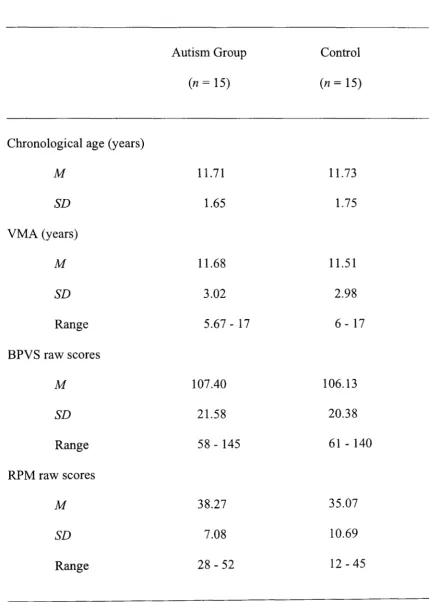
chronological age from 8 years and 9 months to 13 years and 11 months. Children in the control group were recruited from local schools in South East England. Their ages ranged from 8 years and 5 months to 14 years and two months. VMA was assessed by the BPVS (L. M. Dunn et aI., 1997). Nonverbal mental age was assessed using Standard Progressive Matrices (Raven, 1996). Table 3.1 summarises
Table 3.1 Participant characteristics
Chronological age (years) M SD VMA (years) M SD Range BPVS raw scores
M SD Range RPM raw scores
M SD Range
Autism Group (n = 15)
11.71 1.65
11.68 3.02 5.67 - 17
107.40 21.58 58 - 145
38.27 7.08 28 - 52
Control (n = 15)
11.73 1.75
11.51 2.98 6 - 17
106.13 20.38 61 - 140
35.07 10.69 12 - 45
Note. VMA = verbal mental age. BPVS = British Picture Vocabulary Scale. RPM
Materials. All stimuli were black line drawings presented singly on white 13 cm by 10 cm cards. There were two response cards differing only with respect to the relative positions, top or bottom, of two sentences: "I have seen the picture before" I "I have not seen the picture before". The response cards served as reminders as to what decision had to be made over the stimuli. In addition, once participants were trained in their use, these cards enabled participants to make responses without verbal prompts from the experimenter.
There were 16 practice items. These were divided equally into two
categories: plants and buildings. Each category was divided equally into study and test items. There were 32 memory task items. These were divided equally into two categories: animals and vehicles. Again, each of these categories was divided equally into study and test items. For both practice items and memory task items, half the test stimuli were "old" replicas of the study items, the remainder being novel items.
attention wandered, he was prompted to look at the card again and any mistakes in placing cards were corrected immediately by the experimenter. Participants then completed the practice test session. At the start, they were told that some of the test cards were exact copies of cards they had seen before, and some were new. They had to look at each card carefully and decide if they had seen the same picture before. They were familiarised with a response card and told to guess if unsure of the answer. The test cards were shuffled and placed face up in a single pile on the table one at a time. Participants responded in their own time by pointing to the relevant place on the response card. The memory task followed immediately with a procedure that was identical to the one described above for the practice session. Response card type was counterbalanced across participants.
Results and Discussion
The mean proportion of correct recognition responses from the memory task was similar for both participant groups: .87 (SD = .13) for the autism group and .81 (SD = .17) for the controls. The difference between groups was not significant: t(28)
= 1.05, p = .30. One sample t-tests revealed that for each group responding was significantly above the chance level of .5: t (14) = 11.19, p < .01 for the autism group and t(14) = 6.91,p < .01 for the control group. These reasonably high levels of memory task performance indicated successful use of the response cards by both participant groups and that recognition memory was intact in both groups. The absence of group differences suggested that performance on these two variables was
Experiment 3.2
In this experiment, participants were familiarised with categories that were very similar to those used by Klinger and Dawson (2001). The stimuli were cartoon animals that were organised around average prototypes. These prototypes possessed features (e.g. legs or nose) that were the category average in size. Following a short study phase participants made recognition responses to five exemplar types that were of decreasing similarity to the prototype. If there is a problem in integrating
information across experience, as proposed by central coherence theory (Frith, 1989; Frith & Happe, 1994), and if there is an impairment in the formation of prototypes (Klinger & Dawson, 2001) and in processing common features (Plaisted et al., 1998a) , then the usual prototype effect should not be replicated in the autism group using a recognition test. The recognition responses of the autism group should not reflect similarity to the prototype to the same extent as those of the control group. It is unlikely that such a reduced effect could be attributable to poorer recognition memory. This is because the autism group performed similarly to the control group on the memory task in Experiment 3.1.
Method
Participants. The same participants from Experiment 3.1 were recruited.
exemplar possessed six features that were varied along a dimension with five equal steps from value 1 to value 6. One particular feature could have any of the six discrete values. Alternatively, if it belonged to the prototype, it took the average value (3.5 on the scale). The size of the steps between values varied across features but was constant for each single feature (e.g. for the "insect neck" the values 1,2,3, 4,5, and 6 represented increments of 4mm). Exemplars varied in their global
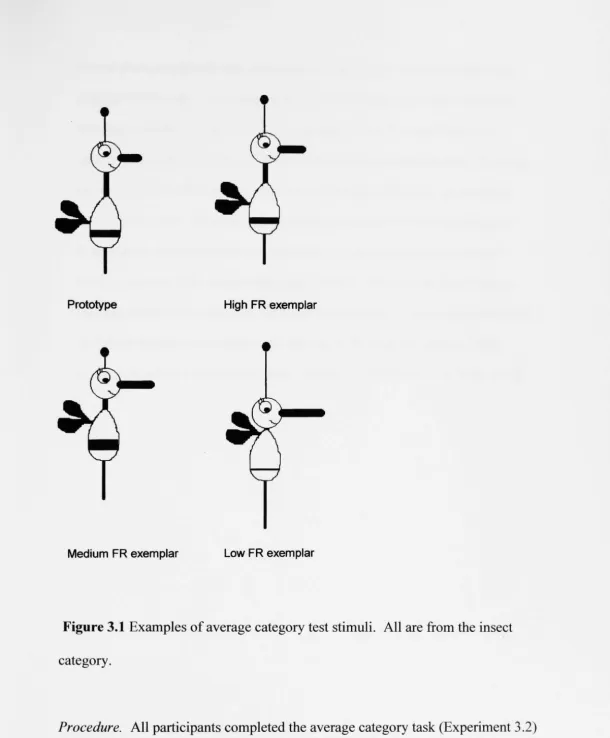
similarity or family resemblance (FR) to the prototype. In addition to the prototype (with all feature values set at 3.5), three exemplar types were generated. These possessed features that could take one of two possible values. The exemplar types with corresponding feature values in parentheses are as follows: high FR (3, 4), medium FR (2,5), and low FR (1,6).
There were 16 study items, 8 "monsters" and 8 "insects", and 34 test items: 17 from each category. The study items bore medium FR to their respective
prototype. See Table 3.2 for a description of study item structure for insects. The monster study items had an identical structure.
The test items for each category consisted of 4 replicas of study items (old medium FR exemplars) and 13 new items. The latter comprised one prototype and four items each of high, medium and low FR exemplars. Table 3.3 gives a
description of feature values for insect test items. Monster test items had an identical structure. Figure 3.1 illustrates the prototype and other new test exemplars from the
insect category.
the prototype features. In contrast, the study sets of the present experiments contained only medium FR exemplars. This single exemplar type was selected so that the results would reveal more information about what strategies participants were using. If they simply memorised single features from the study set, failed to integrate them, and then responded to test items on the basis of how confusable test item features were with study item features then recognition scores would not reveal a prototype effect. Medium FR exemplars would receive the highest recognition because they shared identical features with the study set. Also, recognition scores for prototype, high FR, and low FR exemplars would be very close because their
features all differed from the most similar study item features by roughly the same value (1.5, 1, and 1 units respectively). If however participants were integrating the features to produce an average then their responses would be determined by
Prototype High FR exemplar
[image:49.660.21.632.25.764.2]Medium FR exemplar Low FR exemplar
Figure
3.1
Examples of average category test stimuli. All are from the insect
category.
Procedure.
All participants completed the average category task
(Experiment 3.2)
after the memory task (Experiment 3.1) and both tasks were completed
within a
week. The instructions and procedure for the average category recognition task
were
identical to those used for the memory task
except
that during the study phase
Table 3.2 Study stimuli for average prototype categories: Insect feature values
Insect features
Body
Neck Nose Wing Sting band Antenna
Item No.a length length posItIOn .. b length width length
I 5 2 2 5 2 5
2 2 2 5 5 2 5
3 5 5 2 2 2 5
4 2 5 2 5 2 5
5 2 5 5 2 5 2
6 2 2 5 5 5 2
7 5 5 2 2 5 2
8 5 2 5 2 5 2
Note. a All items are medium family resemblance exemplars. b As measured from
Table 3.3 Test Stimuli for Average Prototype Categories: Insect Feature Values
Item No.
(Exemplar Type)
1 (Old Medium FR) 2 (Old Medium FR) 3 (Old Medium FR) 4 (Old Medium FR) 5 (New Prototype) 6 (New High FR) 7 (New High FR) 8 (New High FR) 9 (New High FR)
10 (New Medium FR) 11 (New Medium FR) 12 (New Medium FR) 13 (New Medium FR) 14 (New Low FR) 15 (New Low FR) 16 (New Low FR) 17 (New Low FR)
Neck length 5 5 2 2 3.5 3 4 3 4 2 5 5 2 1 6 1 6 Insect features
Nose Wing Sting length positiona length
2 2 5
5 2 2
5 5 2
2 5 5
3.5 3.5 3.5
4 3 4
3 4 3
3 4 4
4 3 3
5 5 2
2 5 2
2 2 5
5 2 5
6 1 6
1 6 1
1 6 6
6 1 1
Body
band Antenna width length
2 5
2 5
5 2
5 2
3.5 3.5
3 4
4 3
3 4
4 3
2 5
2 5
5 2
5 2
1 6
6 1
1 6
6 1
[image:52.643.91.535.166.772.2]Results and Discussion
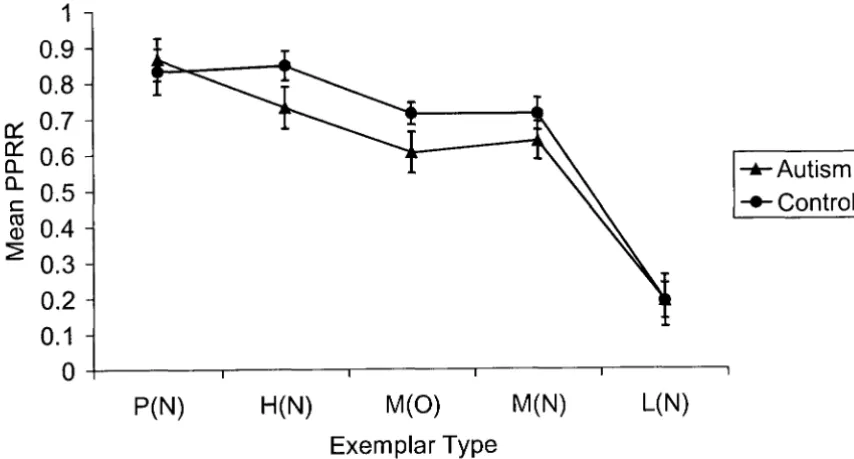
The frequency of positive recognition responses, selecting the answer "1 have seen the picture before", was counted for each subject and exemplar type. The proportion of positive recognition responses was then calculated. This represented true recognition for the "old" exemplars and incorrect responses (i.e. false alarms) for the remainder. The maximum possible number of positive recognition responses was 2 for the prototypes and 8 for each of the other exemplar types. (For each exemplar type, a chance level response would be 1 and 4 respectively.) The two participant groups were very similar in terms of the number of prototypes that they recognised. All individuals recognised at least one prototype, with 11 individuals from the autism group and 10 from the control group recognising both. An
independent samples t-test revealed no significant difference between the proportion of prototypes selected by the two participant groups: t(28) = .39, p = .70.
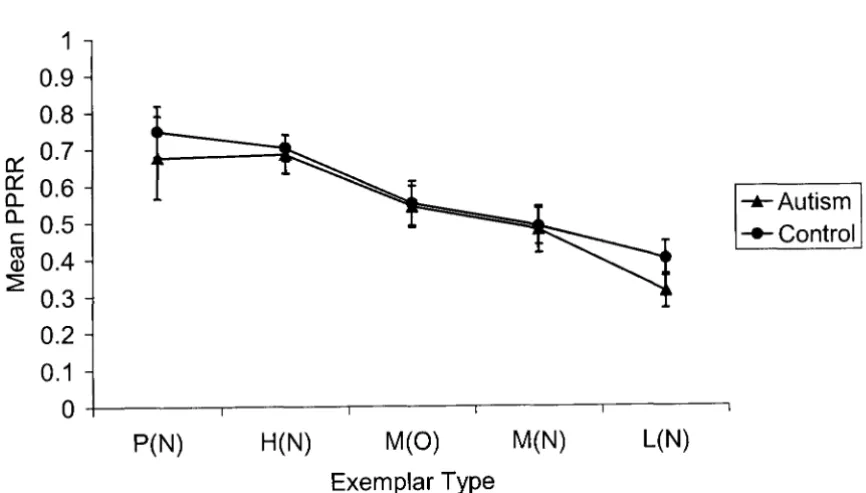
Both participant groups showed the same pattern of results. A higher proportion of prototypes and high FR exemplars were identified (incorrectly) as old than the actual study item replicas (old medium FR exemplars). There was no
1.72, p = 0.201. Repeated contrasts confirmed that high FR exemplars received a
significantly greater proportion of positive recognition responses than old medium FR exemplars, F(1,26) = 10.59,p < .01, and that new medium FR exemplars
received a significantly greater proportion of positive recognition responses than low FR exemplars, F(1,26) = 119.44, p < .01. The contrasts between the remaining exemplar types were not significant: prototype and high FR, F(1,26) = 1.63,p = .21, also old medium FR and new medium FR, F(1,26) = .15, p = .70.
1
0.9
0.8
~
0.7
~
0.6
0.. 0..
0.5
c co
0.4
Q) ~0.3
0.2
0.1
0
P(N) H(N) M(O)
Exemplar Type
M(N) L(N)
[image:54.646.100.527.330.559.2]... Autism ~Control
The aim of this experiment was to see whether a prototype effect could be obtained in the recognition memory of HF A children using an average category structure. The full effect was obtained in both the autism and control groups. New category prototypes and high FR exemplars received greater levels of recognition than exemplars that were actually studied. Furthermore, the two participant groups differed neither in overall level of exemplar recognition nor in the degree to which similarity to a category prototype affected recognition. In both groups the lower the family resemblance of novel exemplars the less false recognition they tended to receive. Thus it seems unlikely that individuals in either group responded on the basis of how confusable individual features belonging to test items were with individual features belonging to study items. If they were doing this, as discussed earlier, there would be no prototype effect. The proposals that autism is
characterised by impairments in prototype formation (Klinger & Dawson, 2001) and common feature processing (Plaisted et aI., 1998a) were unsupported by this study. No group differences were found in how the correlational structure of stimuli was represented in memory.
Experiment 3.3