City, University of London Institutional Repository
Citation
:
Ali, S.A.H. (1995). The impact of computer technology on accounting and auditing in the Middle East with special emphasis on Arabisation, transfer of technology and training. (Unpublished Doctoral thesis, City University London)This is the accepted version of the paper.
This version of the publication may differ from the final published
version.
Permanent repository link:
http://openaccess.city.ac.uk/7737/Link to published version
:
Copyright and reuse:
City Research Online aims to make research
outputs of City, University of London available to a wider audience.
Copyright and Moral Rights remain with the author(s) and/or copyright
holders. URLs from City Research Online may be freely distributed and
linked to.
CITY
University
BUSINESS SCHOOL
The Impact of Computer Technology
on Accounting and Auditing in the Middle East
with Special Emphasis on Arabisation,
Transfer of Technology and Training
Sami Abbas Hussain Ali
lq016
VOLUME I
CONTENTS
Page
List of Figures
5
List of Tables
6-11
Acknowledgments
12
Abstract
1 3
CHAPTERS
I
INTRODUCTION
1.1
Background To Selected Number Of Countries In
The Middle East 141.1.1
Demography Of The Region
15
1.1.1.1
Major Industrial and Economic Development Of Countries In The Region
1 6
1.1.1.2
The Accounting Profession
27
1.1.1.3
Education
30
1.1.1.4 Economic Prospective Of The GCC States
31
1.1.1.5 Economic Of The Region: A Historical Overview
37
1.1.2
Technical Aspiration Of The Countries In The Region
39
1.1.2.1
Introduction
39
1.1.2.2
Historical Background
40
1.1.2.3
Objectives
41
1.1.2.4 Methodology
41
1.1.2.5 The Status Of Information Technology In The Arab World
42
1.1.2.6
Applications
42
1.1.2.7
Employees
43
1.1.2.8
Current Development Capabilities
43
1.1.2.9 Analysing The Needs Of Arab Countries For Development
45
1.1.2.10 Areas Of Development
46
1.1.3
Western Influence On The Region
47
1.1.3.1
Users' Perspective
47
1.1.3.2 Hardware and Software Companies
48
1.1.3.3
Software Suppliers
50
1.1.3.4
Accounting Profession
51
1.1.4
Industrial and Commercial Opportunities In Government and Private Sectors 56
1.1.4.1
Introduction
56
1.1.4.2
Gulf Expatriate Work Force
56
1.1.4.3
The Scope For Computerisation
59
1.1.4.4 Size Of The Market To 1985
62
1.1.4.5
Size of the Market in the UAE
66
1.1.4.6
Banking
69
1.1.4.7
Construction
70
1.1.4.8
Travel
70
1.1.4.9
The Oil Sector
70
1.1.4.10 Education
71
1.1.4.11 Government
71
1.2
Purpose, Need and Limitations Of The Study
7 1
1.2.1
Purpose
71
1.2.2
The Need For The Study
72
1.2.3
Limitations
73
II
HISTORICAL EVOLUTION OF COMPUTER TECHNOLOGY
2.1
Introduction
74
2.2
Historical Perspective
74
2.2.1
Overview
74
2.2.2
Current Hardware Development
76
Page
2.3 Historical Development Of Software 79
2.3.1 Introduction 79
2.3.2 Computers Operating Systems and Application Software 79
2.3.2.1 Programming Language 80
2.3.2.2 Application Software 80
2.3.2.3 System Software 81
2.4 Information Technology 81
2.4.1 Introduction 81
2.4.2 Evolution Of Standards 81
2.4.3 Information Technology Assessment and Adaptation In Organisations 82
2.5 Transfer Of Information Technology 93
2.6 Role Of The Transnational Corporations In The Transfer Of
Information Technology 96
2.6.1 The Role Of Transnational Corporations In New Technologies 96
2.6.2 Transnational Technology Market 97
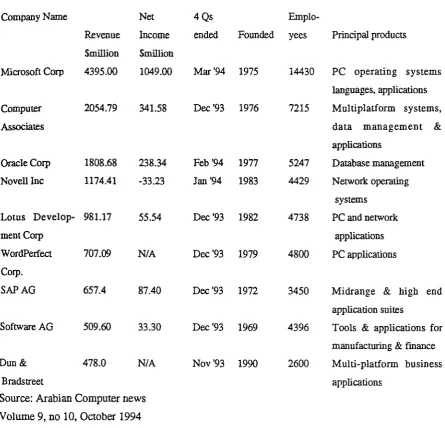
Annex Sales and Profit of Major Transnational Corporations in Electronics 102-105
DI THE INTERRELATIONSHIP BETWEEN INFORMATION TECHNOLOGY AND THE ACCOUNTING AND AUDITING PROFESSION IN THE MIDDLE EAST
3.1 Objective 106
3.2 The Current State Of The Accounting and Auditing Profession 106
3.2.1 Introduction 106
3.2.2 Current Trends In Public Accounting Practice 114
3.3 Automating the External and Internal Audit Function 116
3.3.1 The Role of Automated Audit Tools 116
3.3.2 Auditing with Computer 120
3.3.2.1 Introduction 120
3.3.2.2 Changes in Auditing Methodes and Skills Requirements 123
3.3.2.3 Auditing Skills Requirements 123
3.3.2.4 Automating The Internal Audit Function 126
3.3.2.5 The Internal Auditor's Role 126
3.4 Computer Control Guidelines 128
3.4.1 Audit Responsibilities 128
3.4.2 General Control Procedures 129
3.4.3 The Effect of Microcomputers on the Accounting System and Related
Internal Controls 130
3.4.4 The Effect of a Microcomputer Environment on Audit Procedures 130
3.5 Local Area Networks 132
3.6 Conclusion 133
3.7 Research Hypotheses 135
3.7.1 Introduction 135
3.7.2 Experimental Investigation Relating to Computer Hardware and
Software Users 136
3.7.3 Experimental Investigation Relating to the Auditing Profession 136 3.7.4 Experimental Investigation Relating to Colleges and Universities 137 3.7.5 Experimental Investigation Relating to Computer Hardware and Software
Suppliers 137
3.7.6. Experimental Hypotheses 138
3.7.7 Formulation of Hypotheses 138
3.7.7.1 Hypotheses Relating to Arabisation 139
3.7.7.2 Hypotheses Relating to Transfer of Technology 139
3.7.7.3 Hypotheses Relating to Computer Training 140
Page
IV RESEARCH METHODOLOGY
4.1 Introduction 141
4.2 Research Environment 142
4.2.1 The GCC Political, Social and Economical Environment 142
4.2.1.1 United Arab Emirates 144
4.2.1.2 Bahrain 144
4.2.1.3 Saudi Arabia 145
4.2.1.4 Oman 145
4.2.1.5 Qatar 146
4.2.1.6 Kuwait 146
4.2.2 Use Of Expatriate Workforce 146
4.2.3 Projections Of Gulf Populations 147
4.2.3.1 Demographic Growth 147
4.2.3.2 Expatriate Population 149
4.3 Research Targeted Population 152
4.3.1 Overall Population By Industry and Country 153
4.3.2 Computer Hardware and Software Users 154
4.3.3 External Audit Firms 155
4.3.4 Colleges and Universities 157
4.3.5 Computer Hardware and Software Suppliers 158
4.4 Approach 160
4.4.1 Phase I - Available Literature 160
4.4.2 Phase 11 -PilotPilot Study 160
4.4.3 Phase Tll - The Structured Questionnaire 160
4.4.4 Phase IV - Interviewing Through Research Interview Questionnaire 161 4.4.4.1 Development and Approval Process Of Research Interview Questionnaire 161
4.4.4.2 Development Of Interview Plan 163
4.4.4.3 Selected Organisations 164
4.4.4.4 Key Characteristics Of Individuals Interviewed 165
4.4.4.5 Conducting The Interviews and Interpreting The Data 165
V DESCRIPTIVE ANALYSIS OF DATA COLLECTED - PHASE THREE
5.1 Introduction 166
5.2 Sources Of Information On Targetted Audience for the
Survey Questionnaire 166
5.2.1 Introduction 166
5.2.2 Main Sources Of Information On Computer Hardware and
Software Suppliers 167
5.2.3 Telephone Directories Of Businesses In The Gulf 168
5.2.4 Other Sources 168
5.3 Overall Analysis Of Survey Responses 169
5.3.1 Introduction 169
5.3.2 Number Of Organisations Responded By Country 170
5.3.3 Number Of Organisations Responded By Sector Within Country 170
5.3.4 Language Of Administration 171
5.3.5 Composition Of Workforce By Nationality 173
5.3.6 Conclusion 180
5.4 Analysis Of Survey Responses - Computer Hardware and Software Users 180
5.4.1 Introduction 180
5.4.2 Analysis Of Users By Country 181
5.4.3 Analysis Of Application Systems and Users 182
5.4.4 Factors Limiting The Expansion Of Computer Accounting
Systems In Arabic 184
5.4.5 Analysis Of Arabic Terms and Quality Of Language Used
In Arabic Systems 191
Page
5.4.6
Computer Hardware
192
5.4.7
Language Of Operating Systems
192
5.4.8
Application Software Run On Main Computer
193
5.4.9
Application Software Run On The Organisation Equipment Other
Than The Main Computer system
194
5.4.10
Use Of Consultants
195
5.4.11
Training On The Use Of Information Technology
197
5.4.12
Overall Assessment On The Ease Of Use and Implementation Of
Accountining Systems
198
5.5
Analysis Of Survey Responses- Audit Firms
200
5.5.1
Introduction
200
5.5.2
Analysis Of Audit Firms Responses By Country
201
5.5.3
Analysis Of Language Users Of Computer Systems
201
5.5.4
Composition Of Audit Firms
202
5.5.5
Analysis Of Audit Clients
205
5.5.6
Analysis Of Qualified Audit Staff
206
5.5.7
Use Of Computer Technology By Audit Staff
207
5.5.8
Computer Applications Used
208
5.5.9
Staff Training
209
5.5.10
Computer Consultancy Provided To Clients
211
5.5.11
Client Training
212
5.5.12
Sources Of Training
214
5.6
Analysis Of Survey Responses - Colleges and Universities
215
5.6.1
Introduction
215
5.6.2
Analysis Of Respondents By Country
215
5.6.3
Language Of Administration
216
5.6.4
Users Of Computer Systems
217
5.6.5
Policies and Guidelines Concerning Computer Utilisation
217
5.6.6
Implementing Computer -Based Systems and /or Curricula
218
5.6.7
Factors Impacting On The Introduction Of Computer Education
220
5.6.8
Computer Co-Ordinator
222
5.6.9
Responsibility For Computer Education
223
5.6.10
Level Of Support For Computer Technology and Automation
224
5.6.11
Computer Literacy In Colleges and Universities
225
5.6.12
Instructional Applications
227
5.6.13
Type Of Computer Courses
228
5.6.14
Business Community Involvement
230
5.6.15
Level Of Motivation To Introduce Computer Technology
231
5.6.16
Computer Introduction Into Universities and Colleges
232
5.6.17
Role Of The Ministry Of Education In Computer Education
233
5.7
Analysis Of Responses - Computer Hardware and Software Suppliers
234
5.7.1
Introduction
234
5.7.2
Analysis Of Suppliers By Country
234
5.7.3
Language Of Administration
235
5.7.4
Composition Of Workforce By Nationality
236
5.7.5
Analysis Of Users and Their Language Of Operation
236
5.7.6
Scope Of Activities
237
5.7.7
Supply Of Hardware
237
5.7.8
Supply Of Software
239
5.7.9
Number Of Sites
241
5.7.10
Demand For Computerised Arabic Based Accounting Systems
241
5.7.11
Professional Advice On Computerisation
242
5.7.12
Supply Of Training Sources
242
LIST OF FIGURES
Figure No. Figure Title Eng
2.1 MIS Support of Various Organisations Level 85 - 86
2.2 MIS Environment: Era I (Data Processing) mid-1950s through
mid-1970s 87
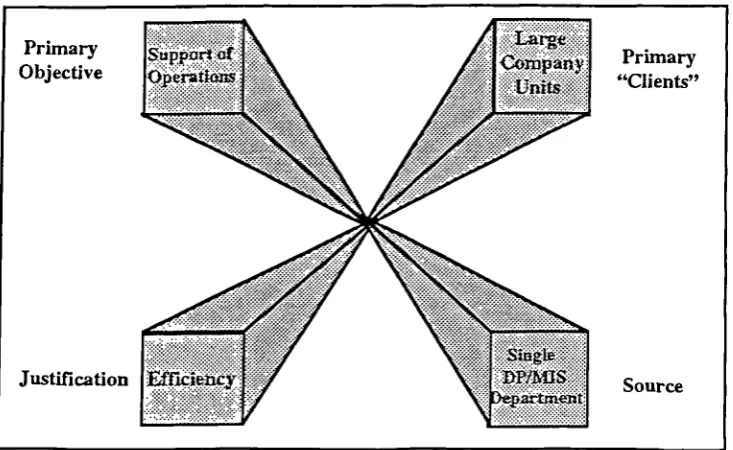
2.3 MIS Environment: Era ll (Management Support), mid-1970s
through mid-1980s 87
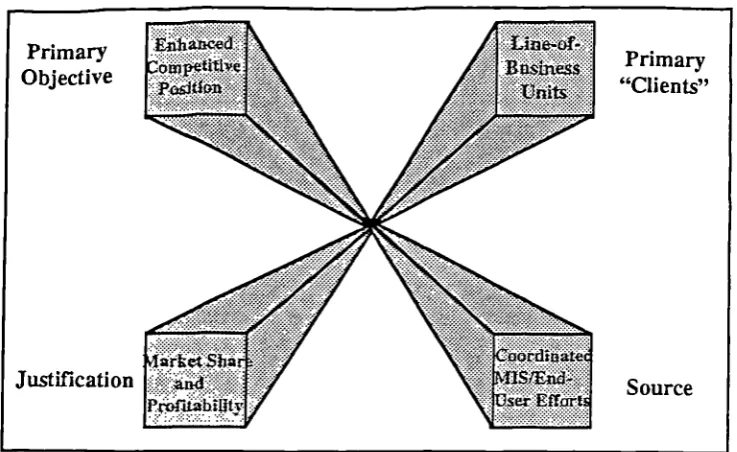
2.4 MIS Environment: Era III (Competitive Positioning), mid-1980s
through the Present. 88
2.5 The Personal Workstation on Enabling Tool 89
2.6 Function and Categories of Personal Productivity Software 90
3.1 Summarise of Audit Tools and Techniques 117-118
3.2 Use of Information Technology Tools/Techniques in Auditing 119
3.3 Percentage of Respondents who Reported the Benefit of Information Technology as one of the three most Important
Benefits 119
3.4 Auditor's Tool Box 120
3.5 Specific Technology Trends and Their Risk, Contro and
Audit Implications 133-135
LIST OF TABLES
Table No.
Table Title
Page
1.1
Key Economic Indicators
17
1.2
Saudi Arabia: Current and Capital Account Forecast, 1994 - 96
18
1.3
Key Economic Indicators
20
1.4
Key Economic Indicators
25
1.5
Key Economic Indicators
27
1.6
Estimated World Oil output 1993
33
1.7
GCC: Oil Export revenues 1990 - 1995
34
1.8
Spot Crude Prices US Dollars per barrel
35
1.9
GCC: Volume of Export of Crude Oil and Petroleum Products
1990 - 1995
36
1.10
Proved Reserves at End 1993
36
1.11
Gross Domestic Product per person (US$)
37
1.12
Estimate of Population by Age Group in the Gulf States
38
1.13
Gross Domestic Product of Gulf States (in US billion at Current
Prices) Latest Figures
39
1.14
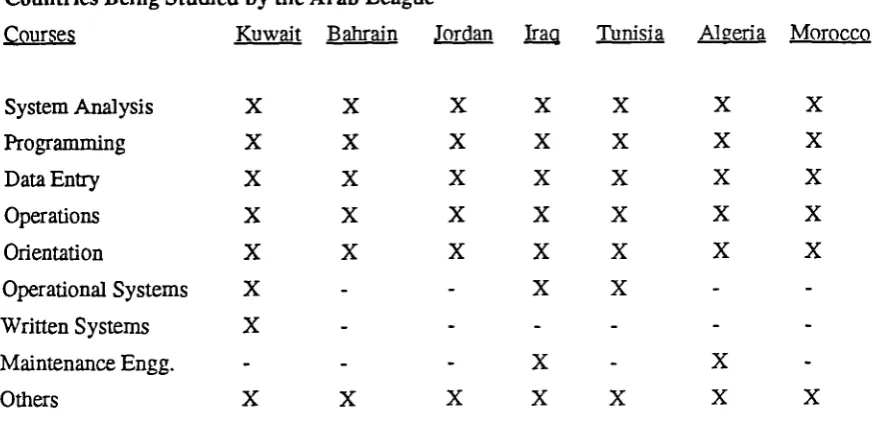
Distribution of Information Technology Development Courses
in Seven Countries Being Studies by the Arab League
44
1.15
Number of Centres and Organisations or Academic Institutions
which offer Technical Development and Professional Development
in Information Technology
45
1.16
Top European IT Companies
49
1.17
Leading Computer Companies
49
1.18
Top Ten Independent Software Vendors Operating in the Gulf Region
50
LIST OF TABLES
Table No. Table Title Page
1.19 Top Ten Leading Accounting Firms in the US - FEED ATA 52
1.20 Top Ten UK Firms Fee Income Split 1994 52
1.21 Top Ten Accounting Firms in the World - Member Firm Fee Income
($ million) 53
1.22 Top Ten Consultancies in the World Ranked by Revenue 54
1.23 The largest accounting firms in the Gulf region 54
1.24 The largest Pan Arab accounting firms operating in the Gulf region 55
1.25 Percentage of Gulf Expartriate Work Forces (latest available figures) 57
1.26 Saudi Arabia: non-national population by nationality, 1990 58
2.1 Generations of Modern Digital Computers 77
2.2 Quantitative leaps in chip complexity 78
2.3 Programming languages 80
2.4 Growth estimates of world production of information technology
systems 1986 - 1995 99
4.1 GCC populations 1990 and 1995 148
4.2 GCC non-national populations 1990 and 1995 149
4.3 Change in non-national populations 1990 to 1995 151
4.4 Change in non-national populations 1990 to 1995 151
4.5 Overall targeted population by country 153
4.6 Overall targeted population by industry 153
4.7 Number of computer hardware and software users approached 154
4.8 External audit firms approached 156
4.9 Colleges and universities approached 157
4.10 Computer hardware and software suppliers approached 159
LIST OF TABLES
Table No. Table Title Page
5.1 Overall Response by country 170
5.2 Response by Sector 170
5.3 Languages of Administration 171
5.4 Analysis of main written languages of Administration by user 172
5.5 Analysis of second language used regularly for administration by user 172
5.6 Computer language of operations 173
5.7 Composition of workforce by Nationality 173
5.8 Analysis of Response by Industry 180
5.9 Response by country 181
5.10 Computer Hardware & Software Users: Composition of workforce
by Nationality 182
5.11 Analysis of number of persons within the organisation who can use the
application systems regularly as part of their normal duties 183
5.12 Analysis of the effect of non-arabic application systems used by staff
whose first language is Arabic 183
5.13 Analysis of factors limiting the expansion of computer accounting
systems in Arabic 184
5.14 Analysis of reasons for not using bilingual systems 184
5.15 Analysis of Arabic Technical Accounting Terms and Non-Technical
Arabic Language Used. 192
5.16 Type of main computer hardware 192
5.17 Applications run on the organisation's main computer system 193
5.18 Applications run on the organisations equipment other than the
main computer system 195
5.19 Type of professional advice obtained on computerisation. 196
LIST OF TABLES
Table No. Table Title
Eau
5.20 Type of organisation from whom professional advice is bought in 196
5.21 Source and area of advice on computer training 197
5.22 Language in which training is provided to staff on the use of computer
technology 198
5.23 Overall assessment on the ease of use and in implementing computer
accounting system 199
5.24 Response by country : Audit firms 201
5.25 Analysis of the firm's position within the audit profession 202
5.26 Analysis in percentage terms of audit clients mix by business category 205
5.27 Analysis of the number of qualified Accountants 206
5.28 Analysis of number of accounting and auditing staff in the firm who
use computer technology very regularly 207
5.29 Analysis of the number of staff other than accounting and auditng
staff who use computer technology very regularly 208
5.30 Analysis of the type of application and computer uses in the firms 208
5.31 Analysis of frequency and type of computer training provided to the
qualified Accountant within the firm 210
5.32 Analysis of the type of advice provided to the clients on computerisation 211
5.33 Analysis of the area of expertise in which training on the use of computer
technology is provided to clients 213
5.34 Analysis of the sources of advice on computer training given to clients 214
5.35 Analysis of bought-in advice on computer training 214
5.36 Response by country 215
5.37 Analysis of main written language of administration 216
5.38 Analysis of the written policies/guidelines concerning computer
utilisation adopted by the universities and colleges 217
LIST OF TABLES
Table No. Table Title Page
5.39 Analysis of factors that delayed or hampered the university's
progress into computer education 221
5.40 Analysis of the department's responsible for each of the listed
computer-related activities of the institution 223
5.41 Analysis of the level of support given to the introduction of computer
technlogy and automation by the faculty members of the universities 225
5.42 Analysis of the percentage of instructors who are computer literate 225
5.43 Analysis of the percentage of instructors who are actively using the
computer with curriculum 226
5.44 Analysis of the instructional applications of computers covered by in service program offered to instructors in the universities/ colleges
5.45 Analysis of the type of courses offered in terms of their business application
5.46 Analysis of the language of instruction for the computer technology courses
5.47 Analysis of the direct involvement of the business community in promoting computer technology in the eductional institution
5.48 Analysis of the university level of motivation in introducing computer technlology
5.49 Analysis of the year in which the computer technology was first introduced as part of the university curricullum
5.50 Analysis of the institutions' perception of the Ministry's role in the
support of computers in education 233
5.51 Response by country 235
5.52 Analysis of main written language of administration 235
5.53 Composition of workforce by nationality 236
5.54 Analysis of company's activities 237
5.55 Analysis of the type of hardware the company supplies 237
227
228
228
230
231
232
LIST OF TABLES
Table No. Table Title Page
5.56 Analysis of the application software packages offered by suppliers 239
5.57 Analysis in percentage terms of the assessment of the companies about
the demand for computer accounting systems in Arabic by Arabic users 241
5.58 Type of professional advice obtained on computerisation 242
5.59 Language in which training is provided to staff in the use of computer
technology 243
5.60 Type of organisations from whom professional advice is bought-in 243
A CKNOWLEDQEMENT
I have received a great amount of support and assistance in preparing this research
particularly from various government agencies, businesses, auditing firms, computer
hardware and software suppliers and universities in the Middle East who participated by
responding to the research questionnaires.
Special recognition and thanks to Dr. George Selim, my research professor for his
continuous encouragement, support and guidance throughout the project, and to Liz Taylor
of City University Business School, London for her relentless reminders of what I ought to
do.
Acknowledgements are also due to Mr Brendan Walsh of the Institute of Chartered
Accountants in England and Wales who provided a number of related articles; to Judith K
Burke, Director of Professional Services at the Institute of Internal Auditors, and Dr. Faria Al
Zahawai of the League of Arab States for providing useful information on the computer
centres in the Middle East and Samir Mehanna of Al Bawarcii Group and Steve Roberts of
the Higher Colleges of Technology for their technical computer support.
Contribution was also made by my firm Ernst & Young in providing access to numerous
articles and literature and for authorising the typing of the thesis. Special thanks to Mr
Jamil I Channo, Managing Partner of Ernst & Young's Abu Dhabi Office, for his moral
support and the typing staff of Abu Dhabi Office for typing the research material over and
over.
Last but not the least I would like to thank my wife Anya for her patience, encouragement
and unlimited support.
ABSTRACT
The purpose of this research is to examine closely the impact of information technology on accounting and auditing , in particular, the computer technology on accounting and auditing in the Middle East with special emphasis on arabisation, transfer of technology and training.
The use of computers and information technology is altering the way we do things. Middle East practitioners at present are experiencing a transition in contemplating the use of technology to improve their working methods.
The traditional role of Arab accountants is changing. There is a great deal of demand for improved skills to cope with the increased use of technology by government agencies, private businesses and educational institutions.
The improved economic conditions in the Middle East over the past decade have made it possible to acquire new technology, and at the same time made it necessary for accountants and auditors who do not have technical skills to upgrade their standards to deal with the revolution of information technology that is taking place in the West.
The objective of the research is to deal with two distinct problems relating to computer technology. The first is that of existence of such technology in the Middle East. The second concerns the appropriate level of its introduction to the region.
The specific objectives of this research are as follows:
(a) to review the current status of computer technology worldwide and in the Middle East;
(b) to outline the inadequacies of the current practice by businesses, governments, auditing firms and educational institutions;
(c) to show how the region may benefit from the introduction of computer technology; and
(d) to discuss the implications of such technology on the region as a whole and its impact on issues such as Arabisation, transfer of technology and training.
To accomplish the desired objectives of the research, a research methodology was used and included a historical analysis and literature search and pilot study and analysis of the survey which included computer technology users, providers and consultants. The study focused on the key variables namely introducing the technology and its impact, computer hardware, computer software Arabisation and training and skills transfer.
CITY
University
BUSINESS SCHOOL
The Impact of Computer Technology
on Accounting and Auditing in the Middle East
with Special Emphasis on Arabisation,
Transfer of Technology and Training
CHAPTER 1
CHAPTER I
INTRODUCTION
1.1 Background to a Selected Number Of Countries in the Middle East
Recent changes in the world economy have had a profound impact on the Arab countries.
The nature and extent of the impact varied greatly from one country to another. It is possible to
identify three groups of countries in the Arab world (1).
(a) Oil exporting countries such as Algeria, Bahrain, Iraq, Kuwait, The Libyan Arab
Jamahiriya, Oman, Qatar, Saudi Arabia and the United Arab Emirates.
(b) Middle income countries comprising Egypt, Jordan, Lebanon, Morocco, The Syrian Arab
Republic and Tunisia.
(c) Low income countries such as Mauritania, Somalia, Sudan, The Yemen Arab Republic and
Djibouti.
The study will concentrate on the oil producing countries in the Gulf.
For the oil exporting countries, the single most important factor has been the rise and fall in the
price of oil which constitutes on average more than 90 percent of their exports. During the better
part of the 1970s and early 1980s, these countries were in a fortunate position of adjusting to the
dramatic increase in their wealth following soaring oil prices. More recently they have been
confronted with the consequences of an equally dramatic decline in their oil revenues a trend
which seems to continue in 1990's.
For almost a decade after 1973, following the escalation of oil prices, the oil exporting countries
faced the uncommon challenge of adjusting to a massive increase in foreign receipts and large
external payment surpluses (2).
Typically, the immediate policy response was to increase government spending with a view to
redistributing part of the increased oil earnings, promoting domestic absorption and encouraging
private sector investment. This was a sound policy strategy not only from the standpoint of
domestic development but also from that of global adjustment. Domestically, the challenge for
the oil exporting countries was to foster more balanced economic development while maintaining
the financial stability that had historically characterised their economies.
The oil exporting Arab countries achieved a considerable measure of success in bringing about
more balanced growth and realised important gains in terms of diversification. Virtually all
sectors in the oil exporting countries particularly manufacturing, construction and services
witnessed rapid growth. However, in some countries, lags in development of infrastructure led to
bottlenecks aggravating inflation and exerting upward pressure on real exchange rates.
From the standpoint of global adjustment, the very strong growth of imports of goods and
services by oil exporting countries from the rest of the world provided an important offset to the
recessionary tendencies in the world economy in the mid 1970s. At the same time, the oil
exporters took the opportunity to accumulate large holdings of official reserves and other foreign
assets.
1.1.1 Demography of the Region
The Arab countries which have been selected in this study include Saudi Arabia, United Arab
Emirates, Qatar, Bahrain and Kuwait. These are the most affluent countries in the region with
sufficient financial resources to acquire the technology and hire professional staff to help them
use it. These countries are bound by a joint economic agreement called "Joint Economic
Agreement of the members of the Gulf Co-operation Council" (3). The agreement calls for closer
and stronger relations and ties based on willingness to develop, expand and support their
economic ties on stronger bases and for the benefit of their people. The agreement was drafted in
order to co-ordinate and unify their economic, financial and monetary policies as well as their
commercial and industrial legislation and their customs regulations.
In the remainder of this section these countries will be explored individually with a view to
establishing an understanding of the country and the opportunities for the use of information
technology. Various references and brief quotations are made in this research to materials on the
countries in the region which have been compiled and issued by a number of organisations
operating in the region including banks, public accountancy firms, government gazette and the
1.1.1.1 Major industrial and economic development of countries in the region
(a) Saudi Arabia
Since the 1970s oil boom, Saudi Arabia has rapidly developed a modern infrastructure. It has
up-to-date seaports, an efficient network of roads, three international airports and numerous
regional ones. Its telecommunication system is advanced. It has two modern industrial cities,
Jubail and Yanbu, and industrial estates in several other major cities. It is equipped with modern
hospitals and numerous universities and vocational training centres.
The 1980s decrease in world oil demand and prices led to decreased government spending and a
reduction in economic activity. However, beginning in 1986, however, the government increased
oil production, enabling the economy to grow again. Through its five year (1985-1990) economic
plan Saudi Arabia was pursuing two economic goals:
development of industry, agriculture and mining to decrease dependence on oil; and
the private sector's assumption of responsibility for the economic development of the
Kingdom.
To achieve the first goal, the government encouraged the creation of joint ventures with foreign
participation and management. These joint ventures have gradually evolved into enterprises with
Saudi management and Saudi ownership of a majority interest. The second goal was promoted
through round table discussions between the government and the business community.
These goals, together with Saudi Arabia's need for technical know-how and foreign expertise, its
developed infrastructure and its active private sector, were combined to create a wide range of
potential economic opportunities for business interests in industrialised nations (4).
According to a memorandum issued by Clifford Chance, an international law firm operating in
the Gulf Region that the countries of the Gulf co-operating council are considered to be important
customers for overseas military and civil works equipment and service suppliers. In Saudi Arabia
and the United Arab Emirates increased emphasis is being given to ensuring that part of the
significant cost of defence procurement from overseas contractors is offset by investment in the
According to Clifford Chance, it is anticipated that in future this type of offset investment
requirement will be extended to major non-defence related projects. In this connection, the Saudi
Ministry of posts, telegraphs (PTT) has been reported to be considering attaching offset
investment as a requirement to a proposed contract for a major expansion and upgrading of the
kingdom's telecommunication system (6).
Other GCC states are likely to adopt similar programmes to offset part of their defence and major
civil works procurement contracts in future. Consideration was given to including an offset
investment requirement for the main contract for Bahrain's expansion of the Alba Aluminum
smelter defence procurement contracts and foreign civil and aircraft orders in Kuwait, following
the liberation of that country in early 1991, are likely to include an element of offset investment;
Qatar too is studying ways in which offset investment may be implemented.
The concept of offset is that foreign suppliers should plough back a proportion of their contract's
value into an investment in their country, with the overall intention of assisting in the economic
development of that country (7).
Key economic indicators according to latest published results are as follows:
Table 1.1: Key Economic Indicators
1993 1992
GDP ($ million) 110,200 110,200
GDP growth (per cent) 0.0 5.0
Inflation (per cent) 0.0 -4.0
Trade surplus ($ million) 10,000 13,000
GDP = gross domestic product
Source: Government figures.
MEED estimates
According to MEED the Kingdom planners are building on firm foundation with a gross domestic
(GDP) of more $ 110,000 million, Saudi Arabia is already the largest economy in the Middle
East. Long the largest oil exporter it has recently overtaken Russia to become the world's leading
oil producer. The Kingdom's wealth has made it one of the biggest importers of goods and
services outside the OECD.(8) As shown in table 1.2 that the Kingdom's balance of payments
published earlier in 1994 shows exports rising to almost $50 billion in 1995.
Due to surging oil sales and firmer prices, the Kingdom's oil exports are projected to rise to 8.9
million barrels a day (b/d) in 1995 and 9.4 million b/d in 1996. Despite rising imports, the current
account deficit will fall to $ 3 billion in the year. The deficit will start rising again in 1996 on a
further increase in imports. The most consistent trend is in external debt which is forecast to rise
to more than $37 billion in 1996. This will more than twice the 1989 level, but still less than a
third of forecast gross domestic product that year.(9)
Table 1.2: Saudi Arabia: current and capital account forecast, 1994-96
($ million)
1994 1995 1996
Exports 41,553 49,168 49,189
Imports 25,626 27,893 29,356
Trade balance 15,927 21,275 19,833
Net Services -13,927 -15,974 -16,283
Transfers -9,000 -8,300 -8,300
Current account -7,000 -3,000 -4,750
Source: Trade & Finance. The Petroleum Finance Company, Washington DC
August 1994
(b) United Arab Emirates
Exploitation of oil and gas reserves during the 1970s and 1980s enabled the seven Emirates
making up the UAE to achieve substantial economic growth. Economic activity centred on the
development of a modern infrastructure, including roads, ports, airports, telecommunications,
electric utilities and desalination projects; the construction of residential and commercial
structures, schools, hospitals and hotels; and the establishment of petrochemical and
manufacturing industries.
The economy is influenced by fluctuations in the international market because oil, gas and related
petrochemical industries continue as the most important economic sector. To reduce the
dependence on petroleum by diversifying the economies of the oil producing Emirates and to
establish a firm economic base for the country as a whole, the federal and individual Emirate
governments have initiated programmes to attract foreign and local investment in fields they
believe will be of national benefit. Manufacturing and agricultural projects that will help the
UAE move towards self-sufficiency are particularly encouraged.
To attract investments of expertise and capital, the governments of the individual Emirates seek to
provide an attractive environment to promote business activity within the country. The following
are some of the principal features of the economic and business environment (10):
a co-ordinated infrastructure, which provides all essential utilities to the major centres;
excellent communication systems with the Middle East region and the rest of the world;
a virtual absence of taxation;
a well-structured financial sector with no exchange control regulations;
free trade zones, which ensure ease of registration and efficient operating facilities;
minimal financial reporting requirements at both the federal and the local Emirate levels;
and
an attractive social environment, including modern educational, medical and recreational
facilities.
According to Clifford Chance the UAE Offset Programme was launched in 1990 and its stated
aims are to generate foreign exchange, create jobs for UAE nationals, transfer technology from
overseas to the UAE and generally create a favorable business environment. The UAE Offset
Programme applies only in respect of defence contracts with the Federal Armed Forces and not
those with, for example, the Dubai Defence Force.
As in Saudi Arabia, offset investment in the UAE is regarded as a valuable investment for the
country's national economic development. Consequently, whilst defence procurement contracts
are an obvious starting point for offset requirements, it is possible that these will be extended
subsequently to other large civil contracts.
To be accepted as offset investment, proposals put forward by foreign vendors must meet criteria
related to long-term commercial viability, price, technology transfer and represent either a new
business activity or an extension of commercial entities presently being undertaken by overseas
As regards technology transfer, the proposed offset investment must employ technology which is
at least equivalent in sophistication to that of the goods or services purchased. Preferably, the
technology transferred should include elements which are not presently available to local
companies in the UAE. Such technology may be transferred by licensing, patents and through
continued access to foreign expertise and data.
The UAE Offset Programme also provides that cash payments may be made by the foreign
contractor in lieu of a conventional offset proposal. Such cash contributions will be subject to
negotiation between the UAE Offset Group (UOG), representing the UAE Federal Government,
and the relevant foreign contractor and will be deposited in an Offset Development Fund for
subsequent disbursement by the UOG to high priority projects in accordance with perceived
national development priorities (11).
Key economic indicators according to the latest published results are as follows:
Table 1.3 Key Economic Indicators
1993 1992
GDP ($ million) 35,865 35,457
GDP growth (per cent) 1.0 3.0
Inflation (per cent) 6.5 5.0
Trade surplus ($ million) 4,755 5,962
GDP = gross domestic product
Source: government figures,
MEED estimates
Preliminary figures released by the UAE Ministry of Planning indicated that all segments of the
economy of the UAE with the exception of the oil sector, recorded further growth in 1993 for the
fourth consecutive year. The GDP of the nation in 1993 rose by 1.08% to a level of 35.9 billion
compared with $ 35.5 billion the previous year.(12) The atmosphere is most buoyant in Abu
Dhabi. Despite federal government's announcement that public spending is being reduced in
1994.
More recent announcements in the newspapers are directed at the government efforts to privatise
its infrastructure. According to Emirates law newsletter September 1994 edition that:
"The UAE is planning to end the government monopoly of various utilities (including ports,
electricity, communications and other utilities) by way of a large scale privatisation program to
provide the private sector with an opportunity to invest its funds locally instead of abroad.
Privatisation plans could also cover hospital and airport services and manufacturing entities.
With the law establishing the UAE Stock Exchange expected to be published soon, the UAE
Federal and local authorities are giving increased attention to various issues related to capital and
securities markets which are currently outside the scope of the law. Examples are the lack of any
rules on insider trading and on the offering of securities within the UAE by foreign companies. It
will be interesting to watch developments in these areas particularly since more and more foreign
companies are looking for investors in the Gulf states.
Of the six GCC states, only the UAE and Qatar have not yet established formal stock exchanges
although Qatar is actively planning to open a formal stock exchange. Currently, shares are traded
in the UAE informally on the telephone by local brokers on a matched bargain basis. There is
little public information on the performance of the companies concerned and this is another area
which is likely to change under the new regime. The local press has already reported that the law
will require strict reporting for companies whose shares are traded on the exchange.
Whilst non-GCC expatriates have recently been allowed for the first time to invest in the stock
exchanges established in certain other Gulf countries, notably Oman, Bahrain and Kuwait (on
various terms and in some circumstances subject to residence and other restrictions), it does not
appear to be the case, at least initially, in the UAE that even nationals of other GCC states will be
permitted to trade on the UAE stock exchange.
Ultimately, the plan appears to be to link the exchanges of the six GCC states to create a regional
market. In the meantime, Oman is to list Bahraini companies on its stock market soon according
to the Director of the Muscat Exchange. Final approval is expected within the next few weeks.
According to Gulf News that the UAE Government plans to eventually open petrochemicals to
private sector in 1995 according to the reporter. That "The much-anticipated privatisation of a
number of major industries in Abu Dhabi, including the vast petrochemicals industry, is set to
begin by the second half of 1995, according to the capital's chief industrialist
"We have just approved recommendations by our consultants on privatising several major
industries in Abu Dhabi," Sheikh Hamad Bin Tahnoun Al Nahyan, Chairman of the Abu
Dhabi-based General Industry Corp (GIC), said yesterday.
Speaking to Gulf News, Sheikh Hamad said the GIC was in the process of submitting the
just-completed report on the feasibility of privatising these projects to the Abu Dhabi Executive
Council (EC) for consideration and endoresement
He noted that privatisation of government-owned industries was the brainchild of Abu Dhabi
Crown Prince and Deputy Supreme Commander of the Armed Forces Sheikh Khalifa Bin Zayed
Al Nahyan, who is also EC chairman.
"Sheikh Khalifa has always been keen on allowing the private sector to play a broader role in Abu
Dhabi's industrial projects and he has been following up the possibility of allowing nationals to
buy shares in these projects," he explained.
Sheikh Hamad stressed the EC chief had expressed interest in transferring ownership of a number
of industries run by the GIC, the Abu Dhabi government's industrial arm, to the private sector, but
only when they became profit-making enterprises.
"When we first started, the cost of our industrial projects was extremely high and the market was
moving downwards. Most of our projects were suffering losses and Sheikh Khalifa didn't want
the private sector to take over a losing project," he explained.
But this situation has now changed, and all GIC-run industries have started to generate profit that
covered both the initial cost of the project and the losses incurred in the early days of the projects,
Sheikh Hamed Said.
He added that the feasibility study for privatisation covered all the existing industries operated by
the GIC. Although he did not disclose any of the recommendations made in the report, he said
Privatisation would be beneficial for both the private sector and the GIC, he noted. "Currently
we're busy operating the existing projects and we have no time to set up new ones. We will
overcome this problem if the private sector gets involved," the GIC chief said.
The GIC, under the direction of Sheikh Khalifa Bin Zayed, also has other plans to encourage the
private sector to venture into industry as part of the Abu Dhabi government's general tenor to
diversify its sources of income from oil.
Sheikh Hamad disclosed that the GIC has just compiled a list of the 40 best industrial investment
opportunities in the emirate's small, medium and large industries. "Feasibility studies for these
projects will soon be made available to interested investors," he said.
"We want to direct the private sector to investment in fruitful industries that will boost the
national economy... that's why we asked our consultants to select the 40 best industries from a list
of more than 100 to be given to prospective investors," he added.
Sheikh Hamad also disclosed that the Abu Dhabi government had plans, besides, to open up the
last petrochemicals industry to the private sector but only after the industry's infrastructure is
completed.
"We will first set up big projects which the private sectors can build on to establish their own
small and medium sized industries. We will focus on industries which don't need much labour
and involve high technology and low consumption of water and electricity," he said.
Asked to comment on instructions issued by Sheikh Khalifa for the creation of three 'model'
industrial cities in Abu Dhabi, Marfa'a and Al Ain, he said the GIC plans to send teams to
neighboring Gulf states to study their industrial cities.
"We don't have any experience in model industrial cities so we are sending teams to Saudi Arabia
and Oman to learn from their experiences in this field. We will also be looking at Singapore's
expertise in industrial cities," the GIC chairman noted.
The first industrial city, to be located in Mussafah, is expected to be ready after two or three
years, Sheikh Hamad said, noting that the tender for this massive project is still in the
"Sheikh Khalifa has more or less chosen the location for the first industrial city in Mussafah with
an initial area of four square kilometres that could be expanded to 16 square kilometers," he
added.
He declined to disclose the exact location of the city, saying only that it would be a strategic
location along the beach in order to allow investors to take advantage of access to the sea. A
mini-port could later be built near the city, he elaborated.
Commenting on Sheikh Khalifa ts approval of Dh 100 million in soft loans from GIC funds for
national industrialists, he said that this was the first step towards setting up a fund for industrial
activities similar to the Khalifa Committee for setting up buildings.
"Sheikh Khalifa himself said that his would be a start. If the beneficiaries make good use of the
loans, a permanent fund would be set up and the amount would be increased from Dh 100
million," Sheikh Hamad noted.(14)
(c) Qatar
The Qatari economy remains overwhelmingly dependent on oil revenues with more than 90% of
its export earnings deriving from this source. The oil price crash in 1986 lead to an unprecedented
decline in economic activity in the country with gross domestic product falling by 21% on 1985
levels. Austerity programmes pursued by the government have helped to lessen the subsequent
impact of these reversals to stabilise economic performance and plan for future developments.
The government is heavily involved in the country's commerce and industry as the economy is
vulnerable to outside forces. It is however stated government policy to promote the private sector
and to enter only those fields for which private capital is not available or those where government
participation is believed to be in the national interest
Economic activity within the country is directly related to government spending on infrastructure
development. The unpredictability of oil prices has meant that the level of such development has
Key Economic indicators according to the latest published results are as follows:
Table : 1.4 Key Economic Indicators
1993 1992
GDP ($ million) 7,143 7,473
GDP growth (per cent) 3.0 8.6
Inflation (per cent) 2.0 3.1
Trade surplus ($ million) 1,099 1,825
GDP = gross domestic product
Source: Government figures,
MEED estimates
A 10 percent cut in public spending has been announced in 1994. The government is looking at
new ways of financing spending. These include issuing treasury bonds and tapping private
finance for infrastructure and industrial projects.
Public projects are still going ahead, but large scale infrastructure schemes are rare, except in the
industrial sector. About $3,000 million-worth of contracts have been awarded over the past 12
months in the natural gas development programme. The majority are being financed by
international banks and export credit agencies.
The success in securing credit for this programme is encouraging the government to examine the
possibility of mobilising bank credits for general infrastructure work. This could include the
planned new international airport, the sewerage system and leisure schemes.
For these reasons confidence in the economy of the country is reAsonaNy high this summer.
Business people believe that Qatar has good long-term potential and are prepared to tolerate a
short-term dip in economic activity in the private sector and some delays in payments from
government. (16)
(d) Bahrain
Bahrain, the first country in the Arabian Gulf to discover oil (in 1932), subsequently used its oil
However, oil resources are limited by comparison to other Gulf states and, since the mid 1970s,
the government has tried to encourage new investment to diversify the economic base. In this
regard, Bahrain has achieved some measure of success. Alternative industries have been
developed, such as aluminum manufacture, ship repairing and medium-size light industries. In
addition, Bahrain has emerged as a major regional banking and financial centre, with particular
emphasis on offshore banking activities.
There is a liberal business environment and the government is keen to attract foreign private
investment, which currently accounts for up to 25% of gross domestic product. In the
commercial sector, trading concerns and corporate entities operating in Bahrain are normally
required to have 51% Bahraini ownership, but the Commercial Companies Law does permit the
registration of "exempt companies".
The government's oil interests are managed by the Bahrain National Oil Company (BANOCO)
whose onshore production is presently 42,000 barrels per day. In addition, BANOCO shares the
offshore Abu Shaafah field with Saudi Arabia.
Bahrain is very active in downstream oil activities and in 1980 the government acquired a 60%
stake in the Bahrain Petroleum Company (BAPCO), which manages an oil refinery. BAPCO
currently refines approximately 250,000 barrels per day of crude oil from Saudi Arabia.
The government also exploits its considerable volume of gas reserves through its 75% interest in
the Bahrain National Gas Company (BANAGAS). In 1987, production reached 3,300,000 barrels
of liquefied petroleum gas, and these relatively cheap supplies have encouraged the development
Key economic indicators according to the latest publishing results are as follows:
Table: 1.5 Key Economic Indicators
1993 1992
GDP ($ million) 4,521 4,225
GDP growth (per cent) 6.2 4.6
Inflation (per cent) 1.0 -0.3
Trade surplus ($ million) -136 -799
GDP = gross domestic product
Source: Government figures,
MEED estimates
New initiatives are beginning to pay off for the GCC country with the least energy resources.
Efforts to promote small and medium-size industries, some successes in attracting foreign
companies and the development of capital markets are helping to underpin confidence.
Results show that the private sector is largely in profit and expanding. Consumer confidence is
high, and the Bahrain Monetary Agency (BMA - central bank) has asked local banks to reduce
personal lending. This follows an expansion in consumer lending to BD 265 million ($ 703
million) in 1993, a rise of 59 per cent compared with 1991.
Medium-size projects are coming on the market on a regular basis. Tourism and business service
industries are making progress. The big prospect for the future is the continuing expansion of
Aluminum Bahrain (Alba), which has announced plans to invest $250 million in new facilities,
and the hope that Bahrain Petroleum Company (Bapco) will finally implement its modernisation
programme. (17)
1.1.1.2 The accounting profession
(a) Saudi Arabia
The accounting profession is controlled by the Ministry of Commerce, which issues licences to
qualified individuals and associations of qualified individuals. There are approximately 200
The development of the profession is being influenced by the following guidance from the
Ministry of Commerce:
the introduction of Saudi Arabian Accounting Concepts and Objectives;
the introduction of Saudi Arabian Auditing Standards;
the advancement of the Saudi Accountants Association; and
a requirement that 20% of an accountant's technical staff must be composed of Saudi
nationals.
In 1982, the General Auditing Bureau, a Government office, issued comprehensive auditing
standards. The development of the profession in Saudi Arabia in the view of the researcher has
proceeded at a very slow pace compared to other parts of the world.
The accounting profession offers a wide range of services, from sole practitioners providing
book-keeping services to a full range of services provided by international firms. Most of the
largest international firms have affiliations with local firms.
(b) United Arab Emirates
The accounting profession is well represented in the United Arab Emirates, with most of the large
international accounting firms maintaining
offices in the major centres. The repstration of
accountants and auditors is governed by Federal Law No. 9 of 1975. There is no local
professional body of accountants.
(c) Qatar
All limited liability companies with capital exceeding QR 500,000 and all public shareholding
companies should have auditors appointed by the general assembly every year. There is no
accounting body which issues specific guidelines on auditing and accounting matters. It is normal
for international audit firms to recommend the application of International Accounting Standards
(d) Bahrain
There are no organisations formally responsible for formulating accounting principles, auditing
standards or professional ethics in Bahrain. Auditors are expected to follow International
Accounting Standards and best industry practice (18).
There exists, however, the Bahrain Society of Accountants and Auditors, whose membership is
open to all accountants working in Bahrain.
By law, companies in Bahrain are required to maintain the accounting books and records
necessary to reflect properly both the company's operations and its financial status, and to allow
the preparation of an annual balance sheet and income statement
The Commercial Companies Law of 1975 requires all corporate entities to maintain the following
statutory registers:
a register of shareholders;
a register of minutes of directors' meetings; and
a register of debenture holders.
There is no requirement concerning where accounting records should be maintained or the
particular language to be used. Normally, the books and accounting records are maintained in
1.1.1.3 Education
(a) Saudi Arabia
There are six universities in Saudi Arabia distributed across the Kingdom as follows:
University
Year
established
Language of
instruction
Riyadh King Saud University 1957 Arabic/English
Mohd Bin Saud
Islamic University 1974 Arabic
Jeddah King Abdul Aziz University 1967 Arabic
Dhahran Petroleum Mining University 1963 English
Medina Islamic University 1961 Arabic
Ihsa/Danunam King Faisal University 1975 Arabic/English
Although all levels of education are free for Saudi nationals, foreigners working in Saudi Arabia
do send their children to private community and international schools.
Because of the diversity of the foreign population, American, British, French and other ethnic
schools are available in Alkhobar, Riyadh and Jeddah. Usually operated by experienced
headmasters recruited from the home countries, these schools rely almost exclusively on qualified
foreign staff.
(b) United Arab Emirates
A comprehensive network of government schools provides free primary and secondary education
to UAE nationals. Two universities in Al Mn and Ajman offer programmes through the graduate
and post- graduate levels in a wide range of subjects in both Arabic and English languages.
The major urban centres have private English and American schools staffed by expatriate
teachers. There are also German, French, Japanese and Dutch schools.
(c) Qatar
The Ministry of Education was the first ministry to be established. A primary system began in
1956, intermediate in 1958 and secondary in early 1960s. In 1973 the Higher Teacher Training
College was founded. Qatar University was established in 1977. The university has the most
up-to-date facilities and includes specialist centres for scientific, technical and educational
research.
(d) Bahrain
There are various Government schools, colleges and university in Bahrain with Arabic and
English as the medium of instruction. In addition, there are a number of private institutions
offering training and training in computers and accountancy.
1.1.1.4 Economic Perspective of the GCC States
Having weathered in disruption of the Gulf war in early 1991, the six states of the Gulf
Co-operation Council are now preparing for an economic revival. With their wealth of oil and gas,
and with the prospect of rising world demand for energy in the mid-1990's they are well placed to
earn substantial revenues that should benefit both the public and private sectors wrote Pamela
Ann Smith in a recent MEED market survey on the Gulf Consumer Markets. Revenues from
these hydrocarbon exports already provide more than 90 per cent of government earnings in most
of the Gulf countries and, when oil-and energy-related industries such as petrochemicals,
fertilisers and aluminum are added, account for the largest share by far of their gross domestic
product.
Recent Gulf News report indicated that the GCC posted 5.6 percent gross domestic product GDP
growth in 1993. According to the article:
"The economies of six Gulf states grew by more than five per cent in 1993 despite a decline in
their oil earnings due to weak crude prices, according to an official report.
The Gross Dometic Product (GDP) of the six-national Gulf Cooperation Council (GCC) stood at
$201.1 billion in 1993 compared with $190.4 billion in 1992, an increase of 5.6 per cent, the Gulf
A breakdown showed all members recorded positive growth rates although they widely varied
due to fluctuation in oil production and other sectors.
Kuwait recorded that highest growth rate of nearly 32.1 per cent, with its GDP rising to $28.7
billion in 1993 from $21.7 Million in 1992.
The Doha-based group gave no reason for the sharp growth but economists attributed it to a large
increase in oil output after the emirate completed repair of its oil sector that was badly damaged
by the Iraqi invasion.
According to the Organisation of Arab Petroleum Exporting Countries (Oapec), Kuwait produced
an average 1.8 million bpd in 1993 compared with one million bpd in 1992 and 179,000 bpd in
1991.
Saudi Arabia, whose oil production of eight million bpd accounts for nearly 12 per cent of the
world's, recorded a low growth rate of 1.9 per cent. Its GDP rose to around $113 billion from
$110.9 billion.
The UAE, the second biggest Arab oil producer, registered a similar rate, with its GDP growing
to $35.89 billion from $35.2 billion in the same period, according to GOIC, which advises on the
industrial policies of member states.
The other members Oman, Bahrain and Qatar also recorded positive growth rates in 1993, the
report said.
Although the total GCC growth rate was higher than the world average, it remains far lower than
growth levels achieved during the oil boom of the late 1970s and early 1980's. Most GCC states
had reported their economies grew by as high as 10 to 15 per cent a year due to massive
investment in the infrastructure.
But some of them started to record negative rates when oil prices began to decline in the mid
1980s. This has prompted most members to launch industrial drives and carry out reforms,
including privatisation.
According to the GOIC, industrial output has steadily grown over the past few years due to large
From $12.8 billion 1987, the output increased to $14.1 billion in 1990 and $16.5 billion in 1992.
Other non-oil sectors like trade construction and agriculture also recorded an upturn.
Writing in the annual report, GOIC Secretary General Abdul Rahman Al-Jaafari said the GCC's
main economic indicators were positive in 1993 and actual budget deficits were lower than in
1992 despite a drop in income.
A report by the Kuwait-based Oapec showed oil earnings of the six GCC states fell to $72.7
billion in 1993 from $76.8 billion in 1992. Crude prices averaged around $16.33 in 1993 and
$18.44 in 1992".(19)
Together, the six states of the GCC-Saudi Arabia, Kuwait, Bahrain, Qatar, the United Arab
Emirates (UAE) and Oman- possess almost half the world's proven reserves of crude oil and more
than 15 per cent of its reserves of natural gas. Combined GCC exports of crude oil is estimated to
more than $61 billion in 1994 alone and accounted for an impressive 37.9% of total world oil
imports. As shown in the following Tables:
Table 1.6: Estimated world oil output, 1993
1993 1992
OPEC (crude only) 25.0 +2.9
OPEC including NGL and condensate 27.3 +3.0
America 13.9 -1.2
Europe 5.0 +5.0
Non-OPEC Africa/Middle East 3.7 +3.6
Far East 5.2 +2-5
Former Soviet Union 7.8 -13-1
Non-OPEC NGL 3.1 +0.3
World total 66.0 -0-1
Source: Petroleum Intelligence Weekly, New York, 24 January 1994
Table 1.7: GCC: Oil export revenues 1990 - 1995
1990 1991 1992 1993(e) 1994(e) 1995(f)
($ billion)
United Arab Emirates 15.6 14.8 14.1 12.1 11.3 11.9
Bahrain 3.2 3.0 2.6 2.4 2.3 2.4
Saudi Arabia 40.1 43.7 40.0 34.0 31.5 33.4
Oman 4.8 4.2 4.6 4.2 4.0 4.2
Qatar 3.2 2.8 3.4 2.8 2.6 2.8
Kuwaitb..,1 Da (21. 2.2 21 10.4
73.2 69.4 70.9 65.4 61.2 65.1
Sources: IMF, World Bank, Local Central Banks, BIS.
Middle East Monitor (MEM) September 1994
e/f = MEM estimates/forecasts
Oil prices rose dramatically in the wake of the Iraqi invasion of Kuwait in August, 1990, reaching
more than $40 a barrel at one point. They fell back somewhat once the Gulf war ended, but most
industry observers expect that they will average between $14 and $18 a barrel for the remainder
Table 1.8: Spot Crude Prices US Dollars per barrel
Arabian Forties/
Light/Dubai Brent
$/bbl $/bbl
1972 1.90
1973 2.83
1974 10.41
1975 10.70
1976 11.63 12.80
1977 13.38 13.92
1978 13.03 14.02
1979 29.75 31.61
1980 35.69 36.83
1981 34.32 35.93
1982 31.80 32.97
1983 28.78 Zg .55
1984 28.07 28.66
1985 27.53 27.51
1986 12.97 14.38
1987 16.92 18.43
1988 13.22 14.96
1989 15.69 18.43
1990 20.50 23.81
1991 16.56 20.05
1992 17.21 "I& 31
1993 14.90 17.07
Source: Platt's
June 1994 - 15.67 16.58
MEED
Average production and volume of export in most GCC states have been carried out on a
consistent basis since 1991 as shown in the table below:
Table 1.9: GCC: Volume of export of crude oil and petroleum products 1990 - 1995
1990 1991 1992 1993(e) 1994(e) 1995(f)
(million b/d)
United Arab Emirates 2.29 2.60 2.49 2.44 2.42 2.45
Bahrain 0.11 0.11 0.11 0.14 0.14 0.14
Saudi Arabia 6.68 8.23 8.49 8.13 8.03 8.20
Oman 0.66 0.70 0.74 0.75 0.75 0.75
Qatar 0.46 0.44 0.49 0.50 0.49 0.51
Kuwait 1.20 0.18 1.07 1.95 2.00 2.10
11.4 12.26 13.39 13.91 13.83 14.15
Sources: IMF, World Bank, Local Central Banks, B/S.
Middle East Monitor (MEM) September 1994
elf = MEM estimates/forecasts
Proved GCC states oil reserves at end of 1993 according to BP statisitical review of world energy
dated June 1994 is summarised in the table below:
Table 1.10: Proved Reserves at End 1993
Share of
Billion Billion World
Tonnes Barrels Total
United Arab Emirates 12.9 98.1 9.7%
Bahrain
Saudi Arabia 35.5 261.2 25.9%
Oman 0.6 4.7 0.5%
Qatar 0.5 3.7 0.4%
Kuwait 13.3 96.5 9.6%
Source of data: The estimates contained in this table are those published by the Oil and Gas
journal in its issue of 27th December 1993.
The above figures of proved reserve do suggest that the economies of the GCC states particularly
Saudi Arabia, United Arab Emirates and Kuwait whose economies are heavily dependent on oil
will continue to enjoy the oil revenues for many decades to come.