Eulerian Simulation of the Fluid Dynamics
of Helicopter Brownout
Catriona Phillips
∗and Richard E. Brown
†University of Glasgow, Glasgow, Scotland G12 8QQ, United Kingdom
DOI: 10.2514/1.41999
A computational model is presented for simulating the development of the dust cloud that can be entrained into the air when a helicopter is operated close to the ground in dusty conditions. The physics of this problem and the associated condition known as brownout, where the pilots lose situational awareness as a result of their vision being occluded by dust suspended in theflow around the helicopter, are very complex. The approach advocated here involves an approximation of the full dynamics of the coupled particulate–air system. Away from the ground, the model assumes that the suspended particles remain in near equilibrium under the action of aerodynamic forces. Close to the ground, this model is replaced by an algebraic sublayer model for the saltation and entrainment process. The model is used to analyze the differences in the geometry and extent of the dust clouds that are produced by single main rotor and tandem-rotor configurations as they decelerate to land and shows that the location of the ground vortex and the size of any regions of recirculatoryflow, should they exist, play a primary role in governing the extent of the dust cloud that is created by the helicopter.
Nomenclature
CT = rotor thrust, scaled byAR2 d = particle diameter
F = drag force on particle
g = acceleration due to gravity
m = particle mass
R = rotor radius
Sp = source of particulates S! = source of vorticity t = time
u = velocity of particle relative to air
& = species of particle
= advance ratio
? = thrust-normalized advance ratio,= C T=2
p
= fluid viscosity
p = particle diffusion constant = air density
p = local density of particulates in air s = material density of particles = localflow velocity
b = local on-blade velocity g = fallout velocity due to gravity p = particle velocity
t = threshold velocity ! = vorticity
!b = blade bound vorticity
Introduction
A
PARTICULAR concern to helicopter operators in desert or dusty conditions is the possibility of entrainment of dust from the ground into the air when the vehicle is operated close to the ground. This entrainment can cause large clouds of dust to form in the air surrounding the helicopter, and the possibility exists under certainoperational conditions that these clouds might obscure the pilot’s view, particularly while landing or taking off. A considerable body of anecdotal evidence from pilots describes how, under the severest conditions, the envelopment of the helicopter in clouds of dust can result in a potentially dangerous condition known as brownout, in which the pilot loses situational awareness. Although it is unlikely that any remedy for the operational effects of brownout will be entirely aerodynamic in origin, there is the strong possibility that an improved understanding of thefluid dynamics of brownout may lead to measures that might ameliorate its effects. Indeed, some recent reports have claimed that the specifics of rotor geometry may have significant impact on the spatial extent and rate of formation of the dust cloud as brownout conditions develop in the airflow surrounding the helicopter.
Perhaps not surprisingly, given the recency of the events that have promoted a resurgence of interest in the brownout phenomenon, very little work has been published to date that investigates the governing physics behind its onset in any detail. Although a fairly large number of works exist that detail both observational and theoretical studies of the transport of particulate matter by air or water, this literature has originated primarily from within thefield of riverine and aeolian sedimentology. A large body of information and a number of empirical models do exist for the behavior of particulate matter suspended in water and air, but these models have generally been derived forflows found in nature, in which thefluid length and time scales are somewhat different from those associated withflow con-ditions in the helicopter wake. In the helicopter context, very limited experimental data exist and, although some significant progress has been made, it is fair to say that modeling of brownout and its development is still in its infancy. Indeed, in the helicopter context, much remains to be understood at a very fundamental level.
Currently, most approaches to the modeling of brownout have been formulated in the particle-fixed Lagrangian frame of reference. In this approach, the dynamics of a (very large) number of individual dust particles are tracked as they are carried along in the airflow that is generated by the helicopter. The properties of the resultant dust cloud are then inferred from the behavior of this representative set of particles. Previous work in this vein includes that of Keller et al. [1] and Lee et al. [2]. Good qualitative results are possible using the Lagrangian approach, but the detailed dynamics of a very large number of particles need to be modeled if an accurate measure of the prime variable influencing brownout (i.e., the distribution of dust density within theflow around the helicopter) is to be obtained. The computational requirements of the Lagrangian approach can become very large, and the formal accuracy of its predictions can be difficult
Received 4 November 2008; revision received 30 March 2009; accepted for publication 1 April 2009. Copyright © 2009 by Catriona Phillips and Richard E. Brown. Published by the American Institute of Aeronautics and Astro-nautics, Inc., with permission. Copies of this paper may be made for personal or internal use, on condition that the copier pay the $10.00 per-copy fee to the Copyright Clearance Center, Inc., 222 Rosewood Drive, Danvers, MA 01923; include the code 0021-8669/09 and $10.00 in correspondence with the CCC.
∗Postgraduate Researcher, Department of Aerospace Engineering;
†Mechan Chair of Engineering, Department of Aerospace Engineering;
Vol. 46, No. 4, July–August 2009
to quantify rigorously. Computationalfluid dynamics methods for the rotorflow itself are generally formulated in the Eulerian (i.e., helicopter- or ground-fixed) frame of reference. A much more con-venient representation of the brownout problem would thus result from modeling the dynamics of the particulate distribution in the air surrounding the helicopter using an Eulerian approach, in which the evolution of the dust density distribution is calculated directly using suitable transport equations.
Given the importance of aerodynamic forces in governing the trajectory of the particles through the air, a formalism that relies on a coupled system of mass and momentum transport equations to encapsulate the behavior of thefluid and any particulate matter suspended within it would seem to yield the most logical and physically complete approach to modeling the dynamics of brown-out. The multiphase formalism that is required to implement this approach is relatively well developed within the chemical processing industry, for instance (see [3]). In applying this approach in its full rigor to the brownout problem, there is the distinct possibility, though, that the parameters that are required to characterize the interactions between the various particulates and the particulates and the air may, in fact, be unknown or only amenable to crude estimation, especially given the diversity of particle sizes and types that are involved. Arguably, a model that contains too many free parameters is of little use from an engineering perspective in any case because of the lack of robustness of its predictions to variation in its parameters (the Occam’s hill scenario described by Leishman in [4]). There is thus considerable merit, particularly at our present level of understanding of the brownout phenomenon, in developing a robust model with as few free parameters as possible to reduce the sensitivity of predictions to errors in capturing thefine details of the behavior of the particulates during the formation of the brownout cloud.
In this vein, Ryerson et al. [5] have produced a model for the dynamics of the dust cloud that uses a two-phase mass-transport equation to represent the suspended particulate matter as one of two coexisting but continuousfluid phases within theflow around the helicopter. The suspended particulate matter is assumed to be con-vected at the local velocity of the air, offset by a fallout velocity to account for the effects of gravity. Such an approach has the advantage of forgoing any explicit accounting for the momentum interchange between thefluid and the suspended particulate matter, and hence any requirement for explicit characterization of the interactions within the system, but must thus necessarily involve some approxi-mation of the dynamics of the suspended particulate matter. The limits to the applicability of the simplified mass-transport approach in the context of brownout modeling has yet to be rigorously explored, however.
In this paper, an approximate form for the continuum equations of motion describing the transport of particulates in the Eulerian reference frame is derived from the basic principles of statistical mechanics, beginning from the Newtonian dynamics of individual particles. This approach neatly reconciles the Lagrangian and Eulerian descriptions of the particulate transport problem and yields a mass-transport equation that can be used to analyze the physics of brownout from within the Eulerian frame of reference. The model that results from the analysis is similar in structure to the mass-transport equations of Ryerson et al. [5], but the foundation of the model in the aerodynamic behavior of the individual particles that constitute the cloud of suspended matter allows the validity of the approach to be estimated directly in terms of the properties of theflow in the wake of the helicopter.
An extension of Brown’s vorticity transport model (VTM) [6,7] that includes this model for the entrainment and transport of particulates is then described in some detail. One of the main benefits of using the VTM to support the particulate transport model is that a particularly efficient computational formulation of the brownout problem can be obtained due to the similarities between the Eulerian formulation of the particle transport equation and the vorticity transport equation.
Given the extraordinary complexity of the physics in the ground layer, it proves impossible (given the current state of knowledge) not
to introduce a fairly large element of semi-empiricism into any self-contained model that is capable of predicting the dynamics of particulate flows that are driven by the interaction of the heli-copter wake with the ground. Various insights into the dynamics of particulate motion along the ground and the entrainment of particles into the airflow are borrowed from the environmentalfluid dynamics community to construct the various semi-empirical constituents of the brownout model that is described in this paper. Further analysis and verification will reveal if the particular selection of empirical models described here is the most appropriate for the modeling of the onset and development of brownout conditions surrounding the helicopter. Notwithstanding, the resultant model is used to simulate the evolution of the dust cloud that is generated by two coupled rotor-fuselage configurations in strong ground effect (one representing a conventional helicopter with a single main rotor and the other representing a tandem configuration) when operated at low altitude above a dusty surface. These initial computations illustrate the capabilities of the model and, indeed, reveal some significant differences between the dust cloud that is generated by these two configurations. These differences are, to a large degree, consistent with anecdotal evidence.
Vorticity Transport Model
A model for the transport of particulates in the airflow surrounding the helicopter has been integrated into Brown’s vorticity transport model [6,7]. The VTM is afinite volume method that calculates the evolution of the vorticity distribution on a structured computational mesh surrounding the rotorcraft by evolving the solution to the vorticity-velocity form of the incompressible Navier–Stokes equation
@
@t! r!! rS!r
2! (1)
through time. The velocity with which the vorticity is convected through theflow is related to the vorticity by the differential form of the Biot–Savart relationship:
r2 r ! (2)
The vorticity sourceS!arises in the shed and trailed vorticity from
the lifting surfaces immersed within theflow and can be written as
S! d
dt!bbr !b (3)
where!bis the bound vorticity associated with each surface.
Particle Transport Model
In the Lagrangian frame of reference, the dynamics of a single particle (with massm) is given by Newton’s second law:
mdp
dt F (4)
whereFis the force applied to the particle. If gravity and aero-dynamic drag are assumed to be the dominant forces acting on the particle, then Rayleigh’s expression
Fu 1 2juju
d2
4 CDmg (5)
is often used to describe the force applied to a particle with diameter
d, whereup is the particle velocityprelative to the air
velocity. The drag coefficientCDof the particle is generally also a
function ofu(i.e., of the particle Reynolds numberRe) and for very small particlesCD24=Reyields a result that is consistent with
Stokes’s well-known expression:
To derive the equation that governs the transport of a large number of suspended particles in the ground or helicopter-fixed Eulerian frame of reference, the most robust approach results from adopting the formalism of classical statistical mechanics. Let the spectrum of particles present in theflow be defined by some (continuous) variable&representing the species of any particle as distinguished by its mass, size, or other relevant physical char-acteristics. Define the particle probability density function
x; v; &; t so that x; v; &; txv& is the probability of
finding a particle of species within the range & containing &, traveling with velocity within the rangevcontaining v, within the region of spacexsurroundingxat timet. Assume that the particles are sufficiently dilute once they are suspended within the air for collisions to be rare (so that the forces associated with collision do not need to be accounted for) and so that the reaction of the particles on the air can be neglected. Assume also that the particles do not break up or coalesce (so that the species distribution of the particles does not change with time). Newton’s second law can then be expressed in terms of the evolution of the particle probability density function as
xvt; vFt=m; &; tt x; v; &; t (7) whereFx; v; mis the force experienced by a particle with mass
m&and velocityvtraveling through the point x[and hence is given by Eq. (4)]. In the infinitesimal limitt!dt, this expression reduces to the Liouville equation:
@=@tv r F=m rvx; v; &; t 0 (8)
For the purposes of predicting brownout, the assumption is then made that the evolution of the particle distribution is governed by two physical processes that have highly disparate time scales. Specifically, it is assumed that the convective motion of the particles as they are carried along with the airflow is slow compared with the acceleration of the particles in response to any imbalance in the forces acting upon them or, in other words, ifu_≠0, thenu__, regardless of the acceleration of theflow_. Given the structure of Eq. (5) or Eq. (6), this assumption implies that the particles will remain in near equilibrium under the action of the aerodynamic forces that are generated by the particle as they move relative to the air (i.e., the dynamics of any individual particle is such that the net forceFacting on any particle remains small). This near-equilibrium assumption is justified subsequently in the context of the typical particle sizes involved in creating the dust cloud that is responsible for brownout.
From either Eq. (5) or Eq. (6), exact equilibrium in the Lagrangian sense implies thatpg, wheregis the fallout velocity of the
particle due to gravity. In the Eulerian frame of reference, the assumption of near equilibrium allows Eq. (8) to be factored into a fast equation,
@=@tF=m rvx; v; &; t 0 (9)
and a slow equation:
@=@tv rx; v; &; t 0 (10) The solution to the fast equation can easily be shown to be a particle probability density function that concentrates ever more closely on the equilibrium Lagrangian particle velocitypg
as time proceeds.‡
The number density of particles at pointxin theflow with species within the band &;. . .; &;. . .; &can be obtained from the
particle probability density function as
px;; t
Z1
1 Z&
&
x; v; &; td&dv Z
;v
x; v; &; td&dv
(11)
Applying this operator to the slow component [Eq. (10)] of the Liouville equation gives
Z
;v
@=@tv rd&dv0 (12)
which can be expanded as
@ @t
Z
;v
d&dv Z
;v
v rd&dv0 (13)
From Eq. (11), thefirst term in this expression is simply@p=@t. By
the midpoint theorem, the second term can be written as
v r Z
;v
d&dv Z
;v
v0 rd&dv (14)
where the species-dependent ensemble velocity
v R
;vvd&dv
R
;vd&dv
(15)
Given the structure of the solution to the fast component of the Liouville equation for a system of particles close to equilibrium, the Lagrangian equilibrium velocitypfor particles with species&is a
very good approximation of v. This allows the first term of Eq. (14) to be interpreted as representing the convection of the particle distribution by the airflow under conditions of force equilibrium. The second, residual, term then represents the transport of particles due to nonequilibrium of the system (i.e., due to scatter of the particle velocities about their equilibrium values). This second term can be modeled in various ways. For instance, if a symmetric distribution of velocities about equilibrium is assumed, then this term can be represented as an isotropic diffusion termpr2p(but where
the diffusion coefficient is species-dependent [i.e., pp]).
Alternatively, a more sophisticated nonisotropic model can be adopted to capture the skew of the particle velocity distribution about equilibrium, for instance, by including a dependence on vorticity gradients in theflow to model the centrifugal spin-out of particles from vortex cores.
Thus, the transport equation for the particulates within the species bandcan be written as
@
@tp g rp
Sppr2pother nonequlibrium terms (16)
where the source termSpis introduced to allow the addition of
particulates into the flow by entrainment from the ground. The assumption of the absence of collisions between particles allows any significant variations in the physical properties of the particulate matter within the flow to be accommodated by grouping the particulates into a number of species bands1;. . .;Nand solving
an independent transport equation for each band.
Particle Equilibrium
For the equations derived previously to yield an adequate description of particulate transport under brownout conditions, it remains to justify the principal underlying assumption of the analysis that the airborne particulates that are responsible for brownout conditions exist in a state of near equilibrium with the aerodynamic and gravitational forces that act upon them. Newton’s equation (4) can be recast in terms of the relative velocity betweenfluid and particle as
_
uFu=m_ (17) Consider the special case in the absence of gravity, so that particle force equilibrium is attained whenu0. If the conditionu__for near equilibrium of the particles does apply whenu_≠0, then, for instance, given Stokes’s drag law (similar results can be derived for other drag models),
u=_ (18) is an approximate solution to Eq. (17), in which the particle drag-to-mass ratio (the reciprocal of the particle velocity response time used commonly in the multiphasefluid dynamics literature):
18
s
d2 (19)
The relative local deviation of the particle dynamics from equi-librium is thus small ifuis small relative to, in other words, if
[image:4.585.304.545.53.266.2]j_j=jj, that is, if the drag-to-mass ratio of the particles is large compared with the local acceleration of theflow (scaled by the local velocity of the flow) in the Lagrangian, or particle, frame of reference.
Figure 1 shows typical values for the particle drag-to-mass ratio
(assuming the particle drag to be given by Stokes’s law; note that this model underestimates the aerodynamic drag of large particles) as a function of the particle size parametersd2for the variety of different
particle types that might constitute the ground surface below the helicopter.
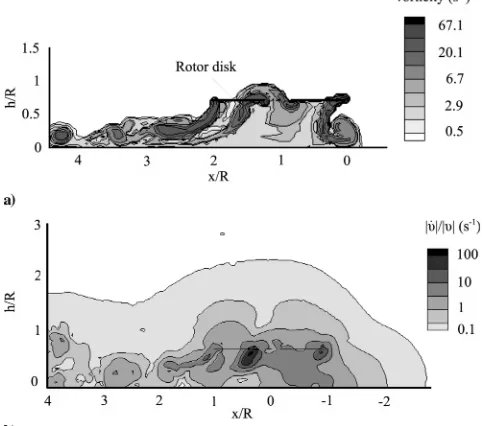
For comparison, Fig. 2 shows a typical distribution of the Lagrangian acceleration parameter j_j=jjwithin theflow in the wake below an isolated helicopter rotor operating in strong ground effect, as predicted using the VTM. In this example, the rotor isflying 0.68 radii above the ground at an advance ratio of 0.05. The data are scaled to be representative of a helicopter in the same weight class as a UH-60 Blackhawk. The Lagrangian acceleration parameter is calculated from the Eulerian velocity distribution in the flow surrounding the helicopter according to the equivalence _ @=@t r. It is important to bear in mind when analyzing this
figure that thefinite resolution of the computation results in any local maxima in the Lagrangian acceleration parameter being under-estimated, as any nonresolved finer structures in the flow will significantly contribute to the local acceleration through the term
r.
Comparing Figs. 1 and 2 shows that the question of the validity of the Eulerian transport equations derived earlier as a model for particulate transport in the helicopter flowfield needs to be ap-proached with some care. For given local flow conditions, the assumption of near equilibrium becomes increasingly valid the smaller and lighter the particulate matter. The analysis of particulate transport using the Eulerian approach presented previously, even when corrected for nonequilibrium effects by the addition of suitable terms to the transport equation, would be somewhat tenuous through-out the rotorflowfield when the behavior of large objects such as pebbles, rocks, and other debris is important, such as in the analysis of helicopter-induced damage and erosion, for instance. In these cases, the traditional approach through calculation of the Lagrangian dynamics of individual particles within theflow is likely to remain the most reliable and efficient. Similarly, the analysis for particles
with intermediate size (e.g., sand) is likely to prove satisfactory only if augmented by terms, as described previously, representing the nonequilibrium behavior of the particles. Much anecdotal evidence suggests though that the principal composition of the brownout cloud is extremely fine, powderlike, particulate matter, and for this application, the comparison presented here suggests that for realistic helicopter weights and sizes, the near-equilibrium assumption, and hence the analysis of the brownout problem using the particulate transport equations derived previously, remains well-founded throughout most of theflow surrounding the helicopter, with perhaps the exception being near the cores of the individual vortices that constitute the rotor wake, and very close to the rotor itself.
Particle Entrainment Model
The source termSpin the particle transport equation accounts for
the entrainment of particulates from the ground into the airflow. In the context of brownout modeling, the model for the source term provides essentially a sublayer-type description that captures the essence of the complex physics that take place within the few inches of fluid just above the ground. In much the same fashion as a boundary-layer model matches the viscous, possibly turbulent, characteristics of theflow near the surface to a simplified model that approximates thefluid behavior away from the surface, the model for the particulate sourceSpis used to represent the effect of the physics
in the sublayer on the dynamics of the particulate distribution in the
flow away from the surface. In particular, within the sublayer, the particulate density can be high and the collisions between particles may assume fundamental importance, in direct variance with the assumptions made earlier in deriving the particulate transport equations.
According to Marticorena and Bergametti [8] entrainment of dust into the air takes place only if the velocity of the air just above the ground surface exceeds the minimum, or threshold, velocity required to initiate particle motion along the surface. The larger particles then hop along the surface in a motion called saltation, and the impact of these saltating particles with the surface causes further particles to be ejected from the surface. Instead of returning to the surface, though, the smallest ejected particles are entrained into theflow above the ground.
Fig. 1 Particle drag-to-mass ratios for various sizes of particle commonly encountered in the desert environment.
[image:4.585.46.276.568.736.2]The physics of particle entrainment into theflow are thus very complex. Direct modeling of the dynamics of saltating particles is well beyond the present state of the art, but several empirical models exist for the saltation process that are able to take into account various factors such as surface roughness, soil moisture, and soil crusting. Models of this complexity may be useful in capturing the detailed behavior of the ground surface in specific geographical areas, but in the present work, a simpler semi-empirical model,
t 1 a1 s gd a2 d s (20)
that represents the threshold velocity forflow over dry, loose, soil surfaces is used. On the basis of wind-tunnel measurements by Lu and Shao [9], the coefficientsa1anda2are approximately 0.0123 and
3104kgs2, respectively. The factoraccounts for the presence
of surface roughness elements. Many different roughness elements can be present in an actual desert environment, but to simplify the model, only one type is considered in the calculations presented in this paper. It is assumed simply that there are fragments of rock present that armor the surface and inhibit the entrainment of particulates into theflow. According to MacKinnon et al. [10], the value offor this type of surface is 0.44. For simplicity, the results presented in this paper were generated after adopting a single representative value of saltating particle diameterdand densitys,
and hence a uniform threshold velocity over the entire ground surface is assumed.
The overall source of particulate matter into theflow is dependent on theflux of saltating particles along the ground. The saltation or horizontal particlefluxQis determined using the theory of White [11], in which the horizontal particle flux is related to the flow velocityjust above the surface by
QEc3 g
1t
1 2 t 2 (21)
where t is the threshold velocity calculated from Eq. (20).
Empirically,c0:261, andEis the ratio of erodible to total surface area, taken for simplicity to be unity in the calculations presented in this paper.
The particleflux from the surface into the airflow above the surface then consists of those dust particles that are released from the saltation process and remain in suspension in the air above the ground. The ratio of the particleflux into the air to the saltationflux is dependent on the percentage of clay within the soil. In the current model, the empirical relationship
SpQe13:4f6:0 (22)
described in [8] is used to relate the sourceSpof particulate matter
into theflow to the saltationflux. This relationship applies for soils with clay fractionfless than 0.2; all results presented in this paper were generated usingf0:1.
Particle Fallout Model
The fallout velocitygin Eq. (16) accounts for the tendency of
suspended particulate matter to settle out from theflow under the influence of gravity. The model that was used to calculate the fallout velocity for the calculations presented in this paper is based on the work by Cheng [12], which extends Stokes’s solution for the settling velocity of spherical particles to allow it to be used when the particle Reynolds number is greater than one. The dimensionless particle diameterd?isfirst defined as
d?d
gb 2
1=3
(23)
whereb s=. The fallout velocity of the particles is then
given by
g d
251:2d2 ?
p
51:5 (24)
Computational Implementation
There are obvious similarities between the mathematical form of the vorticity transport equation (1) and the particulate transport equation (16). Both equations (when taken at face value) represent the passive advection of some quantity by a background velocity
field and allow for a localized source of the advected quantity. In the case of the vorticity transport equation, an additional stretching term appears simply to account for the fact that the advected quantity (the vorticity) is fundamentally vectorial in nature, rather than scalar as in the case of the particulate density. The similarity in structure between the two transport equations allows the procedure that is used within the VTM to calculate the evolution of the vorticity within theflow simply to be generalized slightly if the combined evolution of the
flow and particulate density is to be calculated. For the combined particulate-vorticity transport model, define the vector of conserved variables x; t !; 1
p;. . .; Np, where ipx; t is the local
density of particles in species bandiat timet. The object-oriented
structure of the VTM allows the augmented vectorof conserved variables simply to be defined as a generalized form of the vector of conserved quantities!that is used by the originalfluid-only version of the code. The VTM uses an operator-splitting approach to evolve the equations of motion for the coupled system. The source ofinto the computational domain isfirst calculated by evolving the equation
@
@tS (25)
over time t, using the initial condition x; t to yield the intermediate solution x. The combined particulate/vorticity
source S S!; S1p;. . .; SNp is constructed using the appropriate
physical model for each component. The advection equation
@
@tV r0 (26)
is then advanced throught, usingas the initial condition, to
yield the revised intermediate solution. The advection velocity
V ; g, and the operatora rbis overloaded so that
a; b rc; d a rc; b rd
This part of the calculation is performed using Toro’s weighted averageflux method [13], which allows tight control to be main-tained over any spurious diffusion of vorticity or particulate density from cell to cell as a result of numerical truncation errors.
Finally, the vorticity distribution is corrected for the effects of stretching by advancing the solution to
@
@t!! r0 (27)
throughtusing Runge–Kutta integration and initial conditions!
to obtain the solution!. The vector!; 1
s ;. . .; Nsis then
a second-order approximation ofx; ttas long asand are both second-order-accurate approximations to the solutions
of their own differential equations [6]. The process is then repeated for subsequent time steps. The similarity of this approach to that used by thefluid-only version of the VTM can be assessed by comparing this sequence of operations with that described in [6].
In the calculations presented in this paper, no nonequilibrium processes were accounted for, but these could be included in the calculation through an additional step that has similar form to that used to evolve the solution to Eq. (25).
Veri
fi
cation of Ground-Effect Predictions
of theoretical studies of ground effect, focusing particularly on thrust and power requirements at various rotor heights above the ground, have been published. Betz [14] and Knight and Hefner [15], for example, showed that the power required to maintain a constant thrust reduces in ground effect and that the effect of the ground reduces significantly at heights above one rotor diameter. Cheeseman and Bennett [16] reported on the effects of the ground during forward
flight, showing that the power required to maintain a constant thrust increases with increasing forward speed. Hayden [17] provided a comprehensive review of power and thrust requirements for a range of helicopters hovering in ground effect that were obtained from
flight-test data and confirmed that the greatest effect of the ground is felt at a height of less than one rotor diameter.
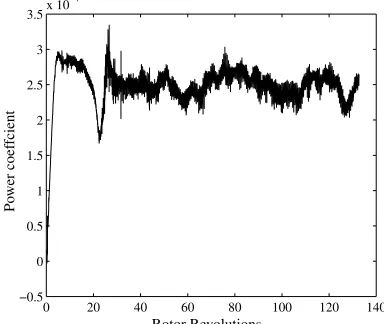
The main impediment to accurate modeling of theflow that is induced by the rotor when in ground effect is that the dominantflow structures grow and evolve over very long time scales. Simulations must thus resolve the wake accurately over many rotor revolutions to yield a valid portrayal of the governing fluid mechanics. As an example, Fig. 3 shows how approximately 25 rotor revolutions have to elapse from the start of any simulation before the transients within the calculation dissipate, the system settles into its true long-term behavior, and the low-frequency unsteadiness in the power that is characteristic of the rotor dynamics when in ground effect is revealed. The VTM has been shown to be capable of conserving the wake structure almost indefinitely, which gives the model an important advantage in being able to capture the slowly evolving features of theflow that dominate the behavior of the system when in strong ground effect.
Most important in the present context, the experimental work of Sheridan and Wiesner [18] and Curtiss et al. [19,20] has shown that the rotor wake exists in a number of distinct states, depending on the thrust-normalized advance ratio
?
CT=2
p (28)
and height of the rotor above the ground. In hover, the wake is significantly distorted by the presence of the ground, and, indeed, at very low forward-flight speed, the wake can be recirculated erratically through the front of the rotor. At intermediate forward speeds, the wake changes structure and a stable bow-shaped ground vortex forms beneath the rotor. As the system is accelerated further, the ground vortex is swept downstream and the effect of the ground on the performance of the rotor reduces dramatically as the rotor accelerates over a narrow range offlight speeds. This characteristic behavior, and its dependence on aircraft geometry and flight condition, must be captured accurately for the dynamics of the sand cloud that is associated with the development of brownout to be modeled correctly.
Figure 4 illustrates the ability of the VTM to capture the dependence of the structure of the wake on the forward speed of the rotor. The wake structure predicted by the VTM is visualized at various forward speeds by plotting snapshots of the vorticity distribution within theflow. Figure 4a shows the wake geometry at a low advance ratio and reveals significant recirculation of the wake through the front of the rotor. At the slightly higher advance ratio shown in Fig. 4b, a much more stable ground vortex forms below the rotor. As the advance ratio is increased further, the ground vortex moves backward below the rotor until it is eventually swept downstream to yield the wake geometry shown in Fig. 4c. The
0 20 40 60 80 100 120 140
−0.5 0 0.5 1 1.5 2 2.5 3 3.5x 10
−4
Rotor Revolutions
Po
wer coef
fcient
Fig. 3 Example calculation showing the number of rotor revolutions that need to be simulated if rotor behavior in ground effect is to be captured accurately and induced power required for a rotor hovering at 1:27Rabove the ground (CT0:0046).
[image:6.585.326.521.175.744.2] [image:6.585.64.256.556.718.2]changes in computed wake geometry with forward speed are entirely consistent with the existence of the variousflow regimes that were revealed in the experimental data of Curtiss et al. [19].
As a more quantitative verification of the VTM, its ability to model the outwash in the wake of a hovering rotor has been examined. The
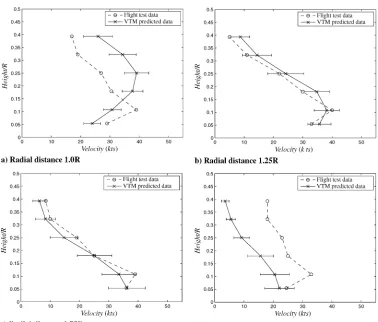
flight-test data of Harris and Simpson [21] as documented by Preston [22] have been used to compare the outwash velocity predicted by the VTM with that measured below a hovering CH-53E. Flight tests were carried out at three rotor heights with a range of different disc loadings, and outwash velocity profiles were measured at a number of radial distances from the rotor center. A sample com-parison between VTM predictions and the test data for the helicopter hovering at a rotor height of two radii above the ground (at a thrust coefficient of 0.0072) is presented in Fig. 5. The VTM data have been averaged over approximately 20 rotor revolutions after allowing the initial transients from the starting vortex to dissipate. There is significant unsteadiness in theflow below the rotor, even in hover, and the error bars attached to the numerical data represent the standard deviation of the predicted velocity over this time. The velocity profiles predicted using the VTM match theflight-test data very well at the radial distances of1:25Rand1:75R. At the innermost location of1:0R, the comparison is not particularly good, however, with the flight-test data somewhat curiously showing a strong jet wake to have already formed well underneath the rotor. The numerical results suggest that the jet forms somewhat further out-board. This discrepancy may be related to the absence of a fuselage in the calculations. The VTM also underpredicts the velocities at the furthest radial station from the rotor that was compared with the experimental data. This may be due to a slight excess of numerical dissipation within the calculations or possibly to the calculations not having been run for long enough for the velocity profile this far from the rotor to have established itself. Nevertheless, the comparison lends further support to previous evidence suggesting that the VTM is eminently capable of modeling the flowfield around rotors in strong ground effect.
Veri
fi
cation of Particulate Transport Predictions
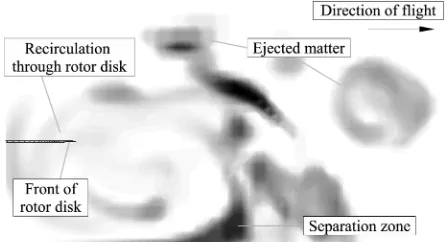
To date, very limited experimental data are available that can be used directly to verify the predictions of numerical brownout models. A recent experimental study carried out at the University of Glasgow [23] has allowed some confidence to be placed in the predictions of the VTM, however. The experiment involved placingfine particles on thefloor of a wind tunnel below a small model rotor to simulate the dynamics of the dust particles that would be entrained into theflow around the rotor in a brownout situation. The motion of the particles as they were transported through theflow surrounding the rotor was recorded using high-speed photography. Figures 6a and 6b show typical snapshots of the particle distribution in front of the model rotor when it was placed at one radius above the ground and the tunnel speed was set to represent a thrust-normalized advance ratio of 0.65. For comparison, Fig. 7 shows a representative snapshot of the particle density distribution in front of the rotor that is predicted by the VTM under similarflight conditions. The experiment reveals a wedge-shaped area in theflow some distance upstream of the rotor, termed theseparation zoneby Nathan and Green [23], in which the particle density is very high as a result of the existence of aflow stagnation line in the meanflow on the surface below. Figure 7 shows the location and size of this zone to be represented well by the VTM. Figure 6a shows a significant proportion of the suspended particulate matter to be recirculated through the front of the rotor disk under the operating conditions of the experiment, but Fig. 6b, captured at a later time during the same experiment, shows that clouds of particles that do not recirculate through the rotor are also ejected sporadically from the separation zone. Figure 7 shows both of these characteristic features of the dynamics of the dust cloud surrounding the rotor to be captured by the VTM.
Although a more quantitative verification of the numerical approach awaits further refinement of the experimental technique, the good qualitative agreement between the particulate density distributions that are predicted by the VTM and the distribution of
[image:7.585.104.482.419.741.2]particulates that were observed in this simple experiment suggests that the VTM is capable of producing credible simulations of the evolution of the dust cloud surrounding the helicopter under brown-out conditions.
Simulation of Brownout Development
As an initial test of the capabilities of the approach, the coupled VTM-particulate transport model has been used to compare the geometry and extent of the dust cloud that is generated under brownout conditions by the two generic helicopters shown in Fig. 8. Anecdotal evidence suggests that under practical conditions, brown-out manifests rather differently for helicopters with a single main rotor, such as that shown on the left in thefigure, than for aircraft with the tandem-rotor configuration shown on the right. In particular, the dust cloud generated by the rear rotor of the tandem configuration is thought to run forward during landing to eventually engulf the cockpit, whereas the dust cloud of the single rotor system is thought to originate somewhat further forward, upstream of the ground vortex, and to engulf the helicopter in more sudden fashion as the helicopter nears the ground. These observations are partially
con-firmed by images, such as those shown in Fig. 9, of the dust clouds that are generated by the two different types of helicopter whenflown
Fig. 6 Snapshots of the particulate distribution around a rotor during wind-tunnel simulations of brownout: a) recirculation of fine particulates through the front of the disk and the existence of a well-defined separation zone above the ground plane and b) escape of a cloud of particles from the main recirculatoryflow. The blade tip is visible on the middle left. Images courtesy of the University of Glasgow.
Fig. 7 VTM-predicted particulate density distribution on a vertical slice through the rotor centerline under the sameflight conditions as Fig. 6, qualitatively showing the same features as the experiment.
Fig. 8 Simulated helicopter geometries.
[image:8.585.45.278.46.452.2] [image:8.585.305.544.245.356.2] [image:8.585.304.544.391.728.2] [image:8.585.49.273.547.668.2]at a low level in dusty conditions. Although there are indeed likely to be very strong qualitative differences between the way that brownout conditions manifest for the two different rotor configurations, it should be borne in mind that simplistic descriptions and gross generalizations such as the one just given soon prove inadequate once the operating conditions and detailed geometry of the helicopter are considered in more detail. The geometry and extent of the helicopter-generated dust cloud appears to be strongly dependent, for instance, on how the aircraft is maneuvered over the ground as the dust cloud begins to form.
Some care was taken to define the two simulated helicopters to provide a fair comparison between the behavior of single main rotor and tandem-rotor configurations. Both simulated helicopters were defined with the same rotor diameter and overall blade area and in both cases were trimmed to an overall thrust coefficient of 0.0145. The systems thus have ostensibly the same blade loading and should thus produce wakes of very similar strength. The resultant dust density distributions in theflow surrounding the two configurations can thus be compared directly if the two helicopters areflown at the same thrust-normalized advance ratio. In all cases, the wake was resolved using 40 computational cells across the rotor diameter.
The helicopters were modeled with a nose-up pitch attitude of 15 deg to represent the aircraft during the late stages of a landing maneuver. Somewhat unrealistically, this pitch attitude and also the rotor height above the ground was maintained throughout the maneuver. Given that the trajectory of the aircraft is thought to have such a strong influence on the formation of the dust cloud, future efforts will be focused on extending the model to allow the dynamics of the vehicle above the ground to be represented in a more comprehensive fashion.
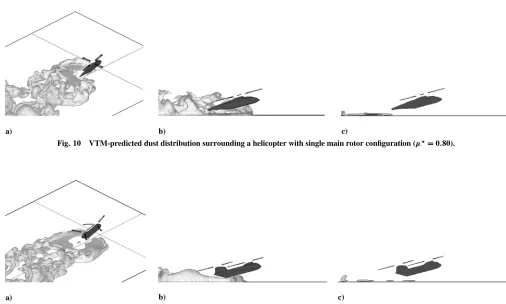
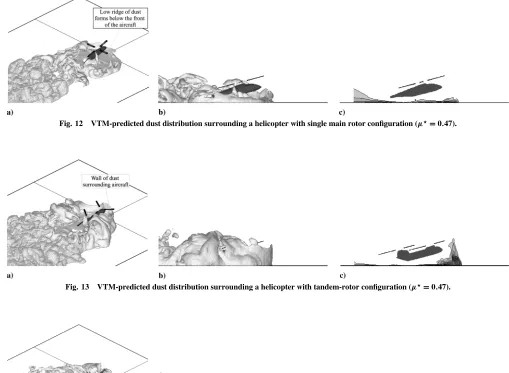
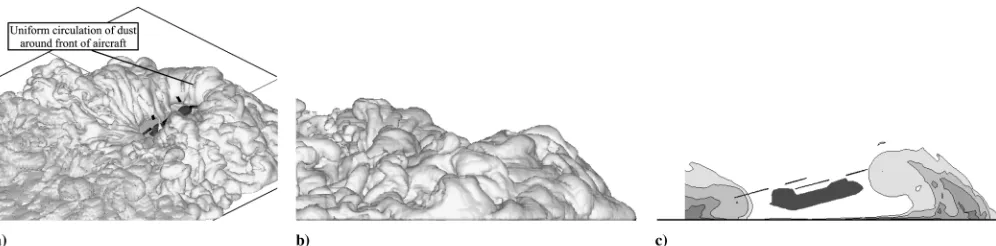
Figures 10–17 show the geometry of the dust cloud that is predicted by the VTM with the helicopters at various
forward-flight speeds during the simulated deceleration to land. A three-dimensional view of the dust cloud is shown on the left in each of thesefigures by plotting an isosurface of dust density within theflow surrounding the helicopter. It should be appreciated, however, that these instantaneous snapshots do little justice to the highly unsteady character of the dust cloud that is generated by the computational model. At center, the same isosurface is represented, but from a side
perspective so that the vertical extent of the dust cloud relative to the operating height of the helicopter can be appreciated. On the right, contours are shown of dust density on a vertical slice through theflow around the helicopter on a plane that coincides with the centerline of the fuselage. These contour plots show the dust density in theflow around the helicopter, averaged over 60 rotor revolutions to yield an appreciation of the most persistent features in the dust cloud. The minimum contour level represented in the contour plots has the same value as the isosurface value used to generate the 3-D plots. It is important to avoid contamination of the data by vortical or particulate structures that arise simply in the initial conditions that were applied to the simulations, and for this reason, thefigures present the dust distributions in theflow around the helicopters at a time far enough into the simulations for theflow to have settled into its long-term behavior.
Figures 10 and 11 show the dust cloud that is created by the two configurations whenflying at a relatively high forward speed above the ground. At the advance ratio?0:80of thesefigures, the
wakes of both configurations operate in the ground vortex state, although at this forward speed, the ground vortex is relatively compact and forms some distance behind the leading edge of the rotors. The major interaction between the wake and the ground thus occurs some distance behind the nose of the helicopter in both cases. As a result, at this advance ratio, the aircraft remains in the clear air ahead of the majority of the dust that is entrained from the ground into theflow. A low crescent-shaped ridge of dust marks the advancing front of the dust cloud below the aircraft; this ridge forms on the ground some distance behind the nose of the aircraft and extends outward and downstream, following the location of the separation zone that forms along the forward edge of the ground vortex that is generated by the helicopter. The interaction between the wakes of the front and rear rotors of the tandem configuration appears to yield a more rearward location of the ground vortex and associated dust cloud than the single main rotor configuration under the sameflight conditions.
[image:9.585.37.543.446.750.2]The isosurface plots of dust density show that the single main rotor configuration generates a distinctly asymmetrical dust cloud (with a marked absence of dust to the right of the aircraft; the rotor of this helicopter was arranged to rotate anticlockwise when viewed from
Fig. 10 VTM-predicted dust distribution surrounding a helicopter with single main rotor configuration (?0:80).
above). In comparison, the tandem-rotor configuration generates a dust cloud that spreads out symmetrically on both sides of the aircraft at this forward-flight speed. Unfortunately, the asymmetry of the dust cloud generated by the helicopter with single main rotor does not seem to persist to the very lowest forward-flight speeds at which it might be exploited practically to mitigate the effects of brownout.
To explain the asymmetry in the dust cloud, Fig. 18 compares the vorticity distribution with the corresponding dust distribution in the
[image:10.585.33.541.47.168.2]flow around the helicopter with single main rotor. For comparison, Fig. 19 shows similar plots for the tandem-rotor configuration. The isosurface used to represent the vorticity distribution has been chosen to reveal the strongest vorticity that is present in theflow.
[image:10.585.35.544.51.424.2]Fig. 12 VTM-predicted dust distribution surrounding a helicopter with single main rotor configuration (?0:47).
Fig. 13 VTM-predicted dust distribution surrounding a helicopter with tandem-rotor configuration (?0:47).
[image:10.585.41.543.532.662.2]Fig. 14 VTM-predicted dust distribution surrounding a helicopter with single main rotor configuration (?0:29).
Fig. 16 VTM-predicted dust distribution surrounding a helicopter with single main rotor configuration (?0:12).
Fig. 17 VTM-predicted dust distribution surrounding a helicopter with tandem-rotor configuration (?0:12).
Fig. 18 Correlation between the vorticity distribution surrounding a helicopter with single main rotor and the regions of maximum entrainment of dust into theflow (?0:80).
Fig. 19 Correlation between the vorticity distribution surrounding a tandem-rotor helicopter and the regions of maximum entrainment of dust into the
[image:11.585.43.544.367.533.2] [image:11.585.44.544.578.737.2]The powerful crescent-shaped ground vortex that lies below each helicopter is clearly shown, but the plot also reveals that for the helicopter with a single main rotor, this structure is significantly asymmetric. The core of the ground vortex remains significantly closer to the ground on the left-hand side of the aircraft than on the right as the helicopter moves forward along the ground. The tandem-rotor helicopter, on the other hand, generates a ground vortex that has a far more symmetric structure. Any asymmetry in the dust cloud is then explained by the clear correlation between the region of maximum entrainment of dust into the air and the position and strength of the ground vortex that is evident by comparing Figs. 18a– 18c and 19a–19c.
Figures 12 and 13 show that the dust cloud that the VTM predicts to form around the helicopters once they have decelerated to an advance ratio ?0:47. At this forward speed, the wake of an
isolated horizontal rotor would exist within the recirculation regime, but the rearward tilt of the rotors under the simulated conditions instead causes a fairly large and coherent ground vortex to form just forward of the helicopters. Most interestingly, the isosurface plots of the dust density distribution around the single main rotor configuration show a fairly broad region surrounding the helicopter in which the dust layer remains sheetlike and very close to the ground. Even when the dust is lifted into theflow, the resultant cloud remains relatively close to the ground. In contrast, the dust cloud forms much closer to the tandem-rotor configuration and has significant vertical extent. Indeed, the plots of the averaged dust density on the longitudinal slice through theflow show the wall of dust that forms in front of the aircraft with a single main rotor to be diffuse and somewhat tenuous in comparison with the thick
persistent wall of dust that forms directly in front of the tandem-rotor aircraft at this forward speed.
Further deceleration of the helicopters results in a significant enlargement of the dust cloud that surrounds the aircraft, particularly as the wake transitions from the ground vortex regime into the recirculatory regime. Figures 14 and 15 show the dust distribution in theflow with the aircraft travelling above the ground at advance ratio
?0:29. At this advance ratio, the rotors operate well within
the recirculatoryflow regime. Nevertheless, a comparison of the averaged dust density on the longitudinal slice through theflow shows the tandem-rotor configuration to continue to produce a dust cloud that is far larger and more persistent, and that extends significantly higher above the helicopter, than the cloud that is produced by the single main rotor configuration.
In a similar vein to Figs. 18 and 19, Figs. 20 and 21 contrast the vorticity and dust density distributions in theflow around the two helicopter configurations at this low forward speed. The much-enlarged region of strong vorticity that forms in front of the helicopter with the rotors operating in the recirculatory regime is principally responsible for transporting dust high into the air surrounding the helicopter from its origin on the ground plane. The key role of the separation zone just forward of the recirculatoryflow in limiting the forward extent of entrainment of dust from the ground, and hence in governing the overall size of the dust cloud, is clearly evident when comparing the vorticity and dust distributions within theflow.
[image:12.585.127.461.373.531.2]Further deceleration of the aircraft results in both configurations becoming engulfed in a large and persistent cloud of dust. Figures 16 and 17 show the predicted dust cloud around the aircraft whenflying above the ground at very low forward speed (?0:1174).
[image:12.585.125.462.579.738.2]Fig. 20 Correlation between the vorticity distribution surrounding a helicopter with single main rotor and the regions of maximum entrainment of dust into theflow (?0:29).
Fig. 21 Correlation between the vorticity distribution surrounding a tandem-rotor helicopter and the regions of maximum entrainment of dust into the
Significant recirculation of dust through the rotor disks is clearly evident in both cases, and it is quite plausible that, in practical circumstances, the density and persistence of the dust cloud might precipitate the onset of brownout conditions.
The results presented here thus reveal distinct differences in the geometry of the dust cloud that is formed by single main rotor and tandem-rotor configurations when operating at low altitude and forward speed above a dusty surface, and it appears that at least some of these differences can be related to the geometry of the vorticity distribution that is produced by the rotors as they interact aerodynamically with the ground surface.
Conclusions
This paper presents a computational model for simulating the development of the dust cloud that is associated with the particulate matter that can be entrained into the air when a helicopter is operated close to the ground in desert or dusty conditions. The physics of this problem and the associated pathological condition known as brownout, in which the pilot loses situational awareness as a result of his vision being occluded by dust suspended in theflow around the helicopter, are acknowledged to be very complex, and, indeed, modeling of the brownout problem fromfirst principles poses many basic challenges.
The approach advocated here involves an approximation of the full dynamics of the coupled particulate–air system. Away from the ground, the model that is derived in this paper relies on the simplifying assumption that the suspended particulate matter remains in near equilibrium under the action of the aerodynamic forces that are generated by the particles as they move relative to the air. Close to the ground, where this assumption begins to fail, this representation of the dynamics of the particulates is replaced with a sublayer-type source model, in which the saltation process that is fundamental to the entrainment of particulates into the air is modeled algebraically. As the state of the art advances, it may indeed be possible to supplant this approach using a model that is based on a more fundamental physical description, but the extreme complexity of the physics within the dense layer of strongly interacting particles close to the ground certainly precludes this approach for the time being.
The advantage of the present approach is that the growth in the number of free parameters within the model is strongly curtailed; in fact, almost all of the tunable coefficients within the present implementation of the approach reside within the sublayer model itself. This should have distinct advantages for the reliability and robustness of the approach, and in many ways, it can be argued that the model presented here may provide a more sensible, balanced, and well-justified engineering approach to the analysis and eventual understanding of the brownout problem than some descriptions of the problem that embody a more complete set of physical processes and effects.
Most computational codes are written in an Eulerian frame of reference, whereas the most obvious description of the dynamics of individual particles is in a Lagrangian frame of reference. Using the basic principles of statistical mechanics, the Lagrangian and Eulerian descriptions of the problem can be reconciled, however. The advan-tage of such an analysis is that it provides an inherent method of quantifying its own assumptions; indeed, it has been shown how the validity of the method can be evaluated in context by comparing the spectrum of physical properties of the suspended particulates to the local properties of theflowfield surrounding the helicopter.
The result is a particulate transport model that resides in the Eulerian frame of reference and that, because of its particular mathematical form, can be integrated in a fairly straightforward manner into other models that describe the dynamics of thefluid in terms of the Eulerian transport of thefluid properties. The VTM helicopter simulation code is used here to host the particulate transport model and indeed possesses particular advantages with respect to the computational implementation of the coupledfl uid-particle model because of the very close similarities in structure
between the particulate transport equation and the vorticity transport equation.
Verification of the predictions of the method remains problematic at this early stage in investigations into the brownout phenomenon, however. A significant quantity of data resides within the environ-mentalfluid dynamics community, but it is not immediately obvious how relevant these data are, given the rather different length and time scales that are important within theflowfield that is induced by a helicopterflying close to the ground. This presents some concerns as to whether the choice of sublayer model used in the present study, based as it is on work conducted in thefield of aeolian and riverine sediment transport, is entirely appropriate in the context of brownout modeling. Full verification of the approach awaits further develop-ments in experimental technique and the gathering of data that are directly relevant to the brownout problem, but limited comparisons against small-scale rotor experiments show encouraging results.
An important prerequisite of any model of brownout is the ability to capture the basic characteristics of theflow that is induced by the helicopter rotors when in strong ground effect; the VTM has been demonstrated to perform well in this respect. Particularly important in the present context appears to be the ability of the model to predict the transition of the wake generated by the helicopter between several characteristic states as the speed of the helicopter above the ground is varied. This is by no means a trivial task, as it requires careful preservation of the vortical structures in the wake for the many rotor revolutions that characterize the time scales over which the rotor-inducedflow evolves in the presence of the ground.
An example application of the coupled VTM-particulate transport model to analyzing the differences in the geometry and extent of the dust clouds that are produced by single main rotor and tandem-rotor configurations as they decelerate to land has yielded some very interesting results. Although the simulations described here are based on a rather simplified representation of the helicopter landing maneuver, it appears, somewhat surprisingly, that relatively coarse features of the geometry and strength of the rotor wakes (in particular, the location of the ground vortex and the size of any regions of recirculatoryflow, should they exist) play a primary role in governing the extent of the dust cloud that is created by the helicopter.
Much work still remains to be done in conducting and dissecting simulations such as these to elucidate the key parameters that govern the evolution of the dust cloud that is generated by the aerodynamic interaction between the helicopters and the ground when these machines operate at a low level in dusty environments. The results presented here represent perhaps a small step along the way to a sufficient practical understanding of how the physics of particle entrainment and transport within theflow around the helicopter can precipitate the onset of brownout conditions, but it is hoped that they also provide some encouragement that the problem may eventually yield to careful engineering analysis.
References
[1] Keller, J. D., Whitehouse, G. R., Wachspress, D. A., Teske, M. E., and Quackenbush, T. R.,“A Physics-Based Model of Rotorcraft Brownout for Flight Simulation Applications,” 62nd Annual Forum of the American Helicopter Society [CD-ROM], AHS International, Alexandria, VA, May 2006.
[2] Lee, T. E., Leishman, J. G., and Ramasamy, M.,“Fluid Dynamics of Interacting Blade Tip Vortices with a Ground Plane,” 64th Annual Forum of the American Helicopter Society [CD-ROM], AHS International, Alexandria, VA, Apr. 2008.
[3] Crowe, C. T. (ed.),Multiphase Flow Handbook, CRC Press, Boca Raton, FL, 2006.
[4] Leishman, J. G.,The Helicopter—Thinking Forward, Looking Back, College Park Press, College Park, MD, 2007.
[5] Ryerson, C. C., Haehnel, R. B., Koenig, G. G., and Moulton, M. A.,
“Visibility Enhancement in Rotorwash Clouds,”43rd AIAA Aerospace Sciences Meeting and Exhibit, Reno, NV, AIAA Paper 2005-263, Jan. 2005.
[6] Brown, R. E.,“Rotor Wake Modeling for Flight Dynamic Simulation of Helicopters,”AIAA Journal, Vol. 38, No. 1, January 2000, pp. 57– 63.
[7] Brown, R. E., and Line, A. J., “Efficient High-Resolution Wake Modeling Using the Vorticity Transport Equation,” AIAA Journal, Vol. 43, No. 7, July 2005, pp. 1434–1443.
doi:10.2514/1.13679
[8] Marticorena, B., and Bergametti, G.,“Modeling the Atmospheric Dust Cycle. 1: Design of a Soil-Derived Dust Emission Scheme,”Journal of Geophysical Research, Vol. 100, No. D8, Aug. 1995, pp. 16415– 16430.
doi:10.1029/95JD00690
[9] Lu, H., and Shao, Y.,“Toward Quantitative Prediction of Dust Storms: An Integrated Wind Erosion Modelling System and Its Applications,”
Environmental Modelling and Software, Vol. 16, No. 3, Apr. 2001, pp. 233–249.
doi:10.1016/S1364-8152(00)00083-9
[10] MacKinnon, D. J., Clow, G. D., Tigges, R. K., Reynolds, R. L., and Chavez, P. S., Jr., “Comparison of Aerodynamically and Model-Derived Roughness Lengths (Zo) over Diverse Surfaces, Central Mojave Desert, California, USA,”Geomorphology, Vol. 63, Nos. 1–2, Nov. 2004, pp. 103–113.
doi:10.1016/j.geomorph.2004.03.009
[11] White, B. R., “Soil Transport by Winds on Mars,” Journal of Geophysical Research, Vol. 84, No. B9, Aug. 1979, pp. 4643–4651. doi:10.1029/JB084iB09p04643
[12] Cheng, N.-S., “Simplified Settling Velocity Formula for Sediment Particle,”Journal of Hydraulic Engineering, Vol. 123, No. 2, Feb. 1997, pp. 149–152.
doi:10.1061/(ASCE)0733-9429(1997)123:2(149)
[13] Toro, E. F., “A Weighted Average Flux Method for Hyperbolic Conservation Laws,” Proceedings of the Royal Society of London, Series A: Mathematical and Physical Sciences, Vol. 423, No. 1865, 1989, pp. 401–418.
doi:10.1098/rspa.1989.0062
[14] Betz, A.,“The ground Effect on Lifting Propellers,”NACA TM 836, Aug. 1937.
[15] Knight, M., and Hefner, R. A.,“Analysis of Ground Effect on the Lifting Airscrew,”NACA TN 835, 1941.
[16] Cheeseman, I. C., and Bennett, W. E.,“The Effect of the Ground on a Helicopter Rotor in Forward Flight,”Aeronautical Research Council, Reports and Memoranda No. 3021, London, 1957.
[17] Hayden, J. S.,“The Effect of the Ground on Helicopter Hovering Power Required,”32nd Annual Forum of the American Helicopter Society
[CD-ROM], AHS International, Alexandria, VA, May 1976. [18] Sheridan, P. F., and Wiesner, W.,“Aerodynamics of Helicopter Flight
Near the Ground,”33rd Annual Forum of the American Helicopter Society[CD-ROM], AHS International, Alexandria, VA, May 1977. [19] Curtiss, H. C., Jr., Erdman, W., and Sun, M., “Ground Effect
Aerodynamics,”Vertica, Vol. 11, No. 1–2, 1987, pp. 29–42. [20] Curtiss, H. C., Jr., Sun, M., Putman, W. F., and Hanker, E. J., Jr.,“Rotor
Aerodynamics in Ground Effect at Low Advance Ratios,”Journal of the American Helicopter Society, Vol. 29, No. 1, 1984, pp. 48–55. doi:10.4050/JAHS.29.48
[21] Harris, D. J., and Simpson, R. D.,“CH-53E Helicopter Downwash Evaluation,”Naval Air Test Center, TR NATC-SY-89R-78, Patuxent River, MD, Aug. 1978.
[22] Preston, J. R., “VTOL Downwash/Outwash Operational Effects Model,” American Helicopter Society 50th Annual Forum, AHS International[CD-ROM], Alexandria, VA, May 1994.