City, University of London Institutional Repository
Citation
:
Tong, A.C. (1991). A study of organizational and professional commitment among nurses in Singapore. (Unpublished Doctoral thesis, City University London)This is the accepted version of the paper.
This version of the publication may differ from the final published
version.
Permanent repository link:
http://openaccess.city.ac.uk/7760/Link to published version
:
Copyright and reuse:
City Research Online aims to make research
outputs of City, University of London available to a wider audience.
Copyright and Moral Rights remain with the author(s) and/or copyright
holders. URLs from City Research Online may be freely distributed and
linked to.
A STUDY OF ORGANIZATIONAL AND PROFESSIONAL COMMITMENT
AMONG NURSES IN SINGAPORE
ANG CHIN TONG
Presented As Partial Requirement For The Degree Of Doctor Of Philosophy
Business School The City University
Page IV VI VII VIII Ix List of Tables
List of Figures
Acknowledgement Declaration Abstract 1 2 3 3 4 5 5 6 7 9 11 11 13 14 CONTENTS
Chapter One : Introduction
Historical Background
Parliamentary System
Political Stability
Labour Force
Flexible Wage System
Economic Development
Economic Restructuring
Labour Shortage and Turnover
Demand for Nurses
Commitment and Identification
Organizational Hierarchy and Salary
Entry Qualification
Training and Advancement
Role of Civil Service Institute
16 17 19 20 22 25 39 40 49 139 140 145 148 150 Page
Purpose of Study
Outline of Study
Chapter Two : Review of Literature
Introduction
Interest in Commitment Study
Concepts and Theories
Approaches to Commitment Study
Identification
Commitment Measurement
Antecedents of Commitment
Summary
Commitment vs Job Satisfaction
Job Satisfaction Measurement
Consequences of Commitment
Critical Evaluation
Chapter Three : Methodology
Sample of Study
Commitment Measurement Scale
Job Descriptive Index
Piloting of Questionnaires
166
168
172
175
182
191
207
210
266
270
295
326 Page
Administration of Questionnaires 177
Method of Analysis 179
Chapter Four : Analysis of Data
Distribution of Personal Data
Testing of Hypotheses
Summary
Chapter Five : Findings and Conclusions
Findings and Discussion
Summary
Conclusions
Appendices
References
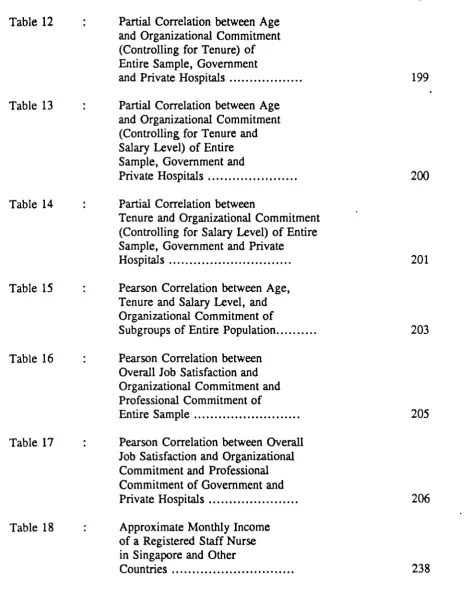
LIST OF TABLES
Table 1 Spearman-Brown Coefficients
of Organizational Commitment Scale and Professional Commitment Scale
Table 2 Spearman-Brown Coefficients of JobDescriptive Index ...
Table 3 Number of Sets of Questionnaires Sentand Returned ...
Table 4 Rates of Return and Usable
Setsof Questionnaires...
Table 5 Profile of Respondents
(Government Hospitals)...
Table 6 Profile of Respondents
(Private Hospitals) ...
Table 7 Means and Standard Deviations for Organizational Commitment and Professional Commitment ofEntire Sample ...
Table 8 Means and Standard Deviations for Organizational Commitment and Professional Commitment of Government and Private
Hospitals...
Table 9 Means and Standard Deviations for Organizational Commitment of Government and Private
Hospitals...
Table 10 : Pearson Correlation between Age, Tenure and Salary Level and Organizational Corn mitment of Entire
Sample...
Page
Table 12 : Partial Correlation between Age and Organizational Commitment (Controlling for Tenure) of Entire Sample, Government
and Private Hospitals 199
Table 13 : Partial Correlation between Age and Organizational Commitment (Controlling for Tenure and Salary Level) of Entire Sample, Government and
Private Hospitals 200
Table 14 : Partial Correlation between
Tenure and Organizational Commitment (Controlling for Salary Level) of Entire Sample, Government and Private
Hospitals 201
Table 15 : Pearson Correlation between Age, Tenure and Salary Level, and Organizational Commitment of
Subgroups of Entire Population 203
Table 16 : Pearson Correlation between Overall Job Satisfaction and Organizational Commitment and Professional Commitment of
Entire Sample 205
Table 17 : Pearson Correlation between Overall Job Satisfaction and Organizational Commitment and Professional Commitment of Government and
Private Hospitals 206
Table 18 : Approximate Monthly Income of a Registered Staff Nurse in Singapore and Other
Countries 238
Figure 1
Figure 2
Figure 3
Figure 4
Figure 5
Figure 6
LIST OF FIGURES
Page
10
32
37
164 Organizational Hierarchy in
Government Nursing Service
Exchange Approach
Psychological Approach
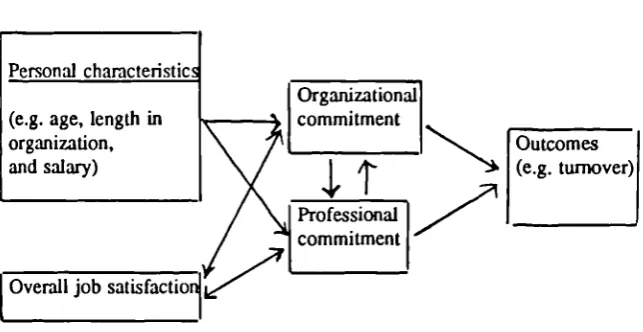
Model of Commitment
Relationships between the Nurses' Age, Tenure and Salary Level and Their Organizational Commitment
Relationships among Core Job Dimensions, Psychological States and Personal and Work Outcomes
241
278
ACKNOWLEDGEMENT
The researcher of the current study would like to express his
heartfelt gratitude and appreciation to Professor Allan P.O. Williams of the
Business School, the City University, London; and Professor Joseph Putti of the
School of Postgraduate Management Studies, National University of Singapore, for
their kind consent to be the supervisors for the current study.
The researcher is also very grateful to Professor Richard M. Steers
of the College of Business Administration, University of Oregon, U.S.A., for his
advice on formulating the research hypotheses and the research design and
methodology; to Professor Joseph A. Alutto of the School of Management, State
University of New York, U.S.A., for his kind permission for the use of the
commitment instruments and for his advice on the use of the instruments; to Mrs
Janaki Chalam of the Civil Service Institute, Singapore, for her editorial advice;
and to the nurses who participated eagerly in the study.
The researcher is greatly indebted to Professor Allan P.O. Williams
and Professor Joseph Putti for their invaluable advice and guidance, and for their
constant support and encouragement; without them, the current study would not
DECLARATION
I hereby grant authority of discretion to the City University Librarian to allow
the thesis to be copied in part and in single copies for study purposes without further
ABSTRACT
Issues on commitment have captured the great interest of
organizations and research scholars. The health-service organizations in Singapore are anxious to develop appropriate organizational strategies to enhance their nursing personnel's levels of commitment to the organization and profession, and hope that this may, in one way or other, help to ease the turnover among the nurses currently taking place in the organizations.
The current study has, therefore, been carried out to investigate the commitment levels of nurses in the health-service organizations in the Asian Context of Singapore with an attempt to (a) establish the differences between the nurses' level of organizational commitment and professional commitment; (b) determine the effects of the nurses' personal variables on their organizational commitment; and (c) ascertain the relationships between the nurses's overall job satisfaction and their organizational commitment and professional commitment.
A total of 2,424 usable questionnaires were collected from nurses in six government hospitals and four private hospitals.
The results of the data analysis have indicated that (a) the nurses, irrespective of their organizational affiliation to the public or private sector, tended to show a higher level of commitment to the profession than to the organization; (b) the nurses in the private hospitals did not tend to show more commitment to the organization than their counterparts in the government hospitals; (c) the personal variables of age, tenure and salary level of the nurses in both the government and private hospitals seemed to have created an impact on their organizational commitment, and that of these variables, salary level seemed to have the greatest impact on the organizational commitment, and have an intervening effect on the relationships between age and tenure and the
organizational commitment; and (d) the overall job satisfaction of the nurses in the government hospitals seemed to have been related more to their professional
commitment than to their organizational commitment, but the overall job
satisfaction of the nurses in the private hospitals did not appear to have significant relationships either with their organizational commitment or professional
commitment. The possible contributing factors to these findings were analysed; the implications for the health-service and other organizations concerned, and the implications for future studies were discussed.
CHAPTER ONE
INTRODUCTION
As the current study will be focused on the commitment levels of nurses in the
Republic of Singapore, this Chapter will provide some information on the general
background of Singapore. First, a brief description of the historical background, the
parliamentary system and the political climate of the Republic will be presented. This
will be followed by an account of the labour force and the economic development in
Singapore. The problems of labour shortage and labour turnover faced by employers,
especially the health-service organizations will also be included, and a brief
description of the nursing service and the role of the Singapore Civil Service Institute
will follow. Finally, an account of the purpose and outline of the current study will
be presented.
Historical Back2round
The Republic of Singapore is a young country located in the centre of
Southeast Asia and mid-way between the Indian and Pacific Oceans. The population
was about 2.65 million in June 1988. Of this figure, 76 per cent were Chinese, 15.1
per cent were Malays, 6.5 per cent were Indians and the rest were other races,
including Caucasians, Eurasians, etc.. The beginnings of Singapore have remained a
matter of speculation. However, modern Singapore is unique in that it was founded
treaty with the local chieftain, the Temenggong of Johore providing for the foundation
of a British trading post. Singapore was thus occupied by the British. In 1826
Singapore was joined with Penang and Malacca to form the Straits Settlements under
the general supervision of Penang. In 1830, the Straits Settlements were placed under
the government in Bengal. In 1867, the Straits Settlements became a crown colony
directly under the control of the Colonial Office.
Singapore remained as a British Colony (except for the period from 1942 to
1945 during which the island was occupied by the Japanese troops) till 1959. In 1959
Singapore became a self-governing state. In 1963 Singapore joined the Federation of
Malaya., Sabah and Sarawak to form Malaysia. In 1965 Singapore was separated from
Malaysia and became a fully independent and sovereign country.
Parliamentary System
Singapore is a republic with a parliamentary system of government. The
Constitution of Singapore provides for a President who is the Head of State elected
by Parliament once in four years. The Member of Parliament who commands the
confidence of the majority in Parliament is appointed as Prime Minister by the
President. Power is vested in the Prime Minister and his Cabinet Ministers who are
responsible collectively to Parliament. The Ministers are appointed by the President
from Members of Parliament on the advice of the Prime Minister. There are 13
Ministries altogether. Each is under the charge of a Minister. Parliament is
years in single-member constituencies and group representation constituencies.
Political Stability
The government of Singapore realizes that political stability and an honest
administrative machinery are prerequisites to the economic development and prosperity
of the country. The attention of the government has been focused on the development
of political stability. The Republic has been able to maintain remarkable political
stability and a highly efficient and honest administration since its independence. The
success in these efforts by the government has generated a strong confidence and good
investment climate for investors from many overseas countries, resulting in a strong
influx of foreign investments to the Republic. The foreign investmeiits have thus
enhanced the country's economic growth and enabled the young country to progress
steadily in the last 25 years.
Labour Force
The latest figure from "Singapore 1989", a government publication, shows that
the total labour force in Singapore was about 1.28 million persons in 1988.
Employers in the manufacturing, commercial, community, social and personal services
sectors engaged about 73 per cent of the total employed persons. Production workers,
transport equipment operators and labourers formed the largest group of employed
persons (36 per cent of the total employed persons). Professional, technical,
per cent).
Job seekers in Singapore are provided with counselling by the Ministry of
Labour on job expectations, and employers are advised by the Ministry of Labour on
market conditions. The Employment Act governs the terms and conditions of
employment, and stipulates the rights and obligations of employers and employees.
The industrial relations climate in Singapore has been peaceful and steady since its
independence in 1965. The country has enjoyed the good reputation of being
strike-free since then.
Flexible Wage System
To be able to respond to the economic performance of the country and the
market conditions of the world speedily and effectively, Singapore has adopted a
flexible wage system in both the public and private sectors. The flexible wage system
allows employers greater flexibility in meeting the market demands and ensuring that
high wages awarded to employees in good years will not be perpetuated in any
subsequent lean years. Using the system as a guide, the National Wages Council, a
tripartite body consisting of representatives from the government, employers and
workers, advises the government on general wage guidelines and wage adjustments
for the year according to the economic performance of the country. The
recommendation by the Council, when accepted by the government, serves as a basis
for negotiations between employers and employees or their unions for wage
Economic Development
Singapore's economy has developed rapidly and steadily since its
independence; the country has enjoyed one of the fastest economic growth rates in the
world. The average economic growth rate for the 1970s was 9.4 per cent, and the
growth rate for 1988 was 11 per cent. The per capita GNP increased from, for
example, $9,600* in 1980 to $12,600* in 1984. As a proportion of Japan's 1980 per
capita ONP of $19,100*, Singapore's per capita GNP rose from 49 per cent in 1980
to 66 per cent in 1984. Workers have benefited substantially from this rapid economic
growth. Except for the periods between 1985 and 1986, Singapore has enjoyed full
employment since the early 1980s. No worker has had difficulty at all in getting ajob
he prefers.
Economic Restructuring
The late 1970s saw a steady rise of protectionism, particularly in the advanced
countries. The rise of protectionism has posed a serious threat to the economies of
developing countries such as Singapore. To safeguard Singapore's economy, the
government had to restructure the Republic's economy in the early 1980s by phasing
out gradually labour intensive industries; and by developing high value added, skill
intensive and low weight products for the world market and by providing highly
sophisticated services and banking and financial facilities for the region. The
economic restructuring has been very successful, and Singapore has been able to
sustain its economic growth, in spite of the highly competitive market and
protectionism.
Labour Shorta2e and Turnover
The rapid economic growth and full employment have brought about several
side effects to the labour market in Singapore. Labour shortage and high employee
turnover or job hopping are some of these problems. Because of labour shortage and
job hopping, employers are unable to plan their human resource development in a
more meaningful way. Many of the employers have had to resort heavily to foreign
labour imported from neighbouring countries to sustain their organizations' growth.
The restructuring of the economy and the heavy emphasis on higher value added
industries and sophisticated services have also intensified the demand for skilled and
professional workers. This has deteriorated the tight labour market; and has directly
or indirectly encouraged employers to "snatch" workers, particularly professional
workers, from one another by offering workers higher wages and better conditions of
service.
The government has also imposed heavy levies on companies which employ
foreign workers in order to encourage the companies to automate or mechanize their
work process, and phase out foreign labour. Being caught between these ends,
employers have constantly tried to search for other alternatives to overcome the labour
behaviour so that they will be more loyal or committed to their organizations.
Because of this, the issues of organizational commitment or organizational loyalty
have become one of the major focuses of management both in the public and private
sectors. Various programmes and efforts have been used by organizations to promote
workers' loyalty to or their identification with their organizations. The introduction
of company based welfare schemes, and the increase of other employee welfarism
programmes are some of the examples of employers' efforts to promote workers'
commitment and loyalty to organizations.
On the other hand, the government has also tried to encourage workers and
management to form workers' house unions to replace the existing industry-based
unions. It is believed that a house union will be more concerned with the success and
progress of the organization. The assumption is that the members' rice bowl is
inextricably tied to the success of the organization; and the recognition of this
relationship will, therefore, enhance the linkages between employees and their
organizations.
Demand for Nurses
Efforts to upgrade medical science and technology in Singapore, and eventually
develop the country into an excellent medical centre in this region have been
undertaken by the government as part of the economic restructuring programmes to
develop and sustain the economy of the country. To make the efforts more
sector in order to encourage private organizations to take an active part in making
Singapore, for example, a highly reputable medical centre providing excellent medical
services. As a result of the encouragement of the government, many private hospitals
and medical centres have been established since the early 1980s. The rapid rise of
private health-service organizations has resulted in a high demand for trained and
qualified nurses, and has created an acute shortage of nurses in the labour market. In
addition, the health-service organizations in the foreign countries such as Australia,
Canada, Brunei and Saudi Arabia have also competed for qualified nurses in
Singapore with local health-service organizations. This has further deteriorated the
labour shortage problem.
The full employment situation achieved by Singapore in these few years has
provided job seekers with ample opportunities to get a job they prefer. The nursing
profession has become one of the least preferred jobs in the mind of young job
seekers because of shift duties and longer hours of work. Health-service
organizations, therefore, have been faced with extreme difficulties in recruiting people
to join the nursing profession. This has worsened the manpower shortage faced by
the organizations. The high demand for trained nurses has also encouraged in-service
nurses to leave their present organizations and join other organizations or simply retire
earlier from their jobs with the relative assurance that they will be able to re-enter the
labour market any time they wish. This has added an extra burden to health-service
organizations, and hampered their development plans.
to train nurses. The only source of supply of trained nurses is the government
health-service organizations. In order to keep the organizations functioning effectively, the
private sector has no other alternative but to recruit trained nurses directly from the
government health-service organizations or from other private health-service
organizations. To be able to compete successfully in the tight labour market for
nurses, the private health-service organizations have relied heavily on higher wages
and better conditions of service and incentives to lure qualified nurses especially from
the government health-service organizations. As a result, the public sector has
suffered a great loss of trained nurses to the private sector, and has faced a serious
shortage of nursing personnel. The shortage of fresh supply from the labour market
has made the problem even worse. In 1988, the government had no other alternative
but to announce a pay rise for the nursing service in the public sector, hopefully by
doing so, the public sector would be able to improve the situation.
Commitment and Identification
However, the government has also realised that increase in pay or other
financial incentives may be just a short term solution to the problem. Perhaps, as a
long term strategy, the public sector health-service organizations may have to pay
more attention to the attitudinal and behavioural aspects of nurses so as to inculcate
in them a sense of loyalty to or identification with their organizations. As a result,
the curriculums used in the government School of Nursing, and the human resource
development programmes adopted by the various government health-service
employees' commitment to or identification with their organizations and profession.
Hopefully by doing so, nurses will be more loyal to their organizations and be more
willing to stay with their organizations or profession.
In addition, a comprehensive publicity programme has also been launched by
the government to enhance the image of the nursing profession in order to attract job
seekers to the nursing service. On the other hand, the private health-service
organizations have also followed the public sector's example by directing their efforts
to promoting the commitment of their nursing staff so that they will.not be lured to
join other organizations.
Figure I
Organizational Hierarchy in Government Nursing Service
Chief Nursing Officer
Senior Principal Nursing Officer
Principal Nursing Officer
Higher Nursing Officer
Nursing Officer
Staff Nurse
Assistant Nurse/Staff Midwife
Student Nurse
Pupil Assistant Nurse
(Salary Scale: $5O()()*)
(Salary Scale: $3700 - 4 150*)
(Salary Scale: $2800 - 3675*)
(Salary Scale: $2000 - 3 125*)
(Salary Scale: $1300 - 2330*)
(Salary Scale: $S10 - 1745*)
(Salary Scale: $610 - 1200*)
(Salary Scale: $570 - 780*)
(Salary Scale $490 - 615*)
Organizational Hierarchy and Salary
Figure 1 shows the general organizational hierarchy or promotional aspects of
the nursing service currently (i.e. 1988) implemented in the public sector. A similar
organizational structure of the nursing personnel has also been followed in the private
health-service organizations, although the titles of the posts are different. For
example, the post of Chief Nursing Officer in the government health-service
organizations is named as Nursing Director in the private sector, and the post of
Principal Nursing Officer in the public sector is named as Assistant Nursing Director
in the private sector. The salary scales quoted in Figure 1 are the basic wages
currently implemented in the public sector. In addition to the basic wages, nurses are
given monthly allowances, an annual bonus, and an extra annual bonus (ranging from
one month to three months of the basic salary, depending on the economic
performance of the country for the year). Similar wage guidelines have also been
followed by the private sector. However, because of the labour shortage, many private
sector organizations have offered much higher wages and better terms and conditions
of service as inducements to attract nurses to join their organizations.
Entry Qualification
Candidates can enter the service either as Pupil Assistant Nurses or Student
Nurses depending on their educational qualifications. The basic entry qualifications
for the nursing service in Singapore, as stipulated by the Ministry of Health (the
are:-(a) Pupil Assistant Nurse
(1) Obtained Singapore-Cambridge GCE "N" Level Passes
in three subjects;
(2) Passed Secondary Three Education;
(3) Completed Secondary Four Education;
and
(4) Obtained three "0" Level Passes.
(b) Student Nurse
(1) Obtained three GCE "0" Level Passes which include
English and either Science or Mathematics;
and
(2) Obtained Four GCE "0" Level Passes.
Special aptitudes and fitness required for entry into the nursing service
(a) physically and mentally fit
(b) having a caring attitude;
(c) be willing to study hard, work hard and make adjustments in
personal life;
and
Training and Advancement
The training agency for nurses in the public sector is the School of Nursing.
All Pupil Assistant Nurses are required to undergo a two-year basic training
programme, and all student nurses are required to undergo a three-year basic training
programme at the School of Nursing. As the private health-service organizations do
not have their own training schools, the School of Nursing has also provided basic
training for private nurses.
According to the policy and practice adopted by the public and private
health-service organizations, Pupil Assistnt Nurses, on successful completion of the basic
training, will be eligible for enrollment on the Roll for Assistant Nurses with the
Singapore Nursing Board; and are eligible for appointment as Assistant Nurses. After
five years of completed service, Assistant Nurses are eligible for consideration for
promotion to Senior Assistant Nurses. Confirmed Assistant Nurses are also eligible
for applying for Student Nurse Training in order to advance to the grade of Staff
Nurse.
On the other hand, on successful completion of the basic training, Student
Nurses are eligible for registration as State Registered Nurses with the Singapore
Nursing Board. They are also eligible for applying for appointment as Staff Nurse.
After completing five years of service, Staff Nurses are eligible for consideration for
promotion to Nursing Officer if they possess a recognised post-basic nursing
Higher Nursing Officer, Principal Nursing Officer, Senior Principal Nursing Officer
and Chief Nursing Officer. However, promotion from Nursing Officer to the various
higher grades is generally more stringent. It depends on educational qualifications,
length of service, experience and work performance.
Confirmed nurses in the public nursing service are also eligible for advanced
training in specialised clinical fields or in the fields of nursing education and
administration or other post basic courses to enable them to move up the
organizational hierarchy and to take up more responsible jobs.
Role of Civil Service Institute
The researcher of the current study is a Training Manager of the Civil Service
Institute in Singapore. The Institute is the central training organization in Singapore
responsible for the training and development of officers in the Singapore Civil Service.
The Institute's mission is to support the goals and programmes of the Singapore Civil
Service
through:-(a) selective training, especially in management and supervision,
clerical and technical skills, language and related areas;
and
(b) the promotion of productivity, especially through the Work
The Institute's key objective is to improve the quality of civil servants in
Singapore by:
(a) training and developing them locally;
(b) providing training and development consultancy services for
their departments;
(c) promoting and sustaining a system of training and work
improvement through Work Improvement Teams;
and
(d) testing and evaluating their gains in skill and knowledge
However, it is felt that many of the existing training programmes that the
Institute has developed appear to be inadequate and unable to cope with the real needs
of the various departments especially departments which provide professional services.
Many of the existing training programmes have been developed generally through the
intuition or personal judgement of the course developers. Very little empirical
research has been carried Out by the Institute to identify the real training and
development needs of civil servants in the Service, particularly those in the
professional fields. As a result, there appears to be no concrete evidence to indicate
whether the programmes have been effectively implemented and have successfully met
the needs of the civil servants and their organizations. Therefore, it is hoped that
more empirical research will be carried out by the Institute to increase the
The researcher of the current study is responsible for planning, designing,
developing and implementing training programmes for civil servants in Singapore,
especially for those who are in the professional services. In addition, the researcher
has provided consultancy services on the planning and development of human
resources in government organizations. It is, therefore, hoped that the current study
will generate some valuable information to help the Institute review and restructure
some of its present training and development programmes, particularly in the areas of
organizational behaviour, and, at the same time, to enable the Institute to provide
better quality consultancy in the area of human resource development. This will, in
turn, upgrade the image of the Institute as a central agency of training and
consultancy.
Purpose of Stuç!y
The current study intends
to:-a) examine the commitment level of nurses
in both the public and private
health-service organizations in Singapore;
b) establish the differences between the
levels of organizational commitment and
professional commitment of the nurses;
c) determine the effects of some of the
personal factors of the nurses on their
and
d) ascertain the relationships between the
nurses' overall job satisfaction and their
commitment to the organization and the
profession.
No research of this nature in the nursing service has ever been carried out in
Singapore. It is, therefore, hoped that the current study will throw some light on the
types of training and development programmes and organizational strategies that the
Civil Service Institute should try to provide for government health-service
organizations to enhance the nurses' loyalty and commitment to both their
organizations and profession. It is also hoped that the findings will provide the private
health-service organizations with some useful suggestions for improving their human
resource development programmes, or designing appropriate organizational strategies
to strengthen their nursing personnel's commitment and loyalty.
Outline of Study
In Chapter Two a review of the literature pertaining to commitment will be
presented. The review will include the general issues, definitions, concepts and
theories of commitment, and the studies carried out by scholars and researchers in
these areas.
Three. The chapter will cover the samples and questionnaires selected for the study,
the method of administering the questionnaires and the types of analysis techniques
to be used in examining the data.
In Chapter Four the compiled data will be presented in tabular forms and
analysis will be carried out to interpret the data gathered through the survey
questionnaires. Statistical tools will be utilized to analyse the data.
Chapter Five will focus on the findings and conclusions of the study. A
detailed discussion on the findings and their implications will be presented. The
CHAPTER TWO
REVIEW OF LITERATURE
The chapter will begin with a brief mention of the interest shown by
management and researchers in the study of commitment. Next, a discussion on the
concepts and theories of commitment will be presented, and a brief account of some
of the instruments used by researchers to measure commitment will also be reported.
This will be followed by a detailed discussion on the antecedents of commitment. The
differences between commitment and job satisfaction will be briefly discussed then,
and a report on the scales or instruments used by researchers to measure job
satisfaction will also be given. This will be followed by a brief discussion on the
consequences or outcomes of commitment, though outcomes will not be a focus in the
study. A critical evaluation of the various problems and issues related to commitment
and job satisfaction, and a conceptual model of commitment to be used as a guide for
the current study will then be given. Finally, the hypotheses formulated as a result
of the review of the literature will be presented.
Introduction
In 1956 Whyte published a stimulating book on the dangers of an individual's
over-commitment to his organization. Whyte (1956) called his book "The
Organization Man". In the book, Whyte warned his readers against the various serious
the "organization man" as someone who not only worked for the organization but also
belonged to the organization. He believed in the group as the source of creativity and
in belongingness as the ultimate need of the individual. Whyte felt sorry for the
"organization man" and
urged:-"each individual to avoid total involvement in any
organization; to seek to whatever extent lies within his
power to limit each group to the minimum control
necessary for performance of essential functions; to
struggle against the effort to absorb; to lend his
energies to many organizations and give himself
completely to none ..." (p51)
Interest in Commitment Study
Since then, the topic of commitment has become an area of central interest to
organization scholars and researchers and has been explored extensively, as evidenced
by the proliferation of concepts designed to operationalize the construct and, as Lee
(1971)
commented:-"the analysis of men's loyalty or commitment to a
certain person, a group of people, or an organization is
a major topic of concern in the systematic study of
Similarly, Scholl (1981) also pointed out that:
"it is difficult to find any comprehensive work on
organizations that does not in some way refer to the
construct of organizational or employee commitment."
(p589)
Organizations prefer loyal, devoted and productive employees, and, therefore,
have constantly attempted to find ways and means to increase employees' motivation,
enhance their work attendance and performance, and encourage their stay with the
organizations; or to identify factors that are related to employee commitment so that
appropriate organizational strategies can be designed to increase employees'
commitment levels. Researchers too, are anxious to establish variables that may affect
employees' work attitude and behaviour or their linkages with their organizations. As
Mowday, Porter and Steers (1982) pointed
out:-"concern about these linkages exists in all types of
organizations that employ people..." (p1)
One factor that has been identified by researchers as an important precursor of
employees' work outcomes or their linkages with their organizations is commitment.
that:-"commitment has become a variable of interest because
of the belief that increased commitment leads, in some
way, to increased organizational effectiveness, and is
therefore something worth developing in employees."
(p589)
The enthusiasm of researchers in this area can be witnessed in the great
volume of research articles, dissertations and books produced. The major interest of
researchers has been focused on the theoretical efforts to implicate the construct of
commitment; and on the empirical efforts to determine the antecedents and outcomes
of commitment, and the processes through which commitment develops. Through the
various studies, commitment has been identified by many researchers as an important
variable in understanding the work attitude and behaviour of employees in
organizations.
Conce pts and Theories
But, what is commitment? What does it mean? This is a very difficult
question to answer. When one reviews the literature on commitment, one will
discover that there is a vast difference of views by researchers about the meaning or
concept of commitment as the topic has been studied from so many different
theoretical perspectives.
interpret the construct in accordance with their own perspectives and research
objectives. For example, Buchanan (1974), after reviewing the commitment literature,
felt that there was little consensus on what the construct meant, and an acceptable
definition of commitment was, therefore, still lacking.
Salancik (1977) contended
that-"in them you will find, in short, a lot of nonsense mixed
with a lot of common sense. But from them your
understanding of commitment may not be enhanced"
(pi)
Mowday, Steers and Porter (1979) commented
that:-"studies of commitment have been made more difficult
by a general lack of agreement concerning how best to
conceptualize and measure the concept." (p225)
Mowday et al (1982) felt
that:-"as the area grew and developed, researchers from
various disciplines ascribed their own meanings to the
topic, thereby increasing the difficulty involved in
Morrow (1983) noted that there might be more than 25 commitment-related
concepts and measures and
that:-"a review of work commitment concepts used in
organizational research indicates that many researchers
have elected to formulate their own definition and
measure of work commitment rather than rely on an
existing approach to commitment." (p486)
Reichers (1986) commented
that:-"the empirical literature concerning organizational
commitment is potentially confusing, because it is
characterized by a diversity of definitions and
operationalizations of organizational commitment."
(p508)
Pierce and Dunham (1987), after reviewing the commitment literature,
commented
that:-"to date, the process by which organizational
commitment develops and operates is only partially
However, they added
that:-"still a number of theoretical models have emerged to
help explicate this process." (p164)
Approaches to Commitment Study
Although the views vary considerably, certain trends have appeared to be quite
evident. If one studies the trends carefully, one may broadly classify the different
concepts of commitment into two main categories or approaches as suggested by
Stevens, Beyer and Tnce (1978); namely: the exchange approach and the
psychological approach.
(a) Exchange approach The exchange approach tends to view commitment
from an economic standpoint. As explained by, for instance, Morris and Sherman
(1981), the approach considered commitment as an outcome of
inducement/contribution transactions between an individual and his organization, with
an explicit emphasis on the instrumentalities of membership as the primary
determinant of the member's accrual of advantage or disadvantage in the ongoing
process of exchange. Therefore, the greater the favourability of the exchange from
the member's perspective, the greater will be his commitment to the organization.
Becker (1960), Grusky (1966), Sheldon (1971), Alutto, Hrebiniak and Alonso (1973),
and Farrell and Rusbult (1981), for example, are the researchers who used this
Becker, for example, described commitment as a disposition to engage in a
consistent line of activity (maintaining membership in the organization) as a result of
the accumulation of side bets that would be lost if the activity was discontinued. He
contended that
commitment:-"contains an implicit explanation of one mechanism
producing consistent human behaviour. Commitments
come into being when a person, by making a side bet,
links extraneous interests with a consistent line of
activity. Side bets are often a consequence of the
person's participation in social organizations." (p32)
Becker felt that when we proposed commitment as an explanation of
consistency in behaviour, we must have independent observations of the major
components in such a proposition. These components were : (1) prior actions of the
person staking some originally extraneous interest on his following a consistent line
of activity; (2) a recognition by him of the involvement of this orginally extraneous
interest in his present activity; and (3) the resulting consistent line of activity. Becker
argued that an individual invested in his organization or occupation by placing side
bets or staking something in which he valued, or something originally unrelated to his
present line of activity. Therefore, the more the investments or side bets were at
stake, the greater would be his commitment to his organization or occupation.
as:-"the nature of the relationship of the member to the
system as a whole." (p489)
He felt that two general factors which influenced the strength of a person's attachment
to an organization were the rewards he had received from the organization and the
experiences he had had to undergo to receive them. So, as Grusky argued, people
became members of formal organizations because they could attain objectives that
they desired through their membership. if the person discovered that he could not
obtain the rewards he originally desired, he either left the organization and joined
another, or if this was not feasible, he accepted those rewards which he could obtain
and became less committed to the organization. On the other hand, as Grusky
felt:-"obtaining the rewards sought, operates to further his
felt obligation to the organization, and his commitment
is strengthened." (p489)
Ritzer and Trice (1969, 1970) contended that commitment was basically a
psychological phenomenon. However, they added that the side-bets or structural
factors discussed by Becker also played a role in increasing organizational
commitment. To them, commitment to an
occupation:-"is primarily a psychological phenomenon based on the
They argued that the strength of an individual's commitment to his organization or
occupation depended upon the rewards perceived by the individual.
Sheldon (1971) held that commitment
was:-"an attitude or orientation toward the organization which
links or attaches the identity of the person to the
organization." (p143)
She felt that investments would produce commitment to the organization, regardless
of other features of the relationship of the person to the organization. To her,
investments
meant:-"participation in an organization to an extent that
possible participation in another organization is
decreased. Investments may develop with or without
the person being aware of their development." (p144)
Similarly, Hrebiniak and Alutto (1972) also felt that commitment
was:-"an exchange and accrual phenomenon, dependent on
the employee's perception of the ratio of inducements to
contributions and the accumulation of side bets or
Alutto, Hrebiniak and Alonso (1973) held that commitment, as defined by
Becker, was primarily a matter of accrued investments and
that:-"as investments or side bets increase over time the
attractiveness of other organizations or occupations
tends to decline". (p448)
The researchers argued
that:-"individual-occupational, and individual-organizational
transactions and the accrual of side-bets or investments
are crucial to an understanding of the commitment
phenomenon" (i'453)
In other words, when side bets (e.g. pension schemes, status, time or other
accrued investments) are made to an organization or an occupation, the individual will
tend to perceive these associated benefits as positive elements in an exchange, and will
be more likely to stay with the organization or occupation in order not to lose these
benefits. When investments increase over time, the individual's propensity to remain
with his organization or occupation will also increase. Many of these investments are,
to cite what Shoemaker, Snizek and Bryant (1977), have said, "structurally arranged"
either by the society in which the individual lives or the organization in which the
individual works. The individual may have little control over the investments or cost
individual's perspective, the greater will be his commitment, either to his organization
or occupation.
Salancik (1977) defined commitment
as:-"the binding of the individual to behavioural acts." (p4)
In other words, his view of commitment was, as he said, grounded in behaviour and
the implications of behaviour in one situation for behaviour in another. Salancik
contended that the degree of commitment derived from the extent to which a person's
"behaviours are binding". To him, action was a necessary ingredient of commitment.
Therefore:-"a person who is committed to a goal will try harder to
achieve it than if he is not." (p27)
He held that four characteristics of behavioural acts made them binding, and hence
determine the extent of commitment. These four characteristics of behavioural acts
were explicitness; revocability; volition and publicity.
The "behaviour" as Mowday et al (1979) commented later, represented "sunk
costs" in the organization where individuals would have to forgo alternative courses
of action. Scholl (1981) also commented later, that the behavioural school used the
so:-"implicitly defines commitment as a type of force
directing individual behaviour." (p590)
As commitment to the organization involves the individual's willingness to
remain with a particular system given an alternative job that provides better outcomes
for the individual, Kidron (1978) referred to this kind of commitment as "calculative
commitment." On the other hand, because of the consistent lines of activity that the
individual engages or the consistent behaviour of the individual in his organization,
Stevens et al (1978) labelled the concept as "continuance commitment." The
researchers felt that continuance commitment was generally developed on the basis of
an "economic rationale". They argued
that:-"with its economic rationale, this approach gives us a
general model for commitment that can be attached to
various objects and that allows for a variety of possible
influences - both positive and negative." (p381)
The investment concept of commitment was further expounded by Farrell and
Rusbult (1981) who argued that job commitment was a function
of:-"the rewards and costs (satisfaction) derived from the
job, the quality of the individual's job alternatives, and
the magnitude of the individual's investment in the job"
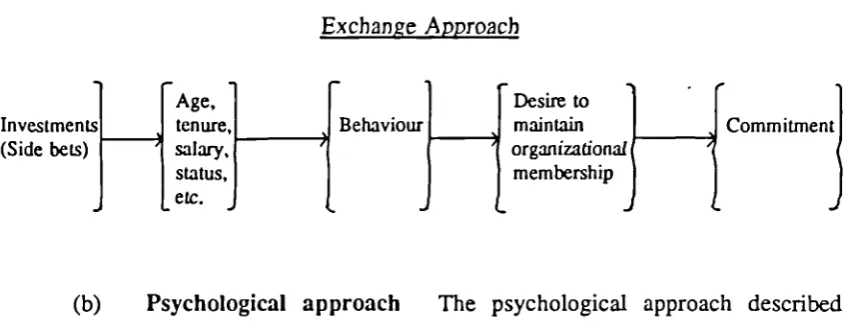
In brief, the exchange approach argues that commitment is a function of the
rewards and costs associated with organizational membership; these typically increase
as tenure in the organization increases. Therefore, the greater the number of
investments is, the greater the degree of commitment will be; and an individual will
find it costly to leave the organization, if he has to give up the rewards he has
accrued. The approach may be summed up in the following
diagram:-Figure 2
Exchange Approach
[Age,
1
[
[
Desire toInvestments
J tcnure,
J Behaviour
J maintain
J
Commitment (Side bets)1
salary, ( '1
1
organizationaLstatus, membership
Lee. J
(b) Psychological approach The psychological approach described
commitment as a more active and positive orientation toward the organization. The
approach views commitment as affective or attitudinal. Researchers such as Kanter
(1968), Buchanan (1974), and Porter, Steers, Mowday and Boulian (1974) seemed to
favour this approach.
Kanter (1968), to a certain extent, also viewed commitment as affective. For
example, she defined commitment
as:-"the willingness of social actors to give their energy and
loyalty to social systems, the attachment of personality
[image:43.595.77.501.279.442.2]self-expressive (p499)
On the other hand, Kanter also argued that commitment involved three distinct
areas. These three areas were continuance, group cohesion and social control; each
was supported by a dissociative and an associative process, and operationalized in
terms of specific mechanisms - organisational practices and arrangements which
distinguished successful from unsuccessful "commitment-requiring organizations."
She explained that continuance commitment involved primarily securing an
actor's positive cognitive orientations, inducing the actors to cognize participation in
the organization as profitable. She felt that if an individual, after considering the
profit and cost, found that the cost of leaving the social system would be greater than
the cost of remaining, the "profit" would compel the individual to continue
participating in the system. She contended that there were positive and negative
components in the cognitive-continuance commitment. For example, personal sacrifice
was a negative component and investment was a positive component. Like Becker
(1960) and other side-bet theorists, Kanter felt that through, for instance, investments
individuals became integrated with the social system, since their time and resources
had become part of its economy. The individual, as Kanter contended,
had:-"in effect purchased a share in the proceeds of the
organization and now have a stake in its continued good
She argued that when individuals invested their resources in one system rather than
in other potential paths, they tied their rewards and the future usefulness of their
resources to the success of the system, and cut themselves off from other ways of
allocating their resources. Obviously, this argument was in line with Becker's concept
of commitment when he described about the unanticipated involvement of other
sources of rewards or other aspects of a person once a line of action was chosen.
Kanter was of the view
that:-"Becker is talking primarily of continuance - the
conditions under which an individual will continue a
line of action once undertaken; he attributes this to the
making of 'side-bets', the unanticipated investment of
other, often intangible, resources once a person is a
member of a system." (j5O6)
However, when she referred to cohesion commitment, she interpreted it as the
commitment of an actor to group solidarity or to a set of social relationships. It
involved primarily the actor's positive "cathectic" orientations, affective ties to the
community, and gratifications that stemmed from involvement with all the members
of the group. According to Kanter, two general processes were involved - the
renunciation by the individual of other ties; and the communion by the individual with
the group as a whole.
norms and obeying the authority of the group. It involved primarily the individual's
positive evaluative orientations. For example, the demands made by the system on
the individual were evaluated as right, moral, just, so that the obedience by the
individual to these demands was regarded as a normative necessity. For example, the
so-called "organisation man " syndrome, as Mowday et al (1982) pointed out later, in
which the lives of employees were largely determined by their organizations is a good
example of control commitment.
Kanter felt that the above three types of commitment were highly interrelated,
and organizations often used all the three types simultaneously to develop their
members' commitment. In many ways, these three aspects of commitment acted to
reinforce each other to influence an individual's ties with his organization.
Buchanan (1974) viewed commitment
as:-"a partisan, affective attachment to the goals and values
of an organization, to one's role in relation to goals and
values, and to the organization for its own sake, apart
from its purely instrumental worth." (p533)
He suggested that commitment should consist of identification with the goals and
values of the organization; involvement in work activities; and organizational loyalty.
Affective attachment or psychological bond to the organization, and internalization of
The psychological views of commitment and the acceptance of organizational
goals and values were expressed also by Porter et a! (1974). The researchers
contended that commitment could be
defined:-"in terms of the strength of an individual's identification
with and involvement in a particular organization. Such
commitment can generally be characterized by at least
three factors: (a) a strong belief in and acceptance of the
organization's goals and values; (b) a willingness to
exert considerable effort on behalf of the organization;
and (c) a definite desire to maintain organizational
membership." (p604)
Similar views were also given by Porter, Crampon and Smith (1976). Again,
the individual's involvement with his organization, his belief in and acceptance of the
organization's goals and values, his willingness to show strong effort for the
organization, and his strong desire to maintain organizational membership were
highlighted. Thus to Porter et a! (1974) an individual's commitment did not just
represent his mere passive loyalty to his organization; it involved an active
relationship such that the individual was willing to put forth extra effort in order to
contribute to his organization's well being. In other words, an individual who was
highly committed to his organization intended to stay with it and to work hard towards
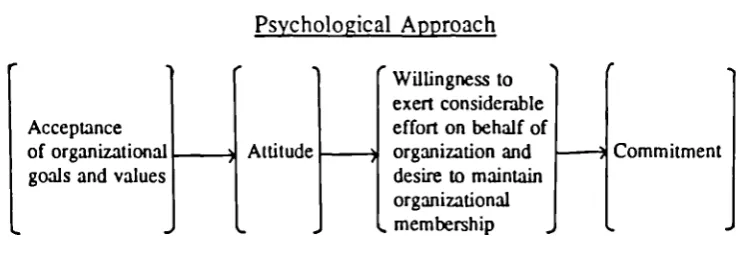
To conclude, the psychological approach describes commitment as a positive
and high-intensity orientation toward the organization. The researchers see
commitment as an individual's involvement with his organization, his internalization
of the organization's values, his willingness to put forth a strong effort to help his
organization to achieve its goals, and his strong desire to maintain his membership in
the organization. Thus the stronger the attachment he has, the greater his reluctance
to leave the organization. As commitment to the organization involves the
individual's incorporation of the organizational values and goals into his own identity,
Kidron (1978) referred to the commitment as "moral commitment." The approach
may be summed up in the following
diagram:-Figure 3
Psychological Approach
Willingness to exert considerable
Acceptance effort on behalf of
of organizational Attitude organization and Commitment
goals and values desire to maintain
organizational membership
Based on the above arguments, Aranya, Pollock and Amemic (1981) defined
professional commitment
as:-(a) "the belief in, and acceptance of, the goals and
values of the profession; (b) a willingness to exert
considerable effort on behalf of the profession; and (c)
a definite desire to maintain membership in the
[image:48.595.100.476.397.524.2]Because of the affective attachment as highlighted by the researchers, Meyer
and Allen (1984) referred to this approach as "affective commitment" as opposed to
"continuance commitment". McGee and Ford (1987) supported this conceptual
distinction between continuance commitment and affective commitment.
Behavioural-attitudinal approach Mowday et al (1979), and Mowday et al
(1982) tended to view the concepts in rather different perspectives. After reviewing
the literature on commitment, the researchers commented that though approaches to
the definitions of organizational commitment might vary considerably, certain trends
were evident. In particular, as Mowday et al (1979) argued, many of these definitions
focused on "commitment-related behaviours." For example, when one taLked about
someone becoming "bound by his actions" or "behaviours that exceeded normal and/or
normative expectations," one
was:-"in effect focusing on overt manifestations of
commitment. Such behaviours represent sunk costs in
the organization where individuals forgo alternative
courses of action..." (p225)
This behavioural approach to commitment was, as Mowday et al pointed out,
discussed in detail by, for example, Salancik (1977).
A second trend that emerged from the available theories was, according to
attitudinal commitment. For example, when Sheldon (1971) talked about "the identity
of a person (is linked) to the organization" or when Hall, Schneider and Nygren
(1970) mentioned about "the goals of the organization and those of the individual
becoming increasingly integrated or congruent", they were in effect talking about
attitudinal commitment. Attitudinal commitment thus, as Mowday et al (1979)
contended:-"represents a state in which individual identifies with a
particular organization and its goals and decides to
maintain membership in order to facilitate these goals."
(p225)
Mowday et al (1982) maintained that there was a cyclical relationship between
attitudinal commitment and behavioural commitment whereby commitment attitudes
led to committing behaviour which, in turn, reinforced commitment attitudes.
Identification
In the review of the literature, one will find that the term "identification" has
been used by many researchers in their studies of commitment. The issue pertaining
to organizational identification or the process by which an individual identifies with
his organization or profession has also captured the trememdous interest of many
organizational researchers. McGregor (1967), for example, was of the view that
including, for example, goal commitment, goal achievement, quality of performance
and job satisfaction. Hall et al (1970) also pointed out the positive relationship
between organizational identification and individual commitment to organizational
goals.
Commitment Measurement
The richness and diversity of concepts and theories about commitment found
in the literature, as noted earlier, have resulted in a vast diversity of views as to how
commitment should be measured. As researchers have generally tended to construct
or develop their own scales of measurement or instruments in accordance with their
own assumptions about commitment or the purposes they intend to achieve, one can
easily find a large number of different commitment scales in the literature. This has
made the study of commitment even more complicated. Mowday et al (1979), for
example, noted
that:-"studies of commitment have been made more difficult
by a general lack of agreement concerning how best to
conceptualize and measure the concept." (p225)
Hrebiniak and Alutto (1972) also contended
that:-"the lack of extensive examination of the organizational
difficulty of making that concept operational and of
deriving indexes amenable to empirical testing and
validation." (p558)
The number of items to be measured in the scales generally differs. It ranges
from two items to over 30 items. However, most of the scales, as noticed by
Mowday et at (1979) generally consist of two items to four or five items, depending
on the objectives which the researchers intend to achieve and the basic underlying
assumptions they have in mind.
Grusky (1966), as mentioned earlier, argued that the two general factors which
influenced the strength of a person's attachment to an organization were the rewards
he had received from the organization and the experiences he had had to undergo to
receive them. He felt that upward career mobility in an organization might be
considered a general reinforcer in that it provided rewards of many kinds for the
upward-mobile person. Based on this argument Grusky constructed a four-item scale
in his study to examine the relationship between organizational commitment and the
rewards in a large business organization. These four items were seniority,
identification with the company, attitude toward the company's administrators, and
general satisfaction with the company. The major measure of reward used in the
study was the degree of upward career mobility experienced by the managers in the
organization. An interrater reliability was reported as 0.90 by Grusky.
organizational research must include four aspects of involvement. These four aspects
of involvement were attraction to the organization, consistency of individual and
organizational goals, loyalty, and the reference of self to organizational membership.
Accordingly, a four-item index representing the four aspects of involvement was
designed by Brown to measure organizational identification. A test-retest reliability
of the index from one of the studies by Brown was reported as 0.61. An example of
the items
is:-(a) If you could begin working over again, but in the same
occupation as you are in now, how likely would you be
to choose TVA as a place to work?
Respondents were asked to answer the question on a five-point scale, ranging from
"definitely would choose another place" to "definitely would choose TVA".
Becker's (1960) theory of commitment was typically operationalized by the
scales developed by Ritzer and Trice (1969), and Hrebiniak and Alutto (1972). Ritzer
and Trice (1969), for example, developed a five-item instrument to test the utility of
Becker's side-bet theory of commitment to organization and occupation. The five
items were pay, freedom, status, responsibility and opportunity. In brief, respondents
were asked to indicate whether they would change their organization or occupation;
or would definitely not change their organization or occupation; or were undecided if
following:-(a) (1) no (2) a slight or (3) a large increase in pay; and
(b) (1) no more (2) a little or (3) much more freedom, status, responsibility
and opportunity to get ahead.
As commitment was viewed by the side-bet theory in terms of the perceived utility
of continued participation in the organization (i.e. calculative involvement), the
measure of commitment in this scale was, therefore, reflected in the respondents'
willingness or unwillingness to change their organization or occupation for moderate
advantages. The rest-retest reliability indices, as reported by Ritzer and Trice, ranged
from 0.83 to 1.0.
Sheldon (1971) hypothesized that investments would produce commitment to
the organization regardless of other features of the relationship of the person to the
organization, and his social involvement would also produce commitment to the
organization. Two separate scales were thus developed by her to test the
organizational and professional commitment of a group of Ph.D scientists. The
following were examples of the questions used to measure organizational
commitment:-(a) In the near future I would most like:
(1) To make a major contribution to one of the laboratory's
(2) To publish a paper in the leading journal of my profession even
though the topic might be of minor interest to the laboratory.
(b) As far as you know what are your career plans?
(1) I plan to stay here permanently, if possible.
(2) I plan to stay for the time being but to move somewhere else
eventually.
Respondents were asked to indicate their feeling about the organization on a
seven-point rating scale to measure organizational commitment. A coefficient of
reproducibility of 0.89, a minimum marginal reproducibility of 0.61, and a coefficient
of scalability of 0.72 were reported by Sheldon.
The following were examples of the questions used to measure professional
commitment:-(a) (1) How important is it to you to have a chance to contribute to
scientific knowledge?
(2) How important is it to you to have freedom to carry out your
own research ideas?
(3) How important is it to you to have a chance to do basic
The choice of "very important" was considered endorsement for all items; the choices
of "some importance", "minor importance", and "no importance" were considered
non-endorsement. A coefficient of reproducibility of 0.91, a minimum marginal
reproducibility of 0.62 and a coefficient of scalability of 0.76 were reported by
Sheldon for this scale.
Based on the argument of the side-bet or investment theory, Hrebiniak and
Alutto (1972) constructed a four-item scale to measure the organizational commitment
and professional commitment of a group of school teachers and nurses. The scale was
basically modelled upon that designed by Ritzer and Trice (1969). However, the
"responsibility" variable in the scale developed by Ritzer and Trice was deleted
because, as explained by Alutto, Hrebiniak and Alonso
(1973):-"of its possible ambivalence as a positive or negative
inducement condition." (p449)
The variable of "opportunity to get ahead" was also replaced by the inducement of
increased "friendliness" of co-workers.
The instrument developed by Hrebiniak and Alutto has been widely used by
researchers to measure organizational commitment as well as professional
commitment. The reliability of the scale was reported by Hrebiniak and Alutto as
0.79. Shoemaker, Snizek and Bryant (1977) used the "slight scale" of the instrument