1
A Vibrational Approach to Node Centrality and Vulnerability in
Complex Networks
Ernesto Estrada1
Department of Mathematics and Statistics, Department of Physics, Institute of
Complex Systems, University of Strathclyde, Glasgow G1 1XQ, UK.
Naomichi Hatano
Institute of Industrial Science, University of Tokyo, Komaba, Meguro, Tokyo
153-8505, Japan.
PACS: 89.75.Fb, 89.75.Hc, 89.65.-s
Keywords: network vibrations; centrality; spectral theory; Kirchhoff index; information
centrality; social networks
1
2
Abstract
We propose a new measure of vulnerability of a node in a complex network. The measure is based on the analogy in which the nodes of the network are represented by balls and the links are identified with springs. We define the measure as the node displacement, or the amplitude
of vibration of each node, under fluctuation due to the thermal bath in which the network is supposed to be submerged. We prove exact relations among the thus defined node
displacement, the information centrality and the Kirchhoff index. The relation between the first two suggests that the node displacement has a better resolution of the vulnerability than the information centrality, because the latter is the sum of the local node displacement and the
3
1. Introduction
The identification of the most central nodes in complex networks has run a long way from the pioneering works of several social scientists interested in quantifying the centrality and prestige of actors in social networks [1-3]. Nowadays, some of these “classical” centrality
measures [3], such as degree, betweenness and closeness, play a fundamental role in understanding the structure and properties of complex biological, ecological and
infrastructural networks [4-10]. As one of the founding fathers of this field, L.C. Freeman, has stated that the centrality has gone in the “wrong” way: from social sciences to physical science, in contrast with the traditional way, which is from physical science to social ones
[11]. A concept that is quite related to that of centrality is the concept of vulnerability [12-16]. In the seminal paper of Albert, Jeong and Barabási [17] the analysis of the vulnerability
of a network to intentional attacks is carried out by considering the degree of the nodes in the network. Then, in scale-free networks the removal of the highest-degree nodes makes the network collapse into many small isolated chunks. This idea has been extended by others to
consider other centrality measures [12-16]. In this context, for instance, it is possible to identify large parts of the network that can be isolated by removing the nodes with the largest
betweenness centrality [12].
A different question, however, is the identification of the most vulnerable nodes in a network. In a network we assume that we can attack any node by simply removing it from the
graph. We call this removal a primary extinction. However, it is well known that a node can be completely disconnected from the rest of the network by removing other node(s) in the
graph [17]. For instance, consider the case of a node i having only one connection, i.e., its
degree is one. In this case removing the node to which i is attached will isolate it from the
4 are less vulnerable than the low-degree ones. This has been the basis of the strategy of
attacking networks by removing hubs used by Albert, Jeong and Barabási [17]. Because the hubs are highly connected nodes, their disconnection will leave many low-degree nodes isolated. Observe that the attack strategy is always to remove the least vulnerable nodes by
primary attacks as the most vulnerable ones will be disabled as a consequence of secondary extinctions. However, the node degree accounts for only the nearest-neighbours attached to a
node. Consequently, the influence of more distant nodes is not considered in the vulnerability analysis based on the node degree. This has given rise to the use of alternative strategies, such
as the use of betweenness centrality [12].
The purpose of the present study is to find a more appropriate and useful measure of vulnerability. In a general context, we can think about the node vulnerability as the
susceptibility that a node has to any perturbation taking place on the network. In the present paper we use the physical concept of vibrations to account for the node vulnerability. We submerge the network in question in a thermal bath. The thermal fluctuation works as the
“perturbations” acting on the network. As a measure of vulnerability, we will use the displacement of a node from its “equilibrium” position due to small “oscillations” in the
network.
In Sec. 2, we will define the node displacement and find its expression in terms of the Moore-Penrose generalised inverse of the graph Laplacian matrix. We will argue in Sec. 3 the
role played by the temperature in the present theory. Then in Sec. 4, using spectral graph theory we will show that the node displacement is a good measure of the vulnerability of a
node. We will prove analytically in Sec. 5 that the so-called information centrality introduced by Stephenson and Zelen [18] is the sum of the local square node displacement and the average square displacement. Thus, we reinterpret this centrality measure here in terms of the
5 Sec. 6 that the Kirchhoff index is proportional to the average square node displacement.
Finally in Sec. 7, we will illustrate the applications of the new concepts developed here by studying a social network. We will show that despite the similarities between the information centrality and the node displacements, the node displacement has a better resolution of
vulnerability than the information centrality. We demonstrate this by analysing temporal changes of a real-world network.
2. Vibrations in complex networks
First we consider the analogy in which the nodes of the complex network are represented by
balls and the links are identified with springs with a common spring constant k. We would
like to consider the vibrational excitation energy from the static position of the network. Let
i
x denote the displacement of a node i from its static position. The meaning of these
displacements will be evident later. Then the vibrational potential energy of the network can
be expressed as
x kx x V TL2
, (1)
where LDA is the discrete Laplacian matrix of the network and x is the vector whose
th
i entry is the displacement xi. We recall that D is the diagonal matrix of degrees and A is
the adjacency matrix of the network. Suppose that the network is affected by an external
stress. In our physical model this is simulated by immersing the network into a thermal bath
of inverse temperature . The meaning of the temperature concept in the context of complex networks will be clarified in the next section. Then the probability distribution of the displacement of the nodes is given by the Boltzmann distribution
,2 exp 1
k x x
Z Z e x
P V x T
L
(2)
6 . 2 exp
dx k x x
Z T
L
(3)
The mean displacement of a node i can be expressed by
xi xi2 xi2P x dx, (4)
where denotes the thermal average. We can also define the displacement correlation as
xxPxdx x
xi j i j () . (5)
We can calculate this quantity once we diagonalise the Laplacian matrix L. Let us
denote by U the matrix whose columns are the orthonormal eigenvectors and the
diagonal matrix of eigenvalues of the Laplacian matrix. Note here that the eigenvalues of
the Laplacian of a connected network are positive except for one zero-eigenvalue. Then, we
write the Laplacian spectrum as 012n. An important observation here is that the zero eigenvalue does not contribute to the vibrational energy. This is because the mode
1
is the mode where all the nodes (balls) move coherently in the same direction and
thereby the whole network moves in one direction. In other words, this is the motion of the
center of mass, not a vibration.
In calculating Eqs. (2) and (3), the integration measure is transformed as
y d d y U d x x d i i n i i
1 1
d e t (6)
because the determinant of the orthogonal matrix,
det
U
, is either 1. Then we have7 Note again that because 1 0 the contribution from this eigenvalue obviously diverges. This is because nothing stops the whole network from moving coherently in one direction. When
we are interested in the vibrational excitation energy within the network, we should offset the motion of the center of mass and focus on the relative motion of the nodes. We therefore
redefine the partition function by removing the first component 1 from the last product.
We thereby have
. 2 2 ex p ~ 2 2 2
n n k y k d y Z (8)Next we calculate the mean displacement xi defined by Eq. (4). We first compute the
numerator of the right-hand side of Eq. (4) as follows:
. 2 ex p 2 ex p 2 ex p 2 ex p 1 2 1 1 2 1 2 2
n n i n i T n i T i T i i y k y y U U y d y y k y U y d y y k y U y d x x k x x d I (9)On the right-hand side, any terms with
will vanish after integration because theintegrand is an odd function with respect to y and y . The only possibility of a finite result
8
, 2 exp 2 exp 2 exp 2 exp 2 1 2 2 2 2 2 2 1 1 1 1 2 1 2
y k dy y k y U dy y k dy y U dy y k y U y d I n i n n i n n i i (10)where we separated the contribution from the zero eigenvalue and those from the other ones. Due to the divergence introduced by the zero eigenvalue we proceed the calculation by
redefining the quantity Ii with the first node removed:
. ~ 2 8 2 2 exp 2 exp ~ 2 2 2 2 3 2 2 2 2 2 2
n i n n i n i n i k U Z k k U y k dy y k y U dy I (11)We therefore arrive at the following expression for the mean displacement of a node, Eq. (4):
xi xi
2 I ˜ i
˜
Z
Ui2 k
2
n
. (12)If we designate by L the Moore-Penrose generalised inverse (or the pseudo-inverse) of the graph Laplacian [8], which has been proved to exist for any molecular graph, then it is
straightforward to realise that
i
i i kx
L
1
2 . (13)
A similar calculation also gives the displacement correlation, Eq. (5), in the form
n i j i j j i k k U U x x 2 1
9 Returning to a real-world situation, the displacement of a node given by xi represents
how much the corresponding node is affected by the external stress to which the network is
submitted to. A node which displays a large value of the displacement is one which is very much affected by the external conditions, such as economical crisis, social agitation,
environmental pressure or physiological conditions. In other words, it is a node with high vulnerability to the change in the external conditions. This equivalence between displacement
and vulnerability will be analysed in the next section.
3. On the concept of temperature in complex networks
Complex networks are continuously exposed to external “stress” which is independent
of the organizational architecture of the network. By external we mean here an effect which is independent of the topology of the network. For instance, let us consider the network in
which nodes represent corporations and the links represent their business relationships. In this case the external stress can represent the economical situation of the world at the moment in which the network is analysed. In “normal” economical situations we are under a low level of
external stress. In situations of economical crisis the level of external stress is elevated. Despite the fact that these stresses are independent of the topology of the network they can
have a determinant role in the evolution of the structure of these systems. For instance, in a situation of high external stress like an economical crisis it is plausible that some of the existing links between corporations are lost at the same time as new merging and strategic
alliances are created. The situation is also similar for the social ties between actors in a society, which very much depend on the level of “social agitation” existing in such a society
in the specific period of time under study.
10 strong dependence on the external temperature. For instance, the intermolecular interactions
between molecules differ significantly in gas, liquid and solid states of matter. The agents (molecules) forming these systems are exactly the same but their organization changes dramatically with the change of the external temperature. We are going to use this analogy to
capture the external stresses influencing the organization of a complex network.
Suppose that the complex network is submerged into a thermal bath at the temperature
T. The thermal bath represents here an external situation which affects all the links in the network at the same time. It fulfils the requirements of being independent of the topology of the network and of having a direct influence over it. Then, after equilibration all links in the
network will be weighted by the parameter
1 T kB . The parameter
is known as the inverse temperature and kB is the Boltzmann constant.
This means that when the temperature tends to infinity,
0
, all links have weightsequal to zero. In other words, the graph has no links. This graph is known as the trivial or
empty graph. For 1, we have the simple graph in which every pair of connected nodes
have a single link. The concept of temperature in networks can be considered as a specific case of a weighted graph in which all links have the same weights. If we consider the case
when the temperature tends to zero, , all links have infinite weights. Then, we can
have an analogy with the different states of the matter, in which the empty graph obtained at
very high temperatures
0
is similar to a gas, formed by free particles with no linkamong them. In the other extreme , we have a graph with infinite weights in their
links, which in some way has resemblances with a solid. The simple graph may be then analogous to the liquid state. These kinds of networks, obtained at different temperatures are
illustrated in Fig. 1.
Insert Fig. 1 about here.
11 The node displacement xi depends on the eigenvectors corresponding to all non-trivial
eigenvalues of the Laplacian matrix. Consequently, this measure contains information not
only on nearest-neighbours but also on the influence of more distant nodes from i.
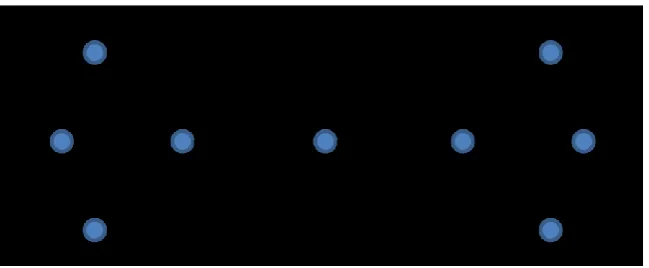
For instance, in the simple graph illustrated in Fig. 2 the values of node displacement reflect the influences of all nodes on a particular one to be analysed. In this example the node
displacements are:
x
1
x
2
x
3
x
7
x
8
x
9
1
.
165
,
x
4
x
6
0
.
762
and685
.
0
5
x
, for the nodes with labels given in Fig. 2. This means that the nodes of degreeone are very much affected by the external conditions, which means that they are highly vulnerable. It is easy to realise that these nodes are completely isolated by removing nodes 4 or 6. In addition the removal of node 5 leaves nodes of degree one in an isolated cluster
containing four nodes.
The second most vulnerable nodes according to the displacement are nodes 4 and 6.
They are not affected by the removal of nodes of degree 1 but they are left into an isolated cluster of four nodes when node 5 is removed. Finally, node 5 is the least vulnerable one. It is not affected by the removal of nodes of degree one and when nodes 4 or 6 are removed it still
remains in the largest component of the graph, which is formed by five nodes.
Obviously, the degree fails in ranking the vulnerability of these nodes as it identifies
nodes 4 and 6 as the least vulnerable ones. In addition, betweenness centrality also fails in identifying the least vulnerable node in this graph. The betweenness of nodes 1, 4 and 6 are 0, 18 and 16, respectively, which also identifies node 4 as the least vulnerable one.
Insert Fig. 2 about here.
An explanation of why the displacement is a good measurement of the node
vulnerability can be given in terms of the Laplacian spectrum. We recall that we have ordered
12 3
2
. Then because the eigenvalues of the Laplacian appear in the denominator of the nodedisplacement (12), the term 2
2 2
i
U
has the largest contribution to xi. The smallest non-trivial
eigenvalue
2 and its corresponding eigenvector are known as the algebraic connectivity andthe Fiedler vector of the graph, respectively [19]. The Fiedler vector is very well known in spectral graph partitioning [20]. Accordingly, the nodes of the graph are partitioned into two
sets V1 and V2 as follows: V1
i|Ui20
, V2
i|Ui20
. That is, a node belongs“strongly” to a partition if it has a large positive or a large negative value of the
corresponding entry of the Fiedler vector, whereas a node with Ui2 close to zero does not belong strongly to either of the two partitions. Consequently, the latter nodes can be considered as “separators” among the partitions. Then, if we remove such separators we in
general isolate the two partitions found by the positive and negative components of the Fiedler vector.
For instance, in the previous example, we have
U
52
0
,
U4 20.086 and
U1 2 0.138.
Of course, the equivalent nodes at the other side of the graph have the same values of the
Fiedler vector but with negative signs. As a first approach we can consider a partition of the graph in which the nodes 1, 2, 3 and 4 form a cluster and the nodes 6, 7, 8 and 9 form another. Then, it is clear that the node 5 is a separator of the two partitions. This means that removing
this separator will isolate the two clusters. In the second approach we can consider that a cluster is formed by nodes 1, 2 and 3, while the other by nodes 7, 8, 9. In this case, the nodes
4, 5 and 6 are separators. As can be seen the node 5 appears as a separator in the two possible partitions and the nodes 4 and 6 in only one of them, which introduces the ranking in vulnerabilities given by the node displacement.
13 graph into isolated components. It is known that
2
G
, where
G
represents the node connectivity, which is the minimum number of nodes that must be removed in order todisconnect the graph. Then, the two main contributions to the displacement guarantee that the
smallest value of xi is obtained for the nodes contributing more to separate the network into
disconnected parts.
The obvious question at this point is why to use xi instead of the Fiedler vector as a measure of node vulnerability. First, it has been previously proved that the use of as many
eigenvectors as practically possible should be preferred for partitioning purposes. While the Fiedler vector gives a bipartition of the network the other eigenvectors give partitions into
larger number of clusters, which helps to identify the “separators” in a more appropriate way.
In the second place, the Fiedler vector may be degenerate. That is, the assumption
2
3 isnot always true, e.g., in square grids and complete graphs. In this case it has been observed
that there are great problems with the convergence of algorithms used for partitioning purposes. Finally, the use of the physically appealing concept of node vibrations permits us also to compare nodes in different networks on the basis of the penalization imposed by the
eigenvalues in the expression for xi.
A desired property for a measure of node vulnerability in complex networks is that it accounts in some way for the empirical observation that low-degree nodes are more
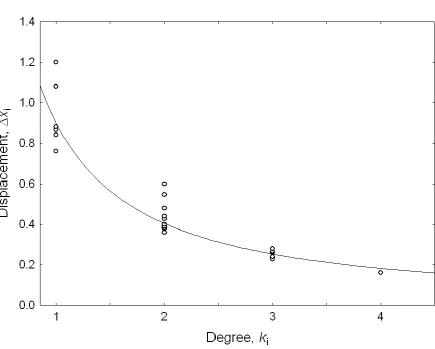
vulnerable than the high-degree ones. In Fig. 3 we illustrate the relation between the displacement and the degree for all connected graphs having 5 nodes. It can be seen that the
node displacement correlates with the node degree as xi ~ki with some power
1
.
155
, which agrees with the intuition that low-degree nodes are more vulnerable than high-degree14 nodes with the same degree a large variability in their displacements is observed, which adds
an extra value to the use of xi instead of the node degrees as a measure of node vulnerability.
Insert Fig. 3 about here.
5. Node displacement and information centrality
In the present and next sections we will find exact relations between the node
displacement and other measures. A measure of centrality of a node in a network was introduced by Stephenson and Zelen [18] and is known as information centrality (IC). It is based on the information that can be transmitted between any two points in a connected
network. If A is the adjacency matrix of a network, D a diagonal matrix of the degree of each node and J a matrix with all its elements equal to one, then IC is defined by inverting the
matrix BDAJ as
C
B
1i j
c
, from which the information matrix is obtained asfollows:
2
1 ii jj ij
ij c c c
I (15)
The information centrality of the species i is then defined by using the harmonic average:
1
1
1
j i j n i I C
I (16)
Stephenson and Zelen [18] proposed to define Iii as infinite for computational purposes,
which makes 1 0
i i
I .
It is straightforward to realise that BLJ. The following theoretic result guarantees
the existence of CB1
for connected networks.
Lemma 1: If G is a connected network, then the inverse of B has the same eigenvectors as
15
B1L 1
n2J. (17)
where as before L is the Moore-Penrose generalised inverse of L. Proof: Let
k1. Then,
k k k k k
k U U U U
U LJ L J
B , (18)
because JUk 0. Now, let
k1. Then, JU1 n U1 due to the fact that 1 1 1
n
U and
because
10 and
LU1 0 r , we have
B
U
1
L
J
U
1
L
U
1
J
U
1
nU
1, (19) which means that n is the eigenvalue of B corresponding to
U1.
It is known that LL LL I J n 1 ,
LJJ LLJJ L0 and J2nJ. Then, we have
LJ
L 1 n2 J
I
1
nJ nJ
n2 I, (20)
which proves that
L 1
n2J is the inverse of B.
Then, we have the following new result concerning the information centrality.
Theorem 2: Let xi be the node displacement and
x
2the average displacement over all
nodes in the network. Then, the information centrality of node
i is given by
2 2
1 x x k i I C
i
. (21)
Proof: Let us write the information centrality as follows
2
1n R T c i
I C i i , (22)
where
n j jj c T 1and
n j ij c R 1 . Then, ci i
B1i iL
1
n2J
i i
L i i1
n2k
xi2 1
16
T cj j
j1
n
T r B1T r L 1n2J
T r L
1
n
k
xi2
i1
n
1n, (24)
R ci j
j1
n
B1i j j1
n
1n, (25)
because
T r J n and
01 1
n i i j n ji j L
L . Then, we have
2 2
1 1 2 2 2 1 2 1 1 x x k n n n x k n x k i I C i n i i i
. (26)
6. Electrical networks analogy
Let us consider a connected network which has associated with an electrical network in such a way that each link of the network is replaced by a resistor of electrical resistance equal to
one Ohm. When the poles of a battery are connected to any pair of nodes i and j in the
network the resulting resistance ij between them is given by the Kirchhoff and Ohm laws.
Such resistance is known to be a distance function [21] and called the resistance distance. It was introduced in a seminal paper by Klein and Randić a few years ago [21] and has been intensively studied in mathematical chemistry [21-25]. The standard method of computing the
resistance distance for a pair of nodes in a network is by using the Moore-Penrose generalised
inverse of the graph Laplacian L, which is given by [21, 22]
ii jj ij ji ij L L L L , (27)
for i j. The resistance matrix Ω is the matrix whose non-diagonal entries are ij and
0
i i [21]. It is easy from Eqs. (12) and (14) to see
2 2
2j i i j j i j i
ij k x x x x x x k x x
. (28)
The right-hand side of Eq. (28) should be small when the nodes
i and
j vibrate in the same
17 particularly on the mode corresponding to
2, on which we discussed in Sec. 4, two nodes in the same partition according to the Fiedler vector vibrate in the same direction and ones in different partitions vibrate in the opposite directions. Then, Eq. (28) dictates that two nodes
that are close in terms of the resistance distance tend to be in the same partition and vibrate in the same direction whereas ones that are far tend to be in different partitions and vibrate in the opposite directions, which fits our intuition well.
The resistance matrix
is the basis of a topological index for a network that was
introduced first for studying molecular graphs. This index is known as the Kirchhoff index
Kf and is defined as
j i
i j
Kf [21-25]. It is known that Kf can be expressed in terms of
the Laplacian eigenvalues as follows [22],
1 Tr L2
n n
Kf n
j j
, (29)
which means that we can express the Kirchhoff index using the node displacements as
x 2 n2 k
x 2. kn
K f n
i i
i
(30)
This in turn gives the information centrality [18] in the form
2 1
n Kf i
I C L i i , (31)
where
i i k
xi 2
L is interpreted here as the contribution of the node to the effective
resistance of every link attached to it. In the case of networks having no cycles, i.e., trees, it is known that the Kirchhoff index and the sum of shortest path lengths between all pairs of
nodes in the graph coincide [21].
Let
j i j i
R be the sum of the resistance distances from node i to all other nodes in
18
2 2
1n k x x nIC i
Ri i . (32)
That is, the information centrality measure of a node is inversely proportional to the sum of
the resistance distances from the corresponding node to all other nodes in the network.
7. Application to a social network
The first conclusion from the previous analysis is that for a given network the node
displacement and the information centrality contain exactly the same topological information about the corresponding node, i.e., they are linearly related as
2 2
/1 ICi
k xi x . (33)Despite the relationship between the information centrality and the node displacement, there is a fundamental difference between them. The information centrality can be seen as a
composite index containing local information about a node as well as global topological information about the network, whereas with the node displacement we can separate it into
the local information as
xi
2and the global one as
x
2. This difference is very relevant
when comparing nodes in different networks.
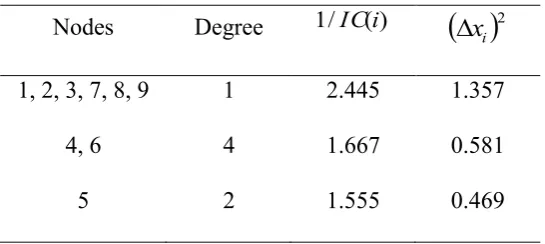
Let us first see the difference using the simple example in Fig. 2. We listed the
breakdown of
1/IC(i) into
xi
2and
x
2. In terms of the information centrality, the
vulnerability of the nodes 1 and 5 differs only by factor 1.6. In terms of the square node displacement, however, they differ by factor ~3. Moreover, we can claim the following. For
the node 1, we see
xi
2
x 2, which suggests that the vulnerability of the node 1 comesmainly from its own weak position. For the node 5, on the other hand, we see
xi
2
x 2,which suggests that the vulnerability of the node 5 comes mainly from the weakness of the entire network, not from its own weakness. This observation suggests that the node
19
Insert Tab. 1 about here.
For a more realistic illustration we are going to use the data obtained by Kapferer about the social ties among tailor shops in Zambia [26]. Hereafter we use the parameter value of
k1, for which the vibrational energy is comparable to the thermal energy. The network is
formed by 39 individuals who were observed during a period of ten months for their friendship and socio-emotional relationships. The data consists of two networks of social
interactions recorded at two different times [26, 27]. After the first data was collected an abortive strike was reported [26]. Then, after seven months the second data was collected and
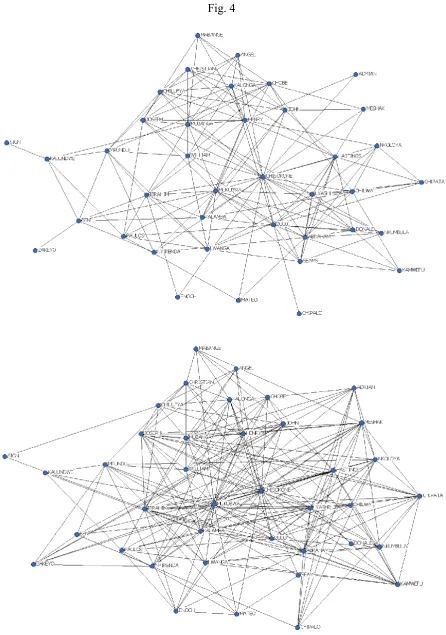
a successful strike took place after it. In Fig. 4 we illustrate the social interactions between the 39 people in the tailor shop at the two different times.
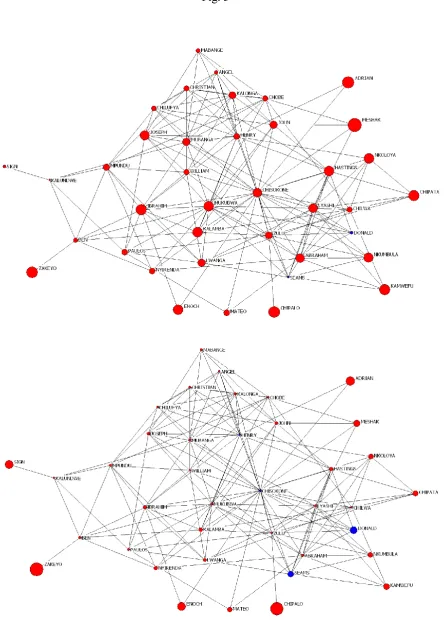
Insert Fig. 4 about here.
We have proved analytically that the information centrality and the node displacement are directly related to each other for the nodes of a network. Then, we focus here on the
differences between the two indices when we compare the same nodes in two different versions of the same network. For the purpose, we are going to use the change in the
information centrality after seven months in the tailor shop IC
i IC2
i IC1
i , where
iICt is the information centrality of node i at time step t. In a similar way we define xi
as the difference in the node displacement at the two times in which the network was
analysed. In Fig. 5 we represent the differences in
IC
i
and xi for all nodes in the tailorshop. For the sake of comparison, the values of
2x
for these two versions of the tailor shop
network are 0.242 and 0.129, respectively.
Insert Fig. 5 about here.
This example clearly illustrates the differences between the information centrality and
the node displacement in characterization of nodes. According to I C
i the individuals that20 Chipata > Kamwefu > Ibrahim > Mukubwa > Nkoloya > Enoch. However, the ranking
according to the node displacements is: Zakeyo > Chipalo > Adrian > Sign > Enoch > Donal > Meshak > Seans > Kamwefu > Chipata. Meshak, who is ranked as number one according to
i I C , is the actor displaying the largest change in the degree among all the actors. It
changes its degree from 4 to 18 in the two versions of the tailor shop. However, Zakeyo and
Chipalo, who are ranked by xi as the ones having the largest change in the node
displacement have changed their degree from 1 to 7 in the two versions of the tailor shop
network.
According to Eq. (33), the increase in the information centrality of a node can mean either the decrease in the local node displacement or the decrease in the global (average) node
displacement (or both). Comparing the two panels in Fig. 5, we realise that the increase of the information centrality is, for most nodes, due to the decrease of the average node
displacement, not due to the local one. Many nodes had many links in the first place and were not very vulnerable. Their information centrality increased after seven month mainly because
the number of links generally increased in the entire network and hence
x
2decreased,
whereas their own node displacement scarcely decreased, that is, their own local vulnerability scarcely changed. For some nodes such as Zakeyo and Chipalo, however, their own
vulnerability improved greatly after seven months because their own degrees increased dramatically. This demonstrates clearly that the node displacement has a better resolution of
the situation than the information centrality.
In general, the change in the information centrality is very much correlated with the
change in the degree centrality DC
i . For instance, the correlation coefficient between
iI C
and
DC
i
is 0.87 for the nodes in the network analysed here. However, xi21 very well these differences is provided by the ranking of Sign, who is ranked as the fourth
largest change in xi among all actors in the tailor shop. He is ranked as number 36 out of
39 according to the change in the information centrality and between 29 and 32 according to the change of the degree centrality, which is only 1. Sign was in a very vulnerable position in
the initial network as he was connected to only one actor. After seven months he displayed a less vulnerable position in the network as he appears connected to two other actors. In the cases of Zakeyo and Chipalo this change has been more dramatic as they increased their
degree from 1 to 7 in the two versions of the network and they appear as the ones having the
largest changes in xi.
8. Summary
In the present paper we proposed the node displacement as a measure of vulnerability of each node in a network. We defined the node displacement as the amplitude of vibration caused by
thermal fluctuation of a heat bath. This simulates the situation where the network in question is under a level of external stress. We proved exact relations among the node displacement,
the information centrality and the Kirchhoff index. The relation between the first two suggested that the node displacement has a better resolution of vulnerability than the information centrality; the latter is the sum of the local node displacement and the averaged
22
References
[1] L.C. Freeman, Sociometry 40 (1977) 35. [2] S.P. Borgatti, Social Networks 27 (2005) 55.
[3] S. Wasserman, K. Faust, Social Network Analysis, Cambridge University Press,
Cambridge, 1994.
[4] H. Jeong, S.P. Mason, A.-L. Barabási, Z.N. Oltvai, Nature 411 (2001) 41.
[5] E. Estrada, Proteomics 6 (2006) 35.
[6] G. del Rio, D. Koschutzki, G. Coello, BMC Syst. Biol. 3 (2009) 102. [7] F. Jordan, Phil. Trans. Royal Soc. B, Biol. Sci. 364 (2009) 1733.
[8] E. Estrada, Ö. Bodin, Ecol. Appl. 18 (2008) 1810.
[9] M. Barthelemy, A. Barrat, A. Vespignani, Adv. Compl. Syst. 10 (2007) 5.
[10] J.H. Choi, G.A. Barnett, B.S. Chou, Global Networks 6 (2006) 81. [11] L.C. Freeman, J. Soc. Struct. 9 (2008) 1.
[12] P. Holme, B.J. Kin, C.N. Yoon, S.K. Hau, Phys. Rev. E 65 (2002) 056109.
[13] L. Zhao, K. Park, Y.-C. Lai, Phys. Rev. E 70 (2004) 035101.
[14] J. Wang, L. Dong, D.J. Hill, G.H. Zhang, Physica A 387 (2008) 6671.
[15] A. Santiago, R.M. Benito, Physica A 388 (2009) 2234.
[16] G. Chen, Z.Y. Dong, D.J. Hill, G.H. Zhang, Physica A 388 (2009) 4259.
[17] R. Albert, H. Jeong, A.-L. Barabási, Nature 406 (200) 378. [18] K. Stephenson, M. Zelen, Social Networks 11 (1989) 1.
[19] M. Fiedler, Czech. Math. J., 23 (1973) 298.
[20] D.A. Spielman, S.-H. Teng, Lin. Algebra Appl. 421 (2007) 284. [21] D.J. Klein, M. Randić, J. Math. Chem. 12 (1993) 81.
[22] W. Xiao, I. Gutman, Theor. Chem. Acc. 110 (2003) 284.
23 [24] H.Y. Chen, F.J. Zhang, Disc. Appl. Math. 155 (2007) 654.
[25] B. Zhou, N. Trinajstić, J. Math. Chem. 46 (2009) 283.
[26] B. Kapferer, Strategy and transaction in an African factory. Manchester University Press, Manchester, 1972.
24
Table 1
Tab. 1: Inverse of the information centrality and the squared node displacement for the nodes
of the network shown in Fig. 2. These two measures satisfy Eq. (33) with
x2 1.086 and
k1.
Nodes Degree 1/IC(i)
xi 2 1, 2, 3, 7, 8, 9 1 2.445 1.3574, 6 4 1.667 0.581
25
Figure Captions
Fig. 1: A network submerged in a thermal bath. A “gas” at
T, a “liquid” at
T
1
, and a“solid” at
T
0
.Fig. 2: A simple network for illustration.
Fig. 3: Correlation between the node degree and the node displacement. The solid curve
indicates the power-law relation
xi ~ki
1.155
, with correlation coefficient 0.958.
Fig. 4: The social network of 39 tailor shops in Zambia at one time (top) and seven months
after that (bottom).
Fig. 5: Temporal changes in the information centrality and the node displacement. Each node
is drawn with a diameter proportional to the absolute value of
IC
i
(top) or
x
i(bottom), respectively. In the upper panel, the red circles indicate the nodes where their information centrality increased (less vulnerability) and the blue ones indicate the nodes
where it decreased (more vulnerability). In the lower panel, the red circles indicate the nodes where the node displacement increased (less vulnerability) and the blue ones indicate the
26
Fig. 1
0
T 1
0 T