Identifying drivers for the intra-urban spatial variability of airborne
particulate matter components and their interrelationships
Hao Wu
a,b,*, Stefan Reis
b,c, Chun Lin
a, Iain J. Beverland
d, Mathew R. Heal
a aUniversity of Edinburgh, School of Chemistry, Joseph Black Building, David Brewster Road, Edinburgh, EH9 3FJ, UKbCentre of Ecology&Hydrology, Bush Estate, Penicuik, Edinburgh, Midlothian, EH26 0QB, UK cUniversity of Exeter Medical School, Knowledge Spa, Truro, TR1 3HD, UK
dUniversity of Strathclyde, Department of Civil and Environmental Engineering, James Weir Building, 75 Montrose Street, Glasgow, G1 1XJ, UK
h i g h l i g h t s
Peripatetic measurements of UFP, BC and PM2.5were taken in an urban environment.
Spatial variability in UFP and BC were much larger than in PM2.5.
UFP and BC were significantly correlated with traffic counts, while PM2.5was not.
PM2.5variability was largely determined by synoptic meteorological influences.
a r t i c l e i n f o
Article history:
Received 19 January 2015 Received in revised form 21 April 2015
Accepted 24 April 2015 Available online 25 April 2015
Keywords:
Black carbon Ultrafine particles PM2.5
Spatiotemporal variability Mobile measurements
a b s t r a c t
The aim of this work was to compare the variability in an urban area offine particles (PM2.5), ultrafine
particles (UFP) and black carbon (BC) and to evaluate the relationship between each particle metric and potential factors (local traffic, street topography and synoptic meteorology) contributing to the vari-ability. Concentrations of the three particle metrics were quantified using portable monitors through a combination of mobile and static measurements in the city of Edinburgh, UK. The spatial variability of UFP and BC was large, of similar magnitude and about 3 times higher than the spatial variability of PM 0.5-2.5(the PM size fraction actually quantified in this work). Highest inter-daily variability was observed for
PM0.5-2.5, which was approximately 2 times higher than inter-daily variability of BC and UFP. Elevated
concentrations of UFP and BC were observed along streets with high traffic volumes whereas PM0.5-2.5
showed less variation between streets and a footpath without road traffic. Both BC and UFP were significantly correlated with traffic counts, while no significant correlation between PM0.5-2.5and traffic
counts was observed. BC was significantly correlated with UFP, with significantly different regression slopes between working days and non-working days implying that the increased number of diesel powered heavy goods vehicles during working days contributed more to BC than to UFP. It is concluded that variations in BC and UFP concentrations were mainly determined by the nearby traffic count and varying background concentrations between days, while variation in PM0.5-2.5concentration was mainly
associated with regional sources. Thesefindings imply the need for different policies for managing human exposure to these different particle components: control of much BC and UFP appears to be manageable at local scale by restricting traffic emissions; however, abatement of PM2.5requires a more
strategic approach, in cooperation with other regions and countries on emissions control to curb long-range transport of PM2.5precursors.
©2015 The Authors. Published by Elsevier Ltd. This is an open access article under the CC BY license (http://creativecommons.org/licenses/by/4.0/).
1. Introduction
Evidence continues to accumulate of the adverse health impacts
of PM2.5, the mass concentration of airborne particulate matter
(PM) with an aerodynamic diameter of less than 2.5
m
m (WHO,2013). However, metrics of other characteristics of ambient PM
*Corresponding author. University of Edinburgh, School of Chemistry, Joseph Black Building, David Brewster Road, Edinburgh, EH9 3FJ, UK.
E-mail address:[email protected](H. Wu).
Contents lists available atScienceDirect
Atmospheric Environment
j o u r n a l h o m e p a g e : w w w . e l s e v i e r . c o m / l o c a t e / a t m o s e n v
http://dx.doi.org/10.1016/j.atmosenv.2015.04.059
including numbers of ultrafine particles (UFP, particles of diameter
<100 nm) and black carbon (BC) concentrations are emerging as
important in terms of their association with health effects (Heal
et al., 2012). A relevant issue is the extent to which UFP and BC concentrations vary within populated areas, since a shortcoming in many epidemiological studies is assumption of homogenous exposure within the study area. This might be plausible for
pol-lutants with less spatial variability but could result in significant
bias in exposure-response relationships for highly spatially variable
pollutants (Hoek et al., 2002). In this context, variables related to
the contribution of emissions from major roads (e.g. traffic
in-tensity, or distance to the road) are commonly identified as
sig-nificant predictors for a range of traffic-related air pollutants in
many studies applying land-use regression models (Hoek et al.,
2008), the validity of which might be influenced by the
underly-ing causes of the variability of different pollutants. Thus one of the aims of this work was to evaluate the extent to which potential factors affect the spatiotemporal variability of ambient BC, UFP and
PM2.5in an urban area. These factors include local traffic, street
topography and synoptic meteorology which, although recognised in the literature, have rarely been compared in terms of their
in-fluences on different metrics.
The three airborne particle metrics are closely related to traffic
in urban environments (HEI, 2010; Kassomenos et al., 2014;
Sandradewi et al., 2008) but, for PM2.5 in particular,
synoptic-scale meteorology also affects the dispersion and long-range
transport of secondary particles (Pinto et al., 2004). UFP
vari-ability is also subject to high intensity secondary formation
asso-ciated with strong solar radiation (Reche et al., 2011). Street
canyons, which are ubiquitous in many urban environments, introduce complex dispersion characteristics that further increase
the spatial variability of BC and UFP (Peters et al., 2014; Rakowska
et al., 2014). One limitation of inter- and intra-urban studies of
airborne particle concentrations is that the fixed-site
measure-ments on which they are based are rarely sufficient in number, and
thus in spatial coverage, to explore the variability of exposure to particles at street level. One way to monitor particle concentration at high spatiotemporal resolution is by use of mobile monitoring instruments, which has good prospects for wider application in the
assessment of human exposure to air pollution in the future (Steinle et al., 2013).
Both UFP and BC have received increasing interest in recent
studies (Patton et al., 2014; Ruths et al., 2014), as they can be
considered markers of a range of traffic-related particulate
pollut-ants. Therefore the relationships of UFP and BC with traffic volume
and composition need to be understood in order to correctly assign
exposure to traffic pollution in health studies. In the UK and many
other countries, PM2.5 and PM10are the only two regulated PM
metrics (AQEG, 2012). Given the increasing evidence for the
harm-fulness of UFP (WHO, 2013) with its ability to penetrate deep into
the airways (Knibbs et al., 2011), investigation on the relationship
between UFP and PM2.5can provide insight on the extent to which
current policy can effectively protect human health. Thus another aim of this work was to investigate the inter-relationships between
the different metrics of PM and their relationships with traffic.
In this work, pairs of portable instruments were used to
mea-sure PM0.5-2.5(used here as a measure of PM2.5), UFP number and
BC concentrations within the city of Edinburgh (Scotland) in two series of measurement campaigns in winter and in spring. Analyses of data from a combination of mobile and stationary measurements were used to evaluate possible causes of the variations in the concentrations of the different PM metrics.
2. Methods
2.1. Study design
BC, UFP and PM0.5-2.5concentrations were measured across the
south of the city of Edinburgh, UK (55.9N, 3.2 W, population
~480,000) in two separate campaigns using 2 units of the following instruments: microAeth AE51 (AE51), TSI 3007 Condensation Par-ticle Counter (CPC) and Dylos Corp. DC1700 (Dylos).
In the winter campaign, between December 2013 and January 2014, the measurements were conducted three times on Mondays and once on Sunday primarily near roadside by walking between
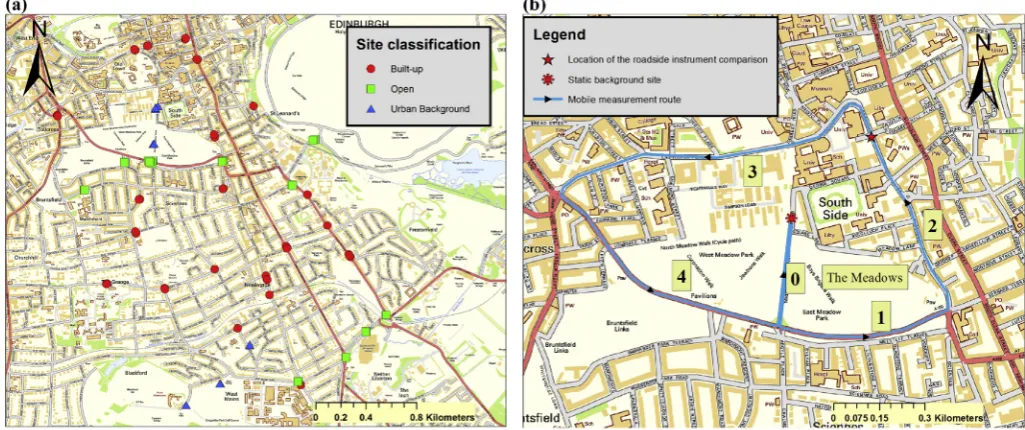
and pausing at designated sites (Fig. 1a). The sites were selected to
[image:2.595.45.558.495.710.2]cover potential hotspots, urban background sites (at least 130 m from the nearest major road) and different street topographies
Fig. 1.(a) Location and classification of the static measurement sites. Streets with buildings on both sides are classified as built-up. Streets with buildings on only one side or no buildings on either side are classified as open. Background sites are at least 130 m away from the nearest major road. (b) Mobile measurement route and location of the contemporaneous background measurements. Segments of the mobile route are labelled from 0 to 4. Base map from Edina Digimap®.
(open or built-up) over an area of about 6 km2. In a typical walk, the measurements started at around 10:00 a.m. and proceeded through
the designated sites to thefinal location roughly in the order from
south to north and from east to west (Fig. 1a). At each site a 5-min
static measurement was conducted, during which the number and type of vehicles (car, van, heavy goods vehicle and bus) passing the observer were recorded. Throughout each walk, measurements for each pollutant were taken in parallel (with duplicate instruments) on both sides of the road. To evaluate the duplicate precision, inter-comparison between the pairs of instruments was conducted in a separate trial on Mon 3rd Feb 2014 from 10:00 a.m. to 12:00 p.m. by walking through the same route but with the duplicate instruments carried by one person. The weather conditions on this day were
similar to other measurement days (Supplementary Information
Table S1). Traffic characteristics are assumed to be similar to other Monday measurements.
In the spring campaign, between April and May 2014,
mea-surements were taken around a park area (~1 km2), referred to
locally as‘the Meadows’, focusing on understanding the
contribu-tions from traffic-related sources and local background sources to
BC, UFP and PM0.5-2.5on typical urban streets (Fig. 1b). The road on
the south edge of the Meadows had an annual average dailyflow of
13,272 vehicles in 2013 (Dft, 2015). The pollution level associated
with traffic was monitored by walking along a route surrounding
the Meadows. To measure temporal variation in the background concentrations, a duplicate set of instruments was located at a static site inside the route circuit during the collection of the mobile measurements. This background location had perpendicular dis-tance between 160 and 480 m to the three sides of the triangle
route (Fig. 1b). The measurements were conducted on one Sunday
andfive weekdays. On each day the mobile measurements started
together with the static measurements at the background site and
proceeded in the directions indicated inFig. 1b. Two trips were
carried out in the morning (~9e10 a.m.) and early afternoon (~1e2
p.m.) during each day, except for adverse weather conditions on one of the weekday afternoons. Other incomplete sets of mea-surements during each day were due to instrument faults. The
route of the mobile measurements was divided intofive segments
with different street topographies and traffic densities, as labelled
onFig. 1b. The total traffic passing the observer in the direction of
the route was counted for each segment. Trafficflow in the opposite
direction of the route is assumed to be similar. The duplicate in-struments were compared against each other during the last four measurement days by co-location for at least 20 min either at the
static background site or near a busy roadside (Fig. 1b). The
inclu-sion of both background and roadside sites was to cover a range of concentrations for the evaluation of duplicate instrument precision.
2.2. Instrumentation
The AE51 determines BC concentration from absorption of 880 nm laser light by particles continuously collected on a
glass-fibre filter. The CPC measures particle number concentrations of
particles between 0.01 and 1
m
m in diameter by using laser lightscattering after condensing particles with super-saturated
iso-propanol vapour. Although UFP is usually defined as particles
smaller than 100 nm, since the number concentration is dominated
by ultrafine particles the measurement from the CPC can be
considered to represent UFP number concentration. The Dylos measures the particle number concentration using laser light
scattering technique in two size ranges,>0.5 and >2.5
m
m. Onlyparticles between 0.5 and 2.5
m
m in diameter were included in thisstudy and are thus referred to as PM0.5-2.5. The use of the
termi-nology PM2.5elsewhere in this paper refers to the mass of all
par-ticles<2.5
m
m as defined for air quality standards.In the winter campaign the time bases for the AE51, CPC and Dylos were 1 min, 1 s and 1 min, respectively. Because of the shorter duration of a trip in the spring campaign the resolution for the AE51
was increased to 30 s to ensure sufficient data points for each
segment. The Optimised Noise-reduction Averaging (ONA) algo-rithm was used to reduce the noise in the data recorded by the AE51 (Hagler et al., 2011). The ONA algorithm conducts adaptive time-averaging of the BC data, with the incremental light attenuation
(
D
ATN) through the instrument's internalfilter determining thetime window of averaging. The
D
ATN thresholds were set at 0.01and 0.05 for winter and spring measurements, respectively, as a result of the different proportions of clean background areas and sampling resolutions in two campaigns. Negative values recorded after the smoothing were omitted from further analyses (consisting of ~5% of the whole data set), which mostly occurred when the
measured concentrations were<100 ng/m3.
Major axis (MA) regression analysis was carried out to test the equivalence between duplicate instruments, assuming that the
uncertainties in the duplicate instruments are similar (Warton
et al., 2006). A statistical summary of instrument
inter-comparison results is given in SITable S2. Correlations between
duplicate instruments were highly significant, however the 95%
confidence interval of the slopes for AE51 and CPC in spring
campaign and Dylos in both campaigns did not encompass unity. Therefore corrections based on the slope and intercept from the MA regression analyses were applied to the corresponding instruments to allow comparison between duplicate instruments.
2.3. Additional data
The average PM2.5concentrations measured by a TEOM-FDMS
instrument at the UK national network monitoring station St.
Leonards (55.945589N, 3.182186W) located 600 m to the east of
the Meadows during each set of measurements are summarised in SIFig. S1. The TEOM-FDMS is a reference-equivalent instrument for
quantifying gravimetric PM2.5for statutory purposes.
Meteorolog-ical data for the period of measurement for each day in both campaigns and for the period when instrument inter-comparisons were carried out in the winter campaign were obtained from a weather station on the rooftop of a seven storey building located
~3 km to the south of the Meadows (55.92N, 3.17W) and are
summarised inTable S1.
2.4. Data analyses
Reduced major axis (RMA) regression analysis was used to investigate the correlation between different pollutants, since the magnitudes of the data values and their uncertainties are not the
same for different instruments (Ayers, 2001). Given the skewed
nature of pollutant distributions, the non-parametric
Man-neWhitney U test and the KruskaleWallis test were used to
determine whether median concentrations differed significantly
between two and more than two samples, respectively. Data
ana-lyses were performed mainly using R software (R Core Team, 2014)
and sometimes Microsoft Excel. Back trajectory data was imported from pre-calculated trajectory data using the HYSPLIT trajectory
model via the “importTraj” function in openair (Carslaw and
Ropkins, 2012), an R package for air quality data analysis.
3. Results and discussion
3.1. Spatiotemporal variability of BC, UFP and PM0.5-2.5
Distributions of BC, UFP and PM0.5-2.5 concentrations in the
Fig. 2.Distributions of (a) BC, (b) UFP and (c) PM0.5-2.5concentrations measured on both sides of the road during each week in the winter campaign. The bold horizontal line denotes the median, and the box demarcates the interquartile range. The whiskers extend to the values 1.5 times the IQR on each side of the median. The PM0.5-2.5concentration measured by one of the Dylos instruments was corrected based on the statistics from MA regression analysis of instrument co-deployment during the winter campaign (Table S2). Side of road is defined with respect to the walking direction in the mobile measurements. The UFP concentrations in (b) are 1 min averages of the raw 1 s data.
H.
Wu
et
al.
/
Atmospheric
En
vironment
11
2
(20
15
)
306
e
31
6
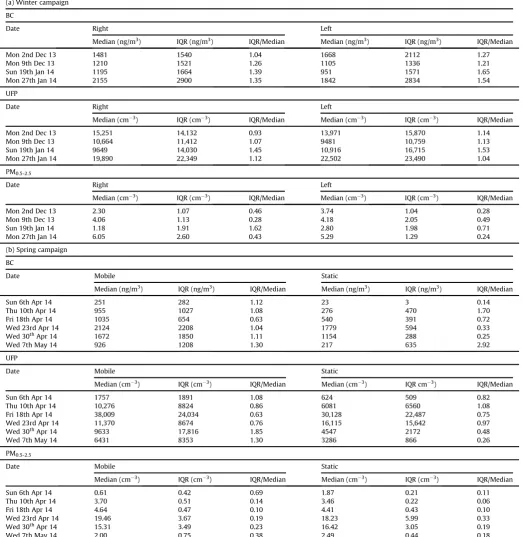
pollutant concentrations are highly skewed, especially for BC and UFP, so the interquartile range (IQR) is used to illustrate the varia-tion in distribuvaria-tion. Statistical summaries of the median and IQR for
measurements on both sides of the road are listed inTable 1a. BC
and UFP concentrations in spring campaign and PM0.5-2.5
concen-trations in both campaigns were corrected according to the MA
regression analyses results in Table S2to allow comparison
be-tween duplicate instruments. The ratio bebe-tween IQR and median is
used here as a metric of the spatiotemporal variability of each
pollutant during each measurement trip.Table 1a shows that BC
had the highest variability in the winter campaign (average IQR/ median ratio of 1.34), which is about twice as high as for the metric
with lowest variability, PM0.5-2.5(average IQR/median ratio of 0.56).
The difference in concentrations measured on two sides of the road
was not significant for BC and UFP as the median on one side of the
[image:5.595.33.557.202.740.2]road was always within the IQR of the other side (Fig. 2). PM0.5-2.5
Table 1
The median, IQR and ratio between IQR and median on each day for BC, UFP and PM0.5-2.5for (a) winter and (b) summer campaign. Left and right side of the road is defined with
respect to the walking direction in the mobile measurements. Adjustment derived from MA regression analyses of instrument co-deployments (Table S1) was applied to one set of PM0.5-2.5data in both campaigns, and one set of BC and UFP data in the spring campaign.
(a) Winter campaign
BC
Date Right Left
Median (ng/m3) IQR (ng/m3) IQR/Median Median (ng/m3) IQR (ng/m3) IQR/Median
Mon 2nd Dec 13 1481 1540 1.04 1668 2112 1.27
Mon 9th Dec 13 1210 1521 1.26 1105 1336 1.21
Sun 19th Jan 14 1195 1664 1.39 951 1571 1.65
Mon 27th Jan 14 2155 2900 1.35 1842 2834 1.54
UFP
Date Right Left
Median (cm3) IQR (cm3) IQR/Median Median (cm3) IQR (cm3) IQR/Median
Mon 2nd Dec 13 15,251 14,132 0.93 13,971 15,870 1.14
Mon 9th Dec 13 10,664 11,412 1.07 9481 10,759 1.13
Sun 19th Jan 14 9649 14,030 1.45 10,916 16,715 1.53
Mon 27th Jan 14 19,890 22,349 1.12 22,502 23,490 1.04
PM0.5-2.5
Date Right Left
Median (cm3) IQR (cm3) IQR/Median Median (cm3) IQR (cm3) IQR/Median
Mon 2nd Dec 13 2.30 1.07 0.46 3.74 1.04 0.28
Mon 9th Dec 13 4.06 1.13 0.28 4.18 2.05 0.49
Sun 19th Jan 14 1.18 1.91 1.62 2.80 1.98 0.71
Mon 27th Jan 14 6.05 2.60 0.43 5.29 1.29 0.24
(b) Spring campaign
BC
Date Mobile Static
Median (ng/m3) IQR (ng/m3) IQR/Median Median (ng/m3) IQR (ng/m3) IQR/Median
Sun 6th Apr 14 251 282 1.12 23 3 0.14
Thu 10th Apr 14 955 1027 1.08 276 470 1.70
Fri 18th Apr 14 1035 654 0.63 540 391 0.72
Wed 23rd Apr 14 2124 2208 1.04 1779 594 0.33
Wed 30thApr 14 1672 1850 1.11 1154 288 0.25
Wed 7th May 14 926 1208 1.30 217 635 2.92
UFP
Date Mobile Static
Median (cm3) IQR (cm3) IQR/Median Median (cm3) IQR cm3) IQR/Median
Sun 6th Apr 14 1757 1891 1.08 624 509 0.82
Thu 10th Apr 14 10,276 8824 0.86 6081 6560 1.08
Fri 18th Apr 14 38,009 24,034 0.63 30,128 22,487 0.75
Wed 23rd Apr 14 11,370 8674 0.76 16,115 15,642 0.97
Wed 30thApr 14 9633 17,816 1.85 4547 2172 0.48
Wed 7th May 14 6431 8353 1.30 3286 866 0.26
PM0.5-2.5
Date Mobile Static
Median (cm3) IQR (cm3) IQR/Median Median (cm3) IQR (cm3) IQR/Median
Sun 6th Apr 14 0.61 0.42 0.69 1.87 0.21 0.11
Thu 10th Apr 14 3.70 0.51 0.14 3.46 0.22 0.06
Fri 18th Apr 14 4.64 0.47 0.10 4.41 0.43 0.10
Wed 23rd Apr 14 19.46 3.67 0.19 18.23 5.99 0.33
Wed 30thApr 14 15.31 3.49 0.23 16.42 3.05 0.19
showed noticeable difference in distributions between two sides of the road. However this may have resulted from the use of a single linear equation to correct the Dylos data. A 3-day comparison be-tween the duplicate Dylos instruments in an urban background
environment (55.92 N, 3.18 W) at the beginning of the winter
campaign (3rde 5th Dec 2013) showed a significantly different
slope from that derived from the inter-comparison at the end of the
winter campaign (3rd Feb 2014) (Table S2).Fig. S2suggests that the
relationship between the duplicate Dylos instruments might follow a different linear relationship between different days as indicated by the deviation of scatter points on one day from the main trend line. Due to lack of inter-comparison between the Dylos
in-struments during each measurement day, it is difficult to quantify
the genuine difference in PM0.5-2.5concentrations between the two
sides of road inFig. 2c. The discrepancies in the relationship
be-tween duplicate CPC and AE51 units on different days were
considered to be less significant than the Dylos, since the
correla-tion coefficients between CPC and AE51 units (r > 0.97) in the
mobile winter inter-comparison were much higher and the
gradients (0.98 and 0.97, respectively) were much closer to unity
than the Dylos equivalents (r¼0.90, gradient¼0.44) (Table S2).
Distributions of BC, UFP and PM0.5-2.5 concentrations in the
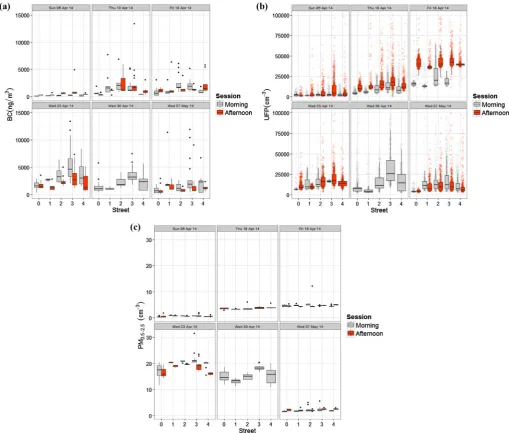
spring measurements are summarised inFig. 3. Jittered points are
plotted for UFP to reveal the overlapping of large numbers of data
points. In order to discern the details of the boxes inFig. 3a and b,
BC and UFP concentrations greater than 15,000 ng/m3 and
100,000 cm-3, respectively, are not included. However, extremely
high concentrations were observed, extending to 50,000 ng/m3for
BC and 400,000 cm-3 for UFP. Elevated BC concentrations were
observed on streets with traffic (route segments 1e4) compared
with the footpath through an area of urban park (route segment 0). The median concentrations for each route segment also varied between different times of a day. Only on Thu 10th Apr 2014 were
BC concentrations not significantly different between morning and
noon sessions (ManneWhitney U test). BC concentration on Sun
6th Apr 2014 (median¼251 ng/m3) was significantly lower than on
weekdays (median¼1281 ng/m3) (one-tailed ManneWhitney U
[image:6.595.48.558.285.718.2]test, P < 0.01), which is similar to findings in the winter
Fig. 3.Box plots for (a) BC, (b) UFP and (c) PM2.5concentrations grouped by different days and sessions in the spring campaign. Data visualisations as defined inFig. 2. Additional
jitter points are plotted inFig. 2b to reveal the extent of data in the outliers.
measurements.
The large range of outliers in the UFP distributions (Fig. 3b)
implied that UFP was greatly influenced by the emissions of nearby
traffic. Despite the fact that the outlier measurements on each
street were usually a factor 3 higher than their median, the dif-ference in the medians between streets was relatively small, sug-gesting that elevated levels due to occurrence of exhaust plumes only transiently affected the UFP concentration. Using ratios be-tween median concentrations on streets and on the footpath it was calculated that, on average, a pedestrian was exposed to 1.8 times higher concentration on streets than on the footpath for UFP, and 2.3 times higher for BC. The markedly high UFP level on Fri 18th Apr 2014 at noon was associated with the lowest wind speed, highest
solarflux (Table S1) and relatively high O3concentration of ~70
m
g/m3(recorded at the St. Leonards UK national network monitoring
station) compared to other days. All these conditions are likely to have promoted secondary particle formation from photochemical
reactions (Reche et al., 2011).
The distribution of PM0.5-2.5concentrations (Fig. 3c) exhibited a
different pattern compared with the BC and UFP concentrations. The range of concentration on each street was smaller, and the relative variation in medians between streets within the same day
was lower. Only on Sunday and Wednesday 1 were PM0.5-2.5
con-centrations highly significantly different between footpath and the
streets (ManneWhitney U test,P<0.01), indicating that local traffic
is frequently not a dominant contributor to PM0.5-2.5concentrations
in the locations where measurements were made. Possible traffi
c-related sources to PM in this size range would be tyre and brake wear and road abrasion, but these are considered to contribute
relatively little to PM2.5(AQEG, 2012). Significant variation in PM
0.5-2.5concentrations was noticed between all spring working
sam-pling days (KruskaleWallis test,
c
2¼297, df¼3,P<0.01), whichimplies that PM0.5-2.5 is more influenced by the regional sources
and meteorological conditions on a particular day rather than the
local traffic emissions. This is consistent with observations in other
cities, e.g. relatively low contribution (13%) to PM2.5 from local
traffic was also found in Paris (Skyllakou et al., 2014). Despite the
Dylos not measuring particles smaller than 0.5
m
m, PM0.5-2.5vari-ation between days was in very good relative agreement with that
of the PM2.5 concentration measured by TEOM-FDMS at the St
Leonard's national network urban background site (SIFig. S1), i.e.
highest PM2.5levels on Mon 27th Jan 2014 in winter, and on Wed
23rd Apr 2014 and Wed 30thApr 2014 in spring, and lower on
Sundays in both campaigns.
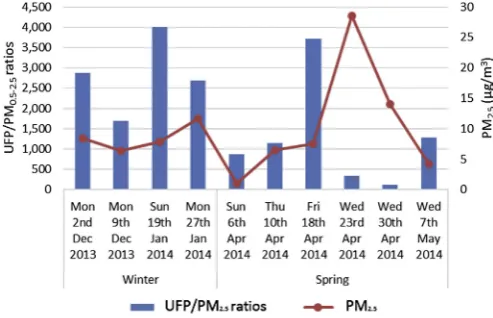
Assuming that UFP represents contribution from local traffic
sources, the ratio between median UFP and PM0.5-2.5approximates
the relative contribution of local sources to PM2.5concentration
during that day. However caution should be made in this inter-pretation since any photochemical new particle formation (e.g. Fri 18th Apr 2014 in spring campaign) may lead to overestimation of the relative level of local contribution compared to days when such an event is unfavourable. In the winter measurements, the highest
UFP/PM0.5-2.5ratio (3999), was associated with relatively low PM2.5
concentration (8
m
g/m3) on Sunday (Fig. 4). In the springmea-surements, the highest ratio was on Fri 18th Apr 2014 (3715), which was about ten times the ratio on Wed 23rd Apr 2014 (349), despite
the fact the PM2.5concentration on Fri 18th Apr 2014 (~9
m
g/m3)was only a third of that on Wed 23rd Apr 2014 (~27
m
g/m3). It isnoted that in both campaigns highest local contributions did not
coincide with the highest PM2.5concentrations. This observation
again indicates a strong regional component in PM2.5observed in
urban areas, as also noted byAQEG (2012).
Four-day air-mass back trajectories arriving at Edinburgh at 09:00 a.m. and 12:00 p.m. on each measurement day are plotted in SI Fig. S3. The trajectories associated with the highest PM2.5
concentrations in the winter and spring campaigns originated from North America and northern continental Europe, respectively.
However, the highest PM2.5concentration in winter coincided with
a relatively large contribution from local sources (UFP/PM0.5-2.5
ratio of 2682) suggesting that the high PM2.5on that particular day
may be mainly due to local emission sources. In contrast, the south-easterly trajectory originating from northern continental Europe (Fig. S3) was associated with high PM2.5concentrations and low
local contributions. It is notable that the PM2.5concentrations on
the days associated with relatively high local emissions were close to the Scottish annual air quality objective threshold concentration
for PM2.5of 12
m
g/m3to be achieved by 2020 (AQEG, 2012), and thatthe two days with PM2.5concentrations breaching the limit (Weds
23rd and 30thApr 2014 in spring,Fig. S1) had the largest regional
contribution. In the UK context, transboundary import of inorganic aerosol components resulting in high particle concentrations was
reported in a modelling study (Vieno et al., 2014).
The evidence presented here highlights that the effective
management of PM2.5in the UK may require international scale
cooperation in the control of emission sources. The good agreement between Dylos and TEOM-FDMS, together with the above analysis
on the potential sources of high PM2.5 episodes during each
campaign, confirm that the Dylos is capable of measuring elevated
PM2.5arising from both regional and local influences (Steinle et al.,
2015). However, this analysis does not reveal the contribution from
local traffic emission at street level. This is in line with thefindings
ofPrice et al. (2014)who showed that number concentration of particles greater than 262 nm was more closely related to meteo-rological conditions whilst UFP was more closely associated with
traffic variables. Nevertheless this work presents a novel approach
to apportioning PM2.5to local and regional sources by comparing
the relationship between UFP and PM2.5with the help of
back-trajectory analysis.
The IQR/median ratio was used to represent the variability of
each pollutant in the spring measurements (Table 1b), in which the
IQR/median ratio from the static measurements quantifies only the
temporal variation between different times of a day, and the ratio in
the mobile measurement reflects both spatial and temporal
varia-tion between different streets (with the former expected to be greater than the latter). Consistent with the observations in the winter measurements, the spatial variations of BC and UFP (average mobile IQR/median ratios of 1.05 and 1.08, respectively) were much
[image:7.595.303.550.66.225.2]larger than spatial variations of PM0.5-2.5 (average mobile IQR/
Fig. 4.Ratios between median UFP and PM0.5-2.5concentrations and average PM2.5
median ratio of 0.29). The within-day variations of BC and UFP
(range of static IQR/median ratios 0.14e2.92 and 0.26e1.08,
respectively) were also generally larger than equivalent within-day
variations of PM0.5-2.5(range of static IQR/median ratios 0.06e0.33)
but were of varying magnitudes. This implies that changes in local
traffic counts and atmospheric conditions within a day have more
pronounced effects on variations in BC and UFP than on variations
in PM0.5-2.5. However PM0.5-2.5varied more between days (static
IQR/median ratio for the whole spring campaign of 3.27) than BC and UFP (equivalent ratios of 1.77 and 2.19, respectively). Collec-tively this evidence suggests that the variability of all three PM metrics is subject to the varying background concentrations. For BC and UFP in particular, the geographical locations, namely proximity
to trafficked roads, also contribute a significant part of the spatial
variability. Contrary to another study (Sullivan and Pryor, 2014),
which found that the spatial variability of PM2.5(defined as the
relative standard deviation for the mobile measurements on
different routes) was 2e3 times greater than the sub-daily
tem-poral variability (defined as the RSD for the measurements when
stationary), results from this study suggest that the spatial
vari-ability of PM0.5-2.5was of similar magnitude to the sub-daily
tem-poral variability. Possible explanations of this discrepancy include the larger geographical area in the former study, and the potential for bias from a few extremely high concentrations when using RSD rather than IQR as an indicator for variability.
3.2. Pollutant concentration in relation to street topography and traffic counts
To understand the relationship between traffic counts and the
pollutant concentration, reduced major axis (RMA) regression an-alyses were conducted between the mean of the concentrations on both sides of the road at each spot measurement in the winter
campaign and traffic counts.Fig. 5shows the scatter plots of BC and
UFP against traffic counts grouped by the classification of each site.
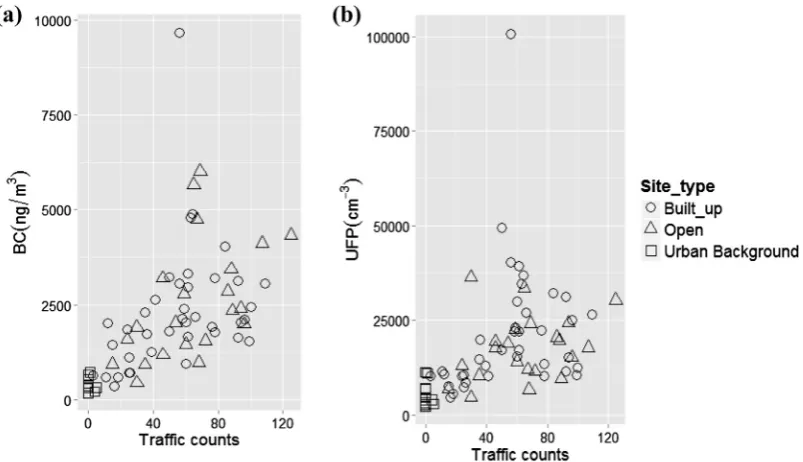
Correlations of 5-min average BC and UFP concentrations with
traffic counts were moderate and highly significant (r¼0.56 and
0.39, respectively,P<0.01,n¼72). PM0.5-2.5was not significantly
correlated with traffic counts (r¼0.17,n¼72).
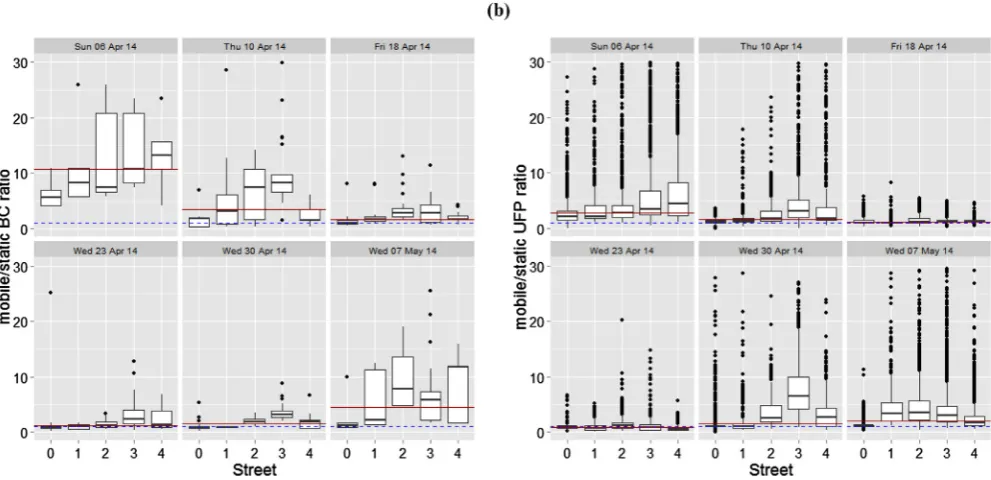
Ratios between mobile and static measurements in the spring campaign were calculated for each timestamp to represent the
elevation in the pollutant concentration due to traffic. The
distri-bution of the ratios for BC and UFP were grouped by streets and
plotted inFig. 6. Only ratios in the range 0e30 are shown inFig. 6to
avoid extreme values skewing the plots. Median mobile/static ra-tios are higher on Sun 6th Apr, Thu 10th Apr and Wed 7th May 2014 than on other days, an observation more pronounced for BC than for UFP. These days coincide with the days with higher wind speed (Table S1), which explains the greater contrast between roadside and background concentrations as the high wind speed facilitates the mixing of clean air at the background site while the immediate roadside concentration still stays at relatively high level. A sum-mary of the median values of the mobile/static measurement ratio
for each street and the traffic density on each street are tabulated in
Table 2. The data show a common pattern in the mobile/static ratios for BC and UFP: streets 2 and 3 had the highest median mobile/
static ratios. Considering that the traffic density in streets 2 and 3
were not the highest among all the streets, the difference in street topography is the most likely explanation of the greater mobile/ static ratios. Streets 2 and 3 are mostly characterised by street
canyons with aspect ratios in the range of 0.6e1.3, whereas streets
1 and 4 are beside the Meadows urban park with an open terrain. As a result, dispersion in streets 2 and 3 is likely to be reduced compared to dispersion in streets 1 and 4. Similar results were reported in a study in Hong Kong characterised by high-rise buildings, where notably elevated BC and UFP concentrations were observed in deep street canyons compared to an open road
although the trafficflow were significantly lower in street canyons
(Rakowska et al., 2014).
The correlation of averaged BC and UFP concentration with
traffic counts for each route segment was calculated in the spring
campaign. BC was again significantly correlated with traffic counts
(r¼0.45,P<0.01,n¼50), but UFP was not (r¼0.25,n¼48,
P ¼ 0.09). The lower correlation in spring compared to winter
campaign could be attributed to the fact that traffic counting on one
side of the street in spring campaign may not have represented
total traffic composition sufficiently. The low correlation between
[image:8.595.104.506.496.727.2]traffic count and UFP may have been caused by the secondary
Fig. 5.Scatter plots of 5-min averaged (a) BC and (b) UFP concentrations vs. traffic counts at each measurement site in the winter campaign.
particle formation mentioned in Section3.1. This interpretation was supported by the increased correlation when the data from Friday
was excluded (r¼0.66,P<0.01,n¼39). Despite the moderate to
high correlation coefficients of BC and UFP with traffic counts found
in this study, mixed conclusions have been drawn in the literature
for the relationships between traffic and BC or UFP as a result of
characteristics of specific measurement sites, the consistency of
trafficflow and the formation/transformation of particles governed
by environmental conditions (Kumar et al., 2008; Peters et al., 2014;
Price et al., 2014; Rakowska et al., 2014). Further investigation of
relationships between BC, UFP and traffic would provide beneficial
information to inform the potential use of nearby trafficflow data
to predict BC and UFP concentrations. Street topography effects on BC and UFP concentrations are similarly important for further investigation.
3.3. Correlation between BC and UFP
The correlations between BC and UFP were evaluated using RMA
regression. The results summarised inTable 3were calculated from
1-min averaged concentrations with BC as theyvariable and UFP as
thexvariable.
The correlations between BC and UFP during each week ranged
between 0.49 and 0.77 and in all cases were significant (P<0.01).
During working and non-working days, slope coefficients were not
significantly different between measurements taken on different
sides of the road in the winter campaign or between mobile and static measurements in the spring campaign. The agreement of the BC/UFP relationship between roadsides or between busy roads and local background suggests that BC and UFP concentrations
vary similarly as they disperse away from traffic sources. The
slopes on non-working days were significantly lower than the
slopes on working days, indicating a decrease in BC/UFP ratios on non-work days. This variation in the BC/UFP ratios was not only observed in the measurements taken near road but also in the static background measurements during the spring campaign. The reason for this variation in BC/UFP relationship is likely due to the decrease in heavy goods vehicles (HGV) on the road during the weekend as HGV had the lowest share on weekends (3.2%) compared with weekdays (~6.8%). This observation suggests that HGV contribute relatively more to BC than to UFP concentrations. Therefore a policy targeting on reduction of UFP may not be effective if it only focuses on restricting HGV. On the other hand policies aimed at reduction of BC should focus on controlling HGV emissions, which has direct implications for instance for the design and implementation of Low Emission Zones in urban areas. Considering that recent epidemiological studies suggested that BC was more strongly associated with harmful particle substances
than was the PM2.5mass (Grahame et al., 2014; WHO, 2013), traffic
[image:9.595.52.548.66.306.2]control strategy targeting at the HGV may effectively contribute to Fig. 6.Distributions of mobile/static measurement ratios in different streets for (a) BC, and (b) UFP, in the winter campaign. Solid red lines denote the median mobile/static measurement ratio for each day. The dashed blue line denotes a ratio of one to highlight the elevated concentrations on streets. Measurements at the static background were corrected based on the MA regression analyses results inTable S2. (For interpretation of the references to colour in thisfigure legend, the reader is referred to the web version of this article.)
Table 2
Median ratios of mobile/static measurements in each street and the traffic density for each street.
Street Median of the mobile/static ratios for all the days (range of medians for each day) Mean traffic density (range of traffic density for each session) (traffic/km)
BC UFP
0 1.1 (0.9e5.6) 1.1 (1.0e2.2) 0
1 1.4 (0.9e8.3) 1.4 (0.7e3.4) 27 (16e38)
2 3.0 (1.2e7.8) 2.0 (1.2e3.5) 33 (24e42)
3 4.2 (2.4e15.8) 2.8 (0.9e7.0) 27 (18e35)
[image:9.595.35.554.668.743.2]alleviation of population health burdens arising from urban air pollution.
3.4. Study limitations
This paper describes design and interpretation of a pilot study to investigate potential drivers for the spatiotemporal variability of different particulate matter components in the urban environment. It is recognised that it may be limited in terms of giving exhaustive
consideration and quantification of each individual driver on
pollutant concentration, particularly the complex influence of local
street topography. The absence of summer measurements could
mean that the influence of photochemical particle formation may
be underestimated (Ma and Birmili, 2015). Overall, however, this
study has demonstrated that careful experimental design and data interpretation of short-term mobile measurements can identify the important drivers governing different metrics of PM concentration,
and which also support findings in literature that use more
so-phisticated long term measurements.
4. Conclusions
Distributions of BC, UFP and PM0.5-2.5concentrations in the
ur-ban environment and the relationship between concentrations and
potential influences (local traffic, street topography and synoptic
meteorology) were studied through a combination of mobile and static measurements in the south of the city of Edinburgh, UK.
BC and UFP exhibited a high spatial variability in the urban
environment, roughly 3 times greater than that of PM0.5-2.5;
how-ever PM0.5-2.5had the highest inter-daily variability. Very high BC
and UFP concentrations were frequently measured at roadside and sometimes exceeded 3 times the street median concentration. However the median BC and UFP concentrations measured on the
streets were not greatly influenced by the frequent spikes and were
on average approximately double the median measured on the
footpath. PM0.5-2.5did not show a consistent elevated concentration
in the streets in comparison with the footpath. Both geographical locations and varying background concentrations had important
effects on the BC and UFP concentrations. Variation in PM0.5-2.5
concentrations was largely influenced by regional sources,
although local sources also contributed to a lesser extent.
Both BC and UFP were highly correlated with traffic counts.
PM0.5-2.5showed very low correlation with the traffic counts.
Sig-nificant difference was found between the slopes of BC vs. UFP
regression analyses between working days and non-working days.
During non-working days the reduction of HGVflows results in a
decrease in the BC/UFP ratio, suggesting that HGV may contribute more to BC than to UFP concentrations. Therefore control of HGVs may be effective in reducing the negative health effects associated
with BC. PM2.5 was observed in a few instances to have a large
background component, the variability of which may not be well accounted for by only using local sources as indicators. Therefore international cooperation in control of emission sources is
impor-tant for PM2.5management in the UK. Furthermore, this study
in-dicates that the proximity to the road as a primary indicator for the assessment of exposure to air pollutants is highly dependent on the pollutant being considered.
Acknowledgement
Hao Wu acknowledges funding from the University of
Edin-burgh and the NERC Centre for Ecology&Hydrology (NERC CEH
project number NEC04544). The CPC and AE51 instruments were purchased under a NERC multi-institution grant (NE/1007822/1).
We thank Hugo Man for assistance in conducting the field
mea-surements and Christopher Malley for help in calculating back trajectories. We thank Defra for data from the UK AURN.
Appendix A. Supplementary data
Supplementary data related to this article can be found athttp://
dx.doi.org/10.1016/j.atmosenv.2015.04.059.
References
AQEG, 2012. Fine Particulate Matter (PM2.5) in the United Kingdom. Air Quality
Expert Group, UK Department for Environment. Food and Rural Affairs, London. PB13837.http://uk-air.defra.gov.uk/library/reports?report_id¼727.
Ayers, G.P., 2001. Comment on regression analysis of air quality data. Atmos. En-viron. 35, 2423e2425.
Carslaw, D.C., Ropkins, K., 2012. openairdAn R package for air quality data anal-ysis. Environ. Model. Softw. 27e28, 52e61.
Dft, 2015. City of Edinburgh [WWW Document]. Dep. Transp.eTraffic Counts. http://www.dft.gov.uk/traffic-counts/cp.php?la¼CityþofþEdinburgh.
Grahame, T.J., Klemm, R., Schlesinger, R.B., 2014. Public health and components of particulate matter: the changing assessment of black carbon. J. Air Waste Manag. Assoc. 64, 620e660.
Hagler, G.S.W., Yelverton, T.L.B., Vedantham, R., Hansen, A.D.A., Turner, J.R., 2011. Post-processing method to reduce noise while preserving high time resolution in aethalometer real-time black carbon data. Aerosol Air Qual. Res. 11, 539e546.
Heal, M.R., Kumar, P., Harrison, R.M., 2012. Particles, air quality, policy and health. Chem. Soc. Rev. 41, 6606.
HEI, 2010. Traffic-related Air Pollution: a Critical Review of the Literature on Emissions, Exposure, and Health Effects. Health Effects Institute.
Hoek, G., Beelen, R., de Hoogh, K., Vienneau, D., Gulliver, J., Fischer, P., Briggs, D., 2008. A review of land-use regression models to assess spatial variation of outdoor air pollution. Atmos. Environ. 42, 7561e7578.
Hoek, G., Meliefste, K., Cyrys, J., Lewne, M., Bellander, T., Brauer, M., Fischer, P., Gehring, U., Heinrich, J., van Vliet, P., Brunekreef, B., 2002. Spatial variability of
fine particle concentrations in three European areas. Atmos. Environ. 36, 4077e4088.
Kassomenos, P.A., Vardoulakis, S., Chaloulakou, A., Paschalidou, A.K., Grivas, G., Borge, R., Lumbreras, J., 2014. Study of PM10 and PM2.5 levels in three European cities: analysis of intra and inter urban variations. Atmos. Environ. 87, 153e163.
[image:10.595.41.563.93.191.2]Knibbs, L.D., Cole-Hunter, T., Morawska, L., 2011. A review of commuter exposure to ultrafine particles and its health effects. Atmos. Environ. 45, 2611e2622.
Table 3
RMA regression analyses for 1-min averaged BC and UFP concentrations. The shading in the table represents the data collection period (grey: working days; white: non-working days). Left and right side of the road is defined with respect to the walking direction in the mobile measurements. ** indicates correlation at>99% significance.
r Slope (ng106) Intercept (ng/m3) Number of data points r Slope (ng106) Intercept (ng/m3) Number of data points
Winter campaign
Left side of road Right side of road
0.66** 0.15 (0.14e0.16) 575 (726 to432) 833 0.65** 0.16 (0.15e0.17) 737 (900 to583) 822
0.58** 0.08 (0.07e0.09) 149 (1 to 283) 223 0.58** 0.11 (0.09e0.12) 137 (43 to 298) 225
Spring campaign
Mobile Static
0.49** 0.13 (0.12e0.14) 102 (289 to 69) 319 0.50** 0.11 (0.10e0.13) 148 (61e226) 270
0.62** 0.05 (0.04e0.06) 48 (158 to 50) 166 0.77** 0.04 (0.03e0.04) 15 (46 to 13) 181
Kumar, P., Fennell, P., Britter, R., 2008. Measurements of particles in the 5-1000 nm range close to road level in an urban street canyon. Sci. Total Environ. 390, 437e447.
Ma, N., Birmili, W., 2015. Estimating the contribution of photochemical particle formation to ultrafine particle number averages in an urban atmosphere. Sci. Total Environ. 512e513, 154e166.
Patton, A.P., Perkins, J., Zamore, W., Levy, J.I., Brugge, D., Durant, J.L., 2014. Spatial and temporal differences in traffic-related air pollution in three urban neigh-borhoods near an interstate highway. Atmos. Environ. 99, 309e321.
Peters, J., Van den Bossche, J., Reggente, M., Van Poppel, M., De Baets, B., Theunis, J., 2014. Cyclist exposure to UFP and BC on urban routes in Antwerp. Belg. Atmos. Environ. 92, 31e43.
Pinto, J.P., Lefohn, A.S., Shadwick, D.S., 2004. Spatial variability of PM2.5 in urban areas in the United States. J. Air Waste Manag. Assoc. 1995 (54), 440e449.
Price, H.D., Arthur, R., BeruBe, K.A., Jones, T.P., 2014. Linking particle number con-centration (PNC), meteorology and traffic variables in a UK street canyon. Atmos. Res. 147e148, 133e144.
Rakowska, A., Wong, K.C., Townsend, T., Chan, K.L., Westerdahl, D., Ng, S., Mocnik, G., Drinovec, L., Ning, Z., 2014. Impact of traffic volume and composi-tion on the air quality and pedestrian exposure in urban street canyon. Atmos. Environ. 98, 260e270.
R Core Team, 2014. R: a Language and Environment for Statistical Computing. R Foundation for Statistical Computing, Vienna, Austria.http://www.R-project. org/.
Reche, C., Querol, X., Alastuey, A., Viana, M., Pey, J., Moreno, T., Rodríguez, S., Gonzalez, Y., Fernandez-Camacho, R., de la Campa, A.M.S., de la Rosa, J., Dall’Osto, M., Prev^ot, A.S.H., Hueglin, C., Harrison, R.M., Quincey, P., 2011. New considerations for PM, black Carbon and particle number concentration for air quality monitoring across different European cities. Atmos. Chem. Phys. 11, 6207e6227.
Ruths, M., von Bismarck-Osten, C., Weber, S., 2014. Measuring and modelling the
local-scale spatio-temporal variation of urban particle number size distribu-tions and black carbon. Atmos. Environ. 96, 37e49.
Sandradewi, J., Prevot, A.S.H., Szidat, S., Perron, N., Alfarra, M.R., Lanz, V.A.,^ Weingartner, E., Baltensperger, U., 2008. Using aerosol light absorption mea-surements for the quantitative determination of wood burning and traffic emission contributions to particulate matter. Environ. Sci. Technol. 42, 3316e3323.
Skyllakou, K., Murphy, B.N., Megaritis, A.G., Fountoukis, C., Pandis, S.N., 2014. Contributions of local and regional sources tofine PM in the megacity of Paris. Atmos. Chem. Phys. 14, 2343e2352.
Steinle, S., Reis, S., Sabel, C.E., 2013. Quantifying human exposure to air pollutione moving from static monitoring to spatio-temporally resolved personal exposure assessment. Sci. Total Environ. 184.
Steinle, S., Reis, S., Sabel, C.E., Semple, S., Twigg, M.M., Braban, C.F., Leeson, S.R., Heal, M.R., Harrison, D., Lin, C., Wu, H., 2015. Personal exposure monitoring of PM2.5 in indoor and outdoor microenvironments. Sci. Total Environ. 508, 383e394.
Sullivan, R.C., Pryor, S.C., 2014. Quantifying spatiotemporal variability offine par-ticles in an urban environment using combinedfixed and mobile measure-ments. Atmos. Environ. 89, 664e671.
Vieno, M., Heal, M.R., Hallsworth, S., Famulari, D., Doherty, R.M., Dore, A.J., Tang, Y.S., Braban, C.F., Leaver, D., Sutton, M.A., Reis, S., 2014. The role of long-range transport and domestic emissions in determining atmospheric secondary inorganic particle concentrations across the UK. Atmos. Chem. Phys. 14, 8435e8447.
Warton, D.I., Wright, I.J., Falster, D.S., Westoby, M., 2006. Bivariate line-fitting methods for allometry. Biol. Rev. 81, 259e291.
WHO, 2013. Review of Evidence on Health Aspects of Air PollutioneREVIHAAP
Project: Technical Report. World Health Organisation, Copenhagen, Denmark.