Theses
6-10-2018
Social Media and Its Impact on Users’ Decision
Making to Visit a Fine Dining Restaurant
Petra Malbasa
Follow this and additional works at:https://scholarworks.rit.edu/theses
This Master's Project is brought to you for free and open access by RIT Scholar Works. It has been accepted for inclusion in Theses by an authorized administrator of RIT Scholar Works. For more information, please [email protected].
Recommended Citation
Social Media and Its Impact on Users’ Decision
Making to Visit a Fine Dining Restaurant
By
Petra Malbaša
A Capstone Project Submitted in Partial Fulfillment of the Requirements
for the Degree of Master of Science in Service Leadership and
Innovation
Department of Service Systems
College of Applied Science and Technology
Rochester Institute of Technology-Croatia
Zagreb, Croatia
Committee Approval:
Jennifer Matic Date
Abstract
This study focused on exploring what factors and social media tactics are important to consider
when creating an effective social media strategy for a fine dining restaurant in Zagreb for
Facebook and Instagram. The important factors to consider when creating an effective social
media strategy and useful social media tactics to use for a fine dining restaurant in Zagreb
were defined. The study used a qualitative research approach and in-depth research questions.
Ten participants shared their personal experiences connected to social media and fine dining
restaurants. Fifty percent of the participants were experts in marketing and the food industry who
provided the study with in-depth results. The main factors discovered tied to social media
marketing and social media strategies that could motivate participants to visit a fine dining
restaurant in Zagreb were: quality photos and videos, special offers, positive word of mouth,
social media tactics, price, emotions and reasons to visit (enjoyment, business, recommendations,
and curiosity). A combination of the most effective social media tactics and fine dining
restaurant needs and wants of the participants are discussed.
Keywords: fine dining restaurant, Zagreb, social media, decision making, social media
Table of Contents
Abstract……….….…3
Introduction ……….…..6
Research Problem ………..6
Review of Past Studies and Deficiencies ……….……….….6
Significance of the Study………...………...8
Problem Statement ………...8
Research Questions ………...9
Literature Review ……….………...10
The Importance of Social Media Marketing ………..………..…….11
Social Media Tactics ……….………..….14
Creating Positive Word of Mouth ………..………..….19
Positive Effects of Using Social Media for Your Restaurant…………...………..23
What Attracts Customers to Fine Dining Restaurants………....24
Conclusion of the Literature Review ……….26
Methodology ……….…………..…...27
Research Design ………..…….…...27
Strategy of Inquiry ………..28
Participants ……….….29
Data Collection ………...32
Ethical Considerations ……….34
Reliability and Validity ………....35
Role of the Researcher ………...…..37
Results ………..40
Visual Quality Content ………...40
Special Offers ………...43
Positive Word of Mouth ………...44
Social Media Tactics ………...46
Price ………...48
Emotions and Reasons to Visit ………...49
Discussions/Recommendations ………...51
Limitations and Future Directions ………...59
References……….…..….62
Appendix A: Interview questions……….…....69
Social Media and Its Impact on Users’ Decision Making To Visit a Fine Dining Restaurant
Research Problem
Have you ever scrolled down your Facebook or Instagram feed, seen an interesting post,
liked it and just kept scrolling? If you use social media, you most likely have done this. Are you
overwhelmed with everyday ads, marketing, and day to day information in general? Social media
can be exhausting to our minds. Typically users reach out to social media for entertainment, but
sometimes being constantly barraged with advertisements and hard selling ads tends to push the
audience away. According to Fox (2016), customers have become sceptic of marketing and also
only share information that is useful to them. Restaurants should create interesting content that is
appealing to the audience rather than just advertise to them (Fox, 2016). For example, create a
social media post that includes a joke, a quote, a blog post, a contest – some type of content that
can trigger users to relate to the restaurant’s social media post (Fox, 2016). This means that users
have been intrigued and that the restaurant succeeded in catching the users’ attention and
connecting to their customers, instead of just advertising their products to them (Fox, 2016). If
users can benefit from the restaurant’s post such as, getting a laugh from it, being able to relate to
it or learning something useful, they will most likely reach out to the brand more often because
they will feel an emotional connection rather than being over advertised (Fox, 2016).
Review of Past Studies and Deficiencies
According to Barrett (2016), developing a sincere customer relationship by motivating
your audience to engage in conversation, using more video content and using user-generated
content (content created by users that is connected to your brand or products) are just a few of
Maintaining a quality relationship with your customers rather than hard core advertising your
product brings businesses many benefits, such as positive word of mouth and higher sales (Fox,
2016). According to Kim, Koh, Cha, and Lee (2015), social media has a positive effect on
businesses that know how to use it correctly.
It is important for businesses to have a good relationship with their customers on social
media pages because these pages are the “mirror” of their companies. They present their service,
care, personality, offers and basically who they are, what they do and how well they do it. Every
day is a chance for companies to improve their image and gain more new customers or lose
customers based on how much effort they put into social media management (Fox, 2016). Social
media is essential for businesses today because customers explore their options on Facebook and
Instagram. If a hotel or restaurant is not active on these social media platforms it is equal to the
idea that they do not exist in the business world (Aaker & Smith, 2010).
Customers’ visits to restaurants’ social media platforms should motivate them to visit.
However, if they receive bad customer service right at the start of their pre-purchase stage, they
will most likely eliminate that restaurant as one of their options (Aaker & Smith, 2010). On the
other hand, if a restaurant can build a relationship with their followers (customers), keep them
entertained and constantly remind them about the restaurant then they will most likely decide to
visit the restaurant (Song & Yoo, 2016). Past studies showed that social media marketing is
beneficial for companies that use it wisely and effectively (Kim, et al., 2015). They discovered
Significance of the Study
This study explored what factors and social media tactics are important to consider when
creating an effective social media strategy for a fine dining restaurant in Zagreb for Facebook
and Instagram. The proposed research provided information from past studies that mentioned the
advantages of using social media marketing for restaurants and other businesses if used correctly.
The study could also help the reader understand the importance of social media marketing, what
the most effective social media tactics are, and the positive effects it has had on sales and why
people are attracted to visiting fine dining restaurants. Since fine dining restaurants are a specific
market, this study aimed to explore what types of social media content, tactics and overall factors
were important to consider when creating an effective social media strategy for fine dining
restaurants in Zagreb.
This study also focused on exploring the needs and wants of customers of fine dining
restaurants in Zagreb and what type of content is essential in creating a quality post that can turn
a lead into a real life customer. Social media is a great tool that helps businesses/restaurants
approach their customers easier, faster and more effectively than ever (Business Review
Australia, 2014). The result of this study could advance the knowledge of fine dining restaurant
owners and social media marketers regarding how they can use the benefits of social media
marketing to its utmost extent to attract customers specifically to fine dining restaurants in
Zagreb, which has not yet been discovered in previous studies.
Problem Statement
Social media is the fastest, most affordable and effective way of marketing to customers
today (Business Review Australia, 2014). It has turned into the new digital version of “word of
mouth” and has become an essential part of the path to success for businesses worldwide
users have been spammed with ads on Facebook and Instagram daily and it has become
challenging for brands to stand out on social media platforms. While social media platforms
provided opportunities for new customers and sales, on the other hand, they also required
businesses to pay for ads (such as Facebook and Instagram). Businesses needed to pay to receive
results and reach as many users as possible. Even with amazing ads, sometimes people are just
not interested. Consumers today know when they are being marketed to and they are not
attracted to ads, especially if prices are high or if they are not interested in the product. This
study aimed to find out how companies can reach their customers attention and motivate their
interest to visit a fine dining restaurant in Zagreb despite all of the ads that they receive daily.
The participants for this research were foodies, people who enjoy dining at restaurants, drinking
wine and are in the age range of 25 – 35. According to Hutchinson (2017), most Instagram users
are the age of 35 and under while most Facebook users vary from 18 – 49. This is the reason why
the age range was 25 - 35. The participants were mostly from the area of Zagreb and people who
love food and wine. All ten participants enjoy eating out at delicious restaurants, one participant
is a wine owner, one is a restaurant owner and one is a sommelier as well as a PR/marketing
agency owner. One participant has worked as a waiter in restaurants. One of the participants was
a well-known food critique. They all have two things in common – they love enjoying quality
food and wine and are active on Facebook and Instagram.
Research Questions
The research question being explored is: What factors and social media tactics are
important to consider when creating an effective social media strategy for a fine dining restaurant
in Zagreb? Sub research questions are: What will make customers actually visit the fine dining
Literature Review
The following literature shows what best practices other businesses and restaurants have
experienced worldwide to attract customers. The purpose of finding these best practices was to
learn what worked best for other restaurants and businesses and to see whether participants of
this study would have similar answers. The following literature also helped the researcher to
create unique and consistent research questions for the participants with the purpose of finding
greater, in-depth answers on whether social media can effect decision making of potential
customers of fine dining restaurants in Zagreb (Noel, Vinodol, Dubravkin put, Pod Zidom Bistro
& Wine Bar, Ristorante Carpaccio) and how.
The literature review focuses on four areas: social media tactics, creating positive word of
mouth, the positive outcome of using social media to promote business/a restaurant and what
attracts people to fine dining restaurants. The literature explains what social media strategies
were effective and what social media tactics attracted customers. These four topics are connected
to the study because they give solid background on what has worked best for other restaurants
and businesses that have used social media marketing. The literature that focuses on the topic of
social media tactics explains what tactics have been found to be effective and which ones have
resulted in high social media engagement with customers that lead to more sales. Many of the
literature references also explained the importance of positive word of mouth and how social
media has become the new form of online word of mouth. The literature explained why and how
people have perceived certain companies as ones that they can trust and be loyal to, that they
would visit and recommend through social media channels such as Facebook and Instagram.
In today’s world, most people know that using social media for your business is good and
results of social media campaigns and the positive outcomes that come from them to businesses
and restaurant owners. Finally, the business of fine dining is explained through the following
literature review and it focuses on what attracts customers to visit specifically fine dining
restaurants and what factors have helped them decide whether they should visit a fine dining
restaurant again. This study explored to whether social media marketing can have an impact on
social media users’ decision making to visit a fine dining restaurant in Zagreb and what type of
content and factors could motivate them to visit.
The Importance of Social Media Marketing – Cheap, Fast, Reliable, Powerful
Low cost and beneficial. Remember billboards, TV ads, newspaper ads and similar?
Traditional ways of marketing are now slowly disappearing due to the low cost and high
effectiveness of social media marketing (Whiting & Deshpande, 2016), (Bennett, 2017).
According to Alhabash and Ma (2017), “about three quarters of Internet users report having a
Facebook account”. Alhabash and Ma (2017) stated:
Instagram has over 400 million active monthly users who shared over 40 billion pictures,
with an average of 3.5 billion daily likes for >80 million photos shared daily on the site.
More than half of young adults (18–29 years old) report using Instagram, thus making
them the largest group of Instagram users. (para. 7)
What better way to advertise than a place where most people are active? According to Bennett
(2017), social media marketing has become the most efficient marketing strategy for companies.
It is low-cost and allows businesses to connect to their customers and develop a relationship
which is very important. For only a few dollars, businesses can reach over a thousand people,
target people by interests, location, and age on Facebook. Instagram is connected to Facebook
Large impact on decision making in the customers’ pre-purchase stage. According to
Song and Yoo (2016), social media has had a large impact on customers’ purchasing decisions in
the pre-purchasing phase. Travelers use social media before they visit a destination, during their
stay and after (Song & Yoo, 2016). Developing a relationship with your customers is important
in the pre-purchasing phase (Song & Yoo, 2016). According to Song and Yoo (2016, p. 93),
customers who use social media are influenced by the functionality of using social media which
provides them with quick information, fast service and shared experiences where they can see
how other people enjoyed a restaurant or travel destination by viewing other people’s comments,
pictures, videos and reviews. They are also influenced by discounts, special deals, free coupons
and amusing posts that provide them with entertainment and fun. Their study showed that users
were least motivated by psychological and social influences such as feeling a belonging, trust or
sense of identification.
Connecting to customers. Bennett’s (2017) study is about how small restaurant
businesses use social media for marketing strategies. According to Bennett (2017), social media
marketing is used to increase sales, brand awareness and positive word of mouth. It is used to
attract customers and increase food purchases at restaurants. Restaurant owners used social
media channels “to post pictures, videos, promote community events, advertise daily specials,
and post the restaurant’s menu” (Bennett, 2017, p. 26) which increased their sales by 54%
(Bennett, 2017, p. 70). According to Bennett (2017), social media allows restaurants to easily
reach their customers and send them marketing messages. Electronic word of mouth and
customer reviews increase brand awareness (Bennett, 2017). According to Bennett (2017), social
media marketing can help increase sales, allows restaurant owners to easily connect and
study found that social media marketing had a significantly positive impact on restaurant
performance. While traditional marketing is a one-way street telling customers what you want
them to hear, social media marketing is a multilane highway giving users a chance to say their
opinion about products and services (Bruce & Solomon, 2013). This gives businesses a chance to
find out what they need to improve and allows customers to be proactive in co-creation rather
than just taking what is given. This can lead to innovation and growth, rather than stagnation
(Hajli, Shanmugam, Papagiannidis, Zahay & Richard, 2017). Building a level of trust with
consumers will help marketers grow their business faster than those who only advertised to
consumers (Liang, 2013). Enterprises and consumers develop loyalty and trust through social
media marketing (Kim et al, 2015). Social media is almost like a virtual food market; customers
come to the market and have tons of choices.
Customers explore and see who they would like to buy from, who they can trust the most,
whose food looks the most quality and what type of service they can expect to receive from the
restaurant (Liu, Li, Ji, North and Yang, 2017). Social media provides users with options and
businesses should take advantage of that position and create the best possible brand image,
provide top service and treat their customers with care (Weintraub, 2012). According to Kim, et
al. (2015), social media has a positive impact on brands or companies. Kim et al. (2015) stated,
“Especially for small business operators in the restaurant industry, social media provides
low-cost advertising to increase market share and boost restaurant sales”. However, what is being
explored in this study is what social media tactics can attract people to fine dining restaurants in
Zagreb. Before revealing what the participants of this study believe, let us take a look at what
experts from past studies believe to be true for restaurants and businesses in general.
User-generated content. There are many social media tactics out there such as, videos,
live-videos, contests and more. Some are consistently effective and a few are just passing trends.
According to Cutrone (2015), user-generated content is one of the most effective ways of gaining
trust from your followers on social media. User-generated content is tied to trust because it is
easier for people to trust another person’s experience rather than what the brand is trying to sell
to them. In other words, pictures, videos and text that other customers have posted to the brand’s
social media page (user-generated content) are used as confirmation to other users’ that these
customers were satisfied with the brand, service, product and/or experience. This assures the
customer that is still found in the decision making phase to either become a customer of the
brand or business or not (Cutrone, 2015). Customers trust other users’ experiences more than the
brand’s photos, videos or words. Followers are more likely to purchase something from a
business if they see that others have been satisfied. For instance, users could view a fine dining
restaurant in Zagreb and be debating whether it would be worth visiting or not. If the fine dining
restaurant’s social media pages have many visitor photos showing that they were satisfied, this
would most likely motivate the people watching to visit and also increase online positive word of
mouth (the overall picture of the restaurant). Users would be more likely to be attracted to
visiting that restaurant. However, if the users only saw pictures that the restaurant created, then
there could be a possibility that they could be sceptical and give up on visiting the place due to
uncertainty or search for more information and feedback before making their decision.
Encourage communication and engagement with customers. A few social media
tactics that could help companies enhance their image and engagement on social media channels
are: showing behind the scenes moments, answering customer complaints, beginning a
to gaining new customers is engaging in conversation with them, motivating communication and
presenting the restaurant in its best light with amazing pictures and content. However, sometimes
even amazing content needs to be filled with background meaning or personal fulfilment for
users. Companies should mention the benefit that users are receiving from reading their posts.
For example, companies can start their posts with a question or include humorous content for the
purpose of differentiating themselves from the usual advertisements that users see on social
media and in their everyday lives (Aaker & Smith, 2010). According to Aaker and Smith (2010),
it would also be a good idea to talk about topics that have nothing to do with sales. For instance,
companies can mention a community or worldwide event, just to show customers or users that
their focus is not exclusively on the company, its products or profit. Connecting to the audience
on an emotional level and creating relationships with users will motivate the audience to reach
out to the companies more, pay attention to their social media posts, and remind the users of their
brands, and products more often (Aaker & Smith, 2010). It is similar to receiving a birthday
discount in the mail, the more the companies think about their customers and pay attention to
them, the more their customers will think about and pay attention to them.
Video content. Due to the overload of information that people receive in today’s world
both online and offline, video content is a clear and simple way to communicate a message and
grab the users’ attention (Gamble, 2016). According to Gamble (2016, p. 47), color visuals
increase users’ willingness to read by 80%. People do not have time to read articles anymore and
are only interested in the main ideas. People can remember 80% of the content that they see and
only 20% of what they read (Gamble, 2016, p. 47). Videos motivate users because they usually
tell a story, contain beautiful pictures or animations and are short and to the point (Gamble,
visuals 60,000 times faster in the brain (Gamble, 2016, p. 47). Watching videos on Facebook and
Instagram have become the way that we perceive the world today. It is the fastest and most
effective way to learn and discover new things. It replaces old TV ads and can be targeted on
Facebook for low cost.
Connecting to customers. Nokia for instance, knows that having a good relationship
with customers’ results in more sales. For example, they delivered personal experiences to their
consumers and gained their trust. They focused, on maintaining conversation with them and
always looked for future opportunities of communication with existing and new followers
(Holloman, 2016). One example would be: a few Nokia employees created Nokia Follow Friday
(#FF) on Twitter during a social media team day in Finland. Each Friday, people recommended
people to follow along with the #FF tag on their tweets. Originally, they were supposed to spend
the day being graffiti artists, but at the end, they posted the graffiti to Twitter and announced the
first Nokia Follow Friday which is now a tradition (Holloman, 2016, p. 47). This showed that
they constantly sought new opportunities to connect to their followers and gain new ones.
According to Jackson (2016), sharing recipes is one of the top keys to catching the hearts
of restaurant customers. This allows customers to enter the restaurant’s comfort zone and
therefore the restaurant is being transparent with its customers. In return, customers feel close to
the brand (Jackson, 2016). One interesting finding from Jackson, Lancanster and Wirth (2016)
was that Ben & Jerry’s takes pictures of hands and their products, which has showed more
effectiveness in social media posts on Instagram because it gave a more real-life feeling to the
photo. It made users or customers feel like “I want to be holding that delicious food in my hand,
Marketing on Facebook is more effective when indirect marketing is used, such as
sharing menu descriptions rather than the restaurant pointing out that they are selling the food
from the menu directly (Kwok & Yu, 2013). According to Rowe (2016), five ways restaurants
can be noticed on Instagram are using the best photos that the restaurant has, sharing an insider's
look (menu items, events, chef, staff, behind the scenes magic), having a social media content
plan, following people and using hashtags. By communicating to customers that the restaurant is
not just selling, but wants to provide an experience to its customers, a sense of value is created
and users feel like the visit to the restaurant would be worthwhile.
Customization, choice and convenience. Another way restaurant owners could adjust
their social media tactics and strategies is by following the needs of the new generation Z, which
is mostly by being active on Instagram, Twitter and Tumbler. Their needs are the 3 C's:
customization, choice, and convenience (Ruggless, 2016). In other words, customer of
generation Z are in need of personalized service and products, a variety of choice, and fast and
efficient service. If the restaurant has this in their offer, they can easily market this population on
social media platforms and gain new customers who would most likely share their experience
online through social media platforms (Ruggless, 2016). Each customer would like to be treated
with special care and they love to have a variety of choices to choose from when picking the
product they want to purchase; for example, if a girl is choosing a pair of sweat pants, she will
probably want to choose from at least four or five different colors (Ruggless, 2016).
Listen and pay attention to your customers. Weintraub (2012) highlighted the
importance of companies listening to customers and managing their brand reputation on social
media platforms. According to Weintraub (2012), answering messages on social media and
social media for further information such as, price, reservations, offers and online reviews (Fox,
2016). Users search for fast answers and dedicated brands (Fox, 2016). Listening to customers
helps brands find out what they should change or how they can improve their offer (Weintraub,
2012). Facebook and Instagram have become open portals for communicating with customers
and providing top service as best and as quickly as possible (Kim, Li, & Brymer, 2016).
Allow the food pictures and videos to speak. Ariyasriwatana and Quiroga (2016)’s
empirical study focused on restaurant reviews from the website Yelp and how many different
ways the deliciousness of food can be communicated by people.
Ariyasriwatana and Quiroga (2016)’s study found that there were eight categories in
which the deliciousness of food could be communicated: senses (subcategories: taste,
smell, touch, flavor, visual and deliciousness), culinary affair (subcategories: cooking,
authenticity, variety of menu offering, and portion), matter of the heart (affection, feeling,
emotion, sentiment, mood and the indulge of craving), health (subcategories: healthy
deliciousness and unhealthy deliciousness), testimonial and endorsement (general word,
ranking and rating, approval from connoisseur, guarantee,
recommendation/invitation/challenge/a call to action,
gratitude/congratulation/admiration, celebrity, and insider/guru from food industry),
personal signature (subcategories: humour, drama, nonverbal communication), consumer
(subcategories: mouth-watering, frequency, eating mannerism, amount consumed,
celebration, wanting more, food virgin, leftovers and takeout, out of comfort zone), and
restaurant (subcategories: worth of price, service, inconvenience, atmosphere, where the
locals eat, food supply) (Ariyasriwatana and Quiroga, 2016). According to
people express deliciousness through online restaurant reviews on the Yelp website.
(para. 3)
According to Ariyasriwatana and Quiroga (2016, para. 3), the customers used sentences
such as, “…this cake was impossibly light yet bursting with a deep, hearty chocolate flavor”.
Ariyasriwatana and Quiroga (2016, para. 4) stated: “Marketers and planners can benefit from
these categories”. Food is often linked to pleasure and strong emotions; it is also seen as fun and
entertaining (Ariyasriwatana and Quiroga, 2016). These categories and examples of expressed
deliciousness could help marketers attract customers in general and on social media
(Ariyasriwatana & Quiroga, 2016). If the food speaks to us, we will most likely want to try it out.
A good mixture of words and pictures or videos could certainly attract users’ attention on social
media (Ariyasriwatana and Quiroga, 2016).
Creating Positive Word of Mouth
Traditional word of mouth and online word of mouth. Word of mouth has had a great
impact on people’s behaviors and their decision making (Kim et al., 2016). Traditional word of
mouth is when one person shares information with another person about a certain experience or
recommends the experience to another person (Eelen, Özturan & Verlegh, 2017). Today, online
word of mouth is created using pictures, comments, videos and leaving reviews or comments on
social media platforms such as Facebook, Instagram and more online social networks (Lui et al.,
2017).
The importance of online word of mouth. According to Liu et al., (2017), maintaining a consistent relationship with consumers leads to more positive word of mouth. Word of mouth
can then increase sales and brand awareness (Fox, 2016). Therefore, social media is truly a
powerful marketing tool for small business restaurants when used and properly implemented
they decided to make a Valentine's Day contest. Contest members had to post a way that the
brand is a part of their love life and mention the hashtag Dunkinlove. Under the hashtag
Dunkindonuts or Dunkinlove on social media channels, all you can see is positive things about
the brand. This made a great deal of positive word of mouth for Dunkin’ Donuts. The most
effective part of the contest that created positive word of mouth for Dunkin’ Donuts was the
prize, free coffee and donuts for a year and $2500 to spend on anything outside of Dunkin’
Donuts. This was a great example of how to get customers’ attention and loyalty through social
media channels (Food and Beverage Closeup, 2017).
The importance of interacting and developing a quality relationship with your
audience. According to Fox (2016), it is important to have developed relationships with
customers rather than just advertising to them. Fox’s (2016) study focused on the importance of
word of mouth and online word of mouth. It was an empirical study done in Dublin, Ireland
using a qualitative approach. Restaurant marketers who used social media marketing and
restaurant customers who used social media were both interviewed. The interview topic was
online word of mouth and finding out what types of styles and communication could create
effective stimulation of positive online word of mouth for restaurants in Dublin (Fox, 2016). A
way to create a viral campaign is by inviting the audience to engage in what the restaurant is
doing. For example, a restaurant that has launched a new summer cocktail menu requested its
Facebook friends to get involved by assigning names to the new cocktails (find the source?). An
incentive was offered to the person who chose the winning name. This was one way to face the
challenge of creating interaction and engaging communication.
In contrast, it was found that excessively promotional content makes the audience
(2016), it is important to create online communication with a dash of personal touch. Restaurant
marketers from Fox’s (2016) study felt that it was almost compulsory to personally sign-off on
posts (Fox, 2016). It was also found that communications must be distinctive, and restaurants
must be able to transmit their own character through their social media content (Fox, 2016).
Fox’s (2016)) study strongly supports the idea that restaurants in Dublin should be using flexible,
laid back communication, different tactics for different social media channels, funny posts,
storytelling and adapt everything to mobile (Fox, 2016).
Offer value – market value. According to Gromfin (2016), before marketing a
restaurant it is important to make sure that the restaurant is being run well. Otherwise, there is no
point to market a restaurant that people would not enjoy visiting (Gromfin, 2016). The goal is to
create something valuable to share about the business with customers, tell everyone about it, and
be there constantly for guests. In other words, customers’ experiences are equivalent to positive
or negative word of mouth and can either promote the restaurant or destroy it (Gromfin, 2016).
According to Grub Street (2016), one chef adjusted his entire restaurant to adapt it to the
technology that was being used by the younger population. He wanted it to be a place where
customers would post a picture saying that they are in his restaurant, and he succeeded. This
brought the restaurant nothing but positive word of mouth because he recognized his target
market needs and delivered it to them both online and offline. This is what he said,
Starbucks did it 15 years ago - created a sense of a third place. This is the new third
place. If you look on the walls, I have nothing but USB ports everywhere. I don't have plugs. I
have free 5G WI-FI. Everything is Instagrammable. I have hashtags on my mirrors. Pokémon Go
is trending, and I have something on my board outside about it. The whole point is that this is
The importance of being active on social media. Kwon and Mattila’s (2015) study
examines the importance of self-brand connection and positive word of mouth. According to
Kwon and Mattila (2015), brand love is connected to positive word of mouth, loyalty,
willingness to pay premium price and forgiveness of brand failures. The empirical study focused
on discovering what factors caused positive word of mouth amongst customers who loved
hospitality brands (Kwon & Mattila, 2015). Kwon and Mattila (2015), found that a self-brand
connection raises loyalty levels and also positive word of mouth amongst consumers. For
instance, the Starbucks app allows customers to pay by phone and also store their own
customized favorite drinks in the database (Kwon & Mattila, 2015). Kwon and Mattila (2015)
also pointed out that marketers should use messages that promote individuality such as, “enjoy
yourself”, “create your own favorite drink” or “people like you”. A combination of self-brand
connection a promotion of individuality is the secret to success for gaining loyal customers and
positive word of mouth (Kwon & Mattila, 2015). Kwon and Mattila (2015) suggested that
marketers should use social media to create a brand personality among customers which could
potentially raise the brands’ online positive word of mouth. For example, a restaurant that
follows the concept “farm-to-table” could focus on factors such as being local, having fresh
foods, being laid-back and creating an emotional connection with their loyal customers through
social media (Kwon & Mattila, 2015).
According to Grub Street 2017, Jack’s Wife Freda is a small restaurant that recognized
the potential of Instagram just when it started to grow. They paid attention to small details and
creating a great marketing story that made their restaurant go viral on Instagram. For example,
they had cute sayings put on their sugar packets such as, hello sweet, hug more and Jack <3
designed that were used as placemats. Also, they had a story behind the restaurant name. Jack
and Freda were the names of the owner’s immigrant grandparents who loved each other very
much. All of these techniques combined with connecting to their audience on Instagram allowed
Jack’s Wife Freda to have 120,000 Instagram followers, while their nearby competition the
Dutch’s had 11,100 and the Spotted Pig’s had 20,500 (Grub Street, 2017). Overall, a creative
marketing approach, a strong social media presence and a good connection with the audience can
have a great positive effect for the restaurant.
The Positive Effects of Using Social Media to Promote Business/Restaurant
Kim et al.’s (2015) empirical study focused on the impact of social media activity on the
restaurants’ firm values. Kim et al. (2015) found that if social media is used correctly, there is a
positive linear relationship between social media and the firms’ value. Kim et al. (2015) found
that positive consumer reactions to a firm’s social media activity can improve the firm’s value in
financial markets. Also, restaurants can benefit from social media because it is a low-cost
advertising tool and is used to increase market share and boost restaurant sales (Kim et al.,
2015). According to Kim et al. (2015), 93 % of marketers use social media for their businesses
and the restaurant business uses it greatly. It is important to manage online reviews well. For
example, Starbucks accepts first hand suggestions and criticism (Kim et al., 2015). If online
reviews are handled poorly, customers will punish the brand rather than promote it with positive
word of mouth (Kim et al., 2015). Kim et al. (2015) recommended that restaurants engage in
social media activity and managing social media pages with care because the restaurant firms
will be able to receive positive feedback from customers and financial markets for their
leadership in the industry.
Positive reviews equal positive revenue. According to Kim et al. (2016), positive
has positively effects its financial performance on three levels: net sales, guest counts and
average check (Kim et al., 2016). As stated above in the “Creating positive word of mouth”
section, users rely on social media and other online sources to determine if they want to trust a
restaurant and visit (Liu et al., 2017). The more positive online reviews there are, the more users
will be willing to try the restaurant (Liu et al., 2017).
Measuring successful campaigns and a positive pattern of sales. Companies can check
how much effect social media has had on their sales. According to Ruggless (2016), companies
can look at how many online orders were received through social channels and those average
checks, and how many website views were produced. By using Google analytics, you can
measure the success of your social media campaign (Tonyan, 2016). Clearly, social media does
have a positive impact on sales. This research paper explores whether that is true for fine dining
restaurants in Zagreb.
What Attracts Customers to Fine Dining Restaurants
It is important to know what customers want from fine dining restaurants because no
matter how good a restaurants’ social media marketing can be, if the original product or service
does not satisfy the customers’ needs, they will not return to the restaurant. (FIND SOURCE)
Dunn, Njite and Hyunjung’s study (2008) focused on discovering what attributes impacted
customers’ selections of fine dining restaurants. Dunn et al. (2008) found that customer relations
was the most important factor. After that, employee competence, convenience, atmosphere, and
price (Dunn et al., 2008). Price was the least important decision making factor (Dunn et al.,
2008). Each of the factors were important, but customer relations was most significant factor to
be considered when providing successful fine dining services to customers.
Further, the research acknowledged that developing and maintaining desirable customer
attributes is of utmost importance to brand managers because certain attributes
strategically place a product in the consumer's mind. (para. 64)
According to Dunn et al. (2008), strength of association can have an effect on a
customers’ decision making. Dunn et al. (2008) suggested that managers should focus on hiring
well-qualified employees and training. Thus, providing top quality service (Dunn et al., 2008).
Customers said that they wanted personalized service, so the service must be very professional
and dedicated to the customer (Dunn et al., 2008). Therefore, their attention should be put on the
interaction between customers and service providers, investing a large amount of attention in that
area (Dunn et al., 2008). According to Dunn et al. (2008), if customers develop a positive
attitude toward employees at fine dining restaurants, the brand will likely be successful and if
they do not the brand will likely be unsuccessful. Dunn et al.’s study (2008) taught fine dining
restaurant managers and marketers how to position their restaurant and send a positive message
to their audiences. Also, it taught fine dining managers and marketers what factors should be
mentioned in advertisements and which ones should be used rarely. According to Dunn et al.
(2008), the following factors should be mentioned in advertisements more frequently: customer
relations, employee competence, convenience, and atmosphere. On the other hand, price should
be mentioned much rarely (Dunn et al., 2008).
According to Harrington and Ottenbacher’s (2011) study, restaurant marketers should
focus on communicating the benefits of fine dining restaurants. Also, it is important for
marketers to have in mind what target market they are communicating to. Marketers should have
the following customer characteristics in mind: age, gender and dining frequency. Harrington
variety/innovation were important factors that customers considered when selecting fine dining
restaurants.
Females rated price/value, quality expectation and dietary attributes as important
(Harrington & Ottenbacher, 2011). Marketers should focus on quality of attributes when
marketing to women, while men paid less attention to this factor (Harrington & Ottenbacher,
2011). Frequent male diners rated the atmosphere/setting important more than less frequent
diners (Harrington & Ottenbacher, 2011). Females did not rate the setting as important whether
they were frequent or non-frequent diners (Harrington & Ottenbacher, 2011). Regarding the age
factor, older consumers should be marketed with the following: promotion (reviews, and
advertising), quality expectation (atmosphere, design, reputation, and recommendations), setting
(private and low noise), and dietary (healthy options and menu flexibility to meet special diet
needs) (Harrington & Ottenbacher, 2011). While, younger customers should be marketed with
messages that communicate pricing, increasing the value of their experience and products that
increase the value for price (Harrington & Ottenbacher, 2011). According to Harrington and
Ottenbacher (2011), frequent diners are a target market that have higher expectations, menu
variety and innovativeness is of great importance to them, they are a reached market and also one
that will maximize revenue. Both frequent and non-frequent diners rated the price for value
relationship very important (Harrington & Ottenbacher, 2011).
Conclusion of the Literature Review
In order to gain knowledge about what social media tactics other hospitality businesses
around the world used for their social media strategies, the researcher gathered information from
various literature sources from the RIT library and relied on this information for further
development of the study. According to Kim et al. (2015), social media marketing is used to a
market share and boost restaurant sales. However, social media marketing only has a positive
effect if used correctly (Kim et al., 2015). That is why it is important for restaurant marketers to
learn about the most effective social media tactics that they can use for their social media
strategy. In general, social media tactics that are effective are using user-generated content, video
content, motivating customers to engage in conversations, and entertaining users with fun
content. Specifically, for restaurants, all of these can be applied with an addition of sharing
recipes, behind the scenes photos and highlighting the content and also visuals of the food. It is
also good for restaurants to creatively advertise by including the audience in engagement within
the posts, rather than just saying what is on their menu. The importance of creating positive
online word of mouth represents the benefits of social media and how it can easily raise or lower
sales due to user-generated content and reviews. Finally, the section about fine dining restaurants
defines what people look for in fine dining restaurants and what factors are important to them
when deciding to visit these particular types of restaurants. The study will explore what factors
and social media tactics are important to consider when creating an effective social media
strategy for a fine dining restaurant in Zagreb.
Methodology
Research Design
The research approach used to gather information for this study was the qualitative
approach. The qualitative approach gathered participants’ perspectives on the research problem
(Creswell, 2014, p. 186). This research paper used a qualitative research method because the goal
was to discover the opinions and experiences of participants related to social media, fine dining
restaurants, and the possible effects of social media marketing on user buying decisions.
This study explored what social media tactics are effective and can help fine dining
customers to actually visit a restaurant rather than just liking a post. Participants who visited fine
dining restaurants occasionally or have had a usual habit of visiting fine dining restaurants shared
their opinions on what type of content and social media marketing tactics could attract potential
customers to visit fine dining restaurants in Zagreb (Noel, Dubravkin put, Vinodol, Pod Zidom
Bistro & Wine Bar and Ristorante Carpaccio).
Strategy of Inquiry
The strategy of inquiry for this study is phenomenological research. The phenomenon
that was researched was whether social media could impact the decision of fine dining customers
to visit fine dining restaurants in Zagreb. This study considers participants’ opinions based on
their experiences related to using social media in their everyday lives, whether their decision to
visit a fine dining restaurant is affected by social media and what their wants and needs are when
it comes to visiting a fine dining restaurant in Zagreb (Creswell, 2014). A semi-structured
interview with open-ended questions was used to gather information from participants
(Descombe, 1998, p. 200). Open-ended questions helped the researcher collect a large and
diverse amount of information from participants. The questions were predetermined, but the
researcher left room for participants to add any information that they felt was important. The
interview was conducted online using e-mail without using Skype. This caused a loss of visual
contact and remoteness (Descombe, 1998, p. 200). The researcher chose e-mail interviews and
Facebook messages to relieve the participants from having to take extra time from their busy
lives to schedule a meeting. E-mail interviews and Facebook messages allowed the participants
to take time answering questions. Facebook messages also provided the interviewer with real
time additional information. Finally, telephone interviews the researcher with in-depth additional
data. The researcher relied on written responses and e-mail interview phone calls, and Facebook
Participants
There were ten participants in the age range 25 to 35 years old. They were tech-savvy and
social media users, meaning that they logged into Facebook and Instagram at least once a day.
They were food and wine lovers who enjoyed treating themselves to luxury pleasures
occasionally or had a habit of consistently eating out and enjoying a hedonistic approach to life.
The participants were people who owned wine bars, restaurants and have had experience in the
food industry, marketing or just enjoyed visiting fine dining restaurants on special occasions.
They were not part of a certain financial status. There were nine female participants and one
male participant. It is possible that this introduced some bias. The population were customers
who visited fine dining restaurants before or have had a usual habit of visiting fine dining
restaurants. The samples were selected because they fell under the category “foodie”, they had a
habit of visiting fine dining restaurants and they used social media at least once a day. The
researcher did not know where to find people who would fit into that group so the researcher
asked to be connected to people who were involved in the food industry because the researcher
assumed that they would have a better chance of visiting a fine dining restaurant.
The researcher contacted a wine bar owner in the city of Zagreb and asked to be
connected to food and wine lovers who tend to visit restaurants and to interview them for the
purpose of this research. Eight out of ten participants had several years of experience in the food
or marketing industry, which helped provide the study with rich study results because some
participants’ shared both their customer point of view, as well as their business experience and
knowledge.
For instance, participants with a marketing background shared useful tips for future
experiences and what they would like to see in the future regarding marketing and fine dining
offers. Food and beverage experts shared their knowledge in what customers want and how they
can be attracted, as well as what they would like to see and experience as a customer. Food
critiques provided in depth answers about what a fine dining restaurant should provide the
customer with, how it should be marketed and what they would like to see and experience in the
future based on their thirteen year experience of visiting many fine dining and other restaurants.
Participants who visited fine dining restaurants but were not involved in any of these
backgrounds provided the researcher with insight on what they expect from fine dining
restaurants and how they should be marketed. Their answers were similar to the experts’, but
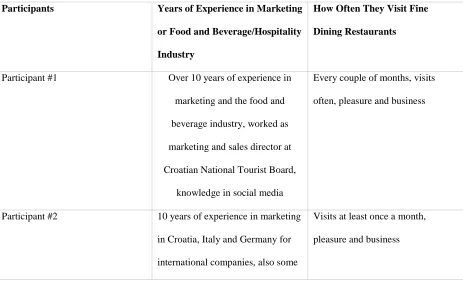
they provided the researcher with less information. A chart including the participants, their years
of experience in the marketing or hospitality industry and how often they visit fine dining
[image:31.612.76.539.429.711.2]restaurants can be found below in Table1:
Figure 1: Participants
Participants Years of Experience in Marketing
or Food and Beverage/Hospitality
Industry
How Often They Visit Fine
Dining Restaurants
Participant #1 Over 10 years of experience in marketing and the food and beverage industry, worked as marketing and sales director at Croatian National Tourist Board,
knowledge in social media
Every couple of months, visits often, pleasure and business
Participant #2 10 years of experience in marketing in Croatia, Italy and Germany for international companies, also some
experience in the food and beverage industry
Participant #3 10 years of experience in a PR agency, experience in marketing and organizing events, social media, copywriting, owns their own agency for organizing events and also a sommelier
A few times a year
Participant #4 More than 10 years of experience in the marketing and food industry, owns their own restaurant
Visits 2 fine dining restaurants a month
Participant #5 3 years of experience in the food industry, working at restaurants and bars
Has visited most of the fine dining restaurants in Zagreb, frequently
Participant #6 13 years of experience as food critiques
Have visited all of the fine dining restaurants in Zagreb and further, very frequently
Participant #7 Over 10 years of experience in marketing and wine bar owner
A few times a year
Participant #8 7 years of experience in the hospitality industry
Visits fine dining restaurants from time to time
Participant #9 Business major A few times a year Participant #10 Pharmacist Enjoys visiting fine dining
restaurants on business occasions
Participants were contacted before the interview via Facebook messenger and informed
that they would receive interview questions sent to their e-mail addresses. The e-mail included a
heading, the researcher and participant’s name (Creswell, 2014). Each participant received the
e-mail interview with eleven questions. The participants were given instructions in the e-e-mail and a
time period by when they should return their answers to the researcher. This helped them be
familiar with how they should approach the e-mail interview (Creswell, 2014).
The e-mail interview began with a question that allowed the interviewer and interviewee
to “break the ice” such as, “how are you”. These questions were followed by open ended
questions that allowed the researcher to learn more about the participant’s opinions on what
types of social media posts could impact their decision making to visit a fine dining restaurant in
Zagreb. For example, the participants were asked to examine the social media pages (Facebook
and Instagram) of the five fine dining restaurants in Zagreb (Noel, Vinodol, Dubravkin put, Pod
Zidom Bistro & Wine Bar and Ristorante Carpaccio) and give their feedback. For instance, what
they liked, what they disliked, what could be added and what would make them actually visit
rather than just like a post. They answered from a customer’s point of view, but some also added
their knowledge and perspective from a business point of view. The participants were asked
eleven questions about social media, fine dining restaurants and details about them to explore the
possible answers to the research question.
The interviews were conducted by e-mail with the intention of allowing participants to
feel that the interview is casual and convenient in today’s busy world when doing things online
makes everything easier. The interviewee could feel relaxed and open to share their answers.
Their relaxed home or personal environment gave them enough time and comfort to answer the
the e-mail interview for about a half an hour phone call in order for the researcher to collect more
information. One participant was contacted after the e-mail interview through Facebook
messenger and also asked additional questions. The three participants that were contacted
additionally for a telephone interview had over ten years of experience in the food or marketing
industry and were frequent visitors at fine dining restaurants. They were asked questions such as
“What is your favorite fine dining restaurant and what are the reasons that you always return to
it?”, “What is the definition of fine dining to you?”, “Why do you visit fine dining restaurants?”,
“What would you recommend fine dining restaurants market/communicate on their social media
pages, or what type of content or offer on a fine dining restaurant’s social media page would
motivate you to visit their restaurant?”, “What type of food do you enjoy eating a fine dining
restaurants?” and “What is your association to fine dining restaurants?”. All ten participants were
asked how many years of experience they had in the food or marketing industry and how often
they visited fine dining restaurants. A thank you statement was sent to each interviewee for
taking the time to participate in the interview and for sharing their time and valuable answers and
opinions.
The interview questions explored what types of posts and what leading factors could
motivate the participants to visit a fine dining restaurant in Zagreb. It also explored what
participants expected from fine dining restaurants both online (social media marketing) and
offline (restaurant offer, service and atmosphere). Specifically, the interview questions aimed to
explore whether social media marketing through Facebook and Instagram could have an effect
on the participants’ buying decision to visit a fine dining restaurant in Zagreb, and if so what
social media tactics and content would be most effective to use in a social media strategy.
customer to visit a fine dining restaurant, whether word of mouth is more powerful than social
media marketing for fine dining restaurants and whether the participants used Facebook or
Instagram more to follow their favorite restaurants.
The interview questions can be found in Appendix A. The five fine dining restaurants
that were selected for this study were: Noel, Vinodol, Dubravkin put, Pod Zidom Bistro & Wine
Bar and Ristorante Carpaccio in Zagreb. They were defined as fine dining restaurants in this
study due to their specific and unique menu offers, elegant atmospheres, high prices and social
status of being expensive restaurants that serve quality food in Zagreb.
Ethical Considerations
The interview questions were sent by e-mail to the respected participants during the first
part of the data gathering process. The research paper and interview questions were looked over
by RIT’s institutional review board to determine if there were any risks and to protect the human
rights of the participants before conducting the interview. Participants received a thank you letter
as a sign of respect and gratitude for their time and help. Participants were not forced to do
anything and they could decline to participate if they are not able to. All of the information
collected from participants is kept confidential by the researcher and represented only in
Reliability and Validity
The research was meant to be descriptive and describe the opinions of participants based
on their experiences related to the research question (Creswell, 2014). In order to make sure the
study had validity and reliability, the researcher checked the transcript with the informants to
eliminate researcher bias and made sure that the researcher understood what the participants
wanted to communicate to the researcher through their answers (Descombe, 1998, p. 200). Also,
the plausibility of the data was checked. Participants were asked if they had experience in the
food, marketing industry or of just visiting fine dining restaurants and how many years of
experience. This determined how much knowledge the participants could provide in their
answers (Descombe, 1998, p. 200). Finally, the researcher used the data triangulation method to
reduce bias as well. Various sources of information that could be found in the literature review
provided the researcher with a clearer view on the results received from participants (Descombe,
1998, p. 200). Last, but not least, the researcher searched for themes throughout the participants’
answers throughout the data analysis, in other words repeated answers that could be validated as
reliable answers to the research question in the study (Descombe, 1998, p. 200).
Data Analysis
The data analysed in this study was from the researcher’s interviews with participants
who were foodies, had experience in the fields of marketing or the food industry and have had a
normal tendency to visit fine dining restaurants, as well as use Facebook or Instagram on a daily
basis. After receiving the participants’ answers by e-mail, the researcher reviewed the transcripts
several times to avoid any misinterpretations or wrong conclusions (Creswell, 2014). Also, the
researcher asked additional sub questions in order to collect more data from participants that
through a phone call and one participant through Facebook messenger. Through phone calls with
three participants and e-mails with all ten participants, the researcher contacted the participants
and used the member checking method to assure that the descriptions of the transcripts were
correct (Creswell, 2014). Each participant was also asked how many years of experience they
have in the food industry or marketing and how much experience they have in visiting fine
dining restaurants in order to assure the validity of the participants' answers.
After the data was checked for accuracy, the researcher created codes by highlighting the
most important information that was tied to answering the research question. Based on the codes,
themes about the most common information stated by the participants were created and those
that were irrelevant were dismissed. The themes and sub themes connected to whether social
media marketing can influence a user to visit a fine dining restaurant in Zagreb, and what social
media tactics and overall factors should be considered when creating an effective social media
Figure 1: Data analysis codes and themes Part 1
Quality visual
content
• Photos and videos • Storytelling
•Personal/"human" touch
Special offers
• Tasting menus
• Hosting different chefs • Value for money
• Sampling menu, special price, and daily offer
• Seasonal produce and traditional dishes with a modern twist
Positive word of
mouth
Social media
tactics
• Brand personality, stories and be approachable with excellent service • High quality photos and videos, team pictures and special offers • Post frequently but use a human approach
Price
• Menu prices should be communicated on website, special offers on social media • Prices must match value of the offer
Emotions and
reasons to
visit
• Top reasons to visit fine dining restaurants • Emotions and motives
Role of the Researcher
According to Creswell (2014, p. 185), the researcher is the key instrument in a qualitative
study. In this qualitative study, the researcher collected the data (Creswell, 2014, p. 207). The
researcher has had three years of experience working as a social media specialist for a Croatian
hotel chain, marketed their hotels and all of their services including food, excursions, hotel
accommodation and more. The researcher held responsibility for seventeen Facebook pages, two
Instagram profiles, one Twitter profile, one Pinterest, and one Youtube account. One of the
hotels had a fine dining restaurant. Therefore, the researcher has had some experience in
marketing fine dining restaurants. The researcher’s background experience helped the research
be create quality research questions that were up to date with social media trends in the
hospitality and restaurant industry according to both the literature references and the researcher’s
personal experience in the industry and social media marketing.
The way that the researcher perceived social media marketing is as an effective, low-cost,
and efficient marketing tool in today’s world. The researcher believes that all other forms of
marketing have been dying out and that more and more people were paying for Facebook,
Instagram, and Google ads. The researcher believed that companies that are not investing in
social media marketing are missing out on opportunities.
The researcher was aware of the bias that her background work experience in digital
marketing could have possibly brought to this study, which is why she was very careful when
selecting her sample and creating her interview questions. She was also very aware and careful
when collecting, analysing and presenting the results that the participants provided her with for
Results
In the previous section, the researcher described how the data was gathered and analysed
after interviewing the participants. In this section the researcher presented the results found from
the collected interview data through themes that were detected during the coding process. These
themes answered the research question. The research question being explored is: What factors
and social media tactics are important to consider when creating an effective social media
strategy for a fine dining restaurant in Zagreb? Sub research questions are: What will make
customers actually visit the fine dining restaurant rather than just liking a post?
This section focuses on participants’ perspectives about whether social media could
influence their buying decision to visit a fine dining restaurant in Zagreb, what they expect from
a fine dining restaurant (both their social media pages and restaurant experiences) and their
experiences with previous fine dining restaurants and what type of a posts and social media
tactics would motivate them to visit a fine dining restaurant in Zagreb in the future. This section
will allow the reader to learn how fine dining restaurants can differentiate themselves in the
market and tend to their user’s needs through Facebook and Instagram.
Visual Quality Content
Photos and videos. According to participants’ results, visual quality content, more
specifically photo or video is one of the most important factors to incorporate in a social media
strategy when using social media marketing to promote fine dining restaurants in Zagreb. All ten
of the participants agreed that quality photos or videos were an important factor in attracting
them to be interested to visit a fine dining restaurant in Zagreb based on the restaurant’s social
media pages Facebook and Instagram. Pictures, videos or Instagram stories that are inviting and