Vectors based on hybrids consisting of adeno-associated virus types 2 (ITRs and Rep) and 5 (Cap) were evaluated for muscle-directed gene transfer (called AAV2/5). Evaluation in immune-competent mice revealed greater transduction efficacy with AAV2/5 than with AAV2 and no cross-neutralization between AAV2/5 and AAV2. Interestingly, we saw no immunologic evidence of previous exposure to AAV5 capsids in a large population of healthy human subjects.
Vectors based on the human parvovirus adeno-associated virus (AAV) are being evaluated in preclinical and clinical models of gene therapy. The majority of experiments have been performed with vectors based on serotype 2 (14). A number of principles have emerged from these studies. A wide spectrum of permissivity for AAV2 vector transduction exists, ranging from skeletal muscle, where transduction rates are high, to hematopoietic stem cells, which require large vector doses for detection of transduction. When achieved, transgene expression is remarkably stable and largely void of destructive T-cell responses to nonsecreted transgene products (11, 13).
Six serotypes of AAV have been isolated and fully charac-terized with respect to nucleotide sequence (8, 12, 15, 16). Serotype 5 was isolated from a human condylomatous skin lesion, while the other serotypes were identified as contami-nants of human adenovirus preparations (3, 6, 12). Serotypes 1, 2, 3, and 4 represent distinct molecular isolates with significant homology, particularly in the inverted terminal repeat (ITR) and Rep regions; within this group, Rep proteins can bind to heterologous ITRs and support rescue and replication. Sero-type 6 represents a hybrid virus consisting of seroSero-types 1 and 2. Serotype 5 is quite dissimilar to the others, with a distinct ITR structure and only 67% homology of therepgene to that of AAV2 (7).
Other investigators have generated vectors based on AAV5 by using an AAV5 rep-capgenome for production of vector and a vector with AAV5 ITRs. They have shown enhanced performance in terms of transduction efficiency in the murine lung, central nervous system, and most recently, in skeletal muscle (5, 10, 17).
In this study, an AAV vector based on serotype 5 was gen-erated by transfection of the vector (i.e., ITRs and transgene), arep-cap-expressing construct, and a plasmid expressing E2a, E4-orf6, and VA from adenovirus (2). The standard AAV5 vector was produced with an AAV5rep-capconstruct together with a vector containing AAV5 ITRs; the recombinant virions were purified by cesium chloride sedimentation (called AAV5).
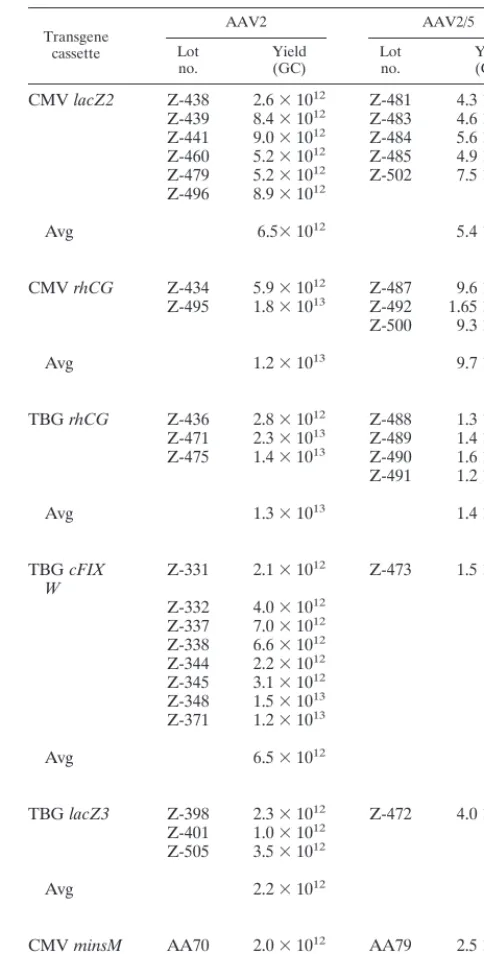
A “pseudotyped” version of AAV2 was created by usingrep from AAV2 and cap from AAV5 together with a plasmid containing a vector based on AAV2; this was also purified by cesium chloride sedimentation. The resulting vector is referred to as AAV2/5. In comparing the performance of vectors based on AAV2 versus AAV2/5, we utilized common production protocols but different methods of purification. The AAV2 vector was purified by heparin chromatography, which has been shown by several investigators to yield vectors substan-tially more potent than those purified by cesium chloride sed-imentation (2, 18). This is due, in part, to the inactivation of AAV2 in the presence of cesium chloride during extended centrifugations (2). Heparin chromatography is not useful for the purification of AAV2/5, since it recognizes a different re-ceptor. Instead, we used cesium chloride sedimentation, which provides a valid comparison to heparin-purified AAV2, since AAV2/5 was not appreciably inactivated by cesium chloride (data not shown). Initial experiments evaluated the expression of CMV lacZ in mouse skeletal muscle injected with equal quantities of the AAV2, AAV5, and AAV2/5 vectors. Histo-chemical analysis revealedlacZexpression from AAV2/5 (Fig. 1C) intermediate between that achieved with the AAV5 (Fig. 1A and B) and AAV2 (Fig. 1D and next paragraph) vectors. All subsequent studies were performed with the AAV2/5 vec-tor in order to allow comparison of the capsid protein alone. The yield of the AAV2/5 vector is essentially identical to that of the AAV2 vector when standard transfection approaches are used. Table 1 summarizes the yield, based on the number of genome copies, of seven vectors packaged with either an AAV2 or an AAV2/5 construct. A quantitative analysis oflacZ expression from the AAV2 or AAV2/5 vector following injec-tion into murine skeletal muscle revealed a twofold increase from the AAV2/5 vector. Enzymatic analysis for -galactosi-dase (-gal) from tissue homogenates demonstrated averages of 3.6⫾0.1g of-gal/g of tissue for AAV2 and 7.3⫾1.2g of-gal/g for AAV2/5 (n⫽6;⫾1 standard deviation).
The AAV2/5lacZvector was evaluated in a number of other tissues. Subcutaneous injection of the vector led to substantial lacZexpression in smooth muscle cells (Fig. 1E and F). The AAV2/5 vector more efficiently infected differentiated airway epithelial cells from the apical surface (Fig. 1G) than did * Corresponding author. Mailing address: 204 The Wistar Institute,
3601 Spruce St., Philadelphia, PA 19104-4268. Phone: (215) 898-3000. Fax: (215) 898-6588. E-mail: [email protected].
6199
on November 9, 2019 by guest
http://jvi.asm.org/
on November 9, 2019 by guest
http://jvi.asm.org/
protein (eGFP) vector, followed 28 days later by an intramus-cular injection into the contralateral leg of an AAV2 or AAV2/5 lacZ vector. Expression of -gal was evaluated by enzymatic analysis of tissue homogenates harvested 14 days after the second injection.
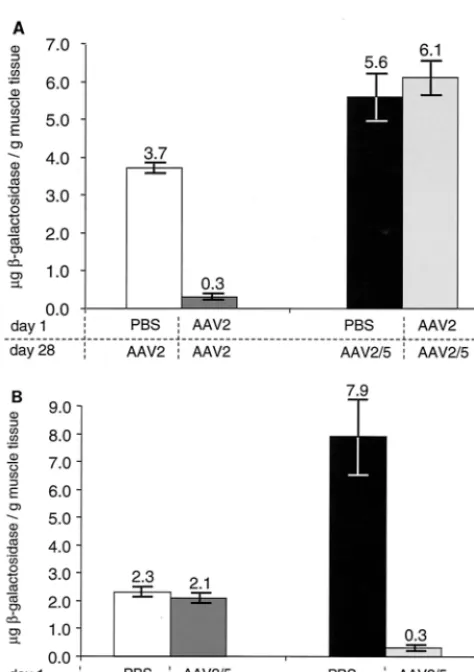
Immunization with AAV2 eGFP diminished the effective-ness of a subsequent administration of AAV2lacZ20-fold but had no effect on expression from an AAV2/5 vector (i.e., gene expression equivalent to that observed in naive animals; Fig. 2A). The reverse experiment yielded identical results: immu-nization with AAV2/5 blocked AAV2/5 readministration but not AAV2 gene transfer and expression (Fig. 2B).
A cohort of 85 human volunteers previously evaluated for neutralizing antibodies to AAV1 and AAV2 were evaluated for neutralizing antibodies to AAV2/5. We were surprised to see that not a single subject demonstrated neutralizing bodies to AAV2/5 despite the presence of neutralizing anti-bodies to AAV1 and AAV2 in 19 and 25% of the subjects, respectively (Fig. 3). The lack of neutralizing antibodies to AAV5 in our study contrasts with a previous study of AAV5 seroepidemiology performed in 1984 by Geog-Fries et al. (12) with an enzyme-linked immunosorbent assay (ELISA) which detected antibodies to AAV5 capsid proteins in 60% of the individuals tested. Our experience with AAV2 suggests that the ELISA is a more sensitive, and potentially less specific, assay for a specific serologic response; of 74 subjects analyzed, 96% were ELISA positive for AAV2 while only 32% were able to neutralize an infection with AAV2 (9).
The absence of neutralizing antibodies to AAV2/5 is poten-tially important for human applications. In contrast to AAV2, where at least a quarter of all patients may have diminished vector engraftment due to preexisting immunity, AAV2/5 up-take should not be affected by immune status in the context of primary vector administration. How can one reconcile the ab-sence of AAV2/5 neutralizing antibodies in humans with the finding that AAV5 was isolated from a human skin lesion?
FIG. 1. AAV5-based cytomegalovirus (CMV)lacZwas derived from plasmid pAAV5 Rn (6), while the AAV5 packaging construct pack 5 was derived from viral AAV5 DNA (3). The hybrid packaging construct pack 2/5 was created by exchanging AAV2capfrom the AAV2 packaging construct p600 trans (2) with AAV5cap. The AAV2-based AAV CMVlacZconstruct has been described previously (2). (A) Transduction of murine muscle with AAV5 CMVlacZ. The right anterior tibialis of C57BL/6 mice was injected with 1010genome copies of AAV5 CMVlacZand harvested 28 days postinjection. (B) Higher magnification of panel A. (C and D) Transduction of murine muscle with AAV2/5 CMVlacZ(C) and AAV2 CMVlacZ(D). The right anterior tibialis muscle of C57BL/6 mice was injected with 4⫻1010genome copies of AAV2/5 CMVlacZand AAV2 CMVlacZ, respectively. Muscles were harvested 60 days postinjection. (E) Transduction of murine smooth muscle with AAV2/5 CMVlacZ. We injected 1010genome copies of AAV2/5 CMVlacZsubcutaneously into C57BL/6 mice. Expression of-gal was assessed 60 days after vector administration. (F) Higher magnification of panel E. (G and H) Apical transduction of primary human epithelial airway cells with AAV2/5 (G) and AAV2CMV (H). Primary human airway epithelial cells were infected apically with 5⫻1010genomic particles of the corresponding virus (liquid-air transwell system). Cells were fixed and stained with 5-bromo-4-chloro-3-indolyl--D-galactopyranoside (X-Gal) 7 days postinfection.
CMVrhCG Z-434 5.9⫻1012 Z-487 9.6⫻1012 Z-495 1.8⫻1013 Z-492 1.65⫻1013 Z-500 9.3⫻1012
Avg 1.2⫻1013 9.7⫻1012
TBGrhCG Z-436 2.8⫻1012 Z-488 1.3⫻1013 Z-471 2.3⫻1013 Z-489 1.4⫻1013 Z-475 1.4⫻1013 Z-490 1.6⫻1013 Z-491 1.2⫻1013
Avg 1.3⫻1013 1.4⫻1013
TBGcFIX
W Z-331 2.1⫻10
12 Z-473 1.5⫻1013
Z-332 4.0⫻1012 Z-337 7.0⫻1012 Z-338 6.6⫻1012 Z-344 2.2⫻1012 Z-345 3.1⫻1012 Z-348 1.5⫻1013 Z-371 1.2⫻1013
Avg 6.5⫻1012
TBGlacZ3 Z-398 2.3⫻1012 Z-472 4.0⫻1012
Z-401 1.0⫻1012 Z-505 3.5⫻1012
Avg 2.2⫻1012
CMVminsM AA70 2.0⫻1012 AA79 2.5⫻1012
CMVeGFP AA45 1.5⫻1012 AA74 2.2⫻1012 aGC, genome copies; CMV, CMV promoter; TBG, thyroxine-binding
globu-lin promoter;rhCG, gene for rhesus chorionic gonadotropin;cFIX, gene for canine factor IX;W, woodchuck hepatitis virus posttranscriptional regulatory element;minsM, gene for furin-modified mouse proinsulin. Average numbers of genome copies were calculated when more than one recombinant AAV prepa-ration was produced.
on November 9, 2019 by guest
http://jvi.asm.org/
[image:3.612.311.553.84.561.2]Several possibilities exist. The initial isolate could have been a contaminant, the incidence of a natural infection may be low, or the systemic serologic response of a natural infection is undetectable.
In summary, vectors based on AAV2/5 may have a number of advantages for muscle gene therapy. Efficacy of transduction in mice is higher than with AAV2 and may be even further improved if a better purification method is developed. Further-more, preexisting immunity should not be a problem in hu-mans. Testing in other models, such as nonhuman primates,
will be important in further evaluating these potential disad-vantages.
We thank the Vector and Morphology Cores of the Institute for Human Gene Therapy.
This work was supported by grants from the Cystic Fibrosis Foun-dation, the Juvenile Diabetes FounFoun-dation, and the NIH (P30 DK47757-07, P01 HL59407-02). J. M. Wilson’s laboratory also re-ceived funding from Genovo, Inc. (now Targeted Genetics), a biotech-nology company with which he formally consulted and in which he currently owns equity. Alberto Auricchio is the recipient of a fellow-ship from Telethon-Italia (371/B).
REFERENCES
1.Anand, V., N. Chirmule, M. Fersh, A. M. Maguire, and J. Bennett.2000. Additional transduction events after subretinal readministration of recom-binant adeno-associated virus. Hum. Gene Ther.11:449–457.
2.Auricchio, A., M. Hildinger, E. O’Connor, G. Gao, and J. M. Wilson.2001. Isolation of highly infectious and pure adeno-associated virus type 2 vectors with a single-step gravity-flow column. Hum. Gene Ther.12:71–76. 3.Bantel-Schaal, U., H. Delius, R. Schmidt, and H. zur Hausen.1999. Human
adeno-associated virus type 5 is only distantly related to other known primate helper-dependent parvoviruses. J. Virol.73:939–947.
4.Bennett, J., A. M. Maguire, A. V. Cideciyan, M. Schnell, E. Glover, V. Anand, T. S. Aleman, N. Chirmule, A. R. Gupta, Y. Huang, G.-P. Gao, W. C. Nyberg, J. Tazelaar, J. V. Hughes, J. M. Wilson, and S. G. Jacobson.1999. Stable transgene expression in rod photoreceptors after recombinant adeno-asso-ciated virus-mediated gene transfer to monkey retina. Proc. Natl. Sci. Acad. USA96:9920–9925.
5.Chao, H., Y. Liu, J. Rabinowitz, C. Li, R. Samulski, and C. Walsh.2000. Several log increase in therapeutic transgene delivery by distinct adeno-associated viral serotype vectors. Mol. Ther.2:619–623.
6.Chiorini, J. A., S. Afione, and R. M. Kotin.1999. Adeno-associated virus (AAV) type 5 Rep protein cleaves a unique terminal resolution site com-pared with other AAV serotypes. J. Virol.73:4293–4298.
7.Chiorini, J. A., F. Kim, L. Yang, and R. M. Kotin.1999. Cloning and characterization of adeno-associated virus type 5. J. Virol.73:1309–1319. 8.Chiorini, J. A., L. Yang, Y. Liu, B. Safer, and R. M. Kotin.1997. Cloning of
adeno-associated virus type 4 (AAV4) and generation of recombinant AAV4 particles. J. Virol.71:6823–6833.
9.Chirmule, N., K. Propert, S. Magosin, G. Qian, R. Qian, and J. M. Wilson.
1999. Immune responses to adenovirus and adeno-associated virus in hu-mans. Gene Ther.6:1574–1583.
10. Davidson, B. L., C. S. Stein, J. A. Heth, I. Martins, R. M. Kotin, T. A. Derksen, J. Zabner, A. Ghodsi, and J. A. Chiorini.2000. Recombinant adeno-associated virus type 2, 4, and 5 vectors: transduction of variant cell types and regions in the mammalian central nervous system. Proc. Natl. Acad. Sci. USA97:3428–3432.
11. Fisher, K. J., K. Jooss, J. Alston, Y. Yang, S. E. Haecker, K. High, R. Pathak,
FIG. 2. (A) Influence of neutralizing antibodies to AAV2 on vector readministration. Immunocompetent mice (C57BL/6) were injected with 3 ⫻ 1010 genome copies of AAV2 CMV eGFP in the right anterior tibialis muscle (11) and injected 28 days later with 3⫻1010 genome copies of either AAV2 CMVlacZor AAV2/5 CMVlacZin the left anterior tibialis muscle. Expression of-gal was determined 14 days after the second injection by ELISA (Boehringer GMbH, Mann-heim, Germany) in accordance with the manufacturer’s instructions. Mean values of six animals per group are shown. (B) Influence of neutralizing antibodies to AAV2/5 on vector readministration. Immu-nocompetent C57BL/6 mice were injected with 4⫻1010genome cop-ies of AAV2/5 CMVeGFP in the right anterior tibialis muscle and injected 28 days later with 1010genome copies of either AAV2 CMV
[image:4.612.57.294.67.403.2]lacZor AAV2/5 CMVlacZin the left anterior tibialis muscle. (Note that the AAV2/5 CMVlacZvirus preparation in this experiment is different from those used for Fig. 1 and 2A.) Expression of-gal was determined 14 days after the second injection by ELISA in accordance with the manufacturer’s (Boehringer) instructions. Mean values of eight animals per group are shown. PBS, phosphate-buffered saline control.
FIG. 3. Prevalence of neutralizing antibodies (NAB) to AAV in a human population. Neutralizing antibody titers were determined as previously described (1, 4, 9), except that AAV5 CMVeGFP3was used instead of an AAV2eGFPvirus for the measurement of AAV5 neu-tralizing antibodies. Sera of 85 human volunteers were tested for the presence of neutralizing antibodies to AAV1, AAV2, and AAV5. All of the samples tested were negative for AAV5 neutralizing antibodies. Even sera with high AAV1- or AAV2- neutralizing activity did not inhibit AAV5 infectivity.