Int. J. Electrochem. Sci., 13 (2018) 4298 – 4308, doi: 10.20964/2018.05.173
International Journal of
ELECTROCHEMICAL
SCIENCE
www.electrochemsci.org
A Comparative Study of Critical Pitting Temperature (CPT) of
Super Duplex Stainless Steel S32707 in NaCl Solution
Xiu-qing Xu1,2,*, Mifeng Zhao3, Yao-rong Feng1,2, Fa-gen Li1,2, Xiang Zhang1
1 Tubular Goods Research Institute of China National Petroleum Corporation, Xi’an Shaanxi 710077 2
State Key Laboratory of Performance and Structural Safety for Petroleum Tubular Goods and Equipment Materials, Xi’an Shaanxi 710077
3
Oil and Gas Engineering Research Institute of PetroChina Tarim Oilfield Company, Korla Xinjiang 841000
*
E-mail: [email protected], [email protected]
Received: 6 January 2018 / Accepted: 15 March 2018 / Published: 10 April 2018
In this study, the critical pitting temperature (CPT) of super duplex stainless steel UNS S32707 was compared using potentiodynamic, potentiostatic techniques, EIS and new electrochemical noise method. The results revealed that the CPT of S32707 is between 55–65 °C for potentiodynamic polarization and 64 °C for potentiostatic polarization, respectively. The pitting corrosion of S32707 occurs at about 65 °C for EIS method and the CPT value is between 58–65 °C for electrochemical noise method.
Keywords: critical pitting temperature, super duplex stainless steel UNS S32707, electrochemical methods, NaCl solution
1. INTRODUCTION
Super duplex stainless steel S32707 is a newly developed stainless owning austenite and delta ferrite phase microstructure with similar proportions, which has excellent corrosion resistant and mechanical properties[1-3]. Usually it can be considered as preferred material for marine equipment instead of high-grade austenitic stainless steels and other anti-corrosion alloys. However, the surface passive film of S32707 is sensitive to temperature. Therefore, it is necessary to study the CPT of S32707 in order to guide its application in marine environment.
has been demonstrated [6,7] that the formation of corrosion pits divided into two consecutive stages with a early metastable growth and following a stable growth. Once the temperature exceeds CPT, stable pitting will occur and breakdown potentials drop. CPT is recognized as an important reference standard for screening materials in engineering application, which can accurately reflect the sensitivity of materials to temperature. CPT values reported are between 80 and 90 °C for super duplex steels[8- 10]. However, processing methods such as hot isostatic pressing (HIP), and casting often change the CPT of these materials.
Several methods have been used for measuring the CPT of high pitting resistance stainless steels. Potentiodynamic polarization technique was used to measure CPT by Qvarfort [11,12], and it was pointed out that the temperature of the breakdown potential decreasing rapidly can be regarded as CPT. Furthermore, the potentiostatic and potentiodynamic determination method were developed by Li [13] and El-Meguid [14], whose applied these methods to determine the critical protection temperature respectively. Electrochemical impedance spectroscopy (EIS) is also widely used to study the CPT of stainless steels because the stable pitting information can be obtained more precisely [15-17]. Electrochemical noise (EN) method to determine the CPT was firstly introduced by Salinas-Bravo and Newman [18]. They monitored the potential and current fluctuation of the specimen and considered the value of CPT is the temperature at which the amplitude of current fluctuation increased to 5 μA/cm2. Later many scholars improved this method to the determine the CPT of stainless steel[19-22].
The aim of the present work is attempted to obtain the CPT value of newly developed UNS S32707 manufactured by HIP in marine environment. For this purpose, the CPT of UNS S32707 in 3.5 wt.% NaCl solution was compared using potentiodynamic, potentiostatic techniques, EIS and EN method. The effect of temperature on the formation mechanism of passive film on S32750 is investigated.
2. EXPERIMENTAL DETAILS
2.1 Materials
The super duplex stainless steel S32707 manufactured by HIP (Advanced Technology & Materials Co., Ltd) was used as experiment material and its chemical compositions in weight percent is shown in Table 1. The pitting resistance equivalent (PREN) of S32707 with a value of 50 was calculated according to Eq. (1)[23].
[image:2.596.9.596.689.725.2]PREN = % Cr + 3.3% Mo + 16% N (1) Table 1. Chemical composition of super duplex stainless steel S32707
Elements C Si Mn P S Cr Ni Mo Nb V Ti Cu N
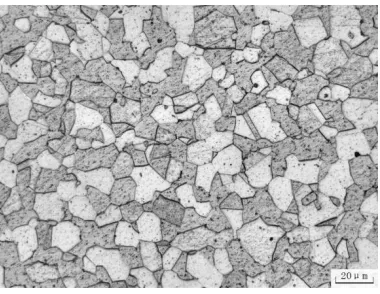
The microstructure of super duplex stainless steel S32707 was characterized by metallographic microscope (MEF4M, Germany LEICA ), as shown in Fig.1. The ratio of thicker-grey ferritic structure (α) and light-grey austenite structure is close to 1:1.
Figure 1. The microstructure of super duplex stainless steel S32707
Samples were prepared in disk type with the size of 15 mm in diameter and 3 mm in thickness. In order to prevent corrosion, samples were embedded in the epoxy resin exposing 15 mm diameter surface for testing. Before the test, the surface was abraded up to 2000 emery paper and polished, rinsed with distilled water and dried by hot air. The test solution, 3.5 wt.% NaCl was prepared from analytical reagent grade NaCl and distilled water. And pure nitrogen gas (N2) was filled the test
solution during the whole experiment process.
2.2 Electrochemical measurements
To determine the CPT value and electrochemical corrosion of super duplex stainless steel S32707 in 3.5 wt.% NaCl solution, the electrochemical measurements including EIS method, EN measurement, potentiodynamic and potentiostatic techniques were performed. A CS3250 electrochemical workstation (manufactured by Wuhan CorrTest Instrument Co. Ltd.) was used to test electrochemical behaviors and the data were obtained in a three-electrode mode. The reference electrode was a saturated calomel electrode (SCE). A platinum plat with a surface area of 1 cm2 was used as the auxiliary electrode. In all measurements, the electrolyte in the cell was deaerated for at least 1 h before the experiment. Prior to determine the CPT, the specimen was allowed to stabilize at open circuit potential for 60 min at room temperature. The temperature of the medium solution was controlled by an oil bath (HHS-01, Beijing Kewei Instrument Co. Ltd) and each test was repeated at least three times to ensure reproducibility.
Potentiodynamic polarization measurement was carried out at 45 °C, 55 °C, 65 °C and 75 °C. Before the measurements, the open circuit potential (OCP) was recorded for 60 min at least. The range of potential was from -200 mV to 1500 mV at a constant scan rate of 1 mV/s. The potential at which the current density exceeded 100 μA/cm2
[image:3.596.204.394.140.287.2]
Potentiostatic CPT determination experiments were carried out at applied anodic potential of 750 mV/SCE and the temperature increased with a rate of 1 °C/min until the current density exceeded 100 μA/cm2
. The temperature associated to this current density was chosen as a criterion for CPT assessment.
EIS tests were performed in 3.5 wt.% NaCl solution at temperatures varying from 45 °C (±1 °C) to 75 °C. The frequency ranges of EIS measurement was from 10-3
Hz to 105 Hz.
Electrochemical noise measurements as a new method were carrying out using electrochemical workstation. Two same specimens were used as the working electrode and an Ag/AgCl (saturated KCl) electrode as the reference electrode, respectively. The electrochemical current noise was measured as the galvanic coupling current between these two working electrodes. The frequency of electrochemical noise measurement was 50 Hz and EN data was continuously recorded for 3600 s, meanwhile the solution temperature was started from 30 °C and increased with a rate of 1 °C/min.
3. RESULTS AND DISCUSSION
3.1 Potentiodynamic CPT measurements
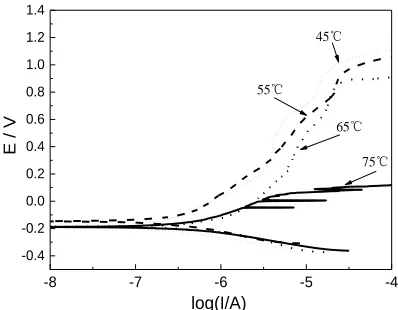
Potentiodynamic polarization curves of super duplex stainless steel S32707 in 3.5 wt.% NaCl solution at different temperatures are shown in Fig. 2. Generally, the passive current density increases with the increasing temperature[15]. For instance, it increased from 3.2 to 5 μA/cm2 when temperature increased from 45 to 75 °C. The breakdown potential decreased from 1100 mV/SCE at 45 °C to 100 mV/SCE at 75 °C (see Fig. 3). It can be observed that the super duplex stainless steel S32707 shows passivity in the temperature range of 45–55 °C in 3.5 wt.% NaCl solution. Then increase of current density fluctuations in passive domain is observed at 65 °C and a transition from transpassivity to pitting corrosion took place.
-8 -7 -6 -5 -4
-0.4 -0.2 0.0 0.2 0.4 0.6 0.8 1.0 1.2 1.4
75℃
65℃
55℃
E / V
log(I/A)
45℃
[image:4.596.198.397.524.679.2]
45 50 55 60 65 70 75
0 200 400 600 800 1000 1200
Break
do
wn
Potential mV(SCE
)
Temperature(℃)
Figure 3. Breakdown potential vs. temperature for S32707 in 3.5 wt.% NaCl solution at different temperatures.
According to the criterion of 100 μA/cm2 for the breakdown potential, the pitting potential at 65 °C is 900 mV(SCE). In conclusion, transition from transpassivity to pitting corrosion occurred between 55 and 65 °C in 3.5 wt.% NaCl solution according to the potentiodynamic measurements results.
3.2 Potentiostatic CPT measurement
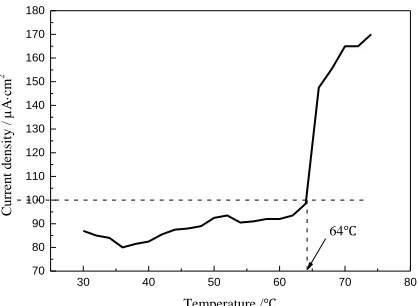
Fig. 4 shows the CPT result of super duplex stainless steel S32707 using potentiostatic measurement under 750 mV/SCE anodic potential at different temperatures. Considering the criterion of 100 μA/cm2 current density for CPT evaluation, it can be seen that the CPT of S32707 was 64 °C in 3.5 wt.% NaCl solution.
30 40 50 60 70 80
70 80 90 100 110 120 130 140 150 160 170 180
Current density /
A
cm
2
Temperature /℃
64℃
Figure 4. Potentiostatic polarization results of S32707 at 750 mV/SCE in 3.5 wt.% NaCl solution.
[image:5.596.197.397.69.220.2] [image:5.596.194.403.517.670.2]
indicating the passivating film suffering broken. By further increasing temperature, the temperature of metastable pits occurrence on super duplex stainless steel S32707 can be obtained. It is noticeable that this temperature obtained is too much lower than the background current density in this study[24], which may be related to the HIP manufacture method. The relationship between manufacture methods and CPT will be discussed in the future research. When the temperatures higher than 64 °C, the current density rises rapidly and the metastable pitting becomes stable at this stage. By comparing the presented results of potentiostatic and potentiodynamic polarization methods, it is clear that these two methods are in reasonable accordance.
3.3 CPT measurement by EIS method
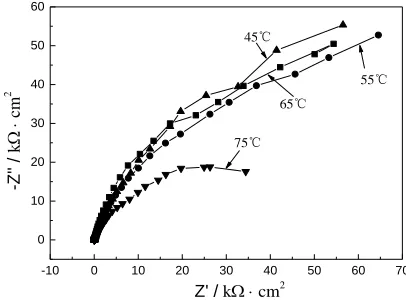
Fig. 5 shows the EIS results of super duplex stainless steel S32707 in 3.5 wt.% NaCl solution at different temperatures in the frequency range of 10-3 Hz to 105 Hz. As shown, the diameter of depressed semi-circle decreases by the increasing temperature especially at the 75 °C. The models of equivalent circuits for EIS results are shown in Fig. 6 and the electrochemical parameters based on the model is presented in Table 2.
As seen, the Nyquist plots show the line-like feature of 45 degree due to existence of the passive surface below 65 °C. Above the temperatures of CPT, the impedance semicircle shrinks markedly which shows the worse corrosion resistance. The stable pits are formed on the surface at this temperature, so the equivalent circuit is different from that of lower temperatures as seen in Fig. 6. In these circuits, CPEpit represents the double layer formed at the interface between surface and solution
in pit whose impedance can be calculated by Eq. (2) [25]: Z=P-1(i)-n (2)
where P is the value of CPEpit, is the angular frequency and n value depends on the surface
morphology.
Other parameter Rpit refers to the charge transfer resistance related to pit and Ri is the pit
solution resistance respectively.
-10 0 10 20 30 40 50 60 70
0 10 20 30 40 50 60
75℃
65℃
55℃
45℃
-Z''
/
k
c
m
2
[image:6.596.194.397.549.699.2]Z' / k cm2
When stable pits appeared, the surface is separated to the passive surface and pitted area. The circuit for the passive surface is similar to that for the temperatures below CPT. However, Rpit is added
to the equivalent circuit in the presence of stable pit on the surface, as seen in Fig.6b.
As it can be seen from Table 2, the charge transfer resistance and n-value decreases, P-value increases by the increasing temperature. At the temperatures below CPT, the increase in ions diffusion through the passive layer results in the decrease in Rp which indicating the increased concentration of
defects in the passive film. Additionally, the decrease of n-value shows that the temperature can destroy the homogeneity of passive layer effectively. Because the capacitance of double layer CPEp
should increase by the increasing temperature if there is no stable pit on the surface[15].
Figure 6. Equivalents circuits which are used for modeling the EIS results a) below CPT and b) above CPT.
Table 2. Parameters obtained by fitting the EIS data for 3.5 wt.% NaCl solution at different temperatures.
T/°C Rp
(Ω·cm2
)
Rpit
(Ω·cm2
)
Ri
(Ω·cm2
) CPEp CPEpit
P (μF/cm2) n P (μF/cm2) n
45 18450 — — 67.8 0.84 — —
55 13010 — — 89.7 0.81 — —
65 11980 — — 101.5 0.80 — —
75 10320 69.9 70.0 31.1 0.82 100.2 0.70
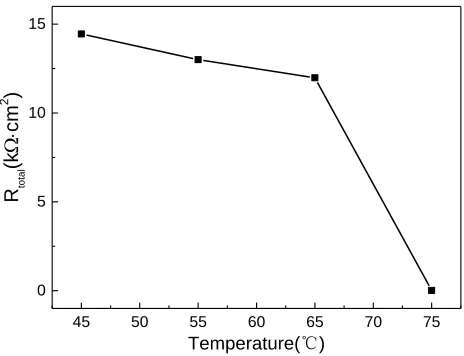
According to the literature [15], the CPT can be considered as the temperature of Rtotal
decreasing sharply. Rtotal is calculated by the following equation:
(3)
As seen, the value of Rtotal is equal to Rp at temperature under the CPT. Fig. 7 shows the change
in the Rtotal values (calculated from the data in Table 2) at different temperatures for S32707 in 3.5
[image:7.596.172.427.245.324.2] [image:7.596.64.534.436.561.2]
45 50 55 60 65 70 75
0 5 10 15
Rto
ta
l
(k
cm
2 )
Temperature(℃)
Figure 7. Variation of total resistance (Rtotal) values vs. temperature for S32707 in 3.5 wt.% NaCl
solution.
As seen, the sharp decrease occurred at temperature from 65 to 75 °C and the decrease in breakdown potential begins at about 65 °C. So the determined CPT value for S32707 in 3.5 wt.% NaCl solution is between 65 and 75 °C. Considering the results obtained via other techniques, i.e. potentiostatic and potentiodynamic polarization methods, it can be seen that the results acquired by EIS method show close correlation with results of the other two techniques.
3.4 CPT measurement by electrochemical noise method
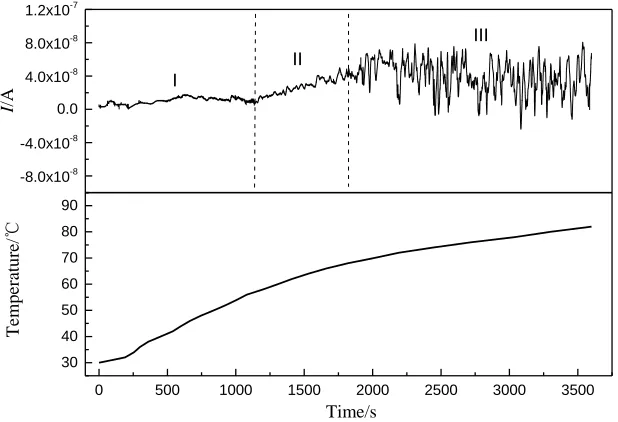
[image:8.596.183.415.68.246.2]
-8.0x10⁻⁸ -4.0x10⁻⁸ 0.0 4.0x10⁻⁸ 8.0x10⁻⁸ 1.2x10⁻⁷
0 500 1000 1500 2000 2500 3000 3500
30 40 50 60 70 80 90
I
/A
I
II
III
Temperature/
℃
Time/s
Figure 8. Effect of temperature scanning on the current noise response of S32707 in 3.5 wt.% NaCl solution.
3.5 Pit observation
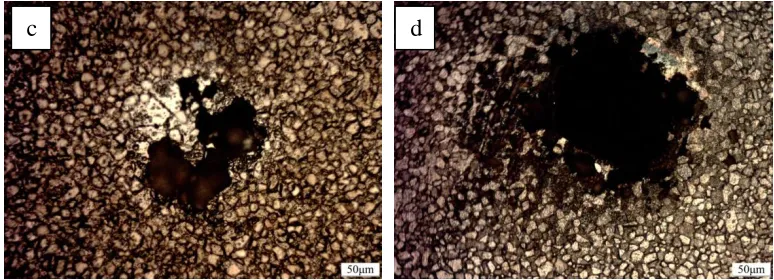
Fig. 9 reveals the optical microscope surface morphologies of super duplex stainless steel S32707 in 3.5 wt.% NaCl after applying an anodic potential of 750 mV(SCE) in a potentiostatic polarization experiment. As it can be seen in Fig. 9a and b, no pit appears on specimen surface when the temperature is below the CPT. As the temperature is up to 65 °C, a few stable pits can be observed clearly (see Fig. 9c), and these pits grew up gradually with increasing temperature (see Fig. 9d). The images illustrate that the CPT value of S32707 in 3.5 wt.% NaCl is between 55 and 65 °C. Meng[27] reported that the chemical adsorption of Cl- on the outer surface of passive film is favored by increasing temperature and thus promotes the breakdown of passive film. Eventually, it leads to the decrease of breakdown potential and formation of stable pits. The OM characterization result agrees well with that of the electrochemical measurements.
[image:9.596.145.454.72.283.2] [image:9.596.105.492.576.719.2]
Figure 9. Optical microscope surface morphologies of S32707 in 3.5 wt.% NaCl solution after applying an anodic potential of 750 mV(SCE) at (a) 45 °C (b) 55 °C (c) 65 °C and (d) 75 °C.
4. CONCLUSIONS
In this research, the CPT of super duplex stainless steel S32707 in 3.5 wt.% NaCl solution has been investigated by means of the potentiodynamic, potentiostatic, EIS and electrochemical noise measurement techniques. The results could be summarized as follows:
1. The measured CPT value of S32707 by potentiodynamic polarization method is between 55 and 65 °C, and the CPT obtained via potentiostatic polarization method is 64 °C.
2. The CPT value of S32707 measured by EIS method is between 65 and 75 °C. At this temperature range, pitting corrosion occurs and the charge transfer resistance decreases significantly.
3. Electrochemical noise result illustrated that the CPT value of S32707 is between 58 and 65 °C. It shows good agreement with the results that were obtained by potentiostatic, potentiodynamic polarization and EIS methods indicating the good universality and precision of this criterion.
ACKNOWLEDGEMENTS
The authors acknowledge the financial support of the National Key Technology Research and Development Program of the Ministry of Science and Technology of China (No. 2015BAE03B03) and National Nature Science Foundation of China (No. 21506256).
References
1. S. S. M. Tavares, J. M. Pardal, E. Ponzio, A. Loureiro and J. A. de Souza, Mater. Corros., 4 (2010) 313.
2. A. Eghlimi, M. Shamanian, K. Raeissi, Surf. Coat. Technol., 244 (2014) 45. 3. A.M. Elhoud, N.C. Renton, W.F. Deans, Int. J. Hydrogen Energ., 12 (2010) 6455. 4. R.J. Brigham, E.W. Tozer, Corros., 29 (1973) 33.
5. R.J. Brigham, E.W. Tozer, Corros., 30 (1974) 161.
6. G.T. Burstein, P.C. Pistorius and S.P. Mattin, Corros. Sci., 35 (1993) 57.
7. T. Zhang, D.Y. Wang, Y.W. Shao, G. Z. Meng, F. H. Wang, Corros. Sci., 58 (2012) 202.
8. L. Pezzato, M. Lago, K. Brunelli, M. Breda, E. Piva and I. Calliari, Mater. Sci. Forum, 879 (2017) 1495.
[image:10.596.104.491.70.210.2]
9. H. Tan, Y. Jiang, B. Deng, T. Sun, J. L. Xu and J. Li, Mater. Charact., 9 (2009) 1049. 10.K. Göransson, M.L. Nyman, M. Holmquist, Revue de Métallurgie, 9 (2007) 411. 11.R. Qvarfort, Corros. Sci., 28 (1988) 135.
12.R. Qvarfort, Corros. Sci., 29 (1989) 987.
13.B. Deng, Y. Jiang, J. Gong, C. Zhong, J. Gao and J. Li, Electrochim. Acta, 53 (2008) 5220. 14.EAAE Meguid, AAAE Latif, Corros. Sci., 49 (2007) 263.
15.N. Ebrahimi, M. Momeni, A. Kosari, M. Zakeri and M.H. Moayed, Corros. Sci., 59 (2012) 96. 16.M. Hoseinpoor, M. Momeni, M.H. Moayed and A. Davoodi, Corros. Sci., 80 (2014) 197.
17.D.K. Xu, E.Z. Zhou, Y. Zhao, H.B. Li, Z.Y. Liu, D.W. Zhang, C.G. Yang, H. Lin, X.G. Li and K. Yang, J. Meter. Sci. Technol., In press (2017).
18.V. Salinas-Bravo, R. Newman, Corros. Sci., 36 (1994) 67.
19.Y. Zhao, E.Z. Zhou; Y. Z. Liu, S.J. Liao, Z. Li, D. K. Xu, T. Zhang and T. Y. Gu, Corros. Sci., 126 (2017) 142.
20.N. Ebrahimi, M. Moayed, A. Davoodi, Corros. Sci., 53 (2011) 1278.
21.M. Iannuzzi, C. Mendez, L. Avila-Gray, G. Maio and H. Rincón, Corros., 66 (2010) 0450031. 22.K. Wang, J.H. Wang, W.B. Hu, Mater. Design, 82 (2015) 155.
23.J. R. Davis (Ed.), ASM Speciality Handbook Stainless Steels, American Society for Metals, Metals Park, Ohio 1994.
24.G.T. Burstein, B.T. Daymond, Corros. Sci., 51 (2009) 2249.
25.N.S. Ayati, S. Khandandel, M. Momeni, M.H. Moayed, A. Davoodi and M. Rahimizadeh, Mater. Chem. Phys. 126 (2011) 873.
26.C. N. Cao, X. Y. Chang, H. C. Lin, J. Chin. Soc. Corros. Prot., (1989) 21.
27.G. Z. Meng, Y. Li, Y.W. Shao, T. Zhang, Y.Q. Wang and F. H. Wang, J. Mater. Sci. Technol., 3(2014) 253.