Elli Siapkidou
University of Athens
Information and voting behaviour in European referendums: A missing link?
Abstract
In recent years an increasing number of European governments have decided to hold referendums on European issues. Whether it is the Treaty of Nice, participation in EMU, the European Constitution or the Treaty of Lisbon, whether the referendum is legally required (e.g. Ireland) or government induced (e.g. France), the number of European referendums has increased. This increase has been accompanied, more often than not, by negative outcomes. Starting with the Danish rejection of the Treaty on the European Union (TEU) in 1992, there has been an increase in negative outcomes in European referendums. These negative outcomes, along with fall in public support (see Eurobarometers) and the rise of Eurosceptic parties across Europe have brought public opinion to the centre of the political and academic debate, casting doubts about the resilience of the citizens’ “permissive consensus”. Whether it has become a “constraining dissensus” or not, the fact remains that there is a gap between Europe and its citizens and it seems to be widening.
I. Introduction
Referendums are the most direct way by which people can influence a political process.1 A referendum can be defined as a direct popular vote to approve or reject a proposed or existing governmental policy or institution.2 Recently, referendums, and European referendums in particular, have attracted increased attention in the scholarly community. Some scholars focus on the general institutional, political and legal context in which a referendum is decided and in which the campaigns are run. Most authors highlight the distinction between legally required referendums and referendums called by governments. Several scholars have linked the institutional context of a referendum with voting behaviour. For example, Suksi (1993) classified referendums according to whether or not the outcome of the popular vote is binding and stressed that when the referendum is binding, the citizens effectively have the last word in a ratification procedure.3 Schneider and Weitsman (1996) suggest that punishment strategies of voters are of central importance in referendums.4 The authors argue that voters may have to choose between accepting an agreement on the basis of its merit and risk rewarding a government that has not successfully managed domestic politics, or rejecting the treaty, thereby punishing a popular government that negotiated and supported ratification of the agreement. Similarly, Hug and Sciarini (2000) develop a theoretical argument on how voting behaviour is influenced by institutional factors, like whether a referendum is constitutionally necessary or non-required and non-binding. In the second case, it is more probable government supporters will vote mainly on the issue at hand, and less as a “vote of confidence” for the government.5
1 This paper uses “referendums” as the plural form of referendum, as recommended by the editors of the
Oxford English Dictionary: ‘In terms of its Latin origin, referendums is logically preferable as a modern plural form meaning ballots on one issue (as Latin gerund referendum has no plural); the Latin plural gerundive referenda, meaning “things to be referred”, necessarily connotes a plurality of issues’.
2 Ranney A. (ed) (1981)
The referendum device, London: American Enterprise Institute for Public Policy Research, p.xi
3 Suksi M. (1993)
Bringing in the people: A comparison of constitutional forms and practices of the referendum, Dordtrecht, the Netherlands: Martinus Nijhoff
4 Schneider G. and Weitsman P.A. (1996) “The punishment trap: Integration referendums as popularity
contests”, Comparative Political Studies, vol.28, no.4, pp.582-607
5 Hug S. and Sciarini P. (2000) “Referendums on European integration: Do institutions matter in the voter’s
Other scholars have focused on the interplay between domestic politics and a government’s decision to hold a referendum. For instance, King (1991) highlighted that a government might use a referendum to strengthen its own position (plebiscite), or in order to legitimize a given proposal.6 Bogdanor (1994) stressed the importance of the person or institution in triggering the decision to call a referendum, highlighting that “where the power to call a referendum lies in the hands of government, it is likely to prove a tactical weapon in strengthening its powers”.7 In this context, González (2006) examined the motivations behind the decisions of ten member state governments to hold a referendum on the Constitutional Treaty (CT), and argued that political actors used the possibility to hold referendums about European matters in a strategic way to strengthen their positions in a the domestic context, rather than to correct the democratic deficit of the EU, i.e. in an attempt to give legitimacy to the decisions of the EU.8
Since the beginning of the 1990s there is a tendency of national governments to resort to referendums, either as way of resolving a matter of domestic debate (e.g. to join or not the euro) or as way of ratifying EU treaties. Nonetheless, there is a debate on the use of referendums on European issues. Some argue that European issues are inherently too complicated to be simplified to a “yes or no” question. Referendums on Europe oversimplify texts, which are effectively compromises between different national positions, and are often difficult for the expert to comprehend, let alone the average citizen. On the contrary, those in favour of European referendums claim that, as they are high visibility events, they provide an opportunity to draw the attention of citizens on Europe, and make political parties articulate more coherent arguments regarding European integration. Furthermore, many academics view referendums as a way to reduce the EU’s democratic deficit.9 Resorting to direct democracy is viewed by some as
6 King A. (1991) “Referendums and the European Community” in Ranney A. (ed.)
The referendum device, Washington DC: American Enterprise Institute pp.113-122
7 Bogdanor V. (1994) “Western Europe” in Butler D. and Ranney A. (eds)
Referendums around the world, London: Macmillan, pp.24-97, p.31
8 González G.M. (2006) “Domestic politics and referendums on the Constitutional Treaty”,
EUI Working Paper, Robert Schuman Centre, 2006/32, Florence: European University Institute, p.13
9 Weiler J. (1997) “The European Union belongs to its citizens: Three immodest proposals”
a mechanism to counterbalance the limited democratic mechanisms in the EU. For instance, Habermas (2001) has argued in favour of European-wide referenda, which “would give citizens broader opportunities and more effective means to participate in the shaping of policies”.10
Finally, there are some who argue that referendums are a useful tool for democracy, provided there is a lengthy information campaign which will enable voters to comprehend all the aspects of the issue on which the referendum is conducted. Referendums strengthen democracy on the condition that there is sufficient time for a proper public debate and accurate information, through a vibrant public sphere.11 In this vein, for example, some have accused the Dutch government on running a very short campaign on the Dutch referendum in 2005 for the CT.
In any case, since the early 1990s, more and more referendums are conducted on European issues and European leaders have increasingly chosen this way of ratifying European treaties (as opposed to ratification through a parliamentary vote).
In some countries, like Ireland, referendums are required by law and are foreseen by the
national constitution on issues which affect the sovereignty of the country. As a result, Ireland has seen a total of seven referendums since its accession to the European Community: on the accession to the EEC in 1972, on the Single European Act in 1987, on the Treaty on the EU in 1992, on the Treaty of Amsterdam in 1998, two referendums on the Treaty of Nice - the outcome of the first referendum (2001) was negative and that of the second (2002) was positive - and one on the Treaty of Lisbon in 2008, which had a negative result.
order, Lanham: Rowmann and Littlefield, pp.115-38, Schmitter P. (2000) How to democratize the Euro-polity … and why bother?, Lanham: Rowmann and Littlefield
10 Habermas J. (2001) “Why Europe needs a Constitution”,
New Left Review, no.11, September / October, pp.5-26
11 E.g. J. Habermas, Nouvel Observateur, 7 May 2005, Fossum J.E. and Trenz H-J (2006) “When the
In other countries, like Denmark, there is a tradition of referendums on European
treaties. According to Article 20 of the Danish Constitution, any law that requires granting sovereignty should be subject to a referendum, if not approved by at least a majority of 5/6 of the Danish parliament. However, in 1971 all major parties agreed that even if the Accession Treaty to the EC received parliamentary approval, a referendum would be held. Thus a tradition began on holding referendums on European issues. Furthermore, as Buch and Hansen (2002) point out, Europe is a very divisive issue among Danish political parties and referendums are a way to separate domestic politics from European issues.12 Referendums in Denmark are held because of political reasons and not because of legal reasons. Six referendums have been held in Denmark: on the accession to the EEC in 1972, on the SEA in 1986, on the Treaty on the EU in 1992 and 1993 (the first referendum’s result was negative and the second’s positive), on the Treaty of Amsterdam in 1998 and on the adoption of the euro in 2000, which resulted in Denmark remaining outside the European and Monetary Union (EMU).
On the contrary, in Germany no referendum has ever been held as it expressly prohibited
by the Constitution. Also, no referendums on European issues have taken place in
Greece, Portugal and Belgium. In other countries, referendums have been held
occasionally, following a government decision.
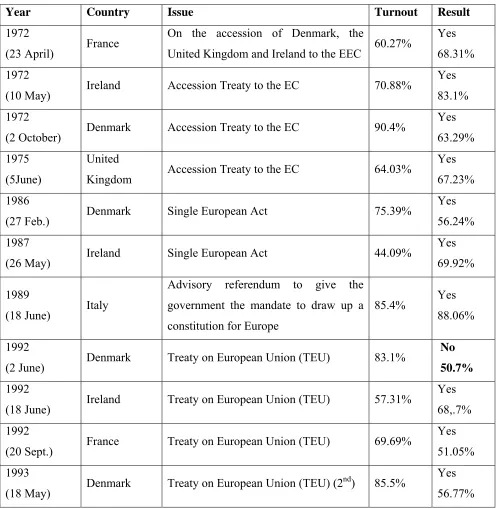
As shown in Table 1, four referendums on European issues were held in the 1970s: The issue was the accession of the United Kingdom, Denmark and Ireland to the EEC and the referendums were held in these three countries respectively, as well as in France. All of them had positive results.13
During the 1980s, three referendums took place. Two of them were held in Ireland and Denmark for the SEA. The third took place in Italy (the only Italian referendum on
12 Buch R. and Hansen K.M. (2002) “The Danes and Europe: From EC 1972 to Euro 2000 – Elections,
referendums and attitudes”, Scandinavian Political Studies, vol.25, no.1, pp.1-24, p.8, Lauring Knudsen A-C “Euroscepticism in Denmark” in Szczerbiak A. and Taggart P. (eds) (2008) Opposing Europe: The comparative party politics of Euroscepticism vol.1 – Case studies and country surveys, Oxford: Oxford University Press, p.155
13 In the 1970s, two more referendums were held, in Greenland and Norway on accession to the EEC,
European issues). The Italian referendum was consultative and the question was on providing the government with a mandate to draw up a constitution for Europe (in view of the Intergovernmental Conference on Economic and Monetary Union and Political Union). All referendums had positive results.
Table 1. Referendums on European issues – Results
Year Country Issue Turnout Result
1972
(23 April) France
On the accession of Denmark, the
United Kingdom and Ireland to the EEC 60.27%
Yes 68.31% 1972
(10 May) Ireland Accession Treaty to the EC 70.88%
Yes 83.1% 1972
(2 October) Denmark Accession Treaty to the EC 90.4%
Yes 63.29% 1975
(5June)
United
Kingdom Accession Treaty to the EC 64.03%
Yes 67.23% 1986
(27 Feb.) Denmark Single European Act 75.39%
Yes 56.24% 1987
(26 May) Ireland Single European Act 44.09%
Yes 69.92% 1989
(18 June) Italy
Advisory referendum to give the government the mandate to draw up a constitution for Europe
85.4% Yes 88.06% 1992
(2 June) Denmark Treaty on European Union (TEU) 83.1%
No
50.7%
1992
(18 June) Ireland Treaty on European Union (TEU) 57.31%
Yes 68,.7% 1992
(20 Sept.) France Treaty on European Union (TEU) 69.69%
Yes 51.05% 1993
(18 May) Denmark Treaty on European Union (TEU) (2
1993
(13 Nov.) Sweden Accession Treaty to the EU 83.32%
Yes 52.74% 1994
(12 June) Austria Accession Treaty to the EU 82.35%
Yes 66.58% 1994
(10 Oct.) Finland Accession Treaty to the EU 70.4%
Yes 56.88% 1998
(22 May) Ireland Treaty of Amsterdam 56.26%
Yes 61.74% 1998
(28 May) Denmark Treaty of Amsterdam 76.24%
Yes 55.1% 2000
(28 Sept.) Denmark Adoption of the euro 87.2%
No
53.21%
2001
(7 June) Ireland Treaty of Nice 34.79%
No
53.8%
2003
(14 Sept.) Sweden
Participation in EMU and adoption of
the euro 82.60%
No
56.15%
2002
(19 Oct.) Ireland Treaty of Nice (2
nd) 48.45% Yes
62.89% 2005
(20 Feb.) Spain Constitutional Treaty 42.32%
Yes 76.72% 2005
(29 May) France Constitutional Treaty 69.37%
No
54.67%
2005 (1 June)
The
Netherlands Constitutional Treaty 62.80%
No
61.54%
2005
(10 July) Luxembourg Constitutional Treaty 90.44%
Yes 56.52% 2008
(12 June) Ireland Treaty of Lisbon 53.1%
No
53.4%
The 1990s saw a total of nine referendums on European issues. The first three referendums were held in 1992 in Ireland, France and Denmark on the TEU. The results were positive in Ireland and France – although the positive outcome in the French referendum was quite thin (51.05% voted yes), the well-known “petit oui”. The outcome of the Danish referendum was negative (50.7% voted “no” with 83.1% turnout) and the second referendum (after the Danish opt-outs on defense policy, justice and home affairs, the euro and union citizenship were secured by the Edinburgh agreement) was held a year later (1993) and resulted in a yes. Furthermore, referendums were held in Sweden (1993), Austria and Finland (1994) for accession to the EU, with positive outcomes and high turnout. Finally, two referendums took place in Ireland and Denmark on the Treaty of Amsterdam (1998). Both had positive outcomes.
From 2000 onwards, nine referendums have taken place in the EU-15. The Danish referendum in 2000 for the adoption of the euro had a negative outcome (53.21% voted against joining EMU with a turnout of 87.2%). A year later, the Irish rejected the Nice Treaty (53.8% voted “no”), but with a very low turnout (34.79%), while a few months later the majority of Swedes (56.15%) rejected participation in EMU, with a turnout in of 82.60%. The second Irish referendum on the Treaty of Nice in 2002, where there was a higher turnout (48.45%), resulted in a yes (62.89% voted in favour).
held on 12 June 2008 in Ireland on the Treaty of Lisbon. The result was negative (53.4% against) and the turnout was 53.1% of eligible voters.
It should be noted that in 2003, another nine referendums took place in the 2004 enlargement countries in view of their accession to the EU. All the referendums had positive outcomes, with varied levels of turnout.14
The first conclusion to be drawn is that as the number of European referendums has increased, so have the objections of the European citizens, or at least of some of them. The question which follows is “Have we reached the limits of the citizens’ ‘permissive consensus?’” According to Lindberg and Scheingold (1970) the positive indicators in public opinion constituted a permissive consensus, and they suggested that “policy makers can probably move in an integrative direction without significant opposition, since this permissive consensus would tend to reduce the chances that opposing elites could mount an effective counterattack”. Despite the fact that it is not necessarily the opposing elites that mount the counterattack, it seems that quite often when governments proceed towards an integrative direction, citizens oppose. Are citizens against further integration? Should the negative outcomes of European referendums be viewed as an indicator of growing public disaffection with European integration, questioning the legitimacy of the whole project or as “anomalies” in the European integration process, caused by circumstantial factors like bad information campaigns, poor party performance or bad timing (e.g. they coincide with bad economic conditions)?
The answer to this question is directly related to the debate of whether European referendums mirror citizens’ attitudes towards European integration or they are influenced by national political factors, such as e.g. the government’s performance. Given the two levels of governance and politics in the European system of governance
14 In particular, the results were as follows: Czech Republic 77.33% in favour, turnout 55.18%, Estonia
66.83% in favour, turnout 64.06%, Hungary 83.76% in favour, turnout 45.59%, Latvia 67.5% in favour, turnout 71.5%, Lithuania 91,07% in favour, turnout 63.37%, Malta 53.65% in favour, turnout 90.91%, Poland 77.45% in favour, turnout 58.85%, Slovakia 93.71% in favour, turnout 52.15%, Slovenia 89.64% in favour, turnout 60.41%,. Source: Election Guide, International Foundation for Elections Systems (IFES), www.electionguide.org, Elections and referendums in Europe – Civic Active,
(national and European) and the fact that referendums take place within the national political context, it is expected that referendums are influenced by the national political environment. However, to which degree do national politics influence voting behaviour in European referendums and to which do they reflect citizens’ affection or disaffection with Europe? Are the outcomes of European referendums’ determined by voters’ attitudes towards Europe or the national political context?
Some have argued that EU attitudes are irrelevant as far as the referendum outcome is concerned, since EU referendums can be regarded as ‘second-order elections’ where only national issues, such as the government’s performance, influence voting behaviour.15 In particular, Franklin and his colleagues examined the referendums on the TEU in Denmark, France and Ireland and argued that voting behaviour on European referendums has similar traits of that in European elections, in that it is influenced by the parties’ political standing and government popularity.16 The argument is that, as parties find it difficult to mobilize their supporters in European referendums, they leave much of the responsibility to governments. So if the government is unpopular, the unpopularity translates into votes against the object of the referendum.17 Thus, referendums on European matters should be viewed in the same way: not so much in terms of the European content that is the overt subject of the referendum, but in terms of the domestic standing of the governments that is asking for support.18
15 According to Reif and Schmitt (1980), European elections should be best understood as ‘second-order’
elections (e.g. local and regional elections), in that voting behaviour is coloured by the political setting and the standing of political parties for the next national elections (‘first-order’ elections). As voters, parties and the media view ‘second-order’ elections as national party contests, turnout will tend to be lower than in national elections and there will be increased protest voting and voter-switching. Reif K. and Schmitt H. (1980) “Nine second-order national elections – a conceptual framework for the analysis of the European elections results”, European Journal of Political Research, vol.8, pp.3-44
16 Franklin M.N., Marsh M. and McLaren L. (1994) “Uncorking the bottle: Popular opposition to European
unification in the wake of Maastricht”, Journal of Common Market Studies, vol.32, no.4, Franklin M., Marsh M. and Wlezien C. (1994) “Attitudes toward Europe and referendum votes: A response to Siune and Svensson”, Electoral Studies, vol.13, no.2, pp.117-121, Franklin M.N., Van der Eijk C. and Marsh M. (1995) “Referendum outcomes and trust in government: Public support for Europe in the wake of Maastricht”, West European Politics, vol.18, no.3
17 Franklin, Marsh and Wlezien (1994)
Electoral Studies, p.118, Franklin, van der Eijk and Marsh (1995) West European Politics, p.101
18 Franklin, Marsh and McLaren (1994)
Similarly, Franck (2005) examines the French referendum on the CT in 2005 and suggests that the reasons why the French voted “no” were less related to the content of the Treaty itself and more to economic and political concerns regarding their country.19 According to Jérôme and Vaillant (2005), the French rejection resulted from the fear of loss of national identity as a result of the European integration process and the voters’ sanction of the French government’s record.20
However, others have argued that voting behaviour in European referendums reflects people’s underlying broad attitudes towards Europe. This attitude-approach therefore suggests that it is primarily voters’ attitudes towards European integration that drive voting in referendums. Regarding the French referendum on TEU, Ysmal (1993) claimed that the outcome of the French referendum on Maastricht in 1992 was linked to voters’ European preferences.21 Similarly, Suine and Svensson (1993) claimed that the outcome of the Danish referendum on the TEU in 1992 was the result of the Danish voters’ predispositions towards Europe. The authors also stressed that “a large number of people turned against the advice of their party at the referendum”.22 Regarding the positive outcome of the second Danish referendum in 1993, Siune, Svensson and Tonsgaard (1994) argued that voting behaviour of the Danes both in 1992 and in 1993 was very consistent with their attitudes towards European integration.23 However, in the second referendum, their fear of losing national sovereignty was reduced as the Economic Monetary Union and the Single Currency were taken off the agenda by the Edinburgh Agreement.24 Similarly, Svensson (2002), claims that although other matters like the way the campaigns are run play an important role, the “results of Danish referendums on
19 Franck Ρ. (2005) “Why did a majority of French voters reject the European Constitution?”,
European Journal of Political Economy, vol.21, no. 4, pp.1071-1076, p.1072
20 Jérôme B. and Vaillant N.G. (2005) “The French rejection of the European constitution: An empirical
analysis”, European Journal of Political Economy, vol. 21, no.4, pp. 1085–1092, p.1085-6
21 Ysmal C. (1993) “France”,
European Journal of Political Research, vol.24, no.4, pp.425-434, p.431
22 Siune K. and Svensson P. (1993) “The Danes and the Maastricht Treaty: The Danish EC Referendum of
June 1992”, Electoral Studies, vol.12, no.2, pp.99-111, p.102-3
23 Siune K., Svensson P. and Tonsgaard O. (1994) “The European Union: The Danes Said ‘No’ in 1992 but
‘Yes’ in 1993: How and why?”, Electoral Studies, vol.31, no.2, pp.107-116, p.115
24 Siune K., Svensson P. and Tonsgaard O. (1994) “The European Union: The Danes Said ‘No’ in 1992 but
European integration express more than merely the popularity of the government calling the referendum”.25
Examining the two Irish referendums on the Nice Treaty, Garry, Marsh and Sinnott (2005) found that the issue-voting model outperforms the second-order model in both referendums. Their analysis suggests that although the effect of satisfaction/ dissatisfaction with the incumbent government (i.e. the second-order effect) is detectable, it played a much smaller role in determining the outcome compared with the effect of attitudes to a range of European issues.26 They also concluded that the first Nice Treaty referendum campaign was a classic case of an ineffective campaign, with low levels of citizen interest in, and knowledge of, the treaty.27
Finally, Hobolt (2003) argued that the relative importance of EU attitudes and national factors is determined by a significant element in the national political context, namely the level of EU salience.28 She tested these propositions by analyzing the level of EU salience and EU attitude stability in Ireland and Denmark and suggested that the importance of European attitudes varies according to the national political context.29
II. Methodology
Within this debate and in light of the increasing number of European referendums, it would be useful to have a better understanding of European citizens’ voting behaviour. What determines Europeans’ vote in referendums? What are the reasons for voting “yes” or “no” in a European referendum? Are those voting “no”, against further integration?
25 Svensson P. (2002) “Five Danish referendums on the European Community and European Union: A
critical assessment of the Franklin thesis”, European Journal of Political Research, vol.41, no.6, p.747
26 Garry J., Marsh M. and Sinnott R. (2005) “’Second-order’ versus ‘issue-voting’ effects in EU
referendums”, European Union Politics, vol.6, no.2, pp.201-221, p.215
27 Garry J., Marsh M. and Sinnott R. (2005) “’Second-order’ versus ‘issue-voting’ effects in EU
referendums”, European Union Politics, vol.6, no.2, pp.201-221, p.216
28 Hobolt S.B. (2003) “Europe and the ballot: Voting behaviour in referendums on European integration”,
Paper presented at the 2nd Conference of the European Consortium for Political Research (ECPR), Marburg, Germany, 18-21 September 2003, p.2
29 Hobolt S.B. (2003) “Europe and the ballot: Voting behaviour in referendums on European integration”,
Furthermore, why do some Europeans go and vote and others don’t? What are the reasons for abstention?
In the next two sections, we will attempt to answer some of these questions, based on the Eurobarometers published by the European Commission. The data used here are the five post-referendum Eurobarometer surveys which were conducted after the referendums in France, the Netherlands, Spain and Luxembourg for the Constitutional Treaty (2005) and the one held in Ireland on the Treaty of Lisbon (2008).30
We will focus on a set of four questions which allows us to grasp voting behaviour. The first question examines the “why” behind the vote, i.e. the reasons why people voted as they did, as these are provided by voters themselves. In particular, the respondents are asked to give all the reasons why they voted yes or no (What are all the reasons why you voted “Yes” / no at the referendum on the European Constitution?”). They answer spontaneously and the interviewers code the answers into several categories (e.g. The respondent voted “no” because of fear of rise of unemployment in his country / because the economic situation in his country is weak). The results of this methodology are more reliable, compared to other methods, where the respondent is asked to choose between several answers, or where he/she simply replies whether she agrees or not with a specific statement. As this question was not included in the survey on the Spanish referendum, the results presented here are from the surveys in France, the Netherlands, and Luxembourg on the CT and Ireland on the Treaty of Lisbon.31
The second question considers the “how” of the voting decision, i.e. the mechanism by which the voting decision was made. What were the criteria used for voting? Were they
30 Flash Eurobarometer No.171, “The European Constitution: Post-referendum survey in France”, June
2005, European Commission, Flash Eurobarometer No.172, “The European Constitution: Post-referendum survey in the Netherlands”, June 2005, European Commission, Flash Eurobarometer No.245, “Post-referendum survey in Ireland”, July 2008, European Commission, Flash Eurobarometer No.173, “The European Constitution: Post-referendum survey in Luxembourg”, July 2005, European Commission
31 Flash Eurobarometer No.171, “The European Constitution: Post-referendum survey in France”, June
European or national concerns that guided the vote? The survey’s question is “Could you tell me what was the key element that led to your vote in this Referendum?” and the interviewees are presented with a list of answers, from which they choose one.32 The list includes answers like e.g. your opinion on the EU, your opinion on the social and economic situation in your country etc. In this way, an assessment can be made about whether the voters’ decision was based on national or European criteria. This question is helpful in order to assess the degree to which voters’ decisions were influenced by the position of their government or their political party affiliation and allows for an indirect test to the “second-order” election hypotheses. It is noted that this question was not included in the survey on the Irish referendum, so the results presented here focus on Spain, France, Netherlands and Luxembourg.
The third question is about the “when” of the voting decision, i.e. the timing. The survey’s question is phrased “Can you tell me roughly when did you make up your mind how you would vote in the Referendum on the European Constitution?”. The respondents are presented with a list of answers, of which they choose one.33 This question allows for an assessment of voters’ stability of opinion regarding their decision. Did they decide early on, or was their vote influenced by the campaign?
The last question addresses the issue of abstention. The question used in the survey is: “If you did not go to vote in the Referendum, is it because … ?”. Respondents are presented with a list of answers with which they are asked to agree or disagree. This question sheds some light on why voters abstain. As such, it can provide some insights regarding voting behaviour and abstention in European electoral procedures.
32 The answers include: - Your opinion on the European Constitution - Your overall opinion regarding the
European Union - Your opinion of those who led the "YES" campaign - Your opinion of those who led the "NO" campaign - Your opinion on the economic and social situation in France / Netherlands / LUX. The last sentence was not included in the Spanish survey.
33 The answers include: - At the time the Referendum was announced - At the beginning of the campaign /
III. Results
1. Why “yes” and why “no”
At first, we will examine voting behaviour in terms of positive and negative voting. The following section presents the findings from the referendums in France, the Netherlands and Luxembourg and on the Constitutional Treaty (CT) and Ireland on the Lisbon Treaty. This question was not included in the Spanish survey.
France
As far the motivations behind the French “yes” vote are concerned, the most common answer was that the CT was seen as “essential in order to pursue the European construction”. This answer was given by 39% of the respondents. 25% of the respondents provided reasons which largely fell into the category “other” and unfortunately were not specified in the survey. “I’ve always been in favour of the European construction” was the reason mentioned by 16% of the interviewees who voted “yes”. 12% of the respondents justified their “yes” vote by saying that the Constitutional Treaty “strengthens the role of France within the EU / in the world”. 11% of the respondents voted “yes” because they thought the CT would “strengthen the EU over the United States” and 11% for “the future generations”. This sentence is not further clarified in the survey.34 Finally, only 8% cast a positive vote because the CT was seen as “First steps towards / a symbol of a political unification of Europe” and equally 8% because it would “strengthen France’s economic and social situation”.35
Regarding the “no” votes, the main consideration was the economic situation in France and in particular unemployment. 31% of the French respondents said they cast a negative vote because the CT would “have negative impact on the employment situation in
34 Flash Eurobarometer No.171, “The European Constitution: Post-referendum survey in France”, June
2005, European Commission
35 Flash Eurobarometer No.171, “The European Constitution: Post-referendum survey in France”, June
France”, and 26% because “the economic situation in France is too weak / there is too much unemployment”. The perception that “economically speaking, the draft is too liberal economically” was the reason provided by 19% of the respondents, while 18% mentioned that they voted “no” because they “were opposed to the President of the Republic/the national government/certain political parties”. In line with the social and economic concerns of the “no” voters, 16% claimed that “there was not enough social Europe” in the CT. Finally, the fact that the CT was “too complex” was mentioned by 12% of the respondents. It is interesting to note that “opposition to Turkey’s accession” or to “further enlargement” were not main considerations (mentioned only by 6% and 3% of the interviewees respectively). It should be noted that 21% of the “no” voters provided motivations which fell into the category “other”, which remains unspecified.
The objections of the French concerned social-economic issues relating to their
country, such as unemployment, fear of relocation of French enterprises and the
economic situation. It should be added that in the same survey, 88% of the respondents
considered France’s membership of the EU is a good thing.
The Netherlands
The reasons why the Dutch voted “yes” were similar to those of the French. 24% of the respondents voted “yes” because it was perceived as “essential in order to pursue the European construction” (just like 39% of the French). Some Dutch cast a positive vote because the Constitutional Treaty would “strengthen the feeling of a European identity” (13%), while others because it would “strengthen the role of the Netherlands within the Union/in the world” (13%). The CT was viewed as “essential for the smooth running of the European institutions” by 12% of the respondents, and the “first steps towards/ Symbol of a political unification of Europe” by another 10%. Finally, a few respondents voted “yes” because the CT would “strengthen the European Union over the United States” (10%) and because it would “strengthen the economic and employment situation/ the economic cooperation” (10%).36
36 Flash Eurobarometer No.172, “The European Constitution: Post-referendum survey in the Netherlands”,
The motivations behind the Dutch “no” vote were quite different from those of the French. When asked to mention all the reasons why they voted “no” at the referendum on the European Constitution, 32% of respondents mentioned “lack of information”. The fear of “loss of national sovereignty” was mentioned by 19% of the Dutch, and “opposition to the national government/ certain political parties answered” was the reason given by 14% of the respondents. 13% of the Dutch “no” voters gave the justification “Europe is too expensive”. Finally, only 8% replied “I am against Europe / European construction / European integration”.
In the Netherlands, the main reasons behind the negative vote were lack of
information and fear of loss of national sovereignty. It is noted that at the time of the
survey, 82% of Dutch felt the country's participation in the EU is a good thing.
Luxembourg
As far as Luxembourg is concerned, the main motivation behind the “yes” vote was that the CT was perceived as “essential in order to pursue the European construction”. This was mentioned by 39% of respondents, exactly the same percentage as in the French survey. “For peace in Europe” was the justification provided by 28% of the “yes” voters, while 23% mentioned that the CT would “strengthen Luxembourg’s role within the EU /in the world”. 18% of the respondents voted “yes” for the (largely unclear) “future generations”. Some justified their vote by saying that the CT would “strengthen the economic and social situation in Luxembourg” (16%) and others by viewing it as the “first steps / a symbol for social Europe” (16%). Some “yes” voters mentioned that they “had always been in favour of the European construction” (15%). Finally, 14% of the “yes” voters said that the CT would “strengthen the European identity”. The same percentage (14%) felt that the European constitution was “essential for the smooth running of European the institutions”.37 It should be noted that 25% of the “yes” voters provided answer that fell into the category “other”, the same percentage as with the French respondents.
37 Flash Eurobarometer No.173, “The European Constitution: Post-referendum survey in Luxembourg”,
The reasons for the “no” vote were primarily national, just like in France. 37% of the “no” voters thought the CT “would have negative effects on the employment situation Luxembourg/ relocation of enterprises” (in France this was 31%).38 The fact that “the economic situation in Luxembourg is too weak/ there is too much unemployment” was mentioned by 23% of the respondents and 22% felt that the CT would not sufficiently promote a “social Europe”. 20% of the respondents said they voted “no” because the “draft goes too far/advances too quickly”. Finally, “opposition to Turkey’s accession”, the complexity of the text (“too complex) and lack of information were mentioned equally by 17% of the respondents.39
Although the outcome of the referendum in Luxembourg was positive, the concerns of the citizens of Luxembourg coincide with those of French: unemployment,
relocation companies from the country abroad and concern for economic and social
conditions.
Ireland
Regarding the Irish, when asked to justify their “yes” vote in the referendum for the Lisbon Treaty, the most common answer was that “It was in the best interest of Ireland”. This was mentioned by 56.9% of the respondents. The second most popular motivation was “Ireland gets a lot of benefit from the European Union”, mentioned by 33.8%. 16.3% of the Irish replied that they voted in favour of the Lisbon Treaty because “It keeps Ireland fully engaged in Europe”, while the perception that it would “help the Irish economy” was mentioned by 14.9% of the Irish.40
Regarding the reasons for “no” voting, the most popular answer was lack of information. The response “Because I do not know enough about the treaty and would not want to vote for something I am not familiar with” was given by 34.7% of the respondents. 19.5% of the Irish said they voted “no” to “protect the Irish identity”. “To safeguard Irish neutrality in security and defence matters” and “I do not trust politicians” was equally mentioned by
38 The same percentage (37%) mentioned reasons which were coded as “other”.
39 Flash Eurobarometer No.173, “The European Constitution: Post-referendum survey in Luxembourg”,
July 2005, European Commission
10.3% of the respondents.41 Finally, 9.4% of the respondents said they voted “no” because [Ireland] “will lose our right to have an Irish Commissioner in every Commission”.42
In Ireland, therefore, the main reasons behind the negative vote was the lack of
information, while the fear of loss of national identity / Irish specificity on social
issues (abortion, gay marriages, etc.) and security and defense also played a part. It
should also be noted that according to the same survey, 87% of Irish people support the participation of their country in the EU.
So, the objections of the French, Dutch and Irish were not about European integration in general. In all three countries, the majority of respondents were in favour of their country’s participation in the EU country which implies that we have not reached the limits of the “permissive consensus”. Citizens were not necessarily opposed to a further integration (which would lead us to the conclusion that at least for some Europeans, the limits of “permissive consensus” have been reached). Instead, the objections of citizens concerned specific issues: For the French, it was unemployment, the economic situation and the fear of French companies being relocated outside France with the consequent decrease in employment. The same issues concerned citizens of Luxembourg, despite the fact that the referendum had a positive outcome. For the Dutch, the reason behind the negative votes was lack of information, combined with concern about the loss of national sovereignty. Similarly, lack of information was the primary reason behind the Irish no, as well as fear of loss of national sovereignty.
Both in the Netherlands and in Ireland and to a smaller degree in France, the lack of information or, more accurately, the subjective assessment of lack of information played a key role in voting “no”.
In all three countries where the results were negative (France, Netherlands, Ireland), general support for European integration and a sense that participation in the EU is something positive for their country was enough for “yes” voters. Instead, for citizens who cast a negative vote, concerns about issues affecting their country played a bigger role than their general pro-European predisposition. The vote of the citizens seem to have a national and European dimension, with the national dimension prevailing in the “no” voters and the European in the “yes” votes. This, however, is not the case for Ireland where both the negative and positive vote were motivated by national concerns.
2. The “how”
In this section, there will be an examination of the mechanism of the decision-making. Did the voters decide based on national or European preoccupations? This was the question “Could you tell me what was the key element that led to your vote in this Referendum?” and respondents were permitted to choose only one answer.
As far as the Spanish are concerned, the vote was guided by European preoccupations for the majority of the respondents (59%). 26% said the key element that led to their vote in this Referendum was their opinion on the European Constitution and 33% their overall opinion regarding the EU. 15% mentioned that it was their opinion of those who led the “yes” campaign. Only 1% voted as they did because it would be “a good thing for Spain”. It should be noted that this percentage of “European” considerations that led the vote rises to 66% for the “yes” voters and falls to 41% in the “no” voters.43
In France, again a large part of the voters seem to have decided how to vote based on European criteria (50%). 18% voted according to their opinion of the European Constitution and 32% on their opinion of the EU. The same percentage (32%) decided how to vote based on their opinion of the economic and social situation in France (this statement was not available in the Spanish survey). It should be noted that amongst the French “yes” voters, 68% of them voted based on European criteria, i.e. the decision was
43 The statement “your opinion on the economic and social situation in Spain” was not included in the
mostly “European” and only 11% based on the economic and social situation in France. Conversely, 47% of the “no” voters decided based on the economic and social situation in France and only 37% based on their “European” opinion (either on the European Constitution, 20% or the EU, 17%).
Table 2: Factor determining the vote
Key element that led to vote
Spain France
The
Netherlands Luxembourg Your opinion on the European
Constitution 26 18 18 22
Your overall opinion regarding the
European Union 33 32 31 35
Your opinion of those who led the
"YES" campaign 15 7 11 10
Your opinion of those who led the
"NO" campaign 4 4 6 5
It's my duty as citizen 3 It's my right as citizen 1 It is a good thing for Spain 1 Your opinion on the economic and social situation in France /NL /LUX (FR/NL /LUX
only) 32 21 24
Other 7 5 8 2
DK / NA 8 3 3 2
In Luxembourg, 62% of the “yes” voters voted “European” (13% by their opinion on the Constitution and 49% by their opinion on the EU) and only 21% on their opinion of the economic and social situation in Luxembourg. However, 30% of the “no” votes were based on national considerations and 52% on European.
In France, the Netherlands and Luxembourg, there is an association between the “Europeaness” of the vote and the vote itself. For the voters who are pro-European, the general idea that European integration is a positive process and their country’s participation in the EU is a good thing seems enough to make them cast a positive vote. However, for some national considerations prevail over their pro- European disposition. This is particularly evident in France. 52% of the French “yes” decided based on their “overall opinion regarding the European Union” and 16% on their “opinion on the European Constitution”. Only 11% of those chose the sentence “Your opinion on the economic and social situation in France”. On the contrary, among the “no” voters this number reaches 47%.
Two points need attention. First, it should be noted that although the vote has a European dimension, it is based on an overall impression and opinion on Europe not on the actual text of the CT. Second, it should be noted that although this particular question was not included in the Irish survey, one can tell a significant difference from analyzing the previous question “What are the reasons why you voted yes/no”. As was mentioned, the most popular answer behind the “yes” vote was that the Lisbon Treaty was perceived to be “in the best interest of Ireland” (56.9%) followed by “Ireland gets a lot of benefit from the European Union” (33.8%). It is interesting to note that although for the French, the Dutch and the Luxembourgian the “yes” vote was mainly European and “no” national, in the case of Ireland, both the “yes” and the “no” vote were nationally motivated.
Regarding the timing of the voting decision, respondents were asked “Can you tell me roughly when did you make up your mind how you would vote in the Referendum on the European Constitution?” and had to choose one answer from a list. The list included the following answers: At the time the Referendum was announced; At the beginning of the campaign / Fairly early on during the Referendum campaign; After French and Dutch referendums’ results (LUX only); Only in the last weeks / In the final weeks of the campaign; The week before the Referendum; On the day of the Referendum itself; Don’t know/ No answer.
Table 3. Timing of the decision
SP FR NL LUX IRE
At the time the Referendum was
announced 35 29 26 29 10.3
Fairly early on during the Referendum campaign / At the beginning of the campaign (IRE
only) 23 29 21 22 18.7
After French and Dutch referendums’
results (LUX only) 4
Only in the last weeks (IRE only) 55.4
In the final weeks of the campaign 16 20 20 23 The week before the Referendum 15 14 21 17
On the day of the Referendum itself 10 7 11 6 15.2
DK/ NA 2 1 0 0 0.4
and 22% of the Luxembourgian decided how to vote “fairly early on during the Referendum campaign”.
16% of the Spanish, 20% of the French and the Dutch and 23% of the Luxembourgian decided in the final weeks of the campaign and 15% of the Spanish, 14 of the French, 21% of the Dutch and 17% of the Luxembourgian decided the week before the Referendum.
On the contrary, 55.4% of the Irish said they decided how to vote “only in the last weeks”. Some of them had decided early on (10.3% at the time the referendum was announced and 18.7% at the beginning of the campaign). 15.2% of the Irish decided on the day of the referendum itself. This finding confirms earlier finding about the relative instability of the Irish European predispositions.44
In the Spanish, French, Dutch and Luxembourgian referendums voters made up their mind quite early on. This is not the case for the referendum in Ireland, where voters decided quite late in the campaign. This is important in two ways: First, it shows that the French and the Dutch “no”s are different both in “weight” and seriousness that than of the Irish. Second, it shows that in Ireland the campaign played an important role in determining the outcome of the referendum.
4. Participation
This section will focus on the reasons for abstention. In particular, we will consider the answers given by respondents in the referendums in France, the Netherlands, Spain and Ireland (in Luxembourg attendance is mandatory).
France
There were many reasons why French citizens abstained, ranging from personal circumstances which prevented voters from turning out, a lack of interest in politics in
44 Hobolt S.B. (2003) “Europe and the ballot: Voting behaviour in referendums on European integration”,
general or European affairs. The most popular answer provided by the French for not going to vote was that they were “held up that day”.45 Unfortunately, this is a totally subjective response from which no definite conclusions can be drawn. Essentially it is not possible to know whether the respondent intended to vote but was prevented because of circumstance, or some other activity was considered more important than voting in the referendum.
From the rest of the answers, it is clear that abstention is associated with the (subjective) sense of being badly informed coupled with the perception that the text of the CT was complicated. The next most popular reasons are related to the voters’ perception of lack of information. In particular, 60% of the respondents said that they thought “the text was too complicated”, while 49% believed that they “were not sufficiently informed on the Constitution to go vote”. 30% of the French abstained because they “believed that voting at the referendum would not change anything” while 29% said they are “not interested in politics, by elections in general”. Finally, 27% of the respondents abstained because they “wished to penalize the Government (the president of the Republic for France)”.46
Netherlands
As far as the Dutch are concerned, when asked why they abstained, the most popular answer was that they believed that they “were not sufficiently informed on the Constitution to go vote” (51%).47 41% of the respondents claimed that “something prevented me from voting”. 26% abstained because they thought “the text was too complicated” and another 26% said they believed that “voting at the referendum would not change anything”. 24% of the Dutch did not vote because they were “not interested in politics, by elections in general” and 23% because they “are not interested in the European Constitution”. The same percentage (23%) claimed “It was not worth to vote because it was clear that the ‘no’ would win in any case”.48
45 Flash Eurobarometer No.171, “The European Constitution: Post-referendum survey in France”, June
2005, European Commission
46 Flash Eurobarometer No.171, France, 2005
47 Flash Eurobarometer No.172, “The European Constitution: Post-referendum survey in the Netherlands”,
June 2005, European Commission
Lack of information seems to be the same reason for the abstention in the Dutch
referendum.
Spain
In the Spanish survey, the question on turnout was phrased different: “Which of the following statements best describes why you did not vote in the referendum?”. The respondents could choose up to three.49
It is interesting to note that the most popular answer to this question was “I don’t know”, and was chosen by 71% of the respondents. Lack of information was the reason given by 30% of the respondents. 28% claimed that they “really intended to vote but circumstances on the day prevented them”. 13% said they “are just not interested in politics” while 10% said that “there has been a lack of public debate, a lack of electoral campaign”.
Regarding the Spanish referendum, information was an important factor influencing the low turnout but abstention was also a result of apathy and indifference. It should be noted the feeling of being badly informed which was expressed by a large proportion of Spaniards actually corresponds to low levels of information.50
49 The answers were: You really intended to vote but circumstances on the day prevented you; You are not
interested in politics, by elections in general / you are just not interested in politics; You are not interested in the European Union; You are not interested in the Constitution for Europe; Vote has no consequences / does change anything; You did not have enough information ; You did not know there was a Referendum; There has been a lack of public debate, a lack of electoral campaign; The European Constitution is too complex; No point in voting because obvious that "Yes" be chosen anyway; Other; Don’t know / No answer
50 It should be noted that in the same survey, there were some questions regarding the actual levels of
Ireland
As far as the Irish are concerned, the most popular answer for abstaining was that they “felt they did not fully understand the issues raised by the referendum” (52.3% of the respondents) 44.6% of the Irish said they abstained because they were “too busy” while 41.9% felt that they “were not informed about the issues at stake”.51 38.1% of the respondents said they “had more important things to do” than go to vote while 36.9% did not vote because they “were not informed about the content of the Lisbon Treaty. Finally, 33.7 of the abstainers felt “turned off” by the political campaigns around the referendum turned you off.
In the Irish referendum, the subjective feeling of being badly informed played an important part in influencing turnout at the day of the referendum.
In conclusions, in all four countries (France, Netherlands, Spain and Ireland), the subjective sense of being or not informed played an important role in the decision to go to the ballot box.
IV. Conclusions
Increasingly, European governments have held referendums on European issues. With this increase in European referendums, there has been a rise of negative outcomes on issues regarding European integration. Although citizens do not seem to be against European integration, their concerns were specific. For the French, it was the rise of unemployment, the economic situation and the concern about French companies moving outside France. These same concerns were shared by the citizens of Luxembourg, despite the fact that the referendum had a positive outcome. Both the Netherlands and Ireland, a major reason for negative voting was lack of information or, more accurately, the sense of being badly informed information. In both these countries, negative voting was also motivated by a fear of loss of national sovereignty. With regard to the relation between
the abolition of national citizenship, which was considered untrue by the majority of Spaniards, in all the other issues concerning the Constitutional Treaty, the Spaniards were poorly informed.,
voting and feeling informed, it appears to be interactive. People who feel more informed, tend to cast a positive vote, but also those who are pro-European consider themselves to be better informed.
Regarding the effect of national politics on voting, it does not appear to be strong, at least as far as these surveys are concerned. The approach of referendums as second-order elections is useful in highlighting the way referendums are influenced by the national political system and coloured by the standing of parties in the domestic political arena. However, it does not capture the whole picture. According to the findings here, voting behaviour in European referendums seems to have both a European and a national dimension and does not simply express opposition to government or certain political parties. For some voters, their impression that European integration is a “good thing” and their conviction that the treaty in question is necessary in pursuing it are reasons enough to vote yes. For others, it seems that national preoccupation take precedence over their pro-European attitudes.
Regarding the turnout in the referendums, it is related to feelings of being informed. This is the case for the referendums in the Netherlands, Spain and Ireland and to a lesser extent in France.
Bibliography
Aardal B., Jenssen A.T., Oscarsson H., Sankiaho R. and Saynassalo E. “Can ideology explain the EU vote?” in Jenssen A.T., Pesonen P. and Gilljam M. (eds) (1998) To join or not to join, Oslo: Scandinavian University Press.
Apter D.E. (ed.) (1964) Ideology and discontent, New York: Free Press
Bille L. (1993) “Denmark”, European Journal of Political Research, no.24, no.4, pp.411-418
Bogdanor V. (1994) “Western Europe” in Butler D. and Ranney A. (eds) Referendums around the world, London: Macmillan
Buch R. and Hansen K.M. (2002) “The Danes and Europe: From EC 1972 to Euro 2000 – Elections, referendums and attitudes”, Scandinavian Political Studies, vol.25, no.1, pp.1-24
Budge I. (1996) The new challenge of direct democracy, Cambridge: Polity Press
Butler D. and Ranney A. (eds) (1978) Referendums: A comparative study of practice and theory, Washington: American Enterprise for Public Policy Research
Butler D. and Ranney A. (eds) (1994) Referendums around the world, London: Macmillan
Converse P.E. “The nature of belief systems in mass publics” in Apter D.E. (ed.) (1964) Ideology and discontent, New York: Free Press
Detlef J. and Storsved A-S (1995) “Legitimacy through referendum? The nearly successful domino-strategy of the EU-referendums in Austria, Finland, Sweden and Norway”, West European Politics, vol.18, no.4, pp.18-37
Elster J. (1998) Deliberative democracy, Cambridge: Cambridge University Press
Flash Eurobarometer No.168, “The European Constitution: Post-referendum survey in Spain”, March 2005, European Commission
Flash Eurobarometer No.172, “The European Constitution: Post-referendum survey in the Netherlands”, June 2005, European Commission
Flash Eurobarometer No.173, “The European Constitution: Post-referendum survey in Luxembourg”, July 2005, European Commission
Flash Eurobarometer No.245, “Post-referendum survey in Ireland”, July 2008, European Commission
Fossum J.E. and Trenz H-J (2006) “When the people come in: Constitution-making and the belated politicisation of the European Union, European Governance Papers (EUROGOV), No.C-06-03, http://www.connex-network.org
Franck Ρ. (2005) “Why did a majority of French voters reject the European Constitution?”, European Journal of Political Economy, vol.21, no.4, pp.1071-1076 Franklin M., Marsh M. and Wlezien C. (1994) “Attitudes toward Europe and referendum
votes: A response to Siune and Svensson”, Electoral Studies, vol.13, no.2, pp.117-121
Franklin M.N., Marsh M. and McLaren L. (1994) “Uncorking the bottle: Popular opposition to European unification in the wake of Maastricht”, Journal of Common Market Studies, vol.32, no.4, pp.455-472
Franklin M.N., Van der Eijk C. and Marsh M. (1995) “Referendum outcomes and trust in government: Public support for Europe in the wake of Maastricht”, West European Politics, vol.18, no.3, special issue, pp.101-117
Franklin M.N. (2002) “Learning from the Danish case: A comment on Palle Svensson’s critique of the Franklin thesis”, European Journal of Political Research, vol.41, no.6, pp.751-758
Garry J., Marsh M. and Sinnott R. (2005) “’Second-order’ versus ‘issue-voting’ effects in EU referendums”, European Union Politics, vol.6, no.2, pp.201-221
Gilland K. (2002) “Ireland's (First) Referendum on the Treaty of Nice”, Journal of Common Market Studies, vol.40, no.3 pp.527-35
González G.M. (2006) “Domestic politics and referendums on the Constitutional Treaty”, EUI Working Paper, Robert Schuman Centre, 2006/32, Florence: European University Institute
Grande E. (2000) “Post-national democracy in Europe” in Greven M. and Louis W. (eds) Democracy beyond the state: The European dilemma and the emerging global order, Lanham: Rowmann and Littlefield
Habermas J. (2001) “Why Europe needs a Constitution”, New Left Review, no.11, September / October, pp.5-26
Hobolt S.B. (2003) “Europe and the ballot: Voting behaviour in referendums on European integration”, Paper presented at the 2nd Conference of the European Consortium for Political Research (ECPR), Marburg, Germany, 18-21 September 2003
Hug S. (2002) Voices of Europe: Citizens, referendums, and European integration, New York: Rowman and Littlefield Publishers
Hug S. and Sciarini P. (2000) “Referendums on European integration: Do institutions matter in the voter’s decision?”, Comparative Political Studies, vol.33, no.1, pp.3-36 Jérôme B. and Vaillant N.G. (2005) “The French rejection of the European constitution:
An empirical analysis”, European Journal of Political Economy, vol. 21, no.4, pp.1085–1092
Kaufman B. (ed.) (2005) Initiative & Referendum Monitor 2004/2005, Amsterdam: Initiative & Referendum Institute Europe
King A. (1991) “Referendums and the European Community” in Ranney A. (ed.) The referendum device, Washington DC: American Enterprise Institute
Klingemann H-D. and Römmele A. (eds) (2002) Public information campaigns and opinion research, London: Sage
Lauring Knudsen A-C (2008) “Euroscepticism in Denmark” in Szczerbiak A. and Taggart P. (eds) Opposing Europe: The comparative party politics of Euroscepticism vol.1 – Case studies and country surveys, Oxford: Oxford University Press
Lindberg L. and Scheingold S. (1970) Europe’s would-be polity: Patterns of change within the European Community, Englewood Cliffs, New Jersey: Prentice Hall
Mendelsohn M. and Parkin A. (2001) (eds) Referendum democracy: Citizens, elites and deliberation, New York: Palgrave
Ranney A. (ed.) (1981) The referendum device, London: American Enterprise Institute for Public Policy Research
Reif K. and Schmitt H. (1980) “Nine second-order national elections – a conceptual framework for the analysis of the European elections results”, European Journal of Political Research, vol.8, no.1, pp.3-44
Schmitter P. (2000) How to democratize the Euro-polity … and why bother?, Lanham: Rowmann and Littlefield
Schneider G. and Weitsman P.A. (1996) “The punishment trap: Integration referendums as popularity contests”, Comparative Political Studies, vol.28, no.4, pp.582-607 Siune K. and Svensson P. (1993) “The Danes and the Maastricht Treaty: The Danish EC
Referendum of June 1992”, Electoral Studies, vol.12, no.2, pp.99-111
Siune K., Svensson P. and Tonsgaard O. (1994) “The European Union: The Danes Said ‘No’ in 1992 but ‘Yes’ in 1993: How and why?”, Electoral Studies, vol.31, no.2, pp.107-116
Suksi M. (1993) Bringing in the people: A comparison of constitutional forms and practices of the referendum, Dordtrecht, the Netherlands: Martinus Nijhoff
Sully M. (1995) “Notes on recent elections: The Austrian Referendum 1994”, Electoral Studies, vol.14, no.1, pp.67-69
Svensson P. (2002) “Five Danish referendums on the European Community and European Union: A critical assessment of the Franklin thesis”, European Journal of Political Research, vol.41, no.6, pp.733-750
Szczerbiak A. and Taggart P. (eds) (2008) Opposing Europe: The comparative party politics of Euroscepticism vol.1 – Case studies and country surveys, Oxford: Oxford University Press
Walker M. (2003) The strategic use of referendums: Power legitimacy and democracy, New York: Palgrave Macmillan
Weiler J. (1997) “The European Union belongs to its citizens: Three immodest proposals” European Law Review, vol.22, no.2, pp.150-56