Weiss, Stephan and Dooley, Saul and Stewart, Robert and Asoke, Nandi
(1998) Adaptive equalization in oversampled subbands. In: 32nd
Asilomar Conference on Signals, Systems, and Computers, 1998-11-01 -
1998-11-04. , http://dx.doi.org/10.1109/ACSSC.1998.750892
This version is available at https://strathprints.strath.ac.uk/32618/
Strathprints is designed to allow users to access the research output of the University of Strathclyde. Unless otherwise explicitly stated on the manuscript, Copyright © and Moral Rights for the papers on this site are retained by the individual authors and/or other copyright owners. Please check the manuscript for details of any other licences that may have been applied. You may not engage in further distribution of the material for any profitmaking activities or any commercial gain. You may freely distribute both the url (https://strathprints.strath.ac.uk/) and the content of this paper for research or private study, educational, or not-for-profit purposes without prior permission or charge.
Any correspondence concerning this service should be sent to the Strathprints administrator: [email protected]
The Strathprints institutional repository (https://strathprints.strath.ac.uk) is a digital archive of University of Strathclyde research outputs. It has been developed to disseminate open access research outputs, expose data about those outputs, and enable the
Adaptive Equalization in Oversampled Subbands
Stephan Weiss, Saul R. Dooley, Robert W. Stewart, and Asoke
K.
Nandi
Signal Processing Division
Department
of
Electronic and Electrical Engineering
University of Strathclyde, Glasgow GI lXW, Scotland, UK
[email protected]
Abstract
The potential presence of fractional delays, non- minimum phaseparts, and a colouring of the channel output can require adaptive equalizers to adapt very long filters, which can have slow convergence for LMS-type adaptive algorithms. These problems can be addressed by a subband approach to reduce computational complexity and improve convergence speed. We discuss, why amongst other pos- sibilities of subband processing the oversampled approach is particularly appealing to sign@cantly reduce computa- tional complexity and improve convergence speed. Simula- tion results for typical systems found in acoustics and com-
munication channels are presented and highlight the benefit
of our method.
1.
Introduction
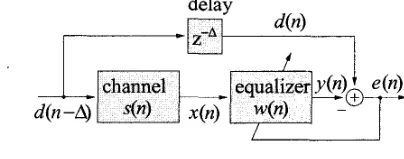
When data is transmitted through a channel, the charac- teristics of the channel generally create a signal distortion which may cause bit errors on the receiving side. Thus, in communication systems a filter is employed to equalize any linear distortions of the channel [ 131. Similarly, audio systems may require equalization of the room acoustics for dereverberation or feedback suppression [ 11, 121. To ac- count for time-varying behaviour of the system to be equal- ized, usually an adaptive solution is preferred. The general set-up of an adaptive equalizer is shown in Fig. 1. There,
[image:2.618.70.272.573.653.2]I
d(n-A)
Fig. 1. Adaptive equalizer set-up.
the channel output s[n] is ;fed into the equalizer
4.1.
Af-ter adaptation, the overall system s[n]
*
w[n] should ideally resemble a delay 6(n - A) only. In an audio application,s [n] would incorporate the room acoustics, amplifiers, and electro-acoustic transducers. For either application, we will here assume linearity of s[n].
Equalization is generally difficult due to a number of problems. Firstly, the system to be equalized may be very long, as for example the case in room acoustics, where the sampled impulse response can have several 1000’s of co- efficients [4]. Secondly, some types of characteristics are particularly hard to equalize, for example non-minimum phase systems [ I I , 211, and fractional delays [8], which involve the identification of very long and generally non- causal impulse responses. For adaptive equalization operat- ing in the fullband, adaptive algorithms with high compu- tational complexity such as, the RLS cannot be used, while for computationally less complex LMS-type algorithms the convergence speed depends on the filter length. Finally, if the channel exhibits large slpectral dynamics, the filter input signal
4.
1
will have a large eigenvalue spread and the con- vergence speed of LMS-type adaptive algorithms is further slowed down [6].Therefore, the application of subband adaptive filters (SAF) appears sensible. In an SAF system as shown in Fig. 2, both input and desired signal, z[n] and d [ n ] , are decomposed into decimated frequency bands. By operat- ing adaptive filters independetly in these subbands, both the update rate and the length of the adaptive filters can be greatly reduced leading to a lower computational complex- ity. Further, the subband decomposition performs a whiten- ing of the input signal, resulting in improved convergence behaviour [7,3]. ’
In the following, we will give a brief introduction to sub- band adaptive filter structures, and concentrate on a partic- ular SAF system using complex oversampled SAFs based on a signal decomposition using generalized DFT (GDFT)
filter banks [ 11, which allows a very inexpensive implemen-
d K
analysis filter
bank
synthesis filter
bank
Fig. 3. Decomposition of a signal
4.
1
by an analysis bank into K subbands decimated byN
5
K ; a fullband signal 2[n] can be recon- structed by a synthesis bank.Fig. 2. SAF system with adaptive filters work- ing independently in K decimated subbands; the subband splitting and fullband error re- construction is performed by filter banks.
ences in SAF systems. Sec. 3 discusses some fundamental problems of equalization and presents our approach to per- form adaptive equalization in oversampled subbands. Fi- nally, examples and results underlining the benefit of the proposed method are given in Sec. 4.
2.
Adaptive Filtering in Subbands
2.1.
Structural Approaches to
S A F
Subband adaptive filter (SAF) systems, as shown in Fig. 2, are widely used for problems such as acoustic echo cancellation (AEC), where a large number of adaptive pa- rameters has to be adjusted and the adaptive filter input is coloured. Therefore general fbllband adaptive systems are very costly to implement and show a considerable decrease in convergence speed. The reduction in complexity by the subband approach becomes viable due to decreased com- plexity by processing in decimated subbands. Furthermore, the separation into frequency bands can reduce spectral dy- namics.
However, the case of critical decimation, where the dec- imation ratio N equals the number of uniform subbands K , requires either cross-terms at least between adjacent frequency bands [3], which compensate for the informa-
tion loss in the region of spectral overlap, or gap filter
banks [23, 151, which introduce spectral loss to avoid any aliasing problems. The drawbacks are, that the inclusion of cross-terms requires multichannel adaptive algorithms with generally slower convergences and again increased com- putational cost, while the distortion produced by gap-filter banks may not be acceptable.
Oversampled SAF systems, with a decimation ratio N
<
K , are designed such that after decimation the alias levelwithin the subbands is kept sufficiently low. Differences arise for the decimation of complex or real valued frequency bands. The decimation of real valued bandpass signals is generally complicated, and real valued signals have to be ei- ther modulated into the baseband prior to decimation by, for example, single sideband modulation (SSB,[ 1, 19]), or their bandwidth and decimation ratio has to be chosen in accor- dance with the sampling theorem, leading to non-uniform filter banks [14, 51. In contrast, the decimation of complex valued bandpass signals with any integer factor N
<
K is straightforward. Therefore, we focus on an SAF system which generalized DFT (GDFT) filter banks [ 11, perform- ing a particular type of complex valued subband decompo- sition. In general, complex valued filter banks can be shown to be at least as efficient to implement as their real valued counterparts.2.2.
Oversampled Modulated Filter Banks
A general structure of a K band filter bank with decima- tion by a factor N
5
K is shown in Fig. 3. The analysis filters h k [n] are derived from a real valued Iowpass proto- type FIR filter p [ n ] of length L, by a generalized discrete Fourier transform (GDFT),hk[n] = e J % ( k + k o ) ( n + n o ) . p [ n ] , k , n E
N.
(1)The term generalized DFT [l] stems from offsets ko and no introduced into the frequency and time indices. With
ko = 1/2, for a real valued input signal ~ [ n ] it is suffi- cient to process the first K / 2 subbands covering the fre- quency interval [O; 7r] as shown in Fig. 4, while the remain-
ing subbands are redundant. Together with conditions on p [ n ] , the time offset no can be set appropriately to ensure useful properties such as linear phase. The synthesis filters
g k [n] can be obtained by time reversion and complex con- jugation of the analysis filters,
g k [ n ] = h;[L,-n+l]
.
(2) [image:3.621.81.300.70.216.2] [image:3.621.324.545.70.163.2]- 0
?! ---20
&*-40 m
-
0
m 2 -60
0
0 02 0 4 0 6 0 8 1 !2 1 4 1 6 1 8 2 -80
normalized frequency 62 I R
Fig. 4. Example of a K = 16 modulated filter bank.
The modulation approach allows for both low memory consumption for storing filter coefficients and an efficient polyphase implementation. The latter even works for non- integer oversampling ratios K I N , and allows a factoriza- tion of the filter bank into a real valued polyphase network only depending on the prototype filter [2, 171. The output of this network is rotated by a GDFT transform, which can be mainly implemented using an FFT.
Through the above modulation, the filter bank design re- duces to an appropriate choice of the prototype filter, which has to fulfill two criteria. Firstly, the filter's attenuation in the stopband, 0 E [ 7 r / N ; x ] , has to be sufficiently large. Every frequency of the input signal z[n] lying within the interval [7r/N; 7r] will be aliased into the baseband after fil-
tering and decimation, and cause a distortion of the subband signal. A second constraint on the design is the perfect re- construction condition. If stopband attenuation of the pro- totype filter is high enough to sufficiently suppress aliasing, this condition reduces to the consideration of inaccuracies in power complementarity [ 161:
(3)
k=O
A prototype filter approximating these constraints can be constructed by an iterative least-squares method [ 191.
2.3. Subband Adaptive Filtering
When performing adaptive equalization in oversampled complex valued subbands, the adaptive filter lengths can be chosen shorter compare to a fullband adaptive filter in accordance with the sampling rate reduction by a factor
N
<
K . Further, updating now occurs at the lower rate.Following the approach in [ 19, 201, for real valued signals
4.
1
and d[n] only K / 2 complex subbands decimated byN
<
K need to be processed, since the remaining sub-bands are complex conjugate and therefore redundant. This yields a reduction in computational complexity by a factor T =
4
for LMS-type algorithms (omitting any additional costs introduced by the filter banks). Therefore, it is ad- 2Nstable, non-causal
[image:4.618.342.527.69.152.2]unstable, causal
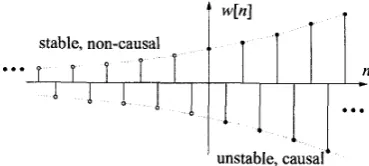
Fig. 5. Two possilDilities of representing an unstable pole by all-zero models.
vantageous in terms of computational cost to keep the over- sampling ratio KIN close to one, i.e. choose non-integer oversampling. For an extensive discussion of computational costs, please refer to [ 1711.
For an S A F system to perform satisfactorily, a delay in
the path of the desired si,gnal is required to account for var- ious decimated transients of the analysis filter banks. If the
SAF length is sufficient, no model truncation occurs, and if observation noise is absent, the minimum mean square er- ror (MMSE) is limited aaly by the aliasing level produced by the decimation in the analysis filter banks, and the max- imally achievable accuracy of the equalizer bound by the distortion function of the filter bank. In the case of modu- lated filter banks, both errors can be stated in terms of the prototype filter [20].
3.
Subband Adaptive Equalization
For successful equalization, an adaptive algorithm is ex- pected to perform an inverse system identification of the channel [21]. This becomes awkward as many real world channels are non-minimum phase systems, i.e. posses ze- ros outside the unit circle, e.g. in room acoustics [ 1 I] or communication systems [8]. Considering a maximum phase zero location a, la1
>
1, the inverse system can be stated bytwo representations for FIR equalizers, obtained by polyno- mial division:
(4)
1
-
1 - a - l z L i=l
[image:4.618.84.304.69.157.2]Fig. 6. Adaptive equalization in subbands.
A simple structure for an equalizer was introduced in Fig. 1. When incorporatingthe subband approach, the struc- ture shown in Fig. 6 arises, where the SAF system is applied in series to the distorting channel. The delay inserted in the desired path should be approximately half the length of the SAFs [21], which can be justified from the assumption, that maximum- and minimum-phase zeros of the channel are lo- cated at similar distances from the unit circle, and causal and non-causal part of the impulse response to be identified should therefore have approximately the same length.
4.
Application Example
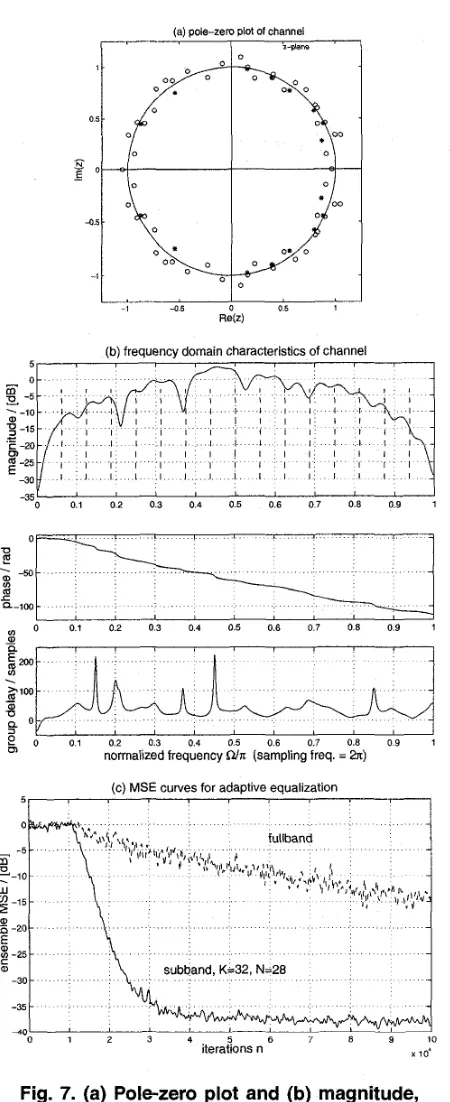
To demonstrate the benefit of adaptive equalization in subbands, a bandpass channel with magnitude and a non- linear phase response as shown Fig. 7(b) is used for sim- ulation. Fig. 7(a) shows its pole-zero plot. Noise inter- ference with spectral characteristics similar to the chan- nel has been added at 40dB S N R . To invert this system, we apply an NLMS adaptive algorithm to both a 1500 tap fullband filter and an SAF system with K / 2 = 16 com- plex subbands (with bandedges indicated by vertical dashed lines in Fig. 7(b)), decimated by N = 28 and having (1500
+
896)lN M 86 tap filters in each channel. The in-crease in length by L, = 896 is to approximately compen- sate for transients caused by the filter banks, which are mod- ulated from a lowpass prototype with L, coefficients. Both fullband and subband adaptive algorithms operate with the same normalized LMS step size [21]. From the ensemble mean squared error curves in Fig. 7(c), a clear advantage in adaptation speed for the SAF equalization system is ev- ident, while also requiring only 22% of the computational resources of the hllband equalizer.
Since SAF exhibit slower convergence at band edges [lo], the choice of K forms a trade-off between the pre- whitening effect of the subband approach and the number of band egdes introduced. Simulations in [ 171 indicate that the decimation ratio N has hardly any influence on the con- vergence speed, and should therefore be choosen as close as possible to K to allow an inexpensive implementation.
(a) pole-zero plot Of channel I
(b) frequency domain characteristics of channel
* O 0.1 0 2 0.3 0.4 0.5 0.6 07 0.8 0.9 1
0 ~ 0 1 0 2 0 3 0 4 0 5 0 6 0 7 0 8 0 9 1
normalized frequency Wrr (sampling freq. = 2n)
(c) MSE curves for adaptive equalization
5
1
subband, K=32, N=28
-30.
-35- . . ., .. ,
0 1 2 3 4 5 6 7 8 9 10
x lo'
iterations n
Fig. 7. (a) Pole-zero plot and (b) magnitude, phase response and group delay of the chan- nel; (c) ensemble MSE curves of SAF and full- band equalizers (adaptation switched On at
n = io4).
[image:5.620.80.305.74.169.2]5.
Conclusions
We have introduced an oversampled subband adaptive filter approach to the equalization problem. This method runs contrary to some approaches suggested in the liter- ature, which use oversampled adaptive filters (fractional equalizers) to find better adaptable solutions for equalizers. In our method, “oversampled” relates t o the fact that the subbands are not critically decimated, but decimation close to the critical rate is desirable to achieve inexpensive real- izations.
We have motivated the application of subband adaptive filtering to the equalization problem, which can otherwise require a considerable filter length and suffer from slow convergence in a fbllband implementation. The subband
approach presented here used oversampled, near perfect re-
constructing filter banks, which gives a significant reduction in computations and improved convergence speed over the fullband scheme.
Extensions of our work may target multiple input-output (MIMO) approaches, which are robust towards spectral ze- ros in the system to be equalized [9, 121. For communi- cation systems, also integration with transmultiplexers [22] m a y be investigated.
6.
Acknowledgements
T h e work of Stephan Weiss and Bob Stewart was sup- ported by a scholarship from William Garven Research Be- quest, Glasgow. Saul Dooley and Asoke Nandi would like to thank the Engineering and Physical Sciences Research Council for their support.
References
[ I ] R. E. Crochiere and L. R. Rabiner. Multirate Digital Signal Processing. Prentice Hall, Englewood Cliffs, NJ, 1983. [2] Z. CvetkoviC and M. Vetterli. “Tight Weyl-Heisenberg
Frames in Zz((z)”. IEEE Trans Signal Processing,
Vo1.46(No.5):pp. 1256-1259, May 1998.
[3] A. Gilloire and M. Vetterli. “Adaptive Filtering in Subbands with Critical Sampling: Analysis, Experiments and Appli- cations to Acoustic Echo Cancelation”. IEEE Trans Signal Processing, Vol.SP-40(No.8):pp. 1862-1 875, Aug. 1992. [4] E. Hansler. “The Hands-Free Telephone Prob-
lem: an Annoted Bibliography”. Signal Processing,
Vo1.27(No.3):pp.259-271, June 1992.
[5] M. Harteneck, J. M. Piez-Borrallo, and R. W. Stewart. “An Oversampled Subband Adaptive Filter Without Cross Adap- tive Filters”. Signal Processing, Vo1.64(No. l):pp.93-101, January 1998.
[6] S. Haykin. Adaptive Filter Theoly. Prentice Hall, Engle- wood Cliffs, 2nd edition, 1991.
[7] W. Kellermann. “Analysis and Design of Multirate Systems for Cancellation of Acowtical Echoes”. In Proc. IEEE Inter- national Conference on Acoustics, Speech, and Signal Pro- cessing, volume 5, pages 2570-2573, New York, 1988. [8] T. I. Laakso, V. Valimaki, M. Karjalainen, and U. K. Laine.
“Splitting the Unit Delay”. IEEE Signal Processing Maga- zine, Vol. 13(No. I):pp.30-60, January 1996.
[9] M. Miyoshi and Y. Kaneda. “Inverse Filtering of Room Acoustics”. IEEE Trans Acoustics, Speech and Signal Pro- cessing, Vo1.36(No.2):pp.145-151, Feb. 1988.
[lo] D. R. Morgan. “Slow Asymptotic Convergence of LMS Acoustic Echo Cancelltd. IEEE Trans on Speech and Au- dio Processing, Vo1.2(No.3):pp. 126-1 36, March 1995. [ 113 S. T. Neely and J. B. Allen. “Invertibility of a Room Im-
pulse Response”. Journal of the Acoustic Society of Amer-
ica, VoI.66(No. l), July 1979.
[I21 P. A. Nelson, H. Hamaida, and S . J. Elliott. “Adaptive In- verse Filters for Stereophonic Sound Reproduction”. IEEE Trans on Signal Processing, VoldO(No.7):pp. 1621-163 1, July 1992.
[I31 J. G. Proakis. “Channel Equalization”. In J. D. Gibson, editor, The Mobile Communications Handbook, chapter 6, pages 56-80. CRC Press / IEEE Press, 1996.
[ 141 V. Somayazulu, S. Mitra, and J. Shynk. “Adaptive Line En- hancement Using Multirate Techniques”. In Proc. IEEE In- tern. Con$ Acoustics, :Speech, and Signal Processing, vol- ume 2, pages 928-93 1, Glasgow, Scotland, UK, May 1989. [15] 0. Tanrikulu, B. Baykal, A. G. Constantinides, and J. Chambers. “Residual Echo Signal in Critically Sam- pled Subband Acoustic Echo Cancellers Based on IIR and FIR Filter Banks”. IEEE Trans on Signal Processing,
[16] P. P. Vaidyanathan. Multirate Systems and Filter Banb. Prentice Hall, Englewood Cliffs, 1993.
[17] S. WeiR. “On Adaptive Filtering in Oversampled Sub- bands ”. PhD thesis, Signal Processing Division, University
of Strathclyde, Glasgow, May 1998.
[18] S. WeiB, S. R. Dooley, R. W. Stewart, and A. K. Nandi. “Adaptive Equalization in Oversampled Subbands”. Elec- tronics Letters, Vo1.340Vo. 15):pp. 1452-1453, July 1998. [ 191 S. WeiR, L. Lampe, and R. W. Stewart. “Efficient Implemen-
tations of Complex and Real Valued Filter Banks for Com- parative Subband Processing with an Application to Adap- tive Filtering.”. In Proc. Intern. Symp. Communication Sys- tems and Digital Signal Processing, pages 32-35, Sheffield, UK, April 1998.
[20] S. WeiR, R. W. Stewart, A. Stenger, and R. Rabenstein. “Performance Limitations of Subband Adaptive Filters”. In
European Signal Processing Conference, volume 111, pages 1245-1248, Rodos, Greece, September 1998.
[21] B. Widrow and S. Steams. Adaptive Signal Processing. Prentice Hall, Englewood Cliffs, New York, 1985. [22] T. Wiegand and N. J. Fliege. “Equalizers for Transmultiplex-
ers in Orthogonal Multiple Carrier Data Transmission”. An- nals of Telecommunications, Vo1.52(No. 1-2):pp.39-45, Jan-
uary 1997.
[23] Y. Yamada, H. Ochi, and H. Kiya. “A Subband Adaptive Filter Allowing Maximally Decimation”. IEEE Journal on
Selected Areas in Communications, Vol. 12(No.9):pp. 1548- 1552, September 1994.
![Fig. 3. N analysis bank into Decomposition of a signal 4.1 by an K subbands decimated by 5 K; a fullband signal 2[n] can be recon- structed by a synthesis bank](https://thumb-us.123doks.com/thumbv2/123dok_us/1734243.126937/3.621.81.300.70.216/analysis-decomposition-signal-subbands-decimated-fullband-structed-synthesis.webp)