City, University of London Institutional Repository
Citation
:
Mayhew, L. and O'Leary, D. (2014). Unlocking the potential. UK: Demos.
This is the published version of the paper.
This version of the publication may differ from the final published
version.
Permanent repository link:
http://openaccess.city.ac.uk/13664/
Link to published version
:
Copyright and reuse:
City Research Online aims to make research
outputs of City, University of London available to a wider audience.
Copyright and Moral Rights remain with the author(s) and/or copyright
holders. URLs from City Research Online may be freely distributed and
linked to.
nlo ck in g t he P ote nti
al |
L
es M
ay
he
w · D
un ca n O ’L ea ry 2014 © Demos
governments refused to confront. An ageing population has placed growing strains on the care system, without the means to pay for it. In this context, the Care and Support Bill, now making its way through Parliament, represents a substantial achievement. The reforms contained in the bill mark the most significant changes to social care in a generation, including the first ever cap on the lifetime cost of care.
Unlocking the Potential seeks to build on those reforms. It examines how likely the Government is to succeed in fostering a new market in long-term care products and explores additional policy measures to facilitate more forward planning. The fundamental argument is that the Care and Support Bill will not be enough on its own to produce a step change in the way people plan for social care. Policy must also draw on behavioural economics to spur people into action.
The report recommends various ways of achieving a more complete agenda for social care funding, based on a more accurate understanding of human behav-iour. These include a financial ‘health-check’ for individuals before they first withdraw from the state pension; a simplified means test, to make it easier for people to determine their eligibility; and ‘care accounts’ to provide stronger incentives for planning ahead. In so doing, it holds out the potential for a fairer, more effective system in the future.
Les Mayhew is Professor in the Faculty of Actuarial Science and Insurance at Cass Business School, City University. Duncan O’Leary is Deputy Director of Demos.
£10
ISBN 978-1-909037-54-0
“ We need a step-change
in the way people plan
for social care…”
Les Mayhew
Duncan O’Leary
thinkers and host thought-provoking events. We have spent 20 years at the centre of the policy debate, with an overarching mission to bring politics closer to people.
Demos is now exploring some of the most persistent frictions within modern politics, especially in those areas where there is a significant gap between the intuitions of the ordinary voter and political leaders. Can a liberal politics also be a popular politics? How can policy address widespread anxieties over social issues such as welfare, diversity and family life? How can a dynamic and open economy also produce good jobs, empower consumers and connect companies to the communities in which they operate?
Our worldview is reflected in the methods we employ: we recognise that the public often have insights that the experts do not. We pride
ourselves in working together with the people who are the focus of our research. Alongside
quantitative research, Demos pioneers new forms of deliberative work, from citizens’ juries and ethnography to social media analysis.
Demos is an independent, educational charity. In keeping with our mission, all our work is available to download for free under an open access licence and all our funders are listed in our yearly
London, SE1 2TU, UK
ISBN 978 1 909037 54 0 Series design by modernactivity Typeset by Chat Noir Design, Charente Printed by Lecturis, Eindhoven
Set in Gotham Rounded and Baskerville 10
the copyright. We therefore have an open access policy which enables anyone to access our content online without charge.
Anyone can download, save, perform or distribute this work in any format, including translation, without written permission. This is subject to the terms of the Demos licence found at the back of this publication. Its main conditions are:
· Demos and the author(s) are credited
· This summary and the address www.demos.co.ukare displayed · The text is not altered and is used in full
· The work is not resold
· A copy of the work or link to its use online is sent to Demos
You are welcome to ask for permission to use this work for purposes other than those covered by the licence. Demos gratefully acknowledges the work of Creative Commons in inspiring our approach to copyright. To find out more go to
Acknowledgements 7
Foreword
9Executive summary
11Introduction
171
Making a market
212
Simplifying the system
333
Rewarding contribution
454
Unlocking housing wealth
635
New products: drawing on housing wealth
73Conclusion
87Appendix 1 Formula for the simplified means
test
91Appendix 2 Insurance-for-equity product
93Appendix 3 Glossary of terms
95Notes 97
Acknowledgements
Thank you to Just Retirement for making this project possible and to Nicky Edwards, Stephen Lowe and Ben Stafford in particular. We are also extremely grateful to our advisory board, for offering advice and feedback throughout the life of the project.
At Demos, we thank Hannah Ashley for research support, Claudia Wood for help shaping the ideas and Ralph Scott and Rob Macpherson for seeing the report through production. At Cass Business School, we thank David Smith for an invaluable contribution.
Finally, thank you to the many people who participated in our roundtable discussions and gave up time for one-on-one conversations.
As ever, all errors and omissions remain our own.
Les Mayhew1
Foreword
Developed nations around the world are today grappling with public policy challenges created by dramatic improvements in life expectancy. Quite simply, people are living much longer than previous generations and in greater numbers than ever before – bringing the challenge of how we pay for these extra years to individuals and governments.
With the number of UK citizens aged 85 and over forecast to double between now and 2030 and 1.3 million people already receiving social care services in England alone, social care funding is a key public policy challenge. Against this backdrop the Government has set in train a set of reforms designed to get social care funding onto a sustainable footing, by establishing a new level for what individuals and the state will pay. The reforms are designed to encourage individuals to explore how best to use their available wealth and assets to meet care costs through a mixed economy of local authority and private sector care-funding options.
The litmus test for the reform package will be the extent to which it delivers a framework that prompts, encourages and enables people to plan ahead. This was among the issues identif-ied by the House of Lords Public Service and Demography Committee, which warned that government and society are ‘woefully underprepared’ for the numbers of people requiring social care in later life. Addressing this lack of awareness so that people understand they have a responsibility to pay for some or all of their social care services, how much these services cost, and how the Government cap on these costs works in practice will be crucial to the reforms’ success.
In writing Unlocking the PotentialDemos, in collaboration
seek fresh insights to inform the development of new options to address obstacles individuals face when making financial provisions for the costs in later life. The analysis draws on the framework set out in the Care Bill and known consumer behavioural traits, and develops recommendations to motivate individuals to plan for their care funding well before the point of need. The report also leverages one of the other key
recommendations made by the Lords Committee – utilising housing wealth, and exploring how to enable people to pledge housing equity towards their potential care costs in later life.
Just Retirement is delighted to have contributed to the development of this report, making good the insurance industry’s commitment to helping create new policy and financial product options to address people’s needs in later life. With the Care Bill expected to create a new framework by 2016 this is a timely and hugely important contribution to the debate.
Executive summary
The passage through parliament of the Care and Support Bill marks a watershed moment in the history of social care funding in England. For the first time the costs of social care will be capped for each individual, albeit with various exceptions and caveats about which specific costs the cap includes.
This report explores what happens next. It argues that the reforms are necessary, but not sufficient, to create a new culture in which citizens forward plan for the costs of care in later life. It examines what further steps policy makers might take to encourage and enable people to plan ahead for care costs, and considers the kind of private sector products that might contribute to this.
The expectation among policy makers is that by capping the lifetime costs of care, a new market will open up for long-term care products, which enable people to meet their
obligations up to the level of the cap. As the Prime Minister has put it, ‘It’s right to try and put in place a cap which will then open up an enormous insurance market, so people can insure
against that sort of catastrophic loss.’2
In addition to this lack of public awareness, there may also be strong behavioural barriers to people acting on the
information that they have. People tend to suffer from ‘optimism bias’ – the tendency to overestimate the probability of desirable things – and underestimate the probability of undesirable things. Social care costs are likely to fall into this second category. Furthermore, recent pensions policy provides a warning about the risk that inertia will prevent people from acting even when they have good information and the intention to put money aside. The Government has decided the best strategy is to capitalise on inertia, rather than seek to overcome it. Since 2013 employees at the largest UK companies have been automatically enrolled into occupational pensions by law, with the ability to opt out rather than being expected to opt in themselves.
The passing of the Care and Support Bill therefore represents an opportunity for the Government to tell people what they will be entitled to and expected to pay through a concerted awareness-raising effort. Given the expectation that the financial services industry will innovate in response to the reforms and offer new long-term care products, it is also likely that the industry will play some part in raising awareness in order to demonstrate the value of its products. However, the lesson from policy areas such as pensions is that government information is not always enough to spur action on its own.
tool should also provide easily digestible facts, covering the likelihood of the individual requiring social care, the probable costs, the division of responsibility between government and the individual, and some broad-brush options for people to consider.
The Government should also explore the potential of introducing a more personalised and extensive face-to-face consultation with a financial expert, at an earlier age, when they are still preparing for later life. People could be invited to go through such a check at age 50.
The point here is to ensure that people understand – and stop to consider – the likely costs of social care in later life. This would be a major step forward in encouraging a culture of forward planning so that, having understood their liability for care costs, people can begin to assess their options in a straightforward way. One significant barrier to engagement in this respect is the complexity of the means test proposed in the Government’s reforms. This complexity makes the system difficult for people to understand, let alone use as a basis for forward planning.
We propose that the Government should adopt a simpler means test, which would eradicate the complicated formula for ‘equivalising’ assets and income, as well as the thresholds and ‘cliff edges’ that make it hard for people to predict what support they can expect from the state. Our proposed, simplified system works through establishing how many years in residential care an individual could afford, based on a combined assessment of their assets and income. If implemented, those who can afford to shoulder a greater amount of their care costs would receive less support from the Government. Under this proposal, people would be reassessed annually so that as their assets deplete over time – and they can afford fewer years of care in the future – they receive more help from the state. The intention of this simplified approach is to make forward planning easier for people.
their assets – because the state offers a safety net as a funder of last resort through the means test.
The Government should therefore seek ways in which to encourage and reward funding, and planning ahead for self-funding. If enough extra people can be encouraged to self-fund, or the same number can be encouraged to self-fund to a greater degree, then it may be possible to make savings and to reward those willing to take responsibility for their own care. This would have a double benefit: first, it would bring new money into the care system and improve care quality; second, it would reduce the burden on the Government and taxpayers who will face the material costs of meeting care services for a rapidly ageing population.
We recommend two options for further exploration. The first of these options is a savings model, with some similarities to pensions. Under this model the Government would create ‘care accounts’ in which individuals would store wealth in the form of savings or housing equity. The funds in care accounts would be reserved specifically for covering care costs and could not be withdrawn without a financial penalty after a set age in people’s lives, such as age 70.
The incentive for people to ring-fence, or store, funds in these care accounts in this way would be that a proportion of the funds in the account would be disregarded in calculations for the Government’s means test for care costs. This policy would be designed to reduce the moral hazard created by the means test, in that it would reward people for setting money or housing equity aside, rather than treating this as a reason for the Government to offer less support.
would have to register the purchase of a long-term care product such as insurance or a disability-linked annuity with HM Revenue & Customs. Registered products would be kite-marked, to confirm their status.
These two options could coexist, or be implemented independently of one another, but both aim to reduce the moral hazard currently created by the means test by rewarding individuals willing to commit funds in advance to cover the future costs of social care. Both also rely on encouraging a greater degree of self-funding to cover the costs of the incentives involved. We recommend that the Government should explore the viability of these two options.
Finally, we explore the new types of products likely to enable people to draw on their assets – housing wealth in particular – and plan ahead for the costs of social care. We argue that the Government’s Universal Deferred Payment Scheme will help people to draw on their assets, but not to plan ahead for care, especially if that care is provided in a domiciliary setting. On this point, we also argue that the opportunity exists for innovation by the financial services industry – to look at options that enable planning ahead and the use of housing wealth to cover care costs, including while homeowners still live in their homes.
We present one model for this concept, based on an equity-for-insurance deal. Under this model, individuals would be able to insure against care costs up to the cap in exchange for a fixed proportion of their housing equity. By allowing people to pay for insurance through housing equity rather than cash, such products would allow individuals to hedge against the risk of high care costs, without having to sacrifice their disposable income.
Introduction
Social care funding has long been the problem that governments refused to confront. The last government produced a royal commission and three major reports on the subject but no significant policy changes. Cross-party talks have frequently been sought and always broken down.
In particular, governments have been unwilling to address the role of housing wealth in care funding. An ageing population has placed growing strains on public funding for care, while those aged 65 or over now hold an estimated £750
billion of unmortgaged housing equity.3Yet the cultural
attachment to housing in the UK and the desire of people to pass something on to their children has made linking these two things politically toxic. A row over the so-called ‘death tax’, New Labour’s final policy offering on the subject, dominated the airwaves for much of the 2010 election campaign before the
proposal was withdrawn.4
In this context the Care and Support Bill making its way through parliament at the time of writing represents a substantial achievement. The reforms contained in the bill mark the most significant changes to social care in a generation, through capping lifetime costs for care (though not accommodation) for the first time in England and paving the way for an interest-bearing deferred payment scheme to be made available by local authorities across the country, to prevent the need for people to sell their homes against their wishes to meet care costs.
sophisticated ways than the Government’s deferred payment scheme allows for.
The report draws on seven months of research and
engagement with key stakeholders involved in the shaping of the Care Bill reforms. This work has included six policy seminars, including one at each of the three 2013 party conferences with relevant ministers and shadow ministers, as well as in-depth interviews with experts in the field, and desk-based modelling and research at Demos and Cass Business School, part of City University, London.
Our fundamental argument is that the Care and Support Bill will not be enough, on its own, to produce a step change in the way people plan for social care and that the care cap established through the current reforms is a necessary but insufficient step. Policy must go beyond these measures to draw on behavioural economics to spur people into action,
particularly to overcome the known lack of public awareness of the realities of care funding costs. Government should sharpen incentives to ensure that people have good reason to plan ahead and new long-term care products will be needed, including products that draw on housing equity but also enable people to plan ahead for care.
Chapter 1 focuses on demand-side barriers to encouraging much greater forward planning for social care costs. It argues that people lack good information about care costs and their likelihood of facing them, noting further ‘behavioural’ barriers, such as a tendency towards inertia and a natural bias towards optimism, which may stop people from acting even when well informed. We recommend that the Government addresses these barriers by requiring individuals to go through an online financial health check as a condition of receiving their first payment from the state pension. Such a move could ‘nudge’ people to take steps to prepare for care costs in later life.
Chapter 2 examines the means test proposed by the Government, which builds on the recommendations made in the
Dilnot report on social care funding.5We argue that the design
risks exacerbating people’s natural tendency towards disengagement and inertia and in this chapter we set out an alternative, simpler means test to address this.
Chapter 3 explores the incentives that arise from the means test. We suggest that there is a risk of ‘moral hazard’ when government is willing to cover the costs of those who cannot afford to pay for their own care. We argue that the Government should examine ways to encourage and reward those willing to take steps to cover their own care, and explore two ways in which it could reward those willing to make commitments in advance to funding social care.
1
Making a market
‘These reforms bring reassurance to millions of people by ending the existing unfair system so no one need face unlimited care costs or the prospect of selling their home in their lifetime,’ argued care minister Norman Lamb, as the Government announced its plans for the reform of social care funding in
2013.6The measures the minister was referring to have since been
developed, consulted on and inserted into the Care and Support Bill. This chapter argues that:
· the reforms represent a welcome move towards a ‘social insurance model’, through which the state helps individuals to pool risks of high care costs
· while a key goal of the reforms is to create a vibrant market for long-term care products, there remain supply-side and demand-side barriers
· in particular, government must anticipate the ‘behavioural’ obstacles to forward planning, in the same way it applies ‘behavioural insights’ to other areas of policy
· the Government should ‘nudge’ people to prepare for future care costs through an online financial health check at retirement age · participation in this health check should be a condition of
people making their first withdrawal from the state pension · the Government should explore the potential for a face-to-face
financial health check, which would be more personalised and extensive than the health check people would have when they reach retirement age, and would occur earlier in people’s lives
The Dilnot reforms
provisions to cap the lifetime costs of social care at £72,000, while also limiting annual accommodation or ‘hotel costs’ (which are not included in the cap). The bill increases the means test for residential care as well as the capital threshold for the residential
care means test, which will rise to £118,000.7
The proposed reforms have not been immune from criticism. The Centre for Social Justice has described the provisions contained in the bill as ‘the wrong priority at the wrong time’, objecting to what it regards as middle class welfare and arguing that ‘helping the most disadvantaged must be the starting point
for any reforms’.8However, the ‘care cap’ is best understood as a
move towards social insurance, designed to protect people against risks beyond their control, and it is this feature that has helped gather a relatively broad coalition of support for the changes.
Under the old means test anyone with assets over £23,250 received no financial state support and was therefore required to fund their own care. This left some individuals and families open to catastrophic costs and many having to sell their homes to pay for care. The Dilnot report found that under the current, unreformed system half of over-65s could expect to pay care bills of up to £20,000, with one in ten facing costs of £100,000 or
more.9Some could spend hundreds of thousands of pounds on
care in later life. Dilnot himself described this as ‘a bit like being in a shop with no prices’, arguing that ‘we are moving to a world where people are effectively insured by the state which should
make them feel much more comfortable’.10
In practice, the cap will provide financial support to only a few people. It is estimated that around 30 per cent will need
long-term care at some point in their lives11and of these 16 per
cent are projected to reach the cap.12Our own research suggests
peace of mind as a result of having an upper limit put on lifetime care costs.
Creating a market
Beyond risk pooling, the social care cap has another explicit purpose. With government having capped the liabilities that people will face, it is expected that people will be in a better position to take steps to prepare for the costs of care up to the level of the cap. The idea is that the cap will open up space for industry to step into, with new financial products designed to help people to plan ahead. The government statement on funding reform, issued in February 2013, put it this way:
the limit on people’s care costs will provide greater incentives to provide relevant products that people see the benefit of purchasing.
The government expects the financial services industry to work creatively to amend existing products and develop new products that support people in making choices about how to plan for their care costs.13
The Prime Minister has been more bullish still about the development of a market for risk pooling, asserting that ‘it’s right to try and put in place a cap which will then open up an enormous insurance market, so people can insure against that
sort of catastrophic loss’.14
The development of such a market would be a considerable achievement, given recent history and some scepticism over the
capacity for such a market to grow in the near future.15As the
Government’s impact assessment on the new funding
arrangements acknowledges, care liabilities have proven difficult to insure against, with providers citing difficulties establishing sustainable products and withdrawing from the market in the
2000s.16Even with the establishment of a cap, some doubt the
likelihood of a new market developing either quickly or easily. During interviews that formed part of this project,
order to price risk effectively, insurance companies need to find a way to predict care costs over an individual’s lifetime – and this risk is difficult to quantify. While companies have data to draw
on for some of the variables determining care needs, such as life
expectancy and the probability of people facing disability at
some point in their lives, care costs are much more unpredictable.
This is because some people will draw on informal forms of care support, such as that of family members, while others will rely more on formal care. It will therefore be complicated to predict when the care ‘meter’ will start, in the run up to reaching the possible £72,000 cap. One insurance industry representative told us: ‘Care needs don’t necessarily lead to care costs – and if you’re pricing a product that is what you have to be able to predict.’
These supply-side issues pose problems but are likely to be surmountable, as a clearer picture emerges over time about average care costs under the new system and how the meter will work. However, there are further demand-side barriers to be overcome before a new market for long-term care products will emerge. The first is that at present people have very little sense of where and how the costs of social care will be divided between themselves and the Government.
Information and awareness
One policy expert from Age UK pointed out: ‘Most older people and their families know very little about social care before they first encounter the system, typically at a time of crisis such as a
fall leading to an unplanned hospital admission.’17This lack of
awareness is reflected in government figures showing that around four people in ten are unaware that they might need to
pay for their care and support later in life.18In large part this is
because many people simply have not stopped to consider it or have assumed that the state is responsible for paying for this sort of care. More than six in ten (63 per cent of) people say they have hardly thought about how to pay for social care needs in the future, while over seven in ten (72 per cent) say they have not
When people do consider potential care costs, other studies have found that people tend to underestimate the probability of needing care themselves in the future. More than half believed the probability was lower than 40 per cent, when in fact 65-year-old men have a 68 per cent chance of needing care before they
die, and women an 85 per cent chance.20(Note the chances of
needing institutional care are much less – perhaps 30 per cent. Institutional care is usually described as long-term care. Social care generally subsumes all forms of care – domiciliary, informal, nursing home and so on.)
There is little awareness among the public of the precise or even rough cost of paying for care. Surveys find that nearly half of the public say they do now know the average weekly cost of a place in a residential care home. The mean figure suggested by those who think they know the cost is around £140 – far below
the actual average weekly fee of £531.21
Given that so few people have an accurate picture of the key funding aspects of the existing system, it is unsurprising that awareness of the details of the proposed reforms is low. A high proportion (82 per cent) of those who are 50 and over are aware of the cap on care costs, but less than one in ten (9 per cent) say they know what limit it has been set at – a crucial factor. More-over, researchers found there was little understanding of how the
care cap would be calculated among the general public.22
Without clear information about how the social care system works, the real chances of needing some form of social care in later life, and their liability to pay for it, people are unlikely to take steps to prepare for the future in the way that policy makers hope they might. All this has obvious implications for the likelihood that people will take steps, ahead of time, to plan for the costs of social care, through either saving or the purchase of long-term care products. As the Association of British Insurers has put it: ‘Where people do not understand the risks and costs of care, the perceived value of planning ahead and paying
premiums is low.’23
behaviour if people don’t know about it,’ argued one financial services representative in our discussions. The passing of the Care and Support Bill therefore represents an opportunity for government to communicate what people will be entitled to and expected to pay. Given the expectation that financial service companies will bring new long-term care propositions to market it is also likely that industry will play some part in raising awareness, as part of a bid to demonstrate the value of its products.
However, the lesson from other policy areas is that information provision is not always enough to spur action or even engagement by consumers, even when it might appear to be in people’s own interests. The UK Government and others throughout the world are seeking to understand better the behavioural quirks and biases that can confound the most rational of policy incentives. The Government’s Behavioural Insights Unit, dubbed the ‘Nudge Unit’ after the best-selling
book Nudge,24is an expression of this. The Unit ‘applies insights
from academic research in behavioural economics and
psychology to public policy and services’25and we set out some
options for how these insights could be usefully applied to encourage forward planning below.
Behavioural barriers
Deep behavioural insights and bold policy measures are almost certainly likely to be needed in order to address the awareness challenge and encourage people to engage with long-term care planning. One such challenge is ‘optimism bias’. Evidence in this area suggests that people systematically underestimate the chances of unwelcome things happening to them, such as getting divorced, losing a job or being diagnosed with cancer, but overestimate the likelihood of positive life events, such as having gifted children, successful careers or long lives. Thus, even when
Box 1 Optimism bias
Optimism bias refers to specific beliefs about whether positive or negative events or outcomes are more likely to occur for oneself than for others. For example, studies have found that, on average, smokers regard their own risk of suffering from a smoking related disease to be lower than that of other smokers. Similarly, newlyweds underestimate the likelihood of going through a divorce themselves, despite awareness of the divorce rate. One study found that when asked the likelihood that they would divorce in the future, the median response of newlyweds was 0 per cent. The same study found that in a survey while male respondents estimated that 20 per cent of children live with their fathers following divorce, double that amount (40 per cent) estimated that this would be the case should they go through a divorce themselves.27
Optimism bias can be a problem for organisations. The UK government issues guidance on overcoming the problem, finding that the costs of publicly funded projects tends to be underestimated by between 10 per cent and 23 per cent.28
not just the right information,’ argued a stakeholder from one ageing charity.
Box 2 Inertia
Inertia is ‘lack of movement or activity especially when movement or activity is wanted or needed’29 and occurs when there is a gap between people’s intentions and their actions. For example, around 65 per cent of British people say they are prepared to donate an organ after their death, yet only 27 per cent of the adult population are registered donors.30 Policy is increasingly based on not just changing attitudes, but linking positive attitudes with action. The Office of Fair Trading has produced its own work on inertia, recognising that it can undermine traditional competition policy if not properly accounted for.31 For example, there is evidence that people tend to switch banks on average once every 26 years.
Awareness of these biases as significant obstacles for the reforms suggests that while the provision of information is necessary and important, it will be insufficient without people being prompted in a more overt and deliberate way to consider how they prepare for the potential costs of social care. While there is no equivalent social care policy to equal the auto-enrolment approach taken to encourage pension savings, there is a strong case for interventions that provoke people to pause and consider their options for care in later life.
The Government should learn lessons from its health policy, which has introduced regular health checks in England for those between 40 and 74, following an announcement in
2009.32Under the new model, people will be invited in for a
which will provide people with tailored health advice after they
fill in a questionnaire.33
Financial health checks
Online or face-to-face interventions are appropriate for financial as well as physical health. We recommend that the Government institutes a financial health check for everyone reaching the state pension age. Each individual’s first withdrawal from the state pension should be conditional on going through the health check, to ensure universal participation in it. The health check would be advisory and no more – people would still be left to make their own choices – but it would be a useful ‘nudge’ to encourage people to consider their assets, liabilities, planned future income and possible future care needs.
There are different ways in which his financial health check could be instituted. We recommend that the Government should begin at the light-touch end of the spectrum. People should simply be required to go through an online health check, such as
that already provided by the Money Advice Service,34which
contains around 30 questions and takes around five minutes to complete. The Money Advice Service ‘money health check’ provides tailored feedback based on the questions, and offers prompts for immediate action and tools such as reminder emails to encourage people to follow up on plans in the future.
Recommendation 1
The Government should make each individual’s first withdrawal from the state pension conditional on going through an online financial health check. The health check would be advisory only, but would provide people with clear information and broad-brush advice about social care costs.
This online tool should be coupled with easily digestible facts, covering the likelihood of requiring social care, the probable costs, the division of responsibility between
for individuals to consider. This would be a powerful prompt for people to consider in relation to their future, involving only a very minimal imposition on each individual and a very low cost to the taxpayer.
In the medium term, the Government should explore the potential for something more personalised and extensive, involving a face-to-face consultation and expert advice at the point at which people are preparing for retirement. This would be more likely to drive behaviour change, but would have far greater cost implications. The Government should begin by instituting the light-touch model and then consult on whether there is public and industry support for a more extensive advice system – and if so how the costs might be shared between government, industry and individuals themselves.
Chapter summary
The care cap is an important step forward in the creation of a more equitable system of social care funding, and a welcome move towards a model of social insurance in which the state protects people against catastrophic costs through pooling risk. There is also the potential for it to help create a market for long-term insurance products or related products, assuming measures can be taken to address known supply-side barriers including the inability to predict movements in care costs accurately. However, there are demand-side problems too. The first of these is a lack of public awareness about who is expected to pay for care and how much it really costs. The second problem is that even when people have good information, behavioural barriers such as ‘optimism bias’ and inertia greatly undermine forward planning.
Increasingly, government policy draws on behavioural economics to ensure policy measures go with the grain of known public behaviour. Harnessing approaches to pay for the costs of care in later life will be crucial to encouraging a culture of forward planning in relation to social care costs.
2
Simplifying the system
Ensuring that people understand – and stop to consider – the likely costs of social care in old age would be a major step forward in encouraging a culture of forward planning. However, having understood their liability for care costs, people must then be able to assess their options in a straightforward way. This chapter argues that:
· a significant barrier to forward planning is the complexity of the means test proposed as part of the Care Bill
· the multiple thresholds and ‘cliff edges’ contained in the means test make calculating entitlements for state support much more difficult than it should be
· the formula for ‘equivalising’ assets and income makes this problem even worse
· a simplified model is required, which eliminates the cliff edges and is based on a straightforward test of how many years of care an individual can afford
· the Government should adopt the means test we propose, which works on this basis
Complexity in the means test
In principle means tests are not difficult to understand: those who have less receive more support. In practice, the
Government’s proposed model is far less straightforward. Not only must people make ongoing calculations based on a formula
combining assets and income,35there are various additional
means test in its entirety. One Age UK representative commented that ‘working out the overall impact on a person’s income and
assets of the Dilnot reforms is complex and challenging’.36
Figure 1 illustrates the proposed means test boundary at the heart of the Care and Support Bill. Those people with
insufficient assets or income falling inside the solid line (region a) qualify for means tested support and those outside it do not (region B). In this example, we base our calculation on an assumed care home tariff of £25,000 per year. The graph demonstrates that there are three thresholds and two ‘cliff edges’ in this system, where state support either begins or falls away sharply. This makes the system difficult for people to understand and respond to. For example, the upper limit of £118,000 gives an impression that people should receive some state support if their wealth is less than this. However, after taking their typical retirement income into account a person will need assets of less than £89,000 before they receive any state support.
[image:37.340.39.306.63.225.2]Similarly, the ‘cliff edges’ make the system less intuitive than it should be: support from the state can increase or decrease very suddenly in certain circumstances but not in others. This makes it difficult for people to adopt rules of thumb about the Figure 1 The means test proposed by the Government in the Care
kind of support they can expect from the state as their
circumstances change. Instead, planning ahead requires people to make a series of calculations if they are to benefit, rather than lose out, from sharp changes in state support.
These kinds of complications make planning ahead an extremely complex endeavour, with the risk that people are overwhelmed and simply disengage altogether. As the last chapter showed, inertia is likely to be a barrier in any case – but disengagement becomes more and more likely the more complex the system becomes.
In seminar discussions, financial services sector
representatives stressed that the complexity of proposals is likely to undermine efforts to develop a market for long-term care products. One representative commented:
The more complex the system, the harder it is to understand whether a given product will produce value for money. Not only do you have to understand the product itself, but you also have to get to grips with all the different ways the means test will affect the product in different situations. As the consumer you have to start working through all sorts of scenarios – what if this product tips me over this threshold or that cliff-edge and so on. It’s a nightmare. Most consumers just aren’t going to do that... they are just going to switch off all together.
The consensus among those in the industry is that a consistent taper, without the cliff edges and thresholds in the Government’s proposed system, would go a long way to addressing this problem.
A simplified means test
In our discussions with consumer groups, ageing charities and financial services providers, representatives from these bodies were unanimous that a simpler means test, with a consistent taper, is required to encourage forward planning.
consistent taper. The formula for our simplified means test is set out in appendix 1 but, at its most basic, it works through establishing how many years in residential care an individual could afford through a combination of their assets and income. Those who can afford more years of care receive less support from government. Each year, people are reassessed, so that as people’s assets deplete over time – meaning they can afford fewer years of care in the future – they receive more help from the state.
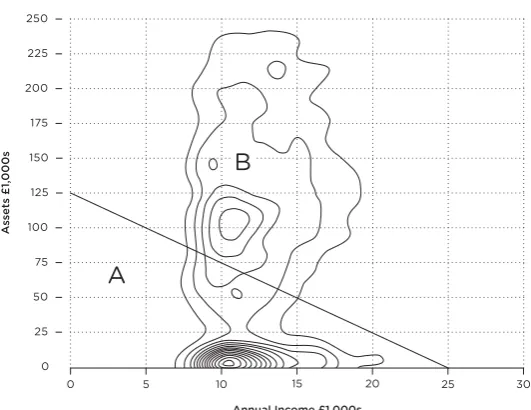
[image:39.340.40.306.78.283.2]Figure 2 illustrates how our proposed, simplified means test would work by showing the distribution of people affected in proportion to those individuals’ income and assets. As with figure 1, this assumes an annual care home tariff of £25,000 per year. People falling inside the solid line (region A) qualify for means tested support and those outside do not (region B). The graph also demonstrates how different groups would be affected Figure 2 Simplified means test with contours showing
by our proposed means test, with contours showing
concentrations of people aged over 65 in different parts of the income–asset spectrum.
The concentration at the foot of the chart between the £8,000 and £15,000 income brackets represents people with assets of less than £25,000 and income of about £10,000. This group mostly comprises non-home owners. A second
concentration includes people with assets of over £100,000 and an income of around £10,000. This group consists mostly of home owners. In total, there are about 3.4 million individuals age over 65 in region A, who would be eligible for some state support from the outset, and 8.3 million in region B – some of
whom may need support at a later stage in their care cycle.37
The simplified means test in practice
Figure 3 illustrates how our simplified means test would work in practice. This shows the percentage of costs that would be met
by the state based on the number of years of care afforded.38
Those who are able to afford care for a higher number of years – through a combination of their assets and income – receive less support, while those who can afford care for fewer years receive more support.
For example, people who could afford up to one year of care are in band A. This group receives between 80 per cent and 100 per cent of their care costs. Those who could afford to pay for care for between one and two years are in band B. This group receives 60 per cent to 80 per cent of their care costs. Those who can afford to pay for care for between two and three years are in band C and receive between 40 per cent and 50 per cent of care costs – and so on. Anyone who can afford five years of support or more receives no support with their care costs until their income and assets are depleted such that they fall into one of the bands on the graph.
Recommendation 2
based on establishing how many years of care individuals could afford, through a combination of their assets and income.
Under the Government’s proposed means test, entitlements are set to be recalibrated each year as people’s financial circum-stances change. We do not propose changing this. Therefore, under our proposed means test it is likely that from one year to the next, people may move from one band of support into another, gaining more support over time as their wealth diminishes.
Box 3 Example: Recalibrating support under our
simplified system
Through a combination of her income and assets, an individual can afford between two and three years of care. This means that she is placed in band C and receives between 40 per cent and 50 per cent of care costs that year.
The following year her entitlements are
[image:41.340.39.304.66.222.2]recalibrated, to take account of the fact that she has been paying for care costs over the course of that year. Because her combined income and assets are now lower Figure 3 Simplified means test showing the levels of support for
than a year ago, she can now afford between one and two years of care, rather than between two and three, so she is placed in band B and has 60 per cent to 80 per cent of her care costs covered by the state during that year.
After a year her entitlements are recalibrated again to reflect her financial position.
Overall, we anticipate that under our reformed system the costs to the taxpayer would be roughly equivalent to those arising from the Government’s proposed means test. Any variation could also be adjusted by using different tapers. However, within this spending envelope, our simplified formula would provide less state support in the early years of care and more support in later years as a consequence of eliminating the cliff edges in the Government’s proposed system. This would fit with the overall principles of the Dilnot review and the Care and Support Bill, which are to continue to support those who have little, but to provide greater protection for those who end up facing higher costs.
How our simplified means test would work over time
Table 1 provides an example of how our simplified means test would work over time. It is designed to show the financial costs to an individual and the state of a typical person who enters a care home and is initially self-funding. We assume a tariff made up of £12,000 care costs and £13,000 living costs. The individual begins with £100,000 of savings and £10,000 income, so can afford 6.7 years of care and is not entitled to any support.
£41,852 – assets at the start of the year less £3,951 leaving £37,901 in this example.
The table illustrates three important points:
Table 1 Care cost progression over a six-year cycle up to the cap
including the depletion of assets, state support and out-of-pocket costs
Year in Cumulative Assessable State Cost to Contribution care care capital at support (£) individual to cap (£)
payments start of care (£)
(£) year (£)
1 25,000 100,000 - 25,000 12,000
2 50,000 85,000 - 25,000 24,000
3 75,000 70,000 1,667 23,333 36,000
4 100,000 56,667 6,111 18,889 48,000
5 125,000 47,778 9,074 15,926 60,000
6 150,000 41,852 11,049 13,951 72,000
Total 27,901 122,099
· Because accommodation costs are not included in the Government’s £72,000 care cap, costs to the individual can mount up considerably even with a cap in place. The individual in this example pays more than £122,000 in total – including accommodation costs – before the cap kicks in, leaving them liable for ongoing accommodation costs.
· It is likely to take several years for many people to reach the cap in practice – six years in the case of this individual.
· The pace of depletion of assets – though high in the early years – gradually tails off.
A final and crucial point to note in light of these features of the means test is that the average life expectancy in residential care
is around two and a quarter years.39This explains why only a small
Fair treatment of assets and income
A further positive feature of our simplified means test is that it would neither favour income nor savings. This contrasts with the Government’s proposed means test, which favours assets over income. Table 2 demonstrates this through three hypothetical examples – persons A, B and C – and assumes care costs of £25,000 a year.
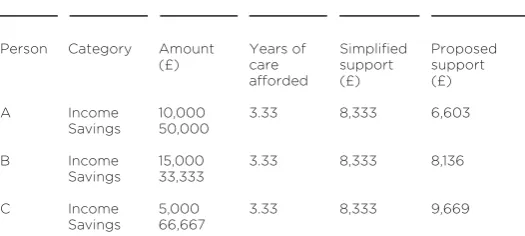
Person A has £50,000 of savings and £10,000 income per annum. He can notionally afford 3.33 years of care, based on total care costs including care itself and ‘hotel costs’ of £25,000. Person B has £33,333 of savings and £15,000 income per annum. He can also notionally afford 3.33 years of care out of pocket. Person C has £66,667 of savings and £5,000 income per annum. She can also notionally afford 3.33 years of care out of pocket.
[image:44.340.51.314.92.210.2]Table 2 shows that the Government’s proposed system unfairly favours people with large savings above people with higher incomes because it delivers more state support to person C than to person A, even though the two can afford the same number of years of care. Our simplified means test would eradicate this problem, delivering the same level of support to persons A, B and C because money gained from assets and income is treated equally. There is no formula to ‘translate’ a Table 2 The amount of state support delivered by the simplified
and proposed means test for three people of equal wealth
Person Category Amount Years of Simplified Proposed
(£) care support support
afforded (£) (£)
A Income 10,000 3.33 8,333 6,603
Savings 50,000
B Income 15,000 3.33 8,333 8,136
Savings 33,333
C Income 5,000 3.33 8,333 9,669
given amount of income per annum into a given amount of assets; instead our simplified system simply calculates how many years people could notionally afford, by adding together assets and income.
In our system state support gradually increases as the total figure – based on a combined figure for assets and income – declines as people run down their assets to pay for their own care. Table 3 summarises the differences between the
Government’s proposed means test and our simplified system.
Chapter summary
The means test proposed by the Government in response to the Dilnot recommendations risks discouraging forward planning because of the in-built complexity that arises from the
combination of various thresholds, cliff edges and the formula to convert assets into income for the purposes of assessing
eligibility. There is a risk that this level of complexity will lead to fatalism and inertia, rather than forward planning.
We propose a simplified means test, which would go a long way to making it easier for people to plan ahead. Our simplified system, which we believe would be no more costly to the taxpayer than the Government’s proposed system, would be based on the number of years an individual could afford through Table 3 The Government’s proposed means test compared with
our simplified system
Proposed government means test Our simplified system
Cliff edges and thresholds Consistent taper
Formula to convert income into Income and assets added together to
assets establish years of care afforded
Favours assets over income Assets and income treated equally
a combination of their assets and income. Each individual’s financial position would then be reassessed each year, and this approach would be adaptable for domiciliary and institutional care purposes with certain important differences such as the treatment of housing assets.
3
Rewarding contribution
If more people are to plan ahead for the costs of social care then they must first understand their liabilities so they are in a position to assess their options. However, there is a risk that equipped with this information people will simply choose to do nothing at all – or, worse, to deliberately run down their assets. This is because, through the means test, the state offers a safety net as a funder of last resort. This chapter argues that:
· the means test creates the risk of ‘moral hazard’: people may choose to let the state cover the costs of their care rather than provide for themselves
· there should be stronger incentives for self-funding
· encouraging a new generation of self-funders would produce a saving for the taxpayer
· the Government should perform a cost-benefit analysis of the two policy options set out in the chapter, which are designed to encourage more self-funding
Care funding shortages
One of the problems that the Dilnot review was set up to address was the shortfall in funding for social care, illustrated in figure 4, which shows demand for care growing at a faster rate than funding. Between 2005/06 and 2009/10 demand for social care outstripped funding by 9 per cent. This funding gap goes some way to explaining the problems with standards in the care sector. When the same resources are spread over a larger number of people, it is always likely that standards will drop.
identified failings judged to put the vulnerable at risk.41More
than 900 notices were issued by the CQC over the course of a
year, an increase of 43 per cent from the year before.42Such
figures, alongside some high profile cases of abuse and neglect, have filtered through into the public consciousness. Demos research has revealed overwhelmingly negative perceptions of residential care, with only a quarter of adults saying they would consider moving into a care home if they became frail in
old age.43
Experts in the sector warn against attempting to ‘provide care on the cheap’, and in 2013 the director general of Saga Group observed, ‘We have a crisis in the care home sector, with staff on minimum wage pay delivering minimal care, rather than
the decent and dignified care that people deserve.’44These
[image:49.340.37.306.51.279.2]sentiments were echoed by various stakeholders in the research for this report. Local authority officers expressed concerns about Figure 4 Expenditure and demand in social care for the elderly in
the UK, 2005/06–2009/10
the growing proportion of local authority funding being taken up by social care provision and the difficulty of achieving quality standards when faced with such demand. One senior politician summarised the problem by suggesting that people would not be willing to see their own parents treated in many care homes.
Dilnot’s answer to the problem of underfunding was to create a system with a higher proportion of self-funders and a smaller proportion of people reliant on state funding:
It is our expectation that our reforms will be an important step in delivering higher quality services overall. Our proposals should lead to a better resourced system, in which people are less fearful of the future, feel able to spend their money more effectively and can manage their care as best suits them.45
The mechanism to create a better resourced system is the care cap, which Dilnot believed would enable and encourage people to plan ahead by clarifying their responsibilities. The Dilnot report describes the proposal for a care cap as ‘a type of social insurance policy, with a significant “excess” that people
will need to cover themselves’.46In some ways this is a fair
description, in that the cap does pool risk, in an attempt to protect people from contingencies outside their control.
However, unlike most insurance policies, the post-Dilnot system contains no formal incentives for people to contribute because those who have nothing or relatively little in the way of assets or income will receive state support under the means test. Under the proposed reforms state support will be available for those entering residential care with assets of £118,000 or less, while anyone with less than £17,000 in assets will have their care
paid for entirely.47
Moral hazard
There is no benefit to the individual of planning ahead unless they have income or assets well above the means test threshold, because saving or insuring for care costs means that the individual does not benefit from state support.48
In practice, people could choose to run down their assets in order to ensure qualification for the means test, or fewer people might take active steps to ensure that they have the means to cover care costs in old age. One local authority official argued, ‘It is our job to look after the most vulnerable, but we have to get better at persuading the rest to put money aside. That’s the difficulty with the means test.’
The Government recognises this problem in the current system. As the official statement on funding reform, issued in February 2013 put it, ‘There are large incentives in the current system for people who would otherwise not receive financial support to hide their assets to gain access to government
support.’49The document sounds a note of optimism that
the care cap will ‘make it more likely that people would pay their fair share’ but the reality is that the care cap does little to change the situation of those close to the means test threshold. In discussions for this project, a representative from a charity for social care users warned that ‘a market has sprung up in terms of companies peddling trusts to avoid long-term care fees’.
The social care system already contains measures designed to prevent people from intentionally running down their assets in order to qualify for the means test. The rules stipulate that if someone is judged to have done this deliberately to avoid care costs councils are permitted to treat that person as if they still owned the assets. However, financial advisers engaged in this project described this as a ‘grey area’. Equally, Age UK guidance published in April 2013 on the deprivation of assets and the means test explains that the organisation ‘continues to work to
clarify the rules’50– suggesting the rules are hardly watertight.
Where the rules are clearer it is evident that low-level spending, planned in advance, would not constitute a breach of the rules. For example, the Department of Health guidance states that in regard to capital
it would be unreasonable to decide that a resident had disposed of an asset in order to reduce his charge for accommodation when the disposal took place at a time when he was fit and healthy and could not have foreseen the need for a move to residential accommodation.51
In interviews for this project, government officials expressed greater concern about inaction than the deliberate deprivation of assets. As one put it:
The rules we have should be enough to stop people playing the system. The bigger worry is that people won’t do anything at all... they will drift along and end up relying more on the Government than they should do.
Clearly it is likely that large numbers of people will simply be less inclined to make sacrifices over a long and indeterminate period of time when they know that local authorities will fund their care if necessary. Low-level awareness that the government is the funder of last resort will add to the risk of inertia described in previous chapters.
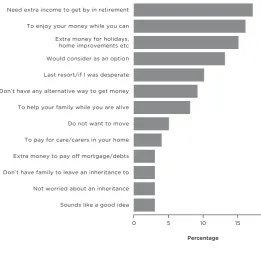
This attitude is demonstrated in the responses given to a survey in 2012 by Just Retirement (figure 5). Of those who said that they are interested in equity release products, just 4 per cent said that the purpose of releasing equity would be to pay for care in old age. Under the current system, at least, there is little expectation that people will draw on their assets to cover care costs.
Incentives for forward planning
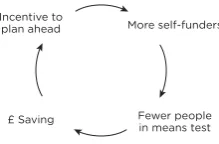
more thinly than need be the case. The challenge, then, is to find the best way to offset the risk of moral hazard with a stronger incentive for people to make provision to pay for their own care. To meet this risk of moral hazard, the Government should explore ways to encourage and reward those willing to take steps to guard against the costs of care in later life. The aim should be to create a virtuous circle, in which more people are encouraged to self-fund, reducing the number of people falling into the means test, and thereby freeing up resources to reward thrifty and responsible forward planners (figure 6).
Figure 5 Reasons for expressing an interest in equity release
In our interviews for this report industry figures, third sector groups and government officials all recognised the potential for such incentives. There was a consensus that incen-tives should fulfil two essential criteria. First, any new incentive
should encourage an outcome– self-reliance – rather than a
methodof paying for care. A representative of one consumer group warned, ‘Government should avoid favouring particular products individuals and their families are best placed to make those decisions. People need the right information, not someone telling them which route to go down.
Second, new policies should work to minimise ‘dead-weight’ costs. One Whitehall official commented: ‘You don’t want to be throwing money at people to reward them for things they are likely to do anyway. If there’s going to be an incentives for people to self-fund, you want it to actually change behaviour.’ An incentive for forward planning should reward those who are thrifty and responsible – but also encourage more people to demonstrate those virtues.
[image:54.340.88.198.86.158.2]for people to make commitments ahead of time. The aim would be to use the mechanism of ring-fencing alongside the offer of an incentive, in order to produce a higher number of self-funders.
Option 1 The savings model
The first of the two options that government should explore is a savings model. This would involve the Government creating a new legal mechanism, ‘care accounts’, through which people could put funds aside specifically to cover the costs of care in later life. People would be given the option of committing portions of their current wealth – in the form of savings, housing equity or a combination of both – into care accounts. Savings could be transferred to care accounts through a simple bank transfer; housing equity would be stored in the accounts through a legal charge on their home.
The funds stored in these care accounts would be reserved specifically for covering care costs, in such a way that access to the amount pledged would then be triggered following a care assessment. In this way, government would know that people were setting money aside for their part of the bargain up to the level of the care cap, reducing the risk of people relying instead on support through the means test. The incentive for people to ring-fence funds in these care accounts would be that a
proportion of the funds in the account would be disregarded in calculations for the Government means test for care costs.
An important feature of care accounts would be a set a deadlines in people’s lives. For example, there could be a dead-line that people could no longer add funds to the care account once they have reached age 70. The purpose of preventing people from adding money or equity to the account after the deadline would be to provide a spur to action, rather than allowing people to drift along and inertia to take hold. The deadline would also serve to reduce deadweight costs, by preventing people from sheltering assets in care accounts immediately prior to care needs. The aim is to encourage forward commitments and therefore increase self-funding, not simply to subsidise everyone. Should care costs never arise, the
Government would have no claim on the money stored in the care accounts. The accumulated value of the person’s care account would go into their estate.
The deadline would also have implications for people withdrawing money from care accounts, for example in the case of a financial emergency. Until the deadline, people would be able to withdraw money or equity from care accounts at any point, without any consequences. After the deadline the funds contained in the account would be committed to meeting social care costs. Anyone seeking to withdraw funds from the account would be subject to a financial charge or penalty. The purpose of this arrangement would be to encourage people to leave funds in the accounts to cover care costs, having made a commitment to do so, but still leave them with enough flexibility to cope with crises. In setting the level of the penalty, the Government would need to ensure that the flexibility built in for personal financial emergencies would not undermine the need for the ring-fence to be a meaningful commitment for the vast majority of people taking up the option.
on other things. This implies that simply getting people to place money or housing equity into care accounts should be half the battle. The financial incentives associated with the account would matter, but so too would the effect on the way people would come to think about their savings.
Box 4 Mental accounting
The term mental accounting describes the way in which people mentally apportion money for different sorts of spending in their lives. For example, people create budgets for different categories of spending, such as food, travel and entertainment. Academics at Princeton University have identified that when people spend over their assigned budget in one area of spending, they tend to claw back savings in that area rather than make up the ground through lower expenditure in a different category.53
Policy makers in the UK are now beginning to explore what this insight means for policies dealing with welfare and saving. For example, the Department for Work & Pensions (DWP) has been exploring the potential for ‘jam jar’ accounts, which enable people to place either wages or welfare payments into different accounts for different purposes. Such accounts could encourage people to account mentally for portions of their income as being ‘rent money’, even if in practice they are free to spend it as they choose to.54
Box 5 Loss aversion
Loss aversion occurs when people experience more pain from losses than they experience pleasure from
equivalent gains. For example, studies have shown that people typically ask for higher prices when selling a
good than they are willing to pay when buying it.55
Similarly, people demonstrate reluctance to enter into 50/50 bets, suggesting that the risk of the pain outweighs the equally likely prospect of gain.
Policy makers are increasingly interested in how to apply this idea. For example, in the US researchers found that school results improved when teachers were paid bonuses in advance – with schools asking for them back only when results were not achieved. This type of incentive had a greater effect than traditional performance bonuses, which were paid only after goals had been achieved.56
An important feature of care accounts is the potential to ring-fence savings, housing equity, or a combination of both, up to the level of the cap. At any point, people would have the option of switching housing equity for savings in the account, or vice versa. This would be a major step forward in encouraging people to start to think through how to use all of their assets and income, as a package, to cover the costs of care in later life.
Should people move house they would be able to reassign portions of housing equity in their new homes, making the care accounts ‘portable’ from one home to the next. For example, should an individual owning a house worth £200,000 decide to ring-fence £25,000 of housing equity and subsequently downsize to a house worth £150,000 they would have two options: to exchange the fenced housing equity worth £25,000 for ring-fenced cash to the same value, or to continue to ring-fence £25,000 worth of equity in their new home.