City, University of London Institutional Repository
Citation
:
Bowman, C. and Cox, A. (2014). Decomposition numbers for Brauer algebras of type G(m,p,n) in characteristic zero. Journal of Pure and Applied Algebra, 218(6), pp. 992-1002. doi: 10.1016/j.jpaa.2013.10.014This is the unspecified version of the paper.
This version of the publication may differ from the final published
version.
Permanent repository link:
http://openaccess.city.ac.uk/2405/Link to published version
:
http://dx.doi.org/10.1016/j.jpaa.2013.10.014Copyright and reuse:
City Research Online aims to make research
outputs of City, University of London available to a wider audience.
Copyright and Moral Rights remain with the author(s) and/or copyright
holders. URLs from City Research Online may be freely distributed and
linked to.
TYPE G(m, p, n) IN CHARACTERISTIC ZERO CHRISTOPHER BOWMAN AND ANTON COX
Abstract. We introduce Brauer algebras associated to complex reflection groups of typeG(m, p, n), and study their representation theory via Clifford theory. In particular, we determine the decomposition numbers of these algebras in characteristic zero.
Introduction
The symmetric and general linear groups satisfy a double centraliser property over tensor space. This relationship is known as Schur–Weyl duality and allows one to pass information between the representation theories of these algebras. The Brauer algebra was defined to play the role of the symmetric group algebra in a Schur–Weyl duality with the orthogonal (or symplectic) group.
The original definition of the Brauer algebra has been generalised in many directions (see for example [BW89, HO01, CFW09, CLY12, Tur89, Koi89]). In this paper we regard the classical Brauer algebra,Bn(δ), as an enlargement of
the symmetric group algebra; in other words it corresponds to an enlargement of a complex reflection group of type G(1,1, n). By considering analogous en-largements of other complex reflection groups, we arrive at the Brauer algebras of typeG(m, p, n).
The type G(m,1, n) case was studied in [BCD13], where the decomposition numbers for these algebras are calculated by a reduction to the typeG(1,1, n) case. In this paper we study the Brauer algebras of type G(m, p, n). Using a combination of diagram algebra techniques, Clifford theory, and Brauer– Humphreys reciprocity, we calculate the decomposition numbers of these al-gebras.
We begin in Section 1 by defining the Brauer algebras, Bm,p,n, of type
G(m, p, n) and realise the algebra of type G(m,1, n) as a skew group algebra. This will allow us to apply the methods of Clifford theory. We then review the basic representation theory of complex reflection groups which is both required for and motivates the results that follow.
In Section 3 we begin to study the representation theory of the Brauer alge-bras of type G(m, p, n). We deduce when the algebra is quasi-hereditary and give explicit constructions of the standard modules. We then apply Clifford theory to deduce restriction rules for standard, simple, and projective mod-ules. We briefly consider restriction to the underlying group algebra using Littlewood–Richardson theory.
2000Mathematics Subject Classification. 20C30.
Using Clifford theory and the fact that Hom-spaces forBm,1,nhave nice
rota-tional symmetries, we are able to decompose Hom-spaces forBm,p,n. Combining
these results and Brauer–Humphreys’ reciprocity, we conclude by determining the decomposition numbers ofBm,p,n in terms of those for the classical Brauer
algebra (which have been given in terms of Kazhdan–Lusztig polynomials by [Mar]).
1. Brauer algebras of type G(m, p, n)
We fix k, an algebraically closed field. Let m, p, n∈N be such thatpd=m
for some d∈ N. In this section we will define the Brauer algebras, Bm,p,n, of
type G(m, p, n). We shall show that the Brauer algebra of typeG(m, p, n) is a subalgebra of that of typeG(m,1, n) introduced in [BCD13, Appendix] (where it was called the unoriented cyclotomic Brauer algebra).
1.1. Definitions. Given n ∈ N and δ = (δ0, δp, δ2p, . . . , δ(d−1)p) ∈ kd, the Brauer algebra of type G(m, p, n), denoted by Bm,p,n, is a finite dimensional
associative k-algebra generated by certain Brauer diagrams. A diagram con-sists of a frame with n distinguished points on the northern and southern boundaries, which we call nodes. Each node is joined to precisely one other by a strand; strands connecting the northern and southern edge will be called
through-strands and the remainder (northern or southern) arcs. There may also be closed loops inside the frame, those diagrams without closed loops are called reduced diagrams.
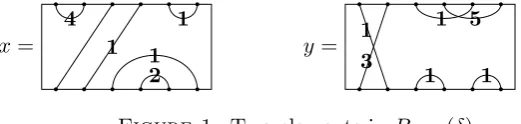
Each strand is labelled by an element of the cyclic group Z/mZ; we require the additional restriction that the total sum over the labels is a multiple of p. When drawing diagrams we will adopt the convention that unlabelled arcs have label 0. Two diagrams are equivalent if the strands connect the same pairs of nodes and have the same labels. As a vector space,Bm,p,n is the k-span of the
reduced diagrams. Figure 1 gives an example of two such elements inB(6,3,6).
x= 4
1 2 1
1
y=
1 1
5 1 1
[image:3.595.158.419.499.561.2]3
Figure 1. Two elements in B6,3,6(δ)
Given x, y∈Bm,p,n, we define the product x·y to be the diagram obtained
by concatenation of xabove y, where we identify the southern nodes ofx with the northern nodes of y and then ignore the section of the frame common to both diagrams.
The label of each strand, s, in the concatenated diagram, is then the sum of the labels of the strands from which it is composed. The product of two diagrams may contain a closed loop: if this loop is labelled by ip∈Z/mZthen the diagram is set equal to δip times the same diagram with the loop removed;
Example 1.1.1. The productx·y of the elements in Figure 1 is given in Figure 2. The product y2 = 0 as it results in the removal of a closed loop labelled by 2 (when reduced mod 6), which is not divisible by 3.
4 1
2 1
1
1 1
5 1 1
3
= δ3
1 4
4 1 1
[image:4.595.176.401.143.242.2]1
Figure 2. The productx·y
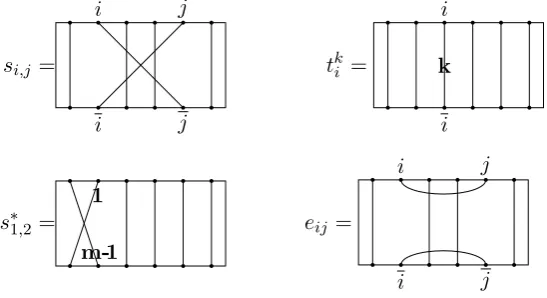
We will need to speak of certain elements of the algebra with great frequency. The elementssi,j,tki,s∗i,j, andei,j (fori, j≤n) are indicated in Figure 3, where
the nodes are numbered in increasing order from left to right by 1 up ton on the northern edge, and ¯1 up to ¯non the southern edge.
si,j =
j
j i
i
tki =
i
i
k
s∗1,2 = 1 m-1
eij =
j
j i
i
Figure 3. The elements si,j,tki, and s
∗
i,j andei,j
Remark 1.1.2. The p = 1 case was first studied in the Appendix to [BCD13]. There it is christened the un-oriented cyclotomic Brauer algebra; this alge-bra is not the (oriented) cyclotomic Brauer algealge-bra studied (for example) in [HO01, AMR06, GH09, RX07, RY04, Yu07]. Both the oriented and un-oriented cyclotomic Brauer algebras are specialisations of the BMW algebra. However, it is only the un-oriented algebra which has a family of subalgebras which can be studied by analogy with the complex reflection groups of typeG(m, p, n). 1.2. Clifford theory I. Consider the algebra Bm,1,n, as defined above. Let
p|m and specialise the parameter δ∈km so that δi is zero for any index ithat
is not congruent to zero modulop, i.e. take
[image:4.595.150.424.347.496.2]Take the subspace of Bm,1,n (with parameter as above) spanned by all
dia-grams whose labels sum to a multiple ofp. Multiplication is inherited from that in Bm,1,n; our choice of parameter ensures that any closed loops removed are
labelled by a multiple of p(otherwise the product is zero) and therefore the di-agram obtained by their removal still lies in the same subspace. Therefore this subspace is in fact a subalgebra, and is clearly isomorphic toBm,p,n.
Through-out this paper, we shall only consider Bm,1,n for the parameter as above.
LetZ/pZact via thek-algebra automorphism ofBm,1,n given by conjugation
by td
1. This mapsBm,p,n onto Bm,p,n. We have the following theorem.
Theorem 1.2.1. The algebra Bm,1,n (with parameter δ as above) is the skew group algebra
Bm,1,n=Bm,p,no Z/pZ=
X
z∈Z/pZ
dzz:d∈Bm,p,n
with linear multiplication given by the concatenation action: zd= (zdz−1)z.
Proof. This is similar to the the group algebra case. The natural diagram basis of Bm,1,n can be partitioned into p distinct sets, B0, B1, . . . ,Bp−1, (of
equal cardinality) each consisting of the diagrams whose sum over the labels is congruent to 0,1, . . . p−1 modulo prespectively. The algebraBm,p,n has basis
given by B0, as seen above.
Left and right multiplication by t1 both define bijections from Bi to Bi+1.
Using this to rewrite diagrams as ti1d0 or as d00tj1 for some d0, d00 ∈ B0, one can
check that the multiplication onBm,p,noZ/pZis equivalent to the multiplication
on Bm,1,n (with δ as above).
This result means that we will later be able to apply methods from Clifford theory (see [RR85, Section 1]).
1.3. Generators for subalgebras. Just as for the Brauer algebra, it follows from the definitions that Bm,1,n is generated by si,i+1, t1 and e1,2. The group
algebra of typeG(m, p, n) can be identified with the subalgebra ofBm,1,n
gener-ated bys∗1,2, si,i+1andt1p; forn >2 the subalgebraBm,p,n ofBm,1,nis generated
by s∗1,2, si,i+1,t1p and e1,2 for 1≤i≤n−1.
1.4. Cyclotomic parameters. We have defined the algebra Bm,p,n in terms
of δ = (δ0, δp, . . . , δ(d−1)p) ∈ kd. It is shown in [BCD13] that the following
cyclotomic functions of these parameters govern the representation theory of the algebra Bm,1,n under the assumption thatm is invertible in k.
Definition 1.4.1. For each 0≤r ≤d−1 we define therth cyclotomic parameter to be
δr=
1
m
d−1
X
i=0
ξiprδip.
2. Reflection groups of type G(m, p, n)
We have already assumed thatk is an algebraically closed field. Henceforth we shall also assume that kis of characteristic zero and we shall fix ξ ∈k×, a primitivemth root of unity. The group algebra of the complex reflection group,
G(m,1, n), is theskew group algebra
G(m,1, n) =G(m, p, n)o Z/pZ,
this comes from taking the semidirect product of the two groups. We shall study G(m, p, n) via Clifford theory. The results in this section can be found in [MM10, Section 2.3].
2.1. TypeG(m,1, n)combinatorics. A partition is a finite weakly-decreasing sequence of non-negative integers. An m-partition of n is an m-tuple of par-titions λ = (λ0, . . . , λm−1) such that Pm−1
i=0 |λi| = n (where |λi| denotes the
sum of the parts of the partition λi). We let Λ(m,1, n) denote the set of all
m-partitions of n−2l for l≤n/2; we let Λ0(m,1, n) denote the subset where l= 0.
Letλ be an m-partition of n. A λ-tableau is a bijection t :λ→ {1,2..., n}, which we consider as an m-tuple t = (t0, . . . ,tm−1) of labelled tableaux where
ts is aλs-tableau for eachs; the tableauxts are the components oft. We say a tableau, t, isstandard if the entries in the component tableaux are increasing along the rows and columns. We letTλ denote the set of standardλ-tableaux. Forta tableau, we sett(i) =sif the integeriappears ints. Let 1≤i < j ≤n, we define the axial distance,a(i, j), as follows: if t(i) 6=t(j) then a(i, j) = ∞ (so that 1/a(i, j) = 0); if t(i) = t(j) andi occurs in row i0 and columni1 and
j occurs in rowj0 and columnj1, thena(i, j) = (i0−i1)−(j0−j1).
If t is a λ-tableau and w ∈ Σn let wt be the tableau obtained from t by
replacing each entry int by its image under w. Lett∈ Tλ, we setti↔i+1 equal
tosi,i+1t if this is still a standard λ-tableau, and 0 otherwise.
Proposition 2.1.1. The algebrakG(m,1, n)has simple modules indexed by the posetΛ0(m,1, n). For a given m-partition λ of n, the simple module S(λ) has
a basis given by the set of standard λ-tableaux. With respect to this basis the generators act as follows
ρλ(t1)t=ξt(1)t, ρλ(si,i+1)t=
1
a(i, i+ 1)t+
1 + 1
a(i, i+ 1)
ti↔i+1
2.2. TypeG(m, p, n)combinatorics. Letpd=mand letσbe a distinguished generator ofZ/pZ. There is a natural action of the cyclic group Z/pZ on the poset Λ(m,1, n) given by permutation of the indices. This extends to an action on tableaux by setting
For λ∈Λ(m,1, n) let Stab(λ) denote the stabiliser of λunder the permuta-tion acpermuta-tion. We have StabZ/pZ(λ) =hσ
tiand 0≤r < p/t. We let Λ(m, p, n)
de-note the set of pairs consisting of a representative of aZ/pZ-orbit on Λ(m,1, n) and an integer 0≤r < p/t. We let Λ0(m, p, n) denote the subset where l= 0.
Example 2.2.1. We have that Λ(2,1,2) = {(∅,∅),(∅,2),(∅,12),(2,∅),(12,∅)}. There is a unique element, (∅,∅), with non-trivial stabiliser hσ1i = Z/2Z. Therefore Λ(2,2,2) has four elements and (picking a set of orbit representa-tives) is equal to the set{(∅,∅)0,(∅,∅)1,(2,∅),(12,∅)}.
2.3. Simple modules for G(m, p, n). We now give the construction, via Clif-ford theory, of the simple modules for G(m, p, n). We do not go into much detail here, and instead refer to [MM10].
Simple modules forG(m, p, n) are labelled by a representation of Stab(λ)≤ Z/pZ (given by an integer 0 ≤ r < p/t) and a representation of G(m,1, n) (given by an m-partition). Recall that Stab(λ) = hσti ≤ Z/pZ. By Clifford theory, we have that S(λ)↓=⊕0≤r<p/tS(λr), where
S(λr) = ker(σt−ξdtr)S(λ) for 0≤r < p/t. We let
pr =
t p
X
0≤i<p/t
ξ−idtrσit
denote the projection onto this subspace.
Take as representatives of the hσti-orbits the t ∈ T0
λ where Tλ0 is the set of
standard λ-tableaux with t(1) < td. Take the subspace spanned by tableaux in T0
λ and apply the projectionpr, this provides a basis of S(λr) (in the case
that r = 0 this is the average of the hσti-orbit). Setting tr = pr(t), we then
get formulae for the action of the generators of G(m, p, n) on S(λr) as follows:
ρλ(t)pr=pr+1ρλ(t), and so
ρλ,r(tp)tr=ξprt(1)tr, ρλ,r(s∗1)tr =ξr(t(1)
−t(2))ρ
λ,r(s1)tr,
ρλ,r(si)tr=
1
a(i, i+ 1)t
r+
1 + 1
a(i, i+ 1)
tri↔i+1.
3. Brauer algebras of type G(m, p, n)
Unless otherwise stated, let k denote an algebraically closed field of charac-teristic zero. Fixξto be a primitivemth root of unity. In this section we study
Bm,p,n via Clifford theory. By verifying the first two conditions of a tower of
3.1. Highest weight theory. Letn ≥2. Suppose first that δ 6=0 ∈ kd and
fix a δip 6= 0 for some 0 ≤ i < d. We then define the idempotent en−2 = 1
δipt ip
n−1en−1,n as illustrated in Figure 4. Note that it is a scalar multiple of a
diagram withn−2 through-strands. Ifδ= 0 andn≥3 then we defineen−2 to
be the idempotenten−1,nen−2,n−1, as illustrated in Figure 4.
1
δip
[image:8.595.149.425.172.224.2]ip
Figure 4. The idempotent en−2 (for n = 6) in the cases that δ 6= 0,δ = 0 respectively.
A tower of recollement was defined in [CMPX06] to be a family of algebras (with idempotents) satisfying six conditions (A1–6). It is easy to see that
(3.1.1) en−2Bm,p,nen−2∼=Bm,p,n−2
and that
(3.1.2) Bm,p,n/Bm,p,nen−2Bm,p,n ∼=kG(m, p, n).
For the latter isomorphism, note that the lefthand-side has a basis consisting of the diagrams with no arcs. Therefore we have the following
Theorem 3.1.1. Let k be a field of characteristic cha(k) ≥0. Let m, n ∈N, and δ ∈ km. If n is even suppose δ 6= 0 ∈ km. The algebra Bm,p,n(δ) is quasi-hereditary if and only ifcha(k)> n and cha(k)6 |m, or cha(k) = 0.
We leave it to the reader to verify the remaining tower conditions using classical tower arguments (see [CDDM08], [CDM09]) and Clifford theory.
3.2. The standard modules of Bm,1,n. Recall our assumption on the
pa-rameter δ ∈ km from Section 1.2. By [BCD13, Theorem 3.1.2], the algebra
Bm,1,n is an iterated inflation of the group algebrasG(m,1, n−2l) along vector
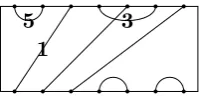
spacesVl spanned by all possible (m, n, l)-tangles. An (m, n, l)-tangle haslarcs
denoted by (ip, jp) (forp= 1, . . . , l) where ip (resp. jp) is the left (resp. right)
vertex of the arc, andn−2lfree lines. Each arc has a label given by an element
r∈Z/mZ. For example a (5,7,2)-tangle is depicted in Figure 5. 1 3
Figure 5. A (5,7,2)-dangle
We therefore have the following theorem:
Theorem 3.2.1.The algebraBm,1,n has standard modules indexed byΛ(m,1, n). For a givenm-partition, λ, of n−2l, we have the standard module
The action of a diagramX ∈Bm,1,nonv⊗x∈∆(λ) is given as follows. Apply
the diagram X to the (m, n, l)-tangle v. If we obtain more than l arcs, or a closed loop labelled by an integer not divisible byp, this element is sent to zero. Otherwise, we obtain another (m, n, l)-tangle Xv and a signed permutation
σ ∈G(m,1, n−2l) on then−2lfree vertices of Xv, we then defineX(v⊗x) = (Xv)⊗σx.
3.3. Standard modules for Bm,p,n. By (3.1.1) and (3.1.2), we have that the
standard modules for Bm,p,n are of the form
∆n(λr) = (Bm,p,n/(Bm,p,nen−2l−2Bm,p,n))en−2l⊗Bm,p,n−2lS(λ r).
This module is spanned by the elementsd⊗Bm,p,n−2ltrwheretr∈S(λr) and
d∈Bm,p,nwith precisely (n−2l) through-lines. By taking elements ofBm,p,n−2l
across the tensor product we can just consider diagrams dwith (a) no crossing through-lines (b) only the leftmost through-line has a non-zero label, (c) this label, q, is strictly less than p (as any diagram d0 ∈ Bm,p,n can be written as
a product d0 = dσ for σ ∈G(m, p, n) and d of the required form). Of course, these diagrams must still be elements of Bm,p,n and so the northern arcs of
the diagram must have labels totalling p−q modulo p. Figure 6 contains an example for typeG(6,3,7).
5 1
[image:9.595.244.344.352.402.2]3
Figure 6. A diagram of typeG(6,3,7) satisfying condition (a),
(b), and (c), above.
One can then pass the decoration on the left-most strand through the tensor product by noting thatt1tr=tr+1 and thattp/t1 tr=tr, by construction. Define Vl(q, p/t) ⊂ Vl to be the subspace of dangles whose label sum is congruent to
−q modulo p/t.
Theorem 3.3.1. The algebraBm,p,nhas standard modules labelled byΛ(m, p, n). For λr ∈Λ(m, p, n), we have that
∆n(λr)∼={v⊗x:v∈Vl(q, p/t), x∈S(λq+r),0≤q < p/t}
Example 3.3.2. The modules ∆((1,0,1,0)0) and ∆((1,0,1,0)1) for B4,4,4 are
both 24-dimensional. Let t denote the unique element of T0
(1,0,1,0) and let v
be the dangle with a single undecorated arc (1p,2p). Some typical elements of
∆((1,0,1,0)0) are
v⊗t0, t21v⊗t0, t1v⊗t1, t31v⊗t1,
and some typical elements of ∆((1,0,1,0)1) are
v⊗t1, t21v⊗t1, t1v⊗t0, t31v⊗t0.
3.4. Clifford theory II. We will use Clifford theory techniques to give the decomposition of the restriction of a standard, simple, or projective module fromBm,1,n toBm,p,n.
3.4.1. Standard modules. Let (ip, jp) and (iq, jq) be two arcs inv with
annota-tionsl and k, respectively. We let l,ip denote the Kronecker delta which is 1
or 0 ifl=ip for some 0≤i < d, or not, respectively. We writei6∈v ifilabels a free line inv. Finally, note that there arennodes on the top of a dangle and
n−2lon the bottom of a dangle. If theith node on the top of the diagram is a free node, we letidenote the corresponding node on the bottom of the dangle. From Theorem 3.2.1, we deduce that the action of the generators of Bm,1,n
(under our assumption on the parameter δ ∈ km from Section 1.2) on the standard module ∆(λ) is as follows:
πλ(t1)(v⊗t) =
(
ξt(1)(v⊗t) if 16∈v
(t1v)⊗t if 1 =ip for somep
πλ(si,i+1)(v⊗t) =
(
1
a(i,i+1)(v⊗t) +
1 +a(i,i1+1)(v⊗ti↔i+1) ifi, i+ 16∈v
(si,i+1v)⊗t otherwise
πλ(e1,2)(v⊗t) =
0 if 1,26∈v
l,ipδip((t−1lv)⊗t) if 1 =ip,2 =jp
ξlt(1)πλ(s1,jp)((t
−lv)⊗t) if 16∈v,2 =i p
πλ(s1,jp)((t l
1t
−l
2 v)⊗t) if 1 =iq,2 =ip
The case ofπλ(e1,2) is symmetric in the coordinates 1,2 and so we have omitted
the details.
We recall that{tp1, s∗1, e1,2, si,i+1 : 0≤q < r,1≤i≤n−1} generate Bm,p,n
forn >2, and that the quotientBm,1,n/Bm,p,n is cyclic, generated by t. Letχ
be the generator of the group of linear characters of the quotient which maps
t to ξd. From the formulae for the action of t1, s∗1,2, e1,2, and the si,i+1 for
1≤i≤n−1, we see that the map
σ(v⊗t) =ξdqv⊗σ(t),
whereq is the total label onv, induces an isomorphismχ⊗πλ=πσ(λ).
It is easy to check thatσtcommutes with the action ofρ
λ(si,i+1),ρλ(s∗1) and ρλ(e1,2), and thatσt◦ρλ(t1) =ξdtρλ(t1)◦σt. It follows thatσt commutes with
the action of Bm,p,n and that
∆n(λ)↓BBm,m,p,n1,n∼=⊕0≤r<p/tker(σt−ξdtr)∆n(λ),
(although these direct summands need not be indecomposable). For a given 0≤r < p/t, we have that the projection onto ker(σt−ξdtr) is given by:
pr=
t p
X
0≤i<p/t
Theorem 3.4.1. The restriction of a standard module, ∆(λ), for Bm,1,n is a direct sum ofp/t standard modules forBm,p,n. Forλ∈Λ(m,1, n), we have that
∆n(λr)∼= ker((σt−ξdtr)∆n(λ)).
Proof. It suffices to show that pr∆(λ) is the standard module constructed in
the previous section. For a givenx∈Vl⊗S(λ), we have that
σt(v⊗t) =ξdqtv⊗σt(t) where q is the label total onv, and therefore
pr(v⊗t) =v⊗
t p
X
0≤i<p/t
ξ−idtr+dqtσitt
=v⊗tq+r.
These elements form the basis of ∆(λr) given in Theorem 3.3.1, and the result
follows.
3.4.2. Simple and projective modules. By Clifford theory [RR85, Theorems 1.1 and 1.3], we have that the simpleBm,1,n-module,L(λ), restricts to a direct sum
of simple Bm,p,n-modules. As each simpleBm,1,n-module appears as the head
of the unique standard module with the same label, we have that
L(λ)↓Bm,1,n
Bm,p,n
∼
=⊕0≤r<p/tL(λr),
by Frobenius reciprocity and Theorem 3.4.1. As L(λ) is a quotient of ∆(λ), we can use the action of σt on the quotient to characterise L(λr) as ker(σt−
ξdtr)L(λ).
The algebra, Bm,1,n, is free as a Bm,p,n-module. Therefore the restriction of
a projective module is itself projective. By Frobenius reciprocity,
P(λ)↓Bm,1,n
Bm,p,n
∼
=⊕0≤r<p/tP(λr).
Forλ∈Λ(m,1, n), the projective moduleP(λ) appears as quotient (in fact, a direct summand) of
B(λ) =Bm,1,nen−2l⊗Bm,1,n−2lS(λ).
We can therefore construct the projective modules as the eigenspaces of the automorphism σt (by first extending theσt-action to the module B(λ) in the obvious way).
3.4.3. Restriction to the group algebra. We now calculate the structure of the projective, standard, and simple modules for Bm,p,n upon restriction to the
group algebra kG(m, p, n).
Proposition 3.4.2. Let λr, µq ∈ Λ(m, p, n), with StabZ/pZ(λ) = hσ
ti and
StabZ/pZ(µ) = hσui. We have for a simple, projective, or standard Bm,p,n -module M(λr), that
[M(λr)↓kG(m,p,n):S(µq)] = (
P
ρ∈T[M(λ) :S(µρ)] if r =q modulo hcf( p t,
p u)
where T is a set of cosets for hσhcf(t,u)i ≤
Z/pZ.
Proof. The multiplicities [M(λ) :S(µ)] are calculated in terms of Littlewood– Richardson coefficients in [BCD13, Appendix]. From this result, it is immediate that
[M(λ)↓G(m,1,n):S(µ)] = [M(λσ)↓
G(m,1,n):S(µσ)].
We have thathσtifixes M(λ) andhσui fixes S(µ). Therefore [M(λ)↓G(m,1,n):S(µ)] = [M(λ)↓G(m,1,n):S(µτ)]
forτ ∈ hσhcf(t,u)i. Therefore, we want to calculate the (well-defined) multiplic-ities
[M(λ)↓kG(m,p,n): (⊕τ∈hσhcf(t,u)iS(µτ))↓kG(m,p,n)].
First, note that we can factorise the map (σt−ξdtr) as the product (σt−ξdtr) = Y
0≤i<t
(σ−ξd(r+ip/t)).
Now, consider the kernel of the map (σt−ξdtr) applied to the direct sum. We have that
ker(σt−ξdtr)(⊕τ∈hσhcf(t,u)iS(µτ)) =
M
0≤i<t
ker(σ−ξd(r+ip/t))(⊕τ∈hσhcf(t,u)iS(µτ))
= M
r=qmod hcf(p/t,p/u)
S(µq).
Summing over a set of coset representatives of (Z/pZ)/hσhcf(t,u)iwe obtain the
desired result.
4. Homomorphisms between standard and projective modules
4.1. Identifying Hom-spaces. Letλ, µ∈Λ(m,1, n) with StabZ/pZ(λ) =hσ
ti
and StabZ/pZ(µ) = hσ
ui. Let 0 ≤r < p/t and 0 ≤q < p/u. We let λr, µq ∈
Λ(m, p, n) denote the elements corresponding to therth and qth orbits. Lemma 4.1.1. Consider the algebra Bm,1,n with parameter δ ∈km as in Sec-tion 1.2. Let λ, µ ∈ Λ(m,1, n) Let M(λ) be a standard or projective module labelled byλ. Let N(µ) be a simple, standard, or projective module labelled by
µ. We have that
HomBm,1,n(M(λ), N(µ))= Hom∼ Bm,1,n(M(λσ), N(µσ))
Proof. The condition on the parameter implies that
δk=δip+k
for alli and 0 ≤k≤p−1. Therefore, by the un-oriented version of [BCD13, Corollary 5.5.2] outlined in the Appendix, we have that rotating both partitions
byip places results in the required isomorphism.
Lemma 4.1.3. Let M(λr) and N(µq) be simple, standard, or projective mod-ules labelled by λr, µq∈Λ(m, p, n). We have the following isomorphism:
HomBm,p,n(M(λ
r), N(µq))∼
= HomBm,p,n(M(λ
r+1), N(µq+1))
Proof. This follows by twisting both modules under conjugation by td1.
We let r,q denote the Kronecker delta ofr and q modulo hcf(p/t, p/u).
Theorem 4.1.4. Letλr, µq ∈Λ(m, p, n). LetM(λr)be a standard or projective module labelled by λr. Let N(µq) be a simple, standard, or projective module labelled by µq. We have isomorphisms
HomBm,p,n(M(λ
r), N(µq))∼=
r,qHomBm,1,n(M(λ),⊕ρ∈(Z/pZ)/hσu,σtiN(µρ)) ∼
=r,qHomBm,1,n(⊕ρ∈(Z/pZ)/hσu,σtiM(λρ), N(µ)).
Proof. We first focus on the righthand side. By Clifford theory, we have that
HomBm,p,n(⊕0≤i<p/tM(λ
i), N(µq))∼
= HomBm,p,n(M(λ)↓, N(µ q))
∼
= HomBm,1,n(M(λ), N(µ q)↑)
∼
= HomBm,1,n(M(λ),⊕ρ∈(Z/pZ)/hσuiN(µρ)), ∼
=⊕ρ∈(Z/pZ)/hσuiHomB
m,1,n(M(λ), N(µρ)).
Therefore by Lemma 4.1.1, we have that
HomBm,p,n(⊕0≤i<p/tM(λ
i), N(µq))∼= M
ρ∈(Z/pZ)/
hσu,σti
HomBm,1,n(M(λ), N(µρ))
u/hcf(t,u).
We now focus on the lefthand side. AnyBm,p,n-homomorphism must restrict
to a G(m, p, n)-homomorphism, therefore
HomBm,p,n(⊕0≤i<p/tM(λ
i), N(µq))∼= Hom
Bm,p,n(⊕r=qmod
hcf(p/t,p/u)
M(λr), N(µq)) as all the other hom-spaces are zero, by Proposition 3.4.2. By repeated appli-cation of Lemma 4.1.3, we get that all the summands on the righthand side are isomorphic, and so
HomBm,p,n(⊕0≤i<p/tM(λ
i), N(µq))∼
= HomBm,p,n(M(λ
r), N(µq))u/hcf(t,u),
therefore the results follows.
5. Decomposition numbers for Bm,p,n
We now use Theorem 4.1.4 and Brauer–Humphrey’s reciprocity to calculate the decomposition numbers for the Brauer algebras of type G(m, p, n). For
m, p, n∈N, we let
dm,p,nλr,µq(δ) = [∆n(λr) :Ln(µq)]
denote the multiplicity of Ln(µq) in ∆n(λr) as a Bm,p,n-module. By Brauer–
Humphrey’s reciprocity
dm,p,nλr,µq(δ) = dimk(HomBm,p,n(Pn(µ q),∆
5.1. Reduction to the G(m,1, n) case. In [Mar, CD11], the decomposition numbers, d1λ,µ,1,n, for the classical Brauer algebra (i.e. the type G(1,1, n) case) are given by the corresponding parabolic Kazhdan–Lusztig polynomials of type (Dn, An−1).
The typeG(m,1, n) is covered in [BCD13]. In [BCD13, Appendix] it is shown that the decomposition numbers for the un-oriented cyclotomic Brauer algebras are as follows:
dm,λ,µ1,n(δ) = Y
0≤i<m
d1λ,1,n
i,µi(δi).
By Theorem 4.1.4, Brauer–Humphrey’s reciprocity, and the above, we have the following description of the decomposition numbers of Brauer algebras of typeG(m, p, n).
Theorem 5.1.1. The decomposition numbers, dm,p,nλr,µq(δ)for Bm,p,n over a field of characteristic zero are as follows:
dm,p,nλr,µq(δ) =r,q
X
ρ∈(Z/pZ)/
hσu,σti
dm,λ,µ1ρ,n(δ).
Remark 5.1.2. In [BCD13, Remark 5.5.3] it is noted that one can reduce the calculation of certain higher extension groups for B(m,1, n) to the case of the classical Brauer algebra, as we did above for the decomposition numbers. In these cases one can calculate the corresponding higher extension groups for
Bm,p,n in a similar fashion to the above.
Acknowledgements. We would like to thank Maud De Visscher for help iden-tifying the family of Brauer algebras studied in this paper. We would also like to thank Jean Michel and Shona Yu for helpful discussions concerning complex reflection groups, as well as the Centre International de Rencontres Math´ematiques and the organisers of ‘Lie theory and quantum analogues’ for providing support and a stimulating environment during the conference, where this project began. The first author is grateful for financial support received from the ANR grant ANR-10-BLAN-0110.
References
[AMR06] S. Ariki, A. Mathas, and H. Rui, Cyclotomic Nazarov-Wenzl algebras, Nagoya Math. J.182(2006), 47–134.
[BCD13] C. Bowman, A. Cox, and M. De Visscher,Decomposition numbers for the cyclo-tomic Brauer algebras in characteristic zero, J. Algebra378(2013), 80–102. [BW89] J. Birman and H. Wenzl,Braids, link polynomials and a new algebra, Trans. AMS
313(1989), 249–273.
[CD11] A. G. Cox and M. De Visscher, Diagrammatic Kazhdan-Lusztig theory for the (walled) Brauer algebra, J. Algebra340(2011), 151–181.
[CDDM08] A. G. Cox, M. De Visscher, S. Doty, and P. P. Martin,On the blocks of the walled Brauer algebra, J. Algebra320(2008), 169–212.
[CDM09] A. G. Cox, M. De Visscher, and P. P. Martin,The blocks of the Brauer algebra in characteristic zero, Representation Theory13(2009), 272–308.
[CLY12] A. Cohen, S. Liu, and S. Yu, Brauer algebras of type C, J. Pure and Applied Algebra216(2012), 407–426.
[CMPX06] A. G. Cox, P. P. Martin, A. E. Parker, and C. Xi,Representation theory of towers of recollement: theory, notes, and examples, J. Algebra302(2006), 340–360. [GH09] F. M. Goodman and H. Hauschild Mosley,Cyclotomic Birman-Wenzl-Murakami
algebras I: Freeness and realization as tangle algebras, J. Knot Theory and Ram-ifications18(2009), 1089–1127.
[HO01] R. H¨aring-Oldenburg,Cyclotomic Birman-Murakami-Wenzl algebras, J. Pure and Applied Algebra161(2001), 113–144.
[Koi89] K. Koike,On the decomposition of tensor products of the representations of clas-sical groups: by means of universal characters, Adv. in Math.74(1989), 57–86. [Mar] P. P. Martin, The decomposition matrices of the Brauer algebra over
the complex field, Trans. AMS., to appear; preprint (2009) available at http://arxiv.org/pdf/0908.1500.
[MM10] I. Marin and J. Michel, Automorphisms of complex reflection groups, Represent. Theory 14(2010), 747–788.
[RR85] I. Reiten and C. Riedtmann,Skew group algebras in the representation theory of Artin algebras, J. Algebra92(1985), 224–282.
[RX07] H. Rui and J. Xu,On the semisimplicity of the cyclotomic Brauer algebras II, J. Algebra312(2007), 995–1010.
[RY04] H. Rui and W. Yu,On the semi-simplicity of the cyclotomic Brauer algebras, J. Algebra277(2004), 187–221.
[Tur89] V. Turaev,Operator invariants of tangles andR-matrices, Izvestija AN SSSR ser. math.53(1989), 1073–1107, (in Russian).
[Yu07] S. Yu,The cyclotomic Birman-Murakami-Wenzl algebras, Ph.D. thesis, University of Sydney, 2007,http://arxiv.org/pdf/0810.0069.
E-mail address:[email protected]
Institut de Math´ematiques de Jussieu, 175 rue du chevaleret, 75013, Paris
E-mail address:[email protected]