City, University of London Institutional Repository
Citation
:
Mai, L., Kalyvianaki, E. and Costa, P. (2013). Exploiting Time-Malleability in Cloud-based Batch Processing Systems. Paper presented at the LADIS '13: 7th Workshop on Large-Scale Distributed Systems and Middleware, 02-11-2013 - 03-11-2013,Pennsylvania, USA.
This is the accepted version of the paper.
This version of the publication may differ from the final published
version.
Permanent repository link:
http://openaccess.city.ac.uk/8179/Link to published version
:
Copyright and reuse:
City Research Online aims to make research
outputs of City, University of London available to a wider audience.
Copyright and Moral Rights remain with the author(s) and/or copyright
holders. URLs from City Research Online may be freely distributed and
linked to.
City Research Online: http://openaccess.city.ac.uk/ [email protected]
Exploiting Time-Malleability in Cloud-based Batch Processing Systems
Luo Mai
Imperial College London City University LondonEvangelia Kalyvianaki Microsoft ResearchPaolo Costa
Abstract
Existing cloud provisioning schemes allocate re-sources to batch processing systems at deployment time and only change this allocation at run-time due to unexpected events such as server failures.
We observe that MapReduce-like jobs are
time-malleable, i.e., at runtime it is possible to dynami-cally vary the number of resources allocated to a job and, hence, its completion time.
In this paper, we propose a novel approach based on time-malleability to opportunistically update job resources in order to increase overall utilization and revenue. To set the right incentives for both providers and tenants, we introduce a novel pricing model that charges tenants according to job completion times. Using this model, we formulate an optimiza-tion problem for revenue maximizaoptimiza-tion.
Preliminary results show that compared to today’s practices our solution can increase revenue by up to 69.7% and can accept up to 57% more jobs.
1 Introduction
MapReduce and its derivatives such as Dryad and Spark are the de-facto standard to execute batch jobs in a cloud environment. They support a sim-ple programming model that limits the dependencies among their sub-tasks, leading to a flexible mapping between tasks and resources. This allows jobs to scale out to run on an arbitrarily large number of servers, without requiring any additional effort from programmers. The constrained programming model and fixed dependencies among tasks also simplify the estimation of the job execution time and several esti-mation models, which take into account job charac-teristics, input data size, and the resources allocated, have recently appeared in literature [5–7, 10, 11].
Several systems build upon this predictability at deployment time to derive the number of resources needed to meet user specified deadlines [6, 7, 11]. Small allocation adjustments can be made at runtime in order to cope with unexpected and not-so-common events such as server failures [5]. A major drawback of these approaches, however, is that the provider is
bound to afixedallocation plan. This is at odds with
the elastic nature of cloud where available resources fluctuate over time.
In contrast, we propose an approach that deliber-ately varies the amount of resources allocated to jobs over time in order to control their completion time and increase cloud utilization. The intuition is that if spare resources are available, they should be al-located to running jobs to reduce their completion time. However, if new jobs are submitted, these re-sources should be claimed back to accommodate the new jobs. Our approach builds upon the observation
that most (if not all) MapReduce-like jobs are
time-malleable, i.e., it is possible to change their resource allocation at runtime, without affecting the correct-ness of the results [2, 7].
A key challenge of our approach is that under the current, pay-as-you-go, pricing model, there is no incentive for the provider to reduce execution
time. Even with the recently proposed
deadline-based models, e.g., [7, 8], users can only specify a
single desired completion time. To address these shortcomings, we combine our solution with a novel pricing model in which the later a job is completed, the lower users pay. However, to avoid unbounded completion time, users also specify the longest ac-ceptable deadline of their jobs. Dually, they also in-dicate the maximum price they are willing to pay.
%
$
% %
%
WLPH LQWHUYDO
$ $
$ $
$ $
%
% %
% %
UHVRXUFH XQLW
(a) Allocation plan for jobs A and B
%
$
% &
% $
$ $ $
$ $
&
& & &
%
% %
% % %
WLPH
LQWHUYDO UHVRXUFH
XQLW
(b) Runtime reallocation for new job C
Figure 1: Example of dynamic resource allocation
users and the provider. It provides great incentives users to define a long deadline in the exchange of a reduced price. At the same time, this model also ben-efits the provider to devise flexible planning decisions among all jobs.
In this paper, we take a first step in this direction by formulating the allocation problem as a mixed in-teger program to maximize provider’s revenue (Sec-tion 3.2). Our work relies on existing work to rive the initial resource requirements for jobs at de-ployment and we extend our formulation to con-sider related errors at runtime (Section 3.3). Sim-ulation results show that our approach significantly improves both provider revenue and jobs acceptance ratio. (Section 4).
2 Overview
We illustrate our approach by means of the example in Figure 1. We assume a cloud data center with three resource units (e.g., a VM or a MapReduce slot) at
any given time. Consider two jobs, A and B, with
the following requirements: (rA =7, dA =6) and
(rB=9,dB=7), whererjdenotes the total resource
units for job j and dj shows the completion time
deadline of jcounting from its submission time. We
assume an initialfeasibleallocation plan as depicted
in Figure 1(a); an allocation plan shows the number of units allocated to a job at any given time. A plan is feasible when the total allocation of resource units per interval does not exceed the cloud capacity.
Let us now suppose that a new jobCis submitted
at timet=2 with the requirements (rC=5,dC=3).
Under today’srigid allocation scheme, jobC could
not be accommodated, since by the timeBcompletes
att=6 and resources become free,C’s deadline has
already expired. However, by exploiting job
time-malleability, it is possible todynamicallychange the
allocation plan, exploiting the loose deadline ofBto
accommodateCand potentially increase its revenue.
Figure 1(b) shows such a reconfiguration that leads
to feasible allocation plans for jobsBandC.
Besides meeting the deadlines of current jobs, the provider also aims at maximizing its revenue. There-fore, while reallocating resources, it must ensure that the total revenue does not decrease as a consequence of accepting a new job and delaying an already run-ning one. The next section presents our solution to this problem.
3 Allocation for time-malleable jobs
In this section, we formulate the problem of cloud revenue maximization. We first present a basic for-mulation, followed by an adjustment that takes into account errors in the estimations of jobs resource re-quirements. Overall a new job is accepted if and only if the solution to the maximization problem provides a feasible allocation plan with an estimated revenue higher than the revenue coming from the current
al-location without the new job. A user with a new jobj
communicates to the provider the longest acceptable
deadlinedjand the number of resource units required
rj. The user and the provider also agree upon a
pric-ing function described below.
3.1 Pricing function on completion time
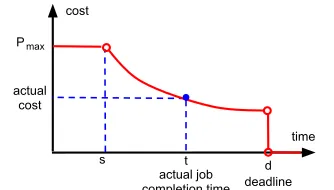
A pricing function P(t) describes the relationship
between the job completion time t and the
corre-sponding price to be paid to the provider. To build such a function, the user indicates the longest accept-able deadline (hereafter referred to as the deadline)
of her job d. The user and the provider also agree
upon a maximum affordable price pmax paid if the
job finishes at an earliest possible completion time s. A pricing function that captures the fact that a job should cost less for longer completion times is:
P(t) =
pmax if t<s
f(t) if s≤t≤d
0 if t>d.
Figure 2 provides an example P(t). In the range
where (s≤t≤d), the price f(t)of a job completion
timetshould be monotonically decreasing totand its
values never exceed pmax. Figure 2 shows a convex
function; but different shapes can be considered as
well. Note that if (t>d) then the job fails to meet its
deadline and no payment is issued.
[image:3.612.116.264.70.218.2]GHDGOLQH 3
WLPH FRVW
PD[
G V
DFWXDOMRE FRPSOHWLRQWLPH
W DFWXDO
[image:4.612.106.273.71.166.2]FRVW
Figure 2: Example of a pricing functionPj of job j.
3.2 Cloud revenue maximization
Consider N−1 jobs running under certain
alloca-tion plans and a new job arriving. Our goal is to find a feasible allocation for the new job that
max-imizes the total revenue for all N jobs over time.
To find a set of feasible allocation plans we formu-late the mixed integer programming (MIP) problem with the objective (1) subject to constraints (2)- (6). We solve the maximization problem for a duration of
T=argmaxjdjintervals to include the longest
dead-line among all N jobs. We uset to index intervals
for the nextT intervals starting from the current one
pointed byt=1, i.e.,t∈ {1, . . . ,T}. We ensure that
the solution includes feasible plans via the constraints explained below. We also use Figure 3 to illustrate key points of the constraints.
maximize
x,y,p
∑
N
j=1pj (1)
subject to
∑
dji=1yji=1 ∀j, (2)
∑
dji=1xji=r�j ∀j, (3)
∑
Nj=1xjt≤K ∀t, (4)
0≤xjt≤K×
∑
Ti=tyji ∀j,t, (5)pj≤Pj
�
˜
tj+
∑
di=j1i×yji�
∀j, (6)
yji∈BN×T, xji∈NN×T, pj∈R+, (7)
j∈ {1, . . . ,N}, t∈ {1, . . . ,T}. (8)
Deadline feasibility constraint. All jobs should fin-ish before their deadlines shown by (2) where the
bi-nary variableyji∈BN×Tis assigned to 1 if job j
[image:4.612.325.546.77.189.2]com-pletes at timei, otherwise is set to 0, also shown in
Figure 3. For every job j there should be only one
yji=1 at a time before its deadlinedj.
Resource feasibility constraints.All jobs should be given resource units according to their requirements shown by (3) and exemplified in Figure 3. The
de-cision variablexji∈NN×T denotes the allocation of
job 2 finishes at time k
y2k= 1 job1
job2
2
1 k
job N
�d2
i=1x2i=r
�
2
�N j=1xj2≤K
(x21, y21) (x22, y22) (x2k, y2k)
(xN2, yN2)
(x12, y12)
...
...
...
...
(x2T, y2T)time
job T=d2
Figure 3: Example illustration of the constraints and
the decision variablesxandy.
resource units per job jat intervali. The number of
resource units before the deadline, i.e.,∑dj
i=1xji, must
be equal tor�
j; where r�j ≤rj denotes the remaining
resource units needed to allocate for job jgiven that
j might be an existing running job and has already
used some of its resource units. The sum of allo-cations across jobs per interval must not exceed the
total cloud capacity denoted byKand shown by (4).
Furthermore, the resource allocationxjiitself cannot
exceed the total capacity of the cloud and is shown by (5).
Finally, constraint (6) denotes the payment of a job
given its completion time and where ˜tj denotes the
previous running time of job j. This payment is
bounded by functionPj(t).
The problem to find the optimal solution for a MIP formulation has shown to be NP-complete. There-fore, we use the CPLEX state-of-the-art optimiza-tion solver [13] to find approximated soluoptimiza-tions within short times.
3.3 Discrepancies in resource estimation Our model uses an estimate of the number of re-source units required by a job. Recent work on of-fline profiling and analytic performance models de-rive the resource units required for MapReduce jobs e.g., [5, 7, 10, 11]. Further, some workloads exhibit a large fraction of recurring jobs. For example, in Bing’s production clusters recurring jobs account for 40.32% of the total [1]. This allows to improve the prediction by taking into account prior executions.
Nevertheless, despite the accuracy of these initial estimations, it is still possible that discrepancies arise during job execution, e.g., due to stragglers [3, 12]. Therefore, we extend our basic formulation to ac-commodate for estimation errors.
[image:4.612.79.302.424.584.2]job size estimation error, into constraint (3) to intro-duce the job execution variability in planning, i.e.,
rj
ej. For example, whenej∈(0,1)then the size of the
job is underestimated (resp. overestimated ifej>1).
Hence, constraint (3) can be transformed into a
prob-ability constraint: Probj
�
∑dj
i=1xji=r
�j
ej
�
≥1−α,∀j.
This rewritten constraint ensures that, with a(1−a)
probability guarantee, the accumulated number of re-source units allocated to a job before its deadline equals its remaining job size considering any estima-tion errors. Using a probability constraint makes the program stochastic and cannot be solved by standard solvers like CPLEX. To calculate the solution to it, we transform it into a deterministic equivalent by
as-suming thatejis subject to a normal distribution, i.e.,
ej∼N(µj,σ2j). Due to space limitations we omit the
details of the transformation. At the end, the trans-formed formulation can be solved with CPLEX. 4 Preliminary Results
To quantify the benefits achieved by the formula-tion approach outlined in Secformula-tion 3 (hereafter,
re-ferred to as GEARBOX), we use a discrete event
sim-ulator and CPLEX to solve the maximization prob-lems. While preliminary, our results indicate that by allowing users to specify long deadlines and by exploiting time-malleability our approach increases both provider revenue and acceptance ratio.
4.1 Setup
Given the unavailability of a reference workload that would fit our pricing model, we adopt a synthetic workload. While admittedly simplistic, we believe that this workload is a good approximation of what a real workload might be.
We assume a cloud with a total capacity of K =
1,000 resource units. We denoterj to be the initial
number of units required by job j; dminj = rKj is the
shortest completion time possible whenallcloud
re-sources are assigned to j. We consider two different
scenarios. In the former (Figure 4), we assign the
initial resource requirementsrj of job jto be a
ran-domly chosen integer between 2,500 and 7,500 re-source units. This ensures that all jobs take at least
more than two units of time to complete (i.e.,dminj >2
for all jobs). In the latter scenario (Figure 5), we set
rj=50·(1+b), wherebis randomly selected using
a half-normal distribution with a mean of 0 and stan-dard deviation of 50 modeled after the analysis from
Google cluster traces [9]. The parameterssj anddj
of the pricing function in Figure 2 are randomly
cho-sen andsj∈[dminj ,5·dminj ]anddj∈[sj,3·sj]. Note
that this setup implies that some jobs may have no
flexibility at all, i.e.,sj=dj.
For simplicity we consider a linear pricing
func-tionPj. We also experimented with different function
shapes and different ranges forsj anddj, observing
similar trends to the results reported below.
We simulate job requests arriving over time for a total duration of 10,000 seconds. We assume Poisson
job arrivals with a mean arrival rate λ varying
be-tween 0.12 and 0.26 jobs/s (resp. 0.30 and 0.65 jobs/s for the Google-inspired workload). These values yield a data center utilization between 60% and 100% when we allocate resources.
Baselines. We compare our approach against three
baselines, representative of common techniques used
in today’s systems. EARLY: a fixed set of resources
is reserved for a job to meet its most demanding
dead-linesj. This closely resembles the existing approach
in deadline-based systems where a single deadline is
considered. LATE: a fixed set of resources is
re-served for a job to meet its deadline dj; EDF: this
baseline implements an earliest deadline first (EDF) approach where we allow runtime modifications in
jobs allocation plans; we consider the deadlinedj.
CPLEX execution time.We run our experiments on
a server with 16 Intel Xeon E5-2690 cores and 32 GB of RAM. We set the upper bound of the CPLEX exe-cution time per job to 100 s and the error rate to 1%.
Across all runs1, the median CPLEX execution time
is 2 s and the 95th percentile is 6 s. Since our
algo-rithm needs to be run only when a job is submitted, the overhead introduced is negligible.
4.2 Basic formulation results
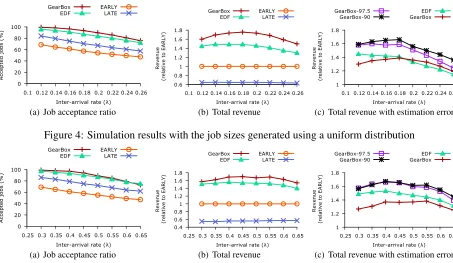
We begin our analysis by considering the case with no estimation errors. Figure 4(a) shows the percent-age of jobs accepted by each method. We observe
that the dynamic allocation plans (GEARBOX and
EDF) accept significantly more jobs than the static
ones (EARLYand LATE). The reason is that, by being
unable to reallocate resources as new jobs come in, or existing jobs terminate, the performance of static al-location plans is drastically reduced. This highlights the problem with today’s setup and motivates our ef-fort to explore alternative solutions.
The second metric used in our evaluation is the
1We average the results across 5 runs and the standard devia-tion for all experiments in this secdevia-tion is within 3%.
!" !#" !$" !%" !&" !'""
!"(' !"('#!"('$!"('%!"('& !"(# !"(##!"(#$!"(#%
)* *+ ,-+ . !/ 0 1 2! 34 5
67-+89:88;<:=!8:-+!35 >+:8?0@
ABC A)DEFE)GA
(a) Job acceptance ratio
!"#$ !"#% !& !&#' !&#( !&#$ !&#%
!"#& !"#&'!"#&(!"#&$!"#&% !"#' !"#''!"#'(!"#'$
)* + * , -* ! !. /* 01 23 + * !2 4 !5 6 ) 78 9
:,2*/;1//3+10!/12*!.9 <*1/=4>
5?@ 56)7876A5
(b) Total revenue
!" !"#$ !"#% !"#& !"#'
!(#" !(#"$!(#"%!(#"&!(#"' !(#$ !(#$$!(#$%!(#$&
)* + * , -* ! !. /* 01 23 + * !2 4 !5 6 ) 78 9
:,2*/;1//3+10!/12*!.9 <*1/=4>;?@#A
<*1/=4>;?( <*1/=4>5BC
[image:6.612.82.535.69.332.2](c) Total revenue with estimation errors
Figure 4: Simulation results with the job sizes generated using a uniform distribution
!" !#" !$" !%" !&" !'""
!"(#) !"(* !"(*) !"($ !"($) !"() !"()) !"(% !"(%)
+, ,-./ -0 !1 2 3 4! 56 7
89/-:;<::=><?!:</-!57 @-<:A2B
CDE C+FGHG+IC
(a) Job acceptance ratio
!"#$ !"#% !"#& !' !'#( !'#$ !'#% !'#&
!"#() !"#* !"#*) !"#$ !"#$) !"#) !"#)) !"#% !"#%)
+, -, . / , ! !0 1, 23 45 -, !4 6 !7 8 + 9: ;
<.4,1=3115-32!134,!0; >,31?6@
7AB 78+9:98C7
(b) Total revenue
!" !"#$ !"#% !"#& !"#'
!(#$) !(#* !(#*) !(#% !(#%) !(#) !(#)) !(#& !(#&)
+, -, . / , ! !0 1, 23 45 -, !4 6 !7 8 + 9: ;
<.4,1=3115-32!134,!0; >,31?6@=AB#)
>,31?6@=A( >,31?6@7CD
[image:6.612.81.540.74.188.2](c) Total revenue with estimation errors
Figure 5: Simulation results with the job sizes generated using a half-normal distribution [9]
total revenue, shown in Figure 4(b), normalized
against EARLY. GEARBOX achieves much higher
revenue than EARLY (between 53.7% and 69.7%)
and LATE (between 170% and 205%). This is
be-cause of GEARBOX’s ability to dynamically
reas-sign resources and, hence, accept more jobs.
Inter-estingly, GEARBOXalso outperforms EDF(between
5.6% and 17.5% higher revenue), although their frac-tion of accepted jobs is close. The reason is that
GEARBOXadmits a new job only if this increases the
total revenue. This means that in some cases, even if there would be enough idle resources to accept a job,
GEARBOX can still decide to reject it, if this is not
cost-effective. In contrast, if resources are available,
EDFalways accepts a new job, although this might be
detrimental in the long term. This shows the impor-tance of considering the total revenue as a first-class citizen in the admission control. Similar trends are also observed when using the Google-inspired work-load as shown in Figure 5.
We also experimented with a flat pricing function, obtaining a factor of 1.8x improvement in the
rev-enue of GEARBOX over EARLY (resp. 1.1x over
EDF). This shows that even when there is no
ad-ditional premium for the provider to complete jobs early, it can still increase its revenue by exploiting
their malleability. This is because GEARBOX fully
utilizes resources as soon as they become available and, hence, it is more prepared to accommodate fu-ture bursts of jobs. Furthermore, and in contrast to
EARLY, it also has the ability to reclaim resources
back from running jobs as appropriate for new ones.
Interestingly, at low load (λ =0.12), the median
job completion time increase (relative to sj) is less
than 1% (95thpercentile is 46%). At high load (λ=
0.26), instead, the median is 26% (95th percentile is
177%). This indicates that GEARBOXexploits
time-malleability only for a few jobs, while for the vast majority of them, it strives to minimize the comple-tion times. This is a consequence of the incentives set by our pricing model. The provider has a strong incentive to finish the job as soon as possible. At the same time the provider can delay a few jobs if this increases the overall revenue.
4.3 Estimation errors
We now consider the impact of estimation errors on
our base solution, GEARBOX, and show how the
ex-tension detailed in Section 3.3 can mitigate these. We
refer to our extended solution as GEARBOX-p, where
pis the probability in the transformed constraint.
We assume that the estimation error ej for a job
jfollows the normal distributionN(1, 0.1). This is
σ∈[0.05,0.15], obtaining similar results.
Figure 4(c) and 5(c) show the revenue for different
job inter-arrival rates λ in the two workloads
con-sidered. GEARBOX-97.5 and GEARBOX-90 achieve
higher revenue than both EDF and GEARBOX. In
this scenario, EDFoutperforms GEARBOX because
as it recomputes the deadlines at runtime, it natu-rally shifts resources to jobs that are close to dead-lines, thus implicitly accounting for estimation
er-rors. However, the GEARBOX-p solutions achieve
the best performance because they account for esti-mation errors in their allocation plans.
This is also reflected in the fraction of accepted jobs
that miss the deadline. While EDF and GEARBOX
exhibit a miss ratio of 6.05% and 13.75%
respec-tively, GEARBOX-90 achieves a miss ratio of 0.7%
(respectively 0.07% for GEARBOX-97.5).
5 Discussion
We are implementing our approach in the Apache Hadoop framework. Our prototype currently sup-ports dynamic reallocation in the map phase. Since map tasks are short, independent and run in multi-ple waves, we can vary the number of resources be-tween each wave. Reduce tasks are more complex as they are typically long-running and they run in a single wave. To support dynamic reallocation in the reduce phase, we are currently integrating our proto-type with the Sailfish project [2, 14], which supports suspend and resume of reduce tasks.
The current version of the model makes some sim-plifying assumptions. In particular, we assume per-fect scalability and ignore data dependencies. For a real deployment, our model needs be extended to in-clude constraints such as job barriers, which can re-duce parallelism, and data locality, which can have an impact on the total running time. Addressing these limitations as well as including network constraints (possibly leveraging our prior work [4, 7]) is part of our current research agenda.
We also intend to explore more advanced pricing functions. In the results presented in the previous
section, we assumestaticpricing, i.e., the shape and
values of the function depend only on the job type and size. We are currently investigating the
bene-fits of usingdynamicpricing functions similar to the
Amazon spot instances model [15], in which prices changes based on the current utilization. We believe that combining dynamic pricing with job malleability would allow to further increase utilization and rev-enue while providing more flexibility to tenants.
6 Conclusions
Current batch processing systems support fixed al-location plans, in which the resources allocated to a job are never changed (unless in cases of unexpected events such as failures or stragglers). Rather, we ar-gue that the time-malleability property of batch jobs should be exploited to opportunistically vary the al-location plans at runtime. Our approach allows users to specify the longest acceptable deadline for their jobs along with the maximum price they are willing
to pay. Providers then use this information to
dynam-icallyallocate resources to jobs in order to improve
utilization and revenue. Preliminary results show that our approach can significantly increase revenue and acceptance rate, by only marginally affecting job ex-ecution time.
Acknowledgements. The authors wish to thank Wolfram Wiesemann for his helpful comments and suggestions, and Bolun Dong, James Simpson, and Jiawei Yu for their help on building a preliminary prototype of our system. Luo Mai is a recipient of the Google Europe Fellowship in Cloud Computing, and this research is supported in part by this Google Fellowship.
References
[1] AGARWAL, S., KANDULA, S., BRUNO, N., WU, M.-C., STO -ICA, I.,ANDZHOU, J. Re-Optimizing Data-Parallel Computing. InNSDI(2012).
[2] ANANTHANARAYANAN, G., DOUGLAS, C., RAMAKRISHNAN,
R., RAO, S.,ANDSTOICA, I. True Elasticity in Multi-Tenant Data-Intensive Compute Clusters. InACM SoCC(2012). [3] ANANTHANARAYANAN, G., KANDULA, S., GREENBERG, A.,
STOICA, I., LU, Y., SAHA, B.,ANDHARRIS, E. Reining in the outliers in map-reduce clusters using Mantri. InOSDI(2010). [4] BALLANI, H., COSTA, P., KARAGIANNIS, T., AND ROW
-STRON, A. Towards Predictable Datacenter Networks. In SIG-COMM(2011).
[5] FERGUSON, A., BODIK, P., KANDULA, S., BOUTIN, E.,AND
FONSECA, R. Jockey: Guaranteed Job Latency in Data Parallel
Clusters. InEuroSys(2012).
[6] HERODOTOU, H., DONG, F.,ANDBABU, S. No One (Cluster) Size Fits All: Automatic Cluster Sizing for Data-intensive Ana-lytics. InACM SoCC(2011).
[7] JALAPARTI, V., BALLANI, H., COSTA, P., KARAGIANNIS, T.,
ANDROWSTRON, A. Bridging the Tenant-Provider Gap in Cloud
Services. InACM SoCC(2012).
[8] LUCIER, B., MENACHE, I., NAOR, J.,ANDYANIV, J. Efficient Online Scheduling for Deadline-Sensitive Batch Computing. In SPAA(2013).
[9] SCHWARZKOPF, M., KONWINSKI, A., ABD-EL-MALEK, M.,
ANDWILKES, J. Omega: flexible, scalable schedulers for large compute cluster. InEurosys(2013).
[10] VERMA, A., CHERKASOVA, L.,ANDCAMPBELL, R. H. ARIA: Automatic Resource Inference and Allocation for MapReduce Environments. InACM ICAC(2011).
[11] WIEDER, A., BHATOTIA, P., POST, A.,ANDRODRIGUES, R. Orchestrating the Deployment of Computations in the Cloud with Conductor. InNSDI(2012).
[12] ZAHARIA, M., KONWINSKI, A., JOSEPH, A. D., KATZ, R.,
ANDSTOICA, I. Improving MapReduce performance in hetero-geneous environments. InOSDI(2008).
[13] IBM, ILOG CPLEX.http://www.ibm.com.
[14] Sailfish Project.http://code.google.com/p/sailfish/.
[15] Amazon EC2 Spot Instances.http://aws.amazon.com/ec2/ spot-instances/.