City, University of London Institutional Repository
Citation
:
Maras, K. L. and Bowler, D. M. (2012). Context reinstatement effects on eyewitness memory in autism spectrum disorder. British Journal of Psychology, 103, pp. 330-342. doi: 10.1111/j.2044-8295.2011.02077.xThis is the accepted version of the paper.
This version of the publication may differ from the final published
version.
Permanent repository link:
http://openaccess.city.ac.uk/4725/Link to published version
:
http://dx.doi.org/10.1111/j.2044-8295.2011.02077.xCopyright and reuse:
City Research Online aims to make research
outputs of City, University of London available to a wider audience.
Copyright and Moral Rights remain with the author(s) and/or copyright
holders. URLs from City Research Online may be freely distributed and
linked to.
1
Context reinstatement effects on eyewitness memory in autism spectrum
disorder
Katie L. Maras
Dermot M. Bowler
City University London
2
Abstract
The Cognitive Interview is among the most widely accepted forms of police
interviewing techniques; however it is ineffective for witnesses with Autism Spectrum
Disorder (ASD). One of its main components involves mentally reinstating the internal and
external context that was experienced at encoding. We report evidence showing that it is the
mental reinstatement instructions in the absence of any physical cues that individuals with
ASD find difficult. In more supported conditions where they physically return to the same
environment in which they learnt the material, they recall as much as their typical
counterparts. Our findings indicate that recall in ASD is aided by context, but only when
supported by the physical environment. These findings have important implications for
investigative interviewing procedures for witnesses with ASD.
Key Words: Autism Spectrum Disorder, Context, Cognitive Interview, Eyewitness,
3
Context reinstatement effects on eyewitness memory in autism spectrum disorder
Police interviewing techniques in the UK and USA have improved substantially in the
past 25 years. The Cognitive Interview (Fisher & Geiselman, 1992; Geiselman, Fisher,
Firstenberg, Hutton, Sullivan, et al., 1984) is an evidence-based technique which is now
taught to police interviewers as part of their specialist interviewing training to elicit more
details from witnesses but without compromising their accuracy (Home Office, 2007). The
Cognitive Interview is based on two basic memory principles: First, that recall will be
enhanced if the context that is experienced at retrieval matches that experienced at
encoding (Tulving & Thomson, 1973). This is achieved by ‘context reinstatement’ -
encouraging the witness to mentally relive both the internal (subjective thoughts and feelings
etc) and external (physical and environmental) contextual details that they experienced prior
to and during the witnessed event, before going on to freely recall everything that they can
from the event, even seemingly trivial or partial details. The second principle is that
memories are stored as a series of interconnected nodes, so a single memory can be
accessed in a number of different ways (Anderson & Pichert 1978). This is done by asking
the witness to recall the events in a different order or from a different perspective (but see
Boon & Noon, 1994).
A number of studies have demonstrated that the Cognitive Interview is effective in
increasing the amount of correct details reported without a concomitant increase in incorrect
details with a number of different groups, including adult witnesses (see Memon, Meissner &
Fraser, 2010), children (e.g. Geiselman & Padilla, 1988), older witnesses (e.g. Wright &
Holliday, 2007) and witnesses with intellectual disabilities (e.g. Milne, Clare & Bull, 1999). In
the only study to date to examine the Cognitive Interview with witnesses with autism
spectrum disorder (ASD) however, it not only failed to increase the amount of correct details
4
ASD encompasses a range of pervasive developmental disorders including Autistic
Disorder, Asperger’s Disorder, and Pervasive Developmental Disorder Not Otherwise
Specified, all of which are clinically defined by abnormalities in the domains of
communication and socio-emotional behaviour, and the presence of narrow, stereotyped
and repetitive patterns of behaviour and interests (American Psychiatric Association, 2000).
It has been argued that deficits in reciprocal social behaviour are at the core of ASD (e.g.
Constantino & Todd, 2003; Mundy, Sigman & Kasari, 1994; Kanner, 1943). It is not
surprising therefore, that when Maras & Bowler (2010) broke each detail that participants
recalled down in terms of whether it pertained to a person, action, surrounding, or object, the
ASD group recalled significantly fewer person and action details, but did not differ from their
typical comparisons on the number of surrounding or object details that they recalled.
However social deficits are not the only features of ASD; individuals with ASD also present
with a rather unique cognitive profile, including very specific memory difficulties. Whilst they
tend to demonstrate intact or even enhanced abilities in some domains such as rote memory
(e.g. Kanner, 1943; Mottron, Belleville, Stip, & Morasse, 1998), they show impairments in
other areas including the ability to spontaneously exploit the semantic relations between
items to aid their recall (e.g. Gaigg, Gardiner & Bowler, 2008; Hermelin & O’Connor, 1967;
Tager-Flusberg, 1991) and in recalling personally experienced events (e.g. Crane &
Goddard, 2008; Klein, Chan & Loftus, 1999; Lind & Bowler, 2010).
Indeed, several converging lines of evidence suggest that individuals with ASD would
have great difficulty with the context reinstatement component of the Cognitive Interview,
which might explain why Maras and Bowler (2010) found this interview to be so ineffective
for witnesses with ASD. First, they have diminished memory for source or incidentally
encoded context, particularly in unsupported conditions where the context has to be recalled
rather than recognised (Bowler, Gardiner & Berthollier, 2004; Bowler, Gaigg & Gardiner,
2008). In the aging literature difficulties with monitoring the source of memories have been
linked to problems in the kinds of processes that context reinstatement requires, namely in
to-be-5
remembered details in the first place at encoding (e.g. Chalfonte & Johnson, 1996), and then
later spontaneously considering these context details at retrieval (e.g. Henkel, Johnson &
DeLeonardis, 1998). If individuals with ASD do not encode the event with its context or if
they have difficulty in later recalling the context, then it is unsurprising that the context
reinstatement procedure of the Cognitive Interview is ineffective.
Second, on tests of recognition individuals with ASD tend to rely more heavily on
feelings of familiarity (e.g. ‘know’ responses) and report fewer instances of consciously
recollecting vivid contextual details that were associated with the item at encoding (e.g.
‘remember’ responses). Tulving (1985) argues that ‘remembering’ involves mental time
travel to re-create the spatio-temporal context of the recollected episode. This is exactly the
process that is required by context reinstatement, and individuals with ASD are known to
have difficulties with this (e.g. Lind & Bowler, 2010).
Third, individuals with ASD perform well on tasks that rely on item-specific
processing, which focus on individual items of information without any reference to relations
among them, and poorly on relational processing tasks (Gaigg et al., 2008). Context
reinstatement is based on the exploitation of the relations between context and event details
to trigger more details from memory. If individuals with ASD witness a crime and process the
event details in isolation from the crime’s situation or context, then context reinstatement is
likely to be ineffective.
Context utilisation difficulties in ASD: a problem with encoding or retrieval?
Nevertheless, these context utilisation difficulties in ASD appear to be more of a
retrieval rather than an encoding problem: individuals with ASD can remember the context in
more supported conditions, for example they demonstrate intact recognition but diminished
recall for incidentally encoded contextual details. Bowler et al (2008) reported that ASD
participants failed to make use of context to aid their memory on tests of recall, but on
recognition tests they utilised context words that were presented at study to enhance their
6
individuals with ASD will only make use of context if it is more explicitly presented to them at
recall. Indeed, “…cognition in ASD is more rooted in the here-and-now rather than in
information that has to be brought to mind in a way that is not immediately cued by the
current situation…” (Bowler et al., 2008, p. 997). If utilising context is a retrieval rather than
an encoding problem, then effective interview procedures might at least be possible to aid
recall for individuals with ASD. It is possible that being physically back in the same context
rather than solely trying to recreate the context mentally in the absence of any physical cues
may enhance recall for individuals with ASD; a contention that fits well within a source
support framework, where difficulties in remembering the source of information are largely
eliminated in more supported retrieval conditions (see Bowler et al., 2004).
Previous work has demonstrated that, in addition to the positive effects of mental
context reinstatement procedures, typical individuals can also remember more if they return
to the same room at test than if they recall in a different room (e.g. Davies & Milne, 1985;
Fernandez & Alsono, 2001). In an early study by Smith (1979), for example, participants
were asked to recall (without mental context reinstatement instructions) previously learned
lists of words in either the same room in which they learnt them or in a different room.
Participants who recalled the word lists in the same room recalled significantly more words
than the group who recalled the lists in a different room from study. The purpose of the
present study was to see if individuals with ASD might also benefit from physically returning
to the same environmental context at recall.
We presented participants with ASD and their typical counterparts with photographs
of everyday scenes, rich in a variety of different but quantifiable details. One hour later each
participant was interviewed for their memory for these photographs using the context
reinstatement procedure followed by free-recall. However for half of participants this was
carried out in a Different Room from which the photographs were initially viewed (in-line with
Maras & Bowler, 2010), and for the other half of participants this was back in the Same
Room where they had initially viewed the photographs. The aim of the present study was
7
reinstatement poses a problem for individuals with ASD. Our first prediction therefore is that
when interviewed using a context reinstatement procedure in a Different Room, ASD
witnesses would recall significantly fewer correct details and with lower accuracy than their
typical counterparts. This would replicate some of the findings from Maras and Bowler
(2010). Our second aim was to examine whether this problem with context reinstatement
results from a failure to store context at all in relation to memories for the to-be-remembered
event details, in which case physically returning to the Same Room in which the to-be
remembered event was witnessed would make no difference to their recall, or whether it is
more of a retrieval problem. If the latter is the case we would expect that context can in fact
enhance recall if more context support is provided by carrying out testing in the room where
the event was witnessed. To summarise, we predicted (1) less complete and less accurate
recall by the ASD group when mental context reinstatement procedures were carried out in a
Different Room from where the witnessed scenes were viewed, and (2) that when physically
back in the Same Room, the ASD group’s recall would improve to levels comparable with
those of the comparison group. Moreover, based on Maras and Bowler (2010) we also
predicted equivalent rates of quantity and accuracy of recall for details pertaining to
surroundings and objects in both groups, but that the ASD group would show less complete
and less accurate recall for details pertaining to persons and actions in both test conditions.
Method
Participants
Twenty eight individuals with ASD (23 males, 5 females) formally diagnosed by
qualified clinicians took part. A review of available records and/or assessment with the
Autism Diagnostic Observation Schedule (ADOS; Lord, Rutter, DiLavore & Risi, 1999)
confirmed that they all met DSM-IV (American Psychiatric Association, 2000) criteria for
8
males, 13 females)1 were recruited through local newspaper advertisements. No participants
in either group were taking psychotropic medication, and none had any psychiatric or
neurological disorder. ASD and comparison participants were matched on verbal IQ
(Wechsler Adult Intelligence Scale Third UK Edition, Wechsler, 1997) and age. Fourteen
participants from the ASD group and 14 comparison participants were randomly assigned to
either the Same Room or Different Room conditions, provided that IQ scores and age were
similarly distributed across the two conditions. A 2 x 2 (Group x Room) ANOVA found no
significant main effects of Group (all Fs < .42, ps > .52), Room (all Fs < 1.21 ps > .28), or
Group x Room interactions (all Fs < .38 ps > .54) for verbal IQ, performance IQ, full-scale IQ.
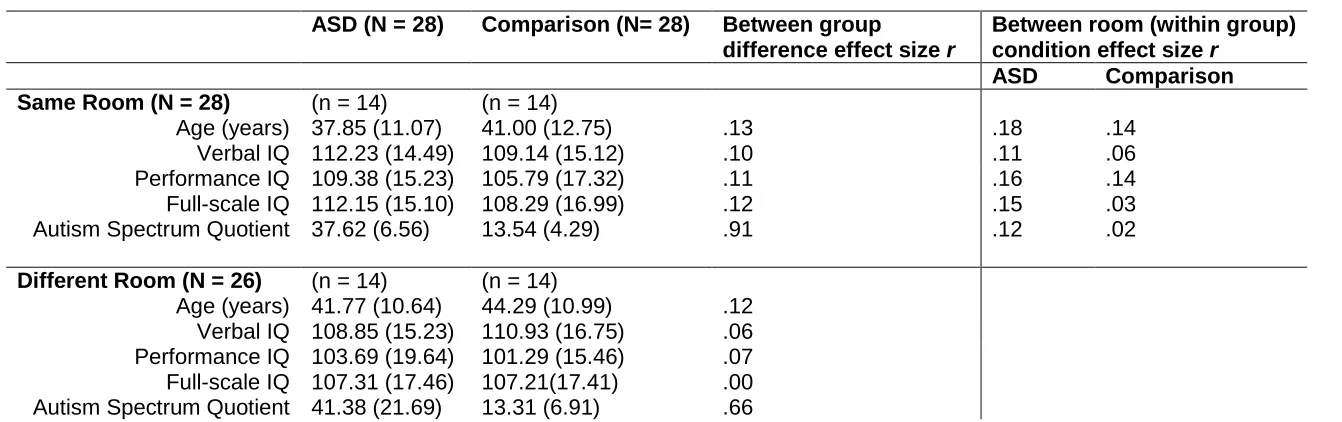
There were also no main effects or interactions for age (all Fs < 1.35, ps > .25). Table 1
summarises these data. Participants also completed the Autism Spectrum Quotient (AQ,
Baron-Cohen, Wheelwright, Skinner, Martin & Clubley, 2001). None of the comparison
participants exceeded the minimum cut off score for ASD of 32 (maximum = 23), and a 2
(Group) x 2 (Room) ANOVA for AQ scores revealed no main effect of Room, F (1, 48) = .44,
p= .51, r = .10, or Group x Room interaction, F (1, 48) = .29, p = .60, r = .08. There was
however a main effect of Group, F (1, 48) = 165.52, p < .001, r = .88; as expected the ASD
group scored significantly higher than the comparison group on this measure.
[INSERT TABLE 1]
1
There was an unequal male-female ratio in each group, which was reflected by a significant
association between participant group (ASD or comparison) and gender, ² (1) = 5.24, p<.05.
However there were no differences between male and female comparison participants or between
male and female ASD participants in terms of correct details, errors, or accuracy (all ts < 1.19, ps
>.28). For this reason, combined with the lack of previous research to suggest that gender should
influence recall by the conditions used in the present research, we included this unequal male-female
9
Materials
The to-be-remembered stimuli consisted of four photographs of everyday scenes
(titled ‘camping’, ‘shopping’, ‘dinner’, and ‘launderette’), each sourced via an internet search
(see Appendix A for an example of one of the scenes). Scenes were selected that were
different from one another but all rich in quantifiable details relating to Persons, Actions,
Surroundings, and Objects. Scenes were presented via Microsoft Office PowerPoint on a 19”
monitor at a rate of one per 20 seconds. Each scene was followed by a 5-second blank
black slide and a 7-second instruction slide for the proceeding slide, which informed
participants that they were about to see a photograph of an everyday scene and that their
task was to describe everything that they could see in the scene in as much detail as
possible, including what was happening.
Procedure
Participants were tested individually. The room in which the slides were presented
was the same for all participants, and was chosen as it was notably different from the usual
laboratory testing room (where interviews took place in the Different Room condition) in
terms of location, size, layout and décor. The order in which the slides were presented was
varied randomly for each participant. Following presentation of the slides participants
completed unrelated filler tasks lasting around one hour in a different room (to avoid
spontaneous context reinstatement). Both before and after the filler tasks participants were
engaged in conversation by the researcher about events unrelated to the slides.
Following this one-hour delay participants were interviewed about their memory for
the slides in either the Same Room in which they watched them, or in a Different Room.
Participants in the Same Room condition were seated in the same seat facing the same PC
monitor as before (which was now switched off). All participants were interviewed for their
memory of the slides using the context reinstatement procedure, which was followed by
free-recall. In order to follow best practice guidance, interviews followed the same structure (up
10
Office 2007), and Fisher and Geiselman (1992). This protocol included building rapport with
the participant, explaining the aims of the interview, instructions to report everything (no
matter how small or trivial it may seem) and to concentrate hard. Prior to interviews
participants were informed that the purpose of the study was to investigate the use of part of
a police interview that is frequently used to help witnesses to remember more, called context
reinstatement, and the procedure was fully explained to them in lay language. Participants
were told not to worry if they could not remember certain details and not to guess.
The context reinstatement procedure took around 10 minutes and encouraged
participants to focus on all aspects of their experience prior to and during encoding, including
the internal (e.g. how the participant was feeling, what they were thinking) and external (e.g.
what the environment around looked like) states, before attention was focussed on each
slide in turn. This procedure began from ‘re-tracing their steps’ on their arrival to their journey
into the room where they saw the slides, focussing on the room, where they were sitting,
picturing the PC monitor in front of them, building up a clear mental picture of the first
instruction slide and then that changing to the first photograph. Participants were instructed
to focus hard and build up a clear mental picture of the photograph in question, noting every
small detail, focusing on where the scene was taking place (i.e. where the photograph was
taken), what the environment around looked like, what people were involved, what they were
wearing, doing, how they were behaving, etc. Finally this was followed by free-recall for each
slide. Participants were guided though mini context-reinstatements for each slide in the
same order in which they were presented at study, following which they were asked to recall
everything in as much detail as they could from that slide. Free-recall for each slide was
uninterrupted by the interviewer until the participant had finished speaking and had indicated
that was all they could recall for that slide. The interviewer then moved on to the next slide
that was presented. The first author conducted all of the interviews, and had previously
attended a police Cognitive Interview training course run by Surrey Police. Whilst the
11
reinstatement protocol were standardised so that all participants received the same
instructions and context reinstatement procedure in each condition.
Coding and Scoring
All interviews were audio-recorded and transcribed, and details were scored against
an original transcript for the slides using a technique developed by Memon, Wark, Bull and
Koehnken (1997). Each slide was transcribed for each unit of detail that occurred to form the
original transcript. Any details reported by participants that were not included in the original
transcript but were confirmed as present in the slide were added to the original transcription
of the slides to provide an exhaustive list of details. Each detail was further coded according
to whether it related to a Person, Action, Surrounding, or Object. A second independent
scorer blindly scored each detail in the final transcription according to which type of detail it
was. Inter-rater reliability was good, Kappa = .89, p < .0001, 95% CI (0.85, 0.93).
Each detail reported by the participant was coded against the original transcript of
details from the respective slide as either correct if it was present in the photograph (e.g. “the
man was sitting on the bench”), or incorrect if it was either inconsistent with the slide (e.g.
“the man was sitting on the washing machine”) or not present in the slide at all (e.g. if in fact
there was no man sitting down). One point was given for each new unit of information
provided by participants, for example ‘‘one man (Person) is sitting (Action) on a bench
(Object) reading aloud (Action) to another man (Person)” would be coded as five correct
points: two Person correct, two Action correct, and one Object correct. Subjective
statements of opinion (e.g. ‘‘he looked a bit shifty’’) were ignored. A second independent
rater scored eight randomly selected interview transcripts (two in each group x condition)
against the video clip transcription and the resulting Pearson’s correlations between the two
raters were: rcorrect = .98, p < .0001, rincorrect = 0.85, p < .01. Accuracy scores were calculated
12
Results
Overall recall
Our first step was to examine overall recall using a multivariate ANOVA, with Group
(ASD vs. Comparison) and Room (Same vs. Different) as the between participant fixed
factors, and correct details, incorrect details, and overall accuracy as the dependent
variables. The multivariate result was significant for Group, Pillai’s Trace = .14, F (3, 50) =
2.75, p < .05, but not Room, Pillai’s Trace = .08, F (3, 50) = 1.42, p = .25, and was
marginally significant for the Group x Room interaction, Pillai’s Trace = .12, F (3, 50) = 2.22,
p = .09. Univariate tests revealed a main effect of Group for accuracy, F (1, 52) = 5.52, p <
.05, r = .31. The ASD group were significantly less accurate (mean = .91, SD = .06) than the
comparison group (mean = .95. SD = .04), although there were no main effects of Group for
overall correct, F (1, 52) = 1.56, p = .22, r = .17, or incorrect details, F (1, 52) = 3.31, p = .08,
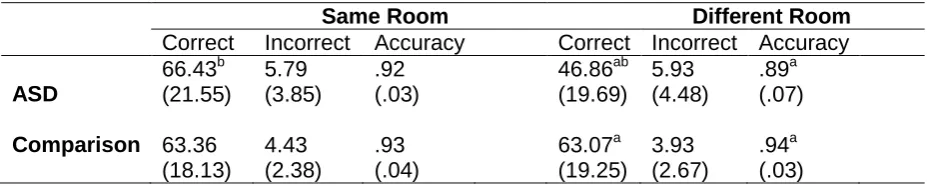
r = .24. Although Table 2 suggests that the effect of the Same Room compared to the
Different Room was more pronounced in the ASD group than the comparison group, these
interactions were only marginally significant for accuracy, F (1, 52) = 3.32, p = .07, r = .25,
and correct details, F (1, 52) = 3.36, p = .07, r = .25, and not significant for incorrect details,
F (1, 52) = .12, p = .732, r = .05.
Did being back in the same room facilitate recall for the ASD group?
Although not justified by a significant interaction (p = .07), our a priori predictions that
the ASD group would benefit more from recalling the photographs in the Same Room
compared to in a Different Room, led to us carry out planned comparisons. We first
examined differences between-participants. These revealed that whereas the ASD group
recalled significantly fewer details than the comparison group in the Different Room
condition, t (26) = 2.20, p < .05, r = .38, there was no difference between groups in the Same
Room condition, t (26) = .41, p = .69, r = .08. A similar pattern emerged for accuracy, where
13
in a Different Room, t (18) = 2.50, p < .05, r = .43, but when interviewed in the Same Room
there was no difference in accuracy between the two groups, t (26) = .48, p = .64, r = .09.
Comparisons were also made within groups, and these showed that the ASD group
reported significantly more correct details if they were interviewed in the Same rather than a
Different Room, t (26) = 2.51, p < .05, r = .43, but there was no such increase in correct
details between rooms for the comparison group, t (26) = .04, p = .97, r = .01. Table 2
summarises these data.
[INSERT TABLE 2 HERE]
What types of details were reported, and did these differ between groups?
In-line with previous work (Maras & Bowler, 2010), we next examined where these
differences between groups and rooms lay in terms of the types of details that were
reported. A 2 (Group) x 2 (Room) x 4 (Detail Type: Person, Action, Surrounding, Object)
mixed ANOVA revealed a significant Group x Detail Type interaction for the number of
correct details that were reported, F (3, 156) = 4.77, p < .01, r = .17, and Group x Detail
Type interaction for accuracy scores, F (3, 156) = 2.92, p < .05, r = .14. No other Detail Type
interactions were significant (all Fs < 1.74, ps > .16). Follow-up t-tests revealed that groups
did not differ on the number of correct details, t (54) = .70, p = .49, r = .09, or their accuracy,
t (54) = .86, p = .39, r = .12, for Surrounding details, or on the number of correct details, t
(54) = .15, p = .88, r = .02, or accuracy, t (54) = .38, p = .71, r = .05, for Object details.
However, the ASD group reported significantly fewer correct details, t (54) = 2.18, p < .05, r
= .28 and had lower accuracy, t (54) = 2.58, p < .05, r = .33, for Person details, and reported
fewer correct details, t (54) = 2.51, p < .05, r = .32, with lower accuracy, t (54) = 2.01, p <
.05, r = .26, for Action details than the comparison group. Table 3 summarises these data.
14
Discussion
In line with our predictions, when interviewed with a context reinstatement procedure
in a Different Room from which they witnessed the to-be-remembered scenes, adults with
ASD recalled significantly fewer details and were less accurate than their typical
counterparts. When interviewed back in the Same Room however, the ASD group recalled
as many correct details, and were just as accurate as the comparison group. These findings
have important implications for police interviewing techniques. It appears that people with
ASD are aided by context, but only when they return to the original location in which the
stimuli were encoded do the Cognitive Interview techniques result in successful recall.
Limitations on participant availability prevented the present study testing whether
individuals with ASD benefit simply from physically returning to the encoding environment
with no effect of verbal context instructions. Ideally this would be done by including a third
group who are asked to recall the slides in a Same Room with no context reinstatement
procedure. It is therefore difficult to ascertain from the present findings alone whether
physically returning to the environmental context is effective because it provides scaffolding
for the context reinstatement instructions, thus supporting the mental time travel that the
Cognitive Interview encourages. Alternatively it is possible that this physical context
reinstatement works independently of the mental context reinstatement mnemonic by
encouraging spontaneous engagement in mental time travel without the need for any
external context reinstatement instructions. We acknowledge that the lack of a third condition
is a major limitation of the present study, and future work should explore whether physical
context reinstatement without the mental instructions is similarly effective in enhancing recall
for individuals with ASD.
Nevertheless, since previous research (Maras & Bowler, 2010) which directly
compared a context reinstatement condition with a recall without context reinstatement
condition found that context reinstatement failed to increase the amount of correct details
that were reported by the ASD group, it seems safe to assume that the traditional mental
15
reinforced by the present study’s finding that the ASD group were significantly worse than
the comparison group when interviewed with context reinstatement in a Different Room.
Thus it seems that only when individuals with ASD have the support of returning to the
physical context where the event or study material was learnt are they able, when
encouraged, to engage successfully in mental time travel and thus recall details of the
witnessed event accurately. Whether the mental context reinstatement instructions are
important or not in combination with the physical context reinstatement remains to be seen,
however, and caution is warranted in interpreting these findings until future work that
includes a critical third condition without mental context reinstatement instructions has
clarified this issue.
In line with our predictions and with previous findings (Maras & Bowler, 2010), the
ASD group recalled fewer correct details and were less accurate for details which pertained
to Persons and Actions, whilst there were no such differences between groups for details
which pertained to Surroundings or Objects. A lack of significant group x room x detail type
interaction suggests that this more physical form of context reinstatement (i.e. in the Same
Room condition) does not have a differential effect on improving the types of details that are
reported by witnesses with ASD. Nevertheless, it would be worthwhile for future work to
explore whether there are interviewing techniques that can specifically enhance the reporting
of Person and Action details by witnesses ASD.
Whilst at first glance the finding that the comparison group’s recall did not differ
between Same and Different Room conditions is surprising, some previous work has also
found a lack of physical context effect when combined with a mental context reinstatement
procedure. Smith (1979) for example found that whilst memory for previously learnt lists was
better when tested in the Same Room than Different Room, this difference was eliminated
when in a second experiment an additional group of participants were tested in a different
room and instructed to recall the original learning environment: their recall was enhanced to
a similar level to that of the group who were tested in the same room. It seems then that
16
back in the Same Room was superfluous. Context reinstatement did not aid the ASD group’s
recall however, meaning that there was scope for improvement by physically being back in
the Same Room.
The limitations that apply to most laboratory eyewitness research also apply here.
The static photographs used here are very different from real-life dynamic events and it is
possible that they triggered more of an associative type of memory, as opposed to narrative
memory which might be more common for eyewitness events. Since individuals with ASD
tend to show intact associative memory (e.g. Minshew, Goldstein, Muenz, & Payton, 1992;
Williams, Goldstein & Minshew, 2006), we cannot rule out this explanation. Future work
should extend these findings using more dynamic stimuli to control for this possibility. It is
also possible that context reinstatement is ineffective for individuals with ASD not because of
the way in which their memories are stored with or without context, but because of the
language requirements and online processingthat the context reinstatement procedure
demands, given that individuals with ASD have difficulties in both of these domains (e.g.
Darmala, Keller, Kana, Cherkassky, Williams, et al., 2010; Gabig, 2008; Joseph, McGrath &
Tager-Flusberg, 2005). Physically returning to the same environment allows the individual
similar support as the traditional context reinstatement, but without the language and
working memory demands. Future work is needed to clarify this issue. In addition, whilst the
present findings may well prove useful if witnesses are able to re-visit the location of the
witnessed event, there are obvious practical issues with this, and findings are limited to
memory for single events in a unique setting. Cases of repeated offences, or those in the
witness’s own home, are unlikely to be better recalled by revisiting the scene because of
contamination with other unrelated memories. Finally, such real-life events are likely to be
more arousing than static scenes. Since arousal can facilitate or impede memory
performance (see, e.g. Christianson, 1992), caution is needed when generalising these
findings.
Nevertheless, the present study has important implications for helping individuals
17
interview a witness in same place in which they witnessed an event, the present work
suggests that there may be interviewing strategies, such as the use of photographs as
context reinstatement aids, which might enhance recall in witnesses with ASD. Future work
should explore such options.
Acknowledgments
We would like to thank Sophie Lind and two anonymous reviewers for their helpful
18
References
American Psychiatric Association (2000). Diagnostic and statistical manual of mental disorders,
Fourth Edition (DSM-IV). American Psychiatric Press: Washington DC.
Anderson, R. C., & Pichert, J. W. (1978). Recall of previously unrecallable information following a
shift in perspective. Journal of Verbal Learning & Verbal Behavior, 17, 1-12.
Baron-Cohen, S., Wheelwright, S., Skinner, R., Martin, J., & Clubley, E. (2001). The
Autism-Spectrum Quotient (AQ): Evidence from Asperger syndrome/high-functioning autism, males
and females, scientists and mathematicians. Journal of Autism and Developmental
Disorders, 31, 5-17.
Boon, J., & Noon, E. (1994). Changing perspectives in cognitive interviewing. Psychology, Crime &
Law, 1, 59-69.
Bowler, D. M., Gaigg, S. B., & Gardiner, J. M. (2008). Subjective organization in the free recall
learning of adults with Asperger's syndrome. Journal of Autism and Developmental
Disorders, 38, 104-113.
Bowler, D. M., Gardiner, J. M., & Berthollier, N. (2004). Source Memory in Adolescents and Adults
with Asperger's Syndrome. Journal of Autism and Developmental Disorders, 34, 533-542.
Chalfonte, B. L., & Johnson, M. K. (1996). Feature memory and binding in young and older adults.
Memory & Cognition, 24, 403-416.
Christianson, S. A. (1992). Emotional-stress and eyewitness memory – A critical review.
Psychological Bulletin, 112, 284-309.
Constantino, J. N., & Todd, R. D. (2003). Autistic traits in the general population: A twin study.
Archives of General Psychiatry, 60, 524-530.
Crane, L., & Goddard, L. (2008). Episodic and semantic autobiographical memory in adults with
autism spectrum
disorders.
Journal of Autism and Developmental Disorders, 38
,
498-506.
Darmala, S. R., Keller, T. A., Kana, R. K., Cherkassky, V. L., Williams, D. L., Minshew, N. J. & Just,
19
autism: Evidence from an fMRI study of an embedded figures task. Autism Research, 3,
273-279.
Davies, G., & Milne, A. (1985). Eyewitness composite production: A function of mental or physical
reinstatement of context. Criminal Justice and Behavior, 12, 209-220.
Fernandez, A.N., & Alonso, M. A. (2001). The relative value of environmental context reinstatement
in free recall. Psicolagica, 22, 253-266.
Fisher, R. P., & Geiselman, R. E. (1992). Memory-enhancing techniques for investigative
interviewing: The cognitive interview. Charles C Thomas, Publisher: Springfield, IL England.
Gabig, C. S. (2008). Verbal working memory and story retelling in school-age chidlren with autism.
Language, Speech, and Hearing Servives in Schools, 39, 498-511.
Gaigg, S. B., Gardiner, J. M., & Bowler, D. M. (2008). Free recall in autism spectrum disorder: The
role of relational and item-specific encoding. Neuropsychologia, 46, 983-992.
Geiselman, R. E., Fisher, R. P., Firstenberg, I., Hutton, L. A., Sullivan, S. J., Avetissian,
I. V., & Prosk, A. L. (1984). Enhancement of eyewitness memory: An empirical
evaluation of the cognitive interview. Journal of Police Science & Administration, 12,
74–80.
Geiselman, R. E., & Padilla, J. (1988). Cognitive interviewing with child witnesses. Journal of Police
Science and Administration, 16, 236-242.
Henkel, L. A., Johnson, M. K., & De Leonardis, D. M. (1998). Aging and source monitoring:
Cognitive processes and neuropsychological correlates. Journal of Experimental
Psychology: General, 127, 251-268.
Hermelin, B., & O'Connor, N. (1967). Remembering of words by psychotic and subnormal children.
British Journal of Psychology, 58, 213-218.
Home-Office. (2007). Achieving Best Evidence in Criminal Proceedings: Guidance on Interviewing
Victims and Witnesses, and using Special Measures. London: HMSO.
Joesph, R. M., McGrath, L. M. & Tager-Flusberg, H. (2005). Executive dysfunction and its relation to
language ability in verbal school-age children with autism. Developmental Neuropsychology,
20
Kanner, L. (1943). Autistic disturbances of affective contact. Nervous Child, 2, 217-250.
Klein, S. B., Chan, R. L., & Loftus, J. (1999). Independence of episodic and semantic
self-knowledge: The case from autism. Social Cognition, 17, 413-436.
Lind, S. E., & Bowler, D. M. (2010). Episodic memory and episodic future thinking in adults with
autism. Journal of Abnormal Psychology, 119, 896-905.
Lord, C., Rutter, M., DiLavore, P., & Risi, S. (1999). Autism Diagnostic Observation Schedule–
Generic. Los Angeles: Western Psychological Services.
Maras, K. L. & Bowler, D. M. (2010). The cognitive interview for eyewitnesses with autism spectrum
disorder. Journal of Autism and Developmental Disorders, 40, 1350-1360.
Memon, A., Meissner, C. A., & Fraser, J. (2010). The cognitive interview: A meta-analytic review
and study space analysis of the past 25 years. Psychology, Public Policy, & Law, 16,
340-372.
Memon, A., Wark, L., Bull, R., & Koehnken, G. (1997). Isolating the effects of the cognitive interview
techniques. British Journal of Psychology, 88, 179-197.
Milne, R., Clare, I. C. H., & Bull, R. (1999). Using the cognitive interview with adults with mild
learning disabilities. Psychology, Crime & Law, 5, 81-99.
Minshew, N. J., Goldstein, G., Muenz, L. R., & Payton, J. B. (1992). Neuropsychological functioning
nonmentally retarded autistic individuals. Journal of Clinical and Experimental
Neuropsychology, 14, 749-761
Mottron, L., Belleville, S., Stip, E., & Morasse, K. (1998). Atypical memory performance in an autistic
savant. Memory, 6, 593-607.
Mundy, P., Sigman, M., Kasari, C., Baron-Cohen, S., Tager-Flusberg, H., & Cohen, D. J. (1994).
The theory of mind and joint-attention deficits in autism. In Understanding other minds:
Perspectives from autism. (pp. 181-203). New York, NY US: Oxford University Press.
Smith, S. M. (1979). Remembering in and out of context. Journal of Experimental Psychology:
Human Learning and Memory, 5, 460-471.
Tager-Flusberg, H. (1991). Semantic processing the free-recall of autistic children- further evidence
21
Tulving, E. (1985). Memory and Consciousness. Canadian Psychology-Psychologie Canadienne,
26, 1-12.
Tulving, E., & Thomson, D. M. (1973). Encoding specificity and retrieval processes in episodic
memory. Psychological Review, 80, 352-373.
Wechsler, D. (1997). Wechsler Adult Intelligence Scale—Third UK Edition. London, England:
Pearson.
Williams, D. L., Goldstein, G., & Minshew, N. J. (2006). The profile of memory function in children
with autism. Neuropsychology, 20, 21-29.
Wright, A. M., & Holliday, R. E. (2007). Interviewing cognitively impaired older adults: How useful is
22
Table 1.
Age, IQ and AQ scores for the ASD and comparison groups (standard deviations in parentheses), and effect sizes for differences within each
group and within each room condition
ASD (N = 28) Comparison (N= 28) Between group
difference effect size r
Between room (within group) condition effect size r
ASD Comparison Same Room (N = 28) (n = 14) (n = 14)
Age (years) 37.85 (11.07) 41.00 (12.75) .13 .18 .14
Verbal IQ 112.23 (14.49) 109.14 (15.12) .10 .11 .06
Performance IQ 109.38 (15.23) 105.79 (17.32) .11 .16 .14
Full-scale IQ 112.15 (15.10) 108.29 (16.99) .12 .15 .03
Autism Spectrum Quotient 37.62 (6.56) 13.54 (4.29) .91 .12 .02
Different Room (N = 26) (n = 14) (n = 14)
Age (years) 41.77 (10.64) 44.29 (10.99) .12
Verbal IQ 108.85 (15.23) 110.93 (16.75) .06
Performance IQ 103.69 (19.64) 101.29 (15.46) .07
Full-scale IQ 107.31 (17.46) 107.21(17.41) .00
23
Table 2.
Mean number of correct and incorrect details, and accuracy scores for ASD and
comparison groups within Same and Different Room conditions (standard deviations are in
parentheses)
Same Room Different Room
Correct Incorrect Accuracy Correct Incorrect Accuracy
ASD
66.43b (21.55)
5.79 (3.85)
.92 (.03)
46.86ab (19.69)
5.93 (4.48)
.89a (.07)
Comparison 63.36 (18.13)
4.43 (2.38)
.93 (.04)
63.07a (19.25)
3.93 (2.67)
.94a (.03)
24
Table 3.
Mean accuracy scores and number of correct details reported by ASD and
comparison groups for Person, Action, Surrounding and Object details (standard deviations
are in parentheses)
Correct details Accuracy
Persona Actiona Surround Object Persona Actiona Surround Object
ASD 15.54 (8.86) 11.86 (4.31) 14.61 (7.22) 14.64 (6.45) .84 (1.12) .91 (.10) .95 (.06) .94 (.06)
Comparison 20.21 (7.13) 14.75 (4.30) 13.36 (6.13) 14.89 (6.05) .91 (.06) .95 (.06) .97 (.05) .94 (.09)