City, University of London Institutional Repository
Citation:
Banal-Estanol, A., Jofre-Bonet, M. and Lawson, C. (2013). The Double-EdgedSword of Industry Collaboration: Evidence from Engineering Academics in the UK (13/03). London, UK: Department of Economics, City University London.
This is the draft version of the paper.
This version of the publication may differ from the final published
version.
Permanent repository link:
http://openaccess.city.ac.uk/2916/Link to published version:
13/03Copyright and reuse: City Research Online aims to make research
outputs of City, University of London available to a wider audience.
Copyright and Moral Rights remain with the author(s) and/or copyright
holders. URLs from City Research Online may be freely distributed and
linked to.
City Research Online: http://openaccess.city.ac.uk/ [email protected]
Department of Economics
The Double-Edged Sword of Industry Collaboration:
Evidence from Engineering Academics in the UK
Albert Banal-Estanol1
(City University London & Universitat Pompeu Fabra, Barcelona)
Mireia Jofre-Bonet
Department of Economics, City University London
Cornelia Meissner
(University of Torino)
Department of Economics Discussion Paper Series
No. 13/03
The Double-Edged Sword of Industry Collaboration:
Evidence from Engineering Academics in the UK
(version of July 2013)
Albert Banal-Estañol
ab*, Mireia Jofre-Bonet
aand Cornelia Lawson
acda City University London, Department of Economics, Northampton Square, London, EC1V 0HB, UK b Universitat Pompeu Fabra, Department of Economics and Business, Ramon Trias Fargas 25-27, 08005
Barcelona, Spain
c University of Turin, Department of Economics S. Cognetti de Martiis, Via Po 53, 10124 Turin, Italy d BRICK, Collegio Carlo Alberto, Via Real Collegio 30, 10024 Moncalieri (Turin), Italy
* Corresponding author: Albert Banal-Estañol, Universitat Pompeu Fabra, Department of Economics and Business, Ramon Trias Fargas 25-27, 08005 Barcelona, Spain, Email: [email protected], Tel.: +34 93 542 2871, Fax: +34 93 542 1746
Email addresses: Banal-Estanol: [email protected], Jofre-Bonet: [email protected], Lawson: [email protected].
Abstract
This paper studies the impact of university-industry collaboration on academic research output. We report findings from a unique longitudinal dataset on all the researchers in all the engineering departments of 40 major universities in the UK for the last 20 years. We introduce a new measure of industry collaboration based on the fraction of research grants that include industry partners. Our results show that productivity increases with the intensity of industry collaboration, but only up to a certain point. Above a certain threshold, research productivity declines. Our results are robust to several econometric estimation methods, measures of research output, and for various subsamples of academics.
Keywords: Industry-science links, research collaboration, basic vs. applied research.
1 Introduction
In a modern economy transforming scientific research into competitive advantages is essential. In the US, extensive collaboration between universities and industry, and the ensuing transfer of scientific knowledge, is viewed as one of the main contributors to the successful technological innovation and economic growth of the past three decades (Hall, 2004). At the same time, according to a European Commission report (1995), insufficient interaction between universities and firms in the EU has been one of the main factors for the EU’s poor commercial and technological performance in high-tech sectors. Nowadays, increasing the levels of university-industry collaboration is a primary policy aim in most
developed economies.1
The increased incentives (or, as some say, pressures) to collaborate with industry may
have controversial side effects on the production of scientific research itself. Nelson (2004), among many others, argues that industry involvement might delay or suppress scientific publication and the dissemination of preliminary results, endangering the “intellectual commons” and the practice of “open science” (Dasgupta and David, 1994). Florida and Cohen (1999) argue that industry collaboration might come at the expense of basic research: growing ties with industry might be affecting the choice of research projects, “skewing” academic research from a basic toward an applied approach.
Academics that contribute to knowledge and technology transfer, on the other hand, maintain that industry collaboration complements their own academic research by securing funds for graduate students and lab equipment, and by providing them with ideas for their own research (Lee, 2000). Siegel et al. (2003), for example, report that “[s]ome scientists explicitly mentioned that these interactions improved the quantity and quality of their basic research.” Ideas sourced from industry may thus expand traditional research agendas (Rosenberg, 1998), benefitting the overall scientific performance of researchers.
1 In the 1980s, the US introduced a series of structural changes in the intellectual property regime accompanied by
These claims raise two questions for empirical research: (1) Does collaboration with industry increase or decrease researchers’ productivity in terms of publication rates? (2) How does collaboration affect the various types of academic researchers and research outcomes? Previous research on these long-standing questions has mostly used patenting as a measure of industry collaboration (see Geuna and Nesta, 2006, and Baldini, 2008, for reviews). The evidence is somewhat mixed, ranging from the negative effects of patenting on research output reported in surveys of academic scientists (Blumenthal et al., 1996), to no effect in some of the econometric studies (Agrawal and Henderson, 2002) to even a positive relationship in some of the recent evidence (Azoulay et al., 2009; Breschi et al., 2008; Fabrizio and DiMinin, 2008; Stephan et al., 2007; van Looy et al., 2006).
This paper studies the effect of industry collaboration on academic research output using a new measure of industry collaboration based on the fraction of research grants which include industry partners. In contrast to patents, our measure is continuous in nature, and so we are able to identify an optimal level of collaboration. Collaborative links through joint research, consulting or training arrangements are not only more widespread (D’Este and Patel, 2007), but are also more important knowledge transfer channels than patents, licenses, and spin-offs, both according to the academics (Agrawal and Henderson, 2002) and the firms (Cohen et al., 2002). Data on research collaborations also provide a more continued assessment of the level of interaction with industry than measurements based on the number of patents. Possibly due to the lack of comparable data, the literature has paid little attention to these more collaborative forms of university-industry interaction.
Our measure is constructed exploiting comprehensive information from the main UK agency for funding in engineering, which distinguishes between collaborative and
non-collaborative research grants based on the involvement of industry partners.2 In
addition to research funds, we compiled a unique, longitudinal dataset containing research output (publications), patents, and other individual characteristics for all academics employed in all the engineering departments of 40 major UK universities between 1986 and 2007. Since our dataset contains the majority of academic engineers in the UK, our results are not driven by the most successful researchers, a single university, or academic inventors
2 The presence of industry partners in public research grants might not be a perfect proxy for the level of interaction with
alone. In fact, we can test whether the effects of industry collaboration differ across types of researchers.
In addition, by following each academic over time, we are able to identify the individual impact of industry collaboration on academic productivity, controlling for individual characteristics, potential reverse causality problems, and the dynamic nature of publications. Successful, productive researchers are better placed to attract more interest from industry. Industry collaboration can hence be the consequence, and not just the cause, of high numbers of publications. Furthermore, as is shown by previous papers (e.g. Arora et al., 1998; Agrawal and Henderson, 2002), the number of past, present and future publications are correlated. We address these two identification issues using instrumental variables and applying a dynamic panel data approach.
The paper is organized as follows. In section 2 we provide the conceptual framework. In section 3 we describe the dataset and introduce our empirical strategy. Section 4 presents our results. Section 5 discusses and concludes.
2 Conceptual framework
We base our empirical specification on the implicit assumption that an academic derives utility from her academic research output. Her objective consists of maximizing this utility. Indeed, publications in peer-reviewed journals provide substantial benefits in terms of
career, salary, and internal and external recognition (Tuckman and Leahey, 1975).3 While
other factors like public engagement, grantsmenship, and patenting are becoming increasingly important, publications still present the major goal for academic researchers. For example, the UK’s Research Excellence Framework (REF), which links departmental research to core government funding, still has publications as its most important factor.
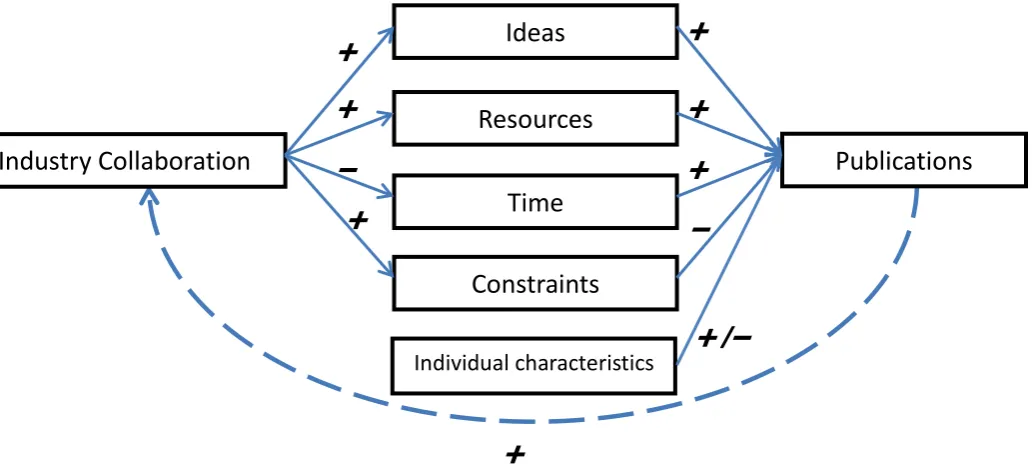
As illustrated in Figure 1, the quantity and quality of publications of an academic depend
positively on (i) the quality and quantity of her ideas, (ii) the amount of resources available,4
(iii) the time she devotes to academic research, and negatively on (iv) the constraints on publication activity, due for example to dissemination restrictions or commercialization of
3 Academic researchers have also repeatedly been shown to possess a “taste” for science and derive satisfaction from
scientific publication (Stephan, 1996, 2012; Stern, 2004).
4 The availability of research funding is important for scientists in all academic disciplines, but especially in
scientific outcomes (Stephan, 1996, 2012). Of course, publication rates may also be affected by time-invariant individual characteristics, such as gender, field, and education, together with time-variant attributes, such as past publications and seniority.
In this section we explain how industry collaboration affects each of these four factors and hence academic research output. Comparing the marginal benefits and the marginal costs of collaborating, we then show that there is an optimal degree of collaboration, in terms of research output. Of course, industry collaboration can bring other benefits (Lawson, 2013a), including direct and indirect pecuniary gains (such as commercial applications), in addition to those considered here. Third, we discuss the effects on different types of academics and across different measures of academic output. Finally, we argue that collaboration can be the consequence and not only the cause of research output and stress the importance of addressing this potential reverse causality.
2.1 Effects of industry collaboration
Collaboration with industry can boost academic research output for at least two reasons. First, collaboration can expand academics’ research agendas and improve the pool of research ideas (Rosenberg, 1998). Survey evidence in Lee (2000) shows that collaboration helps academics gain new insights for their own research and test the practical application of their theories. Mansfield (1995) also shows that a substantial number of publicly sponsored research projects stem from industrial problems encountered in consulting.
Second, industry collaboration can expand the available financial resources. Indeed,
industry has been identified as a major source of funding for academic research in recent years. According to survey evidence by Lee (2000), two of the most important reasons for academics to collaborate with industry are to secure funds for graduate students and lab equipment, and to supplement funds for their own academic research. Private financial support is especially important in light of the progressive decline in direct government funding during the last three decades (OECD, 2010).
In addition, firms’ commercial interests might impose constraints on the publication activity of collaborating academics. Czarnitzki et al. (2011) find that the percentage of researchers that report higher secrecy and publication delay is significantly larger for researchers sponsored by industry. Collaboration might even influence the selection of research topics and methodology (Florida and Cohen, 1999). As argued by Trajtenberg et al. (1997), industry research and development (R&D) is directed at commercial success, while university research generally focuses on solving fundamental scientific questions. Thus, research that addresses market demands, and appeals to industry partners, may not necessarily be close to the research frontier (Rosenberg and Nelson, 1994).
In sum, industry collaboration has benefits as well as costs for academic research. On the one hand, collaboration might help individual research by providing new ideas and additional funds. But on the other hand, less time and research constraints might lead to a reduction in academic research output. In the next section, we discuss the importance of each of these factors as the degree of collaboration changes.
2.2 The optimal degree of collaboration
However small, some exposure to real business problems might help non-collaborating academics gain valuable insights into their area of research, and expand the pool of research ideas and resources available. Therefore, as illustrated in the left-hand side panel of Figure 2, the marginal benefits of collaboration are expected to be substantial at very low levels of collaboration. But, as the level of collaboration increases, we expect the marginal benefits of collaboration to decrease. Indeed, a small increase in collaboration activity for an academic heavily involved with industry is less valuable than for someone collaborating little.
On the other hand, the marginal costs of collaboration, especially those related to the time lost to commercial application, are expected to be low for low levels of collaboration. But, as the extent of collaboration increases, the marginal costs of collaboration should increase. At the limit, an academic spending most of her time interacting with industry does not have time to do any basic research at all. As a result, the marginal costs for high levels of collaboration are expected to be higher than the marginal benefits, as exemplified in the left-hand side panel of Figure 2.
as shown in the right-hand side panel of Figure 2, we predict an inverted U-shaped relationship between industry collaboration and academic research output. Thus, the optimal level of collaboration, denoted as x* in Figure 2, is interior, i.e. lies inside the interval. We expect academics involved in collaborative research projects with industry to publish more than their non-collaborating peers. But, we also expect academic output to be lower for those that become heavily involved.
The existing results on patents provide indirect evidence of the positive effect of collaboration for low levels of involvement. Academic patenting can be viewed as industry collaboration requiring low levels of interaction with firms (Agrawal and Henderson, 2002) and are likely to be on the increasing part of the curve in Figure 2. Recent evidence indeed finds a positive relationship between patenting and publications (Azoulay et al., 2009; Breschi et al., 2008; Fabrizio and DiMinin, 2008; Stephan et al., 2007; van Looy et al., 2005).
Previous research that investigates the effects of forms of collaboration that require substantial interaction, as for example in academic start-ups, provides evidence for the negative effects of high levels of collaboration. Toole and Czarnitzki (2010) show that US academics that receive funding to start or join for-profit firms are more productive than their peers, but that they produce fewer publications after receiving the grant. Goldfarb (2008) tracks a sample of 221 university researchers funded by the NASA and concludes that researchers repeatedly funded by the NASA experienced a reduction in academic output. In this case, the effect is likely to have been that associated to the decreasing part of the curve.
2.3 Differences across types of academics
We expect some academics to be more affected than others by the positive and negative effects of collaboration. For instance, regular collaborators, i.e., those that show high levels of collaboration throughout their career, should be more affected than occasional collaborators. Occasional collaborators might not be heavily invested, and benefit or suffer less from collaboration, than those that regularly collaborate and write papers with the industry.
research. But high levels of involvement might also be relatively worse, because industry would then account for the overall majority of funding and could impose severe time and publication activity constraints.
We also expect the trade-off associated with collaboration to be less pronounced for senior academics. Experience and network effects might make senior researchers less prone to the positive and negative effects of collaboration. Young researchers, instead, are at a crucial point of their careers, and should be more affected (Dasgupta and David, 1994).
2.4 Differences across measures of research output, quality and type of research
Industry collaboration might affect not only the quantity but also the quality and the type of publications. We expect the effects of collaboration to appear both for basic and applied research, but to be stronger for applied research. The availability of financial resources
benefits, above all, applied research programs.5 Research ideas arising from collaboration
are also more likely to be turned into applied research papers. At the same time, publication constraints should affect, especially, applied publications. Survey studies on this topic, such as Blumenthal et al. (1986), Gulbrandsen and Smeby (2005) and Glenna et al. (2011) report that researchers with funding from industry claim to undertake significantly more applied research than researchers with no external funds or other types of funds.
The trade-off associated with industry collaboration may also be different for research quantity than for average research quality. A small level of collaboration might increase the number of publications, due to enhanced pools of ideas and resources, but not their average quality, which depends relatively more on intrinsic researcher characteristics, such as ability. Similarly, high levels of collaboration might reduce publication numbers due to time constraints or secrecy issues, though not necessarily affecting their average quality. Empirical evidence on this topic is mixed. While Hottenrott and Lawson (2013) find evidence that researchers with high levels of engagement, i.e., those that claim that industry is of high importance for gaining ideas for research, produce fewer publications but not publications of lower quality, Toole and Czarnitzki (2010) find a negative effect for both outcomes.
5 Financial rewards, however, might also have a positive impact on the production of basic research because basic and
2.5 The collaboration decision
Engaging in collaborative activities is not an exogenous but a strategic decision of both academic researchers and firms. A substantial body of literature has studied, in addition to the benefits and costs of collaboration mentioned earlier, which types of academics tend to collaborate more often with industry (see Perkmann et al., 2013). Academic researchers' characteristics and attitudes, as well as local group norms play a role. Geographical proximity to the firms is also important, particularly for researchers in universities with a modestly rated faculty (Audretsch and Stephan, 1996; Mansfield and Lee, 1996).
Several papers have also identified the private sector’s benefits and costs from collaborating with academia (Henderson et al., 1998; Salter and Martin, 2001; Cohen et al., 2002; Link and Scott, 2005, Laursen et al., 2011). Firms that choose to team up with academics gain access to specialized knowledge and equipment that benefit their own research and development. As a result, firms’ decision to collaborate depends on their absorptive capacity (Veugelers and Cassiman, 2005), their size, and whether they adopt an "open" search strategy (Mohnen and Hoareau, 2003; Laursen and Salter, 2004).
Nonetheless, ultimately, forming a partnership is a strategic decision on both sides of the ‘market’ (Mindruta, 2012). Banal-Estanol et al. (2013) develop a two-sided matching market model of academic researchers and firms developing research projects. Participants on each side of the market are heterogeneous in terms of scientific ability (past publications, patents, or know-how) and project preferences (degree of “appliedness”). They show, theoretically and empirically, that successful academics and those involved in more applied research are more likely to collaborate with industry, whereas the least able and those mostly involved in basic research are more likely to develop non-collaborative projects. Also, they find that the matching, among those that collaborate, is positive assortative in terms of scientific ability, i.e. top academics collaborate with top firms and less-able academics collaborate with less-able firms; and also in terms of project preferences, i.e. academics involved in more applied research collaborate with more applied firms and academics mostly involved in basic research collaborate with more basic firms.
[between collaboration and publications] is that companies selectively support talented and energetic faculty who were already highly productive.” Consequently, estimates of the impact of industry collaboration on academic research output could be biased upwards if endogeneity is not corrected for. We shall address this issue in our empirical strategy.
3 Data and Empirical Strategy
In this section, we provide a detailed account of the creation of the dataset, as well as of the model specification and the identification strategy used.
3.1 Data
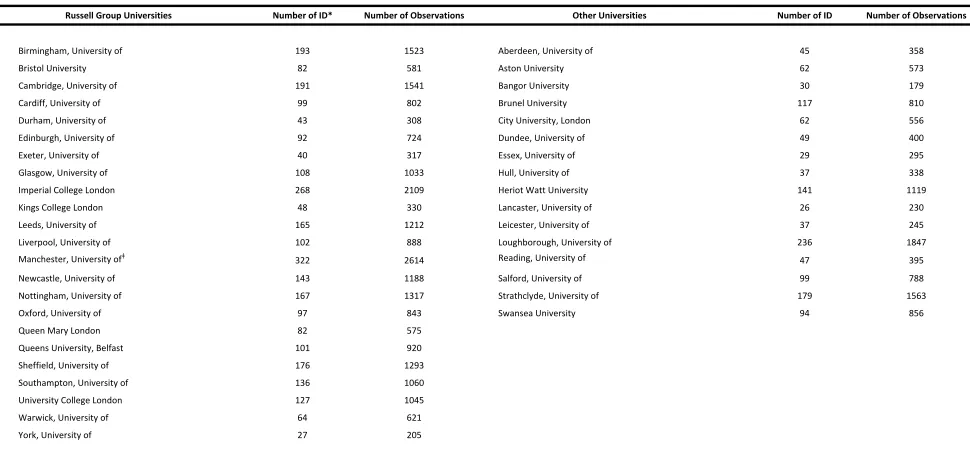
We created a unique longitudinal dataset containing individual characteristics, publications, research funds, and patents for all researchers employed in all the engineering departments of 40 major UK universities between 1986 and 2007 (see Table 1 for a list of universities). Through the British Library, we searched for university calendars and prospectuses, providing detailed staff information for all the universities with engineering
departments in the UK.6 Our final sample contains all the universities that had calendar
information available, including all the universities that are members of the prestigious Russell Group, a coalition of 24 research-intensive UK universities, as well as 16 other
comprehensive or technical universities.7
We retrieved the academics’ names and ranks for all the years 1986 through to 2007. We focused on academic staff carrying out both teaching and research and did not consider research officers or teaching assistants. We followed the researchers’ career paths between the different universities by matching names and subject areas and by checking the websites of researchers. Academics leave (and join or rejoin) our dataset at different stages in their career, when they move to (or from) abroad, industry, departments other than engineering (e.g., chemistry, physics, computer science), or universities that are not part of our dataset.
6 By Act of Parliament, the British Library is entitled to receive a free copy of every item published in the UK. These data
were supplemented with information from the Internet Archive, a not-for-profit organization that maintains a free Internet library committed to offering access to digital collections. Their collection dates back to 1996 and enabled us to retrieve information from outdated Internet sites.
7 We identified the initial set of engineering departments from the 1996 and 2001 Research Assessment Exercises
They represent the basis for our data collection and enable us to retrieve information on publications, research funds, and patents.
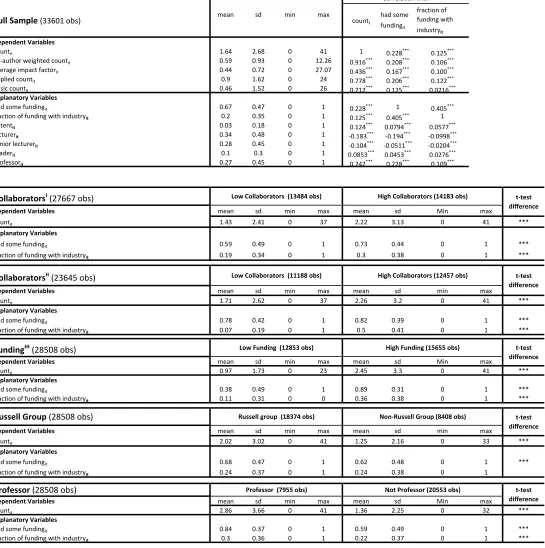
Our final sample contains information on 3,991 individuals. The final sample excludes all inactive researchers (those with neither publications nor funds during the entire sample period) and researchers who were present for less than six consecutive years so that all of our (stock) variables could be created. We describe below our sources and measures of research output (our dependent variable), industry collaboration (our main independent variable), as well as funding, patents, and other individual characterizing variables. We provide summary statistics of these variables in the first panel of Table 2.
Research output. Data on publications were obtained from the ISI Science Citation Index (SCI). The number of publications in peer-reviewed journals is not the only measure but is the best recorded and the most accepted measure for research output as they are essential for gaining scientific reputation and for career advancements (Dasgupta and David, 1994). We collected information on all the articles published by researchers in our database while they were employed at one of the institutions in our sample. Most entries in the SCI database include detailed address data that allowed us to identify institutional affiliations and
unequivocally assign articles to individual researchers.8
As a main measure of research output for each researcher in each year, we use the
normal count of publications (countit), i.e. the number of publications in t on which
researcher i is named as an author. Publication counts, however, might be misleading for
articles with a large number of authors and may not reflect a researcher’s effective productivity. Therefore, we also use the co-author-weighted count of publications (co-author
weighted countit), which we obtain by weighting publications by the inverse of the
publication’s number of co-authors.
To investigate the effects on the quality of publications, we take into account the impact factor attributed to the publishing journals. The SCI Journal Impact Factor (JIF) is a measure of impact based on the number of citations received by articles published in the journal in the first three years of publication. Though not a perfect measure of quality, the JIF represents the importance attributed to a particular article by peer review. As the JIF of a
8 Publications without address data had to be ignored. However, we expect this missing information to be random and
journal changes over time and journals are constantly added to the SCI, we collected JIFs for all years between 1986 and 2007. We measure the average quality of publications of an
individual i in a year t as the average JIF of her publications (average impact factorit).
Publications in journals without a JIF were given a weight of zero.
As an indicator for the type of research, we use the Patent board (formerly CHI) classification (version 2005), developed by Narin et al. (1976) and updated by Kimberley Hamilton for the National Science Foundation (NSF). Based on cross-citation matrices between journals, it characterizes the general research orientation of journals, distinguishing between (1) applied technology, (2) engineering and technological science, (3) applied and targeted basic research, and (4) basic scientific research. Godin (1996) and van Looy et al. (2006) reinterpreted the categories as (1) applied technology, (2) basic technology, (3) applied science, and (4) basic science; and grouped the first two as “technology” and the last two as “science”. We use the normal count of publications in each of these two categories and
denote them “applied” (applied countit) and “basic” (basic countit), respectively. Due to the
applied character of engineering sciences, 74% of all publications are applied.
Industry collaboration. Our measure of industry collaboration is based on grants awarded by the Engineering and Physical Sciences Research Council (EPSRC), the main UK government agency for research in engineering and the physical sciences, and by far the largest provider of funding for research in engineering (more than 50% of overall third-party funding). The EPSRC encourages (but does not require) academic researchers to find private partners for their projects. As defined by the EPSRC, “Collaborative Research Grants are grants led by academic researchers, but involve other partners”. Partners generally
contribute either cash or `in-kind' services to the full economic cost of the research.9
We obtained information on all the grants awarded since 1986. For each grant, we collected the start year; duration; total amount of funding; names of principal investigator (PI) and co-investigators; grant receiving institution; and names of partner organizations, if any. We use the presence of private partners to construct our measure of industry
9 The EPSRC does not favor specific types of academic research output. Grants are awarded based on peer-review and
collaboration (fraction of funding with industryit), which quantifies the fraction of
collaborative EPSRC funds of an individual i in the five previous years (i.e. between t-4 and t). To be precise, the variable fraction of funding with industry was constructed as follows. We divided the total monetary income of each grant between the PI and her co-investigator(s). We took into account the participation of all investigators but positively discriminated PIs by assigning them half the grant value and splitting the remaining 50% among the co-investigators. PIs were assigned a major part as they are expected to lead the
project. We additionally spread the grant value over the award period.10 This was done in
order to account for the on-going benefits and costs of the project and to mitigate the effect of focusing all the funds at the start of the project. Finally, for each year and for each researcher we computed the fraction of “collaborative” funds in the previous five years, i.e. those that included one or more industry partners, over all EPSRC funds received in the same period. We use a five-year window to reflect the profile of an academic in terms of her past stream of funding.
Funding. As discussed in the conceptual framework section, the availability of funds is an important factor for research output. We therefore created an indicator variable (had some
fundingit) that takes value 1 if academic i received any EPSRC funding (collaborative or not)
in the five previous years and 0 otherwise. We used the indicator instead of the funding level because the latter is discipline-specific (some disciplines require more funding than others). As for industry collaboration, we used a five-year window to reflect the academic’s profile.
Patents. In the conceptual framework, we argued that the commercialization of research results might impose constraints on publication activity. Our analysis therefore should control for patent activity. By including patents, we also separate the effect of patenting from the effect of collaborating with industry, as defined above. Prior research has considered patenting itself as being an indicator of a researcher’s involvement with industry. As a result, the benefits and costs of collaboration might also appear through the patent channel.
We obtained patent data from the European Patent Office (EPO) database. We collected those patents that identify the aforementioned researchers as inventors and were filed while
10 If the grant lasted two years, we split it equally across those two years. If it lasted three or more years, the first and
they were employed at one of the 40 institutions. We not only consider patents filed by the universities themselves, but also those assigned to third parties, e.g., industry or government agents (as shown by Lawson, 2013b, 52% of academic patents in the UK are not owned by the university). The filing date of a patent was recorded as representing the closest date to invention. Since the filing process can take several years, we were only able to include
patents published by 2007, hence filed before 2005.11 The EPO only covers a subsample of
patents filed with the UK Intellectual Property Office (UKIPO). Nevertheless, the patents that are taken to the EPO are those with a higher economic potential and/or quality (Maurseth and Verspagen, 2002) and have been used in the past to analyze academic patenting in Europe (see Lissoni et al., 2008).
To measure the impact of patenting on the timing of publications, we use a dummy
variable indicating whether the academic i has filed any patent in the same year (patentit), or
in the two years preceding the publication (patentit-1 and patentit-2). Researchers in Europe,
unlike the US, cannot benefit from a “grace period” and hence have to withhold any publication related to the patent until the patent application is filed. We therefore expect a lag of up to two years between invention and publication in a journal.
Individual characteristics. Research output might be linked to the researcher’s personal
attributes such as sex, age, education, and academic rank. Academic rankit is the only
time-variant observable characteristic in our dataset. Thus, we incorporate information on the evolution of researchers’ academic status from lecturer to senior lecturer, reader, and professor into our analysis. Lecturer corresponds to an assistant professor in the US, whereas senior lecturer and reader would be equivalent to associate professor.
We also include, as an additional time-variant characteristic of an academic at a given point in time, her past publications. Indeed, as argued by Stephan (1996), there is a “cumulative advantage” in science that results in a dynamic relationship between past and present publication output.
11 Just like previous studies (see e.g., Fabrizio and DiMinin, 2008), data construction requires a manual search in the
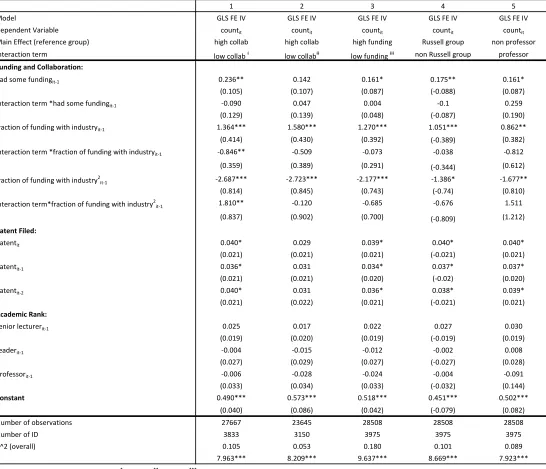
Interaction variables. As discussed in Section 2.3, the effect of industry collaboration on research output might differ across categories of academics. We therefore created five indicator variables which we use as interaction variables. We differentiated between academics that collaborate below and above the median intensity of collaboration, defined using (i) the lifetime share of publications with industry co-authors and (ii) the lifetime share of collaborative grants. Researchers with zero publications and zero grants were excluded. We also differentiated between (iii) those that had received above or below the median amount of funding during the previous five years; (iv) those that belonged to the selected Russell group of universities from those that did not; and (v) those at an earlier stage of their careers from the most senior researchers (professors). Researchers were able to change groups when they changed universities or were promoted. Panels 2 to 6 in Table 2 present the descriptive statistics of the two main variables of interest for these subsamples.
3.2 Econometric specification
Following our theoretical prediction, we estimate a model where research output is influenced non-linearly by the degree of collaboration with industry. The model includes as explanatory variables, not only the fraction of funding with industry and its quadratic term, but also past research output, having had any type of funding, the patent indicator variables, and other individual characteristics. Accordingly, we formulate our empirical model as:
𝑦𝑖𝑡 = � 𝛼j
2
𝑗=1
𝑦𝑖(𝑡−𝑗)+𝛽1ℎ𝑓𝑖𝑡−1+𝛽2𝑓𝑖𝑛𝑖𝑡−1+𝛽3𝑓𝑖𝑛𝑖𝑡−12 +� 𝛾𝑘 2
𝑘=0
𝑝𝑖(𝑡−𝑘)+𝛿𝑥𝑖𝑡−1+𝜇𝑖 +𝑣𝑖𝑡,
where yit stands for academic i’s research output at time t (either countit, co-author weighted
countit,, average impact factorit, applied countit, or basic countit); hfit-1 is the indicator variable
had some fundingit-1; finit-1 is the fraction of funding with industryit-1; pit is the patentit
indicator variable; and, xit-1 is a vector of other time-variant individual characteristics
including academic rankit-1 and year. All the independent variables except the patents are
lagged because of the publication lead time. The error term contains two sources of error:
the academic i’s fixed effect term µi, and a disturbance term vit. Since the distributions are
highly skewed, we take logarithms of both the research output and industry collaboration variables. As these figures contain zero values, we add the unit before we take logarithms.
As is well known, the presence of time-invariant individual factors in the error term µi
Ordinary Least Squares (OLS) inefficient and yielding incorrect standard errors. Thus, we estimate our model using Generalized Least Squares (GLS). And, because these
individual-specific effects μi (e.g. ability or IQ) may be correlated with some of the
explanatory variables (i.e., industry collaboration or academic rank), we choose a GLS with fixed effects (FE) estimator as our benchmark.
This model, though, cannot correct the autocorrelation created by the endogeneity of past research output. Thus, we compare the results of our benchmark regression, which does not include past research output, with those obtained using a dynamic Generalized Method of Moments (GMM) panel data model, which allows for the inclusion of lagged dependent variables as explanatory variables. In particular, we use the Arellano-Bond GMM estimator (Arellano and Bond, 1991; Blundell and Bond, 1998). This estimator transforms the model into first differences and thus eliminates the individual effects – and, thus, the cause of the autocorrelation across time periods. Thus, lagged dependent terms become valid instruments, which, along with lagged independent and exogenous variables, allow for the computation of asymptotically efficient estimates of the coefficients of interest.
3.3 Instrumental variables and identification strategy
As explained in the theoretical discussion, industry collaboration may not only be the cause of research output but also its consequence, creating reverse causality issues. Similarly,
the had some funding indicator variable may be endogenous because the most able
academics are also more likely to receive funding. Thus, in order to obtain consistent estimates of the coefficients of interest, we need to use instrumental variables.
For the GLS models, we instrument the fraction of funding with industry variable using
instrument the had some funding variable using the aggregate amount of funding received by the department, based on the same RAE data. Given that some of our instruments were only available for 1993 onwards, the number of observations is reduced in the regressions with
instruments. We test the validity of our instruments following the two-step model approach
described in Wooldridge (2002: 531–532, 2003: 483).
We also use these variables as instruments in the Arellano-Bond GMM (GMM-AB) models. The identification of our GMM models is warranted as they satisfy both the Autocorrelation and the Sargan tests. The autocorrelation test of the Arellano-Bond estimator rules out that the residuals’ dynamic structure is a source of autocorrelation and is thus an ignored cause of bias of the estimates. The satisfaction of the Sargan test warrantees that the depth of the endogenous and exogenous variables’ lags taken is enough to ensure that they are valid instruments and do not cause endogeneity issues in the transformed first differences models. In our case, the required depth of the lags is three periods. Even if our models satisfy the required tests, they use three and deeper lags of the dependent and independent variables as instruments, whereas the funding history goes back five years. To make sure that this is not a hidden cause of autocorrelation, and as a robustness check, we also estimate our model using a funding stock variable based on only two years of funding, as opposed to five.
4 Empirical Results
In this section we present our estimates of the impact of industry collaboration on research output. We first introduce our main results and then perform robustness checks. Finally, we analyze whether the impact of collaboration differs across types of researchers or measures of research output.
4.1 Main Results
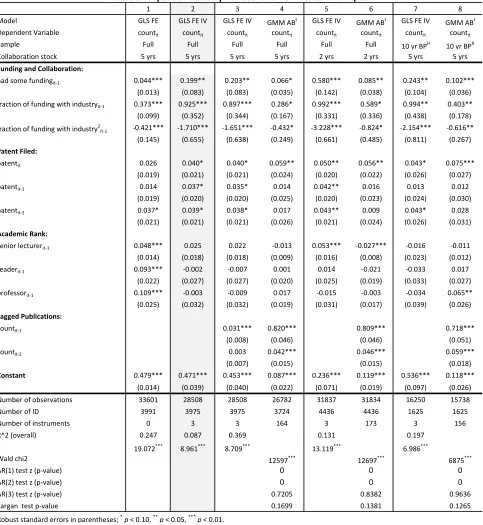
The first four columns in Table 3 report the basic estimates of research output, measured
as the normal count of publications, using GLS with fixed effects (columns 1, 2 and 3) and
GMM estimators (column 4). Column 1 displays the estimates of the non-instrumented GLS with fixed effects (GLS FE). Column 2 shows the estimates of our benchmark model, the GLS
lagged counts of publications as explanatory variables (GLS FE IV lags).12 Column 4
estimates the same specification using the Arellano-Bond GMM model, with lagged endogenous and exogenous variables and year dummies as instruments (GMM-AB).
At the bottom of the table, we include goodness of fit statistics. For each GLS specification,
we report the R2 and the F-statistic associated to the joint significance of all regressors. The
null of joint non-significance is rejected in all the models. For the GMM models, we report (i)
the Wald Chi2 tests, which reject the joint non-significance of the regressors; (ii) the
Sargan/Hansen tests, which are insignificant, suggesting that the models do not suffer from over-identification, and (iii) the Arellano-Bond tests, which do not reject the null that there is an absence of third (or higher) order correlation of the disturbance terms of our specifications, which is required for the consistency of these estimates. We report robust standard errors.
In the following paragraphs we present the main results grouped in themes for clarity.
Baseline number of publications. The antilog of the estimate of the constant term, minus the unit, can be considered the “baseline” productivity prediction, i.e., the expected number of publications for an academic at the lowest rank (lecturer) who does not have any funding or patents. For the GLS IV FE benchmark in column two, the baseline number of publications associated to the estimate of the constant term is 0.60. According to the GMM-AB estimator in column four, once we incorporate the average effect of lagged publications, the baseline number of publications is higher (1.20). The GMM-AB estimates, however, are very sensitive to past publications (the coefficients for each of the two previous years are 0.820 and 0.042, respectively).
The effect of (non-collaborative) funding. Consistent with the conceptual framework, we find that financial resources enhance research output. According to the benchmark estimates, the incremental effect of having (non-collaborative) funding when compared to not having any funding at all is 0.35 publications. This is the difference between the baseline number of
publications when the academic had some funding, i.e. the antilog of (0.471+0.199) minus
one, and the bare baseline publications, i.e. the antilog of 0.471 minus one. For the GMM-AB
12 Although the GLS IV estimator does not correct for the autocorrelation created by the endogeneity of lagged publications,
specifications the incremental effect is 0.14. This is lower because GMM-AB estimates attribute a large part of the variation in current publications to variation in past publications.
The effect of industry collaboration. For the benchmark in column 2, the linear coefficient
of the fraction of funding with industry variable (β2 in the equation in Section 3.2) is positive
and significant (0.925) and the coefficient of the quadratic term (β3 in the same equation) is
negative and significant (-1.710). These results indicate that the effect of industry
collaboration on the number of publications has an inverted U-shape. The fraction of funding
with industry that would result in the maximum number of publications is 0.31. This is the antilog (minus one) of the fraction x satisfying the first order condition of the number of
publications’ maximization problem, i.e., x*= β2 / [-2* (β3) 2]. Thus, in the range of 0% to
31%, increasing the fraction of collaborative funding results in more publications, but beyond that threshold more collaborative funding decreases the number of publications.
For all specifications, the linear coefficient is positive and significant and the quadratic term is negative and significant. Thus, independent of the estimation method chosen, the effect of industry collaboration on the number of publications remains an inverted U-shape. Similarly, the optimal collaborative fractions in all the specifications range from 0.3 to 0.4, except for the non-instrumented GLS FE specification (0.56).
Thus, the non-instrumented GLS FE estimates, which are not corrected for the reverse causality of publications on funding, result in an optimal collaboration level that is almost twice the optimal level in the benchmark case. The coefficients associated with industry collaboration in the non-instrumented specification are partly absorbing the (reverse) positive effect of publications on collaborative funding, and are thus overestimating the positive effect of collaborating with the industry.
The effect of academic rank. Being a senior lecturer, a reader or a professor as opposed to a lecturer has little effect according to our estimates, except for the non-instrumented model. Correcting for the reverse causality of industry collaboration and funding removes the effect of academic rank on research output.
The effect of lagged publications. In columns 3 and 4, we include past publications as explanatory variables. The coefficient associated with the previous year’s publications is positive and significant, both in the GMM-AB specification (0.820) and in the GLS FE IV with lags (0.031). The effect of the number of publications two years prior is positive but smaller. Because we have taken logarithms of both the dependent variable and its lagged terms, we can interpret these coefficients as elasticities. Thus, increasing the number of publications in the previous year by 100% (i.e. doubling them) would increase the following year’s expected number of publications by almost one percentage point according to the GMM-AB specification and by 0.3 percentage points according to the GLS FE IV with lags estimator.
As in earlier papers, our estimates suggest that there is persistence in publications. But, most importantly, accounting and correcting for the effect of past publications on current output using GMM-AB, does not result in a qualitative change of the results obtained with the GLS IV FE estimators in terms of an inverted U-shaped response of publications to the intensity of collaboration with industry.
Summary. Figure 3 shows the aggregated impact of industry collaboration on publications. Using the estimates of each of the four models, we plot the predicted number of publications against the levels of collaborating funding for a lecturer with no patents. The levels of collaborative funding range from 0% to 100%, i.e., from all funding involving no industry partners (non-collaborative) to all funding including industry partners. We also plot the predicted number of publications for a researcher that has not received any funding for the benchmark GLS FE IV specification (the predicted number is similar for the other models).
but beyond a certain threshold it is negative. For very high levels of industry collaboration (above 70%) the predicted number of publications is lower than for non-collaborative funding, but it is always better than for no funding at all.
Overall our estimates provide strong evidence to support the hypothesis that industry collaboration does non-linearly affect the number of publications. The effect is positive for low intensities of collaboration, but it turns negative after a certain threshold, in all the different specifications. The inverted U-shaped curves reach their maxima at an intensity of industry collaboration of about 0.3 for the two GLS FE IV models, at about 0.4 for the GMM-AB models, and at 0.56 for the non-instrumented GLS FE.
4.2 Robustness checks
Two-year based funding stock. The GLS FE IV and GMM-AB estimates in columns five and six in Table 3 use a variation of the measure of industry collaboration. Here, the variables had some funding and fraction of funding with industry include the stream of funds received in the last two years only (as opposed to the last five). Although this choice reflects less accurately the funding profile of the academic, it deals better with potential autocorrelation issues. Indeed, all the GMM-AB models use three and deeper lags of the dependent and independent variables as instruments whereas the funding history in the main results is five years long. Additionally, basing our measure on a shorter window allows younger and more mobile researchers to enter the sample. This specification enables us to assess the impact of using the five-year window-based funding stock on the benchmark estimates.
Balanced sample. The specifications in columns seven and eight in Table 3 are estimated using only those researchers that can be observed for the full last 15 years of our sample, so that we are able to build the 5-year funding and industry collaboration variables and estimate a balanced 10 year panel. This specification enables us to explore whether the full-sample estimates have been significantly affected by attrition.
Again, all coefficients of interest have the same sign and similar magnitude as in the full-sample regressions, which we interpret as being an indication that attrition has not caused important biases in the main estimates. The optimal levels of collaboration are also very similar. Interestingly, being a professor has a significant positive impact (0.07 publications) according to the GMM-AB estimator. This may be related to the fact that the fraction of professors in the 10 years panel is larger than in the full sample.
4.3. Differences across types of academics
In Table 4, we reproduce the results of our benchmark model for various types of academics by interacting our variables of interest with indicator variables for particular groups of academics. The main effect in each specification reflects the effect of a variable for the group of reference. The effect for the interacted group is obtained by adding the interaction term to the main effect, if it is significantly different from zero. To summarize, the results in Table 4 show that the trade-off of industry collaboration exists for all the categories of academic researchers. The coefficient for the linear term is positive and that of the quadratic term is negative in all cases, both for the reference and non-reference groups. The magnitudes of the effects, however, differ, as we explain below.
The first column distinguishes between academics who have an above (main effect) and
below (adding the interaction effect) the median percentage of publications co-authored
The second column distinguishes between academics with an above (main effect) and below (adding the interaction term) the median percentage of average lifetime funding with industry. High collaborators in terms of funding history with industry have slightly stronger effects than the high collaborators in terms of joint publications. But low collaborators in funding history do not appear to be significantly different from their high collaboration counterparts. The negative coefficients, although insignificant, would imply a slightly flatter and lower curve, and the impact of collaboration would be slightly worse.
The third column separates academics with high and low levels of funding, i.e., academics above (main effect) and below (adding the interaction effect) the median in the amount of funding received in the past 5 years. Results suggest that those with a high level of funding have a slightly more positive response to industry collaboration, and a slightly higher curve. But, according to the interaction term estimates, academics with funding below the median are not significantly different from those above the median.
In column 4, we distinguish between academics working in (main effect) and not working in (adding the interaction effect) a Russell group university. We find that those in the Russell group are not significantly different to those in other, lesser known and less-funded institutions. The negative coefficients of the interaction terms, although insignificant, suggests that the impact of collaboration for researchers in a non-Russell group university is slightly worse than for their counterparts.
Lastly, column 5 distinguishes between academics that are of a lower academic rank (main effect) as opposed to professors (adding the interaction effect). According to our estimates, professors do not experience a significantly different impact than academics in lower academic ranks. The negative sign of these coefficients, however, are suggestive of professors having a flatter relationship between industry collaboration and publications.
4.4. Differences across measures of research output, quality, and types of research
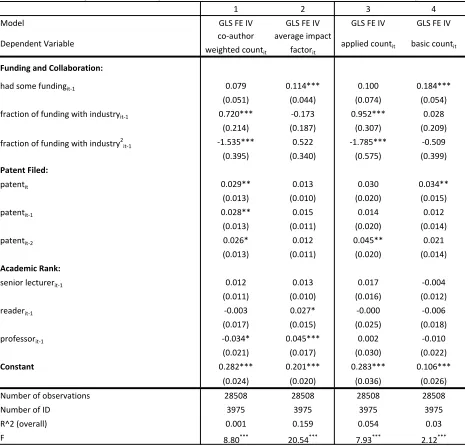
In Table 5, we reproduce the results of our benchmark model using different measures of research output. The first column shows the impact of industry collaboration when publications are weighted by the inverse of the number of co-authors. The baseline number of the co-author weighted publication count is 0.33. The coefficients of the linear and
quadratic terms of the fraction of funding with industry variable are significant, and jointly
benchmark of 0.3 in Table 3. The effect of the had some funding variable is insignificant, suggesting that funding may increase the number of publications simply by increasing the size of teams. This is further suggested by the negative effect of the professor dummy, as these may primarily benefit from larger labs through co-authorship. The effect of patents is positive and significant just like in the benchmark regression in Table 3.
Column 2 reports the results of the effect of industry collaboration on the average quality of publications. While the existence of funding is positive and significant, the effects of the two industry collaboration terms and the patent variables are insignificant. This indicates that while industry funding and patenting positively affect publication quantity they do not affect average publication quality, which may depend more on intrinsic research ability.
Columns 3 and 4 decompose the effects by type of research. We report the estimates of the impact of collaboration on the count of applied (“technology”) and basic (“science”) publications. The baseline number of applied and basic articles is, respectively, 0.33 and 0.11. Thus, the expected number of basic publications is lower than that for applied publications. The existence of funding positively impacts the number of basic publications, but the fraction of collaborative funding does not. According to the (insignificant) coefficients, the optimal fraction of funding in collaboration with the industry would be just 0.03. For applied research, the linear and quadratic coefficients associated to the industry collaboration variables are instead significant, and jointly imply an optimal intensity of about 0.3, similar to the benchmark regression in Table 3.
5 Discussion and Conclusion
This paper uses the individual time-varying fraction of research funding that involves industry partners to identify the effects of industry collaboration on research output. Many authors argue that research collaborations, contract research, and consultancy are far more important channels of knowledge transfer than patents, licenses, and spin-offs. Those channels are, however, more difficult to measure empirically and even more difficult to compare across institutions and time, which may explain why the literature has paid little attention to these collaborative forms of university-industry interactions. Here, we use homogeneous information on grants awarded by the EPSRC, by far the most important funding source of research in engineering sciences in the UK.
Our results for this panel indicate that the number of publications increases with the presence of non-collaborative funding and increases even further with the intensity of industry collaboration, but only up to a certain point. For levels of collaboration above 30%– 40%, research output declines. These results have proven robust to variations in the econometric estimation method, for various subsamples of academics, and for various measures of academic research output. Nevertheless, some remarks are in order. Basic research output and average publication quality are significantly positively affected by (non-collaborative) funding but are not significantly affected by industry collaboration.
We use panel data estimation methods in which funding and industry collaboration are instrumented for, as successful researchers are better placed to attract interest from industry. Thus, industry collaboration can be the consequence, and not only the cause, of high number of publications. We also provide dynamic panel estimates that use lagged publications as explanatory variables. The positive effect of non-collaborative funding and the inverted U-shaped effect of industry collaboration on research output are validated when we instrument for both industry collaboration and lagged publications. Moreover, we show that the impact of excessive diversion from academic activity through industry collaboration can be seriously underestimated when inadequate estimation methods are used. Without controlling for reverse causality, our estimated optimal level of collaboration is almost twice the estimated level when this source of endogeneity is corrected for.
Just as in earlier literature, we find a positive effect of patenting on publications. The contemporaneous effect of patent disclosure is similar to the one of past patents, giving no evidence of a “secrecy” effect. However, when we consider the nature of research we find a stronger contemporaneous effect of patents on publications in basic science journals. This may explain the positive correlation found in papers that analyze the publication and patenting activity of researchers in more basic sciences, e.g., life-science (Azoulay et al., 2009; Breschi et al., 2008). As argued by Murray (2002) and Thursby et al. (2007) and confirmed by Thursby and Thursby (2011), ideas gained through basic research may also result in patents. We do however find a delayed positive effect of patenting for publications in applied journals, suggesting that they may suffer from “secrecy”. Perkmann and Walsh (2009) also argue that more applied projects are more likely to be affected by secrecy, because of immediate commercial viability.
Our findings suggest that encouraging universities to collaborate moderately with industry is a beneficial policy. A moderate degree of industry collaboration not only facilitates the transfer of knowledge and accelerates the exploitation of new inventions, but it also increases academic research output. A moderate degree of collaboration increases the number of applied publications but it does not significantly affect the number of basic ones.
similar for very different types of researchers within our sample: for those in large, research-intensive universities and in smaller ones, as well as for junior and senior, and for researchers receiving below and above median levels of funding. This suggests that our results might also be true in other contexts.
Ours can only be a first step in the analysis of the effects of the various channels of knowledge transfer. With more comprehensive and homogeneous information, we could make comparisons between the effects of research collaborations, contract research, consultancy, and patents. In our sample, research collaborations have a stronger impact than patents. It might also be interesting to tackle interactions between different knowledge transfer channels. We know very little about whether collaboration channels complement or substitute each other. Consultancy, for example, might have a positive effect on research output if and only if it is complemented by collaboration in research. Of course, this is only a conjecture and a challenging task for future research.
Acknowledgements
References
Agrawal, A., and R. Henderson, 2002, “Putting patents in context: Exploring knowledge transfer from MIT”, Management Science 48, 44–60.
Arellano, M., and S. Bond, 1991, “Some tests of specification for panel data: Monte Carlo evidence and an application to employment equations”, Review of Economic Studies 58, 277–297.
Arora, A., P. David and A. Gambardella, 1998, “Reputation and Competence in Publicly Funded Science: Estimating the Effects on Research Group Productivity”, Annales d’Economie et de Statistique 49–50, 163-198.
Audretsch, D. and P. Stephan, 1996, "Company-Scientist Locational Links: The Case of Biotechnology", The American Economic Review 86, 641–652.
Azoulay, P., W. Ding and T. Stuart, 2009, “The Impact of Academic Patenting on the Rate, Quality, and Direction of (Public) Research”, The Journal of Industrial Economics, 57(4), 637–676.
Baldini, N., 2008, “Negative effects of university patenting: Myths and grounded evidence”, Scientometrics, 75 (2), 289–311.
Banal-Estañol, A., and I. Macho-Stadler, 2010, “Scientific and Commercial Incentives in R&D: Research vs. Development?”, Journal of Economics and Management Strategy, 19 (1), pp. 185–221.
Banal-Estanol, A., I. Macho-Stadler and D. Pérez-Castrillo, 2013, “Endogeneous Matching in University-Industry Collaboration: Theory and Empirical Evidence from the UK”, working paper Universitat Pompeu Fabra.
Benavente, J.M., G. Crespi, L. Figal Garone, and A. Maffoli, 2012, "The impact of national research funds: A regression discontinuity approach to the Chilean FONDECYT", Research Policy 41, 1461–1475.
Blumenthal, D., N. Causino, E. G. Campbell, and K. S. Louis, 1996, “Relationships between Academic Institutions and Industry in the Life Sciences — An Industry Survey.” , New England Journal of Medicine, 334 (6), pp. 368–73.
Blumenthal, D., M. Gluck, K.S. Louis, M.A. Stoto, and D. Wise, 1986, “University-industry Research Relationships in Biotechnology: Implications for the University”, Science 13 June, 232, 4756, 1361–1366.
Blundell, R. and S. Bond. 1998, “Initial conditions and moment restrictions in dynamic panel data models”, Journal of Econometrics 87, 11–143.
Cohen, W.M., R.R. Nelson and J.P. Walsh, 2002, “Links and Impacts: The Influence of Public Research on Industrial R&D”, Management Science 48, 1–23.
Czarnitzki, D., C. Grimpe and A. Toole, 2011, "Delay and Secrecy: Does Industry Sponsorship Jeopardize Disclosure of Academic Research?" ZEW Discussion Paper 11-009,
Mannheim.
D’Este P. and P. Patel, 2005, "University–industry linkages in the UK: What are the factors underlying the variety of interactions with industry? ", Research Policy 36, 1295–1313. Dasgupta, P. and David, P.A., 1994, “Toward a new economics of science” Research Policy 23
(5), 487–521.
European Commission, 1995, “Green Paper on Innovation”, Luxemburg.
Fabrizio, K. and A. DiMinin, 2008, “Commercializing the Laboratory: Faculty Patenting and the Open Science Environment”, Research Policy 37, 914–931.
Florida, R. and W.M. Cohen, 1999, “Engine or Infrastructure? The University Role in Economic Development” In: Branscomb, L.M., Kodama, F., Florida, R. (Eds.),
Industrializing Knowledge: University—Industry Linkages in Japan and the United States. MIT Press, London, 589–610.
Geuna, A. and L. Nesta, 2006, “University patenting and its effects on academic research: The emerging European evidence”, Research Policy, 35(6), 790–807.
Glenna, L.L., R. Welsh, D. Ervin, W.B. Lacy and D. Biscotti, 2011, “Commercial Science,
Scientists’ Values, and University Biotechnology Research Agendas”, Research Policy 40, 957– 968.
Godin, B., 1996, “Research and the practice of publication in industries”, Research Policy 25, 587–606.
Goldfarb, B., 2008, “The effect of government contracting on academic research: Does the source of funding affect scientific output? ”, Research Policy 37, 41–58.
Gulbrandsen, M. and J.C. Smeby, 2005, “Industry Funding and University Professors’ Research Performance”, Research Policy 34, 932–950.
Hall, B., 2004, “University-Industry Research Partnerships in the United States”, in Contzen, Jean-Pierre, David Gibson, and Manuel V. Heitor (eds.), Rethinking Science Systems and Innovation Policies, Purdue University Press.
Henderson, R., A. Jaffe and M. Trajtenberg, 1998, "Universities as a Source of Commercial Technology: a Detailed Analysis of University Patenting, 1965–1988", Review of Economics and Statistics 80, 119–127.
Hottenrott, H., and S. Thorwarth, 2011, “Industry Funding of University Research and Scientific Productivity”, Kyklos 64 (4), 534–555.
Jacob, B. A. and L. Lefgren, 2011, “The impact of research grant funding on scientific productivity”, Journal of Public Economics 95: 1168–1177.
Laursen, K., T. Reichstein and A. Salter, 2011, "Exploring the Effect of Geographical Distance and University Quality on Industry-University Collaboration in the UK", Regional Studies 45, 507–523.
Laursen, K. and A. Salter, 2004, "Searching low and high: what types of firms use universities as a source of innovation", Research Policy 33, 1201–1215
Lawson, C., 2013a, “Academic Patenting: The Importance of Industry Support”, Journal of Technology Transfer 38 (4), 509–535.
Lawson, C., 2013b, "Academic inventions outside the university: Investigating patent ownership in the UK", Industry and Innovation, forthcoming.
Lee, Y. S., 2000, “The sustainability of university-industry research collaboration: An empirical assessment”, The Journal of Technology Transfer, 25 (2), 111–133. Link A.N. and J.T. Scott, 2005, "Universities as partners in US research joint ventures",
Research Policy 34, 385–393.
Lissoni, F., P. Llerena, M. McKelvey and B. Sanditov, 2008, "Academic patenting in Europe: new evidence from the KEINS database", Research Evaluation 17, 87–102.
Manjarres-Henriquez, L., A. Gutierrez-Gracia, A. Carrion-Garcia, and J. Vega-Jurado, 2009, “The effects of university–industry relationships and academic research on scientific performance: Synergy or substitution? ” Research in Higher Education, 50 (8), 795– 811.
Mansfield, E., 1995, “Academic Research Underlying Industrial Innovations: Sources, Characteristics, and Financing”, Review of Economics and Statistics 77, 55–65.
Mansfield, E. and J.-Y. Lee, 1996, "The modem university: contributor to industrial innovation and recipient of industrial R & D support", Research Policy 25, 1047–1058.
Maurseth, P., and B. Verspagen, 2002, “Knowledge Spillovers in Europe: A Patent Citations Analysis”, Scandinavian Journal of Economics, 104(4) 531–45.
Meissner, C, 2011, “University Research and Industry Involvement. Three Essays on the Effects and Determinants of Industry Collaboration and Commercialisation in Academia”, PhD Thesis, City University London.
Mohnen, P. and C. Hoareau, 2003, “What Type of Enterprise Forges Close Links with Universities and Government Labs? Evidence from CIS 2”, Managerial and Decision Economics 24, 133–146.
Mowery, D., R. Nelson, B. Sampat, and A. Ziedonis, 2001, “The growth of patenting and
licensing by U.S. universities: an assessment of the effects of the Bayh–Dole act of 1980”. Research Policy 30, 99–119.
Murray, F., 2002, “Innovation as overlapping scientific and technological trajectories: exploring tissue engineering”, Research Policy 31, 1389–1403.
Narin, F., G. Pinski, and H. Gee, 1976, “Structure of the Biomedical Literature,” Journal of the American Society for Information Science, 25–45.
Nelson, R., 2004, “The market economy, and the scientific commons”, Research Policy, 33(3), 455-471.
OECD (Organisation for Economic Co-operation and Development) 2009. Business-Funded R&D in the Higher Education and Government Sectors, in: OECD Science, Technology and Industry Scoreboard 2009. Paris: OECD Publishing.
Perkmann, M., V. Tartari, M. McKelvey et al., 2013, "Academic engagement and
commercialisation: A review of the literature on university–industry relations", Research Policy 42, 423–442.
Perkmann, M. and K. Walsh, 2009, “The two Faces of Collaboration: Impacts of
University-Industry Relations on Public Research”, Industrial and Corporate Change 18, 1033–1065.
Rosenberg, N., 1998, "Chemical Engineering as a General Purpose Technology", in: Helpman, E. (Ed.), General Purpose Technologies and Economic Growth. Cambridge: MIT Press, 167–192.
Rosenberg, N. and R. Nelson, 1994, “American Universities and Technical Advance in Industry”, Research Policy 23, 323–348.
Salter, A. and B.R. Martin, 2001, “The Economic Benefits of Publicly Funded Basic Research: a Critical Review”, Research Policy 30, 509–532.
Siegel, D.S., D. Waldman and A. Link, 2003. "Assessing the Impact of Organizational Practices on the Relative Productivity of University Technology Transfer Offices: An Exploratory Study”, Research Policy 32, 27–48.
Stephan, P., 1996, "The Economics of Science", Journal of Economic Literature 34, 1199– 1235.
Stephan, P., 2012, How Economics Shapes Science, Cambridge, MA: Harvard University Press.
Stern, S., 2004, "Do scientists pay to be scientists?" Management Science 50, 835–853. Thursby, J., and M. Thursby, 2011, “Has the Bayh-Dole act compromised basic research?”
Research Policy 40, 1077–1083.
Thursby, M., J. Thursby, and S. Mukherjee, 2007, “Are there Real Effects of Licensing on Academic Research? A Life Cycle View”, Journal of Economic Behavior & Organization 63(4), 577–598.
Toole, A., and D. Czarnitzki, 2010, “Commercializing Science: Is there a University ‘Brain Drain’ from Academic Entrepreneurship? ” Management Science 56(9), 1599–1614 Trajtenberg, M., R. Henderson and A.B. Jaffe, 1997, “University Versus Corporate Patents: a
Window on the Basicness of Invention”, Economics of Innovation and New Technology 5 (19), 19–50.
Tuckmann, H.P. and J. Leahey, 1975. "What is an article worth", Journal of Political Economy 83, 951–968.
van Looy B., K. Debackere and J. Callaert, 2006, “Publication and Patent Behaviour of academic researchers: conflicting, reinforcing or merely co-existing”, Research Policy 35, 596–608.
Veugelers, R. and B. Cassiman, 2005, "R&D cooperation between firms and universities. Some empirical evidence from Belgian manufacturing", International Journal of Industrial Organization 23, 355-379.
Wooldridge, J.M., 2002, “Econometric Analysis of Cross Section and Panel Data”, MIT Press, Cambridge, MA.