Copyright( 1975 AmericanSocietyforMicrobiology Printedin U.S.A.
Synthesis
of
Functional
Bacteriophage T4-Delayed
Early
mRNA
in
the
Absence of Protein Synthesis
JEFFREY W. MORSE' ANDPAUL S. COHEN*
University of Rhode Island, Department ofMicrobiologyand Biophysics,
Kingston,
Rhode Island 02881Received forpublication4February 1975
When Escherichia coli B207 is grown either
aerobically
or under limited aerobic conditions, pretreatedwith chloramphenicol to block protein synthesis,and then infected with bacteriophage T4, the phage RNA whichaccumulates, termed "immediate early" (IE), contains thetranscripts ofalimited number of prereplicative genes. Among the transcripts which accumulate is the mRNA which serves as a template for deoxycytidylate
hydroxymethylase
(HMase) synthesis. Among the prereplicative gene transcripts which do not accumulate under these conditions are deoxycytidine triphosphatase(dCTPase),
a-glucosyltransferase (a-gt), and deoxynucleotide kinase (kinase); these genes have been termed"delayed early" (DE). In contrast, whenproteinsynthesis isinhibited by
depleting
aerobically
grown E. coli B207 ofK+,
both IE and DE T4 RNAaccumulate, but these transcripts donot contain functional HMase, dCTPase, a-gt, orkinase mRNA's. However, if E. coli is grown underconditions of limited aeration and then depleted of K+ prior to T4 infection, the T4 RNA which accumulates contains both IE and DE transcripts and functional HMase,
dCTPase, and a-gt mRNA's. Functional kinase mRNA does not accumulate under these conditions. The results of these experiments indicate that the
synthesis of functional DE RNA in the absence of simultaneous protein synthesis, depends on the
physiological
condition of the cells and the way inwhich protein synthesis is inhibited. In addition, data is presented which
suggests that extensive transcription of DE genes in the absence of protein
synthesis results in the inhibition oftranscription ofcertain IE genes.
Several laboratorieshave
reported
the resultsofexperiments whichshowthatalimited num-ber of T4 early genes, termed "immediate
early" (IE) genes, are transcribed in cells
infected in the presence of chloramphenicol (CM) (4, 14, 19, 28, 30, 35). In contrast, "de-layed early" (DE) genes are expressed shortly
after normal infection, butare not transcribed
inthe presence ofCM (4, 14, 19, 28, 30, 35). Recentlyit has been shown thatthree groups
ofIE genes canbe distinguished on thebasisof
the time at whichthey stop being expressed in vivo. GroupA genes are transcribed during the firsthalf of the early period, group B during the
entireearly period, and group Cthroughout the entire latent period (H. J. Witmer, In Progress inMolecular andSubcellularBiology,inpress).
There also are at least two groups of DE genes. The first group,perhapsrepresentativeof
the majority of DE genes, appears to be tran-scribed as extension products ofIE genes and
'Present address: University of Connecticut Health
Center, Department of Biochemistry, Farmington, Conn. 06032.
330
would,therefore,initiate at IE promotors (2, 23, 24). Transcription of this group of genes does
not take place in the presence of CM in vivo, but does occur in infected cells pretreated with the amino acid analogue 5-methyl tryptophan (14, 19), starved for a required amino acid (A.
Baros, and H. J. Witmer, Arch. Biochem.
Biophys., in press), or allowed brief periods of normal RNA and protein synthesis (8, 25, 26). Treatment with amino acid analogues,
starva-tion for arequiredaminoacid,orbrief periods of normalRNA and protein synthesis, which allow small but significant amounts of protein
synthe-sis(19, 25, 26), suggest that transcription of this group of DE genes either requires ribosome movement along a large portion of the RNA transcripts distal to the IE portions or that smallamountsofspecific protein(s) are synthe-sized immediately after infection which some-how prime these DE genes for transcription. The second group of DE genes (sometimes referredtoas"quasilate" genes) requires signif-icant amounts of T4 RNA and protein for
transcription, presumablyforthe synthesisof a
on November 10, 2019 by guest
http://jvi.asm.org/
mRNA SYNTHESIS
phage-specific proteinnecessary during the ini-tiation step (8, 25, 26).
In the present investigation, we present
evi-dence which shows that DE genes which are formed as extensions of IE transcripts can be synthesized in the complete absence of protein synthesis invivo. However, the transcription of thesegenesdependsonthephysiological condi-tion ofthe cells both during growth and infec-tion and onthe way in which protein synthesis is inhibited.
MATERIALS AND METHODS
Bacteria and bacteriophage. Escherichia coli B207, a mutant of E. coli B which cannot
concen-trate and retain K+ normally from the growth
medium (21), wasused in this study. Bacteriophage
T4amBL292 (gene 55),amaturation-defectivemutant ofT4, synthesizes exclusivelyIE and DE T4 mRNA inE. coli B (3, 34). T4RNA isolated from amBL292-infected E. coli Bwasused inDNA-RNA
hybridiza-tion experiments. E. coli PA 505MSI, kindly pro-vided by J. M. Buchanan, requires diaminopimelic
acid for growth and was used for preparation ofthe lysozyme assay substrate. As in all our previous work, wild-type bacteriophage T4 B was used in all other experiments.
Mediumandgrowthconditions for E. coli B207. The growth medium employed in these studies has been describedpreviously(5,7). Two differentgrowth conditionswereusedinthe present investigation.
(i)Aerobic growth. E. coli B207wasgrownat37C with vigorousshaking inaNewBrunswick G76water bath shakeratvolumeswhichwere nomorethan 10% ofthe growth flaskcapacity. Under these conditions the massdoublingtimewas36 to 42min.
(ii) Limited aerobic growth. Fifty-milliliter
cul-turesofE. coli B207weregrownin250-mlErlenmeyer
flasks at 37C without shaking and were aerated by bubblingairthrough10-ml pipettesintothe cultures
at a constant pressure of 4
lbs/inch'.
Under theseconditions the mass doubling time ofE. coli B207 was between 50 and 60 min, but the kinetics of phage production and the final phage yield did not differ significantly from those observed during T4 infection ofaerobicallygrowncells.
Inhibition ofproteinsynthesis.Proteinsynthesis
wasinhibitedbyeithertreating E. coli B207 withCM
(100
gg/ml
finalconcentration) ordepleting B207 of K+ by washing in K+-free medium as described previously (7, 28). In all the experiments reportedhere, CM treatment or K+ depletion inhibited the
rate of protein synthesis by greater than 99%, as
measured by incorporation of
[4C]Ileucine
intopro-tein (7).
Preparation of DNA and RNA for DNA-RNA hybridization experiments. T4 DNAwas prepared
bythe methodofKaiser andHogness(17).Toprepare
(0 to 12 min) labeled T4 amBL292 RNA (30C),
[6-3H]uracil (0.5
MCi/ml,
0.25gg/ml),
was added atthetimeofinfection.At 12min, cells werecollected by centrifugation (2,600 x g) after pouring over an
equal volume of ice. Both radioactive T4 amBL292 RNA andunlabeled competitor RNAs (see text) were extractedby the method of Lembach and Buchanan (19) and were completely alkali and RNase sensitive.
DNA-RNA hybridization. These experiments were performed as previously described (28). Filters
containing5,gofphageDNA were incubated at 37 C in the presence of 2 ug of 'H-labeled T4 amBL292 RNA inatotalvolume of 0.5 ml. Competing nonradi-oactive RNA was added at the indicated concentra-tion at the same time as the radioactive RNA. All experimental points were carried out in triplicate to
ensurethevalidity of these experiments.
Infection and preparation of infected cell ex-tracts.Infection wascarried out ata multiplicity of 5 phage/cell as described previously (7). Under these conditionsgreater than 98% of the cells were infected within 5 min.
Infected cells (50 ml) were collected at the times indicated in the figures, and extracts were prepared as describedpreviously (6).
Enzyme assays. Deoxycytidylate hydroxymeth-ylase(HMase) was assayed by the method of Wiberg andBuchanan (36).Deoxynucleotide kinase (kinase) wasassayed asthymidylate kinase by themethod of Wiberg et al. (37). Deoxycytidine triphosphatase (dCTPase) and a-glucosyl transferase (a-gt) were assayed aspreviously described (8) andlysozymewas assayed by the method of Leutgeb as described by
Schweiger and Gold (31).
Chemicals. [6'HHluracil, L-[1- 1"C ]leucine, [C-formaldehyde, [2- 4C]thymidine 5'-monophosphate, [2-14C deoxycytidine 5'-triphosphate, and uridine diphosphate [U- "4CJglucose, were purchased from NewEngland NuclearCorp. [2,6-'H]diaminopimelic acid was purchased from Amersham/Searle Corp. Tetrahydrofolic acid (gradeIII), ATP,dCTP,UDPG, and 2-mercaptoethanol were purchased from Sigma. Rifampin and egg white lysozyme were purchased from Calbiochem and chloramphenicol was a gift fromParke-Davis andCo.
RESULTS
Hybridization properties of phage RNA
made in the absence of protein synthesis. In the following experiments, we determined
whether T4 mRNA made in K+-depleted cells contained exclusively IE RNA or both IE and DE RNA. As in previous work (28), we took
advantage of the finding that T4 amBL292, a
maturation-defective mutant, makes allspecies ofIE andDE RNA but no late RNA whengrown
on the nonpermissive host, E. coli B (3, 34). Nonradioactive RNAsmadeduringinfectionfor 20 min in the presence of CM (20-min CM-RNA) and RNA made during either a5-minor
20-min infection of K+-depleted cells (5-min
KD-RNA and 20-min KD-RNA, respectively) were individually competed against RNA
iso-lated from T4 amBL292-infected E. coli B207 labeled with [3H
]uracil
from 0 to 12 min after infection[(0-12)-amRNA].
These experiments 331on November 10, 2019 by guest
http://jvi.asm.org/
were performed underfourdifferent conditions
of growth and infectionofcells.
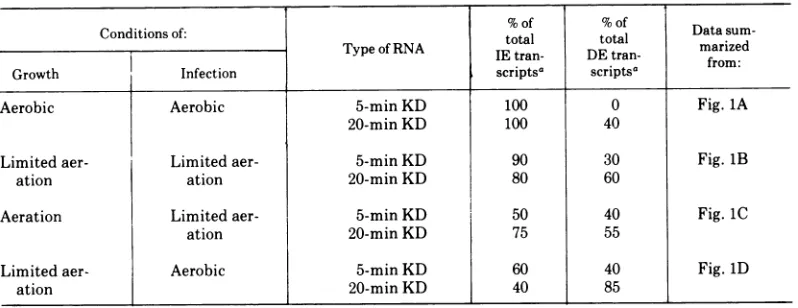
(i)Aerobicgrowth-aerobicinfection.Only about one-half ofthe (0-12)-amRNA was
com-peted out by 5-min KD-RNA. That this RNA contains all the IE species of RNA is shown by the facts that the competitive power of 5-min KD-RNA was almost identical to 20-min CM-RNA and that when all IE sites on T4 DNA were blocked by 20-min CM-RNA, the level of competition was not increased by the addition of 5-min KD-RNA(Fig. IA).
In contrast, approximately 65% ofthe (0-12)-amRNAwascompetedoutby20-minKD-RNA
andblockage ofIE sites with 20-min CM-RNA did not alter the competitive power of 20-min KD-RNA. Therefore, 20-minK-RNAcontained all IE species of RNA andabout 40% oftheDE species of RNA (see legend to Table 1 for
calculation methods).
(ii) Limited aeration growth and limited aeration infection. Under these conditions competition of(0-12)-amRNAbyKD-RNAwas
greaterthan 50% (Fig. 1B). However, therewas a tendency for KD-RNA to compete out less
(0-12)-amRNA when used alone than when IE sites were blocked by the presence of 20-min
CM-RNA indicating the presence ofsome DE species ofRNAand the lackofsomeIE species of RNA. Specifically, 5-min KD-RNA con-tained approximately 90% of the IE species of RNA and 30% ofthe DE species ofRNA. The
20-min KD-RNA containedabout80% ofthe IE
species of RNA and 60% of the DE species of
RNA.
(iii) Aerobic growth and limited aeration
infection. Under these conditions, 5-min KD-RNA contained approximately 50% of the IE species of RNA and 40% of the DE species of RNA(Fig. 1C).The 20-minKD-RNA contained
about 75% ofthe IE species of RNA and 55% of
the DE species ofRNA.
(iv) Limited aeration growth and aerobic
infection. Under these conditions, 5-min KD-RNA contained approximately 60% of the IE RNA species and 40% of the DE RNA species (Fig. 1D). The20-min KD-RNA contained about
40% ofthe IE RNA species and 85% of the DE species of RNA.
These data are summarized in Table 1.
Accumulation of functional mRNA in the
absenceofprotein synthesis. Several laborato-ries have shown that IE RNA accumulated in vivo in thepresence of CM can serve as mRNA
for the synthesis of HMase, but not for the
synthesis ofdCTPase, a-gt, or deoxynucleotide kinase (kinase) (19, 28, 29, 35, 39).
Since all of these enzymes are synthesized
shortly after infection, these results suggested
that HMase mRNA is an IE species, whereas the mRNA's necessary for dCTPase, a-gt, and kinase synthesis are members of the DE class. To determine whether the T4 RNA that
accu-mulates in the absence of K+ contained func-tional IE and DE mRNA, the following
experi-ment was performed.
E. coliB207wasinfected with T4 either in the absence of K+orin thepresence of CM. Either 5
or 20 min later, rifampin was added to block further initiation of RNA transcripts (33) and 5 min later CMwas washedout orK+ wasadded back to allow protein synthesis to resume.
Twenty minutes later the cells were collected and assayed for the early enzymes HMase, dCTPase, kinase, a-gt, and the late enzyme, lysozyme. Again, these experiments were per-formed under four different conditions ofgrowth and infection.
(i) Aerobic growth-aerobic infection. As reported previously (19, 28, 35), of the enzymes tested, only HMase mRNA accumulates in T4-infected cells pretreated with CM.However, in K+-depleted cells, although all IE and as
muchas40% of the DE mRNAspeciesappeared to be transcribed (Fig. 1A, Table 1), they did
not direct the synthesis of any of the enzymes
wetested (Table 2).
(ii) Limited aerationgrowth-limited aer-ation infection. Again, of the enzymestested, only HMase and mRNA accumulated in CM pretreated cells. However, in K+-depletedcells, not only did the HMase mRNA accumulate (IE), but dCTPasemRNA (DE), and toalesser extent a-gt (DE) mRNA, were transcribed. Neither kinase mRNA nor lysozyme mRNA appeared to accumulate under these conditions (Table 3). These results areconsistent with the fact that almost all the IE and as muchas 60% of the DE mRNA species accumulate under theseconditions (Fig. 1B, Table1).
(iii) Aerobic growth-limited aeration in-fection. Under these conditions, very little functional HMase mRNA accumulated in CM-pretreated cells, but this mRNA was again the only one of those tested which was detectable. However, in K+-depleted cells, significant
amounts of HMase mRNA (IE) and dCTPase mRNA(DE) accumulated andtoalesser extent a-gt mRNA (DE) accumulated. Neither kinase mRNA nor lysozyme mRNA were detectable
(Table 4). These results are consistent with the DNA-RNA hybridization data (Fig. 1C, Table 1) which show that most of the IE mRNA's and as much as 60% of the DE mRNA's accumulateinK+-depleted cells under these conditions.
on November 10, 2019 by guest
http://jvi.asm.org/
mRNASYNTHESIS IN T4-INFECTED CELLS
_100
I
< 75
z
I
to
- 50
c
25 0
Ratio Unlabeled/ Labeled RNA
I
z
I
E >
x
0 50 100 150 200
Rotio Unlabeled/Labeled RNA
I
z
c-0
z
0
E
a
0 50 100 150 200
Ratio Unlabeled/ Labeled RNA Ratio Unlabeled/Labeled RNA
FIG. 1. Hybridization properties of T4 RNA accumulated in K-depleted E. coli B207. Radioactive IE and DE
T4 RNA was isolated after infecting 50-ml cultures of E. coli B207 for 12minat 30 C with T4 amBL292
(multiplicity of infection of 5) in the presence of [6-3H]uracil (0.5 ,uCi/ml, 0.25 ug/ml). This RNA was
designated 3H-labeled (0-12)-amRNA. Competing RNAwasprepared asfollows: 20-minCM-RNA: CM (100
i.g/ml) wasadded 5minbefore infection, the cellswereinfectedwithwild-typeT4, and 20 min later the cells were collected and the RNA waspurified aspreviously described (28). 5-min KD-RNA: E. coli B207was
depleted ofK+5minbefore infection and infected, and 5minlater the cellswerecollected and the RNAwas
purified. 20-min KD-RNA: as5-minKD-RNA exceptthatinfectionwasallowedtoproceed for20minofK+
depletion before collecting the cells and purifying the RNA. Filters containing5 jigof denatured T4 DNAwere
incubatedinthepresenceof2ggof 3H-labeled (0-12)-amRNAat64 Cinatotal volumeof 0.5mlasdescribed
previously (28). Competing nonradioactive RNA wasaddedatthe indicatedconcentrationsatthesametimeas
the radioactive RNA. When20-min CM-RNAwasusedtoblock all IE sites in mixedcompetitor experiments,it
was used at the saturating RNA/DNA ratio of 200 and designated 20-min CMS-RNA. The competing
nonradioactiveRNAswere:0,5-minKD-RNA;0,20-min KD-RNA; V, 20-min CM-RNA;*, 5-minKD-RNA
+20-min CMS-RNA;E, 20-minKD-RNA +20-min CMS-RNA; A,nonradioactive(0-12)-amRNA.Cellswere
growneitheraerobicallyorwith limited aeration(seeMaterials andMethods)andinfectedinthe absenceofK+ eitheraerobicallyorwithlimited aerationin thefollowingcombinations:(A)aerobicgrowth-aerobic infection;
(B) limited aerationgrowth-limited aeration infection; (C)aerobicgrowth-limited aerationinfection; (D)
limited aerationgrowth-aerobic infection.In the absenceof competing RNA, about 15%oftheradioactivity
washybridized toT4DNA (2,800 counts/min).
333
'It
z
E
-'I
cr
on November 10, 2019 by guest
http://jvi.asm.org/
[image:4.503.58.456.55.500.2]TABLE 1. IEand DE RNAcontentof T4-infected K+-depletedcells: effect of culture conditions
% of % of Data
sum-Conditionsof: total total
Dataisum
T TypeofRNA IEtran- DEtran-
marized
Growth Infection scriptsa scriptsa from:
Aerobic Aerobic 5-min KD 100 0 Fig. 1A
20-min KD 100 40
Limitedaer- Limitedaer- 5-minKD 90 30 Fig. 1B
ation ation 20-min KD 80 60
Aeration Limitedaer- 5-minKD 50 40 Fig. 1C
ation 20-min KD 75 55
Limited aer- Aerobic 5-minKD 60 40 Fig.1D
ation 20-minKD 40 85
aTotal IE transcripts, designated CM, are defined as the percent of 3H-labeled (0-12)-am transcripts competedoutof T4DNA-RNAhybridsby20-minCM-RNAat aratioof unlabeledtolabeled RNA of 200.Total DEtranscripts, designated (0-12)-am - CM, aredefinedasthepercentage of 3H-labeled (0-12)-amtranscripts
competedout ofT4 DNA-RNAhybrids by(0-12)-am RNAat aratio ofunlabeledtolabeled RNA of 200(i.e.,
total IE and DEtranscripts)minustotal IEtranscripts(CM). Total IE and DE transcripts presentinKD-RNA, designated KD, aredefined asthe percentage of 3H-labeled (0-12)-amtranscripts competed out of T4 DNA-RNA hybrids by KD-RNA at a ratio ofunlabeled to labeled RNA of 200. Total DE transcripts present in KD-RNA, designated (KD + CM) - CM, aredefined asthe percentage of 3H-labeled (0-12)-amtranscripts
competed out of T4DNA-RNAhybrids byKD-RNA whenIE sitesinT4DNAarefilledby20-minCM-RNA transcripts, (KD+CM), minustotal IE transcripts(CM). Accordingtothese definitions:%of the totalIE
tran-scripts present inKD-RNA = gKD - [(KD + CM) - CM]I/CM x 100; %of total DEtranscripts present in KD-RNA= [(KD+CM) -CM
I/[0-12)-am
-CM] x 100.TABLE 2. Synthesisofprereplicativeenzymesduring recovery from CMtreatmentandpotassium depletion in aerobic cellsa
Minutes after infection Enzyme activityb
Cul-tr5 0 i-S +10 ±20 +25 +30 ±40 +45 HMase
dT-a-gt
Ki Lyoase nase zvme
1 CM Infect Harvest 0 0 0 0 0
2 CM Infect Wash Harvest 1,397 5,143 15,500 1,132 13,811
3 CM Infect +Rif Wash 295 167 0 0 0
+Rif Harvest
4 CM Infect +Rif Wash Harvest 371 0 0 58 17
+Rif
5 KD Infect Harvest 0 0 0 0 0
6 KD Infect +K+ Harvest 2,098 4,060 10,052 3,918 5,921
7 KD Infect +Rif +K+ Harvest 50 45 0 250 0
8 KD Infect Rif +K+ Harvest 15 145 0 148 0
aFour 50-ml cultures ofaerobically grownE. coli B207 wereincubatedfor 5minin thepresenceof CM (100
,ug/ml)
andthen infected under areobicconditionsat amultiplicityof 5.After20min furtherincubation, culture 1 was harvested. Another culture (2) was washed free ofCMat 20 min andincubated foranadditional20minin growth mediumlackingCM andthen harvested. Rifampicin(Rif), at aconcentration of 200gg/ml,wasaddedtoculture3, 5min after infection.Theculturewas thenwashed free ofCMat10minandincubatedfor anadditional20min infresh growth medium lackingCM butcontaining Rif.Rifwasaddedtoculture4, 20 minafter infection.The culturewasthenwashedfree ofCM at 25 min and incubated for an additional20min infreshgrowth medium lacking CMbut containing Rif. Thecellswereharvested,extracts were made, and enzymes wereassayedasdescribed previously (28).Assays 5 to 8 weresimilarto 1 to 4except thatK+depletion(KD) wasused toinhibitproteinsynthesis. Significant synthesisofenzyme (at least 8% control values) was observed only in thesituations indicatedby underlinednumbers.bEnzymeactivitiesareexpressed ascounts per minuteinproductper108 infectedcells minus counts per minute inproduct per 10' uninfected cells. Average counts per minute per 10' uninfected cells was: HMase 106counts/min: dCTPase 623
counts/min,a-gt,1,065counts/min; kinase,602counts/min; lysozyme,380counts/min.
(iv) Limited aeration growth-aerobic in- pretreated cells, but of the other enzymes fection. Under these conditions, a significant tested, no mRNA accumulation was observed. amount ofHMase mRNAaccumulated in CM- However, in K+-depleted cells, significant
334 AND COHEN
on November 10, 2019 by guest
http://jvi.asm.org/
[image:5.503.59.458.86.240.2]TABLE 3. Synthesisofprereplicative enzymes during recovery from CM treatment and potassium depletion of limited aeration grown cellsa
Minutes after infection Enzyme activity"
Cul-ture -5 0 +5 +10 +20 +25 +30 +40 +45 HMase dT a-gt Ki-
Lyso-ase nase zyme
1 CM Infect Harvest 0 0 0 0 0
2 CM Infect Wash Harvest 2,730 7,418 20,317 1,691 7,756
3 CM Infect +Rif Wash Harvest 430 21 0 0 23
+Rif
4 CM Infect +Rif Wash Harvest 232 51 0 0 87
+Rif
5 KD Infect Harvest 0 0 0 0 0
6 KD Infect +K+ Harvest 2,40 5.058 7,009 4,643 4,592
7 KD Infect +Rif +K+ Harvest 128 388 374 203 0
8 KD Infect +Rif +K+ Harvest 306 3448 748 30 161
aSame asTable2, exceptthat cells were grown with limited aeration and infected with limited aeration.
"As inTable2, average counts per minute per106uninfected cells subtracted was: HMase, 96 counts/min;dCTPase, 793
counts/min;a-gt, 1,221counts/min;kinase, 709counts/min;lysozyme,504counts/min.
TABLE 4. Synthesis of prereplicative enzymes during recovery from CM treatment and potassium depletion after aerobic growth and limited aeration infectiona
Minutes after infection Enzyme activity"
Cul-ture 5 0 +5 +10 +20 +25 +30
+40
+45
HMase dCTP- | Ki-Lyso-ase nase zyme
1 CM Infect Harvest 0 0 0 0
2 CM Infect Wash Harvest 1,415 2,570 15,684 2,925 6,694
3 CM Infect +Rif Wash Harvest 75 0 179 0 104
+Rif
4 CM Infect +Rif Wash Harvest 110 123 0 0 191
+Rif
5 KD Infect Harvest 0 0 0 0 0
6 KD Infect +K+ Harvest 1,555 3,107 18,722 4,428 3,336
7 KD Infect +Rif +K+ Harvest 41 1,377 813 0 0
8 KD Infect +Rif +K+ Harvest 451 1,117 1,667 0 0
aSame as Table 2, except that cellsweregrownaerobicallyand infected withlimited aeration.
b As inTable2, average counts per minute per 108 uninfectedcells subtracted was: HMase, 75 counts/min; dCTPase, 742
counts/min;a-gt, 1,166counts/min; kinase,779counts/min; lysozyme,743counts/min.
TABLE 5. Synthesisofprereplicativeenzymesduringrecoveryfrom CMtreatmentandpotassium depletion after limited aerationgrowthand aerobicinfectiona
Minutes after infection Enzyme activity"
Cul-
-I
ture 5 0 +5
+10
+20 +25 +30 +40 +45 HMase dCTP- a-gt Ki-Lyso-ase nase zyme
1 CM Infect Harvest 0 0 0 0 0
2 CM Infect Wash Harvest 1,319 4,080 16,931 2,875 5,099
3 CM Infect +Rif Wash Harvest
|
10|
54 01
0 186+Rif
4 CM Infect +Rif Wash Harvest 290 82 0 0 56
+Rif
5 KD Infect Harvest 0 0 0 0 0
6 KD Infect +K+ Harvest 1,224 5,276 15,923 1,982 8,661
7 KD Infect +Rif +K+ Harvest
|I1T
2,0261
28
0
8 KD Infect +Rif +K+ Harvest 484 2,818 5,802 32 209
aSameasTable2, except thatcells weregrownwithlimitedaerationand infectedaerobically.
',AsinTable 2, averagecountsperminuteper 108 uninfected cells subtractedwas:HMase,60counts/min; dCTPase,641
counts/min;a-gt,1,008counts/min;kinase,802counts/min;lysozyme,467counts/min.
on November 10, 2019 by guest
http://jvi.asm.org/
[image:6.503.56.454.490.625.2]336 MORSE AND COHEN
amounts of HMase mRNA (IE), dCTPase
mRNA (DE), and a-gt mRNA (DE)
accumu-lated. No kinase mRNA or lysozyme mRNA were observed (Table 5). These results are
con-sistent with the fact that about half the IE mRNA's andasmuchas85% of the DE mRNA's
accumulate under these conditions (Fig. 1D, Table1).
It is important to emphasize that lysozyme mRNA did not accumulate under any of the
growth and infection conditions used in the
present studies (Tables 2-5). Functional
tran-scription of the lysozyme gene requires the
synthesis of IE and DE early enzymes and T4
DNA synthesis (22, 32). The lack of
accumula-tion of lysozyme mRNA in these experiments therefore serves as anadditional control,
ensur-ing the validity of each experiment. It is also important to note that the enzyme activities
observed in the control cultures (rows 2 and 6,
Tables 2-5) were comparable to those found
after 20 minin normallyinfected cells. To clarify the relationships between growth
and infection conditions and the accumulation
of IE and DE mRNA's, the data presented in
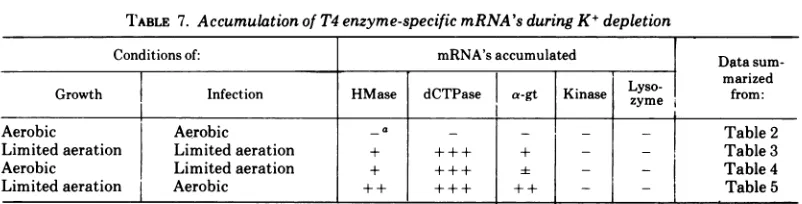
Tables 2-5aresummarized in Tables 6 and 7.
DISCUSSION
Protein synthesisisnotrequiredfor
trans-cription of some DE RNAs. When E. coli is
treated with the amino acid analogue 5-methyl-tryptophan (19) or is starved for a required
amino acid (A. Baros and H. J. Witmer, Arch. Biochem. Biophys., inpress) and then infected withphage T4, transcription ofmanyDEgenes
occurs. However, since significant amounts of protein are synthesized under these conditions
(19;A. Baros and H. J.Witmer, Arch. Biochem. Biophys., in press), such experiments havenot
resolved the question as to whether protein synthesis is required for DEgenetranscription.
Inthe present investigation we have
unequivo-callyshown thatprotein synthesisis not neces-sary for the transcription of substantial
amounts ofdCTPase and a-gtmRNA's bothof
which have been characterized as belongingto
the DE class (19, 28, 29, 39). This conclusion
requires that K+ depletion of E. coli B207
prevents protein synthesis at least as well as
CMtreatmentof E. coli. That such is thecaseis
shown by the following facts: (i) both CM
treatment (100
Ag/ml)
and K+ depletionof E.coliB207 result invirtuallythecomplete
inhibi-tion of protein synthesis as measured
chemi-cally or by incorporation of radioactive amino
acids into protein (12, 13); (ii) whereas treat-ment ofE. coliwithCM (100 gg/ml) allows the
synthesis of those proteins necessary for
in-fected cells to acquire resistance to lysis from
without, K+ depletion blocks the synthesis of those proteins (28); (iii) whereas CMtreatment allows the accumulation of small polysomes (9, 15) and the synthesis ofsmallpeptides (9)inE. coli,K+depletionresults in thecomplete break-down ofpolysomesto monosomes (10, 11).
Not all DE genes are transcribed in the absence of protein synthesis. When infected cellsare eitherpretreated with
5-methyltrypto-phan (19), starvedforarequiredaminoacid (A. Baros, and H. J. Witmer, Arch. Biochem.
Biophys., inpress), or allowed 1.5minofRNA
and protein synthesis prior to the addition of
rifampin (25, 28), someDE genetranscriptsdo not accumulate. Consequently, it has been suggested that the presence of significant
amounts of a phage-specific protein(s) in the
cell is necessary for the transcription of these
genes. Deoxynucleotide kinase has been
desig-natedas amember of this "quasi-late" class (8).
The resultspresented heresupport this view in that conditions have been found in which both
dCTPase mRNA and a-gt mRNA accumulate
in the complete absence of protein synthesis,
but in no case does kinase mRNA accumulate. It is important to note that 85% ofthe DE transcripts can accumulate to a significant
extent under conditions of limited aeration
growth followed by aerobic infection in the
absence of K+ (Fig. 1D). These transcripts are
functional (Tables 5 and 7). Since kinase
TABLE 6. Accumulation ofT4enzyme-specific mRNA's during CM treatment
Conditions of: mRNA's accumulated Data
sum-Datarized
Growth Infection HMase dCTP- a-gt Kinase Lyso- from:
ase zyme
Aerobic Aerobic ++ a - _ Table 2
Limited aeration Limited aeration + - - _ _ Table 3
Aerobic Limited aeration + - - - - Table 4
Limitedaeration Aerobic + + - - - - Table 5
aSymbols: -, <8% of control enzyme activity (that in row 2); +, 8 to 10% of control enzyme activity; +,10 to
20% of controlenzyme activity; ++,20to 40% of control enzyme activity.
on November 10, 2019 by guest
http://jvi.asm.org/
T'ABLE 7. Accumulation ofT4enzyme-specific mRNA's during K+ depletion
Conditions of: mRNA's accumulated Data
sum-1~~~~~~~~~~~~~~
marizedGrowth Infection HMase dCTPase a-gt Kinase
Lzysome
frmAerobic Aerobic _a I Table2
Limited aeration Limited aeration + + + + + _ - Table 3
Aerobic Limited aeration + +++ 4 --_ Table 4
Limited aeration Aerobic + + + + + + + - Table 5
aSymbols: -, <8% of control enzyme activity (that in row 6);
±,
8 to 10% of control enzymeactivity; +, 10 to 20% of control enzyme activity; ++, 20 to 40% of control enzyme activity; +++, >40% of control enzyme activity.mRNAdoes not accumulate under these condi-tions and the kinase gene is a quasi-late func-tion (8), it seems reasonable to assume that if
all quasi-late genes act like the kinase gene,
they direct the synthesisof no morethan 15% of
theDE transcripts.
DE gene transcription may prevent the transcription of certain IE genes. When
pro-tein synthesis is blocked by starving E. coli
B207 for K+, the transcription of DE genes is
accompanied
by
a decrease in the percentage ofIE genes transcribed (Table 1). Thisobserva-tionisparticularly strikinginthecaseoflimited
aerationgrowth followed by aerobicinfection in
the absence of K +. Under these conditions, 20-min KD-RNAcontains 85% oftheDE tran-scripts, but only 40% of the IE transcripts
(Table 1). The DE transcripts accumulated
under these conditions are in relatively high
concentration as evidenced by thefactthatthey
can serve as a template for thesynthesis of53
and 37% ofthe controlamountofdCTPaseand
a-gt, respectively (Tables 5 and 7). The expla-nation that some IE genes require K+ for transcription is ruled out by the fact that cells
grown aerobically and infected aerobically in
the absence ofK+ accumulate 100% ofthe IE
transcripts (Fig. 1A, Table 1). However, it is
possible that extensive transcription of DE genes limits the free pool ofRNA polymerase and consequently theonly IEgenestranscribed
arethose with astrongaffinityforthisenzyme. Ifso, the shutoffofgroup AIE gene
transcrip-tion inthefirst halfofthelatentperiod during normal infection (1, 35) would not require the synthesis of any phage-specific protein but
might result as a consequence of DE gene transcription.
The physiological state of E. coli deter-mines which transcripts accumulate in
K+-depletedcells. Inapreviouspaper, we
reported
that K+-depleted cells accumulate IEtran-scripts exclusively under aerobic conditions at
30C (28). In the present investigation, all
experiments were performed at 37 C. When
cells were grown and infected under aerobic
conditions, K+-depleted cells accumulated IE
transcriptsexclusivelyinthe first 5min, but by 20 min after infection significant transcription ofDE genes had occurred (Fig. 1A, Table 1). However, as reported previously (28), under
aerobic conditions we were unable to detect
accumulation offunctional mRNA's in K+-de-pleted cells asdefined by their ability to direct
the synthesisofenzymes in vivo(Tables 2, 7). In contrast, cells grown under limited aeration
conditions and infected under limited aeration
conditions in the absence of K+ accumulated
most ofthe IE transcripts and approximately
60%ofDE transcriptsby 20 min after infection
(Fig. 1B, Table1).TheRNAthusaccumulated was able to direct the synthesis of small amounts of the IE enzyme HMase, small
amounts of the DE enzyme a-gt, and large
amounts oftheDE enzymedCTPase (Tables3
and 7). It therefore seems possible that the IE and DEtranscripts accumulated underlimited
aeration conditions areeithermorestable than the same transcripts accumulated under strict
aerobic conditions or that IE and DE
tran-scripts terminate prematurely under aerobic but not limited aeration conditions in infected cellsdepleted ofK+.
Itis important to note that under all
condi-tions of
growth
and infectiononly
HMase mRNA, of the five mRNA'stested,
accumu-lated in CM-treated cells (Tables 2-6). This result suggests that transcription is limited to
IE genes in CM-treated cells even when the
physiology of those cells favors accumulation of
functional DE transcripts and argues against
the hypothesis (2) that rapid breakdown of distal DEportionsofT4transcriptsaccountsfor the exclusive accumulation ofIEtranscripts in
CM-pretreated cells. This view is
supported
by
the results of experiments in which IE genes were transcribed exclusively in bothCM-treated SuA+ and SuA- strains of E. coli
(A.
on November 10, 2019 by guest
http://jvi.asm.org/
[image:8.503.50.451.69.171.2]338 MORSE AND COHEN
Baros and H. J. Witmer, Arch. Biochem. Bio-phys., in press).
RNA is far more stable when bacterial cells are grown anaerobically than aerobically, but the reason is not as yetfullyunderstood (16, 20). Fromthe results of the presentstudy, itisclear that functional T4 mRNA can accumulate in K+-depleted E. coli as long as the cells are either grown orinfected under limited aeration conditions. In fact, it appears that aerobic infection ofcells grown under limited aeration conditions specificallyallows the accumulation of significant amounts of a-gt mRNA in the absence of K+. That is, the ca-gt mRNA
ac-cumulated under these conditions results in the synthesis ofabout 35% as much a-gt as in the control culture (Tables 5 and 7). Infection underanyother set ofconditionsresulted in the accumulation offunctional a-gt mRNA which yieldedat mostabout 10% of the control level of a-gt synthesized (Compare Tables 2, 3, and 4
with Table 5). In contrast, significant amounts ofdCTPasemRNA were accumulated under all conditions ofgrowth and infection except
aero-bic growthand infection (Tables2-5and 7). At present, the reason for these differences is
unclear, but it is interesting to note that a-gt mRNA accumulated significantly only when 85%ofthe DE mRNA species were transcribed (Fig. 1D, Tables 5 and 7), whereas significant
amountsofdCTPasemRNAaccumulated when
asfew as40% ofthe DE genes weretranscribed
(see Tables 4 and 5, rifampin added at 5 min and Fig. 1C and D, hybridization of 5-min KD-RNA). Whether these results point to dif-ferential rates of transcription of the two DE genesordifferential rates of turnover of the two transcripts under the different experimental
conditions remains unclear. It has been shown previously, however, that when T4-infected cells are treated withCMshortlyafter infection,
theturnover ratesofa-gtmRNA, T4 endonucle-asemRNA, and deoxynucleotide kinase mRNA arevastly different (29, 38).
The reason chloramphenicol restricts T4 transcription to IE genes, whereas K+ depletion allows transcription of most DE genes, remains obscure. However, it should be emphasized that CM and K+ depletion act in entirely different ways. For example, it is known that CM does not prevent initiation of protein synthesis nor does it prevent polysome formation (9, 15, 27), but it does inhibit elongation of the peptide chain by inhibiting the peptidyl transferase reaction (27). In contrast, K+ depletion results
in the complete breakdown of polysomes (10, 11). Therefore, iftranscription of DE genes like a-gtordCTPaserequires the action of a normal
E. colipolysomal protein at specific sites imme-diately proximal to such genes, it is possible that transcription ofthese genes ispreventedin CM-treated cells because ribosomes are con-fined to IE promoter sites; however, in K+-de-pleted cells, it ispossiblethat the dissociation of polysomes to monosomes (10, 11) releases
poly-somaltranscription proteins which then bindto
the aformentioned DE sites on the T4 genome and stimulate transcription of these genes. In this context, it has recently been shown that
ribosomal proteins can stimulate T4 transcrip-tion at the initiation step (18).Alternatively, it ispossible thatanE. coliproteinresponsiblefor restricting transcription to IE genes in CM-pre-treated cells requires K+ for activity.
ACKNOWLEDGMENTS
This investigationwassupportedby Public Health Service grantA111518-01fromthe NationalInstitute ofAllergy and Infectious Diseases and the National Science Foundation grantGB-37942. Thispaper is from adissertationbyJ. W. Morse inpartial fulfillment oftherequirement for aPh.D. degreeinBiologicalSciences, UniversityofRhodeIsland.
We express our appreciation to Herbert L. Ennis for helpfulcriticism of ouroriginalmanuscript.
LITERATURE CITED
1. Bautz, E.F. K., and F. A.Bautz. 1970.Studiesonthe function ofthe RNApolymerase a factorin promoter selection. Cold Spring Harbor Symp. Quant. Biol. 35:227-232.
2. Black, L. W., and L. M. Gold. 1971. Prereplicative developmentofthe bacteriophage T4: RNA and pro-tein synthesis in vivo and in vitro. J. Mol. Biol. 60:365-388.
3. Bolle, A., R.H. Epstein, W. Salser, and E. P. Geidus-chek. 1968. Transcription during bacteriophage T4 development: requirementsforlatemessenger synthe-sis.J. Mol. Biol.33:339-362.
4. Brody,E.N., R. Sederoff, A. Bolle, and R. H. Epstein. 1970. Early transcription in T4-infected cells. Cold Spring Harbor Symp. Quant. Biol. 35:203-211. 5. Cohen, P. S.1968.Reversible repressionofearlyenzyme
synthesis in bacteriophage T4-infected Escherichia coli.J.Virol.2:192-197.
6. Cohen, P. S. 1970. Regulation of cessation of early enzymesynthesisinbacteriophageT4-infected Esche-richiacoli: separatemechanismsfordifferentenzymes. Virology41:453-458.
7. Cohen,P.S.,and H. L. Ennis. 1965. Therequirementfor potassiumforbacteriophageprotein and deoxyribonu-cleic acidsynthesis. Virology27:282-289.
8. Cohen,P. S., P. J. Natale, and J. M.Buchanan. 1974. Transcriptional regulationofT4bacteriophage-specific enzymessynthesizedin vitro.J. Virol. 14:292-299. 9. Cremer, K. J., L. Silengo, and D. Schlessinger. 1974.
Polypeptide formation and polyribosomes in Esche-richia coli treated withchloramphenicol.J. Bacteriol. 118:582-589.
10. Ennis, H. L.1971. Role of potassium in theregulationof polysomecontentand proteinsynthesisinEscherichia coli. Arch.Biochem.Biophys.143:190-200.
11. Ennis, H. L., and M. Artman. 1972. Ribosome size distribution in extracts ofpotassium-depleted Esche-richia coli. Biochem. Biophys. Res. Commun. 48:161-168.
on November 10, 2019 by guest
http://jvi.asm.org/
12. Ennis, H. L., and M. Lubin. 1965. Selective synthesis of ribosomal protein during recovery from unbalanced growth. Biochim. Biophys. Acta 95:624-633. 13. Ennis, H. L., and M.Lubin. 1965. Preribosomal particles
formed in potassium-depleted cells. Studies on degra-dation and stabilization Biochim. Biophys. Acta 95:605-623.
14. Grasso, R. J., and J. M. Buchanan. 1969. Synthesis of early RNA in bacteriophage T4-infected Escherichia coli. Nature(London) 224:882-885.
15. Gurgo, C., D. Apirion, and D. Schlessinger. 1969. Polyri-bosome metabolism in Escherichia coli treated with chloramphenicol, neomycin, spectinomycin or tetracy-cline. J. Mol. Biol. 45:205-220.
16. Guthrie, G. D. 1971. Translational regulation of T4 messengerRNAmetabolism. Biochim. Biophys. Acta 232:324-337.
17. Kaiser,A.D., and D. S. Hogness. 1960. The transforma-tion of Escherichia coli with deoxyribonucleic acid isolated from bacteriophage X dg. J. Mol. Biol. 2:392-415.
18. Leavitt, J. C., R. H. Hayashi, and D. Nakada. 1974.
Stimulation of RNA synthesis at initiation by
ribo-somal proteins.Arch. Biochem. Biophys. 161:705-708. 19. Lembach, K. J., and J. M. Buchanan. 1970. The
relation-shipofproteinsynthesis to early transcriptive eventsin bacteriophage T4-infected Escherichia coli B. J. Biol. Chem. 245:1575-1587.
20. Levinthal, C., D. P. Fan, A. Higa, and R. A. Zimmer-mann. 1963. The decay and protection ofmessenger RNA in bacteria. Cold SpringHarborSymp. Quant.
Biol. 28:183-190.
21. Lubin, M., and D. Kessel. 1960. Preliminary mappingof the genetic locus for potassium transport in Esche-richia coli. Biochem. Biophys. Res. Commun. 2:249-255.
22. Mathews,C. K.1966.Deoxyribonucleicacidmetabolism
and virus-induced enzyme synthesis ina
thymidine-requiring bacterium infected by a thymine-requiring
bacteriophage. Biochemistry5:2092-2100.
23. Milanesi, G.,E. N.Brody,and E. P.Geiduschek. 1969.
Sequence of the in vitro transcription of T4 DNA.
Nature(London) 221:1014-1016.
24. Milanesi, G., E. N. Brody, 0.Grace,and E. P. Geidus-chek. 1970. Transcription of the bacteriophage T4 template in vitro: separationof"delayed-early" from "immediate-early" transcription. Proc. Natl. Acad. Sci. U.S.A. 66:181-188.
25. O'Farrell,P.Z.,and L. M.Gold. 1973.BacteriophageT4
geneexpression: evidence fortwoclasses of
prereplica-tive cistrons. J.Biol.Chem. 248:5502-5511.
26. O'Farrell, P. Z., and L. M. Gold. 1973. Transcription and translation ofprereplicative bacteriophage T4 genes in vitro. J. Biol. Chem. 248:5512-5519.
27. Pestka, S. 1971. Inhibitors of ribosome functions. Annu. Rev. Microbiol. 25:487-562.
28. Peterson, R. F., P. S. Cohen, and H. L. Ennis. 1972. Properties of phage T4 messenger RNA synthesizedin theabsence of protein synthesis. Virology 48:201-206. 29. Sakiyama, S., and J. M. Buchanan. 1972. Control of the
synthesis of T4 phage deoxynucleotide kinase messen-ger ribonucleic acid in vivo. J. Biol. Chem. 247:7806-7814.
30. Salser, W., A. Bolle, and R. H. Epstein. 1970. Transcrip-tionduring bacteriophage T4 development: a demon-stration that distinct sub-classes of "early" RNA appear atdifferent times and that some are "turned off' at later times. J. Mol. Biol. 49:271-295. 31. Schweiger, M., and L. M. Gold. 1969. Bacteriophage T4
DNA-dependent in vitro synthesis oflysozyme. Proc. Natl.Acad. Sci. U.S.A. 63:1351-1358.
32. Sekiguchi, M., and S. S. Cohen. 1964. The synthesis of messengerRNA without protein synthesis. II. Synthe-sis of phage-induced RNA and sequential enzyme production. J. Mol. Biol. 8:638-659.
33. Sippel, A., and G. Hartmann. 1968. Mode of action of rifamycin onthe RNA polymerase reactions. Biochim. Biophys. Acta 157:218-219.
34. Snyder, L., and E. P. Geiduschek. 1968. In vitro synthesis of T4 late messenger RNA. Proc. Natl. Acad. Sci. U.S.A. 59:459-466.
35. Trimble, R. B., J. Galivan, and F. Maley. 1972. The temporal expression ofT2 r+ bacteriophage genes in vivo and in vitro. Proc. Natl. Acad. Sci. U.S.A. 69:1659-1663.
36. Wiberg, J. S., and J. M. Buchanan. 1964. Studies on labiledeoxycytidylate hydroxymethylases from Esche-richia coli B infected with temperature-sensitive mu-tants of bacteriophage T4. Proc. Natl. Acad. Sci. U.S.A. 51:421-428.
37. Wiberg, J. S., M. L. Dirksen, R. H. Epstein, S.E.Luria, and J. M.Buchanan. 1962.Early enzymesynthesis and itscontrol in E. coli infected withsomeambermutants of bacteriophage T4. Proc. Natl. Acad. Sci. U.S.A. 48:293-302.
38. Young, E. T. 1970. Controloffunctional T4 messenger synthesis. Cold Spring Harbor Symp. Quant. Biol. 35:189-195.
39. Young, E. T., and G. Van Houwe. 1970. Control of synthesisofglucosyl transferase andlysozyme messen-gers afterT4 infection. J. Mol. Biol. 51:605-619.