City, University of London Institutional Repository
Citation
:
Defever, F., Heid, B. and Larch, M. (2015). Spatial exporters. Journal ofInternational Economics, 95(1), pp. 145-156. doi: 10.1016/j.jinteco.2014.11.006
This is the accepted version of the paper.
This version of the publication may differ from the final published
version.
Permanent repository link:
http://openaccess.city.ac.uk/16008/Link to published version
:
http://dx.doi.org/10.1016/j.jinteco.2014.11.006Copyright and reuse:
City Research Online aims to make research
outputs of City, University of London available to a wider audience.
Copyright and Moral Rights remain with the author(s) and/or copyright
holders. URLs from City Research Online may be freely distributed and
linked to.
City Research Online: http://openaccess.city.ac.uk/ [email protected]
Spatial Exporters
∗
Fabrice Defever
†, Benedikt Heid
‡, Mario Larch
§Forthcoming at the
Journal of International Economics
Abstract
In this paper, we provide causal evidence that firms serve new
mar-kets which are geographically close to their prior export destinations
with a higher probability than standard gravity models predict. We
quantify the impact of this spatial pattern using a data set of
Chi-nese firms which had never exported to the EU, the United States, and
Canada before 2005. These countries imposed import quotas on textile
and apparel products until 2005 and experienced a subsequent increase
in imports of previously constrained Chinese firms. Controlling for
firm-destination specific effects and accounting for potential true state
de-pendence we show that the probability to export to a country increases
by about two percentage points for each prior export destination which
shares a common border with this country. We find little evidence for
other forms of proximity to previous export destinations like common
colonizer, language or income group.
∗A previous version of this paper has been circulated under the title “Spatial Exporter
Dynamics” (mimeo, January 2010). We thank two anonymous referees and the assigned co-editor for their comments which have considerably improved the paper. We also thank James Anderson, Roc Armenter, Kala Krishna, Laura M´arquez Ramos, Thierry Mayer, Emanuel Ornelas, Henry Overman, Jennifer Poole, and James Rauch for helpful comments on an earlier version of this paper and participants of the 2012 ESEM conference in M´alaga, the WTO-UNCTAD-University of Geneva-Graduate Institute Seminar, Oct. 2011, the 2011 CEPR-ERWIT conference at the University of Nottingham, the 2010 EIIT conference at the University of Chicago, the 2010 EEA conference in Glasgow, the 2010 Econometric Society World Congress in Shanghai, the 2010 ETSG conference, the CAED 2010 confer-ence at Imperial College London, the Copenhagen Asian Dynamics Initiative 2010 Confer-ence, the 2010 IAW workshop, the 2010 CESifo-GEP workshop, the 2010 Korea University workshop, the 2010 GEP-Malysia conference and the 2010 GEP-China conference for their comments. We thank Zheng Wang for providing us with the US industry-HS6 concordance table. Thanks also to Julian Langer for excellent research assistance. Funding from the Leibniz-Gemeinschaft (WGL) under project “Pakt 2009 Globalisierungsnetzwerk” and the DFG under project 592405 is gratefully acknowledged. The usual disclaimer applies.
†University of Nottingham, GEP and CEP/LSE,[email protected] ‡University of Bayreuth,[email protected]
§University of Bayreuth, ifo Institute, CESifo and GEP,
1
Introduction
Firm exports exhibit a geographical pattern. Not only do different firms serve
different numbers of countries but also the spatial distribution of those
coun-tries differs across firms. Standard gravity models predict that firms are more
likely to export to larger countries and to countries that are closer to the
country of origin of the firm. These standard gravity forces generate some
degree of unconditional spatial concentration of export destinations of firms. Recently, the literature has highlighted that the observed spatial correlation
is larger than what the standard gravity model would predict. This fact has
been labeled ‘extended gravity’ (see Morales et al., 2011, and Albornoz et al.,
2012) or ‘spatial exporters’ (see Defever et al., 2011).
In this paper, we provide causal evidence for ‘extended gravity’ or ‘spatial
exporters’, i.e. time-varying firm-specific heterogeneity in export destination
choices shaped by firms’ previous export experience in spatially close
coun-tries. We take into account unobserved time-invariant heterogeneity at the
firm-country level. It may arise because firms can differ in their ability to serve specific markets, e.g. due to differences in language skills of their sales
force. We also control for true state dependence at the firm-destination level
which captures market-specific sunk costs of exporting (see Das et al., 2007).
We show that the probability that a firm exports to a country increases by
about two percentage points for each additional prior export destination with
a common border with this country.
One reason for observing spatial exporter patterns may be the crucial need
for gathering local information from trading partners over time. Different local
information which has been acquired through previous export experience may
then lead to different trade networks across firms. Recently, Chaney (2014) has developed a model describing trade patterns as an international network.
Firms tend to build on their network for finding new trading partners, similar
to social interactions between individuals (see Jackson and Rogers, 2007).1
1For instance, an exporting firm may gain access to a new export market via a
When demand is uncertain but correlated across markets, firms may enter
new destinations gradually to learn about profits in proximate markets from
their previous export experience (see Albornoz et al., 2012; Nguyen, 2012).
Also, when firms have to adapt products to specific markets, adaptation costs
may be reduced if a firm already has entered markets which are relatively
similar (see Morales et al., 2011). As a consequence, when trade barriers fall,
firms expand their export destinations following a spatial pattern.
These channels highlight that one has to take into account two different
aspects of the firm’s problem: i) when to enter a new destination, and ii)
where to go. When destination choices of a firm are independent, the deci-sion problem is simple: Every market entry decideci-sion can be analyzed on its
own. Hence, the two problems of when and where to export can be separated.2
However, if destination choices are not independent, these two decisions
be-come intrinsically related. Empirically, this leads to a dynamic discrete choice
problem. As explained by Morales et al. (2011), this problem is formulated
in a straight-forward way theoretically but quickly leads to an empirically de
facto unsolvable problem. The insolvability arises because one would have to
compute the expected profits for every possible combination of time paths of
entries into destinations to identify the firm’s profit-maximizing choice.3
Com-2012), this mechanism also implies a spread of exports to contiguous countries. In addition to geography, cultural closeness can generate a similar pattern through networks of ethni-cally related firms. For instance, networks may reduce search costs as firms may learn about potential suitable suppliers within their ethnic community (see for instance Rauch, 2001).
2For instance, Das et al. (2007) estimate the parameters of a firm’s dynamic problem of
when to start and stop exporting, irrespective of the specific export market choice.
3Therefore, Morales et al. (2011) do not solve this dynamic problem explicitly. Instead,
plementary to the structural empirical approach suggested by Morales et al.
(2011), we use reduced form regressions exploiting a quasi-natural experiment.
We present evidence for ‘spatial exporters’ relying on the removal of
bind-ing import quotas under the MultiFiber Arrangement/Agreement on Textiles
and Clothing (MFA/ATC) regime in 25 EU countries, the United States, and
Canada in 2005. This exogenous shock has generated a large entry of firms in
a set of potential new destinations (see Khandelwal et al., 2013). Our sample
consists of Chinese textile and apparel exporters which never exported to these
countries before 2005. We study these firms’ subsequent export destination
choices in other countries which were not directly affected by the lifting of the MFA quotas. As the timing of the MFA quota removal was exogenous to
firms, it helps us to overcome the endogeneity problem due to the dynamic
nature of the firm’s export destination choice.
Our empirical strategy gauges the relative importance of the time-varying
cross-country correlation of a firm’s export destination choices. This
correla-tion may be a result of a firm’s export history in close markets. A previous
export destination is considered as close when it is geographically or culturally
close. Cultural closeness is measured by sharing a common language, sharing
a common colonizer, or having similar income levels. As we use reduced form regressions we do not rely on a specific channel imposed by an underlying
struc-tural model. Rather, we establish the causal impact of a firm’s export history
on the probability to export to a specific country, irrespective of whether it
arises from the demand or supply side.
Our paper provides causal evidence of the spatial correlation of export
decisions at the firm level that has been put upfront by recent theoretical
developments on export dynamics (see Albornoz et al., 2012; Nguyen, 2012,
Morales et al., 2011, and Chaney, 2014). It could also contribute to explain
the pattern of zero bilateral trade flows observed empirically (see Evenett and Venables, 2002). Understanding exporting firm behavior is also crucial from
a policy perspective. If across-country path dependence in firm destination
choices is important, it also has ramifications for trade liberalization
cies: if two countries liberalize trade with each other, their level of trade with
non-liberalizing nearby countries will be higher than standard gravity would
predict. This gives rise to externalities across countries.4 Therefore, our
re-search highlights another reason for potential efficiency increases from trade
liberalization through policy coordination between countries.
The remainder of the paper is organized as follows: Section 2 describes the
data set and our identification strategy. Section 3 presents our baseline
em-pirical results. We start with a differences-in-differences (diff-in-diff) approach
which investigates the impact of the lifting of the MFA quotas on the
proba-bility of exporting to a country which is contiguous to a previously restricted MFA country. We then investigate the impact of previous export experience
in close markets on a firm’s destination choice. Our regressor of interest in
the latter specification is potentially endogenous. We therefore present
instru-mental variable regressions where we use the lifting of the MFA quotas as an
instrument. Finally, we present dynamic panel specifications. These allow
us to control for our potentially endogenous regressor of interest as well as
the persistence and true state dependence in export destination choices.
Sec-tion 4 presents evidence at the firm-product-couple level. SecSec-tion 5 presents
robustness checks. The last section concludes.
2
Data and identification
2.1
Sample and dependent variable
We use transaction level customs panel data on the universe of Chinese
ex-porters for the years 2000 to 2006. We only keep products which fall in the
4For instance, Defever and Ornelas (2014) show that the end of the MFA turned China
Harmonized System (HS) chapters of textile and clothing products, i.e.
chap-ters 50 to 63, as these are the products covered by the MFA regime. We
aggregate all transactions of a firm in a country in one year into one
observa-tion. The sample is restricted to continuous exporters, i.e. firms that export
at least to one country every year.5 Specifically, we investigate the export
destination choice between 150 non-MFA member countries of firms which did
not export in any of the MFA restricted countries during the years 2000 to
2004.6 Hence, our sample includes both firms that enter the MFA member
countries after 2004 as well as those which export to other countries between
2000 and 2006. Overall, our sample is composed of 1,295 continuous exporters which never entered the MFA restricted countries before 2005.
Our dependent variable is the firm-specific vector of export status yit =
(yi1t, . . . , yijt, . . . , yiJt) which indicates whether a firm i exports to a specific
destinationj in year t. J is the number of non-MFA countries in our sample.
We present descriptive statistics for all variables in the online Appendix in
Table A.38.7 1.2 percent of our observed destination choices turn out to be
positive. Hence, serving a specific foreign market is a rare event.
2.2
Identification strategy
Under the MultiFiber Arrangement/Agreement on Textiles and Clothing
(MFA/ATC) regime, restrictions were upheld on many products even after China acceded to the WTO on December 11th, 2001. On January 1st, 2005
the removal of import quotas led to the entry of a large number of firms in
the then 25 EU countries, the United States, and Canada.8 Figure 1 shows
5This allows us to abstract from selection into exporting at the firm-extensive margin.
See Das et al. (2007) for a structural model of selection into exporting.
6The previously restricted MFA countries are the 25 EU countries as of 2005, the United
States, and Canada. A comprehensive list of all non-MFA countries in our sample can be found in the online Appendix in Table A.37.
7We use the years 2000 to 2005 to construct our lagged regressors of interest. Our final
data set then covers the years 2001 to 2006. As we include two lags in our dynamic panel specifications, we are left with four years for our estimation. For reasons of comparability, we use these four years for all our specifications.
8See Harrigan and Barrows (2009), Brambilla et al. (2010), Upward et al. (2011), and
the average number of exporters into these markets across all restricted HS-6
products. While around 100 to 150 firms had been exporting a restricted MFA
product while the import restrictions were still upheld, this number jumped
to more than 300 in 2005.
One possible reason behind the large and rapid entry of firms into MFA
countries in 2005 can be seen in the fear that safeguard mechanisms could
potentially re-introduce quotas. Actually, the EU countries, the United States,
and Canada had product-specific safeguard mechanisms which were not phased
out until 2008. The possible use of these safeguard measures was likely and it
was unclear which products would be affected. This is corroborated by Figure 1 which shows that the average number of exporters across products did not
increase in 2006 so that there is no evidence of a gradual entry of firms into
the previously restricted MFA countries, at least on average. This can be
explained by the new and transitional license system for textile exports that
has been reintroduced in 2005 by the Chinese government. The intention was
to limit the growth of Chinese exports of MFA products for the years 2006
to 2008. Looking back, the restrictions imposed in 2005 were by and large
ineffective. However, the new restrictions had an impact on the growth of
Chinese textile exports for 2006 to 2008.9
The lifting of the MFA quotas in 2005 exogenously changed the potential
profitability of exporting to the previously restricted MFA countries. New
entrants could reap part of the quota rents which previously accrued to those
firms with an export license, leading to the increase in the number of firms
in the EU, the United States, and Canada. If firms are ‘spatial exporters’,
this change should have influenced the subsequent export destination choices
in non-MFA countries. The same firms which quickly entered the previously
9In June 2005, China and the EU agreed to re-impose quotas on some products. Despite
100
200
300
Average number of firms per HS6 product
2000 2001 2002 2003 2004 2005 2006 Year
[image:9.612.163.452.107.316.2]Notes: Yearly average number of firms exporting to one EU country, the United States or Canada for HS 6-digit products for which the quota fill rate was higher than 90 percent.
Figure 1: Average Number of Exporting Firms to one EU Country, the United States or Canada per Restricted MFA 6-Digit Product
restricted MFA countries for the first time could then potentially learn about
other profitable export opportunities in countries which are geographically or
culturally related to the previously restricted MFA countries.
3
Specifications
We have now described our identification strategy in general terms. It is
com-patible with several complementary empirical specifications which rely on
dif-ferent assumptions about the data-generating process. Specifically, we will use
a differences-in-differences (diff-in-diff) strategy, (panel) instrumental variable
regressions and dynamic panel estimations. This multitude of specifications
provides robust evidence for spatial exporters. We will next discuss in turn
3.1
Differences-in-Differences
Viewing the removal of the quotas as a quasi-natural experiment, it seems
natural to start with a differences-in-differences (diff-in-diff) specification.
MFA restrictions were removed January 1st, 2005. This lifting opened
up new potential export markets but was not influenced by the decisions of
individual firms and thus exogenous at the firm level. Beginning from this date, firms in our sample were able to enter the previously restricted MFA
countries for the first time. There they could potentially acquire information
about contiguous export markets. Therefore, firms should export more to
destinations which are contiguous to MFA countries after the removal of the
MFA restrictions. Hence, our treatment indicatorCj is defined at the
country-level.10 It is a dummy variable indicating whether a country j is contiguous
to an MFA-restricted country. This also renders our treatment exogenous to
the firm’s choices, as the set of MFA restricted countries is the same for all
firms. Similar to Morales et al. (2011), we assume a one year lag to quantify ‘spatial exporters’, reflecting the fact that the learning or product adaptation
processes of the firm take time. Hence, we define the year 2006 as our
post-treatment period. y2006t is the corresponding dummy variable for the year
2006. The treatment effect, δ, measures whether firms export more frequently
to countries that are contiguous to previously restricted MFA countries in 2006
and is captured by the interaction term of y2006t and Cj.
Specifically, our first empirical specification is therefore given by
yijt=δ(y2006t×Cj) +θij +θt+ijt, (1)
whereyijtis a dummy variable indicating whether a firmiexported to country
j ∈ J in year t, where J is the set of non-MFA countries. We also introduce
θij, a firm-destination fixed effect, and θt, a year fixed effect.11 ijt is the error
term. Note that this regression is equivalent to a diff-in-diff specification as the
10We therefore use standard errors clustered at the country-level following the
recommen-dation for differences-in-differences estimates by Bertrand et al. (2004).
11See Section A of the online Appendix for evidence on firm-specific heterogeneity in
year and firm-destination fixed effects control for the treatment period as well
as the treatment group dummies. We estimate specification (1) with ordinary
least squares which leads to a linear probability model.12
The firm-destination fixed effects capture all country-firm characteristics
that do not change over the considered time period. This includes
time-constant destination-specific variables generally known to influence bilateral
trade flows from the gravity literature such as market size, overall
remote-ness of a country (multilateral resistance terms), and trade costs. Crucially, it
also controls for time-constant firm-specific heterogeneity such as
productiv-ity, qualproductiv-ity, labor costs, and assortative matching of workers. For example, a firm might employ managers with specific language skills which influence the
firm’s export destination choice.13 θ
t captures the general time trend in the
empirical probability of exporting to a country.
We expect δ to be positive if firms are spatial exporters. δ is identified
by firms which start to export to a country in 2006 which is contiguous to
an MFA-restricted country. A positive effect can stem from two sources:
1.) The additional expected profit from learning about previously restricted
MFA countries. This makes a country j more attractive as a potential export
destination if it is contiguous to a previously MFA-restricted country. This is
independent of whether the firm has exported to an MFA-restricted country or
not. 2.) Firms which actuallydid export to an MFA-restricted country in 2005
for the first time and gained knowledge about potential business opportunities
in contiguous country j. We disentangle these two sources in our alternative
empirical specifications presented in Sections 3.2 to 3.4. Note that firms which
12As we are only interested in average effects and not in predictions for individual firms
and given the high number of fixed effects, we stick to the linear probability model, see Winkelmann and Boes (2009). As we also control for lagged endogenous variables in later specifications, we can extend our regression framework by using a linear dynamic panel estimator in a straight-forward way, simplifying the interpretation and comparison of results across our different specifications.
13In a strict sense, some gravity variables may change over time (such as market size and
stop exporting to countryj in 2006 decrease the estimate of δ (and may even
render the coefficient negative).
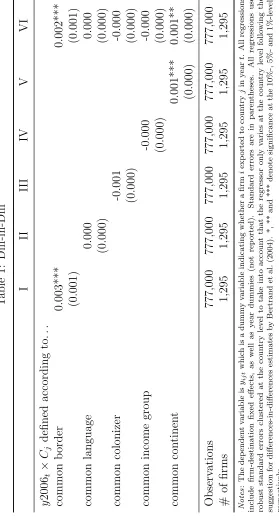
Table 1 reports estimates of the diff-in-diff specification as given in equation
(1). Specifications I to VI give the estimated treatment effects for exporting to
a contiguous MFA country one year after the lift of the quota restrictions for
different definitions of contiguity. A firm’s destination choice can be correlated
not only in markets which are geographically proximate to its previous export
destinations but also in markets which share some other form of closeness.
Specifically, we define contiguity according to whether the countries share a
common border, a common language, a common colonizer, a common income group, or whether they are located on the same continent using data provided
by CEPII, see Mayer and Zignago (2011). Therefore, our concept of space is
general and can refer to geographic as well as cultural cross-country correlation
in export destination choices. Section L in the online Appendix gives a detailed
description of the construction of our contiguity variables.
In specification I, contiguity is defined according to whether countries share
a common border. The coefficient estimate of 0.003 implies an average increase
of 0.3 percentage points in the probability of choosing a new export destination
that is contiguous to a previously restricted MFA country in 2006. This effect may sound small. We therefore compare this marginal effect to the observed
empirical probability of a firm exporting to a particular country in our sample
reported. We report these empirical probabilities in Table A.37 in the online
Appendix. For example, this implies about a 14 percent (0.003/0.022) increase
in the probability of a firm exporting to Russia in 2006, as Russia shares a
common border with Finland, an MFA country.14
Specifications II to V run separate regressions where we construct our
con-tiguity measure according to whether countries share the same language
(spec-14Note that we do not compare our estimates to the unconditional observed frequency
ification II), whether countries have common colonial ties (specification III),
whether countries are in the same income group (specification IV), or whether
countries are located on the same continent (specification V). Evidently,
espe-cially space in the geographic sense (common border and common continent)
plays a significant role in firms’ export location choice. We do not find evidence
for other definitions of contiguity, like common language, common colonizer
or common income group, as important determinants for spatial exporters.
In column VI, we include all different contiguity measures at the same
time to gauge the relative importance of the different measures. The marginal
effects are hardly affected by conditioning on all other contiguity measures. Also significance stays by and large the same.
In the specification given in equation (1) we do not condition on whether
the firm has exported to a previously restricted MFA country. Hence, we
identify a combination of the effects 1.) and 2.) mentioned before. Whereas
1.) increases the profitability of a destination only due to the option value
of exporting to an MFA restricted country and therefore for all firms in our
sample without any action from the firm15, 2.) directly measures actually
occurred spatial exporting only for firms that did export to an MFA restricted
country first and afterwards to a contiguous one.
While Table 1 provides a first step towards evidence for spatial exporters,
we now turn to identify how a firm’s export destination choice is influenced by
its export history in contiguous markets. Hence we disentangle the additional
expected profit from learning about previously restricted MFA countries from
actual export experience by focusing on the second effect only.
3.2
Fixed effects regression taking into account
firm-level history
Until now, we only focused on those countries which were contiguous to
previ-ously restricted MFA countries and neglected the impact of a firm’s previous
15Note that this effect is heterogeneous across firms as it depends on a firm’s export
export history. To capture spatial exporting which takes into account
firm-level history, we construct our contiguity measure,Nij,t−1, which measures the
number of countries which are contiguous to countryj and to which firmihas
exported int−1 for each firm i and destination j. As the set of the previous
export destinations is firm-specific, so are the contiguity variables. Specifically,
Nij,t−1 =w0jy
∗
i,t−1, where y
∗
i,t−1 is the (N ×1) vector of the export indicators
for firmiint−1 whose typical elementyi`,t−1 is 1 if firmiexported to country
` in year t −1, and zero otherwise. To construct our explanatory variable,
Nij,t−1, we use a set of N = 177 countries, including the previously restricted
MFA countries. In our regression sample, however, we continue to investigate the choice betweenJ = 150 non-MFA countries as in the previous section. wj
is the jth row ofW, a (N × N) contiguity matrix. The typical entry w`m of
W is 1 if countries ` and mare contiguous, and zero otherwise. Note that for
this specification, we do not exploit the quasi-natural experiment of the lifting
of the MFA quota restrictions. We will use it again in Section 3.3.16
As withCj, we measureNij,t−1 by defining contiguity in terms of the
coun-tries sharing a common border, sharing a common language, sharing a common
colonizer, being in a common income group, or being located on the same
con-tinent. For example, Nij,t−1 = 2 measured in terms of common border means
that for firmi, countryj shares a common border with two countries to which
firm i has exported in t−1.
To take into account whether a firm actually has exported to a contiguous
country in the previous year, we run the following regression:
yijt=δI(Nij,t−1 >0)ijt+θij +θt+ijt, (2)
16In principle, one could also think about using yM F A
i,t−1 to construct Nij,t−1, whose
di-mension is (N ×1) and whose typical element yM F A
i`,t−1 is 1 if firmi exported to country `
in t−1, and this country is an MFA country, and zero otherwise. By using y∗i,t−1 instead
of yM F A
i,t−1 to construct Nij,t−1, we also count previous export destinations of a firm which
where I is the indicator function taking value one if Nij,t−1 > 0. In this
regression,δ now quantifies the effect of actual experience in a previous export
destination on future export decisions in contiguous countries. We expectδto
be positive if previous export experience from contiguous countries matters.
Note that in contrast to y2006t×Cj, I(Nij,t−1 >0)ijt varies at the firm-level.
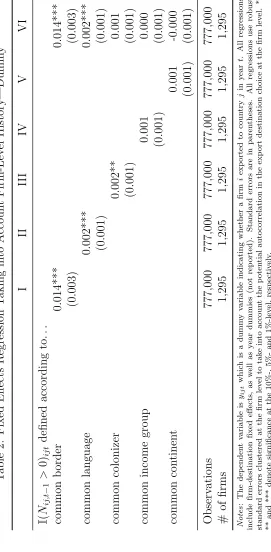
Table 2 gives the result for specification (2) and is organized in the same
way as Table 1. Column I shows that the probability of exporting to a country
increases by 1.4 percentage points if the firm previously exported to an export
destination with a common border. Is this effect large or small? We again
compare this marginal effect to the empirical probability of a firm exporting to a particular country in our sample reported in Table A.37 in the online
Appendix. Given these empirical probabilities, this implies e.g. a 20 percent
increase in the probability of a firm exporting to Singapore when it has
pre-viously exported to Malaysia.17 This effect is larger than the effect identified
in Table 1 because we now focus on source 2.), i.e. the effect of actual export
experience in contiguous countries.
Again, the effect of sharing a common border is the largest and most
signif-icant effect. Also sharing a common language or colonial ties are signifsignif-icant,
albeit with smaller magnitudes. For example, the probability of exporting to Australia increases by about 4 percent (0.002/0.054) if the firm has
pre-viously exported to Great Britain (or some other English-speaking country).
Similarly, the probability of exporting to India increases by about 11 percent
(0.002/0.019) if the firm has previously exported to Great Britain with which
it shares a common language. Column VI shows quantitatively very
simi-lar effects when conditioning on all different dimensions of spatial exporters
jointly.
Similarly, we can also estimate the impact of an increase in the number
of previous contiguous export destinations by omitting the indicator function
17Note that Japan and South Korea, our most frequent export destinations, do not have
from equation (3), i.e.:
yijt=δNij,t−1+θij +θt+ijt. (3)
Table 3 reports the estimates. Results are virtually unchanged, with sharing
a common border remaining the regressor with the largest point estimate.
The slight change in the specification implies that the probability of exporting to a country that shares a common border with a previous export destination
increases by 1.2 percentage points if the firm actually exports to one additional
contiguous country in the previous year.
A problem of regressions (2) and (3) is that, contrary to regression (1), now
the regressor of interest is potentially endogenous: firms may anticipate that
they may learn from previous export destinations and potentially choose their
export destinations accordingly. We will therefore present (panel) instrumental
variable regressions in the next subsection.
3.3
Instrumental variable regressions
To account for the potential endogeneity of our regressor
I(Nij,t−1 > 0)ijt, we instrument it with the exogenous regressor of interest
from regression (1), y2006t×Cj, which is 1 for countries that are contiguous
to previously restricted MFA countries in 2006, and zero otherwise. The
exo-geneity of our instrument is again justified as it is a country-specific variable
and is not influenced by firm decisions. Still, it is relevant as the instrument
and the potential endogenous regressor are correlated by construction: Cj
indi-cates countries contiguous to (previously) MFA restricted countries andNij,t−1
is positive if a firm exports to at least one country. As the MFA restricted
countries in sum make up a large share of the world market, it is very likely
thatNij,t−1 >0 ifCj = 1. In addition, the diff-in-diff regression results clearly
show the relevance of the proposed instrument. For our estimation, we use the
two-stage least-squares within panel instrumental variables estimator which
includes firm-country fixed effects as in the previous specification.
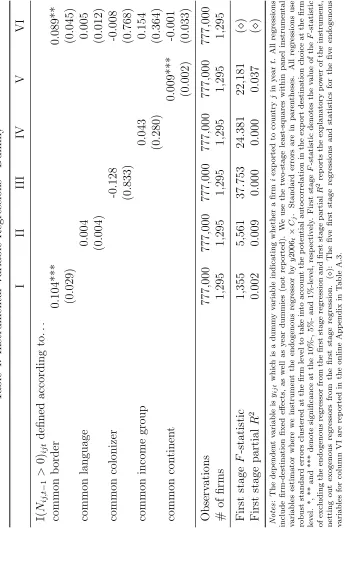
to be endogenous in Table 4. Allowing for endogeneity does not lead to a
qual-itative change in our results (compare with Table 2). However, the size of the
effect of contiguity is approximately seven times larger. Again, sharing a
com-mon border has the largest effect (coefficient of 0.104) and only geographical
contiguity turns out to be statistically significant. Results also remain largely
unchanged when including all contiguity measures simultaneously (see column
VI in Table 4). The F-statistics for the excluded instruments in the first
stage regressions are also larger than 10 (with the exception of column III),
indicating that our instruments are relevant. Partial R2 measures admittedly
are very low. However, this is not too surprising given the generally very low R2 of firm-level export destination choice models, see Albornoz et al. (2012),
as within-models remove the explanatory power of the firm-destination fixed
effects.18
Table 5 reproduces Table 3 but instrumentsNij,t−1 withy2006t×Nj, which
counts the number of countries that are contiguous to previously restricted
MFA countries in 2006, and is zero otherwise.19 Comparing results shows that
the effects of geographical contiguity (common border and common continent)
are about seven times larger. Hence, our estimate in specification I implies
that the probability of exporting to a country that shares a common border with a previous export destination increases by eight percentage points if the
firm actually exports to one additional contiguous country in 2005.20
One may wonder about the increase of the IV estimates in comparison with
the OLS estimates. If unobserved factors increase the probability that a firm
enters a particular country, they may as well increase the probability of
ex-18Full results of first stage regressions are available in Section B of the online Appendix. 19We usey2006
t×Njas this has the same type of country-level variation as our potentially
endogenous regressor,Nij,t−1. We could also again instrument byy2006t×Cj, or even use
y2006t×Nj in our diff-in-diff specification. These choices hardly matter for our results.
20We also experimented with the year 2004 and 2005 to construct our instrument, finding
similar but larger effects. When defining the treatment period to begin in 2004, the estimate for common border is 0.311 for I(Nij,t−1 > 0)ijt and 0.268 for Nij,t−1. When we define
porting to a similar country in the future. Hence, these omitted factors would
lead to an upward bias of our OLS estimates. However, endogeneity may also
arise due to measurement error in the explanatory variable. As pointed out
in Morales et al. (2011) and Nguyen (2012), when deciding about the export
decision in t, the firm actually solves a dynamic optimization problem taking
into account the spatial correlation of profits across destinations. Our
econo-metric specification proxies this dynamic component by including our regressor
of interest,I(Nij,t−1 >0)ijt, which tries to control for the firm’s state variable.
Obviously, this is only a very crude way to introduce dynamics into a static
regression framework. As is well known, measurement error leads to attenua-tion bias, which may very well explain why our OLS estimates underestimate
the true effect (see e.g. Cameron and Trivedi, 2005, chapter 26.2).
Even though we rely on panel data for our regressions so far, we have,
until now, ignored the persistence and state dependence in the export status
of firms. We turn to this issue in the next section.
3.4
Dynamic panel results taking into account state
de-pendence
At least since Roberts and Tybout (1997) and Das et al. (2007) it is well known
that whether a firm has exported in the previous period is highly correlated
with its current export status. Evidence for this is provided at the firm level,
irrespective of the variation of export destinations within a firm across time.
Hence, it is based on persistence of the export status at the firm level, not
at the firm-destination level. In principle, it is possible that this persistence
is also evident at the firm-destination level. And indeed in our data set, the
correlation between our dependent variable and its one year lag is 0.75. One can distinguish between two major sources of this observed persistence.
First, there may be some unobserved time-invariant firm-destination
compo-nent which determines whether a firm enters a specific destination. Second,
there can be true state dependence, i.e. the previous export history of a firm
export history in export destination choice matters.
Whereas the first persistence is captured in our specification by the
firm-destination fixed effect θij, we did not properly account for potential true
state dependence in our estimations so far. As has been demonstrated by
Nickell (1981), fixed effect estimators are biased in the presence of true state
dependence. How does this affect our estimates? In our setting, consider a firm
which exports to both Singapore and Malaysia in 2005 and 2006. Then, when
not including lags of the dependent variable, our regressor of interest explains
the firm’s exporting behavior in Malaysia by its previous export experience in
Singapore and vice versa.21 To control for this confounding factor, avoid the Nickel bias, and account for the high persistence in our dependent variable,
we employ the system-GMM dynamic panel estimator by Blundell and Bond
(1998).22
Specifically, we estimate
yijt =φ1yij,t−1+φ2yij,t−2+δI(Nij,t−1 >0)ijt+θij +θt+ijt. (4)
We include two lags of the dependent variable as Roberts and Tybout (1997)
show that typically two lags have a significant and decaying impact on the
export decision of a firm.23
Note that the dynamic panel estimator allows us to treat our contiguity
variable as predetermined. This is consistent with the fact that lagged
val-ues of our regressor of interest, I(Nij,t−1 > 0)ijt, cannot be changed by the
firm in the current period but future values may be adjusted by the firm, as
21Note that for firms which continuously export to both destinations in all years included
in the sample, this will be captured by the destination fixed effects. However, firm-destination fixed effects will not cover this persistence for intermittent exporters.
22We present results using the difference-GMM dynamic panel estimator from Arellano
and Bond (1991) as robustness checks in the online Appendix in Tables A.9 and A.10. Results even more strongly support evidence for spatial exporters, and even the Sargan model specification tests do not reject the validity of the instruments.
23While most applications of dynamic panel estimators only include one lag, Cameron
stressed by the mechanisms in Morales et al. (2011), Albornoz et al. (2012),
and Nguyen (2012). The system-GMM dynamic panel estimator uses moment
conditions derived from Equation (4) in levels and in differences. These
mo-ment conditions imply different sets of instrumo-ments for the equation in levels
and in differences. For the level equation, we use the lagged differences of
our dependent variable as well as the differences of our regressor of interest.
For the differenced equation, we use the second and third lag of the level of
the dependent variable as well as the first and second lag of the level of our
regressor of interest (see Baltagi, 2008, chapter 8.5 and Cameron and Trivedi,
2009, chapter 9.4). Note that we restrict the maximum number of lags to two to prevent a proliferation of instruments.24
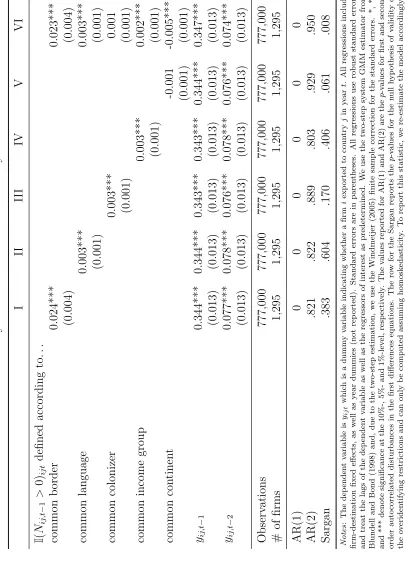
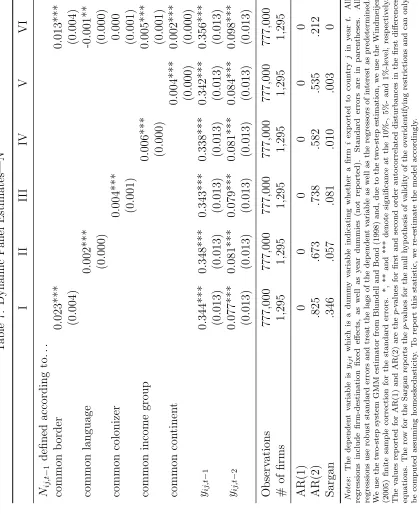
Table 6 presents our dynamic panel estimates for specification (4), i.e. using
dummy variables to indicate contiguity between a destination and previous
export destinations. The table is organized in the same way as the previous
tables. We find true state dependence in all our specifications even at the
firm-destination level. Our result that sharing a common border is the largest
and most significant contiguity effect is corroborated by the dynamic panel
estimates. Sharing a common language, colonial ties or being in the same
income group are all significant but have smaller effects than common border. Column VI presents results when we include all regressors at the same
time. Sharing a common border still has a similar impact on the probability
of exporting to a country compared to the specification in column I. The same
holds for sharing a common language or being in the same income group.
Interestingly, sharing a common colonizer has a significant and positive effect
in column III. This effect vanishes, however, in column VI. Being on the same
continent even turns out to have an albeit small but significantly negative
effect. Note, however, that a country which is located on the same continent
very likely also shares a common border or a common language with a previous
24In the online Appendix in Tables A.7 and A.8, we additionally use our instrument
from the instrumental variable regressions from Section 3.3,y2006t×Cj andy2006t×Nj,
export destination. In other words, there is a high correlation between our
different contiguity measures. We again compare our estimated marginal effect
to the empirical probability of a firm exporting to a particular country from
Table A.37 from the online Appendix. Given the empirical probabilities, this
implies e.g. a 33 percent (0.023/0.070) increase in the probability of a firm
exporting to Singapore when it has previously exported to Malaysia.
We use the Sargan test and a test for the first and second order
autocorrela-tion of the residuals to test our specificaautocorrela-tions. The bottom three lines of Table
6 report their p-values. While we find evidence for first order autocorrelation
in the residuals, we do not find evidence for second order autocorrelation, im-plying that the moment conditions used for the dynamic panel estimator are
valid. We also report a Sargan overidentification test even though this test is
only valid under homoskedasticity. In most specifications also the Sargan test
does not reject our model specification. Only in specifications VI the Sargan
test rejects our internal instruments. Overall, results suggest a proper model
specification.
We again can use the number of contiguous export destinations as an
al-ternative regressor. Then, the dynamic panel specification is given by
yijt=φ1yij,t−1+φ2yij,t−2+δNij,t−1+θij +θt+ijt. (5)
Table 7 shows that results are hardly affected. Again, we find strong evidence
for true state dependence, and again sharing a common border has the largest
impact on the destination choice. Specification tests for first and second order
autocorrelation again do not invalidate our regressions. However, the Sargan test does reject the validity of our internal instruments in specifications
IV-VI. Note, however, that the test is only valid under homoskedasticity which is
4
Multi-product firms
Until now our analysis considered an export destination as contiguous if the
firm previously exported any product to a contiguous market. It is well known
that a substantial fraction of firms produce and export multiple products, and
that multi-product firms make up for the majority of sales in a given industry,
see Arkolakis and Muendler (2010) and Bernard et al. (2010). In our sample, 56
percent of firms export in more than one HS-6 product category. If there exists within-firm correlation of export destination choices between products, then
a firm may enter a new export market with a product when it has previously
sold a different product in a contiguous market.
Both supply and demand side reasons may explain these economies of
scope. When costs for product adaptation are lower for other products within
a firm once they have been incurred for a specific market and product, the
additional cost of adapting the product for a similar market may be lower.
When a firm sells its products under a single brand to benefit from brand
loyalty of consumers, successful exports of one product provide information about likely profitable exports across the whole product mix of a firm’s brand.
We modify our dynamic panel specification given in equation (4) as follows:
yijt= φ1yij,t−1+φ2yij,t−2+δ1I(Nij,tsameproduct−1 >0)ijt
+δ2I(Nij,totherproducts−1 >0)ijt+θij +θt+ijt, (6)
where i now denotes a firm-product couple at the HS-6-digit product
cate-gory and no longer a single firm, and where Nij,tsameproduct−1 is the number of
contiguous destinations where the firm has exported the same product before
and Nij,totherproducts−1 is the number of contiguous destinations where the firm has
previously exported products from other HS-6 categories. θij now captures
unobserved time-invariant firm-product-destination characteristics.
As we now focus on firm-product couples, we use all firm-product couples
which have never entered the previously restricted countries before 2005. In
a firm exports about 3.3 products on average.25 In our previous regressions,
we kept only those firms that never exported any product into the previously
restricted MFA countries. As firms may have entered into the previously
re-stricted MFA countries only with a subset of their products, we now keep all
other firm-product couples where we do not observe exports into the
previ-ously restricted MFA countries before 2005. Hence, there are more firms in
our multi-product sample than in the previous regressions.26
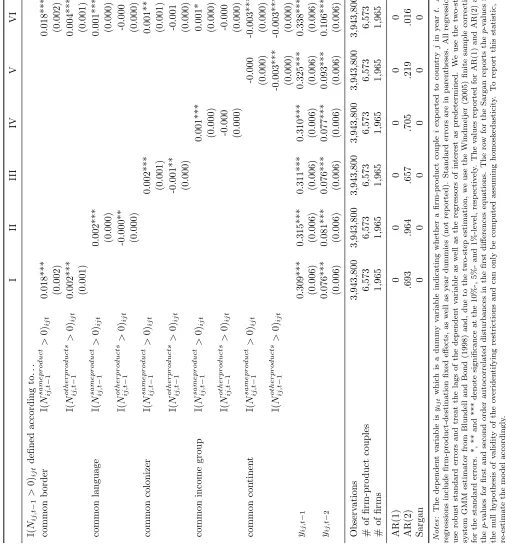
We present results in Table 8. Overall we find hardly any evidence that
ex-porting to a country is more likely after a previous entry into contiguous export
destinations across products, the only exception being the common border co-efficient in specifications I and VI. We find that the probability of choosing a
country increases by 1.8 percentage points when a firm previously has exported
the same HS-6 product to a contiguous country, and by 0.2 percentage points
if it has exported other HS-6 products. For the other contiguity measures, our
results indicate no (economically) significant effect of across product learning.
Interestingly, we find small significant negative effects for common colonizer
and common continent. This may hint at a potential for diversification in
a firm’s export portfolio by selling different products to different contiguous
countries when they share a colonial past or are located on the same continent. Note that our results for the same HS-6 product are in line with the effects
found at the firm-level in Section 3.4.
The tests for autocorrelation in the disturbances in first differences
indi-cate a well-specified model. However, contrary to the firm-level regressions,
the Sargan test now rejects the validity of the overidentifying restrictions.
With nearly four million observations based on 6,573 firm-product couples,
the amount of heteroskedasticity is higher by construction as compared to the
firm-level regressions. This may explain the rejection of the overidentifying
restrictions by the Sargan test based on the assumption of homoskedasticity. In the online Appendix, we also present results using the number of
con-25Descriptive statistics can be found in Table A.39 in the online Appendix.
26Imagine a firm which has exported panties to an MFA country in 2004 but not bras.
tiguous countries as regressor in Table A.11. Results remain similar. To sum
up, we hardly find evidence for across product learning of exporters. This
probably hints at only small economies of scope for multi-product firms when
entering new export markets with several products, at least across markets.
5
Robustness checks
We now discuss several effects that could influence our results and which
are unrelated to the cross-country correlation in export destination choices of firms. Detailed regression results pertaining to these robustness checks can
be found in the online Appendix. Unless otherwise noted, all robustness checks
use specification VI from Table 7 as a starting point.
Lagged export values: In addition to learning from its previous export
experience, a firm may also exhibit increasing returns to scale via a learning
by doing mechanism in textile and apparel production. Since the MFA quotas
represent an artificial quantity restriction, removing it should result in a large
increase in the volume of export sales. As our regressor of interest is correlated
with a firm’s export volume by construction and this might bias our results, we include the lagged export value as an additional control variable. Contiguity
between export destinations still has a significant positive impact on a firm’s
exporting decision even when controlling for the lagged export value.
Competitors’ success: Krautheim (2012) theoretically investigates the
im-portance of spillover effects from competing firms on exporting fixed costs.
The number of exporting firms of the same product or the number of export
markets already entered by close competitors may influence a firm’s ability
to export to a specific destination. Wen (2004) shows that Chinese firms
producing in the same industry tend to cluster geographically across Chinese regions. We therefore use the sum of the number of previously entered
contigu-ous export destinations over all competitors in the same Chinese prefecture,
N−ij,p,t−1, to control for these spillover effects. We can construct this control
variable using again all of our different contiguity measures. Controlling for
Trading agents: The raw data contains a number of trading agents
(“in-termediary firms”) which mediate trade for other firms but do not directly
engage in production. Including these firms could cause problems as their
behavior is probably different from that of manufacturing firms. To exclude
the possibility that our results are driven by these trading agent business
net-works, we exclude trading firms which are identified by certain keywords in
their names. Ahn et al. (2011) use the Chinese characters for “importer”,
“exporter”, and “trading” to identify “intermediary firms”. By contrast, we
follow Upward et al. (2011) and use a more comprehensive list of keywords
which are typically used by various kinds of trading agents in China. These trading companies represent about four percent of our observations. Dropping
trading agents does not change our conclusions.
State-owned firms: Khandelwal et al. (2013) argue that state-owned firms
seem to have been more likely to obtain a license before the MFA quota
restric-tions were lifted. This makes them potentially different from privately-owned
firms. We therefore exclude state-owned firms. Again, our results hold up.
Foreign-owned firms: We exclude all foreign-owned firms and processing
trade as the destination choice of firms could be influenced by the foreign
headquarters’ location or by the location of other foreign direct investments realized by the parent company. While qualitative results are similar, our
results lose some of their significance. This may well be due to the large drop
in the number of firms and observations to about a tenth of the full sample.
Processing trade: Our data allow us to distinguish between processing and
ordinary exports. The former refers to exports that are assembled in an export
processing zone and use a high share of imported intermediate inputs. Note
that foreign owned firms often engage in processing exports but not necessarily
so. Processing exports may be special with respect to the export location
choice because they could be influenced by a third foreign party. In addition, processing trade firms may have less liberty in their export destination choice.
Excluding processing trade export transactions leads again to a substantial
drop in the number of observations to around a fifth of the original sample.
Excluding Russia: As Russia shares a common border with both China and
MFA-restricted countries, our identification for the diff-in-diff could mainly
stem from Russia. Indeed, our coefficient on common border reduces in size
but remains positive and significant.
Country-specific time trends: We include country-specific time trends in all
the regressions presented in Sections 3 and 4. The diff-in-diff and instrumental
variable specifications are not robust to country-specific time trends and hint
at high multicollinearity between the country-specific time trends and our
re-gressors of interest. The fixed effects and dynamic panel estimates, however,
retain their significance and are similar in magnitude compared to the regres-sions without time trends. When using continent-specific time trends, also the
diff-in-diff and instrumental variable specifications lead to a significant and
similar effect of sharing a common border.
Different effect of previous entry in contiguous MFA-restricted versus
non-MFA-restricted countries: We follow up on footnote 16 and introduce NM F A ij,t−1,
the number of contiguous previous export destinations which are MFA
coun-tries, and Nij,tnonM F A−1 , the number of contiguous previous export destinations
which are not MFA countries, instead of our default regressorNij,t−1, the total
number of contiguous previous export destinations, in our regressions from Section 3.2. Note that Nij,t−1 =Nij,tM F A−1+Nij,tnonM F A−1 . We find that evidence for
spatial exporters in our sample comes predominantly from entering in
previ-ously restricted MFA countries if we define our regressor as sharing a common
border, consistent with our identification and sample selection strategy.
Full sample: As in principle the dynamic panel regressions take account
of the previous export experience of a firm by the lagged dependent variable,
we re-estimate our model by including also those firms which entered in
MFA-restricted countries between 2000 and 2004, i.e. those which did have an export
license. Estimated coefficients remain similar. However, the model specifica-tion tests clearly reject all regressions. This hints at the endogeneity bias
introduced by not restricting the sample to firms who have never exported to
6
Conclusion
How do firms choose new export destinations? While there are many factors
that are important for this decision, one empirical regularity stands out: Firms
tend to choose new export markets that are geographically close to their prior
export destinations more often than standard gravity models would predict.
We quantify this spatial pattern using Chinese customs data and the
quasi-natural experiment of the end of the import quota restrictions on Chinese textile exports which creates an exogenous set of potential new destinations
(25 EU countries, the US, and Canada). We use the sample of firms which
had never exported to the 27 previously restricted MFA countries before 2005.
These firms allow us to identify the effect of previous export history in
con-tiguous countries on the probability of exporting to one of the 150 countries
which were not covered by the MFA import restrictions. This enables us to
quantify the importance of ‘extended gravity’ or ‘spatial exporters’, i.e. the
time-varying firm-specific heterogeneity in export destination choices shaped
by firms’ previous export experience in spatially close countries. Our regres-sions control for unobserved time-invariant heterogeneity at the firm-country
level as well as true state dependence.
Our baseline results show that the probability to export to a country
in-creases by about two percentage points for each prior export destination with
a common border with this country. For example, this implies a 33 percent
increase in the probability of a firm exporting to Singapore, one of the top
ex-port destinations in our data set of non-MFA countries, when it has previously
exported to Malaysia, a country which shares a border with Singapore.
References
Ahn, J., Khandelwal, A. K., and Wei, S.-J. (2011). The Role of Intermediaries
in Facilitating Trade. Journal of International Economics, 84(1):73–85.
Albornoz, F., Calvo Pardo, H. F., Corcos, G., and Ornelas, E. (2012).
Antr`as, P., Fort, T. C., and Tintelnot, F. (2014). The Margins of Global
Sourcing: Theory and Evidence from U.S. Firms.unpublished working paper.
Arellano, M. and Bond, S. R. (1991). Some Tests of Specification for Panel
Data: Monte Carlo Evidence and an Application to Employment Equations.
Review of Economic Studies, 58(2):277–297.
Arkolakis, C. and Muendler, M.-A. (2010). The Extensive Margin of Exporting
Products: A Firm-Level Analysis. NBER Working Paper 16641.
Baltagi, B. H. (2008). Econometric Analysis of Panel Data. Fourth Edition. Wiley, Chichester.
Basker, E. (2005). Job Creation or Destruction? Labor Market Effects of
Wal-Mart Expansion. Review of Economics and Statistics, 87(1):174–183.
Bernard, A. B., Redding, S. J., and Schott, P. K. (2010). Multiple-Product
Firms and Product Switching. American Economic Review, 100(1):70–97.
Bertrand, M., Duflo, E., and Mullainathan, S. (2004). How Much Should
We Trust Differences-in-Differences Estimates? Quarterly Journal of
Eco-nomics, 119(1):249–275.
Blundell, R. and Bond, S. R. (1998). Initial Conditions and Moment
Restric-tions in Dynamic Panel Data Models. Journal of Econometrics, 87(1):115–
143.
Borchert, I. (2008). Essays on Market Access and Export Product Variety.
PhD thesis, University of St. Gallen.
Brambilla, I., Khandelwal, A. K., and Schott, P. K. (2010). China’s Experience
under the Multi-Fiber Arrangement (MFA) and the Agreement on Textiles and Clothing (ATC). In Feenstra, R. C. and Wei, S.-J., editors, China’s
Growing Role in World Trade, pages 345–387. The University of Chicago
Buckley, C. (2005). Europe and China in Accord Over End to a
Textile Dispute. New York Times, September 6. Available from:
http://www.nytimes.com [accessed 11/09/2013].
Cameron, A. C. and Trivedi, P. K. (2005). Microeconometrics: Methods and
Applications. Cambridge University Press, Cambridge.
Cameron, A. C. and Trivedi, P. K. (2009). Microeconometrics Using Stata.
Stata Press, College Station.
Chaney, T. (2014). The Network Structure of International Trade. American Economic Review, 104(10):3600–3634.
Das, S., Roberts, M. J., and Tybout, J. R. (2007). Market Entry Costs,
Producer Heterogeneity, and Export Dynamics. Econometrica, 75(3):837–
873.
Defever, F. (2012). The Spatial Organization of Multinational Firms.
Cana-dian Journal of Economics, 45(2):672–697.
Defever, F., Heid, B., and Larch, M. (2011). Spatial Exporters. CESifo
Work-ing Paper 3672.
Defever, F. and Ornelas, E. (2014). Trade Liberalization and Third-Market
Effects. unpublished working paper.
Evenett, S. J. and Venables, A. J. (2002). Export Growth by Developing
Countries: Market Entry and Bilateral Trade. unpublished working paper.
Harrigan, J. and Barrows, G. (2009). Testing the Theory of Trade Policy:
Evidence from the Abrupt End of the Multifiber Arrangement. The Review
of Economics and Statistics, 91(2):282–294.
Jackson, M. O. and Rogers, B. W. (2007). Meeting Strangers and Friends of
Friends: How Random Are Social Networks? American Economic Review,
Jia, P. (2008). What Happens When Wal-Mart Comes to Town: An Empirical
Analysis of the Discount Retailing Industry. Econometrica, 76(6):1263–
1316.
Khandelwal, A. K., Schott, P. K., and Wei, S.-J. (2013). Trade Liberalization
and Embedded Institutional Reform: Evidence from Chinese Exporters.
American Economic Review, 103(6):2169–2195.
Krautheim, S. (2012). Heterogeneous Firms, Exporter Networks and the Effect
of Distance on International Trade. Journal of International Economics,
87(1):27–35.
Lawless, M. (2013). Marginal Distance: Does Export Experience Reduce Firm
Trade Costs? Open Economies Review, 24(5):819–841.
Mayer, T. and Zignago, S. (2011). Notes on CEPII’s Distances Measures: The
GeoDist Database. CEPII Working Paper 2011 - 25.
Molina, A. C. (2010). Are Preferential Agreements Stepping Stones to Other
Markets? IHEID Working Paper.
Morales, E., Sheu, G., and Zahler, A. (2011). Gravity and Extended Gravity: Estimating a Structural Model of Export Entry. MPRA Paper No. 30311.
Morales, E., Sheu, G., and Zahler, A. (2014). Extended Gravity. unpublished
working paper.
Nguyen, D. X. (2012). Demand Uncertainty: Exporting Delays and Exporting
Failures. Journal of International Economics, 86(2):336–344.
Nickell, S. J. (1981). Biases in Dynamic Models with Fixed Effects.
Econo-metrica, 49(6):1417–1426.
Rauch, J. E. (2001). Business and Social Networks in International Trade.
Roberts, M. J. and Tybout, J. R. (1997). The Decision to Export in Colombia:
An Empirical Model of Entry with Sunk Costs. American Economic Review,
87(4):545–564.
Santos Silva, J.M.C. and Tenreyro, S. (2006). The Log of Gravity. The Review
of Economics and Statistics, 88(4):641–658.
Upward, R., Bernhofen, D. M., and Wang, Z. (2011). Quota as a Sorting
Machine: Quantity Restrictions and Price Adjustments of Chinese Textile
Exports to the U.S. unpublished working paper.
Wen, M. (2004). Relocation and Agglomeration of Chinese Industry. Journal
of Development Economics, 73(1):329–347.
White, M. and Gow, D. (2005). EU and China in ‘Bra Wars’ Deal. The
Guardian. September 6. Available from http://www.theguardian.com
[ac-cessed 11/09/2013].
Wikipedia (2013). Multi Fibre Arrangement. Available from:
http://en.wikipedia.org/ [accessed 11/09/2013].
Windmeijer, F. (2005). A Finite Sample Correction for the Variance of Linear Efficient Two-Step GMM Estimators. Journal of Econometrics, 126(1):25–
51.
Winkelmann, R. and Boes, S. (2009). Analysis of Microdata. Second Edition.