City, University of London Institutional Repository
Citation:
Einbond, A., Schwarz, D., Borghesi, R. & Schnell, N. (2016). Introducing
CatOracle: Corpus-based concatenative improvisation with the Audio Oracle algorithm.
Proceedings of the International Computer Music Conference, pp. 140-146.
This is the published version of the paper.
This version of the publication may differ from the final published
version.
Permanent repository link:
http://openaccess.city.ac.uk/15424/
Link to published version:
Copyright and reuse: City Research Online aims to make research
outputs of City, University of London available to a wider audience.
Copyright and Moral Rights remain with the author(s) and/or copyright
holders. URLs from City Research Online may be freely distributed and
linked to.
Introducing CatOracle: Corpus-based concatenative improvisation with the
Audio Oracle algorithm
Aaron Einbond
City University London
[email protected] Diemo Schwarz IRCAM/CNRS/UPMC [email protected] Riccardo Borghesi IRCAM/CNRS/UPMC [email protected] Norbert Schnell IRCAM/CNRS/UPMC [email protected] ABSTRACT
CATORACLEresponds to the need to join high-level con-trol of audio timbre with the organization of musical form in time. It is inspired by two powerful existing tools:
CataRTfor corpus-based concatenative synthesis based on the MUBU for MAX library, and PYORACLE for com-puter improvisation, combining for the first time audio de-scriptor analysis and learning and generation of musical structures. Harnessing a user-defined list of audio fea-tures, live or prerecorded audio is analyzed to construct an “Audio Oracle” as a basis for improvisation. CATORA -CLEalso extends features of classic concatenative synthe-sis to include live interactive audio mosaicking and score-based transcription using theBACHlibrary forMAX. The project suggests applications not only to live performance of written and improvised electroacoustic music, but also computer-assisted composition and musical analysis.
1. INTRODUCTION
One of the most influential paradigms in recent digital music making has been the notion of “reproduction” [1]. This includes processes of transcription, such as audio mo-saicking. However, it could also be extended to reproduc-tion of musical behavior: not only imitating sound in-the-moment, but as it unfolds in time.
A notable recent technique that lends itself to audio re-production and transcription is corpus-based concatenative synthesis (CBCS); however, still missing is a better tempo-ral logic for organizing synthesis based on musical struc-ture. Individual samples are selected by targeting a list of associated features, however there is no inherent connec-tion between the descriptors of one sample and a succes-sive sample to be concatenated.1
At the same time, the Factor Oracle (FO) algorithm [2] has proven a successful approach to realtime pattern-recognition, most notably applied musically in OMAX[3].
Could a factor-oracle-based system be used to augment re-altime CBCS, permitting a predictive logic for synthesis?
1David Wessel, personal communication, 23 March 2012.
Copyright: ⃝c2016 Aaron Einbond et al. This is an open-access article distributed under the terms of theCreative Commons Attribution License 3.0 Unported, which permits unrestricted use, distribution, and reproduc-tion in any medium, provided the original author and source are credited.
Our goal is to build on the wealth of timbral detail available through CBCS along with the pattern-generating capabil-ities of the FO to create a flexible tool for realtime syn-thesis, improvisation, computer-assisted composition, and musical analysis.
2. PREVIOUS WORK
The approach presented here draws on some of the most versatile existing tools for realtime interaction: CATART
for CBCS and the OMAX/PYORACLE for
computer-assisted improvisation.
2.1 Corpus-Based Concatenative Synthesis
CBCS systems such as CATART [4] build up a database of
prerecorded or live-recorded sound by segmenting it into
units, usually of the size of a note, grain, phoneme, or beat, and analysing them for a number of sound descrip-tors, which delineate their sonic characteristics. These descriptors are typically pitch, loudness, brilliance, nois-iness, roughness, spectral shape, or meta-data, like instru-ment class, phoneme label, that are attributed to the units, and also include segmentation information. These sound units are then stored in a database (thecorpus). For syn-thesis, units are selected from the database that are closest to giventargetvalues for some of the descriptors, usually in the sense of a weighted Euclidean distance. The selected units are then concatenated (overlapped) and played, pos-sibly after some transformations. CBCS has the advantage of combining the richness and nuances of recorded sound with a direct and meaningful access to specific sound char-acteristics via high-level perceptual or musical descriptors.
2.2 Factor Oracle
OMAX has proven a dynamic tool for combining
real-time computer-performer interaction with high-level musi-cal representation. It first requires a “learning” phase dur-ing which audio input (for example from a live performer) is recorded, segmented, and the FO structure is calculated. The “improvisation” phase follows, in which the FO re-combines the recorded segments of audio to produce new permutations of material. “Learning” and “improvisation” can overlap, so that as further audio input is added, the FO is extended as a basis for later improvisation. Multiple
im-provisations can be generated simultaneously, polyphoni-cally, from the same underlying FO.
Improvisation with the FO algorithm has been described in detail elsewhere [3, 5]: the central idea is that at each segment orstateof the improvisation, the oracle can jump along forward transitions to states with shared context, along suffix links back to states with the longest shared past, or continue to the next adjacent state. The choice among these available states is determined by user-defined probabilities and thresholds.
OMAXcan take as an input symbolic MIDI pitches, or live audio signal analyzed with the YIN algorithm and
Mel Frequency Cepstral Coefficients (MFCCs), comple-menting the pitch estimate with a spectral description [5]. Building on this work, we introduce a more extensive and customizable list of descriptors, especially for tim-bral features, to facilitate computer improvisation in con-texts where pitch descriptions are inadequate: “computer noise improvisation.” In the tradition of CATART, we pro-pose that user-defined and weighted descriptor choices of-fer powerful creative advantages over features that describe the timbre as a whole such as MFCCs, as each of them can describe a specific aspect of the sound.
2.3 Audio Oracle
The Audio Oracle(AO) algorithm is an extension of FO optimized for processing of audio signals [6]. FO and AO rely on parsing the incoming signal into an alphabet of states; however, when instead of MIDI values, continuous ranges of descriptors are used, this becomes a non-trivial task. One of the most powerful features of AO is that it uses concepts from music information geometry to calcu-late an ideal distance threshold based oninformation rate
(IR), a measure of “the reduction in uncertainty about a sig-nal when past information is taken into account” [7]. Units with descriptor values within this threshold are grouped into the same state, orletterof the oracle alphabet.
The AO algorithm has been implemented in the freely distributed PYTHONlibrary PYORACLE2 [7]. In addition to providing a flexible collection of code for audio pro-cessing, PYORACLEalso includes the MAXpatch
pyora-cle improviser, which allows PYTHONscripts to be called using the py/pyext externals.3 The resulting improvisa-tion tool shares many features with OMAX, but now us-ing the AO algorithm with features calculated with the
Zsa.descriptorslibrary including pitch, amplitude, MFCC, spectral centroid, zero-crossing, and chroma. However these features can only be selected one-at-a time and not combined. Once the desired feature has been chosen, the AO requires an initial “training” phase: an example of the audio input is analyzed for roughly one minute, in order to calculate the IR-based distance threshold that will be used to analyze audio afterwards. Afterwards learning and im-provising proceed as with OMAX.
Another innovative feature of PYORACLE, shared by the SOMAX project [8], is context sensitivity: improvisation is informed both by past events in the oracle, and simul-taneously by the current audio input. For example in pitch-focused music this could encourage improvisation
2https://pypi.python.org/pypi/PyOracle/5.5 3http://grrrr.org/research/software/py/
that blends with the immediate harmonic context of a live improvisation partner.
2.4 How they work together in CatOracle
The key to combining CBCS with the FO or AO algorithm is to associateunitsin CATART with states of the oracle. As mentioned above, for real-valued descriptors (as op-posed to MIDI) multiple states are grouped together into letters to form an alphabet. Units may also correspond to multiple states: while this would not occur with a live in-put, where each new unit is unique, it could occur when the input is based upon a pre-recorded corpus, in which the same unit could be repeated multiple times (see Figure 7(b) below). These correspondences between units, states, and letters are stored in PYTHONarrays and MAXcollobjects. Once an AO has been learned, these data can be saved for later use so subsequent improvisations can be performed without repeating training or learning phases.
As inpyoracle improviser, CATORACLEincorporates a PYTHONscript with thepyMAXobject. In order to sup-port user-defined and weighted descriptors, the PYORA-CLE code has been adjusted to accept an incoming list of descriptors of arbitrary length and units. Each descriptor may be weighted by the user with amultisliderobject (see Figure 2 below). During the training phase, the incoming descriptors are normalized (either based on minimum and maximum values or mean±standard deviation) and scaled by descriptor weights before the AO distance threshold is calculated. While this straightforward approach might pro-duce statistical infelicities if descriptors are not fully inde-pendent, it is nevertheless advantageous for the subjective control it permits. As with other features of CATORACLE, the user’s creative aural judgements are favored over theo-retical criteria.
CATORACLEadopts the approach to context-sensitivity implemented in PYORACLE, but taking advantage of CATORACLE’s extended descriptors for timbrally rich mu-sic. During improvisation, the list of next available oracle states is filtered based on a comparison with the descriptors of the incoming audio signal. Only states falling within a chosen descriptor distance, the “query threshold,” are per-mitted for the oracle’s next jump.
3. IMPLEMENTATION
After evaluating several potential architectures, it was de-cided that that CATORACLEwould be implemented with the MUBUlibrary for MAXand PYORACLE. This offers the efficiency and modularity of MUBUwith the easy leg-ibility and customizability of PYTHONcode.
3.1 MuBu and PiPo
Multi-Buffer [9] is a multi-track container library, repre-senting multiple synchronised data streams. A particular track might represent audio samples, a single audio de-scriptor or a vector of dede-scriptors, markers or any other stream of numerical data associating each element of the stream to a precise instant in time.
synthesis. Paired with the PIPO(Plugin Interface for
Pro-cessing Objects) framework, analysis of audio descriptors and segmentation can be performed in realtime or in batch on a whole collection of sound files.
[image:3.1191.619.1142.59.455.2]We implemented CBCS in realtime in our CataRT sys-tem,4 now rebased on MUBUand PIPO(Figure 1).5
Figure 1: Screenshot ofcatart-by-mubu.
3.2 CatOracle Patch Structure
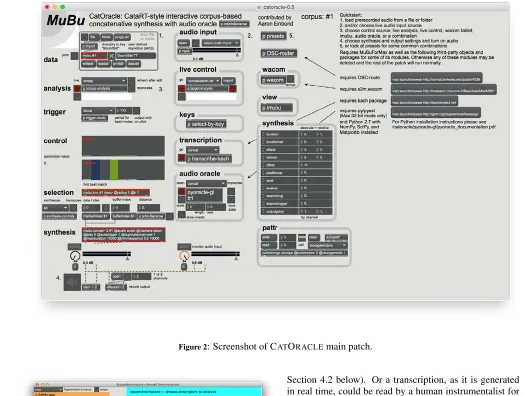
CATORACLEis distributed with MUBUin the examples folder.6 It takes advantage of MUBU’Smodular structure, with multiple objects accessing the same multi-buffer data structure through a shared argument (Figure 2).
3.2.1 Live Input
An extension of classic CBCS is realtime control using live audio to search the corpus. When descriptors are compared for closest matches between units, this could be termed realtime “audio mosaicking.” Already implemented in CATART for FTM&Co with the module catart.analysis [10], this process can now take advantage of the symmet-rical architecture of MUBUand PIPOfor even more trans-parent control of identical parameters for deferred- and re-altime analysis and segmentation.
In CATORACLEtwo segmentation methods are provided for both: “chop,” which segments periodically by a spec-ified duration; and “onseg,” a simple attack detector on a specified descriptor threshold (by default based on am-plitude in decibels, but reconfigurable by the user to any descriptor). The descriptors values are compared in the mubu.knnexternal, which constructs a kD-tree on the pre-recorded corpus for efficient comparison with the live in-put to find the k-nearest-neighbors for each incoming unit. Following previous work with CATART [11], analysis can be carried out in “targeted-transposition” mode, where dif-ferences in frequency and energy between corpus and tar-get descriptors are taken into account before re-synthesis. These data can be stored inBACHslots (see Section 3.2.5) and later edited to affect playback.
4http://ismm.ircam.fr/catart/
5http://ismm.ircam.fr/mubu,http://ismm.ircam.fr/pipo/ 6http://forumnet.ircam.fr/product/mubu-en/
3.2.2 Audio Descriptors
By default the analysis subpatches are set to usepipo.basic, providing as descriptors: frequency, energy, periodicity, autocorrelation, loudness, centroid, spread, skewness, and kurtosis. This allows CATORACLEto run entirely within the free MUBUdistribution. Other descriptor calculations may be customized by replacing the PIPO module with pipo.yin,pipo.moments, orpipo.mfcc. Or, with a software license, the full range of the IRCAMDESCRIPTORSlibrary [12] is available withpipo.ircamdescriptors.7
A subpatcher with convenient checkboxes for descriptor selection may be substituted for the existing analysis mod-ules in CATORACLE allowing access to spectral, temporal, or many other features in any combination (Figure 3).
3.2.3 Key Values
For large corpora, tagging individual sound files with metadata can be an invaluable tool for navigation: for ex-ample, to organize an orchestral sample library by instru-ment name. For this purpose CATORACLE includes the subpatch select-by-key to enable and disable parts of the corpus. This takes advantage of the key-value data struc-ture of MUBU. When loading a new sound file (or folder containing sound files) to the corpus, an arbitrary key-value pair may be entered through a texteditobject. Or the key “SoundSet” may be assigned automatically with its value set to the directory of the file, thereby allowing to group sounds beforehand. These values are saved and reloaded with the corpus. Then the sounds matching a given key-value pair can be enabled or disabled by a check-box.
3.2.4 iMuBu View
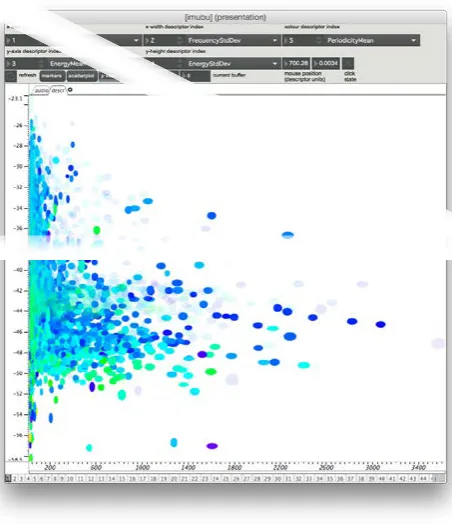
Multi-buffers can be viewed using the graphical inter-face object imubu. Within CATORACLE, this object is accompanied by useful presets to view the waveforms of individual sound files in the corpus (wave view) with their segmentationmarkers(equivalent to units in classic CATART). Or, inspired by the CATART lcd view, mark-ers may be viewed in a scatterplot with user-chosen de-scriptors as x− and y−positions, x−and y−widths, or color. Transparency is used to indicate sound files (and their markers) that have been disabled by key-value (Fig-ure 4). From both wave view and scatterplot view, a mouse or other controller can be used to select markers for play-back throughmubu.concat∼.
3.2.5 BACHTranscription
In previous work, CATART was connected to the BACH library8 to build a DAW-like interface for concatenative synthesis based on musical score notation [13]. A simi-lar procedure was implemented in CATORACLE: in sum-mary, units or markers are represented as note heads on a musical staff, using eitherbach.rollorbach.score. Along with frequency mean (pitch), energy mean (dynamic), and duration, any other descriptor data and metadata can be saved with each note in itsslots. In particular, the indices
7http://forumnet.ircam.fr/product/max-sound-box-en/ 8http://www.bachproject.net
Figure 2: Screenshot of CATORACLEmain patch.
Figure 3:pipo.ircamdescriptorsanalysis subpatch.
of the marker and buffer are saved with each note, permit-ting playback fromBACHthroughmubu.concat∼. This
in-formation and other slot contents, for example source file-name, can be displayed directly in the roll or score. Check-boxes permit quick selection of permitted rhythmic values withbach.quantize. Taking advantage ofbach.score’s pro-portional spacing attribute (@spacingtype 2), the roll and score are aligned rhythmically by default (Figure 5). From bach.score a MusicXML file can be exported, including slot metadata like dynamics and textual annotations, for further editing (see corresponding passage in Figure 9)
Combined with the audio oracle, this interface now of-fers new potential improvisation scenarios. For example, a computer improvisation can be transcribed in music no-tation for later use in computer-assisted composition (see
Section 4.2 below). Or a transcription, as it is generated in real time, could be read by a human instrumentalist for acoustic playback (see Section 5 below).
3.2.6 Audio Oracle
The agent for computer-assisted improvisation is contained in the abstraction pyoracle-gl. As described above, de-scriptor values are received from other modules in the patch (pipo,mubu.knn, or imubu) depending on the sce-nario. They are normalized and weighted before being sent to the AO. The “queryae-gl” script loaded in thepy exter-nal calls functions from the PYORACLElibrary to calculate the ideal distance threshold, learn the oracle, and generate the next state for improvisation. The module features a number of control parameters common to OMAXand PY
-ORACLE: the probability of linear continuity versus
jump-ing along the oracle, restriction to a region of the oracle, and forbidding repetition of thenmost recent states with the “taboo” parameter (Figure 6). Due to the hybrid na-ture of CATORACLE the timing of improvisation can be
controlled in several ways: durations can be reproduced from the durations of the learned oracle, durations can be taken from the pre-recorded corpus (possibly affected by mubu.concatsynthesis attributes), or the oracle can wait to be triggered externally to advance to the next state.
[image:3.1191.51.294.137.286.2]Figure 4: iMuBu scatterplot showing a corpus with some sound files (and their markers) disabled (transparent).
[image:4.1191.59.285.54.316.2]and suffix links below. The shaded ball represents the cur-rent state of an improvisation, and the shaded rectangle corresponds to a region to which improvisation is restricted (Figure 6).
3.2.7 Additional Features
Further features improve the user interface and perfor-mance of CATORACLE: communication through OSC
messages usingOSC-route,9 control ofimubuwith a WA -COM tablet using the s2m.wacom external,10 attrui
ob-jects to control the granular-synthesis-style parameters of
mubu.concat, andpattrobjects with bindings to these at-tributes as well as other important parameters in the patch for convenient saving and reloading of preset scenes.
3.3 CataRT-MuBu-Live
An additional “light” version of the patch, entitled catart-mubu-live, is made available without the Audio Oracle al-gorithm and with no dependencies on any third-party li-braries and externals. The remaining patch, requiring only MUBUand the standard MAXdistribution, still retains the other features of CATORACLE, notably live analysis of an
incoming audio signal for audio mosaicking, live record-ing the corpus, and an expanded list of triggerrecord-ing methods, as well as the tagging system provided by key-value pairs in MUBU. Furthermore, it avoids the limitation of thepy
external to 32-bit mode, and so can be used with MAXin 64 bits. It complements the even more streamlined catart-by-mubu and more elaborate CATORACLE, and all three
are distributed in the MUBUexamples folder.
9http://cnmat.berkeley.edu/downloads
10http://metason.cnrs-mrs.fr/Resultats/MaxMSP/
Figure 5: Transcription subpatch showing markers dis-played inbach.rollandbach.scorewith slots for metadata.
4. MUSICAL APPLICATIONS
A range of applications extend the existing capabilities of CATART, OMAX, and PYORACLEas outlined in Figure 7.
(a) Depicts a process similar to OMAX: the performance
begins with an empty corpus and the oracle is learned from a live audio input, stocking both the audio corpus and the oracle structure upon which improvisation is to be based.
(b) Represents a variation taking advantage of CBCS: a pre-recorded corpus is used in place of a live input. The or-acle is learned from a musical sequence generated from the corpus, activated by a gestural controller such as a mouse or WACOMtablet. No new audio is recorded, but the oracle is recorded and used to generate an improvisation based on the same corpus.
(c) Combines (a) and (b): again the process begins with a pre-recorded corpus. But instead of a gestural controller, live audio input is used to control the initial musical se-quence: for example through a live audio mosaic, compar-ing the live input to the closest matches in the corpus. No new audio is recorded, but the recorded oracle captures the structure of the input in terms of its descriptors. This could be advantageous in a performance situation where realtime control is desired, but without the risk of recording au-dio in non-ideal conditions (seeXylographybelow). Or it could be used for a more radical interpretation of computer improvisation: to imitate the behavior of one musical se-quence using completely different sound material, raising intriguing æsthetic as well as technical questions.
(d) Begins with an audio oracle generated through any of the previous methods. But when improvisation begins, a live audio input is taken as a guide for navigation us-ing PYORACLE’s “query mode,” so that the
improvisa-tion is informed by the current audio context. For noise-improvisation, this could be used to guide the computer improvisation toward timbral fusion with the live input, especially effective with the expanded list of timbral de-scriptors available frompipo.ircamdescriptors.11
4.1 Comprovisation
The combination of pre-composed music with computer-assisted improvisation, or “comprovisation” [5], is
well-11See a video of context-sensitive noise improvisation with CATORA
-CLEby violist Nils Bultmann athttps://vimeo.com/157177493.
Figure 6: Audio Oracle abstraction showing (above) impro-visation controls and (below) oracle visualization.
suited for CATORACLE. The first work to use the
sys-tem for composition and performance is Xylography for violoncello and electronics by Aaron Einbond.12 In this
rigorously-composed work, no audio is recorded live: all of the electronics are generated from samples pre-recorded in the studio. However there is still a high degree of inter-activity: audio oracles are learned in realtime, responding to the performer’s fleeting variations in timbre and timing, especially relevant in a score with extended instrumental techniques. When the computer takes this as a basis for improvisation, it is informed by the performer’s unique in-terpretation of the score. At times query mode is used to bring these improvisations into closer proximity with the performer as she continues playing from the notated score.
4.2 Computer-Assisted Composition
Xylography also makes use of computer-assisted
com-position: applying the notational capabilities of BACH,
12Written for Pierre Morlet and S´everine Ballon; videos available at
[image:4.1191.622.854.55.476.2]http://medias.ircam.fr/xfb3c40andhttps://vimeo.com/137971814.
Figure 7: Paradigms of improvisation with CATORACLE.
computer-improvised sequences were transcribed as the basis for parts of the score to be performed acoustically. In this way, computer-improvisation becomes a technique for elaborating and developing acoustic material. In Fig-ure 9, the first passage from the opening of the work is transcribed precisely from a recorded improvisation by the human performer. The second is transcribed from a computer-improvisation based on this recording, to be reinterpreted live by the performer near the end of the work. The intended effect is of a recapitulation, recog-nizable timbrally, but as if mis-remembered in its tempo-ral sequence. The repetition and permutation of similar elements can be observed in spectrograms of the learned ’cello passage and the computer-improvised response (Fig-ure 8), as well in the score, which has been edited in FI
-NALEto render the graphical symbols (Figure 9).
Figure 8: Spectrograms of learned and computer-improvised passages labeled with oracle states/markers.
[image:4.1191.897.1149.426.568.2] [image:4.1191.901.1145.635.718.2]5. DISCUSSION AND FURTHER DIRECTIONS A number of directions for further research could extend the implications of this project further.
The possibility of transcribing improvised sequences in music notation to be re-interpreted by a human per-former in realtime has not yet been implemented in ex-isting computer-assisted improvisation platforms. While
the BACH package offers promising possibilities, further
development will be necessary to refine the notation of dy-namics, playing techniques, and realtime rhythmic quanti-zation before it is useable in performance.
CATART’Spotential for soundscape texture synthesis has already been proposed [14]. Could an AO algorithm offer a more “natural” reproduction of a soundscape, in effect imitating its behavior by permitting limitless renewal of non-repetitive textures? While no additional technical ap-paratus is necessary, listening tests must be employed to evaluate the effectiveness of potential results.
So far FO and AO algorithms have been used predom-inantly for musical creation. However their capacity for musical pattern identification and data reduction could also have uses for analysis of existing music, especially elec-troacoustic or timbrally rich music that still offers a chal-lenge for existing techniques. In particular, the graphi-cal representation of the oracle could be used to visualize
large-scale formal and sonic connections. CATORACLE
could be integrated with existing tools for digital analy-sis such as INDESCRIPor EANALYSIS[15] to provide an-other complementary view of musical structure.
Finally, FO and AO are only two of several oracle al-gorithms that could be evaluated. Another recent exam-ple is the Variable Markov Oracle (VMO) [16]. Or a re-lated project is ImproTek [17], exploring the possibility of using pre-defined structures as templates for context-sensitive improvisation. While it could rely on a tonal structure, like a jazz progression, it could also follow an arbitrary trajectory of descriptors in time. Presently
im-plemented in OPENMUSIC, it could exchange data with
CATORACLEin the form of OSC messages. These alterna-tive algorithms should be explored to determine how their
results differ from CATORACLE and how they could be
musically enriching.
Acknowledgments
We gratefully thank S´everine Ballon, Pierre Morlet, Ar-shia Cont, Benjamin L´evy, G´erard Assayag, Jean Bres-son, Mikhail Malt, Emmanuel Jourdan, Paola Palumbo, Stephanie Leroy, Pascale Bondu, Aur`elia Ongena, J´er´emie Bourgogne, Julien Aleonard, Sylvain Cadars, and Eric de G´elis. This paper is dedicated to the memory of David Wessel, mentor and inspiration for this work.
6. REFERENCES
[1] N. Donin, “Sonic Imprints: Instrumental Resynthesis
in Contemporary Composition,” inMusical Listening
in the Age of Technological Reproduction, G. Borio, Ed. Farnham/Aldershot: Ashgate, 2015, pp. 323–341.
[2] C. Allauzen, M. Crochemore, and M. Raffinot, “Fac-tor Oracle: A New Structure for Pattern Matching,” in
Proceedings of SOFSEM99. Springer-Verlag, 1999, pp. 291–306.
[3] G. Assayag, G. Bloch, M. Chemillier, B. M. Juin, A. Cont, and S. Dubnov, “Omax brothers: a dynamic topology of agents for improvization learning,” inACM Multimedia Conference, Santa Barbara, 2006.
[4] D. Schwarz, “Corpus-Based Concatenative Synthesis,” IEEE Signal Processing Magazine, vol. 24, no. 2, pp. 92–104, 2007.
[5] B. L´evy, “Principles and Architectures for an Interac-tive and Agnostic Music Improvisation System,” Ph.D. dissertation, Universit´e Pierre et Marie Curie, Paris, 2013.
[6] S. Dubnov, G. Assayag, and A. Cont, “Audio Oracle: A New Algorithm for Fast Learning of Audio Structures,” inProc. ICMC, Copenhagen, 2007.
[7] G. Surges and S. Dubnov, “Feature Selection and
Composition Using PyOracle,” inAIIDE Conference,
Boston, 2013.
[8] G. Assayag, “Keynote Talk: Creative Symbolic Inter-action,” inProc. ICMC, Athens, 2014.
[9] N. Schnell, A. R¨obel, D. Schwarz, G. Peeters, and R. Borghesi, “MuBu & Friends – Assembling Tools for Content Based Real-Time Interactive Audio
Process-ing in Max/MSP,” inProc. ICMC, Montreal, 2009.
[10] A. Einbond, D. Schwarz, and J. Bresson, “Corpus-Based Transcription as an Approach to the
Composi-tional Control of Timbre,” inProc. ICMC, Montreal,
2009, pp. 223–226.
[11] A. Einbond, C. Trapani, and D. Schwarz, “Precise Pitch Control in Real Time Corpus-Based Concatena-tive Synthesis,” in Proc. ICMC, Ljubljana, 2012, pp. 584–588.
[12] G. Peeters, “A large set of audio features for sound description (similarity and classification),” IRCAM, Tech. Rep., 2004, unpublished.
[13] A. Einbond, C. Trapani, A. Agostini, D. Ghisi, and D. Schwarz, “Fine-tuned Control of Concatenative Synthesis with CataRT Using the bach Library for
Max,” inProc. ICMC, Athens, 2014, pp. 1037–1042.
[14] D. Schwarz and N. Schnell, “Descriptor-based Sound
Texture Sampling,” inSound and Music Computing,
Barcelona, 2010, pp. 510–515.
[15] P. Couprie and M. Malt, “Representation: From
Acoustics to Musical Analysis,” inEMS Network
Con-ference, Berlin, 2014.
[16] C. Wang and S. Dubnov, “Guided Music Synthesis
with Variable Markov Oracle,” inAIIDE Conference,
Raleigh, 2013, pp. 56–62.
[17] J. Nika and M. Chemillier, “ImproteK, integrating har-monic controls into improvisation in the filiation of
OMax,” inProc. ICMC, Ljubljana, 2012, pp. 180–187.