Bayesian Compressed Vector Autoregressions
∗Gary Koop University of Strathclyde†
Dimitris Korobilis University of Essex‡
Davide Pettenuzzo Brandeis University§
February 10, 2017
Abstract
Macroeconomists are increasingly working with large Vector Autoregressions (VARs) where the number of parameters vastly exceeds the number of observations. Existing approaches either involve prior shrinkage or the use of factor methods. In this paper, we
develop an alternative based on ideas from the compressed regression literature. It
involves randomly compressing the explanatory variables prior to analysis. A huge
dimensional problem is thus turned into a much smaller, more computationally tractable one. Bayesian model averaging can be done over various compressions, attaching greater weight to compressions which forecast well. In a macroeconomic application involving up to 129 variables, we find compressed VAR methods to forecast as well or better than either factor methods or large VAR methods involving prior shrinkage.
Keywords: multivariate time series, random projection, forecasting
JEL Classifications: C11, C32, C53
∗
We would like to thank Andrea Carriero, Todd Clark, Drew Creal, Frank Diebold, Serena Ng, Daniel Pe˜na, Simon Price, Frank Schorfheide, Rob Taylor, Allan Timmermann, Ruey Tsay, Herman van Dijk, Mike West, Jonathan Wright, and Kamil Yilmaz for their helpful comments and suggestions. We also would like to thank seminar participants to the 2016 NBER-NSF Time Series Conference, the 2016 European Seminar on Bayesian Econometrics, the 2016 NBER Summer Institute, the 2016 European Meeting of the Econometric Society, and seminar participants at the Bank of England, Brandeis University, ECARES, University of Essex, University of Konstanz, University of Pennsylvania, and University of St Andrews for their comments.
†
University of Strathclyde, Department of Economics, Room 4.06, Sir William Duncan Building, 130 Rottenrow, Glasgow G4 0GE, United Kingdom. [email protected]
‡
Essex Business School, Wivenhoe Park, Colchester, CO4 3SQ, United Kingdom. Dimitris.Korobilis@ glasgow.ac.uk
§
1
Introduction
Vector autoregressions (VARs) have been an important tool in macroeconomics since the
seminal work of Sims (1980). Recently, many researchers in macroeconomics and finance
have been using large VARs involving dozens or hundreds of dependent variables (see, among
many others, Banbura, Giannone and Reichlin, 2010, Carriero, Kapetanios and Marcellino,
2009, Koop, 2013, Koop and Korobilis, 2013, Korobilis, 2013, Giannone, Lenza, Momferatou
and Onorante, 2014 and Gefang, 2014). Such models often have many more parameters
than observations, over-fit the data in-sample, and, as a consequence, forecast poorly
out-of-sample. Researchers working in the literature typically use prior shrinkage on the parameters
to overcome such over-parametrization concerns. The Minnesota prior is particularly popular,
but other approaches such as the LASSO (least absolute shrinkage and selection operator, see
Park and Casella, 2008 and Gefang, 2014) and SSVS (stochastic search variable selection, see
George, Sun and Ni, 2008) have also been used. Most flexible Bayesian priors that result
in shrinkage of high-dimensional parameter spaces rely on computationally intensive Markov
Chain Monte Carlo (MCMC) methods and their application to recursive forecasting exercises
can, as a consequence, be prohibitive or even infeasible. The only exception is a variant of the
Minnesota prior that is based on the natural conjugate prior, an idea that has recently been
exploited by Banbura, Giannone and Reichlin (2010) and Giannone, Lenza and Primiceri
(2015), among others. While this prior allows for an analytical formula for the posterior,
there is a cost in terms of flexibility in that a priori all VAR equations are treated in the same
manner; see Koop and Korobilis (2010) for a further discussion of this aspect of the natural
conjugate prior.
The themes of wishing to work with Big Data1 and needing empirically-sensible shrinkage
of some kind also arise in the compressed regression literature; see Donoho (2006). In this
literature, shrinkage is achieved by compressing the data instead of the parameters. These
methods are used in a variety of models and fields (e.g. neuroimaging, molecular epidemiology,
astronomy). A crucial aspect of these methods is that the projections used to compress
1Big Data comes in two forms that are often called Tall and Fat. Tall data involves a huge number of
the data are drawn randomly in a data oblivious manner. That is, the projections do not
involve the data and are thus computationally trivial. Recently, Guhaniyogi and Dunson
(2015) introduced the idea of Bayesian Compressed regression, where a number of different
projections are randomly generated and the explanatory variables are compressed accordingly.
Next, Bayesian model averaging (BMA) methods are used to attach different weights to the
projections based on the explanatory power the compressed variables have for the dependent
variable.
In economics, alternative methods for compressing the data exist. The most popular of
these is principal components (PC) as used, for instance, in the Factor-Augmented VAR,
FAVAR, of Bernanke, Boivin and Eliasz (2005) or the dynamic factor model (DFM) of, e.g.,
Geweke (1977) and Stock and Watson (2002). PC methods compress the original data into a
set of lower-dimensional factors which can then be exploited in a parsimonious econometric
specification, for example, a univariate regression or a small VAR. The gains in computation
from such an approach are large (but not as large as the data oblivious methods used in the
compressed regression literature), since principal components are relatively easy to compute
and under mild conditions provide consistent estimates of unobserved factors for a wide variety
of models, including those with structural instabilities in coefficients (Bates, Plagborg-Møller,
Stock and Watson, 2013). However, the data compression is done without reference to the
dependent variable(s). PC is thus referred to as an unsupervised data compression method.
In contrast, the approach of Guhaniyogi and Dunson (2015) to compressed regression, since it
involves the use of BMA, is supervised. To our knowledge, supervised compressed regression
methods of this sort have not yet been used in the VAR literature.2
In this paper, we extend the Bayesian random compression methods of Guhaniyogi and
Dunson (2015), developed for the regression model, to the VAR leading to the Bayesian
Compressed VAR (BCVAR). In doing so, we introduce several novel features. First, we
generalize the compression schemes of Guhaniyogi and Dunson (2015) and apply them both
to the VAR coefficients and the elements of the error covariance matrix. In high dimensional
2Carriero, Kapetanios and Marcellino (2016) use a reduced rank VAR framework they refer to as a
VARs, the error covariance matrix will likely contain a large number of unknown
parameters. As a concrete example, the error covariance matrix of the largest VAR we
consider in our empirical application includes more than 8,000 free parameters. Compressing
the VAR coefficients while leaving these parameters unconstrained may still lead to a
significant degree of over-parametrization and poor forecast performance, which explains our
desire to compress the covariance matrix. Second, we allow the explanatory variables in the
different equations of the VAR to be compressed in potentially different ways. To
accomplish this, we develop a computationally efficient algorithm that breaks down the
estimation of the high dimensional compressed VAR into the estimation of its individual
equations. We believe this feature to be particularly important for macroeconomic VARs,
where the first own lag in each equation is often found to have important explanatory
power, and forcing the same (compressed) variables to appear in each equation seems
therefore problematic. Our algorithm has very low requirements in terms of memory
allocation and, since the VAR equations are assumed to be independent, can be easily
parallelized to fully exploit the power of modern high-performance computer clusters
(HPCC).3 Third, we generalize our compressed VAR methods to the case of
large-dimensional VARs with equation-specific time-varying parameters and volatilities.
This is achieved by extending the approach developed in Koop and Korobilis (2013) to the
compressed VAR, relying on variance discounting methods to model, in a computationally
efficient way, the time variation in the VAR coefficients and error covariance matrix.
We carry out a substantial macroeconomic forecasting exercise involving VARs with up to
129 dependent variables and 13 lags. We compare the forecasting performance of seven key
macroeconomic variables using the BCVAR to various popular alternatives: univariate AR
models, the DFM, the FAVAR, and the Minnesota prior VAR. Our results are encouraging
for the BCVAR, showing substantial forecast improvements in many cases and comparable
forecast performance in the remainder.
The rest of the paper is organized as follows. Section 2 provides a description of the
theory behind random compression. Section 3 introduces the Bayesian Compressed VAR
with constant parameters, and develops methods for posterior and predictive analysis, while
3
section 4 describes the empirical application. Section 5 introduces heteroskedasticity and
time-variation in the parameters of the BCVAR and documents that these extensions further
improve the forecasting performance of our approach. Section 6 provides some concluding
remarks.
2
The Theory and Practice of Random Compression
Random compression methods have been used in fields such as machine learning and image
recognition as a way of projecting the information in data sets with a huge number of variables
into a much lower dimensional set of variables. In this way, they are similar to PC methods,
which take as inputs many variables and produce as the output orthogonal factors. With PC
methods, the first factor accounts for as much of the variability in the data as possible, the
second factor the second most, etc. Typically, a few factors are enough to explain most of
the variability in the data and, accordingly, parsimonious models involving only a few factors
can be constructed. Random compression does something similar, but is computationally
simpler, and capable of dealing with a massively huge number of variables. For instance,
in a regression context, Guhaniyogi and Dunson (2015) have an application involving 84,363
explanatory variables.
To fix the basic ideas of random compression, let X be a T ×k data matrix involving T
observations on k variables where k T. Xt is a 1×k vector denoting the tth row of X.
Define the projection matrix, Φ,which ism×kwith mkand Xet0 = ΦXt0. Then Xet is the
1×mvector denoting thetthrow of the compressed data matrix,Xe. SinceXe hasmcolumns
andX hask, the former is much smaller and is much easier to work with in the context of a
statistical model such as a regression or a VAR. To see precisely how this works in a regression
context, letyt be the dependent variable and consider the regression:
yt=Xtβ+εt. (1)
If k T, then working directly with (1) is impossible with some statistical methods (e.g.
maximum likelihood estimation) and computationally demanding with others (e.g. Bayesian
approaches which require the use of MCMC methods). Some of the computational burden can
matrices even a single time can be very demanding. For instance, calculation of the Bayesian
posterior mean under a natural conjugate prior requires, among other manipulations, inversion
of ak×k matrix involving the data. This can be difficult ifk is huge. In order to deal with
a large number of predictors, one can specify a compressed regression variant of (1)
yt= ΦXt0
0
βc+εt. (2)
Once the explanatory variables have been compressed (i.e. conditional on Φ), standard
Bayesian regression methods can be used for the regression of yt on Xet. If a natural
conjugate prior is used, then analytical formulae exist for the posterior, marginal likelihood,
and predictive density and computation is trivial. Note that the model in (2) has the same
structure as a reduced-rank regression (early work in the econometrics literature includes
Geweke, 1996 and Kleibergen and Van Dijk, 1998), as the k explanatory variables in the
original regression model are squeezed into a small number of explanatory variables given by
the vector Xet = ΦXt0. The crucial difference with likelihood-based approaches such as the
ones proposed by Geweke (1996), Kleibergen and Van Dijk (1998) and Carriero, Kapetanios
and Marcellino (2016) is that the matrix Φ is not estimated. This is the main idea behind
compressed regression methods, which recommend treating Φ as a random matrix and
drawing its elements in some fashion.4
The key question is: what information is lost by compressing the data in this fashion?
The answer is that, under certain conditions, the loss of information may be small. The
underlying motivation for random compression arises from the Johnson-Lindenstrauss lemma
(see Johnson and Lindenstrauss, 1984). This states that anykpoint subset of Euclidean space
can be embedded inm=O log (k)/2
dimensions without distorting the distances between
any pair of points by more than a factor of 1± for any 0 < < 1. In the econometrics
literature, Ng (2016, pages 10-13) provides a detailed explanation and the intuition behind
this rather remarkable result and shows how it can be used to tackle economic problems.
Further intuition on the potential usefulness of these methods in the linear regression setting
of (2) can be drawn from the literature on random subspace methods (see Boot and Nibbering,
4Random projection methods are referred to as data oblivious, since Φ is drawn without reference to the
2016), and complete subset regression (see Elliott, Gargano and Timmermann, 2013, 2015).
Both these approaches are similar to the compressed regression in (2). In particular, random
subspace methods involve randomly drawing subsets of the explanatory variables, while the
complete subset regression method of Elliott, Gargano and Timmermann (2013, 2015) uses
equal-weighted combinations of all available subsets of explanatory variables, and resorts to
randomly selecting the subsets when the number of regressors is larger than the total number
of observations available. Another important reference in this context is Guhaniyogi and
Dunson (2015), who provide proofs of the theoretical properties of compressed regression
methods, asymptotically in T and k. Under some weak assumptions, the most significant
relating to sparsity (e.g. on how fast m can grow relative to k as the sample size increases),
Guhaniyogi and Dunson (2015) show that their Bayesian compressed regression algorithm
produces a predictive density which converges to the true predictive density. The convergence
rate depends on how fast m and k grow with T. With some loose restrictions on this, they
obtain near parametric rates of convergence to the true predictive density. In a simulation
study and empirical work, they document excellent coverage properties of predictive intervals
and large computational savings relative to popular alternatives. We note that in the large
VAR there is likely to be a high degree of sparsity since most VAR coefficients are likely to
be zero, especially for more distant lag lengths. In such a case, the theoretical results of
Guhaniyogi and Dunson (2015) suggest fast convergence should occur and the computational
benefits will likely be large.
Finally, note that Guhaniyogi and Dunson (2015) show that the desirable properties of
random compression hold even for a single, data oblivious, random draw of Φ. In practice,
they recommend taking many random draws and then averaging them. They draw Φij, the
ijth element of Φ, (where i= 1, .., m andj = 1, .., k) from the following distribution:
PrΦij = √1ϕ
=ϕ2
Pr (Φij = 0) = 2 (1−ϕ)ϕ
PrΦij =−√1ϕ
= (1−ϕ)2
, (3)
where ϕ and m are unknown parameters.5 Next, they rely on BMA to average across the
different random projections entertained. Treating each Φ(r) (r = 1, .., R) as defining a new
5
model, they first calculate the marginal likelihood for each model, and then average across
the various models using weights proportional to their marginal likelihoods. Note also thatm
andϕcan be estimated as part of this BMA exercise. In fact, Guhaniyogi and Dunson (2015)
recommend simulatingϕfrom theU[a, b] distribution, wherea(b) is set to a number slightly
above zero (below one) to ensure numerical stability. As form, they recommend simulating
it from theU[2 log (k),min (T, k)] distribution.
Intuitively, the use of BMA will ensure that bad compressions (i.e. those that lead to the
loss of information important for explaining yt) are avoided or down-weighted. To provide
some more context, note that if we were to interpret m and ϕ and, thus, Φ, as random
parameters (instead of specification choices defining a particular compressed regression), then
BMA can be interpreted as importance sampling. That is, the Uniform distributions that
Guhaniyogi and Dunson (2015) use for drawing ϕ and m, respectively, can be interpreted
as importance functions. Importance sampling weights are proportional to the posterior for
m and ϕ. But this is equivalent to the marginal likelihood which arises if Φ is interpreted
as defining a model. Thus, in this particular setting, importance sampling is equivalent to
BMA. In the same manner that importance sampling attaches more weight to draws from high
regions of posterior probability, doing BMA with randomly compressed regressions attaches
more weight to good draws of Φ which have high marginal likelihoods.
In a VAR context, doing BMA across models should only improve empirical performance
since this will lead to more weight being attached to choices of Φ which are effective in
explaining the dependent variables. Such supervised dimension reduction techniques contrast
with unsupervised techniques such as PC. It is likely that supervised methods such as this
will forecast better than unsupervised methods, a point we investigate in our empirical work.
In summary, for a given compression matrix, Φ, the huge dimensional data matrix is
compressed into a much lower dimension. This compressed data matrix can then be used
in a statistical model such as a regression or a VAR. The theoretical statistical literature on
random compression has developed methods such as (3) for randomly drawing the compression
matrix and showed them to have desirable properties under weak conditions which are likely
to hold in large VARs. By averaging over different draws for Φ (which can differ both in terms
working only with models of low dimension.
3
Random Compression of VARs
We start with the standard reduced form VAR model,6
Yt=BYt−1+t (4)
whereYt fort= 1, ..., T is ann×1 vector containing observations onn time series variables,
t is i.i.d. N (0,Ω) and B is an n×n matrix of coefficients. Note that, with n = 100, the
uncompressed VAR will have 10,000 coefficients in B and 5,050 in Ω. In a VAR(13), such
as the one used in this paper, the former number becomes 130,000. It is easy to see why
computation can become daunting in large VARs and why there is a need for shrinkage.
To compress the explanatory variables in the VAR, we can use the matrix Φ given in (3)
but now it will be an m×n matrix wherem n, subject to the normalization Φ0Φ =I. In
a similar fashion to (2), we can define the compressed VAR:
Yt=Bc(ΦYt−1) +t, (5)
whereBcism×n. Thus, we can draw upon the motivations and theorems of, e.g., Guhaniyogi
and Dunson (2015) to offer theoretical backing for the compressed VAR. If a natural conjugate
prior is used, for a given draw of Φ the posterior, marginal likelihood, and predictive density
of the compressed VAR in (5) have familiar analytical forms (see, e.g., Koop and Korobilis,
2009). These, along with a method for drawing Φ, is all that are required to forecast with the
BCVAR. And, ifmis small, the necessary computations of the natural conjugate BCVAR are
straightforward.7
We note however that the natural conjugate prior has some well-known restrictive
properties in VARs.8 In the context of the compressed VAR, working with a Φ of dimension
6For notational simplicity, we explain our methods using a VAR(1) with no deterministic terms. These can
be added in a straightforward fashion. In our empirical work, we have monthly data and use 13 lags and an intercept.
7
In the literature on compression in multivariate regression, it is worth citing Hoff (2007). This paper uses BMA to estimate the rank of a singular value decomposition for the right-hand side variables in a class of models which includes the VAR. In contrast to our approach, he uses Gibbs sampling methods to estimate the optimal decomposition.
8
m ×n as defined in (5), with only n columns instead of n2 would likely be much too
restrictive in many empirical contexts. For instance, it would imply that to delete a variable
in one equation, then that same variable would have to be deleted from all equations. In
macroeconomic VARs, where the first own lag in each equation is often found to have
important explanatory power, such a property seems problematic. It would imply, say, that
lagged inflation could either be included in every equation or none when what we might
really want is for lagged inflation to be included in the inflation equation but not most of
the other equations in the VAR.9
An additional issue with the natural conjugate BCVAR is that it allows the error covariance
matrix to be unrestricted. In high dimensional VARs, Ω contains a large number of parameters
and we may want a method which allows for their compression. This issue does not arise in the
regression model of Guhaniyogi and Dunson (2015) but is potentially very important in large
VARs. For example, in our application the largest VAR we estimate has an error covariance
matrix containing 8,385 unknown parameters. These considerations motivate working with
a re-parametrized version of the BCVAR that allows for compression of the error covariance
matrix. Following common practice (see, e.g., Primiceri, 2005, Eisenstat, Chan and Strachan,
2015 and Carriero, Clark and Marcellino, 2015) we use a triangular decomposition of Ω:
AΩA0 = ΣΣ, (6)
where Σ is a diagonal matrix with diagonal elements σi (i = 1, ..., n), and A is a lower
triangular matrix with ones on the main diagonal. Next, we rewrite A = In+Ae, where In
is the (n×n) identity matrix and Ae is a lower triangular matrix with zeros on the main
diagonal. Using this notation, we can rewrite the reduced-form VAR in (4) as follows
Yt = BYt−1+A−1ΣEt (7)
whereEt∼N(0, In). Further rearranging, we have
Yt = ΓYt−1+Ae(−Yt) + ΣEt (8)
= ΘZt+ ΣEt
9
whereZt=
h
Yt−0 1,−Yt0i
0
, Γ =AB and Θ =hΓ,Ae i
. Because of the lower triangular structure
of Ae, the first equation of the VAR above includes only Yt−1 as explanatory variables, the
second equation includesYt−0 1,−Y1,t
0
, the third equation includesYt−0 1,−Y1,t,−Y2,t
0 , and
so on (here Yi,t denotes the i-th element of the vector Yt). Note that this lower triangular
structure, along with the diagonality of Σ, means that equation-by-equation estimation of the
VAR can be done, a fact we exploit in our algorithm. Furthermore, since the elements of
e
A control the error covariances, by compressing the model in (8) we can compress the error
covariances as well as the reduced form VAR coefficients.
Given that in the triangular specification of the VAR each equation has a different number
of explanatory variables, a natural way of applying compression in (8) is through the following
specification:
Yi,t = Θci ΦiZti
+σiEi,t i= 1, ..., n (9)
where now Zti denotes the subset of the vector Zt which applies to the i-th equation of the
VAR: Zt1 = (Yt−1), Zt2 =
Yt−0 1,−Y1,t
0
,Zt3 =Yt−0 1,−Y1,t,−Y2,t
0
, and so on. Similarly, Φi
is a matrix with m rows and column dimension that conforms with Zti. Following (9), we
now haven compression matrices (each of potentially different dimension and with different
randomly drawn elements), and as a result the explanatory variables in the equations of
the original VAR can be compressed in different ways. Note also that an alternative way to
estimate a compressed VAR version of model (8) would be to write the model in its SUR form;
see Koop and Korobilis (2009). If we did so, the data matrixZt would have to be expanded
by taking its Kronecker product withIn. For large n such an approach would require huge
amounts of memory (many times more than a modern personal computer has available). Even
if we were to use sparse matrix calculations, having to define the non-zero elements of the
matrices in the SUR form of a large VAR would result in very slow computation. On the
other hand, the equation-by-equation estimation we propose in (9) is simpler and can be easily
parallelizable, since the VAR equations are transformed so as to be independent.
For a given set of posterior draws of Θci and σi (i = 1, .., n), estimation and prediction
can be done in a computationally-fast fashion using a variety of methods since each model
equation at a time. In the empirical work in this paper, we use standard Bayesian methods
suggested in Zellner (1971) for the seemingly unrelated regressions model. In particular, for
each equation we use the prior:
Θci|σ2i ∼ N Θci, σ2iVi
(10)
σi−2 ∼ G s−i 2, νi ,
whereG s−i 2, νidenotes the Gamma distribution with means−i 2 and degrees of freedomνi.
In our empirical work, we set set Θci = 0, Vi = 0.5×I and, for σi−2 use the non-informative
version of the prior (i.e. νi= 0). We then use familiar Bayesian results for the Normal linear
regression model (e.g. Koop, 2003, page 37) to obtain analytical posteriors for both Θci and
σi. The one-step ahead predictive density is also available analytically. However,h-step ahead
predictive densities forh > 1 are not available analytically.10 To compute them, we proceed
by first converting the estimated compressed triangular VAR in equation (9) back into the
triangular VAR of equation (8), noting that
Θ =
(Θc1Φ1,0n)0,(Θc2Φ2,0n−1)0, ...,(Θcn−1Φn−1,0)0,(ΘcnΦn)0
0
(11)
where 0n is an (1×n) vector of zeros, 0n−1 is an (1×n−1) vector of zeros, and so on.
Subsequently, we go from the triangular VAR in equation (8) to the original reduced-form
VAR in equation (4) by noting that B = A−1Γ, where Γ can be recovered from the first
n×nblock of Θ in (11), and Ais constructed fromAeusing the remaining elements of Θ (see
equation (8)). Finally, the covariance matrix of the reduced form VAR is simply given by
equation (6), where both Aand Σ are known. After these transformations are implemented,
standard results for Bayesian VARs can be used to obtain multi-step-ahead density forecasts.
So far we have discussed specification and estimation of the compressed VAR conditional
on a single compression Φ (or Φi, i = 1, .., n). In practice, we generate R sets of such
compression matrices Φ(ir) (i = 1, .., n and r = 1, .., R), and estimate an equal number of
compressed VAR models, which we denote with M1, ..., MR. Then, for each model, we use
the predictive simulation methods described above to obtain the full predictive density
10
p Yt+h|Mr,Dt
, where h= 1, ..., H. For each forecast horizonh, the final BMA forecast is a
mixture of the form
p Yt+h|Dt
=
R
X
r=1
wrp Yt+h|Mr,Dt
, (12)
whereDt is the information set available at time t, w
r = exp (−.5Ψr)/PRr=1exp (−.5Ψr) is
model Mr weight, and Ψr = BICr−BICmin, with BICr being the value of the Bayesian
Information Criterion (BIC) of modelMr and BICmin the minimum value of the BIC among
allRmodels. We use BIC to approximate the marginal likelihood because it can be computed
easily for high-dimensional VARs and is insensitive to the choice of the priors.
In our empirical work, the Φ(ir)’s are randomly drawn using the strategy described in (3).
This scheme means that for each of theR random compression matrices, we have to generate
the parameter ϕ and decide on the number of rows m of each Φ(ir) (that is, the dimension
of the projected space). Both these parameters are drawn randomly: ϕ is drawn from the
uniform U[0.1,0.8] distribution andm is drawn from the discrete U[1,5 ln (ki)], where ki is
the number of explanatory variables included inZti for VAR equationi.11
We note, to conclude this section, that papers such as Achlioptas (2003) have proposed
alternative schemes to the one we adopted in (3) to randomly draw the elements of Φi.
While some of these may be potentially more efficient and can provide a higher degree of
sparsity (zeros in Φi), in our macroeconomic application we found that a wide range of
alternative random projection schemes produced almost identical forecasts. Thus, in our
empirical application we will focus exclusively on the scheme proposed by Guhaniyogi and
Dunson (2015), as described in equation (3).
4
Empirical Application:
Macroeconomic Forecasting with
Large VARs
This section introduces the macroeconomic data considered in our application and reports the
forecasting performance of the Bayesian Compressed VAR methods described in section 3,
relative to a number of popular alternatives. We first consider the accuracy of point forecasts,
11These choices are similar to those used in Guhaniyogi and Dunson (2015), but our choice to draw values of
using Mean Squared Forecast Errors (MSFEs). Next, we turn to the quality of the density
forecasts, and for that rely on the average of the log predictive likelihoods (ALPL), as in
Geweke and Amisano (2010).
4.1 Data
We use the FRED-MD data-base of monthly US variables from January 1960 through
December 2014. The reader is referred to McCracken and Ng (2015) for a description of this
macroeconomic data set, which includes a range of variables from a broad range of
categories (e.g. output, capacity, employment and unemployment, prices, wages, housing,
inventories and orders, stock prices, interest rates, exchange rates and monetary aggregates).
We use the 129 variables for which complete data was available, after transforming all
variables using the transformation codes provided in Appendix A.12 We present detailed
forecasting results for seven variables of interest: industrial production growth (INDPRO),
the unemployment rate (UNRATE), total nonfarm employment (PAYEMS), the change in
the Fed funds rate (FEDFUNDS), the change in the 10 year T-bill rate (GS10), the finished
good producer price inflation (PPIFGS) and consumer price inflation (CPIAUCSL).13 In
particular, we estimate VARs of different dimensions, with these seven variables included in
all of our specifications. We have a Medium VAR with 19 variables, a Large VAR with 46
variables and a Huge VAR with all 129 variables.14 A listing of all variables (including
which appear in which VAR) is given inAppendix A. Note that most of our variables have
substantial persistence in them and, accordingly, the first own lag in each equation almost
always has important explanatory power. Accordingly, we do not compress the first own lag.
This is included in every equation, with compression being done on the remaining
12In addition to dropping a few series with missing observations, we also remove the series non-borrowed
reserves, as it became extremely volatile during the Great Recession.
13We also standardize our variables prior to estimation and forecasting. The forecasts of the original variables
are then computed by inverting the transformation and reassigning means and variances. This standardization is computed recursively, i.e., using only the data that would have been available at each point in time to estimate the various models.
14
variables.15 Following Banbura et al. (2010), we choose a relatively large value for lag length
(p = 13) for all the methods we compare, trusting in the compression or shrinkage of the
various methods to remove unnecessary lags.
4.2 Estimating the Bayesian Compressed VAR
Random compression methods are most useful for forecasting and, hence, we will not discuss
estimation of the model’s parameters in any detail. However, before turning to forecasting, it
is worth presenting evidence relating to the random compression itself. This is controlled by
m and ϕ, which define the dimension and the degree of sparsity in the compression matrix.
Figure 1 and Figure 2 plot their empirical distributions for the Bayesian compressed VARs
of different dimensions. They can be interpreted as approximations to the posteriors of these
parameters. To aid in interpretation note that, in our compressed VARs, there is a different
compression matrix in each equation and so, for brevity, the figures average over all equations
and are based on the 75% of draws with highest posterior probability. Remember that smaller
values of m indicate a higher degree of compression and, for a given m, ϕ= 0.5 induces the
highest degree of sparsity.
The posteriors in the figures are clustered around sensible values. The high dimensional
data vectors,Zti, tend to be compressed down to dimensions of 10-20. The value ofm tends
to rise somewhat as we move from the Medium to Large to Huge VAR, but even for the latter
almost all the posterior weight if clustered below 20. It is also worth noting that, even though
we are drawing values ofmas low as 1, such draws never receive appreciable weight. In other
words, our algorithm is not attaching much weight to extreme compressions which reduce the
high-dimensional vector of predictors too much. The posterior for ϕ tends to be clustered
near the value which induces most sparsity.
4.3 Alternative Methods for Large VARs
We use the Bayesian compressed VAR methods introduced in section 3 in two ways: the
first one, which we label as BCVARc, compresses both the VAR coefficients and the error
15
covariances as in (9). The second one, which we label BCVAR, is the same, except for the
fact that it does not compress the error covariances.
To better assess the forecasting accuracy of these compressed VAR methods, we compare
their performances against a number of popular alternatives. Reasoning that previous work
with large numbers of dependent variables have typically used factor methods or large
Bayesian VARs, we focus on these. In addition, we compare the forecasts using all of these
methods to a benchmark approach which uses OLS forecasts from univariate AR(1) models.
Dynamic Factor Model
The dynamic factor model (DFM) can be written as:
Yt = λ0+λ1Ft+t
Ft = Φ1Ft−1+...+ ΦpFt−p+Ft (13)
whereFtis a q×1 vector factors (with qn) which contains information extracted from all
nvariables,λ0andλ1aren×1 andn×qmatrices, andt∼ N 0,ΣY
where ΣY is a diagonal
matrix. The vector of factors is assumed to follow a VAR(p) process with Ft ∼ N 0,ΣF,
with t independent of Fs at all t and s. We use principal component methods to estimate
the factors.16
We select the number of factorsqand the lag lengthpas follows: We specify the maximum
number of factors and lag lengths to beqmax=√nandpmax= 13, respectively. Next, at each
point in time we use BIC to choose the optimal lag length and number of factors. We use
Bayesian methods with non-informative priors to estimate and forecast with this model (note
that the law of motion for the common factors in equation (13) is needed to iterate forward
the forecasts whenh >1).
Factor-Augmented VAR
We use the Factor-Augmented VAR (FAVAR) of Bernanke, Boivin, Eliasz (2005) dividing
Ytinto a set of primary variables of interest, Yt∗ (these are the same key seven variables listed
16
above), and the remainderYet, and work with the model:
e
Yt = ΛFt+Yte (14)
Ft Yt∗
= B0+B1
Ft−1
Yt−∗1
+...+Bp
Ft−p Yt−p∗
+∗t.
The vector (Ft0, Yt∗0)0 is assumed to follow a VAR(p) process with Ye
t ∼ N
0,ΣYe
, ∗t ∼
N(0,Σ∗), and t independent of ∗s at all t and s. As with the DFM model, we rely on
principal component methods to extract the factors Ft, and select the optimal number of
factors q and the lag length p using BIC. We use Bayesian methods with non-informative
priors to forecast with this model.
Bayesian VAR using the Minnesota Prior
We follow closely Banbura et al (2010)’s implementation of the Minnesota prior VAR which
involves a single prior shrinkage parameter, ω. However, we select ω in a different manner
than Banbura et al (2010), and estimate it in a data-based fashion similar to Giannone, Lenza
and Primiceri (2015). We choose a grid of values for the inverse of the shrinkage factor ω−1
ranging from 0.5×√npto 10×√np, in increments of 0.1×√np. At each point in time, we use
BIC to choose the optimal degree of shrinkage. All remaining specification and forecasting
choices are exactly the same as in Banbura et al (2010) and, hence, are not reported here. In
our empirical results, we use the acronym BVAR to refer to this approach.
To conclude this section, we would like to stress that we are only comparing our methods to
alternatives that are computationally feasible with large VARs. This rules out many popular
VAR-based approaches and explains why we are only considering the Minnesota prior VAR.
But we note that even the Minnesota prior VAR will not handle the truly enormous VARs that
may arise for the researcher working with multi-country data sets or combining macroeconomic
and financial data. Random compression methods should scale up to handle VARs with
thousands of variables (as will principal components methods), but the Minnesota prior VAR
will not. Carriero, Clark and Marcellino (2016a) explore in detail the computational challenges
of working with large VARs, and note that the posterior covariance matrix for the VAR is an
(np+ 1)nmatrix and manipulating this is the chief computational bottleneck. With general
approaches (which do not involve a natural conjugate or Minnesota prior) manipulating such a
matrix involvesO n6p3
(e.g. the Minnesota prior) this can be reduced to O n3p3. This is a huge computational
reduction whenn= 100 which explains why so many large VAR researchers use priors which
have this Kronecker structure (despite well known criticisms of it). But when n = 1000 or
n = 10,000 even if the Kronecker structure is maintained there will come a point where
computation will break down. Furthermore, when forecasting with large VARs the Minnesota
prior is mainly used for point forecasting since obtaining the predictive density typically
involves predictive simulation. This involves repeatedly simulating VAR coefficients and then
simulating future values of the variables. This raises additional computational bottlenecks
which limits the use of the Minnesota prior VAR in very large models.
4.4 Measures of Predictive Accuracy
We use the first half of the sample, January 1960–June 1987, to obtain initial parameter
estimates for all models, which are then used to predict outcomes from July 1987 (h = 1)
to June 1987 (h = 12). The next period, we include data for July 1987 in the estimation
sample, and use the resulting estimates to predict the outcomes from August 1987 to July
1988. We proceed recursively in this fashion until December 2014, thus generating a time
series of forecasts for each forecast horizonh, withh= 1, ...,12. Note that whenh >1, point
forecasts are iterated and predictive simulation is used to produce the predictive densities.
Next, for each of the seven key variables listed above we summarize the precision of the
h-step-ahead point forecasts for modeli, relative to that from the univariate AR(1), by means
of the ratio of MSFEs:
M SF Eijh =
Pt−h
τ=te2i,j,τ+h
Pt−h
τ=te2bcmk,j,τ+h
, (15)
where t and t denote the start and end of the out-of-sample period, and where e2
i,j,τ+h and
e2bcmk,j,τ+h are the squared forecast errors of variable j at time τ and forecast horizon h
associated with modeli(i∈ {DF M, F AV AR, BV AR, BCV AR, BCV ARc}) and the AR(1)
model, respectively. The point forecasts used to compute the forecast errors are obtained by
averaging over the draws from the various models’ h-step-ahead predictive densities. Values
ofM SF Eijh below one suggest that modeliproduces more accurate point forecasts than the
AR(1) benchmark for variablej and forecast horizon h.
multivariate loss function of Christoffersen and Diebold (1998). Specifically, we compute the
ratio between the multivariate weighted mean squared forecast error (WMSFE) of model i
and the WMSFE of the benchmark AR(1) model as follows:
W M SF Eih=
Pt−h
τ=twei,τ+h
Pt−h
τ=twebcmk,τ+h
, (16)
where wei,τ+h =
e0i,τ+h×W ×ei,τ+h
and webcmk,τ+h =
e0bcmk,τ+h×W ×ebcmk,τ+h
are
timeτ+h weighted forecast errors of modeliand the benchmark model,ei,τ+h andebcmk,τ+h
are the (7×1) vector of forecast errors for the key series we focus on, and W is an (7×7)
matrix of weights. Following Carriero, Kapetanios and Marcellino (2011), we set the matrix
W to be a diagonal matrix featuring on the diagonal the inverse of the variances of the series
to be forecast.
As for the quality of the density forecasts, we follow Geweke and Amisano (2010) and
compute the average log predictive likelihood differential between model i and the AR(1)
benchmark,
ALP Lijh =
1 t−t−h+ 1
t−h
X
τ=t
(LP Li,j,τ+h−LP Lbcmk,j,τ+h), (17)
where LP Li,j,τ+h (LP Lbcmk,j,τ+h) denotes model i’s (benchmark’s) log predictive score of
variablej, computed at timeτ+h, i.e., the log of theh-step-ahead predictive density evaluated
at the outcome. Positive values ofALP Lijh indicate that for variable j and forecast horizon
hon average modeli produces more accurate density forecasts than the benchmark model.
Finally, we consider the multivariate average log predictive likelihood differentials between
modeliand the benchmark AR(1),
M V ALP Lih=
1 t−t−h+ 1
t−h
X
τ=t
(M V LP Li,τ+h−M V LP Lbcmk,τ+h), (18)
whereM V LP Li,τ+h and M V LP Lbcmk,τ+h denote the multivariate log predictive likelihoods
of modeliand the benchmark model at timeτ+h, computed under the assumption of joint
normality.
In order to test the statistical significance of differences in point and density forecasts, we
consider pairwise tests of equal predictive accuracy (henceforth, EPA; Diebold and Mariano,
conduct are based on a two sided test with the null hypothesis being the AR(1) benchmark.
We use standard normal critical values. Based on simulation evidence in Clark and McCracken
(2013), when computing the variance estimator which enters the test statistic we rely on
Newey and West (1987) standard errors, with truncation at lag h−1, and incorporate the
finite sample correction due to Harvey et al. (1997). In the tables, we use ***, ** and * to
denote results which are significant at the 1%, 5% and 10% levels, respectively, in favor of the
model listed at the top of each column.
4.5 Forecasting Results
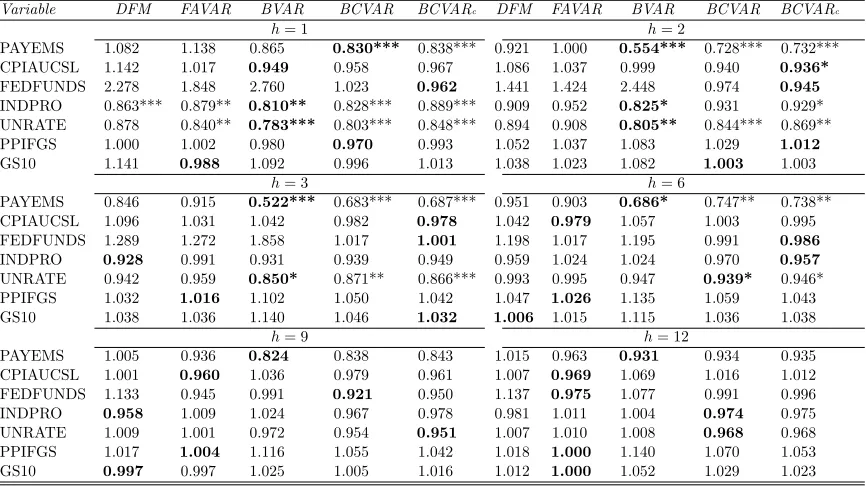
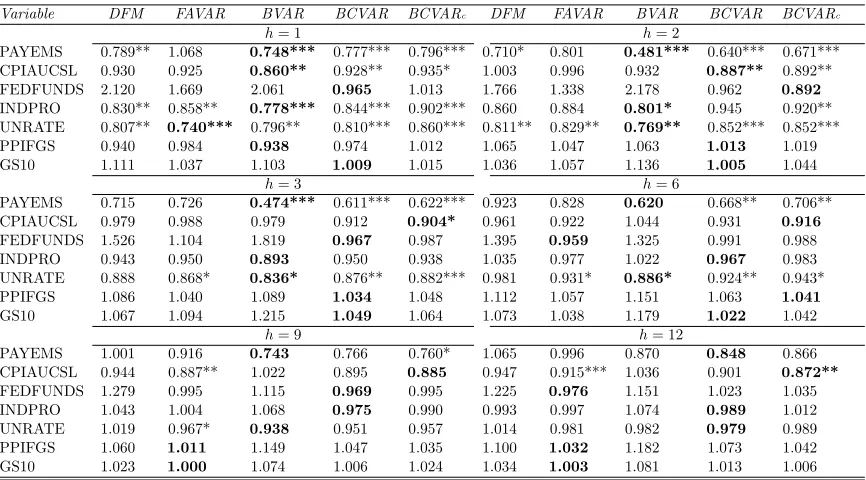
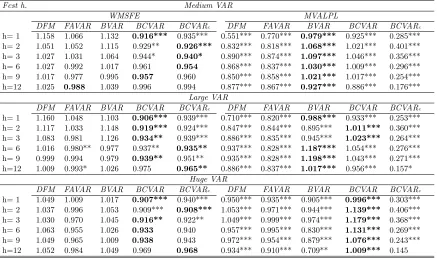
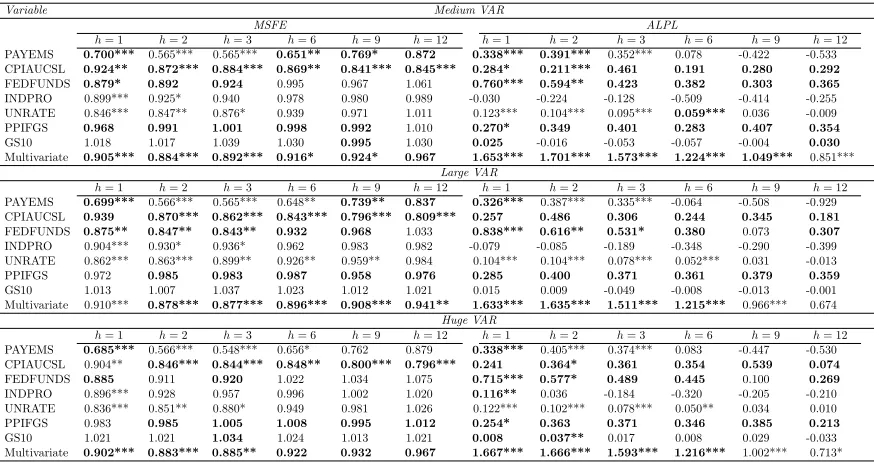
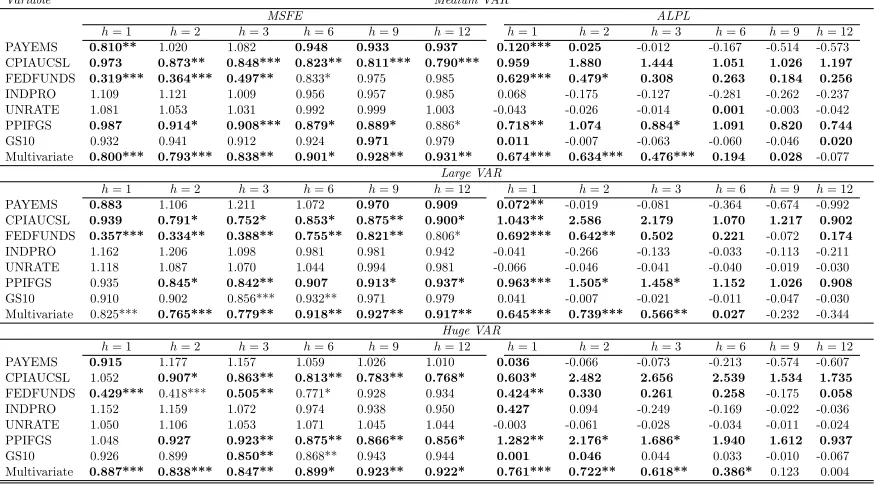
Tables 1 through 3 and the left side of Table 7 present evidence on the quality of our point
forecasts for our seven main variables of interest relative to the AR(1) benchmark. With a few
exceptions we are finding that BCVARs beat the benchmark and often tend to forecast better
than the other approaches. This holds, with several exceptions, for every VAR dimension,
variable and forecast horizon. Table 7, which presents the WMSFEs over the seven variables
of interest, provides the best overall summary of our results as they relate to point forecasts.
With six forecast horizons and three VAR dimensions, this table contains 18 dimensions in
which point forecasts can be compared. In 17 of these, either BCVAR or BCVARcis the model
with the lowest MSFE. In 12 of these cases, compressed VAR approaches beat the benchmark
in a statistically significant manner. The FAVAR is the next best approach, although it is
worth noting that in some cases (e.g. with short term forecasting and particularly with the
medium VAR) it does poorly, failing to beat the AR(1) benchmark. Overall, we are finding
random compression to work well, often the best but, in cases where it is not the best, it is not
too far from the best so that a risk averse user might feel confident using random compression
methods.
Thus, random compression of the VAR coefficients is at least competitive with other
multivariate forecasting methods with the data set under consideration. Evidence relating to
compression of the error covariance is more mixed. That is, in some instances the BCVARc
forecasts better than the BCVAR, but there are many cases where the forecasts from the
BCVAR model are more accurate.
for compressed VAR approaches to do particularly well at shorter horizons, but there are no
strong differences across horizons. In terms of the individual variables, one notable pattern in
these tables is that BCVAR and BCVARcare (with some exceptions) forecasting particularly
well for the most important macroeconomic aggregates such as prices, unemployment and
industrial production. In contrast, for the long-term interest rate (GS10), our Huge or Large
VAR methods are almost never beating the benchmark. But at least in this case, where
small models are forecasting well, it is reassuring to see that MSFEs obtained using random
compression methods are only slightly worse than the benchmark ones. This indicates that
random compression methods are finding that the GS10 equation in the Huge VAR is hugely
over-parametrized, but is successfully compressing the explanatory variables so as obtain
results that are nearly the same as those from parsimonious univariate models.
Figures 3 through 5 present evidence on when the forecasting gains of BCVARs relative
to the other approaches are achieved. These plot the cumulative sum of weighted forecasting
errors (jointly for the N = 7 variables of interest) for the benchmark AR(1) model minus
those for a competing approach, CSW F EDiht =
Pt−h
τ=t(webcmk,τ+h−wei,τ+h), for different
sized VAR sizes and different forecasting horizons. Positive values for this metric imply that
an approach is beating the benchmark. For short horizons, BCVAR is the only approach that
consistently beats the benchmark model, throughout the whole forecast period. All other
approaches accumulate more forecast errors over time compared to the simple AR(1). It is
particularly interesting that during the 2007-2009 crisis all multivariate methods seem to,
at least temporarily, improve over the univariate AR(1). However, towards the end of the
crisis, for all methods but the BCVAR relative forecast performance deteriorates abruptly.
For longer forecast horizons some of the alternative multivariate models perform fairly well
(e.g., ath= 12, the FAVAR ends up being the best model by a short margin). Nevertheless,
even at these horizons BCVAR remains consistently a reliable forecasting model.17
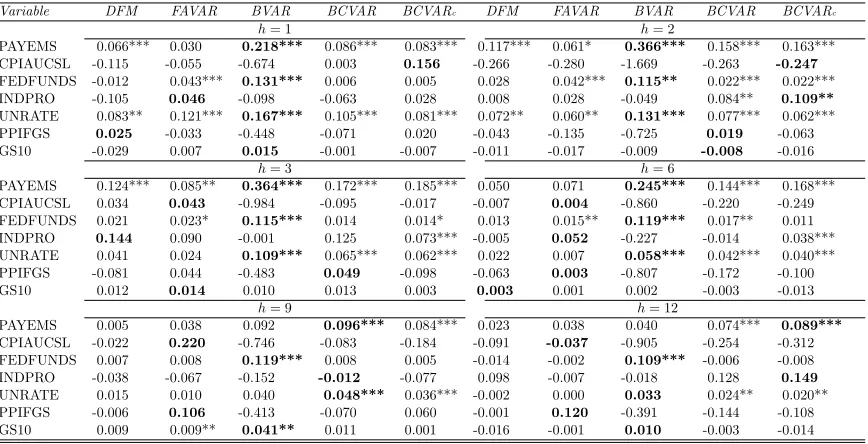
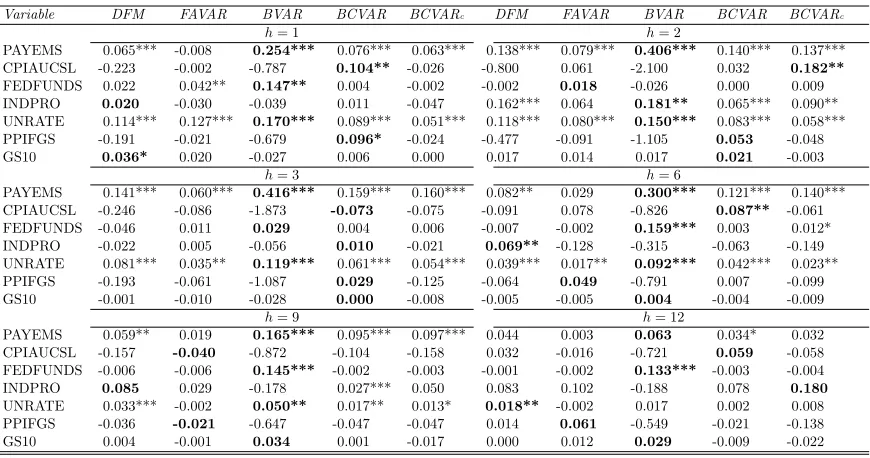
Tables 4 through 6 and the right hand side of Table 7 shed light on the quality of our
density forecasts by presenting averages of log predictive likelihoods for the VARs of different
dimensions. Results are similar as for MSFEs and we will not discuss them in detail. But they
17
do differ in their strength in two ways. First, the evidence that compressed VAR approaches
can beat univariate benchmarks becomes much more strong. See in particular the right hand
side ofTable 7which shows strong rejection of the hypothesis of EPA at every horizon and for
every VAR dimension. Second, the evidence that compressed VARs can forecast better than
BVAR or FAVAR approaches becomes somewhat weaker. In particular, with the medium and
large VARs standard large Bayesian VAR methods using the Minnesota prior tend to forecast
slightly better than the compressed VAR approaches. On the other hand, our BCVAR does
particularly well in the Huge VAR case, improving over the standard large Bayesian VAR and
FAVAR methods at all forecast horizons.
Figures 6,7 and 8 plot the cumulative sums of the multivariate log predictive likelihood
differentials, CSM V LP LDij = Pt−hτ=t(M V LP Li,τ+h−M V LP Lbcmk,τ+h), for VARs of
different dimensions and across a number of forecast horizons. It is interesting to note that,
in contrast to Figures 3 through 5, there is not strong evidence of a large deterioration in
forecasting performance relative to the univariate benchmark. In general, our compressed
VAR approaches may not be best in every case, but even when they are not they are close
to the best.18
The preceding results compared the forecasting performance of various approaches to the
AR(1) benchmark. Tables such as Table 7 typically show strong evidence of statistically
significant improvements of all the multivariate forecasting methods relative to this
benchmark. To shed light on whether there are statistical significance differences between
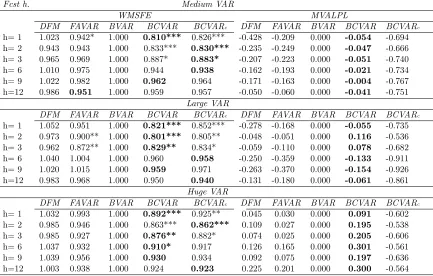
the multivariate approaches, Table 8 presents forecast performance using the BVAR as the
benchmark. If we use log predictive likelihoods as the measure of forecast performance, it
can be seen that, although the compressed VAR approaches do better than the BVAR, this
difference is not statistically significant. In fact, there are not statistically significant
differences between any of our multivariate forecasting methods. When using MSFEs to
evaluate forecast performance there are, however, some cases where the compressed VARs
are forecasting significantly better than the Minnesota prior BVAR.
Finally, it is worth stressing that this section is simply comparing the forecast performance
18
of different plausible methods for a particular data set. However, the decision whether to use
compression methods should not be based solely on this forecasting comparison. In other,
larger applications, plausible alternatives to random compression such as the Minnesota prior
BVAR or any VAR approach which requires the use of MCMC methods, may simply be
computationally infeasible. The results presented in this section show that with the present
data set, random compression works fairly well. With larger data sets, it may very well be
that BCVAR is the only approach that is computationally feasible.
4.6 Robustness Checks
In the preceding sub-sections, we have shown that two particular ways of implementing
compression methods with VARs produce forecasts which are as good or better than more
computationally demanding alternatives. But there are many alternative ways of doing
random compression that we have experimented with. As noted previously a logical (and
simpler) way of doing random compression in VARs would be to use the natural conjugate
VAR of (5) instead of our equation by equation approach of (9). However, we have found
this to forecast very poorly. Other alternative approaches arise from different ways of
drawingϕ. We have tried several and found that they yield very similar results and, hence,
we will not discuss this issue further. Instead, in this sub-section, we present evidence on the
robustness of results to changes in ways the model averaging is done and to changes in the
way the variables are ordered.
Our main results use BIC-based weights to do model averaging (i.e. averaging over
different randomly drawn compressions). The BICs are calculated using the likelihood of the
entire vector of dependent variables, Yt. Given that we are only forecasting 7 key variables
of interest, we can also do model averaging using BICs only for these seven variables.
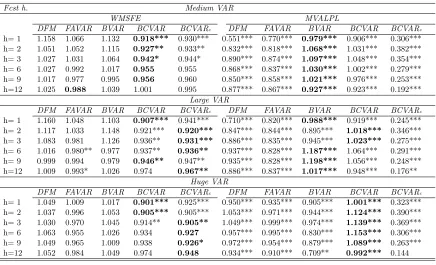
Table 9 (which is of the same format and should be compared toTable 7 ) summarizes the
forecasting performance for this approach. In a few cases, using BIC for only the 7 variables
of interest produces some very small improvements, but this makes very little difference.
To produce our main results, we ordered our dependent variables with our 7 variables
interest coming first. Our equation-by-equation approach to random compression implies
So it is possible that the way the variables are ordered will matter, especially when we are
compressing the error covariance matrix as in BCVARc. Table 10 presents results with the
7 variables of interest being ordered last (labelled BCVARc,v.2) compared to those of other
approaches. BCVARc and BCVARc,v.2 are producing very similar results.
5
Time-variation in Parameters: The Compressed TVP-SV
VAR
In macroeconomic forecasting applications, it is often empirically necessary to allow for
time-variation in the VAR coefficients and/or the error covariance matrix. There is an
increasing literature that shows that ignoring macroeconomic volatility and possible
structural changes in coefficients of a VAR can result in bad in-sample fit and poor
out-of-sample forecast performance; see for example Clark (2011). Both such extensions add
greatly to the computational burden since MCMC methods are usually required. In the
context of the constant coefficient VAR with conjugate prior for the VAR coefficients there
is a growing literature (e.g. Carriero, Clark and Marcellino, 2015, 2016a and Chan, 2015)
investigating various structures for time-varying error covariance matrices which do not lead
to excessively large computational demands. However, even these can be restrictive and
require the use of MCMC methods which will make them unsuitable for use in extremely
large models. Allowing for time-variation in the VAR coefficients (e.g. through assuming
coefficients evolve according to a random walk or a Markov switching process) will also
greatly increase the burden.
In this section, we show how the compressed VAR methods can be generalized to the
case of a VAR with time-varying parameters and stochastic volatilities (BCVARtvp−sv). Our
model becomes
Yi,t = Θci,t ΦiZti
+σi,tEi,t. (19)
Notice that relative to equation (9) now all parameters including the error variances may
vary over time and, thus, they havetsubscripts,t= 1, ..., T. We also remind the reader that
the variables Zti contain lags of the dependent variables and the terms which relate to the
error covariances as defined in (8). This TVP-SV VAR model is different from the previous
(2005) would specify the VAR in the familiar seemingly unrelated regression form, where all
n VAR equations are modeled jointly. Estimation using the latter form can become
cumbersome as n increases, since the posterior for both the time-varying regression
coefficients and volatilities involves many manipulations involving large data matrices.
Using (19), estimation of the BCVARtvp−sv is reduced to the estimation of n univariate
time-varying parameter regressions which is computationally more efficient for large n.
Additionally, the possibly large matrixZti is still compressed using Φi as with the BCVAR.
In general, forecasting with TVP-SV VARs is computationally demanding as it typically
relies on MCMC methods. In our case, even if we use Φi to compress the data, a full Bayesian
analysis could be computationally demanding with largensince MCMC methods are required
and must be run for each of thenequations. Accordingly, we turn to approximate methods to
deal with the TVP-SV aspect of our BCVAR. These are generalizations of those developed by
Koop and Korobilis (2013) in the context of a time-varying parameter with time varying error
covariance matrix. They use variance discounting methods to model the time-variation in the
VAR coefficients and error covariance matrix, and provide analytical formulae for updating
them. Thus, in (19), once we draw Φi randomly, Θci,t and σi,t2 can be updated using simple
recursive formulae based on the Kalman filter, without relying on computationally intensive
MCMC methods.
Adapting Koop and Korobilis (2013), the compressed TVP-SV VAR model involves
estimating Θci,t and σi,t2 by assuming that they evolve according to:
Θci,t = Θci,t−1+ v u u t
(1−λi,t)var
Θc
i,t−1|t−1
λi,t
ui,t, (20)
σi,t2 = κi,tσ2i,t−1+ (1−κi,t)Ebi,t2 . (21)
That is, Θci,t follows a random walk using a forgetting factor approximation to its error
covariance matrix. Kalman filtering methods can be used for this equation. Forσ2
i,t we have
an Exponentially Weighted Moving Average filter. Ebi,t2 is the time t prediction error
estimated from the i-th equation of the VAR, ui,t ∼ N(0,1), and var
Θci,t−1|t−1 is the
variance of Θci,t−1 given information up to time t−1 and is produced by the Kalman filter
the forgetting and decay factorsλi,t and κi,t. These factors, which are typically in the range
of (0.9,1), control how quickly discounting of past data occurs. For example, if λi,t = 0.90
then Θc
i,t depends very heavily on recent observations, and changes very rapidly over time.
On the other hand, ifλi,t = 0.99 the discounting of the past is more gradual and Θci,t varies
more smoothly. Finally, when λi,t = 1 we go back to the constant parameter VAR. Similar
arguments can be made forσ2i,t and its decay factor κi,t.
For out-of-sample forecasting, we extend the methods of Koop and Korobilis (2013) by
allowing for the decay and forgetting factors to vary over time using simple updating formulae:
λi,t = λ+ (1−λ)×exp −0.5×
b Ei,t−2 1
b σi,t−2 1
!
, (22)
κi,t = κ+ (1−κ)×exp
−0.5×kurt
b
Ei,t−12:t−1
, (23)
whereσb 2
i,t−1 is the timet−1 estimate of the variance andkurt
b
Ei,t−12:t−1
is the kurtosis of
the VAR prediction error, evaluated over the past year (i.e. with monthly data this is based
on a rolling sample of 12 observations). λand κ put bounds on the minimum values of the
forgetting and decay factors. We setλ= 0.98 and κ= 0.94 which, in the context of monthly
data, allow for the possibility of a fairly large amount of time variation.19
Note that, if the prediction error is close to zero thenλit= 1 which is the value consistent
with the parameters in equation i being constant. In words, if the model forecast well last
month, we do not change its parameters this month. However, the larger the prediction error
is, the smaller λit becomes and, thus, a higher degree of parameter change is allowed for.
For the decay factor κi,t, we use a similar reasoning, except in terms of the kurtosis of the
prediction error. As is well known (e.g. from the GARCH literature), assuming that errors
are Normally distributed, in times of constant volatility kurtosis will be equal to zero, but in
times of increased volatility kurtosis is higher. Allowing forκitto depend on the kurtosis over
the past year is a simple way of allowingσi,t to change more rapidly in unstable times than
in stable times. Using these methods, it is straightforward to allow for time-variation in our
compressed VAR approach in a computationally simple manner.
19
Figure 9, which plots the time series of the predictive density volatilities for the Medium
BCVARtvp−sv against the time series of volatilities obtained from the alternative methods
described in section 4, confirms that heteroskedasticity plays a very important role in our
data. While the alternative methods allow for some time variation in the volatilities (they are
estimated on an expanding window of data), BCVARtvp−sv is finding a lot more variation.
This is particularly true at the time of the financial crisis.
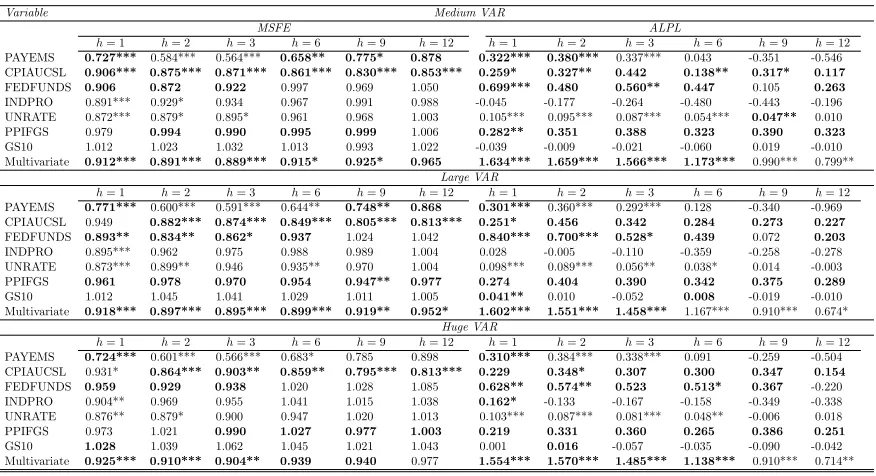
Table 11, Figure 10, and Figure 11 present results on the forecast performance of our
BCVARtvp−sv approach. The story that jumps out is a strong one: adding time variation in
the parameters and volatilities leads to substantial improvements in forecast performance.
Conventional wisdom has it that allowing for time-variation (particularly in the error
covariance matrix) is particularly important for predictive density estimation. In a time of
fluctuating volatility, working with a homoskedastic model may not seriously affect point
forecasts, but may lead to poor estimates of higher predictive moments. This wisdom is
strongly reinforced by our results. The right panels of Table 11 show that in terms of
predictive likelihoods, the BCVARtvp−sv performs much better than our other compressed
VAR approaches, and better (with some exceptions) than standard large VAR and factor
methods. This is particularly true when focusing on the multivariate predictive performance
and short to medium forecast horizons. In addition, improvements relative to the univariate
benchmark (as indicated by the stars in the table) are almost always strongly statistically
significant. In terms of MSFEs, allowing for time variation in parameters leads to some
improvements, but these improvements are not as large as those we find with predictive
likelihoods. Again, the multivariate results are particularly strong, for all VAR sizes and
forecast horizons. In summary, the message conveyed by Table 11 is a particularly strong
one: BCVARtvp−sv is forecasting better than any other approach considered in this paper.
Figure 10 indicates that, with some exceptions, the reported success in terms of overall
point forecast accuracy of the BCVARtvp−sv relative to the alternative methods we considered
(namely, DFM, FAVAR, and BVAR) is not the result of any specific and short-lived episodes
but is instead built gradually throughout the forecast evaluation period, as indicated by
the increasing lines depicted in the figure. Interestingly, both at h = 1 and h = 12, the
notable around the time of the financial crisis, but are not confined to it. Figure 11provides a
similar analysis in terms of the overall density forecast accuracy of the BCVARtvp−sv model.
The left panels of the figure show that at h = 1 the previously reported forecast success of
the BCVARtvp−sv is once again built steadily throughout the forecast evaluation period. On
the other hand, the right panels of the figure, which focus onh= 12, show that while up until
the beginning of the last financial crisis the BCVARtvp−sv is forecasting more accurately than
all the alternatives, the 2007-2009 period has a strong negative impact on its density forecast
performance.
The preceding results use individual AR(1) forecasting models as the benchmark for
comparison. Table 12 uses the Minnesota prior BVAR as the benchmark. It can be seen
that many of the forecast improvements of BCVARtvp−sv over the BVAR are statistically
significant.
5.1 Robustness Checks
With our constant coefficient models, we presented robustness checks with respect to: i)
which variables were used to calculate the BICs used to construct weights attached to each
compression and with ii) whether the ordering of the variables mattered. Table 13andTable 14
repeat these robustness checks for TVP-SV versions of our approach. In both cases, forecasting
performance is very similar. There is a very slight forecast deterioration when the 7 variables
of interest are ordered last. But overall we are still finding a high degree of robustness.
Our compressed TVP-SV VAR allows for time-variation in both VAR coefficients and the
error covariance matrix. To investigate which of these is more important, Table 15presents
forecasting results for the model with both sorts of time variation (labelled BCVARtvp−sv
in the table) as well as those with only variation in the error covariance matrix (labelled
BCVARsv in the table). Comparing these two models in the table, it can be seen that
allowing for time variation in both does lead to some forecast improvements.
We also wish to compare our approaches to other fully Bayesian VAR approaches which
allow for time-variation in parameters. The difficulty of doing so is computational. These
approaches require the use of MCMC methods which makes them infeasible in large VARs.
be scaled up to large VARs due to the computational burden. D’Agostino, Gambetti and
Giannone (2013) carry out a forecast evaluation exercise using this model with three variables
and even this is very computationally demanding. One recent approach that shows promise
for larger VARs with stochastic volatility is that of Carriero, Clark and Marcellino (2016b).
But even their model cannot handle the really large VARs.20 However, we have carried out a
comparison of their approach to ours for the Medium VAR and a Small VAR involving only
the 7 variables of interest.21 The top two panels of Table 15 compares our BCVARtvp−sv
and BCVARsv approaches to the model of Carriero, Clark and Marcellino (2016b) (labelled
BVARccm). Results from the three approaches are roughly similar. For the Small VAR, their
model tends to forecast slightly better at short horizons than our BCVARsv. But in the
Medium VAR our compressed approaches tend to forecast better (particularly when forecast
performance is evaluated using WMSFE). Accordingly, we are finding an ability to forecast as
well or better than a sophisticated fully Bayesian VAR with stochastic volatility where such a
comparison is possible. But methods such as Carriero, Clark and Marcellino (2016b), which
require the use of MCMC methods, are still not at the stage of being suitable for forecasting
with hundreds of variables, much less than thousands of variables that would be possible with
random compression.
6
Conclusions
In this paper, we have drawn on ideas from the random projection literature to develop
methods suitable for use with large VARs. For such methods to be suitable, they must be
computationally simple, theoretically justifiable and empirically successful. We argue that the
BCVAR methods developed in this paper meet all these goals. In a substantial macroeconomic
application, involving VARs with up to 129 variables, we find BCVAR methods to be fast
and yield results which are at least as good as or better than competing approaches. And,
in contrast to the Minnesota prior BVAR, BCVAR methods can easily be scaled up to much
20
Carriero, Clark and Marcellino (2016b) do impulse response analysis in a VAR with 125 variables, but in their forecast evaluation never work with more than 20 variables. The results inTable 15for the Medium VAR took 25 hours to run on a PC using a modern Core i7 and 32Gb of RAM.
21For the autoregressive coefficients we use the asymmetric Minnesota prior with shrinkage hyperparameter