Building regions: a resource-based view of a policy-led knowledge
exchange network
Dr Joanne Larty (corresponding author)
IEED, Lancaster University Management School, Lancaster, LA1 4YX, [email protected] (+44)1524 592192
Professor Sarah Jack
IEED, Lancaster University Management School, Lancaster, LA1 4YX, [email protected] (+44)1524 594743
Professor Nigel Lockett Leeds University Business School,
The University of Leeds, Leeds, LS2 9JT, [email protected] (+44)113 343 8354
Building regions: a resource-based view of a policy-led knowledge exchange network
ABSTRACT
This study looks to further understanding about how important the choice of intermediary can
be in supporting policymakers in their regional development activities. Drawing on the
resource based view as a framework, the paper provides new insights into resource
combinations underpinning the successful creation and expansion of a regional network for
knowledge exchange. Through an in-depth study of a partnership of three intermediaries
involved in designing and implementing a regional ICT network, the study highlights that
policymakers need to consider not only organizational resources of intermediaries, but also
the resources of key individuals from those organizations.
Keywords: knowledge exchange; policy; intermediary; regional development; resources
INTRODUCTION
The importance of clusters for regional economic development has long been known
(CORTRIGHT, 2006; PORTER, 1998; WENNBERG and LINDQVIST, 2010). A key
advantage of the clustering of sector-specific firms within a particular geographical region is
that it offers greater opportunity for the sharing of knowledge (ASHEIM et al., 2013;
HUGGINS, 2008b; MACKINNON et al., 2004). This in turn can lead to an increase in local
productivity, innovation and the competitive advantage of regions (LAWSON and LORENZ,
1999; MOODYSSON and ZUKAUSKAITE, 2014; STOUGH et al., 1998). However,
knowledge exchange is dependent upon the existence of social networks between regional
(LAWSON and LORENZ, 1999; SAXENIAN, 1996). Given that the creation of social
networks between firms is important, policy has for over two decades looked to facilitate the
creation and expansion of networking opportunities to support regional growth (LAWSON
and LORENZ, 1999; MACKINNON et al., 2004; OECD, 2011, 2013).
Recently, scholars interested in regional knowledge exchange and the importance of
networks between firms have turned their attention to the important role of intermediaries
(HOWELLS, 2006; LOCKETT et al., 2013; ZHANG and LI, 2010). Intermediaries act as
‘middle men’ who play a role in encouraging the creation of new networking opportunities
between firms for the purposes of facilitating new collaborations and knowledge exchange
(see HOWELLS (2006) for an overview). Given the important role intermediaries play, the
choice of intermediary to support knowledge exchange is critical (WOLPERT, 2002;
WRIGHT et al., 2008; YUSUF, 2008). However, what seems especially important is that the
chosen intermediary has the right network and knowledge resources to facilitate knowledge
exchange between regional firms (INKINEN and SUORSA, 2010; KLERKX and LEEUWIS,
2008; NOOTEBOOM, 2003; STEWART and HYYSALO, 2008).
Despite current research pointing to the important role of intermediaries in facilitating new
relationships between firms, there is a need for more empirical work on factors which
contribute to the effectiveness of intermediaries’ in their creating links between firms
(BATTERINK et al., 2010; SAPSED et al., 2007). This is important given policymakers are
increasingly relying on intermediaries such as local universities or regional government
agencies to help develop new knowledge exchange initiatives (HUGGINS and KITAGAWA,
2012; YOUTIE and SHAPIRA, 2008). There are, however, two areas of existing research
which need further investigation to help policymakers choose the right intermediary to
support regional initiatives. First, research so far on intermediaries has focused largely on
ACWORTH, 2008; HOWELLS, 2006; WRIGHT et al., 2008). Policymakers, however, also
rely on intermediaries such as universities (KAUFFELD-MONZ and FRITSCH, 2013;
LOCKETT et al., 2013) or regional government agencies (ARANGUREN et al., 2009;
BATTERINK et al., 2010; HUGGINS, 2000; KLERKX and LEEUWIS, 2008;
LASCHEWSKI et al., 2002) for the creation of new networks. Given intermediaries’ networks and knowledge resources are essential for the expansion of existing networks, there
is a need to further understand how these (and other) resources underpin the successful
creation of new networks for knowledge exchange. Second, a large body of work suggests the
creation of regional networks is underpinned by relationships between individuals within the
region (COLEMAN, 1988; HUGGINS and JOHNSTON, 2010; NAHAPIET and
GHOSHAL, 1998). This is important since much of the literature on the role of
intermediaries tends to focus on organizational resources, rather than the social networks and
resources of key individuals (HOWELLS, 2006; WRIGHT et al., 2008; YUSUF, 2008;
ZHANG and LI, 2010). The role of key individuals and the importance of individual
resources in contributing to organizational goals have gained much ground in recent years
(FELIN and HESTERLY, 2007; WRIGHT et al., 2001). Understanding the role of key
individuals and the resources they are able to access and leverage to contribute to the success
of regional networks for knowledge exchange is thus an important research endeavour.
Given the importance of networks, knowledge and social resources in underpinning the
creation of networks to support knowledge exchange, this paper uses the resource-based view
(RBV) as a framework to focus attention on idiosyncratic resources (RUMELT, 1997). The
RBV perceives firms and organizations as bundles of heterogeneous resources and takes the
view that increased levels of success depend on a firm’s access to unique resource
combinations (BARNEY et al., 2001; NEWBERT, 2007; PENROSE, 2009; PETERAF,
historical and environmental context (BARNEY, 1991; BARNEY, 2014). As such, this paper
considers the uniqueness of intermediaries’ resources (with a particular focus on networks,
knowledge and social resources) that underpin the successful creation and expansion of a
policy-led network for regional knowledge exchange. Originally used to explain the success
of large profit making organisations, the RBV has more recently been used as a framework to
explain unique resource combinations which underpin the success of particular Higher
Education Institution (HEI) technology transfer programmes (POWERS and MCDOUGALL,
2005). Just as HEI technology transfer programmes have become increasingly popular and
have created a competitive market amongst HEI providers (BERCOVITZ and FELDMAN,
2006), so too has the provision of regional knowledge exchange networks (HUGGINS et al.,
2008). Institutions and organizations working together to provide such networks need to
compete not only for funding, but also to get in place the right resources to support those
activities and to ensure demonstrable outcomes (NOOTEBOOM, 2003). Although resources
are known to be important, less is known about the idiosyncratic nature of those resources
specific to the organizations and institutions involved. This paper uses the RBV as a
framework to focus attention towards understanding unique resource combinations.
This paper is based on an in-depth study of the successful creation and expansion of a
policy-led intermediary-driven regional knowledge exchange network for the information and
communication technologies (ICT) sector. The study provides an important contribution to
extending understanding of the choice of intermediary organization and the role
intermediaries play in both creating and expanding regional knowledge exchange networks
(STEWART and HYYSALO, 2008; WOLPERT, 2002; ZHANG and LI, 2010). The study
also contributes more broadly to the body of research on factors underpinning the success of
al., 2008; MARTIN and SUNLEY, 2003; MORRISON et al., 2003; PICKERNELL et al.,
2007).
The paper is organised in the following way. To begin, literature on regional networks and
intermediaries is considered, with a particular emphasis on resources underpinning the
creation and expansion of knowledge exchange networks. The RBV as a framework for
focusing the study towards unique resources is then explained. This is followed by the
methodology and an outline of the empirical study. Thereafter, the findings from this study
are discussed. Finally, conclusions, recommendations and directions for future scholarly
inquiry are provided.
REGIONAL KNOWLEDGE EXCHANGE
Knowledge creation and diffusion are critical to the competitive advantage of firms,
clusters and regions (BOSCHMA, 2004; LAWSON and LORENZ, 1999). However, such
valuable knowledge is often tacit and intangible, and acquired only through experience or
social interaction (BOSCHMA, 2005; VALDALISO et al., 2011). Policy initiatives therefore
need to be able to encourage interactions amongst firms to increase opportunities for
knowledge sharing (MALMBERG and MASKELL, 2002).
The importance of geographical proximity has been criticised (BOSCHMA, 2005), with
some pointing to how it could lead to ‘lock-in’ relationships (CLIFTON et al., 2010).
However, there is a large body of work which supports the important role played by regional
networks for knowledge exchange (ASHEIM et al., 2013; CHASTON, 1999; HUGGINS et
al., 2008; HUGGINS and WILLIAMS, 2011; MURO and KATZ, 2011). Indeed work carried
out around industrial districts (BECATTINI et al., 2009), and more recently regional
innovations systems (COOKE et al., 2004), have highlighted the importance of spatial
resources and provide a higher value-add for the region as a whole (MURO and KATZ, 2011;
ROELANDT and DEN HERTOG, 1999), as well as contributing to firm level survival and
performance (WENNBERG and LINDQVIST, 2010).
High-profile cases of regional network successes continue to attract the attention of
Government and policy (HUGGINS, 2000; HUGGINS and WILLIAMS, 2011; INKINEN
and SUORSA, 2010; OECD, 2011, 2013). As part of their remit, policymakers have looked
at different ways of facilitating the creation of networks amongst firms with a view to
providing new opportunities for knowledge exchange (BODDY, 2000; HUGGINS et al.,
2008; PICKERNELL et al., 2007). There are ample examples which demonstrate the active
role of policy in supporting such initiatives (DE MARTINO et al., 2006; JOHANNISSON et
al., 2007; YUSUF, 2008). Although regions and regionalism is often at the forefront of policy
agendas (PEARCE and AYRES, 2009), there has been much criticism over the ability of
policymakers to create new knowledge exchange networks for regional firms (HUGGINS
and WILLIAMS, 2011; PEARCE and AYRES, 2009). While there have been some successes
(ASHEIM et al., 2013; CHASTON, 1999), research has generally concluded that
policymakers often lack the necessary knowledge and network resources at the regional level
to facilitate the creation process (ASHEIM et al., 2013; SHUTT and PELLOW, 1997;
TÖDTLING and TRIPPL, 2005).
More recently, scholars have turned their attention to understanding factors that underpin
successful regional knowledge exchange. A particularly fruitful area of work has focused on
the role of intermediary organizations (HOWELLS, 2006; INKINEN and SUORSA, 2010;
YUSUF, 2008; ZHANG and LI, 2010). Intermediaries act as ‘bridgers’, ‘brokers’ or other
‘third parties’ to facilitate interactions between firms (HOWELLS, 2006; SNOW et al., 2000;
YUSUF, 2008). HOWELLS (2006) suggests a working definition of intermediaries as “an
between two or more parties” (p. 720). In his review of the role of intermediaries,
HOWELLS (2006) highlights the broad range of services intermediaries offer, from
facilitating new links between firms for knowledge sharing, through to adapting new
solutions to the individual needs of firms. YUSUF (2008) usefully identifies four types of
intermediaries: general purpose intermediaries, specialist intermediaries, financial
intermediaries, and institutional intermediaries who “offer incentives to encourage knowledge
transfer” (p. 1170). This article focuses on institutional intermediaries who are often called
upon by policymakers to support, encourage and facilitate knowledge sharing and the
creation of new links between regional firms (YUSUF, 2008).
In order to be effective, intermediaries need to be embedded within the regional context
and have on hand necessary resources to support the creation of new links between regional
firms (INKINEN and SUORSA, 2010; STEWART and HYYSALO, 2008; YUSUF, 2008;
ZHANG and LI, 2010). There are three key functions of intermediaries: (1) understand the
needs of network participants; (2) create new links between firms; and (3) provide
mechanisms to enable knowledge sharing (BATTERINK et al., 2010). To do this effectively
intermediaries need to understand the environment and have access to the right network and
knowledge resources (e.g. BRAMWELL and WOLFE, 2008; WRIGHT et al., 2008).
An intermediary’s network and knowledge resources emerge through their experience and
embeddedness within a particular region and sector. An intermediary’s ability to accumulate
such knowledge is dependent upon the extent of available networks (HUGGINS and
JOHNSTON, 2009; HUGGINS and JOHNSTON, 2010). In turn, the accumulation of
knowledge provides a useful resource for broadening existing networks and creating new
network ties; thus perpetuating the value of that intermediary to the region (HUGGINS et al.,
2008; YUSUF, 2008; ZHANG and LI, 2010). The success of networks such as Silicon Valley
pool and leverage a stock of regional, firm, product and technology related knowledge
(SAXENIAN, 1990). Universities are also often embedded within such networks and so can
play an important role as intermediaries and ‘knowledge-creating institutions’ (HUGGINS,
2008: 2). Indeed, universities are often involved in regional knowledge exchange initiatives
(HUGGINS and WILLIAMS, 2011).
There are, however, two limitations of existing research which impact on policymakers’
ability to choose the right intermediary to support regional knowledge exchange networks.
First, research on the role of intermediaries has largely focused on the expansion of existing
networks of knowledge exchange, rather than their role in the creation of new networks
(HOWELLS, 2006; INKINEN and SUORSA, 2010). This is problematic since many
policy-led initiatives for the creation of new networks involve the support of intermediaries
(ARANGUREN et al., 2009; BATTERINK et al., 2010; KAUFFELD-MONZ and FRITSCH,
2013; LASCHEWSKI et al., 2002). In addition, central Governments continue to actively
support the development of regional knowledge exchange networks, usually through
significant financial investment (e.g. COOKE, 2001; OECD, 2011, 2013). Understanding
resources which underpin the successful creation of new networks for knowledge exchange is
thus also important.
Second, there is a tendency in many studies on intermediaries to focus on organizational
level resources, rather than the importance of key individuals within those firms (e.g.
HOWELLS, 2006; WRIGHT et al., 2008; YUSUF, 2008; ZHANG and LI, 2010). The
importance of key individuals, and their network and knowledge resources, has been
recognised as particularly important as often individuals play a more important role than at
first thought (FELIN and HESTERLY, 2007; WRIGHT et al., 2001). Moreover, regional
networks are often built through the social networks that exist between individuals, rather
HUGGINS et al., 2012; NAHAPIET and GHOSHAL, 1998). Indeed, research indicates that
regional firms, particularly smaller businesses, rely more on personal and informal
relationships (ASHEIM, 2003; JACK et al., 2010). There is therefore a need to pay more
attention to the resources of key individuals.
In addition to these limitations of existing research, there is increasing pressure on
policymakers to demonstrate clear outcomes from the creation and expansion of regional
networks for knowledge exchange. Given the important role that intermediaries play, it is
essential that policymakers understand resource combinations that underpin the success of
networks for regional knowledge exchange. This would enable policymakers to make more
informed decisions over the choice of intermediary they bring on board to help facilitate the
process of network creation and expansion (ARANGUREN et al., 2009; BATTERINK et al.,
2010; KAUFFELD-MONZ and FRITSCH, 2013; LASCHEWSKI et al., 2002).
This paper focuses on a particular example of a policy-led and intermediary driven
regional network. In this example a Regional Development Agency (RDA), University and
City Council played key roles as institutional intermediaries tasked with using their
knowledge and networks to facilitate the creation and expansion of a regional network for
knowledge exchange. The RBV is used as a framework to focus attention on the unique
resource combinations that underpinned the successful network creation and expansion.
METHODOLOGY
In order to generate new insights, it was important to adopt an approach that would
provide insight into informal social interactions and relationships which underpin the creation
of new regional networks (COLLINSON, 2000; JACK et al., 2010). A qualitative study was
therefore deemed most appropriate; this allowed an exploration of the relationships
relationships and how they contributed to the successful creation and expansion of a regional
network for knowledge exchange.
The context
The ICT sector is an industry which has been shown to benefit considerably from regional
networks for knowledge exchange (BRAMWELL et al., 2008; BRAMWELL and WOLFE,
2008; MAURSETH and FRANK, 2009; VALDALISO et al., 2011; VICENTE and SUIRE,
2007). At the time of the study, the Government was pushing development agencies towards
regional economic growth and development. The ICT sector had been recognised as a fruitful
area for the development of regional knowledge exchange networks to support regional
economic development.
The network was initiated by the RDA, which brought on board a local University (HEI)
and a City council who had both worked previously on projects within the ICT sector. These
three intermediaries form the focus of this study and their role was to act as institutional
intermediaries who would leverage their knowledge and networks to facilitate new
opportunities for regional knowledge exchange and collaboration. Driven by a recent
Government policy to encourage regional development, the RDA had developed an economic
development strategy to support the ICT sector. The ICT sector within the region was
estimated to be worth £16 billion, with 31,000 companies employing 320,000 staff. It
generated 16% of the region’s Gross Value Added (GVA), employed 10.6% of its workforce
and formed the second largest regional cluster of ICT firms in Europe (NWDA, 2010). The
local HEI was already heavily involved in supporting the ICT sector through a range of
initiatives to promote knowledge exchange and innovation. The aim of the ICT knowledge
network was to create new links between firms that would enable the sharing of new
promoting new collaborations. At the time of the study, the network had been formed for
over four years and had successfully achieved its goals of creating new opportunities for
knowledge exchange and new collaborations. It had also expanded the network to include
over 100 regional businesses. The RDA’s quarterly activity and output reports for regional,
national and European funding bodies indicated the extent of their knowledge transfer
activities, as well as regional increases in sales and jobs. The network in this study was
already meeting targets and generating a positive outcome for the region. The research was
thus conducted at a timely stage in its development.
Data collection
The focus of the study was on the resources that the RDA, City Council and local
University combined to facilitate the creation and expansion of a new regional ICT network.
All three intermediaries were embedded in the region and had strong networks with regional
firms (LOCKETT et al., 2013). The study followed key people from the three intermediaries
who each played an important role in the creation and expansion of the ICT network. Five
participants from three intermediaries were purposefully selected (HILL et al., 1999; MILES
and HUBERMAN, 1984; PRATT, 2009) as they had been actively involved in the creation
process and the network’s activities. Interviews were also carried out with five entrepreneurs
brought on board by the intermediaries who played key roles in the creation process. These
interviews helped triangulate the findings and also offered further insight into the value of the
resource combinations for regional firms. Interviewees were therefore chosen for what they
added to theoretical insights into the creation process (ALVESSON, 2009) and from whom
the desired information could be obtained (EISENHARDT, 1989). The tool for data
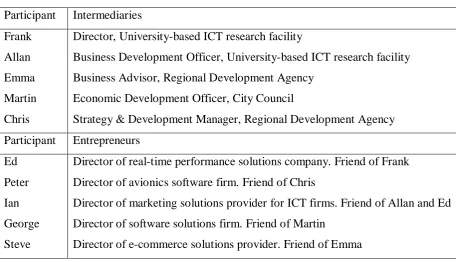
2000 for an overview). Table 1 below provides an overview of the participants and their
affiliation.
---
INSERT TABLE 1 AROUND HERE
---
The value of an in-depth research design, such as this one, is that it is able to provide
rich detail and thick description about the relationships that were critical to the network’s
creation (GEERTZ, 1973). An independent interviewer carried out all the interviews. This
interviewer was known to the participants and had been involved with the HEI and the
network’s creation and expansion. The interviewer was also an experienced researcher having
conducted similar studies previously. This approach, combined with the interviewer’s
familiarity with research participants, led to the collection of in-depth and insightful material
for analysis (DENZIN and LINCOLN, 2005). All interviews were digitally recorded and
transcribed.
Data analysis
An inductive approach was used to identify emerging themes from the data (DENZIN
and LINCOLN, 2005; SILVERMAN, 2013). Data analysis was based on EISENHARDT
(1989) who suggests starting by first sifting through the data, discarding elements that are
irrelevant and then bringing together the elements that seem most important. Inductive
qualitative analysis and the constant comparative method were used to analyse the data
(ALVESSON, 2009; GLASER, 1967; SILVERMAN, 2013). This involved an iterative
The first stage was to read through the interview transcripts and identify emerging
themes specific to the resource combinations for both the creation and expansion of the
network. Attention was directed to network, knowledge and social resources as these have
already been identified as crucial to supporting regional knowledge exchange. The RBV was
used as a framework to focus attention on the idiosyncratic nature of those resources; as well
as how those resources combined to underpin the creation and expansion of the network. This
stage was carried out independently by the three authors. To increase reliability the authors
discussed, compared and agreed on the themes that would be used to analyse and compare the
data. It was evident from the data that resource combinations underpinning the knowledge
exchange network were idiosyncratic to the institutions, the partnership between those
institutions, and to key individuals from those institutions. In addition, the data suggested that
resource combinations important to the creation of the network were different to those
underpinning network expansion. It was therefore important to draw out these distinctions in
the presentation of findings. The next stage involved refining the themes, whilst also
identifying and comparing examples. This has become an accepted approach and one
reported in previous work (HILL et al., 1999; HUMAN and PROVAN, 1996; JACK, 2010;
LEITCH et al., 2010). In order to preserve their anonymity the names of participants have
been changed.
RESOURCE COMBINATIONS FOR REGIONAL KNOWLEDGE EXCHANGE
Presented below is an insight into the organizational and individual resource
combinations that underpinned the network’s success. The findings demonstrate how these
resources were idiosyncratic to the institutions and individuals involved in this particular
At the same time, the data also provides an insight into the challenges of limited network and
social resources for network expansion.
Resource combinations underpinning the creation of a knowledge exchange network
The intermediaries had worked together on previous projects and so were familiar
with each other’s background, experience and goals. They also all had extensive experience
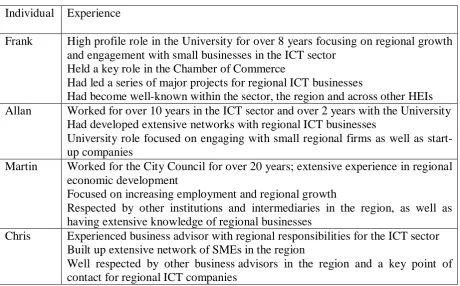
working with regional firms, see Table 2 below for a summary of their experience.
---
INSERT TABLE 2 AROUND HERE
---
As a consequence of their experience, each of the intermediaries was knowledgeable
about the region and had built extensive networks with regional firms. The intermediaries
interviewed were all aware from the start that there needed to be clear advantages to each of
their institutions in creating a new ICT network as the resource commitment needed to make
the network a success was significant.
Important role of organizational resources: foundations of the network. The key to the creation of the network was twofold: first, that each intermediary would benefit from the
resources of the other two intermediaries; second, that the combination of organizational
resources could create something greater than the individual intermediary’s resources would
allow. Prior to creating the network, the HEI was already working across a number of
different government initiatives with the aim of creating closer ties between the HEI and
regional businesses. The HEI had recognised that working with the City Council and the
number of regional firms and would provide resources which would feed into other initiatives
they were working on. As Allan from the HEI stated, ‘[the partnership] is a good way for us to be able to communicate with businesses that we wouldn’t normally reach […] it is a useful conduit for us to meet companies, potential investors, or people looking at broader engagement with the university’. In addition to supporting existing initiatives, such a partnership also provided an opportunity for the university to promote its research to a wider
audience and create new links with regional firms: ‘it is also a good opportunity to show-case new developments and get academics involved with local businesses’ (Allan, HEI). Similarly, the City council was able to engage with more regional businesses and to promote its new
city centre office space: ‘from our point of view [it’s] getting businesses through the door of [City Space] because we want to promote that building and increase tenancies and ashamedly that is one of the advantages for us [working in partnership]’ (Martin, City Council).
In addition, the three intermediaries also recognised the advantages of combining their
resources. As Chris from the RDA stated, ‘We would always recognise in economic development work these days that the amount that any individual organisation or any individual can do might be quite limited but by combining effort with other partners we feel that we have a particular strength’. This recognition of combined value and the creation of something that had never been done before was acknowledged by Frank (HEI) who
commented on how ‘the commitment of [all three intermediaries] has brought credibility, it has brought commitment, it has brought support, it has brought access and technology […] it gives people a bit of a buzz if they think they are part of something that is new and evolutionary’. There was thus a clear recognition that the formation of a partnership and the combining of organizational resources benefited each of the intermediaries, as well as the
to the support we collectively provide to the sector as a whole’ (Martin, City Council). It also enabled regional firms to have ‘increased exposure’ to a greater range of ‘opportunities’ and the partnership enabled them to ‘raise the profile of these opportunities locally as much as possible’ (Allan, HEI). However, although these organizational resources provided an important foundation to the network, the creation of the network itself relied heavily on the
leveraging of the resources of key individuals.
Important role of individual resources: creation of the network. Frank (HEI), Allan (HEI), Martin (City Council) and Chris (RDA) all had extensive experience in the ICT sector which
had been acquired through previous projects and their own interests in the sector and in
regional growth (see Table 3 below for a summary of their experience).
---
INSERT TABLE 3 AROUND HERE
---
Through these individuals’ experience in the sector and the region, and their work on
previous projects with ICT sector organizations, they understood the need to “have [business owners] locally who were prepared to take the lead from the private sector point of view” (Martin, City Council) and to “get the private sectorto take […] ownership’ (Frank, HEI) of the creation process. Given the importance of finding the right local business owners to lead
this process, the intermediaries relied on the social networks of key individuals. Martin from
the City Council, for example, highlighted the importance of Frank’s (HEI) networks within
Frank and Allan, from the HEI, played key roles in bringing on board a number of business
owners who would themselves be ‘good networkers’, ‘like-minded souls’ (Frank), and would be ‘keen to take an active role’ in engaging other businesses in regional knowledge exchange. Frank had contacted Ed, a local business owner that he had known for a number of years
through one of the HEI’s incubator programmes. Frank indicated how Ed was a good person
to lead the creation process as Ed was already ‘connected to a number of regional firms’, and ‘Ed is a lovely guy and very much a strong networker’. Allan also encouraged Ian, a local business owner who he knew personally, to take charge of running key events to get the
network off the ground. Ian stated how the creation process was about ‘helping other people in my situation to network […and] also to look at new strategic relationships and partnerships with other regional firms’. Business owners such as Ian and Ed, along with three other entrepreneurs interviewed, played important roles in steering and guiding the initial
network of ICT organizations. These entrepreneurs were all brought on board by Frank
(HEI), Allan (HEI), Martin (City Council) and Chris (RDA) and formed a steering committee
that became the driving force behind the network’s creation and expansion.
Resource combinations for expanding the network
The expansion of the network came about in two different ways. On one hand, the
knowledge resources of the HEI, RDA and City Council played a key role in drawing in new
participants. These resources helped underpin knowledge exchange by promoting the sharing
of new knowledge between regional firms. On the other hand, the individual networks and
knowledge of Frank, Allan and Chris were central to facilitating new collaborations amongst
regional firms. These are discussed in more detail below.
value of being able to tap into the University’s research, ‘the network provides me with more interaction with [the] University and their other research programmes’. Ian also stated how the University’s reputation for leading research in the ICT sector attracted many new
members ‘because the University were holding quite a few events […] we started getting requests from companies in [local town, 30 miles away] and [local town, 50 miles away] to join our network because [they could see] the benefit [of the University] to their business’.
In addition, the partnership of intermediaries and what it could offer local businesses was
important, ‘it has given us some kudos [which allows us to] pull in some quite useful players […] we had an MP at one event’ (Chris, RDA); ‘When we launched the network the turnout was particularly big because the local authority were presenting’ (Frank, HEI).These ‘useful players’ helped to raise the profile of the network and meant it was able to be expanded to a broader range of participants who were looking for new knowledge to help their businesses.
However, although the organizational network and knowledge resources of the intermediaries
played a key role in attracting firms to participate, this was only one avenue for creating
value for regional businesses.
Individual resources. The data points to how the more long-term value of the network emerged through the unique resources of key individuals from the intermediaries which they
had developed over a number of years. Frank, Chris and Allan in particular played important
roles in facilitating new collaborations between regional firms. Their knowledge of the region
and of regional firms was of particular value to participating firms and the regional business
a policy-led network, the important role of key individuals and the resources they were able
to leverage were crucial to facilitating new collaborations and, more broadly, increasing
knowledge exchange between regional firms.
The challenges of engaging resources for network expansion. Expanding the network presented a key challenge for the three intermediaries. The intermediaries recognised the
limitations of their network resources. Although each intermediary had ties to a number of
regional firms, given the extent of the ICT industry within the region, their networks did not
extend to all ICT firms. In an attempt to expand the network, intermediaries relied heavily on
the network resources of key entrepreneurs as well as other core members. The intermediaries
realised quite early on the ‘difficulties’ of relying on ‘participants of the network group to bring in new members, friends or colleagues’ (Martin, City Council). Since most members of the network were small regional firms, their networks were also quite small. Another
challenge was expanding participation to larger organizations, as Chris stated, ‘the thing that hasn’t happened that I would have hoped would have happened is that some of the larger businesses in the sector would take a more active involvement’. Since all three intermediaries had historically focused on the development of smaller regional businesses, they had only
limited network ties to larger organizations. As Martin from the City Council stated, ‘one of the areas where [the intermediary partnership] has fallen down a little bit is engaging with the larger businesses and it may be that its main strengths lie in the small business sector’. Despite the extensive networks to regional businesses of both the intermediary organizations
as well as individuals such as Frank, Allen, Martin and Chris, they struggled to engage
businesses outside of those networks. It is perhaps no surprise that the network resources of
intermediaries constrain growth and in the particular example reported here this limits the
ability of intermediaries to expand the network to larger organizations. This points to
resources were strong at a local level, their ability to use those resources to expand the
network to broaden regional participation was a recognised weakness.
DISCUSSION AND INTERPRETATION
Using the RBV as a framework has helped focus this study towards an exploration of unique
resource combinations that underpin the creation and expansion of a regional network for
knowledge exchange. The findings point to different resource combinations for a) the
creation of a knowledge exchange network and b) the expansion of that network to attract a
broader base of participants. The analysis of data uncovered the importance of both
organizational and individual resources which underpinned the successful creation and
expansion processes. In addition, the findings highlight the idiosyncratic nature of those
resources specific to the three institutions involved, the partnership between those
institutions, and to key individuals. The findings also indicate that although organizational
resources were necessary and important, they were in themselves not sufficient to support the
creation and expansion of a regional network. The data suggests that the unique resources of
key individuals played an essential, and perhaps central, role in supporting the creation and
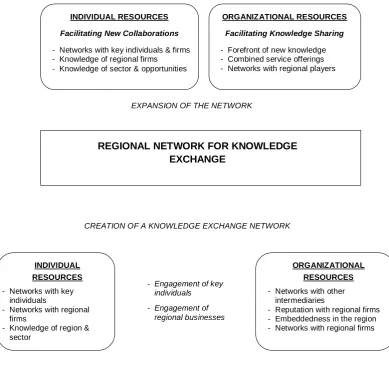
expansion processes. Figure 1 provides a summary of findings.
---
INSERT FIGURE 1 AROUND HERE
---
The creation of a successful knowledge exchange network (illustrated in the bottom half of
Figure 1) is underpinned by the network and knowledge resources of intermediary
organizations. However, the network resources and social capital unique to key individuals
plays an important role in engaging the help of regional firms and individuals. Expansion of
organizational resources play a key role in providing new knowledge sharing opportunities;
in the example here this was supported by the University’s unique and cutting-edge
knowledge resources, as well as the knowledge and network resources of the RDA and city
council. On the other hand, it is again the unique resources of key individuals which play a
central role in underpinning the successful expansion of the network through facilitating new
collaborations between regional firms.
The findings contribute to three key areas of existing research. First, they highlight the
importance of the relationship between intermediary organizations and how this relationship
is critical for underpinning the successful creation of a regional network for knowledge
exchange. This adds to understanding of the importance of partnerships between
intermediaries in policy-initiated knowledge exchange network formations (YUSUF, 2008).
Recent studies using the RBV also point to the importance of resources that a firm is able to
leverage by combining resources available through partnership agreements (LAVIE, 2006).
Second, although extant research highlights the role of intermediaries’ organizational
resources, there has been little acknowledgement of the role of key individuals within those
organizations. The study highlights that a focus on intermediaries as organizations can mask
the importance of the resources of key individuals and the leveraging of their unique social
and knowledge resources that facilitate regional knowledge exchange. This study therefore
provides an important addition to furthering understanding of the role of intermediaries in
supporting knowledge exchange (HOWELLS, 2006; INKINEN and SUORSA, 2010;
WOLPERT, 2002; YUSUF, 2008; ZHANG and LI, 2010). Finally, the study highlights how
important the choice of intermediary can be in supporting policymakers in their regional
development activities (ASHEIM et al., 2013; CORTRIGHT, 2006). Each of these areas is
In focusing on the important value of resource combinations available through
partnerships and alliances, LAVIE (2006) stated that “the inimitability of resources will
depend less on the nature of resources and more on the nature of relationships between the
firm and its partners” (ibid: 649). This particular study demonstrates how important the
existing relationship between the three intermediary organizations was in supporting the
creation and expansion of a regional network for knowledge exchange. More specifically,
two key aspects of this relationship were particularly important. First, recognition that each of
the intermediaries would benefit from the combining of resources. Second, that combining
resources could also create something greater than the sum of its parts (LAVIE, 2006; TENG, 2007); a unique resource combination which would benefit the regional as a whole.
This provides an important addition to existing work on understanding key factors
underpinning intermediary collaborations (YUSUF, 2008). In addition, this study also
highlights the value that can be created through partnerships of intermediaries working
together on policy implementation. However, the study suggests that the nature of the
partnership in this study was developed over a period of years through which each
intermediary was able to gain an understanding of each other’s goals, resources that they had
on hand, as well as a relationship that is based on mutual trust (HUGGINS, 2000; HUGGINS
et al., 2008; KAUFFELD-MONZ and FRITSCH, 2013).
Second, although prior research has highlighted the importance of intermediaries’
networks and knowledge resources (INKINEN and SUORSA, 2010; STEWART and
HYYSALO, 2008; WOLPERT, 2002; ZHANG and LI, 2010), such studies have tended to
largely assume the relevance of organizational resources, rather than the resources of key
individuals within those organizations. In this study, the findings indicate that although the
combination of intermediaries’ organizational resources provide a strong foundation for the
success. The study draws attention to the role of key individuals from those organizations;
their knowledge of the region, the sector and of regional firms is essential to expanding the
network and underpins their role as mediators for new collaborations and new links between
regional firms. This provides an important extension to understanding the role of
intermediaries (HOWELLS, 2006; INKINEN and SUORSA, 2010; WOLPERT, 2002;
YUSUF, 2008; ZHANG and LI, 2010) and calls for further acknowledgement of the role of
key individuals within those intermediaries and the importance of their network and
knowledge resources.
Finally, the study also contributes to understanding the importance of the choice of
intermediary in supporting policy initiatives for the creation and expansion of regional
networks for knowledge exchange. The role of intermediaries in supporting regional
knowledge exchange is a particularly important area of research (YUSUF, 2008; ZHANG
and LI, 2010). This is particularly relevant given that policymakers, who often rely on
intermediaries such as local universities, often struggle to implement new knowledge
exchange networks (SHUTT and PELLOW, 1997; TÖDTLING and TRIPPL, 2005). The
findings highlight how policymakers, when choosing intermediaries to support their regional
network initiatives, need to consider whether those intermediaries have access to, and are
able to leverage, the right combinations of organizational and individual resources. This study
has provided an insight into the idiosyncratic organizational and individual resource
combinations that create value for participating firms (BARNEY, 1991; BARNEY, 2014).
However, what this study shows is that the uniqueness of such resources only comes about
through extended periods of immersion within the region and embeddedness within a
network of regional (and maybe national) firms. The challenge for policymakers is that the
embeddedness of intermediaries’ within existing networks underpins their ability to be able to
can be difficult for intermediaries without sufficient experience to gather together the
necessary resources in a shorter period of time, as such resources often take significant time
to develop (BARNEY, 1991; DIERICKX and COOL, 1989). This also helps explain the
weakness in the intermediaries’ networks with larger firms, which they believed limited their
ability to expand the network. The challenge for these intermediaries, and for the key
individuals from those firms, is that they had been historically immersed in networks of local
and regional firms and their experience was largely with small businesses (see Tables 2 and 3
above). This also points to how resources may change, or may need to change, over time as
the network expands and the needs of the network changes. This is certainly an interesting
topic for future research.
Conclusions
Increasingly, policymakers are drawing on the resources of key intermediaries, such as
universities and development agencies, to facilitate the creation and expansion of regional
networks for knowledge exchange. It is therefore important for policymakers to understand
how the choice of intermediary organization may contribute to their success. While previous
studies have explored key factors which underpin the success (or failure) of policy-initiated
network formations (CORTRIGHT, 2006; HUGGINS, 2000, 2001, 2008a) as well as the
important role of intermediary organizations (STEWART and HYYSALO, 2008;
WOLPERT, 2002; YUSUF, 2008; ZHANG and LI, 2010), few have focused specifically on
the resources of intermediaries and how these might impact on the creation of regional
networks. In this study, the RBV is used to focus attention towards unique resource
combinations underpinning the successful creation and expansion of a regional network for
The approach combined with the research context enabled a deeper insight into the
organizations and individuals involved in the development of a regional network for
knowledge exchange. This study has two important implications for policymakers. First, the
findings not only highlight the relevance of intermediary organizations, but importantly point
to the significance of key individuals within those organizations. A relevant question is how
policymakers are able to identify who such individuals might be. Second, the importance of
the value created through a combination of intermediary and individual resources cannot be
developed in a short period of time. The development of such resources can be specific to a
particular regional context.
However, there are limitations of this study. It is important for future research to extend
the findings from this study to other cases and contexts, to avoid these findings being accused
of bias towards a successful network (TÖDTLING and TRIPPL, 2005). It would also be
interesting to explore the generalizability of these findings for other regional networks for
knowledge exchange. Future work might also consider how the combinations of
organizational and individual resources change over time and in particular how they
Table 1: Key participants
Participant Intermediaries
Frank
Allan
Emma
Martin
Chris
Director, University-based ICT research facility
Business Development Officer, University-based ICT research facility
Business Advisor, Regional Development Agency
Economic Development Officer, City Council
Strategy & Development Manager, Regional Development Agency
Participant Entrepreneurs
Ed
Peter
Ian
George
Steve
Director of real-time performance solutions company. Friend of Frank
Director of avionics software firm. Friend of Chris
Director of marketing solutions provider for ICT firms. Friend of Allan and Ed
Director of software solutions firm. Friend of Martin
Director of e-commerce solutions provider. Friend of Emma
Table 2: Summary of Intermediaries’ Experience
Intermediary Experience
University Worked alongside the RDA for over 3 years on a variety of regional ICT projects
Had worked on a series of funded projects in the ICT sector and had built relationships with regional firms
Worked with the City council for 3 years on a variety of projects for promoting regional growth
Regional
development agency (RDA)
Identified the ICT sector as a key sector for increasing GVA in the region
Worked with the University on several projects over a 3-year period and built good relationships with regional firms
Worked with other institutions in the region and had often been asked for advice on ICT sector growth projects
City Council Had for some time become heavily involved in regional growth programmes for small businesses
[image:27.595.67.526.399.652.2]Table 3: Summary of individual’s experience and networks
Individual Experience
Frank High profile role in the University for over 8 years focusing on regional growth and engagement with small businesses in the ICT sector
Held a key role in the Chamber of Commerce
Had led a series of major projects for regional ICT businesses
Had become well-known within the sector, the region and across other HEIs Allan Worked for over 10 years in the ICT sector and over 2 years with the University
Had developed extensive networks with regional ICT businesses
University role focused on engaging with small regional firms as well as start-up companies
Martin Worked for the City Council for over 20 years; extensive experience in regional economic development
Focused on increasing employment and regional growth
Respected by other institutions and intermediaries in the region, as well as having extensive knowledge of regional businesses
Chris Experienced business advisor with regional responsibilities for the ICT sector Built up extensive network of SMEs in the region
Figure 1: Resource combinations underpinning network creation and expansion
REGIONAL NETWORK FOR KNOWLEDGE EXCHANGE
CREATION OF A KNOWLEDGE EXCHANGE NETWORK
INDIVIDUAL RESOURCES
- Networks with key individuals
- Networks with regional firms
- Knowledge of region & sector
ORGANIZATIONAL RESOURCES
- Networks with other intermediaries
- Reputation with regional firms - Embeddedness in the region - Networks with regional firms
INDIVIDUAL RESOURCES
Facilitating New Collaborations
- Networks with key individuals & firms - Knowledge of regional firms - Knowledge of sector & opportunities
ORGANIZATIONAL RESOURCES
Facilitating Knowledge Sharing
- Forefront of new knowledge - Combined service offerings - Networks with regional players
EXPANSION OF THE NETWORK
- Engagement of key individuals
REFERENCES
ACWORTH E. B. (2008) University– industry engagement: The formation of the Knowledge Integration Community ( KIC) model at the Cambridge- MIT Institute, Research Policy 37, 1241-54. ALVESSON M. (2009) Reflexive methodology : new vistas for qualitative research. London : SAGE, London.
ARANGUREN M. J., LARREA M. and WILSON J. (2009) Learning from the Local: Governance of Networks for Innovation in the Basque Country, European Planning Studies 18, 47-65.
ASHEIM B., COOKE P. and MARTIN R. (2013) Clusters and Regional Development: Critical Reflections and Explorations. Taylor & Francis.
ASHEIM B. T. (2003) Regional Innovation Policy for Small-medium Enterprises. Edward Elgar. BARNEY J. (1991) Firm resources and sustained competitive advantage, Journal of Management 17, 99-120.
BARNEY J., WRIGHT M. and KETCHEN D. J. (2001) The resource-based view of the firm: Ten years after 1991, Journal of Management 27, 625-41.
BARNEY J. B. (2014) Gaining and sustaining competitive advantage. Pearson, Harlow.
BATTERINK M. H., WUBBEN E. F. M., KLERKX L. and OMTA S. W. F. (2010) Orchestrating innovation networks: The case of innovation brokers in the agri-food sector, Entrepreneurship &
Regional Development 22, 47-76.
BECATTINI G., BELLANDI M. and DE PROPRIS L. (2009) A handbook of industrial districts. Cheltenham : Edward Elgar, Cheltenham.
BERCOVITZ J. and FELDMAN M. (2006) Entpreprenerial Universities and Technology Transfer: A Conceptual Framework for Understanding Knowledge-Based Economic Development, The Journal of
Technology Transfer 31, 175-88.
BODDY M. (2000) Technology, innovation, and regional economic development in the state of Victoria, Environment and Planning C: Government and Policy 18, 301-19.
BOSCHMA R. (2004) Competitiveness of regions from an evolutionary perspective, Regional Studies
38, 1001-14.
BOSCHMA R. (2005) Proximity and innovation: a critical assessment, Regional Studies 39, 61-74. BRAMWELL A., NELLES J. and WOLFE D. (2008) Knowledge, innovation and institutions: Global and local dimensions of the ICT cluster in Waterloo, Canada, Reg. Stud. 42, 101-16.
BRAMWELL A. and WOLFE D. A. (2008) Universities and regional economic development: The entrepreneurial University of Waterloo, Research Policy 37, 1175-87.
CHASTON I. (1999) Existing propensity to cooperate: an antecedent influencing the potential performance of small-business networks?, Environment and Planning C: Government and Policy 17, 567-76.
CLIFTON N., KEAST R., PICKERNELL D. and SENIOR M. (2010) Network Structure, Knowledge Governance, and Firm Performance: Evidence from Innovation Networks and SMEs in the UK,
Growth And Change 41, 337-73.
COLEMAN J. S. (1988) Social capital in the creation of human capital, American Journal of Sociology, S95-S120.
COLLINSON S. (2000) Knowlege networks for innovation in small Scottish software firms,
Entrepreneurship & Regional Development 12, 217-44.
COOKE P. (2001) Biotechnology Clusters in the U.K.: Lessons from Localisation in the Commercialisation of Science, Small Business Economics 17, 43-59.
COOKE P., HEIDENREICH M. and BRACZYK H.-J. (2004) Regional innovation systems : the role of governances in a globalized world. London : Routledge, London.
CORTRIGHT J. (2006) Making sense of clusters: Regional competitiveness and economic development Brooklings Institution, Metropolitan Policy Program.
DE MARTINO R., MC HARDY REID D. and ZYGLIODOPOULOS S. C. (2006) Balancing localization and globalization:exploring the impact of firm internationalization on a regional cluster,
Entrepreneurship & Regional Development 18, 1-24.
DIERICKX I. and COOL K. (1989) Asset stock accumulation and sustainability of competitive advantage, Management Science 35, 1504-11.
EISENHARDT K. M. (1989) Building Theories from Case Study Research, The Academy of
Management Review 14, 532-50.
FELIN T. and HESTERLY W. S. (2007) The Knowledge-Based View, Nested Heterogeneity, and New Value Creation: Philosophical Considerations on the Locus of Knowledge, The Academy of
Management Review 32, 195-218.
GEERTZ C. (1973) The Interpretation of Cultures: Selected Essays. Basic Books.
GLASER B. G. (1967) The discovery of grounded theory : strategies for qualitative research. Chicago : Aldine Pub., Chicago.
HILL J., MCGOWAN P. and DRUMMOND P. (1999) The development and application of a qualitative approach to researching the marketing networks of small firm entrepreneurs, Qualitative
Market Research: An International Journal 2, 71-81.
HOWELLS J. (2006) Intermediation and the role of intermediaries in innovation, Research Policy 35, 715-28.
HUGGINS R. (2000) The success and failure of policy-implanted inter-firm network initiatives: motivations, processes and structure, Entrepreneurship & Regional Development 12, 111-35. HUGGINS R. (2001) Inter-firm network policies and firm performance: evaluating the impact of initiatives in the United Kingdom, Research Policy 30, 443-58.
HUGGINS R. (2008a) Universities and knowledge-based venturing: finance, management and networks in London, Entrepreneurship & Regional Development 20, 185-206.
HUGGINS R. (2008b) The evolution of knowledge clusters: progress and policy, Economic Development Quarterly.
HUGGINS R., JOHNSTON A. and STEFFENSON R. (2008) Universities, knowledge networks and regional policy, Cambridge Journal of Regions, Economy and Society 1, 321-40.
HUGGINS R. and JOHNSTON A. (2009) The economic and innovation contribution of universities: a regional perspective, Environment and Planning C: Government and Policy 27, 1088-106.
HUGGINS R. and JOHNSTON A. (2010) Knowledge flow and inter-firm networks: The influence of network resources, spatial proximity and firm size, Entrepreneurship & Regional Development 22, 457-84.
HUGGINS R. and WILLIAMS N. (2011) Entrepreneurship and regional competitiveness: The role and progression of policy, Entrepreneurship & Regional Development 23, 907-32.
HUGGINS R., JOHNSTON A. and THOMPSON P. (2012) Network Capital, Social Capital and Knowledge Flow: How the Nature of Inter-organizational Networks Impacts on Innovation, Industry
and Innovation 19, 203-32.
HUGGINS R. and KITAGAWA F. (2012) Regional Policy and University Knowledge Transfer: Perspectives from Devolved Regions in the UK, Reg. Stud. 46, 817-32.
HUMAN S. E. and PROVAN K. G. (1996) External resource exchange and perceptions of competitiveness within organizational networks: an organizational learning perspective, in REYNOLDS P. (Ed) Frontiers of Entrepreneurship Research, pp. 240–52.
INKINEN T. and SUORSA K. (2010) Intermediaries in Regional Innovation Systems: High-Technology Enterprise Survey from Northern Finland, European Planning Studies 18, 169-87. JACK S., MOULT S., ANDERSON A. R. and DODD S. (2010) An entrepreneurial network evolving: patterns of change, International Small Business Journal 28, 315-37.
JACK S. L. (2010) Approaches to studying networks: Implications and outcomes, Journal of Business
Venturing 25, 120-37.
JOHANNISSON B., CAFFARENA L. C., CRUZ A. F. D., EPURE M., PÉREZ E. H., KAPELKO M., MURDOCK K., NANKA-BRUCE D., OLEJÁROVÁ M., LOPEZ A. S., SEKKI A., STOIAN M.-C., TÖTTERMAN H. and BISIGNANO A. (2007) Interstanding the industrial district: contrasting conceptual images as a road to insight, Entrepreneurship and Regional Development 19, 527-54. KAUFFELD-MONZ M. and FRITSCH M. (2013) Who Are the Knowledge Brokers in Regional Systems of Innovation? A Multi-Actor Network Analysis, Regional Studies 47, 669-85.
LASCHEWSKI L., PHILLIPSON J. and GORTON M. (2002) The facilitation and formalisation of small business networks: evidence from the North East of England, Environment and Planning C:
Government and Policy 20, 375-91.
LAVIE D. (2006) The competitive advantage of interconnected firms: An extension of the resource- based view, Acad. Manage. Rev. 31, 638-58.
LAWSON C. and LORENZ E. (1999) Collective Learning, Tacit Knowledge and Regional Innovative Capacity, Regional Studies 33, 305-17.
LEITCH C. M., HILL F. M. and HARRISON R. T. (2010) The Philosophy and Practice of
Interpretivist Research in Entrepreneurship Quality, Validation, and Trust, Organizational Research
Methods 13, 67-84.
LOCKETT N., JACK S. and LARTY J. (2013) Motivations and challenges of network formation: Entrepreneur and intermediary perspectives, International Small Business Journal 31, 866-89. MACKINNON D., CHAPMAN K. and CUMBERS A. (2004) Networking, trust and embeddedness amongst SMEs in the Aberdeen oil complex, Entrepreneurship & Regional Development 16, 87-106. MALMBERG A. and MASKELL P. (2002) The elusive concept of localization economies: towards a knowledge- based theory of spatial clustering, Environ. Plan. A 34, 429-49.
MARTIN R. and SUNLEY P. (2003) Deconstructing clusters: chaotic concept or policy panacea?,
Journal of economic geography 3, 5-35.
MAURSETH P. and FRANK B. (2009) The German Information and Communication Technology ( ICT) Industry: Spatial Growth and Innovation Patterns, Reg. Stud. 43, 605-24.
MILES M. B. and HUBERMAN A. M. (1984) Qualitative data analysis. A sourcebook of new methods. Sage, Berverly Hills, London, New Delhi.
MOODYSSON J. and ZUKAUSKAITE E. (2014) Institutional Conditions and Innovation Systems: On the Impact of Regional Policy on Firms in Different Sectors, Regional Studies 48, 127-38. MORRISON A., BREEN J. and ALI S. (2003) Small business growth: Intention, ability, and opportunity, Journal of Small Business Management 41, 417.
MURO M. and KATZ B. (2011) The new “cluster moment”: how regional innovation clusters can foster the next economy. Emerald Group Publishing Limited.
NAHAPIET J. and GHOSHAL S. (1998) Social capital, intellectual capital, and the organizational advantage, Academy of Management Review 23, 242-66.
NEWBERT S. L. (2007) Empirical research on the resource- based view of the firm: An assessment and suggestions for future research, Strateg. Manage. J., pp. 121-46.
NOOTEBOOM B. (2003) Problems and solutions in knowledge transfer, in FORNAHL D. AND BRENNER T. (Ed) Cooperation, Networks and Institutions in Regional Innovation Systems pp. 105-27. Edward Elgar, Northampton.
NWDA (2010) Digital and Creative research Strand Eight: Key Infrastructure Assets. WM Enterprise, Birmingham.
OECD (2011) Regions and Innovation Policy. OECD Publishing. OECD (2013) Knowledge Networks and Markets. OECD Publishing.
PEARCE G. and AYRES S. (2009) Governance in the English regions: the role of the regional development agencies, Urban Studies 46, 537-57.
PENROSE E. T. (2009) The theory of the growth of the firm. Oxford : Oxford University Press, Oxford.
PETERAF M. A. (1993) The cornerstones of competitive advantage: A resource‐based view,
Strategic Management Journal 14, 179-91.
PICKERNELL D., ROWE P. A., CHRISTIE M. J. and BROOKSBANK D. (2007) Developing a framework for network and cluster identification for use in economic development policy-making,
Entrepreneurship & Regional Development 19, 339-58.
PORTER M. E. (1998) Clusters and the new economics of competition, Harv Bus Rev 76, 77-90. POWERS J. B. and MCDOUGALL P. P. (2005) University start-up formation and technology licensing with firms that go public: a resource-based view of academic entrepreneurship, Journal of
Business Venturing 20, 291-311.
ROELANDT T. and DEN HERTOG P. (1999) Cluster analysis and cluster-based policy making in OECD-countries: An introduction to the theme, Boosting innovation: the cluster approach, p. 9. OECD Publishing.
RUBIN P. H. (1973) The Expansion of Firms, Journal of Political Economy 81, 936.
RUMELT R. P. (1997) Towards a strategic theory of the firm, Resources, firms, and strategies: A reader in the resource-based perspective, 131-45.
SAPSED J., GRANTHAM A. and DEFILLIPPI R. (2007) A bridge over troubled waters: Bridging organisations and entrepreneurial opportunities in emerging sectors, Research Policy 36, 1314-34. SAXENIAN A. (1990) Regional Networks and the Resurgence of Silicon Valley, California
Management Review 33.
SAXENIAN A. L. (1996) Regional Advantage. Harvard University Press.
SHUTT J. and PELLOW N. (1997) Industrial Clusters and LED Business Support: Contrasting Strategy Evidence from the North of England. Leeds Metropolitan University.
SILVERMAN D. (2013) Doing qualitative research : a practical handbook. Thousand Oaks, CA : Sage Publications, Thousand Oaks, CA.
SNOW C. C., MILES R. E. and COLEMAN JR H. J. (2000) Managing 21st century network organizations, Technology, Organizations, and Innovation: Critical Perspectives on Business and Management, 1621-38.
STEWART J. and HYYSALO S. (2008) INTERMEDIARIES, USERS AND SOCIAL LEARNING IN TECHNOLOGICAL INNOVATION, International Journal of Innovation Management 12, 295-325.
STOUGH R., HAYNES K. and CAMPBELL H., JR. (1998) Small Business Entrepreneurship in the High Technology Services Sector: An Assessment for the Edge Cities of the U.S. National Capital Region, Small Business Economics 10, 61-74.
TENG B. S. (2007) Corporate entrepreneurship activities through strategic alliances: A resource- based approach toward competitive advantage, J. Manage. Stud., pp. 119-42.
TÖDTLING F. and TRIPPL M. (2005) One size fits all?: Towards a differentiated regional innovation policy approach, Research Policy 34, 1203-19.
VALDALISO J., ELOLA A., ARANGUREN M. and LOPEZ S. (2011) Social capital,
internationalization and absorptive capacity: The electronics and ICT cluster of the Basque Country,
Entrepreneurship & Regional Development 23, 707-33.
VICENTE J. and SUIRE R. (2007) Informational Cascades versus Network Externalities in
Locational Choice: Evidence of ‘ ICT Clusters’ Formation and Stability, Regional Studies 41, 173-84. WENNBERG K. and LINDQVIST G. (2010) The effect of clusters on the survival and performance of new firms, Small Business Economics 34, 221-41.
WOLPERT J. D. (2002) Breaking out of the innovation box, Harv Bus Rev 80, 76-83, 148.
WRIGHT M., CLARYSSE B., LOCKETT A. and KNOCKAERT M. (2008) Mid-range universities’ linkages with industry: Knowledge types and the role of intermediaries, Research Policy 37, 1205-23. WRIGHT P. M., DUNFORD B. B. and SNELL S. A. (2001) Human resources and the resource based view of the firm, Journal of Management 27, 701-21.
YOUTIE J. and SHAPIRA P. (2008) Building an innovation hub: A case study of the transformation of university roles in regional technological and economic development, Research Policy 37, 1188-204.
YUSUF S. (2008) Intermediating knowledge exchange between universities and businesses, Research
Policy 37, 1167-74.