EU Environmental Policy Making and Implementation:
Changing Processes and Mixed Outcomes
Henrik Selin
Frederick S. Pardee School of Global Studies Boston University
E-mail: [email protected]
Stacy D. VanDeveer Department of Political Science
University of New Hampshire E-mail: [email protected]
Paper presented at the 14th Biennial Conference of the European Union Studies Association, Boston, Massachusetts, March 2015
Draft of article for future publication in Annual Review of Environment and Resources (2015) – Comments and suggestions most welcome!
Introduction
The European Union (EU) is, by far, the most legally, politically and economically authoritative international organization in the world. Today’s EU dates back to the 1957 Rome Treaty, establishing the European Economic Community (EEC), and a parallel Rome Treaty creating the European Atomic Energy Community (EURATOM)(1-3). Since the six original countries, membership has grown to 28 member states – representing over 500 million people and cooperating and making decisions within a diverse set of EU bodies. This increased number of members has been accompanied by a significant increase in the quantity and scope of policy issues under EU authority. Environmental issues are among the policy domains where this expansion is most notable, involving the transfer of substantial decision-making power from domestic bodies to the regional level (4-8). Presently, most environmental policies are formulated within EU bodies, rather than by national and sub-national governments, legislative venues, and regulatory agencies.
After modest beginnings in the 1970s, the EU emerged as a regional and global leader in many areas of environmental politics and policy-making. This remarkable development, largely unanticipated at the onset, was made possible by a series of amendments to the Rome Treaty expanding the EU’s legal authority on environmental issues and increasing the influence of EU bodies over individual member states. After over four decades, EU law-making has yielded a large, and still expanding, body of environmental policy that includes some of the world’s most stringent mandates and regulatory standards. However, this complex governance system has produced decidedly mixed outcomes. Scientific and policy data show significant environmental and human health improvements in some areas, but little progress in others (9, 10). Substantial implementation and policy integration challenges remain across member states, as EU and national level policy-makers and organizations struggle to put strong rhetoric and ambitious sustainability goals into practice.
Early analyses of EU environmental politics date to the 1980s, with a sharp increase in studies since the 1990s. This review article, building on the diverse literature about EU environmental politics and management, examines forty-plus years of European environmental policy-making and implementation. The next section discusses the evolution of the EU legal basis for making environmental policy and seeking sustainable development as developed through revisions to the EEC Treaty. Next is an introduction to the main actors in EU environmental politics, followed by a brief discussion of how EU environmental policy is made and implemented. The subsequent section reviews EU environmental politics in the context of membership enlargements, leading into an examination of how the EU engages external fora and countries. The penultimate section presents data on environmental policy and ecological impacts within and outside the EU. The final section summarizes main arguments on the role of environmental policy in European integration and sustainable development and provides suggestions for future research.
EU Studies and the Evolving Legal Basis of Environmental Policy
- Intergovernmentalist analysis focuses on (the most powerful) states and national interests and leaders in shaping political agendas and decision-making (11, 12).
- Neo-functionalist approaches explore how EU bodies, states and other actors cooperate to address practical problems, and how such cooperation can spill over to include also more politically sensitive issues (13, 14).
- New institutionalists study how institutions such as social structures, principles and norms shape the interests, behavior and decision-making of states, EU bodies and advocacy groups as they develop new collaborative structures (15, 16).
- Constructivists are interested in how deeper identities and interests of EU bodies, states and non-state actors are shaped and changed through social interaction and communication, and how this impacts discourses and decision-making (17, 18).
- Multi-level governance research examines how EU bodies, states and other actors operate across regional, national and local governance levels, how authority is shifted across forums and scales, and how this shape decisions and outcomes (19, 20).
- Europeanization studies explore how European integration influences how member states interact with EU bodies and non-state actors, and developments and obstacles toward greater policy convergence (4, 21-23).
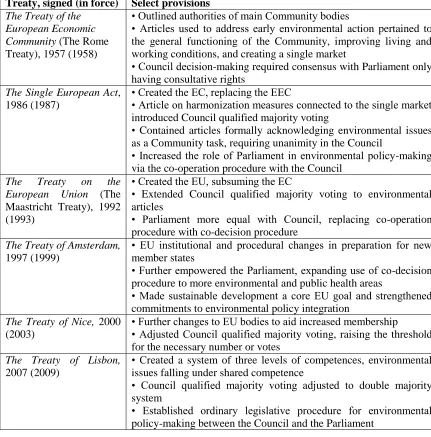
Acknowledged by all theories of European integration, EU law-making authority stems from provisions in foundational treaties negotiated, approved, and revised by member states. The Rome Treaty, which laid down the basic functions of the ECC, did not cover the environment (see table 1). Yet, the Rome Treaty contained other language that served as a legal basis for the introduction of environmental initiatives. Two sets of treaty-based provisions, in particular, were referenced by early environmental policy advocates: First, the general functioning of the Community in support of integration and related aspirations to improve peoples’ living and working conditions, and second the (initially more frequently used) mandate to reduce barriers to trade and economic exchange toward the ultimate objective of creating a single market (24, 25). Realizing these goals, supporters argued, required the harmonization of environmental and human health standards across member states – many raised above the lowest-common-denominator with support from EU bodies, member states and advocacy groups (5, 26).
Table 1: List of treaties and how they impacted environmental policy making
Official EU environmental action dates back to a 1972 Paris Summit of leaders of then nine EEC member states (6).This Summit, held as the modern environmental movement gained momentum, was a follow-up to the United Nations Conference on the Human Environment in Stockholm, Sweden earlier the same year. The Stockholm Conference called for political, scientific and technical cooperation around environmental issues such as industrial pollution and marine and terrestrial wildlife protection. In response, the Paris Summit initiated the practice of developing Environmental Action Programs (EAPs) where EU bodies and member states – with civil society input – set agendas and identify areas for targeted action. The current, seventh EAP articulates priorities for policy initiatives to 2020 and outlines a broad vision of sustainability for 2050 (27). Many environmental laws in the 1970s and 1980s, however, were adopted arbitrarily, reacting to specific conditions and changing political and economic contexts rather than as part of a clearly visible or systematic strategy for a greener Community (28, 29).
a common market, realizing the single market in 1993. Increasingly, this required the coordination of national policies and reducing obstacles impacting the free movement of goods between member states, including environmental controls. Much environmental policy standardization centrally increased mandates across the region – often substantially. These efforts were aided by the adoption of the 1986 Single European Act (SEA), which created the European Community (EC), and launched a series of important changes to environmental decision-making processes. First, the SEA included treaty articles for environmental law-making. Starting in the 1970s, the Court of Justice of the European Union (“the Court”) established a legal basis for Community environmental action, resting on case law rather than environment-specific treaty provisions. Building on these Court decisions, the SEA marked the beginning of a more comprehensive and ambitious approach to adopting more expansive and stringent environmental standards and laws.
Second, the SEA introduced qualified majority voting, as member states in the Council of the European Union (“the Council”) approved new laws. Previously, the Council acted by consensus giving each country veto power. In the SEA, member states agreed that a shift towards majority voting was necessary to effectively make decisions in a growing Community. Green leader states used this opportunity to push for more ambitious policies (30-32). Initially, some environmental-related issues addressed under treaty articles pertaining to the single market were subject to majority voting. In contrast, issues falling under the new environmental provisions still required member state unanimity. Among the major changes in subsequent treaty revisions was the application of majority voting to decisions addressed under the environmental articles, as that list was expanded to include almost all environmental issues (with a few exception where member states retain the right to make their own decision, including fiscal matters, energy supply, land use and planning, and quantitative water management). The rules for Council voting further changed over time, most recently determined by the 2007 Lisbon Treaty.
Third, the SEA granted the European Parliament (“the Parliament”) greater influence, establishing the “co-operation procedure” for policy-making together with the Council. Previously, the Council consulted Parliament, but was free to decide whether to follow its recommendations. The Parliament’s increased role continued through the 1992 Maastricht Treaty, which created the EU (incorporating the EC and EURATOM) and expanded the co-operation procedure into the “co-decision procedure.” Since given a greater role, the Parliament has helped raise many standards (33). Subsequent treaties – the 1997 Amsterdam Treaty and the 2000 Nice Treaty – amended EU bodies and procedures to allow for a large membership increase, made sustainable development a core objective, and stressed the importance of environmental policy integration. The 2009 Lisbon Treaty established rules for the current co-decision procedure, also called the ordinary legislative procedure, and identified the environment (together with the single market, social policy, consumer protection, transport, and energy) as an area of shared competence where EU bodies formulate policies with member states.
EU Environmental Policy Actors
center, many different bodies shape environmental policy, and their roles and influence change over time. Five EU bodies are most actively involved in environmental policy-making: the European Council, the European Commission (“the Commission”), the Council, the Parliament, and the Court (34, 35). In addition, other EU bodies and many non-state actors seek to influence environmental policy while a host of evolving principles and norms shape actors and outcomes. Member States and EU Bodies
Member state leaders meet regularly in the European Council, formulating political agendas and discussing profile issues and lead by a President elected for a 30 month term. This high-level body is not involved in passing specific laws, but is a forum where heads of governments formulate goals and set directions. Each member state holds the Presidency of the European Council for six months on a rotating basis, allowing it to influence the agenda and prioritize issues during its term (36). Most discussions are not environment-specific, but the European Council plays an important role in formulating collective targets for greenhouse gas emission (GHG) reductions and renewable energy expansions, for example. Decisions on other political and economic issues also have important ramifications for efforts to green the EU and move toward sustainable development. Furthermore, the European Council plays an important role in selecting the President of the Commission. In addition, European Council meetings on foreign policy and security issues include the presence of the High Representative of the Union for Foreign Affairs and Security Policy who also serves as Vice-President in the Commission.
As the EU grew larger and more powerful, so has the Commission in its official capacity as an engine of deeper integration (37). The Commission, and the people who work at the headquarters in Brussels and offices around Europe and the world, are tasked with promoting the collective European interest, rather than individual national preferences. The Commission has several formal tasks. These include: (i) the sole right to propose new EU legislation; (ii) monitor the implementation of EU laws in member states; (iii) initiate enforcement actions against member states not meeting their obligations under EU law; (iv) manage the EU budget after it has been set by member states; and (v) represent the EU in external fora (together with other EU officials including the President of the European Council, the High Representative of the Union for Foreign Affairs and Security Policy, and member state representatives). Fulfilling these tasks makes the Commission a central actor in political debates and legislative processes on environmental issues, often advocating fro greater EU authority and increased mandates and goals.
The Council – previously named the Council of Ministers – is the second body where member state representatives meet and negotiate based on national interests, as they seek common ground on regional issues (38). The Council plays a key role in EU environmental law-making, as one of the two bodies that reviews legislative proposals from the Commission under the current ordinary legislative procedure. Council work, supported by a separate Secretariat, is divided into nine topical areas. The Environment Council addresses all environmental issues, including climate change, while agricultural and fisheries issues go through the Agriculture and Fisheries Council. Based on the Lisbon Treaty’s double majority voting system, a proposal passes the Council under the ordinary legislative procedure with a qualified majority of 55 percent of member states (16 of 28), representing at least 65 percent of the EU’s population. Unless a blocking minority includes at least four member states, the necessary majority is deemed reached even if the population criterion is not met.
The roles and authority of the Parliament have changed significantly through the series of treaty revisions, starting with the SEA. The Members of the European Parliament (MEPs) were first selected by member states’ national parliaments, but direct elections every five years started in 1979 (33, 39). The size of the Parliament grew with the increase in member states, to the current 751 seats. Seats are allocated roughly based on member states’ population, but MEPs sit in political groups rather than national ones. The Parliament has input in the selection of the President of Commission and holds hearings with nominated Commissioners, which may result in candidate withdrawals, before a vote to approve the full Commission. As the other body scrutinizing proposals under the ordinary legislative procedure, much work takes place in parliamentary committees, including the Committee on Environment, Public Health and Food Safety, often taking pro-environmental positions. In committee and plenary, MEPs make decisions by simple majority (majority of voting members) or absolute majority (376 of 751 members).
The Court plays a central role in EU environmental governance by elaborating the legal basis of EU environmental policy-making consistent with treaty language supporting higher standards and guiding their uniform application in member states. Court proceedings are either contentious or non-contentious (25). Contentious proceedings settle disagreements between member states, between EU bodies, between the Commission and a member states, or between individuals and EU bodies. Non-contentious proceedings occur when a member state national court voluntarily asks the Court for a preliminary ruling on how to apply EU law to a domestic legal case (including environmental ones). National courts are thus not obligated to ask for such rulings, but must follow them once they have decided to seek advice from the Court. In a large number of rulings since the 1970s, the Court developed an expanded role for environmental policy action, and clarified relationships between single market operation and the need for regional and national measures to protect human health and the environment, including how protective measures should be taken when they intersect with economic and trade issues (40).
assessments and reports on environmental conditions and trends), the European Food Safety Authority (providing scientific and technical information on food and feed safety, nutrition, animal health and welfare, and plant protection), the European Chemicals Agency (executing administrative and assessment tasks implementing EU chemicals policy), and the European Fisheries Control Agency (coordinating member states’ activities under the Common Fisheries Policy). As the number and activities of these agencies grows, their role in monitoring and policy reform increase.
Private and Civil Society Actors
As the EU gained influence and lobbying in Brussels increased substantially, debates and studies of how EU bodies work with stakeholder groups became more common. Lobbying creates opportunities for non-state groups to shape policy that impacts them, but draws criticism that organized and specialized interests can have undue influence, including on environmental, agricultural and fisheries policies (43). To counter-balance the influence of well-funded and well-staffed private sector groups, the Commission financially supports participation and work by environmental advocacy groups in its stakeholder consultations (44, 45). European business groups often oppose efforts to increase specific mandates, but generally accept that regional environmental policy-making is a central EU function. Environmental groups frequently seek potential allies in the Commission, the Parliament and leader states.
Interest groups often engage EU bodies and policy processes through umbrella organizations. These include BusinessEurope (lobbying on behalf of national business federations in 33 countries), the European Chemical Industry Council (representing large chemical companies located across Europe), Green 10 (coordinating efforts by large environmental organizations), and the European Environment Bureau (speaking on behalf of more the 140 environmental groups in 30 countries). Many major private sector actors and environmental organizations, including Greenpeace, Friends of the Earth, and WWF International, have offices in Brussels. Sometimes, looser, short-term alliances of different actors are formed around specific policy issues (46). Furthermore, non-European groups such as the American Chamber of Commerce, as well as Chinese and other foreign industry representatives, are active in Brussels.
In addition, the 2011 European citizens’ initiative law affords the public the right to petition the Commission to develop a new policy proposal. A petition must be signed by at least one million people from at least one quarter of member states (7 out of 28) with a minimum number of required signatures in each country. The Charter of Fundamental Rights of the European Union also gives individuals the right to petition the Parliament to address environmental and other topics. Both initiatives seek to increase individuals’ abilities to interact with EU bodies, partly in responses to contentious discussions about ways the EU needs to become more transparent and democratic to address concerns about “democratic deficits,” as a growing number of major decisions are taken in EU bodies far removed from average citizens (47).
Making and Implementing EU Environmental Policy
system. EU policy-making is often characterized as highly technocratic in content and by extensive efforts to achieve consensus. EU literature also focuses attention on member state implementation of environmental laws, how such processes are monitored, and how EU bodies enforce compliance. Collectively, such studies illustrate the complexity of EU environmental policy-making and implementation.
EU Legislation and Policy Instruments
EU law combines primary legislation (the treaties) and secondary legislation (issue specific laws). EU bodies adopt three types of secondary legislation. First, “regulations,” passed solely by the Commission or jointly by the Council and the Parliament, set down rules that member states must implement uniformly by a shared deadline. For example, the large 2007 law requiring the registration, evaluation, authorization and restriction of chemicals in the single market is a regulation (the so-called REACH regulation). Second, the more commonly used “directives,” passed by the Council and the Parliament, lay down certain ends allowing member states flexibility in how to meet these. Directives may include varying deadlines based on differences in national conditions. Many air pollution laws, for instance, are directives. Third, “decisions,” issued by the Council (sometimes with the Parliament) or the Commission, are binding acts requiring authorities or individuals in member states to act, to stop doing something, and/or bestow them with specific rights. Examples include the approval of genetically modified crops and requirements for reporting and sharing pollution data.
In choosing environmental policy instruments, EU bodies continue to favor command-and-control style approaches, but also rely on some market-based instruments – most notably the Emissions Trading System (ETS) for reducing GHG emissions. The EU also makes limited use of suasive policy instruments such as voluntary agreements and eco-labels (48). Environmental policy formation is guided by several principles, including: the polluter pays principle (polluters should bear the burden of mitigation and clean-up costs); the precautionary principle (a lack of full scientific certainty should not be used as a reason for postponing cost-effective measures to prevent environmental degradation where there are threats of serious harm); the subsidiarity and proportionality principles (policy decisions should be taken at the lowest appropriate administrative level as EU level action should not go beyond what is necessary to meet EU objectives); and the effort sharing principle (member states are assigned varying targets based on domestic environmental and socio-economic differences) (7). The exact application of these principles, however, are often highly contested during the adoption of specific policies
Making Environmental Policy
Such initiatives include support for both more ambitious and less stringent environmental standards.
Often, actors attempting to re-shape the EU environmental policy agenda push for some sort of working paper or informal report on current policies, their shortcomings, and the state of related scientific and technical information. Even when the initial work, including early drafts of new policy, is conducted within an individual DG under the leadership of a single Commissioner, much consultation occurs across DGs and with other EU bodies (including the Council, the Parliament, specialized agencies and consultative committees). One important way environmental leader states influence such agenda-setting processes is through the placing of national government experts within the Commission, where staff frequently relies on external assistance (49). Such seconded experts can have considerable influence on environmental policy proposals. In 2002, the Commission also introduced an Impact Assessment reports system to evaluate needs for new EU law and consider pros and cons of specific policy options (50). This practice seems to have impacted Commission working processes, but less so subsequent law-making (51).
Final legislative proposals are endorsed by the full College of Commissioners before the dossier is sent to the Council and the Parliament for first readings (see figure 1). It is also forwarded to the Committee of Regions, the European Economic and Social Committee, and national parliaments for reviews and comments. Extensive consultation between EU bodies continues throughout legislative procedure.
Figure 1: Scheme of the Ordinary Legislative Procedure
In the Parliament, MEPs face two options: adopt the original proposal or amend it. The initial review is carried out by a lead committee before the dossier is sent to plenary where other committees and groups of MEPs can suggest further amendments. During the 2009-14 session, the Committee on Environment, Public Health and Food Safety dealt with the single highest number of cases – 79 of the 641 files in the ordinary legislative procedure (52). In both committee and plenary, a simple majority of voting MEPs is required to approve an amendment. Over the years, the Parliament has often advocated raising environmental standards (53). After plenary vote, the dossier goes to the Council where it is examined in lower-level working groups and committees before being forwarded to the Committee of Permanent Representatives (member state officials with titles of Ambassadors to the EU) and then ultimately to national government ministers in the relevant Council group (such as the Environment Council) formulating a common position. One estimate claims that 70 percent of dossiers are finalized at the working group level, while 85-90 percent of issues are settled by all member states in the Committee of Permanent Representatives before reaching the ministerial level (54). Even though decisions can be taken by double majority, member states typically strive for consensus.
body, fails to develop a compromise text within eight weeks of its creation, the process ends. If it approves a text, both the Council (qualified majority) and the Parliament (simple majority) must decide within eight weeks in a third reading. If both approve the text, the law is adopted. If either body rejects it, or does not act in time, the proposal fails. During the 2009-14 session, 89 percent of cases were finalized after the first reading, 10 percent were concluded at the end of the second reading, and only 1 percent went to third reading (55).
The Comitology Procedure
As EU law increased in quantity and ambition, the Council realized it was unable to specify all relevant rules during implementation, delegating some powers to the Commission (56, 57). To manage this important rule-making process, member states and the Commission established the comitology procedure. This system has changed with current rules detailed in a 2011 regulation (58). Now all issues relating to the environment, agriculture, fisheries, and the health or safety of humans, animals or plants fall under the examination procedure. In recent years, between 200 and 300 comitology committees were in operation. In 2011, for example, 268 comitology committees were organized in 29 policy sectors (59). Environmental policies were addressed by the second highest number of committees at 30. In addition, 4 climate action committees, 14 agriculture and rural development committees, and 5 maritime affairs and fisheries committees operated. As the comitology procedure’s importance increases, the traditional division between policy-making and implementation is diminishing in EU environmental governance.
Under the examination procedure, the Commission drafts an implementing act, sometimes in collaboration with a specialized agency; for example, regulating a chemical. The draft act is sent for review to a comitology committee of member state representatives, chaired by a Commission official. If the committee’s opinion on the proposed act is positive, garnering a qualified majority in favor, the act is adopted. If the committee issues a negative opinion – with a qualified majority against – the proposal fails. If the committee is split and cannot reach a positive or negative opinion, the Commission has discretion over its adoption. A negative opinion (or no opinion) leaves the Commission two options: submit an amended version to the same committee for another round of consideration, or re-submit the original proposal to an appeals committee. In the latter case, member state representatives and the chair can propose changes in search of compromise. If the appeals committee’s opinion is positive, the Commission adopts the original proposal. If its opinion is negative, the process ends. If the appeals committee delivers no opinion, the Commission has authority to decide whether or not to adopt the act.
Ensuring Implementation and Compliance
actors and individuals also submit environment-related petitions to Parliament (62). If implementation problems persist, the Commission may launch a four stage infringement procedure.
The Commission first initiates informal discussions with a member state government. If the Commission is satisfied with the response, the process ends. If not, the Commission (secondly) sends a formal notice, requesting an official reply. If the answer is deemed unsatisfactory, the Commission (in a third phase) formulates a reasoned opinion, stating its position and calling for improved compliance with specific requirements. If a member state in the Commission’s opinion fails to meet these requirements, the Commission can refer the issue to the Court, which issues a judgment (phase four). Member states found non-compliant and failing to comply with the ruling can be returned to the Court by the Commission and issued financial penalties. Only a small minority of infringement procedures go through all four phases, which takes an average of almost four years. The average duration of an environmental Court case is approximately two years.
Recently, the number of open infringement cases across all areas of EU law has declined, from almost 2,900 cases in 2009 to 1,343 by the end of 2012 (63). In 2012, the environmental area had the single highest number of open cases – 272 (20 percent of total). These included water management, nature protection, waste handling, inadequate application of impact assessments, and air quality. Several other cases relating to climate change, energy, and agriculture and rural development were also open. Most environmental cases involved Spain (with 27), Italy (with 25), and Greece (with 19), but all member states struggle at times; for example, the Commission in 2012 initiated procedures against 24 out of 27 member states for failing to transpose a directive on buildings’ energy performance (63). Many Court rulings support the Commission over member states. By 2012, however, financial penalties had been issued in only five environmental cases: Greece (1997), Spain (2001), France (2007), and Ireland (twice 2012) (63, 64). By the end of 2012, member states had failed to implement 35 Court judgments on environmental issues, leaving them open to future financial penalties.
Environmental Politics and EU Enlargement
Rather than trading off growing membership for continued political and economic cooperation, the EU has grown from 6 to 28 member states while pursuing deeper integration across a host of policy areas, including the creation of a single market and a vast expansion of environmental policy. Additional countries are seeking membership. By 2014, three candidate countries were in formal membership negotiations (Iceland, Montenegro, and Turkey), while three more were waiting to open such talks (Albania, Macedonia, and Serbia). However, no country is expected to join until at least 2019 (65). EU environmental politics research highlights several major issues relating to membership requirements, leaders and laggards dynamics among member states, difficulties of domestic policy adjustments, and EU support for new members.
significant environment-related content: agriculture and rural development; food safety, veterinary, and phytosanitary policy; fisheries; transport; and energy. Negotiations on each chapter are closed when a candidate country has adjusted all relevant national laws and rules to those within the EU. Countries do not receive EU membership until all chapters are closed.
Environmental issues did not play an important role during the earliest enlargement negotiations with Denmark, Ireland and the UK joining in 1973. The 1980s membership expansions – adding Greece, Portugal and Spain – took place as member states moved towards the adoption of the SEA creating a clear legal foundation for environmental law-making. During the often contentious negotiations leading up to the first major revisions to the Rome Treaty, northern member states including Denmark, Germany and the Netherlands argued for a single market with high environmental and human health standards. Southern member states, including the most recent ones, in contrast focused on promoting economic growth through increased investment and trade. In a compromise, countries agreed to create a single market starting in 1993 with clear legal provisions for adopting environmental laws and setting up structural funds with financial resources to support development and infrastructure projects in less affluent member states (5).
The 1995 inclusion of Austria, Finland and Sweden, affluent countries with high environmental standards (some above those in the EU), shifted the political balance toward member states favoring more ambitious environmental policy-making (4, 67). Collectively and individually, green leader states worked within EU bodies to raise standards and push major reforms of, for example, water governance and chemicals management. Such actions were driven by a series of interests, including responding to domestic political opinion, wanting to reduce transboundary pollution, protecting domestic industries subject to relatively stringent domestic mandates by pushing for uniform standards across the single market, expanding markets for firms exporting greener technology, and making it easier for firms to comply with one set of rules on the single market rather than several diverse national requirements. Member state laggards often resisted such efforts, believing their less demanding regulations constituted a competitive advantage and that higher EU standards would be too expensive to implement (30, 32).
In many ways, the enlargements of 2004, 2007 and 2013 (adding Cyprus, Czech Republic, Estonia, Hungary, Latvia, Lithuania, Malta, Poland, Slovakia, Slovenia, Bulgaria, Romania and Croatia) posed the greatest challenges for both the EU and new member states (68, 69). Central and Eastern European countries suffered massive ecological destruction under Communist regimes, creating severe environmental and human health problems. Candidates had limited institutional, financial and human capacity to effectively change, monitor and enforce environmental regulation or engage civil society, as they were building a market economy and a democratic system. Some observers expressed fears that adding many new members with lower economic and ecological standards would significantly slow or weaken EU environmental policy-making (70). Such worries were largely unfounded; newer members did not act as a block in EU bodies, instead joining various coalitions of leaders and laggards around particular environmental issues. Similarly, their MEPs take varying positions on new environmental legislative proposals (53).
transportation-related infrastructure (71). The Commission and member states are also part of the Environment for Europe process, holding ministerial conferences and promoting improved public and civil society sector capacities and policies (72). However, the role and effectiveness of conditionality are contested (73). Targeted governments respond selectively and sometimes largely on paper without altering more fundamental norms and practices, as analysts find varying progress across programs, issues and countries (74-77). There is also evidence of corruption in member states (78). In addition, the EU offers political and financial support to civil society groups, and helped create the Regional Environment Centers in Hungary and Georgia working across Central and Eastern Europe to enhance cooperation between public, private and civil society actors. The Commission sees non-state groups important for public dissemination of information and monitoring state activities (79-82).
The EU’s External Influence
A growing body of research analyzes the activities and influence of EU bodies and member states in international fora and bilateral relations. Analysis critical of the EU’s ability to formulate common positions and exert influence often focus on traditional foreign, security and defense policy areas, where member states remain protective of national sovereignty often struggle to find common positions (83). In contrast, studies examining the EU role in international trade and environmental governance – where EU bodies hold more authority vis-à-vis member states – tend to find a greater role for the EU (84-89). These studies sometimes connect to arguments about EU attempts to exercise “soft power” as a “normative” or “civilian” power (90-93). Court rulings, dating back to the 1970s, established EEC authority to act internationally in policy areas where the Community held internal legislative authority. Later rulings and practice expanded external authority to areas where no explicit Community policy existed, but where external action was needed to meet central objectives. The SEA laid down formal powers of external representation on environmental issues (88, 94).
The EU is represented externally by the President of the European Council and the High Representative of the Union for Foreign Affairs and Security Policy, often with support from the European External Action Service (the EU’s diplomatic arm). The Commission, through the President, Commissioners, and representatives of the various DGs, also engages international political debate and negotiation, including the formulation of treaties. Member state leaders and delegates are also present in international fora alongside EU officials (95, 96). On international policy issues like trade, where the EU has exclusive competence, the Commission is the sole negotiator and ratifier of treaties. On environmental agreements, part of the category of “mixed agreements,” Commission officials and member state representatives negotiate together – the EU on issues where the Union has competence to act under existing legislation and member states on the rest (97). Mixed agreements must be ratified by both the EU and each member state individually.
and political-economy interests in creating a level playing field for European firms on international markets (103-106). The EU also uses its comparatively high environmental regulations to export standards via market mechanisms, as foreign countries and firms seeking access to the European market must meet these, as well as through deliberate policy diffusion efforts by EU bodies, member states, business groups and advocacy organization (104-108). In addition, Non-European civil society or public sector advocates may use EU standards and data to push for higher standards in US state capitals or federal agencies, or across Asia and Africa.
The EU engages in direct relations with non-member states in multiple ways. The single market includes the four members of the European Free Trade Agreement, via the membership of Iceland, Liechtenstein, and Norway in the European Economic Area and through a series of agreements with Switzerland. As a result, many EU environmental, consumer and food safety standards – especially those related to goods and services – apply directly to 32 countries. Furthermore, the EU GHG trading scheme includes Iceland, Liechtenstein, and Norway, and Norway is also developing local river management plans in accordance the EU water governance standards. In addition, the European Environment Agency includes members of the European Free Trade Agreement and Turkey, while Albania, Bosnia and Herzegovina, Macedonia, Montenegro, Serbia and Kosovo are cooperating countries. The regional, country and issue-based assessments produced by the European Environment Agency disseminate scientific and technical environmental data that are used to build knowledge and awareness within and outside the EU (and to prepare candidate countries for membership).
The European Neighborhood Policy offers privileged relations with non-member states (109, 110). By 2014, it involved 16 countries located to the EU’s east (Armenia, Azerbaijan, Belarus, Georgia, Moldova, and Ukraine) and south (Algeria, Egypt, Israel, Jordan, Lebanon, Libya, Morocco, Palestine, Syria, and Tunisia). The EU uses bilateral agreements to entice countries to conform to its principles and rules, engendering debates about “soft imperialism” (111). Based on one way conditionality and the “more for more principle,” countries get more financial grants (from the European Commission), loans (from the European Investment Bank and the European Bank for Reconstruction and Development), and other policy benefits, the more it performs in accordance with EU expectations (60). Most agenda topics are not environmental, but include climate change, water, resource and waste management, and hazardous chemicals – including joining international agreements around such issues. Selective access for goods to the single market also requires harmonization with EU standards. These policy efforts have produced mixed results, however, shaped by a of host regional, national, and local political and economic factors (60, 112).
typically covering several environmental and natural resources issues (e.g. agriculture and fisheries) that may be impacted by an expansion of free trade, cross-border investments, and joint rule-making.
Environmental Policy Impacts In the EU and Beyond
The EU has established institutions, policies and standards on a host of environmental issues. Partially as a result, regional assessments and national data show some environmental and human health conditions trending in positive directions, as Europeans enjoy a relatively safe and clean environment. However, other information reveals limited improvements, with the EU falling short of several of its targets and goals (7). Of course, no ecological trends (positive or negative) are solely the result of EU environmental action, be those internally-driven policies or efforts to fulfill commitments under international agreements. National factors such as industrial and economic profiles, urban planning patterns, energy and transportation structures, agricultural and fisheries practices, and consumer behaviors influence resource use and environmental degradation – and all differ considerably across member states.
European Outcomes
Policy areas with notable success include air and water pollution control. EU policy helped eliminate or reduce the use of over 200 stratospheric ozone depleting substances, and there are varying and sometimes significant reductions in other air emissions, including for sulfur dioxide, nitrogen oxides, ammonia, benzene, carbon monoxide, lead, and mercury. Nevertheless, some member states exceed national targets and many sensitive ecosystems are threatened (120-122). Urban air quality is greatly improved, but concentrations of particulate matter and ground-level ozone remain above EU limits, causing ecological damage, health problems, and premature deaths (123-126). EU water governance, based on the principle of integrated watershed management with a focus on catchment areas and river basins, helped improve water quality through substantial pollution controls on urban, industrial, agricultural sources. Yet, many water bodies do not meet “good status” targets with major differences among member states, and water allocation and land-use patterns within watersheds often fail to meet EU goals (127-129).
Mixed outcomes are clear for areas associated with waste management, hazardous chemicals, GMOs and climate change. Policy on recycling and reuse has notably reduced the amount of waste going to landfills and banned hazardous substances in electrical and electronic goods, but some products are recycled at substantially lower rates than others and significant national differences continue (130). About 32 percent of municipal waste is recycled across the EU, but national recycling rates vary from 64 percent in Germany to one percent in Romania, while all states should achieve 50 percent recycling by 2020 (131). Pioneering chemicals policy on the registration, evaluation, authorization and labeling of substances based on the precautionary principle and expanded private sector responsibility generates a vast amount of risk assessment data, triggering controls and accelerated phasing out of toxic chemicals. This helps safeguard the environment and public health, but stakeholders express concerns about the system’s administrative and financial burdens (132).
and is on track to meet the three 2020 goals of 20 percent reduction in GHGs below 1990 levels, 20 percent of final energy use coming from renewable sources, and improving energy efficiency by 20 percent compared with a 2007 reference projection for 2020 (135). No non-EU industrial country can match that record. In 2014, the EU set an additional 40 percent reduction goal for GHGs, together with 27 percent goals for renewable energy generation and improved energy savings, by 2030. Yet, most EU members struggle to cut GHG emissions from transportation and agriculture, even as they face growing adaptation needs in the years ahead.
Some policy areas are notable for their repeated failures. The Common Agriculture Policy attracts substantial scrutiny due to its high financial costs, annual subsidies to large producers, and pernicious effects on international commodity markets. Critics also assert that environmental concerns are not adequately integrated in agriculture and rural development policy (136). The Common Fisheries Policy is marred by political disagreement over how to address industry over-capacity and protect fish stocks and other marine resources as scientific and technical expertise is routinely ignored. As debate continues, 30 percent of Europe’s commercial fish stocks are fished beyond safe biological limits and 70 percent of commercial stocks were fished above maximum sustainable yield in 2010, and many marine ecosystems are under considerable pressure (9, 137). The EU remains far from reaching a 2020 target and a 2050 vision relating to slowing and then halting biodiversity loss and restoring ecosystem services. A mere 17 percent of habitats and species and 11 percent of key ecosystems covered by EU legislation are in a favorable state and a majority of ecosystems are degraded to the point that they no longer deliver valuable services (138, 139).
Influence and Results Beyond EU Borders
EU influence on environmental governance and ecological outcomes reaches far beyond its borders. Such influence is highly complex, with both positive and negative consequences for the environment and sustainable development. EU free trade agreements and partnerships with other countries – and European foreign direct investments – help improve human living conditions through increased economic exchange and growth, leading to job creation, higher national and individual incomes, and expanded environmental protection measures (131, 140). EU bodies and member states support environment-related technology transfer and capacity building, enhancing policy-making and implementation in developing countries under a wide range of international organizations and agreements. Enacting high environmental standards offers opportunities for other states and actors to voluntarily emulate new EU policies. This can be seen, for example, around hazardous substances and vehicle emissions, helping to raise standards in non-EU countries and improve products sold globally (141, 142). Furthermore, European firms may diffuse green technology and higher standards of environmental protection when they operate abroad (143).
acquire farm land in developing countries, raising concerns about land conversion and degradation, fertilizer use, disputes over land rights, higher commodity prices, and growing food insecurity for the poorest (140, 146). EU agricultural subsidies, import restrictions, export support and preferential trade agreements also have wide-ranging economic, social and environmental impacts on agricultural production and consumption in countries all over the world (147, 148).
The Future of EU Environmental Policy
The Rome Treaty stressed the importance of improved living conditions for all people living in the original six EEC member states. In the 1970s, the national leaders of a growing Community expanded that goal to explicitly include environmental conditions. Looking back at the subsequent four decades of European integration and environmental politics and policy-making, the record is both impressive with respect to institutions and policies constructed over time, and decidedly mixed in terms of ecological and sustainable development outcomes (10). Substantial progress in several environmental and human health areas is apparent, as Europeans live longer and healthier lives. This is perhaps most dramatically demonstrated by the enormous declines in industrial pollutants across Central and Eastern Europe in the transition away from state socialism to fully integrated EU member states. Yet, the EU faces enormous political and societal challenges to further greening toward the 2050 goal in the seventh Environmental Action Programme, to create a low-carbon, resource-efficient economy that allows Europeans to “live well, within the planet’s ecological limits” (27).
The expansion of EU environmental law is remarkable in both quantity and scope of issues and supra-national authority. The EU is now central in European environmental governance, taking decision away from national legislative bodies and regulatory agencies and harmonizing hundreds of mandates and protection standards upwards across the continent. However, member states’ different political and economic interests and varying institutional histories and capacities impact environmental governance. This can, for example, be seen in the negotiations over regional and national goals for GHG reductions and renewable energy generation, including stalled efforts to create an Energy Union with an internal energy market as energy production remains a national priority (149). Yet, EU-28 per capita GHG emissions in 2014 were significantly lower than most other industrialized countries – less than half those of the United States and not much higher than China’s with some member states’ per capita emissions already lower than China’s. In many areas, countries and environmental advocates around the world look to the EU for environmental policy ideas and guidance.
addressing perennial problems of incomplete and uneven implementation of legislation in virtually every environmental policy area (151).
The EU remains long on environmental policy integration rhetoric and short on accomplishments. Many challenges must be overcome if ecological and human health concerns are not to be seen as separate topics, but are more fully incorporated into other socio-economic areas and policy initiatives (152). Meeting these requires broad recognition that many environmental problems have shifted from production-driven to increasingly consumption-driven patterns, as European consumption exceeds regional natural resource production by a factor of two (9, 131). Dealing with this changing situation means that traditional controls of major point sources and other similarly narrow measures would need to be complemented with an increased focus on the importance of economic policy and life-style changes to reduce resource use. Consumption by EU member states, firms and individuals has significant negative environmental impacts in Europe and around the world. For 2050 sustainability goal to be achieved, nascent efforts around the resource efficiency agenda will need to be extremely impactful and innovative.
More broadly, EU environmental policy-making seeks to green the state and societies in the quest for more sustainable development (153, 154). This effort, related to oft-invoked visions of ecological modernization and weak conceptualizations of sustainability, sometimes encompasses efforts to establishing a green economy (155-157). Even if it is rhetorically recognized that achieving such goals requires fundamental changes to European and global production and consumption systems, EU initiatives to date relay largely on modest efforts to increase the use of more environmentally-friendly technology and green capitalist markets without challenging the way these operate at more fundamental levels – efforts outlined while EU leaders simultaneously seek to improve the international competitiveness of European firms and support technological development (158). Yet the creation of a more circular economy requires substantial lifestyle and livelihood changes and much further de-coupling of welfare improvements from ecological destruction and increasing natural resource use and material throughput (159, 160).
As European political and economic integration continues, even in the face of significant fiscal and economic challenges, several promising areas of EU environmental politics, policy-making and implementation can be identified for further research and scholarship. For example, the evolving nature of relationships between the EU bodies – including the Commission, the Council, the Parliament, and (more neglected to date) the specialized agencies – warrants scrutiny. More attention can also be paid to comparative studies of environmental policy implementation and integration efforts in member states, including further exploring processes of Europeanization and comparing it more systematically to other federal and quasi-federal political systems and other efforts at sustainability transitions. Studies in the area of sustainability transitions can examine opportunities and obstacles to establishing a more resource-efficient EU. Lastly, a large set of empirical research and theorizing opportunities exist related to interstate, transnational and ecological impacts of EU policies, politics and lifestyles.
Table 1: List of EU Treaties and Select Provisions
Treaty, signed (in force) Select provisions
The Treaty of the European Economic Community (The Rome Treaty), 1957 (1958)
• Outlined authorities of main Community bodies
• Articles used to address early environmental action pertained to the general functioning of the Community, improving living and working conditions, and creating a single market
• Council decision-making required consensus with Parliament only having consultative rights
The Single European Act, 1986 (1987)
• Created the EC, replacing the EEC
• Article on harmonization measures connected to the single market introduced Council qualified majority voting
• Contained articles formally acknowledging environmental issues as a Community task, requiring unanimity in the Council
• Increased the role of Parliament in environmental policy-making via the co-operation procedure with the Council
The Treaty on the European Union (The Maastricht Treaty), 1992 (1993)
• Created the EU, subsuming the EC
• Extended Council qualified majority voting to environmental articles
• Parliament more equal with Council, replacing co-operation procedure with co-decision procedure
The Treaty of Amsterdam, 1997 (1999)
• EU institutional and procedural changes in preparation for new member states
• Further empowered the Parliament, expanding use of co-decision procedure to more environmental and public health areas
• Made sustainable development a core EU goal and strengthened commitments to environmental policy integration
The Treaty of Nice, 2000 (2003)
• Further changes to EU bodies to aid increased membership • Adjusted Council qualified majority voting, raising the threshold for the necessary number or votes
The Treaty of Lisbon, 2007 (2009)
• Created a system of three levels of competences, environmental issues falling under shared competence
• Council qualified majority voting adjusted to double majority system
• Established ordinary legislative procedure for environmental policy-making between the Council and the Parliament
Notes
1. Urwin DW. 1995. The Community of Europe: A History of European Integration since 1945. Harlow: Pearson Education Limited
2. Dinan D. 2004. Europe Recast: a History of European Union. Boulder: Lynne Rienner Publisher 3. Jones E, Menon A, Weatherill S, eds. 2014. The Oxford Handbook of the European Union. Oxford:
Oxford University Press
4. Jordan AJ, Liefferink D, eds. 2005. Environment Policy in Europe: The Europeanization of National
Environmental Policy: Routledge
5. Weale A, Pridham G, Cini M, Konstadakopulos D, Porter M, Flynn B. 2000. Environmental
Governance in Europe: An Ever Closer Ecological Union? Oxford: Oxford University Press
6. McCormick J. 2001. Environmental Policy in the European Union. New York: Palgrave
7. Selin H, VanDeveer SD. 2015. The European Union and Environmental Governance. New York: Routledge
8. Jordan AJ, Adelle C, eds. 2012. Environmental Policy in the EU: Actors, Institutions and Processes. London: Earthscan
9. European Environment Agency. 2010. The European Environment -- State and Outlook 2010. Copenhagen: European Environment Agency
10. European Environment Agency. 2015. The European Environment -- State and Outlook 2015. Copenhagen: European Environment Agency
11. Hoffmann S. 1966. Obstinate or Obsolete? The Fate of the Nation-State and the Case of Western Europe. Daedalus: 862-915
12. Moravcsik A. 1991. Negotiating the Single European Act: National Interests and Conventional Statecraft in the European Community. International Organization 45: 19-56
13. Haas EB. 1958. The Uniting of Europe: Political, Social, and Economic Forces 1950-1957. Stanford: Stanford University Press
14. Lindberg LN. 1963. The Political Dynamics of European Economic Integration. Stanford: Stanford University Press
15. Meyer JW, Rowan B. 1977. Institutionalized Organizations: Formal Structure as Myth and Ceremony. American Journal of Sociology 83: 340-63
16. March JG, Olsen JP. 1989. Rediscovering Institutions: The Organizational Basis of Politics. New York: Free Press
17. Wendt A. 1992. Anarchy is What States Make Of It: The Social Construction of Power Politics.
International Organization 46: 391-425
18. Schmidt VA. 2008. Discursive Institutionalism: The Explanatory Power of Ideas and Discourse.
Annual Review of Political Science 11: 303-26
19. Hooghe L, Marks G. 2001. Multi-level Governance and European Integration. Lanham: Rowman & Littlefield
20. Marks G, Hooghe L, Blank K. 1996. European Integration from the 1980s: State‐Centric v. Multi‐level Governance. Journal of Common Market Studies 34: 341-78
21. Knill C. 2001. The Europeanisation of National Administrations: Patterns of Institutional Change
and Persistence. Cambridge: Cambridge University Press
22. Mény Y, Muller P, Quermonne J-L, eds. 1996. Adjusting to Europe: The Impact of the European
Union on National Institutions and Policies. London: Routledge
23. Schimmelfennig F, Sedelmeier U. 2005. The Europeanization of Central and Eastern Europe. Ithaca: Cornell University Press
25. Krämer L. 2012. The European Court of Justice. In Environmental Policy in the EU: Actors,
Institutions and Processes, ed. AJ Jordan, C Adelle. London: Earthscan
26. Vogel D. 1995. Trading Up: Consumer and Environmental Regulation in a Global Economy. Cambridge: Harvard University Press
27. European Commission. 2014. General Union Environment Action Programme to 2020: Living
Well, Within the Limits of Our Planet. Brussels: European Commission
28. Hildebrand PM. 1992. The European Community's Environmental Policy, 1957 to '1992': From Incidental Measures to an International Regime? Environmental Politics 1: 13-44
29. Weale A. 1996. Environmental Rules and Rule‐making in the European Union. Journal of
European Public Policy 3: 594-611
30. Börzel T. 2002. Pace Setting, Foot-Dragging and Fence-Sitting: Member State Responses to Europeanization. Journal of Common Market Studies 40: 193-214
31. Jänicke M. 2005. Trend‐setters in Environmental Policy: The Character and Role of Pioneer Countries. European Environment 15: 129-42
32. Liefferink D, Andersen MS. 1998. Strategies of the 'Green' Member States in EU Environmental Policy-making. Journal of European Public Policy 5: 254-70
33. Burns C. 2013. The European Parliament. In Environmental Policy in the EU: Actors, Institutions
and Processes, ed. AJ Jordan, C Adelle, pp. 132-51. London: Routledge/Earthscan
34. Cini M, Borragán NP-S. 2010. European Union Politics. Oxford: Oxford University Press
35. Dinan D. 2010. Ever Closer Union: An Introduction to European Integration. Boulder: Lynne Rienner Publishers
36. Wurzel RKW. 1996. The Role of the EU Presidency in the Environmental Field: Does it Make a Difference Which Member State Runs the Presidency? Journal of European Public Policy 3: 272-91
37. Schön-Quinlivan E. 2013. The European Commission. In Environmental Policy in the EU: Actors,
Institutions and Processes, ed. AJ Jordan, C Adelle, pp. 95-112. London: Routledge/Earthscan
38. Wurzel RKW. 2013. Member States and the Council. In Environmental Policy in the EU: Actors,
Institutions and Processes, ed. AJ Jordan, C Adelle, pp. 75-94. London: Routledge/Earthscan
39. Hix S, Høyland B. 2013. Empowerment of the European Parliament. Annual Review of Political
Science 16: 171-89
40. Selin H, VanDeveer SD. 2008. Politics of Trade and Environment in the European Union. In
Handbook on Trade and the Environment, ed. K Gallagher, pp. 194-203. Aldershot: Edward Elgar
Publishing
41. Hönnige C, Panke D. 2013. The Committee of the Regions and the European Economic and Social Committee: How Influential are Consultative Committees in the European Union? Journal of
Common Market Studies 51: 452-71
42. Egeberg M, Trondal J. 2011. EU-level agencies: New Executive Centre Formation or Vehicles for National Control? Journal of European Public Policy 18: 868-87
43. Balme R, Chabanet D. 2008. European Governance and Democracy: Power and Protest in the EU. New York: Roman and Littlefield
44. Adelle C, Anderson J. 2013. Lobby Groups. In Environmental Policy in the EU: Actors, Institutions
and Processes, ed. AJ Jordan, C Adelle, pp. 162-69. London: Routledge/Earthscan
45. Grant W, Matthews D, Newell P. 2000. The Effectiveness of European Union Environmental
Policy. Basingstoke: Macmillan
46. Barron A, Hultén P. 2014. Exploring Corporate Lobbyists' Perception of Prospective Coalition Partners in Brussels. Environment and Planning. C, Government and Policy 32: 963-81
48. Wurzel RKW, Zito AR, Jordan AJ. 2013. Environmental Governance in Europe: A Comparative
Analysis of New Environmental Policy Instruments. Northampton: Edward Elgar
49. Selin H, VanDeveer SD. 2011. Institutional Linkages and European Air Pollution Politics. In
Governing the Air: The Dynamics of Science, Policy, and Citizen Interaction, ed. R Lidskog, G
Sundqvist, pp. 61-92. Cambridge: MIT Press
50. European Commission. 2009. Impact Assessment Guidelines. SEC(2009) 92
51. Adelle C, Jordan AJ, Turnpenny J. 2013. Policy Making. In Environmental Policy in the EU: Actors,
Institutions and Processes, ed. AJ Jordan, C Adelle. New York: Earthscan
52. European Parliament. 2014. Committee on the Enviornment, Public Health and Food Safety (ENVI): Activity Report for the 7th Parliamentary Term 2009-2014. http://www.europarl.europa.eu/document/activities/cont/201406/20140618ATT85502/201406 18ATT85502EN.pdf.
53. Burns C, Carter N, Worsfold N. 2012. Enlargement and the Environment: The Changing Behaviour of the European Parliament. Journal of Common Market Studies 50: 54-70
54. Hayes-Renshaw F, Wallace H. 2006. The Council of Ministers. Basingstoke: Palgrave Macmillan 55. European Parliament -- Directorate for Plenary Sessions. 2014. Legislative Procedures Voted in
Plenary 7th Parliamentary Term 2009-2014.
56. Blom-Hansen J. 2011. The EU Comitology system: Taking Stock Before the New Lisbon Regime.
Journal of European Public Policy 18: 607-17
57. Héritier A, Moury C. 2011. Contested Delegation: The Impact of Co-decision on Comitology.
West European Politics 34: 145-66
58. European Council. 2011. Council Regulation 182/2011 of the European Parliament and of the Council of 16 February 2011 laying down the rules and general principles concerning mechanisms for control by Member States of the Commission's exercise of implementing powers.
59. European Commission. 2012. Report from the Commission on the Working of Committees during
2011. COM(2012) 685, Brussels
60. Langbein J, Börzel TA. 2013. Introduction: Explaining Policy Change in the European Union's Eastern Neighbourhood. Europe-Asia Studies 65: 571-80
61. European Commission. 2011. 29th Annual Report On Monitoring The Application of EU Law. Brussels: European Commission
62. Krämer L. 2009. The Environmental Complaint in EU Law. Journal for European Environmental
and Planning Law 6: 13-35
63. European Commission. 2012. 30th Annual Report on Monitoring the Application of EU Law.
64. Jordan AJ, Tosum J. 2013. Policy Implementation. In Environmental Policy in the EU: Actors,
Institutions and Processes, ed. AJ Jordan, C Adelle. New York: Earthscan
65. Juncker J-C. 2014. A New Start for Europe: My Agenda for Jobs, Growth, Fairness and Democratic
Change. Political Guidelines for the Next Commission. July 15, 2014.
66. Hillion C. 2014. The Copenhagen Criteria and Their Progeny. In EU Enlargement: A Legal
Approach, ed. C Hillion, pp. 1-22. Oxford: Hart Publishing
67. Schreurs M. 2005. Environmental Protection in an Expanding European Community. In EU
Enlargement and the Environment, ed. J Carmin, SD VanDeveer. New York: Routledge
68. Börzel TA. 2013. When Europeanization Hits Limited Statehood: The Western Balkans as a Test Case for the Transformative Power of Europe. In European Integration and Transformation of
Western Balkans: Europeanization or Business as Usual?, ed. A Elbasani, pp. 173-84. New York:
Routledge