UNIVERSITI TEKNIKAL MALAYSIA MELAKA
WATER SAVING DEVICE FOR ABLUTIONS
This report submitted in accordance with requirement of the Universiti Teknikal Malaysia Melaka (UTeM) for the Bachelor Degree of Mechanical Engineering
Technology (Automotive Technology) (Hons.)
by
MOHAMAD SAFUAN BIN AB WAHID B071310406
911031-06-5761
iii
DECLARATION
I hereby, declared this report entitled “Water Saving Device for Ablutions” is the results of my own research except as cited in references.
Signature : ………..
Author’s Name : Mohamad Safuan Bin Ab Wahid
iv
APPROVAL
This report is submitted to the Faculty of Engineering Technology of UTeM as a partial fulfilment of the requirements for the degree of Bachelor Degree of Mechanical Engineering Technology (Automotive Technology) with Honours. The member of the supervisory is as follow:
v
ABSTRACT
vi
ABSTRAK
vii
DEDICATIONS
viii
ACKNOWLEDGEMENT
ix
TABLE OF CONTENT
DECLARATION ... iii
APPROVAL ... iv
ABSTRACT ... v
ABSTRAK ... vi
DEDICATIONS ... vii
ACKNOWLEDGEMENT ... viii
TABLE OF CONTENT ... ix
LIST OF TABLES ... xiv
LIST OF FIGURES ... xv
LIST OF ABBREVIATIONS, SYMBOLS AND NOMENCLATURE ... xvii
CHAPTER 1 ... 1
1.0 Introduction ... 1
1.1 Background of the Study ... 1
1.2 Problem Statement... 4
1.3 Project Objective ... 5
1.4 Scope of Project ... 5
CHAPTER 2 ... 6
2.0 Introduction ... 6
x
2.1.1 Ball Faucets ... 8
2.1.2 Disc Faucets ... 9
2.1.3 Compression Faucets ... 9
2.1.4 Cartridge Faucets ... 9
2.2 Nozzle ... 10
2.2.1 Air Atomizing Nozzle ... 11
2.2.2 Hollow Cone Nozzle ... 12
2.2.3 Flat Fan Nozzle ... 13
2.2.4 Full Cone Nozzle ... 14
2.3 Machining ... 15
2.3.1 External Operations of Turning Machine ... 17
2.3.1.1 Turning ... 17
2.3.1.2 Facing ... 17
2.3.1.3 Grooving ... 18
2.3.1.4 Cut Off (Parting) ... 19
2.3.1.5 Thread Cutting ... 20
2.3.2 Internal Operations of Turning Machine... 21
2.3.2.1 Drilling ... 21
2.3.2.2 Boring ... 22
2.3.2.3 Reaming ... 22
xi
CHAPTER 3 ... 24
3.0 Introduction ... 24
3.1 Methodology Flow Chart for BDP ... 25
3.2 Actual Data ... 26
3.3 Nozzle Selection Process ... 27
3.4 Conceptual Design ... 28
3.5 Material Selection ... 28
3.6 Final Design ... 29
3.7 CAD Modelling ... 29
3.8 Design review ... 30
3.9 Fabricating and machining ... 30
3.10 Prototype and Testing ... 30
CHAPTER 4 ... 31
4.0 Introduction ... 31
4.1 Product Design Specification ... 32
4.1.1 Product Design Specification ... 32
4.1.2 Quality Function Deployment ... 34
4.2 Morphology Chart ... 34
4.3 Conceptual Design ... 36
4.4 Concept Design ... 37
xii
4.4.2 Concept Design 2 ... 38
4.4.3 Concept Design 3 ... 39
4.4.4 CAD Drawing Concepts ... 40
4.4.4.1 Concept Design 1 ... 41
4.4.4.2 Concept Design 2 ... 42
4.4.4.3 Concept Design 3 ... 43
4.5 Conceptual Evaluation... 43
4.5.1 Concept Scoring ... 44
4.6 Detail Design ... 45
4.6.1 Part Drawings ... 46
4.6.2 Assembly Drawing ... 48
4.6.3 Exploded Drawing ... 49
4.7 Material Selection ... 50
4.8 Prototypes ... 51
4.9 Calculations of Water Rate ... 52
4.9.1 Calculations of Actual Water Rates at Surau Factory 3, FTK ... 54
4.9.2 Calculations of Water Rates using Water Saving Device at Surau Factory 3, FTK ... 55
4.10 Problem Faced During This Project ... 56
4.10.1 Literature Review ... 56
xiii
4.10.3 Choosing Material Problems ... 57
4.10.4 Machining Process Problems ... 57
CHAPTER 5 ... 58
5.0 Conclusion ... 58
5.1 Recommendation ... 59
REFERENCES ... 60
xiv
LIST OF TABLES
Table 3.1: Survey Form ... 26
Table 3.2: A decision matrix for nozzle selection ... 27
Table 3.3: Linear Weighting System ... 28
Table 4.1: Product Design Specification for the Nozzle ... 32
Table 4.2: Morphology Chart ... 35
Table 4.3: The Discrete Activities under Conceptual Design (Dieter & Schmidt, 2009) ... 36
Table 4.4: Parts with Options ... 38
Table 4.5: Parts with Options ... 39
Table 4.6: Parts with Option ... 40
Table 4.7: Concept Evaluation using Decision Matrix ... 44
Table 4.8: Linear Weighting System ... 45
Table 4.9: Part Drawing for Water Saving Device for Ablutions ... 46
xv
LIST OF FIGURES
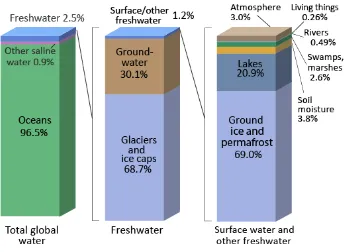
Figure 1.1: Distribution of Earth’s Water ... 2
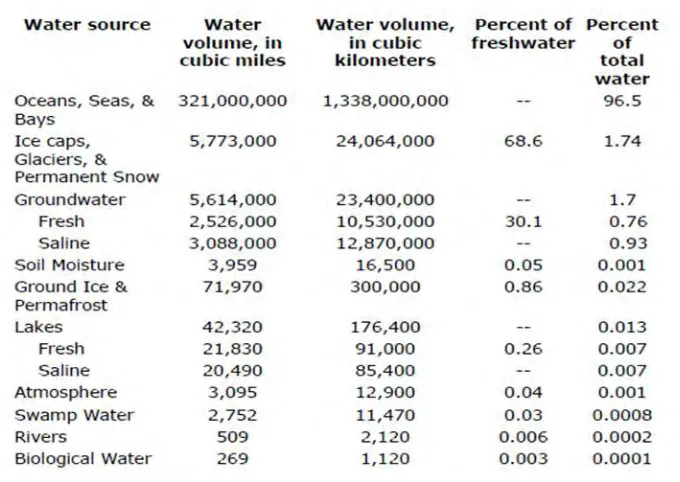
Figure 1.2: Estimate of Water Distribution ... 3
Figure 1.3: Water consumption in Malaysia for the year of 2014-2015 ... 3
Figure 2.1: Faucet ... 8
Figure 2.2: Types of Faucet ... 10
Figure 2.3: Types of Nozzle (Spraying Systems Co., 2000) ... 11
Figure 2.4: Air Atomizing Nozzle (Richard Et Al., 2011) ... 12
Figure 2.5: Hollow Cone Nozzle (Mare, 1984) ... 13
Figure 2.6: Flat Fan Nozzle (Lawson et al, 2003) ... 14
Figure 2.7: Full Cone Nozzle (Adee, 1974) ... 15
Figure 2.8: Turning or Lathe Machine ... 16
Figure 2.9: Turning Operation Process ... 17
Figure 2 10: Facing Operation Process ... 18
Figure 2.11: Grooving Operation Process ... 19
Figure 2.12: Cut Off Operation Process ... 20
Figure 2.13: Thread Cutting Operation Process ... 21
Figure 2.14: Drilling Operation Process ... 21
Figure 2.15: Boring Operation Process ... 22
Figure 2.16: Reaming Operation Process... 23
Figure 2.17: Tapping Operation Process ... 23
Figure 4.1: Concept Design 1 ... 37
Figure 4.2: Concept Design 2 ... 38
Figure 4.3: Concept Design 3 ... 39
Figure 4.4: Concept Design 1 using CAD Drawing ... 41
Figure 4.5: Concept Design 2 using CAD Drawing ... 42
xvi
Figure 4.7: Assembly Drawing of Water Saving Device for Ablutions ... 48
Figure 4.8: Exploded Drawing for Water Saving Device for Ablutions... 49
Figure 4.9: Prototype for water saving device for ablutions ... 52
Figure 4.10: Water rate for Malaysia Industry Guide 2016 ... 54
xvii
LIST OF ABBREVIATIONS, SYMBOLS AND
NOMENCLATURE
BDP - Bachelor’s Degree Project
FTK - Fakulti Teknologi Kejuruteraan
Gal - Gallon
H20 - Water
L - Litre
pcd - Per Capita Per Day
s - Second
1
CHAPTER 1
INTRODUCTION
1.0 Introduction
Chapter 1 is the framework of this project includes brief introduction about the distribution of water on earth, problem statement, objective and scope of this project.
1.1 Background of the Study
Water, hydrogen oxide, is a straightforward liquid which shapes the world's streams, lakes, seas and rain, and is the real constituent of the liquids of life forms. As a chemical compound, a water particle contains one oxygen and two hydrogen molecules that are connected by covalent bonds, H2O. Water is a fluid at standard ambient temperature and pressure, but it frequently coincides on Earth with its solid state, ice and gaseous state, steam (water vapor). It additionally exists as snow, haze, dew and cloud. (Reimann, 2006).
2 biological bodies and manufactured products. A greater amount of water is found in the world's interior.
Figure 1.1: Distribution of Earth’s Water
(Source: http://ga.water.usgs.gov/edu/watercycle.html 2/5/2016)
3 Figure 1.2: Estimate of Water Distribution
(Source: http://ga.water.usgs.gov/edu/watercycle.html 2/5/2016)
Figure 1.3: Water consumption in Malaysia for the year of 2014-2015 (Source:
[image:19.595.114.526.407.648.2]4 Figure 1.3 shows the water consumption in Malaysia for the year of 2014-2015. For the consumption of water in the state of Melaka it shows an increasing for domestic and non-domestic consumption of water.
Al Quran has stated that water was the beginning of the source of life, and from here we are as beings that have been given by God's wisdom mind can figure out the excess water and so can use these resources to a level that is more beneficial to all parties. And from water we made every living thing. (Surah Al-Anbiyak: 30). In other view, Allah has mentioned in Al-Quran that “Verily spendthrifts are brothers of Satan, and Satan is ever ungrateful to his Lord.” (Surah Al-Isra’, verse 27).
Water is viewed as a purifier in many religions. Water is commonly used in ritual washing (ablution) include Christianity, Hinduism, Islam, Judaism, the Rastafarians development, Shinto, Taoism, and Wicca. In Islam, the five daily prayers should be done by finishing washing certain parts of the body using clean water (wudu’), unless water is inaccessible for Muslims they can do Tayammum. In addition, a ritual bath in pure water is performed for the dead in many religions including Islam and Judaism.
In order to maintain the quantity of water, human nowadays need to reduce their used of water in daily live. Then the water saving device need to be produced to ensure there is no more waste water during ablutions process.
1.2 Problem Statement
5 It was narrated that the Prophet Muhammad S.A.W crossed Saad while performing ablution, then he asked: “Why are you extravagance like this, O Saad?” Saad asked: “Is the ablution also no term extravagance?” He said: “True , even though you are in a flowing river.” (Narrated by Ahmad R.A.). Actually the ablutions process followed by Islam is to make sure the all surface of skin is cover by water and by using not too much water. It is just to remove the dirty on skin before prayers. Thus, the solution for this problem is by build the water saving device during ablutions process. At the end of this project work the vision is to ensure there is no more waste of water during ablution process.
1.3 Project Objective
Based on the background and problem statement stated above, the objectives of this project are stated below:
1. To design water saving device during ablution process by using SolidWorks software.
2. To ensure water usage during ablution process much better.
1.4 Scope of Project
In order to achieve the objective of this project, several scopes have been identified:
1. Design concept of a faucet that can be used in making this water saving device for ablutions process.
6
CHAPTER 2
LITERATURE REVIEW
2.0 Introduction
Literature review purpose for this study is to review other research related to the study conducted in order to get the right idea and concept. Literature review also use in this study to obtain problem statement and to gain best and suitable methodology. With two thirds of the world's surface secured by water and the human body comprising of 75 per cent of it, it is apparently clear that water is one of the prime components in charge of life on earth.
7 problem, we should save our water usage at home or any other place to keep our fresh water enough during the El Nino phenomena.
Besides that in Al-Quran, Allah has mentioned that intend to save is very important in Islam. It was said in Al-Quran:
“Verily spendthrifts are brothers of Satan, and Satan is ever ungrateful to his Lord.” (Surah al - Isra ‘, verse 27).
Water saving device is the key to solve this problem and this paper will focus on study of faucets. A faucet is a device for delivering water from a plumbing system. It can consist of the following components: spout, handle(s), lift rod, cartridge, aerator, mixing chamber, and water inlets. When the handle is turned on, the valve opens and controls the water flow adjustment under any water or temperature condition. The faucet body is usually made of brass, though die-cast zinc and chrome-plated plastic are also used.
2.1 Faucets
A faucet is a device that allows water flow out from the plumbing system. Major component in this device is spout, handle, and lift rod, cartridge, aerator, mixing chamber, and water inlets. At the point when the handle is turned on, the valve opens and controls the water stream modification under any water or temperature condition. The faucet body is usually made of brass, though die-cast zinc and chrome-plated plastic are also used. The greater parts of residential faucets are single or double control cartridge faucets.
8 adults increases water use. Faucet use is also negatively related to the number of persons working outside the home and is lower for those who have an automatic dishwasher.
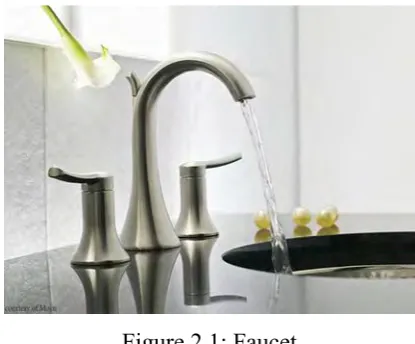
Figure 2.1: Faucet
(Source: http://www.moen.com/fina/_/N-1z141rc 31/7/2011)
There are four common types of faucets valve that are ball faucets, disc faucets, compression faucets, and cartridge faucets.
2.1.1 Ball Faucets