Symbol-Flipping Based Decoding of Generalized
Low-Density Parity-Check Codes Over
GF
(
q
)
Fang-Chun Kuo and Lajos Hanzo
School of Electronics and Computer Science, University of Southampton, SO17 1BJ, UK,
[email protected]
Abstract— An efficient symbol-flipping based decoding al-gorithm designed for nonbinary Generalized Low-Density Parity-Check (GLDPC) codes is proposed. By extending the concept of the Weighted Bit Flip Voting (WBFV) al-gorithm designed for binary Hamming-code based GLDPC codes, the symbol-flipping decoding algorithm can be ben-eficially employed for decoding the family of GLDPC codes constructed from nonbinary constituent codes, such as non-binary Bose Chaudhuri Hocquenghem (BCH) codes or Reed Solomon (RS) codes. The simulation results demonstrate that improvements of 1 dB and 2.7 dB are achieved by the proposed coding scheme in comparison to the more conven-tional binary GLDPC codes using the WBFV decoding algo-rithm, when using the Galois FieldGF(32)for communicat-ing over AWGN and uncorrelated Rayleigh fadcommunicat-ing channels, respectively.
I. Introduction
Low-Density Parity-Check (LDPC) codes were originally devised by Gallager [1] in the early 1960s, but have not
been exploited in practice until the 1990s [2, 3].
Dur-ing the past decade, however, LDPC codes have received substantial research attention as a benefit of their excel-lent performance and hence numerous new developments
have taken place in this area. As an evolution of
clas-sic LDPC codes [1], Generalized Low-Density Parity-Check (GLDPC) codes were introduced by Tanner [4] and then Hamming-code based GLDPC codes were further explored
by Boutros et al. [5] as well as by Lentmaier and
Zigan-girov [6]. GLDPC codes are constructed by replacing each single parity check of regular LDPC codes with the parity check matrix of a small linear block code referred to as the constituent code. It has been shown that Hamming-code based GLDPC codes are asymptotically good in the sense of minimum distance and exhibit an excellent performance over both AWGN and Rayleigh channels [5–7]. Pothier [8] also demonstrated that GLDPC codes can be considered as a generalization of product codes and as a benefit of their higher flexibility in terms of the selection of code length, GLPDC codes constitute a promising design alternative to replace product codes in many applications, such as dig-ital audio and TV broadcasting, high speed packet data transmission and deep space applications. Furthermore, the GLDPC decoder of a Hamming-code based scheme has a regular parallel structure, which renders them amenable to systolic array based practical integrated circuit (IC) im-plementations.
The financial support of the EPSRC, UK and the Euroepan Union in the framework of the NEWCOM and PHOENIX projects is grate-fully acknowledged.
In this paper, we investigate the attainable performance of symbol-based hard decision decoding algorithms
de-signed for GLDPC codes constructed over GF(q), since
there is a paucity of results on GLDPC codes employ-ing nonbinary constituent codes. By contrast, binary con-stituent codes have more often been used for constructing GLDPC codes [9–14]. Moreover, perhaps the best known classic codes are the maximum-minimum-distance nonbi-nary Reed Solomon (RS) codes, which are used in numer-ous standards, such as the Digital Audio Broadcast (DAB) and Digital Video Broadcast (DVB) schemes or in Com-pact Disc (CD) players. It might therefore be worth inves-tigating, how RS codes behave when they are embedded in GLDPC coding schemes. A particular further advantage of GLDPC codes is that their iterative decoding is based on the decoding of modest-complexity constituent codes, hence the total decoding complexity may be expected to be low.
For based hard decision decoding, a symbol-flipping algorithm is considered, which may be considered to be an extension of the bit-flipping algorithm [1, 11, 15]. A simple bit flipping scheme was originally proposed by Gallager for LDPC codes [1]. Based on the appealing con-ceptual and implementational simplicity of the bit-flipping algorithm, the Weighted Bit-Flipping (WBF) algorithm was developed in [15] for the sake of achieving an im-proved performance by exploiting some bit-reliability in-formation, which results in an attractive tradeoff between the achievable performance and the decoding complexity imposed [15]. The concept of bit flipping algorithms us-ing votes [11] was generalised for employment in GLDPC codes using binary Hamming constituent codes and hence it was termed as Weighted Bit Flip Voting (WBFV) [11]. Based on the philosophy of the WBFV algorithm devel-oped for binary Hamming-code based GLDPC codes, here we propose a symbol flipping algorithm for employment in nonbinary GLDPC codes. Similar to the WBFV algorithm of [11], the error correcting capability of the constituent codes is exploited for more accurately determining the po-sition of the least reliable symbols. However, in the context of the symbol-flipping algorithm, not only the error
posi-tions, but also the (q−1) legitimate error magnitudes have
nonbi-j
H :PCM of a super−codeCj, j=1,2,...,J
H0: PCM of a constituent code C0 (n,n−1) N = 12 n = 4
N−K = 9
π3
π2
00000000 00000000 00000000 00000000
11111111 11111111 11111111 11111111
000000000 000000000 000000000 000000000
111111111 111111111 111111111 111111111
00000000 00000000 00000000 00000000
11111111 11111111 11111111 11111111
0 0
0 0 0
0 0 0
0 0 0 0
0 0 0 1 1 1 1
0 1 1 1 1
0 0 0 0 0 0 0 0
0 0 1 1
1 1 0 0 0
0 0 0
1 1
1
1 1 1
1
1
0 0 0 0 0
0 0 0 0 0
0 0 0 0 0 0
1 0
0 1 1
1 1
1 1
1 1
1 1 1
0 0 0 0 0 0 0
0 0 0 0 0 0 0 0
0 0 0 0 0 0 0
1 1 1 1
J=3 submatrices of SPC (4,3) code H0
H
H
[image:2.595.86.251.42.202.2]H3 2 1
Fig. 1. Parity-check matrixH of anR=K/N = 1/4-rate LDPC (12,3) code havingJ= 3 levels, which uses the single parity check code SPC(4,3) as its constituent code.
PCM of constituent code C0(n,k)
2
π
0
H
0
H
0
H
πJ
N−K
n N
0
0
n − k
H2
HJ H1
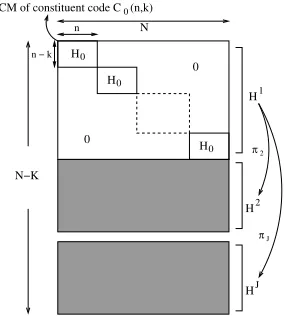
Fig. 2. Parity-check matrixHof a GLDPC (N, K) code
nary constituent code. We will provide simulation results to demonstrate that symbol-flipping algorithms can be suc-cessfully employed for the decoding of nonbinary GLDPC codes. We will also demonstrate that the proposed coding scheme results in an improved error rate performance in comparison to binary GLDPC codes using the WBFV de-coding algorithm of [11], when communicating over both AWGN and uncorrelated Rayleigh fading channels.
The remainder of this paper is organized as follows. In Section II, a brief review of GLDPC codes is provided. The symbol-flipping algorithm proposed for nonbinary GLDPC codes is outlined in Section III. Our simulation results are presented in Section IV and, finally, our conclusions are offered in Section V.
II. The Structure of GLDPC Codes
In this section, the structure of GLDPC codes is intro-duced [8]. There are two appealing ways of describing the structure of GLDPC codes. The first one is based on the construction of the Parity Check Matrix (PCM), which may be interpreted as an extension of the PCM of LDPC codes [1], while the other is based on the concept of Tanner graphs [4].
A. Description of the Parity-Check Matrix
Consider the example shown in Fig. 1, portraying the
PCM H of size 9×12 of a classic R = K/N-rate LDPC
(N, K) code [1] using the parameters N = 12, K = 3 and
J = 3, where H is constructed by concatenating J = 3
submatrices, namelyH1, H2andH3. The three
submatri-cesH1, H2andH3 seen in Fig. 1 are of dimension 3×12,
which are the PCMs of the super-codesC1, C2andC3,
re-spectively, that are constructed from the single parity check
(SPC) codes (n, n−1). More explicitly, the first
subma-trix H1 seen in Fig. 1 is a block diagonal matrix having
the matrix elements H0, which constitutes the PCMs of
the SPC(n, n−1) codes associated with n = 4 along its
main diagonal. Accordingly, each group of 4 bits
consti-tuting a codeword of the super-codeC1 is only related to
a SPC(4,3) code. Therefore, the super-code C1 is
con-stituted by the direct concatenation of N/n = 3
num-ber of SPC(4,3) codes, which are hence referred to as
the constituent codes C0 seen in the top third of Fig. 1.
All the other submatrices, namelyH2 andH3 are formed
by the pseudo-random permutation of all the columns of
the submatrixH1without interleaving the elements of the
columns. This operation is formulated asHj=πj(H1) for
j = 2,3, explicitly indicating that the super-codes C2, C3
are constructed by random interleaving the super-codeC1.
The codewordCis the intersection, i.e. the common
sym-bols of the super-codesC1, C2andC3. More explicitly, the
codeword C of the LDPC (N, K) code should be checked
by the PCM H, which is the concatenation of theJ = 3
PCMs of the super-codesC1, C2andC3, therefore we have
C·H1=C·H2=C·H3= 0.
This example of a classic LDPC code can be general-ized for the sake of constructing GLDPC codes. The SPC
(n, n−1) code is used as the constituent code, when
con-structing classic LDPC codes, while a more general class
of (n, k) block codes may be used as constituent codes,
when constructing GLDPC codes. As illustrated in Fig. 2,
the matrix H0 of dimension (n−k)×n is the PCM of
a constituent code C0(n, k). The first submatrix H1 of
the super-code C1 portrayed in the top segment of Fig. 2
produces the direct concatenation ofN/nnumber of
con-stituent codes C0(n, k) according to [8]. Hence we have
C1 = N/n
l=1 C0, where N is the codeword length of the
GLDPC (N, K) code andn is the codeword length of the
constituent code C0(n, k). Finally, the PCM H of the
GLDPC (N, K) code is constructed from the concatenation
of theJ number of submatrices (H1· · ·HJ), which are the
PCMs of the super-codes (C1· · ·CJ), respectively. Thus,
a GLDPC (N, K) code may be viewed as the intersection
C=Jj=1Cj of theJ super-codes [8]. Furthermore, since
the submatrices H2,· · · , HJ are derived by interleaving
the columns of the first submatrix H1, the codewords of
the super-codes Cj, j ∈ {2· · ·J} are constituted by
ran-dom permutations of the codewords of the super-codeC1,
which is expressed as Cj = πj(C1), where πj represents
[image:2.595.99.241.253.411.2]n = 4
SPC(4,3) Constituent code
The clump of
the super−code C1 the super−code CThe clump of 2 the super−code CThe clump of 3
degree = 3
degree =4
N = 12 encoded symbol nodes
[image:3.595.39.297.44.167.2]JN/n = 9 constitutent code nodes
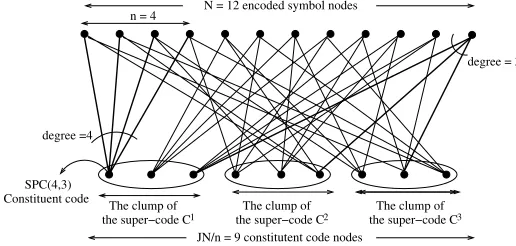
[image:3.595.47.242.174.312.2]Fig. 3. The bipartite graph of the LDPC (12,3) code using the PCM of Fig. 1.
...
...
...
...
C0(n,k)
super−code C of the The clump to J−th clump
to 1st clump
degree:J degree:n
constituent code
N symbol nodes JN/n constituent code nodes
J
Fig. 4. The bipartite graph of the GLDPC (N, K) code.
B. Graphical Concept
Fig. 3 portrays the bipartite graph of the classic LDPC
(12,3) code [1] defined in Fig. 1. As shown in Fig. 3,
the upper part contains N = 12 codeword symbol nodes,
while the lower part represents J ×N/n = 9 constituent
code nodes. The 9 constituent codes are simple binary
SPC (4,3) codes. An edge between a symbol node and
a constituent code node indicates that the corresponding symbol belongs to particular constituent code. Therefore, a 12-symbol word included in the upper part is a code-word of the resultant LDPC codes, if and only if the 9
lower nodes of 4 incoming symbols belong to the SPC (4,3)
codes. Furthermore, theJ = 3 edges stemming from every
single symbol node are connected to specific constituent code nodes belonging to different so-called clumps [8] of
super-codesC1,· · ·, C3. We can also see in Fig. 3 that the
degrees of the symbol node and constituent code node are
alwaysJ = 3 andn= 4, respectively, which are defined as
the number of the super-codes and the codeword length of
the constituent codeC0(n, k).
Similar to the classic LDPC code of Fig. 3, the graphical
representation of the GLDPC (N, K) code is depicted in
Fig. 4. The SPC (n, n−1) code is replaced by a more
gen-eral (n, k) block code used as the constituent codeC0. The
GLDPC code’s length is N symbols, which is the number
of symbol nodes in the left part of Fig. 4. The right part of
Fig. 4 holdsJ ×N/nconstituent code nodes. The degree
of the constituent code node is equal ton, while the
con-stituent code itself is defined asC0(n, k) in Fig. 4. The
de-gree of the symbol nodes isJ, which implies that every
sym-bol node is connected to J constituent codes represented
by J different clumps of super-codes Cj, j ∈ {2· · ·J},
re-spectively. In other words, every symbol is determined by
the J constituent codes, which belong to J super-codes,
respectively.
C. Summary
The code rate of a GLDPC code can be lower-bounded by observing its parity-check matrix as [8]:
R=K/N≥1−J(1−r0), (1)
where r0 denotes the code rate of the constituent code
C0(n, k), where the equality holds, when the parity-check
matrix H has full rank, i.e. when all of its rows are
in-dependent. In practice, πj is chosen at random, but by
avoiding that two (or more) symbol nodes are connected to
the sameJ constituent code nodes, since this would create
short cycles of length 4 in the Tanner graph [8].
More-over, GLDPC codes having J = 2 levels have the highest
possible code rate [8] as well as a low-complexity decoder structure, which are desirable properties in practical ap-plications. Thus, in our study, we consider only GLDPC
codes havingJ = 2 levels. Note that for practical (N,2, n)
GLDPC codes, it is only possible to construct a
meritori-ous PCMH in which no undesirable short cycles of length
4 appear in the graph, if we haveN/n≥n[16]. Therefore,
the (N,2, n) GLDPC codes should always satisfyN/n≥n.
III. Symbol-Flipping Based Decoding Algorithm
Given the definition of the GLDPC codes in terms of
J number of interleaved super-codes [5–7], the decoding
philosophy of theJ = 2-level GLDPC (N, K) code is
sim-ilar to that of the product code, where every symbol of
the GLDPC (N, K) codeword could be decoded by two
constituent codes, which belong to two independent
super-codes, respectively [5–7]. Accordingly, the WBFV [11]
algorithm decodes the GLDPC codes using an iterative method, in which a hard decision decoder is applied by
each constituent codeC0(n, k) and passes back n
individ-ual votes to the symbols it covers. The magnitude of a vote indicates how reliable a constituent code node con-siders the current symbol’s value to be. Here we extend the concept of the WBFV algorithm designed for the bi-nary Hamming-code based GLDPC codes [11] to symbol-flipping and invoke it for the GLDPC codes using either nonbinary BCH or RS constituent codes. Again, in the symbol-flipping algorithm not only the error positions, but
also the error magnitudes defined over GF(q) have to be
evaluated, where the algebraic decoders of the nonbinary constituent codes provide both the error positions as well as the error magnitudes.
For theJ = 2-level nonbinary GLDPC construction
em-ployed, allGF(q) symbols will belong to both of the (n, k)
constituent codes in the super-code C1 and C2,
respec-tively. Fig. 5 shows the symbols’ vote generation process for
the GLDPC (21,9) code constructed overGF(8) using the
constituent code RS (7,5). Note that for the sake of
of the symbol are generated by the Peterson-Gorenstein-Zierler (PGZ) or the Berlekamp-Massey (BM) [17] hard decision decoders (HDDs) of the RS constituent codes in
the super-code C1 and C2. In nonbinary HDDs, owing
to the limited error-correction capability of the RS code,
a decoding failure occurs, when the corrupted codeword is
not within the so-called decoding sphere of a valid code-word. Hence, for the nonbinary algebraic RS constituent decoders used in the symbol-flipping algorithm, there are three possible decoding scenarios, which are also featured in Fig. 5 and discussed below:
• All-zero syndromes: this implies the presence of a valid
(V) codeword, hence all thenconstituent RS code symbols
are labelled by the characterV.
• Non-zero syndromes and decoding success: this indicates
the presence of an invalid but correctable received word. Since successful decoding took place, the corresponding
er-ror positions are labelled withE indicating that the
sym-bols are in error. By contrast, the correct symbol label e
is assigned to all other symbols.
• Non-zero syndromes and decoding failure: no error
po-sitions were identified owing to decoding failure, therefore no corrective action may be carried out and no useful in-formation may be gleaned from this decoder. Hence all the
nRS code symbols of the codeword are also labelled bye,
similarly to the correctly received symbols of the correct decoding scenario.
To elaborate a little further, the various votes V, e, E
are given numerical values so that the votes arriving from
the J = 2 decoders for all the N = 21 symbols, which
are either V V,eV, EV, ee,eE orEE, may be ranked in
terms of their reliability according to the sum of theJ = 2
constituent votes. It was suggested in [11] that using the
weight of V = 0, e = 1 and E = 2 is capable of
produc-ing the lowest possible BERs, where havproduc-ing higher weights represents a lower reliability. Table I shows the weights of the various vote pairs adopted from Hirst and Honary [11] for our symbol-flipping algorithm. Noting that in our fu-ture research, we intend to specifically optimize the weights for nonbinary RS constituent codes operating over different
GFs. As depicted in Fig. 5, a vote pairEE indicates that
different error magnitudes were suggested by the J = 2
constituent decoders. In this case, we will randomly opt for the error magnitude suggested by one of the two con-stituent codes and re-calculate the corresponding weight,
which has to satisfy EE > EE > Ee. Accordingly, in
each decoding iteration, after ranking the vote weight of each symbol, the symbols deemed to be least reliable by the vote weights or confidence measures are then corrected according to the error magnitudes determined by the PGZ or BM HDDs.
Based on the above elaborations, the symbol-flipping aided decoding algorithm designed for the family of the GLDPC codes using nonbinary RS constituent codes is summarized as follows:
1. Invoke the PGZ or BM HDDs of the nonbinary RS
con-stituent codes, which belong to the super-codeC1andC2,
respectively.
vote pair EE vote pair EE`
vote pair ee vote pair eV
Decoding Failure All-zero Syndromes Decoding Success vote E
vote e vote V
RS (7,5) code
EE eV ee ee eV ee eV ee ee eV ee ee eV ee eV ee ee eV eeEE`
EM= 4 EM= 4 ee
EM= 1
EM= 6
The clump of super-code C1 The clump of super-code C2
[image:4.595.311.549.48.200.2]EM = Error Magnitude
Fig. 5. Example of the voting process for the J = 2-level
GLDPC (21,9) code constructed over GF(8) using the con-stituent RS(7,5) codes in one iteration. The 21 encoded symbol nodes are seen in the upper part, while the 6 constituent code nodes are portrayed in the lower part of the figure.
TABLE I
Vote Weights for the symbol-flipping based decoding algorithm for the nonbinary GLDPC codes [11].
V = 0, e= 1, E= 2
Vote pair EE EE Ee EV,ee eV V V
Vote weight 4 3.5 3 2 1 0
2. Compute the vote weight for each of theN symbols
ac-cording to Table I for the sake of quantifying the reliability of all symbols.
3. Rank the symbols according to their reliability based on their vote weights.
4. Correct the lowest reliability symbols, i.e. those having the maximum vote weights, according to the error
magni-tudes. If the vote pair assumes the values ofeeoreV, the
corresponding symbol will not be corrected, since no valid error magnitude was calculated.
5. Repeat steps (1) to (4). This process of symbol flipping
continues, until we either arrive at the vote pair V V for
all the N symbols or the maximum affordable number of
GLDPC iterations is reached.
IV. Simulation Results
Five nonbinary GLDPC codes defined over GF(32)
were employed in our simulations using BPSK
modula-3.0 3.5 4.0 4.5 5.0 5.5 6.0 6.5 7.0
Eb/N0(dB)
10-7
10-6
10-5
10-4
10-3
10-2
10-1
100
BER
Hamming(15,11), R = 0.467 Ns=8010, GF(2), iter = 30 RS(31,29), R = 0.871 RS(31,27), R = 0.742 RS(31,25), R = 0.613 RS(31,23), R = 0.484 RS(31,21), R = 0.355 Ns=1612, GF(32), iter = 20
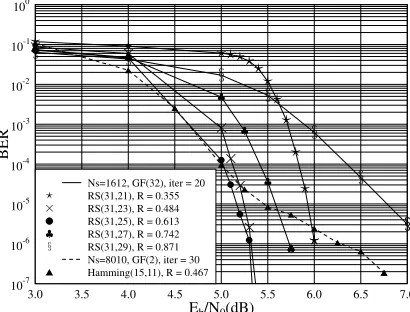
Fig. 6. BER performance of GLDPC codes using both linear Ham-ming and RS constituent codes. BPSK modulation is used when
communicating over anAWGN channel. The codeword length
[image:4.595.322.527.539.695.2]8 10 12 14 16 18 20 22
Eb/N0(dB)
10-7
10-6
10-5
10-4
10-3
10-2
10-1
100
BER
Hamming(15,11), R = 0.467 Ns=8010, GF(2), iter = 30 RS(31,29), R = 0.871 RS(31,27), R = 0.742 RS(31,25), R = 0.613 RS(31,23), R = 0.484 RS(31,21), R = 0.355 Ns=1612, GF(32), iter = 20
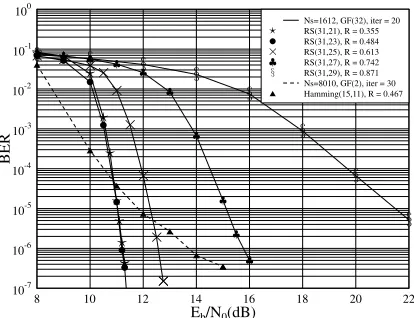
Fig. 7. BER performance of GLDPC codes using both linear Ham-ming and RS constituent codes. BPSK modulation is used when
communicating over an uncorrelated Rayleigh fading
chan-nel. The codeword length is around 8000 bits for all the codes of Table II.
TABLE II
Coding gain at a target BER of 10−5, extracted from the results shown in Fig. 6 and Fig. 7. BPSK modulation is used, when communicating over both AWGN and uncorrelated Rayleigh fading
(URF) channels.
Constituent code Rate Coding gain
AWGN URF
RS(31,21) 0.355 3.7 dB 33.0 dB
RS(31,23) 0.484 4.2 dB 33.0 dB
RS(31,25) 0.613 4.3 dB 31.8 dB
RS(31,27) 0.742 4.0 dB 28.9 dB
RS(31,29) 0.871 2.8 dB 22.8 dB
tion for communicating over both AWGN and uncorre-lated Rayleigh fading channels. All codes had a codeword
length of N = 1612 5-bit symbols defined over GF(32)
(8060 bits), and the RS codes (31,21), (31,23), (31,25),
(31,27), (31,29) were used as our constituent codes, which
have error correcting capabilities t = 5,4,3,2 and 1 5-bit
symbols, respectively. It can be observed in Fig. 6 that as expected, the GLPDC code using the RS (31,25) con-stituent code achieves the highest coding gain at a BER of
10−5, when communicating over an AWGN channel. On
the other hand, the best constituent code for the GLDPC
codes defined overGF(32) for transmission over an
uncor-related Rayleigh fading channel was seen in Fig. 7 to be the
RS (31,23) code, since it had the highest coding gain,
out-performing the RS (31,21) code, although the latter one
had the edge over the AWGN channel. A range of further conclusions can be drawn from Table II.
Our GLDPC scheme defined over GF(32) was also
benchmarked against a binary GLDPC code using the
(15,11) Hamming constituent codes, as shown in both
Fig. 6 and Fig. 7. At the BER of 10−6, the R = 0.
484-rate GLDPC code using the RS (31,21) constituent code
has an Eb/N0 improvement of 1 dB in comparison to the
R= 0.467-rate binary GLDPC code employing the (15,11)
Hamming constituent code, when communicating over an AWGN channel. By comparison, in uncorrelated Rayleigh
channels an Eb/N0 improvement of 2.7 dB was achieved
against the Hamming-code based benchmarker.
V. Conclusions
An efficient symbol-based hard decision aided decoding algorithm designed for nonbinary GLDPC codes was pro-posed, which evolved from the WBFV algorithm of [11]. The benefit of GLDPC codes is that they can be con-structed from short nonbinary constituent codes. The sim-ulation results demonstrated that GLDPC codes defined
over GF(q) have the potential of outperforming
similar-rate binary constituent codes. Improvements of 1 dB and 2.7 dB were achieved for a code rate around 0.47, when
us-ing GF(32) for communicating over AWGN and
uncorre-lated Rayleigh fading channels, respectively. Furthermore, the nonbinary GLPDC codes using the proposed symbol-flipping algorithm have exhibited no error floor. In our fu-ture research, we will consider the employment of the pro-posed codes in sophisticated system studies using unequal-protection multilevel codes and Fountain codes.
References
[1] R. G. Gallager,Low-Density Parity-Check Codes. Cambridge, MA: MIT Press, 1963.
[2] M. Sipser and D. A. Spielman, “Expander codes,”IEEE Trans-actions on Information Theory, vol. 42, no. 6, pp. 1710 – 1722, 1996.
[3] D. J. C. MacKay, “Good error-correcting codes based on very sparse matrices,” IEEE Transactions on Information Theory, vol. 45, no. 2, pp. 1710–1722, Mar. 1999.
[4] R. M. Tanner, “A recursive approach to low complexity codes,” IEEE Transactions on Information Theory, pp. 533 – 547, Sept. 1981.
[5] J. Boutros, O. Pothier, and G. Zemor, “Generalized low density (Tanner) codes,” inIEEE Internationl Conference on Commu-nications (ICC 1999), vol. 1, June 1999, pp. 441 – 445. [6] M. Lentmaier and K. S. Zigangirov, “On generalized low-density
parity-check codes based on Hamming component codes,”IEEE Communication Letters, vol. 3, no. 8, pp. 248 – 250, Aug. 1999. [7] O. Pothier, L. Brunel, and J. Boutros, “A low complexity fec scheme based on the intersection of interleaved block codes,” in Vehicular Technology Conference, 1999, pp. 274–278.
[8] O. Pothier, “Compound codes based on graphs and
their iterative decoding,” Ph.D. thesis, Ecole
Na-tionale Suprieure des Telecommunications, Jan. 2000,
http://www.comelec.enst.fr/ boutros/coding/.
[9] T. Zhang and K. Parhi, “A class of efficient-encoding gener-alized low-density parity-check codes,” in 2001 IEEE Interna-tional Conference on Acoustics, Speech and Signal Processing (ICASSP ’01), vol. 4, May 2001, pp. 2477 – 2480.
[10] ——, “High-performance, low-complexity decoding of general-ized low-density parity-check codes,” inIEEE Global Telecom-munications Conference, vol. 1, Nov. 2001, pp. 181 – 185. [11] S. Hirst and B. Honary, “Decoding of generalised low-density
parity-check codes using weighted bit-flip voting,”IEE Proceed-ings Communications, vol. 149, no. 1, pp. 1 – 5, Feb. 2002. [12] ——, “Application of efficient Chase algorithm in decoding of
generalized low-density parity-check codes,”IEEE Communica-tions Letters, vol. 6, no. 9, pp. 385 – 387, Sept. 2002.
[13] T. M. N. Ngatched and F. Takawira, “Efficient decoding of gen-eralized low-density parity-check codes based on long component codes,” in2003 IEEE Wireless Communications and Network-ing, vol. 1, March 2003, pp. 705 – 710.
[14] I. Djordjevic, O. Milenkovic, and B. Vasic, “Generalized low-density parity-check codes for optical communication systems,” Journal of Lightwave Technology, vol. 23, no. 5, pp. 1939 – 1946, May 2005.
[15] Y. Kou, S. Lin, and M. P. C. Fossorier, “Low-density parity-check codes based on finite geometries,”IEEE Transactions on Information Theory, vol. 47, pp. 2711–2736, Nov. 2001. [16] T. Zhang, “Efficient VLSI Architectures for Error-Correction
Codingh,” Ph.D. thesis, University of Minnesota, July 2002, www.ecse.rpi.edu/homepages/tzhang/RVSAL/research.html. [17] L. Hanzo, T. Liew, and B. L. Yeap,Turbo Coding, Turbo
[image:5.595.56.263.46.205.2]