UNIVERSITI TEKNIKAL MALAYSIA MELAKA
INVESTIGATION ON THE SUITABILITY OF
PLASTIC BOTTLE MATERIAL AS 3D PRINTER FILAMENT.
This report is submitted in accordance with the requirement of the Universiti Teknikal Malaysia Melaka (UTeM) for the Bachelor of Mechanical Engineering
Technology (Refrigeration and Air-Conditioning Systems) with Honours.
by
MUHAMMAD SYAHMI BIN ZAINAL KIFLI B071410326
941220-07
UNIVERSITI TEKNIKAL MALAYSIA MELAKA
BORANG PENGESAHAN STATUS LAPORAN PROJEK SARJANA MUDA
TAJUK: INVESTIGATION ON THE SUITABILITY OF PLASTIC BOTTLE MATERIAL AS 3D PRINTER FILAMENT.
SESI PENGAJIAN: 2017/18 Semester 1
Saya MUHAMMAD SYAHMI BIN ZAINAL KIFLI
mengaku membenarkan Laporan PSM ini disimpan di Perpustakaan Universiti Teknikal Malaysia Melaka (UTeM) dengan syarat-syarat kegunaan seperti berikut: 1. Laporan PSM adalah hak milik Universiti Teknikal Malaysia Melaka dan penulis. 2. Perpustakaan Universiti Teknikal Malaysia Melaka dibenarkan membuat salinan
untuk tujuan pengajian sahaja dengan izin penulis.
3. Perpustakaan dibenarkan membuat salinan laporan PSM ini sebagai bahan pertukaran antara institusi pengajian tinggi.
4. **Sila tandakan ( )
SULIT
TERHAD
TIDAK TERHAD
(Mengandungi maklumat yang berdarjah keselamatan atau kepentingan Malaysia sebagaimana yang termaktub dalam AKTA RAHSIA RASMI 1972)
(Mengandungi maklumat TERHAD yang telah ditentukan oleh organisasi/badan di mana penyelidikan dijalankan)
Alamat Tetap:
No 15, Lorong DJ 12,
Taman Desa Jaya 2, 26400, Bandar Jengka, Pahang
Tarikh: ________________________
Disahkan oleh:
Cop Rasmi:
I
DECLARATION
I hereby, declared this report entitled “INVESTIGATION ON THE
SUITABILITY OF PLASTIC BOTTLE MATERIAL AS 3D PRINTER FILAMENT.” is the results of my own research except as cited in references.
Signature : ……….
Author’s Name : ………
II
APPROVAL
This report is submitted to the Faculty of Engineering Technology of UTeM as a partial fulfillment of the requirements for the degree of Bachelor of Mechanical Engineering Technology (Refrigeration and Air-Conditioning System) with Honours. The member of the supervisory is as follow:
………
III
ABSTRAK
Tujuan kajian ini dijalankan adalah untuk membina filamen mesin pencetak 3D (tiga dimensi) menggunakan bahan buangan botol plastik. Kajian ini dilakukan dengan mengambil kira beberapa faktor seperti jenis botol minuman terbuang, suhu cairan botol minuman, kekuatan dan kekasaran permukaan produk yang dihasilkan. Terdapat tujuh jenis botol minuman atau plastik polimer yang sering diguna-pakai seluruh dunia. Namun kajian ini hanya memfokuskan kepada penghasilan filamen 3D menggunakan botol jenis High Density Polyethylene (HDPE). Penyataan masalah yang merujuk kepada kajian ini adalah lambakan bahan buangan daripada jenis botol minuman plastik dan tidak boleh mereput dengan mudah. Kaedah kitar semula yang sedia ada memerlukan kos yang tinggi kerana melibatkan pelbagai proses dan ianya tidak mesra alam. Objektif kajian ini adalah untuk menyediakan filament menggunakan bahan buangan botol plastik jenis HDPE. Seterusnya, adalah untuk menganalisis produk 3D yang dihasilkan menggunakan filamen yang dibuat. Objektif kajian yang terakhir adalah untuk menguji kesesuaian produk yang dihasilkan menggunakan filamen dengan beberapa jenis ujian seperti ujian kekuatan tegangan dan juga kekasaran permukaan. Cara penghasilan filamen ini adalah dengan menghancurkan bahan buangan plastik botol kepada serpihan kecil. Kemudian,
serpihan tersebut akan dimasukkan kedalam alat “filament extruder” untuk
menghasilakan filamen. Filamen yang dibuat kemudian akan digunakan oleh mesin pencetak 3D untuk mencetak produk 3D.
IV
ABSTRACT
The purpose of this research is to develop 3D printer filament using plastic bottle waste. This research is done by taking a few factors such as type of plastic bottle, plastic bottle melting temperature, strength and surface roughness of produce product. There are seven types of plastic polymer that popularly used around the globe but this research only focusing on developing 3D filament using High Density Polyethylene (HDPE) bottle. The problem statement that bring to this research is the excess volume of plastic bottle that stuck on landfills and cannot be dispose easily. The currently recycling method is high cost because its involve many process and not eco-friendly. The objective for this research is to prepare the 3D filament using plastic bottle waste HDPE type. Next objective is to analyze the 3D product that make from produce 3D filament. Last objective is to test the suitability of produce product using several tests such as tensile strength and surface roughness. The process to produce the 3D filament starts with shredding the plastic bottle waste into small fragments. Then, the fragments are feed into filament extruder to produce 3D filament. The produce filament then used on the 3D printer to print the 3D product.
V
DEDICATIONS
VI
ACKNOWLEDGMENTS
VII
Table of Contents
ABSTRAK...III
ABSTRACT... IV
DEDICATIONS ... V
ACKNOWLEDGMENTS ... VI
Table of Contents ... VII
List of figure ... IX
List of table ... X
CHAPTER 1 ...1
1.0 Introduction ...1
1.1 Background ...1
1.2 The purpose of the research ...3
1.3 Problem statement ...3
1.4 Objective and scope ...4
1.5 Proposed solution ...4
1.6 Summary ...5
CHAPTER 2 ...6
2.0 Introduction ...6
2.1 Plastic polymers ...6
2.1.1 Thermoplastic ...7
2.1.2 Thermosetting ...8
2.2 Plastic bottle ...8
2.2.1 Polyethylene Terephthalate (PET) ... 10
2.2.2 High Density Polyethylene (HDPE) ... 11
2.2.3 Polyvinyl Chloride (PVC) ... 12
2.2.4 Low Density Polyethylene (LDPE) ... 13
2.2.5 Polypropylene (PP) ... 14
VIII
2.2.7 Other plastics ... 16
2.3 Recycling paper ... 17
2.4 Recycling E-waste... 18
CHAPTER 3 ... 19
3.0 Introduction ... 19
3.1 Project flowchart ... 19
3.2 Collection HDPE plastic bottle waste ... 20
3.3 Cutting process ... 21
3.4 Extruding ... 22
3.4.1 Filament puller ... 24
3.5 Print 3D product ... 25
3.6 Testing and analysis ... 26
3.6.1 Tensile strength ... 26
3.6.2 Filament analysis ... 27
CHAPTER 4 ... 28
4.0 INTRODUCTION ... 28
4.1 FILAMENT EXTRUSION ... 28
4.2 EXTRUDER OPTIMIZATION ... 30
4.3 TENSILE STRENGTH TEST ... 31
4.4 Limitation of study ... 34
CHAPTER 5 ... 36
5.0 Introduction ... 36
5.1 Conclusion ... 36
5.2 Recommendation... 37
IX
List of figure
Figure 1: Thermoplastic polymer change into softened state. ... 7
Figure 2: Thermosetting plastic at high temperature bond. ... 8
Figure 3: World production of plastic materials by region on 2013. ... 9
Figure 4: Recycled logo for PET plastic type. ... 10
Figure 5: Recycle logo for HDPE plastic type. ... 11
Figure 6: Recycle logo for PVC plastic type. ... 12
Figure 7: Recycle logo for LDPE plastic type. ... 13
Figure 8: Molecular structure of PP. ... 14
Figure 9: Recycle logo for PP plastic type. ... 14
Figure 10: Molecular structure of Polystyrene. ... 15
Figure 11: Recycle logo for Polystyrene plastic type. ... 15
Figure 12: recycle logo for others plastic. ... 16
Figure 13: small flakes produce from cutting plastic bottle... 21
Figure 14: 3D printer filament ... 22
Figure 15: Filament extruder part. ... 23
Figure 16: Filastruder machine. ... 23
Figure 17: Filament puller electrical diagram. ... 24
Figure 18: Dog-bones 3D product design. ... 25
Figure 19: Open source 3D printer. ... 25
Figure 20: Tensile testing machine. ... 26
Figure 21: Filament extrusion without puller. ... 29
Figure 22: Filament extrusion with pulling system. ... 30
Figure 23: Conducted tensile strength test ... 31
Figure 24: HDPE vs ABS data comparison. ... 32
Figure 25: HDPE vs ABS data comparison on reducing tensile modulus. ... 33
X
List of table
1
CHAPTER 1
INTRODUCTION
1.0 Introduction
Introducing the Bachelor Degree Project (BDP), this chapter is written about this project tittle which is “Investigation on the suitability of plastic bottle material as 3D printer filaments”. This investigation is focusing on creating an eco-friendly filament which is produced from recycled plastic waste.
1.1 Background
There are many organization out there that focused-on recycling plastic bottle. However, the uses of plastic bottle have rapidly increasing years by years due to their ease of manufacture and low cost. The disposal process of plastic bottle is challenging because high amount of plastic is being accumulate. Organizations now are faces with the growing problem due to its very low biodegradability and it also comes in high quantity.
The largest components of plastic packaging or bottle waste is Polyethylene terephthalate (PET) following by high density polyethylene (HDPE) and polystyrene. These 3 types of plastic packaging are domination the world usage.
2 besides reusing it. Nowadays, scientist is recycling plastic waste in concrete since it has long service life and widely used which is the plastic waste is removed from the waste stream for a long period of time.
Plastic has its own properties which is suitable for using it as 3D filaments such as durable and corrosion resistant, it also a good isolation for cold, heat, and sound, has long lifetime and light weight. Therefore, in this research, recycling high density polyethylene (HDPE) and produce 3D filaments is proposed to realize the recycling process of polyethylene is green engineering forming technology. Moreover, it will be used in industrial and reducing the quantity of plastic waste around the world.
The process to recycling plastic waste into 3D printer feedstock or filaments is start with collection of plastic waste. Type of plastic waste that can be uses is high density polyethylene (HDPE), Polyethylene terephthalate (PET), Polyvinyl chloride (PVC), and other suitable plastic type. There are 7 types of plastic packaging but only some of them is suitable to recycling process because certain factor such as its density and contamination in plastic. After the collection process is done, the plastic packaging waste must be cleaned from contaminant to prevent defective in it physical properties. If the plastic packaging waste is bottle, the label on the bottle must be removed because the only material required is the plastic itself.
Shredding process then take place to shred the bottle into small pieces. The shredding bottle then enter the filament extruder machine and leaving the machine as 3D filaments. At first, the machine is only using to extrude the raw high-density polyethylene (HDPE) and form 3D filaments. But, this investigation is about the suitability of plastic packaging waste as 3D filaments.
3 1.2 The purpose of the research
The purpose of this research is to investigate the suitability of the plastic packaging or bottle into 3D printer filaments and create the 3D filament. High density polyethylene (HDPE) is characterize as relatively stiff with high tensile strength compare to the other polyethylene based material (American Chemistry Council, 2007). So, the HDPE is the most suitable material to produce filament and it is easy to obtain as this research is conducted by using plastic packaging waste such as plastic bottle. There are many commercial products in market that using HDPE as their plastic packaging.
There are many types of 3D filaments that currently used such as polylactic acid (PLA), Acrylonitrile Butadiene Styrene (ABS), copolyester (PETG) is upgrade version of polyethylene terephthalate (PET), polyamide or known as Nylon, and others. These materials have their own characteristic and physical properties. So, this research is conducted to test whether this type of material (HDPE) are suitable to use as 3D filaments of vice versa.
By the end of this research, a 3D printing product is produce and the surface roughness and tensile strength test is conducted compared to the 3D product that produce using current market filament. The process to produce it and testing on the product will be done to assure it suitability as 3D printer filament.
1.3 Problem statement
4 There are many plastic wastes that cannot be dispose and stuck on the landfills. To overcome this problem. Further investigation is performed to create more ways to recycling plastic waste and forming green engineering technology and helping to preserve the earth. Hence, that’s why this study has been conducted.
1.4 Objective and scope
Based on the research title “Investigation on the suitability of plastic bottle material as 3d printer filaments”, the objective below are pursued.
a) To determine the suitable parameter for extruding process.
b) To test whether it is suitable to use as 3D printer filaments by printing it on open sources 3D printer.
c) To comparing the mechanical properties of 3D product produces from
recycled HDPE filament and ABS filament using tensile strength test.
This study focused on the recycling process of high density polyethylene (HDPE) plastic bottle into 3D printer filaments. The scope in this study is HDPE plastic bottle, 3D filaments, and testing which is bending test and tensile strength test.
1.5 Proposed solution
Recycling is the best method to carry out this plastic waste management problem. But, recycle has many ways to done it such as, reusing it, reducing it and recycling it into another object. So, this study chooses the method of recycling it into another plastic thing which is 3D printer filaments. Nowadays, 3D filaments are high demand from the industry and for educational purposes. When recycling plastic waste into 3D filaments, the cost to create this filament is also reduce and reducing the plastic pollution.
5 1.6 Summary
Based on the raw material that will be used in this investigation, all material is easily obtained because the plastic waste can be collected free from anywhere. Shredding machine and filaments extruder also are available in university laboratories and widely use around Malaysia. Here, the temperature control play an important role as the plastic material has its own melting point. So, the further study need to know how to control the temperature to melting the plastic waste and not affect the earth pollution.
6
CHAPTER 2
LITERATURE REVIEW
2.0 Introduction
In this chapter, there are few briefing from a few journals and some other resources such as magazine, books, report and others on how the recycling plastic bottle into 3D filaments process, HDPE plastic bottle type properties, and some testing explanation.
2.1 Plastic polymers
7 2.1.1 Thermoplastic
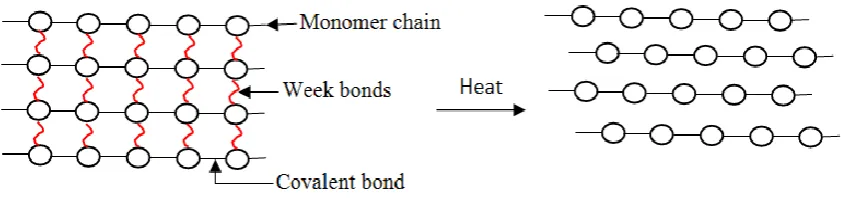
[image:19.595.117.538.291.392.2]Thermoplastic is a class of polymer, which can be effortlessly dissolved or softened by applying the high temperature to recycle the material. Thermoplastic have covalent bond interaction between monomer molecules. Furthermore, it has connection between polymer chain by weak van der wall interaction (Cowie, J. M. G.; Polymers: Chemistry and Physics of Modern Materials, Intertext Books, 1973). Figure below shown the interaction between molecules.
Figure 1: Thermoplastic polymer change into softened state.
(source:< http://pediaa.com/difference-between-thermoplastic-and-thermosetting-plastic>, 2017)
The softened thermoplastic can be placed in the mold and then cooled to produce desired shape. Therefore, the advantages of this polymers are easily recycled and remodel because each time it reheated it can change it form into desired shape. The plastic bottle that consumer use nowadays is polymers such as HDPE and PET plastic bottle.
8 2.1.2 Thermosetting
[image:20.595.113.545.331.411.2]Thermosetting has superior properties such as high warm solidness, high inflexibility, high dimensional strength, impervious to crawl or twisting under load, high electrical and warm protecting properties, and so forth. The thermosetting plastic has three-dimensional connection in covalent bond linked together between atoms and this is highly cross-linked polymers. This bond shows the resistance of the thermosetting plastic to high temperature which provide greater thermal stability compared to the thermoplastic. Therefore, this type of polymer cannot be recycled and reformed. The figure 2.1.2 shows the change between the molecules when the high temperature is applied.
Figure 2: Thermosetting plastic at high temperature bond.
2.2 Plastic bottle
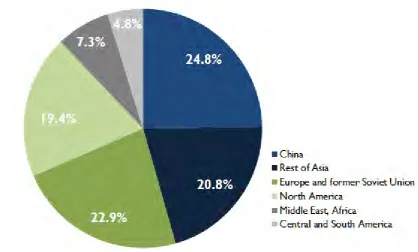
9 Density Polyethylene (LDPE), (5) Polypropylene (PP), (6) Polystyrene (PS) and (7) other plastics (Hammaad, 2005). Plastic bottle waste is everywhere and figure below show the quantity of plastic production around the world by region.
Figure 3: World production of plastic materials by region on 2013. (source: <
http://www.worldwatch.org/global-plastic-production-rises-recycling-lags-0 >)
10 2.2.1 Polyethylene Terephthalate (PET)
PET is abbreviation for Polyethylene Terephthalate from one of polymer groups out of seven. Polyethylene terephthalate (PET) has turned into the greatest bundling material worldwide for water and soft drinks bottles (Welle, 2011). The PET is one of the favorable polymers used worldwide because of its material properties also the unbreak ability and the low weight of the bottles contrasted with glass bottles of a similar filling volume. The amounts of PET plastic bottle usage around the globe are increasing and it may harm the earth environmental and green house effects. worries over environmental issues, asset preservation, and the advancement of recuperation innovation, recycling has turned into a key calculate the production network of PET bottle. Recycling of PET bottles not just can possibly monitor petroleum derivatives; however, it can likewise be reducing energy usage and greenhouse effects (Smithers Pira organization, 2012; Coelho, 2011).
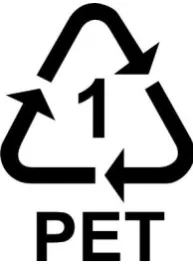
[image:22.595.270.367.530.665.2]PET plastic bottle mostly has number 1 logo label using coding system from U.S. and use in various country around the globe (D20 Committee, 2013). A press report published on 10 February 2003 in source weekly by Lilya says that there is possibly toxic substance migrate from PET plastic bottle into drinking water when reusing it. From this report, PET plastic bottle is not safe to reusing it again and again because of toxic presence. However, the PET plastic bottle cannot bear the high temperature of boiling water.
11 2.2.2 High Density Polyethylene (HDPE)
HDPE stands for High Density Polyethylene which is some of the polymers type. In construction industry, recycled HDPE fibers can be instrumental and creating a new value chain also contributing to environment performance. This is suggested by
all the findings from (Pe??i?? et al., 2016). It enough to tell the world that HDPE
plastic bottle is safe to use again and again or reuse it. HDPE plastic bottle has number 2 recycle logo which is considered as safe to use and low risk of leaching (Natural society 2013). All number 2 recycled logo is high density polyethylene (HDPE) type of plastic and mostly found in milk jugs, bleach bottle, juice bottle toiletries, butter tubs and many more.
Figure 5: Recycle logo for HDPE plastic type.
(Source: <https://ecosumo.wordpress.com/tag/no-2-recycling-symbol> June, 2009)
There are large quantity of readily available post-consumer waste of HDPE plastic and can create new value in circular economy through the production. From this waste stocks through one of the industrially established extrusion process, the
recycled HDPE fibers could be most economically produces (Pe??i?? et al., 2016).
12 2.2.3 Polyvinyl Chloride (PVC)
[image:24.595.249.392.316.503.2]PVC is broadly used in the cable industry, majority of them contain plasticizer or other natural added substance in order to enhance its flexibility (Suresh, Mohanty and Nayak, 2016). According to Mersiowsky et al., 2001 The phthalic acid esters (phthalates) were mostly used in the PVC mixtures because of its excellent plasticizing properties. PVC also has excellent transparency, chemical resistance, enduring stability and good stable electrical properties. PVC also used to make plastic container such as Tupperware, bottle, caps and others. PVC are widely used to make pipe which is known as PVC pipe and broadly used on building, residential area and others as water pipe or electrical wire insulation. PVC has recycled codes 3 as shown below.
Figure 6: Recycle logo for PVC plastic type.