0022-538X/11/$12.00 doi:10.1128/JVI.02307-10
Copyright © 2011, American Society for Microbiology. All Rights Reserved.
A 128-Base-Pair Sequence Containing the
pac1
and a Presumed Cryptic
pac2
Sequence Includes
cis
Elements Sufficient To Mediate
Efficient Genome Maturation of Human Cytomegalovirus
䌤
Jian Ben Wang and Michael A. McVoy*
Department of Pediatrics, Virginia Commonwealth University School of Medicine, 1101 E. Marshall Street, Richmond, Virginia 23298-0163
Received 4 November 2010/Accepted 14 February 2011
Herpesvirus DNA replication proceeds via concatemeric replicative intermediates that are comprised of head-to-tail linked genomes. Genome maturation is carried out by the terminase, an enzyme complex that mediates both the insertion of concatemer DNA into capsids and its subsequent cleavage to release genomes within these capsids. This cleavage is sequence specific, but the governingcis-acting DNA sequences are only partially characterized. Two highly conserved motifs, thepac1andpac2motifs, lie near the ends of herpesvirus genomes and are known to be critical for genome maturation. In murine cytomegalovirus, poorly conserved sequences distal to thepac2motif up to 150 bp from the point of cleavage are also important for cleavage. Here, we sought to identify the cleavage/packaging signals of human cytomegalovirus. Our results show that a previously proposedpac2-like poly(A) tract is dispensable for cleavage/packaging function and suggest that human cytomegalovirus may utilize a crypticpac2motif that lacks a poly(A) tract characteristic ofpac2motifs in other herpesviruses. Additional distal sequences 47 to 100 bp from the point of cleavage were found to enhance cleavage efficiency. These results should facilitate the identification oftrans-acting factors that bind to theseciselements and elucidation of their functions. Such information will be critical for understanding the molecular basis of this complex process.
Herpesviruses have large (130- to 235-kb) linear double-stranded DNA genomes that replicate via concatemeric inter-mediates consisting of head-to-tail linked genomes. An enzyme complex called terminase functions to package the concatem-ers into preformed capsids and cleave the DNA at precise locations to release unit-length genomes within the capsids (3). This process is thought to be governed in part by twocis-acting sequences, designated the pac1 and pac2 sequences, which were first identified as herpesvirus-conserved motifs located approximately 30 bp from opposite ends of herpesvirus ge-nomes (7). Typically,pac1motifs consist of 3- to 7-bp A- or T-rich regions flanked on each side by poly(C) tracts (7, 32), whereaspac2motifs consist of 5- to 10-bp A-rich regions (7). Subsequent studies of several viral systems suggest that both
pac1andpac2motifs play important roles in genome matura-tion (5–8, 11, 12, 21, 26, 31, 34, 38, 40).
In the simplest model, thepac1motif-containing end of one genome is fused to thepac2motif-containing end of the adja-cent genome in the concatemer. Hence,pac1andpac2motifs are about 60 bp apart, and cleavage occurs at a precise nucleo-tide position in between. The situation is more complex for viruses with class E genomes (27), such as herpes simplex virus 1 (HSV-1) and human cytomegalovirus (HCMV). In HSV-1, thepac1andpac2motifs lie near opposite ends of the terminal repeat, orasequence, that is present as a single copy adjacent to thecsequence at the short (S) segment terminus (ca), as one or more reiterated copies adjacent to thebsequence at the
long (L) segment terminus (anb), and as one or more copies in inverted orientation (relative to the terminalasequences) at the junction between the L and S segments (b⬘a⬘mc⬘) (28). For HSV-1, the observation that all genomes have at least onea
sequence at each end, yet are cleaved from concatemers that predominantly contain junctions with singleasequences, sug-gests thatasequences must first be duplicated by an unknown mechanism such that cleavage can occur between two adjacent
asequences.
Earlier efforts to identifyciscleavage/packaging sequences by insertion ofasequence subfragments into the HSV-1 ge-nome were problematic due to recombination between the subfragments and nativeasequences present in inverted ori-entation at L/S junctions (31). To avoid this problem, we chose to study murine cytomegalovirus (MCMV), which has a simple genome structure that lacks internal repeats and invertible elements (9, 24). We developed a system based on the premise that a second or “ectopic” cleavage site in the genome will function as an alternate to the natural cleavage site. However, because cleavage sites must be spaced nearly a genome length apart, genome packaging will occur in two frames: a natural frame in which cleavage occurs at natural cleavage sites and intervening ectopic sites are skipped over, and an ectopic frame in which cleavage occurs at ectopic cleavage sites and intervening natural sites are skipped over. Consequently, viri-ons will contain a mixture of two genome types: those cleaved at natural sites, having natural termini and uncleaved internal ectopic junctions, and those cleaved at ectopic sites, having ectopic termini and uncleaved internal natural junctions. If the ectopic sites function with the same efficiency as the natural sites, the ratio of the two genome types will be roughly equal, while mutations that reduce the efficiency of ectopic sites will shift the ratio to favor genomes cleaved at natural sites. There-* Corresponding author. Mailing address: Department of Pediatrics,
Medical College of Virginia Campus of Virginia Commonwealth Uni-versity, P.O. Box 980163, Richmond, VA 23298-0163. Phone: (804) 828-0132. Fax: (804) 828-6455. E-mail: [email protected].
䌤Published ahead of print on 23 February 2011.
4432
on November 7, 2019 by guest
http://jvi.asm.org/
gests that in HCMV, both c-a and a-a junctions represent functional cleavage sites. While both contain a typical pac1
element at oneasequence end, neither thecsequence end nor the otherasequence end (which opposes thepac1motif across the point of cleavage) contains an A-rich region characteristic ofpac2motifs. In 1989, Kemble and Mocarski suggested that
an ATAAAA motif might represent the HCMV pac2 motif
despite its unusual location 644 bp distal from the predicted
pac2 terminus (Fig. 1A) (15). Subsequently, however, a pro-posed “crypticpac2” element, which functions in DNA matu-ration and occupies the expected pac2 position yet lacks an A-rich region, was identified for guinea pig cytomegalovirus (21). This suggested that HCMV may have similar crypticpac2
elements located near thecandasequence ends. Partial ho-mologies betweena and csequences located an appropriate distance from their respective genomic termini were used to identify putative crypticpac2 elements that were designated
pac2aandpac2celements (Fig. 1A) (23).
With the advent of infectious bacterial artificial chromosome (BAC) clones of the HCMV genome, it became theoretically possible to delete the entire internalb⬘a⬘c⬘L/S junction region, producing an HCMV genome that lacks the internal inverted
asequences that were problematic for HSV-1 studies. This was achieved through BAC mutagenesis withEscherichia coli, and the resulting BAC gave rise to an HCMV mutant, HB15⌬L/S, that replicates with near wild-type efficiencyin vitrobut has a simple genome that does not undergo segment inversion (29). Here, we show that ectopic cleavage sites inserted into the HB15⌬L/S genome are cleaved efficiently and that the AT AAAA motif identified by Kemble and Mocarski (15) is dis-pensable for efficient cleavage and therefore does not repre-sent the HCMVpac2motif. We further show that the region opposite the pac1 motif predicted to contain a cryptic pac2
motif (23) is critically important for HCMV genome matura-tion.
MATERIALS AND METHODS
Recombinant virus construction and propagation.Construction of bacterial artificial chromosome (BAC) HB15⌬L/S from parental BAC HB15Tn7⌬k been previously described (29). Ectopic cleavage sites were inserted into plasmid pFastBac1 (Invitrogen) and shuttled into theattTn7site of HB15⌬L/S by Tn7-mediated site-specific transposition as described previously (10). The control virus HB15-t178b was derived by transposition of an expression cassette for enhanced green fluorescent protein (EGFP) into BAC HB15Tn7⌬k. Clones were screened for correct transposition as described previously (10). Human
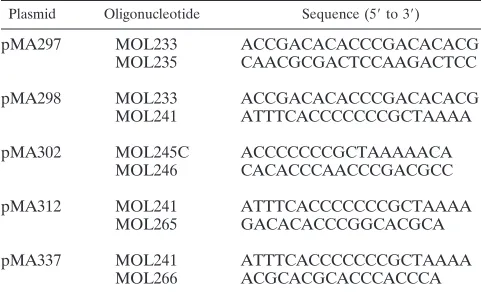
constructed by restricting pMA273 with PleI/BseYI, blunt ending as described above, and ligating into StuI-digested pFastBac1. Plasmids pMA297, pMA298, pMA302, pMA312, and pMA337 were constructed by PCR amplification of pMA273 DNA using the primers shown in Table 1, cloning the PCR products into pCR8/GW/TOPO (Invitrogen), and then moving the resulting inserts, con-tained in EcoRI fragments, into EcoRI-restricted pFastBac1.
Analysis of ectopic cleavage site function.Cells were infected at a multiplicity of infection (MOI) of⬃0.1. Ten days after infection, virion DNAs were purified from extracellular viral particles, restricted with PmeI, separated by agarose electrophoresis, transferred to nylon membranes, and hybridized using32
P-la-beled probes as described previously (22). The pFastBac1 probe consisted of NotI-digested pFastBac1 DNA. Probes s and l were BglII (s) or KpnI (l) frag-ments gel-purified from BglII- or KpnI-restricted pMA253 DNA (Fig. 1A). Autoradiographs of hybridized membranes were scanned as transparencies, and fragment intensities were quantitated as previously described (39). Percent cleav-age efficiencies were calculated using the formula (TS⫺background)/(J ⫺ background)⫻100, where TS is a terminal fragment and J is a junction.
RESULTS
Ectopically inserted tandem a sequences are cleaved effi-ciently.Previous studies have shown that L termini and L/S junctions of HCMV genomes can contain one to several a
sequences in tandem arrangement, while S termini generally contain one or, in some cases, no copies of theasequence (20, 33). It was therefore uncertain whether oneasequence or two in tandem would be needed for ectopic cleavage. A fragment containing two tandemly repeatedasequences derived from HCMV strain Towne was transposed into the attTn7 site of HB15⌬L/S to generate virus RC253. The ectopic Towne a
sequences differed somewhat from that of the native AD169a
sequences of HB15⌬L/S, but regions of partial homology and the location of the pac1 motif indicated that the ectopic a
sequences were inserted in direct orientation relative to the nativeasequences, as illustrated in Fig. 1A. Virus HB15-t178b, which has an expression cassette for EGFP transposed into the
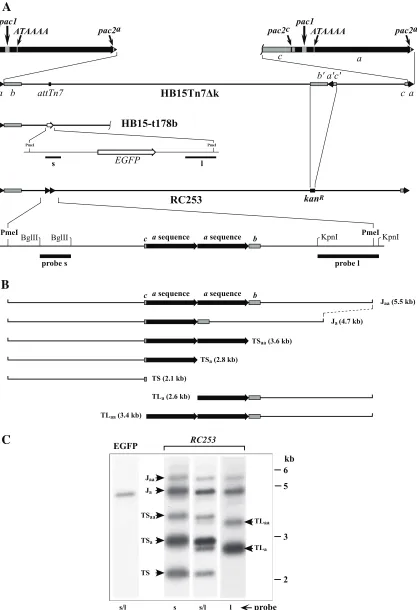
attTn7 site, as illustrated in Fig. 1A, was used as a control. Virion DNAs from viruses RC253 and HB15-t178b were di-gested with the restriction enzyme PmeI and analyzed by Southern hybridization. Figure 1B shows the ectopic cleavage site of RC253 as well as restriction fragments predicted from PmeI digestion of RC253 DNA representing ectopic junctions that retain two a sequences (Jaa) or one a sequence (Ja), ectopic S termini having zero (TS), one (TSa), or two terminal
asequences (TSaa), and ectopic L termini having one (TLa) or two terminalasequences (TLaa). L ends lacking anasequence
on November 7, 2019 by guest
FIG. 1. The HCMV ectopic cleavage site system. (A) The genome of wild-type BAC-derived virus HB15Tn7⌬k is shown at the top with terminalasequences (triangles) expanded above (black arrows) to illustrate the relative positions of putativeciselements. Below this are shown the genomes of virus HB15-t178b, illustrating the insertion of an EGFP expression cassette (open arrow) at theattTn7site, and RC253, illustrating the replacement of theb⬘a⬘c⬘segment with the Kanrgene (kanR) and ectopic insertion of twoasequences at theattTn7site. The RC253 ectopic
on November 7, 2019 by guest
http://jvi.asm.org/
were not predicted, as they are not observed at the native ends of normal HCMV genomes (20, 33).
The membrane was initially hybridized with a mixture of two probes, s and l, containing sequences derived from both sides of the ectopic cleavage site (probe locations are shown in Fig. 1A). As expected, the probe mixture hybridized with only one fragment in the control virus HB15-t178b, and its 5-kb size was consistent with the PmeI fragment predicted from this virus (Fig. 1C). In contrast, seven fragments were detected in RC253 DNA (Fig. 1C), and their sizes matched the sizes of the pre-dicted terminal and junction fragments illustrated in Fig. 1B. To confirm their identities, the membrane was stripped and sequentially rehybridized with probe s and then probe l. The results precisely matched the predictions for each fragment. Both probes hybridized to the 4.7- and 5.5-kb fragments pre-dicted to be junction fragments Jaand Jaa; probe l hybridized to the 2.6- and 3.4-kb fragments predicted to be TLaand TLaa and failed to detect the three TS fragments; and probe s hy-bridized to the 2.1-, 2.8-, and 3.6-kb fragments predicted to be TS, TSa, and TSaabut failed to detect either of the TL frag-ments (Fig. 1C). From these results, we conclude that during replication of RC253, most of the Jaajunctions present in BAC DNA were recombined to give rise to Jajunctions. One or both of these junctions were able to serve as cleavage packaging sites, giving rise to ectopic termini having various numbers of terminalasequences, precisely as observed previously for wild-type HCMV (20, 33).
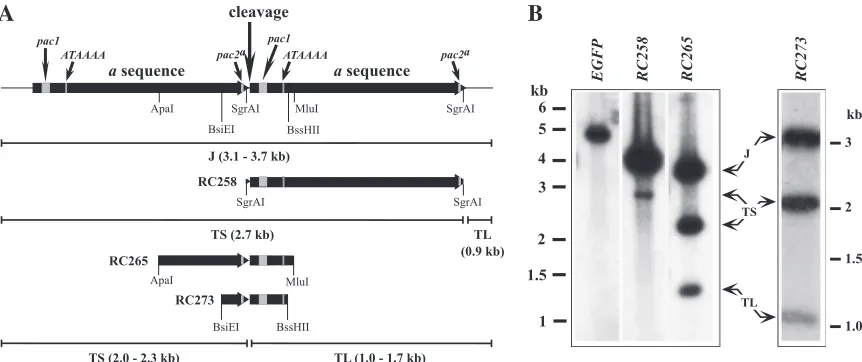
Fragments spanning the junction between twoasequences are cleaved efficiently.We next predicted that sequences span-ning the junction between twoasequences would be sufficient to mediate cleavage and would lack the complexity arising from multiple a sequences. Various restriction fragments, shown in Fig. 2A, were transposed into theattTn7site of BAC HB15⌬L/S, and the resulting viruses were assayed for cleavage
corresponding 911-bp TL fragment (Fig. 2B) even after ex-tended exposure (not shown). These results indicate that (i) the BsiEI-BssHII fragment is sufficient to mediate efficient cleavage and packaging, (ii) in the absence of thepac1motif, inefficient cleavage and packaging can occur via cleavage ad-jacent to thepac2amotif, and (iii) efficient cleavage and
pack-aging requires thepac1motif counterposed across the point of cleavage from thepac2amotif (or adjacent sequences).
The minimal functional cleavage site retains thepac1and
pac2a
motifs but not the ATAAAA motif. The BsiEI-BssHII fragment in virus RC273 consists of 234 nucleotides. Assigning the zero position to the point of cleavage, we numbered the nucleotides on thepac2aside from⫺1 to⫺100 and those on
the pac1side from ⫹1 to ⫹134 (Fig. 3A). Nested deletions, shown in Fig. 3A, were constructed and assayed for cleavage by Southern hybridization (Fig. 3B) as described above. To quan-tify the efficiency of ectopic cleavage, hybridization signals for J and TS were measured densitometrically and corrected for background. Cleavage efficiencies were then calculated as the ratios of TS to J signal intensities. This analysis revealed an 82% cleavage efficiency for the BsiEI-BssHII cleavage site in virus RC273. This high efficiency remained essentially un-changed in viruses RC297 and RC298 (77% and 76%, respec-tively), which lack sequences to the right of thepac1motif (Fig. 3A). These results demonstrate that virtually all sequences distal to the pac1 motif (nucleotides ⫹65 to ⫹134) are not important for HCMV DNA cleavage and packaging. As the
ATAAAAmotif is contained within this region, we conclude
that theATAAAAmotif is not involved in HCMV DNA cleav-age and packaging and hence cannot represent the HCMV
pac2motif.
Ectopic cleavage efficiency dropped precipitously as se-quences were deleted from thepac2aside of the cleavage site.
The 76% cleavage efficiency of virus RC298 decreased to 47%
cleavage site is expanded below to show the twoasequences (black arrows) with flanking partialbandcsequences (gray boxes). Fragments used as hybridization probes s and l are indicated by black bars. (B) Schematics illustrate restriction fragments predicted from PmeI digestion of RC253 DNA representing junctions (J) and terminal fragments (TS and TL) predicted to arise from cleavage at the ectopic locus. Predicted fragment sizes (kb) are in parentheses. (C) Virion DNAs from viruses HB15-t178b (EGFP) and RC253 were digested with PmeI, separated by agarose electrophoresis, transferred to a nylon membrane, and sequentially hybridized with probe s, probe l, or a mixture of s and l (s/l) as indicated below each lane. Fragment identifications (arrows) are based on molecular weights and probe hybridizations. The positions of DNA size standards are shown on the right.
on November 7, 2019 by guest
[image:4.585.42.283.82.229.2]when nucleotides⫺100 to⫺76 were deleted in virus RC312. No further decrease was observed when additional nucleotides, from⫺75 to⫺64, were deleted in virus RC315, but deletion of distal sequences through⫺47 in virus RC337 and through⫺32 in RC302 fully eliminated cleavage. These results suggest that (i) sequences in the⫺100 to⫺76 region, though not essential for cleavage, play a modest role in augmenting cleavage effi-ciency, (ii) sequences from⫺75 to⫺64 are not important for cleavage, and (iii) sequences in the region from⫺63 to⫺47 are crucial for cleavage site function.
DISCUSSION
Herpesvirus DNA maturation, including DNA translocation and site-specific cleavage, are critical for viral replication but are of no importance for cellular processes. Hence, they rep-resent attractive targets for antiviral development. Several compounds that inhibit DNA maturation have been identified (4, 13, 17, 35–37), and one, active against HCMV, has entered clinical trials (19). However, our understanding of herpesvirus DNA packaging at the molecular level remains fragmentary. Terminase clearly recognizes specific DNA sequences that di-rect both where to cleave and which end to insert into empty procapsids to initiate packaging. Evidence to date suggests that multiplecis-acting elements are involved, but these elements have not been precisely defined and it remains uncertain how or if different elements interact with different terminase sub-units to mediate different functions (e.g., initiation of packag-ing versus terminal cleavage).
The pac1 and pac2 cis-acting elements are well conserved
near the termini of herpesvirus genomes (7, 21). However, the
pac2element of HCMV has remained an enigma, as regions predicted to containpac2elements lack the poly(A) tract that is characteristic ofpac2elements from other viruses. While the
ATAAAAmotif identified by Kemble and Mocarski (15) has a
plausible pac2-like sequence, its location distal to the pac1
sequence is not consistent with the location ofpac2elements (opposite the point of cleavage from thepac1element) seen for other viruses. This led us to propose that, like guinea pig cytomegalovirus (21), HCMV uses crypticpac2elements that carry out the function(s) ofpac2 elements but lack the char-acteristic poly(A) tract (23). Moreover, because HCMV forms two types of short-arm ends (one ending with ca and one ending with c) we postulated the existence of two distinct crypticpac2elements and proposed putativeciselements, the
pac2a and pac2c elements, based on position and sequence
conservation between the two ends (23).
The work presented here clearly eliminates the ATAAAA
motif as having any involvement in DNA maturation. Indeed, there appear to be nocis-acting sequences distal to thepac1
element/⫹65 that are important to this process. This finding is fully consistent with our results from MCMV as well as those from HSV-1, where deletions, insertions, or substitutions of sequences distal to thepac1motif had little or no impact (12, 22, 34, 39). On the proposed crypticpac2side of the cleavage site, we found that sequences greater than 100 nucleotides from the point of cleavage are dispensable. Within the end-proximal 100 nucleotides, there are at least two regions of importance. The first, between⫺100 and⫺76, is nonessential but augments cleavage site efficiency nearly 2-fold. This is consistent with findings for other herpesviruses, including in-direct evidence for the existence of augmenting sequences at positions⫺101 to⫺78 of HSV-1 (12) and mutagenic evidence defining augmenting sequences within two regions for MCMV (⫺150 to ⫺127 and ⫺117 to ⫺101) (39) and at ⫺89/88 of varicella-zoster virus (14) (in each virus, nucleotides are num-bered negatively from thepac2end).
[image:5.585.76.507.69.250.2]The second region, from ⫺63 to⫺47, contains sequences essential for cleavage site function. Although these results nei-ther confirm nor preclude the existence of a crypticpac2(e.g., FIG. 2. Analysis of fragments spanning the junction between twoasequences. (A) Two adjacentasequences are shown to illustrate the positions of putativeciselements, thepac2a,pac1, andATAAAAelements, relative to the predicted point of cleavage. Restriction fragments shown
below were tested as ectopic cleavage sites. Lines with bars illustrate PmeI junctions (J) and terminal fragments (TS and TL) predicted to arise from cleavage at the ectopic loci. Sizes (kb) predicted for these fragments are shown in parentheses and vary slightly between sites. (B) Virion DNAs from viruses HB15-t178b (EGFP), RC258, RC265, and RC273 were digested with PmeI, separated by agarose electrophoresis, transferred to a nylon membrane, and hybridized with a probe consisting of radiolabeled pFastBac1 sequences. Arrows indicate J, TL, and TS fragments, and the positions of DNA size standards are shown to the left or right of each panel.
on November 7, 2019 by guest
http://jvi.asm.org/
pac2a) element within sequences proximal to ⫺47, they do
affirm the presence of criticalcis-acting sequences on this side of the cleavage site. Indeed, the fact that conserved sequences that include a CGCGGCG-like motif (CGCGGCT) lie adja-cent/distal to thepac2amotif (Fig. 3A, boxed regions) suggests
the possibility that the HCMV pac2 motif encompasses the
pac2a motif and these additional distal sequences, perhaps
extending into the⫺63 to⫺47 region. This hypothesis is sup-ported by the observation that a 6-bp insertion 1 bp distal to the MCMV pac2 poly(A) eliminates cleavage site function (22). In contrast,pac2-adjacent sequences are not important in HSV-1, as substitution mutants of its CGCGGCG motif or sequences immediately adjacent to thepac2poly(A) tract had no apparent impact on DNA cleavage or packaging (12, 34). Mutants with more detailed substitutions will be needed to directly demonstrate the importance of HCMV sequences proximal to position⫺47.
Curiously, the presence of TS fragments within virions (Fig.
1B) would seem to contradict the above results derived using
a-ajunctions. The latter clearly demonstrate the importance of sequences greater than 46 nucleotides from the point cleavage, while the fact that only 34 bp ofcsequence are present in the RC253 cleavage site suggests that cleavage and packaging of genomes with TS ends does not require thepac2celement or
paralogs of the distalciselements identified above. Perhaps the key to this contradiction is the context: one experiment in-volves full a sequences, while the other involves small frag-ments spanninga-ajunctions. Thus,ciselements required for cleavage at c-aora-a junctions may be different from those required for cleavage when a fullasequence is present anda
sequence duplication is presumably occurring.
As our studies examined the contents of extracellular viri-ons, they reveal only theciselements essential for the complete process and cannot differentiate distinct functions. However, other studies support models in which thepac1 andpac2 se-quences govern formation of their respective termini, while FIG. 3. Nested deletions of the ectopic cleavage site. (A) The full sequence of the BsiEI-BssHII fragment is shown with a dash (–) indicating the point of cleavage. Nucleotides to the left are numbered⫺1 to⫺100, and nucleotides to the right are numbered⫹1 to⫹134. Putativecis
packaging elements, thepac2a,pac1, andATAAAAelements, are shown in bold. A conserved block (dashed box) and sequences similar to
CGCGGCG motifs (on the complementary strand; solid box) were identified in a prior study (23). Sequences below represent cleavage sites introduced into recombinant viruses. The nucleotide positions for left and right ends of each construct are in parentheses. (B) Virion DNAs from the indicated viruses were digested with PmeI, separated by agarose electrophoresis, transferred to a nylon membrane, and hybridized with a probe consisting of radiolabeled pFastBac1 sequences. Arrows indicate J, TS, and TL fragments. Below each lane are the ectopic cleavage site efficiencies that were calculated from densitometric measurements of J and TS fragment intensities of each virus. The positions of DNA size standards are shown on the left.
on November 7, 2019 by guest
pac2and/or associated sequences direct the insertion of con-catemer ends into procapsids to initiate packaging (12, 23, 30, 34, 38). Consistent with this, virus RC258 produced a small number of TS fragments in the absence of detectable TL frag-ments, suggesting that cleavage can occur adjacent to thepac2a
element in the absence of a counterposingpac1element, but of the two ends that are formed, only those containing thepac2a
element are packaged into virions. This is highly reminiscent of results described by Tong and Stow, in which cells infected by HSV-1 mutants lacking thepac1 motif formed both genome ends, but only thepac2-containing ends were protected from nuclease and hence presumably packaged (34). If indeedcis
sequences are required for insertion of concatemer ends into procapsids, the detection of TS ends with noa sequence in virions suggests that such sequences lie within the terminal 34 bp of thecsequence. It is interesting to note that analogous HSV-1 sequences (⫺1 to ⫺20) comprising the DR1 repeat were recently shown to be crucial for genome maturation (34). This suggests the intriguing possibility that while thepac2 mo-tif may mediate formation of concatemer ends, the extreme terminal sequences of these ends may govern concatemer/pro-capsid docking and/or initiation of DNA packaging. Future studies examining packaged and unpackaged intracellular viral DNA species formed by our mutants may yield additional clues to the unique functions of specificcis-acting sequences.
An accurate delineation of the cis elements required for DNA maturation should facilitate identification of functional interactions betweenciselements and terminase, its subunits, or other proteins involved in genome maturation. Whilepac1
binding has been reported for terminase subunits UL28 of HSV-1 (1) and UL56 of HCMV (2), protein interactions with
pac2elements have been difficult to demonstrate. Prior reports showing binding to theATAAAAmotif by proteins in HCMV-infected cells (2), HCMV UL56 (2), or an unidentified cellular protein (15) must now be considered irrelevant to DNA pack-aging in light of our finding that theATAAAAmotif is dispens-able. Nevertheless, future efforts to demonstrate sequence-specific DNA cleavage or relevant DNA-protein interactions will benefit greatly from a detailed understanding of the func-tionalciselements required for this process.
ACKNOWLEDGMENTS
We are grateful to Gabriella Hahn for providing BAC HB15Tn7⌬k and to Edward Mocarski for plasmid pON232.
This work was supported by Public Health Services grants R01AI46668 and R21AI43527 (to M.A.M.).
REFERENCES
1.Adelman, K., B. Salmon, and J. D. Baines.2001. Herpes simplex virus DNA packaging sequences adopt novel structures that are specifically recognized by a component of the cleavage and packaging machinery. Proc. Natl. Acad. Sci. U. S. A.98:3086–3091.
2.Bogner, E., K. Radsak, and M. F. Stinski.1998. The gene product of human cytomegalovirus open reading frame UL56 binds the pac motif and has specific nuclease activity. J. Virol.72:2259–2264.
3.Brown, J. C., M. A. McVoy, and F. L. Homa.2002. Packaging DNA into herpesvirus capsids.p. 111–153.InE. Bogner and A. Holzenburg (ed.), Struc-ture-function relationships of human pathogenic viruses. Kluwer Academic/ Plenum Publishers, London, United Kingdom.
4.Buerger, I., et al.2001. A novel nonnucleoside inhibitor specifically targets cytomegalovirus DNA maturation via the UL89 and UL56 gene products. J. Virol.75:9077–9086.
5.Chowdhury, S. I., H. J. Buhk, H. Ludwig, and W. Hammerschmidt.1990. Genomic termini of equine herpesvirus 1. J. Virol.64:873–880.
6.Davison, A. J.1984. Structure of the genome termini of varicella-zoster virus. J. Gen. Virol.65:1969–1977.
7.Deiss, L. P., J. Chou, and N. Frenkel.1986. Functional domains within the a sequence involved in the cleavage-packaging of herpes simplex virus DNA. J. Virol.59:605–618.
8.Deiss, L. P., and N. Frenkel.1986. Herpes simplex virus amplicon: cleavage of concatemeric DNA is linked to packaging and involves amplification of the terminally reiterated a sequence. J. Virol.57:933–941.
9.Ebeling, A., G. M. Keil, E. Knust, and U. H. Koszinowski.1983. Molecular cloning and physical mapping of murine cytomegalovirus DNA. J. Virol. 47:421–433.
10.Hahn, G., M. Jarosch, J. B. Wang, C. Berbes, and M. A. McVoy.2003. Tn7-mediated introduction of DNA sequences into bacmid-cloned cytomeg-alovirus genomes for rapid recombinant virus construction. J. Virol. Meth-ods107:185–194.
11.Hammerschmidt, W., H. Ludwig, and H. J. Buhk.1988. Specificity of cleav-age in replicative-form DNA of bovine herpesvirus 1. J. Virol.62:1355–1363. 12.Hodge, P. D., and N. D. Stow.2001. Effects of mutations within the herpes simplex virus type 1 DNA encapsidation signal on packaging efficiency. J. Virol.75:8977–8986.
13.Hwang, J. S., et al.2007. Identification of acetylated, tetrahalogenated benz-imidazoleD-ribonucleosides with enhanced activity against human cytomeg-alovirus. J. Virol.81:11604–11611.
14.Kaufer, B. B., B. Smejkal, and N. Osterrieder.2010. The varicella-zoster virus ORFS/L (ORF0) gene is required for efficient viral replication and contains an element involved in DNA cleavage. J. Virol.84:11661–11669. 15.Kemble, G. W., and E. S. Mocarski.1989. A host cell protein binds to a
highly conserved sequence element (pac-2) within the cytomegalovirus a sequence. J. Virol.63:4715–4728.
16.Kilpatrick, B. A., and E. S. Huang.1977. Human cytomegalovirus genome: partial denaturation map and organization of genome sequences. J. Virol. 24:261–276.
17.Krosky, P. M., et al.1998. Resistance of human cytomegalovirus to benz-imidazole ribonucleosides maps to two open reading frames: UL89 and UL56. J. Virol.72:4721–4728.
18.LaFemina, R. L., and G. S. Hayward.1980. Structural organization of the DNA molecules from human cytomegalovirus, p. 39–55.In B. N. Fields and R. Jaenisch (ed.), Animal virus genetics. Academic Press, New York, NY.
19.Lischka, P., and H. Zimmermann.2008. Antiviral strategies to combat cy-tomegalovirus infections in transplant recipients. Curr. Opin. Pharmacol. 8:541–548.
20.McVoy, M. A., and D. E. Nixon.2005. Impact of 2-bromo-5,6-dichloro-1-beta-D-ribofuranosyl benzimidazole riboside and inhibitors of DNA, RNA,
and protein synthesis on human cytomegalovirus genome maturation. J. Vi-rol.79:11115–11127.
21.McVoy, M. A., D. E. Nixon, and S. P. Adler. 1997. Circularization and cleavage of guinea pig cytomegalovirus genomes. J. Virol.71:4209–4217. 22.McVoy, M. A., D. E. Nixon, S. P. Adler, and E. S. Mocarski.1998. Sequences
within the herpesvirus-conserved pac1 and pac2 motifs are required for cleavage and packaging of the murine cytomegalovirus genome. J. Virol. 72:48–56.
23.McVoy, M. A., D. E. Nixon, J. K. Hur, and S. P. Adler.2000. The ends on herpesvirus DNA replicative concatemers contain pac2 cis cleavage/packag-ing elements and their formation is controlled by terminal cis sequences. J. Virol.74:1587–1592.
24.Mercer, J. A., J. R. Marks, and D. H. Spector.1983. Molecular cloning and restriction endonuclease mapping of the murine cytomegalovirus genome (Smith strain). Virology129:94–106.
25.Mocarski, E. S., A. C. Liu, and R. R. Spaete.1987. Structure and variability of the a sequence in the genome of human cytomegalovirus (Towne strain). J. Gen. Virol.68:2223–2230.
26.Nasseri, M., and E. S. Mocarski.1988. The cleavage recognition signal is contained within sequences surrounding an a-a junction in herpes simplex virus DNA. Virology167:25–30.
27.Roizman, B., and P. E. Pellett.2001. The family of Herpesviridae: a brief introduction, p. 2381–2397.InD. M. Knipe and P. M. Howley (ed.), Fields virology. Lippincott Williams and Wilkins, Philadelphia, PA.
28.Roizman, B., and A. E. Sears.1996. Herpes simplex viruses and their repli-cation, p. 1048–1066.InB. N. Fields et al. (ed.), Fundamental virology. Raven Press, New York, NY.
29.Sauer, A., J. B. Wang, G. Hahn, and M. A. McVoy. 2010. A human cytomegalovirus deleted of internal repeats replicates with near wild type efficiency but fails to undergo genome isomerization. Virology401: 90–95.
30.Schynts, F., et al.2003. The structures of bovine herpesvirus 1 virion and concatemeric DNA: implications for cleavage and packaging of herpesvirus genomes. Virology314:326–335.
31.Smiley, J. R., J. Duncan, and M. Howes.1990. Sequence requirements for DNA rearrangements induced by the terminal repeat of herpes simplex virus type 1 KOS DNA. J. Virol.64:5036–5050.
32.Tamashiro, J. C., D. Filpula, T. Friedmann, and D. H. Spector.1984. Struc-ture of the heterogeneous L-S junction region of human cytomegalovirus strain AD169 DNA. J. Virol.52:541–548.