Caring dialogue: A step toward realising the dream of
online learning communities
Jennie Swann Centre for Learning and Teaching AUT University
Peter Albion
School of Teacher Education and Early Childhood University of Southern Queensland
Online educators dream of facilitating interpersonal interactions equivalent to those in face-to-face classrooms as an important factor for promoting learning in online classes. Many current
university students are comfortable with online networks as social spaces where they interact with family and friends, but they need help in making them effective as places of learning. A design research study found that the caring dimension of Lipman’s (2003) community of inquiry was fundamental to supporting the critical and creative dialogues necessary for development of higher order thinking. It developed and refined an interactive website that may support online educators in realizing the dream of building relationships that more effectively support learning.
Keywords: Community of inquiry, dialogue, mindfulness, caring
Interaction and online learning
Our digital native students may be able to use technologies, but that does not mean they can learn from them. Being able to read and write never meant you could therefore learn from books (Laurillard, 2013, p. xvii).
Moore (1989) noted that interaction in distance education courses could be with content, instructors, and peers. At that time most distance education was conducted using printed materials that facilitated interaction of learner with content. Interaction with the instructor was mostly by written correspondence or occasional teleconference. Moore commented on the coming challenge presented by enhanced opportunities for interaction among learners being presented by then emerging forms of computer-mediated communication. In subsequent writing he articulated the theory of transactional distance in which the distance in distance education came to be seen as being psychological rather than geographical (Moore, 1993) and argued for the potential of technologies to reduce transactional distance and thereby enhance learning.
At the time Moore was writing, the prospect of inexpensive and instantaneous communication to support distance learning through learner-instructor and learner-learner communication must have seemed like a dream. Successive generations of computer hardware and software have increased the options for online
communication but there is still much to be learned about how best to select technologies and arrange activities to support learning through these systems. At each step the prospect of a ‘perfect’ system appears to recede into the distance like a dream or shimmering mirage.
in an interaction) and of consequent interpersonal relationships influenced their motivation for participation in online discussions. The social presence factors with most effect were those related to course work, with social interactions being rated as less important. That is, learners appreciated interaction that advanced their learning purposefully. A form of virtuous circle emerged in which participation encouraged participation making it easier to maintain momentum once discussions were initiated.
More recently, Zingaro and Oztok (2012) researched quantitative predictors of interaction in an asynchronous online course and reported that longer notes, those posted early in a discussion period, and those that included questions were more likely to attract replies. Once again there appears to be a focus on learning through the discussion rather than merely social interaction and a tendency for participation to be reciprocated.
York and Richardson (2012) described interaction as a “critical factor that impacts student learning and motivation to learn in online courses” (p. 83) and noted that research had demonstrated that online courses lacking “substantive and meaningful interaction” contributed to feelings of isolation, dissatisfied learners, and dropouts. They discussed various typologies of interactions, including the learner-learner, learner-instructor, and learner-content types proposed by Moore (1989) as background to a qualitative study that investigated the approaches that experienced online instructors used to influence interpersonal interaction in their online courses.
The driver for the research study reported in this paper was that, although many of today’s university students can operate comfortably within digital networks, as Laurillard says, they need help in learning how to learn in them. A theory-based digital “artefact” was developed and tested using a design research methodology. The theoretical model was based on a community of inquiry approach (Swann, 2010). This paper is focused on the caring aspect of the community of inquiry model, as this was found to be fundamental to the success of the critical and creative thinking and dialogue fostered in this approach and hence to realisation of the dream of more effective interaction for learning in online environments.
A community of inquiry
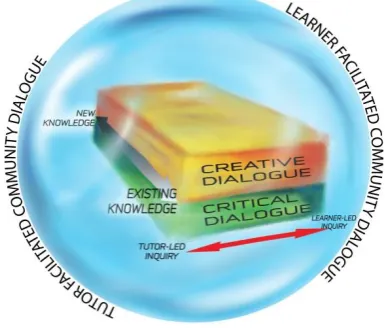
[image:2.595.215.408.575.739.2]Lipman’s work with children was cited as an influence in the development of the most commonly-used community of inquiry model in online learning (Garrison, Anderson, & Archer, 1999). For Lipman it was essential that students felt able to express their ideas in a class which no doubt had its own internal network of relationships, friendship groups, in-groups, out-groups, power relationships and so on. For this reason Lipman included caring thinking, in order to develop in the children a respect for the ideas of others. These notions fit well with the central tenets of adult education articulated by Brookfield (2003) among others. Wegerif’s (2007) version of Lipman’s (2003) community of inquiry model brought its dialogic elements to the fore in ways which were directly relevant to the facilitation of inquiry online through asynchronous media. However, the findings of the first iteration of this research study illustrated the importance of exploring the nature of the shift of control over an inquiry from tutor to students, so Wegerif’s model was redrawn to encompass the two dimensions of control over the inquiry and disciplinary understandings of knowledge provided by the Sheffield IBL model (Levy, Little, McKinney, Nibbs, & Wood, 2010; Levy & Petrulis, 2012); and reflection on the findings of all three iterations, supported by the work of Davey (2006), led to the encompassing of critical and creative dialogue within community dialogue. This is shown in Figure 1 below.
Community dialogue
A community is generally thought of as made up of people who have something in common, and in a
community of inquiry, it is the inquiry which holds it together. As applied to tertiary education, this community of inquiry might be seen as an example of a “rational community” (Biesta, 2004) in that its members are expected to engage in, or develop, the “serious speech” associated with the professions which the students hope to join. However, an online community in a formal educational setting is an artificial thing. Such a community is made up of people who have come together not necessarily voluntarily through some identified common interest, but as a result of their involvement in a course or programme. As a result, not all members have necessarily learned the language and thought processes of the dominant discourse. Those with different backgrounds may be “strangers” in the community. Strangers in this context “are those who do not fit the cognitive, moral, or aesthetic map of the world” (Bauman, 1995, p. 200 quoted in Biesta, 2004).
Such a community of inquiry must make space for the people “who have nothing in common” (Lingis, 1994) within the rational community, and this requires a different view of dialogue, a different power structure. In a rational community it is what we say which is important. In the adversarial world of some forms of
argumentation it is how we say it which is important (Tannen, 1998). In Lingis’s “other” community there may be no shared axioms, no shared discourse, or only a partial overlap. In a dialogic learning community it is important to build a shared language, but if the learning in this community is to be for the 21st century, the shared language must not be only that of the dominant group, since this merely perpetuates the power structures and thought patterns of the elite. Yet if there is no common language, what voice can the “insiders” use to communicate with the “outsiders”? Biesta argues that we can only truly communicate with the strangers in our rational communities by letting go of the rational discourse and using our own authentic voices. This is in addition to, rather than jettisoning, rational discourse, which has immense value for learning and for dialogue about the local, national and international issues which concern us all.
This may sound idealistic, but it is possible for a learner to be aware of and to understand the dominant
discourse without necessarily subscribing to its values, as Flecha demonstrated in his literacy work with Spanish factory workers in Barcelona (Flecha, 2000).
Mindful, or caring, thinking
Understanding something well enough to be able to make a reasonable judgement about it goes beyond critical thinking. It also requires imagination about what might lie beyond what is currently known (Sprod, 2001, p. 16) and this broadening of the dialogue cannot be achieved unless the members of the community respect each other, and each other’s views (Brookfield, 1986). Respect is not the same as agreement. There may be major differences in values or belief systems within a community of learners on a particular course, and
acknowledging others’ beliefs requires the temporary setting-aside of one’s own, which may be deeply rooted. Shared understanding requires consideration of other perspectives, including those which challenge one’s own and in this, relationships are more important than agreement. Discourse is caring when, “each of the participants really has in mind the other or others in their present and particular being and turns to them with the intention of establishing a living mutual relation between himself and them” (Buber, 1974, cited in Lipman, 2003, p. 91). Lipman called this caring thinking and characterised it as not only affective, empathic and appreciative but also active, normative and concerned with matters of importance (Lipman, 2003, p. 261). It seems evident that such caring contributions have potential for encouraging participation in online discussions and moving us closer to realising the dream of deeper interactions for online learning.
The “dark side” of caring
There can, however, be a mismatch between caring and friendship (Davey, 2006). Friendship may actually hinder an inquiry because friends may not like to contradict one another. In general, social relations can hinder inquiry especially when winning is seen as more important than being right. The focus of caring is on accepting of differences, rather than on seeking common interests, as in friendship (Noddings, 2003, p. 42). Friendship can also hinder inquiry when people are so close that they work together to exclude or bully others (Reed &
The research study
The research study involved the development and iterative testing of an intervention, or “artefact,” initially to help tertiary-level tutors to facilitate dialogue in a community of inquiry online, but ultimately to provide students with something which they could use and adapt for themselves. The artefact initially took the form of staff professional development workshops in which participating tutors could learn the community of inquiry approach by experiencing it. In later iterations, these were gradually replaced by the provision of support material in the form of “macro-scripts.”
The word macro-script has been used to describe a pedagogical scenario which “structure[s] collaboration by defining a sequence of activities and assigning roles to individual learners” (Dillenbourg, Järvelä, & Fischer, 2009, p. 8). This has often been achieved through some form of computer intervention. However, Wegerif and his colleagues (2009) have interpreted the term more broadly, using well-known techniques such as de Bono’s six thinking hats (1987) and SWOT analysis (Fine, 2011) as macro-scripts. In this research study the artefact eventually took the form of a website containing 20 macro-scripts, http://www.dialogicinquiry.net/dialogue/
each consisting of a set of open questions designed to stimulate and unpack some of the key features of critical, creative and caring thinking. These were derived from the literature on communities of inquiry, dialogic learning and inquiry-based learning, as well as from online help sites.
Methodology
A design research approach was taken because, as Reeves has said, it “address[es] complex problems in real contexts” (2006, p. 58) and it has an increasing number of advocates among those who wish their educational research to lead to “something [teachers] can use” (Yates, 2004, p. 162). As yet no clear definition of design research has yet emerged (Dede, 2004). Those that exist have been “a set of process descriptors” (Kelly, 2004, p. 118, author’s italics) which provide a useful starting-point. There appears to be general agreement that a design research approach:
is necessarily iterative: to provide a researcher with an awareness of the multitude of variables which may be at work in an authentic learning environment (Brown, 1992), and to allow time for critical reflection on the connection between theory and the enacted intervention and its systematic refinement in the light of its enactment.
is collaborative: unlike action research, design research involves long-term collaborations among practitioners, designers and researchers which help to understand what is valuable, and why (Amiel & Reeves, 2008).
addresses real problems in authentic learning contexts: showing how designs function (or fail to function) in real settings (Design-Based Research Collective, 2003). Design research usually takes place in the complex environment of a real classroom or online course which Cobb et al. call a “learning ecology” (2003).
Research Design
Each of the three iterations of the intervention focused on one of the three dimensions of the community of inquiry model, caring, critical and creative dialogue, although the analysis sought evidence of all three types of dialogue. The dialogic data was obtained from discussion forums. It may be argued that discussion forums have nowadays been superseded by more modern forms of online social interaction: Indeed, one of the reviewers of the paper quoted above referred to the analysis of discussion forums as “a hoary old chestnut.” However, the technology of a discussion forum allows a dialogue to be captured and analysed with a minimum of technical and methodological difficulties. It also allowed the use of an embedded social network analysis tool. A
discussion forum is designed primarily for dialogue and so was an appropriate test environment for the purposes of this research. However, no such constraints apply to the use of the artefact in the practice of learning and teaching: It could be used in any online environment, or indeed face-to-face.
1. What are the participants saying? 2. Who are they talking to?
The first question was addressed through discourse analysis of discussion forum dialogues using coding categories derived from those used in Wegerif’s ARGUNAUT project (Wegerif et al., 2009). For this iteration of the design research study the focus was on the caring dialogue component of the model.
The second was addressed using social network analysis. A browser plug-in, Social Networks Adapting Pedagogical Practice (SNAPP), was used for this because it was free and had been developed specifically for use with discussion forums in the learning management system used at the university where the research was conducted. Tutor and student questionnaires were used to check the analysis of these two sources of data.
Discourse Analysis
The discourse analysis codes used in this research study to identify caring dialogue were as follows.
Addressivity: includes use of names, type of salutation, signoff, as well as emoticons. It also included punctuation which controlled the range of possible meanings of a word or phrase which might be misunderstood, for example quotation marks.
Eliciting views: One of the goals of a community of inquiry is to explore a range of perspectives on an issue or topic, and a first step towards doing so is for participants to encourage members of the community to express theirs.
Empathy: Showing empathy provides evidence of seeing the world from another perspective.
Hedging: Hedging is an indicator of understanding that knowledge is not static and therefore there are no universal “right answers” (Vella, 2002, pp. 30–31). It also shows sensitivity to the perspectives of others through an unwillingness to cause offence by disagreeing with them, or to say something that another might disagree with in such a way that it would deter them from doing so.
Ventriloquation: When people are engaged in a true dialogue they often subconsciously pick up and use the voices of others. This could be a repetition of words or phrases used earlier by another participant in the discussion forum or it might come from a reading.
Warmth, goodwill or respect: This was an indicator of positive emotional response among participants, many of whom didnot know each other before the course started and had spent little time in each others’ physical presence. This category was also used to include expressions of emotional response to the course material itself.
Discourse analysis
Table 1 shows the numbers and percentages of discourse markers for caring dialogue found in the three iterations of the study.
Table 1: Numbers and percentages of discourse markers for caring dialogue
Nodes
Iteration 1
Iteration 2
Iteration 3 N % N % N %
Addressivity 149 27.2 285 19.5 309 19.2 Eliciting views 3 0.5 24 1.6 29 1.8 Empathy 46 8.4 17 1.2 4 0.2 Hedging 42 7.7 220 15.1 210 13.1 Ventriloquation 14 2.6 18 1.2 14 0.9 Warmth, goodwill or respect 15 2.7 34 2.3 33 2.1
familiar to those in their fields. This is as much an indicator of intersubjective orientation as the use of names, but the nature of the relationship is more work-orientated than personal. Most of the students in Iteration 2 worked in the fields of physiotherapy or occupational therapy and those in Iteration 3 were mainly paramedics. Although the proportion of items coded as Warmth, Goodwill or Respect was about the same in each iteration, it was much more distant in the latter two groups as shown by the fewer items coded for empathy and
ventriloquation. In general these indicated that dialogic enquiry could be successful among students who did not know, or get to know, each other well but who had similar professional or work backgrounds.
Eliciting views, though low in incidence, tended to be done more by the tutor in Iteration 1, where the course was fairly traditional in instructional design and facilitation. The course design in Iteration 2 deliberately put the students in control of their own learning and so most of the elicitation was done by students. The design of the discussion activity in Iteration 3 was looser and the tutor less visible during the period because she was involved in the recovery effort of the first earthquake in Christchurch. In this case some of the students simply took over her role and facilitated the dialogue themselves. They did this in different ways and with varying degrees of success, as shown by the social network analysis reported below.
The students in Iteration 2 engaged in a great deal more logical reasoning than those in Iteration 1 and those in Iteration 3 showed more dialogic reasoning. Both used more hedging language, especially where they were challenging an argument or where they were introducing a new idea or perspective. This included use of words like “possibly,” “can,” “could,” “may,” “might,” as well as self-effacement like “I don’t want to sound like a hippy but ....”
Social Network analysis (SNA)
A social network can be visualised through a sociogram or map which shows the connections between the participants. Of two main schools of network analysis theory, formalist and structuralist, the latter was more appropriate to this research study, as it could be used to show how relationship patterns could help us to understand a specific aspect of our own discipline (Scott & Carrington, 2011).
SNA can show who is participating, who is not, who is central to the network, and whether any cliques are forming. Social network maps provide a visual indication of which members are most central to the network while the statistics of network density can show how close-knit a network is. Where each node represents an individual participant, in-degree is the number of connections into a node and out-degree is the number of outward connections from a node. Betweenness centrality is a measure of the influence a particular participant has in terms of how well-positioned they are to give and receive information (de Laat, 2006, p. 86). These measures provide a way of evaluating community formation; if a network has a single centre such as the tutor, then the absence of that tutor can cause the community to fail. If, however, more than one node has a high degree of betweenness centrality, then the community may be said to be more resilient, with a lower risk of failure should one member not contribute to a particular dialogue.
Whereas the tutor was central to the network in Iteration 1, this was not the case in Iterations 2 and 3, which involved five and six student groups respectively. All members of all groups participated in these practice forums and they did so in different ways. The best illustration of this occurred in Iteration 3.
Single leader
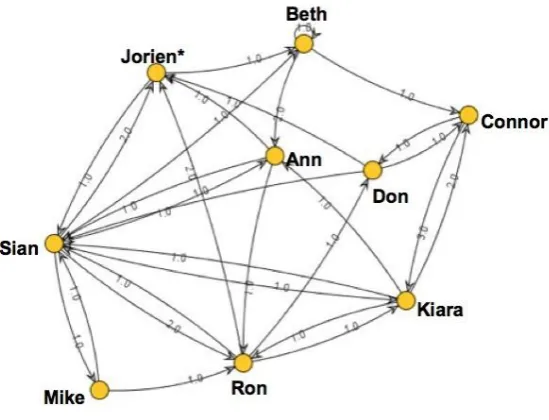
Figure 2: SNA map of Group D (* Tutor)
Although all members of Group D appeared to contribute strongly to the dialogue, the SNA map in Figure 2 shows that it was Sian who was pivotal. She initiated the thread two days before it was scheduled to start with a characteristically enthusiastic tone, “Hi group D! D for dazzling, daring, decisive and dedecated! (sic)”. Although the dialogue ranged over a number of sub-topics, Sian’s many short, chatty posts helped to keep it flowing. Her style was often more like speech than writing, “wow yeh never thought of that!” Each of the students’ styles of writing was very different and this diversity may have been another factor in the wide range of perspectives they took and issues they addressed in the course of their inquiry. However, this group had a relatively low network density (0.36, maximum 1.0), which indicated that a focus around a single centre was not as effective for group cohesion as a distribution of the effort.
No clear leader
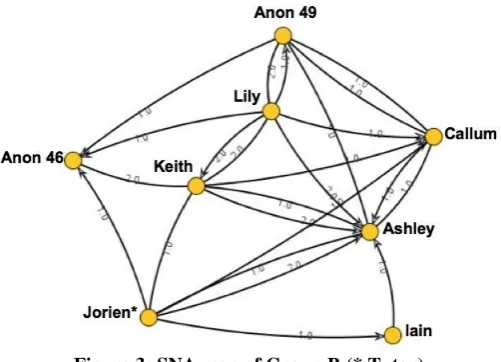
Nevertheless, distributed leadership did not of itself lead to greater group cohesion either. There was another factor, number of threads, and cohesion appeared to depend on the level of student participation in more than one of them. Group B’s forum consisted of five threads yet there appears to have been a considerable amount of cohesion within the group as shown by its network density (0.42). Almost all of the students participated in at least three of the five threads, and discourse analysis showed high levels of coding for Addressivity and Warmth relative to other groups.
Figure 3: SNA map of Group B (* Tutor)
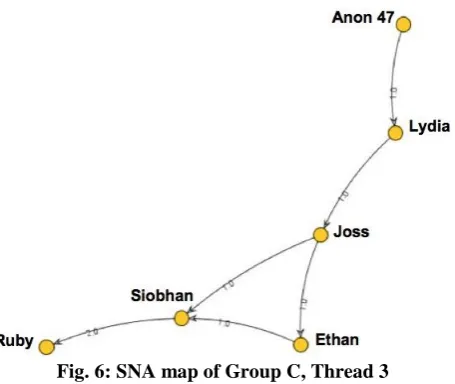
In contrast Group C, although their forum had only three threads, appeared far less cohesive as a community, shown by its network density of 0.26. As can be seen from the SNA maps of the three threads, shown in Figures 4, 5 and 6 below, apart from the main players, Lydia and Joss, almost none of the other group members posted in more than one thread.
Figure 4: SNA map of Group C, Thread 1 (* Tutor)
Fig. 6: SNA map of Group C, Thread 3
Again there were signs of more than one person trying to take the lead. Both of the threads labelled
“Volunteers” (Threads 1 and 2 in Figures 4 and 5) were initiated within three days by two different people. This may not have been the result of a desire to lead the discussion. Many students have had the experience of losing a post after spending time composing it, and particularly at the beginning, when they are finding their feet with the topic and their colleagues, they may compose a post offline and then copy and paste it into the forum. This is essentially a much more monologic activity than reading and posting online, so perhaps it is inevitable that more than one thread will be started because they are writing, not reading.
Conclusion
The original theoretical model gave equal weight to critical, creative and community dialogue. Yet evidence from both this research study and the literature suggests that the community dimension may be fundamental, in that without it the other dimensions cannot function.
In relation to the first research question, “What are the participants saying?” the discourse analysis showed that although higher levels of addressivity and empathy, such as those found in Iteration 1, may indicate the existence of a community, a community of inquiry also requires students to elicit each others’ views and to show respect for them through hedging. This occurred in Iteration 2 where the hedging and elicitation was matched by higher levels of critical reasoning, and in Iteration 3 where there was more dialogic reasoning.
In relation to the second research question, “Who are they talking to?” it appears that the dream of student learning communities emerging naturally as a result of their familiarity with social media is indeed a
shimmering mirage. The discussion forum in Iteration 1 was very much teacher-centred and the social network analysis showed that although such a single leader may keep the dialogue going, the network density figures show that this is not necessarily enough to hold a group together. In all three iterations the intervention included work with the students to support their engagement with each other and where more than one participant did take responsibility for eliciting and responding to the views of the others, the network density figures were higher.
It appears that sharing the responsibility for ensuring that all members of a community are included in the dialogue is essential in that if dialogic engagement fails in some way, then the critical and creative dimensions of a community of inquiry also fail to thrive. This interpretation is supported by the experiences of Wegerif, Mercer, and their colleagues (2008; 2007; 2010) whose work with children influenced the focus on caring talk in the ARGUNAUT project. This is the case not only in communities of people with shared interests and backgrounds, but also in a community of people with little in common, where community dialogue accommodates for differences rather than focusing only on common interests (Davey, 2006, p. 42).
References
Biesta, G. (2004). The community of those who have nothing in common: Education and the language of responsibility. Interchange, 35(3), 307–324. doi:10.1007/BF02698880
Brookfield, S. (1986). Understanding and facilitating adult learning: A comprehensive analysis of principles and effective practices (1st ed.). San Francisco, CA: Jossey-Bass.
Brookfield, S. (2003). Adult cognition as a dimension of lifelong learning. In J. Field & M. Leicester (Eds.),
Lifelong learning: Education across the lifespan. London, UK: RoutledgeFalmer.
Brown, A. L. (1992). Design experiments: Theoretical and methodological challenges in creating complex interventions in classroom settings. Journal of the Learning Sciences, 2(2), 141–178.
doi:10.1207/s15327809jls0202_2
Cobb, P., Confrey, J., diSessa, A., Lehrer, R., & Schauble, L. (2003). Design experiments in educational research. Educational Researcher, 32(1), 9–13.
Davey, S. (2006). Consensus, caring and community: An inquiry into dialogue. Analytic Teaching, 25(1), 18– 51.
De Bono, E. (1987). Six thinking hats. London, UK: Penguin.
De Laat, M. (2006). Networked Learning. Apeldoorn, Netherlands: Politieacademie.
Design-Based Research Collective. (2003). Design-based research: An emerging paradigm for educational enquiry. Educational Researcher, 32(1), 5–8.
Dillenbourg, P., Järvelä, S., & Fischer, F. (2009). The evolution of research on computer-supported collaborative learning. In N. Balacheff, S. Ludvigsen, T. Jong, A. Lazonder, & S. Barnes (Eds.),
Technology-Enhanced Learning (pp. 3–19). Springer Netherlands. Fine, L. (2011). The SWOT analysis (ebook). LLC: Kick It.
Flecha, R. (2000). Sharing words: Theory and practice of dialogic learning. Lanham, MD: Rowman & Littlefield.
Gaggioli, A., Riva, G., Milani, L., & Mazzoni, E. (2013). Analyzing the experience of networked flow through social network analysis. In Networked Flow (pp. 71–99). Dordrecht, Netherlands: Springer. Retrieved from http://link.springer.com/chapter/10.1007/978-94-007-5552-9_4
Garrison, D. R., Anderson, T., & Archer, W. (1999). Critical enquiry in a text-based environment: Computer conferencing in higher education. The Internet and Higher Education, 2(2-3), 87–105.
Kelly, A. E. (2004). Design research in education: Yes, but is it methodological? Journal of the Learning Sciences, 13(1), 115–128.
Laurillard, D. (2013). Foreword to the second edition. In Rethinking pedagogy for a digital age: designing for 21st century learning (2nd ed.). Abingdon, Oxon, UK: Routledge.
Lingis, A. (1994). The community of those who have nothing in common. Bloomington, IA: Indiana University. Lipman, M. (2003). Thinking in education (2nd ed.). Cambridge: Cambridge University Press.
Mercer, N., & Hodgkinson, S. (Eds.). (2008). Exploring classroom talk. London, UK: Sage.
Mercer, N., & Littleton, K. (2007). Dialogue and the development of children’s thinking: A sociocultural
approach. London, UK: Routledge.
Noddings, N. (2003). Caring: A feminine approach to ethics and moral education (2nd ed.). Berkeley, CA: University of California.
Reed, R. F., & Johnson, T. F. (1999). Friendship and moral education : Twin pillars of philosophy for children. New York, NY: P Lang.
Reeves, T. C. (2006). Design research from a technology perspective. In J. van den Akker, K. Gravmeijer, S. McKenney, & N. Nieveen (Eds.), Educational design research (pp. 52–66). London, UK: Routledge. Scott, J. P., & Carrington, P. (2011). Social network analysis: An introduction. In P. Carrington & J. P. Scott
(Eds.), The SAGE handbook of social network analysis. London, UK: Sage Publications.
Sprod, T. (2001). Philosophical discussion in moral education: The community of ethical inquiry. London, UK: Routledge.
Swann, J. (2010). A dialogic approach to online facilitation. Australasian Journal of Educational Technology,
26(1), http://www.ascilite.org.au/ajet/ajet26/swann.html
Tannen, D. (1998). The argument culture: Changing the way we argue and debate. New York, NY: Virago. Tanner, J. L., Arnett, J. J., & Leis, J. A. (2009). Emerging adulthood: Learning and development during the first
stage of adulthood. In M. C. Smith & N. DeFrates-Densch (Eds.), Handbook of research on adult learning and development (pp. 34–67). Abingdon, UK: Routledge.
Vella, J. (2002). Learning to listen, Learning to teach: The power of dialogue in educating adults (Revised.). San Fancisco, CA: Jossey-Bass.
Wegerif, R. (2010). Mind expanding: Teaching for thinking and creativity in primary education. Maidenhead, UK: Open University.
Wegerif, R., Chamrada, M., de Laat, M., Williams, M., Mansour, N., & Hever, R. (2009). ARGUNAUT deliverable D5.2: Patterns of interaction and intervention rules. Retrieved from
Yates, L. (2004). What does good education research look like? Maidenhead, UK: Open University.
Author contact details: Jennie Swann. Email:[email protected]
Please cite as: Swann, J. & Albion, P., (2013). Caring dialogue: A step toward realising the dream of online learning communities. In H. Carter, M. Gosper and J. Hedberg (Eds.), Electric Dreams. Proceedings ascilite
2013 Sydney. (pp.854-864)
Copyright © 2013 Jennie Swann, Peter Albion