Janet Buchan Kristin Wicking John Smithson Melanie Birks
At the COAL FACE
The COAL FACE Project Details
This Guide is an output of a 2013 OLT Extension Grant Project. “At the COAL FACE: Developing Communities Of Active Learners that are Flexible, Adaptive, Connected and Engaged across multi-campus, regional, remote and virtual learning environments”. Name of original grant: Spaces for Knowledge Generation (SKG) (2008) Project reference PP8-849.
Project Team
James Cook University
Dr Janet Buchan – Blended Learning & Innovation Unit, Learning, Teaching and Student Engagement
Mr John Smithson – College of Healthcare Sciences
Prof. Melanie Birks - College of Healthcare Sciences
Dr Kristin Wicking - College of Healthcare Sciences
Ms Helen McDonald – College of Arts, Social Studies and Education
La Trobe University
Associate Professor Matthew Riddle – La Trobe Learning and Teaching
Primary contact: Dr Janet Buchan [email protected]
James Cook University January 2015
Publications from the COAL FACE Project
Birks, M., Buchan, J., Smithson, J., & Norris, P. (2014). Reality at the COALFACE. Paper presented at the Rhetoric and Reality: Critical perspectives on educational
technology. ascilite Dunedin 2014, Dunedin NZ. https://app.box.com/s/ 016cdyv8dq1pp0yhp1vw/3/2704865194/23032567782/1
Smithson, J., Buchan, J., Birks, M., Wicking, K., McDonald, H., & Riddle, M. (2014). COAL FACE: Preparing academics to teach in multi-campus and multi-mode courses to build Communities of Active Learners who are Flexible Adaptive Connected and Engaged. Paper presented at the HERDSA 2014 Conference. Higher Education in a Globalized World, Hong Kong. http://chtl.hkbu.edu.hk/herdsa2014/wp-content/ uploads/2014/06/herdsa-book-prog.pdf
Acknowledgements
The Project team would like to acknowledge the following people:
Firstly, Associate Professor Matthew Riddle (La Trobe), member of the original SKG project, for his guidance and input into the COAL FACE Project.
The following staff from the discipline of Nursing played a key role in exploring the use of active learning interventions in their teaching to give valuable feedback to the project team: Peter Hartin, Vanessa Sparke and Alan Ramsay.
Project officer Philip Norris and research assistant Cindy Woods are thanked for their input.
Publication details
Support for the production of this resource has been provided by the Australian Government Office for Learning and Teaching. The views expressed in this document do not necessarily reflect the views of the Australian Government Office for Learning and Teaching.
All material presented in this document is provided under Creative Commons Attribution-ShareAlike 4.0 International License http://creativecommons.org/licenses/by-sa/4.0/.
The details of the relevant licence conditions are available on the Creative Commons website (accessible using the links provided) as is the full legal code for the Creative Commons Attribution-ShareAlike 4.0 International License http://creativecommons.org/licenses/by-sa/4.0/legalcode.
January 2015
ISBN: 978-0-9941500-5-9 iBook ISBN: 978-0-9941500-6-6 PDF
Teaching
at
the
This Guide provides practical strategies to guide the design of active learning experiences in complex, multi-campus and distributed university learning environments. The title of the Guide describes the aspirational purpose that grounded a project to address the needs of regional Australian learners. The aim of the COAL FACE was to develop Communities of Active Learners that are Flexible, Adaptive, Connected and Engaged.
James Cook University is a multi-campus, regional university and offers courses (programs) across multiple sites: campuses, remote study centres and external (home) to ensure
students have access to relevant and high quality courses at their point of need. Figure 1 illustrates how a multi-campus, distributed community of learners might be represented, whereby the site-based learners are connected as a community of learners via technology and other strategies. Some of the challenges addressed in this OLT Extension Grant Project (within the discipline of Nursing) included maintaining curriculum consistency and providing active learning experiences across sites to meet professional accreditation requirements. Course delivery is done within the context of very different affordances of the learning spaces, technology (including videoconference) and physical resources available to learners at each site and in their own personal learning spaces.
The COAL FACE Project was funded by an OLT Extension Grant that built on the Spaces for Knowledge Generation (SKG) Project (Souter et al., 2011). The SKG Project developed seven principles of learning space design that support an active, constructivist learning environment. These were the CAFE BAR Principles - Comfort, Aesthetics, Flow, Equity, Blending, Affordances, Repurposing.
The COAL FACE research sought to understand the student learning experience in the diverse learning spaces - physical and virtual (online) - that make up the learning
environment in a multi-campus, multi-modal, regional university. Practical issues and barriers that impact on the student learning experience were identified (Birks, M., Buchan, J.,
Smithson, J., & Norris, P. (2014); Smithson, J., Buchan, J., Birks, M., Wicking, K., McDonald, H., & Riddle, M. (2014).
As the research progressed it became clear that the solutions to improving the student experience which emerged from the data, lay in three key areas. Firstly, identifying the basic needs of the learners. These are the 3G ESSENTIALS (see Section 2). Secondly, creating the learning environment. This process is supported by applying the COAL FACE Principles. Finally, employing active learning strategies and blended learning experiences. These are described in the Case Studies from the COAL FACE.
Introduction
The unique contribution this work makes is to get educators to focus holistically on creating the student learning environment from within a complex, multi-campus learning environment.
How to Use the Guide
Teaching at the COAL FACE
Introducing the COAL FACE Project
The guide has been organised into four sections. The flowchart below summarises
the key principles, frameworks and practical strategies which inform the process of
creating active learning environments. There is no distinct pathway through this
Guide and users can navigate between sections as needed.
The 3G Essentials
Meeting students’ basic needs in a distributed learning environment
Getting Access, Getting Connected, Getting Comfortable
Creating the Learning Environment
The COAL FACE Principles for creating distributed learning environments
Comfort, Aesthetics, Flow, Equity, Blending, Affordances, Repurposing
Active Learning in Practice
Case Studies from the COAL FACE
Getting ACCESS
Getting CONNECTED
Getting COMFORTABLE
The experiences of academics and students alike, are impacted by the user-friendliness of the environment in which they teach and learn. The challenges of offering courses in multiple modes in a multi-campus university environment can be compounded by the limitations of the environments, learning spaces and technology in which they are delivered.
The first phase of this research is reported on in ‘Reality at the COAL FACE’ (Birks, Buchan, Smithson, Norris, 2014). During this phase of the research focus groups were conducted with students, academics and support staff at the University’s two main campuses and three remote centres. The focus groups’ questions were based on seven principles that came from the original SKG study’s focus on physical learning spaces (Souter et al, 2011). Students and staff identified significant constraints associated with learning spaces and technology that impacted on the student learning experience.
The following three key aspects emerged as important to the learning and teaching experience: getting access to the learning spaces and associated resources; getting connected to one another and to support mechanisms both within and beyond the university environment; getting comfortable in the use of those spaces and resources (Birks, Buchan, Smithson, Norris., 2014). These have been called the 3G Essentials, a reference to ‘networking’ and connectivity. Planning the student learning experience begins by addressing these basic needs. A concise summary of the 3G Essentials has been created using data from across the research: focus groups, student surveys and picking up on aspects from the Case Studies from the COAL FACE, reported in the section of the Guide on Active Learning in Practice.
What the individual teaching staff members can do to meet some of these basic needs might be limited and practical attention to these basic needs generally lies in the complex domain of multiple stakeholders at a university. These stakeholders include Faculty, ICT Services, audio-visual services, buildings and grounds or estate offices, learning and teaching support divisions and policy makers and their
equivalents (Buchan, 2014).
The 3G Essentials: Meeting students’ basic needs
Getting ACCESS
...the beginning of meaningful student engagement and interaction with the
physical and virtual resources
around them
ESSENTIALS
sufficient resources to accommodate learning
experiences
adequate, accessible facilities
available technology & equipment
functional technological aids
adequate staff
stable technology
adequate wi-fi and internet access
study space
good library and information services access
affordable university accommodation
no hidden or extra costs
access to support
Getting CONNECTED
…creating a culture of helping
ESSENTIALS
formation of close-knit relationships
navigation of the learning process successfully
overcoming difficulties with others
establishing forums outside the university systems, such as on Facebook
establishing feelings of confidence through teamwork & collaboration
taking control of one’s own learning
knowing who to go to for assistance
asking for resources required, assistance needed & sharing views
responsiveness & consistency in communication
online consistency
Getting COMFORTABLE
…strongly associated with an environment facilitative of a positive teaching
and learning experience
ESSENTIALS
lack of technological interruptions
stable website design
relevant, comprehensive orientation information
user-friendly environment & learning space
clean, spacious, functional, well-lit, visually-pleasing learning spaces
inspiring, stimulating, appealing, supportive learning environments
social spaces where interaction with others can take place
spaces that can be customised & personalised
equitable distribution of resources across multi-campus
universities
lack of isolation
strong institutional & peer support
English literacy skills support
transition support for first year students
CREATING
THE
LEARNING
The Learning Environment
Seven Principles of Learning Space Design
The Spaces for Knowledge Generation (SKG) project established seven broad principles of learning space design which support a constructivist approach to learning and that help to create a learning environment which is student-centred, collaborative, and experiential. The principles: Comfort, Aesthetics, Flow, Equity, Blending, Affordances and Repurposing, provided a useful starting point for examining the complex, distributed learning environment in the COAL FACE study (The methodology by which these principles were applied to the COAL FACE research context is outlined in Appendix 1).
Three learning spaces or environments have been identified within the scope and context of the COAL FACE Project. These are the face-to-face learning spaces (confined to single classroom spaces); the online learning spaces (the virtual classroom and its extensions) and the video-linked spaces (Figure 2).
Outside the scope of this Guide, but well described in other studies, are other aspects of the student learning environment such as personal
learning environments and blended and synchronous learning environments (Bower, M., Kennedy, G. E., Dalgarno, B., Lee, M. J. W., Kenney, J., & de Barba, P. (2012). Keppell’s “Perspectives for considering blended and flexible learning” in course (program) development and planning (Flexible Learning Institute, 2009) provide a framework to underpin curriculum and
Figure 2: Learning spaces in a distributed learning environment
A learning environment consists of more than just physical learning spaces. A learning environment needs to be actively co-created and involves interactions amongst the social components
(people), resources and the physical learning environment (Buchan, 2014).
The findings from the research highlighted the importance of active learning, good teaching, effective use of the
videoconference medium, engaging learners with the learning resources including online resources and online spaces that are well designed and integrated into the face-to-face experience. Multi-modal active learning in a multi-campus, distributed
The COAL FACE Principles for Creating Distributed
Learning Environments
A unique contribution of this study is the set of principles for creating distributed learning environments. Informed by the extensive data collection in the COAL FACE Project (see Appendix 2), which examined the student and staff experience in a
multi-campus environment, the original SKG seven principles for learning space have been redeveloped and extended into the new COAL FACE Principles for Creating Distributed Learning Environments.
The power of the COAL FACE Principles lies in using them to ground the creation of connected
communities in multi-campus, multi-modal, dispersed and changing environments. The principles can inform the work of both educators and the variety of stakeholders involved in creating the student learning environment and supporting students through the learning process.
Applying the Principles
The COAL FACE Principles can be applied to a variety of aspects of the learning experience. They can be used to: Underpin the selection of teaching strategies
Guide curriculum and learning design considerations
Inform practical considerations in the choice and use of technology
Inform learning space design and the selection of furniture and equipment; and Underpin the evaluation of the student experience within the learning environment.
The principles should be used in conjunction with a variety of other resources that underpin good learning design. Each of the principles is first
The COAL FACE Principles for Creating Distributed
Learning Environments
The power of the COAL FACE Principles lies in creating connected communities in multi-campus, multi-modal,
dispersed and changing environments
Comfort: A virtual or physical environment that creates a physical and mental sense of ease and well-being, is accessible, stable and comfortable. Human interaction is prioritised, personal and generates a sense of ownership. Being comfortable in the environment also relates to skills and competence in operating and interacting with the facilities including technology.
Aesthetics: Recognises the atmosphere of the learning environment that make it pleasurable to spend time in the physical and virtual learning spaces. Aesthetics include the features of the built, natural and virtual environments being functional, user-friendly and working in harmony, with fitness for purpose.
Flow: The connectedness learners feel when the components of the learning environment are in harmony and synchronised. These include
engagement and communication with others in the learning environment and the design of the learning experience, the continuity and movement between learning spaces: on-campus, virtual, home and work.
Equity: Consideration of needs relating to cultural and physical differences; an equitable learning experience where the mode of delivery ensures that no groups are disadvantaged and that all have equal access to resources, technology and equipment, and that readiness (including digital readiness) for varied modes of learning is assured for students and staff.
Blending: Demonstration of the purposeful integration of a range of face-to-face, online, mobile, distance, social and other technology enhanced learning activities across physical and virtual learning environments and spaces to enact the curriculum.
Affordances: The possibility for activity that the learning environment provides users. Learning activities supported by spaces (classrooms, virtual spaces, peer to peer learning spaces, informal spaces) and physical assets (type of furniture, technology, videoconferencing etc.) facilitate effective independent learning, group work, lectures, online tutorials, practical experience and social connections.
COMFORT
A virtual or physical environment that creates a
physical and emotional sense of ease and wellbeing.
An environment that is accessible, stable and
comfortable. Human interaction is prioritised,
personal and generates a sense of community.
Being comfortable in the environment also relates
to skills and competence in operating and
interacting with the facilities, including technology.
Strategies
open spaces for peak times
utilise spaces off campus & be part of the local community
install flexibility in structure to enlarge rooms or make them smaller
create ambient temperature monitoring, ensuring uniform levels of comfort
make sure that online environment is stable and intuitively navigable
AESTHETICS
Recognises the atmosphere of the learning
environment that makes it pleasurable to spend time
in the physical and virtual learning spaces.
Aesthetics include the features of the built, natural and
virtual environments being functional, user-friendly
and working in harmony, with fitness for
purpose.
Strategies
design buildings & learning spaces with sensitivity to the local
environment
design buildings & learning environments with green spaces
explore & articulate the message of being at a university to study
use active learning strategies to create the appropriate
atmosphere
FLOW
The connectedness learners feel when the components of
the learning environment are in harmony and
synchronised. These include engagement and
communication with others in the learning environment
and the design of the learning experience, the continuity
and movement between learning spaces: on-campus,
virtual, home and work.
Strategies
ensure the interface between the physical, virtual & natural environments works
smoothly
EQUITY
Consideration of needs relating to cultural and
physical differences; an equitable learning
experience where the mode of delivery
ensures that no groups are disadvantaged and
that all have equal access to resources,
technology and equipment, and that readiness
(including digital readiness) for varied modes
of learning is assured for students and staff.
Strategies
look at who benefits from initiatives based on equity
ensure that resources are not allocated to obscure programs with larger groups missing out
be aware of equity of access in the digital learning environment
BLENDING
Blending is the purposeful integration of a
range of face-to-face, online, mobile,
distance, social and other technology-enhanced
learning activities across physical and virtual
learning environments. Blending is
characterised by the purposeful selection and
application of a range of teaching methods
that best promotes or facilitates student
learning.
Strategies
design courses to include the use of a range of learning technologies
acknowledge diverse modes of teaching delivery & learning styles
AFFORDANCES
The possibility for activity that the learning
environment provides users. Learning activities
supported by spaces (classrooms, virtual spaces,
peer to peer learning spaces, informal spaces)
and physical assets (type of furniture,
technology, videoconferencing etc) facilitate
effective independent learning, group work,
lectures, online tutorials, practical experience
and social connections.
Strategies
develop clean, bright, well-ventilated, flexible spaces for learning & socialising
make sure students have access to the essential equipment to participate in the modes of delivery presented
provide for various hardware options & platform support
REPURPOSING
Refers to a flexible learning environment
where learning spaces, physical and virtual,
can be adapted to more than one learning
purpose.
Repurposing occurs when a learning space
or learning activity has multiple uses and
there is reusability in the design of learning
activities and resources.
Strategies
make resource purchases with flexibility & repurposing in mind
look at the provision of mobile digital devices
provide furniture that can be utilised in a variety of ways
design buildings which can be used for more than one type of learning activity
ACTIVE
LEARNING
IN
PRACTICE
James Cook University promotes a consistent
message around active learning and blended
learning approaches through the development of
policy and guidelines. The following definitions
underpin the JCU Learning and Teaching Blueprint.
ACTIVE LEARNING
A process where students are actively engaged in
building understanding of facts, ideas and skills
through the completion of instructor-directed tasks
and activities; any type of activity that gets students
involved in the learning process (Centre for Learning
and Teaching, 2014)
BLENDED LEARNING at JCU
The University promotes blended learning approaches whereby blended learning refers to:
“Learning design that strategically, systematically and effectively integrates a range of face-to-face,
online, mobile, distance, open, social and other technology-enhanced learning across physical and
virtual environments, as informed and driven by student needs and support for desired learning
The findings from this research highlighted the reality that, in distributed learning environments, teaching staff and
students may have limited control over physical aspects of the environment: the learning spaces, technology, availability
of resources and other factors such as curriculum design, that impact on the learning experience. However, what the
staff did have control over was their actual teaching, the design of the learning experience and the inclusion of active
learning strategies.
During the second phase of the project, three Nursing staff took part in piloting a number of active learning
interventions in each of three subjects. The subjects were representative of the multi-campus, multi-modal learning
environment of the BNSc course. This is ‘active learning in practice’ and is described in the three Case Studies that
follow.
Each of the case studies describes the context of the particular subject offering and the mentoring and support process
for each staff member. The staff was supported by professional development opportunities, mentoring and support
from the COAL FACE Project team and resources developed for the project (see Appendix 3, Resource Booklet).
The essence of the project was to keep the work within manageable workloads consistent with the size of the extension
grant project. Each of the staff involved with the pilots selected a small number of key ‘issues’ to focus on in their
teaching. They then explored possible strategies to deal with those issues. The strategies were loosely informed by the
data already collected and the COAL FACE Principles during mentoring discussions.
The cases were each quite different. Some subjects provided for more planning than in others. For example, in the
online subject, the staff member only joined the Project shortly before the semester started, and had his first
CASE STUDY 1
Year 1, Online subject
NS1012: Introduction to Evidence-Based Practice Subject Coordinator: Alan Ramsay
Context
This subject introduces concepts of evidence-based practice and research. The traditions of quantitative, qualitative and mixed methods research are introduced, with a focus on the language of research.
The subject is offered in Semester 2 of the students’ first year of the Bachelor of Nursing Science, and is delivered in a fully online mode for all students, regardless of course mode. It is also
available for mid-year entry students for whom it may be their first exposure to university learning. The subject is taken
alongside NS1220 Primary Health Care, which was also an intervention subject for the COAL FACE project; BM1022, an anatomy and physiology subject; and NS1222 Clinical Nursing Practice 2, which includes a simulation lab and a hospital clinical placement. Through their learning in the subject students can begin the preparation for nursing practice in a world where health care services are influenced by various dynamic and constantly changing factors.
The mentoring process:
The Subject Coordinator was located on a remote teaching site (Thursday Island) and worked in a mentoring relationship with Janet Buchan, based in Townsville, an Academic Developer from the Learning, Teaching and Student Engagement directorate (LTSE). Janet provided a template of reflective questions to guide their meetings, which usually occurred fortnightly via online conferencing (Jabber Video) or phone and lasted approximately one hour on average. The Subject
Coordinator joined the COAL FACE Project late, only a couple of weeks before the semester began, as he was substituting for another suddenly unavailable Subject Coordinator. Although unable to attend the 19 May 2014 Townsville videoconference workshop, presented by Carol
Skyring, an expert in presenting/teaching via video-conferencing, the Subject Coordinator did access the recordings of the workshop online. The Subject Coordinator was also Skyped in to a meeting in August 2014 in Cairns with Matthew Riddle, one of the team on the original SKG project upon which the COAL FACE Project was based where he and the other two Subject Coordinators were able to speak about their experiences in attempting to increase active learning across dispersed environments/timeframes. The Subject Coordinator was also in regular contact with another Subject Coordinator participating in the COAL FACE interventions. Although the Subject Coordinator has taught in the school for a number of years, mostly at another remote teaching site (Mackay), this subject was his first opportunity to undertake the role of Subject Coordination (SC). Technical support in the way of both
equipment (a high quality microphone for creating his desktop
vodcasts), and software (Camtasia Studio), were provided to assist him. In addition to the Subject Coordinator, staff who supported students in the online subject included a Learning Adviser (from LTSE) and an
Strategies and interventions:
1A. Close liaison between the Subject Coordinator (SC) the Learning Systems Support Officer (for LearnJCU support) Information Librarian and Learning Adviser. Clarifying role responsibilities so students were referred appropriately and not bounced between staff. Pacing announcements/resources so multiple ones were not released on same day from SC and from Learning Adviser.
1B. Use of real-time vodcasts by Subject Coordinator to further personalise the online mode, and to create a social presence by projecting his teaching
personality through the online-only environment, using less formal, more approachable language. Students’ questions were addressed as the vodcast was being delivered/recorded, and their emailed questions were also
addressed at the beginning of the recorded lecture. Vodcast commentary was specifically scripted to allow it to be listened to as a standalone podcast (audio only) without requiring simultaneous viewing of the PowerPoint slides for the commentary to make sense.
1C. Linking the skills they are learning as online students to the practical reality that online courses will be the most common mode they will experience post registration for continuing professional development as life-long learners. Linking topics from one week to the next to demonstrate how they fit together, while also linking them to other subjects being taken at the same time
(horizontal alignment) or before/after this subject (vertical alignment).
1D. Personalised Support: Access to technological support (Learning Systems Support Officer and Information Librarian) as well as study skills support (Learning Adviser) and pedagogical support for all students. The Information Librarian used the subject site to post or email links to the Library’s online JCU Info Skills Road Trip (http://libguides.jcu.edu.au/ roadtrip ) to upskill digital literacy, to the APA referencing LibGuide
(http://www-public.jcu.edu.au/libcomp/assist/referencing/index.htm ), and to video clips hosted on YouTube or BlackboardTM websites, regarding how to use features within BlackboardTM. He also ran online sessions through LearnJCU’s Collaborate on how to use the Wiki feature in LearnJCU.
1D cont. The Information Librarian “Luc’s Techno Tips session” that was video-conferenced from Townsville to Mackay students, was much
appreciated. The Learning Adviser’s face-to-face sessions in Townsville and Cairns or Skype to other sites were well received, as was her
willingness to communicate with non-Townsville students by other modes, including ‘low tech’ telephone consultations. The SC made a point of responding to all emails within minutes, and certainly within less than 24 hours, so students felt a sense of readily available support. Student interactions by text were purposefully done in second person, friendly language, addressing students individually by name and closing with the signing of the staff member’s name to increase personalisation.
1E. Design of the LearnJCU site to make it easily navigable, without becoming overly cluttered. Setting up his LearnJCU site design to be consistent with the LearnJCU site of NS1220, so students could easily find components in similar locations within both sites.
1F. Rapid upskilling of SC’s own familiarity and comfort with the LearnJCU environment to achieve technical competency in using it well for this fully online subject.
1G. Troubleshooting technical troubles: i.e., advocating with a third party user to get Java permission to recognise their OERs (Open Educational Resources) as safe for students to download (not create a security alert). 1H. Supporting students to become technologically ready to learn in the online environment: providing advice about the best browsers and
computer compatibility.
1I. Optimising the file size and type for online resources to ease the download time and data download costs for students. Avoiding overly busy slides with excessive text content; ensuring adequate white space.
Issue 2 - Student mastery of the conceptually abstract content
Strategies and interventions:
2A. Using examples of current controversial research studies to engage/stimulate the students’ thinking and to ground the research concepts in reality.
2B. Using Open Educational Resources (OERs) such as freely available video lectures from leading experts (i.e., John Creswell) to augment key concepts.
2C. Use of online learning activities such as crossword puzzles and scatter word games to allow students to have a ‘fun’ online learning experience, while also testing/reinforcing their
knowledge of key concepts, including mastering a long list of difficult vocabulary terms related to the culture of research. 2D. Use of periodic self-assessment quizzes to validate correct understandings while also challenging misunderstandings.
2E. Use of concrete examples and clear explanations in vodcasts to bring abstract concepts into everyday language and link them to real life domains. Use of patient stories to highlight clinical conditions where the research may be lacking or inconclusive or even contradictory.
Issue 3 - The students’ tendency to ‘triage’ their online subject to a lower priority, below their other three face-to-face
subjects
3A. Create more ‘bite sized’ vodcasts, as opposed to a more traditional 1-2 hour lecture vodcast, to attract the busy student to prioritise their online subject over preparation for face-to-face subjects.
3B. Use of difficult/probing questions posted on the LearnJCU discussion board to stimulate interest in weekly topics and to catch the attention of busy students.
3C. Use of Collaborate Session QuickPodcast to allow a safe place for more personalised interaction with students to occur during the session and to allow them to replay/review at their
convenience after sessions.
Alternative Intervention Strategies
• Find and insert more OERs that are contemporary, entertaining, creative and perhaps even amusing in order to engage/stimulate students. • Review time management opportunities to dedicate a focussed attention on implementing some of the above strategies across other topics/
modules within the subject.
CASE STUDY 2
Year 1, Blended mode, multi-campus subject NS1220: Primary Health Care
Subject Coordinator – Vanessa Sparke Context
Primary Health Care is a dynamic and rewarding area of health and one that is designed to shape students’ understanding of the health care industry and assist them to understand why health services are delivered in the way they are. Through this subject students come to appreciate the challenges facing nurses when caring for diverse population groups and in varying health care settings.
The subject is offered in Semester 2 of the students’ first year of the Bachelor of Nursing Science, and is also available to Diploma of Health Science students. It is delivered in a blended mode, with lectures video-conferenced across all 5 locations (Townsville, Cairns, Mt. Isa, Thursday Island and Mackay) and recorded and posted online for external students. Students on the five
campuses also receive face-to-face tutorials. Enrolment during the intervention semester was 560 students. The subject is taken alongside NS1012 Introduction to Evidence-Based Practice, which was also an intervention subject for the COAL FACE Project; BM1022, an anatomy and physiology subject; and NS1222 Clinical Nursing Practice 2, which includes a simulation lab and a hospital clinical placement. Similar to NS1012,
Introduction to Evidence-Based Practice, this subject is also available for mid-year entry students for whom it may be their first exposure to university learning.
The mentoring process
Issue 1: Equitably engaging a mixed cohort of 560 students during a short (50 minute) video-conferenced lecture, which is
delivered from Cairns to multiple campuses, while also being recorded for later listening by external students.
Strategies and interventions:
1A. Presentation delivery was fine-tuned by slowing down speech and zooming camera in for a close shot, so that the Subject Coordinator’s facial expressions were clearly visible. Lighting was adjusted to avoid harsh lighting while still allowing PowerPoint display and presenter’s face to be visible.
1B. Interspersed in lectures a variety of multi-media external resources. These included relevant visual graphics on PowerPoint slides to reinforce the key message, and video clips from relevant programs such as Foreign Correspondent from the Australian Broadcasting Channel’s website, which assisted the students to link the primary health care topics to real life issues and events. Ensured that websites/links were pre-loaded and ready to click and play so there was no ‘dead air’ during the lecture. Moved some video clips from prior year’s lectures out of the lecture and instead posted them on LearnJCU for pre-lecture viewing, then referred to and built on the resource during the lecture itself.
1C. Also interspersed personal stories and others’ stories of real life nursing experiences that related to the week’s topics.
1D. Began each lecture with a slide that reviewed the prior week’s topics, to help students to link topical content into a cohesive mental schema. Advised students that these key slides were a useful springboard for their exam preparation. Also created opportunity for more active participation in lecture by leaving key words/phrases blank on the pre-lecture
LearnJCU posted lecture notes, so students could fill in the missing content as the lecture progressed.
1E. Stopped asking for questions from each site in turn at end of lecture, as this approach rarely generated meaningful dialogue and was Cairns-centric. Instead had students email questions and addressed them for the benefit of the entire group within the next lecture.
1F. Noted that questions regarding assessment were asked of her in person in Cairns immediately after a lecture and/or that Cairns-based students were potentially advantaged by viewing last year’s posters on display in her office. To better ensure equity of guidance and information for all students regarding the assessment she used photographs taken of the poster presentation day in prior years and posted them on to
LearnJCU for all students to be able to visualise the completed assessment product and event.
1G. Created post-lecture interest in viewing or listening to the lecture recording, by putting up a follow-up resource on LearnJCU, such as a reading, journal article, or a link to a TV or radio broadcast. These were placed in a special folder within LearnJCU entitled “Readings and
Viewings of Interest”.
1H. Used the mobile learning audience response system (GoSoapBox). Set up a GoSoapBox event and invited students to participate and respond during the lecture, but uptake by students was minimal, with most instead just viewing the PowerPoint slides.
Issue 2 - Ensuring that the reality of a large number of students spread across multiple campuses did not result in students
experiencing feelings of depersonalisation and disconnectedness from the Subject Coordinator.
Strategies and interventions:
2A. Prior to the lecture beginning, as students were entering the room, stepped away from the lectern and stood near the door, greeting students in a friendly way as they entered the Cairns lecture theatre. This strategy served to help warm and personalise a large and formal lecture theatre space that outsized the student cohort, while also relaxing both the students and the lecturer.
2B. Responded promptly to emails, using friendly and
conversational language, rather than using formal language that accentuated the power differential between teacher and student. Made a particular effort with external students to extend a warm and inviting online presence.
2C. In the first lecture of the semester, gave some background regarding her previous nursing experiences and positions, so students would feel they knew her better, and to increase her credibility to teach the topic. Included pictures of prior work locations.
2D. Used relevant anecdotes from her own personal nursing experiences to reiterate or exemplify key points in the lecture.
2E. Besides addressing each ‘far end’ campus during the video-conferenced lectures, also kept in mind and often verbalised the external students as an additional ‘campus’ who would be listening at a later time, so they would feel included.
2F. Had students send in photos of Primary Health Care Centres in their local area, and displayed on a slide near the beginning of lecture, crediting the student/location of photo.
Issue 3: Sub-optimal student engagement with the LearnJCU subject website
Strategies and interventions:
3A. Set up the LearnJCU site with weekly folders that were easy to navigate and did not require multiple clicks to find key resources like lecture notes or the weekly newsletter.
3B. Creating a clear link between lectures and LearnJCU at three time points: Before the lecture, posting the lecture notes that students could see and/or print and refer to during the lecture; recording the lecture so students who did not attend live could still participate ‘during’ the lecture by watching/listening to the recording; and after the lecture, having a follow-up resource or activity on LearnJCU. 3C. Making LearnJCU a value-added resource in addition to the lectures and tutorials, by posting within it additional resources not included elsewhere, such as links to ABC programs or Discussion Board topics that would promote interaction between students.
3D. Ensuring that the language used within all LearnJCU communications was a friendly, warm and positive discourse.
3E. Converted the required make-up work previously done as written assignments into 10 question online quizzes, with both multiple choice questions and short answer questions. While students who missed more than 20% of tutorials were required to do these online quizzes as make-up work, they were made accessible to all students, and proved to be a popular method for self-assessment of progress of learning. This strategy was a key example of re-purposing a learning activity.
Alternative Intervention Strategies:
• Provide more online learning activities, such as thought-provoking or controversial photos or links that students could then discuss with each other.
• Allocate time for Subject Coordinator to participate more frequently and respond more quickly on Discussion Boards in order to promote/encourage students to remain engaged with the subject via this medium.
CASE STUDY 3
Year 3, Capstone subject.
NS3226/NS3227 Clinical Nursing Practice Subject Coordinator: Peter Hartin
Context
This final year clinical capstone subject is delivered in the final semester of the three-year Bachelor of Nursing Science course. The subject has been designed to encourage students to apply and reflect critically upon discipline knowledge, skills, attitudes and the nursing culture in an authentic context. The subject provided students with the
opportunity to apply the knowledge, skills and professional attitudes obtained during the course in a scaffolded and safe context. Critical to the capstone is the student ability to exercise clinical and professional judgment. The aim is to promote a smooth transition for the student into their new role as a registered nurse. This capstone subject has an emphasis on the assessment, implementation and collaborative
management of persons with complex health care needs. The students are introduced to basic principles of management and leadership, they explore concepts of accountability, responsibility, change and influence within organisations. This subject provides students with the
opportunity to apply clinical knowledge in a nursing model of care. The Subject Coordinator was based on the Townsville campus. This subject is delivered through traditional didactic lecture techniques, supported by an extensive program of workshops and seminars. Students then undertake 240 hours of professional experience before returning for a one-week compressed block during which further
teaching and assessments are undertaken. The student group numbers 242 in total, 93% of which are female, 25% are from a low SES
background, 51% are aged 24 years or less and 62% are first in family to attend higher education. The following describes the issues
identified by the Subject Coordinator at the commencement of the project and interventions used to address them.
The mentoring process
The Subject Coordinator was mentored by project team member John Smithson (Director of Industry Engagement & Course
Coordinator Master of Nursing (Nurse Practitioner)). They had regular meetings that focused on the needs prioritised by the Subject Coordinator as well as informal collegial discussions. In addition to this, intervention strategies were informed by changes in the other two subjects, the broader research team and
Issue 1 – Effectiveness and low impact of videoconferencing on student engagement and knowledge transfer.
The subject was mainly delivered from Townsville, but videoconferenced (VC) to Cairns and Mackay. Videoconferencing was being used
ineffectively in engaging students and delivering content in a way that promoted knowledge acquisition. This was evidenced by lower than
desirable attendance at the face-to-face lectures and low levels of student engagement during the classes.
Strategies and interventions:
1A. Built rapport with students – before each lecture the lecturer would display photos of the work students were doing each week at each site. This was used to show recognition of students’ efforts, remind students of their own learning accomplishments in the past week, tie the group
together as a stronger cohort and personalize the event for those in attendance.
1B. Adequate teaching space preparation. Preset camera positions were identified, one of which was that of the student audience, so during activities, students could view the activity of the entire cohort across all sites rather than an empty presentation desk.
1C. Coordinator elected a student facilitator at each site to facilitate
activities, assist with AV equipment control and facilitate discussion at the distant ends of the videoconference classroom.
1D. Coordinator invited another staff member at each site to help with active facilitation of classes.
1E. Coordinator revised each presentation for font size, colour and transitions to maximize their impact via VC and minimize distractions caused by lag time and altered colour fidelity.
1F. Coordinator ensured personal attire was suitable to avoid distractions when presenting on video. He also ensured he kept eye contact with the distance sites by looking at the camera rather than the monitor. This gave the impression the coordinator was looking directly at the students at the
Issue 2 - Lecture content did not adequately signpost most important elements, nor was it designed to engage students
The content and presentation was structured in a way that was not
engaging. It modelled traditional didactic face-to-face teaching methods and had not been adapted to the VC medium well. The result was a dissatisfying teaching experience and a poor learning experience for the students. This was partly evidenced by poor attendance and low levels of classroom engagement for those who did attend. The coordinator wanted to maintain engagement during the lecture, signpost most important content or concepts in each topic area.
Strategies and interventions:
2A. At the commencement of the lecture, the coordinator made explicit links to the previous lecture content to both reinforce the key concepts and link to the pending content.
2B. Clearly signpost expected learning outcomes by clearly identifying critical elements and using those as the structure for the revised lesson plans for each VC lecture. After identifying the most critical content elements of each lecture, teaching slots less than 20 minutes duration were created within the lecture, each with an associated activity to complement or allow application of the main message. A variety of activities was used to maintain the novel sense of the classroom. Some examples include:
a. Case study
b. Group discussions c. Brainstorming
d. Using the document camera to create ‘live’ content jointly with the students as active participants.
Issue 3 – Learning from previous classes was not coupled with new content.
Content was often presented in distinctive silos, with limited reference to previous learning or student experiences. New knowledge needed to be contextualized within known knowledge and past experiences.
Strategies and interventions:
3A. The coordinator coupled learning with prior knowledge and the immediate previous content to create a predictable learning cycle for students. He focused on the consolidation of learning and created a learning life cycle for a topic area. The learning cycle began with a preparatory task before content delivery and extended past the actual content delivery to post content tasks to reinforce the most critical concept(s). This was then followed up in the subsequent lecture to promote engagement with post-learning activity.
3B. The coordinator drew on student experiences where possible. 3C. This learning cycle was repeated for each lecture so students became familiar with and began to expect this level of integration.
Issue 4 – Feedback and follow-up mechanisms were not effective.
Question time over the videoconference medium was not effective or productive. The time taken to receive, interpret and answer the question, as well as the penetration of the question to all students (those in
attendance and those who would view the lecture later by podcast) was prohibitive and inefficient. The development of an effective feedback and follow-up process was needed.
Strategies and interventions:
4A. Question time was removed from the lecture – this time was used to introduce learning activities.
4B. Weekly discussion boards allowed students to pose questions and encouraged responses from both the coordinator and peers. Student generated answers were often the most valuable, and allowed the
coordinator to provide direction to relevant resources or endorse answers and responses generated by student’s peers.
Evaluating the Case Studies
At the end of Semester 2 2014 the effectiveness of the active learning interventions in the three pilot subjects was evaluated through a student (online) survey. In depth focus groups were held with the teaching and support staff in the three pilot subjects. The evaluation centred around using the new COAL FACE Principles to interrogate student and staff perceptions of the learning environment and learning experience. This in turn helped to consolidate the efficacy of the use of the new principles for this purpose. The application of the principles to the evaluation process was successful and helped to elicit some valuable insights into the student learning environment.
The staff involved in piloting interventions kept reflective journals in which they described their teaching strategies and other aspects of the student experience as an important part of the data collection.
It is beyond the scope of this Guide to report on the detailed findings from the case studies’ final data collection and this will be reported in full in a future publication. However, students generally reported positively on their learning experience and environment as determined by
Conclusion and Future Directions
The 2013 OLT Extension Grant that supported the COAL FACE Project at James Cook University enabled important on-ground work to be carried out to improve the delivery of the Bachelor of Nursing Science in the distributed learning environment. A particular focus in the project was on re-thinking and optimising the use of the videoconference medium and diverse learning spaces, and integrating blended and active learning approaches into the cross-campus course delivery.
Professional development opportunities were made available to staff through workshops, mentoring staff involved in the pilot subjects and for staff to reflect on their teaching by providing input to the researchers through focus groups and teaching journals. A comprehensive Resource Booklet was developed by the COAL FACE Project team to service a need within the Project to have access to resources for Nursing staff who were preparing to implement a variety of active learning strategies in the Bachelor of Nursing Science.
A total of 800 students enrolled in the three case study subjects benefitted from improved teaching and the active learning approaches and interventions applied by staff involved in the Project. The students and staff involved in the pilots provided valuable feedback to the team which will inform future improvements to teaching approaches in the course, and beyond. The outcomes from the research will also inform and support the university’s
implementation of blended learning approaches to its course delivery.
The outcomes of the research have been shared through scholarly publications (Birks, M., Buchan, J., Smithson, J., & Norris, P., 2014), conference presentations (Smithson, J., Buchan, J., Birks, M., Wicking, K., Mcdonald, H., & Riddle, M., 2014) and at forums within the university such as the JCU Learning and Teaching Academy 2014 Showcase, and the Academy’s Learning Spaces Special Interest Group Showcase (see Appendix 1, Table 1A:
Timeline of research activity). Future publications are planned and will be made available on the Project website. The Project website www.coalface.org.au
serves as a lasting repository for the resources from the Project.
The aspirational goal of the Project was the ‘COAL FACE’, i.e., the development of Communities of Active Learners who are Flexible, Adaptive, Connected and Engaged. Within the scope of the Project a solid start was made towards achieving this objective through the work done in the Case Studies. Of
generic interest to other educators are the new COAL FACE Principles for Creating Distributed Learning Environments that should complement existing resources and pedagogical frameworks by supporting the design of blended learning experiences in a variety of different learning environments and learning spaces.
Birks, M., Buchan, J., Smithson, J., & Norris, P. (2014). Reality at the COALFACE. Paper presented at the Rhetoric and Reality: Critical perspectives on educational technology. ascilite ConferenceDunedin 2014. pp.565-569. https://app.box.com/s/016cdyv8dq1pp0yhp1vw/3/2704865194/23032567782/1
Bower, M., Dalgarno, B., Kennedy, G., Lee, M., & Kenney, J. (2014). Blended synchronous learning: a handbook for educators (pp. 190). Retrieved from http:// www.olt.gov.au/system/files/resources/ID11_1931_Bower_Report_handbook_2014.pdf
Bower, M., Kennedy, G. E., Dalgarno, B., Lee, M. J. W., Kenney, J., & de Barba, P. (2012). Use of media-rich real-time collaboration tools for learning and teaching in Australian and New Zealand universities. Paper presented at the ascilite 2011 Future challenges, sustainable futures, Wellington.
Buchan, J. (2014). Developing resilience and managing change in technology-enhanced learning environments. (Doctor of Philosophy), University of Southern Queensland, Toowoomba. Retrieved from http://eprints.usq.edu.au/25684/
Buchan, J., & Swann, M. (2007). A Bridge too Far or a Bridge to the Future? A case study in online assessment at Charles Sturt University. Australasian Journal of Educational Technology, 23(3), 408-434. Centre for Teaching and Learning. (2014). What is active learning? Retrieved 20 June, 2014, from http://www1.umn.edu/ ohr/teachlearn/tutorials/active/what/index.html
Center for Teaching and Learning. (2014). What is active learning? Retrieved 20 June, 2014, from http://www1.umn.edu/ohr/teachlearn/tutorials/active/what/ index.html
Division of Academic and Student Life. (2014). JCU Learning and Teaching Blueprint 2014 - 2016. Townsville: James Cook University. Division of Academic and Student Life. (2013). Blended Learning Policy. Townsville: James Cook University.
Salmon, G. (2011). E-moderating: the key to teaching and learning online (3rd ed.). New York: Routledge.
Smithson, J., Buchan, J., Birks, M., Wicking, K., Mcdonald, H., & Riddle, M. (2014). COAL FACE: Preparing academics to teach in multi-campus and multi-mode courses to build Communities of Active Learner who are Flexible Adaptive Connected and Engaged. Paper presented at the HERDSA 2014 Higher Education in a Globalized World, Hong Kong. http://chtl.hkbu.edu.hk/herdsa2014/wp-content/uploads/2014/06/herdsa-book-prog.pdf
Souter, K., Riddle, M., Sellers, W., Pirotta, N., Keppell, M., Ramus, R., . . . Feil, C. (2011). Spaces for knowledge generation. ALTC Project Final report. Retrieved 20 September, 2013, from http://www.olt.gov.au/project-spaces-knowledge-generation-la-trobe-2008
Skyring, C. (2014). Teaching by videoconference. A workshop with Carol Skyring. Workshop notes. LearnTel. Brisbane.
APPENDIX 1
A concise description of the study design and methodology is given in one of the Project’s
publications (see Birks, M., Buchan, J., Smithson, J., & Norris, P. (2014). Reality at the COAL FACE.
Paper presented at the Rhetoric and Reality: Critical perspectives on educational technology. Ascilite
Dunedin 2014, Dunedin NZ.
https://app.box.com/s/016cdyv8dq1pp0yhp1vw/
3/2704865194/23032567782/1
,).
‘The study design involved various phases of data collection over a period of 12 months. An initial
qualitative phase was undertaken involving the use of focus group interviews. Analysis of data
generated through this process informed the development of a survey tool, data from which
informed the development of strategies for implementation in second study period of 2014. Data
collected through journals maintained by lecturers, coupled with evaluative survey data, forms the
final phase of the study. The use of this iterative and integrative approach to gathering and analysing
data enabled the identification and implementation of strategies responsive to the unique needs of
this particular institution.’ Where relevant, the research methodology will be described in detail in
publications associated with specific aspects of the research.
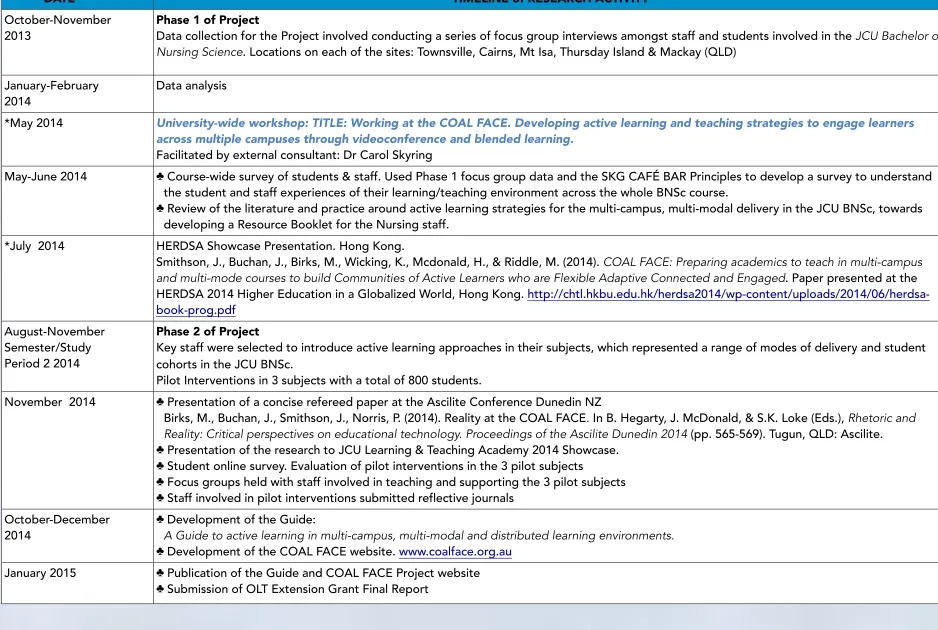
The different stages of the research, data collection, publications and development of resources are
detailed in the Timeline of Research Activity (see Table A1).
DATE TIMELINE of RESEARCH ACTIVITY
October-November
2013 Phase 1 of Project
Data collection for the Project involved conducting a series of focus group interviews amongst staff and students involved in the JCU Bachelor of Nursing Science. Locations on each of the sites: Townsville, Cairns, Mt Isa, Thursday Island & Mackay (QLD)
January-February
2014 Data analysis
*May 2014 University-wide workshop: TITLE: Working at the COAL FACE. Developing active learning and teaching strategies to engage learners across multiple campuses through videoconference and blended learning.
Facilitated by external consultant: Dr Carol Skyring
May-June 2014 ♣ Course-wide survey of students & staff. Used Phase 1 focus group data and the SKG CAFÉ BAR Principles to develop a survey to understand
the student and staff experiences of their learning/teaching environment across the whole BNSc course.
♣ Review of the literature and practice around active learning strategies for the multi-campus, multi-modal delivery in the JCU BNSc, towards
developing a Resource Booklet for the Nursing staff. *July 2014 HERDSA Showcase Presentation. Hong Kong.
Smithson, J., Buchan, J., Birks, M., Wicking, K., Mcdonald, H., & Riddle, M. (2014). COAL FACE: Preparing academics to teach in multi-campus and multi-mode courses to build Communities of Active Learners who are Flexible Adaptive Connected and Engaged. Paper presented at the HERDSA 2014 Higher Education in a Globalized World, Hong Kong. http://chtl.hkbu.edu.hk/herdsa2014/wp-content/uploads/2014/06/herdsa-book-prog.pdf
August-November Semester/Study Period 2 2014
Phase 2 of Project
Key staff were selected to introduce active learning approaches in their subjects, which represented a range of modes of delivery and student cohorts in the JCU BNSc.
Pilot Interventions in 3 subjects with a total of 800 students.
November 2014 ♣ Presentation of a concise refereed paper at the Ascilite Conference Dunedin NZ
Birks, M., Buchan, J., Smithson, J., Norris, P. (2014). Reality at the COAL FACE. In B. Hegarty, J. McDonald, & S.K. Loke (Eds.), Rhetoric and Reality: Critical perspectives on educational technology. Proceedings of the Ascilite Dunedin 2014 (pp. 565-569). Tugun, QLD: Ascilite.
♣ Presentation of the research to JCU Learning & Teaching Academy 2014 Showcase. ♣ Student online survey. Evaluation of pilot interventions in the 3 pilot subjects
♣ Focus groups held with staff involved in teaching and supporting the 3 pilot subjects ♣ Staff involved in pilot interventions submitted reflective journals
October-December 2014
♣ Development of the Guide:
A Guide to active learning in multi-campus, multi-modal and distributed learning environments.
♣ Development of the COAL FACE website. www.coalface.org.au
[image:41.1024.20.958.87.717.2]January 2015 ♣ Publication of the Guide and COAL FACE Project website ♣ Submission of OLT Extension Grant Final Report
APPENDIX 2
Managing the 3G Essentials
– A checklist for the
institution
The 3G Essentials that emerged from this research highlighted the complexities of meeting the basic
needs of students and staff when courses are offered in multiple modes in a multi-campus, distributed
and online learning environment. The basic needs of the learners fall into a number of key
‘management’ categories that have been used to develop a Management Checklist. The checklist does
not provide solutions but can be used to assist planning and also diagnosis of issues.
The 3G Essentials Management Checklist uses the successful Bridge Support Framework (Buchan &
Swann, 2007) which was developed in a similar multi-campus context and grounded in research into
supporting online and blended learning environments. The Framework has been applied to the findings
from the COAL FACE experience to develop the Checklist.
Each institution has its own organisational structure and delineation of responsibilities for managing
different aspects of the physical learning environment and technology, and providing support for
1. Stakeholders
Iden%fy the stakeholders involved with managing the learning environment and suppor%ng staff and students.
Iden%fy the problem and approach the relevant person or sec%on.
Stakeholders include: Facul%es/Colleges, ICT Services, audio-‐visual services, buildings and grounds/ estate office, %metable managers, learning and teaching support units, library and informa%on services and ins%tu%onal leadership and policy makers – or their equivalents in an ins%tu%on.
2. Communica5on
Iden%fy the chains of communica%on: relevant commiHees, project teams, work units and a mandate for those groups to communicate around suppor%ng the student learning experience and access the building, maintenance and use of technology-‐enabled learning spaces.
3. Ins5tu5onal planning and policy
Iden%fy key ins%tu%onal strategic plans and learning and teaching-‐related policies. Ins%tu%onal planning should be strategic and address a common vision for learning and teaching. Learning and teaching policy and guidelines need to drive ac%vity and decisions.
4. Budget
Ins%tu%onal funding to support technology, staff and students, development of learning spaces budget for equity in access to equivalent learning spaces and technology for all students to promote ac%ve learning. Includes equity considera%ons in student personal budgets to support their studies and access.
5. Support for students
To navigate the learning environment and blended modes of delivery, students require a range of support: pastoral care, tutoring in approaches to study, %me management, developing technology competency and digital literacy, access to technology and learning resources.
6. Support for academic staff
Staff support to enable effec%ve use of learning spaces includes Professional development, mentoring, educa%onal design for blended learning, technical support and training in the use of technology in learning spaces and online systems.
7. ICT infrastructure and support
Management of ICT infrastructure and audio-‐visual equipment requires communica%on between stakeholders about the selec%on and maintenance of hardware and soNware to support learning and teaching needs in distributed learning environments; and sufficient training/ professional development and/or online resources
made accessible.
Key aspects: networking and wifi, learning management systems, videoconference, web-‐conferencing.
8. Campus learning spaces support
Support the design and development of appropriate learning spaces, selec%on of learning technology especially technology that enables real-‐%me communica%on across distributed learning environments.
9. Evalua5on and feedback
Feedback from the student and staff experience is captured and fed through clear channels of communica%on towards future improvements and enhancing the student learning experience and managing the many aspects of the learning environment towards evidence-‐based management.
(Adapted from Buchan & Swann, 2007)
3Gs
Essentials
APPENDIX 3
The COAL FACE Resource Booklet for Subject Coordinators
The Resource booklet was developed by the COAL FACE Project team in 2014 initially to service a
need within the Project to provide a resource for the Nursing staff who were preparing to implement
a variety of active learning strategies in pilot case studies in the Bachelor of Nursing Science as part
of the COAL FACE Project (See website and Guide www.coalface.org.au). It is not a definitive
resource but was aimed at providing very targeted support for the Project.
A copy of the Resource Booklet can be downloaded from the COAL FACE website.