Contents lists available atScienceDirect
NanoImpact
journal homepage:www.elsevier.com/locate/nanoimpact
Research paper
Integration among databases and data sets to support productive
nanotechnology: Challenges and recommendations
Sandra Karcher
a,q, Egon L. Willighagen
b, John Rumble
c,d, Friederike Ehrhart
b, Chris T. Evelo
b,
Martin Fritts
e, Sharon Gaheen
e, Stacey L. Harper
f, Mark D. Hoover
g, Nina Jeliazkova
h,
Nastassja Lewinski
i, Richard L. Marchese Robinson
j,k,1,2, Karmann C. Mills
l, Axel P. Mustad
m,
Dennis G. Thomas
n, Georgia Tsiliki
o,p, Christine Ogilvie Hendren
q,⁎aCivil and Environmental Engineering, Carnegie Mellon University, Pittsburgh, PA 15213-3890, USA
bDepartment of Bioinformatics - BiGCaT, Maastricht University, P.O. Box 616, UNS50, Box 19, NL-6200, MD, Maastricht, The Netherlands cR&R Data Services, 11 Montgomery Avenue, Gaithersburg, MD 20877, USA
dCODATA-VAMAS Working Group on Nanomaterials, Paris, France
eClinical Research Directorate/Clinical Monitoring Research Program, Leidos Biomedical Research, Inc., NCI Campus at Frederick, Frederick, MD 21702, USA fEnvironmental and Molecular Toxicology and School of Chemical, Biological and Environmental Engineering, Oregon State University, Corvallis, OR 97331, USA gNational Institute for Occupational Safety and Health, 1095 Willowdale Road, Morgantown, WV 26505-2888, USA
hIdeaConsult Ltd., 4 A. Kanchev str., Sofia 1000, Bulgaria
iChemical and Life Science Engineering, Virginia Commonwealth University, Richmond, VA 23284, USA jSchool of Chemical and Process Engineering, University of Leeds, Leeds LS2 9JT, United Kingdom
kSchool of Pharmacy and Biomolecular Sciences, Liverpool John Moores University, James Parsons Building, Byrom Street, Liverpool L3 3AF, United Kingdom lRTI International, 3040 Cornwallis Rd., Research Triangle Park, NC 27709, USA
mNordic Quantum Computing Group AS, Oslo Science Park, P.O. Box 1892, Vika, N-0124 Oslo, Norway nBiological Sciences Division, Pacific Northwest National Laboratory, Richland, WA, USA
oSchool of Chemical Engineering, National Technical University of Athens, 9 Heroon Polytechneiou Street, Zografou, 15780, Athens, Greece
pInstitute for the management of Information Systems, ATHENA Research and Innovation Centre, Artemidos 6 & Epidavrou, Marousi, 15125 Athens, Greece qCenter for the Environmental Implications of Nano Technology (CEINT) Duke University, Box 90287, 121 Hudson Hall, Durham, NC 27708-0287, USA
A R T I C L E I N F O
Keywords: Nanomaterials Nanotechnology Nanoinformatics Data integration Databases Web services
A B S T R A C T
Many groups within the broadfield of nanoinformatics are already developing data repositories and analytical tools driven by their individual organizational goals. Integrating these data resources across disciplines and with non-nanotechnology resources can support multiple objectives by enabling the reuse of the same information. Integration can also serve as the impetus for novel scientific discoveries by providing the framework to support deeper data analyses. This article discusses current data integration practices in nanoinformatics and in com-parable maturefields, and nanotechnology-specific challenges impacting data integration. Based on results from a nanoinformatics-community-wide survey, recommendations for achieving integration of existing operational nanotechnology resources are presented. Nanotechnology-specific data integration challenges, if effectively resolved, can foster the application and validation of nanotechnology within and across disciplines. This paper is one of a series of articles by the Nanomaterial Data Curation Initiative that address data issues such as data curation workflows, data completeness and quality, curator responsibilities, and metadata.
1. Introduction
Understanding and addressing complexities involved in integrating nanomaterial and non-nanomaterial data resources to enable and ad-vance scientific research is a key focus of nanoinformatics (Thomas
et al., 2011a). This article discusses the integration of data resources across nanotechnology, including non-nanotechnology resources. It is one in a series of papers focusing on important aspects of nanoinfor-matics produced by the Nanomaterials Data Curation Initiative (NDCI), which is part of the National Cancer Institute (NCI) Nanotechnology
https://doi.org/10.1016/j.impact.2017.11.002
Received 25 August 2017; Received in revised form 12 October 2017; Accepted 10 November 2017 ⁎Corresponding author.
1Current. 2Previous.
E-mail address:[email protected](C.O. Hendren).
Available online 11 November 2017
2452-0748/ Published by Elsevier B.V. This is an open access article under the CC BY-NC-ND license (http://creativecommons.org/licenses/BY-NC-ND/4.0/).
Working Group (Hendren et al., 2015). Other articles in this series discuss data curation workflows (Powers et al., 2015) and data com-pleteness and quality (Marchese-Robinson et al., 2016).
1.1. Background
The NDCI is currently working to advance nanoinformatics and is exploring the role of data integration as an essential component within thefield. The following definition of nanoinformatics (expanded from the Nanoinformatics 2020 Roadmap (de la Iglesia et al., 2011)) has been proposed (Hoover et al., 2015).
“Nanoinformatics is the science and practice of determining which in-formation is relevant to meeting the objectives of the nanoscale science and engineering community, and then: developing and implementing effective mechanisms for collecting, validating, storing, sharing, analyzing, modeling, and applying the information; confirming that appropriate decisions were made and that desired mission outcomes were achieved; and finally, con-veying experience to the broader community, contributing to generalized knowledge, and updating standards and training.”
Data integration within nanoinformatics and with outside data re-sources supports productive nanotechnology, fostering the application and validation of nanotechnology within and across disciplines. Integration of data means combining different data sets such that they are compatible with one another in format and meaning to enable comparison and co-analysis. The nanoinformatics vision is that, beyond achieving individual project goals, the potential exists for broadly-in-tegrated data sets to yield new and unexpected insights from deeper data mining, to generate new hypotheses and knowledge not antici-pated by the originating data resources, and to benefit multiple stake-holders. To realize these secondary benefits of integration, individual projects and disciplines participating in integration efforts must see improvement in their ability to meet their own objectives.
The overlap of interests among biomedicine, materials science,
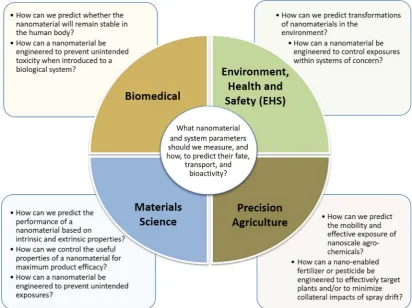
precision agriculture, and environmental, health, and safety (EHS) re-search is illustrated inFig. 1. Thefigure shows that eachfield pursues research relating to its discipline-specific questions, yet at the inter-section of thesefields is a common kernel of questions and answers that would advance each individual researchfield as well as open new vistas on a multi-disciplinary basis. By looking across all four disciplines, data integration potentially positively affects the entire data life-cycle, from experimental design through data sharing.
Integrating data from different data resources supports multiple goals specific to diverse organizations or projects (Oksel et al., 2015) and is a necessary precursor to deeper data mining to enable inter-disciplinary scientific discovery, facilitate regulatory decision making, and provide insight into improving the properties and performance of nanomaterials.
1.2. Importance of data integration to nanotechnology
Nanomaterials (Boholm and Arvidsson, 2016; Rauscher et al., 2012) are becoming ubiquitous in science and technology (Vance et al., 2015; Xia, 2014). Biomedical researchers are making multifunctional nano-materials to diagnose, target, and treat many diseases looking for ways to increase nanomaterial stability and optimize nanomaterial perfor-mance while minimizing potential negative effects (Xia, 2014). Other researchers are harnessing similar useful properties of nanoscale ma-terials for a host of other applications ranging from energy storage to water treatment to improved mechanical strength and flexibility of advanced materials (Roco et al., 2011).
[image:2.595.91.504.419.727.2]To design optimal nanomaterials and predict their behaviors, re-searchers must use data from disparate, non-standardized resources across biomedical, environmental, health and safety, and materials science disciplines. Problems abound. Even when the composition of a nanomaterial is provided, the nomenclature used to describe its com-ponents - the base nanomaterial formulation and the material
constituents (such as core, coat, shell, and any surface modifiers) - and the relationships among them is not standardized, and in many cases, are incomplete. For example, the surface density of“decorator” mole-cules on carbon nanotubes is rarely provided, resulting in the need for “guessing”the actual structure when preparing representative structure files for computational modeling (Shao et al., 2013).
A variety of physical-chemical characterization information (such as the size, shape, purity, and surface properties) are included in different resources, but the methods and techniques used to perform the char-acterization are not always included in sufficient detail or standardized in a way that supports cross-study comparison of reported values (Stefaniak et al., 2013; Marchese-Robinson et al., 2016). Repositories collect and store information in support of their organization's needs and goals, for which the role of nanomaterials data can differ con-siderably as indicated using the following examples.
•
Biomedical repositories focusing on the reactivity and efficacy of nanomaterials in living systems.•
Environmental repositories with geospatial information of the fate of nanomaterials in the environment.•
Physico-chemical repositories containing physical and chemical properties of nanomaterials.•
Genomic and biological pathways repositories with information on biological structures and reactivity.These disparate data repositories, when integrated together, can provide greater insights into understanding common endpoints such as nanomaterial toxicity or stability (Izak-Nau et al., 2015). Because of the current lack of standardization and integration of resources, data users must review documentation describing the protocols for storing in-formation in each repository, and sometimes retrieve and review ori-ginal publications to determine what is and what is not relevant to their research.
1.3. Influence of organizational purpose and goals on data integration
The approaches taken by an organization or project to gather and organize data are governed by the driving scientific questions that need to be answered to further its mission. Some examples of use case sce-narios that could benefit from multidisciplinary data integration are shown inFig. 1. Data that are measured, the information derived from those data, and the level of detail targeted for inclusion in a resource are all informed by the purpose for which data are being collected (Marchese-Robinson et al., 2016). Examples are provided below.
•
Building an authoritative repository of nanomaterial characteriza-tions.•
Parameterizing models to predict nanomaterial behavior in different systems (biomedical, environmental, or other).•
Enabling environmental and health risk assessments.•
Improving performance of materials, medicines, or pesticides.The individual resource goals also shape the type of data integration of interest with each project incentivized to link with other data sets to increase the critical mass of data in support of its mission.
Integrating data from different data resources supports multiple goals specific to diverse organizations or projects (Oksel et al., 2015). Using the example provided inFig. 1, understanding which parameters control stability of a nanomedicine in the human bloodstream could provide insight relevant to predicting nanomaterial dissolution or ag-gregation in a body of freshwater, transport within a cropfield, or ef-ficacy in a material fabrication process.
1.4. Purpose and structure of this article
The goal of this article is to capture the current state of data
integration in nanoinformatics and provide recommendations for ad-vancing integration within and outside of the nanoinformaticsfield. As discussed above, the integration of nanomaterial data with other na-nomaterial data sets as well as with data from otherfields will lead to new and exciting scientific opportunities. This article not only informs the nanoinformatics and nanomaterials testing communities of the challenges involved in data integration, but also identifies concrete actions that will accelerate the integration process. In addition, because much of the material presented herein is based on the results of a survey of most present-day nanomaterials data resources, the authors are confident that many of the current challenges are shared across the emerging communities; further, the characterization of the issues and the recommendations that follow position nano-communities to move forward towards integration, and offer insight to other still-maturing fields characterized by uncertainty.
Following the introduction and a discussion of the importance of integration and the influence of organization purpose and goals on the current state of data integration, the article presents the results of a nanoinformatics community-wide stakeholder survey designed to assess the current practices in integrating data in nanotechnology. Stakeholder demographics are presented (Section 2), followed by sta-keholder-identified challenges to integration (Section 3) and stake-holder-identified needed integration functionality (Section 4).Section 5 describes technological and semantic approaches to achieving integra-tion. Section 6 presents stakeholder recommendations for achieving integration, followed by an author-proposed path for moving forward (Section 7). Some closing remarks are provided inSection 8.
2. Stakeholder demographics
To understand the current practices in data integration and to identify challenges and offer recommendations, several organizations that maintain nanomaterial data resources were surveyed. The goal was to identify, define, and provide a stimulus for initiating integration and exchange of data resources across nanomaterial data repositories and with other related, non-nanotechnology data resources. Survey ques-tions included current and recommended functionality and web ser-vices enabling data integration as well as perceived challenges asso-ciated with integrating primary experimental data sets, or data sets curated from the literature, with other data resources. Appendix A contains a detailed summary of the stakeholder responses to the survey. Stakeholders who participated in the survey ranged from nanoma-terial resources that have extensive experience in integrating data re-sources to those with limited data integration experience whose focus was primarily on repository development (seeTable A-1). The diverse levels of integration capabilities provide insight into the challenges that need to be addressed to integrate across nanomaterial repositories and with other non-nanotechnology resources. A brief summary of the or-ganizations that participated in the survey, which represent some of the most active participants in thefield of nanoinformatics, follows.
caNanoLab, a data sharing portal supported by the National Cancer Institute of the U.S. National Institutes of Health, is designed to facil-itate information sharing across the international biomedical nano-technology research community to expedite and validate the use of nanotechnology in biomedicine. caNanoLab provides support for the annotation of nanomaterials with characterizations resulting from physico-chemical, in vitro and in vivo assays and the sharing of these characterizations and associated nanotechnology protocols in a secure fashion.
Commission (CPSC), the US Army Corps of Engineers (USACE), as well as other key domestic and international partners. CEINT supports fun-damental research regarding the behavior of nanomaterials in labora-tory studies and also in complex ecosystems. One of the goals of the center is to develop a web-based risk assessment tool that can be used to elucidate the potential risk associated with the release of nanomaterials into the environment.
The CSSP/NIPHE, Netherlands (The Center for Safety of Substances and Products),National Institute for Public Health and the Environment(CSSP at NIHE, or RIVM) provides a data resource on eco-toxicity data focusing on nanoparticles in consumer products, used for modeling purposes (QSAR). Also of significance to integrating a broad array of nanomaterial data, RIVM hosts the protocols and other text documents from across the European Union (EU) Seventh Framework Programme 2007–2013 (FP7) NANoREG project; they col-laborated with the FP7 eNanoMapper project (see below) that hosts the data as collected using ISA-TAB-Nano inspired (Thomas et al., 2013) MS Excel templates. The templates produced by the NANoREG project are also available (Totaro et al., 2017). (http://publications.jrc.ec. europa.eu/repository/handle/JRC103178).
DECHEMA is a network of experts in chemical engineering and biotechnology and supports several projects applicable to nano-technology such as the DaNa project and the NANORA project (Kühnel et al., 2014). DaNa is a knowledgebase of applied nanomaterials on health and environment. The NANORA project provides web facilities supporting the Nano Region Alliance, an alliance that facilitates market entrance for nanotechnology subject matter experts.
eNanoMapperwas an EU-funded FP7 project comprising eight re-search and industry institutes, whose aim is to improve data integration and to support safe-by-design development by building up a nanosafety ontology and database and provide web modeling tools for use of these data. Currently the eNanoMapper database at (https://search.data. enanomapper.net) hosts data generated by several EU projects in-cluding publicly accessible NANoREG data. Tools for converting Excel templates into ISA-TAB/ISA-Nano JavaScript Object Notation (JSON) and semantic formats are provided. The application programming in-terface facilitates data usage by the modeling community.
The Nanomaterial Registry is a publicly-available database of nanomaterial characterization and biological/environmental interac-tion data. Data in the Registry are curated from niche databases, lit-erature, catalogs, and reports by trained scientists. Curation is based on a set of minimal information about nanomaterials (Mills et al., 2014). The data of the Registry are also available on the Portal at nanoHUB (https://nanohub.org/) where predictive modelers canfind the data in a format that is easy for them to use.
The Nanoparticle Information Library (NIL) (http:// nanoparticlelibrary.net/nil.html) is a prototype searchable data re-source of nanoparticle properties and associated health and safety in-formation designed to help occupational health professionals, industrial users, worker groups, and researchers organize and share information on nanomaterials, including their health and safety associated proper-ties. It is operated by the National Institute for Occupational Safety and Health (NIOSH) in the United States.
3. Stakeholder-identified data integration challenges
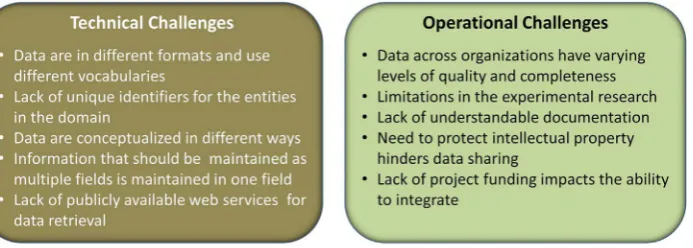
In the survey described above, responding nanoinformatics stake-holders identified several technical and operational challenges im-pacting current data integration efforts, as shown in Fig. 2. These challenges, if not addressed, will continue to hinder the exploitation of the scientific possibilities opened by linking nanomaterials data re-sources to one another and to data rere-sources in related scientific areas such as biology, medicine, and environmental studies. Each challenge is presented in greater detail below. It should be noted that, in preparing each section that incorporates survey responses, the authors organized and summarized the stakeholders input to consolidate and clarify across
the breadth of responses while attempting to maintain the intent and keep as much of the verbiage provided as possible.
3.1. Data are in different formats and use different (or no) common vocabularies or ontologies
The primary challenge in achieving data integration in nano-technology is the diversity of ways in which nanomaterial information is represented across data resources and the lack of standardization to a common model that represents nanomaterial entities, their attributes, and relationships. These issues include multiple meanings for the same word (or abbreviation) and different words (or abbreviations) having the same meaning. For example, cytotoxicity can have different specific meanings when different bioassays were used to measure it. Similarly, examples of synonyms with the same meaning are also abundant. For example, ZnO and zinc oxide are common ways of referring to the same chemical. Developing appropriate ontologies, including resolution of terminology conflicts, to address the nuances of nanotechnology re-search is a critical and important key to achieving integration (Thomas et al., 2011a, 2011b; Hastings et al., 2011).
3.2. Lack of unique identifiers for the entities in the domain
Certain aspects of data integration pertaining to semantics, or judgments of meaning, remain challenging regardless of the specific domain, and regardless of the thoroughness of the supporting ontology. For example, interpretation can become ambiguous in deciding when entities (e.g. nanomaterials, cells, samples, people, etc.) in different data contexts should be mapped as“the same” or“different”(e.g. if their names have narrower or broader meanings). Clear guidance for utilizing ontologies and tools must accompany their development to stave off differences introduced by end-user judgment; consider, for example, the difference between the Nano Particle Ontology terms for titanium dioxide (NPO_1485) and titanium oxide nanoparticle (NPO_1486). The NPO terms are intentionally distinct to distinguish between a compound and a nanoparticle and enable semantic integra-tion of data sets. However, without consistent guidance or built-in tools, a user might potentially select either one. The inherent freedom of in-terpretation in an ontology without associated guidance tools can di-minish the confidence in combined data and impact the ability to perform cross-material comparisons.
Other scientific fields have introduced naming conventions for generating unique identifiers based on metadata. The prevalence of informal terminology and the lack of a strong business case to create more formal conventions, however, make this challenging in the na-noscience area. Fields such as genomics are moving forward with generating a Universal Unique Identifier (UUID) for entities not based on metadata. In the context of nanomaterial data resource integration, needed metadata might include the results of physico-chemical char-acterization required to establish whether the nanomaterials are“the same”or“sufficiently similar”to be matched during data integration. However, the question of which physico-chemical properties need to match (Stefaniak et al., 2013), not to mention complexities associated with different measurement techniques and experimental protocols, make uniquely identifying and matching nanomaterials a significant scientific challenge. Further discussion of metadata (including batch identifiers) that could support unique identification and matching of nanomaterial database records is provided in an earlier article in the NDCI series (Marchese-Robinson et al., 2016).
3.3. Data are conceptualized in different ways
relationships between them. There has been a trend away from estab-lishing a fixed relationship, such as a hierarchy, between database elements, a trend that, in some regards, adds to the data mining chal-lenge. Sometimes knowledge of the relationships between attributes is built into the establishment of a hierarchy and that knowledge can be extracted when mining a database to ensure that data are appropriately aggregated when performing statistical analyses. Often times, databases are designed to support searching, but not specifically to support mining. In these types of databases, measurements are sometimes stored in replicate so that they can be found in different types of searches. If the seemingly replicated measurements are not handled correctly during analysis, they can lead to bias in statistical computa-tions.
3.4. Information that should be maintained as multiple individualfields is maintained in onefield
Integration of data can be hampered by differences in data granu-larity. A common issue is that information in one repository may be stored in one“field”, but be split into multiple“fields”in another re-pository. Additionally, in some repositories, numerical data are stored without a separate unit“field”. For example, some repositories use a field name such as“Concentration”and expect the user to know that the result is always in a specific unit, such as“mg/L”. In other cases, a measured result is combined with a unit and stored together in the same field (e.g. 5 mg/L), or included as a range of values in onefield (e.g. 7–10 mg/L).
3.5. Lack of publicly available web services for data retrieval
Integration is often hindered by the lack of publicly available web services supporting data retrieval. Without publicly available web ser-vices, each user must individually create data retrieval tools every time a data resource is to be integrated. Additionally, even when data ser-vices are provided, open frameworks such as the Representational State Transfer framework (REST) (Fielding and Taylor, 2000) are not lever-aged to ease development of integration touchpoints.
3.6. Data across organizations has varying levels of quality and completeness
A key challenge for nanoinformatics isfinding data that are suffi -ciently complete and of acceptable quality. At times, data from external resources are not integrated with local systems due to concerns re-garding the quality and completeness of those data. For example, a local knowledgebase can implement a screening procedure that carefully selects high quality data from the scientific literature; data from pub-lications not meeting the specific quality criteria are deemed unsuitable and are not curated into the knowledgebase. When evaluating external data for inclusion in the knowledgebase, if they do not come with an indicator or ranking of the reliability of those data, and if the ranking is not in line with the screening procedure used by the curators, it is
difficult to determine if and how those data should be incorporated. Lack of data completeness also poses a challenge to data integration because it is often difficult to obtain the necessary metadata to support comparison (a prerequisite for matching and data integration) between material records in different databases. For example, when obtaining information on physico-chemical characterization, it is valuable to have information on the chemical composition of the nanomaterials, such as the presence/absence of coatings, and if the nanomaterial has been transformed. Lack of complete metadata for associated biological tests may affect the clarity, and hence quality, of results (Klimisch et al., 1997) and could preclude an assessment of whether two sets of results were generated under sufficiently similar conditions to allow them to be meaningfully integrated. The lack of proper particle characterization is a key problem (Krug, 2014), and the consequence is that often a da-tabase contains more blankfields (no information) than actual data. This lack of high quality and complete data sets discourages integration. Though no system of characterizing quality or completeness has been broadly adopted, relative evaluation approaches have been proposed, including the NNI Data Readiness Level framework, as modeled from technology readiness assessment methods https://www.nano.gov// NKIPortal/DRLs.
A thorough discussion of the challenges associated with assessing the completeness and quality of nanomaterial data was presented in an earlier paper in the NDCI series (Marchese-Robinson et al., 2016).
3.7. Limitations in the experimental research
There are limitations in the experimental research process, such as biological variance, uniform characterization, and technological and methodological constraints. One major challenge related to data quality and completeness is defining the minimum data requirements for in-tegration (which often depends on the research question to be ad-dressed by the resulting integrated data set). The continuing evolution of knowledge of the important independent variables that must be controlled to make a measurement or assay accurate and reproducible can change these data requirements. As is customary in science, it takes time for new scientific insights to reach every lab, and as with any novel field, nanotechnology is evolving and maturing. This maturing process is evident in the nanosafetyfield as well as in bioinformatics; thefirst generation of results may not be optimal, but they must be used as a basis for improvement or the field will not progress. Another major challenge in nanoinformatics is that researchers are continuing to refine measurement techniques, which could change the comparability of measure results over time. These kinds of issues are related to the concepts of data quality and completeness, which were discussed, along with recommendations for progress, in the NDCI series ( Marchese-Robinson et al., 2016).
3.8. Lack of usable documentation
[image:5.595.49.396.57.181.2]The available documentation for external resources often just in-troduces the resource and provides instructions for its use, but does not
convey adequate information to understand the conceptualization be-hind the database design nor cover the data selection process. A com-monly accepted minimum documentation standard is needed. 3.9. Protection of intellectual property hinders data sharing
Although data sharing encourages the public to use and exploit knowledge contained in a database, restrictions may be in place to protect intellectual property rights and investments in generating and updating database content. Often, these restrictions have unclear statements regarding ownership, copyright, and licensing. Researchers are sometimes reluctant to share data until they are completely done analyzing and reporting their results out of fear that others will take their data and use it in a way that limits or reduces the novelty of their work (Reichman et al., 2011). Some have even suggested that those performing analysis on data they had no role in generating are “ re-search parasites” (Longo and Drazen, 2016). The need to maintain “unique selling points”of a data resource can impede data sharing. One solution to overcome this challenge is to provide a web service with restricted access in support of data retrieval while maintaining a cus-tomized interface to maintain unique characteristics of the resource. 3.10. Lack of project funding
Individual projects to build data resources and repositories usually do not have funding allocated to data integration. Furthermore, it is not clear which people in the management and funding chain are the cor-rect contacts for expanding a project scope to include integration. This is also a primary constraint for driving standardization towards a common model. The funding issues extend beyond the necessity to win monetary support that is shared by all research endeavors because these projects can often be seen as investments in infrastructure or tools and are thus perceived to fall outside the purview of basic science funding. Data projects, however, are significant exploratory investigations into scientific questions and not just IT projects. Data resources are a major future source of scientific knowledge, and integration across numerous sources expands research opportunities.
4. Stakeholder-identified functionality needed to enable data integration
To make progress on data integration, the key challenges noted above must be addressed through individual and collective activities. Stakeholders identified a number of critical functionalities and web services that are needed to enable data integration across nanomaterial repositories. Stakeholders also identified use-case-driven integration needs with non-nanotechnology resources.
4.1. Use of shared controlled vocabularies
To integrate across resources, each resource needs to either adopt shared controlled vocabularies or be able to map to agreed-upon stan-dards; see for example (ASTMStandard E2456, 2006; ISO, 2007). When mapping between controlled vocabularies, it is important to fully document the mappings and develop tools to assist in the mapping and transformation of data. Although tool development to automate map-ping of terms and schemas requires significant work, time is saved in the long run as standards evolve. Adoption of a common language is important, as well as using open standards for data exchange. 4.2. Data search and retrieval by ontological terms
Most nanomaterial resources support basic search and retrieval by nanomaterial, characterization, protocol, and publication. To facilitate search and retrieval across resources, it is necessary for resources to support searching by ontological terms (Gruber, 1995). A more detailed
discussion of ontologies and how they contain more than just a con-trolled vocabulary is provided by Thomas and others (Thomas et al., 2011a, 2011b; Hastings et al., 2011). Additionally, search capability should support retrieval of data (e.g. primary nanomaterial character-istics) across each nanomaterial resource and retrieval of detailed in-formation, e.g. study endpoints applicable to the resource, from the same source on. For example, in the case of toxicity data, it is necessary to support retrieval of particle fate characteristics during testing as well as information on the test medium. eNanoMapper's search system al-lows searching using ontologies, taking into account synonyms. The demonstration server athttps://search.data.enanomapper.net/ allows simultaneous searching over data collected by eNanoMapper and by caNanoLab, as well as NANoREG data. The site also offers integrated searching over data from several past FP7 projects for H2020 NanoReg2 project partners.
4.3. User friendly web-based data submission forms
Nanomaterial resources should provide user friendly tools sup-porting the submission of data on nanomaterials, characterizations, protocols, and publications via web-based forms. These forms should constrain data entry by requiring use of a controlled vocabulary. 4.4. Data import and export tools
Resources should provide support for the validation, import, and export of data in standard data file formats such as ISA-TAB-Nano (Thomas et al., 2013; Marchese-Robinson et al., 2015; ASTMStandard E2909, 2013), which allows data to be exported from one data resource directly into another. It is understood that the development of such tools would require a significant amount of work for resources not currently supporting standards like ISA-TAB-Nano.
4.5. Tools to analyze and visualize data
Data analysis and visualization tools within and across nanomaterial resources will facilitate cross-material comparisons. Visualizing nano-materials in 3D and displaying scatter plots and distribution plots across data would assist in optimizing nanomaterial design. Analytic tools need to support the work of many disciplines, including chemistry, biology, toxicology, medicine, and physics.
4.6. Data modeling tools
Data modeling tools assist in predicting nanomaterial behavior in different biological and environment systems. The integration of na-nomaterial resources with data modeling tools requires that each re-source provide access to sufficiently high quality and complete data sets in a format supported by modeling tools.
4.7. Facilities for rating data sets for data quality and completeness
Prior to integrating with an existing nanomaterial resource, it is important to understand the data quality and completeness of the re-source. Facilities that rate data for completeness or quality, or both, can assist in providing this assessment. Approaches could include rating against minimum information as well as feedback from users who try to reproduce those data. However, assessing data completeness and quality is decidedly non-trivial. A thorough examination of this issue is presented in another article in the NDCI series (Marchese-Robinson et al., 2016).
4.8. Data annotations
waiving where applicable. Understandably, data can be proprietary and, if so, should be clearly marked as proprietary. The use of resources, such as ZENODO (https://zenodo.org/) and FigShare (https://figshare. com/), which allow users to assign a specific license to their research data, is arguably indicative of a growing awareness of the importance of clarity regarding rights to data usage within the scientific community. These resources, however, do not support the application of automated data integration techniques (Wilkinson et al., 2016). In addition to annotations on data provenance, data annotations can also be provided to further clarify the quality of the data.
4.9. Web services needed to enable data integration across nanomaterial data repositories
Stakeholders supporting the use of nanotechnology in the biome-dicine and the nanosafety communities indicated that the biomedical community needs common web services supporting the exchange of nanomaterials, characterizations, protocols, and publications in support of cross-material comparison. By integrating with other nanomaterial repositories supporting biomedicine and with other data resources from environmental and healthfields, the biomedical community hopes to better predict the bio-distribution and toxicity of nanomaterials in model organisms, including humans. Additionally, the biomedical community would like to obtain detailed information on the in-vestigation, studies, and assays based on the metadata identified as part of the ISA-TAB standard.
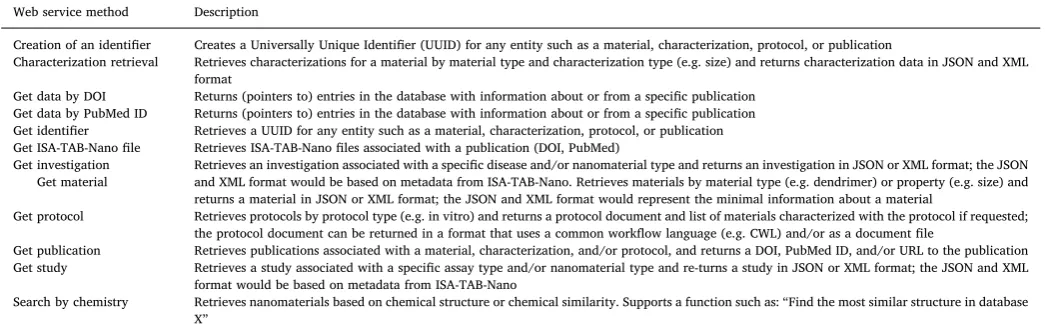
To support such data integration, ISA-TAB and ISA-TAB-Nano Application Programming Interfaces (APIs) that retrieve entities based on the ISA-TAB and ISA-TAB-Nano JSON schemas (https://github.com/ ISA-tools) have been developed. (N.B.: previously TAB and ISA-TAB-Nano data sets have been represented using tab-delimited text fields (Sansone et al., 2008; Marchese-Robinson et al., 2015). The na-nosafety community has many interests and covers many different scientific domains. Of special interest at this time are web services that meet two essential needs: determination of the similarity between two nanomaterials and locating all data and information associated with one published paper or with a specific experimental protocol. Common web services envisaged by these stakeholders as being needed to sup-port integration of nanomaterial data in the biomedical nanotechnology and nanosafety domains are presented inTable 1.
4.10. Needs for integrating nanotechnology data repositories with non-nanotechnology resources
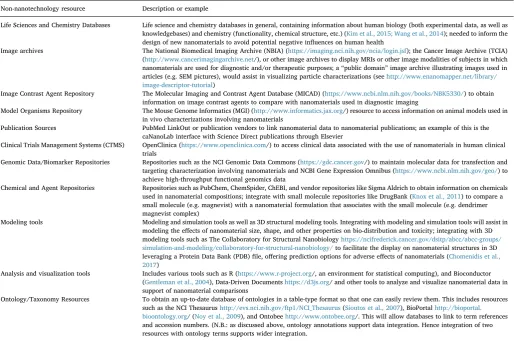
Stakeholders also identified a variety of non-nanotechnology
resources that must be accessed to support use case driven data in-tegration needs; these are summarized inTable 2.
5. Data integration approaches
A variety of approaches to data integration exist, with new ones continuing to be developed, supported by technologies ranging from manual integration (e.g. via an Excel spreadsheet) to a federated search architecture based on semantic web technologies (http://www.w3.org/ standards/semanticweb/) (Cheung et al., 2009; Eyres, 2013). It is be-yond the scope of this paper to provide a comprehensive review of these approaches. Instead, approaches that best facilitate the retrieval of in-tegrated data via automated queries(e.g. through data query lan-guages such as SQL or SPARQL (Hartig and Langegger, 2010)) are discussed. Nonetheless, it is important to note that given the preference of many scientists to work in Excel, tools that allow for automated in-tegration of manually prepared Excel data sets into queryable databases are of considerable value (e.g. https://github.com/enanomapper/ nmdataparser).
5.1. Data integration technology
The extremes of the spectrum with regard to selecting an archi-tecture that supports data integration through automatic querying are provided below (Doan et al., 2012).
•
Data warehousing–an approach that loads the content of different data resources into the same physical database. Subsequently the “warehouse”database can be queried, which involves querying all loaded data resources concurrently, with results presented to the user. [image:7.595.37.560.576.743.2]•
Federated querying–an approach that sends the same query to different data resources at their original locations and presents the results to the user in a unified view after they are received. The data warehouse paradigm accomplishes the integration by transforming all the data resources into a physical schema (i.e. tables and relationships for relational databases, or XML schema, etc.). The federated query approach relies on a“mediated schema”(i.e., a virtual schema, embedded in the application), which does not store any data, but presents to the user a unified view of the domain across resources. The integration itself relies on how the different attributes of the mediated schema match the attributes of the resources, and if the grouping of the attributes corresponds to similar groupings of attributes in the data resources. This is known as“semantic mapping”and is theTable 1
Common web services envisaged by nanoinformatics stakeholders, as reported in the survey, as being needed to support integration of nanomaterial data in the biomedical nano-technology and nanosafety domains.
Web service method Description
Creation of an identifier Creates a Universally Unique Identifier (UUID) for any entity such as a material, characterization, protocol, or publication
Characterization retrieval Retrieves characterizations for a material by material type and characterization type (e.g. size) and returns characterization data in JSON and XML format
Get data by DOI Returns (pointers to) entries in the database with information about or from a specific publication Get data by PubMed ID Returns (pointers to) entries in the database with information about or from a specific publication Get identifier Retrieves a UUID for any entity such as a material, characterization, protocol, or publication Get ISA-TAB-Nanofile Retrieves ISA-TAB-Nanofiles associated with a publication (DOI, PubMed)
Get investigation Get material
Retrieves an investigation associated with a specific disease and/or nanomaterial type and returns an investigation in JSON or XML format; the JSON and XML format would be based on metadata from ISA-TAB-Nano. Retrieves materials by material type (e.g. dendrimer) or property (e.g. size) and returns a material in JSON or XML format; the JSON and XML format would represent the minimal information about a material
Get protocol Retrieves protocols by protocol type (e.g. in vitro) and returns a protocol document and list of materials characterized with the protocol if requested; the protocol document can be returned in a format that uses a common workflow language (e.g. CWL) and/or as a documentfile
Get publication Retrieves publications associated with a material, characterization, and/or protocol, and returns a DOI, PubMed ID, and/or URL to the publication Get study Retrieves a study associated with a specific assay type and/or nanomaterial type and re-turns a study in JSON or XML format; the JSON and XML
format would be based on metadata from ISA-TAB-Nano
hardest task within the integration.
The technology for accessing the data resources can be the same for both approaches. The data warehouse approach may use extract-transform-load (ETL) procedures, connecting to external data re-sources via web services and loading the results into the warehouse, while federated querying can use wrappers for accessing several distinct databases residing on the same machine and combine results only when presenting them to the user. Hence, a web service is a method for ac-cessing the data, but its use does not imply anything about the data integration paradigm after data retrieval.
The emergence of new technologies has repeatedly changed tech-nical approaches to data integration. While paradigms based on central data platforms still predominate (Williams et al., 2012; Maglott et al., 2005), the wider data integration community often use a more dis-tributed, more-easily scalable cloud platform (Samwald et al., 2011; Jupp et al., 2014) and other methods, based upon federated search approaches (Cheung et al., 2009; Eyres, 2013). Additionally, between the two extremes of data warehousing and federated query, hybrid architectures exist that combine elements of both pure data ware-housing and federated querying.
5.2. Semantic issues in data integration
The choice of integration architecture depends not only on tech-nological approaches, but also on the best approach for addressing se-mantic issues. In selecting an approach, the following two questions must be considered.
•
How can/will entities be matched across data resources?•
How will query results be integrated into coherent answers? Regardless of the integration approach, all methods requireentity matching(linking associated information based on database content), orschema mapping(virtually altering the schema of one database so that its content can be queried with data from a database with a dif-ferent schema), or both mapping techniques. Mapping is typically performed using transformation procedures, and there may not exist a simple one-to-one mapping between thefinal schema and the original data resources.This is especially true in scientific and technological disciplines in which very complex concepts (entities) have been mod-eled differently by different groups at different times, a situation ex-acerbated by the evolution of new knowledge constantly being devel-oped.A key requirement for an integration effort is having a network of schema mapping algorithms, based on individual data and metadata identifiers, that crosslink content from different data resources. In dis-ciplines close to nanotechnology, efforts such ashttp://identifiers.org/ (Juty et al., 2012) unify how these identifiers are represented, and other resources provide solutions for mapping identifiers from different da-tabases (van Iersel et al., 2010; Chambers et al., 2014; Wohlgemuth et al., 2010). Identifiers, however, typically focus onentities studied, such as chemicals, materials, genes, and proteins. Identifiers for cell lines, assays, and other key entities involved in nanosafety data are less common, though ontologies commonly provide identifiers for them (Hastings et al., 2011; Thomas et al., 2011b; Hastings et al., 2015a).
[image:8.595.43.558.80.422.2]Developing mapping algorithms has traditionally been done manually; however, active research is producing tools for automatic schema mapping and record linkage by deterministic, probabilistic, and
Table 2
Non-nanotechnology resources needed to support use case driving data integration.
Non-nanotechnology resource Description or example
Life Sciences and Chemistry Databases Life science and chemistry databases in general, containing information about human biology (both experimental data, as well as knowledgebases) and chemistry (functionality, chemical structure, etc.) (Kim et al., 2015; Wang et al., 2014); needed to inform the design of new nanomaterials to avoid potential negative influences on human health
Image archives The National Biomedical Imaging Archive (NBIA) (https://imaging.nci.nih.gov/ncia/login.jsf); the Cancer Image Archive (TCIA) (http://www.cancerimagingarchive.net/), or other image archives to display MRIs or other image modalities of subjects in which nanomaterials are used for diagnostic and/or therapeutic purposes; a“public domain”image archive illustrating images used in articles (e.g. SEM pictures), would assist in visualizing particle characterizations (seehttp://www.enanomapper.net/library/ image-descriptor-tutorial)
Image Contrast Agent Repository The Molecular Imaging and Contrast Agent Database (MICAD) (https://www.ncbi.nlm.nih.gov/books/NBK5330/) to obtain information on image contrast agents to compare with nanomaterials used in diagnostic imaging
Model Organisms Repository The Mouse Genome Informatics (MGI) (http://www.informatics.jax.org/) resource to access information on animal models used in in vivo characterizations involving nanomaterials
Publication Sources PubMed LinkOut or publication vendors to link nanomaterial data to nanomaterial publications; an example of this is the caNanoLab interface with Science Direct publications through Elsevier
Clinical Trials Management Systems (CTMS) OpenClinica (https://www.openclinica.com/) to access clinical data associated with the use of nanomaterials in human clinical trials
Genomic Data/Biomarker Repositories Repositories such as the NCI Genomic Data Commons (https://gdc.cancer.gov/) to maintain molecular data for transfection and targeting characterization involving nanomaterials and NCBI Gene Expression Omnibus (https://www.ncbi.nlm.nih.gov/geo/) to achieve high-throughput functional genomics data
Chemical and Agent Repositories Repositories such as PubChem, ChemSpider, ChEBI, and vendor repositories like Sigma Aldrich to obtain information on chemicals used in nanomaterial compositions; integrate with small molecule repositories like DrugBank (Knox et al., 2011) to compare a small molecule (e.g. magnevist) with a nanomaterial formulation that associates with the small molecule (e.g. dendrimer magnevist complex)
Modeling tools Modeling and simulation tools as well as 3D structural modeling tools. Integrating with modeling and simulation tools will assist in modeling the effects of nanomaterial size, shape, and other properties on bio-distribution and toxicity; integrating with 3D modeling tools such as The Collaboratory for Structural Nanobiologyhttps://ncifrederick.cancer.gov/dsitp/abcc/abcc-groups/ simulation-and-modeling/collaboratory-for-structural-nanobiology/to facilitate the display on nanomaterial structures in 3D leveraging a Protein Data Bank (PDB)file, offering prediction options for adverse effects of nanomaterials (Chomenidis et al., 2017)
Analysis and visualization tools Includes various tools such as R (https://www.r-project.org/, an environment for statistical computing), and Bioconductor (Gentleman et al., 2004), Data-Driven Documentshttps://d3js.org/ and other tools to analyze and visualize nanomaterial data in support of nanomaterial comparisons
machine learning methods (Christen, 2012). In the case of unstructured data resources (e.g. text), the workflowfirst performs data extraction and entity recognition and then proceeds with the mapping. The chal-lenge, of course, is that mapping entities for complex scientific subjects can be very difficult, even for experts. For example, the concept “per-centage cumulative mortality,” which may be reported in different ways depending on the experimental time course and time of ob-servation, can require post-processing of retrieved data (Kovrižnych et al., 2013; Truong et al., 2011).
5.3. Data integration in scientificfields closely related to nanotechnology
Solutions to data integration problems in nanotechnology can be informed by practices developed for use in other scientific disciplines. Specifically, semantic issues encountered in otherfields are similar to those experienced in the nanoinformatics community, and the types of organizations and individuals interested in data integration are also similar. Integration efforts in three closely relatedfields are described below.
5.3.1. Integrating small molecule chemical databases
As in nanoinformatics, the major challenge in integrating small molecule chemical data resources is the determination of the equiv-alency of the composition and structure of two small molecule entities. In the case of small molecule chemicals, the entities are the chemical structures, and the IUPAC International Chemical Identifier, InChI, (http://www.inchi-trust.org) (Heller et al., 2015) can be used as a uniform identifier across databases. When performing integration, the rule for entity matching is,“if the search results returned include one and the same Standard InChI,then the results are for the same compound”.
Several complexities must be considered when matching based on an InChI. For example, small molecule chemicals may be considered the same, yet still have different InChIs due to their rapidly interconverting structures. While InChIs are designed to be invariant to different ways of representing chemicals based on small molecular structures, in-cluding taking into account tautomeric forms which are expected to rapidly equilibrate, they cannot account for all differences in chemical structure that may readily interconvert in practice - such as differences in protonation state or between open-and-closed ring forms that can equilibrate for sugars in solution. If non-standard InChIs are used, the situation is further complicated; indeed, if the so-called “perception options”are employed, different“standard”InChIs may be generated for the same input structure (Heller et al., 2015). Regardless, integra-tion of small molecule chemical data resources based on matching their standard InChIs is currently viewed as best practice and may be com-bined with other software tools to enforce further standardization of chemical structures that may facilitate desired matching (Hersey et al., 2015).
The development of a single, comprehensive identifier for nano-materials, similar to InChI, is an attractive prospect, though the size, complexity, and requisite three-dimensional nature of nanomaterials indicate many challenges for this approach.
5.3.2. Integrating biomolecular databases
The integration of biomolecular databases has faced a number of complex problems, such as mapping things that are related but not identical and mapping things that are similar but not identical. Extending the single identifier approach to more complicated structures (e.g. proteins and genes), requires expanding queries to handle all possible synonyms used within different databases. This is difficult because the nomenclature for biomolecules is still not totally standar-dized. However, some success has been achieved in establishing a common API for a given type of resource, facilitating integration by alleviating the need for schema matching. Essentially, the API defines a common schema and if all resources of the same kind are compliant with the API, the main burden of semantic mapping is met.
An example of implementation of this approach in the genomics field is the Global Alliance for Genomics and Health (GA4GH) Data Working Group (http://ga4gh.org/#/), which is establishing common web services in support of genomic data integration and exchange. Web services using the REST framework (Fielding and Taylor, 2000) are provided with query requests and responses formatted using the JSON. The common web services allow the genomics community to exchange reads, variants, and reference information, provided all data resources follow the API specification. The need for such protocols is essential as modeling data integration approaches to capture cytotoxicity effects are now emerging (Kohonen et al., 2017).
The implementation of a central data warehouse that aggregates data from several resources requires ETL processes to assist in ag-gregating and transforming data based on matching rules. Data are typically transformed into a common data model (e.g. relational data-base or a triple store); examples of this approach are PubChem (https:// pubchem.ncbi.nlm.nih.gov/) and ChEMBL (https://www.ebi.ac.uk/ chembl/) databases. The Open PHACTS project (https://www. openphacts.org/) provides a common API to a variety of pharmacolo-gical data sets. It does not, however, normalize to a single data model, but addresses non-uniformity at the API level (Williams et al., 2012). The European Bioinformatics Institute Resource Description Framework (EBI-RDF) platform uses another approach, maintaining multiple RDF repositories for different resources and allowing federated searching across all of them (Jupp et al., 2014). Entities in the EBI-RDF platform are assigned equivalent identifiers, with identifiers.org service pro-viding mappable URIs, which is essentially implementing the mapping between the distributed resources.
5.3.3. Integrating public life sciences databases
Life sciences data resources provide further insight into the handling of integration of complex data inherent in living biological systems. In these systems, additional complexity is added by the large number of variables needed to fully characterize a living system.
The Syngenta federated search system (Eyres, 2013) is an example of addressing the challenge of integrating internal company data with public life science databases. The system has moved from data ware-housing (even if that offers faster reporting) towards federated search technologies. The architecture includes several internal relational da-tabase repositories, translated into RDF dynamically via D2RQ (http:// d2rq.org/), and provides adapters in order to combine all internal and external data resources into a distributed SPARQL endpoint. The im-plementation of this federated architecture for data integration was found to offer clear benefits to Syngenta's multidisciplinary researchers, even when the questions driving their research were different. Other similar resources include Ontoforce (http://www.ontoforce.com/) and Euretos (http://www.euretos.com/).
5.4. Data integration lessons for nanoinformatics
Linking data enables data integration; by integrating data sets, data comparisons are enabled. Linking does not, of course, provide the definitions needed for data to be compared, or even which data can be connected. Decoupling data integration into two steps, linkage and comparison, allows formalization of a hypothesis into a query. For ex-ample, consider the linkage of two nanomaterial data resources, one containing clinical data and the other embryonic zebrafish toxicity data. Identifying records across both resources as being related to the “same” nanomaterial allows for a hypothesis (e.g. “toxicity towards embryonic zebrafish is of clinical relevance”) (Harper et al., 2008) to be converted into a query (e.g. “report all nanomaterials where high toxicity with respect to embryonic zebrafish corresponds to a high toxicity in a clinical setting, as a fraction of all nanomaterials with both kinds of data”), which compares data retrieved for two endpoints for the same nanomaterial.
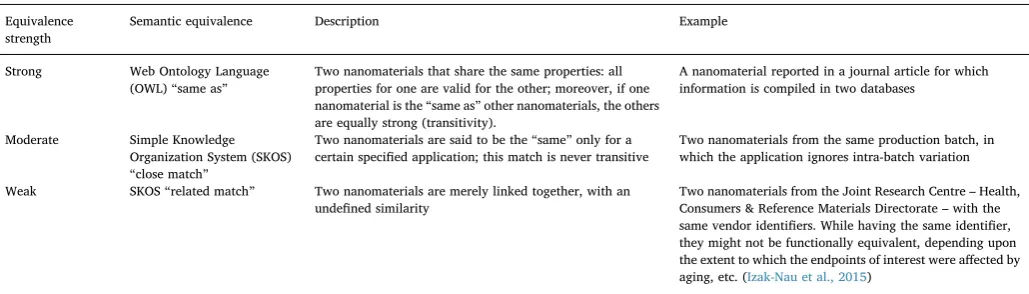
This approach becomes increasingly powerful if links are made between entities (e.g. nanomaterials), even if they are not identical, but show the same chemical or biological characterization for endpoints of interest, i.e. are functionally equivalent (basically the difference be-tween“the same”and“a close match”) (seeTable 3).
A formalization of this approach in terms of Semantic Web tech-nologies has been recently proposed through the introduction of lenses that allow users to turn on and offsuch equivalents based on which links they deem suited for their research question (Batchelor et al., 2014; Brenninkmeijer et al., 2012). This approach merges the worlds of ontologies and data by using Internationalized Resource Identifiers (IRIs), such as those found in the set of Semantic Web technologies (Berners-Lee et al., 2001; Marshall et al., 2012). The Open PHACTS project has taken this approach and developed an Identifier Mapping Service (IMS) that links databases using IRI-based identifiers (Batchelor et al., 2014). Services such asidentifiers.organd the IMS itself provide routes to convert between alphanumeric identifiers (e.g. CHEBI:33128) and IRI-based identifiers (http://www.ebi.ac.uk/chebi/searchId.do? chebiId=CHEBI:33128) as defined in the ChEBI ontology (Hastings et al., 2015b).
Once these links are operational, allowing comparison of data for a set of similar or identical materials, the cross-comparison can be used for automated data curation. During curation, automated comparisons could be enabled to automatically generate warnings that point the user towards other studies reported in other data sources that contradict those being curated. Assuming the linking and subsequent steps leading to the generation of such a warning are correct, the linking could allow researchers of an earlier study to be automatically notified that new related data have been added to the database. These advances in data integration are directly applicable for nanoinformatics and also enable a variety of research goals to be achieved that are specific to a parti-cular organization.
6. Stakeholder recommendations for advancement in nanoinformatics
To assist in providing guidance to the nanotechnology community, stakeholders (in the survey discussed in Section 2) provided re-commendations for furthering the integration and exchange of data sets across nanomaterial resources. Recommendations centered on the de-velopment of pilot projects supporting data integration and the estab-lishment of a global alliance in nanotechnology for standardizing data formats and web services.
6.1. Obtain commitment to integration from funding bodies and from active project leadership
Stakeholders expressed the opinion that the only way to achieve integration effectively is to take the steps listed below.
1. Be committed to integration.
2. Have the funding in place to complete the effort.
3. Get the right people (i.e. hands-on developers and nanomaterial experimental experts) together to work through details of con-ceptual design and controlled vocabulary.
4. Continue fostering a commitment to maximum possible transpar-ency and community-wide sharing of approaches, intentions, and techniques.
Despite the current competitive funding situation, the nanoinfor-matics community must work together to maximize what funding re-sources are available. This good faith collaboration is the necessary key to making enough progress to achieve the momentum needed for long-term success.
6.2. Initiate pilot integration projects
[image:10.595.41.556.78.225.2]Initiating pilot projects in data source integration efforts iscritical. As it stands, individual data resources are funded for individual pur-poses andfinding resources to devote to collaboration and interoper-ability can be difficult. Based on the U.S. National Nanotechnology Initiative's signature initiative for a knowledge infrastructure (Roco, 2011), there is already a documented need for collaborative resources. Stakeholders clearly believe now is the time to fund pilot collaborative projects focused on data integration. To foster a better understanding of the data life cycle and to be successful in developing meaningful plans for moving forward with existing and new knowledge management resources, these projects must be multidisciplinary and include on-tology designers, experimental researchers, and predictive modelers.
Table 3
Levels of equivalence. The equivalence strengths are meant to indicate how data are intended to be combined and do not specify why they should be linked in that manner.
Equivalence strength
Semantic equivalence Description Example
Strong Web Ontology Language (OWL)“same as”
Two nanomaterials that share the same properties: all properties for one are valid for the other; moreover, if one nanomaterial is the“same as”other nanomaterials, the others are equally strong (transitivity).
A nanomaterial reported in a journal article for which information is compiled in two databases
Moderate Simple Knowledge Organization System (SKOS) “close match”
Two nanomaterials are said to be the“same”only for a certain specified application; this match is never transitive
Two nanomaterials from the same production batch, in which the application ignores intra-batch variation
Weak SKOS“related match” Two nanomaterials are merely linked together, with an undefined similarity
6.3. Establish a Global Alliance in Nanotechnology (GAIN) to develop integration standards
Similar to the Global Alliance for Genomics and Health (GA4GH) established by the genomics community, the nanotechnology commu-nity should form an organization to develop integration standards. A Global Alliance in Nanotechnology (GAIN) would provide the critical mass of interest and commitment necessary to support such develop-ment. Thefirst steps of the GAIN would include: developing a common model for representing data and data relationships, creating a standard data dictionary, and establishing web service specifications needed to enable integration.
6.4. Focus on providing high quality and complete data sets in data repositories to encourage integration
Individual resources should recognize the importance of providing high quality and sufficiently complete data, rather than simply focusing on providing large amounts of data, especially if the data quality is suspect. Assessing data quality, however, is a complex issue as is the related topic of data completeness. It should also be recognized that the requirements for data to be considered complete and the degree of quality required may be contingent upon the intended purpose of the data. The extent to which different data resources may have legiti-mately different definitions of data completeness, based upon their different objectives, underscores the importance of nanoinformatics data resource developers collectively recognizing the value of data in-tegration and the need to ensure the necessary data and metadata re-quired to support integration are documented (Marchese-Robinson et al., 2016).
6.5. Implement data stewardship
Data stewardship, the management and ownership of data assets in an organization, such that the data are easily available and of necessary quality and consistency, should be central to any nanomaterial project. Good stewardship requires that all researchers involved in the project actively participate throughout the process, from beginning to conclu-sion. This effort involves experimental design, data management plan-ning (including planplan-ning for data sharing and adoption of scientific methods in handling data), data citation, and more. Stewardship im-plies setting aside resources for these tasks. Some will be monetary resources (e.g. for cloud storage, data hosting, possibly commercial support in making data available in community formats), but other actions should be a core part of the daily research of all the people involved in the project. Postponing planning for data handling, retrie-vability, and storage inevitably jeopardizes good stewardship and in-creases costs substantially (Wilkinson et al., 2016).
7. Authors' recommendations: a path forward for achieving data integration across nanomaterial resources and with non-nanotechnology repositories
Taking into consideration the needs and recommendations of the nanoinformatics stakeholders, a multi-step path forward to achieving meaningful progress in integrating nanomaterial data resources is proposed. The phases identified inFig. 3provide a roadmap towards integration. Each phase is discussed in greater detail below.
7.1. Phase 0: establishment of an organization dedicated to achieving data integration in the nanomaterial domain
Based on the authors' experience with multi-partner projects in Europe and the United States, the authors recommend the nanoinfor-matics community establish a multi-stakeholder, multi-disciplinary, international group focused on nanotechnology data integration. As
described above, this envisioned group, referred to here as the Global Alliance in Nanotechnology (GAIN) would provide the visibility and energy needed to start the process towards meaningful data integration in nanoinformatics. The GAIN could be an independent group or part of an existing working group such as the U.S. Nano WGhttps://wiki.nci. nih.gov/display/icr/nanotechnology+working+group or the NSC (Savolainen et al., 2013) focused on achieving data integration goals. The advantage of having a group such as the GAIN is that the synergy and diversity of data resources necessary to test integration approaches would be present. For example, the breadth of nanomaterials entities (see Phase 1 below) would be rich enough so models developed would encompass relevant domains.
In the stakeholder survey, all stakeholders agreed to participate in a Global Alliance pending availability of funding and time. Active groups include the stakeholders previously identified plus the NanoSafety Cluster (NSC,http://nanosafetycluster.eu/) Databases Working Group (along with participation in other NSC working groups), the US-EU Communities of Research working group on Databases and Computational Modeling for NanoEHS (https://us-eu.org/ communities-of-research/overview/), and the US Nano WG, the CODATA/VAMAS Working Group developing the Uniform Description System for Nanomaterials (http://www.codata.org/nanomaterials) (Rumble et al., 2014). Alliances among these organizations can be strengthened to avoid unnecessary duplication of effort across the broader community with the primary objective of supporting and en-abling concrete open source projects around ontologies, nanoinfor-matics tools, and data integration.
7.2. Phase 1: design of a common model that identifies nanomaterial entities and their relationships within existing resources
One of thefirst tasks for an organization such as the GAIN would be the development of a common model that identifies nanomaterial en-tities and their relationships. It is recommended that the common model provide aflexible structure that can more readily be changed as the model evolves. The design of the common model would prioritize identifying components that cross multiplefields, such as nanomaterial composition and physico-chemical characterizations (Stefaniak et al., 2013). Concepts from ISA-TAB-Nano and other ontologies and de-scription systems can be leveraged to represent entities associated with investigations, studies, assays, and materials. It is important to note that this common model is not envisaged as a single, authoritative, feder-ated cyberinfrastructure to facilitate integration in an automfeder-ated manner. Instead, this model is intended to provide a centralized com-munity-wide understanding of the nanoinformatics space, capturing an overview of the data types implicated, and providing insight into where it makes sense to dedicate resources towards detailed integration pro-jects and tools.
7.3. Phase 2: design specifications for web services that implement the common model
Once the common model is established, specifications for common web services can be developed, including defining service endpoints based on entities in the common model. Web service specification should be prioritized to focus on basic queries to retrieve nanomaterial data sorted by nanomaterial characteristics and other properties. Web services can be further expanded to accommodate use-case-dependent data exchange with non-nanotechnology resources. In support of data exchanges with these resources, established interfaces could be pub-lished and organizations could collaborate with resource providers to develop a common interface that facilitates re-use.
7.4. Phase 3: implementation of web services through pilot projects