White Rose Research Online URL for this paper:
http://eprints.whiterose.ac.uk/136805/
Version: Published Version
Article:
Fairclough, H.E., Gilbert, M. orcid.org/0000-0003-4633-2839, Pichugin, A.V. et al. (2 more
authors) (2018) Theoretically optimal forms for very long span bridges under gravity
loading. Proceedings of the Royal Society A: Mathematical, Physical and Engineering
Sciences, 474 (2217). ISSN 1364-5021
https://doi.org/10.1098/rspa.2017.0726
[email protected]
https://eprints.whiterose.ac.uk/
Reuse
This article is distributed under the terms of the Creative Commons Attribution (CC BY) licence. This licence
allows you to distribute, remix, tweak, and build upon the work, even commercially, as long as you credit the
authors for the original work. More information and the full terms of the licence here:
https://creativecommons.org/licenses/
Takedown
If you consider content in White Rose Research Online to be in breach of UK law, please notify us by
rspa.royalsocietypublishing.org
Research
Cite this article:Fairclough HE, Gilbert M, Pichugin AV, Tyas A, Firth I. 2018 Theoretically optimal forms for very long-span bridges
under gravity loading.Proc. R. Soc. A474:
20170726.
http://dx.doi.org/10.1098/rspa.2017.0726
Received: 13 October 2017 Accepted: 17 August 2018
Subject Areas:
structural engineering, civil engineering, mathematical modelling
Keywords:
bridges, catenary of equal strength, structural optimization, layout optimization
Author for correspondence:
Matthew Gilbert
e-mail:[email protected]
Electronic supplementary material is available
online at https://dx.doi.org/10.6084/m9.
igshare.c.4218686.
Theoretically optimal forms for
very long-span bridges under
gravity loading
Helen E. Fairclough
1
, Matthew Gilbert
1
, Aleksey V.
Pichugin
2
, Andy Tyas
1
and Ian Firth
3
1
Department of Civil and Structural Engineering, University of
Sheield, Mappin Street, Sheield S1 3JD, UK
2
Department of Mathematics, CEDPS, Brunel University London,
Uxbridge UB8 3PH, UK
3
COWI UK Ltd, Bevis Marks House, Bevis Marks, London EC3A 7JB, UK
MG,0000-0003-4633-2839; AVP,0000-0001-5194-4413
Long-span bridges have traditionally employed suspension or cable-stayed forms, comprising vertical pylons and networks of cables supporting a bridge deck. However, the optimality of such forms over very long spans appears never to have been rigorously assessed, and the theoretically optimal form for a given span carrying gravity loading has remained unknown. To address this we here describe a new numerical layout optimization procedure capable of intrinsically modelling the self-weight of the constituent structural elements, and use this to identify the form requiring the minimum volume of material for a given span. The bridge forms identified are complex and differ markedly to traditional suspension and cable-stayed bridge forms. Simplified variants incorporating split pylons are also presented. Although these would still be challenging to construct in practice, a benefit is that they are capable of spanning much greater distances for a given volume of material than traditional suspension and cable-stayed forms employing vertical pylons, particularly when very long spans (e.g. over 2 km) are involved.
1. Introduction
Since construction of the 137 m span Union bridge on the England–Scotland border in 1820, the world’s longest bridge span has doubled approximately every
2
rspa.r
oy
alsociet
ypublishing
.or
g
Proc
.R
.S
oc
.A
47
4
:2
01
70
72
6
...
50 years, and nine out of the 10 longest bridge spans in history have been constructed in the last 20 years. In recent years, plans have been developed for bridges in Italy, Norway and Indonesia with spans of in excess of 3 km, while a more speculative, though still potentially feasible, proposal has been mooted for a bridge with 5 km spans over the Strait of Gibraltar. While these specific structures face challenges of a technical as well as economic and political nature, it is likely that bridge spans will continue to increase in the twenty-first century.
Forms for long-span bridges have evolved over several centuries. The modern suspension bridge form, pioneered by James Finlay in the USA, started to find favour at the turn of the
nineteenth century [1], and is still employed in the world’s longest span bridge structures, such
as the 1991 m span Akashi Kaikyo Bridge in Japan [2]. In the past few decades, the ease and
speed of construction of cable-stayed bridge forms has led to an increase in their popularity, particularly for spans up to approximately 1200 m. This development has led to debate about
the relative merits of suspension versus cable-stayed bridges [3]. However, debate has often
centred on the importance of various practical considerations, for example, relating to ease of construction or susceptibility to dynamic effects, rather than on a comparison of the theoretical efficiency of these forms. Furthermore, and most significantly, it has seldom been questioned whether these forms are appropriate when very long spans are involved, or whether more optimal structural forms exist. This is important as a non-optimal form will consume more material than is necessary, in some cases considerably more. Also, it is important to bear in mind that for any given material the form will limit the overall span that can be attained. In the case of the Akashi Kaikyo Bridge, consultant M. Ito stated that high-strength steel wire was developed to reduce
the dead weightbecause more than 90 percent of the cross section of the main cables is used to carry the
bridge’s own weight[4]. Similarly, K. H. Ostenfeld, Project Director for the Great Belt (East) Bridge with the longest span in the world prior to Akashi Kaikyo at 1624 m, has stated that one of two
limiting factors for long-span bridges isthe limits for known materials in carrying their own weight
[5], governed by the well-known square-cube law [6]. Also Lewis [7] indicates a practical limiting
span of less than 5 km for a suspension bridge when using steel, suggesting that materials with a higher specific strength (the strength/weight ratio) might be necessary to achieve longer spans.
However, although lightweight composite materials [8,9], and even carbon nanotubes [10], have
been proposed for long-span bridges, metals such as steel have advantages, such as far greater
fracture toughness [11]. This coupled with plentiful supply and low cost means that steel is likely
to remain the dominant material for suspension cables for the foreseeable future. Thus, while materials are unlikely to revolutionize longer span bridges in the near term, and recognizing that constructability factors still dominate consideration of economical solutions, there is the possibility for new, more materially efficient, structural forms to do so. This is the focus of the present study.
Although there have been attempts to identify improved designs for very long-span bridges
by using engineering intuition [12,13], an alternative is to use layout optimization, the theoretical
basis of which was developed by Michell [14] in the early twentieth century, building on earlier
work by Clerk Maxwell [15]. This theory later stimulated the development of computer-based
numerical layout optimization methods [16,17]. Modern numerical layout optimization methods
have been found to be capable of identifying new forms and of obtaining very close estimates of the volumes of the corresponding exact solutions. For example, layout optimization was used to show that the minimum volume structure to carry a uniformly distributed load between pinned supports was not the parabolic arch (or cable) form which had presumed to be optimal since
the time of Christiaan Huygens [18], but instead a more complex form comprising networks of
orthogonal tensile and compressive elements near the supports and a central parabolic section; in this case the numerical volume obtained via extrapolation techniques was later shown to be
within 0.001% of the exact analytical solution subsequently derived [19]. Layout optimization has
also been used to investigate bridge-like forms, for example being used to show that changing the ratio of the limiting compressive to tensile material strength gives rise to a family of optimal
structures which range from arch to cable-stayed forms [20], prompting follow on analytical
3
rspa.r
oy
alsociet
ypublishing
.or
g
Proc
.R
.S
oc
.A
47
4
:2
01
70
72
6
...
However, long-span bridge structures are dominated by self-weight and standard layout optimization techniques are not suitable in this case, since phenomena such as cable sag are not modelled intrinsically as part of the formulation. Simplified models which assume self-weight to be ‘lumped’ at end-nodes, and which implicitly assume that bending can be carried by the
element between nodes [22] are problematic in cases where self-weight effects are significant.
This is because in such a formulation the flexural effect of self-weight on the element itself is ignored, and physically meaningful solutions may not be generated (e.g. a solution might comprise long-spanning straight bars of constant cross section, which transmit a large proportion of their self-weight directly to supports).
In fact, when self-weight is taken into account it has been known for almost two centuries that
each (non-vertical) element in an optimal structure must take the form of acatenary of equal strength
[23,24]. This is an element which is free of bending and has a cross section which varies along its
length, thus ensuring no excess material is present, a requirement in a rigorously optimal solution (notwithstanding that uniform cross sections are normally preferred in practice, for practical reasons). A key feature of such an element is that if the spatial positions of its end points are known in advance then that element can take up one of only two possible shapes, depending only on whether the force to be carried is compressive or tensile. This is significant as it means
that the standard layout optimization procedure [16,17] can be modified such that every potential
(non-vertical) member is an equal stress catenary element with ana prioridefined shape. Thus
straight elements are replaced with suitably curved compression and/or tension elements. This also means that applications where self-weight effects are significant can be tackled, such as very long-span bridges, enabling new reference solutions for bridge structures subjected to gravity loadings to be obtained.
In this paper, the formulation for elements of equal strength will first be outlined and then used to provide a new layout optimization formulation. This will then be used to determine the theoretically optimal form for a very long-span bridge of given span carrying gravity loading, with the volume of material required compared with that required to construct traditional bridge forms of the same span. Note that the influence of wind and other dynamic effects, while significant in the design and construction of such spans, are beyond the scope of the present study, although they can, in principle, be incorporated into structural optimization schemes.
2. Elements of equal strength
(a) Catenary elements
Gilbert [23] developed relations to describe the shape of thecatenary of equal strength,a structural
form transferring its self-weight to two level end points. Its cross-sectional areaAis proportional
to the axial forceF, hence its weight per unit length isκF, whereκis a proportionality constant. In
an optimal skeletal structure the stresses at all points in an element must be purely axial, and equal
to the value of the limiting material stress. For a material with unit weightρgthen the weight per
unit length isAρg. If the limiting stress in tension and compression isσT andσC, respectively,
thenF=AσTandκ=ρg/σTfor tensile elements, andF= −AσCandκ= −ρg/σCfor compressive
elements. Unless otherwise stated, in this paper the limiting material stress will be taken to be the
same in tension and compression, such thatσT=σC=σ0.
Routh [25, Art. 453] provides a concise derivation of the equation for this catenary in Cartesian
coordinates, which for our purposes can be reformulated as
κy=log(cos(C1−κx))+C2. (2.1)
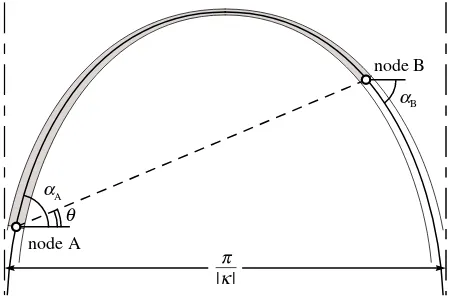
If the origin is placed at the highest point of the curveC1=C2=0. A plot of the curve is shown in
figure 1. The curve has vertical asymptotes at±π/2|κ|. Therefore, elements with a span ofπ/|κ| are not possible, as they would have infinite length and volume. (For the steel material used in
this study, unless stated otherwise, the limiting material stressσ0has been taken as 500 MPa and
4
rspa.r
oy
alsociet
ypublishing
.or
g
Proc
.R
.S
oc
.A
47
4
:2
01
70
72
[image:5.493.134.362.41.189.2]6
...
q aA
aB
p
|k| node A
node B
Figure 1.Approximate shape of an equally stressed element AB in compression.
We will need relations for elements connecting two arbitrary points on a plane, allowing these to be incorporated in the layout optimization formulation that will be described in §3. It can be
shown,figure 1, that an equally stressed element connecting any two arbitrary points will consist
of a segment of the curve defined by equation (2.1) with non-zeroC1andC2. If the coordinates
of two nodes are denoted by (xA,yA) and (xB,yB), the expressions for the associated constantsC1
andC2can be established to be in the form
C1=κxA−arctan
cos(κ(xB−xA))−eκ(yB−yA)
sin(κ(xB−xA))
(2.2)
and
C2=κyA−log
cos
arctan
cos(κ(xB−xA))−eκ(yB−yA)
sin(κ(xB−xA))
. (2.3)
The parameters that will be required in the layout optimization formulation are the reaction forces exerted on the element end points, and the volume of the element. Note also that the horizontal
distance between the two connected points must be belowπ/|κ|in order for it to be possible to
connect them; thus elements with a span greater or equal to this limit will not be added to the ground structure in the layout optimization formulation.
(i) Reaction forces
The angle of inclination of the centreline of the element at any point is given by
α=C1−κx. (2.4)
In order to produce purely axial stresses the force must also be inclined:
qy=qxtan(α), (2.5)
whereqy andqx are the vertical and horizontal components of the force qat the given point.
Componentqxwill be constant over the length of the element as only vertical self-weight forces
are applied between the end points. Given that an external forceqis to be transmitted directly
between the end points, qx=qcos(θ), whereθ is as shown in figure 1. Combining this with
equation (2.5), gives
qy=qcos(θ) tan(α), (2.6)
which, when used with values ofαAandαBfrom equation (2.4), allows the vertical reaction forces
qyto be determined at the supports. Note that when self-weight effects become negligible,αwill
5
rspa.r
oy
alsociet
ypublishing
.or
g
Proc
.R
.S
oc
.A
47
4
:2
01
70
72
[image:6.493.161.329.39.176.2]6
...
t
ds W
q q + dq
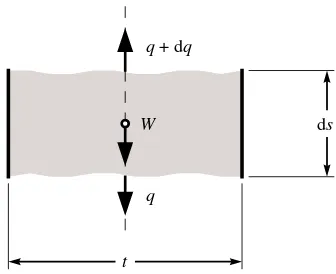
Figure 2.Forces acting on an ininitesimal slice of a vertical, equally stressed element.
(ii) Volume
The volumeVof an element AB with unit width is given by
VAB=
B
AAds, (2.7)
whereAis the cross-sectional area of the element at a given position along the element. By noting
that the cross-sectional area at a point is proportional to the force at that point, it can be shown that
VAB= −qx
ρg(tan(αB)−tan(αA))= −
qcos(θ)
ρg (tan(αB)−tan(αA)). (2.8)
Note that there will be two sets of values forαAandαB, one set for tensile elements and one set for
compressive elements (see equation (2.4), noting that the sign ofκchanges depending on whether
tensile or compressive elements are involved).
(b) Vertical elements
The equations presented in the preceding section cannot be applied to perfectly vertical elements as the curve never becomes completely vertical. Complementary equations for the thickness of an optimal vertical element of varying cross section are therefore now derived.
If an infinitesimal slice of a vertical element is considered, as shown in figure 2, vertical
equilibrium and the requirement that the stress is always equal to the limiting stress gives
− 1
qdq=κds. (2.9)
Integrating both sides between the endpoints A and B gives:
qB=qAexp(κ(yA−yB)). (2.10)
(i) Reaction forces
Equation (2.10) relates the forces at each end of the element; however, unlike the catenary form,
there is no valueqwhich relates this to the force to be transmitted. Therefore, the reaction forces
at the ends of vertical elements are defined in terms ofqA. Trivially, the vertical reaction force at
point A is defined as 1×qAand equation (2.10) provides the definition of the vertical reaction at
6
rspa.r
oy
alsociet
ypublishing
.or
g
Proc
.R
.S
oc
.A
47
4
:2
01
70
72
6
...
(ii) Volume
The volume of the vertical element is found by integrating the cross-sectional area of the element over its length, which, due to (2.10), yields
VAB=
B
AAds= qA
ρg
exp
κ(yA−yB)
−1
. (2.11)
3. Layout optimization
(a) Standard formulation
The standard (weightless) numerical layout optimization procedure involves discretizing
a design domain with n nodes, usually positioned on a uniform grid. These nodes are
interconnected withmpotential truss elements, forming a ‘ground structure’, and optimization
is then used to find the minimum volume truss structure satisfying force equilibrium conditions,
explained diagramatically infigure 3a–c.
The classical ‘equilibrium’ plastic truss layout optimization formulation for a single load case is defined in equation (3.1) as follows:
minV=cTq,
subject to:
Bq=f, (3.1)
q≥0,
where Vis the total volume of the structure. In the standard formulation not involving
self-weightqT= {q+1,q−1,q+2,q−2,. . .,q−m}, andq+i ,q−i are the tensile and compressive internal forces in
bar i(i=1,. . .,m);cT= {l
1/σT,l1/σC,l2/σT,l2/σC,. . .,lm/σC}, whereliis the length of bariand
σT andσC are, respectively, the limiting material stress in tension and compression. Note that
in the classical layout optimization formulation buckling instability is not modelled directly, though the specified limiting material stress in compression can if necessary be reduced to
account for this.Bis a suitable (2n×2m) equilibrium matrix containing direction cosines and
fT= {f1x,f1y,f2x,f2y,. . .,fny}, wherefjxandf y
j are thexandycomponents of the external load applied
to nodej(j=1,. . .,n). The presence of supports at nodes can be accounted for by omitting the
relevant terms fromf, together with the corresponding rows fromB.
Consider now the contribution of a single elementito the volume of the structure and to the
global equilibrium matrix, which can be written asVi=cTiqi andBiqi, whereci,Biandqi are,
respectively, a vector containing terms that allow the volume to be derived from the element force, the local equilibrium matrix, and the vector containing element force terms. The relevant expressions can be written in expanded form as follows:
Vi=
li σT
li σC
q+i
q−i (3.2)
and
Biqi=
⎡
⎢ ⎢ ⎢ ⎣
cosθi −cosθi
sinθi −sinθi
−cosθi cosθi
−sinθi sinθi
⎤
⎥ ⎥ ⎥ ⎦
q+i
q−i , (3.3)
whereθiis the angle of inclination of the element.
This problem is in a form which can be solved using linear programming (LP), with the
member forces inqbeing the LP variables. Although posed as a plastic design problem, when
only a single load case is involved, as is the case here, the formulation furnishes solutions which
7
rspa.r
oy
alsociet
ypublishing
.or
g
Proc
.R
.S
oc
.A
47
4
:2
01
70
72
[image:8.493.60.430.41.426.2]6
...
L/2
W
(b) (c)
(d) (e)
(f) (a)
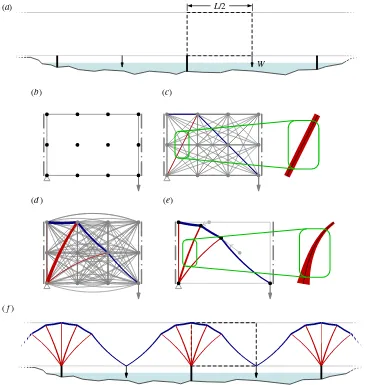
Figure 3.Procedure employed to identify optimal (minimum volume) bridge structures. Steps (a–c) describe the standard
layout optimization formulation while steps (a,b) and (d) describe the new layout optimization formulation, used when
self-weight efects are signiicant. Steps (e,f) show the result of subsequently applying geometry optimization. (a) Problem
deinition (simpliied multi-span bridge problem with multiple spans, with point load applied at the centre of each span;
the highlighted half span can be modelled due to symmetry). (b) Design domain discretized with nodes and assumed
boundary and load conditions. (c) Layout of straight (weightless) elements identiied via layout optimization. (Compressive
and tensile elements shown in red and blue, respectively.) (d) Layout of curved elements identiied via layout optimization.
(Curved elements may lie slightly outside the domain.) (e) Improved design, obtained by adjusting the positions of
active nodes using geometry optimization. (Detail shows an element with exaggerated self-weight, demonstrating the
curvature and non-uniform cross sections of these elements.) (f) Resulting optimized design for the problem. (Online version
in colour.)
(b) Formulation with elements of equal strength
To take account of the effects of self-weight, the standard formulation can be modified to include elements with equal strength along their length. Thus straight elements are replaced with suitably
curved compression and/or tension members, as indicated infigure 3d. By using the relations
given in §2, new terms forViandBiqican be established which take account of self-weight effects
8
rspa.r
oy
alsociet
ypublishing
.or
g
Proc
.R
.S
oc
.A
47
4
:2
01
70
72
6
...(i) Inclined element with self-weight
The element volume and equilibrium expressions can be obtained using (2.8) and (2.6), respectively, and written in expanded form as follows:
Vi=
cos(θi)
tanαA+−tanα+B
ρg
cos(θi)
tanαB−−tanα−A
ρg
ˆ
q+i
ˆ
q−i (3.4)
and
Biqi=
⎡
⎢ ⎢ ⎢ ⎣
cosθi −cosθi
cosθitanαA+ −cosθitanα−A
−cosθi cosθi
−cosθitanα+B cosθitanαB−
⎤ ⎥ ⎥ ⎥ ⎦ ˆ
q+i
ˆ
q−i , (3.5)
whereαA+,αA−andα+B,α−B are the angles of inclination of the tensile and compressive equal stress
catenary elements at points A and B, respectively, which are calculated from equation (2.4), and ˆ
q+i andqˆ−i are the tensile and compressive forces in the element (equivalent toq+i andq−i given in
the previous section).
(ii) Vertical element with self-weight
In this case, the element volume and equilibrium expressions can be obtained using (2.11) and (2.10), respectively, and written in expanded form as follows:
Vi=
1−exp
κ(yA−yB)
ρg
exp
κ(yA−yB)−1
ρg
ˆ
q+i
ˆ
q−i (3.6)
and
Biqi=
⎡ ⎢ ⎢ ⎢ ⎣ 0 0
1 −1
0 0
−exp(κ(yA−yB)) exp(κ(yA−yB)) ⎤ ⎥ ⎥ ⎥ ⎦ ˆ
q+i
ˆ
q−i , (3.7)
where in this caseqˆ+i ,ˆq−i are tensile and compressive force components, equal to qA, the force
exerted on node A.
It is entirely possible for the ground structure, and therefore the resulting solution, to contain any desired combination of weightless, inclined and vertical elements with self-weight.
(c) Rationalization via geometry optimization
When using layout optimization the solution accuracy is controlled by the number of nodes used to discretize the design domain. If large numbers of nodes are employed then highly accurate numerical solutions can be obtained. However, the associated forms will often be complex, and also difficult to realize in practice. To address this a relatively coarse nodal discretization can instead be used to obtain a layout that can then be improved by adjusting the locations of nodes
using the geometry optimization procedure described in [26], though with standard weightless
bars replaced with elements of equal strength, using the relations described in the preceding
section; sample results are shown infigure 3e,f.
4. Application to very long-span bridges
(a) Problem deinition
9
rspa.r
oy
alsociet
ypublishing
.or
g
Proc
.R
.S
oc
.A
47
4
:2
01
70
72
6
...
span of a notional multi-span bridge structure is being modelled, with the problem being as
described infigure 3, but with the point loadsWreplaced with a uniformly distributed load
w, applied at the same elevation. This configuration can also be used to approximately represent
a bridge with a central main span and shorter side-spans. (In fact, this representation will be exact if the side-spans are equal to half the main span, and if reactions at the ends of the bridge are purely horizontal, as is approximately the case, e.g. for the Akashi Kaikyo Bridge.) However, other specific scenarios can readily be modelled using the general numerical procedure described.
The magnitude of w is assumed to include both traffic loading and the self-weight of deck
elements required to provide a continuous level traffic surface, though it does not include the self-weight of material required in the deck to carry axial forces, if present, which is automatically included in the model as part of the optimization process. Note also that in very long-span bridges traffic loading becomes less significant than the self-weight of the deck and cables, which means that the problem can justifiably be posed as a single load case layout optimization problem, furnishing a structural form which consumes the minimum possible volume of material to carry
the distributed loadwand the self-weight of the structural elements employed. (The inherent
bending resistance of the pylons and deck is not considered in the optimization directly, but will be required to ensure that alternative load cases can be carried. Also, although wind and other dynamic effects are very important in cable-supported bridges, particularly when spans are long, various mitigation strategies can often be applied once the basic form has been established. For example, to counter wind-induced vibration it has recently been suggested that the use of slotted
box girder decks will permit 5 km suspension bridge spans to be achieved [27], or alternatively
active control systems can potentially be employed [28]. These are therefore not considered
further here.)
In the interests of computational efficiency, a half span was modelled (taking advantage of
symmetry) and the adaptive solution strategy developed by Gilbert & Tyas [17] was employed
to enable problems with increasingly fine nodal resolutions to be solved. The load discretization
strategy used in [18] was also employed in order to reduce the discretization error associated with
the load. The largest model run contained 68 026 nodes and 2 313 734 325 potential connections,
including overlaps (i.e. over 2billionpotential connections).
(b) New reference volumes
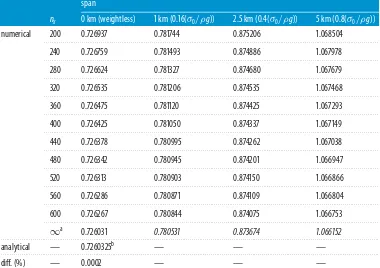
Using the aforementioned assumptions, the layout optimization procedure has been used to
obtain new reference solutions for a range of bridge span lengthsL, obtained by using increasingly
fine nodal resolutions; numerical results are shown in table 1. The spans quoted in the table
assume that high-strength steel is employed for all elements, with a limiting material strength
in tension and compression of 500 MPa and a unit weight of 80 kN m−3- though other scenarios
can readily be modelled using the general numerical procedure described. Also shown are
extrapolated volumes computed using the power-law extrapolation scheme described in [18].
Models comprisingnx=200, 240,. . ., 600 divisions were used to provide source data, wherenxis
the number of nodal divisions across the full span (the number of nodal divisions in the height of
the domain,nywas taken asnx×3/8). A weighted nonlinear least-squares approach was used to
find best-fit coefficient values for use in the extrapolation, with the weighting factor taken asnx,
to increase the influence of fine resolution solutions.
For the 0 km span (weightless) case the extrapolated value was found to compare closely with
a recently published analytical value [20], showing that high-precision results can be obtained.
For the other spans considered the extrapolated values furnish new reference volumes, providing benchmark values against which alternative bridge designs can be judged. (As suggested by Cox
[29], just as there is a limit on the thermal efficiency of a heat engine, set by the Carnot cycle, so
10
rspa.r
oy
alsociet
ypublishing
.or
g
Proc
.R
.S
oc
.A
47
4
:2
01
70
72
[image:11.493.59.439.64.332.2]6
...
Table 1.Numerical volumes (×wL2/σ0) for various bridge spans and nodal resolutions. span
nx 0 km (weightless) 1 km (0.16(σ0/ρg)) 2.5 km (0.4(σ0/ρg)) 5 km (0.8(σ0/ρg))
numerical 200 0.726937 0.781744 0.875206 1.068504
. . . .
240 0.726759 0.781493 0.874886 1.067978
. . . .
280 0.726624 0.781327 0.874680 1.067679
. . . .
320 0.726535 0.781206 0.874535 1.067468
. . . .
360 0.726475 0.781120 0.874425 1.067293
. . . .
400 0.726425 0.781050 0.874337 1.067149
. . . .
440 0.726378 0.780995 0.874262 1.067038
. . . .
480 0.726342 0.780945 0.874201 1.066947
. . . .
520 0.726313 0.780903 0.874150 1.066866
. . . .
560 0.726286 0.780871 0.874109 1.066804
. . . .
600 0.726267 0.780844 0.874075 1.066753
. . . .
∞a 0.726031 0.780531 0.873674 1.066152
. . . .
analytical — 0.7260325b — — —
. . . .
dif. (%) — 0.0002 — — —
. . . .
Notes: The new reference solutions are shown in italics typeface. (Quoted span lengths assume a limiting material stressσ0=500 MPa and
unit weightρg=80 kN m−3.)
aObtained by extrapolation, using a power-law extrapolation scheme as used in [18].
bAnalytical solution obtained by Pichuginet al.[20].
(c) New structural forms
Structural forms corresponding to the new reference solutions for 1, 2.5 and 5 km span lengths
are shown infigure 4a. To provide visually clear solutions a layout optimization discretization
involving 30 nodal spacings across the full span was used prior to rationalizing the solutions using geometry optimization; see appendix A for details.
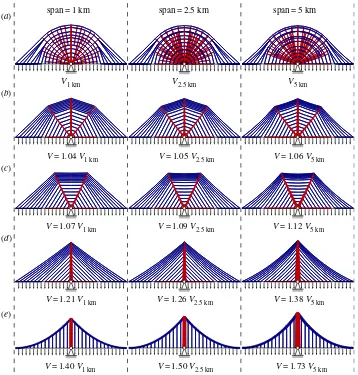
The new reference forms shown in figure 4aquite closely resemble the weightless Michell
structure that was fully described analytically in [20], with tension and compressive elements
aligned (near)orthogonally. They also include a series of inclined compressive elements radiating
out from the supports, just as in [20]. The forms are also markedly different to traditional
cable-stayed or suspension bridge forms, and would clearly be extremely difficult to construct in practice. However, to allow comparison with the former, the inclined compressive elements can readily be removed by omitting candidate inclined compressive elements when setting up the layout optimization problem. The resulting optimized cable-stayed bridge forms are shown infigure 4d, and differ slightly from the standard ‘harp’ cable arrangement in that they have non-uniform spacing of stays along the height of the pylon. However, most significantly, the consumed material is up to 38% greater than that required for the corresponding (near) optimal
reference designs shown in figure 4a. Although the latter would be much more difficult to
fabricate than the more conventional cable-stayed forms shown infigure 4d, they can be used to
inspire a range of simplified forms. Thusfigure 4b,cshows simplified split-pylon bridge structures
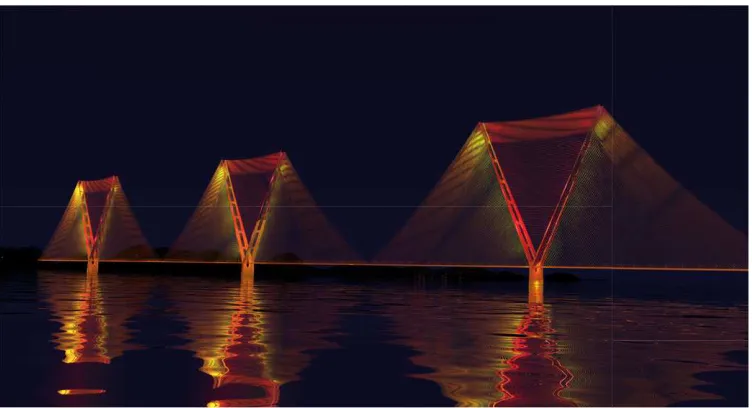
comprising, respectively, three and two pylons, consuming, respectively, approximately 6 and 12% more material than the corresponding reference designs in the 5 km span case; a computer-generated render of a bridge comprising two 5 km spans designed to be potentially suitable for
11
rspa.r
oy
alsociet
ypublishing
.or
g
Proc
.R
.S
oc
.A
47
4
:2
01
70
72
[image:12.493.69.427.39.414.2]6
...
span = 1 km span = 2.5 km span = 5 km
(e) (d) (c) (b) (a)
V= 1.40 V1 km V= 1.50 V2.5 km V= 1.73 V5 km
V= 1.21 V1 km V= 1.26 V2.5 km V= 1.38 V5 km
V= 1.07 V1 km V= 1.09 V2.5 km V= 1.12 V5 km
V= 1.04 V1 km V= 1.05 V2.5 km V= 1.06 V5 km
V1 km V2.5 km V5 km
Figure 4.Bridge forms for various spans and associated volumes, expressed in terms of the reference volume, whereV1 km=
0.7805wL2/σ0,V2.5 km=0.8737wL2/σ0andV5 km=1.0662wL2/σ0(wherewis the load applied at deck level,Lis the span and
σ0is the limiting strength of the material). The three-span lengths considered, 0.16(σ0/ρg), 0.4(σ0/ρg) and 0.8(σ0/ρg),
correspond to 1, 2.5 and 5 km, respectively, whenσ0is taken as 500 MPa and the unit weightρgas 80 kN m−3. All solutions
shown were optimized via geometry optimization. (a) Reference design (simpliied layout shown for clarity). (b) Optimized
triple split-pylon design. (c) Optimized double split-pylon design. (d) Optimized cable-stayed design. (e) Optimized suspension
bridge design (all with variable cross-section cables). (Online version in colour.)
The optimized locations of all elements in the single, double and triple split-pylon cable-stayed
structures shown infigure 4b–dwere found using geometry optimization techniques (appendix
A), indicating that a harp rather than fan style cable arrangement is most materially efficient. Also, for comparative purposes, optimized suspension bridge configurations were obtained by
applying geometry optimization to the standard suspension bridge layout, as shown infigure 4e.
These bridges consume up to 73% more material than the corresponding reference designs shown infigure 4a. (The bridge structures described here are actually somewhat lighter than those found in constructed suspension bridges as the cable areas were here allowed to vary along the lengths of the cables.)
12
rspa.r
oy
alsociet
ypublishing
.or
g
Proc
.R
.S
oc
.A
47
4
:2
01
70
72
[image:13.493.60.436.40.244.2]6
...
Figure 5.Split-pylon concept bridge to cross Strait of Gibraltar, with two 5 km main spans (not showing additional measures
likely to be needed to counteract unbalanced live load efects, e.g. [30]). (Online version in colour.)
cable-stayed bridge form are also included for comparative purposes, along with those for
cable-stayed and suspension bridge forms constrained to use the larger span-to-dip (L/h) ratios
currently employed in the world’s current longest cable-stayed and suspension bridge spans,
respectively, found in the 1104 m span Russky Bridge, Russia (L/h=4.4) and the 1991 m span
Akashi Kaikyo Bridge, Japan (L/h=9). (Traditional suspension bridges have generally been built
with span-to-dip ratios of 8.5–13.5 and cable-stayed bridges with span-to-dip ratios of 3.4–4.9 [7].)
It is evident that traditional bridge forms with larger span-to-dip ratios become very inefficient as spans increase, but that the simplified double and triple split-pylon forms remain comparatively efficient even when the span is long.
(d) Inluence of span-to-dip ratio
The fact that a high span-to-dip ratio in a cable-supported bridge can lead to a high volume of material being required has been known for many years (indeed this prompted the seminal work of Davies Gilbert, who wanted to demonstrate to Thomas Telford that the initial shallow
suspension bridge design for the Menai Straits was structurally inefficient [24]). However, a low
span-to-dip ratio also requires the use of tall pylons, which can be problematic to construct. Also, when non-uniform loadings are present it has been observed that midspan deflections increase
in suspension bridges when lower span-to-dip ratios are employed [30]. It is therefore of interest
to explore the influence of the limiting span-to-dip ratio on the volume of material required, and
to evaluate the performance of the new simplified forms when such limits are imposed. Figures7
and8present volumes and corresponding forms when the span-to-dip ratios are limited to 4.4
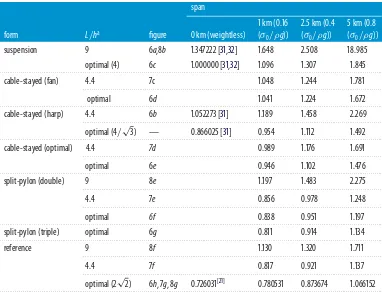
and 9, respectively; key results from figures6–8are also tabulated intable 2, showing that the
span-to-dip ratios identified as being optimal in the present study are considerably lower than those typically used in practice.
From figures7and8it is clear that even when a limit is placed on the span-to-dip ratio, the
corresponding reference form consumes considerably less material than traditional forms. The simplified double split-pylon form is also much more materially efficient than traditional forms, suggesting that this latter form could prove popular in practice. When the span-to-dip ratio is increased to 9 the resulting double split-pylon form quite closely resembles the split-pylon design
13
rspa.r
oy
alsociet
ypublishing
.or
g
Proc
.R
.S
oc
.A
47
4
:2
01
70
72
6
...
(a) (a)
(b) (b)
(c) (c)
(d)
(d)
(e)
(e)
(h) (h)
(f)
(f)
(g) (g)
1 km 2.5 km 5 km 10 km
volume,
w
L
2/s
0
0 0.2 0.4 0.6 0.8 1.0 1.2 1.4 1.6
span, s0/rg 0.5
1.0 1.5 2.0 2.5 3.0 3.5 4.0
Figure 6.Volume versus span for various bridge forms, using equal stress catenary elements and with nodal positions identiied
via geometry optimization. (SpanL=0 data points are taken from the literature; seetable 2for details. Indicated span distances
of 1, 2.5, 5 and 10 km assume thatσ0is taken as 500 MPa and the unit weightρgas 80 kN m−3) (a) Suspension bridge,
with span-to-dip ratio of 9, as in the Akashi Kaikyo Bridge, Japan. (b) Cable-stayed bridge with span-to-dip ratio of 4.4,
as in the Russky Bridge, Russia (harp cable arrangement assumed here). (c) Suspension bridge with optimal pylon height.
(d) Cable-stayed bridge with fan cable arrangement and optimal pylon height. (e) Cable-stayed bridge with optimal pylon
height. (f) Optimized double split-pylon design. (g) Optimized triple split-pylon design. (h) Reference bridge design. (Online
version in colour.)
(a) (a)
(b) (b)
(c) (c)
(d)
(d)
(e)
(e)
(f)
(f)
(g)
(g)
1 km 2.5 km 5 km 10 km
volume,
w
L
2/s
0 0.2 0.4 0.6 0.8 1.0 1.2 1.4 1.6
span, s/rg 0.5
1.0 1.5 2.0 2.5 3.0
Figure 7.Span-to-dip ratio of 4.4-volume versus span for diferent bridge designs: (a) harp style cable-stayed; (b) suspension;
(c) fan style cable-stayed; (d) optimized cable-stayed; (e) optimized double split-pylon; (f) reference optimum form for the
14
rspa.r
oy
alsociet
ypublishing
.or
g
Proc
.R
.S
oc
.A
47
4
:2
01
70
72
6
...
(a) (a)
(b) (b)
(c)
(c)
(d)
(d)
(e)
(e)
(f)
(f)
(g)
(g)
0.5 1.0 1.5 2.0 2.5 3.0 3.5 4.0
0 0.2 0.4 0.6 0.8 1.0 1.2 1.4 1.6
1 km 2.5 km 5 km 10 km
volume,
w
L
2/s
span, s/rg
Figure 8.Span-to-dip ratio of 9-volume versus span for diferent bridge designs: (a) harp style cable-stayed; (b) suspension; (c)
fan style cable-stayed; (d) optimized cable-stayed; (e) optimized double split-pylon; (f) reference optimum form for the given
span-to-dip ratio; (g) reference with unrestricted span-to-dip ratio for comparative purposes. (Online version in colour.)
arrangement rather than the hybrid cable arrangement observed to be optimal here. (A small number of split-pylon cable-stayed bridges have been constructed in practice, though these have generally spanned relatively short distances, and aesthetic or specific practical reasons for their form have usually been cited by their designers. For example, the double split-pylon cable-stayed bridge constructed near Düsseldorf Airport in Germany in 2002 was so designed to keep the
height of the structure low in order to avoid impeding air traffic [33]. Also, this bridge uses a fan
style cable arrangement, rather than the hybrid cable arrangement found to be most materially efficient here.)
When the height available is unrestricted the optimal cable-stayed form resembles the harp
style form but has a non-uniform spacing of cables up the pylon (figure 6); this also leads to a
lower pylon height being required. As the height available is reduced the traditional harp style form (with uniform spacing of cables up the pylon) becomes less efficient than both the fan style form and also the suspension bridge form. Also, the optimal cable-stayed form begins to resemble the fan style form, and has a similar volume.
(e) Inluence of reducing the limiting compressive stress
In this study, the limiting material stress has thus far been assumed to be the same in tension and compression. However, it can be argued that a higher limiting stress should be adopted for tension elements, to account for the likelihood that higher strength steel will be used for the cables, and to account for a reduction in the stress sustainable by compression elements due to buckling effects. On the other hand, in recent years very high strength hot-rolled steel has become available which can potentially be used in the construction of pylon and deck elements carrying compressive stresses, and appropriate detailing can be used to try to mitigate the detrimental effects of buckling on the allowable stress. Nevertheless, it is of interest to explore cases when the
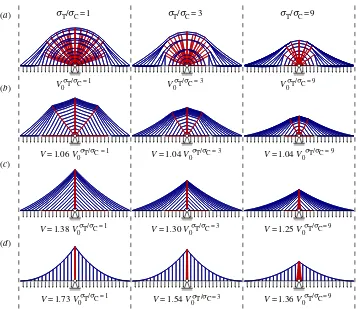
limiting tensile stressσTexceeds the limiting compressive stressσC. For example,figure 9shows
15
rspa.r
oy
alsociet
ypublishing
.or
g
Proc
.R
.S
oc
.A
47
4
:2
01
70
72
[image:16.493.56.438.60.354.2]6
...
Table 2.Comparison of volumes (×wL2/σ0) of traditional bridge forms with those of new reference solutions. span
1 km (0.16 2.5 km (0.4 5 km (0.8 form L/ha igure 0 km (weightless) (σ
0/ρg)) (σ0/ρg)) (σ0/ρg))
suspension 9 6a,8b 1.347222 [31,32] 1.648 2.508 18.985
optimal (4) 6c 1.000000 [31,32] 1.096 1.307 1.845
. . . .
cable-stayed (fan) 4.4 7c 1.048 1.244 1.781
. . . .
optimal 6d 1.041 1.224 1.672
. . . .
cable-stayed (harp) 4.4 6b 1.052273 [31] 1.189 1.458 2.269
. . . .
optimal (4/√3) — 0.866025 [31] 0.954 1.112 1.492
. . . .
cable-stayed (optimal) 4.4 7d 0.989 1.176 1.691
. . . .
optimal 6e 0.946 1.102 1.476
. . . .
split-pylon (double) 9 8e 1.197 1.483 2.275
. . . .
4.4 7e 0.856 0.978 1.248
. . . .
optimal 6f 0.838 0.951 1.197
. . . .
split-pylon (triple) optimal 6g 0.811 0.914 1.134
. . . .
reference 9 8f 1.130 1.320 1.711
. . . .
4.4 7f 0.817 0.921 1.137
. . . .
optimal (2√2) 6h, 7g, 8g 0.726031[21] 0.780531 0.873674 1.066152
. . . .
Notes: A discretization of 30 nodal spacings across the full span and geometry optimization was used except for the optimal reference forms.
Quoted span lengths assume a limiting material stressσ0=500 MPa and unit weightρg=80 kN m−3. The quoted volumes for the
weightless designs are computed using explicit analytical expressions given in [31,32] (for suspension bridges), [31] (for cable-stayed bridges)
and [20] (for optimal Michell structures).
aOptimal span-to-dip (L/h) ratios for weightless designs indicated in parenthesis, where available in the cited sources. (The optimal
span-to-dip ratios for the longer span designs, which include self-weight, are similar, though not identical.)
though the horizontal extent of the fan region over a support reduces (as is also the case when
self-weight effects are neglected [20]). Also the optimal span-to-dip ratio increases for the reference
structure, and also for all the other bridge forms considered. The relative volumes of the
cable-stayed and suspension bridges fall, respectively, to 1.30 and 1.54 for theσT/σC=3 case, and to 1.25
and 1.36, respectively, for theσT/σC=9 case. This indicates that the advantage of the new forms
over traditional forms remains, though does reduce somewhat when the limiting compressive stress is lower than the limiting tensile stress.
(f) Commentary
16
rspa.r
oy
alsociet
ypublishing
.or
g
Proc
.R
.S
oc
.A
47
4
:2
01
70
72
[image:17.493.69.427.37.346.2]6
...
(d) (c) (b) (a)
V= 1.73 V0sT/sC = 1 V= 1.54 VsT/sC = 3
0
sT/sC = 9
V= 1.36 V0
sT/sC = 9
V= 1.25 V0
sT/sC = 9
V= 1.04 V0
sT/sC = 3
V= 1.30 V0
sT/sC = 3
V= 1.04 V0
sT/sC = 1
V= 1.38 V0
sT/sC = 1
V= 1.06 V0
sT/sC = 9
V0
sT/sC = 3
V0
sT/sC = 1
V0
sT/sC= 9
sT/sC= 3
sT/sC= 1
Figure 9.Efect of reducing the limiting compressive stress on selected forms shown inigure 4, for the span = 0.8(σ0/ρg)
case (where the limiting tensile stressσT=σ0and the limiting compressive stress is reduced as indicated). Volumes shown
are expressed in terms of the relevant reference volume. (a) Reference design (simpliied layout shown for clarity). (b)
Optimized triple split-pylon design. (c) Optimized cable-stayed design. (d) Optimized suspension bridge design. (All with
variable cross-section cables.) (Online version in colour.)
contributed only between 15 and 23% of the loads carried by the main cables [34] (all loads
unfactored). Thus although non-uniform traffic loading would need to be considered as part of the detailed design phase it is unlikely to change the overall findings of the present study when very long spans are involved. (By contrast when shorter spans are involved, of the sort likely to be constructed in the immediate future, non-uniform traffic loading can be expected to have an influence on form, with, in the case of multi-span bridges, alternate span traffic loading scenarios being particularly important. This, for example, led to a ‘crossing stay’ cable arrangement being chosen for the three-span Queensferry Crossing bridge across the Firth of Forth in Scotland,
completed in 2017 [35]. Also, cable size may need to be increased to reduce deflections if these
prove to be excessive.)
In this paper elements with non-uniform cross sections have been employed for all bridge forms considered, both new and traditional. This means that material in all cross sections is fully stressed, ensuring that the structures are as materially efficient as possible, thereby allowing reference solutions to be obtained. However, it should be noted that while methods of realizing
non-uniform elements have been proposed (e.g. [36]), usually uniform cross sections are preferred
17
rspa.r
oy
alsociet
ypublishing
.or
g
Proc
.R
.S
oc
.A
47
4
:2
01
70
72
[image:18.493.107.390.40.225.2] [image:18.493.135.359.310.481.2]6
...
cC= cT cC=19cT
sC=19sT sC=sT
C = 7.49 C0 C = 1.78 C0
C0 C = 0.55 C0
Figure 10.Efect of changing the relative cost of compressive and tensile members on the minimum costCand corresponding
geometry of the triple split-pylon bridge form considered inigure 9, whereC=
cTVT+cCVC, and wherecT,VT
and cC,VCare the cost coeicients and volumes for tensile and compressive members, respectively. (Two limiting tensile to
compressive stress and cost ratios considered.) (Online version in colour.)
(a) (b) (c)
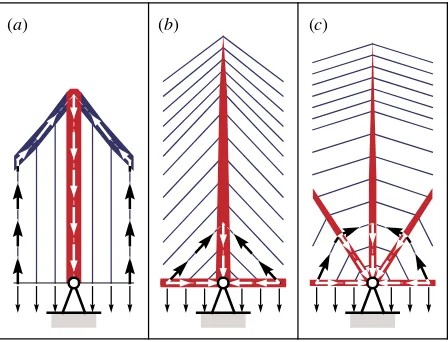
Figure 11.Appraising the relative eiciency of bridge forms by considering how deck loads are transmitted back to a support.
(a) Suspension bridge: the load path is comparatively long, so a large volume of material is required to transmit the forces
involved. (The same situation occurs in a fan cable-stayed bridge.) (b) Harp cable-stayed bridge: the load path is kept short, but
acute angles between the elements lead to high cable forces, and also to signiicant induced forces in the deck. (c) Split-pylon
cable-stayed bridge: the load path remains relatively short but the angles between the elements are less acute, ensuring cable and induced deck forces are lower. (Online version in colour.)
18
rspa.r
oy
alsociet
ypublishing
.or
g
Proc
.R
.S
oc
.A
47
4
:2
01
70
72
6
...
would also require the use of external earth anchorages, due to the presence of tension at the supports. Although ‘self-anchored’ cable-stayed bridge designs have become popular due to ease of construction, a benefit of using earth anchorages for very long spans is that compression in
the deck can be controlled; this is discussed further by Gimseng [37]. Alternatively boundary
conditions in the optimization problem can easily be changed to, for example, prevent a solution being generated which requires transmission of horizontal forces to supports.
Finally, an explanation for the comparative efficiency of the split-pylon form is given in
figure 11; this involves considering how directly deck loads are transmitted back to the supports. Although constructing very long-span bridges based on these latter designs would no doubt be challenging, the reward—significantly reduced material consumption—is clear.
5. Conclusion
A means of obtaining the theoretically optimal bridge form to span a given distance under the action of gravity loading has been described. This required the development of a new numerical layout optimization procedure capable of intrinsically modelling the self-weight of the constituent structural elements. To achieve this, equal strength catenary elements were employed, allowing phenomena such as cable sag to be modelled in the optimization process in an entirely natural manner. The procedure has been applied to the design of hypothetical very long-span bridges, enabling the optimal reference form and associated required volume of material to be established for a given span. The reference volume provides a benchmark against which traditional or proposed new bridge designs can be objectively judged.
It has been found that the reference bridge forms differ markedly to traditional suspension bridge and cable-stayed bridge forms involving vertical pylons, and also require much less material to construct, especially when very long spans are involved. For example, a conventional suspension bridge form spanning 5 km requires up to 73% more material than the corresponding reference design when using steel. The reference designs have also been used as inspiration for simple yet highly efficient bridge designs involving split pylons, which require comparatively little more material than the reference designs.
Data accessibility. Geometrical data describing key reference and geometry optimized bridge forms are provided in the electronic supplementary material.
Authors’ contributions. H.E.F. programmed the methods described and performed the numerical optimization runs, on the suggestion of, and in consultation with, M.G. H.E.F., M.G., A.V.P. and A.T. wrote initial drafts of the paper, which I.F. provided in-depth comments on, providing advice on practical bridge engineering considerations and proposing additional modelling studies. All authors approved the final version of the paper.
Competing interests. We have no competing interests.
Funding. H.E.F. acknowledges the financial support provided by the University of Sheffield, the UK Engineering and Physical Sciences Research Council and Expedition Engineering Ltd, London, UK.
Acknowledgements. The authors are grateful to Linwei He of the University of Sheffield for making available geometry optimization program code, which was extended in the present study to treat problems involving self-weight.
Appendix A
Geometry optimization has been used to generate many of solutions presented. For example,
figure 4awas obtained by starting with a layout optimized solution, obtained using a relatively coarse nodal discretization, and then using geometry optimization to rationalize the solution; see
figure 12for ‘before’ and ‘after’ layouts for this case. It is evident that the half-wheel-like section over the supports appears smoother and more clearly defined after geometry optimization has been performed.
Geometry optimization was also used to establish the most efficient joint positions for the
19
rspa.r
oy
alsociet
ypublishing
.or
g
Proc
.R
.S
oc
.A
47
4
:2
01
70
72
[image:20.493.67.428.42.184.2] [image:20.493.65.432.251.407.2]6
...
span = 1 km span = 2.5 km span = 5 km
(b) (a)
Figure 12.Bridge forms rationalized using geometry optimization. (a) Layout optimized solutions, obtained using a coarse
nodal discretization. (b) Solutions obtained after using geometry optimization to rationalize (a). (Quoted span lengths assume
a limiting material stressσ0=500 MPa and unit weightρg=80 kN m−3.) (Online version in colour.)
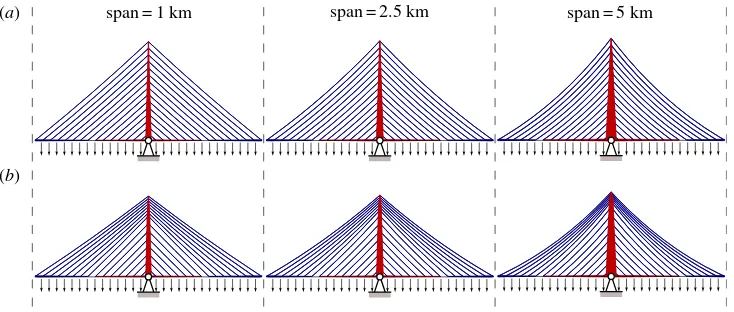
span = 1 km span = 2.5 km span = 5 km
(b) (a)
Figure 13.Sample bridge forms optimized using geometry optimization. (a) Harp style cable-stayed bridge, with cables
intersecting the pylon at equal vertical intervals. (b) Modiied form obtained after applying geometry optimization to the
structure in (a), showing resulting optimized pylon/cable intersection locations. (Quoted span lengths assume a limiting
material stressσ0=500 MPa and unit weightρg=80 kN m−3.) (Online version in colour.)
‘before’ and ‘after’ layouts for a harp style cable-stayed bridge configuration, which indicates that a lower volume solution is obtained if the cables are allowed to ‘bunch up’ near the top of the pylon. In each case a discretization of 30 nodal spacings across the full span was used to ensure visually clear solutions could be obtained (sensitivity studies indicate that this discretization gives solutions which are slightly above, though within approximately 0.1%, of the solutions which can be obtained using extremely fine numerical discretizations).
References
1. Drewry CS. 1832A memoir on suspension bridges, comprising the history of their origin and progress,
and of their application to civil and military purposes. London: Longman, Rees, Orme, Brown, Green & Longman.
2. Kitagawa M. 2004 Technology of the Akashi Kaikyo Bridge.Struct. Control Health Monit.11,
75–90. (doi:10.1002/stc.31)
3. Hansford M. 2012 Cable stay revolution hangs in the balance.New Civil Engineer, 5 July 2012,
20
rspa.r
oy
alsociet
ypublishing
.or
g
Proc
.R
.S
oc
.A
47
4
:2
01
70
72
6
...
4. Ito M. 1996 Super long span cable-suspended bridges in Japan. InProc. 15th Cong. IABSE,
Copenhagen, Denmark, 16–20 June, pp. 1009–1018. Zurich, Switzerland: IABSE.
5. Ostenfeld KH. 1996 Comparison between different structural solutions. The Great Belt
project. InProc. 15th Cong. IABSE, Copenhagen, Denmark, 16–20 June, pp. 1063–1078. Zurich,
Switzerland: IABSE.
6. Galileo G. 1954Dialogues concerning two new sciences. New York, NY: Dover Publications Inc.
7. Lewis WJ. 2012 A mathematical model for assessment of material requirements for
cable supported bridges: implications for conceptual design. Eng. Struct. 42, 266–277.
(doi:10.1016/j.engstruct.2012.04.018)
8. Meier U. 1987 Proposal for a carbon fibre reinforced composite bridge across the Strait
of Gibraltar at its narrowest site. Proc. Inst. Mech. Eng. Part B: J. Eng. Manuf. 201, 73–78.
(doi:10.1243/PIME_PROC_1987_201_048_02)
9. Xiong W, Cai C, Zhang Y, Xiao R. 2011 Study of super long span cable-stayed bridges with
CFRP components.Eng. Struct.33, 330–343. (doi:10.1016/j.engstruct.2010.10.013)
10. Damolini S. 2009 Carbon nanotubes and their application to very long span bridges. PhD thesis, Massachusetts Institute of Technology, Cambridge, MA.
11. Lu K. 2010 The future of metals.Science328, 319–320. (doi:10.1126/science.1185866)
12. Lin T, Chow P. 1991 Gibraltar Strait crossing – a challenge to bridge and structural engineers.
Struct. Eng. Int.1, 53–58. (doi:10.2749/101686691780617779)
13. Starossek U. 1996 Cable-stayed bridge concept for longer spans. J. Bridge Eng. 1, 99–103.
(doi:10.1061/(ASCE)1084-0702(1996)1:3(99))
14. Michell AGM. 1904 The limits of economy of material in frame-structures. Phil. Mag. 8,
589–597. (doi:10.1080/14786440409463229)
15. Maxwell JC. 1870 I. On reciprocal figures, frames, and diagrams of forces.Trans. R. Soc. Edinb.
26, 1–40. (doi:10.1017/S0080456800026351)
16. Dorn WS, Gomory RE, Greenberg HJ. 1964 Automatic design of optimal structures.J. Mec.3,
25–52.
17. Gilbert M, Tyas A. 2003 Layout optimization of large-scale pin-jointed frames.Eng. Comput.
(Swansea)20, 1044–1064. (doi:10.1108/02644400310503017)
18. Darwich W, Gilbert M, Tyas A. 2010 Optimum structure to carry a uniform load between
pinned supports.Struct. Multidiscipl. Optim.42, 33–42. (doi:10.1007/s00158-009-0467-0)
19. Tyas A, Pichugin AV, Gilbert M. 2011 Optimum structure to carry a uniform load between
pinned supports: exact analytical solution. Proc. R. Soc. A 467, 1101–1120. (doi:10.1098/
rspa.2010.0376)
20. Pichugin AV, Tyas A, Gilbert M, He L. 2015 Optimum structure for a uniform load over
multiple spans.Struct. Multidiscipl. Optim.52, 1041–1050. (doi:10.1007/s00158-015-1278-0)
21. Beghini A, Baker WF. 2015 On the layout of a least weight multiple span structure with
uniform load.Struct. Multidiscipl. Optim.52, 447–457. (doi:10.1007/s00158-015-1248-6)
22. Bendsoe MP. 1995 Optimization of structural topology, shape, and material. Berlin, Germany:
Springer Science & Business Media.
23. Gilbert D. 1826 On the mathematical theory of suspension bridges, with tables for facilitating
their construction.Phil. Trans. R. Soc.116, 202–208. (doi:10.1098/rstl.1826.0019)
24. Calladine C. 2015 An amateur’s contribution to the design of Telford’s Menai suspension bridge: a commentary on Gilbert (1826) ‘On the mathematical theory of suspension bridges’.
Phil. Trans. R. Soc. A373, 20140346. (doi:10.1098/rsta.2014.0346)
25. Routh EJ. 1896A treatise on analytical statics: the parallelogram of forces. Forces acting at a point.
Parallel forces. Forces in two dimensions. On friction. The principle of work. Forces in three dimensions. Graphical statics. Centre of gravity. On strings. The machines, vol. 1. Nancy: University Press.
26. He L, Gilbert M. 2015 Rationalization of trusses generated via layout optimization.Struct.
Multidiscipl. Optim.52, 677–694. (doi:10.1007/s00158-015-1260-x)
27. Ge Y-J. 2016 Aerodynamic challenge and limitation in long-span cable-supported bridges. InProc. ACEM16 / Structures16 Conf. Jeju-do, Korea, 28 August–1 September.
28. Xu Y-L. 2013Wind effects on cable-supported bridges. New York, NY: John Wiley & Sons.
29. Cox HL. 2014 The design of structures of least weight.International Series of Monographs in
Aeronautics and Astronautics: Division 1: Solid and Structural Mechanics, vol. 8. Amsterdam, The Netherlands: Elsevier.
30. Gimsing NJ, Georgakis CT. 2011 Cable supported bridges: concept and design. New York, NY:
21
rspa.r
oy
alsociet
ypublishing
.or
g
Proc
.R
.S
oc
.A
47
4
:2
01
70
72
6
...
31. Croll JGA. 1997 Thoughts on the structural efficiency of cable-stayed and catenary suspension
bridges.Struct. Eng.75, 173–175.
32. Dalton HC, French MJ, Croll JGA. 1997 Correspondence on “thoughts on the structural
efficiency of cable-stayed and catenary suspension bridges”.Struct. Eng.75, 345–347.
33. Prehn W, Mertens M. 2002 Die Rheinquerung der a 44-Darstellung der Gesamtmaßnahme.
Stahlbau71, 386–392. (doi:10.1002/stab.200201350)
34. Jensen L, Bloomstine ML. 2009 Application of high strength steel in super long span modern
suspension bridge design.NSCC, pp. 494–501.
35. Carter M, Kite S, Hussain N, Minto B. 2010 Design of the Forth replacement crossing Scotland.
Proc. Inst. Civil Eng. Bridge Eng.163, 91–99. (doi:10.1680/bren.2010.163.2.91)
36. Gokyu I. 1970Parallel cables. US Patent no. 3,500,625.
37. Gimsing NJ. 1994 Suspended bridges with very long spans. InProc. Int. Conf. IABSE-FIP,