This is a repository copy of Knowledge needs for the operationalisation of the concept of
ecosystem services.
White Rose Research Online URL for this paper:
http://eprints.whiterose.ac.uk/148544/
Version: Accepted Version
Article:
Carmen, Esther, Watt, Allan, Carvalho, Laurence et al. (11 more authors) (2017)
Knowledge needs for the operationalisation of the concept of ecosystem services.
Ecosystem Services. pp. 441-451. ISSN 2212-0416
https://doi.org/10.1016/j.ecoser.2017.10.012
[email protected] https://eprints.whiterose.ac.uk/
Reuse
This article is distributed under the terms of the Creative Commons Attribution-NonCommercial-NoDerivs (CC BY-NC-ND) licence. This licence only allows you to download this work and share it with others as long as you credit the authors, but you can’t change the article in any way or use it commercially. More
information and the full terms of the licence here: https://creativecommons.org/licenses/
Takedown
If you consider content in White Rose Research Online to be in breach of UK law, please notify us by
University of Dundee
Knowledge needs for the operationalisation of the concept of ecosystem services
Carmen, Esther; Watt, Allan; Carvalho, Laurence; Dick, Jan; Fazey, Ioan; Garcia-Blanco,
Gemma; Grizzetti, Bruna; Hauck, Jennifer; Izakovicova, Zita; Kopperoinen, Leena; Liquete,
Camino; Odee, David; Steingröver, Eveliene; Young, Juliette
Published in: Ecosystem Services
DOI:
10.1016/j.ecoser.2017.10.012
Publication date: 2017
Document Version Peer reviewed version
Link to publication in Discovery Research Portal
Citation for published version (APA):
Carmen, E., Watt, A., Carvalho, L., Dick, J., Fazey, I., Garcia-Blanco, G., ... Young, J. (2017). Knowledge needs for the operationalisation of the concept of ecosystem services. Ecosystem Services.
https://doi.org/10.1016/j.ecoser.2017.10.012
General rights
Copyright and moral rights for the publications made accessible in Discovery Research Portal are retained by the authors and/or other copyright owners and it is a condition of accessing publications that users recognise and abide by the legal requirements associated with these rights.
• Users may download and print one copy of any publication from Discovery Research Portal for the purpose of private study or research. • You may not further distribute the material or use it for any profit-making activity or commercial gain.
• You may freely distribute the URL identifying the publication in the public portal.
Take down policy
{ PAGE \* MERGEFORMAT }
Knowledge needs for the operationalisation of the concept of ecosystem
services
Authors
1. Esther Carmen1, Centre for Ecology & Hydrology, UK
2. Allan Watt, Centre for Ecology & Hydrology, UK
3. Laurence Carvalho, Centre for Ecology & Hydrology, UK
4. Jan Dick, Centre for Ecology & Hydrology, UK
5. Ioan Fazey, University of Dundee, UK
6. Gemma Garcia-Blanco, TECNALIA Research & Innovation, Spain
7. Bruna Grizzetti, European Commission, Joint Research Centre, Italy
8. Jennifer Hauck, Department of Environmental Politics, Helmholtz-Centre for Environmental Research, and CoKnow Consulting, Mühlweg 3, 04838 Jesewitz, Germany
9. Zita Izakovicova, Institutue of Landscape Ecology, Slovak Academy of Science
10. Leena Kopperoinen, Finnish Environment Institute SYKE, Finland
11. Camino Liquete, European Commission, Joint Research Centre, Italy
12. David Odee, Centre for Ecology & Hydrology, UK and Forest Research Institute, Kenya
13. Eveliene Steingröver, Wageningen Environmental Research (Alterra) , The Netherlands 14. Juliette Young, Centre for Ecology & Hydrology, UK
1 Corresponding author: Esther Carmen, Centre for Ecology and Hydrology, Bush Estate, Edinburgh EH26
0QB, UK, +44 (0)131 4458443, [email protected]
Key words
Ecosystem services; operationalisation; knowledge needs; transdisciplinary research
Abstract
As environmental challenges and their management are increasingly recognised as complex and uncertain, the concept of ecosystem services has emerged from within scientific communities and is gaining influence within policy communities. To better understand how this concept can be turned into practice we examine knowledge needs from the perspective of the different stakeholders directly engaged with the operationalisation of ecosystem systems concept within nine socio-ecologically different case studies from different countries, levels of governance and ecosystems.
We identify four different but interrelated areas of knowledge needs, namely; (i) needs related to develop a common understanding, (ii) needs related to the role of formal and informal institutions in shaping action on the ground, (iii) needs related to linking knowledge and action, and (iv) and needs related to accessible and easy to use methods and tools. These findings highlight the need to view knowledge as a process which is orientated towards action. We discuss the potential to develop
1 Corresponding author: Esther Carmen, NERC Centre for Ecology and Hydrology, Bush Estate, Edinburgh EH26
0QB, UK, +44 (0)131 4458443, [email protected]
{ PAGE \* MERGEFORMAT }
transdisciplinary research approaches and the development of tools and methods explicit as boundary objects in the ecosystem service science community to develop more collaborative practices with other stakeholders and facilitate the operationalisation of the concept of ecosystem services across contexts.
Introduction
Environmental challenges and their management are increasingly recognised as complex and uncertain. As our understanding of these issues increases so does our awareness of the gaps in our knowledge and
V
Kerkhoff and Lebel, 2015, Pahl-Wostl, 2009). In addition to the need to develop scientific ecological understanding, the importance of understanding social and institutional processes, the interactions between governance levels, policy sectors and the need to include a broader range of stakeholder groups and their goals and values is recognised to help shape action that protects ecosystems (Wyborn, 2015b, Carmen et al., 2015, Prager et al., 2012). It is within this backdrop that the concept of ecosystem services, which presents a more integrated, systematic view coupling social and ecological components into one system, emerged from within scientific communities and is gaining influence within policy communities (Carpenter et al., 2009). The aim of this paper is to examine knowledge needs from the perspective of the different social actors directly engaged in decision making processes aimed at applying the concept of ecosystem services to better understand how the concept of ecosystem services can be operationalised and turned into practice more widely.
The ecosystem services concept focuses attention on the fundamental links and feedbacks between nature and society (Mace et al., 2012). Specifically the concept frames these links in terms of the benefits derived from ecosystem functions and processes to diverse social groups (Hauck et al., 2013). Critically, the main aim behind the development of the ecosystem services concept has been to more explicitly incorporate environmental dimensions into decision making and action (Daily et al., 2009), thus operationalising the concept of ecosystem services into practice.
Within the scientific community there has been a focus on developing various frameworks, knowledge and tools to assess and quantify these benefits (Bagstad et al., 2013). This has resulted in new collaborations, particularly between economists and ecologists to develop tools and knowledge on the economic value of ecosystem services, reflecting the increasing recognition of the need to work across disciplinary boundaries within scientific processes relating to the ecosystem services concept (Cornell, 2011). These developments have contributed to our understanding of the dynamics of different socioecological dimensions across contexts, but to a lesser degree have helped developed our understanding of the social and institutional factors that shape decision making processes, environmental practice and change processes more broadly to improve socio-ecological outcomes (Luederitz et al., 2015).
W
{ PAGE \* MERGEFORMAT }
present our findings organised around four key themes identified from the data. Lastly, we examine the implications of these findings for scientific communities to help facilitate the operationalisation of the concept of ecosystem services in practice. Specifically, this focuses on a critical reflection of knowledge production processes in a scientific context.
Conceptualisations of knowledge
Different types of knowledge
Knowledge is not easy to define and, as such, has led authors to conceptualise it and classify it in a variety of ways (Nutley et al., 2007). This includes distinguishing between traditional ecological knowledge and scientific knowledge (Berkes et al., 2000). Nutley et al. (2007) highlight distinctions made between empirical, theoretical and experimental knowledge. Empirical knowledge is often the most explicit and based on quantitative or qualitative research. Theoretical knowledge relies on theoretical frameworks (Potschin-Young et al., This issue) for thinking about problems either informed by research but more often than not based on intuition and informal approaches. Finally experimental knowledge, which is often tactic, based practice implicitly accumulated through operational experience from routines and behaviours in particular social setting and more challenging to articulate (Fazey et al., 2006, Boiral, 2002). Vink et al. (2013) distinguish between organised knowledge and unorganised knowledge. Organised knowledge being characterised as formal knowledge involving a wide consensus and therefore stability of understanding often crystallized in written or modelled form. Unorganised knowledge is characterised as involving collective puzzlement whilst moving towards wider agreement through interactive processes involving deliberation, learning and sharing. Failing et al. (2007) distinguish between fact-based knowledge claims and value based knowledge claims, the former referring to descriptive claims about the way the world is or might be and the latter referring to normative claims about how things should be, thus presenting more explicitly that knowledge is contested. It is however now more commonly agreed that knowledge is socially constructed and value laden (Adams and Sandbrook, 2013) and cannot be separated from its social and political context (Hannigan, 1995). Importantly, different types of knowledge are not mutually exclusive, rather knowledge is a continuum, for example between explicit and tactic knowledge or unorganised and organised knowledge, thus approaching knowledge as a static product may be overly restrictive (Boiral, 2002).
Knowledge production processes
{ PAGE \* MERGEFORMAT }
problem. More broadly if this approach is taken in research it is referred to as transdisciplinary research
W L I T
process-based perspective explicitly recognises different perspectives, knowledge gaps, uncertainty and thus not only known unknowns, but also unknown unknowns (Luks and Siebenhuner, 2007, Pawson et al., 2011). Importantly this methodological shift to a more process-based perspective of knowledge in research is often defined as a move from mode 1 knowledge production, which involves the research community organised into disciplines objectively examining the outcomes of change, towards mode 2 knowledge. Mode 2 knowledge processes explicitly recognise subjective perspectives and mutual dependence between different social groups in society, and thus emphasises the importance of involving them in knowledge processes across different applicable contexts (Buizer et al., 2011, Lemos and Morehouse, 2005, Lang et al., 2012). One example of an approach that embodies mode 2 knowledge is adaptive co-management (Stringer et al., 2006, Armitage et al., 2009). However, a gap has been identified in many studies between the rhetoric of this approach and its application (Plummer & Armitage, 2007). This has led to calls for a focus on the methodological assumptions underpinning adaptive management, moving away from viewing ecosystem management as a technical problem towards broader perspectives that also embrace the social and institutional factors that shape these process Conservation Biology (Plummer & Hashimoto, 2011, Cundill et al., 2012). As a concept that embodies the need for an integrated approach, the operationalisation of the ecosystem services concept into decision making is also an excellent example of such an applicable context.
Current literature relating to transdisciplinary research and biodiversity and ecosystem services sciencepolicy interface processes (Rosendahl et al., 2015, Carmen et al., 2015) highlight the advantages of taking a broader view of knowledge as a process that involve multiple stakeholder groups to increase the likelihood of shaping solution orientated, policy relevant knowledge and outputs (Cash et al., 2003, Young et al., 2014). This includes new ideas, tools and methods to better inform decision making and support practical action. Often however transdisciplinary research is an ideal, and in reality stakeholders may be engaged in the process, but their knowledge may not be perceived as equally valid within an implicit hierarchy of knowledge which prioritises specific knowledge types. Indeed, this hierarchy is still often evident within scientific processes between qualitative and quantitative data (Adams and Sandbrook, 2013).
{ PAGE \* MERGEFORMAT }
production and how to facilitate change that moves the concept of ecosystem services from an ideal into reality more widely (Braat and de Groot, 2012, Daily et al., 2009). From a broader perspective Flyvbjerg
(2001) emphasises the ne
A W
I
experience that, through time and reflectivity, helps shape capacity to navigate through unique combinations of factors embedded within particular settings (Shotter and Tsoukas, 2014). Phronesis
- - get
B F
focuses also on the development of capacity to engage in transdisciplinary research processes across different contexts to move from ecosystem services as way of thinking, to a way of doing.
This current focus in the ecosystem services literature and linear impact assumptions highlights the importance of not only taking a broad approach when examining knowledge needs in addition to examining these needs from the perspective of multiple stakeholders to better understand leverage points for the application of potentially useful concepts such as the ecosystem services beyond research communities. Our aim is firstly to take an inductive approach to examine the knowledge needs for the operationalisation of the concept of ecosystem services from the perspective of the multiple stakeholders exploring the usefulness of this concept in real world situations. Secondly, we aim to explore how the ecosystem services scientific community can better facilitate the use of the concept of ecosystem services beyond the traditional boundaries of science.
Methods and materials
Acknowledging diverse interpretation and the subjectivity of knowledge needs, an inductive, qualitative semi-structured strategy was used to provide a depth of understanding of knowledge needs from the perspective of the multiple stakeholders involved in the operationalisation of ecosystem service (Bryman, 2004). This provided contextual accounts of
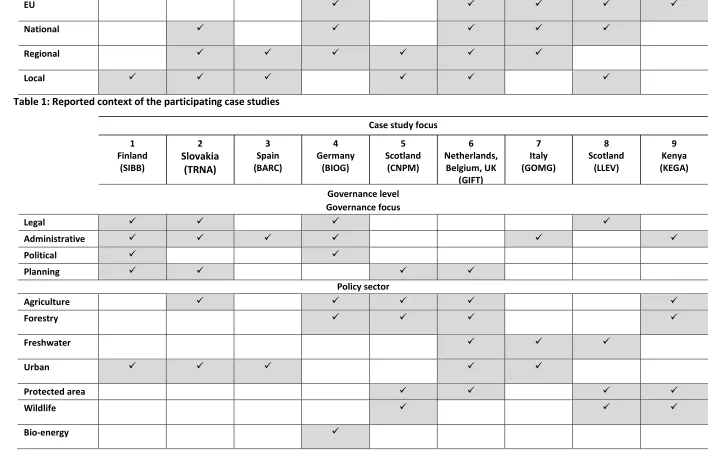
perspectives and feelings on topics that matter to them (Mason, 2002, Arksey and Knight, 1999). Participants included stakeholders from research, practitioner and policy-based communities involved in nine cases studies with varying socio-ecological characteristics exploring the challenges and successes for the operationalisation of the concept of ecosystem services into practice by working with multistakeholder advisory groups. These case studies involved different levels of governance, aspects of the policy cycle and different policy sectors, reported in a basic questionnaire completed by each cases study leader (see Table 1). In addition a further case study was included from the EU level, involving 20
EU EC E A NGO T
{ PAGE \* MERGEFORMAT }
Governance focus
Legal
Administrative
Political
Planning
Policy sector
Agriculture
Forestry
Freshwater
Urban
Protected area
Wildlife
Bio-energy
198
EU
National
Regional
[image:9.842.59.774.23.474.2]Local
Table 1: Reported context of the participating case studies
197
Case study focus
1 Finland
) (SIBB
2 Slovakia
(TRNA)
3 Spain (BARC)
4 Germany
(BIOG)
5 Scotland
(CNPM)
6 Netherlands,
Belgium, UK (GIFT)
7 Italy GOMG) (
8 Scotland
) (LLEV
9 Kenya (KEGA)
Governance level
{ PAGE \* MERGEFORMAT }
199
The involvement of stakeholders in this study was voluntary and a combination of data collection 200
methods was used. This involved a focus group methodology with groups of stakeholders from each 201
case study and from the EU level and semi structured interviewing with researchers leading case 202
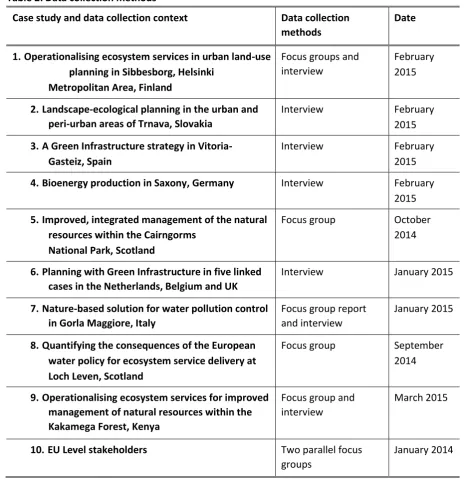
[image:11.595.65.533.166.649.2]studies 1-9. The combination of methods used for each case study are outlined below (see Table 2). 203
Table 2: Data collection methods
204
Case study and data collection context Data collection methods
Date
1.Operationalising ecosystem services in urban land-use planning in Sibbesborg, Helsinki
Metropolitan Area, Finland
Focus groups and interview
February 2015
2.Landscape-ecological planning in the urban and peri-urban areas of Trnava, Slovakia
Interview February
2015
3.A Green Infrastructure strategy in Vitoria-Gasteiz, Spain
Interview February
2015
4.Bioenergy production in Saxony, Germany Interview February 2015
5.Improved, integrated management of the natural resources within the Cairngorms
National Park, Scotland
Focus group October 2014
6.Planning with Green Infrastructure in five linked cases in the Netherlands, Belgium and UK
Interview January 2015
7.Nature-based solution for water pollution control in Gorla Maggiore, Italy
Focus group report and interview
January 2015
8.Quantifying the consequences of the European water policy for ecosystem service delivery at Loch Leven, Scotland
Focus group September 2014
9.Operationalising ecosystem services for improved management of natural resources within the Kakamega Forest, Kenya
Focus group and interview
March 2015
10.EU Level stakeholders Two parallel focus groups
January 2014
205
Focus group discussions were used to gather data with EU level stakeholders and from six of the nine 206
case studies. Semi structured interviews were used in combination with focus groups in three of these 207
six case studies. This combination of methods was used with stakeholders with higher levels of 208
engagement in the cases study who spoke a language other than English. It involved the case study 209
research leaders coordinating and facilitating the focus group discussion in the native language of the 210
{ PAGE \* MERGEFORMAT }
knowledge needs through semi structured interviews. In a further three case studies semi structured 212
interviews with case study coordinator team members were used to collect data when it was to not 213
possible to bring together a group of stakeholders, which is an essential requirement for the focus 214
group methodology (Morgan, 1996). 215
The focus group method involves a facilitator actively stimulating discussions within a group on a 216
predefined topic (Morgan, 1996). Thus, group interaction is a key feature which distinguishes focus 217
groups from other qualitative methods (Smithson, 2000). A key advantage of group interaction is that 218
it can provide a more in depth understanding of issues by bringing together and exploring perspectives 219
in detail collectively (Peek and Fothergill 2009, Bryman 2004). Similarly, the semi structured 220
interviewing method also enables a predefined topic to be explored in detail, although this is explored 221
individually rather than collectively. Applying a semi structured approach to focus groups and 222
interviews involved developing a guide outlining the topics to be explored and during the discussion 223
the facilitator/ interviewer intervening only to probe responses and uncover more detail. Thus, the 224
facilitator surrendered a certain degree of control to the participants to take the discussions in 225
directions which they saw as important (Smithson, 2000). 226
To enable the lead case study researchers to apply the focus group method a detailed guide was 227
produced and discussed in depth before applying this method of data collection. This set out a clear 228
and consistent process for data collection across the different situations, types and numbers of 229
stakeholders in each case study. These guides set out how to begin the discussion by asking about the 230
conceptual frameworks of ecosystem services being used to frame the problem in each case study 231
which brought together existing knowledge on different components of socio-ecological systems and 232
set out relationships between them being explored. This enabled the discussions to identify knowledge 233
needs already considered in the initial phases of the case study. The discussions were then steered 234
towards exploring wider knowledge needs. Discussions were audio recorded with full, informed 235
consent obtained from participants before each focus group or interview. Audio recording ensured 236
that an accurate and full description of all the issues discussed. Recordings were then transcribed 237
verbatim and anonymity of the participants was maintained during the transcription, analysis and 238
reporting phase of the research. 239
Qualitative data analysis was undertaken using aspects of grounded theory (Strauss and Corbin, 1990) 240
using a thematic approach, as described by Ryan and Bernard (2003) which did not rely on a predefined 241
definition of knowledge. The analytical process firstly involved developing a familiarity with all the data 242
by thoroughly reading all the focus group and interview transcripts. Open coding was then applied in 243
an iterative process to organise segments of data from each transcript into sub themes based on 244
repetitions, similarities and differences in issues within the data. The sub themes were labelled based 245
on short phrases and words used to explain knowledge needs by the research participants and 246
organised into an analytical framework (Bryman, 2016). These sub themes and the data segments 247
within them were then grouped into four higher order themes to move from a descriptive to an 248
abstractive level of understanding from the data with a clear chain of evidence connecting back to the 249
raw data (Miles and Huberman, 1994). Each of the themes identified in the analytical process are 250
explained below. Following this the importance of these themes for the ecosystem services research 251
community in efforts to operationalise this concept into practice are explored.
Results
252{ PAGE \* MERGEFORMAT }
Knowledge needs to develop a common understanding
254The need for knowledge to develop a common understanding of the concept of ecosystem services 255
was highlighted as important by stakeholders who participated in this study to ensure that the core 256
T
257
effective communication and dialogue between stakeholders from different levels of governance, 258
policy sectors and from science, policy or practice based communities. These core principles 259
identified by stakeholders included embracing an integrated, systems perspective that cuts across 260
traditional disciplinary and sector boundaries, which requires the involvement of diverse groups of 261
actors across levels of governance from within research, policy and practice based communities. 262
Delivering multiple benefits is another core principle explicitly linked to the concept of ecosystem 263
services. Stakeholders recognised that developing a common understanding across diverse groups 264
takes time. However, building on existing relationships and networks was identified as one way to 265
help speed up this process. Alternatively, the role of boundary organisations or knowledge brokers 266
(boundary people) was identified by stakeholders as another possible way to develop a common 267
understanding between different stakeholder groups, for example between science based 268
stakeholders and policy based stakeholders. 269
To develop a common understanding of the concept of ecosystem services the need for a common 270
language was also identified. This involved the need for clear definitions, however some 271
stakeholders identified the usefulness of some ambiguity in terminology to facilitate dialogue and 272
the development of a common understanding between the different stakeholders in a specific 273
situation. Similarly, the need to translate language to link with the terminology used in policy and 274
practice based communities was also identified as a clear knowledge need by stakeholders to frame 275
decision making and shape action on the ground across levels of governance. For example, linking 276
with terms such as landscape services or green infrastructure. Adapting language in this way was 277
identified as a way to help facilitate a common understanding of the principles embedded in the 278
concept of ecosystem services across groups of actors with different perspectives. 279
Furthermore, knowledge needs identified also related the development and use of positive frames 280
to facilitate a common understanding of issues to bring together diverse groups of actors. Positive 281
messages may help in this way by signalling the synergistic opportunities and benefits from taking 282
integrated action. Conversely, stakeholders suggested that many arguments for the 283
operationalisation of ecosystem services applied negative frames that emphasise loss, adverse 284
impact and often focus on moral responsibilities. Sharing examples that explicitly highlight the 285
importance of and application of positive framing to meet a range of policy goals was identified as a 286
need. Stakeholders suggested this was an important step to help facilitate shared understanding of 287
the need for more integration and collaborative working across policy sectors. 288
Within a specific operational context once multi-stakeholders are brought together, stakeholders 289
identified the need for conceptual frameworks to help frame problems and develop a common 290
understanding of the need for an integrated approach. Specifically, stakeholders identified the 291
usefulness of frameworks for reducing complexity, whilst highlighting the links and feedbacks 292
between different components of the socio-ecological system. However, some stakeholders 293
emphasised the need to avoid presenting a linear relationship between different social and 294
ecological system components represented in frameworks to better acknowledge different but 295
equally important perspectives. Nonetheless, stakeholders highlighted the potential for frameworks 296
to help bring together different types of knowledge at the start of processes to develop a common 297
understanding of the problem and specific knowledge gaps to be addressed between those involved. 298
Overall developing a common understanding was identified as an overarching knowledge need to 299
{ PAGE \* MERGEFORMAT }
and facilitate dialogue between different stakeholder groups, across different contexts as an 301
important first step towards collaborative working to addresses context specific needs. A summary 302
of the knowledge needs to contribute towards developing a common understanding is provided in 303
table 3. 304
Table 3: Summary of the knowledge needs to develop a common understanding between different
305
stakeholder groups
306
Knowledge needs to develop a common understanding
between the different stakeholder groups
Maintain the core principles of an integrated approach and delivering multiple benefits that are embedded within the concept of ecosystem services.
Develop a common language across different stakeholder groups
Communicate by linking with existing policy concepts
Use positively framed messages to signal the potential relevance of the concept for different stakeholder groups
Use socio-ecological frameworks that emphasis the importance of an integrated approach involving multiple stakeholders
307
Knowledge needs on the role of formal and informal institutions in shaping action on the
308ground
309Stakeholders identified the need to better understand how policy frameworks, structural and 310
organisational units (formal institutions) and norms (informal institutions) interact to shape action 311
on the ground. This included understanding how specific EU policy frameworks influence action in 312
relation to sustaining ecosystem services. For example, the Water Framework Directive and the 313
Common Agricultural Policy. Also included however was understanding the role of national policies 314
that are aimed at transferring management responsibilities of natural resources to the community 315
level by developing more meaningful interactions between policy/practice-based stakeholders and 316
local community stakeholders. Furthermore, the link between local policies and action aimed at 317
implementation was also identified as important, for example, the match between integrated 318
strategies and projects on the ground. This knowledge was emphasised as important to better 319
understand if and how to avoid the dilution of the principle of integration through the policy process 320
and across levels of governance. 321
Stakeholders also identified the need to better understand the role of norms in shaping how 322
organisations and groups of stakeholders think and act in approaching the operationalisation of an 323
integrated approach that is core to the ecosystem services concept. Specifically, stakeholders 324
emphasised the importance of organisational, sectoral and disciplinary cultures where integrated, 325
collaborative practices were normal. Thus reducing the likelihood of a mismatch between the goals 326
of different groups in planning and delivering integrated actions to manage ecosystems and the 327
services they provide. Examples of important collaborations were highlighted as including 328
governmental organisations, different departments and between scientists and local practice based 329
stakeholders, for example engineers and planners, in addition the current focus in science on 330
working with policy makers. Furthermore, the need to facilitate the multi-directional flow of 331
knowledge between different societal groups was also identified to enhance learning across 332
contexts. For example, across sectors and levels of governance levels. This included EU policy based 333
stakeholders identifying the need to understand why and how voluntary action to adopt a 334
perspective more in line with the ecosystem concept is applied in different organisations and 335
{ PAGE \* MERGEFORMAT }
Overall understanding the role of informal and informal institutions was identified as an overarching 337
knowledge need to help strengthen the development of integrated approaches, collaborative 338
working and learning between different stakeholder groups to better shape action on the ground. A 339
summary of the knowledge needs on the role of formal and informal institutions in shaping action on 340
the ground is provided in table 4. 341
Table 4: Summary of the knowledge needs on the role of formal and informal institutions in
342
shaping action on the ground
343
Knowledge needs on the role of formal and informal institutions in shaping action on the ground
Understand the role of formal institutions across levels of governance in shaping action on the ground (for example, the EU Common Agricultural policy)
Overcome the cultural barriers (informal institutions) to collaboration in different stakeholder groups to normalise and strengthen collaborative practices between groups
Develop a better match between formal institutions (for example, local policies setting out the need for
integration) and informal institutions (for example, implementation practice)
Facilitate the flow of knowledge (formally and informally) between levels of governance and sectors to help learning and spreading of ideas more widely
344
Knowledge needs to link knowledge and action
345Stakeholders across case study contexts recognised that both knowledge and decision making 346
processes are complex and dynamic. However, the need for a strong link between these processes 347
A EU
348
develop credible, useful data and information to feed back into knowledge and decision making 349
processes. Stakeholders emphasised the importance of an iterative process to both knowledge 350
production and action, which recognises the reality that decision making and action often has to 351
occur in the context of known knowledge gaps in policy processes. Thus knowledge production 352
should not be prioritised over action, with a need to bring these activities closer together. 353
Specifically stakeholders stressed that an iterative approach to collecting data, developing 354
knowledge and taking action was important and could help identify and address knowledge gaps 355
more quickly. The importance of relationships, trust and transparency between stakeholder groups 356
was emphasised as particularly important in this process. Furthermore, stakeholders also 357
emphasised a need to produce outputs with clear levels of uncertainty and guidance on its use to 358
minimise the likelihood of misuse of this information more widely in decision making processes. 359
Some researchers leading the case studies however emphasised the need to not link knowledge and 360
decision making too closely. This related to the need to provide a flexible space to experiment with, 361
adapt and develop scientific tools and scientific knowledge emerging from this. Researcher 362
stakeholders involved in the case studies also highlighted a lack of knowledge about if and how 363
knowledge being produced in multi-stakeholder processes was being used in decision making 364
processes. 365
All stakeholders involved in this study identified the need to better include a wider range of 366
{ PAGE \* MERGEFORMAT }
Although there are current multi-stakeholder groups from science and policy working together in 368
research processes framed around the ecosystem services concept and the core principle of 369
integrated perspectives to environmental management, the need for wider and deeper involvement 370
of other stakeholders in these processes was identified, for example businesses and local people. 371
Some research based stakeholder involved in the case studies identified the usefulness of 372
stakeholder involvement in knowledge production processes to help facilitate the development and 373
spread of ideas into the wider activities of all stakeholders involved. 374
Policy based stakeholders at the EU level identified the need for high quality knowledge from 375
research to help increase the credibility of action on the ground. There was also an emphasis on the 376
need for knowledge production to involve different stakeholder groups and their knowledge 377
alongside scientific stakeholders and their knowledge. EU policy based stakeholders identified the 378
need for this involvement throughout knowledge processes to provide a strong focus on the 379
development of useable/ relevant knowledge. More widely, stakeholders identified the need to 380
understand how to better facilitate this in practice, specifically relating to the challenges of bringing 381
together knowledge in different formats, from different stakeholder groups and from wider society. 382
Developing an understanding about how to overcome some of the barriers hindering closer working 383
and knowledge exchange across groups was identified by stakeholders as important. This included 384
knowledge on how to collaborate when only limited resources are available, for example developing 385
more innovative ways to involve wider social groups. Furthermore, the need to overcome low levels 386
of trust, for example shaped by previous difficulties with specific stakeholder or as a relic of 387
communist regimes was identified as an important need which influenced interactions between 388
stakeholders. The structure and transparency that some tools and methods provided was identified 389
as helping to facilitate trust and balance of perspectives in multi-stakeholder processes. 390
Overall, this theme draws attention to the need for knowledge production processes to be more 391
closely linked with action orientated processes, applying a collaborative, iterative approach involving 392
a wide range of stakeholders. A summary of the knowledge needs to bring knowledge orientated 393
processes and action orientated processes closer together is provided in table 5. 394
Table 5: Summary of the knowledge needs to better link action and knowledge orientated
395
processes
396
Apply an iterative approach to bring these more closely 397
Knowledge needs to together whilst recognising that both knowledge and action 398
link knowledge are equally important. 399
production and action orientated processes
Develop collaborations that involve multiple stakeholders and their knowledge from the start. For example, practice and policy based stakeholders.
Involve a wide range of stakeholders from policy based and science based communities collaborating from the start to develop relevant, useable knowledge that can readily feed into decision making processes
{ PAGE \* MERGEFORMAT }
Develop closer multi-stakeholder collaborations by developing trust and being transparent.
Ensure space is created in collaborations for sharing of existing knowledge and developing new knowledge through experimental learning
400
Knowledge needs relating to methods and tools
401A common knowledge need identified by stakeholders involved the development of simple, 402
transparent tools and methods that could be applied across contexts. This need was identified to 403
help assess the supply and demand of ecosystem services, synergies, conflicts and trade-offs across 404
temporal and spatial scales and policy sectors and the different values attributed to them. 405
Specifically, tools and methods were considered important to identify wider, less tangible benefits 406
and services from ecosystems across society, for example cultural services and the value attributed 407
to them. Although stakeholders acknowledged that some tools and methods already existed, the 408
ability to bring together knowledge dispersed across different types of stakeholders and across large 409
geographic areas was identified as a particular need. This related to the need identified by EU level 410
stakeholders to up-scale methods and tools for application across larger areas, including across 411
political boundaries to contribute to transnational coordination for improved environmental 412
management. Conversely, the need for tools and methods to include assessments of regulatory 413
services, which are often the focus of assessments across larger scales, was identified as a need for 414
assessments focusing on smaller areas. Stakeholders also identified the importance of tools to 415
undertake monetary valuation and incorporate the full range of services for this, particularly to 416
influence policy makers. Stakeholders also highlighted the importance of tools for non-monetary 417
valuations and to move beyond the current strong focus on monetary valuation for ecosystem 418
services. This was identified as important to better represent the full range of services and wider 419
stakeholder perspectives in knowledge emerging from processes. This was an important need for a 420
range of stakeholders but particularly for some local non-government organisations and local 421
business stakeholders to better capture less tangible benefits and services, and thus present a more 422
realistic picture of the diversity of benefits, services and values on the ground. 423
EU policy based stakeholders also identified the need to develop indicators to monitor and evaluate 424
action on the ground. Linked to this was an emphasis on the importance of tools and methods to 425
better understand feedbacks in socio-ecological systems and to help avoid negative impacts and 426
unintended consequences of decisions and actions on the ground. Predominantly this related to the 427
need to gather quantitative data, particularly at the EU level. However more broadly the need for 428
qualitative data was also identified to better integrate different sources and types of knowledge into 429
decision making. This included stakeholders focusing on action at smaller scales, for example the 430
knowledge of local people, and larger scales, although at this scale the need to convert qualitative 431
into quantitative data to inform decision making was emphasised. 432
Overall, this group of knowledge needs relates to the need for tools and methods that improve 433
integrated approaches in the assessment of ecosystem services across different scales, to involve 434
and inform the decision making of different stakeholder groups. A summary of the knowledge needs 435
{ PAGE \* MERGEFORMAT }
Table 6: Summary of the knowledge needs relating to tools and methods
437
Knowledge needs relating to methods and tools
Provide simple, transparent tools and methods that can be applied across contexts to identify synergies and trade-offs across
different spatial and temporal scales to inform decision making
Develop tools and methods to bring together different types and sources of knowledge to improve the assessment of the supply and demand of the full range of ecosystem services
Understand the different data and information needs across stakeholder groups (for example, non-monetary valuation may be more relevant for local stakeholders)
Include a wider range of ecosystem services across the different scales at which assessments of ecosystem services are undertaken (for example, local assessment to transboundary assessments involving more than one European Union Member State)
Develop quantitative indicators to monitor and evaluate the implementation of ecosystem services across large geographic areas (for example at the EU level)
438
Discussion
439
This study aimed to identify knowledge needs for the operationalisation of ecosystem services across 440
different contexts, involving different sectors, stakeholders and levels of governance. In the 441
analytical process four overarching themes were identified, namely; (i) knowledge needs to develop 442
a common understanding, (ii) knowledge needs on the role of formal and informal institutions in 443
shaping action on the ground, (iii) knowledge needs to link knowledge and action, an (iv) knowledge 444
needs relating to tools and methods. Here the implications of these findings to contribute to the 445
operationalisation of the concept of ecosystem services are explored. 446
447
Knowledge needs for the operationalisation of the concept of ecosystem services
448These four themes are interrelated and represent important aspects that require attention to help 449
operationalise the concept of ecosystem services more widely into policy and practice. The 450
importance of developing a common understanding through the selective use of language, with the 451
ideas and meanings attached with this, is widely recognised as critical in the literature focusing on 452
environmental discourse, message framing and science-policy interfaces to help identify shared 453
goals and prime the development of collaborative processes. Specifically, effective communication 454
and translation using the language and experiences of key target stakeholder groups can speed up 455
understanding and identify potential areas of mutual benefit to then move to exploring the 456
application of the concept within a specific context (Cash et al., 2003). In this way selecting and 457
adapting language can help develop more effective arguments to mobilise capacities and share 458
resources (Carmen et al., 2016). Developing a common understanding relates to the knowledge need 459
460
interest in developing collaborations and applying integrated approaches to socio-ecological issues 461
{ PAGE \* MERGEFORMAT }
“
463
2006, Potschin-Young et al., This issue)) for better working across traditional boundaries, for 464
example between science and policy and between policy sectors for more integrated policy 465
development and with practitioners in policy implementation. There is often a strong link between 466
formal institutions such as policy frameworks and the goals of stakeholders in policy and practice 467
based communities. Indeed, analysing current policy frameworks and how they can be strengthened 468
to better align with the concept of ecosystem services is one strand of the current ecosystem 469
services literature, for example see Matzdorf and Meyer (2014). Policy processes are complex 470
involving layers of decisions, stakeholders and their actions (Keeley and Scoones, 1999). Within this 471
process a mismatch between policy rhetoric and practice may develop. Understanding the role of 472
informal institutions in shaping action on the ground is therefore an important knowledge need for 473
operationalising the concept of ecosystem services. This involves norms and cultures of different 474
practitioner groups, that help shape the attitudes and behaviours of stakeholders who may have an 475
important role in turning the concept of ecosystem services into action on the ground, for example 476
local government officers. Importantly attitudes and behaviours that encourage integrated 477
approaches need to be identified and fostered. More specifically, understanding how to move from 478
cooperation, where working together is focused on individual ends, into collaboration, which 479
involves working together for a common goal, is crucial (Jeffrey, 2003). A stronger focus on changing 480
practice for ecosystem services is an essential step towards building practical knowledge, which is 481
embedded in learning through experience to bring the gap between wider goals, attitudes and 482
behaviours closer together (Flyvbjerg, 2001, Boiral, 2002). The concept of ecosystem services 483
involves core principles that emphases a need to adopt integrated approaches and deliver mutual 484
benefits for diverse social groups. The need to foster collaborative thinking and practices implicitly 485
connects these principles and is therefore an important leverage point to help turn this concept into 486
practice more widely. 487
This study has a number of limitations. It is limited in so far as a break-down of knowledge needs 488
across different stakeholder groups, levels of governance and broader socio-ecological context was 489
not possible due to the different levels of engagement of stakeholders across the case studies 490
included in the study and language barriers. Both of these factors meant that data collection was 491
undertaken using both interviews and focus groups which relied on collaboration with the local case 492
study research teams to collect data. Despite the development of data collection protocols this 493
makes a comparative analysis problematic. Instead, the data was combined and broad areas of 494
knowledge needs identified for the ecosystem services community. At the EU level some difference 495
in knowledge needs were identified, for example for collaborating across policy sectors, consistency 496
in data, methods and monitoring across large geographic areas and political boundaries. However, 497
more interestingly, there are subtle differences in the orientation between the four themes 498
identified in this study, not only about types of knowledge need, but also whose knowledge. 499
Whereas developing a common understanding relates to the ecosystem services community working 500
with other stakeholder groups, the role of formal and informal institutions predominately focuses 501
attention towards knowledge for and by science and practice. The need to develop tools and 502
methods and the need to link knowledge and action however predominantly focuses on knowledge 503
needs from specifically within the ecosystem services scientific community. Together these four 504
interrelated themes mirrors a broad perspective of knowledge as a multidimensional, dynamic 505
process. However, addressing these knowledge needs may help provide more credence to the 506
importance of considering an understanding of socio-ecological in decision making processes, these 507
processes are complex and dynamic and may be influenced by a range of other factors. These 508
knowledge needs may be necessary but insufficient to fully operationalise the concept of ecosystem 509
{ PAGE \* MERGEFORMAT }
511
Contribution from the ecosystem services scientific community to better operationalise
512the concept
513There is a growing recognition in scientific communities of the importance of developing knowledge 514
that is legitimate, for example by including wider stakeholders, and relevant to provide knowledge to 515
more readily feed into decision making in policy communities (Sarkki et al., 2013, Carmen et al., 516
2015). In relation to ecosystem services this has often focused on two key areas. The first is the 517
development of methods, frameworks, models and tools to better capture and therefore understand 518
the dynamics of issues. Increasingly these are being used to recognize a range of perspectives of 519
different stakeholder groups. This knowledge need for the development of tools and methods 520
-
521
dynamics of issues in different contexts, leading to explicit knowledge products, such as 522
F vbjerg, 2001). Secondly more recently 523
research has begun to more explicitly focus on informing policy development at larger scales at the 524
national, European and global levels and bring knowledge and action closer together, for example 525
through the Intergovernmental Platform for Biodiversity and Ecosystem Services (Koetz et al., 2012). 526
More widely therefore discussions are turning towards a need to develop and apply Mode 2 527
knowledge processes to better influence decision making across levels of governance. Despite this, 528
there has been very little attention in the ecosystem service literature to date focusing on the need 529
for more inclusive, collaborative approaches more broadly that orientate to both knowledge 530
production and action. In the sustainability science literature however there has been a growing 531
discussion about the need to apply more collaborative transdisciplinary research approaches that 532
take place within real life situations and actively engage in the messy realities of helping to facilitate 533
change (Brandt et al., 2013). Specifically this involves teams of stakeholders from science and policy/ 534
practice developing processes for mutual benefit that actively bring together different sources of 535
knowledge and perspectives to develop solutions to real world problems. Transdisciplinary research 536
not only promises to help better understand problems and potential solutions across contexts, but 537
also invitingly encapsulates the potential to more readily facilitate change across different social 538
settings. 539
The transdisciplinary literature broadly encompasses terms such as co-production of knowledge and 540
action-research (Lang et al., 2012, Wyborn, 2015a, Checkland and Holwell, 1998, Cameron and 541
Gibson, 2005). Transdisciplinarity is emerging as a research topic in its own right and this has helped 542
stimulate critical examination at conceptual, methodological and practical level (Rosendahl et al., 543
2015, Klay et al., 2015, Lang et al., 2012). At a conceptual level transdisciplinary research embraces 544
an interactional model of knowledge production, involving collaborations between scientists from 545
different disciplines and non-academic stakeholders to create solution orientated knowledge that is 546
socially robust and can be applied to both scientific and societal practice (Stokols, 2006). Conversely, 547
inter disciplinary research crosses disciplinary boundaries within scientific communities to produce 548
knowledge (Lyall et al., 2015). Methodologically, transdisciplinary research has been linked to 549
poststructuralism in so far as it recognises multiple types of knowledge as equally valid (Cameron 550
and Gibson, 2005). The design of such research processes has also been connected to a broader 551
form of experimental design (Moses and Knutsen, 2012). Critical however is the iterative coupling 552
between knowledge production and integration into action orientated process through reflective 553
practice in the process. Specifically, for the concept of ecosystem services this could involve specific 554
coupling with, exploring and learning about decision making processes across different levels. 555
Practically, a number of principles have been outlined to guide the development of transdisciplinary 556
{ PAGE \* MERGEFORMAT }
should involve scientific and non-scientific stakeholders to foster collaborative working and feedback 558
from the start. Lang et al. (2012) outline three critical phases of transdisciplinary research. The first 559
phase is collaboratively framing the problem to identify a shared goal and shape the research 560
questions. At the same time this helps develop a common understanding about language, capacities 561
and perspectives within the team (Cash et al., 2003, Jeffrey, 2003). The second phase is coproduction 562
of solution oriented knowledge by applying collaborative research practices and methods. The third 563
phase focuses on the re-integration of knowledge, involving tangible outputs and less tangible 564
learning outcomes emerging from the process. This re-integration is orientated towards decision 565
making, action and practice however also provides opportunities to reveal gaps in knowledge and 566
also continue to develop scientific practice. 567
An important component of any knowledge production process is the use and development of 568
methods, tools, techniques, frameworks and models. Critically these need to be aligned with the 569
research approach and design. Thus in transdisciplinary research approaches methods and tools 570
need to be explicitly developed for and applied as boundary objects, for example to bring 571
stakeholders and their knowledge together to jointly examine an issue, identify patterns, links and 572
gaps for the assessment and valuation of ecosystem services. Star and Griesemer (1989) defined a 573
boundary object as an artefact, for example a tool or framework, that is adaptable to different needs 574
and perspectives yet robust enough to maintain a common identify across different contexts and 575
scales. In this way boundary objects explicitly facilitate collaborative action orientated research 576
processes by helping to bridge ontological and epistemological boundaries between different groups 577
of stakeholders, issues and scales (Keshkamat et al., 2012, Brand and Jax, 2007). There is a strong 578
focus on the use and development of frameworks, method and tools in the ecosystem services 579
literature with the aim of continuing to improve knowledge presented in assessments across scales 580
(Nelson et al., 2009, Daily et al., 2009, Rodríguez-Loinaz et al., 2015). Nonetheless, there is often very 581
little critical discussion about the research approaches and assumptions that shape the context 582
within which tools are applied and the outcomes that emerge from them more broadly. This critical 583
reflection is an important part of ensuring tools and methods operate and maximise their potential 584
to be boundary objects in practice. More importantly however this can help move beyond dominant 585
perspectives in scientific ecosystem services communities that primarily view stakeholders and their 586
involvement in research processes purely as sources of data. 587
Widely recognised in the transdisciplinary research literature is how challenging it is to apply these 588
approaches in practice. This relates to both formal and informal institutional constraints. Examples 589
of formal institutional constraints includes a research system that still often approaches the 590
processes of knowledge production, exchange and integration as separate (Stokols, 2006). 591
Transdisciplinary research with a specific framing around the concept of ecosystem services also face 592
structural constraints in working with and bringing together a range of practitioners organised 593
around separate policy areas. Additional, informal institutional constraints also exist in both science 594
and practice orientated communities. Specifically this involves norms, attitudes and behaviours that 595
shape the type of relationships developed over time, for example across science-policy/ practice 596
interfaces and the move from cooperation to more meaningful collaborative practices. Formal 597
institutions can help develop spaces to bring different groups together, however these often focus 598
on specific issues and values (Wyborn and Bixler, 2013). A critical need therefore for scientific 599
stakeholders is to focus on developing relationships and trust across groups of stakeholders and to 600
601
more broadly and more effectively around the issue of ecosystem services. For scientific 602
communities to contribute to the operationalisation of ecosystem services an important aspect of 603
this is developing an understanding about, experience of and skills to contribute to and shape 604
{ PAGE \* MERGEFORMAT }
mutual learning outcomes (Van Kerkhoff and Lebel, 2015). For the ecosystem services science 606
community the knowledge needs highlighted in this study therefore broadly relate to two interlinked 607
objectives: to turn the concept of ecosystem services into practice and to develop transdisciplinary 608
research approaches and practice.
Conclusions
609At the heart of the ecosystem services concept is the core principle of applying an integrated 610
approach to better shape our understanding of and actions around ecosystems and the services they 611
provide to human society. This requires collaborative, multi-stakeholder processes and practices. 612
The current focus across much of the ecosystem services literature is concerned with examining 613
impacts and identifying constraints. There is a real need for science to not only observe change but 614
also understand and engage in change processes more actively (Daily et al., 2009). Transdisciplinary 615
research approaches provides a promising opportunity for the ecosystem services science 616
community itself to embrace the core principle of integration embedded within the concept whilst 617
contributing to the operationalisation of this concept more broadly. A greater orientation towards 618
transdisciplinary research processes in the ecosystem services science community requires engaging 619
in the messy realities of real world socio-ecological problems, involving different combinations of 620
stakeholder, perspectives, practices, tools and structural constraints. Science is predicated on its 621
ability to critically build on existing knowledge (Klay et al., 2015). Only by actively engaging in 622
transdisciplinary research processes will the ecosystem services science community begin to develop 623
the experience and, more importantly the knowledge about how to more effectively collaborative 624
with diverse stakeholder groups, apply integrated approaches across contexts, bring knowledge and 625
action together and facilitate change in practice. 626
Acknowledgements
627
T O NE““ E U “
628
Programme for research, technological development and demonstration under grant agreement No 629
308428. We thank the participants from the OpenNESS project for their willingness to share 630
information and views on knowledge needs for the operationalisation of the concept of ecosystem 631
services. More information on this project can be found at { HYPERLINK "http://www.openness-632
project.eu/about" \h }{ HYPERLINK "http://www.openness-project.eu/about" \h }{ HYPERLINK 633
"http://www.openness-project.eu/about" \h }{ HYPERLINK "http://www.openness-634
project.eu/about" \h }
635
References
636
ADAMS, W. M. & SANDBROOK, C. 2013. Conservation, evidence and policy. Oryx, 47, 329-335. 637
ARKSEY, H. & KNIGHT, P. 1999. Why Interview? Interviewing for social scientists : an introductory 638
resource with examples. London: Sage. 639
ARMITAGE, D. R., PLUMMER, R., BERKES, F., ARTHUR, R. I., CHARLES, A. T., DAVIDSON-HUNT, I. J., 640
DIDUCK, A. P., DOUBLEDAY, N. C., JOHNSON, D. S., MARSCHKE, M. & MCCONNEY, P. 2009. 641
A ecological complexity. Frontiers in Ecology and the 642
Environment, 7, 95-102. 643
BAGSTAD, K. J., SEMMENS, D. J., WAAGE, S. & WINTHROP, R. 2013. A comparative assessment of 644
decision-support tools for ecosystem services quanitification and valuation. Ecosystem 645
Services, 5, 27-39. 646
BENGT, J. 2011. Towards a practice theory of entrepreneuring. Small Business Economics, 36,
647
135150. 648
BERKES, F., COLDING, J. & FOLKE, C. 2000. Rediscovery of traditional ecological knowledge as 649
{ PAGE \* MERGEFORMAT }
BOIRAL, O. 2002. Tactic knowledge and environmental management. Long Range Planning, 35,
651
291317. 652
BRAAT, L. C. & DE GROOT, R. 2012. The ecosystem services agenda: bridging the worlds of natural 653
science and economics, conservation and development, and public and private policy. 654
Ecosystem Services, 1, 4-15. 655
BRAND, S. F. & JAX, K. 2007. Focusing the meaning(s) of resilience: Resileience as a descriptive 656
concept and a boundary object. Ecology and Society, 12, 23. 657
BRANDT, P., ERNST, A., GRALLA, F., LUEDERITZ, C., LANG, D. J., NEWIG, J., REINERT, F., ABSON, D. J. & 658
VON WEHRDEN, H. 2013. A review of transdisciplinary research in sustainability science. 659
Ecological Economics, 92, 1-15. 660
BRYMAN, A. 2004. Social Research Methods, Oxford, New York, Oxford University Press. 661
BRYMAN, A. 2016. Social research methods, Oxford, UK, Oxford University Press. 662
BUIZER, M., ARTS, B. & KOK, K. 2011. Governance, scale and the environment: the importance of 663
recognizing knowledge claims in transdisciplinary arenas. Ecology and Society, 16. 664
CAMERON, J. & GIBSON, K. 2005. Participatory action research in a poststructuralist vein. Geoforum, 665
36, 315-331. 666
CARMEN, E., NESSHÖVER, C., SAARIKOSKI, H., VANDEWALLE, M., WATT, A., WITTMER, H. & YOUNG, 667
J. 2015. Creating a biodiversity science community: Experiences from a European Network of 668
Knowledge. Environmental Science & Policy. 669
CARMEN, E., WATT, A. & YOUNG, J. 2016. Arguing for biodiversity in practice from the national to the 670
local: A case from the UK Biodiversity and Conservation. 671
CARPENTER, S. R., MOONEY, H. A., AGARD, J., CAPISTRANO, D., DEFRIES, R. S., DÍAZ, S., DIETZ, T., 672
DURAIAPPAH, A. K., OTENG-YEBOAH, A., PEREIRA, H. M. & PERRINGS, C. 2009. Science for 673
managing ecosystem services: Beyond the Millennium Ecosystem Assessment. Proceedings 674
of the National Academy of Sciences of the United States of America, 106, 1305-1312. 675
CASH, D. W., CLARK, W. C., ALCOCK, F., DICKSON, N. M., ECKLEY, N., GUSTON, D. H., JAGER, J. & 676
MITCHELL, R. B. 2003. Knowledge systems for sustainable development. Proceedings of the 677
National Academy of Sciences of the United States of America, 100, 8086-8091. 678
CHECKLAND, P. & HOLWELL, S. 1998. Action Research: Its nature and validity. Systematic Practice 679
and Action Research, 11, 9-21. 680
CORNELL, S. 2011. The rise and rise of ecosystem services: Is "value" the best bridging concept 681
between society and the natural world? Procedia Environmental Sciences, 6, 88-95. 682
CUNDILL, G., CUMMING, G. S., BIGGS, D. & FABRICIUS, C. 2012. Soft systems thinking and social 683
learning for adaptive management. Conservation Biology, 26, 13-20. 684
DAILY, G. C., POLASKY, S., GOLDSTEIN, J., KAREIVA, P. M., MOONEY, H. A., PEJCHAR, L., RICKETTS, T. 685
H., SALZMAN, J. & SHALLENBERGER, R. 2009. Ecosystem services in decision making: time to 686
deliver. Frontiers in Ecology and the Environment, 7, 21-28. 687
DE GROOT, R. S., ALKEMADE, R., BRAAT, L., HEIN, L. & WILLEMEN, L. 2010. Challenges in integrating 688
the concept of ecosystem services and values in landscape planning, management and 689
decision making. Ecological complexity, 7, 260-272. 690
DICK, J., TURKELBOOMB, F., WOODS, H., INIESTA-ARANDIA, I., PRIMMER, E., SAARELA, S., BEZÁK, P., 691
MEDERLY, P., LEONE, M., VERHEYDEN, W., KELEMENG, E., HAUCK, J., ANDREWS, C., 692
ANTUNES, P., ASZALÓS, R., BARÓM, F., BARTON, D. N., BERRY, P., BUGTER, R., CARVALHO, L., 693
C)ÚC)L B DUNFO‘DO ‘ GA‘CIA BLANCO G GEAMĂNĂ N GIUCĂ ‘ G‘I))ETTI B 694
I)AKOVIČOVÁ ) KE‘TÉ“) M KOPPE‘OINEN L LANGEMEYE‘ J MONTENEG‘O 695
LAPOLAW, D., LIQUETE, C., LUQUE, S., MARTÍNEZ PASTUR, G., MARTIN-LOPEZ, B., 696
MUKHOPADHYAYA, R., NIEMELAA, Y., ODEE, D., LUIS PERIAD, P., PINHOA, P., 697
PATRÍCIOROBERTO, G. B., PREDA, E., PRIESS, J., RÖCKMANNA, C., SANTOS, R., SILAGHIA, D., 698